
The Theatre Royal Drury Lane - Main Entrance situated on Catherine Street, Westminster, London
Introduction - Index - First Theatre - Second Theatre - Third Theatre - Present Theatre - 2019 / 2021 Refurbishment
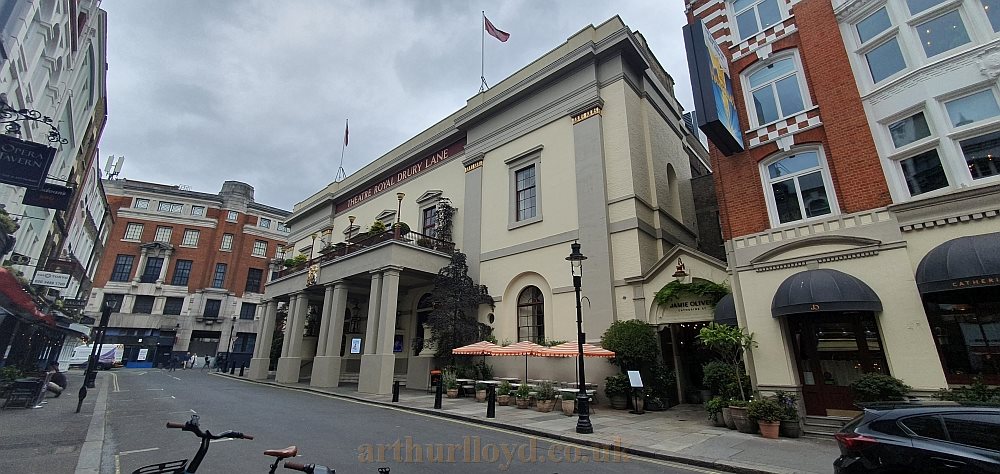
Above - The Theatre Royal, Drury Lane during the run of 'Hercules' in May 2026 - Photo M.L. For more images of the Theatre over the years, inside and out, click here.


 There
have been four Theatres built on the site of the present
Theatre Royal Drury Lane. The first was built by the dramatist Thomas
Killigrew under charter from Charles II.
There
have been four Theatres built on the site of the present
Theatre Royal Drury Lane. The first was built by the dramatist Thomas
Killigrew under charter from Charles II.

It was situated between Drury Lane and Brydges Street, now Catherine Street, where the Theatre has its main entrance today. The Theatre was built at a cost of £2,400 and was quite small compared with the present Theatre Royal, indeed it would likely fit in the space of the current Theatre's stage. More details on the first Theatre can be seen below.
 The
Theatre Royal Drury Lane name often confuses people even to this day
as the Theatre's entrance is not on Drury Lane at all, but on Catherine
Street, formerly known as Brydges Street. The Drury Lane name probably
comes from Drury House, a mansion built for Sir
Robert Drury during the early 1500s, which was situated at the west
end of the former Wych Street, and near
the bottom of today's Drury Lane, see this 1860s
map for details.
The
Theatre Royal Drury Lane name often confuses people even to this day
as the Theatre's entrance is not on Drury Lane at all, but on Catherine
Street, formerly known as Brydges Street. The Drury Lane name probably
comes from Drury House, a mansion built for Sir
Robert Drury during the early 1500s, which was situated at the west
end of the former Wych Street, and near
the bottom of today's Drury Lane, see this 1860s
map for details.
Left - Craven House - From 'Antiquities of London and its Environs' by John Thomas Smith 1791.
The house was later rebuilt by Lord Craven and renamed Craven House, and was later still converted into a Public House called the Queen of Bohemia which was named after Lord Craven's mistress and the daughter of James I, Elizabeth of Bohemia. This pub was eventually demolished and the site was used for the construction of the first Olympic Theatre.
The first and second Drury Lane Theatres, which were situated roughly in the middle of the site of the present Theatre, were approached by long passageways from Brydges Street, now Catherine Street, although in 1775 Robert Adam added an elegant facade to the Brydges Street end of the passageway. The third Theatre had its main entrance on Russell Street but the Pit and Box Entrances were still on Brydges Street. The fourth and present Theatre has always had its main entrance on Brydges Street, today called Catherine Street. Details and an Index for all four Theatres can be found below.
Index to this Page
Introduction - First Theatre - Second Theatre - Third Theatre - Present Theatre
Sketches and Plans from 1825 - 1847 Redecoration - The Circus comes to Drury Lane - Conversion for Opera and back in 1874 / 1875 - 1899 Extension - 1901 Alterations by Philip Pilditch - 1902 Costs of Pantomimes - 1904 Safety Alterations - 1908 Fire - Lighting Equipment after 1908 Fire - A Model of the Theatre from 1911 - 1922 Auditorium Rebuild - 1920s Seating Plan - 2013 FOH Refurbishment - Personal Recollections - Horatio Lloyd and the Theatre Royal, Drury Lane - Horatio Lloyd's 'Two Shilling Gallery' - Will Evans and his Drury Lane Pantomimes - Sleeping Beauty Pantomime - Alec Marlow Carpenter - George Hoare, General Manager - ENSA - Alan Chudley Working TRDL in the 1940s and 1950s - Augustus Harris - Some Notable Drury Lane Productions - The Armada - The Whip - The Baddeley Cake - The Staff Bar - The Substage Machinery and Lifts - View from the Roof - Bomb Damage in 1940 - The Romance of London Theatres by Ronald Mayes - The Drury Lane Charter - Plan of the Theatre - The Basement - Follow Spot Box - A Cartoon - 2019 Refurbishment
The First Theatre 1663 - 1672

 The
first Theatre was built by the dramatist Thomas Killigrew under charter from Charles II. It was situated between Drury Lane and Brydges Street,
now Catherine Street, where the Theatre has its main entrance today.
The Theatre was built at a cost of £2,400 and was quite small
compared with the present Theatre Royal, indeed it would likely fit
in the space of the current Theatre's stage.
The
first Theatre was built by the dramatist Thomas Killigrew under charter from Charles II. It was situated between Drury Lane and Brydges Street,
now Catherine Street, where the Theatre has its main entrance today.
The Theatre was built at a cost of £2,400 and was quite small
compared with the present Theatre Royal, indeed it would likely fit
in the space of the current Theatre's stage.
Right - Both sides of an Entrance Token for the Pit of the first Theatre Royal, Drury Lane dated 1671, the year before the Theatre was destroyed by fire - Courtesy Alan Judd.
The Theatre opened with a production of 'The Humorous Lieutenant' on the 7th of May 1663. Consequently on May the 7th 2013 the present Theatre celebrated its 350th anniversary.
This first Theatre Royal was very successful but was destroyed by fire on the 25th of January 1672.
The Second Theatre 1674 - 1791

Above - The Old Theatre, Drury Lane - From 'Antiquities of London and its Environs' by John Thomas Smith 1791. Caption Reads:- 'This Front which stood in Bridges Street, was built by order of Mr. Garrick previous to parting with his share of the Theatre. See Pennants London. Published June 1. 1794. by N. Smith Mays Buildings St. Martins Lane.'

 The
second Theatre, built on the site of the first, is thought to have been
designed by the architect Sir Christopher Wren and was constructed at
a cost of £4,000. It opened on the 26th of March 1674 as the Theatre
Royal in Drury Lane. Parts of the foundations of this building are said
to still exist beneath the stage of the present Theatre.
The
second Theatre, built on the site of the first, is thought to have been
designed by the architect Sir Christopher Wren and was constructed at
a cost of £4,000. It opened on the 26th of March 1674 as the Theatre
Royal in Drury Lane. Parts of the foundations of this building are said
to still exist beneath the stage of the present Theatre.
Right - Both sides of an Entrance Token for the Pit of the second Theatre Royal, Drury Lane dated 1684 , 10 years after the Theatre had been built - Courtesy Alan Judd.

Above - A Sketch showing Robert Adam's 1775 Brydges Street Facade for the second Theatre Royal which actually linked to the Theatre itself via a passageway - From 'Diprose's book of the stage and the players' Circa 1877.
 This
second Theatre Royal is the Theatre which David Garrick ran with great
success from 1747 to 1776. Details of productions at Drury Lane, and
the Covent Garden Theatre,
from 1760 to 1771 can be read here.
This
second Theatre Royal is the Theatre which David Garrick ran with great
success from 1747 to 1776. Details of productions at Drury Lane, and
the Covent Garden Theatre,
from 1760 to 1771 can be read here.
Garrick's farewell performance at Drury Lane was as Don Felix in 'The Wonder' on the 10th of June 1776. It was a part he had played many times at Drury Lane, a poster for the previous year can be seen right.
Right - A Bill for 'The Wonder - A Woman Keeps a Secret' at the Theatre Royal, Drury Lane on a Friday February the 18th 1775 - Courtesy Shelley Evans who wants to thank Mr. James Longridge, who as a young boy of 6 recognised the importance of the artifact when his parents discovered it and kept it safe for nearly 70 years. He later passed it along to Shelley as a gift when he was a principal at a school where she taught performing arts - In the cast were David Garrick playing Don Felix, and Mr. Palmer, Mr. Philips, Mr. Burton, Mr. Woodward, Mr. Usher, Mr. Johnston, Mrs. Davies, Mrs. Clive, Mifs Minors, and Mifs Macklin. The play was followed with A Masquerade Scene and musical entertainment called 'The Chaplet' with Mr. Beard, Mr. Rooker, Mrs. Vernon, and Mrs. Clive. The evening concluded with a 'Rural Dance'. Prices were: Boxes 5s, Pit 3s, First Gallery 2s, Upper Gallery 1s.
 Left - A Room in David Garrick's House - From 'London
Town Past and Present' by W. W. Hutchings 1909.
Caption Reads 'At the centre house in Adelphi Terrace (No. 5), marked
by one of the tablets of the Society of Arts, and now occupied by the
Institution of Naval Architects, lived David Garrick for the last seven
years of his life, from about 1772 to 1779, dying in the back room of
the first floor. His widow, who survived him for the long space of forty-three
years, died in the same room (1822),
and was laid beside him in Westminster Abbey.'
Left - A Room in David Garrick's House - From 'London
Town Past and Present' by W. W. Hutchings 1909.
Caption Reads 'At the centre house in Adelphi Terrace (No. 5), marked
by one of the tablets of the Society of Arts, and now occupied by the
Institution of Naval Architects, lived David Garrick for the last seven
years of his life, from about 1772 to 1779, dying in the back room of
the first floor. His widow, who survived him for the long space of forty-three
years, died in the same room (1822),
and was laid beside him in Westminster Abbey.'
 W. Macqueen Pope, writing in his book 'The Theatre Royal, Drury Lane'
in 1945, said of Garrick's farewell performance as Don Felix in 'The
Wonder in 1776:- 'The vast theatre could not accommodate all who wished
to be present. Great personalities fought to get in, and were content
with any corner. It was a night without parallel in theatre history.
W. Macqueen Pope, writing in his book 'The Theatre Royal, Drury Lane'
in 1945, said of Garrick's farewell performance as Don Felix in 'The
Wonder in 1776:- 'The vast theatre could not accommodate all who wished
to be present. Great personalities fought to get in, and were content
with any corner. It was a night without parallel in theatre history.
Right - A Bronxe Memorial Tablet placed at 27, Southampton Street, Strand, where David Garrick Lived from 1750 to 1772 - From The Builder, February 9th 1901.
Garrick, who had played the part so many times, gave yet his finest performance; but it was noted that he did not join in the gay Country Dance which ended the show. The curtain fell; and to a hushed and tremulous audience the great actor advanced alone on that beloved stage to speak his last lines, to say farewell. For the first time he betrayed emotion, he was near to tears. He mastered himself with a visible effort, and amidst a deep hush, he commenced to say the last words he would ever utter from the boards which he knew so well.' - W. Macqueen Pope, 'The Theatre Royal, Drury Lane', 1945.
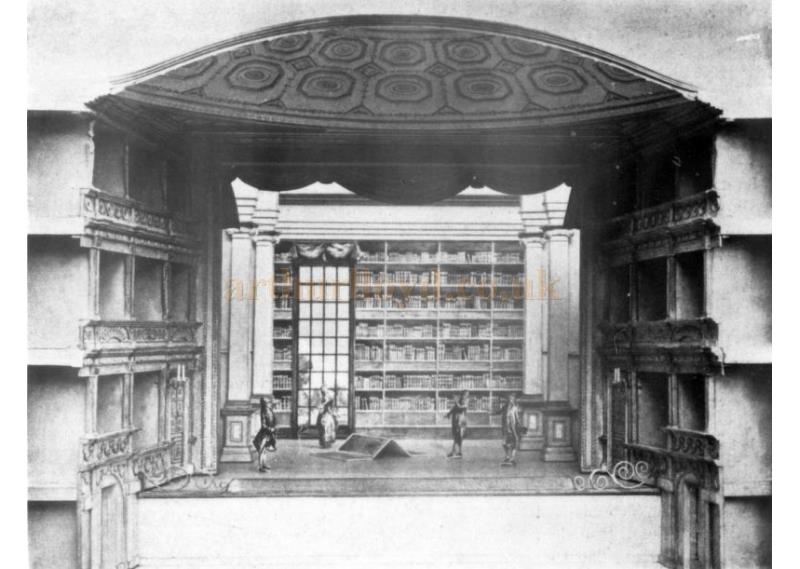 Model of the Stage of Drury Lane Theatre (1778). Now in the Dramatic Museum, Columbia University.
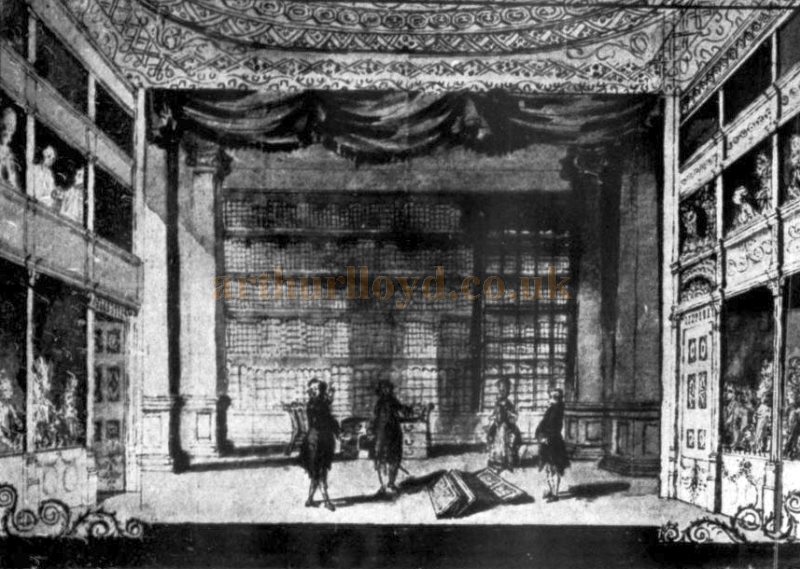 Pen and Wash Drawing of Drury Lane Theatre in the Bodleian Library. The Original of the Engraving reproduced next.
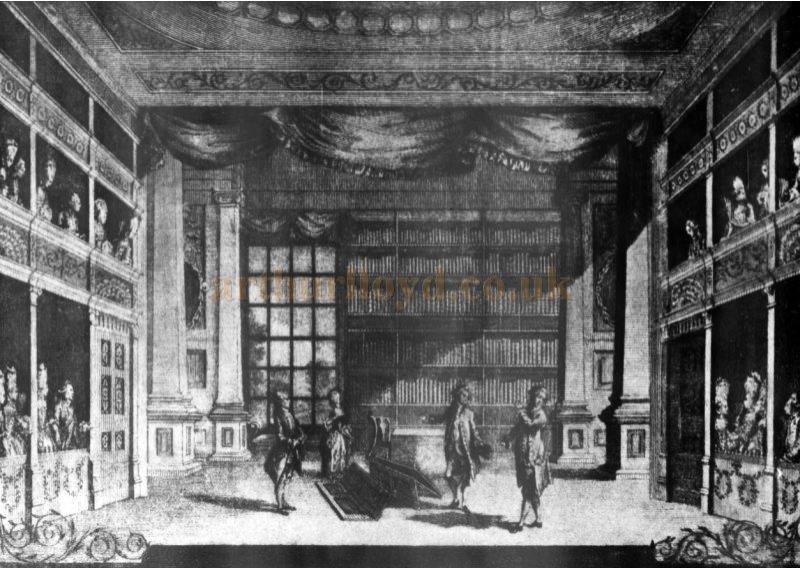 Engraving (Dated 1778) Showing the Screen Scene of 'The School for Scandal' at Drury Lane.
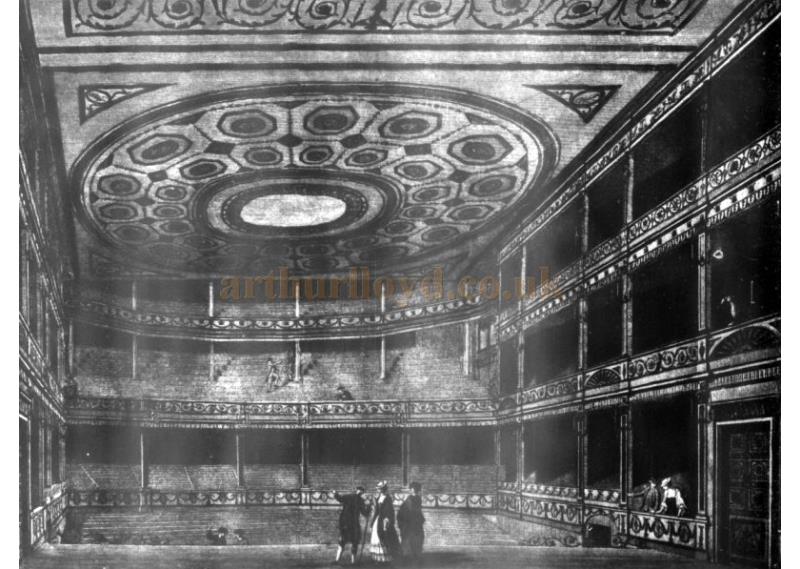 View of Theatre Royal, Drury Lane "As it appears from the stage altered and decorated in the year 1775." From Adam's published designs.
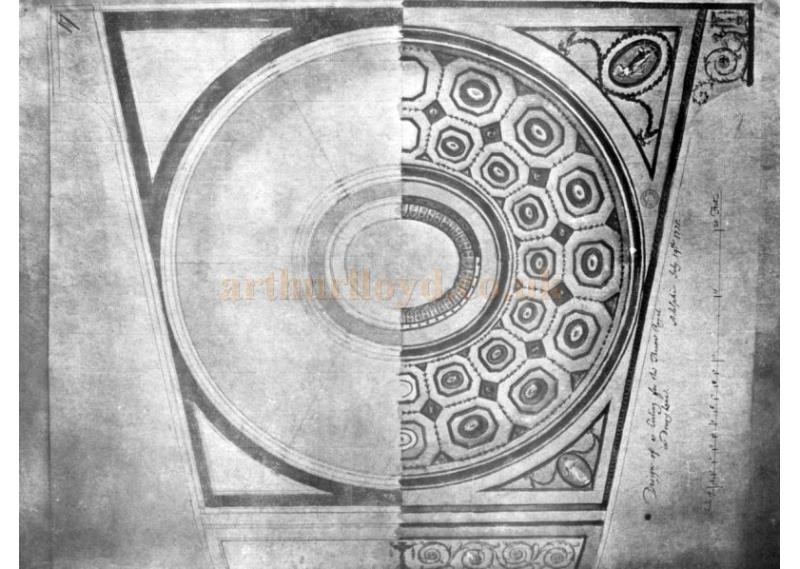 Ceiling of Drury Lane Theatre, From Adam's original drawing dated 1775. (Soane Collection).
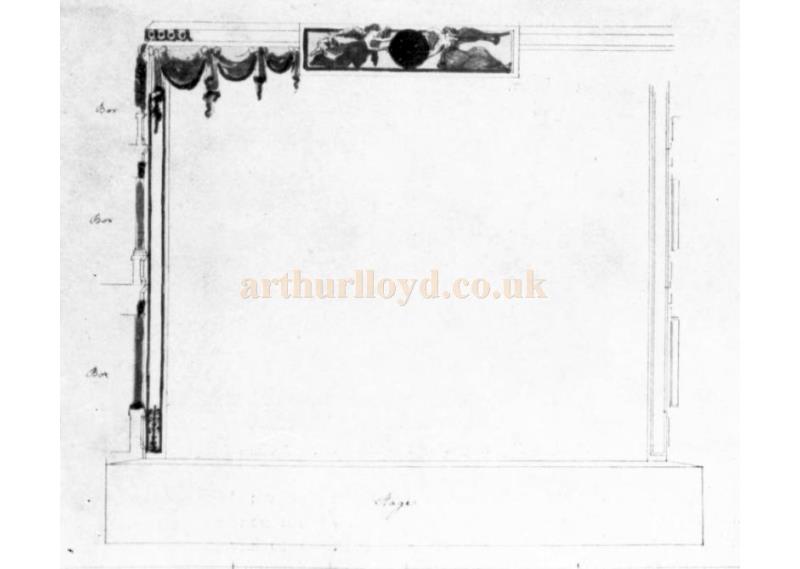 A Drawing by Adam for the Proscenium of Drury Lane (Soane Collection).
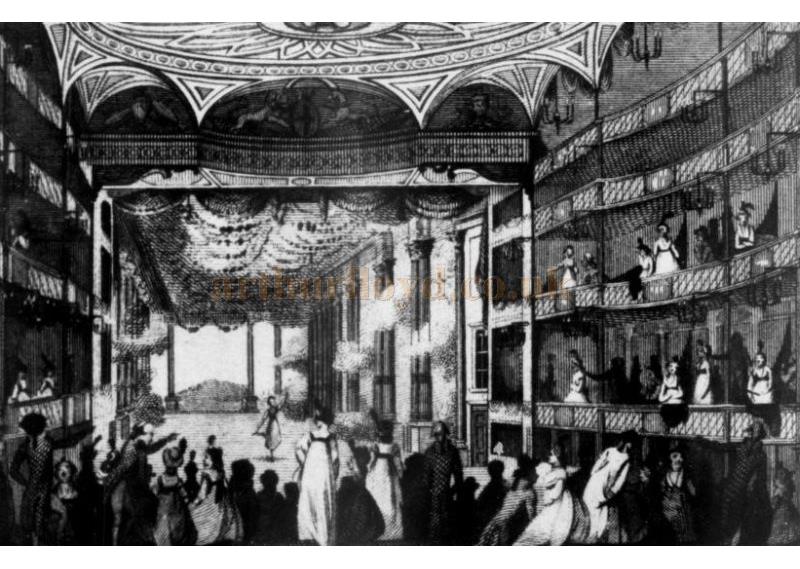 Drury Lane Theatre. From an Engraving after Van Assen in the Bodleian Library.


Above - Images of the Second Theatre Royal, Drury Lane - From The Architectural Review January to June 1915.
David Garrick was followed at Drury Lane by Richard Brinsley Sheridan, with such notable Thesbians as Sarah Siddons and John Philip Kemble taking the stage. This second Theatre Royal eventually fell into such a state of disrepair that it was decided that demolition was the only option. Consequently the Theatre closed on the 4th of June 1791 with a production of 'The Country Girl' and the farce 'No Song, No Supper'. Demolition proceeded shortly afterwards whilst the Drury Lane Company itself decamped to the King's Theatre in the Haymarket until the rebuild was completed in 1794.

Above - A Ticket for William Congreve's 'The Old Bachelor' at the second Theatre Royal, Drury Lane, probably on the 13th of April 1738, although it is undated (See note here). The Ticket is credited as being designed by William Hogarth although there is some dispute over this (See page 323 of this book). The Ticket is for a Benefit for Joe Miller who played the part of Sir Joeseph Wittol in the play. The scene shows the third act where Noll, the companion and bully of Sir Joseph, gets a severe kicking from Sharper. - From Graphic Illustrations of Hogarth, 1794.
The Third Theatre 1794 - 1809

Above - The Third Theatre Royal Drury Lane - From 'London and Middlesex' Volume 3 Part 2 1815
 The
Third Theatre Royal, Drury Lane was constructed between 1791 and 1794
by Henry Holland and opened
for business on Monday the 21st of April 1794 with the Shakespeare play
'Macbeth', although an official opening of the Theatre had taken place
some weeks earlier with a performance consisting of a 'Grand Selection
of Sacred Music' from the works of Handel at the newly opened Theatre
on Wednesday the 12th of March 1794.
The
Third Theatre Royal, Drury Lane was constructed between 1791 and 1794
by Henry Holland and opened
for business on Monday the 21st of April 1794 with the Shakespeare play
'Macbeth', although an official opening of the Theatre had taken place
some weeks earlier with a performance consisting of a 'Grand Selection
of Sacred Music' from the works of Handel at the newly opened Theatre
on Wednesday the 12th of March 1794.
Right - A Fan commemorating the opening of the third Theatre Royal Drury Lane in 1794 - Click for Details.
The Theatre was constructed using some of the previous Theatre's structure but was far larger, and although a grand edifice externally, internally it was plagued with sight line and sound problems from the start.


Above - A Bill for a 'Grand Selection of Sacred Music' from the works of Handel which opened the third Theatre Royal, Drury Lane on Wednesday the 12th of March 1794. And A Bill for the Shakespeare play 'Macbeth' which opened the third Theatre Royal, Drury Lane for business on Monday the 21st of April 1794.

Above - Instructions on how to approach and enter the third Theatre Royal, Drury Lane - From A Bill for a 'Grand Selection of Sacred Music' from the works of Handel which opened the third Theatre Royal, Drury Lane on Wednesday the 12th of March 1794.
 In
the book 'London and Middlesex' Volume 3 Part 2, published in 1815,
they printed some details of this third Theatre saying:- 'The plan of
that Theatre included an area of 320 feet in breadth, and, measuring
from the substratum to the roof, was 122 feet.
In
the book 'London and Middlesex' Volume 3 Part 2, published in 1815,
they printed some details of this third Theatre saying:- 'The plan of
that Theatre included an area of 320 feet in breadth, and, measuring
from the substratum to the roof, was 122 feet.
It was raised on the site of the old house, and opened in the year 1794. There were four tiers of boxes, a pit, and two galleries, with a number of private boxes, ranged on each side the pit, and constructed so as to command a perfect view of the stage, and yet conceal the occupiers from observation. The stage was 105 feet in length, 75 feet wide, and 45 feet between the stage doors.
Under the pit was a large range of lofty vaults, and immediately over it a spacious-room, and one for painting scenery, about, 75 feet wide, and 53 long: above the galleries was another painting-room, about 75 feet by 40.
Right - A Bill advertising 'The Way to Keep Him' and 'Cinderella' produced at the third Theatre Royal, Drury Lane on February the 2nd 1804 - Kindly donated by Shirley Cowdrill and now preserved in the Drury Lane archive.
There were two green-rooms: one for the use of chorus-singers and figurantes; the other for the principal performers: the latter of these apartments was elegantly fitted up. The scenery, under the direction of Mr. Greenwood, whose abilities rank very high in his profession, was always bold, effective, and impressive, and had frequently been aided by the chaste and humorous pencil of Marienari.
The pit was 54 feet in length, and 46 in breadth; had 25 rows of benches, and was so well constructed, that those next the orchestra commanded an uninterrupted view of the whole stage; and the avenues to it were commodious and safe.
The interior of the Theatre resembled the shape of a horseshoe, and the spectator was forcibly struck with the grandeur of the design, elegant execution, and splendid effect of this once superb edifice.
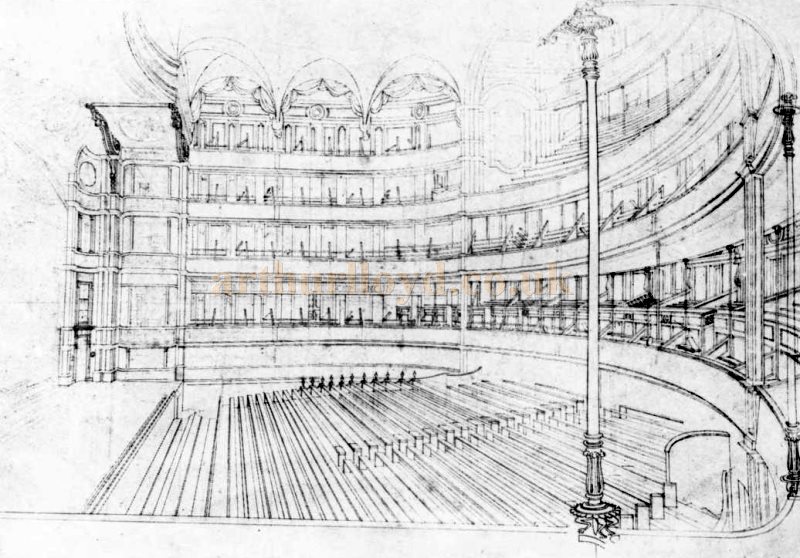
Above - The Auditorium of the Theatre Royal, Drury Lane - From a Drawing in the Soane Museum, signed by William Capon, 'From Actual Measurements, 1805' - From The Architectural Review January to June 1915.
The prevailing colours of the boxes were blue and white, relieved with richly fancied embellishments of decorative ornament. The compartments in which the front of each tier was divided had centrally a highly finished cameo, the ground of cornelian colour, with exquisitely drawn figures raised in white, the objects chiefly from Ovid; the stage boxes projected two feet, and had a raised silver-lattice work, of excellent taste and workmanship...

Above - A Sketch showing the Russell Street Elevation of the Third Theatre Royal Drury Lane in 1805 - From 'The Face Of London' by Harold P. Clunn 1956
...The boxes were supported by cast-iron candalabras, fluted, and silver lackered, resting on elegantly executed feet. From the top of each pillar a branch projected three feet, from which was suspended a brilliant cut-glass chandelier; a circular mirror of five feet diameter was placed on each side the dress-boxes next the stage, that produced a pleasing reflected view of the audience.
On the nights when the Theatre was honoured with their Majesties' presence the partitions of the stage-box were taken down, and it was brought forward nearly two feet; a canopy was erected, superbly decorated with crimson velvet, richly embroidered with gold, and adjoining them sat the princesses. Their box was usually lined with light blue satin, fancifully festooned and elegantly decorated with silver fringe and rich tassels.
There were three entrances to the boxes, and two to the pit and galleries. The one in Brydges Street led to a saloon seventy-five feet by twenty-one, called the Egyptian Hall. Sixteen pillars of the Doric Order, beautifully painted in imitation of porphyry, were at once a splendid ornament, and supported the back boxes, to which a flight of stairs at each end led...

Above - The Auditorium from the Stage of the Theatre Royal, Drury Lane in 1804 - From 'London Past and Present' Vol 2 by W. W. Hutchings 1909.
...Such was the interior of the late Drury Lane Theatre before the conflagration already mentioned laid the whole in ashes. The exterior of this edifice requires little description; the annexed view will convey an adequate idea of its appearance, which it must be confessed, had but little to recommend it to notice it had a sombre gloomy aspect, but ill suited to the purposes for which such buildings are erected...

Above - The Auditorium and Stage of the Theatre Royal, Drury Lane in 1808 - From Microcosm of London, New York Public Library Digital Collections
...The architect was Henry Holland, who constructed the whole upon an immense and magnificent plan, as the account of the interior just given, shews. It was capable of holding in the pit 800 persons; the whole range of boxes, 828; the two-shilling gallery, 308; the total 3611 persons. The whole of this extensive building was surrounded by a stone balustrade, and on the top a colossal figure of Apollo.'
The above text in quotes was first published in the book 'London and Middlesex' Volume 3 Part 2, 1815.

Above - The Third Drury Lane Theatre in 1806, from an original drawing by Pugin and published in 'Haunted London' by Walter Thornbury 1880.
This third Theatre Royal, Drury Lane was billed as a "Fireproof Theatre" and even had one of the first Iron Curtains with water tanks above it to prevent fire ravaging the building, but sadly the Theatre was to burn down just under 15 years after it was built, on the 24th of February 1809, after a performance of the Opera 'The Circassian Bride'.
Once again the Drury Lane Company found themselves without a home, and once again they decamped to the King's Theatre in the Haymarket, as they had done after the Second Theatre was closed and demolished in 1791. The Drury Lane Company opened at the King's Theatre on the 16th of March 1809 but were only there for a short period before they moved to the Lyceum Theatre on the Strand from April the 11th 1809. They would remain at the Lyceum until June 1812, and the rebuilt Theatre Royal, Drury Lane was finally completed and opened in October 1812.
The Fourth and Present Theatre Royal, Drury Lane 1812 - Present

Above - The Fourth and Present Theatre Royal, Drury Lane, shortly after it first opened in 1812 - New York Public Library Digital Collections.
 The Fourth and present Theatre Royal,
Drury Lane, which on the 10th of October 2012 celebrated its bicentenary,
was designed by Benjamin Wyatt and constructed at a cost of almost £152,000.
The Fourth and present Theatre Royal,
Drury Lane, which on the 10th of October 2012 celebrated its bicentenary,
was designed by Benjamin Wyatt and constructed at a cost of almost £152,000.
The Theatre opened on Saturday the 10th of October 1812 with a production of 'Hamlet Prince of Denmark', see Bill below.
Right - A Share Certificate for the rebuilding of the Theatre Royal, Drury Lane from September 1812 with a ground plan of the Theatre shown on it - Courtesy Roger Fox.
The Theatre's architect published a book on his designs for the Theatre the following year, which you can read in full here. A brief biography for Benjamine Wyatt can be found here.
This fourth Theatre is the Theatre where Edmund Kean ruled with huge success for many years. The Theatre went into decline after his departure but was revived in 1879 by Augustus Harris, who had the Theatre redecorated by J. M. Bookbinder in July 1889. The following decades saw the beginning of the great Drury Lane spectaculars, and annual pantomimes with Dan Leno, Will Evans and the like. And in the 1900s the legendary actors Henry Irving, Ellen Terry and Johnston Forbes Robertson took the Theatre by storm.

Above - Benjamin Wyatt's Theatre Royal, Drury Lane of 1812 - From 'Observations on the Design for the Theatre Royal, Drury Lane' by Benjamin Wyatt, FSA Architect 1813, a book by the architect explaining his thinking behind the Theatre, together with plans, elevations and sections, which is available to read in full on Google Books here.

Above - The Proscenium of the Theatre Royal, Drury Lane of 1812 from the architect's drawings held at the Theatre Collection, Harvard College Library - Reproduced in 'Sheridan to Robertson' by Ernest Bradlee Watson, published in 1926.

Above - The Fourth and Present Theatre Royal Drury Lane shortly after it was first constructed in 1812 - From 'London and Middlesex' Volume 3 Part 2 1815.

Above - A Seating Plan for the Theatre Royal, Drury Lane - From 'Who's Who in the Theatre' published in 1930 - Courtesy Martin Clark. Click to see more Seating Plans from this publication.
 In
the Second World War Drury Lane became the headquarters of ENSA, the Entertainments National Service Association, more information and
many images from the period can be seen below and here.
In
the Second World War Drury Lane became the headquarters of ENSA, the Entertainments National Service Association, more information and
many images from the period can be seen below and here.
After the war, and some restoration, the Theatre reopened with a production of Noel Coward's 'Pacific 1860' starring Mary Martin on the 19th of December 1946.
Right - A Programme for Noel Coward's 'Pacific 1860' which reopened the Theatre Royal, Drury Lane after the war on the 19th of December 1946 - Courtesy Michael Jaffé whose grandfather Carl Jaffé performed in the production as Felix Kammer.
 A string of American Musicals then followed under the direction
of Richard Rogers and Oscar Hammerstein II, beginning with 'Oklahoma!'
which opened on the 30th of April 1947 and ran until 1950 (see programme
cover left).
A string of American Musicals then followed under the direction
of Richard Rogers and Oscar Hammerstein II, beginning with 'Oklahoma!'
which opened on the 30th of April 1947 and ran until 1950 (see programme
cover left).
Left - A Programme Cover for 'Oklahoma!' which opened at the Theatre Royal, Drury Lane in 1947 - Kindly Donated by Judy Jones.
Rogers and Hamerstein then staged 'Carousel in 1950, 'South Pacific' in 1951, and 'The King and I' in 1953, which ran until 1956.
The Theatre has been home to a string of highly successful musicals ever since, usually on a huge scale. This is where 'My Fair Lady' with Rex Harrison first opened in 1958 and ran for five years until 1963, at the time the longest run at Drury Lane, and where Cameron Mackintosh’s production of 'Miss Saigon' is notable for then becoming the longest ever run at Drury Lane, ten years in all, from 1989 to 1999 staging a total of 4,263 performances.
There is much information on this World famous Theatre already in existence, in a great many places, so the rest of this page will attempt to show information and images that may not be so well known.
A Bill for the Opening Production of the 4th Theatre Royal, Drury Lane, 'Hamlet Prince of Denmark', on Saturday the 10th of October 1812

Above - A Bill for the opening of the fourth and present Theatre Royal, Drury Lane on October the 10th 1812
Sketches and Plans for the Fourth Theatre Royal Drury Lane in 1825

Above - A sketch by B. Wyatt (Architect) of the original exterior of the Fourth Theatre Royal Drury Lane before the present Portico and the Russell Street colonnade were added in 1820 and 1831 respectively - From 'Illustrations of the public buildings of London, Volume 1' by J. Britton and A. Pugin, 1825.

Above - A longitudinal plan from west to east, looking northward, of the Fourth Theatre Royal Drury Lane by B. Wyatt (Architect) - From 'Illustrations of the public buildings of London, Volume 1' by J. Britton and A. Pugin, 1825 - Key:- a. Entrance Hall. b. Rotunda, lower story. c. Ditto, upper story. d. Saloon. e. e. Pit Lobbies. f. f. f. f. Corridors to the Boxes and Slips. g. g. Lobbies to Upper and Lower Galleries. h. h. h. h. Private Boxes. i. Pit. j . Dress Circle of Boxes. k. k. First and Second Circles of Boxes. 1. Slips. m. Lower Gallery. n. Upper Gallery. o. Proscenium Boxes. .p. Orchestra. q. Arched Passage beneath ditto made to continue the line of communication across the house. r. Stage. s. Continuation of ditto, through an arched aperture of 12 feet diameter, to the extreme wall. t. Mezzanine Floor. u. u. Cellars under ditto. v. Well, or Excavation, for letting down scenery. w. w. Upper and Lower Flies. x. Painting-room. y. Carpenters' Shops, Property-rooms, &c. z. Roof.

Above - A Transverse Section before the Proscenium of the Fourth Theatre Royal Drury Lane by B. Wyatt (Architect) - From 'Illustrations of the public buildings of London, Volume 1' by J. Britton and A. Pugin, 1825 - Key:- a. a. a. a. Lobbies to the Pit and Private Boxes. b. b. b. b. Ditto to Dress Circle. c. c. c. c. Ditto to First Circle. d. d. d. d. Ditto to Second Circle. e. e. Staircases to Slips. f. f. Lobbies to ditto. g. g. Gallery Passages. h. h. h. h.. Private Boxes. i. i. Dress Boxes. j. j . Boxes, First Circle. L k. Ditto, Second Circle. 1.1. Slips. m. Carpenters' Work-shops, &c.

Above - Section through the Grand Staircases and Rotunda of the Fourth Theatre Royal Drury Lane by B. Wyatt (Architect) - From 'Illustrations of the public buildings of London, Volume 1' by J. Britton and A. Pugin, 1825. Key:- a. a. Principal Flights of Steps. b. b. Entrances to Dress Circle. c. c. Ditto, First Circle. d. d. Ditto, Second Circle. e. Rotunda, lower story. f. Ditto, upper story. g. Stone Gallery-floor. h. Iron cradling supporting the upper flights.

Above - A sketch by B. Wyatt (Architect) showing the Rotunda of the Fourth Theatre Royal Drury Lane in the 1820s and which is still there today - From 'Illustrations of the public buildings of London, Volume 1' by J. Britton and A. Pugin, 1825.
1847 Redecoration
In 1847 the Theatre was cleaned and redecorated to the designs of Frederick Gye, the Illustrated London News reported on the changes, and added a sketch of the auditorium (shown below), in their October 16th 1847 edition saying:- 'The theatre has been cleansed throughout - a labour as requisite here as in the Augean stable of old. We have engraved the newly-decorated Auditory of the House, as seen from the stage, with the orchestra and floored pit, during a promenade concert (see image below).
The ground-colour throughout is a faint blossom. The fronts of the boxes, and of the lower gallery (to which the whole of the upper circle is now appropriated) are laced with a bold trellis of gilt moulding, upon which are suspended festoons of flowers, also gilt. On the dress circle, the festoons are looped through wreaths; and, on the other tiers, are smaller and simpler festoons, without the wreaths. The coved, or outer circle of the ceiling, is broken in the centre by the upper gallery, which has an unsightly effect from the stage; but, on each side, are elliptically arched openings, with bold foliage, richly gilt, on the piers and above the arches; over these is a deep cooing of lattice, gilt; and next is the bordure - a bold wreath - inclosing the inner circle of the ceiling. This is painted to imitate a cloudless sky ; around the circle are jets of gas, and, from an aperture in the centre, hangs a vast chandelier of cut glass; the aperture is wreathed, and around it are six winged boys, bearing festoons of flowers, in effect supporting the lustre. The main design of the latter is six flags, of drops, with the lines of the union-Jack marked on each by light. There is also a profusion of drops, in large tassels, festoons, and garlanded forms, too various to describe. The effect of the whole, when lighted, is remarkably brilliant. Around the dress and first circles, are also hung small lustres, with the gas lights in ground-glass shades...

Above - The auditorium of the Theatre Royal, Drury Lane after Frederick Gye's redecoration of 1847 - From the Illustrated London News, October 16th, 1847. Caption reads:- 'Drury Lane Theatre, Redecorated - Jullien's Promenade Concert'.
...The family boxes have been removed from the back of the dress circle, and an inner lobby formed in their place; but, as the backs of the boxes are low, their occupants are exposed to draughts of air from the continued opining of the lobby doors; this will soon become a subject of complaint, and will doubtless be remedied. The first circle is exclusively in private boxes; the draperies of which, as well as of the other circles are of scarlet cloth, trimmed with gold colour. The valens, if so it may be called, is straight and scanty, and has a mean effect. The boxes and lobbies are lined with a crimson ground and yellow patterned paper; and the reeded pillar supports of the boxes are entwined with gilt flowers and fruit.
In the Proscenium, there is little change: the crimson velvet and gold draperies have been displaced by the scarlet; the superb columns have been regilt in the caps and bases; and the pierced shafts are entwined by bold wreaths of flowers, richly gilt. The drapery of the Proscenium arch is plain crimson, without fold or flute, faced with gold trellis. It reminds one of the quaint fashion of an Anna Bolena cap-front...

Above - The Interior of the Theatre Royal, Drury Lane during its 1847 Redecoration - From 'The Builder', September 25th 1847.
...The draperies, inclosing the stage, are white and gold, of the usual design for the concert performance; and the orchestra is much as heretofore; this portion of the house being lighted by gilt lamps suspended from the flies. We should not omit to mention that in the rear of the stage is a spacious reading-room, a new feature of accommodation.
The decoration of the Auditory has been designed and superintended by Mr. Frederick Gye. The general effect is novel and sparkling; and, with the immense flood of gaslight, it is well adapted for the present performances; though the brightness of the embellishments does not show to advantage the black mass in the promenade. Possibly, before the dramatic season commences, it may be advisable to modify the brilliancy, or garish effect; else, to be seated five hours in such lustrous excess may be less pleasurable to the audience than was intended.
The whole of the ornaments - mouldings, fruit and flowers - are of papier-mache, and were made, gilt, and fixed by Mr. Bielefeld, in five weeks; the manufacture involving an extraordinary application of the steam-engine to decorative art.'
The above text in quotes, and the top image, were first published in the Illustrated London News, 16th October 1847.
The Circus comes to Drury Lane in 1851 and 1853

Above - American and French Equestrians at Drury Lane Theatre - Mr M'Collum's Feat on two Horses - From the Illustrated London News, 9th of August 1851.
In June 1851 the Manager and Lease Holder of Drury Lane, James Anderson, (who had taken over the Theatre in 1849 hoping to profit from the Great Exhibition in London) retired from the Theatre's management due to debts of well over £5,000. To keep the Theatre open it was converted for a 4 month season of Circus use, (see image above and review below.)
The Illustrated London News reported on the Circus season at Drury Lane in their 9th of August 1851 edition, along with the sketch shown above, saying:- 'The star riders continue attractive, and the public crowd the theatre to award the prize of their plaudits to the French and American competitors. But by far the most astonishing miracle-worker of the number is an American equestrian, Thomas M'Collum by name, whose feats with two horses are the most remarkable examples of pirouetting and somerseting that we ever witnessed. While the horses are proceeding with the upmost rapidity, he describes several curves in the air repeatedly and comes down safely on their backs, having meanwhile composed a leap over a flag.
We present our readers with an illustration. Others might have been given of still greater beauty and daring, exerting wonder at the rider’s agility and the training of the noble animals that so implicitly obey the master’s volition. The excitement of these exhibitions is exceedingly great; and they have, indeed, in them a certain poetry of their own, calculated to affect the stable mind with a sense of beauty; and this is something.
If the highest dramatic poetry be necessarily banished from the Drury Lane stage, owing to the fault of the proprietary, in omitting to fit the machinery for scenic purposes, so as to make its occupation safe to an honest speculator, we see no reason why this equestrian spectacular poetry may not be substituted, until the requisite duty behind the scenes be performed by those who have this Temple of the Muses in trust, but neglect to discharge the obligation implied in their direction. If the intellect cannot be addressed, surely, if they can, the senses may, so that moral decorum be not violated.
But the fact should not be concealed that the present condition of the building is a national disgrace. The equestrian arrangements have been admirably prepared; and considerable credit is due for them to Mr Risley, who, we understand, is the manager of the entire performances.' - The Illustrated London News. 9th of August 1851, kindly transcribed by Alfred Mason.
 After the 4 month Circus season had ended, Alfred
Bunn became the lessee of Drury Lane again. The above article alludes
to the terrible state of the Theatre at that time and Bunn clearly took
notice as he would redecorate the auditorium in the Louis XVI style
before putting on a season of Operas until May 1852. Circus was revived in 1853 however, and a review
and sketch from the Illustrated London News, in their 26th of November 1853 edition, are shown below.
After the 4 month Circus season had ended, Alfred
Bunn became the lessee of Drury Lane again. The above article alludes
to the terrible state of the Theatre at that time and Bunn clearly took
notice as he would redecorate the auditorium in the Louis XVI style
before putting on a season of Operas until May 1852. Circus was revived in 1853 however, and a review
and sketch from the Illustrated London News, in their 26th of November 1853 edition, are shown below.
''The performances of the American equestrians at Drury-lane Theatre continue to be very popular. Our Illustration represents one of the most attractive feats - the intrepid little equestrienne Mdlle. Ella, taking her surprising leap over a flag nine feet in width.
Right - An Equestrian performance at Drury Lane - From the Illustrated London News, 26th of November 1853.
Mademoiselle Ella was born of French parents, at Louisiana, in the United States, and displayed from her earliest years an extreme fondness for horsemanship. Her feats, extraordinary as they appear, are all performed with an ease and confidence which relieve the mind of the spectator from the idea of their perilous nature, and of the physical exertion necessary to their accomplishment. In the foreground of the Engraving (shown above right) is introduced Barry, the famous Clown, who revives at Drury-lane all that genial fun which rendered him so popular at Astley's.' - The Illustrated London News, 26th of November 1853.
The 1874 Conversion for Opera and then back to Theatre again in 1875
With details of a similar conversion in 1868
In March 1874 the Theatre was converted for use as an Opera House, the Building News and Engineering Journal reported on this in their March 20th 1874 edition saying:- 'HER MAJESTY'S OPERA - Drury Lane Theatre has again been converted into a brilliant opera-house in the short space of a week. The pit floor has been removed, lowered, and formed into "stalls" with a tier of boxes. The dress circle has been formed into a "grand tier" of boxes, and the upper circles in part. The whole of the "dramatic" draperies have been removed, and the original "Her Majesty's" amber satin curtains and hangings, &c., that, it will be remembered, were fortunately saved from the fire, have been substituted. The tout ensemble of the house is brilliant and imposing. The works have been carried out, as usual, by Messrs. Bracher & Son, the builders to the committee, under the personal superintendence of Mr. Marsh Nelson, the architect.' - The Building News and Engineering Journal, March 20th 1874.
In August 1875 the Opera alterations to the Theatre were removed and the Theatre was 'overhauled and repaired'. The Building News and Engineering Journal reported on this in their August 27th 1875 edition saying:- 'DRURY-LANE THEATRE - OLD Drury is being thoroughly overhauled and repaired throughout from roofs to basement. Portions of parapet and other walls are being taken down and rebuilt; old wood cornices that have been long in a state of utter decay are being removed, and the whole exterior repainted. The whole of the massive stone cornice and entablature to the colonnade, portions of which, it will be recollected, fell on the night of July 11, have been taken down and a new parapet and cornice reconstructed with hollow bricks and finished in Portland cement, forming a very much lighter structure, both in weight and effect, than the old stone one. All the wood and lead-work is also being thoroughly overhauled and repaired. The interior of the house has also undergone the usual annual metamorphosis. The "Opera Auditorium" is demolished, and the "Theatrical Auditorium" has taken its place, with the conventional pit, dress circle, gallery, &c.; the stage is also brought forward to the original lines. The works are being carried out, under the combined superintendence of Messrs. Nelson and Harvey, the architects to the committee, and Mr. C. J. Phipps, the architect to the lessee, by Messrs. Bracher and Son, the builders to the committee, except the external painting, which is being executed by Mr. Cobbott.' - The Building News and Engineering Journal, August 27th 1875.
This wasn't the first time the Theatre had been altered for an Opera Season however, the Building News and Engineering Journal reported on another example in their April 3rd 1868 edition saying:- 'Old Drury, within six days and nights underwent a very considerable alteration to prepare it for the opera season, which commenced last Saturday. The portion of the pit formerly under the dress circle has been converted into a lower tier of private boxes, and the same change has been effected in the dress and upper circles, and in the sides of the second, while the central portion of the latter has been commodiously re-seated with stuffed chairs to form the dress circle. Above this are three rows of excellent amphitheatre stalls. The pit space is entirely occupied by luxurious armchairs, the pit proper being abolished. The floors of the principal tiers have been raised, so as to secure additional comfort and excellence of view, and inner corridors constructed to diminish the otherwise extreme depth of the boxes. The whole of the walls are lined with chintz, which produces a general effect of light warm grey, and the boxes are enriched with amber satin curtains, balances, and arm-rests. The alterations were designed by Messrs. Marsh, Nelson, and Harvey, of Whitehall, and carried out by Messrs. Bracher and Son, of Great Ormond street. The gilding was restored by Mr. Kershaw, of Baker-street, and the upholstery and general fitting-up were executed by, Messrs. Green and King, of Baker-street, the decorators to the old Opera House in the Haymarket. - The Building News and Engineering Journal, April 3rd 1868.
The 1899 Extension

Above - The 1899 extension to the rear of the Theatre Royal, Drury Lane in August 2017
 In 1899 an extension to the rear of the Theatre was added, the Building News and Engineering Journal reported on this in their May the 12th 1899 edition saying:- 'Extensive additions to Drury Lane Theatre have been commenced. The new buildings, the plans of which have been prepared by Messrs. Pilditch, Chadwick, and Co., 2, Pall Mall East, will be erected upon vacant ground between Catherine-street, Russell-street, and Drury-lane, immediately adjoining the existing premises.
Right - The Cross Dock or 'Run' behind the stage at the Theatre Royal, Drury Lane in September 2018. This was constructed as part of the rear extension to the building in 1899.
 Upon this space, which has a length of 132ft. and a depth of 100ft., will be erected in red brick and stone a carpenter's shop, a wardrobe store, a ballet room, and a paint room (Shown left in 2018). Two new exits will also be provided from the theatre.
Left - The Paint Frame at the Theatre Royal, Drury Lane in September 2018. This was constructed as part of the rear extension to the building in 1899 and is accessed from the Cross Dock or 'Run' behind the Theatre's stage.
The new buildings will be connected with the old premises by a long covered way (Shown above right in 2018). The front elevation to Drury-lane will consist of three shops, with two floors of flats above them. The work will cost about £15,000.' - The Building News and Engineering Journal, May the 12th 1899.

Above - The Drury Lane elevation to the rear of the Theatre Royal showing the Long Dock and Paint Frame Entrances. The Long Dock, situated on the corner of Russell Street and Drury Lane, which was originally called the Scene Room and Painting Room when it was constructed in 1814, shortly after the Theatre was built in 1812, was re-faced in Red Brick at the time of the 1899 Drury Lane extension to match the rest of the buildings constructed at this time. The Long Dock, as it is known today, is currently in use as Offices for LW Theatres, but the Paint Frame was still in use for its original purpose when this photograph was taken in August 2017, indeed many of the cloths for the current production of 42nd Street were painted here and then hung in the Theatre's Fly Tower when complete, whilst the production of Charlie and the Chocolate Factory was still running at the Theatre.
1901 Alterations by Philip Pilditch

Above - Philip Pilditch's 1901 Theatre Royal, Drury Lane Auditorium shortly before its later reconstruction in 1922 - From The Sphere, 29th April 1922.
 The architect Philip Pilditch altered the Theatre's auditorium in 1901. The Theatre closed in June that year and reopened on Thursday the 19th of September 1901 with a production of a new melodrama by Cecil Raleigh 'The Great Millionaire' with Charles Fulton in the leading role.
Right - An advertisement for 'The Great Millionaire' at the Theatre Royal, Drury Lane in September 1901 - From the St James's Gazette, 24th September 1901.
The alterations were reported on in The Daily News the day before the Theatre reopened saying:- 'The interior of the Theatre Royal, Drury Lane, has within the past few months been undergoing a great change, and now that it is almost out of the hands of the contractors we are enabled to indicate the nature of the reconstruction.
The first thing observable in the new arrangement is the improvement of the auditorium - by bring forward both the grand and the first circle by a largely increased sweep. The large and cumbrous boxes that formerly occupied so much space on the ground floor have been entirely dispensed with, and a better line of sight ensured from the pit and the stalls. This latter were formerly not the most comfortable in London, and access to some parts of them was both difficult and inconvenient. Now not only are the stalls accessible from either end, but two large alleys have been constructed down to the right and left of the centre line, and the stalls arranged in a gentle curve, so that those who are seated at the ends have not to twist their heads to secure a view of the stage. The old and ugly pit barrier has been removed, and is replaced by a handsome brass rail and light curtain. The stalls seats themselves are upholstered in Russian leather, which is cleaner and cooler than the material usually employed. Moreover, they are extremely comfortable...

Above - Preparing for the Autumn Drama at Drury Lane, the 1901 reopening production of 'The Great Millionaire' - From The Sketch, September 18th 1901.
...The Theatre has been entirely redecorated, the scheme being white and gold. The boxes are draped in amber, and the passages decorated in white and amber, which renders them light, airy, and cool. A warm reddish paper completes the background in the auditorium, and the stalls are carpeted in deep red plush...

Above - A Painting by George Richmond depicting the Auditorium and Stage of the Theatre Royal, Drury Lane, after Philip Pilditch's alterations of 1901. George says that the painting shows the stage set of the Carlton Hotel which was used in Act III Scene 3 of the play that reopened the Theatre "The Great Millionaire" by Cecil Raleigh. Colours used are those described in a contemporary article on this page. Click for an Index to all of George Richmond's Paintings on this site.
...Drury Lane used to enjoy an unenviable notoriety because of draught, which was almost inevitable in a theatre of such vast proportions. This, it is hoped, will not be perceptible in the future. An elaborate system has been introduced whereby hot and cold air can be pumped into the theatre when necessary.
The orchestra has been partially sunk, so that the heads of the players will no longer obtrude between the audience and the stage. In order that no inconvenience may be experienced by the sudden extinction of light, two complete and entirely separate systems of electricity have been installed. Needless to say that the arrangement of Drury Lane Theatre affords greater seating capacity than heretofore.'
The above text in quotes was first published in The Daily News, September 18th 1901.

Above - Two Magnificent 'Set' scenes in 'The Great Millionaire' the 1901 reopening production at the Theatre Royal, Drury Lane - From The Sketch, September 18th 1901.
The Builder also reported briefly on the alterations in their August 31st 1901 edition saying:- 'Drury Lane Theatre - During some weeks past extensive alterations and improvements of the interior of the auditorium have been in progress - the structural works being carried out by Messrs. Patman & Fotheringham, under the directions and superintendence of Mr. Philip E. Pilditch, who also has designed a scheme for the new upholstery (by A. R. Dean, Limited) and decoration. The improvements comprise a reconstruction of the stalls and the grand and first circles, the steel work for which is by Messrs. Drew-Bear, Perks, & Co. together with the removal of some of the boxes on the stall-floor, the widening of some of the gangways, a new exit -door in Russell-street, a fresh system of ventilation throughout the whole of the building, and a re-installation of the electric light supply in two services, either one of which will be available, in case of accident, for replacing the other, so that in such an event a recourse to gas will not be necessary.' - The Builder, August 31st 1901.
Costs of Pantomimes at Drury Lane in 1902

Above - The £ s. d. of Pantomimes - From Black & White Budget, 18th January 1902.
The 1904 Safety Alterations
Despite the major alterations to the Theatre in 1901, detailed above, in 1904 the London County Council made an order requiring the directors of the Theatre make over 100 alterations to the Theatre for safety reasons. The Building News and Engineering Journal first reported on this in their 5th of August 1904 edition saying:- 'Next week it is expected that a final settlement will be arrived at with regard to the constructional alterations of Drury Lane Theatre. In the early part of the present year the London County Council made an order requiring the directors of Drury Lane to put their house into a condition more in keeping with modem ideas of safety. The various requirements numbered well over a hundred, many of them being, in the opinion of the directors, absolutely unnecessary, and they applied to the First Commissioner of Works to appoint an arbitrator. Mr. Slater, Vice-President of the R.I.B.A., having been appointed to hear evidence and settle the question between the two parties, has been sitting at Drury Lane. The only witnesses are Mr, Frank T, Verity, architect, on behalf of the London County Council, and Mr, Frank Matcham, architect, for the theatre.'
The Building News and Engineering Journal reported on the situation again in their 2nd of September 1904 edition saying:- 'At the annual meeting of the Drury Lane Theatre Company, held on Wednesday, Mr. T. H. Birch, who presided, animadverted on the action of the County Council in making unreasonable demands for alterations in the building, remarking that many of them were quite unnecessary for the safety of the public. The effect of their appeal to arbitration would be that thousands of pounds would be saved; but when the alterations in progress had been completed, Drury Lane Theatre would be one of the safest and most comfortable in the world.'
Despite the owners of the Theatre arguing over the, as they deemed it, unnecessary improvements required by the Council, the work was carried out and the Building News and Engineering Journal reported on the improvements in their 2nd of December 1904 edition saying:- 'Some time since the London County Council insisted on a number of alterations to be made in the theatre, many of which were objected to by the proprietors. The matter was submitted to the arbitration of Mr. John Salter, who was appointed arbitrator by the First Commissioner of Works, and alterations are being made in accordance with his award (which enforced 111 out of 143 requirements, 14 others being modified and 18 rejected) from the plans of Mr. Philip E. Pilditch, of Pall Mall East, who is consulting architect to the Bedford Estate, to which Drury Lane belongs.
The builders are Messrs. Leslie and Co., Ltd., of Kensington-square. In the auditorium the chief alterations concern the gallery and balcony. The lower tiers were constructed a few ago, but the upper ones have remained up to now as they were when the theatre was opened in 1813 [sic]. The alterations here consist in the removal of the wooden balcony, gallery, and ceilings, and the substitution of steel, concrete, and non-inflammable plaster. The cantilever system has not been adopted, and the overhanging structures are supported on solid steel columns, as this plan was used when the lower tiers were reconstructed.
 In
addition the gallery has been provided with fresh exits, and four new
stone staircases, instead of the two old spiral ones, have been put
in. The proscenium opening is also undergoing considerable decorative
changes (see image right).
In
addition the gallery has been provided with fresh exits, and four new
stone staircases, instead of the two old spiral ones, have been put
in. The proscenium opening is also undergoing considerable decorative
changes (see image right).
Right - Charles Giddings (in the white coat) beside his creation for James Pulham and Son's Royal Coat of Arms for the Theatre Royal Drury Lane alterations of 1904 - Courtesy P. Hopper, a descendant of Charles Giddings - Kindly sent in by Claude Hitching of The Pulham Legacy. (The Coat of Arms was replaced by the present one when the Auditorium was reconstructed in 1922 but you can see this one in situ in a photograph from shortly before the 1922 reconstruction here.
On the other side of the curtain the alterations are of a still more extensive character. The stage has been rebuilt from basement to roof. The stage itself, which was of wood, is now of steel with teak boarding: there are new flies of steel, and a new grid from which the scenery cloths are suspended; and they will be worked by new wire ropes, instead of hemp, running in steel channels with counterweights. The cloths themselves are all treated with a fireproof solution and will not burn.
The rooms beneath the stage level have been reconstructed. The basement floor is of concrete instead of deal, and above that iron galleries run round the whole space and give access to the traps and gear for machinery. Behind the stage additional staircases have been provided for the performers, and a duplicate system of lighting the building with an alternative supply is being installed. Large sliding skylights have also been placed in the auditorium roof, the panels of which can be released by cutting a string, to allow any smoke to escape.'
The above text in quotes was first published in the Building News and Engineering Journal, 5th of August 1904.
The Fire of 1908

 Despite
the 'safety' alterations to the Theatre in 1904,
just 4 years later in 1908 a serious fire threatened to destroy Drury Lane again.
Despite
the 'safety' alterations to the Theatre in 1904,
just 4 years later in 1908 a serious fire threatened to destroy Drury Lane again.
Thankfully, due to the actions of the fire services and the lowering of the safety curtain only the stage house and some backstage areas were destroyed, leaving the auditorium and front of house intact.
Right - Two Images of the 1908 Fire damage to the Theatre Royal, Drury Lane - Click for more information and larger images.
You can read a report of this fire, and some of the work that went into restoring the Theatre afterwards, with many photographs of the fire damage itself here.
Also see the Programme for the reopening production of 'The Marriages of Mayfair' after the fire damage was repaired in the Autumn of 1908 here.
A Model of the Theatre from 1911
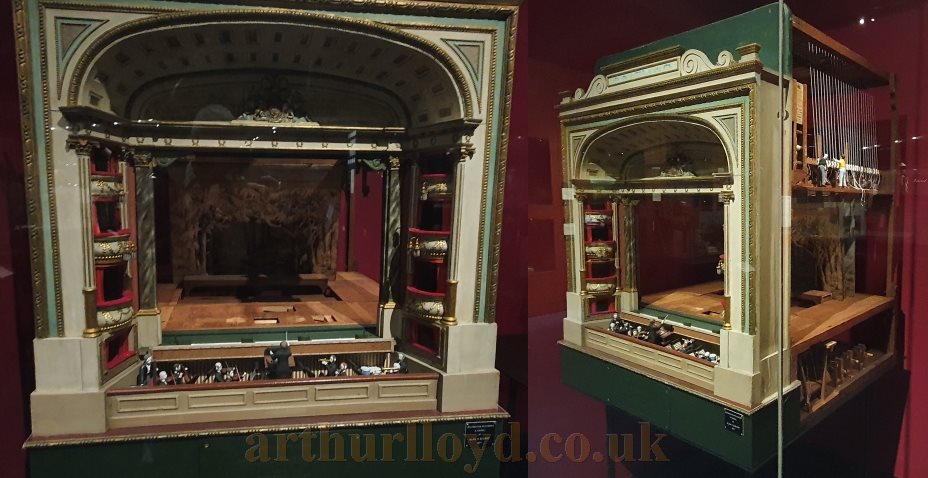
Above - A Detailed Model of the Drury Lane Stage and Auditorium made by J. H. Hollyman in 1911 and restored by Alan Bishop in 1977, held at the Victoria & Albert Museum in London - Photographs M.L. 2026 - Click for more information.
1922 Auditorium Rebuild

Above - The Reconstructed Auditorium of the Theatre Royal, Drury Lane in 1922 - From The Sphere, April 29th, 1922.
 On the 2nd of April 1921 the record breaking run of 'The Garden of Allah' was brought to an end, after a run of over 350 performances, so that the Theatre could be closed for a radical reconstruction of its auditorium
by Emblin Walker, Jones & Cromie.
On the 2nd of April 1921 the record breaking run of 'The Garden of Allah' was brought to an end, after a run of over 350 performances, so that the Theatre could be closed for a radical reconstruction of its auditorium
by Emblin Walker, Jones & Cromie.
Emblin Walker had recently reconstructed the Brighton Hippodrome without closing the Theatre, but here, at Drury Lane, the alterations were much more substantial. Out went the old Horse Shoe shaped auditorium with its four circles (Shown below), and in its place arose a completely new auditorium with three circles (Shown above and below).
The works, which cost £150,000, took nearly a year to complete and the Theatre remained closed until Thursday the 20th of April 1922 when it was reopened with a production of 'Decameron Nights'.
Above - Philip Pilditch's 1901 Theatre Royal, Drury Lane Auditorium shortly before its reconstruction in 1922 - From The Sphere, 29th April 1922.

Above - The Reconstructed Auditorium of the Theatre Royal, Drury Lane in 1922 - From The Sphere, April 29th, 1922.


Above - The 'Rejuvenation of Old Drury' - From The Graphic, April 15th, 1922 - And 'Where all the World's a stage' - From The Graphic, April 22nd, 1922.

Above - The Auditorium of the Theatre Royal, Drury Lane in June 2016 - Photo M.L.

 The Stage Newspaper also reported on the reconstruction
of the Theatre's auditorium in their 16th of March 1922 edition saying:
'The Theatre Royal, Drury Lane has, by a wonderful scheme of reconstruction,
been transformed from an old, ugly building into a new, elegant, comfortable
and commodious theatre.
The Stage Newspaper also reported on the reconstruction
of the Theatre's auditorium in their 16th of March 1922 edition saying:
'The Theatre Royal, Drury Lane has, by a wonderful scheme of reconstruction,
been transformed from an old, ugly building into a new, elegant, comfortable
and commodious theatre.
Above Right - A Plan of the exits from the present Theatre Royal, Drury Lane in 1887, and a seating plan for the present Theatre before 1905, both before the auditorium was reconstructed in 1922 - Click the thumbnails to enlarge.
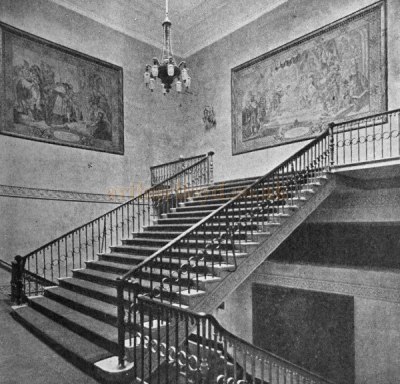
Right - The Grand Staircase at the Theatre Royal, Drury Lane in 1922 - From The architect, 14th of April 1922.
 The work of reconstruction is the more remarkable
because, for doubtless good reasons, the exterior walls had to be left
standing, and all the old rubbish and new material had to be taken out
and brought in through existing doorways or holes cut through the walls.
The work of reconstruction is the more remarkable
because, for doubtless good reasons, the exterior walls had to be left
standing, and all the old rubbish and new material had to be taken out
and brought in through existing doorways or holes cut through the walls.
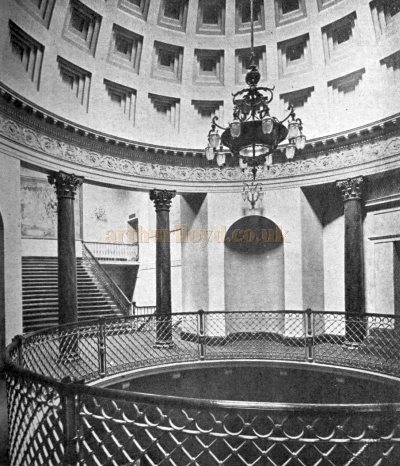
Left - The Rotunda at the Theatre Royal, Drury Lane in 1922 - From The architect, 14th of April 1922.
Further, the work of demolition and of reconstruction had to go on together, new internal walls and piers having to be built in places before it was safe to pull down in others. The job, therefore, was a difficult one for both architect and builder. How well they have each done their work is shown by the veritable "transformation scene" that has taken place within the walls of "Old Drury..."

Above - A Photograph of the 1901 Philip Pilditch Auditorium and Stage at the Fourth and Present Theatre Royal, Drury Lane in 1921, shortly before its 1921/22 reconstruction by Emblin Walker, Jones & Cromie.

Above - A Photograph of the Auditorium and Stage of the Fourth and Present Theatre Royal, Drury Lane in September 2016 - Photo M.L.
 ...Unusual
difficulties were encountered in carrying out the architect's designs.
For one thing, every bit of the old work left standing had to be tested,
and generally strengthened.
...Unusual
difficulties were encountered in carrying out the architect's designs.
For one thing, every bit of the old work left standing had to be tested,
and generally strengthened.
Further, the condition or even the exact positions of these old pieces of structural work were not, in many cases, known. All sorts of curious conditions and even irregularities of construction were discovered during the work of demolition - relics of the old building of 1812 and of the various alterations the old edifice had undergone.
Right - The 1922 reconstructed auditorium of the Theatre Royal Drury Lane in a photograph taken in 2004 - Photo ML - Click for many more pictures.
One result was that the architect's plans had, in several cases, to be modified to meet these unforeseeable obstacles, and many minor feats of applied engineering had to be performed by the contractor.
The bringing in of the steel girders to bridge the proscenium span, 88 ft. wide, themselves measuring 6 ft deep and weighing hundreds of tons, and the moving back of the great steel safety curtain on the stage for the widening of the proscenium were triumphs of skill - performed, as they were, within the restricted area of the four square walls of the old building...

Above - A sketch of the auditorium and stage of the Fourth Theatre Royal Drury Lane as seen from the uppermost box during a performance of 'Little Bo Peep, Little Red Riding Hood, and Hop-O' My Thumb' in 1892. The scene on stage was 'The Grand Hall of a Million Mirrors at the Prince's Palace - From the Graphic, 31st December 1892.

Above - A sketch by B. Wyatt (Architect) of the original auditorium and stage of the Fourth Theatre Royal Drury Lane in 1824 and before its 1922 reconstruction - From 'Illustrations of the public buildings of London, Volume 1' by J. Britton and A. Pugin, 1825.

Above - A sketch of the auditorium, stage, FOH, and backstage of the Fourth Theatre Royal Drury Lane in 1910 during the run of the Pantomime 'Jack and the Beanstalk' - Illustrated London News 1910 - Courtesy Mark Fox, LW Theatres - Click to Enlarge and for more information.
 ...The former horseshoe shape of the auditorium has been replaced by a
rectangular arena, thus allowing far more space for seating. The four
old circles and gallery have been replaced by three new circles, and
these have been extended inwards, so that they each hold twelve instead
of six rows of seats. To provide this greater spacing, the galleries
project, in some cases, for an extra 16 feet.
...The former horseshoe shape of the auditorium has been replaced by a
rectangular arena, thus allowing far more space for seating. The four
old circles and gallery have been replaced by three new circles, and
these have been extended inwards, so that they each hold twelve instead
of six rows of seats. To provide this greater spacing, the galleries
project, in some cases, for an extra 16 feet.
Right - The auditorium of the Theatre Royal, Drury Lane as redecorated by Hampton and Sons, Pall Mall - From The Tatler, April 26th 1922.
 The overhanging portions
are constructed on the cantilever system, so that there are no pillars
or any other obstructions to the view of the stage from any seat the
house. On the first tier there is a spacious apartment for Royalty,
and there are twenty one large, comfortable boxes.
The overhanging portions
are constructed on the cantilever system, so that there are no pillars
or any other obstructions to the view of the stage from any seat the
house. On the first tier there is a spacious apartment for Royalty,
and there are twenty one large, comfortable boxes.
Left - An Advertisement by Hampton & Sons, Decorators and Furnishers of the Theatre Royal, Drury Lane's New Auditorium in 1922 - From the ERA, April 26th 1922.
The well for the orchestra has been enlarged, in view of giving performances of grand opera. Another important alteration is the provision of commodious dressing rooms for the artists - a thing too often lacking in the old insanitary days of theatre construction.
The stalls are now reached by a new short stairway, running direct from the main entrance hall; the pit is raised so as to overlook the whole ground floor...

Above - A Photograph of the Auditorium Ceiling of the Fourth and Present Theatre Royal, Drury Lane in September 2016 - Photo M.L.
 ...An
important feature of the scheme was the new roof, which has replaced
the old one. It has been raised some 8 feet higher than the level of
the old one; it will not obstruct the view of the last man in the topmost
row of the highest gallery, and it will give greater air space, and
allow of more thorough ventilation.
...An
important feature of the scheme was the new roof, which has replaced
the old one. It has been raised some 8 feet higher than the level of
the old one; it will not obstruct the view of the last man in the topmost
row of the highest gallery, and it will give greater air space, and
allow of more thorough ventilation.
Right - The 1922 reconstructed auditorium of the Theatre Royal Drury Lane in a photograph taken in 2004 - Photo ML - Click for many more pictures.
Behind the topmost seats in the upper gallery, a projection cabin has been built. It it the largest of its kind, having a floor area 32 feet by 17 feet, and it houses twenty powerful lamps for the flooding of the stage with any kind of powerful or coloured light. The cabin, and indeed the whole roof, has been constructed of ferro-concrete, which materiel has entered large, into the formation of many of the structural features of the practically new building. (Note: This 'projection cabin' is still in use today as the Theatre's Followspot Box - ML)
 The
ventilation of the new 'Old Drury' has been most thoroughly and scientifically
carried out. Besides all the now usual means for exhausting the vitiated
atmosphere of large, crowded buildings, there is installed the latest
system of ventilation known. The fresh air admitted into the theatre
will be not only filtered by passing through sanitary cotton-wool, but,
also by being forced through a spray of water, which, also can be blended
with disinfecting liquids.
The
ventilation of the new 'Old Drury' has been most thoroughly and scientifically
carried out. Besides all the now usual means for exhausting the vitiated
atmosphere of large, crowded buildings, there is installed the latest
system of ventilation known. The fresh air admitted into the theatre
will be not only filtered by passing through sanitary cotton-wool, but,
also by being forced through a spray of water, which, also can be blended
with disinfecting liquids.
Left - The 1922 reconstructed auditorium of the Theatre Royal Drury Lane in a photograph taken in 2004 - Photo ML - Click for many more pictures.
Exteriorly the theatre has been redecorated, the old walls, columns, and piers made good, and distempered and painted pleasing colours. Internally the house has been decorated and upholstered in the latest Styles of theatre art ornamentation.
It is probable that sentiment prevented the demolition of the outer walls, and though the cost of rebuilding was great - over £100,000 - it was doubtless worth it, for the maintenance of the old traditions and associations connected with London's oldest theatre.'
The above text in quotes was first published in The Stage, 16th of March 1922.

Above - Princess Mary and other dignitaries in the Royal Box of the Theatre Royal, Drury Lane on the Theatre's reopening night with the play 'Decameron Nights' on the 20th April 1922, and a queue for the opening - From The Sketch, April 26th 1922.

Above - Images of 'Old and New Drury' - From the ILS, April 29th 1922.

Above - An all night queue for the opening of 'Decameron Nights' at the newly reconstructed Theatre Royal, Drury Lane - From The Sphere, April 29th, 1922.
The Theatres Trust says of the 1922 Drury Lane auditorium:- 'This is the last auditorium to be designed in the rich fin-de-sièe manner established by Matcham, Sprague & Crewe.'
A Mid 1920s Seating Plan

Above - A Wonderfully Drawn Mid 1920s Seating Plan for the Theatre Royal, Drury Lane
2013 FOH Refurbishment
 The
Theatre's Front of House areas, specifically the Rotunda, Grand Saloon,
and magnificent staircases, were the subject of a major refurbishment
in 2013 by the Theatre's owner Andrew Lloyd Webber whose wish was to
return it to its original Regency splendour.
The
Theatre's Front of House areas, specifically the Rotunda, Grand Saloon,
and magnificent staircases, were the subject of a major refurbishment
in 2013 by the Theatre's owner Andrew Lloyd Webber whose wish was to
return it to its original Regency splendour.
Right - One of the Grand Staircases in the newly restored Front of House at the Theatre royal Drury Lane on its unveiling day of the 15th of May 2013 - Photo M.L. - Click for more images.
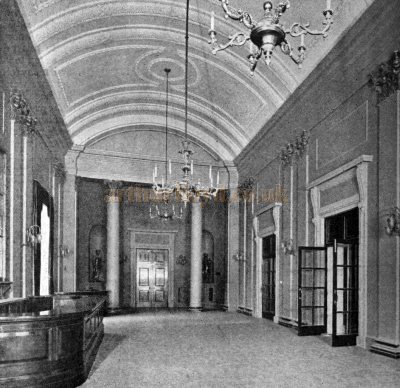 The unveiling of the £4m restoration was on the
15th of May 2013 and revealed the Theatre's original colour scheme,
cleaned and restored paintings and statues, and the Grand Saloon's anti
rooms being restored to their original use.
The unveiling of the £4m restoration was on the
15th of May 2013 and revealed the Theatre's original colour scheme,
cleaned and restored paintings and statues, and the Grand Saloon's anti
rooms being restored to their original use.
Left - The Grand Saloon of the Theatre Royal, Drury Lane in 1922 - From The Architect, 13th of April 1922.
Some more photographs taken on the day of the 2013 unveiling can be seen here.
Some Personal Recollections of the Theatre Royal, Drury Lane

Above - A wonderful photograph of the auditorium of the Theatre Royal, Drury Lane, which also shows the safety curtain with the message 'For Thine Especial Safety' - Courtesy Jeremy Hoare.

 I have strong connections with the Theatre Royal Drury Lane myself, having worked there on and off since the mid 1970s, including a variety of Sunday Concerts, Awards Events such as the Olivier awards, the Baftas and the Evening Standard awards (see image below), and also full time on Miss Saigon from 1992 until it closed in 1999,
'My Fair Lady', 'Anything Goes', 'The Producers,' 'Lord of
the Rings', 'Shrek the Musical', Charlie &
The Chocolate Factory', and more recently on the new production of 42nd Street in 2017.
I have strong connections with the Theatre Royal Drury Lane myself, having worked there on and off since the mid 1970s, including a variety of Sunday Concerts, Awards Events such as the Olivier awards, the Baftas and the Evening Standard awards (see image below), and also full time on Miss Saigon from 1992 until it closed in 1999,
'My Fair Lady', 'Anything Goes', 'The Producers,' 'Lord of
the Rings', 'Shrek the Musical', Charlie &
The Chocolate Factory', and more recently on the new production of 42nd Street in 2017.
Right - A Programme for the Drury Lane production of 'A Chorus Line' in July 1976 - Courtesy Linda Chadwick, and a Programme for the London Palladium production of 'A Chorus Line' in February 2013.
The first production I saw at the Theatre however, was way back in July 1976 when I saw both the Broadway and London casts in 'A Chorus Line.' The production was revived for the first time in February 2013 at the London Palladium and was an almost exact recreation of the original and wonderful to see again after all those years.

Above - The Auditorium of the Theatre Royal, Drury Lane during the run of 42nd Street in December 2017 - Photo M.L.

Above - The Theatre Royal Drury Lane decked out for the Evening Standard Awards in December 2017. The Stalls seating was removed and decking installed for the creation of a single level floor over the stalls and stage, converting the Theatre into a temporary restaurant for the star studded event.
T.C. King, Father in law to Arthur Lloyd, and my Maternal Great Great Grandfather was a famed Drury Lane Tragedian in the mid 1800s, and my Paternal Great Great Grandfather, Horatio Lloyd, who was Arthur Lloyd's father, visited the Theatre on many occasions and writes about it in his Autobiography of 1886, which is a fascinating and contemporary account of a working actor in the mid 1800s. In one section he writes about seeing Kean and Liston at Drury Lane on the same night. I have included an extract of this below, which I think helps to bring this period in the Theatre's history to life.

Above - The Stage Door of the Theatre Royal, Drury Lane during the run of 42nd Street in August 2017 - Photo M.L.
Horatio Lloyd and the Theatre Royal, Drury Lane
"Amongst the greatest and the most popular performers of the other sex whom I have seen and remember, are - or rather were, for it must be about 20 years since the last survivor of them departed- Charles Kemble, Charles Young, Ward, Fawcett, Jones, William Farren, the elder; Blanchard, Tyrone Power, Harley, Mcready, the elder Chas. Matthews, Terry Yates, T. P. Cooke, James Wallack, John Reeve, Wright, Buckstone, Robert Keeley, Knight, Liston, and the immortal Edmund Kean.
 The
two last named I saw for the first time at Drury Lane, on the same evening.
First Kean as Richard III., and then Liston as
Lubin Log, In the favourite farce of those days, "Love, Law, and
Physic." I can never forget the intense delight which afforded
me.
The
two last named I saw for the first time at Drury Lane, on the same evening.
First Kean as Richard III., and then Liston as
Lubin Log, In the favourite farce of those days, "Love, Law, and
Physic." I can never forget the intense delight which afforded
me.
Right - An advertisement in The Times Newspaper of the 8th of December 1823 advertising 'King Richard The Third' and 'Love Law and Physic' at the Theatre Royal, Drury Lane on the same night, and the night in which Horatio Lloyd was in attendance at the Theatre for the first time.
The magnificence of the theatre, the delightful music, the crowded auditorium, and the grand acting produced by a combination which enraptured my young brains. Subsequent to this I visited "Old Drury" regularly once a week.
 Every
Monday evening found me quietly ensconced in the right-hand corner of
the front seat of the two shilling gallery anxiously
awaiting the rising of the great green curtain. It was here and thus
that I so often witnessed the performances of the two great stars I
have mentioned-Liston more particularly. Although poor Kean's powers were evidently on the wane in the eyes of those who had enjoyed
his earlier years, there was no such drawback in my case.
Every
Monday evening found me quietly ensconced in the right-hand corner of
the front seat of the two shilling gallery anxiously
awaiting the rising of the great green curtain. It was here and thus
that I so often witnessed the performances of the two great stars I
have mentioned-Liston more particularly. Although poor Kean's powers were evidently on the wane in the eyes of those who had enjoyed
his earlier years, there was no such drawback in my case.
Left - A Bill advertising Edmund Keen in 'Bride of Abydos' and 'Midnight Hour' at the present Theatre Royal, Drury Lane on March the 5th 1818, just 6 years after the Theatre opened.
I had never seen him in his prime, and in all he said or did now I could see no fault, but everything to admire. Liston took me captive completely. I saw him in all his popular parts, and consider him the most glorious low comedian I ever saw and listened to. He must have been made expressly for a comedian.
He was remarkably ugly-that is to say, in so far as the physiognomy was concerned. Plump cheeks, one larger than the other, a turn up nose, and a twist on one side of the mouth-these were his leading facial features. But he was a tall gentlemanly man, with a very handsome figure. His face alone made the audience roar with laughter before he spoke a word. He would come on the stage and stand silently looking at them, as if overcome with surprise, mingled with disgust at their rudeness.
Then when he had got them almost into convulsions by his simple power of facial expression, he would begin muttering to himself, turn his back to them, and walk up the stage. This was the last straw; for the reason that the exhibition of the unusually ample proportions in the rear with which Nature had been pleased to endow him was considered by his faithful patrons to be the acme of humour. With this sort of pantomime he would keep them into fits for five or six minutes without uttering a word. I repeat that I consider him to be the greatest low comedian I ever beheld. It was no acting; it was the man himself- nature- and that made his drolleries so acceptable."
The above text in quotes above is from Horatio Lloyd's Autobiography 1886.
Horatio Lloyd's 'Two Shilling Gallery'

Above - A photograph taken inside the present Drury Lane roof void showing what's left of Horatio's 'two shilling Gallery.

Above - A fragment of original wallpaper from Horatio's 'two shilling Gallery' which still survives in the Drury Lane roof void.
Will Evans and his Drury Lane Pantomimes
 Will
Evans was born on the 29th May 1866,
and became a well known name in Music Hall and Pantomime in the late 1800s and early
1900s. He was the son of Fred Evans, a clown in the Grimaldi tradition, and made his first appearance with his father when aged just
six years old in a production of 'Robinson Crusoe' at the Theatre Royal,
Drury Lane in 1881.
Will
Evans was born on the 29th May 1866,
and became a well known name in Music Hall and Pantomime in the late 1800s and early
1900s. He was the son of Fred Evans, a clown in the Grimaldi tradition, and made his first appearance with his father when aged just
six years old in a production of 'Robinson Crusoe' at the Theatre Royal,
Drury Lane in 1881.
Right - Will Evans in costume as the Baroness in a Drury Lane Pantomine in 1920 - Kindly sent in by his Grandson Bill Evans.
 After
this he went on tour with his father's comedy company for many years
before returning to London in 1890 to perform in the Music Halls with his wife Ada Luxmore.
After
this he went on tour with his father's comedy company for many years
before returning to London in 1890 to perform in the Music Halls with his wife Ada Luxmore.
Left - Stanley Lupino, Lily Long, and Will Evans posing for the camera, and in costume for, the Drury Lane pantomime 'Babes in the Wood' in 1918 - Kindly sent in by Will Evans' grandson Bill Evans.
After his wife died he carried on as a solo artiste and comedian. His specialty was playing in comic domestic dramas, now better known as farces, the most popular of which were `Building a Chicken House', 'Whitewashing the Ceiling', and 'Papering a House'. He was often to be seen in the Theatre Royal, Drury Lane's regular Christmas Pantomimes.
There is more on Will Evans on this site here.
The Drury Lane Pantomime production of 'Sleeping Beauty' 1912/13/14
 When
the Pantomime 'Sleeping Beauty' was produced at Drury Lane in 1912 the long tradition of having a woman playing principle boy was changed
when they had a man play him instead, Wilfred Douthitt, whilst Florence
Smithson played Beauty. The production also featured Will
Evans, George Graves, Barry Lupino, Renee Mayer, Charles Rock, and
the Poluski Brothers.
When
the Pantomime 'Sleeping Beauty' was produced at Drury Lane in 1912 the long tradition of having a woman playing principle boy was changed
when they had a man play him instead, Wilfred Douthitt, whilst Florence
Smithson played Beauty. The production also featured Will
Evans, George Graves, Barry Lupino, Renee Mayer, Charles Rock, and
the Poluski Brothers.
Right and Below Left - A silver plated Statue of Wilfrid Douthitt
as Prince Auriol in the Drury Lane Pantomime 'Sleeping Beauty' probably
produced as a gift to the cast of the 1913/14 season - Courtesy Peach Eno.  The statue is 23 inches tall and was sculpted
by J. Preston Davies. If you have any more information about this statue
Please Contact me.
The statue is 23 inches tall and was sculpted
by J. Preston Davies. If you have any more information about this statue
Please Contact me.
The following year the same pantomime was revived for the 1913 Christmas season, although this time it was called 'Sleeping Beauty Reawakened'. The cast for this production was almost the same as in 1912 but Forrester Harvey was added to the cast along with Stanley Lupino who was playing his first role in a Drury Lane Pantomime.
The following year, 1914, War broke out, and Arthur Collins put on 'Sleeping Beauty' again as it was a sure fire hit, if you pardon the pun. This time it was called 'Sleeping Beauty Beautified'. Changes to the cast for this revival included Betram Wallis as the principal boy, and Ferne Rogers as Beauty.
In 1915 another pantomime, Puss in Boots' was produced so ending the three year Christmas run of 'Sleeping Beauty'.
Alec Marlow, Carpenter at Drury Lane from 1946 to 1974
 One
of the carpenters who worked at the Theatre from 1946, and who went
on to become Master Carpenter there in 1970, until retiring in 1974,
was Alec Marlow.
One
of the carpenters who worked at the Theatre from 1946, and who went
on to become Master Carpenter there in 1970, until retiring in 1974,
was Alec Marlow.
Alec is thought to have worked on around 12,000 performances at the Theatre and was responsible for helping to build and maintain sets for countless famous productions at the Theatre during his years including 'Pacific 1860', 'Oklahoma', 'Carousel', 'South Pacific', 'The King and I', 'Plain and Fancy', 'Fanny', 'My Fair Lady', 'The Boys from Syracuse', 'Camelot', 'Hello Dolly!', 'The Four Musketeers', 'Mame', 'The Great Waltz', 'Gone with the Wind', 'No No Nanette' and 'Billy'.
Right - Alec Marlow at work on a set at the Theatre Royal, Drury Lane - From the personal collection of Alec Marlow, former Master Carpenter at the Theatre Royal, Drury Lane - Courtesy Phil Davis.
Alec died in February 2009, aged 102, and his son in law, Phil Davis, has kindly written a biography of him and sent it in for inclusion on this site along with many of Alec's personal photographs to illustrate it, plus many of the images on this page.
Alec Marlow's biography can be found on the site here.
George Hoare, General Manager of the Theatre Royal, Drury Lane 1958- 1982

 George
Hoare became General Manager of the Theatre Royal, Drury Lane shortly
before the musical My Fair Lady began in early 1958. George was 47 and
the most experienced manager of Stoll Theatres at the time. His Assistant
Manager was Ernest Kingdon and the resident stage staff were Jack Miller,
Lou Walton, who was at that time Julie Andrew's father-in-law, George
Wright and George Sinclair.
George
Hoare became General Manager of the Theatre Royal, Drury Lane shortly
before the musical My Fair Lady began in early 1958. George was 47 and
the most experienced manager of Stoll Theatres at the time. His Assistant
Manager was Ernest Kingdon and the resident stage staff were Jack Miller,
Lou Walton, who was at that time Julie Andrew's father-in-law, George
Wright and George Sinclair.
Right - A sketch of George Hoare at the Wood Green Empire. George was manager of the Theatre from the late 1940s before becoming General Manager of the Theatre Royal, Drury Lane in 1958 - Courtesy his son Jeremy Hoare.
This was a period when the Theatre was said to have been the most efficient and friendly Theatre to work in, both FOH and backstage. This was also the time when the General Manager was all powerful, there were no middle managers and he would run everything. He was always dressed immaculately in Evening Dress, and supervised the staff, arranged all the functions, organised Press and Public Relations work and would hire out the Theatre to television and film companies and other bodies. The day-to-day ordering of everything needed in the Theatre was up to him.
Right - An Article on George Hoare - From the Wood Green and Southgate Weekly Herald, 24th of January 1958.
 In his time at Drury Lane George met almost all of the Royal Family
when they visited the Theatre, and when he escorted the Queen to the
Royal Box on official occasions she would always ask "Are we ready
Mr Hoare?". The Queen would also sometimes take her children to
a matinee by slipping in at the side door and sitting in the stalls
rather than the Royal Box. And it was George who took it upon himself
to apply to Buckingham Palace for permission to place the Prince of
Wales crest above his box and he was delighted when his request was
granted.
In his time at Drury Lane George met almost all of the Royal Family
when they visited the Theatre, and when he escorted the Queen to the
Royal Box on official occasions she would always ask "Are we ready
Mr Hoare?". The Queen would also sometimes take her children to
a matinee by slipping in at the side door and sitting in the stalls
rather than the Royal Box. And it was George who took it upon himself
to apply to Buckingham Palace for permission to place the Prince of
Wales crest above his box and he was delighted when his request was
granted.
Left - The Theatre Royal, Drury Lane during the run of 'Fanny' in 1958 - Courtesy Gerry Atkins.
During his twenty four years at Drury Lane George was honoured to greet and entertain hundreds of VIPs from all over the world, from the Shah & Empress of Persia and the King & Queen of Thailand to Sir Winston & Lady Churchill and Sir Charles & Lady Chaplin. Winston Churchill gave George one of his famous cigars and no doubt he chatted to Chaplin about his father and Fred Karno.

In 1979 George moved into one of the flats adjoining the rear of the Theatre and so probably had the shortest commute of any employee at Drury Lane. Many people were given their first employment in the Theatre by George. One person in particular, whose job it was to clean and polish the brasswork around the Theatre's entrance, has done very well in the business. He is Sir Cameron Mackintosh who readily acknowledges this first rung on the ladder of success, which in turn he has subsequently turned into employment for numerous people with his sharp eye for good productions.
George retired as General Manager of Drury Lane in 1982 but he continued to be connected with the Theatre as full time Consultant, Historian, and Archivist for Stoll Moss Theatres and began to build up the "George Hoare Theatre Collection" which was housed in the old Treasury Room of the Theatre and is a valuable archive which continues to be added to today. George died on the 17th of August 1997 but is still fondly remembered today by those who knew and worked with him during his time at Drury Lane.
The above text on George Hoare is a brief edited version of the full biography written by his son Jeremy which you can find here and is courtesy and copyright © Jeremy Hoare.
ENSA
at Drury Lane


Above - Two images showing NAAFI / ENSA signage - Courtesy Alan Siggers, former Chief Electrician at the Theatre, who worked there from 1967 to 1980.
During the war years Drury Lane was the headquarters of ENSA (The Entertainments National Service Association), an organisation set up in 1939 by Basil Dean and Leslie Henson, that provided professional entertainment for the armed forces. The Theatre was closed to the public but the ENSA shows were created on its vast stage and then shipped around the world to entertain the troups. ENSA was part of NAAFI (The Navy, Army, and Air Force Institutes). You can read more about ENSA here and there is a very nice trailer for an unmade documentary on ENSA here. And there are more ENSA photographs here.


Above - Two Views of the Stage of the Theatre Royal, Drury Lane during the war years whilst shows were being built for ENSA - Courtesy Alan Siggers, former Chief Electrician at the Theatre, who worked there from 1967 to 1980. There are many more ENSA photographs here.
Working at the Theatre Royal, Drury Lane in the 1940s and 1950s by Alan Chudley

Above - The Russell Street Elevation of the Theatre Royal, Drury Lane, showing the Scene Dock and Stage Door Entrances and the exterior of what was originally the Scene Room and Painting Room in 1814 when the extention to the 1812 Theatre was built. The Long Dock, as it is known today, is currenly in use as Offices for LW Theatres.
 During
the war years Drury Lane was the headquarters of ENSA,
an organisation that provided professional entertainment for the armed
forces, the vast stage at that time was largely partitioned off as offices.
During
the war years Drury Lane was the headquarters of ENSA,
an organisation that provided professional entertainment for the armed
forces, the vast stage at that time was largely partitioned off as offices.
Right - Backstage at the Theatre Royal, Drury Lane by Jimmy Needle - From the personal collection of Alec Marlow - Courtesy Phil Davis.
My fist visit to Drury Lane was in the summer of 1946 when much to the delight of the Drury Lane staff, ENSA had been disbanded and Drury Lane was set to return to its rightful use as a public theatre. The purpose of my visit was to purchase some of the ENSA lighting equipment then being sold off, our transport was a very small borrowed grocers trade van and we were trying to get a switchboard into that van. Walter McQueen Pope the Drury Lane publicity man and historian was walking along Russell Street with some other gentlemen, one of whom said to Mr McQueen Pope; "Five shillings says they do not make it Walter," Egged on by Walter we finally got the switchboard into the van, I was to learn later that the gentlemen was our sovereign King George V1, and that the bet was honoured.
During the 1951 Festival of Britain I was involved under the direction of Mc Queen Pope to show American visitors over Drury Lane on Sundays. Mc Queen Pope used to delight in showing them the green Room, the actors sitting room, where many years ago an Actor named Macklin killed another actor during a quarrel over a wig.
The son of the killed Actor fled to the United States and started what was considered to be the first American Theatre. Mc Queen pope would show the American tourists the fireplace where the killing took place any proudly announce; "That is where your Theatre started"
 About
that time I was one of a gang of casual workers whose task it was to
replace the lighting control at Drury Lane with a brand new Strand Electric
Organ Consul, up to then, "Okalahoma" the current show, was
lit by a motley collection of switchboards which included a "Moy" board installed early in the 20th century
plus a Strand Grand Master board installed for "Cavalcade"
during the 1930s plus several portable hired Strand potables boards.
About
that time I was one of a gang of casual workers whose task it was to
replace the lighting control at Drury Lane with a brand new Strand Electric
Organ Consul, up to then, "Okalahoma" the current show, was
lit by a motley collection of switchboards which included a "Moy" board installed early in the 20th century
plus a Strand Grand Master board installed for "Cavalcade"
during the 1930s plus several portable hired Strand potables boards.
Left - Ernest Trim at the Drury Lane Light Console, the first operator of the new board and the No1 Day-man as he was called - Courtesy Alan Siggers, former Chief Electrician at the Theatre. There are many more of Alan's photographs of this lighting console and its dimmer room on Lighting Designer Nick Hunt's website here.
Later under the direction of Lou Walton, the Drury Lane master carpenter, I was engaged as a casual on several Drury Lane fit-ups which included "Fanny" in which one of the famous stage bridges was used to provide a underground nightclub, sadly "Fanny" was not a success and a lot of people lost a lot of money.
The above article was kindly written for this site by Alan Chudley.
Augustus Harris at the Theatre Royal, Drury Lane in 1879
 Augustus
Harris ran Drury Lane from 1879 and put on a huge number of extremely popular and lavish pantomimes
and spectacular shows. He became very well known by the British public
and people would flock to see a Harris show, indeed he turned round
the fortunes of the Theatre from failure to immense success. Harris
died on the 22nd of June 1896 at the age of 44 having controlled Drury Lane for 17 years.
Augustus
Harris ran Drury Lane from 1879 and put on a huge number of extremely popular and lavish pantomimes
and spectacular shows. He became very well known by the British public
and people would flock to see a Harris show, indeed he turned round
the fortunes of the Theatre from failure to immense success. Harris
died on the 22nd of June 1896 at the age of 44 having controlled Drury Lane for 17 years.
Right - The memorial fountain to Augustus Harris, erected outside the front of the Theatre Royal, Drury Lane after his death - From the book 'The Theatre Royal Drury Lane' by W. Macqueen Pope 1945.
Harris's first production at the Lane in 1879 was 'Henry V' with George Rignold in the leading part. This was an immediate success and the Theatre was full to bursting every night.
 After
this Harris staged the pantomime 'Bluebeard' at Christmas and it is
said that it was 'the most spectacular pantomime London had ever seen.'
After
this Harris staged the pantomime 'Bluebeard' at Christmas and it is
said that it was 'the most spectacular pantomime London had ever seen.'
After this Harris staged a series of dramas at the Theatre and then went on to stage another pantomime the following Christmas, 'Mother Goose' and this time he had comedians from the Music Halls playing the leads, something which had never been tried before, with artistes including Kate Santley, James Fawn, and Arthur Roberts.
Indeed over the years most of the big names in Music Hall appeared in Harris's pantomimes including Nellie Power, Vesta Tilley, Herbert Campbell, Little Titch, Arthur Williams, Marie Lloyd (shown left), and many more.
Left - A signed card from the much loved Music hall artiste Marie Lloyd - Courtesy Tony Craig who says 'The Card was given to my Grandma and Granddad when they worked with her in 1914.
Harris's pantomimes were lavish affairs costing £5,000 to £6,000 a piece, a vast sum in those days, but it certainly paid off. Soon becoming known as Augustus Druryolanus, a name he coined himself, Harris could do no wrong. He co-wrote and played in many of his dramas and pantomimes himself, and put on all manner of productions at the Theatre including plays, dramas, pantomimes, variety, and opera.
 By
the time of his death Augustus Harris controlled six or seven Theatres,
many touring companies, and other businesses, and at one time he had
even owned and written regularly for the Sunday Times newspaper.
By
the time of his death Augustus Harris controlled six or seven Theatres,
many touring companies, and other businesses, and at one time he had
even owned and written regularly for the Sunday Times newspaper.
 Left - The memorial
fountain to Augustus Harris in a photo shot during the run of 'Lord
Of The Rings' in 2007 - Photo ML
Left - The memorial
fountain to Augustus Harris in a photo shot during the run of 'Lord
Of The Rings' in 2007 - Photo ML
Such was his popularity that after he died a drinking fountain was placed outside the front of the Theatre, erected as a tribute to Harris, paid for by public subscription. It was unveiled by the Lord Mayor on Monday the 1st of November 1897, and is still there today. More information on the unveiling can be read here.
A visitor to the site, Ruth Allison, has recently sent in this photograph of a glass in her possession which has the words August Harris engraved on the bowl. Although I have never seen a mention of this glass before it is my assumption that it was probably one of several made to toast Augustus Harris on the unveiling of his memorial fountain outside the Theatre. If you have any more information about this glass please Contact me.
Right - A drinking glass with the words 'Augustus Harris' engraved on the bowl - Courtesy Ruth Allison.
Some Notable Drury Lane Productions


Sins of Society 1907 - Centenary Programme of Every Woman 1912 - Ben Hur 1902 - Pleasure 1897
The Drury Lane production of 'The Armada' in 1888
From the Pillars of Drury Lane by W. Macqueen Pope, 1955
 A production of outstanding merit in every way at Drury Lane was 'The
Armada,' produced in 1888 to
mark the tercentenary of the defeat of that so-called Invincible Fleet.
It was written by Henry Hamilton and Gus Harris. It had a big cast which
included Winifred Emery, Ada Neilson, Leonard Boyne (hero), Luigi Lablache,
Harry Nicholls, Victor Stevens, and many more. Here was a story of love
and adventure finely told and wonderfully staged. A wicked Spaniard
carries off the fair English girl (played by Winifred Emery), and the
hero, Vyvyan Foster (Leonard Boyne), goes in pursuit. There was the
villain's palace in Madrid where he threatens to hand the girl over
to the Inquisition if she will not surrender to him. The hero, being
a hero, got access to her and said he would come to the rescue. His
ship was attacked and there was a most spirited fight. Vyvyan captured
his attacker, no less a person than the Alcalde, and from him wrung
the secret of when the Armada is to sail. What is he to do—return
at once and warn his country, or stay and rescue his girl? Love or duty?
Duty wins and he sails for home, but tells the Spaniards he holds the
Alcalde as hostage for his sweetheart's safety. He sees Queen Elizabeth,
and the great commanders, Effingham, Walsingham, Raleigh, Drake, Hawkins
and Frobisher. He calls for volunteers, in a very beautiful scene representing
the village of Charing, in Kent. Naturally, he gets them.
A production of outstanding merit in every way at Drury Lane was 'The
Armada,' produced in 1888 to
mark the tercentenary of the defeat of that so-called Invincible Fleet.
It was written by Henry Hamilton and Gus Harris. It had a big cast which
included Winifred Emery, Ada Neilson, Leonard Boyne (hero), Luigi Lablache,
Harry Nicholls, Victor Stevens, and many more. Here was a story of love
and adventure finely told and wonderfully staged. A wicked Spaniard
carries off the fair English girl (played by Winifred Emery), and the
hero, Vyvyan Foster (Leonard Boyne), goes in pursuit. There was the
villain's palace in Madrid where he threatens to hand the girl over
to the Inquisition if she will not surrender to him. The hero, being
a hero, got access to her and said he would come to the rescue. His
ship was attacked and there was a most spirited fight. Vyvyan captured
his attacker, no less a person than the Alcalde, and from him wrung
the secret of when the Armada is to sail. What is he to do—return
at once and warn his country, or stay and rescue his girl? Love or duty?
Duty wins and he sails for home, but tells the Spaniards he holds the
Alcalde as hostage for his sweetheart's safety. He sees Queen Elizabeth,
and the great commanders, Effingham, Walsingham, Raleigh, Drake, Hawkins
and Frobisher. He calls for volunteers, in a very beautiful scene representing
the village of Charing, in Kent. Naturally, he gets them.
 The
famous Bowls scene on Plymouth Hoe was reproduced—after the picture
by Seymour Lucas—and there was a perfectly marvellous reproduction
of the English Fleet fighting the Armada, which drew volleys of applause.
The little matter of defeating the Armada being over, the hero went
to Spain to get his girl. She was in the hands of the Inquisition and
was condemned to death. There she stood, in the next scene, tied to
the stake, with the howling populace all about her and the deadly torches
about to be applied to the pyre, whilst the priests chant the miserere.
And then, through the throng, burst the hero and his gallant crew. In
a fight they cut down the Spaniards and cut loose the girl. And so back
to England, with a knighthood for the hero from the sword of Queen Bess
and a pageant of her triumphant progress to St. Paul's—a happy
wedding —red fire—the final curtain and a delighted and enthusiastic
audience. No better piece of stagecraft was ever seen than that battle
with the Armada. To advertise this play Harris issued tens of thousands
of little metal coins, of brass, and about the size of sovereigns. On
one side it said '1588 The Armada 1888'—surrounded by the words
'Drury Lane Theatre Every Evening'. On the other there was a representation
of a sea fight, surrounded by the words `Augustus
Harris, Lessee and Manager 1888'. Thousands of those little 'coins'
still exist and people write to Drury Lane concerning them and ask if
they have any value. Except as curios, they have none. These words may
reach the eyes of those who may come across one—and are thus answered.
The
famous Bowls scene on Plymouth Hoe was reproduced—after the picture
by Seymour Lucas—and there was a perfectly marvellous reproduction
of the English Fleet fighting the Armada, which drew volleys of applause.
The little matter of defeating the Armada being over, the hero went
to Spain to get his girl. She was in the hands of the Inquisition and
was condemned to death. There she stood, in the next scene, tied to
the stake, with the howling populace all about her and the deadly torches
about to be applied to the pyre, whilst the priests chant the miserere.
And then, through the throng, burst the hero and his gallant crew. In
a fight they cut down the Spaniards and cut loose the girl. And so back
to England, with a knighthood for the hero from the sword of Queen Bess
and a pageant of her triumphant progress to St. Paul's—a happy
wedding —red fire—the final curtain and a delighted and enthusiastic
audience. No better piece of stagecraft was ever seen than that battle
with the Armada. To advertise this play Harris issued tens of thousands
of little metal coins, of brass, and about the size of sovereigns. On
one side it said '1588 The Armada 1888'—surrounded by the words
'Drury Lane Theatre Every Evening'. On the other there was a representation
of a sea fight, surrounded by the words `Augustus
Harris, Lessee and Manager 1888'. Thousands of those little 'coins'
still exist and people write to Drury Lane concerning them and ask if
they have any value. Except as curios, they have none. These words may
reach the eyes of those who may come across one—and are thus answered.
Text edited from 'The Pillars of Drury Lane' by W. Macqueen Pope, 1955. - Armada Coin very kindly donated by Alan Harvey.
The Drury Lane production of 'The Whip' in 1909

Above - A Postcard showing a scene from 'The Whip' 1909 - Click here for more images and details of this production.
The Baddeley Cake
 The
Baddeley cake is named after Robert Baddeley who was a popular actor
at Drury Lane for many years until he died in 1794 during the run of
his most celebrated part, Moses in 'School for Scandal.'
The
Baddeley cake is named after Robert Baddeley who was a popular actor
at Drury Lane for many years until he died in 1794 during the run of
his most celebrated part, Moses in 'School for Scandal.'
Right - Ginger Rogers cutting the Baddeley Cake during the run of ''Mame' - From the personal collection of Alec Marlow, former Master Carpenter at the Theatre Royal, Drury Lane - Courtesy Phil Davis.
 Baddeley
left instructions that on the death of his wife 'certain monies' were
'to go to the society established for the relief of indigent persons
belonging to Drury Lane Theatre.'
Baddeley
left instructions that on the death of his wife 'certain monies' were
'to go to the society established for the relief of indigent persons
belonging to Drury Lane Theatre.'
Left - The Baddeley Cake during the run of 'South Pacific' - From the personal collection of Alec Marlow, former Master Carpenter at the Theatre Royal, Drury Lane - Courtesy Phil Davis.
 And
amongst other requests he also left provision that the interest from
£100 be used on the Twelfth Night of every year for the purchase
of a cake, with wine and punch, for the Drury Lane Company in residence
to partake of in the Green Room of the Theatre so that they might remember
him.
And
amongst other requests he also left provision that the interest from
£100 be used on the Twelfth Night of every year for the purchase
of a cake, with wine and punch, for the Drury Lane Company in residence
to partake of in the Green Room of the Theatre so that they might remember
him.
Right - The Baddeley Cake during the run of 'Mame.' The man on the left of the photo is William F. Budd. He was secretary of the Theatre Royal Fund and had worked at the Lane, and was stage and Company Manager there for the production of Gone With The Wind, and was also was manager of the Intimate Theatre in Palmers Green - From the personal collection of Alec Marlow, former Master Carpenter at the Theatre Royal, Drury Lane - Courtesy Phil Davis.
Remarkably this tradition has survived and Baddeley is indeed celebrated and remembered each year on the 6th of January to this day.

Above - The Cake made to celebrate the Theatre's Tri-centenary year, 1963, which also celebrated the long run of 'My Fair Lady' which opened at the Theatre in 1958 and ran for 5 years. This may also have been a Baddeley cake but I'm not sure about that, perhaps you know - From the personal collection of Alec Marlow, former Master Carpenter at the Theatre Royal, Drury Lane - Courtesy Phil Davis.

Above - The Baddeley Cake Celebration during the run of Shrek the Musical at the Theatre Royal, Drury Lane on Sunday the 6th of January 2013, the first time the Baddeley Cake has been cut on a Sunday since it first began. The Grand Saloon where the celebration took place was closed for major renovation and restoration the day after this photograph was taken.

Above - The Baddeley Cake Celebration during the run of Shrek the Musical at the Theatre Royal, Drury Lane on Sunday the 6th of January 2013 - Photo M.L.

Above - The cast and crew of Charlie & The Chocolate Factory celebrate the cutting of the Baddeley Cake at the Theatre Royal, Drury Lane on Monday the 6th of January 2014.

Above - The very inventive Charlie & The Chocolate Factory Baddeley Cake at the Theatre Royal, Drury Lane on Monday the 6th of January 2014.

Above - The Charlie & The Chocolate Factory Baddeley Cake at the Theatre Royal, Drury Lane on the 6th of January 2015.

Above - The 42nd Street Baddeley Cake at the Theatre Royal, Drury Lane on the 6th of January 2018 - Courtesy Jordan Smith.

Above - The 42nd Street Baddeley Cake at the Theatre Royal, Drury Lane on the 3rd of January 2019. The event was held on the 3rd of January as the 6th would have fallen on a Sunday and the show was closing on the 5th. This will be the last Baddeley Cake event until after the Theatre has reopened after refurbishment in 2020, meaning that the next Baddeley Cake will probably be on the 6th of January 2021.
The Staff Bar


Above - Three photographs of the Theatre Royal, Drury Lane staff enjoying a drink in the Theatre's staff bar which was situated in the basement of the Theatre and which is now the lighting department's crew room and workshop - From the personal collection of Alec Marlow, former Master Carpenter at the Theatre Royal, Drury Lane - Courtesy Phil Davis.
The Substage Machinery and Lifts at the Theatre Royal, Drury Lane

After the run of 'Lord of the Rings' at the Theatre Royal, Drury Lane had closed in July 2008 the Grade I Listed substage machinery and Stage Lifts, which had not worked for many decades, had to be reinstated because much of it was removed to house the production's multi-lifting revolve, this was stipulated by English Heritage before it was allowed to be removed, because of its Grade I Listed status. During the reinstation some of the machinery was once again made to work. There is information on the original installation of the lifts in 1898, an article on their use in various productions from 1910, and many images of the machinery in action in 1976, 2006, 2008, and before removal in 2019 here.
Whilst the Theatre was closed and the Substage Machinery was being replaced in 2008, the auditorium was also re-seated in preparation for the opening of 'Oliver' in January 2009, some photos of this are shown below.


Above - The Balcony, Grand, and Royal Circles of the Theatre Royal, Drury Lane being re-seated in July/August 2008 - Courtesy Piers Caunter.
View from the roof of Drury Lane

Above - 360 view of London from the roof of the Theatre Royal Drury Lane - Click to enlarge.
Theatre Royal, Drury Lane, bomb damage in 1940

Above - The Stalls and Circle of the Theatre Royal, Drury Lane, the morning after the bomb hit the Theatre during the second world war. From the book 'Pillars of Drury Lane' by W. Macqueen Pope 1955 - Courtesy Piers Caunter.

Above - Caption reads 'Members of the Drury Lane staff amongst whom the nosecap of the bomb fell when an H.E. hit the theatre in 1940. These men were actually sleeping in the wrecked room and escaped undamaged. The inscribed nosecap is seen amongst them.' From the book 'Theatre Royal Drury Lane' by W. Macqueen Pope 1945 - Courtesy Piers Caunter.
The Romance of London Theatres by Ronald Mayes
No. 110. Drury Lane (1660-1809)
From a London Pavilion Programme 1930

 In
1660 the Master of the Revels issued a permit to Thomas Killigrew and
Sir William Davenant to "erect two companies of players . . . and
to build two houses or theatres. Davenant's letters patent eventually
made their way to the hands of John Rich who built Covent
Garden Theatre. Killigrew purchased from the Earl of Bedford a forty-one
years' lease of a piece of ground situated in the two parishes of St.
Paul's, Covent Garden, and St Martin`s-in-the Fileds.
In
1660 the Master of the Revels issued a permit to Thomas Killigrew and
Sir William Davenant to "erect two companies of players . . . and
to build two houses or theatres. Davenant's letters patent eventually
made their way to the hands of John Rich who built Covent
Garden Theatre. Killigrew purchased from the Earl of Bedford a forty-one
years' lease of a piece of ground situated in the two parishes of St.
Paul's, Covent Garden, and St Martin`s-in-the Fileds.
Right - The actual nosecap of the bomb, now displayed in the Theatre's foyer
 During the building of the theatre Killigrew's Company performed in
a temporary building in Bear Yard, near Lincoln's Inn Fields. The New
Theatre in Drury Lane was built at a cost of fifteen hundred pounds,
the dimensions of which were one hundred and twelve feet by fifty-nine
feet. It was opened in 1663 with Beaumont and Fletcher's comedy, "The
Humorous Lieutenant," of which Pepy's writes, " a silly play
1 think-only the spirit in it that grows very tall and then sinks again
to nothing, having two heads breeding upon one, and then Knipp's singing
did please us."
During the building of the theatre Killigrew's Company performed in
a temporary building in Bear Yard, near Lincoln's Inn Fields. The New
Theatre in Drury Lane was built at a cost of fifteen hundred pounds,
the dimensions of which were one hundred and twelve feet by fifty-nine
feet. It was opened in 1663 with Beaumont and Fletcher's comedy, "The
Humorous Lieutenant," of which Pepy's writes, " a silly play
1 think-only the spirit in it that grows very tall and then sinks again
to nothing, having two heads breeding upon one, and then Knipp's singing
did please us."
Left - An early 20th Century Postcard of the Theatre Royal Drury Lane.
 To this period also belongs that incarnation of frolic and merriment,
Nell Gwynne. It is popularly supposed that as a child she sold oranges
in the pit of Drury Lane and made her way to the stage at the early
age of fifteen. Pepys tells us that lie kissed her.
To this period also belongs that incarnation of frolic and merriment,
Nell Gwynne. It is popularly supposed that as a child she sold oranges
in the pit of Drury Lane and made her way to the stage at the early
age of fifteen. Pepys tells us that lie kissed her.
Right - The 'Run' or 'Cross Dock' situated behind the stage at Drury Lane. This is used for temporary storage of equipment and for the cast and crew to get from one side of the stage to the other during performances. Leading off from this to the right is the 'Paint Frame,' where backdrops for many shows are still created.
The second theatre built by Sir Christopher Wren was opened on March 26th, 1674. Here for many years Thomas Betterton held sway. Silvertone Betterton first served his apprenticeship at the "Cockpit," and was a universal favourite at old Drury. He took a farewell "benefit" here in 1709, when in his seventy-fifth year, finally retiring from the stage and dying in 1710.
 The
theatre is next intimately associated with Colley Cibber, manager and
dramatist, and for twenty-seven years Poet Laureate. During this period
we have James Quin, for long the favourite tragedian of the town, Macklin
and Peg Woffington.
The
theatre is next intimately associated with Colley Cibber, manager and
dramatist, and for twenty-seven years Poet Laureate. During this period
we have James Quin, for long the favourite tragedian of the town, Macklin
and Peg Woffington.
Left - A 1949 Copy of the Drury Lane Charter of 1663 currently displayed in the basement of the Theatre's backstage area - Photo M.L.
 Cibber was followed by David Garrick who was there from
1747 to 1776. Garrick restored Shakespeare, which had been grossly neglected
and introduced several improvements in stage display. Sheridan next
comes to the front as manager, presiding over such great actors as Mrs.
Siddons, John and Charles Kemble, and John Henderson. The theatre was
pulled down in 1791 and rebuilt three years later.
Cibber was followed by David Garrick who was there from
1747 to 1776. Garrick restored Shakespeare, which had been grossly neglected
and introduced several improvements in stage display. Sheridan next
comes to the front as manager, presiding over such great actors as Mrs.
Siddons, John and Charles Kemble, and John Henderson. The theatre was
pulled down in 1791 and rebuilt three years later.
Right - Cross section of the Theatre from an architect's drawing displayed in the basement of the Theatre's backstage area - Photo M.L.
 The
Kembles were the principal attraction at Drury Lane until they withdrew
in 1803, when the fortunes
of the theatre were seriously affected. We are told that Sheridan's
translation of "The Death of Rolla," brought him in £25,000
in five weeks. Left - Deep in the bowels of the Theatre are ancient passageways,
parts of which may contain elements of the earlier Theatres on the
site - Photo M.L.
The
Kembles were the principal attraction at Drury Lane until they withdrew
in 1803, when the fortunes
of the theatre were seriously affected. We are told that Sheridan's
translation of "The Death of Rolla," brought him in £25,000
in five weeks. Left - Deep in the bowels of the Theatre are ancient passageways,
parts of which may contain elements of the earlier Theatres on the
site - Photo M.L.
Right - At the highest point of the Theatre at roof level and to the rear of the balcony is the Follow Spot Box, here you can see one of three spots used on 'The Producers' and beyond the glass; a balcony chandelier.
 Drury Lane Theatre was destroyed by fire in 1809,
when Sheridan was at the House of Commons. He left and went to a little
coffee house opposite his property and drank a bottle of port with his
friend Barry, coolly remarking, "it was hard if a man could not
drink a glass of wine by his own fire."
Drury Lane Theatre was destroyed by fire in 1809,
when Sheridan was at the House of Commons. He left and went to a little
coffee house opposite his property and drank a bottle of port with his
friend Barry, coolly remarking, "it was hard if a man could not
drink a glass of wine by his own fire."
The above text in quotes was first published in The Romance of London Theatres by Ronald Mayes - From a London Pavilion Programme in 1930.
A Cartoon

Above - A Cartoon drawn by Jimmy Needle during the run of 'Hello Dolly' at the Theatre Royal, Drury Lane. The cartoon seems to be suggesting that the Theatre staff were at the time fed up with American productions taking over the Theatre - From the personal collection of Alec Marlow - Courtesy Phil Davis.
Refurbishment of the Theatre 2019 to 2021

Above - A Full House leaves the Theatre Royal, Drury Lane on the last night of 42nd Street at the Theatre on the 5th of January 2019. The Theatre was then closed and stripped out for major refurbishment.
 The Theatre Royal closed down for an extended period after the production of 42nd Street ended on the 5th of January 2019. This was to allow for a major refurbishment project, which was originally expected to take 20 months and cost around £45 million.
Right - Scaffolding being erected to the front of the Theatre Royal, Drury Lane, in February 2019.
During the refurbishment the Theatre's auditorium, which was last reconstructed in 1922, was radically altered by removing all the boxes closest to the stage and reusing the space for lighting and sound equipment, and also reshaping the Royal and Grand Circles to curve round and engulf the first column of boxes, and reduce the height of the boxes above the remaining Royal Boxes on either side. At the same time the auditorium on all levels was re-raked and re-seated, re-carpeted, and repainted, and the seating capacity was reduced.
 The Theatre's Auditorium from the rear of its vast empty stage.
 The Theatre's Auditorium after its seats had been removed.
 The vast empty stage of Drury Lane.
 The Stalls devoid of seats.
 An empty Orchestra Pit.
 From the rear of the Royal Circle.
 The Theatre's counterweight flying system being stripped out.
 The Auditorium devoid of seating.
 One of the Theatre's ancient stage lifts being prepared for documentation.
 An empty auditorium and pit.
 Two of the Theatre's ancient stage lifts being prepared for documentation.
 The Theatre's Grand Saloon being cleared for further refurbishment.
 Two of the Theatre's ancient hydraulic stage lifts being prepared for documentation.
 The Theatre's Fly Floor empty for the first time in years.
 The Theatre's Fly Floor with stripped out flying system.
 Looking towards the rear of the stage from the fly floor.
 The Auditorium, devoid of seats, from the rear cross over bridge at the back of the stage.
 The Theatre's Stage House will be completely stripped out for its renovation.
 Something rarely seen at Drury Lane, an empty Stage House and Grid.
 The Theatre's Auditorium devoid of seats.
 This view of the Theatre's auditorium will look very different after the refurishment.
 The Iron Curtain from the back of the Stage.
 An almost empty Stage House.
 From the back of the Stalls, now devoid of seating.


Above - A Slideshow of photographs showing the Theatre Royal Drury Lane being stripped out in preparation for the Theatre's Refurbishment in January 2019 - Courtesy Jordan Smith.
 The refurbishment also included a new restaurant and bar called 'The Garden' which were constructed next door to the main entrance on Catherine Street and along Vinegar Yard, which was covered over. A large passenger lift to all levels was also installed FOH, and the main foyer was opened up at either end allowing through passage from Russell Street to the new restaurant and bar.
Right - Scaffolding being erected to the front of the Theatre Royal, Drury Lane, in February 2019.
 A new Steel Grid over the stage, and a modern modular stage were fitted to replace the earlier one. The fly floors and galleries were also removed and replaced.
Left - Statues were removed from the Theatre for safe keeping during the refurbishment, here The Three Graces are being removed from the foyer - Photo Courtesy Martin Clark.
Backstage, which was fairly run down, was not proposed to be refurbished or altered unfortunately, other than redecoration, and alterations to the Stage Door, although the Grade I Listed Substage Machinery, which was first installed in 1898, and restored to working order in 2008 by Dorothea Restorations, was recorded and then removed, allowing greater flexibility below the stage, which was also replaced and de-raked to accommodate sight lines for the altered auditorium. (There is information on the original installation of the lifts in 1898, an article on their use in various productions from 1910, and many images of the machinery in action in 1976, 2006, 2008, and before removal in 2019 here.)
Above - The Auditorium of the Theatre Royal, Drury Lane in June 2016, which would be radically altered during the refurbishment of the Theatre in 2019 / 21 - Photo M.L.
 All in all the Theatre has been very much altered, especially the auditorium, and FOH at ground level, but despite the radical nature of the changes the public bodies which aim to protect buildings of architectural significance all approved the plans. You can read the Theatres Trust's response here, which also gives more detail on the alterations.
Right - The Theatre Royal, Drury Lane during finishing touches to it's new colour scheme in January 2021 - Courtesy Martin Clark.
 The Theatre is a Grade I Listed Building so it is remarkable that such changes and alterations were approved. One can only hope that the Theatre, which is over 200 years old now, proves to have been radically improved as a result of the refurbishment, which is said to have cost around £60m in the end. The success or otherwise of the alterations will only be revealed as its facilities are used by producers, creatives, technicians, and of course the public, over the next few decades.
Left - The Theatre Royal, Drury Lane during finishing touches to it's new colour scheme in January 2021 - Courtesy Martin Clark.
The architects responsible for the redesign of the Theatre were HaworthTompkins whose designs for the alterations to Drury Lane can be found on their own Website here. And for a plethora of images and details of the restoration, including historical images and information, Mike Hume's Historic Theatre Photography page on Drury Lane is a must see here.
The Theatre was originally scheduled to reopen after refurbishment in the Autumn of 2020 with a musical version of the Disney film 'Frozen' but the outbreak of the Coronavirus Pandemic in March 2020 meant delays to the project and the opening date for the show was eventually rescheduled for the 27th of August 2021.

Above - The Theatre Royal Drury Lane during its refurbishment in July 2019 with advertising for the musical 'Frozen' which reopened the Theatre in August 2021 - Photo M.L.
The Theatre Royal, Drury Lane is currently owned and run by LW Theatres.
Some archive newspaper reports on this page were collated and kindly sent in for inclusion by B.F. Some information on this page was gleaned from Robert Whelan's informative and detailed book on the history of Drury Lane 'The Other National Theatre'.
Adelphi Aldwych Ambassadors Apollo Apollo Victoria Arts Cambridge Charing Cross Theatre Criterion Dominion Donmar Warehouse Drury Lane Duchess Tom Stoppard Theatre Fortune Garrick Gielgud Gillian Lynne Harold Pinter Haymarket His Majesty's Leicester Square Theatre London Coliseum London Palladium Lyceum Lyric Menier Chocolate Factory Noel Coward Novello Old Vic Palace Peacock Phoenix Piccadilly Playhouse Prince Edward Prince of Wales Royal Opera House Sadler's Wells Theatre Savoy Shaftesbury Sondheim St. Martin's Trafalgar Theatre Vaudeville Victoria Palace Wyndham's