
The Lyric Theatre, Shaftesbury Avenue, London

Above - The Lyric Theatre during the run of ''Thriller Live' in April 2014 - Photo M. L.


 The
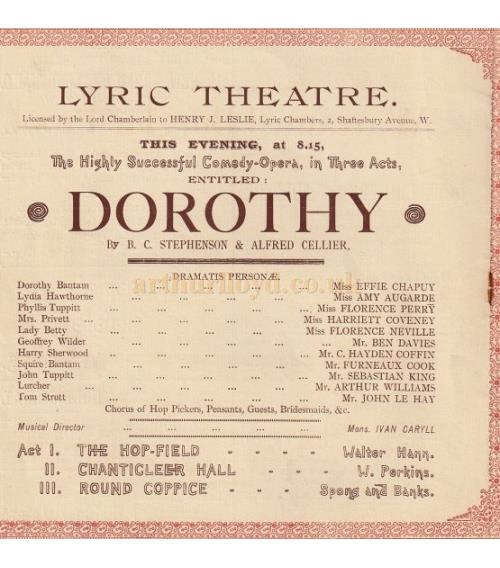
Lyric Theatre opened on Monday the 17th of December 1888 with a Comic Opera called 'Dorothy' by B.C. Stephenson. This production
had originally opened at the first Gaiety
Theatre, then transferred to the Prince
of Wales Theatre, where it achieved 817 performances, before transferring
to the Lyric for this new Theatre's opening.
The
Lyric Theatre opened on Monday the 17th of December 1888 with a Comic Opera called 'Dorothy' by B.C. Stephenson. This production
had originally opened at the first Gaiety
Theatre, then transferred to the Prince
of Wales Theatre, where it achieved 817 performances, before transferring
to the Lyric for this new Theatre's opening.

The Lyric was the second Theatre to be built fronted onto the newly constructed Shaftesbury Avenue, the first was the original Shaftesbury Theatre which opened two months earlier in October 1888.


However, the London Pavilion which opened in 1885 can really lay claim to being the true first Theatre on Shaftesbury Avenue because a large bulk of the building runs along it, however, although it had entrances on that street, its main entrance was on Piccadilly Circus.
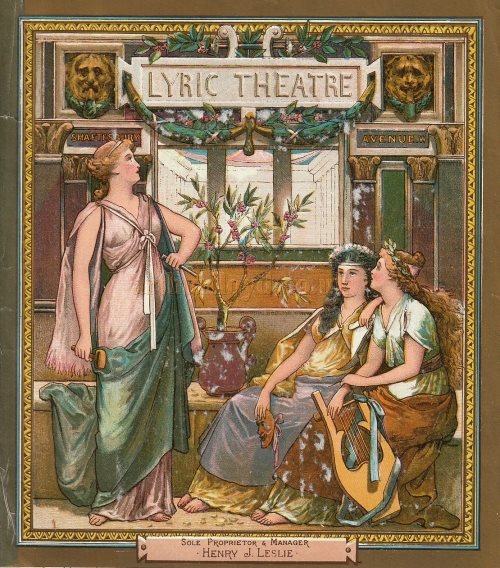
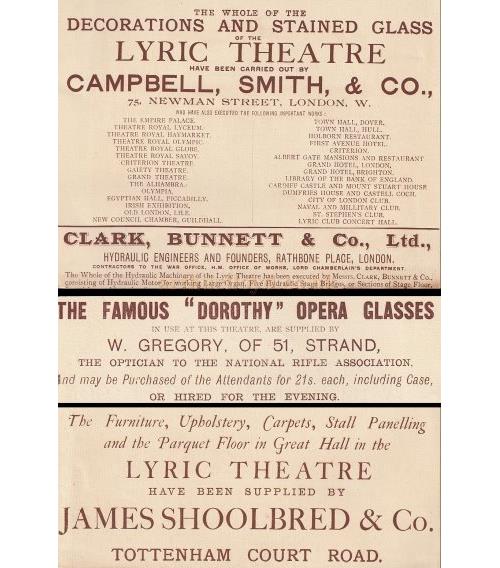
Right - A Programme for the opening production of 'Dorothy' at the Lyric Theatre in December 1888 - Courtesy Simon Moss, stagememories. This is not the complete programme and some pages have been merged to show details of the companies involved with its construction and fitting out.
The Lyric Theatre forms part of a block which includes the Apollo Theatre and the Windmill Theatre, but the Lyric takes up most of the frontage of the block. The Lyric's stage door and dressing rooms are on Great Windmill Street, next to the Windmill's main entrance, and it used to have a Gallery entrance on Archer Street at the back of the Theatre. The Lyric is now one of four Theatres in a row on Shaftesbury Avenue; the others being the Apollo, Gielgud, and Sondheim.
 The
Lyric Theatre was designed by the well known Theatre
Architect C. J. Phipps and built for
Henry J. Leslie by Messrs Stephens and Bastow. Henry Leslie financed the building of his new Theatre
from the profits of 'Dorothy' from which he apparently made the huge
sum, at the time, of £100,000.
The
Lyric Theatre was designed by the well known Theatre
Architect C. J. Phipps and built for
Henry J. Leslie by Messrs Stephens and Bastow. Henry Leslie financed the building of his new Theatre
from the profits of 'Dorothy' from which he apparently made the huge
sum, at the time, of £100,000.
Left - The auditorium and stage of the Lyric Theatre in 1889 - From 'London Theatres and Music Halls' by Dianna Howard - The original is at the British Museum.

In an interview with the New Zealand Evening Post in 1932 Mary Tempest, who had opened the Theatre in 1888 said of the Lyric:- 'I have always loved it, although I never played in it after its first two years...
 I was a prima donna of the 'Dorothy' company, and I had a fairly large hand in the actual decorations of the House. What really happened was that the Lyric was built by Mr. Henry Leslie, who had taken over 'Dorothy' from Edwardes, and ran it for a year at the Prince of Wales's with Hayden Coffin and Ben Davies and myself.
Left - A Programme for 'Othello' at the Lyric Theatre in 1897 - Click to see Entire Programme.
It was in a February* that we moved to the new Lyric - in such a hurry that the walls were still dripping wet. It was too terrible, and finally I had to dress in the Royal Room adjoining the Royal box, which had a staircase leading down to the stage. Its windows looked out on Shaftesbury Avenue.
All the same I adored the theatre. Acoustically it was, and is, perfect, and I have always thought of it as the ideal musical-comedy house. 'Dorothy' ran for another year and then I sang in 'Doris' and 'The Red Hussar' - and then I went off to America, and, strangely enough, I have never played at the Lyric since.' - The New Zealand Evening Post, 8th of February 1932.
*Note that the Theatre actually opened in December 1888 and not February as mentioned by Mary Tempest in the interview.

Above - The Lyric Theatre, Shaftesbury Avenue - From 'Modern Opera Houses and Theatres' by Edwin O Sachs, Published 1896-1898, and held at the Library of the Technical University (TU) in Delft - Kindly sent in by John Otto.

Above - A Drawing of the Front Elevation of the Lyric Theatre, Shaftesbury Avenue - From 'Modern Opera Houses and Theatres' by Edwin O Sachs, Published 1896-1898, and held at the Library of the Technical University (TU) in Delft - Kindly sent in by John Otto.

Above - A Longitudinal Section of the Lyric Theatre, Shaftesbury Avenue - From 'Modern Opera Houses and Theatres' by Edwin O Sachs, Published 1896-1898, and held at the Library of the Technical University (TU) in Delft - Kindly sent in by John Otto.


Above - Ground Plans for the Lyric Theatre, Shaftesbury Avenue - From 'Modern Opera Houses and Theatres' by Edwin O Sachs, Published 1896-1898, and held at the Library of the Technical University (TU) in Delft - Kindly sent in by John Otto.
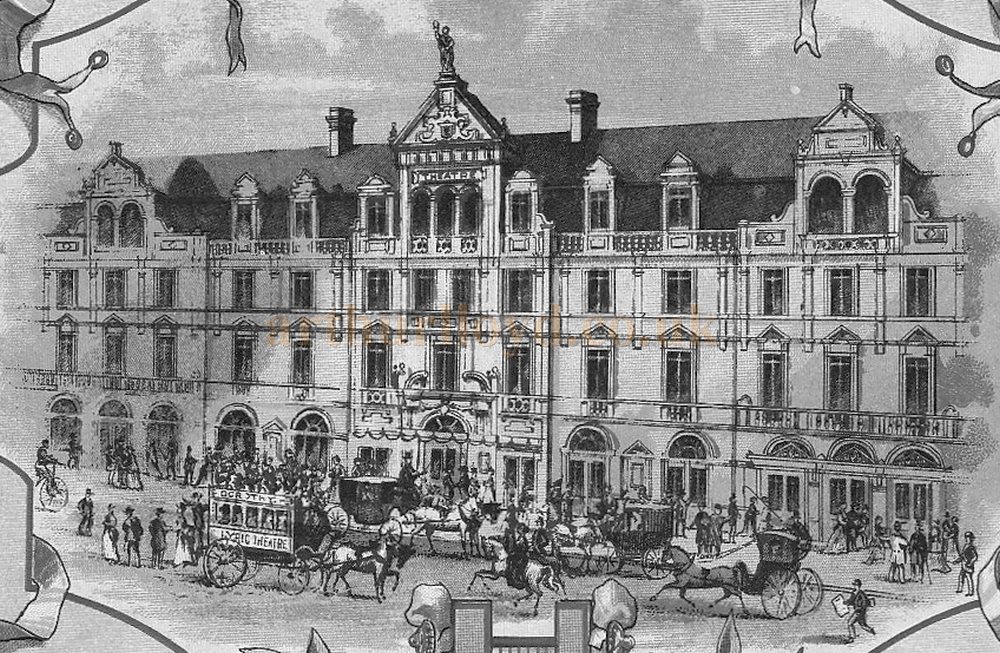
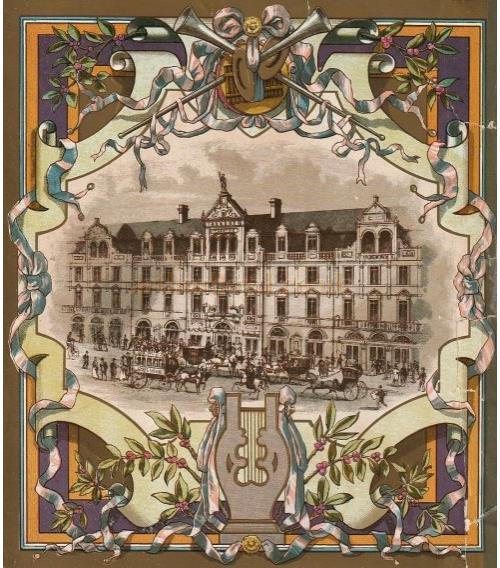
Above - The Lyric Theatre, Shaftesbury Avenue when it first opened in 1888 - From a Programme for the Theatre's opening production of 'Dorothy' in December 1888 - Courtesy Simon Moss, stagememories.
 The
Lyric Theatre's Windmill Street Facade is interesting in that it is
actually the remains of a house which once stood there.
The
Lyric Theatre's Windmill Street Facade is interesting in that it is
actually the remains of a house which once stood there.
The house was built in 1766 by Dr William Hunter, who was an anatomist, partly as a home and partly as an anatomical theatre and museum.
Internally the house was gutted to make way for the Lyric's dressing rooms but externally it is still much in its original form.
The rear of the house was demolished so that the Lyric's stage could be built on the site.
On the Windmill Street Facade today there is a Blue Plaque to commemorate the original building.
Right - The Lyric Theatre's Windmill Street Facade showing the remains of the house that once stood there, now the Lyric's dressing room block and stage door entrance. M. L. 06.
The Lyric Theatre's partly cantilevered auditorium was built on four levels, Stalls and Pit, Dress Circle, Upper Circle, and Gallery, and had a capacity on opening of 1,306.

Above - A Painting by George Richmond depicting the Auditorium and Stage of the Lyric Theatre in 1889. The painting is based on a drawing of the Theatre held at the British Museum, colours were suggested by contemporary articles on this page - Click for an Index to all of George Richmond's Paintings on this site.
 Today
the Theatre's Gallery is called the Balcony and the auditorium seats a more modest
967 people. The stage at the Lyric was large for a playhouse with a width of
29' 6" and depth of 36'.
Today
the Theatre's Gallery is called the Balcony and the auditorium seats a more modest
967 people. The stage at the Lyric was large for a playhouse with a width of
29' 6" and depth of 36'.
Right - An early postcard showing the Lyric and Apollo Theatres side by side in Shaftesbury Avenue.
 When it opened the
Theatre used water to operate its iron curtain, originally this was pumped from the Thames to most of the Theatres and
Hotels around London's West End,
and used to hydraulically operate lifts and all manor of heavy machinery.
Later the Lyric's Iron Curtain was operated via an electric pump but
could also be operated manually by two people at a time, though it was a
very labour intensive job, and slow too.
When it opened the
Theatre used water to operate its iron curtain, originally this was pumped from the Thames to most of the Theatres and
Hotels around London's West End,
and used to hydraulically operate lifts and all manor of heavy machinery.
Later the Lyric's Iron Curtain was operated via an electric pump but
could also be operated manually by two people at a time, though it was a
very labour intensive job, and slow too.
Left - The Lyric Theatre during the run of 'Grab me a Gondola' in 1958 - Courtesy Gerry Atkins.
The Lyric was equipped with five hydraulic bridges in its stage shortly after it was built, more information on these can be found below, however these were later removed and a large revolve was installed instead and was still operable when I worked there in the late 1970s, either by a huge and ancient electric rectifier or by hand.


Above Left - A Programme for 'The Duchess Of Dantzic,' a romantic opera by Henry Hamilton, produced at the Lyric Theatre during the end of the Forbes-Robertson season in October 1903, a musical version of the story of Napoleon, which ran for 236 performance. And Right - A Programme for 'The Medal and The Maid,' a musical comedy with Ada Reeve and Ruth Vincent produced at the Lyric Theatre during the end of the Forbes-Robertson season in April 1903.

Above - A Seating Plan for the Lyric Theatre, date unknown, possibly mid 1920s.

Above - A Seating Plan for the Lyric Theatre - From 'Who's Who in the Theatre' published in 1930 - Courtesy Martin Clark. Click to see more Seating Plans from this publication.
 Shortly
after the Lyric Theatre was opened a set of five bridges were installed
in its stage, operated by hydraulic rams, rather like those still
in place at the Theatre royal, Drury Lane.
Today they are long gone but Edwin O Sachs reported on them in his 'Modern
Opera Houses and Theatres', published between 1896 and 1898 saying:- 'As regards
the installation at the Lyric' Theatre London, it consisted of five
sets of bridges supported by hydraulic rams and placed towards the rear
of the stage proper.
Shortly
after the Lyric Theatre was opened a set of five bridges were installed
in its stage, operated by hydraulic rams, rather like those still
in place at the Theatre royal, Drury Lane.
Today they are long gone but Edwin O Sachs reported on them in his 'Modern
Opera Houses and Theatres', published between 1896 and 1898 saying:- 'As regards
the installation at the Lyric' Theatre London, it consisted of five
sets of bridges supported by hydraulic rams and placed towards the rear
of the stage proper.
Right - A Plan of the Bridges installed in the Lyric Theatre's Stage after the Theatre had opened - From 'Modern Opera Houses and Theatres' by Edwin O Sachs, Published 1896-1898, and held at the Library of the Technical University (TU) in Delft - Kindly sent in by John Otto.
In the illustrations of this installation, Fig. 124 (shown below left) is a section showing the character the appliances without any regard to the construction of the stage, while Fig. 123 (shown right) is a corresponding plan showing the position of the bridges with their pipage. The appliances at the Lyric Theatre were the first of their kind, and their construction apparently took some time, for the work was spread over a period of fifteen months. On the other hand, the outlay was comparatively small, for the cost of the five bridges fully installed was only 867l. The work of erection, I should add, was carried out after the theatre had been opened. Four of the bridges may be termed bridges proper, for they only rise to stage floor level, but a fifth and larger bridge can be taken 10 feet (3 .04 metres) above this level. The loads for the first four bridges are each calculated at two tons, whilst that of the fifth bridge is three tons.
The stage has only one mezzanine and the height from the cellar floor to stage at curtain line is 17 feet 3 inches (5.25 metres). There are, of course, two rams to each bridge, and for the four front bridges the diameter of the rams is 3-¼ inches (90 millimetres), whilst for the larger one the diameter is 4 inches (100 millimetres). The consumption of water for the rise of any of the front bridges is twelve gallons, whilst twenty-nine gallons are required to raise the large bridge a total height of 27 feet (8.20 metres), or 10 feet (3 metres) above the stage floor level.
 The
installation should be considered simply in the light of a set of five
ordinary hydraulic lifts which chance to have been added to a stage.
There is nothing essentially different from similar hoists or elevators
elsewhere or anything calling for special comment. And yet this application
of water power at the Lyric Theatre, with the view of assisting theatrical
effects, marks an important step in the improvement of stage mechanism
in this country.
The
installation should be considered simply in the light of a set of five
ordinary hydraulic lifts which chance to have been added to a stage.
There is nothing essentially different from similar hoists or elevators
elsewhere or anything calling for special comment. And yet this application
of water power at the Lyric Theatre, with the view of assisting theatrical
effects, marks an important step in the improvement of stage mechanism
in this country.
Left - A Section Plan of the Bridges installed in the Lyric Theatre's Stage after the Theatre had opened - From 'Modern Opera Houses and Theatres' by Edwin O Sachs, Published 1896-1898, and held at the Library of the Technical University (TU) in Delft - Kindly sent in by John Otto.
The Lyric ' installation was the first of its kind in this metropolis. Again reverting to the Drury Lane stage, I take the opportunity of saying that the production of the pantomime of Christmas 1896, marked the first adoption of hydraulic machinery for spectacular effects in one of our largest London theatres. The late Sir Augustus Harris had for many years been considering the advisability of installing hydraulic machinery at the Drury Lane Theatre, and at the Covent Garden Opera House, but had, as the lessee to consider the financial outlay and the time it would occupy to set up the appliances. Shortly before his death, however, he decided to order two large bridges for the first-named establishment. These appliances were primarily intended to facilitate the presentation of a large shipwreck scene. The machinery for these two bridges was ordered from Austria, but unfortunately show lines almost identical with those of the earliest Asphaleia work of 1881, instead of the more recent foreign types mentioned in these pages...

Above - The Drury Lane Lifts in action in the late 1890s - From 'Modern Opera Houses and Theatres' by Edwin O Sachs, Published 1896-1898, and held at the Library of the Technical University (TU) in Delft - Kindly sent in by John Otto.
 ...Each bridge measures 4.0 feet (12.9 metres) by 7 feet 6 inches (2.28
metres) and can be raised to nearly 12 feet (3.65 metres) above stage
floor line, whilst the fall under the stage is 9 feet (2.74 metres).
The two bridges adjoin one another, and are only divided from each other
and from the surrounding floor by flaps (Casettenklappen) which are
fixed to the slab of the bridge. The appliances sent from Austria had,
by the bye, to be adapted to suit English requirements in respect to
hydraulic pressure for though the supply by the hydraulic mains is not
more than 700lbs., the valves and cylinders can only stand a much lower
pressure, and reducing valves had, therefore, to be introduced.
...Each bridge measures 4.0 feet (12.9 metres) by 7 feet 6 inches (2.28
metres) and can be raised to nearly 12 feet (3.65 metres) above stage
floor line, whilst the fall under the stage is 9 feet (2.74 metres).
The two bridges adjoin one another, and are only divided from each other
and from the surrounding floor by flaps (Casettenklappen) which are
fixed to the slab of the bridge. The appliances sent from Austria had,
by the bye, to be adapted to suit English requirements in respect to
hydraulic pressure for though the supply by the hydraulic mains is not
more than 700lbs., the valves and cylinders can only stand a much lower
pressure, and reducing valves had, therefore, to be introduced.
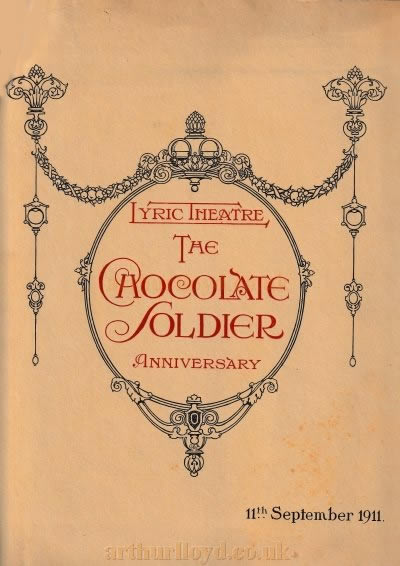
Right - An Anniversary Souvenir Programme for 'The Chocolate Soldier at the Lyric Theatre in September 1911, the show was first produced at the Shaftesbury Theatre in 1910 and revived there in 1940, and was the last production at that Theatre before it was destroyed by bombs in the 2nd World War - Courtesy Jeff Clarke.
The cylinders, I would here add, have an abnormally large diameter of about 17 inches (0.43 metre) each. As both bridges are used together, it is curious that no system of coupling has been adopted, since the separate regulation of each bridge, even when in competent hands, is a matter of great difficulty, and the rise between the two 'bridge,' certainly fluctuates to the extent of a few inches during the movement. However limited the installation at Drury Lane may be, it is certainly a move in the right direction, and those responsible for the economy of this institution recognise that for pantomime and transformation work a great saving in the wage list should be arrived at by the adoption of modern methods. It is, perhaps, interesting to note that even with two hydraulic bridges at work there are still over 100 men employed in shifting scenery during a production of a pantomime...'
The above text in quotes (edited), and its accompanying images, were first published in Edwin O Sachs' 'Modern Opera Houses and Theatres', 1896 / 1898.

Above - Shaftesbury Avenue in June 1977 showing the Lyric, Apollo, Globe, and Queen's Theatres - Photo M.L. 1977.
 I worked at the Lyric Theatre myself from 1975
for 4 years, and the lighting board at that time was one of the early
Rank Strand Console Desks (CD) (Shown Right). The cabinet was
fashioned from an organ and it even had pedals and tabs to operate lighting
groups. This CD board was the two preset version which made life much
easier as the original version, used at Her
Majesty's Theatre at the same time, had organ keys instead of presets.
Although I worked there too in 1974, I was never able to fathom out
how to operate the thing.
I worked at the Lyric Theatre myself from 1975
for 4 years, and the lighting board at that time was one of the early
Rank Strand Console Desks (CD) (Shown Right). The cabinet was
fashioned from an organ and it even had pedals and tabs to operate lighting
groups. This CD board was the two preset version which made life much
easier as the original version, used at Her
Majesty's Theatre at the same time, had organ keys instead of presets.
Although I worked there too in 1974, I was never able to fathom out
how to operate the thing.
Right - The Lighting Console Desk at the Lyric Theatre in 1976. Photo M.L.
 The
board at the Lyric also had a speed control which was like a large accelerator
on a car. You had to push the pedal harder with your foot to create
faster lighting changes. On matinees the electricity supply was always
at a lower voltage than in the evenings so that you had to increase
the speed to attain the same lighting fade times.
The
board at the Lyric also had a speed control which was like a large accelerator
on a car. You had to push the pedal harder with your foot to create
faster lighting changes. On matinees the electricity supply was always
at a lower voltage than in the evenings so that you had to increase
the speed to attain the same lighting fade times.
Left - A Programme for 'The Gold Diggers' at the Lyric Theatre in 1926, which ran for 180 performances.
The Console, situated at the back of the Dress Circle, in the bar conveniently, was connected to dimmer racks in the basement under the stage, and these consisted of huge racks of massive dimmers operated by a large motor and clutches. When doing a fast lighting cue you could sometimes hear the motor screaming under the stage from the Stalls. The tabs you can see in the picture above right were used to select which channels you wanted to move in the next lighting change, and groups of these could be selected at once by using stops which were to the right of the Console. When you pulled the stops out the tabs would jump down and the whole desk would thump and 'ding' like a pinball machine. It could take up to two minutes to set all the faders on the presets for the next cue so that rapid lighting changes were something of a challenge. Nowadays lighting is all done with computers and mostly at the touch of one button, and whilst this is far more efficient and versatile it certainly isn't anything like the adrenaline inducing operation of a Rank Strand Console Desk.
 The
Lyric's basement areas used to include an area which stretched right
up to the underneath of the pavement of Shaftesbury Avenue and housed
Crew Rooms, offices and other areas, and above were shops, but the whole
section was sold off by the London Residue Body when the GLC was abolished
and before the Freehold was given to the Theatre's Trust. This has made
further expansion of the Theatre impossible, indeed it now has less
space than it used to. Luckily the stage area was not owned by the GLC
or that might have gone too when it was abolished.
The
Lyric's basement areas used to include an area which stretched right
up to the underneath of the pavement of Shaftesbury Avenue and housed
Crew Rooms, offices and other areas, and above were shops, but the whole
section was sold off by the London Residue Body when the GLC was abolished
and before the Freehold was given to the Theatre's Trust. This has made
further expansion of the Theatre impossible, indeed it now has less
space than it used to. Luckily the stage area was not owned by the GLC
or that might have gone too when it was abolished.
Right - Programme for 'The Flashing Stream' at the Lyric Theatre in 1938 with Godfrey Tearle and Margaret Rawlings, which ran for 201 performances.
 The
Lyric Theatre has been home to a great many successful productions in
its time, far too many to list here, but recent successes include 'Blood
Brothers' in 1983, which won several awards and, although it only ran
for 6 months at the Lyric, went on to tour the country before a new
production arrived in the West End at the Albery Theatre, where it
was a great success, eventually transferring to the Phoenix where, remarkably, it ran from 1991 until 2012; 'Five Guys Named Mo'
in 1990 which ran for five years; 'Cabaret' which was a very popular
production in 2006, and 'Thriller Live' which opened in January 2009
and was still there until 2020 when it closed on the 15th of March due to the Covid Pandemic, and never reopened.
The
Lyric Theatre has been home to a great many successful productions in
its time, far too many to list here, but recent successes include 'Blood
Brothers' in 1983, which won several awards and, although it only ran
for 6 months at the Lyric, went on to tour the country before a new
production arrived in the West End at the Albery Theatre, where it
was a great success, eventually transferring to the Phoenix where, remarkably, it ran from 1991 until 2012; 'Five Guys Named Mo'
in 1990 which ran for five years; 'Cabaret' which was a very popular
production in 2006, and 'Thriller Live' which opened in January 2009
and was still there until 2020 when it closed on the 15th of March due to the Covid Pandemic, and never reopened.
Left - The Lyric Theatre stage door and Windmill Theatre entrance in June 1977 - Photo M.L. 1977.
The CZ Motorcycle parked by The Lyric Theatre hoardings in the photograph above belonged to the late Sir Ralph Richardson who was also an avid BMW Motorcycle owner, he was appearing at the Lyric at the time, in 'The Kingfisher', the other bike was mine.
Today the Lyric Theatre's Freehold is owned by the Theatres Trust and the Theatre itself is currently run by Nimax Theatres whose own website can be found here.
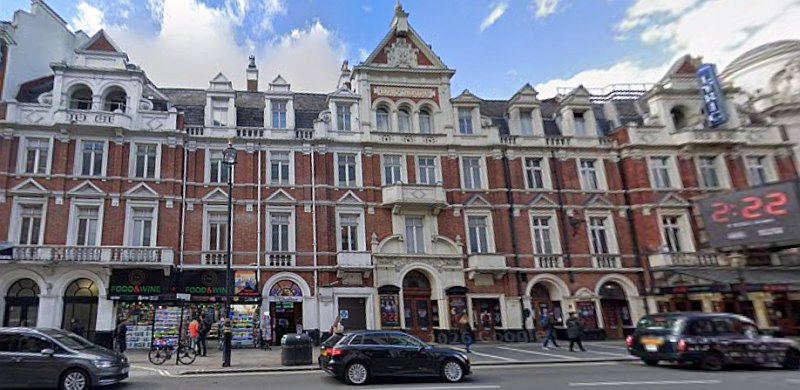
Above - A Google StreetView Image showing the whole of the frontage of the Lyric Theatre in March 2023 - Click to Interact.

Above - The Lyric Theatre during the run of 'Cabaret' in October 2006

Above - The Lyric and Apollo Theatres in Shaftesbury Avenue looking towards Piccadilly Circus - Photo M.L. 2006 - Click for London's West End Theatres page.

Above - The Lyric, Apollo, Gielgud, and Queen's Theatres in Shaftesbury Avenue looking towards Cambridge Circus - Photo M.L. 2006 - Click for London's West End Theatres page.
Adelphi Aldwych Ambassadors Apollo Apollo Victoria Arts Cambridge Charing Cross Theatre Criterion Dominion Donmar Warehouse Drury Lane Duchess Tom Stoppard Theatre Fortune Garrick Gielgud Gillian Lynne Harold Pinter Haymarket His Majesty's Leicester Square Theatre London Coliseum London Palladium Lyceum Lyric Menier Chocolate Factory Noel Coward Novello Old Vic Palace Peacock Phoenix Piccadilly Playhouse Prince Edward Prince of Wales Royal Opera House Sadler's Wells Theatre Savoy Shaftesbury Sondheim St. Martin's Trafalgar Theatre Vaudeville Victoria Palace Wyndham's