
The Fortune Theatre, Russell Street, London, WC2
And the Earlier Fortune Theatre, Golden Lane, Cripplegate, London
The Fortune Theatre Building and History - An article on the Fortune Theatre and its earlier namesake in Cripplegate - The Romance of London Theatres on the Fortune Theatre - The People's Theatre Company at the Fortune Theatre in 1930
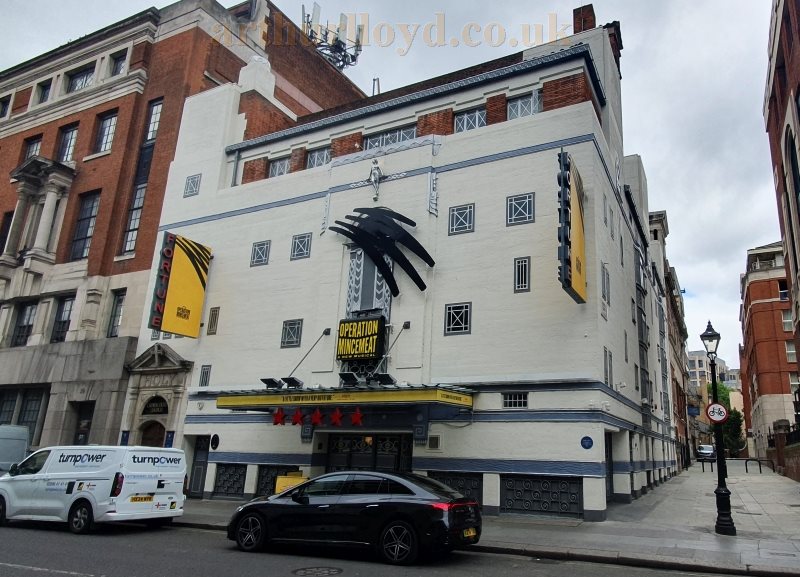
Above - The Fortune Theatre during the run of 'Operation Mincemeat' in May 2026 - Photo M.L.


 The
Fortune Theatre opened on Saturday the 8th of November 1924 with a play
called 'Sinners' by Laurence Cowen, who was also responsible for having
the Theatre built.
The
Fortune Theatre opened on Saturday the 8th of November 1924 with a play
called 'Sinners' by Laurence Cowen, who was also responsible for having
the Theatre built.

Taking nearly two years to build the construction of the Fortune began in 1922 and although it was opened for a press preview on the 25th of April 1924 when it was seen to be practically finished, it would be many months before it would be opened to the public. Many newspapers reported on its imminent opening in April and May 1924, indeed some of the images shown on this page are dated May 1924 and show the Theatre in a what looks like a completed state, but delays with the final fitting out and furnishing, and problems with conforming to regulations by the Council meant that the Theatre wouldn't actually open until over six months later on the 8th of November 1924. An early proposed name for the Theatre had been the Crown Theatre as it's side elevation runs along Crown Court, but when it opened in 1924 it was named the Fortune Theatre.
 The Fortune Theatre was designed by the Zurich born Architect Ernest Schaufelberg who would also design the present Adelphi Theatre on the Strand in 1930. The Theatre
was constructed by Bovis Ltd., on the site of a former Tavern called
the Albion Hotel, and was the first Theatre to
be built in London after the First World War. The seating capacity on
opening was 442.
The Fortune Theatre was designed by the Zurich born Architect Ernest Schaufelberg who would also design the present Adelphi Theatre on the Strand in 1930. The Theatre
was constructed by Bovis Ltd., on the site of a former Tavern called
the Albion Hotel, and was the first Theatre to
be built in London after the First World War. The seating capacity on
opening was 442.
Left - A Painting by George Richmond depicting the Auditorium of the Fortune Theatre in 1924. Colours were suggested by the contemporary articles on this page - Click for an Index to all of George Richmond's Paintings on this site.
Shortly before the Theatre's opening the ERA printed a review of the building in their October the 30th 1924 edition which said:- 'The theatre will certainly be one of the most beautiful in London. The facade alone with its strange medieval art, is already one of the features of metropolitan architecture, and the interior decorations follow the same fresh and original note.
The colour scheme of blue greys, creams, browns, red and old gold is supplemented by an almost lavish use of marble, onyx, copper and wrought iron, and the curtain is a gorgeously rich and satisfying piece of colour. Every seat has a full view of the stage, and they are all of mahogany, upholstered tastefully in dark blue leather.
The famous Schwabe-Hazait lighting system has been installed, not only for its stage purposes, but throughout the theatre, and one of its features is that the lighting in the front of the house is by reflection; not a single lamp being visible to the eye. The entrance hall is an exceedingly handsome affair of marble and copper, and the first thing to meet the eye is the challenging inscription, 'There is a tide in the affairs of men which, taken at the flood, leads on to fortune.'
The above text in quotes was first published in the ERA, October 30th 1924.

Above - The Exterior of the Fortune Theatre in a sketch by its architect Ernest Schaufelberg - From The Builder, May 2nd 1924.
 The Builder reported on the new Fortune Theatre, long before it actually opened, in their May the 2nd 1924 edition, along with many of the images shown here, saying:- 'Built on a site in Covent Garden, this is the first theatre to be built in this country since the war. It is called ''The Fortune," thus reviving the name and the memories of the famous house in which Shakespeare acted.
Right - The Auditorium of the Fortune Theatre - From The Builder, May 2nd 1924.
The theatre has been built for Mr. Laurance Cowan, the playwright. The present building adjoins the Scottish National Church in Crown-court, which has a right-of-way through the whole length of the site from Russell-street to the gallery exit of the church, and has made the planning of the theatre difficult. Allowance had to be made for this passage, which measures 9 ft. in width, and the site charter permitted building under and over it. Without this passage the site measured only 3,430 sq. ft., and this is the real space available for auditorium and stage.
The smallness of the site necessitated a choice of construction which would yield the greatest saving in space, and after careful consideration ferro-concrete was decided upon, without any facing of brick or stone. The consequence of this that actually only 5in. of ferro-concrete separates the upper circle wall from the building line. The concrete was made of Derbyshire pearl spar and "Atlas" white cement, and the whole face was finally bush-hammered with automatic tools.

Above - The Auditorium of the Fortune Theatre from the Stage - From The Builder, May 2nd 1924.
 The London County Council Regulations demanding at least seven days before centering is struck prevented effective brush washing, and the automatic tool was resorted to out of sheer necessity. Otherwise, the concrete face would have presented a much more colourful and sparkling appearance, since any tool used on spar or marble has the effect of the refractive value of the material.
Right - The Proscenium and Stage of the Fortune Theatre - From The Builder, May 2nd 1924.
The windows are made of mild steel, and the frames are set in the face overlapping the concrete, the windows being thus more or less flush with the building line. This saves special reveal worries. No attempt has been made to mould mould the concrete in any way, and the only ornamentation introduced has been done by ribbons of cast led.
In the interior no attempt was made of a style effect, and line and colour were relied upon entirely. In spite of the smallness of the site the stage itself occupies roughly two fifths of the space available, together with the dressing rooms more than one-half. There are fifteen dressing-rooms, including a rehearsal room, and there is a suite of offices over the top of the auditorium along Russell-street.
The electrical installation has been carried out by Messrs. Ohms, Ltd., under the supervision of Mr. P. Godfrey, who acted as consulting engineer. The electrical intake rooms have been equipped by Messrs. Ernest F. Moy & Co., who are also responsible for the stage switch board. The stage electrical installation is a combination of the English batten system with the Schwabe Hazait system of indirect lighting. The stage hoisting gear, as well as many other items connected with the stage equipment, has been supplied by Messrs Bullivant & Gimson. Messrs. Merryweather were responsible for the safety curtain.

Above - Ernest Schaufelberg's Ground Floor Plan of the Fortune Theatre - From The Builder, May 2nd 1924.
This theatre is the first building in London with a non-combustible stage roof, as required by the new regulations, and the skylight operates automatically in case of fire. The auditorium is heated by a plenum system, the distribution of the warm air being effected by means of a warm air chamber extending through the whole space under the floor of the stalls, with the seats giving not more than 10ft. per second flow in a space of 100 sq. in. Small plenum spaces are arranged under the dress circle and upper circle, and no gratings have been placed in the walls in any single instance. The extract chamber is on the roof, and the extraction of the air is effected in one place exactly over the proscenium arch. This has been done in order that, in the event of a fire occurring on the stage, no flames or smoke would invade the upper circle, but would be drawn straight up on the auditorium side of the proscenium arch during the time required. for the fire curtain to descend.

Above - Ernest Schaufelberg's Balcony Plan of the Fortune Theatre - From The Builder, May 2nd 1924.
All other parts of the building, including the stage and the back of the stage, are heated by means of a high pressure hot-water system. The contractors are Messrs. Bovis, Ltd. The principle marble work was executed by Odling & Sons, and the lead and iron work by Messrs. Henry Hope & Sons, Birmingham, and Messrs Galsworthy, of Newman-street, W. The sanitary installation has been carried out by Messrs. Davis, Bennett & Co. The curtain draperies were executed by Messrs J. A. & Co., of Great Portland-street, W. The stage work is by Messrs. Archibald D. Sons, Ltd.

Above - A Seating Plan for the Fortune Theatre, probably 1920s.
The sighting line of the seating is the result of a test made from all quarters of theatre and a clear unobstructed view of the stage is observable, whilst tip-up comfortable seats are provided from stalls to gallery - a truly welcome improvement. Mr. E. Schaufelberg was the architect.'
The above text in quotes was first published in the Builder May 2nd 1924.

Above - An original 1920s Printers Proof for a programme cover for the Fortune Theatre. You can see an actual programme cover for this period below.
 The Fortune Theatre is a Grade II Listed building
and will be remembered by many people today as being the London home of the phenomenally successful production of the
play 'The Woman in Black' which opened at the Fortune Theatre in 1989, after first
being put on at the Playhouse.
The Fortune Theatre is a Grade II Listed building
and will be remembered by many people today as being the London home of the phenomenally successful production of the
play 'The Woman in Black' which opened at the Fortune Theatre in 1989, after first
being put on at the Playhouse.
Right - A Programme Cover for the Fortune Theatre, from the 1920s - Courtesy Roger Fox. Compare this with the Printer's Proof above.
 'The Woman in Black' ran for 13,232 performances at the Fortune and was on for well over 20 years before it finally closed in March 2023.
Left - The Fortune Theatre during the run of 'Woman In Black' in October 2006 - Photo M.L.
The Fortune Theatre is currently run by the Ambassador Theatre Group and you may like to visit their own Website for the Theatre here.
There now follows some information and images for the Fortune Theatre from various early publications and programmes.

Above - The Fortune Theatre from the roof of the Theatre Royal Drury Lane in 2006.
An Article on the Fortune Theatre, Russell Street, London, and the Fortune Theatre, Golden Lane, Cripplegate, London
From a Programme for 'Are You A Mason' in February 1925

Above - A Sketch of the Fortune Theatre, Russell Street, London - From a programme for 'Are You A Mason' at the Theatre in February 1925.
 In
a programme for a production of 'Are You A Mason?' at the Fortune Theatre
which was produced in February 1925 there is a nice article about the
Theatre itself, and its early namesake, the Fortune Theatre in Golden
Lane, Cripplegate. Interestingly the programme has the wrong date printed
on its first page saying the production opened on Monday the 2nd of
February 1924 when actually it opened on Monday the 2nd of February
1925, which was 4 months after the Theatre opened on the 8th of November
1924. I have transcribed the text of this article, and added some images
from the programme below.
In
a programme for a production of 'Are You A Mason?' at the Fortune Theatre
which was produced in February 1925 there is a nice article about the
Theatre itself, and its early namesake, the Fortune Theatre in Golden
Lane, Cripplegate. Interestingly the programme has the wrong date printed
on its first page saying the production opened on Monday the 2nd of
February 1924 when actually it opened on Monday the 2nd of February
1925, which was 4 months after the Theatre opened on the 8th of November
1924. I have transcribed the text of this article, and added some images
from the programme below.
Right - The programme for 'Are You A Mason' at the Fortune Theatre in February 1925 which this article comes from.
The new theatre which Laurence Cowen, the playwright, has built in Covent Garden, facing the eighteenth century Ionic colonnade forming the portico of Drury Lane Theatre, hitherto the most attractive feature of the locality, is the first theatre to be built in this country since 1914, and is called The Fortune," thus reviving the name and the memories of the famous house in which Shakespeare acted.
The original Fortune Theatre Was built in 1600 by "Peeter Streete, cittizein and carpenter," and was situated in Golden Lane, Cripplegate. Documentary evidence as to the internal structure of this Elizabethan theatre is to be found in the detailed building contracts for its erection carefully preserved in the archives at Dulwich College...

Above - A Sketch of the original Fortune Theatre in Golden Lane, Cripplegate - From a programme for 'Are You A Mason' at the Theatre in February 1925.
...The contrast with those of its successor of 1924 makes interesting reading and demonstrates the amazing difference in money values as well as methods of construction spanning the three and a quarter centuries. "The Fortune " was the only theatre permitted for the presentation of stage plays by a Privy Council Order in June, 1600, within the County of Middlesex; one other there was in the adjoining County of Surrey - "The Globe" equally immortalised by actual association with Shakespeare and his company of players. Both houses - "absit omen !" - were burnt to the ground; "The Globe " first, in June 1613, and "The Fortune" in December 1621...

Above - A Sketch of the original Fortune Theatre in Golden Lane, Cripplegate - From 'Diproses Book of the Stage and the Players' Circa 1877. Caption Reads:- 'The Fortune Theatre was built by Philip Henslowe and William Alleyn, in 1599-1600, on the east side of Golden Lane, without Cripplegate. It cost £1,320, and was opened May, 1601. It was a square timber and lath and plaster building, and was burnt December 9th, 1621 (Alleyn's Diary); but was rebuilt on a circular plan, of brick and tiled, 1624. The interior was burnt in 1649 - Prynne says by accident, but it was fired by sectarians. In the Mercurius Politicus, February 14th-21st, 1661, the building, with the ground thereunto belonging, were advertised "to be lette to be built on;" and it is described as standing between "Whitcross Street and Golden Lane"'.
 ...In these demolished playhouses were many of Shakespeare's original
manuscripts, which were the property of his theatrical company. Scattered
copies survived elsewhere in private hands, but the loss of the dramatist's
autographs - according to Sir Sidney Lee - rendered incurable the many
textual defects of surviving transcripts. It would appear that Shakespeare
and his company suffered no better fortune in the case of the "Fortune"
than in the earlier "Globe" burning, when they lost every
costume and property they possessed.
...In these demolished playhouses were many of Shakespeare's original
manuscripts, which were the property of his theatrical company. Scattered
copies survived elsewhere in private hands, but the loss of the dramatist's
autographs - according to Sir Sidney Lee - rendered incurable the many
textual defects of surviving transcripts. It would appear that Shakespeare
and his company suffered no better fortune in the case of the "Fortune"
than in the earlier "Globe" burning, when they lost every
costume and property they possessed.
Right - A programme for 'Fools Rush In' in 1946 which was the first production to be put on at the Fortune Theatre after the Second World War, during which time it had been used by E.N.S.A.
The site on which the new "Fortune" theatre has been erected is historic ground. Here or hereabouts was the famous "Cockpit " - afterwards rechristened the "Phoenix" - built about 1610, and the first theatre to be built in Drury Lane. Later, the almost as famous Albion Tavern, the haunt of the literati and the actors of the Georgian and Victorian eras, bade its guests welcome on this precious bit of soil.
The present edifice not only adjoins the Scottish National Church in Crown Court, but actually embraces it, for the entrance to the church in Russell Street has the theatre built over and under it, a remarkable piece of designing and engineering; for though this passage-way traverses its entire length, stage included, on one of its sides, it is not discernible from within: a most complete example of the union of Church and Stage!
 The
Fortune is the first theatre to be built in this country of ferro-concrete,
which, like wine, improves with age, and as metals and marbles are the
only other materials employed in its construction, it is practically
fire-proof and the safest theatre in the world. It forms a unique and
most picturesque architectural addition to London's buildings, for its
frontages strike a charming medieval note of Italian Renaissance, and
have no counterpart in the Metropolis.
The
Fortune is the first theatre to be built in this country of ferro-concrete,
which, like wine, improves with age, and as metals and marbles are the
only other materials employed in its construction, it is practically
fire-proof and the safest theatre in the world. It forms a unique and
most picturesque architectural addition to London's buildings, for its
frontages strike a charming medieval note of Italian Renaissance, and
have no counterpart in the Metropolis.
Left - Enid Cooper, Richard Cooper, and Elizabeth Arkell - from the programme for 'Are You A Mason' at the Fortune Theatre in February 1925.
 Its
lofty walls and turrets of pale-green and granite-grey masonry are traversed
by great ornamental bands of lead, the austerity of the surface being
otherwise broken by marble surrounds of black and pink and yellow; the
whole studded with quaint metal windows and doors of original design
and wondrous craftsmanship - the finest specimens of structural metallurgy
in London, which took a whole year in the making - in which iron, steel,
lead and bronze are wrought into a beautiful juxtaposition - all novel
and artistic to a degree.
Its
lofty walls and turrets of pale-green and granite-grey masonry are traversed
by great ornamental bands of lead, the austerity of the surface being
otherwise broken by marble surrounds of black and pink and yellow; the
whole studded with quaint metal windows and doors of original design
and wondrous craftsmanship - the finest specimens of structural metallurgy
in London, which took a whole year in the making - in which iron, steel,
lead and bronze are wrought into a beautiful juxtaposition - all novel
and artistic to a degree.
Right - Cast Details from the programme for 'Are You A Mason' at the Fortune Theatre in February 1925 - Note the date on this page of the programme is incorrectly stated as 1924.
Set high up over the arched central window of the "Fortune's" frontage is a charming life-size metal figure of a dancing girl, representing the Goddess Terpsichore - a graceful touch and an effective symbol. The theatre is a very miracle of ingenious surmounting of difficulties of space, for though it covers only some 4,000 square feet, it is perhaps the most completely equipped of any. It is true that expansion has been possible by digging deeply and widely around and beneath the surface level; but even then it is nothing short of amazing that so much has been made of so little.
The auditorium provides accommodation for between 600 and 700 persons; there are three floors, stalls and pit stalls, circle stalls, balcony stalls and four private boxes; the stage is spacious, as large as those of theatres of double the holding capacity, and far and away the best equipped; the dressing-rooms are a revelation in respect of light, air and equipment. There is a rehearsal room of ample capacity; refreshment saloons, foyers, lavatories and cloakrooms are supplied to every part of the house; a full-sized orchestra pit; a fine suite of managerial offices traverse the entire width of its front elevation.
The flat roof, as in the case of the floor level beneath the stage and stalls, is utilised for housing the elaborate plant which provides the heating, ventilating and hydraulic systems, the most efficient modern science has evolved. The electric light installation is the most complete and extensive ever fitted in a theatre, the famous Schwabe-Hazait system being used throughout, and not, as in other instances, for the stage only. A unique feature of the lighting of the auditorium is that it is entirely concealed, and affords the illusion of daylight.

Above - Cast Details from the programme for 'Are You A Mason' at the Fortune Theatre in February 1925.
The colour-scheme of blue-greys, creams, browns, reds and old gold, and the lavish use of marble, onyx, copper and wrought iron as primary means of decoration, are somewhat extravagantly experimental - in the sense that they are "different." The new "Sulzer" heating and ventilating system - for it is a combined process - is the first to be installed in a place of entertainment in this country, and is supplied from great vacuum chambers beneath all the floors.

 The
seating is the same throughout the auditorium - mahogany chairs upholstered
in dark blue leather. All seats have a full view of the stage, that
bugbear of most theatres, side-seats, being eliminated. The tableau
and other curtain upholsteries are of heavy silk-velvet, of a luscious
gold blend, which obtain an enhanced effect from splashes of emerald
and scarlet - a gorgeous bit of colouring. The structural design and
colour scheme unite in providing an unusual "intimate" effect
upon audience and players. The acoustics are perfect, the stage shaping
like a trumpet's mouth into the auditorium. The flooring throughout
is covered with rubber, on which carpets of thick brown pile secure
an absolutely noiseless tread. The proscenium arch provides the opportunity
for beautiful mural painting, and here breaks entirely new ground.
The
seating is the same throughout the auditorium - mahogany chairs upholstered
in dark blue leather. All seats have a full view of the stage, that
bugbear of most theatres, side-seats, being eliminated. The tableau
and other curtain upholsteries are of heavy silk-velvet, of a luscious
gold blend, which obtain an enhanced effect from splashes of emerald
and scarlet - a gorgeous bit of colouring. The structural design and
colour scheme unite in providing an unusual "intimate" effect
upon audience and players. The acoustics are perfect, the stage shaping
like a trumpet's mouth into the auditorium. The flooring throughout
is covered with rubber, on which carpets of thick brown pile secure
an absolutely noiseless tread. The proscenium arch provides the opportunity
for beautiful mural painting, and here breaks entirely new ground.
Commenced in December, 1922, and first opened to the public on Saturday, November 8, 1924, under the management of Miss Ida Molesworth and her husband, Captain Temple Powell, (shown above) with a play by Mr. Cowen, entitled "Sinners," the theatre has occupied nearly two years in construction, more than twice the time contemplated by the contractors.
 An
equally embarrassing instance of post-war building conditions is furnished
in respect of costs, the realised expenditure being approximately three
times the original estimated maximum figures. It is doubtful if any
modern structure in London has necessitated such an outlay per square
foot as this latest acquisition to its places of entertainment - in
the handsome marble and copper entrance hall of which there is fitted
the pregnant if fate-challenging inscription : "There is a tide
in the affairs of men, which, taken at the flood, leads on to Fortune."'
An
equally embarrassing instance of post-war building conditions is furnished
in respect of costs, the realised expenditure being approximately three
times the original estimated maximum figures. It is doubtful if any
modern structure in London has necessitated such an outlay per square
foot as this latest acquisition to its places of entertainment - in
the handsome marble and copper entrance hall of which there is fitted
the pregnant if fate-challenging inscription : "There is a tide
in the affairs of men, which, taken at the flood, leads on to Fortune."'
Left - Laurence Cowen who wrote the opening play 'Sinners' for the Fortune Theatre, and his dog "Nanki Wu".
The above text in quotes, and its accompanying images, is from a programme for 'Are You A Mason' at the Fortune Theatre in February 1925.
An Article on the Fortune Theatre from 'The Romance of London Theatres' by Ronald Mayes 1931

Above - The Fortune Theatre during the run of 'Woman In Black' in October 2006.
 The
Fortune Theatre faces the 18th century Ionic colonnade forming the portico
to Drury Lane. Built by Laurance Cowen,
author and playwright, it was, the first theatre to be erected in England
for a period of ten years (1914-24), and in being christened the Fortune
it revives the name and memories of the famous house in which Shakespeare
acted.
The
Fortune Theatre faces the 18th century Ionic colonnade forming the portico
to Drury Lane. Built by Laurance Cowen,
author and playwright, it was, the first theatre to be erected in England
for a period of ten years (1914-24), and in being christened the Fortune
it revives the name and memories of the famous house in which Shakespeare
acted.
Right - The Fortune Theatre from within the Theatre Royal, Drury Lane portico beside the stage door. Photo M.L. 06.
The first Fortune theatre was built in 1600 and stood in Golden Lane, Cripplegate. This old house of so many associatons was burnt to the ground in December, 1621. The famous "Cockpit," afterwards rechristened the "Phoenix," and built about 1610, occupied the site on which the new Fortune Theatre stands. It was also on the same site that the famous "Albion" tavern stood-a haunt of the actors of the Georgian and Victorian eras.

 The
present building adjoins and embraces the Scottish National Church in
Crown Court, for the entrance to the church in Russell Street has the
theatre built over and under it. The house forms a unique and charming
architectural addition to London's buildings. The frontage of the theatre
is in the style of the Italian Renaissance. It has lofty walls and turrets
of pale green and granite grey masonry. The quaint metal windows and
doors are of original design and beautiful craftsmanship.
The
present building adjoins and embraces the Scottish National Church in
Crown Court, for the entrance to the church in Russell Street has the
theatre built over and under it. The house forms a unique and charming
architectural addition to London's buildings. The frontage of the theatre
is in the style of the Italian Renaissance. It has lofty walls and turrets
of pale green and granite grey masonry. The quaint metal windows and
doors are of original design and beautiful craftsmanship.
Right - The Fortune Theatre in the 1930s from a Programme for the Lewisham Hippodrome1931.
Left - Slip inside 'Fools Rush In' Programme of 1946 advertising shows currently playing in London's West End.
The auditorium provides accommodation for between six and seven hundred
persons; there are three floors to the theatre. The stage is as large
as those of theatres of double the holding capacity. The electric lighting
is most complete and extensive, the famous Schwabe-Hazait system being
used throughout. The lighting in the auditorium is entirely concealed
and gives the illusion of daylight. All seats have a full view of the
stage; side seats are eliminated. The acoustics of the theatre are perfect,
the stage shaping like a trumpet mouth into the auditorium. Particularly
handsome is the marble and copper entrance to the house. Just inside
the doors there is a wall plaque on which one reads the inscription:
"There is a tide in the affairs of men, which, taken at the flood,
leads on to  Fortune."
Right - A Slip inside 'Fools Rush In' Programme of 1946 advertising shows currently playing in London's West End.
This theatre, which took nearly two years to construct - more than twice the time contemplated by the contractors - was first opened under the management of Miss Ida Molesworth and her husband, Captain Templer Powell, with a play by Mr. Cowen, entitled "Sinners." The cast of this play included Mr. William Lorrimer and Mr. H. A. Saintsbury.
 A
new enterprise called "The People's Theatre"
has been recently started at this house, for which Mr. J. T. Grein and
Miss Nancy Price are responsible. They have produced "The
Man from Blankleys," a farcical comedy by Mr. Anstey. The play
was well cast and produced and very much enjoyed by the audience.
A
new enterprise called "The People's Theatre"
has been recently started at this house, for which Mr. J. T. Grein and
Miss Nancy Price are responsible. They have produced "The
Man from Blankleys," a farcical comedy by Mr. Anstey. The play
was well cast and produced and very much enjoyed by the audience.
The theatre has been brought into prominence recently on account of the amazing spiritualistic services being held there on Sundays. The discovery of the leading trance medium of the world has created a sensation. (See image left.)
Left - An advertisement for Mrs. Meurig Morris, Trance Medium, in a weekly series of addresses on 'The Philosophy of Spiritualism' at the Fortune Theatre commencing January 1931 - From a programme for 'The Man From Blankleys' at the Fortune Theatre in October 1930.
The above text is from 'The Romance of London Theatres' by Ronald Mayes - From a Programme for the Lewisham Hippodrome1931.
An Article on 'The People's Theatre' at the Fortune Theatre in 1930

Above - A Seating Plan for the Fortune Theatre - From 'Who's Who in the Theatre' published in 1930 - Courtesy Martin Clark. Click to see more Seating Plans from this publication.
 The
People's Theatre was conceived by the playwright, Theatre manager, and
drama critic Jack Thomas Grein, and co-founded with the actress Nancy
Price. It was inspired by Berlin's Volkstheater. London's own People's
Theatre began life at the Fortune Theatre in October 1930. The first
production by the company being 'The Man From Blankleys', and this was
followed by several other well received productions.
The
People's Theatre was conceived by the playwright, Theatre manager, and
drama critic Jack Thomas Grein, and co-founded with the actress Nancy
Price. It was inspired by Berlin's Volkstheater. London's own People's
Theatre began life at the Fortune Theatre in October 1930. The first
production by the company being 'The Man From Blankleys', and this was
followed by several other well received productions.
Right - Nancy Price - From a programme for 'The Man From Blankleys' at the Fortune Theatre in October 1930.
 However, despite the hopes of the company their last performance at
the Fortune was less than a year later in August 1931.
However, despite the hopes of the company their last performance at
the Fortune was less than a year later in August 1931.
Left - J. T. Grein - From a programme for 'The Man From Blankleys' at the Fortune Theatre in October 1930.
The opening programme for 'The Man From Blankleys' has some details of what the company hoped to achieve, which I have transcribed below along with some of its accompanying images:-
 'This
night is born The People's Theatre. It is for you to say whether it
is to live. You have presented it with its silver spoon. It is not a
very heavy spoon, but it is wrought of the right stuff and has many
thousand blessings. But your work, oh god-parents! has only just begun.
We have worked and planned for its well being, but unless you provide
it with food, it will have a very short life. Let it live to get the
Old Age Pension!' - Nancy Price.
'This
night is born The People's Theatre. It is for you to say whether it
is to live. You have presented it with its silver spoon. It is not a
very heavy spoon, but it is wrought of the right stuff and has many
thousand blessings. But your work, oh god-parents! has only just begun.
We have worked and planned for its well being, but unless you provide
it with food, it will have a very short life. Let it live to get the
Old Age Pension!' - Nancy Price.
Right - A Programme cover for the People's Theatre production of 'The Man From Blankleys' at the Fortune Theatre in October 1930.
It must be realised that a very small Theatre, however delightful in itself, cannot permanently house our movement, for, please remember, this is a movement and not a stunt. To cover expenses in a small intimate Theatre, whilst charging very low prices, would only remain a practicable proposition if choice of plays was limited to those with extremely short casts and demanding the setting of but one scene.
 Such a policy of limitation would have
enormous drawbacks, whereas in a reasonably big theatre, with a correspondingly
increased membership practically guaranteeing the sale of seats. It
may be possible to finally create out of membership subscriptions, a
fund to endow a People's Theatre for all time. Thus "Members and
more Members" must be the slogan, and every existing member can
best secure his or her own future entertainment by getting new members,
and so on.
Such a policy of limitation would have
enormous drawbacks, whereas in a reasonably big theatre, with a correspondingly
increased membership practically guaranteeing the sale of seats. It
may be possible to finally create out of membership subscriptions, a
fund to endow a People's Theatre for all time. Thus "Members and
more Members" must be the slogan, and every existing member can
best secure his or her own future entertainment by getting new members,
and so on.
Left - Cast members from the People's Theatre production of 'The Man From Blankleys' at the Fortune Theatre in October 1930.
 It is in this way that the People's Theatre in Berlin has
grown to have half a million members, and this in a City only half the
size of London. With an ever-growing roll of members we, too, can become
owners of a big important theatre.
It is in this way that the People's Theatre in Berlin has
grown to have half a million members, and this in a City only half the
size of London. With an ever-growing roll of members we, too, can become
owners of a big important theatre.
Right - Cast members from the People's Theatre production of 'The Man From Blankleys' at the Fortune Theatre in October 1930.
A DREAM COME TRUE
 About
six months ago I was in Berlin in quest of plays. One evening I saw
the magnificent edifice of the Volkstheater (People's Theatre), holding
3,000; I saw a play wonderfully performed by real artistes and I went
back to my hotel feeling like Alice in Wonderland, amazed and abashed
that we had no institution to equal it in the greatest city in the world
- London.
About
six months ago I was in Berlin in quest of plays. One evening I saw
the magnificent edifice of the Volkstheater (People's Theatre), holding
3,000; I saw a play wonderfully performed by real artistes and I went
back to my hotel feeling like Alice in Wonderland, amazed and abashed
that we had no institution to equal it in the greatest city in the world
- London.
Left - Cast Details form a Programme for the People's Theatre production of 'The Man From Blankleys'. The cast included Pauline Sitwell, Pamela Carme, Ethel Warwick, Shayle Gardner, Sam Livesley, Margaret Scudamore, Sydney Fairbrother, Vera Beringer, Wilfred Fletcher, H. O. Nicholson, Frederick Lloyd, Laura Smithson, Martin Walker, Dorothy Cheston, Guy Newall, Ursula Millard, and Jean Darcy.
 I tried to sleep, and at length I fell into a heavy slumber. I saw
the vision splendid. I beheld piles and piles of half-crowns gradually
rising to the height of pillars, like the girders of of a concrete building:
and the pillars became framed with walls, the space within them alive
with people - a throng of onlookers, a band of actors: and I heard such
deafening applause and shouts that I awoke with a jubilating cry - "The
People's Theatre."
I tried to sleep, and at length I fell into a heavy slumber. I saw
the vision splendid. I beheld piles and piles of half-crowns gradually
rising to the height of pillars, like the girders of of a concrete building:
and the pillars became framed with walls, the space within them alive
with people - a throng of onlookers, a band of actors: and I heard such
deafening applause and shouts that I awoke with a jubilating cry - "The
People's Theatre."
Right - Cast members from the People's Theatre production of 'The Man From Blankleys' at the Fortune Theatre in October 1930.
 Twenty-four hours later I was back in London on duty at a first night,
my head full of thoughts and plans, but anxious, too, lest somebody
should steal my treasure, frustrate me, frustrate the vision of a lifework.
Twenty-four hours later I was back in London on duty at a first night,
my head full of thoughts and plans, but anxious, too, lest somebody
should steal my treasure, frustrate me, frustrate the vision of a lifework.
And, lo and behold, I saw the gifted actress, Nancy Price, and I exclaimed, "You are heaven-sent, my friend. Will you be my partner, my fellow-worker ?"
Left - Cast members from the People's Theatre production of 'The Man From Blankleys' at the Fortune Theatre in October 1930.
 "Will I?" she said, enthusiasm radiating in her eyes. "Indeed
I will; I will help you with all my might and main."
"Will I?" she said, enthusiasm radiating in her eyes. "Indeed
I will; I will help you with all my might and main."
But we had no money for such a mighty scheme. So we put the few pounds we could spare into a bank, for we had trust in the people. They would subsidise us; they would give us their half-crowns in return for seats so cheap and performances so good that we could defy all competition.
Right - Cast members from the People's Theatre production of 'The Man From Blankleys' at the Fortune Theatre in October 1930. And Founder Members of the People's Theatre.
And from practically nothing, from stamps and circulars, from a helpful press, the piles grew to pillars - and to-day, after two months' arduous labour, our People's Theatre has come into being: has come, we hope, to stay.
That is YOUR work, my bountiful readers. For this we vow you our lasting gratitude and our unremitting zeal. May we prove worthy of your trust. - J. T. GREIN.
The above text on the People's Theatre, and its accompanying images, is from a programme for 'The Man From Blankleys' at the Fortune Theatre in October 1930.

Above - The Fortune Theatre during the run of 'The Woman In Black' in December 2016.
Adelphi Aldwych Ambassadors Apollo Apollo Victoria Arts Cambridge Charing Cross Theatre Criterion Dominion Donmar Warehouse Drury Lane Duchess Tom Stoppard Theatre Fortune Garrick Gielgud Gillian Lynne Harold Pinter Haymarket His Majesty's Leicester Square Theatre London Coliseum London Palladium Lyceum Lyric Menier Chocolate Factory Noel Coward Novello Old Vic Palace Peacock Phoenix Piccadilly Playhouse Prince Edward Prince of Wales Royal Opera House Sadler's Wells Theatre Savoy Shaftesbury Sondheim St. Martin's Trafalgar Theatre Vaudeville Victoria Palace Wyndham's