
The Palace Theatre, Cambridge Circus, Shaftesbury Avenue, London, W1
Formerly - The Royal English Opera House.
Also see:- This Chapter of Concert Halls and Assembly Rooms by Ernest Woodrow, 1895

Above - The Palace Theatre during production for 'Harry Potter and The Cursed Child Parts 1 and 2' in May 2016


 The
Palace Theatre was built in 1891 for Richard D’Oyly Carte as The
Royal English Opera House on an island site at the end of London's
Shaftesbury Avenue, dominating the view from Cambridge Circus.
The
Palace Theatre was built in 1891 for Richard D’Oyly Carte as The
Royal English Opera House on an island site at the end of London's
Shaftesbury Avenue, dominating the view from Cambridge Circus.

This magnificent building was designed by Richard D’Oyly Carte himself with G. H. Holloway providing the drawings and J. G. Buckle as consultant. The architect was T. E. Collcutt. The English Opera House's stage was equipped with some revolutionary flying and stage equipment patented by Walter Pfeffer Dando which you can read about here.
The Theatre opened on the 31st of January 1891 with a production of Arthur Sullivan's Opera 'Ivanhoe' which ran for 155 performances. Unfortunately for D’Oyly Carte, as an Opera House the Theatre was a major failure, and the building was quickly converted the following year, 1892, into a Variety Theatre by the architect Walter Emden, and renamed The Palace Theatre of Varieties. In 1908 Emblin Walker was engaged again, this time to reconstruct the amphitheatre.

Above - A Seating Plan for the Palace Theatre - From 'Who's Who in the Theatre' published in 1930 - Courtesy Martin Clark. Click to see more Seating Plans from this publication.
In 1989 the exterior of the Theatre was restored to its former glory. And in 2004, after the Theatre's longest run, 'Les Misserables,' had moved to the Queen's Theatre, the interior was given a major restoration too, consequently the Palace Theatre still remains much in its original form over a hundred years later. The Palace Theatre is currently run by Nimax Theatres whose own website can be found here.
Details of the building of the Royal English Opera House from an article by the Royal Institute of British Architects of 1892 can be found here.
A history of the Palace Theatre from the book 'Carriages at Eleven, The story of the Edwardian Theatre' by W Macqueen Pope 1947, follows, illustrated with images from my own collection.

Above - The Palace Theatre in the early 1900s, also showing the original Shaftesbury Theatre to the left of the picture.
The following text on the Palace Theatre is from the book 'Carriages at Eleven, The story of the Edwardian Theatre' by W Macqueen Pope 1947. Images are from my own collection.


Above - The Royal English Opera on it's opening in 1891 and the renamed Palace Theatre in 2006 - Click for more exterior views of the Theatre today.
 It
was during the Edwardian Era that Shaftesbury Avenue became London's
street of theatres. Up to then the Strand was the centre of theatreland.
And, indeed, Shaftesbury Avenue, when the Edwardian days dawned, had
only two theatres standing actually in it, the Lyric,
built in 1888, and the (original) Shaftesbury, built in the same year, whilst
the Palace, not actually facing into the Avenue, but into Cambridge
Circus, went up in 1891.
It
was during the Edwardian Era that Shaftesbury Avenue became London's
street of theatres. Up to then the Strand was the centre of theatreland.
And, indeed, Shaftesbury Avenue, when the Edwardian days dawned, had
only two theatres standing actually in it, the Lyric,
built in 1888, and the (original) Shaftesbury, built in the same year, whilst
the Palace, not actually facing into the Avenue, but into Cambridge
Circus, went up in 1891.
Right - An early Variety Programme for the Palace Theatre, captioned 'The Handsomest Music Hall in Europe.'
The London Pavilion, abutting on the Avenue, faces Piccadilly Circus, and was a music hall anyway. So theatre history in the Avenue is new and has its roots in Edward's time. For during that time up went the Apollo, in 1901, the Globe, (now the Guilguid,) in 1906 and the Queen's in 1907. At the extreme northern end of the Avenue, the Prince's, now the (current) Shaftesbury, arose in 1911, almost at the end of the era.
Shaftesbury Avenue was a different place in those days. It was - for a main thoroughfare - very new and shiny. It had an air of gaiety and brightness, and no definite category.
 It
was a mixture of flats, jewellers', dress-shops, pubs and theatres,
mingled with offices mixed in for luck. But it housed the old Eccentric
Club, before that gay mixture of the stage, bohemia and the racecourse
moved into the more select quarter of St. James's. In Edwardian days
the Avenue had more pubs than it has now. There was the 'Prince Rupert,'
on the corner of that thoroughfare, which perpetuates that noble cavalier
leader of cavalry charges and forlorn hopes. The 'Prince Rupert' did
a big trade with the actors, and was a very cheery place indeed, with
a predominance of crystal in its decorations.Upstairs there was a curious
bar, more like a club lounge than a public drinking place, which was
called 'Fitz's Bar,' and was run by Aubrey Fitzgerald, a well-known
actor himself.
It
was a mixture of flats, jewellers', dress-shops, pubs and theatres,
mingled with offices mixed in for luck. But it housed the old Eccentric
Club, before that gay mixture of the stage, bohemia and the racecourse
moved into the more select quarter of St. James's. In Edwardian days
the Avenue had more pubs than it has now. There was the 'Prince Rupert,'
on the corner of that thoroughfare, which perpetuates that noble cavalier
leader of cavalry charges and forlorn hopes. The 'Prince Rupert' did
a big trade with the actors, and was a very cheery place indeed, with
a predominance of crystal in its decorations.Upstairs there was a curious
bar, more like a club lounge than a public drinking place, which was
called 'Fitz's Bar,' and was run by Aubrey Fitzgerald, a well-known
actor himself.
Left - A Palace Theatre of Varieties programme for 1894, just two years after its opening as a variety theatre. Click to see the entire programme.
This place was one of London's minor night-life sights, for the habitues were the remnants of the young men who, in the days of Oscar Wilde, had sported the Green Carnation. Both pub and bar have vanished to make room for a shop. And on the corner of' Great Windmill Street and the Avenue was 'The Avenue Buffet,' now a bank. This was a great place for professionals to lunch at, and also to have snacks. In its later days it was controlled by a man called Moss Vernon, who had started as a costumier, made a lot of money and who had some very good racehorses.
 You
got good food at the Avenue. On one occasion, during some hectic dress
rehearsals, R. C. McCleery, the scenic artist, went there with a friend.
- Both were in a hurry. The friend got there first and ordered Irish
stew with apple pudding to follow. McCleery soon arrived. He was a curious
character, who took his work very seriously, and who was always talking
in a tone of nasal, grumbling, sad complaint-not that he was a dismal
soul, quite the reverse. It was just his manner. Nobody could paint
trees like he could. He asked what his pal was having. He decided on
the same. "Here, miss," he said to the waitress. "Bring
me some Irish stew and apple pudding, and as I'm in a hurry, bring 'em
both together on the same plate. They all go down the same way in the
end. May as well do so in the beginning." He got this strange mixture,
and ate it with every sign of enjoyment, going back to his rehearsal
like a giant refreshed.
You
got good food at the Avenue. On one occasion, during some hectic dress
rehearsals, R. C. McCleery, the scenic artist, went there with a friend.
- Both were in a hurry. The friend got there first and ordered Irish
stew with apple pudding to follow. McCleery soon arrived. He was a curious
character, who took his work very seriously, and who was always talking
in a tone of nasal, grumbling, sad complaint-not that he was a dismal
soul, quite the reverse. It was just his manner. Nobody could paint
trees like he could. He asked what his pal was having. He decided on
the same. "Here, miss," he said to the waitress. "Bring
me some Irish stew and apple pudding, and as I'm in a hurry, bring 'em
both together on the same plate. They all go down the same way in the
end. May as well do so in the beginning." He got this strange mixture,
and ate it with every sign of enjoyment, going back to his rehearsal
like a giant refreshed.
Right - The opening night music cover for the Palace Theatre for November 1892 - Courtesy PeoplePlay UK.

Above - A Sketch showing T. E. Collcutt's Palace Theatre, London - From the 'Academy Architecture and Architectural Review' of 1913. The sketch also shows the original Shaftesbury Theatre to the left of the image.
 The
Palace, which was of Shaftesbury Avenue but not in it,
had, in the days of Edward, achieved its true destiny. It was a place
apart. Under Charles Morton it had ceased to
be an unsuccessful Opera
House, and had become a great house of Variety.
The
Palace, which was of Shaftesbury Avenue but not in it,
had, in the days of Edward, achieved its true destiny. It was a place
apart. Under Charles Morton it had ceased to
be an unsuccessful Opera
House, and had become a great house of Variety.
Right - The Palace Theatre Auditorium in 2004.
That veteran with the golden touch transformed its fortunes, as he had done at so many places. He it was who made it great. For the Palace was not a theatre, and it was not a music hall. It was exactly as it described itself - A Theatre of Varieties. The difference was subtle but distinct. Variety held the stage, but there was no trace of the roaring choruses, the noisy bonhomie of the ordinary music hall. Here white shirts and silk dresses filled the boxes, the stalls, and the dress circle. Here the carriages set down, and 'took up' at eleven. But although women, with their escorts of course, occupied many of the seats, it preserved a masculine atmosphere, as befitted a theatre of varieties. The air was blue with the smoke of good cigars. Champagne and whisky were the drinks in the bars - it even had a cigar bar at the back of the stalls, where good cigars were sold - for the Palace patrons knew a cigar and did not want inferior brands.
 There was, under the staircase leading from the stalls to the lounge,
a bar where champagne was the drink supplied, to the exclusion of all
else.
There was, under the staircase leading from the stalls to the lounge,
a bar where champagne was the drink supplied, to the exclusion of all
else.
Left - The stalls bar of the Palace Theatre, restored to its former glory in 2004.
And the real, regular Palace patrons liked a Rover Ticket, which cost five shillings, but which took you wherever you daned to go, but did not entitle you to a seat. As most of the habitues dropped into the building as they dropped into their club, would watch a special act or so, and then have recourse to the bar, seats did not bother them.
They stood along that passage at the back of the stalls, either leaning against the golden rail at the back, or the partition which terminated the seats. Here you could see all the men about town, all the people who mattered in Edwardian bohemia.
 Some
went every night. You would always meet Louis Bauer there. He was a
man who 'managed' artists, not an agent, he would inform you. He was
a tall, imposing-looking man, with a slight foreign accent, who inevitably
wore a tall hat, a morning coat, adorned with a large buttonhole, and
who carried a malacca cane.
Some
went every night. You would always meet Louis Bauer there. He was a
man who 'managed' artists, not an agent, he would inform you. He was
a tall, imposing-looking man, with a slight foreign accent, who inevitably
wore a tall hat, a morning coat, adorned with a large buttonhole, and
who carried a malacca cane.
Right - The original Pit area, at the rear of the stalls of the Palace Theatre.
It had to be several degrees below freezing with thick snow on the ground before he wore an overcoat, and when he did it was a very heavy ulster. He would go from the Palace to the Empire and back again. That was his evening. That was, for him, all that London contained. And he would drink champagne. If you were a particular friend of his, he would ask you to meet him at the Motor Club - at the corner of Whitcomb and Coventry Street - at eleven a.m. There he would regale you with a pint of the best champagne, and dry biscuits. An astute man of business, who made several stars, that was what life meant to him.
 He
asked no more. His only preoccupation outside of that was a collection
of model owls, of which he had hundreds. This probably arose because
he was a member of the Eccentric
Club. He was a great figure around his own little corner in Edwardian
days, and the Palace and the Empire were his spiritual homes.
He
asked no more. His only preoccupation outside of that was a collection
of model owls, of which he had hundreds. This probably arose because
he was a member of the Eccentric
Club. He was a great figure around his own little corner in Edwardian
days, and the Palace and the Empire were his spiritual homes.
Left - The stalls bar of the Palace Theatre, restored to its former glory in 2004.
Then there was Frank Otter. Here was a man of some standing, who had married into the Theatre. To see Frank far away from a bottle of Rum was to see a wonder. His genial face was the colour of a ripe Victoria plum. He had a curious voice, with slurring tones, but very characteristic. Nothing disturbed him. A bottle of champagne, a pal or two, and the worst of the blitz, even an atomic bomb, would not have made Frank Otter turn a hair. For those things, especially in that little understairs Palace bar, formed his world...

Above - The Palace Theatre during the run of 'Where's Charley?' with Norman Wisdom in 1958 - Courtesy Gerry Atkins.
 ...On
one occasion in that sanctum where casual strangers were not at all
welcome, he was chatting with some friends, when a little, pushing outsider
butted in. Frank gazed at him in silent wonder but ignored his remarks
and went on with the conversation.
...On
one occasion in that sanctum where casual strangers were not at all
welcome, he was chatting with some friends, when a little, pushing outsider
butted in. Frank gazed at him in silent wonder but ignored his remarks
and went on with the conversation.
Right - The stunning Grand Staircase and inner lobby is the first thing that patrons see after entering from the main foyer of the Palace Theatre.
The man butted in again. Frank spoke to him. "Excuse me, sir," he said, 'this may be a public bar -- I believe it is. But this is a private conversation, as between gentlemen (he stressed this word with just the slightest emphasis), so kindly keep your conversation to yourself, if you don't mind." The man was silent, and Frank's group went on with their talk. But the chatty stranger could not resist it, he was listening. Once more Frank regarded him with pained surprise. "Are you a foreigner?" he asked. (He had a pretty hearty contempt for such things, in the good old Edwardian way.)
 The
butter-in denied it indignantly. "Then you haven't that excuse.
Now listen, there's a good chap. I don't know you, I don't want to
know you. I'm speaking to my friends. So shut up, please, and don't
butt in. Otherwise I'll get angry." Silenced again, the stupid
man could not tear himself away. He went on listening. Something which
was said got him going.
The
butter-in denied it indignantly. "Then you haven't that excuse.
Now listen, there's a good chap. I don't know you, I don't want to
know you. I'm speaking to my friends. So shut up, please, and don't
butt in. Otherwise I'll get angry." Silenced again, the stupid
man could not tear himself away. He went on listening. Something which
was said got him going.
Left - The Foyer of the Palace Theatre dressed for a Trade Show for the Film 'The Sport of Kings' in 1931 - From The Bioscope, 4th of March 1931.
 Ducking under the arm of one of the group,
he took the centre of the floor. Otter, in the most matter-of-fact
manner, seized his bottle of champagne off the bar and without even
looking at him, or interrupting his speech, rapped the man over the
head with it, who fell down, absolutely stunned. Frank then resumed
the conversation where it had been so rudely interrupted as if nothing
had happened, and the attendants removed the importunate man who had
so rudely transgressed the Palace social law. That was the sort of
thing which happened at the Palace. All done in the most gentlemanly-like
manner.
Ducking under the arm of one of the group,
he took the centre of the floor. Otter, in the most matter-of-fact
manner, seized his bottle of champagne off the bar and without even
looking at him, or interrupting his speech, rapped the man over the
head with it, who fell down, absolutely stunned. Frank then resumed
the conversation where it had been so rudely interrupted as if nothing
had happened, and the attendants removed the importunate man who had
so rudely transgressed the Palace social law. That was the sort of
thing which happened at the Palace. All done in the most gentlemanly-like
manner.
Right - One of many architectural delights at The Palace Theatre.
Sometimes gentlemen got a little tipsy at the Palace, and in that condition they were not wanted. There was, at the back of the stalls, what was known as 'the drunks' door.' This was an exit leading to the street, which only opened outwards. It was covered with curtains. If a drunk got a little obstreperous, one of the efficient Palace attendants - and they were all most tactful attendants too - would edge the recalcitrant man to this door, and when he reached it, give him the slightest push, and he found himself out in the street, to his intense astonishment. Nor did he ever get in again.
 D'Oyly
Carte built the Palace, but Charles Morton gave it a soul. That grand old man died in 1904 and he was succeeded by Alfred Butt, who had left a big store to give
Morton a hand in the accountancy side, which wasn't the 'Father of Music
Halls' strongest point.
D'Oyly
Carte built the Palace, but Charles Morton gave it a soul. That grand old man died in 1904 and he was succeeded by Alfred Butt, who had left a big store to give
Morton a hand in the accountancy side, which wasn't the 'Father of Music
Halls' strongest point.
Right - The Auditorium of the Palace Theatre in 2004.
Butt was a magician with figures, and the atmosphere got hold of him. He succeeded Morton as general manager and managing director, and he added even more glory to the Palace. It became the smartest of the smart. It was run magnificently. And Butt soon showed that he was as expert a showman as he was an accountant. He gave us variety in the Variety Theatre. There was always something new, something sensational. Not gaudily or highly-coloured sensation, but real novelty.
When he introduced Maud Allan to the Palace, it was a first-class sensation. Here was barefoot-barelegged-dancing, to classical music. Some held it to be mere sensationalism, some said it was a delicate new art form. The arguments filled the Palace, for everyone went to see. But it was Maud Allan's dance as 'Salome' which was the real tour-de-force of her offering.
 In
most exotically scanty oriental attire, to the sensuous waltz tune of
Archibald Joyce, she depicted Salome dancing, with the head of John
the Baptist, before Herod. This caused a real storm. Even those who
were - or produced to be-shocked went along to see. She was the rage
of London, and we felt the Victorian days were gone indeed. Butt followed
this up with more barelegged dancingeven barer legs, and aristocratic
legs at that, for they belonged to Lady Constance Stewart Richardson.
In
most exotically scanty oriental attire, to the sensuous waltz tune of
Archibald Joyce, she depicted Salome dancing, with the head of John
the Baptist, before Herod. This caused a real storm. Even those who
were - or produced to be-shocked went along to see. She was the rage
of London, and we felt the Victorian days were gone indeed. Butt followed
this up with more barelegged dancingeven barer legs, and aristocratic
legs at that, for they belonged to Lady Constance Stewart Richardson.
Left - The Auditorium Celing of the Palace Theatre in 2004.
It was all art, of course, and classic art at that. If she did not cause so much uproar as Maud Allan, it was because she had no 'prop' head of a prophet to stir up public opinion. But she did cause something, for King Edward VII was annoyed that a member of such a family should thus appear in a place of public resort, even though it was the Palace! In those days there was still an aristocracy, there was still class distinction. Today nobody would care twopence about a titled dancer, they are used to them. All they would require would be for her to dance well. She did that.
 Another
of Butt's captures was Margaret Cooper, a very distinguished looking
artist of great refinement who sang very charming songs at the piano
very well. She was first-rate. She swept languidly on to the stage,
surveyed her audience with some hauteur, vouchsafed them the slightest
movement of her upper lip by way of a smile, removed her long gloves
very leisurely and put them on the piano. Removed her handsome and expensive
furs very leisurely, and put them on the piano. Removed her many and
flashing rings very leisurely-and put them on the piano. Then she sat
down at the piano herself-and she charmed us all. There was a dispute
between Miss Cooper and Alfred Butt which occasioned speeches and the
ringing up and down of the curtain, but Butt won. He usually did.
Another
of Butt's captures was Margaret Cooper, a very distinguished looking
artist of great refinement who sang very charming songs at the piano
very well. She was first-rate. She swept languidly on to the stage,
surveyed her audience with some hauteur, vouchsafed them the slightest
movement of her upper lip by way of a smile, removed her long gloves
very leisurely and put them on the piano. Removed her handsome and expensive
furs very leisurely, and put them on the piano. Removed her many and
flashing rings very leisurely-and put them on the piano. Then she sat
down at the piano herself-and she charmed us all. There was a dispute
between Miss Cooper and Alfred Butt which occasioned speeches and the
ringing up and down of the curtain, but Butt won. He usually did.
Right - Programme detail for the Palace Theatre of Varieties being run at the time by Alfred Butt - 27th May 1910. With Margaret Cooper, Anna Pavlova, Clarice Vance, and Michael Mordkin.
The greatest of all novelties which Alfred Butt gave us - to earn our eternal gratitude - was Anna Pavlova. In one night she revolutionized our ideas of dancing. In one night she conquered London. She is a cherished legend today, a beloved one. Butt's finest epitaph would be that he gave us Anna Pavlova. No man could desire more. There was another sensation, too when she slapped the face of her dancing partner when he dropped her. She did this in full view of the audience - and England rang with the news.
 This
partner was Michael Mordkin. He was a magnificent-looking man and a
good enough dancer, but he was not in the Pavlova class. But then, who
was? The applause and the cheers which greeted their dancing went to
his head. He thought he earned as much of it as she. So he got troublesome,
he got a swollen head. He complained of everything, of the way in which
he was billed, of his dressing-room - he ran the whole gamut of theatrical
temperament. On that eventful night, he may have dropped her on purpose,
or he may not.
This
partner was Michael Mordkin. He was a magnificent-looking man and a
good enough dancer, but he was not in the Pavlova class. But then, who
was? The applause and the cheers which greeted their dancing went to
his head. He thought he earned as much of it as she. So he got troublesome,
he got a swollen head. He complained of everything, of the way in which
he was billed, of his dressing-room - he ran the whole gamut of theatrical
temperament. On that eventful night, he may have dropped her on purpose,
or he may not.
Left - A view of the auditorium of the Palace Theatre from the balcony in 2004.
Anyway, it was he who got slapped and Anna who got the sympathy. Even when, after the curtain was lowered, he rushed on to the stage to 'say his piece' they blacked out on him and turned on the 'Bioscope,' with the orchestra going full blast, and all the audience saw was his excited figure bobbing about until he retired, hurt in every sense. But as he was in the habit of wearing a top hat, frock coat and brown boots, he got little sympathy from the Edwardians and he did not appear again. But who would have been cross with Pavlova in London?
 Speaking
about the orchestra brings in Herman Finck, who wielded the baton at
the Palace for thirty years. He was the incarnation of the place; his
orchestra was one of the best in the land and was not just part of the
show, but an asset to it. When it played in the interval, the interval
seemed too short. Finck made history at the Palace in many ways. His
tune, 'In the Shadows,' to which the delectable Palace Girls (always
one of the turns, and studiously copied to-day) did a skipping rope
dance, was so much in the vein of the period that it went all over the
world, even to China.
Speaking
about the orchestra brings in Herman Finck, who wielded the baton at
the Palace for thirty years. He was the incarnation of the place; his
orchestra was one of the best in the land and was not just part of the
show, but an asset to it. When it played in the interval, the interval
seemed too short. Finck made history at the Palace in many ways. His
tune, 'In the Shadows,' to which the delectable Palace Girls (always
one of the turns, and studiously copied to-day) did a skipping rope
dance, was so much in the vein of the period that it went all over the
world, even to China.
Right and below - Views of the fantastically complicated and highly unusual understage design at the Palace Theatre. No longer used but still in place, this system allowed flats to be raised through traps in the stage floor for its whole depth instead of the usual method of flying in from above the stage. How this process was managed, or indeed looked, is hard to imagine.
For Finck was not only a fine conductor but a first-class composer. Though today he is in the shadows himself that tune to which he gave the name still lives in the sun of popularity. He gave us also 'Melodious Memories' - a potpourri of popuar airs, ranging from classics and grand opera to music hall songs, and thereby started a fashion in musical 'switches.' The audience of the Palace, even those of the Rovers, deserted the bars to listen to it and try and name the melodies before he switched to the next. It was a masterpiece. He was as much at home conducting for performing animals as he was for Pavlova or Maud Allan, or a symphony orchestra.
 Once
he caught the wheel which had come off a trick cyclist's machine as
it was dashing straight at him and the audience, and returned it to
the frightened man who had lost it, without missing a beat. For you
could not flurry Herman in that respect. In addition to all this,
Finck was one of the wittiest men in London. He was of middle height,
inclined to stoutness, dark, with luxuriant dark hair parted in the
middle, full in the face, and had a dark moustache and a beaky nose.
He was never at a loss for a joke. And his jokes always had point.
As when he received a wire from a well-known borrower which read,
'Send five pounds immediate.' Finck's reply was, 'Send ten pounds
urgent.' He was not troubled again. Herman Finck was a man-about-town,
a musician, a wit and a good friend. He himself liked being a man-about-town
best. But he was to play that `Melodious Memories' of his on a very
important occasion, no less than the first (and only) Royal
Command performance that has ever been given by the Variety profession.
Once
he caught the wheel which had come off a trick cyclist's machine as
it was dashing straight at him and the audience, and returned it to
the frightened man who had lost it, without missing a beat. For you
could not flurry Herman in that respect. In addition to all this,
Finck was one of the wittiest men in London. He was of middle height,
inclined to stoutness, dark, with luxuriant dark hair parted in the
middle, full in the face, and had a dark moustache and a beaky nose.
He was never at a loss for a joke. And his jokes always had point.
As when he received a wire from a well-known borrower which read,
'Send five pounds immediate.' Finck's reply was, 'Send ten pounds
urgent.' He was not troubled again. Herman Finck was a man-about-town,
a musician, a wit and a good friend. He himself liked being a man-about-town
best. But he was to play that `Melodious Memories' of his on a very
important occasion, no less than the first (and only) Royal
Command performance that has ever been given by the Variety profession.
 For Music Hall was at its very zenith.
It deserved Royal recognition which it had never achieved. King Edward
had often commanded its stars to appear before him privately at Sandringham
and elsewhere, but never had Royalty, in state, graced a variety show. King George V did this gracious thing, and Music Hall thrilled
with pride. The Palace - where more suitable? - was chosen as the venue,
and the performance took place on 1st July 1912.
For Music Hall was at its very zenith.
It deserved Royal recognition which it had never achieved. King Edward
had often commanded its stars to appear before him privately at Sandringham
and elsewhere, but never had Royalty, in state, graced a variety show. King George V did this gracious thing, and Music Hall thrilled
with pride. The Palace - where more suitable? - was chosen as the venue,
and the performance took place on 1st July 1912.
Right - The Souvenir programme for the Royal Command Performance at the Palace Theatre on the 1st of July 1912 - Click to see the entire programme.
This event had nearly been given outside London, for Sir Edward Moss, the boss of Moss Empires, in whom the arrangements were vested, decided to hold it at the Empire, Edinburgh, whilst the Court was in Scotland. But that place was burned down and London got the chance. There was incredible difficulty over the selection of the artists, and a revolution was threatened with all the proposed 'rejects' in a bill at a rival house called 'The Popular Demand Performance.' But by dint of hard work and diplomacy, things were smoothed out. Those who could not give a solo turn, by reason of time, all appeared in a scene, staged as a finale, called 'Variety's Garden Party' and joined in singing the National Anthem, led by Harry Claff in his shining armour as 'The White Knight.'
 The Palace was transformed into a bower of lovely blooms,
things were done in the most lavish manner. Indeed, Their Majesties
were almost buried in flowers. The King and Queen brought the Grand
Duchess George of Russia and Princess Victoria with them. The whole
theatre cheered them, and it was one of those occasions which will never
come again,.'
The Palace was transformed into a bower of lovely blooms,
things were done in the most lavish manner. Indeed, Their Majesties
were almost buried in flowers. The King and Queen brought the Grand
Duchess George of Russia and Princess Victoria with them. The whole
theatre cheered them, and it was one of those occasions which will never
come again,.'
 For London in those days could do things well and this
was one of the occasions when no pains or expense were spared. Austerity
was undreamed of, and every attempt was made, and made successfully,
to make this as a great occasion.
For London in those days could do things well and this
was one of the occasions when no pains or expense were spared. Austerity
was undreamed of, and every attempt was made, and made successfully,
to make this as a great occasion.
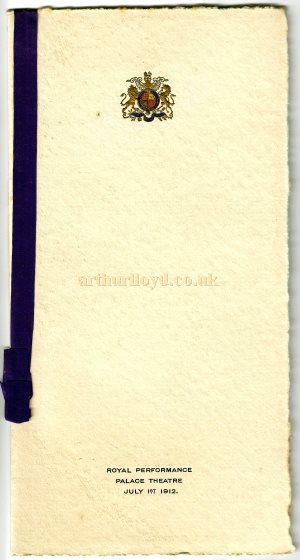
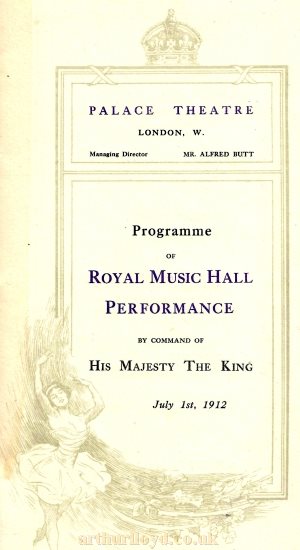
Left and Right - A Simple Programme for the Royal Performance at the Palace Theatre in July 1912 - Courtesy Simon Moss, stagememories. The Full Illustrated Souvenir Programme could be purchased at the Theatre and is shown above and in full here.
Although the place glittered and blazed, the same cannot be said of the behaviour of the audience. Nearly everyone was overcome, 'acts' included. Things had been timed to the fraction of a second, everyone was on edge. Also points had to be watched, for nothing the slightest bit vulgar must creep in to shock the Royal ears. So most of the performers were not really at ease. The audience, largely composed of music hall folks and their supporters, were simply bursting with pride, dressed in their best, and on their best behaviour, they were determined to show the world that they knew how to behave as well as the smartest West End playgoer who ordered carriages at eleven.

 To them, also, the
Royal Box and the behaviour of its occupants was of more interest than
the traffic on the sage. The consequence was an audience which, after
its burst of loyal enthusiasm to welcome the King and Queen, sat frigid
and rather reserved, indulging in only polite applause, for fear of
seeming ostentatious and free-and-easy. Yet the whole thing was electrical
and unforgettable.
To them, also, the
Royal Box and the behaviour of its occupants was of more interest than
the traffic on the sage. The consequence was an audience which, after
its burst of loyal enthusiasm to welcome the King and Queen, sat frigid
and rather reserved, indulging in only polite applause, for fear of
seeming ostentatious and free-and-easy. Yet the whole thing was electrical
and unforgettable.
Right - A Detail from a Palace Theatre of Varieties programme for the 29th of August 1898. And Far Right - Detail from a Palace Theatre of Varieties programme for the 27th of November 1899.
But there was one incident which marked the times as could nothing else. When Vesta Tilley took the stage, dressed, as always, as a man - and beautifully tailored, too - the Royal ladies averted their eyes, and studied their programmes. A woman in trousers was shocking! It was not the thing upon which Royalty could gaze. As we used to say -"not in these trousers." Yet that Queen was our own Mary, who now chats with land girls, factory workers, all dressed in male attire, without the slightest qualm and with every appearance of pleasure. Far, far away are those Edwardian and early Georgian days now. The two wars have made a gap of centuries.

Above - The Palace Theatre with Anna Pavlova Headlining - From the Souvenir programme for the Royal Command Performance at the Theatre on the 1st of July 1912 - Click to see entire programme.
 Alfred
Butt the showman sandwiched the novelties at the Palace with regular
favourites. One of the greatest of these-in every sense of the word
- was Barclay Gammon. A very big man in evening dress, he sat at a piano
and sang to us, and the Palace could never have enough of him. He was
there, with very slight absences, for years.
Alfred
Butt the showman sandwiched the novelties at the Palace with regular
favourites. One of the greatest of these-in every sense of the word
- was Barclay Gammon. A very big man in evening dress, he sat at a piano
and sang to us, and the Palace could never have enough of him. He was
there, with very slight absences, for years.
Right - The Palace Theatre during the run of the film 'Norma Talmadge Secrets' in 1924 - From a Brochure for The Bulman Cinema Screen Company.
There were many Palace personalities besides Blake, its ferocious stage door keeper, (the understated stage door entrance is shown below left M.L.) who has become a theatrical legend. Blake had many 'hates,' women and education being the greatest of them. Telephone girls were anathema. He carried on an eternal feud also with the succession of call boys, for whom he laid in wait, ambushed, harassed, but seldom caught. He thought little of the lovely chorus girls whom he saw daily. They, you see, were women. But one night a chorus girl did something he had never succeeded in doing. She was revenged on the call boy. This young lady was in the habit of looking on the wine when red, and its effect on her was an access of regal dignity. She did not like the call boy of that time. Once she arrived with the bearing and mien of an archduchess. Her companion knew she was 'tight,' but one girl protects another in the theatre.
 The call boy knew she
was 'tight' and told her so. When she was in her dressing-room, preparing
for the opening of the show, his insult penetrated to her bemused brain.She swore revenge. Although without one particle of clothing upon her,
she went right down the stairs to the stage
door.
The call boy knew she
was 'tight' and told her so. When she was in her dressing-room, preparing
for the opening of the show, his insult penetrated to her bemused brain.She swore revenge. Although without one particle of clothing upon her,
she went right down the stairs to the stage
door.
Left - The understated Stage Door of the Palace Theatre in 2004.
Completely nude, she caught the call boy, aghast with wonder, and she bashed his head three times, very resoundingly, against the iron door leading to the stage. Then, satisfied, she proceeded back to her room, her dignity in no way abated but slightly humanized by a contented smile on her placid face. Even Blake did not interfere. The manager was sent for but he had a sense of humour. He reproved and 'suspended' the unclothed lady for a week. She never did it again. That never happens in the Theatre today - and perhaps it is a pity.
 Blake
took a holiday once a year. Arrayed in a complete set of new clothes,
even down to socks and vest and pants, new hat, new gloves, he would
get on a bus on the Sunday morning, and ride to its destination. From
there he would proceed outwards for a week by whatever transport was
available, turning on the following Sunday and arriving back on the
following Sunday night, ready to report as usual on the Monday. North,
east, south, west, he went on these mysterious journeys and would
never say where he had been or discuss them. It was a curious but
perhaps a satisfying form of vacation of which he never tired.
Blake
took a holiday once a year. Arrayed in a complete set of new clothes,
even down to socks and vest and pants, new hat, new gloves, he would
get on a bus on the Sunday morning, and ride to its destination. From
there he would proceed outwards for a week by whatever transport was
available, turning on the following Sunday and arriving back on the
following Sunday night, ready to report as usual on the Monday. North,
east, south, west, he went on these mysterious journeys and would
never say where he had been or discuss them. It was a curious but
perhaps a satisfying form of vacation of which he never tired.
Right - Detail from a Palace Theatre of Varieties programme for the 4th of May 1901.
Arthur Wimperis, a great wit and. a man who loved country life, wrote many songs and sketches - and in later days, revues - for the Palace. And there, too, you would see Comelli, the great costume designer; Tom Reynolds, the producer - a truly delightful man with sometimes a hot Irish temper but a fund of humour and a heart of gold. He would quarrel with you, and if you knew him you would do nothing about it. For one day the phone would ring and Tom would take up the conversation where it had left off and you knew it was all right. Tom did grand work at the Palace, and still remains his humorous, witty self.
When revue came to the Palace in 1914, Finck gave us another memorable song, called 'Gilbert the Filbert,' which popularized the word Knut. It was the swan-song of Edwardianism, if we had only known, for the war came and Basil Hallam, the perfect knut, who sang the song, died on active service.
 In that same revue, The Passing Show, Butt gave us Elsie
Janis - and her mother - as remarkable a couple as ever existed. Elsie
was one of the greatest stars of all time, but she appeared only when
our world was changing and her story is not for here.
In that same revue, The Passing Show, Butt gave us Elsie
Janis - and her mother - as remarkable a couple as ever existed. Elsie
was one of the greatest stars of all time, but she appeared only when
our world was changing and her story is not for here.
Left - A Programme Cover for a Variety Show at the Palace Theatre in April 1959 - Courtesy Philip Paine. On the Bill amongst others were George Ulmer, Oreste Kirkop, and Max Miller.
And once as a stop-gap, Butt engaged a little concert party which shone so brightly that in a London plunged in a real peasoup fog of the old-fashioned variety, they packed the Palace. For they were 'The Follies.' And their great leader, Pelissier, was to crack a great gag in the auditorium one afternoon some time later. For a film had been made of Sir Herbert Tree's great production of 'Henry the Eighth' and a trial show was given at the Palace (where Sir Herbert had appeared on one occasion). The profession were invited and attended in strength, Pelissier amongst them. The film began to unwind its majestic self on the screen. It was, of course, a silent picture - no talkies then. All the great members of His Majesty's company stalked in shadow on the screen. Then Sir Herbert himself, as Cardinal Wolsey, swept on majestically. You saw his eyes move, you saw his gestures, you saw his mouth opening and shutting, but the music of Shakespeare was not there. But it was Harry Pelissier's great chance. "Speak up," he shouted-and there was a burst of Homeric laughter.
 If
there has been a long stop at the Palace, it is because it was so much
the Edwardian place of amusement of the lighter kind, so typical of
its day, so much a mixture of wealth and modest means, each getting
plenty of fun, for no great disbursement. It was not to be found elsewhere,
this particular brand of evening's enjoyment, yet it was truly Edwardian
in its richness, its flavour, its air of complete security.
If
there has been a long stop at the Palace, it is because it was so much
the Edwardian place of amusement of the lighter kind, so typical of
its day, so much a mixture of wealth and modest means, each getting
plenty of fun, for no great disbursement. It was not to be found elsewhere,
this particular brand of evening's enjoyment, yet it was truly Edwardian
in its richness, its flavour, its air of complete security.
Right - The Palace Theatre during the run of 'The Woman in White' in October 2006.
It was the other end of the same pole which balanced the local music halls, then in great number, and midway hung the Oxford, the Tivoli and the London Pavilion. The London Hippodrome was still a bit of a hybrid. It had begun as a circus, it had altered its policy-and like the Palace, when the Edwardian days were over, it was to change again. But the Palace, with its innumerable window boxes aglow with flowers, its terracotta and its red, its gleaming glass verandah beneath which stepped the people from their carriages, their cars, and beneath which entered the bohemians and the men-about-town, was a bright spot of those days.
Much of the text above on this page was edited from the book 'Carriages at Eleven - The story of the Edwardian Theatre' by W Macqueen Pope 1947. All images on this page are from my own collection, except 'The Palace Lancers Programme' and The Royal English Opera on its opening photograph.

Above - A programme for an 'All Star Concert' at the Palace Theatre during the last year of the Second World War on May the 27th 1945 - Courtesy Tony Craig whose mother Jessie Jewel was on the Bill with her name spelt wrong and featured as 'Radio's Redhead'.
 Shown left is a note from, and signed, by Ivor Novello to someone who had written
to him about his performance in 'Kings Rhapsody' at the Palace Theatre
which opened on the 15th of September 1949. The note is addressed from
the Aldwych in London where Ivor Novello lived in a flat above the Strand
Theatre. The note reads 'Thank you so much for your thought of me on the
first night of 'Kings Rhapsody - It really was my most exciting night
in the Theatre and we're all very happy - Yours Ivor Novello.' - Note
kindly sent in by Tony Craig.
Shown left is a note from, and signed, by Ivor Novello to someone who had written
to him about his performance in 'Kings Rhapsody' at the Palace Theatre
which opened on the 15th of September 1949. The note is addressed from
the Aldwych in London where Ivor Novello lived in a flat above the Strand
Theatre. The note reads 'Thank you so much for your thought of me on the
first night of 'Kings Rhapsody - It really was my most exciting night
in the Theatre and we're all very happy - Yours Ivor Novello.' - Note
kindly sent in by Tony Craig.
'Kings Rhapsody' was written by, and starred, Ivor Novello in the leading role along with Phyllis Dare. The show opened at the Palace Theatre on the 15th of September 1949 and ran for 841 performances, outlasting Novello himself, who died on the 6th of March 1951.
There is a page on this site about the building of the Royal English Opera House, now the Palace Theatre, from an article by the Royal Institute of British Architects of 1892 here.
Also see:- This Chapter of Concert Halls and Assembly Rooms by Ernest Woodrow, 1895.

Above - The Palace Theatre during the run of 'The Sound Of Music' in 1961 - Photo Chris Phillips - Courtesy Jason Mullen

Above - The Palace Theatre during the run of 'Oklahoma' in 1980 - Courtesy Jason Mullen

Above - The Palace Theatre in 1986, shortly after the Royal Shakespeare Company’s production of 'Les Misérables' opened at the Theatre in 1985. The production was to become the longest run in the Theatre’s history with a total of 7,602 performances before it transferred to the Queen’s Theatre in 2004. Scaffolding can be seen to the right of the image and this was the start of the exterior refurbishment of the Theatre and removal of 1950’s signage in 1986 - Photo Courtesy Jason Mullen.

Above - A 1970s Seating Plan for the Palace Theatre


Above - A selection of Palace Theatre programmes.

Above - The Palace Theatre during the run of 'Priscilla Queen Of The Desert' in March 2009

Above - The Palace Theatre during the run of 'Singing In The Rain' in February 2012.

Above - The Palace Theatre during the run of 'The Commitments' in October 2014 - Photo M.L.
The Palace Theatre is currently run by Nimax Theatres whose own website can be found here.
Also see:- This Chapter of Concert Halls and Assembly Rooms by Ernest Woodrow, 1895.
Adelphi Aldwych Ambassadors Apollo Apollo Victoria Arts Cambridge Charing Cross Theatre Criterion Dominion Donmar Warehouse Drury Lane Duchess Tom Stoppard Theatre Fortune Garrick Gielgud Gillian Lynne Harold Pinter Haymarket His Majesty's Leicester Square Theatre London Coliseum London Palladium Lyceum Lyric Menier Chocolate Factory Noel Coward Novello Old Vic Palace Peacock Phoenix Piccadilly Playhouse Prince Edward Prince of Wales Royal Opera House Sadler's Wells Theatre Savoy Shaftesbury Sondheim St. Martin's Trafalgar Theatre Vaudeville Victoria Palace Wyndham's