
The Peacock Theatre, Kingsway, London
Formerly - The London Opera House / National Theatre of England / Stoll Picture Theatre / Stoll Theatre / Royalty Theatre
Introduction - The London Opera House - The Stoll Picture Theatre / Stoll Theatre - Closure and Demolition of the Stoll Theatre - The Royalty Theatre / Peacock Theatre

Above - An Office Building and the Peacock Theatre in a photograph taken in 2005. Originally built as the Royalty Theatre in 1960, the Theatre is situated on the site of the former London Opera House / Stoll Theatre - Photo M.L. 05.


 The
Peacock Theatre is situated on London's Kingsway and originally opened as the Royalty
Theatre on the 23rd of June 1960
with Peter Brook's production of 'The Visit' by Friedrich Durrenmatt, staring Alfred Lunt and Lynn Fontanne.
The
Peacock Theatre is situated on London's Kingsway and originally opened as the Royalty
Theatre on the 23rd of June 1960
with Peter Brook's production of 'The Visit' by Friedrich Durrenmatt, staring Alfred Lunt and Lynn Fontanne.

The Royalty Theatre was designed by E. H. Tietjen of Lewis Solomon Kaye & Partners, and was constructed in the basement of an office block which replaced Oscar Hammerstein's magnificent former London Opera House, which had first opened on the 13th of November 1911, and would later become the Stoll Theatre, but was demolished in 1958.
The Royalty Theatre was renamed the Peacock Theatre in honour of the LSE's benefactor Michael Peacock in the autumn of 1996. Information on the London Opera House, later the Stoll Theatre, follows, and more information on the Royalty and Peacock Theatres can be found below.
The London Opera House
Later - The Stoll Picture Theatre / The National Theatre of England / The Stoll Theatre
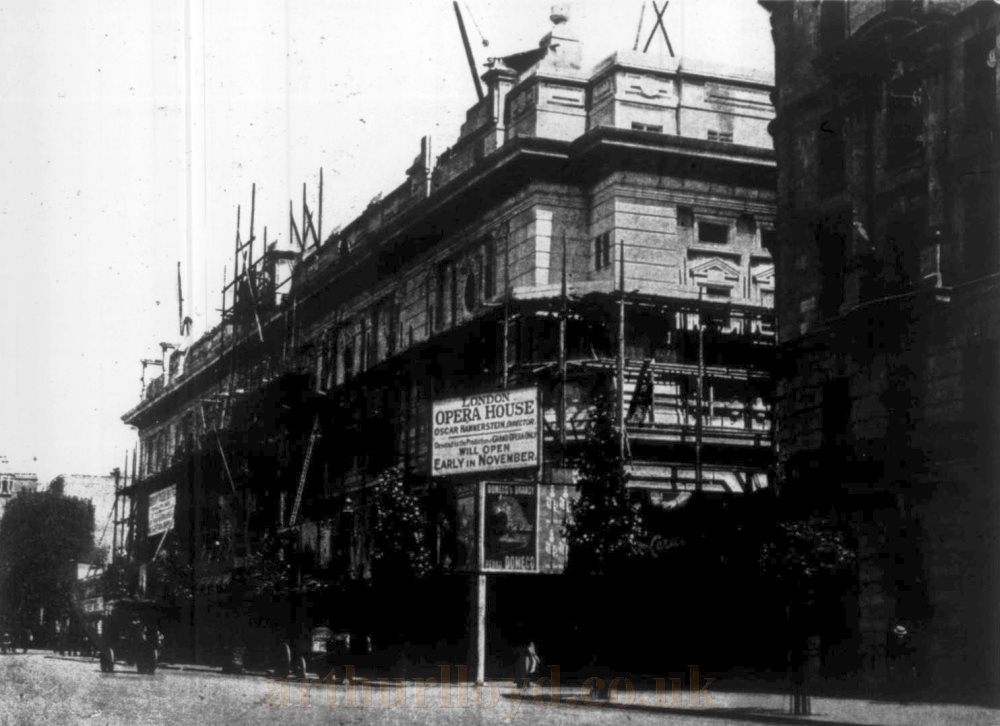
Above - The London Opera House under construction in 1911 - From Harpers Weekly 29th of July 1911.
 The
London Opera House was designed by the well known Theatre
Architect Bertie Crewe for Oscar Hammerstein
who envisaged it as a rival to the Covent
Garden Opera House. The Theatre was enormous and consisted of an
entire block on the recently constructed Kingsway,
covering an area of over 24,000 square feet with a facade stretching
272 feet along the street and a height of 80 foot.
The
London Opera House was designed by the well known Theatre
Architect Bertie Crewe for Oscar Hammerstein
who envisaged it as a rival to the Covent
Garden Opera House. The Theatre was enormous and consisted of an
entire block on the recently constructed Kingsway,
covering an area of over 24,000 square feet with a facade stretching
272 feet along the street and a height of 80 foot.
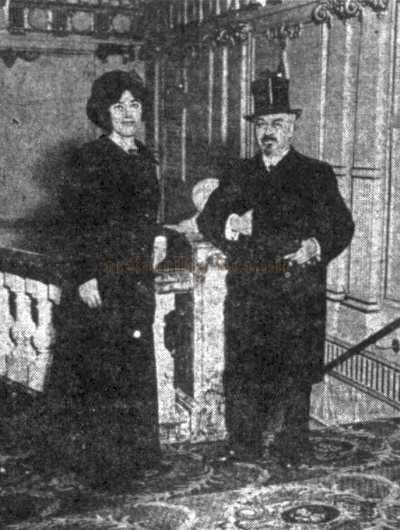
Right - Oscar Hammerstein and his Daughter photographed at the London Opera House on its opening week in 1911 - From the New York Times, 19th of November 1911.
The stage of the Theatre was 44'8" by 78' and it had an auditorium capable of accommodating some 2,660 people.
 The Theatre cost over £200,000 to build and
was designed in the French Renaissance style with a Portland stone frontage.
Along the roof of the Theatre were twelve statues by the sculptor Thomas
Rudge and at either end were statues representing Melody and Harmony.
The Theatre cost over £200,000 to build and
was designed in the French Renaissance style with a Portland stone frontage.
Along the roof of the Theatre were twelve statues by the sculptor Thomas
Rudge and at either end were statues representing Melody and Harmony.
 Left - A Brass End Cap from the brass handrails which
were situated in the main entrance of the Stoll Theatre in the 1950's
- Courtesy Alan Walker. This may have also been an original feature
of the London Opera House before its conversion to the Stoll
Picture Theatre in 1917.
Left - A Brass End Cap from the brass handrails which
were situated in the main entrance of the Stoll Theatre in the 1950's
- Courtesy Alan Walker. This may have also been an original feature
of the London Opera House before its conversion to the Stoll
Picture Theatre in 1917.
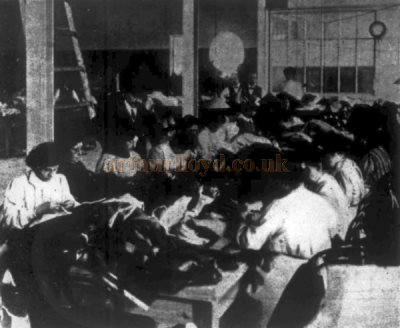
Right - Costumes being created in the top floor Wardrobe Room of the London Opera House for the Theatre's opening in 1911 - From Harpers Weekly 29th of July 1911.
The Theatre's lavish auditorium was in the French Renaissance style, built on four levels, Stalls and three Balconies, with 22 boxes, 18 on three rows flanking either side of the proscenium and 4 at stalls level. There were also private boxes around the rear stalls and the front of the first circle. Thirteen dressing rooms provided accommodation for up to 76 artistes.

Above - A Postcard showing the London Opera House, Kingsway, from above.
 The Stage
Newspaper reported on the building in their November the 2nd 1911 edition saying:- 'The magnificent new building which Mr Oscar Hammerstein
has erected in Kingsway has been watched in its growth with considerable
interest by Londoners generally.
The Stage
Newspaper reported on the building in their November the 2nd 1911 edition saying:- 'The magnificent new building which Mr Oscar Hammerstein
has erected in Kingsway has been watched in its growth with considerable
interest by Londoners generally.
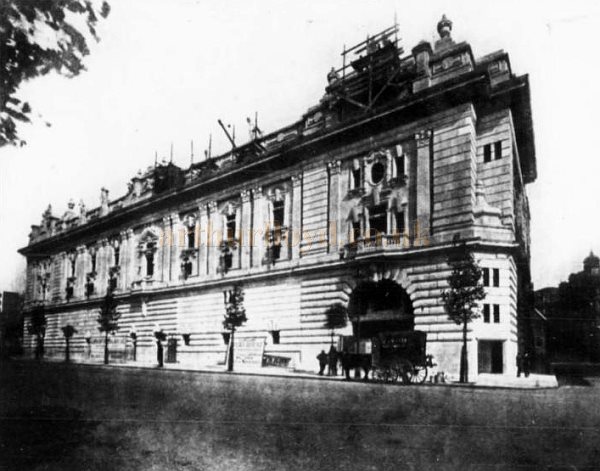
Right - The London Opera House under construction in 1911 - From the ILN, 7th of October 1911.
Many and wonderful have been the stories relating to its interior, and on Friday a large number of people accepted Mr. Hammerstein's invitation to view the new house. Nor were they disappointed in any particular. The visitor found a finely proportioned house, lavishly yet tastefully decorated, and one withal which in every way is worthy to occupy the position of a home for opera.

Above - The London Opera House, Kingsway - From The Stage Yearbook of 1912
 A
curious fact of the exterior is that there is nothing in the way of
a noble entrance to match the building; indeed, all the exits and entrances
seem to be quite miniature affairs. Of course one does not suggest that
they are not adequate for the comfort and convenience of the public,
because one is well aware that the watchful eyes of the L.C.C. are upon
opera house and picture palace alike. But the huge structure dwarfs
all its own doorways. The site occupied by the London Opera House has
an area of 24,500 feet, with a frontage of 265 feet to Kingsway,
and returns of 103 feet and 88 feet in Portugal
Street and Sardinia Street respectively.
A
curious fact of the exterior is that there is nothing in the way of
a noble entrance to match the building; indeed, all the exits and entrances
seem to be quite miniature affairs. Of course one does not suggest that
they are not adequate for the comfort and convenience of the public,
because one is well aware that the watchful eyes of the L.C.C. are upon
opera house and picture palace alike. But the huge structure dwarfs
all its own doorways. The site occupied by the London Opera House has
an area of 24,500 feet, with a frontage of 265 feet to Kingsway,
and returns of 103 feet and 88 feet in Portugal
Street and Sardinia Street respectively.
Right - The Entrance Vestibule of the London Opera House - From the Academy Architecture and Architectural review of 1912.
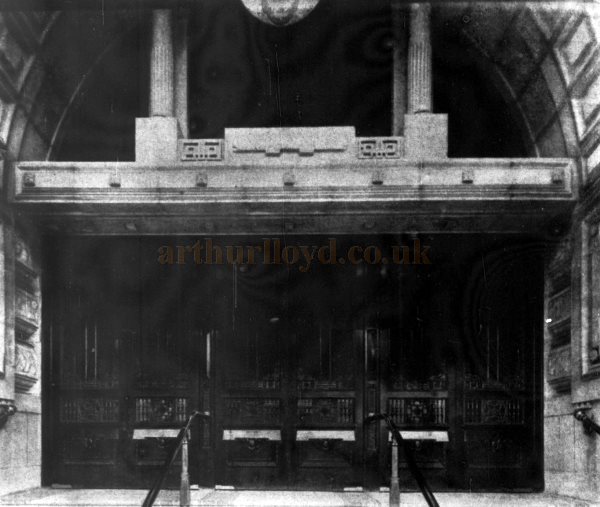
The exterior facade is of Portland stone, with a granite base, and at each side of the building after the first 50 feet red-brick facings are used. A feature of the facade is the central window, the height of which is 30 feet. The main entrance is at the southern end of the Kingsway front. Here a flight of marble and mosaic steps lead to the vestibule and booking offices. The outer and inner doors and draught screens are of mahogany, as also is most of the joinery in the house.
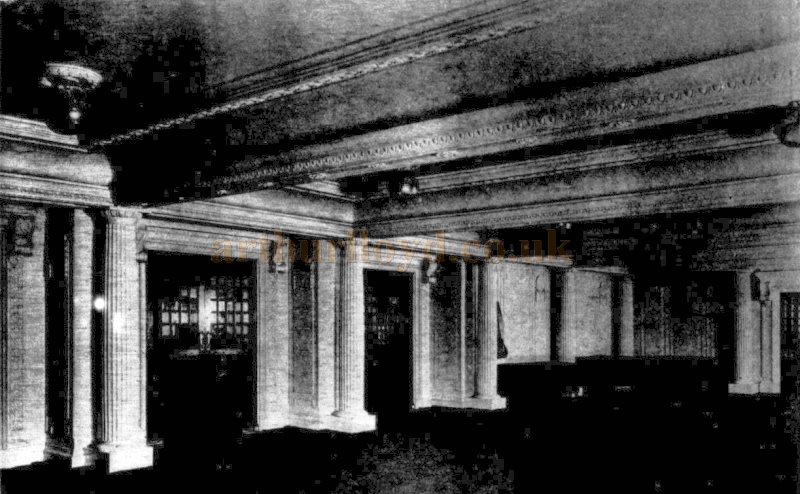
Above - The Stalls Saloon at the London Opera House - From The Builder, 8th of March 1912.
The entrance hall is a finely appointed apartment flanked by white and gold fluted columns, surmounted by bas-reliefs of famous composers. Opening out of the foyer is the box circle. There are twenty-one boxes, twelve of which are provided with ante-rooms. Two marble staircases lead down to the stalls, where are situated sixteen more boxes.

Above - A photograph of the London Opera House Auditorium - From the Stage Newspaper November 2nd 1911
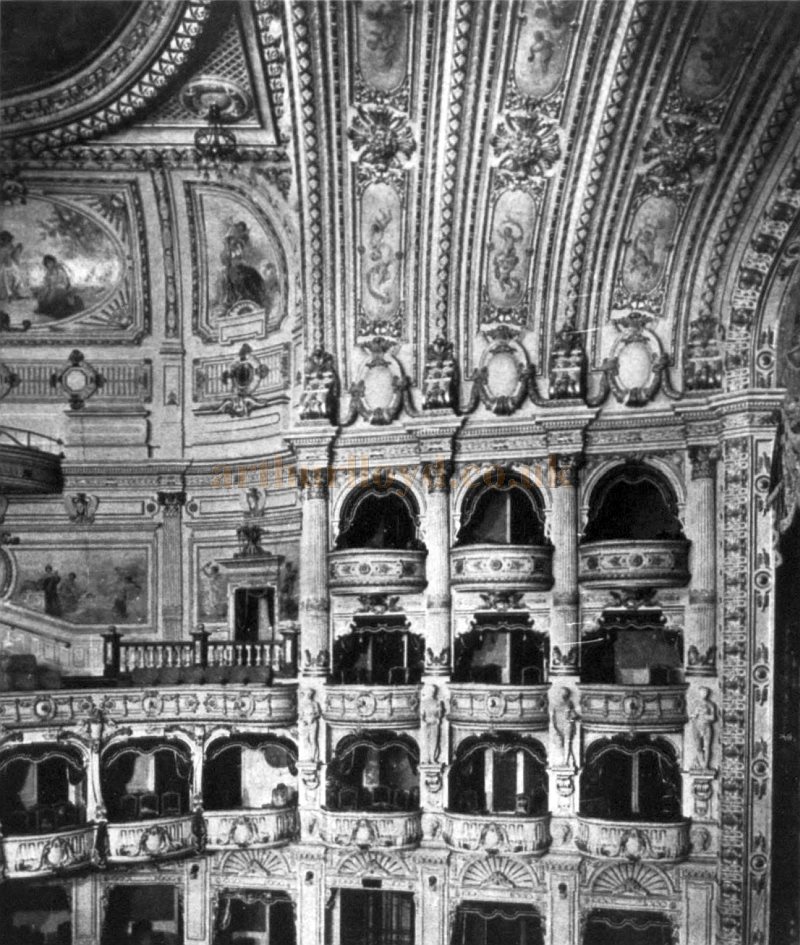
Above - The Auditorium of the London Opera House - From the Architectural review of 1912.
The stage is 64 feet wide and 65 feet in depth. The proscenium opening, which is 45 feet wide and 50 feet high, is designed to prevent echoes. The stage is lighted from above by means of eight battens containing 200 lights in each. The footlights have also 200 lights. There are seventy-five lights at each side of the proscenium opening, and there are also twelve hanging lengths of twenty-four lights each at the side of the stage.

Above - The Lounge Hall of the London Opera House - From the Academy Architecture and Architectural review of 1912.
 The scene docks, of which there are two, occupy a large
space 75 feet by 35 feet, and a total height of 50 feet behind the stage. A large trap-door in the floor of the upper dock and a hand-power goods
lift connect the two docks.
The scene docks, of which there are two, occupy a large
space 75 feet by 35 feet, and a total height of 50 feet behind the stage. A large trap-door in the floor of the upper dock and a hand-power goods
lift connect the two docks.
An artesian well has been sunk in the north-east corner of the building to a depth of 450 feet.
Right - The Cast-Bronze Grillage to the Entrance Doors of the London Opera House - From The Builder, 29th of March 1912.
A motor pumps the water into two 800 gallon tanks on the roof, one at either end of the building. These in turn feed two 500-gallon tanks at the Portugal Street end - one for the lavatories and the other for the heating installation - and two 200-gallon tanks for the supply to the dressing-rooms.

Above - The Circle Foyer of the London Opera House - From the Academy Architecture and Architectural review of 1912.
The upper and lower galleries and the circle are each built upon heavy girders carried on stanchions, the box floor being suspended from the circle girder and from two wing girders carried from the circle girder into the stalls on either side of the auditorium. The roof trusses are of the lattice type. By means of this construction there are no exposed columns, thus ensuring a clear view of the stage from every seat.

Above - An advertisement for A. R. Dean Ltd who had the contract for Fibrous Plaster and Decorations of the London Opera House - From the Stage Newspaper, June 29th, 1911.
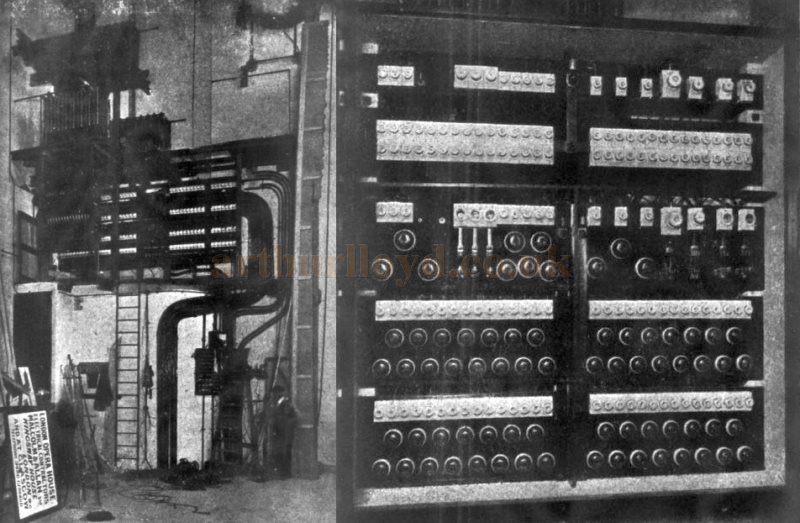
Above - The Stage Switchboard and Front of House Switchboard at the London Opera House - From The Electrical Review, 17th of November 1911.
 The seating accommodation has been designed with a generous
hand, and seats in the armchair style are used throughout the house.
The stall chairs are designed in inlaid mahogany, and the upholstery
is in Rose du Barry pilo velvet, and harmonises with the draperies of
the private boxes.Here the same tone colour will be employed, the material,
however, in this case being silk plush.
The seating accommodation has been designed with a generous
hand, and seats in the armchair style are used throughout the house.
The stall chairs are designed in inlaid mahogany, and the upholstery
is in Rose du Barry pilo velvet, and harmonises with the draperies of
the private boxes.Here the same tone colour will be employed, the material,
however, in this case being silk plush.
Right - An Advertisement carried in the Pall Mall Magazine for Oscar Hammerstein's Summer Season of Grand Opera at the London Opera House, Kingsway in April 1912.
 The whole of the private boxes
will be draped in a similar manner, with the exception of the Royal
box, which has, in addition, a paneling of rich silk of harmonious texture
and pattern. The proscenium curtains, seating, and drapery have been
supplied by Messrs. Maple and Co. Mr. Bertie
Crewe is the architect of the new house.
The whole of the private boxes
will be draped in a similar manner, with the exception of the Royal
box, which has, in addition, a paneling of rich silk of harmonious texture
and pattern. The proscenium curtains, seating, and drapery have been
supplied by Messrs. Maple and Co. Mr. Bertie
Crewe is the architect of the new house.
Left - An Advertisement carried in the Pall Mall Magazine for Oscar Hammerstein's Summer Season of Grand Opera at the London Opera House, Kingsway in April 1912.
The "Plenum" system of ventilation has been used, the two main ducts being formed at each side below the level of the stalls floor, from which branches worked in with the concrete partitions or formed with galvinised iron trunks are carried to all parts of the house with four electric fans in the auditorium roof. The London Opera House will hold 2,700.'
The above text in quotes was first published in the Stage Newspaper November the 2nd 1911.
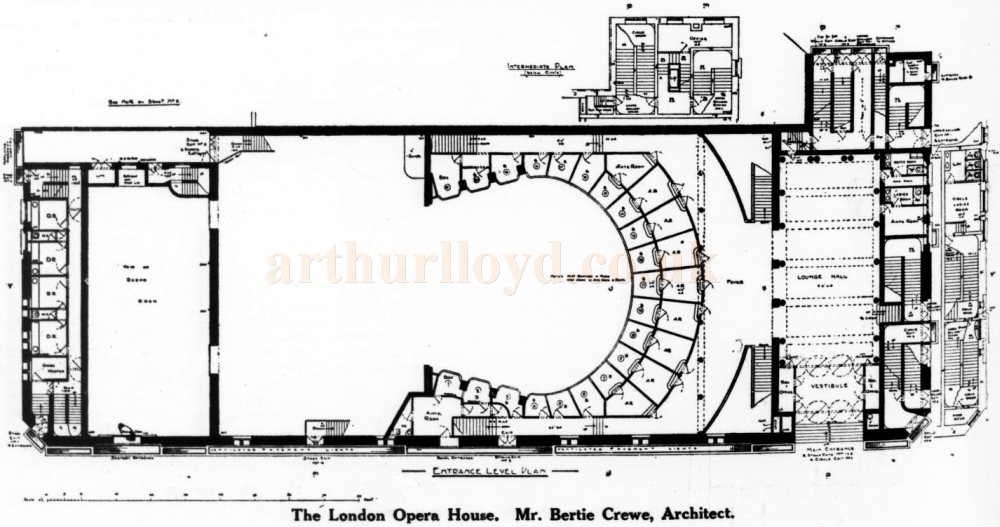
Above - Bertie Crew's Plan of the London Opera House - From The Builder, 8th March 1912.

Above - A Sketch of the London Opera House - From the Stage Newspaper November 2nd 1911.
 The London Opera House opened on
the 13th of November 1911 with
a production of 'Quo Vadis' which was its first appearance in London,
and then continued with a season of operas through to March 1912.
However, Oscar Hammerstein hadn't taken into account that the Covent
Garden Opera House had all the top names in opera performing in
its productions and despite another season at his Theatre, which began
on April the 22nd 1912, by
July he had to admit defeat. Hammerstein closed his Theatre on the 13th
of July 1912 and returned to
America with his tail between his legs and loses amounting to £47,000.
The London Opera House opened on
the 13th of November 1911 with
a production of 'Quo Vadis' which was its first appearance in London,
and then continued with a season of operas through to March 1912.
However, Oscar Hammerstein hadn't taken into account that the Covent
Garden Opera House had all the top names in opera performing in
its productions and despite another season at his Theatre, which began
on April the 22nd 1912, by
July he had to admit defeat. Hammerstein closed his Theatre on the 13th
of July 1912 and returned to
America with his tail between his legs and loses amounting to £47,000.
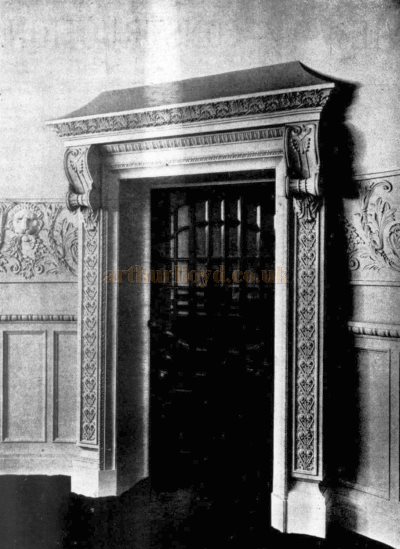
Right - An Exit Door from the Domed Saloon of the London Opera House - From The Builder, 8th of March 1912.
The Guardian reported on the closure in their August 19th 1912 edition saying:- 'Mr. Oscar Hammerstein has abandoned his Kingsway Opera House venture. According to a statement published in the newspapers to-day, he declares that he will give no more grand opera in London, but will in future devote his entire attention to his American interests. He says he is still convinced that there is a public for grand opera in England, but that the difficulties with which he has had to contend have proved far greater than he had expected. The loss that he has suffered has been too large to justify a continuation of the experiment just at present. It is understood that Mr. Hammerstein's decision has been largely influenced by the advice of his son, who has long been opposed to "good American dollars" being "wasted on the English public." Mr. Hammerstein has made no statement as to the future of the London Opera House.' - The Guardian, August 19th 1912.

Above - A Painting by George Richmond depicting the Auditorium and Stage of Bertie Crew's Stoll Theatre, formerly the London opera House, in 1911 - George says that the painting is based on images shown on this page but enhanced to show more of the auditorium, colours were informed by contemporary reports on this page - Click for an Index to all of George Richmond's Paintings on this site.

 After the closure in July 1912 the Theatre remained dark until December when the French impresario, Ferand Akoun, reopened it with a season
of Variety shows and Film showings. Hammerstein then sold the Theatre
to a new company, the London Opera House Ltd, who put on a number of Variety shows. Following this they put on
a new review called 'Come Over Here' which opened on April 19th 1913 and ran for some 217 performances.
After the closure in July 1912 the Theatre remained dark until December when the French impresario, Ferand Akoun, reopened it with a season
of Variety shows and Film showings. Hammerstein then sold the Theatre
to a new company, the London Opera House Ltd, who put on a number of Variety shows. Following this they put on
a new review called 'Come Over Here' which opened on April 19th 1913 and ran for some 217 performances.
The glass jar shown here which commemorated the 200th performance of the review 'Come Over Here' at the London Opera House in September 1913 and was issued to every member of the audience - Kindly donated by Angela Kirk. On the rim of the jar top it has the maker's stamp of 'WJM & Co' and also the anchor stamp for Birmingham, the Lion stamp signifying pure silver and the stamped date letter 'O' for 1913. - Stamp Information courtesy Peter Long.
The Stoll Picture Theatre
Later - The Stoll Theatre

Above - The Stoll Picture Theatre in 1924 - From a brochure for The Bulman Cinema Screen Company
After 'Come Over Here' a number of productions were tried at the London Opera House, none of them very successfully, and for a short period between 1914/15 the Theatre even became known as the National Theatre of England, but then it was bought by Oswald Stoll in 1916 and he converted it for Cinema use and reopened it as the Stoll Picture Theatre on the 31st of April 1917.
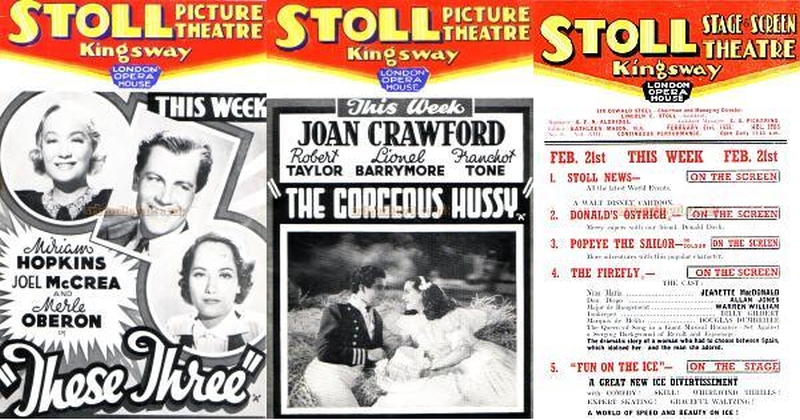
Above - Three programmes for the Stoll Picture Theatre,'These Three' in 1936, 'The Gorgeous Hussy' in 1937, and a Cine Variety production including an Ice spectacular in 1938.
 This
proved to be much more of a success for the Theatre which began by showing
silent films and would later have its own Jardine tubular pneumatic
orchestral organ installed in 1927, and later films were even accompanied
by a full orchestra. Later still the Theatre became home to regular
Cine Variety shows until it was closed in September 1940.
This
proved to be much more of a success for the Theatre which began by showing
silent films and would later have its own Jardine tubular pneumatic
orchestral organ installed in 1927, and later films were even accompanied
by a full orchestra. Later still the Theatre became home to regular
Cine Variety shows until it was closed in September 1940.
The building reopened on the 1st of September the following year, 1941, as a live Theatre and when it was taken over by Emile Littler in 1942 it was renamed the Stoll Theatre.
Right - The London Opera House, Kingsway, later to be renamed the Stoll Picture Theatre and then the Stoll Theatre.
The Stoll Theatre soon became home to lavish stage shows and ice spectaculars and was very successful until it was closed at the end of a 5 week run of 'Titus and Andronicus', starring Laurence Olivier and Vivien Leigh, on the 3rd of August 1957.
Sadly the Theatre was demolished shortly afterwards, more details and images on the demolition of the Theatre can be seen below.
A selection of programmes for the Stoll Theatre, Kingsway from 1942 to 1954
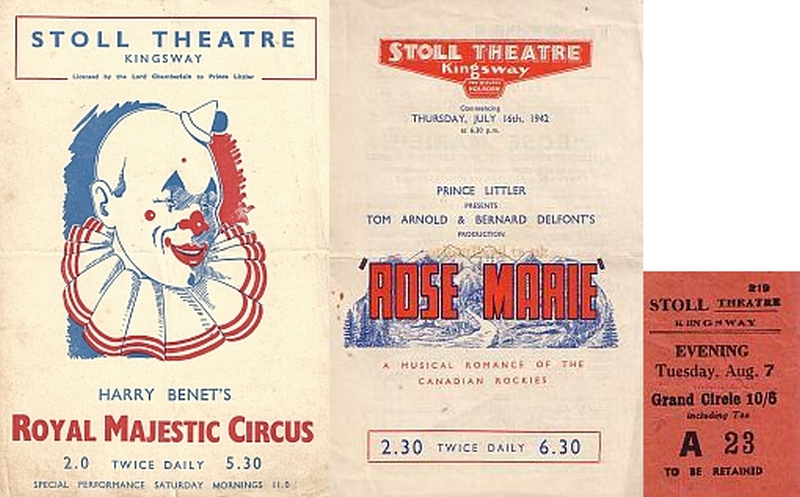
Above - A Programme Cover for the Royal Majestic Circus at the Stoll Theatre during the war - Courtesy Ryan Gosford whose father was deployed in Europe from 1941 to 1945 with the Royal Canadian Air Force and must have seen this production when on leave. And a Programme Cover and Ticket Stub for 'Rose Marie' at the Stoll Theatre for August the 7th 1942.
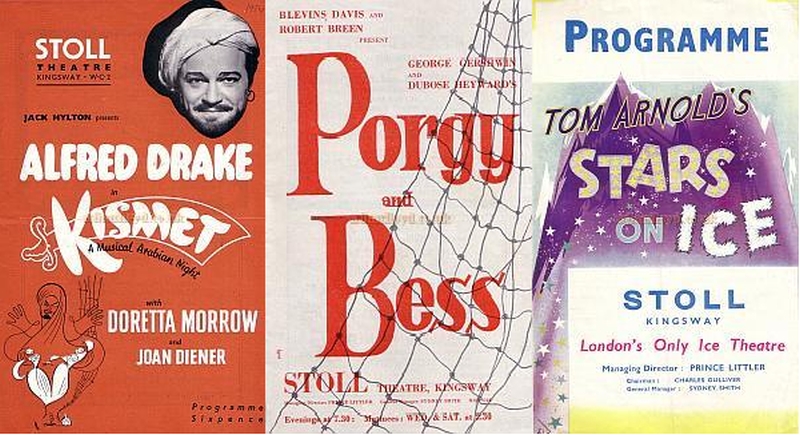
Above - Programmes for 'Kismet', 'Porgy and Bess', and 'Stars on Ice' at the Stoll Theatre in 1947.
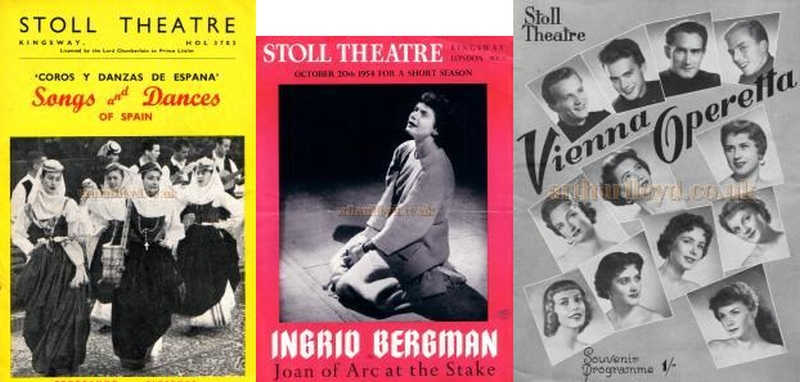
Above - Programmes for 'Songs and Dances of Spain' at the Stoll Theatre in 1952, 'Joan of Arc at the Stake' at the Stoll Theatre in 1954, and The Vienna Operetta season in 1954 - Courtesy Maurice Norman.
Closure and Demolition of the Stoll Theatre

Above - The Stoll Theatre, here called 'The Stoll Ice Theatre', in 1957 and shortly before its demolition in 1958 - From The Sphere, September 28th 1957.
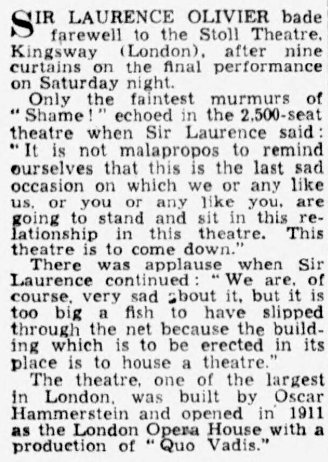 The Stoll Theatre closed on the 3rd of August 1957 with a final performance of 'Titus Andronicus' in which Laurence Olivier and his then wife Vivien Leigh were performing. Vivien Leigh was a passionate advocate for the preservation of Theatres and had recently campaigned to try and save the St. James Theatre which had closed for demolition the previous month, and so here she was on the last night at the Stoll Theatre after a five week run of 'Titus Andronicus' closing this even more impressive Theatre for the last time before its own demolition.
Right - A Report on the last night of the Stoll Theatre in 1957 - From the Nottingham Evening News, 5th of August 1957.
After its closure the Theatre was stripped out and then demolition began the following year in March 1958 to make way for a very sorry looking office block, quite why this was allowed is anybody's guess, but it certainly wouldn't have happened today as one can imagine this vast Theatre being the perfect place to stage the large scale musicals favoured by many producers today. Some images of the Theatre being demolished can be seen below. As a consolation, after the magnificent Stoll Theatre was demolished, a new smaller Theatre, the Royalty Theatre, was constructed in the basement of the office block which replaced it. More on this below.

Above - The Stoll Theatre in 1958, shortly before its demolition - Courtesy Gerry Atkins.

Above - The Stoll Theatre, Kingsway being demolished in 1958 - From The Sphere, May 3rd 1958.

Above - The Stoll Theatre, Kingsway being demolished in 1958 - From The Sphere, May 3rd 1958.

Above - The Stoll Theatre, Kingsway being demolished in 1958 - From The Sphere, July 19th 1958.

Above - The Stoll Theatre, Kingsway being demolished in 1958 - From The Sphere, August 30th 1958.

Above - Statues from the Stoll Theatre, Kingsway left at a bus stop outside the Theatre during its demolition in 1958 - From The Sphere, November 9th 1958.
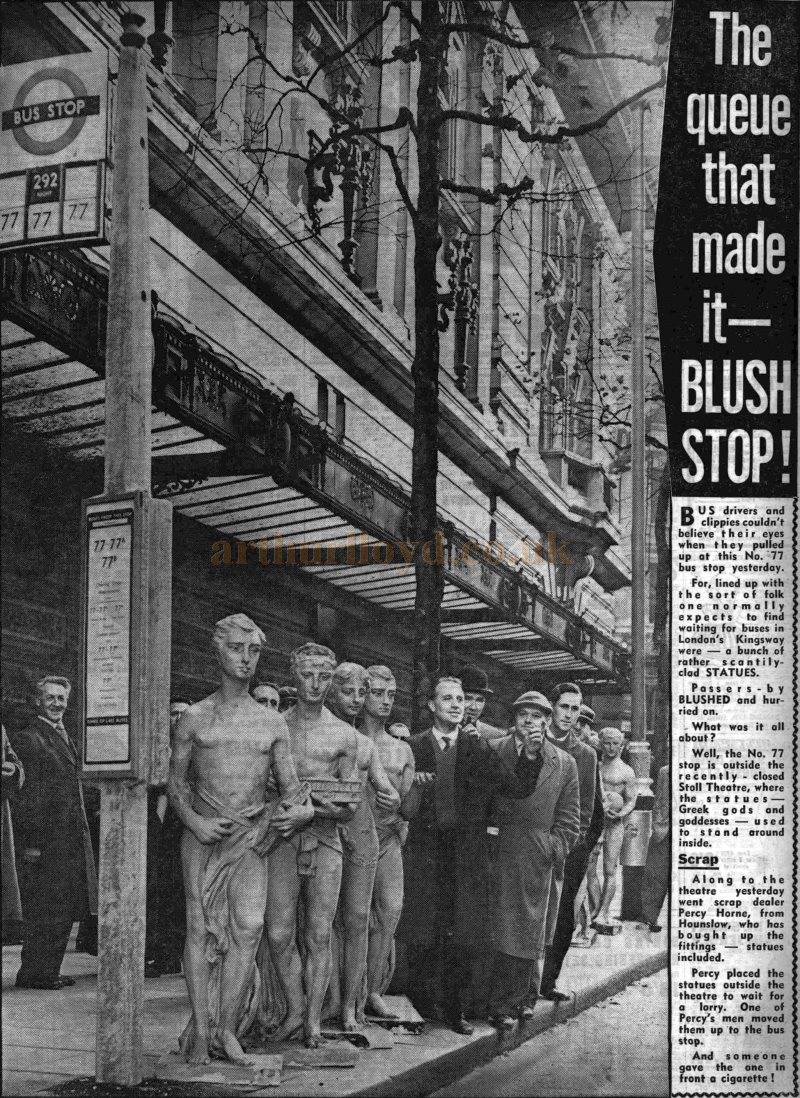
Above - An Article and Image on the Statues from the Stoll Theatre, Kingsway left at a bus stop outside the Theatre during its demolition in 1958 - From The Daily Mirror - Saturday 02 November 1957.

Above - The Site of the Stoll Theatre, Kingsway after a burst water main damaged the perimeter steel fence in 1958 - From The Sphere, November 29th 1958.
The Royalty Theatre, Kingsway and Portugal Street, London
Later - The Peacock Theatre
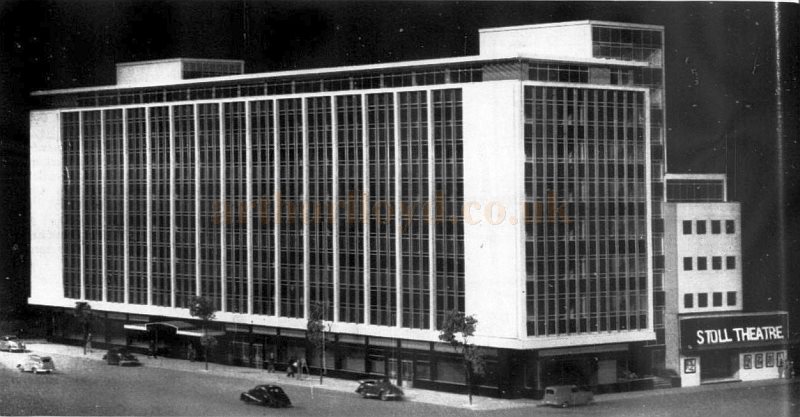
Above - A Model of the Office Building and Replacement Theatre, here called the Stoll Theatre, for the proposed redevelopment of the site of the former London Opera House / Stoll Picture Theatre, Kingsway, which was shown at an Exhibition sponsored by D. E. and J. Levy called 'Changing the Face of London' - From The Builder, 28th of February 1958.
 As
a consolation, after the magnificent Stoll Theatre was demolished in 1958, a
new smaller Theatre, the Royalty Theatre, designed by E. H. Tietjen of Lewis Solomon Kaye & Partners, was constructed in the basement
of the office block which replaced the former Theatre, with a new main entrance for the Theatre on Portugal Street, just off Kingsway.
As
a consolation, after the magnificent Stoll Theatre was demolished in 1958, a
new smaller Theatre, the Royalty Theatre, designed by E. H. Tietjen of Lewis Solomon Kaye & Partners, was constructed in the basement
of the office block which replaced the former Theatre, with a new main entrance for the Theatre on Portugal Street, just off Kingsway.
The new Royalty Theatre opened on the 23rd of June 1960 with Peter Brook's production of 'The Visit' by Friedrich Durrenmatt, staring Alfred Lunt and Lynn Fontanne. The Duchess of Kent and Princess Alexandra attended a Preview of the play the day before the Theatre opened.
Right - The Royalty Theatre on its opening in June 1960 with a production of 'The Visit' - From the ILN, 25th June 1960.
The Royalty Theatre had a capacity of just under 1,000 when it first opened, and should not be confused with the former Royalty Theatre in Dean Street which had originally opened on the 25th May 1840.
The Stage Newspaper reported on the Theatre's imminent opening in their 16th of June 1960 edition saying:- 'London's newest theatre, the Royalty in Kingsway, opens on Thursday next with Alfred Lunt and Lynn Fontanne in Friedrich Duerrenmatt's "The Visit."
 A stone in the foyer of the 1,000-seat theatre, built in an office block on the site of the Stoll, was unveiled yesterday by Dame Edith Evans.
Left - An Opening Night Ticket for the Royalty Theatre on the 23rd of June 1960 - Courtesy Roger Fox.
 The Royalty Theatre in Kings-way, the latest and most up-to date addition to London's luxury playhouses, is the first new theatre to be constructed as an integral part of a new office building, on the site of the old Stoll.
The architects and designers of the Royalty are Lewis Solomon Kaye & Partners. The theatre is licensed to Bernard Delfont, who is chairman and joint managing director of Presentations of Kingsway. Ltd.
Right - Alfred Lunt and Lynn Fontanne who stared in the opening production of 'The Visit' at the Royalty Theatre in June 1960 - From The Stage Newspaper, June 2nd 1960.
The auditorium, 73ft. deep, 71ft wide and 32ft. high, has been designed to afford excellent sight lines from all parts of the house. Special care has been taken in the shape of the auditorium and it's decor to ensure that acoustics are first class.
The seating is on two levels. The stalls can seat 689 people, and the circle 288. which with 20 seats in the boxes, total 997. The large box on the left side of the auditorium is the Royal Box and is provided with a retiring room to which access can be gained directly from Kingsway.

Above - The Auditorium and Stage of the Royalty Theatre on its opening in June 1960 - From the ILN, 25th June 1960.
The decor has been designed to combine the dignity of the Georgian theatre and the lushness of the Victorian theatre in present-day terms. The walls, for acoustic reasons, are panelled in timber which is covered with a sheet plastic resembling leather. The material, which has never been seen in this country before, has been imported from America. The colour scheme is in shades of grey-green, gold and white, with carpets, seating and curtains in red.

Above - The Auditorium of the Royalty Theatre on its opening in June 1960 with a production of 'The Visit' - From The Stage Newspaper, June 16th 1960.

Above - A painting by George Richmond depicting the Auditorium and Stage of the Royalty Theatre in 1960. George says he used the Stage Newspaper sketch shown below as a base and the B&W photo, also shown below, to make what he hopes is an impression of what the auditorium may have looked like in 1960, the colours were suggested by articles on this page - Click for an Index to all of George Richmond's Paintings on this site.
 The light fittings have beer designed in satin brass and cut glass to give the sparkle of the old fashioned chandelier in a more contemporary form. The proscenium opening is adjustable, and can be varied from a full width of 43ft. suitable for a large-scale musical play, to a minimum width of 36ft. suitable for a straight play with a small cast.
Right - The Royalty Theatre's Lighting equipment - From the Stage Newspaper, 23rd of June 1960.
The height of the opening is fixed at 20ft. The stage is 33ft. deep, but, by raising the large door of the scene dock at rear of the stage, an extra 12ft. depth can be obtained. The grid, from which the scenery is suspended, is 52ft. above the stage. An electric hoist provides for raising and lowering scenery from the scenery entrance, which is 16ft. above the stage.
The orchestra pit, which can accommodate 40 musicians, is equipped with a lift rising to stage level. In this position it can serve as an apron stage, extending 7ft. into the auditorium. In the centre of the stage is a compound revolve, consisting of an inner circle 15ft. diameter and an outer ring 25ft. diameter. These can be made to rotate independently of each other at varying speeds and directions, and at the same time the complete inner circle can act as a lift, serving from the floor of the stage basement to a level 4ft. above stage level. The stage is fully fitted with counterweight equipment for flying scenery and electrically operated stage curtains.

Above - A scene from the Royalty Theatre's opening production of 'The Visit' in 1960 - From The Sphere, 23rd July 1960.
 The stage lighting, including the spotlights on the circle front and above the apron stage, is entirely controlled by the most up-to-date type of lighting console located at the rear of the circle. The dimmer banks are sited in a room beneath the stage, and consist of 120 dimmers, to a total load of 240 kilowatts.
Right - The Royalty Theatre's Lighting equipment and Lighting Console - From the Stage Newspaper, 23rd of June 1960.
Microphones are fixed on stage providing a continuous relay of dialogue to dressing rooms and other backstage areas during performances. The stage manager can cut into this to talk to any particular room at will. Other amplifiers provide for sound effects on or off stage. A further amplifier system can relay music, dialogue or announcements to all front-of-house areas, such as foyers, bars, cloak rooms.

Above - An early Seating Plan for the Royalty Theatre, Kingsway.
The dressing rooms are all provided with their own lavatory and the majority have a shower bath. There are several spare showers for general use. The dressing rooms have all been equipped with built-in dressing tables incorporating fluorescent lighting. There is a green room equipped with a coffee and sandwich bar for the actors' use.
 Entrance to the theatre is beneath a projecting canopy in Portugal Street, round the corner from Kingsway. On the stone panel above the entrance are five figures and a crest. These have all been executed in three dimensional mosaic. The figures represent Tragedy, Comedy, Harlequinade, Dancing and Music. The crest is the insignia of the Royalty, and it will be found to be repeated at intervals in the interior decor of the building.
Right - The Foyer of the Royalty Theatre - From the Stage Newspaper, 23rd of June 1960.
The foyer is panelled in Burmese rosewood, and has a ceiling of rosewood and maple panelling; also a photomural of Kingsway and the London Opera House, later known as the Stoll Theatre, which previously existed on this site, as it looked when it was built in 1911.'
The above text in quotes was first published in the Stage Newspaper, 16th of June 1960.

Above - The Auditorium of the Peacock Theatre, formerly the Royalty Theatre - Courtesy Roger Fox.
 Never a very successful Theatre, the Royalty eventually
found a use as a TV studio for ITV's 'This
is Your Life,' but was later taken over by the London School of Economics as a Lecture Theatre. In 1996 some alterations were carried out at the Theatre, to the designs of the architect Burrell Foley Fischer, which included a new foyer and box office, new signage, a new orchestra pit, and various technical improvements. The Theatre reopened in the autumn of 1996 as the Peacock Theatre, a temporary home for the Sadler's
Wells Theatre whilst their own Theatre was being rebuilt. The Peacock name was chosen in honour of the LSE's benefactor Michael Peacock.
Never a very successful Theatre, the Royalty eventually
found a use as a TV studio for ITV's 'This
is Your Life,' but was later taken over by the London School of Economics as a Lecture Theatre. In 1996 some alterations were carried out at the Theatre, to the designs of the architect Burrell Foley Fischer, which included a new foyer and box office, new signage, a new orchestra pit, and various technical improvements. The Theatre reopened in the autumn of 1996 as the Peacock Theatre, a temporary home for the Sadler's
Wells Theatre whilst their own Theatre was being rebuilt. The Peacock name was chosen in honour of the LSE's benefactor Michael Peacock.
Right - The Portugal Street Entrance to the Peacock Theatre in October 2006 - Photo M.L.
The Peacock Theatre is today in use as the LSE's lecture Theatre by day and puts on various productions at night including occasional Sadler's Wells' productions. The Theatre is also home to regular Christmas pantomimes such as 'The Snowman' a perennial favourite at this Theatre.
You may like to visit Sadler's Wells' own website for the Peacock Theatre here.
I am told that in the basement of the Peacock Theatre the boiler room is still the one from the Stoll Theatre. It has modern boilers but two coal chutes from the street remain. This must be the only remaining vestige from the once magnificent Theatre which used to stand on the site.
In February 2015 the Theatre was sold by its Landlord Derwent London to LaSalle Investment Management, which bought the whole building for a reported £64.5 million.
If you have any more information or images for this Theatre that you are willing to share please Contact me.
Adelphi Aldwych Ambassadors Apollo Apollo Victoria Arts Cambridge Charing Cross Theatre Criterion Dominion Donmar Warehouse Drury Lane Duchess Tom Stoppard Theatre Fortune Garrick Gielgud Gillian Lynne Harold Pinter Haymarket His Majesty's Leicester Square Theatre London Coliseum London Palladium Lyceum Lyric Menier Chocolate Factory Noel Coward Novello Old Vic Palace Peacock Phoenix Piccadilly Playhouse Prince Edward Prince of Wales Royal Opera House Sadler's Wells Theatre Savoy Shaftesbury Sondheim St. Martin's Trafalgar Theatre Vaudeville Victoria Palace Wyndham's