
The Lyceum Theatre, Wellington Street, London
Also known as - The Theatre Royal, Lyceum / The Theatre Royal, English Opera House / Royal Lyceum Theatre / English Opera House / Palais de Dance / Mecca Ballroom
Introduction - The First Lyceum Theatre - The Second Lyceum Theatre - 1882 Reconstruction - 1904 Reconstruction - 1945 Conversion to Ballroom - The Mysteries 1985 - 1996 Restoration - Theatres Trust Article - Ronald Mayes Article - W. Macqueen Pope Article 1939

Above - The Lyceum Theatre, London, during the run of 'The Lion King'


 The
Lyceum Theatre, which dominates the bottom of Wellington Street in London
today, has a long and distinguished history.
The
Lyceum Theatre, which dominates the bottom of Wellington Street in London
today, has a long and distinguished history.

The Theatre was originally designed by Samuel Beazley and opened in 1834, and despite many alterations and rebuilds over the years, notably by the architects C. J. Phipps in 1882 and Bertie Crewe in 1904, the facade of the Theatre with its magnificent Portico is still that of the original Samuel Beazley Theatre. Before this present Lyceum Theatre however, an earlier Lyceum Theatre existed on a nearby site on the Strand, details of both Theatres now follow.
The First Lyceum Theatre, Strand, London - 1772
 The
first Theatre with the Lyceum name was built on a site just adjoining
the present Theatre, in 1772, with its main entrance on the Strand,
and opposite what was then Wellington Street, but is now called Lancaster
Place (the entrance to Waterloo Bridge). This was long before Wellington
Street was extended northwards up towards Bow Street where the current
Lyceum Theatre now stands.
The
first Theatre with the Lyceum name was built on a site just adjoining
the present Theatre, in 1772, with its main entrance on the Strand,
and opposite what was then Wellington Street, but is now called Lancaster
Place (the entrance to Waterloo Bridge). This was long before Wellington
Street was extended northwards up towards Bow Street where the current
Lyceum Theatre now stands.
Right - An engraving of the first Lyceum Theatre in 1809 when its entrance was on 254 the Strand - From 'The Lyceum' by A. E. Wilson 1952.
This first Lyceum Theatre, which was originally built as an 'Exhibition Room of the Royal Incorporated Society of Artists of Great Britain' and not a Theatre at all, was designed by the architect James Paine who is also known for designing some of the bridges over the Thames at Chertsey, Walton, Kew, and Richmond, and many important houses and other buildings in London and the rest of the Country. The foundation stone for the Lyceum was laid in 1771 and it duly opened in 1772 but was not a success and was soon sold and let to anyone who would pay the rent.
 In
1777 the Lyceum became an Exchange, Exhibition Space, Debating Room,
and Gallery, and later was home to various forms of entertainment including
bare knuckle boxing matches.
In
1777 the Lyceum became an Exchange, Exhibition Space, Debating Room,
and Gallery, and later was home to various forms of entertainment including
bare knuckle boxing matches.
Left - The roof of the first Lyceum Theatre - From 'The Lyceum and Henry Irving' by Austin Brereton, published in 1903.
In 1789 the building became home to the Royal Wax Works of Mr. Sylvester for a short time, but was then put up for auction in March 1790 but didn't sell, and was put to use instead as an exhibition space for showing exotic animals including an Ostrich, Zebras, and even a baby Rhinoceros. The song writer Charles Dibdin gave an entertainment later in the same year which ran very successfully for 108 nights. Dibdin would return to the Lyceum on successive seasons. In 1794 after Astley's in Westminster Bridge Road had burnt down, Philip Astley took over the Lyceum to continue his circus entertainments there. After this the building became a sale room, lecture hall, and exhibition space again, sometimes putting on musical entertainments too.
In 1794 Samuel Arnold took over the Lyceum and converted into a Theatre, but the managers of the Patent Theatres, namely Drury Lane and Covent Garden, objected to the new Theatre and its Licence was refused. Arnold had to give up the Theatre and it then became home to Maria Porter's 'Great Panoramas', some of which were 120 feet long, set on rollers, and exhibited such scenes as the 'Siege of Acre, and the battles of Lodi, of Alexandria, and of Agincourt.' Madame Tussaud exhibited her Wax Works at the Theatre in 1802, and in 1805 the Lyceum became known as the 'Loyal Theatre of Mirth' when it put on a production called 'The Female Hussar'.

Above - The Auditorium of the first Lyceum Theatre in 1790 - From 'The Lyceum and Henry Irving' by Austin Brereton, published in 1903.
The long history of the Lyceum as a proper Theatre really began in 1809 when the Theatre Royal, Drury Lane was destroyed by fire and its Company needed a new home to perform in whilst their own Theatre was being rebuilt. The Drury Lane Company first decamped to the King's Theatre in the Haymarket, but then moved to the Lyceum Theatre on the Strand from April the 11th 1809, and because of this Samuel Arnold was finally able to gain a theatrical licence for his Theatre and he reopened it as the Theatre Royal, Lyceum on the 26th of June 1809. The Drury Lane Company would remain at the Lyceum until June 1812. (The rebuilt Theatre Royal, Drury Lane was finally completed and reopened in October 1812.) And so began the long history of the Lyceum Theatre that we know today, albeit originally on a slightly different site fronting the Strand. This first Lyceum was renamed by Arnold in 1815 as the Theatre Royal, English Opera House and rebuilt by Samual Beazley the following year, reopening on the 15th of June 1816. The Theatre then remained in use with either name depending on the Season until it was burnt down in 1830.

Above - The Auditorium of the first Lyceum Theatre in 1790 - From 'The Lyceum and Henry Irving' by Austin Brereton, published in 1903.
The first Lyceum Theatre had been destroyed by fire on the 16th of February 1830. However, once Wellington street had been extended northwards, a new Lyceum Theatre was then constructed on the present site to replace the original Theatre. The Lyceum Tavern now stands on the site of the original Theatre's entrance and has a remarkably similar facade, see images below.

Above - An engraving by George Cooke in 1829 showing the Lyceum Theatre's original entrance on the Strand opposite Wellington Street before the 1830 fire which destroyed it, the Lyceum Tavern now occupies the site and its facade is remarkably similar to the original Theatre's, see image below. The 1829 engraving also shows the Exeter Change, now the site of the Strand Palace Hotel.

Above - A Google StreetView Image showing the same view as the 1829 engraving above. Note the Lyceum Tavern's very similar facade to the original Lyceum Theatre entrance - Click to Interact.
The Second Lyceum Theatre, Wellington Street, London - 1834
Also known as the Lyceum and English Opera House

Above - The Second Lyceum Theatre, Wellington Street, in 1834 - From The mirror of literature, amusement, and instruction. Volume 24, 1834.
 The
new Lyceum Theatre, situated on Wellington Street, was designed by the
architect Samuel
Beazley, who had rebuilt the first Lyceum in 1816. The new Theatre opened on the 14th of July 1834.
The
new Lyceum Theatre, situated on Wellington Street, was designed by the
architect Samuel
Beazley, who had rebuilt the first Lyceum in 1816. The new Theatre opened on the 14th of July 1834.
In his book 'The Lyceum Theatre and Henry Irving' Austin Brereton wrote the following on the Theatre's Architect Samuel Beazley saying:- 'Samuel Beazley, the builder of the Lyceum Theatre as it was known from 1834 until 1903, was a remarkable man, inasmuch as he combined the faculties of play-writing with architecture.
Right - The Auditorium and Stage of Samuel Beazley's Lyceum Theatre in 1834 - From 'The Lyceum and Henry Irving' by Austin Brereton, published in 1903.
In addition to the Lyceum, he erected the St. James's Theatre, and was responsible for the colonnade of Drury Lane Theatre, and the old part of the Adelphi Theatre. He was the architect of the South Eastern Railway, and for that company he built their London Bridge Station and a hotel the name of which is known the world over the Lord Warden, at Dover. He was a most industrious, prolific, and versatile man, for, in addition to an enormous amount of work in his profession as an architect, he wrote over a hundred farces and other light pieces for the stage, including Five Hours at Brighton, The Boarding House, Is He Jealous? Gretna Green, The Lottery Ticket, and My Uncle, all of which were great favourites in the fourth and fifth decades of the last century, especially at the Lyceum. Born in 1786, he died in 1851. He wrote his own epitaph: Here lies Samuel Beazley, Who lived hard and died easily.' - Austin Brereton.
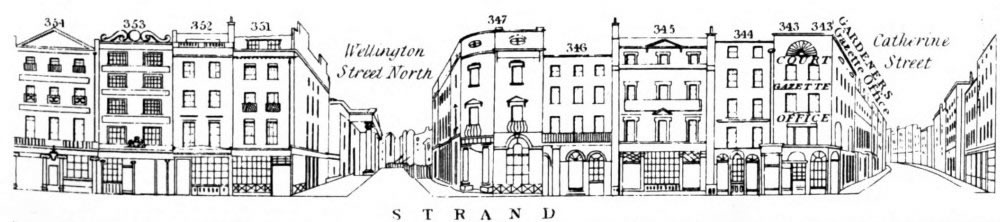
Above - The First and Second Lyceum Theatre, Strand and Wellington Street, as depicted in Tallis's London Street Views 1838 - 1840. The first Theatre was at 354, Strand, this building today is home to the Lyceum Public House. The Second and present Theatre was situated on Wellington Street and its dressing room block backs on to the site of the original Theatre.
The Morning Post reported on the new Lyceum Theatre in their 14th of July 1834 edition saying:- 'Notwithstanding all the prognostications which have been hazarded respecting the re-building and re-opening of the English Opera House during this summer, that event, so interesting to the dramatic and musical world, but, above all, of such vital importance to English musicians and authors, will certainly take place this evening. As a foretaste of what may be expected from the enterprise and tact of Mr. Arnold, a public rehearsal of the Opera of Nourjahad was appointed for last Saturday night, and, as may have been expected, the splendid coup d'oeil which the interior presented elicited the warmest approbation and loudest plaudits of the crowded assemblage, amongst whom were the most distinguished members of the theatrical profession and of the leading literary characters of the day...

Above - The Auditorium and Stage of the Second Lyceum Theatre - From 'The Builder' of 1847.
...The first cursory glance of the spectator immediately conveys the impression of the peculiar elegance of the horse-shoe shape of the structure, the admirable loftiness of the proscenium, and the circular and domelike form of the ceiling. Next to this is the reality conveyed to the senses of the compartments under the common appellation of boxes, pit, and gallery.
Thus, commencing with the gods, - and they are uppermost in our thoughts, - the gallery is essentially one in appearance, the front being composed of a gilded balustrade, the effect of which is light, and adds a finish to the splendours above and below. In other respects the visitant, to this elevated quarter have every reason to be satisfied, as the conveniences for sitting, seeing, and hearing are unusually ample. At the sides of the gallery are the slips, the entrance to the latter being approached from staircases behind the circle of boxes underneath. We may state here as a curious fact that there was no communication in the original design of the architect provided for the public to enter the gallery, and that it has been found necessary to construct a staircase at the exterior of the building, and break through the outer wall for a door. It has been mentioned to us that this omission arose out of the laudable anxiety of Mr. Arnold to provide separate entrances for the different portions of the theatre. In that point of view the defect is rather an advantage, since the grand entrance to the boxes will be exclusively under the handsome portico, with its six Corinthian stone columns, in the new street, while the pit door will be found in Exeter-court, coming into the Strand; and the gallery visitants will find a convenient staircase in Exeter-street for their ascent to the regions above...

Above - A Painting depicting the Auditorium and Stage of Samuel Beazley's 1834 Lyceum Theatre, London by George Richmond who says that the painting was inspired by the contemporary drawing and photograph shown on this page, with the addition of a full proscenium arch and painted ceiling, colours were gleaned from the descriptions of the decorations transcribed on this page - Click for an Index to all of George Richmond's Paintings on this site.
...To return to the interior from which we have wandered. The front of the upper tier of boxes exhibits a rich crimson drapery, decorated with gold ornament, hanging in graceful festoon, as if it had been negligently thrown over the barriers. The design of this is pretty, but we rather object to the colour: it is too glowing - too warm - but we speak under the July temperature, when ice itself could scarcely satisfy us. The space usually appropriated to the dress circle has been made the vehicle of an innovation, new to this country, although the arrangement is known in the Continental Theatres. We allude to what is called the balcony, the front of which projects about two or three feet beyond the boxes above, and which contains two rows of seats, or rather a double row of chairs. The front is a trellis work of cast iron gilt, very fanciful and elegant in its construction. The sides of the balcony are composed of dress boxes, and the rear is fitted up with comfortable boxes, having all the advantages of private box. There are on the stage, and on a level with it, other private boxes of the same kind as in other Theatres. The pit is capacious, and extends under the lower circle of boxes. The place for the orchestra will admit of a large band of performers, and a few seats or stalls are here set apart for those persons who may desire a close approximation to the stage.
The lobbies and passages, including the commodious hall, with the two spacious flights of stairs leading to the saloons, are numerous, and perfectly adapted for the purposes of egress and ingress, as also for the relief and luxury of a lounge during the interregnum of the performance...

Above - A Plan of the Second Lyceum Theatre - From 'The Builder' of 1847.
...The decorative part evinces considerable taste, and the prevailing colours do not offend the eye by a fatiguing repetition of sameness. There is variety as well as richness; and the effect of the buff or cream colour which pervades the ceiling, combined with divisions appropriated to arabesque ornaments, festoons with an inner circle of busts of celebrated English musicians, is unique, chaste, and truly superb.
From the centre of the dome-ceiling, or medallion we might call it, descends the magnificent cut-glass chandelier, the crystal of which is illuminated by myriads of minute gaslights, which throw a grateful yet immense mass of light all over the Theatre. Although the chandelier was not elevated to its proper position on Saturday it was universally admitted that a more elegant design and construction were never witnessed, and when at its altitude we have no doubt the sight will be "prodigious."
The stage arrangements appear to be extensive and complete. Upon the whole we are fully warranted in stating that, for convenience, adaptation for seeing and hearing, for elegance of shape, and beauty of decoration, the Lyceum and English Opera House is without a rival, and reflects the highest credit on the architect, Mr. Beazley, who will need no monument of his fame (and may he live a thousand years) than the splendid structure which he has thus raised within three months from the ruins of the former edifice.
The above text in quotes (edited) was first published in the Morning Post, 14th of July 1834.

Above - The Lyceum Theatre, Wellington Street, in 1834 - From 'The Lyceum and Henry Irving' by Austin Brereton, published in 1903.
 Samuel Beazley's 1834 Lyceum Theatre was for a long time managed by Sir
Henry Irving, indeed the new Theatre became famous for its association
with Irving and Ellen Terry who were associated with the Theatre until
their last performance there in 1902.
Samuel Beazley's 1834 Lyceum Theatre was for a long time managed by Sir
Henry Irving, indeed the new Theatre became famous for its association
with Irving and Ellen Terry who were associated with the Theatre until
their last performance there in 1902.
Charles Dickens's junior wrote about Irving and the Lyceum Theatre in his 'Dickens's Dictionary of London' in 1879 saying:- 'The Lyceum Theatre, Wellington-street, Strand - Has recently passed into the hands of Mr. Irving, who has for some years past been the leading actor and principal attraction there.
Left - A programme for Henry Irving's production of 'The Merchant of Venice' at the Lyceum Theatre in June 1895 - Kindly Donated by Judith Clarke - Click for more information.
It is one of the prettiest houses in London, and, while large enough to enable the poetical drama, even in the case of the heaviest Shaksperean play, to be effectively mounted, is not too large for the requirements of a modern audience.
It may be noticed that evening dress is more commonly in vogue in the stalls and dress-circle here than at other theatres, but there is no absolute rule.

 It
is worth notice, too, that the Lyceum, occupying a perfectly isolated
position with a street on each of its four sides, offers special facilities
for egress in case of alarm, whilst the saloon and lobby accommodation
is on an unusually handsome scale, only equalled by that at Drury
Lane.'
It
is worth notice, too, that the Lyceum, occupying a perfectly isolated
position with a street on each of its four sides, offers special facilities
for egress in case of alarm, whilst the saloon and lobby accommodation
is on an unusually handsome scale, only equalled by that at Drury
Lane.'
Left - A script for Henry Irving's production of 'The Merchant of Venice' at the Lyceum Theatre in November 1879 Kindly Donated by Judith Clarke - Click for more information and the full programme for this production. - Right - A Script for Henry Irving's production of 'King Lear' at the Lyceum Theatre in 1892 - Kindly Donated by Judith Clarke - Click for more information.
The above text in quotes was written by Charles Dickens's (Jr.) in his 'Dickens's Dictionary of London' 1879.
C. J. Phipps' Reconstruction and Alterations of 1882

Right - The Lyceum Theatre in 1903, shortly before its reconstruction by Bertie Crewe the following year - From 'The Lyceum and Henry Irving' by Austin Brereton, published in 1903.
The original architect of the Wellington Street Lyceum had been Samuel Beazley but in 1882 the prolific Theatre Architect C. J. Phipps partially reconstructed the building and made many improvements. In 1884 Phipps also altered the Circle Fronts and oversaw their redecoration. This incarnation of the Lyceum would survive until 1904 when it was reconstructed by Bertie Crewe, retaining only Samuel Beazley's original facade and portico, more on this below. The original Pit Entrance to the Wellington Street Theatre can still be seen today beside the Lyceum Tavern on the Strand, the entrance today leads to an open space for the pub where the side elevation of the Theatre can still be seen. The Original Lyceum Theatre was situated on the Strand, where the Lyceum Tavern stands today, see images below.

Above - A Queue on the Strand outside the Pit Entrance to the Lyceum Theatre in 1897, this is today the entrance to the outside space of the Lyceum Tavern where the Wellington Street Theatre's side elevation can still be seen. The Original Lyceum Theatre Entrance once stood on this same site, also see Google StreetView Image below - 1897 Image From the Penny Illustrated Paper, 2nd October 1897.

Above - A Google StreetView Image of the Lyceum Tavern on the Strand, London - The left hand entrance was once the Pit Entrance to the Lyceum Theatre and today is the entrance to an outside space for the pub, where the side elevation of the Lyceum Theatre can still be seen. The Lyceum Tavern also stands on the site of the entrance to the original Lyceum Theatre - Click to Interact.

Above - C. J. Phipps' Lyceum Theatre Auditorium in 1890 - From 'The Lyceum' by A. E. Wilson 1952.


Above - A programme for William Terriss, Henry Irving, and Ellen Terry playing in 'Ravenswood' at the Lyceum Theatre , 20th of September 1890, which appears to have been signed by Ellen Terry herself in October the following year - Courtesy Sally Hewett.
Bertie Crewe's Reconstruction of 1904
 In 1904 another respected Theatre
Architect, Bertie Crewe, rebuilt
the Theatre retaining only Samuel
Beazley's original facade and portico. In the personal scrap book of Marie de Mensiaux there
was an article from 'The Boulogne & North France Times' of March
4th 1904,
which describes how she was able to look round the Lyceum Theatre whilst
the workmen were destroying the interior of the old Theatre. The article was kindly sent
in by Trevor Dudley and says:- 'I have taken my leave of the poor old
Lyceum Theatre. To my great regret, it was impossible for me to be present
at the sale of the properties and effects which took place within its
walls, but I did want to say a last farewell to a house so full of pleasant
memories for me.
In 1904 another respected Theatre
Architect, Bertie Crewe, rebuilt
the Theatre retaining only Samuel
Beazley's original facade and portico. In the personal scrap book of Marie de Mensiaux there
was an article from 'The Boulogne & North France Times' of March
4th 1904,
which describes how she was able to look round the Lyceum Theatre whilst
the workmen were destroying the interior of the old Theatre. The article was kindly sent
in by Trevor Dudley and says:- 'I have taken my leave of the poor old
Lyceum Theatre. To my great regret, it was impossible for me to be present
at the sale of the properties and effects which took place within its
walls, but I did want to say a last farewell to a house so full of pleasant
memories for me.
Right and below - Henry Irving and Ellen Terry playing the Master of Ravenswood and Lucy Ashton in 'Ravenswood' at the Lyceum Theatre in September 1890 - Courtesy Sally Hewett.
 On
the 18th of March, coming away from The Theatrical Ladies Guild, as
I passed the closed doors of the Lyceum, and heard the hammering of
destruction going on inside, I tried the door of the main entrance,
and it gave way at my touch, but I was at once stopped by some one in
auuthority who informed me that it was strictly forbidden for anyone
to go in except the workmen. Fortunately for me, we still have an "Open
Sesame" in our modern times - "I am one of the Press"
- passed me in without further objection, and I was handed over to the
guidance of, the fireman, I think: not a workman, evidently, and one
who had belonged to the theatre staff, for he spoke of Sir
Henry Irving, as "The Goo'nor".
On
the 18th of March, coming away from The Theatrical Ladies Guild, as
I passed the closed doors of the Lyceum, and heard the hammering of
destruction going on inside, I tried the door of the main entrance,
and it gave way at my touch, but I was at once stopped by some one in
auuthority who informed me that it was strictly forbidden for anyone
to go in except the workmen. Fortunately for me, we still have an "Open
Sesame" in our modern times - "I am one of the Press"
- passed me in without further objection, and I was handed over to the
guidance of, the fireman, I think: not a workman, evidently, and one
who had belonged to the theatre staff, for he spoke of Sir
Henry Irving, as "The Goo'nor".
For the last of many a time I walked up the lobby steps leading to the back of the dress-circle, and there stopped perforce. I could walk half way round the house on the passage behind the dress-circle, but the circle itself was gone; the boxes were gone, the roof was almost gone. The stage had disappeared, the stalls were a mess of debris. And the curtain, or rather the drop-scene, which had not even been drawn up when the work of destruction began, was now only a tattered fragment hanging in mid air, and looking more like an overgrown cobweb than anything else. A sad sight. By the time you read this, nothing but the outer walls will be left, and the theatre we so loved to crowd in, (to use the words of the American Poet, Samuel Minturn Peck.)
Must join the dear delights of yore
And only live in memory's casket.
 And the best of all memory's casket, is Austin Brereton's The Lyceum and Henry Irving. This book, which appeared last autumn,
is an exhaustive history of the Lyceum from its very beginning. And
we, lovers of the stage, owe a debt of gratitude to Mr. Brereton for
enabling us to procure so valuable a souvenir. I must confess that I
brought away a few fragments of the old place with me. - Marie De
Mensiaux, the Bologne and North of France Times, March 24th, 1904 - Courtesy Trevor Dudley.
And the best of all memory's casket, is Austin Brereton's The Lyceum and Henry Irving. This book, which appeared last autumn,
is an exhaustive history of the Lyceum from its very beginning. And
we, lovers of the stage, owe a debt of gratitude to Mr. Brereton for
enabling us to procure so valuable a souvenir. I must confess that I
brought away a few fragments of the old place with me. - Marie De
Mensiaux, the Bologne and North of France Times, March 24th, 1904 - Courtesy Trevor Dudley.
Right - A Twice Nightly 1905 Variety programme for the 1904 reopened Lyceum Theatre - Courtesy Simon Moss, stagememories.
The work described above was carried out to the designs of the Theatre Architect, Bertie Crewe, for Tom Barrasford who totally rebuilt the Theatre in 1904, retaining only Samuel Beazley's original facade and portico. The Theatre reopened on the 31st of December 1904 as a 3,600 seater Variety Theatre to rival Stoll's Coliseum. Known for a time as the New Lyceum it was very busy but not successful for Barrasford because the London authorities refused to grant him a drinks licence.
Irving would never live to see the Theatre return to legitimate drama again as he died in 1905 before it occurred. But on the 30th of March 1907, under the joint management of H. R. Smith and Ernest Carpenter, who formed a company known as Popular Playhouses Ltd, the Lyceum was returned to legitimate theatre use again. There were further minor alterations to the Theatre by F. Edward Jones in 1919.

Above - A Packed Audience at the Lyceum Theatre in a Flashlight Photograph taken by the Biograph Studio of Regent Street - From A Twice Nightly 1905 Variety programme for the 1904 reopened Lyceum Theatre - Courtesy Simon Moss, stagememories.


Above - Two photos of the Lyceum Theatre Greenroom published in Theatre Magazine in April 1905, from photos originally published in the Tatler. The Captions read:- The Most Comfortable Greenroom in the World - Lyceum Theatre, London - Actresses taking tea during the waits and Where the men amuse themselves.

Above - Plans of the Lyceum Theatre - From 'Modern Theatre Construction' by Edward Bernard Kinsila, 1917.

Above - A Seating Plan for the Lyceum Theatre - From 'Who's Who in the Theatre' published in 1930 - Courtesy Martin Clark. Click to see more Seating Plans from this publication.
In 1937 Frederick Melville had the Theatre converted into a Cinema which involved much reconstruction including building a projection booth above the portico, still there today, lowering the auditorium's floor and re-seating and re-carpeting at a cost of nearly £12,000. The Cinema opened with the film 'The Gang Show' on the 13th of April that year but it was to be the only film shown in the Cinema as Melville had neglected to realise that the Film Circuits of the time had the rights to distribution sewn up. The Cinema was converted back to live Theatre the following month.

Above - The Lyceum Theatre in 1930 whilst home to a production of 'Traffic' with Mary Glynne and Dennis Neilson Terry.
On the 1st of July 1939 the Theatre closed down after the final performance of John Gielgud's production of 'Hamlet' and was scheduled for demolition so that a block of flats could be built on the site. (There is much more information on this 'last performance' and the whole history of the Lyceum Theatre further down on this page.)
By the following May however, the scheme to build a block of flats on the site was halted when a new scheme to widen the Strand meant that a roundabout would be built on the site instead. On the 17th of June an auction took place to sell off everything that could be removed from the Theatre including the Iron Curtain which went for just nine guineas, the entire mahogany Box Office for ten shillings, the lighting switchboard for twelve guineas, and 846 of the Upper Circle's seats for just five pence each.
However, due to the outbreak of the Second World War the demolition of the Theatre was put on hold and although it remained empty and forlorn throughout the war years, thankfully the demolition never took place.
Conversion to a Ballroom in 1945

Above - The Lyceum Theatre during its Dance Hall days in 1957 - From The Sphere, September 28th 1957.
 In
1945 the Theatre was converted into a Ballroom called the Palais de
Dance for Mecca who had previously been using the Opera
House as a Ballroom during the war years. The conversion of the
Lyceum was done by Matthews and Sons who transferred the flooring from
the Opera House and transplanted it into the empty Lyceum.
In
1945 the Theatre was converted into a Ballroom called the Palais de
Dance for Mecca who had previously been using the Opera
House as a Ballroom during the war years. The conversion of the
Lyceum was done by Matthews and Sons who transferred the flooring from
the Opera House and transplanted it into the empty Lyceum.
Right - The Palais de Dance in the auditorium and stage of the former Lyceum Theatre on October the 22nd 1945 - From 'The Lyceum' by A. E. Wilson 1952.
The Lyceum Ballroom was very successful and many people still have fond memories of visiting it. In its early years the Ballroom was host to some of the Biggest Dance Bands of the day, and also staged the Miss World contest there every year from 1951 to 1968. In its later years the Ballroom was used for staging popular music concerts with acts such as The Grateful Dead, The Clash, Bob Marley and The Wailers, Led Zeppelin, The Who, Prince, who had his first UK concert there in 1981, Emerson, Lake & Palmer, and many others, and it was also home to several Television Broadcasts.


Above - The Lyceum Theatre during its Mecca Ballroom Dining and Dancing Period - From the papers of the late Richard Brett - Courtesy Roger Fox.
The National Theatre's Mysteries Trilogy at the Lyceum Theatre in 1985
 After Mecca closed the Lyceum Ballroom the Theatre's future again looked bleak and it remained
dark and dilapidated for several years until it was revived briefly in 1985 when it became the temporary home to the National
Theatre's promenade production of Bill Bryden's adaptation of the
Mysteries Trilogy, which opened at the Lyceum on the 15th of May 1985 for a twelve week run.
After Mecca closed the Lyceum Ballroom the Theatre's future again looked bleak and it remained
dark and dilapidated for several years until it was revived briefly in 1985 when it became the temporary home to the National
Theatre's promenade production of Bill Bryden's adaptation of the
Mysteries Trilogy, which opened at the Lyceum on the 15th of May 1985 for a twelve week run.
Right - A Programme cover for the National Theatre's production of the Mysteries Trilogy at the Lyceum Theatre in May 1985.
The production had previously been staged at the NT's Cottesloe Theatre. The work to reopen the Lyceum for this production was quite involved and an article detailing the history of the project and its eventual success is shown below.
The 'Mysteries' at the Lyceum proved to be successful although I think some people probably went just to enter the old Theatre again, I really wanted to go myself but in the end I didn't get round to it because of my work commitments and the short run.


Above - An Article about the staging of the National Theatre's promenade production of the Mysteries Trilogy at the Lyceum Theatre in May 1985 - Courtesy Roger Fox from the papers of the late Richard Brett.
After the Mysteries closed in the summer of 1985 the Theatre went dark again and it would stay closed and boarded up for the next decade or so, becoming extremely derelict in the process (See images below). Due to the abolition of the GLC in 1986 the London Residuary Body had sold a 125-year lease on the building to Brent Walker and it looked as if it would probably never be reopened but would most likely be demolished instead, although its Grade II Listed Status from 1978 helped to prevent this in the end.


Above - Photographs of the Lyceum Theatre in a near derelict state and before its eventual restoration in 1996 - From the papers of the late Richard Brett - Courtesy Roger Fox.
The 1996 Restoration of the Lyceum Theatre

Above - The Lyceum Theatre looking very sorry for itself, boarded up and dark, this photo was taken shortly before its 1996 restoration - Courtesy Jason Mullen.
The freehold of the Lyceum Theatre was later transferred to The Theatres Trust and they were able to eventually negotiate a transfer of the lease from Brent Walker to the Apollo leisure group, who, with Lottery funding, converted the building back to a live Theatre use and restored the auditorium, totally rebuilt the stage house, and incorporated an adjoining building. This was all accomplished by Holohan Architects in 1996 at a cost of £14 million.
I visited the Lyceum myself shortly before the works began and at that time it was hard to believe that it would be possible to restore the Theatre to its former grandeur, such was the state of the building, in fact it was comparable to the London Hippodrome in 2003. The restoration was however a great success and the Theatre looked splendid inside and out when it was reopened by H.R.H. Prince Charles on the 31st October 1996 with a new production of Andrew Lloyd Webber's 'Jesus Christ Superstar'. The Lyceum has since become famous for being the London home of the Disney musical 'The Lion King' which has been playing at the Theatre since 1999.

Above - The Lyceum Theatre during refurbishment and reconstruction in 1996, the photo shows the stage house and dressing room block completely demolished before reconstruction - Courtesy Jason Mullen

Above - The Lyceum Theatre's Stage House during demolition and reconstruction in 1996 - From the Theatre's Opening Souvenir Brochure of 1996

Above - The Lyceum Theatre's Auditorium and Stage House during renovation in 1996 - From the Theatre's Opening Souvenir Brochure of 1996

Above - Bertie Crewe's wonderful Lyceum Theatre Auditorium being restored in 1996 - From the Theatre's Opening Souvenir Brochure of 1996

Above - The Lyceum Theatre's 1996 restored Auditorium - Courtesy John Mann 08.

Above - The Lyceum Theatre's Auditorium today - Courtesy John Mann 08.
The Lyceum Theatre today has a capacity of 2,000 and is a Grade I Listed building. The Theatre was bought by The Ambassador Theatre Group in November 2009.
You may like to visit the Theatre's own Website here.
More articles and images for the Lyceum Theatre can be seen below.
The Lyceum Theatre - From the Theatres Trust Guide
Reproduced here with the kind permission of the Theatres Trust
 The
Lyceum is a building of outstanding national importance, architecturally
and theatrically. Its history is complex.
The
Lyceum is a building of outstanding national importance, architecturally
and theatrically. Its history is complex.
A public building of this name stood on an adjoining site (now covered by Wellington Street) in 1772, then a theatre from 1794 until Wellington Street was formed, when a new theatre was built on the present site. This opened in 1834. It was for a long time managed by Sir Henry Irving and was famous for its association with him and Ellen Terry (their last performance in 1902).
Right - The Lyceum Theatre in 1938 during the run of 'Queen of Hearts.'
The Crewe interior is post-Irving and was intended to be a variety house to compete with the Palace and the London Coliseum but it was not a success in this mode and soon reverted to drama. It was purchased by the LCC in 1939 for demolition in connection with a road improvement, later abandoned.
Leased to Mecca, it became a ballroom. The abolition of the GLC in 1986 led to a period of darkness and uncertainty, during which the London Residuary Body sold a 125-year lease to Brent Walker before transferring the freehold to The Theatres Trust. They eventually negotiated a transfer of Brent Walker's unexpired term to Apollo leisure, who set about works of restoration and improvement. The theatre reopened in 1996 as a home for large scale musicals.
 Despite
the fact that the symmetrical neoclassical composition was altered at
upper level by 1904 and the
domed attic lost, Samuel Beazley's 1834 facade and portico remain
today as rare and valuable pre-Victorian survivals The portico stands
over the public footway (cf Haymarket) and is a striking incident in
the view up Wellington Street from the Strand.
Despite
the fact that the symmetrical neoclassical composition was altered at
upper level by 1904 and the
domed attic lost, Samuel Beazley's 1834 facade and portico remain
today as rare and valuable pre-Victorian survivals The portico stands
over the public footway (cf Haymarket) and is a striking incident in
the view up Wellington Street from the Strand.
Left - Programme for The 'Queen Of Hearts' Pantomime produced at the Lyceum Theatre on December 26th 1938.
The Crewe theatre occupied a wider plot than the earlier building and the portico and entrance staircase are, as a consequence, offset from the axis of the auditorium. The splendid foyer and staircase lead now to Crewe's richly ornamented variety house interior. The rococo-ornamented panel over the proscenium is, perhaps, rather too deep for complete comfort, but the auditorium must, nevertheless, be rated as one of the most flamboyant in Britain.
 The
most striking alteration in the 1996 works was the total rebuilding
of the stage house to give flying height for the most demanding modern
productions. The old stage house was the result of a patchwork of alterations
and additions to the Beazley / Phipps stage with further enlargement
by Crewe The new fly tower is, as
it must be for a major musical house, a landmark. The orchestra pit
has been enlarged to a size suitable for Grand Opera.
The
most striking alteration in the 1996 works was the total rebuilding
of the stage house to give flying height for the most demanding modern
productions. The old stage house was the result of a patchwork of alterations
and additions to the Beazley / Phipps stage with further enlargement
by Crewe The new fly tower is, as
it must be for a major musical house, a landmark. The orchestra pit
has been enlarged to a size suitable for Grand Opera.
 Right
- Image from a programme for The 'Queen Of Hearts' Pantomime produced at the Lyceum Theatre on December 26th 1938.
Right
- Image from a programme for The 'Queen Of Hearts' Pantomime produced at the Lyceum Theatre on December 26th 1938.
Left - Image from a programme for The 'Queen Of Hearts' Pantomime produced at the Lyceum Theatre on December 26th 1938.
 Apollo's initial auditorium decorations were
criticised by some and the renewed ceiling paintings are, undoubtedly,
a touch raw and startling, but this remains one of the most impressive
reawakenings of recent years and one which would have seemed highly
unlikely as recently as the mid 1980s. It is time that this building
was fully researched and an authoritative architectural account published.
Apollo's initial auditorium decorations were
criticised by some and the renewed ceiling paintings are, undoubtedly,
a touch raw and startling, but this remains one of the most impressive
reawakenings of recent years and one which would have seemed highly
unlikely as recently as the mid 1980s. It is time that this building
was fully researched and an authoritative architectural account published.
The above text is reproduced with kind permission of The Theatres Trust From their indispensable book: 'The Theatres Trust Guide to British Theatres 1750-1950' John Earl & Michael Sell.
Available from the publishers, A&C Black (tel 01480 212666).
Images are from my own collection. M.L.
The Romance Of London Theatres By Ronald Mayes.
No. 45. The Lyceum
 The
site of the present Lyceum Theatre was occupied as early as 1765 by
a building housing an exhibition of paintings. From this sprang the
Royal Academy. It was afterwards used for musical entertainments given
by Charles Dibden, and later as a circus, brought by Astley when his
amphitheatre was burned down at Westminster.
The
site of the present Lyceum Theatre was occupied as early as 1765 by
a building housing an exhibition of paintings. From this sprang the
Royal Academy. It was afterwards used for musical entertainments given
by Charles Dibden, and later as a circus, brought by Astley when his
amphitheatre was burned down at Westminster.
Between 1794 and 1809 it was used as a chapel, a concert room, and for an exhibition of waxworks displayed by Madame Tussaud. Between 1809 and 1812 it was used for dramatic performances by the Drury Lane Company after the burning of their own theatre, until the erection of the new edifice.
In 1816, Samuel Arnold opened it as the English Opera House, which was burned down in 1830. Four years later the present building was erected and opened under the title of the Theatre Royal Lyceum and English Opera House.
In 1840, Balfe undertook the production of National Opera, but despite its excellent chances of success, this enterprise was a failure.
In 1871, Henry Irving took over the theatre, and with his memorable performance in "The Bells" in that year, the Lyceum entered into a new Lease of life. "The Bells," with Irving as the ghost-haunted burgomaster, played to overflowing houses for 150 nights. His next success was in "Charles I," in the following year, which ran for 180 nights. This was followed by "Hamlet," in which Irving's popularity reached its greatest height. This great actor was associated with the Lyceum for over 25 years and one of his first acts as manager was to engage Ellen Terry for his productions.
 December, 1885, saw the first night of
"Faust" - the application for reserved seats would have filled
twelve theatres, some thousands coming from Germany alone.
December, 1885, saw the first night of
"Faust" - the application for reserved seats would have filled
twelve theatres, some thousands coming from Germany alone.
Irving constantly left for tours in America, and the boards were occupied by many famous people, including Forbes - Robertson and -Mrs. Patrick Campbel, Sarah Bernhardt and Elennora Duse. Martin Harvey, a pupil of Irving's played a season there in 1899. Coquelin, too, appeared as Cyrano de Bergerac in the summer of 1898. The history of the old Lyceum ends with 1902 when the interior was pulled down and reconstructed, the house being opened for a while as a variety theatre.
Left - The Lyceum Theatre during its time as the Mecca Ballroom, here featuring Benny Boyce and his Orchestra in 1958 - Courtesy Gerry Atkins.
No account of the old theatre would be complete without reference to the "Sublime Society of Beefsteaks," the famous institution which had its home here for fifty years. It was founded by John Rich and dissolved in 1867. The members, who never exceeded twenty-four in number met every Saturday night to eat beefsteaks and to drink port wine.
In recent Years the Lyceum has become the home of popular drama for ten months in the year, and, even more popular pantomime during the remaining two. The present attraction is "Merry, Merry," the popular musical comedy presented by Messrs. Clayton & Waller.
Above text and image from a 'Magazine Programme' for The Aldwych Theatre - May 13th, 1929.
See also 'Down East and Up West' by Montagu Williams.
Note on the history of the Lyceum Theatre by W. Macqueen Pope
From a programme for John Gielgud's Production of 'Hamlet' June 28th - July 1st 1939.

Above - The exterior of the Lyceum Theatre in 1834 - From a programme for John Gielgud's Production of 'Hamlet' June 28th - July 1st 1939.
When The Lyceum Theatre - The Royal Lyceum Theatre, as Irving always called it, closes its doors and is demolished, one of the three most famous playhouses in London will be gone for ever. The story of it glows with colour and is decked with great names; and although it has had, like every famous theatre, its ups and downs, it has also made great theatrical history. Irving's name alone makes its memory imperishable.
 Few
people realise that the history of the Lyceum Theatre goes back to 1765
- 174 years ago. In that year Mr. James Payne, (James Paine M.L.)
an architect, erected a building on part of the site of' the present
theatre for the exhibitions of "The Society of Artists". So
the Lyceum started life as the Royal Academy. Three years later the
Society was disbanded, and the premises were purchased by Mr. Lingham,
a breeches maker in the Strand, who
let them out for dances, meetings and any other purpose for which he
could find a tenant.
Few
people realise that the history of the Lyceum Theatre goes back to 1765
- 174 years ago. In that year Mr. James Payne, (James Paine M.L.)
an architect, erected a building on part of the site of' the present
theatre for the exhibitions of "The Society of Artists". So
the Lyceum started life as the Royal Academy. Three years later the
Society was disbanded, and the premises were purchased by Mr. Lingham,
a breeches maker in the Strand, who
let them out for dances, meetings and any other purpose for which he
could find a tenant.
Right - The programme for John Gielgud's production of Hamlet in 1939 which this article comes from.
In 1794, Dr. Arnold, the composer, rebuilt the interior as a proper theatre. But he encountered opposition, for the patentees of Drury Lane and Covent Garden did not want another theatre in competition, and prevented him from getting a licence, so Lingham got it back. It housed all sorts of attractions again. Astley brought his circus there when the Amphitheatre in Westminster Road was burned down - other attractions were The Musical Glasses, phantasmagoria, panoramas, a school of eloquence, a white negress and a porcupine man. And it was at the Lyceum that Madame Tussaud first exhibited her waxworks in London in 1802. But poetic justice came to the Lyceum. In 1809 Drury Lane Theatre was burned down, and the company had nowhere to play. So the patentees of Drury Lane leased the Lyceum and actually got for it the licence which they had formerly prevented Dr. Arnold from obtaining. The company remained there until 1812, until the present Drury Lane Theatre was ready.
 One
must not forget that the Lyceum once housed a Club-called "The
Sublime Society of Beef Steaks". Founded by John Rich in 1755,
it moved into premises at the Lyceum in 1809,
and remained there until 1867.
It was very exclusive, and very aristocratic. Its members numbered only
twenty-four, and it blackballed the Prince Regent. Its members met every
Saturday night to eat beef steak and drink port wine. At the end of
the dining room was an enormous gridiron, through which the grill could
be seen, and over the gridiron was the quotation: "If it were done,
when 'tis done, then 'twere well it were done quickly."
One
must not forget that the Lyceum once housed a Club-called "The
Sublime Society of Beef Steaks". Founded by John Rich in 1755,
it moved into premises at the Lyceum in 1809,
and remained there until 1867.
It was very exclusive, and very aristocratic. Its members numbered only
twenty-four, and it blackballed the Prince Regent. Its members met every
Saturday night to eat beef steak and drink port wine. At the end of
the dining room was an enormous gridiron, through which the grill could
be seen, and over the gridiron was the quotation: "If it were done,
when 'tis done, then 'twere well it were done quickly."
Next Samuel James Arnold, son of the Dr. Arnold who had made the Lyceum into a theatre, took over the theatre, which remained in the possession of the Arnold family until sold to the Melvilles in 1910 - so that in its long history it has only been in the hands of two families. The lessees, of course, have been numerous.
Left - A page from the programme for John Gielgud's production of Hamlet in 1939 which this article comes from.
Samuel Arnold rechristened the Lyceum - he called it The English Opera House, and he tried to run opera there in English. He increased the size of the theatre by purchasing the whole block of buildings between Wellington Street and Exeter Street and rebuilt it at a cost of £80,000. The principal entrance was in the Strand - there is still an entrance there under a small portico supported by six Ionic columns - and down a long corridor upon which opened the door of a tavern, exactly as it does to-day.
At prices ranging from one to five shillings the house held £350. The interior was handsome of its kind, and a great feature was a saloon seventy-two feet long and forty wide, decorated with flowers and shrubs according to the seasons of the year. Sometimes this saloon was made to resemble an Italian Terrace, sometimes a Chinese Pavilion, and sometimes represented an ancient Egyptian temple.
The Lyceum - or English Opera House - was one of the very first places of public entertainment to be lit with gas - the Haymarket Theatre was the last - and in 1817 the introduction of gas lighting on the stage was made a great feature on the bills. Gas was extended to the auditorium later in the same season. The Olympic - the first place to adopt gas lighting -had installed it two years previously. Those were leisurely days.
The new theatre opened on 15th June, 1816, with "Up All Night" (or "The Smuggler's Cave") and "The Boarding House". T. P. Cooke, Harley and Miss Love were the stars, but the success of the bill was made by Fanny Kelly, who also delivered an Address at each performance. Charles Lamb fell in love with her and proposed to her by letter, but she refused him. She had appeared, as a child, with Mrs. Siddons. She was really the Lyceum's first star.
But the English Opera House was not a success - although twice nightly performances were tried there in 1817.
Then in 1818 Matthews the elder appeared and made a great success. The bills announced that Mr. Matthews would be "At Home" at the Theatre Royal, English Opera House, Strand; and would have the honour of presenting an entertainment to his visitors. Matthews' great strength lay in his power of mimicry - for without the aid of make-up he would disguise his personality entirely. He proved a great success.
But general prosperity did not come to the theatre - English opera failed. In 1821 we find the first mention of "Hamlet" being performed when Mrs. Glover appeared in it for the occasion of her benefit.
In 1828 a gas explosion closed Covent Garden, and the company came to the Lyceum, and included Kean.
On February 10th, 1830, the theatre was burnt down. It was a terrible fire, and involved Arnold in a loss of £8,000. (Please note that the date for the fire was actually the 16th February and not the 10th as stated here. M.L.)
In 1834 the new building was opened, rechristened "New Theatre Royal, Lyceum and English Opera House". Why the title of Theatre Royal should have been adopted is a mystery, for the Lyceum has never had a Royal Charter.


Above - An early Entrance Token for a Box at the Theatre Royal English Opera House - Courtesy Alan Judd
Beazley, the architect, made a curious mistake. He forgot to provide a staircase to the gallery, and a wooden one, which stood for years, had hastily to be put up. John Barnett's opera, "The Mountain Sylph", was the opening attraction, and ran for a hundred nights. But in 1835 the management was bankrupt, and the company were running on a commonwealth, pooling the takings.
In the winter of 1838 - 9 the first Promenade Concert ever held in this country took place at the Lyceum.

Above - The auditorium of the renovated Lyceum Theatre with Mme Vestris and C. J. Mathews in Planche's The Pride of the Market, October 18, 1847 - From 'The Lyceum' by A. E. Wilson 1952.
 In 1841 Balfe took over the
theatre with a flourish of trumpets and announced that he would present
Opera there. Orchestra Stalls were introduced for the first time. The
Queen headed the list of subscriptions. But it all came to nothing.
In 1847 Madame Vestris took
a lease of the Lyceum, where she remained for seven years - indeed,
she made her last appearance there, in "Sunshine Through the Clouds".
In 1841 Balfe took over the
theatre with a flourish of trumpets and announced that he would present
Opera there. Orchestra Stalls were introduced for the first time. The
Queen headed the list of subscriptions. But it all came to nothing.
In 1847 Madame Vestris took
a lease of the Lyceum, where she remained for seven years - indeed,
she made her last appearance there, in "Sunshine Through the Clouds".
Just before her management, the famous Keeleys had run it, and Charles Dickens' novel "Martin Chuzzlewit", in dramatic form, had been a big success.
Dillon comes next in the list of great names: a man who might have been as great as Irving had not the lure of the bottle been too much for him.
Madame Celeste performed "A Tale of Two Cities" at the Lyceum, playing Madame Defarge, and there was another period of opera with Titiens, Alboni and a wonderful cast.
Right - A Programme for 'The Master of Ravenswood' at the Lyceum Theatre in 1866 under the Management of Charles Fechter - Courtesy Simon Moss, stagememories.
Then came Charles Fechter, the great French actor, who revolutionised the stage and acting. His startling changes in methods of staging and acting crowded the Lyceum - as did his Hamlet. Kate Terry, Herman Vezin, Emery and Jordan were amongst those who supported him.
Opera Bouffe followed, but was a dismal failure.
Then followed a management with which these last performances at this great playhouse have a direct line.
In the autumn of 1871 Colonel H. L. Bateman took the theatre. Everyone prophesied failure. He was a great showman, and his three daughters Kate, Isabel and Virginia, were fine actresses, and in his company was an actor called Henry Irving. But he opened badly. "Fanchette", his first production, failed completely. "Pickwick", with Irving as Jingle, was an artistic success but brought in no money. Things looked serious. Now Henry Irving had in his possession a play by Leopold Lewis, founded upon a story by Erckman-Chatrian, called "The Polish Jew". This he took to Bateman. As a desperate throw it was decided to produce it. Bateman really considered an actor called George Belmore as his leading man, but he put up this play with Irving in the lead. It was called "The Bells".
 Like so many theatrical stop-gaps it was an enormous success. Irving
had already made his mark at the St. James's and at the Queen's, Long Acre (now
the offices of Odhams' Press), and especially at the Vaudeville as Digby Grant. But we have to go back to the debut of Garrick, the
triumphs of Kean, and the sensation made by Macklin's
Shylock to find a reception comparable to that given to Henry
Irving on that November evening in 1871,
when he first appeared as the Burgomaster Mathias. The play packed the
theatre for 150 nights. He next appeared as Jeremy Diddler in "Raising
the Wind", arid later Kate Bateman appeared as Leah and Medea.
Like so many theatrical stop-gaps it was an enormous success. Irving
had already made his mark at the St. James's and at the Queen's, Long Acre (now
the offices of Odhams' Press), and especially at the Vaudeville as Digby Grant. But we have to go back to the debut of Garrick, the
triumphs of Kean, and the sensation made by Macklin's
Shylock to find a reception comparable to that given to Henry
Irving on that November evening in 1871,
when he first appeared as the Burgomaster Mathias. The play packed the
theatre for 150 nights. He next appeared as Jeremy Diddler in "Raising
the Wind", arid later Kate Bateman appeared as Leah and Medea.
Left - Three Ophelias at the Lyceum Theatre, Fay Compton, Isabel Bateman, and Ellen Terry - From the programme for John Gielgud's production of Hamlet in 1939 which this article comes from.
Irving's next success was in Wills' "Charles The First", in September, 1872. Isabel Bateman played the Queen. Then came "Eugene Aram", a big success for Irving, but not a financial success. "Richelieu" and "Philip- followed.
But on 31st October, 1874, came one of the greatest Lyceum nights. Bateman presented "Hamlet" with Irving as the Prince and Isabel Bateman as Ophelia. Bateman worked the press for all it was worth. He invited representatives of the provincial papers, a thing which had not been done before for a London first night. Next day eulogies of the production of' Isabel Bateman and of Irving were scattered all over the country. And that night Irving was recognised as one of the greatest actors of his time.
Now with that production we have direct links to-night, for H. L. Bateman was maternal grandfather to Fay Compton, whose performance as Ophelia you witness now, Isabel Bateman was her aunt, and the First. Gavedigger was played by Henry Compton, Fay Compton's paternal grandfather. "Hamlet" ran until June 25th, 1875, long after the death of Colonel Bateman in the previous March.
In 1875, Irving appeared as Macbeth with Isabel Bateman as Lady Macbeth. Irving played Othello in 1876, but it was one of' his failures, nor did Tennyson's "Queen Mary", with Isabel Bateman as the Queen and Irving as Philip of Spain,' prove popular. This was followed by "The Belle's Stratagem".
 Miss
Bateman carried on her father's management and produced "Richard
III" with Irving in the title role, in 1877 - a big success. "The
Lyons Mail" followed and then "Louis XI", with more laurels
for the brow of Irving. "Vanderdecken" came next, and then
the Bateman family relinquished the management.
Miss
Bateman carried on her father's management and produced "Richard
III" with Irving in the title role, in 1877 - a big success. "The
Lyons Mail" followed and then "Louis XI", with more laurels
for the brow of Irving. "Vanderdecken" came next, and then
the Bateman family relinquished the management.
Right - Henry Irving and Ellen Terry - From the programme for John Gielgud's production of Hamlet in 1939 which this article comes from.
 Irving
became his own manager - thanks to the backing of the Baroness Burdett
- Coutts, which he was soon able to pay her back again. On 30th December, 1878, he became the sole lessee.
He revived "Hamlet" and Ellen Terry was his Ophelia. Here
again is another link with to-night, for Ellen Terry was John Gielgud's
great aunt. The season ended with a
revival of "The Lady of Lyons".
Irving
became his own manager - thanks to the backing of the Baroness Burdett
- Coutts, which he was soon able to pay her back again. On 30th December, 1878, he became the sole lessee.
He revived "Hamlet" and Ellen Terry was his Ophelia. Here
again is another link with to-night, for Ellen Terry was John Gielgud's
great aunt. The season ended with a
revival of "The Lady of Lyons".
Left - Henry Irving and Ellen Terry as Hamlet and Ophelia - From the programme for John Gielgud's production of Hamlet in 1939 which this article comes from.
The next production was "The Iron Chest", but this soon gave way to a revival of "The Merchant of Venice" Irving's Shylock was magnificent, but Ellen Terry gave of her greatest art as Portia, which she had first played some years before with the Bancrofts. The Lyceum revival achieved the longest run on record for that play. On the hundredth night Irving gave a supper on the stage - the first of his great stage suppers, which were to become a feature of the artistic life of London.
Irving then revived "The Corsican Brothers", following Kean's conception of the dual role, but he was probably less successful than was Fechter in the same play. In 1881, he presented "The Cup", in which Ellen Terry made a big success as Camma, and for which Irving created one of the loveliest stage productions ever seen.
 In
May, 1881, Irving and Booth
alternated the roles of Othello and Iago. Irving triumphed in the latter
part. A similar success, in the same part, was to be made at His
Majesty's by his son Laurence years afterwards to the Othelo of
Sir Herbert Tree.
In
May, 1881, Irving and Booth
alternated the roles of Othello and Iago. Irving triumphed in the latter
part. A similar success, in the same part, was to be made at His
Majesty's by his son Laurence years afterwards to the Othelo of
Sir Herbert Tree.
Right - A Programme for Edwin Booth, Henry Irving, and Ellen Terry in 'Othello' at the Lyceum Theatre in May 1881 - Courtesy Raymond Buckland -See Cast List Below.
One must also mention a revival of "The Two Roses", by James Albery, with Irving as Digby Grant. This performance introduced George Alexander to the London stage for the first time.
The big theatrical event of 1882 was the production of "Romeo and Juliet". This was one of Irving's mistakes. He was not at all suited to Romeo, and Ellen Terry, except in certain scenes, did not shine as Juliet. William Terriss played Mercutio without distinction, and the successes were made by Mrs. Stirling as the Nurse, and Tom Mead as the Apothecary.
 But
the production was superb. Ellen Terry made perhaps her greatest success
in "Much Ado About Nothing", which followed "Romeo and
Juliet". Her Beatrice made stage history. She broke through the
old tradition of the part and played it in her own way, delighting and
charming even the most crabbed and conventional playgoers and actors.
But
the production was superb. Ellen Terry made perhaps her greatest success
in "Much Ado About Nothing", which followed "Romeo and
Juliet". Her Beatrice made stage history. She broke through the
old tradition of the part and played it in her own way, delighting and
charming even the most crabbed and conventional playgoers and actors.
Irving and Ellen Terry went to America, and in 1885 Mary Anderson made her London debut at the Lyceum. On Irving's return in 1884 he presented "Twelfth Night", with Ellen Terry as a delightful Viola, but there was trouble on the first night owing to a reserved pit, Irving made an unfortunate speech, and the production was not a great success.
During that summer extensive alterations were made to the theatre, and the principal entrance - then as now in Wellington Street - was reconstructed.
Left - Cast Details from a Programme for Edwin Booth, Henry Irving, and Ellen Terry in 'Othello' at the Lyceum Theatre in May 1881 - Courtesy Raymond Buckland - See Cover Above.
Followed one of the great Lyceum first nights - when "Olivia" was presented in May, 1885. This was a stage version of "The Vicar of Wakefield", and the part of the Vicar, originally played by Hermann Vezin at the Court, under John Hare's management, provided Irving with one of his most notable performances. Ellen Terry repeated her triumph as the Vicar's wayward daughter. It was said that there was not a dry eye in the house, and even hardened critics wiped their eyes furtively and blew their noses.
But perhaps the greatest of all Lyceum first nights - one of the greatest that London has ever seen - came on 19th December, 1885, when Irving produced "Faust". His friends told him the play would fail. But there were enough applications to fill six theatres of the size of the Lyceum, and thousands of visitors came from Germany as well. People gathered outside the theatre at nine in the morning. By six o'clock the crowd was halfway along the Strand.
 Scores
of fashionable women thronged the vestibule all day casting despairing
glances at Hurst, the box office keeper, and attempting to rush the
doors. It was a wonderful production. Irving was fine as Mephistopheles,
Alexander made a hit as Valentine, and afterwards succeeded to the role
of Faust, in which Conway had failed on the first night. But greatest
of all was the success of Ellen Terry as Margaret. Mrs. Stirling, who
played Martha, left the stage at the end of the run after a great career
of fifty-seven years.
Scores
of fashionable women thronged the vestibule all day casting despairing
glances at Hurst, the box office keeper, and attempting to rush the
doors. It was a wonderful production. Irving was fine as Mephistopheles,
Alexander made a hit as Valentine, and afterwards succeeded to the role
of Faust, in which Conway had failed on the first night. But greatest
of all was the success of Ellen Terry as Margaret. Mrs. Stirling, who
played Martha, left the stage at the end of the run after a great career
of fifty-seven years.
Irving broke the continuity of his management by repeated visits to America. Sarah Bernhardt played "Theodora" at the Lyceum in 1887, and Richard Mansfield came over from America and appeared at the theatre. Mary Anderson produced "The Winter's Tale" in 1888 and in the same year Irving played "Robert Macaire", while in "The Amber Heart" Ellen Terry had another triumph as Ellaline.
Right - A programme for the 96th performance of 'Macbeth' with Henry Irving and Ellen Terry, and with Bram Stoker as acting manager, at the Lyceum Theatre on April the 25th, 1889 - Kindly donated by Jane Hunt.
In 1889 Verdi's "Otello" was first sung in London at the Lyceum, with Tamagno and Maurel, and Sarah Bernhardt played "Tosca" there for the first time in London.
The Autumn brought Irving and Ellen Terry again in "The Dead Heart", and productions of "Macbeth" and "Ravenswood" followed. (Note the programme shown right refutes W. Maqueen Pope's Autumn statement as this production of Macbeth was for April 1889. M.L.)

Above - A programme for the 96th performance of 'Macbeth' with Henry Irving and Ellen Terry, and with Bram Stoker as acting manager, at the Lyceum Theatre on April the 25th, 1889 - Kindly donated by Jane Hunt.

Above - The Lyceum Theatre in 1891 - From a programme for John Gielgud's Production of 'Hamlet' June 28th - July 1st 1939.
 In 1891 further alterations were
made to the Theatre and in 1892 Irving produced "Henry VIII". Scenically
this was claimed to be his greatest triumph - and Edward German's now
famous Dances were used for the first time. Irving was in fine form
as Wolsey, but Ellen Terry did not impress as Katharine. "Lear"
followed - not a success for Irving, but a decided one for Ellen Terry
as Cordelia.
In 1891 further alterations were
made to the Theatre and in 1892 Irving produced "Henry VIII". Scenically
this was claimed to be his greatest triumph - and Edward German's now
famous Dances were used for the first time. Irving was in fine form
as Wolsey, but Ellen Terry did not impress as Katharine. "Lear"
followed - not a success for Irving, but a decided one for Ellen Terry
as Cordelia.
 Right
- A programme for Henry Irving's production
of 'The Corsican Brothers' and 'Nance Oldfield' at the Lyceum Theatre
in May 1891 - Courtesy Jacqueline
Selcoe.
Right
- A programme for Henry Irving's production
of 'The Corsican Brothers' and 'Nance Oldfield' at the Lyceum Theatre
in May 1891 - Courtesy Jacqueline
Selcoe.
In 1895 Irving produced "Becket", one of the greatest acting successes of his wonderful career. He played the part on the night before he died. Tennyson's "King Arthur" followed, adapted by Comyns Carr, with Ellen Terry as Guinevere and Forbes-Robertson as Lancelot. "Don Quixote" and "A Story of Waterloo", two one-act plays, will be remembered by all who saw them.
Left - Cast details from a programme for Henry Irving's production of 'The Corsican Brothers' and 'Nance Oldfield' at the Lyceum Theatre in May 1891 - Courtesy Jacqueline Selcoe.
Irving went again to America-and Mrs. Patrick Campbell and Forbes Robertson took the Lyceum. Forbes-Robertson was to appear there as Hamlet in 1897. Previously he had been in Irving's company in 1882, playing Claudio in "Much Ado About Nothing".
 Afterwards
he played Leontes in "A Winter's Tale" with Mary Anderson
in 1887, and in 1892 he was back with Irving as Buckingham in "Henry
VIII". Now, in September, 1895,
he played "Romeo and Juliet" with Mrs. Patrick Campbell, under
his own management.
Afterwards
he played Leontes in "A Winter's Tale" with Mary Anderson
in 1887, and in 1892 he was back with Irving as Buckingham in "Henry
VIII". Now, in September, 1895,
he played "Romeo and Juliet" with Mrs. Patrick Campbell, under
his own management.
On Irving's return he did a revival of "Richard III". After the first night he fell and injured his knee. From this time his luck began to fail. In 1897 he produced, "Madame Sans Gene", with himself as Napoleon and Ellen Terry as Madame Sans Gene. "Peter the Great" and "The Medicine Man" - followed, but were not successes.
Right - Cast details from a programme for Henry Irving's production of 'The Corsican Brothers' and 'Nance Oldfield' at the Lyceum Theatre in May 1891 - Courtesy Jacqueline Selcoe.
Some failures and constant absences in America - also a severe fire at a theatrical warehouse which burnt many of his finest productions - had weakened the popularity of Irving, and he now relinquished the management of the theatre to a syndicate headed by Comyns Carr.
Coquelin appeared at the Lyceum in 1898 as Cyrano de Bergerac.
Irving appeared as Robespierre in 1899.
Wilson Barrett did a season in 1899 - including a revival of "The Silver King" - and the Benson Company also appeared there, Sir Frank Benson playing "Hamlet" in its entirety.
Irving reappeared as Coriolanus - and failed. Lewis Waller presented "The Three Musketeers" and "Henry V". In 1901 "Sherlock Holmes" was produced with William Gillette as the great detective.
In the following year Irving revived "Faust", but his star was setting. The curtain fell on Irving at the Lyceum on 19th July, 1902, with "The Merchant of Venice" and "Waterloo".
 Thus
ended one of the greatest phases of the English Theatre.
Thus
ended one of the greatest phases of the English Theatre.
Left - The entrance to the Lyceum Theatre, draped in crepe after Henry Irving's death in October 1905. - From 'The Lyceum' by A. E. Wilson 1952.
Sir Henry Irving was the first actor to receive the honour of knighthood. His personal magnetism and distinguished career raised the whole status of his profession - the actor gained a social position which he had never before achieved, and the drama was again acknowledged one of the great arts.
 Irving's
acting genius, his magnificent standard of stage production, created
a new tradition - one that has never been surpassed. His name and work
will always be remembered - even when this great theatre falls, as fall
it must in a few short weeks. Although no sign of it will remain, the
memory of the Lyceum and Henry Irving will surely live forever.
Irving's
acting genius, his magnificent standard of stage production, created
a new tradition - one that has never been surpassed. His name and work
will always be remembered - even when this great theatre falls, as fall
it must in a few short weeks. Although no sign of it will remain, the
memory of the Lyceum and Henry Irving will surely live forever.
The Lyceum, since those great days, has seen many vicissitudes. Smith and Carpenter gave it drama and pantomime - and under their management the plays of Hall Caine drew London. Matheson Lang played Hamlet - a memorable performance in the great tradition.
Right - The Lyceum Theatre during John Gielgud's production of Hamlet in 1939 - From 'The Lyceum' by A. E. Wilson 1952.
Afterwards the theatre was, for a short time, a music hall as well.
Then, thirty years ago, the Brothers Melville -Walter and Fred - bought the Lyceum and gave it another spell of fame and glory. They produced dramas, often written by themselves. They were men of the theatre - their grandfather, George Melville, had actually given Irving the rights of "The Bells," so to some extent the Melville family had laid the foundation of Irving's greatness. And the Melvilles made the Lyceum pantomimes - pantomimes which crowded the great theatre for over a quarter of a century with delighted children, and no less delighted grown-ups. Under the Melvilles the Lyceum again became one of London's most famous playhouses. Both brothers, alas, have now passed on - they died within a year of each other - and now, soon after their deaths, goes the theatre which they loved so much - a theatre which will always be remembered in the history of the stage - a theatre which has added an imperishable page to the dramatic history of London.
And so, with John Gielgud as Hamlet and Fay Compton as Ophelia, two players bred in the tradition of the theatre, with some of its finest blood in their veins-the Lyceum passes on. "The Rest is Silence".
Above Text by W. Macqueen Pope - From a programme for John Gielgud's Production of 'Hamlet' June 28th - July 1st 1939.

Above - A Photograph of The Lyceum Theatre, looking down Wellington Street towards the Strand in 2005
Adelphi Aldwych Ambassadors Apollo Apollo Victoria Arts Cambridge Charing Cross Theatre Criterion Dominion Donmar Warehouse Drury Lane Duchess Tom Stoppard Theatre Fortune Garrick Gielgud Gillian Lynne Harold Pinter Haymarket His Majesty's Leicester Square Theatre London Coliseum London Palladium Lyceum Lyric Menier Chocolate Factory Noel Coward Novello Old Vic Palace Peacock Phoenix Piccadilly Playhouse Prince Edward Prince of Wales Royal Opera House Sadler's Wells Theatre Savoy Shaftesbury Sondheim St. Martin's Trafalgar Theatre Vaudeville Victoria Palace Wyndham's