
Robert Lloyd (A Hatter on the Strand) - By his G.G.G. Grandson Matthew Lloyd
(Robert Lloyd was the Father of Horatio Lloyd, and Grandfather of Arthur Lloyd)
Biography - Robert Lloyd's Hat Shop on the Strand by Wilfred Whitten - Lloyd's Treatise on Hats - Second Edition

Above - A View of the South Side of the Strand showing Lloyd & Co Hatters at number 71 - From John Tallis's London Street Views 1838 - 40 - Reproduced with the kind permission of the London Metropolitan Archives.
Robert Lloyd was born on the 20th of March 1778 in Salop, Oswestry, Shropshire, England. His parents were Edward Lloyd and Elizabeth Lewis, who were married in 1770, also in Oswestry, Shropshire. Robert was the fifth of six children and, according to his son Horatio Lloyd, (the respected and much loved actor and comedian), in his autobiography, due to some family misunderstanding Robert ran away from home when a mere lad and, 'Finding his way to London, he there got into business, and there settled down until retiring for good and all to Chertsey.'
 Robert
would later marry Elizabeth Gill whose family were all in the Navy.
Her sister, Jane Gill, was the wife of Charles
Jeffreys, whose career as a Navy Captain and Author is well documented.
Robert
would later marry Elizabeth Gill whose family were all in the Navy.
Her sister, Jane Gill, was the wife of Charles
Jeffreys, whose career as a Navy Captain and Author is well documented.
Charles Jeffrey was the Captain of the Kangaroo which carried prisoners to Van Diemen's Land in 1814, and later the Captain of the Saracen which arrived in Hobart Town, Van Diemen's Land on the 24th of April 1820. Robert Lloyd's Son George Lloyd was also on board the Saracen for this journey and went on to write 'Thirty Three Years in Tasmania and Victoria, which was published in 1862.
Right - The shop to the right of this 1883 photograph by Bedford Lemere and Company shows the former premises of Robert Lloyd's 1822 'Lloyd & Co Hatters' at number 71 Strand, London - Photograph reproduced by permission of Historic England Archive whose own caption for the image reads: "Exterior view of the premises of George Attenborough, pawn broker, silversmith and jeweller, at 71-72 Strand. The architects are listed in the Bedford Lemere daybook as Archer and Green. The building has since been demolished."
The trade which Robert Lloyd went into however was that of a Hatter. His father Edward Lloyd was a Corvisor, and his Grandfather James Lloyd had been a Glover and Corvisor, (A Corvisor was a Shoemaker, using Red leather from Spain), so although slightly different trades this may be where he got his talent for Hat Making.
 Robert
Lloyd lived and worked in premises at No. 71 Strand, London, (see images above and left) where his son Horatio Lloyd would later be born on the 9th
of November 1807. A Mr Hare
had been running this shop since about 1782 and Robert seems to have
been apprenticed there for some years before opening his own hatters
shop at 92 Newgate Street in Holborn in around 1814,
and later taking over the Strand premises too, after Hare died in 1822.
Robert
Lloyd lived and worked in premises at No. 71 Strand, London, (see images above and left) where his son Horatio Lloyd would later be born on the 9th
of November 1807. A Mr Hare
had been running this shop since about 1782 and Robert seems to have
been apprenticed there for some years before opening his own hatters
shop at 92 Newgate Street in Holborn in around 1814,
and later taking over the Strand premises too, after Hare died in 1822.
Left - The Strand at the corner of Adam Street, opposite the Adelphi Theatre, in August 2016. The modern building shown in the photograph stands on the site of 71 The Strand where Robert Lloyd's Hatters Shop was situated, and also where his son Horatio Lloyd (Arthur Lloyd's Father) was born in 1807. After the row of shops were demolished the Tivoli Theatre was built on the site, which was itself finally demolished in 1957 to make way for a branch of the Peter Robinson Fashion Store, also now demolished and replaced with the building shown in this photograph.
 But
Robert Lloyd was more than just a hat maker. He was also well known
in his day as a keen appreciator of philosophy, a writer, inventor and
a member of clubs and societies, including London's famous 'Eccentric
Club' along with Sheridan Hook and Lord Petersham. He was eventually entrusted with the books of the Eccentric Club
when it was removed from its then home in the May's Building in St.
Martin's Lane. The May's building would later be converted for use as
a booking office for the Grand Tier, and Balcony of the London
Coliseum.
But
Robert Lloyd was more than just a hat maker. He was also well known
in his day as a keen appreciator of philosophy, a writer, inventor and
a member of clubs and societies, including London's famous 'Eccentric
Club' along with Sheridan Hook and Lord Petersham. He was eventually entrusted with the books of the Eccentric Club
when it was removed from its then home in the May's Building in St.
Martin's Lane. The May's building would later be converted for use as
a booking office for the Grand Tier, and Balcony of the London
Coliseum.
Right - Details of the Eccentric Club from 'The History of Clubs and Club Life' by John Timbs and published in 1872 - Courtesy Imants von Wenden, Secretary of The Eccentric Club (UK).
When Robert eventually retired the records of the Eccentric Club are thought to have passed to another member in Liverpool and the surviving records state that by then Robert was no longer an active member of the club. If you know anything about the whereabouts of these original and now lost records please don't hesitate to contact Imants von Wenden at The Eccentric Club (UK).
Robert Lloyd appears to have been a very successful Hatter and was the author of a number of published books on the subject including several editions called 'Lloyd's Treatise on Hats' first published in 1819.
 This
is described as 'containing novel delineations of his various shapes,
shewing the manner in which they should be worn, the sort of face and
person best suited to each particular hat, and rules for their preservation.
Two copies of the Third edition, which was published in 1821,
and included 24 engravings, can be found at the British Library, but
I have added a transcribed copy of the second edition with images to
the bottom of this page here. An online version
is also available here.
This
is described as 'containing novel delineations of his various shapes,
shewing the manner in which they should be worn, the sort of face and
person best suited to each particular hat, and rules for their preservation.
Two copies of the Third edition, which was published in 1821,
and included 24 engravings, can be found at the British Library, but
I have added a transcribed copy of the second edition with images to
the bottom of this page here. An online version
is also available here.
Left - One of the engravings from Robert Lloyd's 'Treatise on Hats' which is of a hat called 'The New Dash.'
On Sunday June the 29th 1823 an advertisement appeared in 'Bell's Life in London and Sporting Chronicle,' stating: 'Lloyd's New Invented Double Covered Beaver Hats in 1000 different shapes and sizes, completely Water-proof, Oval, and of the most admirable beauty and texture; price only 27s. decidedly the best that ever were, or can be, manufactured, and will positively last longer than two sold under this price. For style durability, and comfort in wearing they are unrivaled. To be had only of the manufacturers R. and H. Lloyd, 71, Strand, and 92, Newgate Street, Inventors of Fashions to the whole Trade. No discount or Credit. N. B. Silk Hats particularly short and thick of nap, only 18s, warranted Waterproof. All letters to be post paid.'
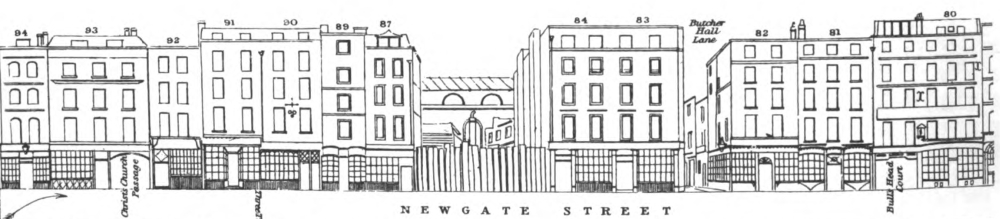
Above - Newgate Street, London - From John Tallis's London Street Views 1838 - 40. Seen here are Nos 91 and 92 Newgate Street where Robert Lloyd's Hatters Shop was situated in 1823.
 This advertisement is interesting in two ways, one because it mentions
R. and H. Lloyd, the R. Lloyd is obviously Robert, but the only H. Lloyd
in the family at that time was his son Horatio who would have been a young man of just 16. Was Robert trying to involve
his son in his profession? If he was then he was to be disappointed
as Horatio was soon to join the acting profession instead. The other
reason the advertisement is interesting is that it mentions the pair
had another shop at 92, Newgate Street which I have since discovered
mention of in several publications. In 1794 there was a Hosier named
Thomas Gubbins occupying the shop. In 1808 a Glover named John Briginsham
occupied the premises. In 1811 there was a James Starton at 92 Newgate
Street, who was a cutler. By 1822 the Records of the Sun Fire Office
have the property insured for a William Ellerby of Ave Maria Lane who
was a wholesale sheffield warehouseman, but the property itself was
occupied by Robert Lloyd, Hatter. By 1833 a Frederick Sandon, a Druggist,
occupied the property so it seems that Robert only had the property
for a maximum of 10 years.
This advertisement is interesting in two ways, one because it mentions
R. and H. Lloyd, the R. Lloyd is obviously Robert, but the only H. Lloyd
in the family at that time was his son Horatio who would have been a young man of just 16. Was Robert trying to involve
his son in his profession? If he was then he was to be disappointed
as Horatio was soon to join the acting profession instead. The other
reason the advertisement is interesting is that it mentions the pair
had another shop at 92, Newgate Street which I have since discovered
mention of in several publications. In 1794 there was a Hosier named
Thomas Gubbins occupying the shop. In 1808 a Glover named John Briginsham
occupied the premises. In 1811 there was a James Starton at 92 Newgate
Street, who was a cutler. By 1822 the Records of the Sun Fire Office
have the property insured for a William Ellerby of Ave Maria Lane who
was a wholesale sheffield warehouseman, but the property itself was
occupied by Robert Lloyd, Hatter. By 1833 a Frederick Sandon, a Druggist,
occupied the property so it seems that Robert only had the property
for a maximum of 10 years.
Anyway, a few years later in 1830, Robert had another book on Hat Making published called : 'Dissertatio Castorum, Or Prosaic and Versified Delineations of the Style, Character, and Properties of Lloyd's Incomparable Beaver Hats: Shewing the Manner in which They Should be Worn, the Sort of Face and Person Best Suited to Each Particular Shape, and the Many Rare Virtues'
 Robert
also filed a number of successful Patents concerned with his hat making.
Patents in those days were published in a great many Journals and Magazines
to get the widest exposure, one of these publications was the 'Monthly
Magazine' who published the following Patent on the 18th of April 1826 which read: 'To James
Rowbotham, of Blackfriars, and Robert Lloyd of No. 71, Strand, Middlesex,
for preparing a certain material, for the purpose of being made into
hats, caps, bonnets, cloaks, coats, trowsers, and for wearing apparel
in general, and various other purposes.'
Robert
also filed a number of successful Patents concerned with his hat making.
Patents in those days were published in a great many Journals and Magazines
to get the widest exposure, one of these publications was the 'Monthly
Magazine' who published the following Patent on the 18th of April 1826 which read: 'To James
Rowbotham, of Blackfriars, and Robert Lloyd of No. 71, Strand, Middlesex,
for preparing a certain material, for the purpose of being made into
hats, caps, bonnets, cloaks, coats, trowsers, and for wearing apparel
in general, and various other purposes.'
Two years earlier, in 1824, the same pair had been granted a Patent for their 'Hat upon a new Construction.' Again this was published in a great many places, one of which was the 'Journal of the Franklin Institute' whose article about it can be seen below.
ENGLISH PATENTS
To ROBERT LLOYD, Hatter, and JAMES ROWBOTHAM, Hat Manufacturer, for a Hat upon a new Construction. Dated February 19, 1824
 I,
THE said Robert Lloyd, do hereby declare, that the nature of the said
invention, and in what manner the same is to be performed, are particularly
described and ascertained in the following description thereof, (that
is to say: — )
I,
THE said Robert Lloyd, do hereby declare, that the nature of the said
invention, and in what manner the same is to be performed, are particularly
described and ascertained in the following description thereof, (that
is to say: — )
The plan or construction of Lloyd and Rowbotham's hats, which is entirely new and their own sole invention, and for which they have obtained his majesty's letters patent, is as follows: —
First, this hat is made, or will be made or manufactured, either wholly
or by mixtures of hair, wool, silk, cotton, fur, leather, flax, hemp,
straw, or any other materials or material not prohibited by law, nor
protected by any patent right vested in other persons; they will also
be made from silk, or cotton velvet, superfine or other woollen or linen
cloths. Second, the peculiar construction of this hat, and wherein it
differs from all hitherto manufactured, is, that the crown is made to
rise and fall, so as to assume different heights, and the way it is
done, is, that one part of the crown is made to retire, fold, or shut
within the other, by which operation the middle part of the crown is
wholly taken up, retiring within itself, somewhat like a telescope:
thus it is, that the same hat may be worn as a high crown or a low crown,
and in the latter case the folding or spare part is taken up, so as
to be completely out of sight; it is this peculiar way of folding, which
is entirely new, that the patentees, Lloyd and Rowbotham, claim as their
invention. Third, although the materials with which these hats are or
may be made, will generally be put together or manufactured in the usual
manner of hat making, there is one way or method which the patentees
have adopted, and which they believe never has been done by any other
person, viz. instead of making the body of the hat, or the hat altogether
in one piece, they have done, and will, for greater facility, cut out
two or more flat pieces of felted cloth, woven cloth, woven fur or furs,
or any other material or substance, and sew or join them together; in
or from which state, the said joined pieces may be strained or blocked
to the shape wanted. Fourth, for the purpose of raising and lowering,
or folding and supporting the crowns of Lloyd and Rowbotham's new invented
hats, they will use the various apparatus herein described and numbered,
1, 2, 3, and 4, viz. No. 1, or diamond jointed prop: this is made of
metal, bone, or wood, and (see margin) the centre or extremes of each
diamond, by working on a pin or pivot, is capable of being drawn out
to any given length, and again shut up or  compressed
into a smaller compass or space, so as to allow the crown of the hat
to rise and fall, from its greatest to its lesser height.' Those diamond
joints will be fixed inside the crown of the hat, to prop or support
the same, and to each hat will be attached one, two, or more, as may
be required; although it is intended, that every prop on this plan shall
have three diamond joints, yet a lesser or a greater number may be used;
one end of this prop will be fastened to the top of the crown, inside,
and the other end at or near the band.
compressed
into a smaller compass or space, so as to allow the crown of the hat
to rise and fall, from its greatest to its lesser height.' Those diamond
joints will be fixed inside the crown of the hat, to prop or support
the same, and to each hat will be attached one, two, or more, as may
be required; although it is intended, that every prop on this plan shall
have three diamond joints, yet a lesser or a greater number may be used;
one end of this prop will be fastened to the top of the crown, inside,
and the other end at or near the band.
No. 2, or corkscrew joint, is a piece of metal wire, bone, or wood, (see margin,) bent, so that the two ends meet; between those ends is placed a small roller, of metal or hard substance, with teeth, or indented: this roller is placed between the ends of the bent wire by a pin, so that it may work round, and the teeth or indenture act as stops, to keep it in the situation required, the whole acting upon the principle of a corkscrew, to each end of which is fastened a small piece of wire or other hard substance, and may be called arms, one end of which will be attached to the inside of the crown, at the top, and the other end near the band. Of these joints there will be one or more to each hat, and the roller joint will allow the crown to be put up or down as wanted.
No. 3, or hoop, is a hoop of a metal or other hard substance, to which is fixed two or more metal wires, wood, or bone uprights; the hoop to be nearest the top of the crown, and passing through several eyes or loops; and the other ends of the uprights to be fastened near the band of the hat. At each end of those uprights will be a moving joint and swivel, so that each will have two distinct motions with this apparatus, fixed inside the hat; the crown, on being pressed down, forces the hoop to slide partly round through the eyes or loops, until the crown is pressed down to the depth wanted, the uprights falling also, and one over the other; but when the crown is wanted to be raised, the uprights or props assume a perpendicular state, when a small spring hasp in the hoop will keep the crown from falling down.
 No.
4, or telescope sliding joint. This joint or prop is made of metal,
bone, wood, or any other hard substance, in the following manner: two
or several pieces are made with sliding grooves, so that one joint or
piece may be pulled out over the other to any given length, and each
joint will fasten with a snap, spring, or catch; one, two, or more of
these being fixed inside the hat, and fastened to the top and bottom
of the crown, will allow it to be compressed and raised as required.
There are many other methods by which these hats may be supported and
worked up and down, and of which the patentees mean to avail themselves;
such, for instance, as a spiral spring or springs; one or more straight
pieces of metal, bone, or wood, to take out and fix in as required,
without or with, joints or springs, to allow of the crown of the hat
being raised or shut down at pleasure or for convenience. The patentees,
for the support and folding of these hats, mean also to use two or more
pieces of wire, bone, or wood, placed in a transverse direction, so
that one-half being made to pass through or turn within the other, will
force the crown up and let it down as required, for convenience, or
as fancy may direct: in short, this hat is to be folded down and raised
in the crown by means of a spring or springs, prop or props, made of
bone, wood, steel, iron, brass, or other metal or metals, which are
to work or turn on a pivot or pivots, hinge or hinges, sliding groove
or grooves, pin or pins, screw or screws, joint or joints.
No.
4, or telescope sliding joint. This joint or prop is made of metal,
bone, wood, or any other hard substance, in the following manner: two
or several pieces are made with sliding grooves, so that one joint or
piece may be pulled out over the other to any given length, and each
joint will fasten with a snap, spring, or catch; one, two, or more of
these being fixed inside the hat, and fastened to the top and bottom
of the crown, will allow it to be compressed and raised as required.
There are many other methods by which these hats may be supported and
worked up and down, and of which the patentees mean to avail themselves;
such, for instance, as a spiral spring or springs; one or more straight
pieces of metal, bone, or wood, to take out and fix in as required,
without or with, joints or springs, to allow of the crown of the hat
being raised or shut down at pleasure or for convenience. The patentees,
for the support and folding of these hats, mean also to use two or more
pieces of wire, bone, or wood, placed in a transverse direction, so
that one-half being made to pass through or turn within the other, will
force the crown up and let it down as required, for convenience, or
as fancy may direct: in short, this hat is to be folded down and raised
in the crown by means of a spring or springs, prop or props, made of
bone, wood, steel, iron, brass, or other metal or metals, which are
to work or turn on a pivot or pivots, hinge or hinges, sliding groove
or grooves, pin or pins, screw or screws, joint or joints.
We are at a loss to discover any utility, or even any thing rational, in this description of a "hat on a new construction:" — if, indeed, among the other variations of fashion, we were condemned to wear our hats a yard or two in length, and to encumber our heads with a few pounds of metal springs, this valuable invention might obtain some repute: it was probably in anticipation of such an event that Messrs. Lloyd and Rowbotham obtained their patent. We should have refrained from publishing this specification, had we not had several inquiries respecting the nature of the patents obtained by Mr. Lloyd ; the former is inserted in our 8th vol. p. 660, present series.
As you can see from the above publication, the Franklin Institute were not that impressed with this patent but I doubt it did Robert any harm. Another publication, The Register of the Arts and Science, in 1825 was more impressed saying: 'MR. Robert Lloyd, of the Strand, in "conjunction with Mr. James Rowbotham, of Blackfriars Road, have taken out a patent for a hat upon a new construction. The object of the invention seems to be to supercede the necessity of the dress or cocked hats in crowded assemblies, being made like them to fold up and wear under the arm. For this purpose they are constructed on the principle of the telescope; that is to say, they are composed of a series of short cylinders which slide one within another, and thus enables the wearers to contract or expand them at pleasure. This property likewise is found to be of advantage in wearing them in a carriage, as the height of the crown may be accommodated to the roof of the vehicle. The means by which the patentees propose to give a hat these desirable qualities are various, but none of them are very clearly explained in the Specification.'
 Despite
the mixed reviews for this invention, in 1827 Robert was presented with a Silver Medal for his new invention of 'Sheet
Cork,' here published in the 'Transactions
of the Society Instituted at London for the Encouragement of Arts, Manufactures,
and Commerce,' By Royal Society of Arts (Great Britain)
Despite
the mixed reviews for this invention, in 1827 Robert was presented with a Silver Medal for his new invention of 'Sheet
Cork,' here published in the 'Transactions
of the Society Instituted at London for the Encouragement of Arts, Manufactures,
and Commerce,' By Royal Society of Arts (Great Britain)
PAPERS
MANUFACTURES
No. I. SHEET CORK
The SILVER Isis MEDAL was presented to Mr. R. LLOYD,
71, Strand, for his Sheet Cork; Samples of which have
been placed in the Society's Repository
THE only use to which sheet cork has hitherto been applied by Mr. Lloyd is in his business, which is that of a hat manufacturer, for the purpose of giving to hats their requisite shape and stiffness. There are, however, several other uses to which cork is applied, such as for the internal sole of shoes, and for lining the drawers and boxes of entomological cabinets. For these, and other similar purposes, Mr. Lloyd's sheet cork, which is very compact, even, and may be had almost of any thickness, down to the thirty-second of an inch, is excellently adapted .
The cork, in its raw state, is first brought to a smooth surface by shaving and rasping; it then is pressed between hot plates ; and, finally, is subjected to the action of a strong press for a day or two. By this process the cork becomes more compact and even, and is then ready to be split. The instrument employed for this latter purpose is similar to that used for splitting skins, with the addition of a flat carriage, by which the cork is brought under the action of the knife.
I have yet to discover exactly when Robert retired, and when he and his wife left their shop and home at 71, The Strand, but if he retired at 65 then it would have been in 1843 which ties in nicely with the 1851 Census which states that Robert was by then living with his daughter Emily Furnell and her 3 young children at 13 Park Cottage, Lambeth, Surrey.
The following decade, at the time of the 1861 Census, Robert and his wife were said to have been living at 46 Milton Street, Gravesend, and his occupation is stated as being a retired Hat Maker. It also mentions that by then he was deaf. By the time of his death at the age of 78 he was stated as having been living in London Street, Chertsey, which his son Horatio also mentions in his autobiography.
Robert Lloyd died on the 8th of September 1865 whilst living in Chertsey, his will, which was authenticated by his daughter Emily Furnell showed that his effects were worth under £1,000. Robert and his wife had had seven children, one of whom was Horatio Lloyd, the respected and much loved actor and comedian, and father of the celebrated Music Hall artiste Arthur Lloyd, and another was George Lloyd who would go on to write the book 'Thirty Three Years in Tasmania and Victoria.
There's one more interesting thing to say about Robert Lloyd's career and that is that he seems also to have been published under the pseudonym of Jonathan Castor at least once. If you have any more information on this I would be pleased to hear from you.
This brief biography of Robert Lloyd was first compiled in 2008 by Matthew Lloyd, Robert's GGG Grandson and the creator of this Website, but is also a work in progress. I am indebted to Imants von Wenden, Secretary of The Eccentric Club (UK), for much of the information on this page about Robert Lloyd. If you have any information about the lost records of the club or would just like to find out more about it you should visit the Website of the Eccentric Club here.
Wilfred Whitten writes on Robert Lloyd's Hat Shop in his 'A Londoner's London' of 1913
Above - A View of the South Side of the Strand showing Lloyd & Co Hatters at number 71 - From John Tallis's London Street Views 1838 - 40 - Reproduced with the kind permission of the London Metropolitan Archives.
 At
No. 71 the Strand flourished Lloyd the hatter, the historian and laureate
of hats. He sold forty shapes, and knew how to glorify each. He assisted
the public to remember his address by publishing these lines : —
At
No. 71 the Strand flourished Lloyd the hatter, the historian and laureate
of hats. He sold forty shapes, and knew how to glorify each. He assisted
the public to remember his address by publishing these lines : —
Lloyd, the great Hatter, renowned far and near,
(Fame trumpets his name through the land)
Crowns with rich Castors, Prince, Peasant, and Peer,
At SEVENTY-ONE in the Strand.
With short naps and long naps, for heads large and small,
In thousands of shapes he can cater,
At his Depot of Taste, Fashion, Fancy, and all,
Just facing th' Adelphi Theatre.
Time has given to Mr. Lloyd's poetic advertisements a certain interest. From them we learn that the popular hat of the eighteen-thirties was the "Tilbury," though Lloyd considered it had too much character to suit many wearers.
Here spake the artist, but the hatter made haste to add, "the shape of the face is immaterial, provided the complexion is not too dingy." He adds that, "neither overgrown nor little fat gentle- men" should wear this shape, whose virtues are compressed into these lines : —
 For
ease, form, and set,
For
ease, form, and set,
The like never yet
Was seen — at least, so run opinions;
Then ye Bloods and ye Whips,
In your "Tilbury" trips,
Look well to your upper dominions.
The "Tilbury" shape narrowed as it ascended, its brim curled rapidly at the sides, but was well splayed in front. Lloyd directed his customers to wear it rather forward, and a little to one side. Captain Gronow, duellist and diarist, wore the "Tilbury." A more accommodating hat was the "Anglesea," with its perfectly straight chimney-pot and delicate brim.
To every head, to every face,
To every form and feature,
This Hat adds lustre, ease and grace —
Thus art combines with nature.
The "Anglesea" must have been a good hat for a states-man, and if I read certain portraits rightly it was worn by the Duke of Wellington after he had assumed that character. But the "Wellington," named after him, was a more formidable headpiece, and dated no doubt from his military days : —
Bold, martial, in style — 'twas designed for the
face
Of England's great Captain and Statesman, his Grace,
Of whose talents and virtues, 'tis a type emblematic,
Which in war is decision, in council emphatic.
From a rather small, well-curled brim, in which there is little benevolence, this hat widened upwards. It overhung the face like a cliff that recedes from the top, and suggested a crushing progress against obstacles.
The "Bon-Ton" hat was like the "Anglesea," but had more devil in its brim. The "Bit of Blood" was like a Wellington — built on a low elevation. It was all angle and curl, and squat at that. It was "admirably calculated for those who are about to ask favours, such being more readily granted when they seem less wanted, and no one could suppose that the saucy animation, which would be so strongly visible under this hat, could make the application from necessity." Lloyd further recommended the "Bit of Blood " to elderly gentlemen about to marry young widows, who "nine times in ten decide on the choice of a man from the cock of his hat."
Mr. Lloyd's talents seem to have made his rivals rather sore. Not much love was lost between him and Mr. Perring of No. 58 Strand. Mr. Perring claimed to have "invented" beaver hats, and particularly to have been the first person to introduce the light beaver hat weighing four ounces. He advertised bitterly that since that great day his "copyists" had "sprung up like mushrooms." Nay, these "unprincipled pretenders "had even copied his doorway."
The above text was first published in 'A Londoner's London' by Wilfred Whitten in 1913 - The full text is available here.
LLOYD'S TREATISE ON HATS
WITH TWENTY-FOUR ENGRAVINGS
CONTAINING
NOVEL DELINEATIONS OF HIS VARIOUS SHAPES, SHEWING THE MANNER IN WHICH THEY SHOULD BE WORN, THE SORT OF FACE AND PERSON BEST SUITED TO EACH PARTICULAR HAT, AND RULES FOR THE PRESERVATION; TO WHICH IS ADDED, THE WHOLE PROCESS OF HAT-MAKING; TOGETHER WITH THE CUSTOMS AND REGULATIONS OF JOURNEYMEN HATTERS, AND OTHER USEFUL INFORMATION
SECOND EDITION LONDON
PRINTED FOR THE AUTHOR - By F. Thorowgood, 9, Addle-Streel, Aldermanbury 1819
PREFACE
 To
what trifles do some men owe a perpetuation of their "famous
memory." There is Nimrod, for instance, not but what he may
have have had other and greater merits, yet he is best known as a "mighty
hunter" and one who "wore boots;" now, allowing
the relation to be true, and that he did hunt, and he did wear boots,
is there anything extraordinary attaching to either, unless indeed,
it could be proved that he had wooden legs, or that he was capable
of sitting on the backs of two or more animals at one time; and if such
were not the case, the simple fact of itself was never worth recording;
as well may it be said, a thousand years hence, that LLOYD was a
great Hat- maker, and lived in a great City.
To
what trifles do some men owe a perpetuation of their "famous
memory." There is Nimrod, for instance, not but what he may
have have had other and greater merits, yet he is best known as a "mighty
hunter" and one who "wore boots;" now, allowing
the relation to be true, and that he did hunt, and he did wear boots,
is there anything extraordinary attaching to either, unless indeed,
it could be proved that he had wooden legs, or that he was capable
of sitting on the backs of two or more animals at one time; and if such
were not the case, the simple fact of itself was never worth recording;
as well may it be said, a thousand years hence, that LLOYD was a
great Hat- maker, and lived in a great City.
But possibly the hunting system of this old gentleman differed materially from the pastime of our modem Tally-ho's and instead of running after hares, snipes, and conies, Nimrod's sport was on the field of battle; in whose days the most rational idea is, that all was game which caused pursuits, and all pursuits hunting : If it were not so, and his majesty's capability only extended to the riding upon a horse's back, there is not a butcher's boy, in any country village between Berwick and St. Ives, that would not have ridden Nimrod's rump off. But it may be asked by those whose inclinations and patience shall lead them to hunt through the following pages, whether this is what it professes to be, a Preface, which is supposed to explain, or prepare the mind for something to come; the answer to which is as follows: A horse that will not go without another being led before him, is not worth riding, and if what is herein written requires a Preface to render it intelligible, it is not worth the reading.
May, 1819.
JOHN BULL
 The greatest difficulty a painter has professionally
to encounter is to produce a striking resemblance of a countenance where
there are no striking features: just so with the Hat called "John
Bull." It has no marked style of peculiarity in the formation;
but, independent of the fine texture, there is in it a combination
of rare qualities not often met with: for instance — it has in
appearance strong marks of becoming gravity — a bold but manly
dignity — a pleasing diffidence, with a conscious, yet unassuming
importance — and is recommended to persons somewhat robust in form,
features full and round, with a complexion not too dark. In wearing,
it should neither be placed aside, thrown too far back, nor brought
particularly forward over the face, for the following reasons —
the first position would bespeak an air of non challance —
the second a sort of slovenly neglect in the person — and the third
an incommunicative sullenness of disposition.
The greatest difficulty a painter has professionally
to encounter is to produce a striking resemblance of a countenance where
there are no striking features: just so with the Hat called "John
Bull." It has no marked style of peculiarity in the formation;
but, independent of the fine texture, there is in it a combination
of rare qualities not often met with: for instance — it has in
appearance strong marks of becoming gravity — a bold but manly
dignity — a pleasing diffidence, with a conscious, yet unassuming
importance — and is recommended to persons somewhat robust in form,
features full and round, with a complexion not too dark. In wearing,
it should neither be placed aside, thrown too far back, nor brought
particularly forward over the face, for the following reasons —
the first position would bespeak an air of non challance —
the second a sort of slovenly neglect in the person — and the third
an incommunicative sullenness of disposition.
THE WELLINGTON
 So called from the great Hero; not for the popularity
of the name alone, but for the reason that such a Hat was actually worn
by him; and, in fact, it is a shape, uncommonly well suited both to
his face and person; the former being a sort of long oval, and
the latter without the least appearance of bulk: indeed a ponderous
body, tall or short, with a round, or what is vulgarly termed a pudding
face, cannot judiciously shelter itself under a Wellington. This Hat
is not only particularly becoming the person of his Grace,
but there is that in its appearance which is strongly characteristic
of his great mind; for, to an excellently formed crown of about seven
inches deep, overspreading an inch at top, there is united a fine arched
brim of small dimensions, taking a smartish sweep of the fourth part
of a circle, and when placed on the head somewhat a la Francais,
carries with it an uncommon degree of brilliancy and fire: and the fore
and hind parts terminating in a close point, clearly shows that,
whether advancing or retreating, this modern CAESAR is
always sure to carry his point.
So called from the great Hero; not for the popularity
of the name alone, but for the reason that such a Hat was actually worn
by him; and, in fact, it is a shape, uncommonly well suited both to
his face and person; the former being a sort of long oval, and
the latter without the least appearance of bulk: indeed a ponderous
body, tall or short, with a round, or what is vulgarly termed a pudding
face, cannot judiciously shelter itself under a Wellington. This Hat
is not only particularly becoming the person of his Grace,
but there is that in its appearance which is strongly characteristic
of his great mind; for, to an excellently formed crown of about seven
inches deep, overspreading an inch at top, there is united a fine arched
brim of small dimensions, taking a smartish sweep of the fourth part
of a circle, and when placed on the head somewhat a la Francais,
carries with it an uncommon degree of brilliancy and fire: and the fore
and hind parts terminating in a close point, clearly shows that,
whether advancing or retreating, this modern CAESAR is
always sure to carry his point.
THE TANDEM.
 This is a Hat wherein is displayed a good deal
of what may be termed character; for which reason, its becoming wearers, comparatively speaking, will be few in number; but notwithstanding
this marked peculiarity, there is a sort of style in its
general feature which is uncommonly striking; nor is there any
form whatever, where so much of that airy lightness is to be seen, as
in the Tandem. Few persons over thirty become this Hat, and none
under twenty, and even between those ages, if the head
be more than twenty-two inches, or less than twenty-one and a half in
circumference, the whole effect is destroyed. Shape of the face immaterial
provided the complexion is not too dingy; but, above all things,
neither overgrown or little fat gentlemen should wear
the Tandem. To have the best effect when on the head, it should be placed
rather forward, inclining a little to one side.
This is a Hat wherein is displayed a good deal
of what may be termed character; for which reason, its becoming wearers, comparatively speaking, will be few in number; but notwithstanding
this marked peculiarity, there is a sort of style in its
general feature which is uncommonly striking; nor is there any
form whatever, where so much of that airy lightness is to be seen, as
in the Tandem. Few persons over thirty become this Hat, and none
under twenty, and even between those ages, if the head
be more than twenty-two inches, or less than twenty-one and a half in
circumference, the whole effect is destroyed. Shape of the face immaterial
provided the complexion is not too dingy; but, above all things,
neither overgrown or little fat gentlemen should wear
the Tandem. To have the best effect when on the head, it should be placed
rather forward, inclining a little to one side.
THE TALLY-HO
 A very comfortable and convenient hunting Hat,
partaking in some degree the natural formation of the head: has many
advantages over the old fashioned cap; is light, though strong
— porous, which allows the heat of the head, arising from
exertion, to fly off — and elastic, the effect of which
is to sit close without pressure; but, above all, it has a most gentlemanly
appearance, which it never fails to communicate to the wearer, particularly
if he be a true sportsman.
A very comfortable and convenient hunting Hat,
partaking in some degree the natural formation of the head: has many
advantages over the old fashioned cap; is light, though strong
— porous, which allows the heat of the head, arising from
exertion, to fly off — and elastic, the effect of which
is to sit close without pressure; but, above all, it has a most gentlemanly
appearance, which it never fails to communicate to the wearer, particularly
if he be a true sportsman.
THE SHALLOW
 A Hat more admired for the ease and simplicity
of style than for any peculiar character in its general appearance;
being low in the crown, it is worn to most advantage by tall thin gentlemen
with very large heads; and as the fore and hind part of the brim is
set nearly horizontal from the base of the crown, it has two great advantages;
the first of which is, that it may be conveniently worn over a wig;
and, secondly, if worn without the shirt collar is kept clean
much longer than usual. This Hat, to have its proper effect, should
be placed on the head with a strict formality of set, which in
many persons will beget an air of importance. N. B. The late Justice
Addington generally wore a shallow.
A Hat more admired for the ease and simplicity
of style than for any peculiar character in its general appearance;
being low in the crown, it is worn to most advantage by tall thin gentlemen
with very large heads; and as the fore and hind part of the brim is
set nearly horizontal from the base of the crown, it has two great advantages;
the first of which is, that it may be conveniently worn over a wig;
and, secondly, if worn without the shirt collar is kept clean
much longer than usual. This Hat, to have its proper effect, should
be placed on the head with a strict formality of set, which in
many persons will beget an air of importance. N. B. The late Justice
Addington generally wore a shallow.
THE COBURG
 For style and form has strong claims
to favour; but, being rather small in appearance, the wearer, to show
to most advantage, should be somewhat slender in his make, features
not too prominent, and in stature about five feet five to five feet
ten, but neither above nor below. One great advantage
attending this Hat is, that the shape of the wearer's nose is
not at all material, provided it be not of that class known by the term
"bottled." It may be worn a little aside, but by no means
placed too far on the head, a failing very general among country gentlemen.
For style and form has strong claims
to favour; but, being rather small in appearance, the wearer, to show
to most advantage, should be somewhat slender in his make, features
not too prominent, and in stature about five feet five to five feet
ten, but neither above nor below. One great advantage
attending this Hat is, that the shape of the wearer's nose is
not at all material, provided it be not of that class known by the term
"bottled." It may be worn a little aside, but by no means
placed too far on the head, a failing very general among country gentlemen.
THE MARQUIS
 A well-proportioned Hat in every respect, and
may, not inaptly, be termed the Universal as it becomes most
persons who wear it; in point of form, there is nothing of what may
be called character or singularity in its appearance,
and has the rare property of giving to the wearer a sort of dignified
affability, a courteous condescension, together with an agreeable modesty,
at least in appearance. It is named after a certain nobleman,
who has all the above qualities united, although in the prime of
life. To show to advantage on the head, this Hat should not go lower
than the tip of the ears, both of which it may barely touch, unless
the wearer has a short neck, in that case it must be worn somewhat aside,
touching one ear only, but by no means to be thrown back.
A well-proportioned Hat in every respect, and
may, not inaptly, be termed the Universal as it becomes most
persons who wear it; in point of form, there is nothing of what may
be called character or singularity in its appearance,
and has the rare property of giving to the wearer a sort of dignified
affability, a courteous condescension, together with an agreeable modesty,
at least in appearance. It is named after a certain nobleman,
who has all the above qualities united, although in the prime of
life. To show to advantage on the head, this Hat should not go lower
than the tip of the ears, both of which it may barely touch, unless
the wearer has a short neck, in that case it must be worn somewhat aside,
touching one ear only, but by no means to be thrown back.
THE ECCENTRIC
 Unique in its way, strongly embodying
the name in its form. This Hat is particularly recommended to
gentlemen (and many are to be found) who hold their understandings libelled
by acting, thinking, speaking, or dressing like other men; but,
it must be observed, that slender persons with dark countenances,
and about the middle size, best become these Hats: for, however eccentric
a man would wish to appear, by adopting any peculiar mode of dress,
he never can hope to succeed unless nature has done a little for him; it follows then of course, that a tall or short man, if he
be stout and well grown, with a fine open florid countenance, cannot
cleverly become an Eccentric; but an agreeable contorsion
of the eye, a trifling disagreement in the symmetry of the shoulders,
or a slight bias of the body right or left, are
indescribable advantages in giving full effect to this Hat, which may
be worn a little on one side, with a gentle inclination over the eyes,
unless they are playing at cross purposes, in the event of which it
must be thrown quite back, to give effect to their playful humour.
Unique in its way, strongly embodying
the name in its form. This Hat is particularly recommended to
gentlemen (and many are to be found) who hold their understandings libelled
by acting, thinking, speaking, or dressing like other men; but,
it must be observed, that slender persons with dark countenances,
and about the middle size, best become these Hats: for, however eccentric
a man would wish to appear, by adopting any peculiar mode of dress,
he never can hope to succeed unless nature has done a little for him; it follows then of course, that a tall or short man, if he
be stout and well grown, with a fine open florid countenance, cannot
cleverly become an Eccentric; but an agreeable contorsion
of the eye, a trifling disagreement in the symmetry of the shoulders,
or a slight bias of the body right or left, are
indescribable advantages in giving full effect to this Hat, which may
be worn a little on one side, with a gentle inclination over the eyes,
unless they are playing at cross purposes, in the event of which it
must be thrown quite back, to give effect to their playful humour.
THE REGENT
 A finely-formed and most decidedly elegant Hat:
is somewhat upon a large scale, the crown being upwards of seven inches
high, much yeoman, with an excellently turned and corresponding brim,
producing together a happy union of the nicest proportions: It is worn
to most advantage by persons whose height and bulk are above the common
stature; not that it is meant to be understood, that every athletic
or robust form would become a Regent; on the contrary, there
is not a shape in the whole catalogue that demands in the wearer a greater
share of external requisites than this; even the very gait is concerned, which, to strike, should be stately and firm, though easy,
each step measuring exactly half the length of the whole body —
more would become an absolute stride — and less a mere strut;
than which nothing can be farther removed from graceful carriage:
Be it understood, also, that the Regent is most becoming when placed
a little on the right side, but by no means to come within half an inch of the ear — unless the latter should exceed its fair
dimensions — in that case it were best hid altogether; but then,
to do this, the Hat is forced beyond the proper position, and what was
intended as ornament, becomes the very reverse: So circumstanced, the
Noble Lord, the Shallow, or the John Bull, might be worn to most advantage;
but when Nature has been a little attentive to the minuter parts, as
well as the greater proportions of manly exterior, the Regent cannot
fail to give additional dignity to the wearer; creating thereby a combination
of elegancies that must render his appearance absolutely irresistible.
A finely-formed and most decidedly elegant Hat:
is somewhat upon a large scale, the crown being upwards of seven inches
high, much yeoman, with an excellently turned and corresponding brim,
producing together a happy union of the nicest proportions: It is worn
to most advantage by persons whose height and bulk are above the common
stature; not that it is meant to be understood, that every athletic
or robust form would become a Regent; on the contrary, there
is not a shape in the whole catalogue that demands in the wearer a greater
share of external requisites than this; even the very gait is concerned, which, to strike, should be stately and firm, though easy,
each step measuring exactly half the length of the whole body —
more would become an absolute stride — and less a mere strut;
than which nothing can be farther removed from graceful carriage:
Be it understood, also, that the Regent is most becoming when placed
a little on the right side, but by no means to come within half an inch of the ear — unless the latter should exceed its fair
dimensions — in that case it were best hid altogether; but then,
to do this, the Hat is forced beyond the proper position, and what was
intended as ornament, becomes the very reverse: So circumstanced, the
Noble Lord, the Shallow, or the John Bull, might be worn to most advantage;
but when Nature has been a little attentive to the minuter parts, as
well as the greater proportions of manly exterior, the Regent cannot
fail to give additional dignity to the wearer; creating thereby a combination
of elegancies that must render his appearance absolutely irresistible.
THE KENT
A very gentlemanly Hat, and although there is not the dignity of the Regent about it, there is, notwithstanding, much to admire: Indeed, the scale of proportions are very similar in both; the only real difference existing in the crown, which is about one-half of an inch lower than the latter; and, in the nautical phraseology, may not inaptly be termed a Regent cut down. It is very singular, and worth remarking, that trifling as the Kent differs from the Regent in actual measurement, the contrariety of effect, when on the head, is great and striking; which unquestionably proves, that a very slight deviation from a given rule will produce results more opposed to each other than the deviation is to the rule itself. The style in which this Hat should be worn is as follows: — if the head be of an oval form, place it thereon, as near as possible, in an horizontal position; but if a round head (which of all descriptions is most dreaded by a castermonger) let the Hat be thrown a little back, with a slight inclination on the side most agreeable, which will tend to prevent its assuming that trencher-like appearance too common from such causes. The personal requisites suitable to the Kent, may be found on referring to the Cobourg; with this difference, that, as the brim is of larger dimensions, the wearer, if he pleases, may be six feet high.
THE CUMBERLAND
 This Hat, in outline and symmetry, is highly
prepossessing, and will always have a number of admirers. The formation,
dimensions, and style of the brim, are similar to the Regent and the
Kent; but the crown is taper and much shallower than either.
It should be worn as nearly horizontal as possible; and, if the wearer
be of the middle stature, or above, his bulk or countenance is immaterial.
This Hat, in outline and symmetry, is highly
prepossessing, and will always have a number of admirers. The formation,
dimensions, and style of the brim, are similar to the Regent and the
Kent; but the crown is taper and much shallower than either.
It should be worn as nearly horizontal as possible; and, if the wearer
be of the middle stature, or above, his bulk or countenance is immaterial.
THE VIS-A-VIS
 A remarkably stylish hat, possessing great and peculiar advantages over most others, on which account its claims
to patronage are of the highest order. The brim, before as well as behind,
being brought down quite square, and almost in a perpendicular line
with the crown itself, gives the wearer an opportunity of observing
things en passant by a sort of side-glance, without being seen so to do; thus, it is well adapted for gentlemen who would fain indulge
in the most exquisite admiration of the beauteous fair: but by
reason of their extreme modesty, shrink from the trial: There is, also,
another and a very important consideration, which cannot be allowed
to pass unnoticed — it is a well-known truth, that there are certain
situations in life where the falling into is not at all times to be
avoided; the result of which is, to create in the imagination, a perpetual
apprehension lest some villainous intruder should, in defiance of eloquence
or inclination, compel the acceptance of his official
or rather officious attendance; to counteract so dirty a custom,
as well as to nip the system in the very bud, this Hat is most
admirably contrived — for by a simple elevation of the hinder part,
the front may be brought so far over the face, as to form a complete
shade for the countenance. Here then is the attainment of two great ends — modesty encouraged, and impertinence restrained. Lastly,
and not the least of its useful purposes is, that should the introduction
of the Vis-a-Vis become general, those novel and graceful evolutions
of the body, denominated the bend, the flutter, and the poke, may be performed in a much smaller space than usual, and
without the least danger to the eyes, which is greatly to be feared,
when the distinguished votaries, in the eager performance of these newly-imported
civilities, are brought too abruptly face to face.
A remarkably stylish hat, possessing great and peculiar advantages over most others, on which account its claims
to patronage are of the highest order. The brim, before as well as behind,
being brought down quite square, and almost in a perpendicular line
with the crown itself, gives the wearer an opportunity of observing
things en passant by a sort of side-glance, without being seen so to do; thus, it is well adapted for gentlemen who would fain indulge
in the most exquisite admiration of the beauteous fair: but by
reason of their extreme modesty, shrink from the trial: There is, also,
another and a very important consideration, which cannot be allowed
to pass unnoticed — it is a well-known truth, that there are certain
situations in life where the falling into is not at all times to be
avoided; the result of which is, to create in the imagination, a perpetual
apprehension lest some villainous intruder should, in defiance of eloquence
or inclination, compel the acceptance of his official
or rather officious attendance; to counteract so dirty a custom,
as well as to nip the system in the very bud, this Hat is most
admirably contrived — for by a simple elevation of the hinder part,
the front may be brought so far over the face, as to form a complete
shade for the countenance. Here then is the attainment of two great ends — modesty encouraged, and impertinence restrained. Lastly,
and not the least of its useful purposes is, that should the introduction
of the Vis-a-Vis become general, those novel and graceful evolutions
of the body, denominated the bend, the flutter, and the poke, may be performed in a much smaller space than usual, and
without the least danger to the eyes, which is greatly to be feared,
when the distinguished votaries, in the eager performance of these newly-imported
civilities, are brought too abruptly face to face.
Although there is much of the dash in this Hat, it has, notwithstanding, a sort of sombre appearance, which calls on the wearer for a figure and countenance to correspond; it is therefore, if ornamentally considered, recommended to such only, whose complexion is of a darkish hue, visage long, not over bulky in person, and above the middle size; but, if usefully considered, all the nicer distinctions must yield to imperious necessity.
THE PETERSHAM
 A connoiseur examining a fine painting, was asked
by a bye-stander, which part he most admired; his answer was, "no
part'." "What!" observed the other, "is it possible
that so highly talented a production as this is acknowledged to be,
can have no merits in your estimation?" To which the connoiseur
replied — "Sir, a work so masterly in execution — so
striking in effect — so perfect in all its parts, cannot
be truly estimated but as a whole.'' Here, then, the picture is the Petersham — the selection of beauties therein,
the difficulty: To get rid of which, be it sufficient to state,
that the prominent feature in this Hat is elegance of style,
strongly visible in all its parts, and each part in unison with the
whole; which for tonish and exquisite dash has no competitor.
It will be seen, from what is here stated, that, much as this Hat is
capable of transfusing its graces to the wearer (and who can
doubt it), some little attention to personal requisites
is necessary — which, in stature, should be over five feet seven,
and not too lusty; countenance or complexion is of little consequence;
but the visage should be oval, such corresponding uncommonly well with
the fine arched brim, which forms nearly two-fifths of a circle;
and, when tastefully placed on the head, with a slight inclination over
the face, so as to bring the fore point on a line with the tip of the nose, such will be the result, that, whatever difficulty may
attend a just description of its astonishing effects, the advantages
to a wearer will most assuredly be felt.
A connoiseur examining a fine painting, was asked
by a bye-stander, which part he most admired; his answer was, "no
part'." "What!" observed the other, "is it possible
that so highly talented a production as this is acknowledged to be,
can have no merits in your estimation?" To which the connoiseur
replied — "Sir, a work so masterly in execution — so
striking in effect — so perfect in all its parts, cannot
be truly estimated but as a whole.'' Here, then, the picture is the Petersham — the selection of beauties therein,
the difficulty: To get rid of which, be it sufficient to state,
that the prominent feature in this Hat is elegance of style,
strongly visible in all its parts, and each part in unison with the
whole; which for tonish and exquisite dash has no competitor.
It will be seen, from what is here stated, that, much as this Hat is
capable of transfusing its graces to the wearer (and who can
doubt it), some little attention to personal requisites
is necessary — which, in stature, should be over five feet seven,
and not too lusty; countenance or complexion is of little consequence;
but the visage should be oval, such corresponding uncommonly well with
the fine arched brim, which forms nearly two-fifths of a circle;
and, when tastefully placed on the head, with a slight inclination over
the face, so as to bring the fore point on a line with the tip of the nose, such will be the result, that, whatever difficulty may
attend a just description of its astonishing effects, the advantages
to a wearer will most assuredly be felt.
THE TILBURY
This Hat is bold in appearance, but full of character, Indeed, there is so much of the whip in its general outline, that it can never, with propriety, be worn but as a driving Hat.
THE BANG-UP
 What a pleasing reflection it is, all things
considered, that near as the human form may approach to perfection,
still that form is capable of being improved by ingenuity; but
then, the difficulty is to decide on what really are improvements:
for instance, some will admire a fine slope in the coat skirts,
tapering off like the tail of a goose; some (whether or no to catch
the mauners of a hoyden) will put on the frock; others,
again, admire the pantaloon; and many give a decided preference
to inexpressibles. But the Bang-up, as a Hat, is the very
master-piece of inventive taste, wherein all admiration must of necessity centre, having not only in its general appearance a bold and
manly front, but a pleasing harmony of parts, all tending to
produce an agreeable union of taste and utility; who then
would mount the "box" without being decorated with
its chiefest ornament?
What a pleasing reflection it is, all things
considered, that near as the human form may approach to perfection,
still that form is capable of being improved by ingenuity; but
then, the difficulty is to decide on what really are improvements:
for instance, some will admire a fine slope in the coat skirts,
tapering off like the tail of a goose; some (whether or no to catch
the mauners of a hoyden) will put on the frock; others,
again, admire the pantaloon; and many give a decided preference
to inexpressibles. But the Bang-up, as a Hat, is the very
master-piece of inventive taste, wherein all admiration must of necessity centre, having not only in its general appearance a bold and
manly front, but a pleasing harmony of parts, all tending to
produce an agreeable union of taste and utility; who then
would mount the "box" without being decorated with
its chiefest ornament?
THE CLERICUS
 A very contemplative, sedate, pious-looking Hat,
much worn by Police-Officers, Quack-Doctors, and Clergymen; this, it
may be said, is a strange assemblage of characters to bring under one head, and some may hold the association to be a reflection
on the latter, when in truth the very opposite is intended
; in proof of which it is only necessary to observe that, where the
attainment of an object depends on outward show, such contrivances
will be resorted to as are best calculated to secure the object in view;
and the very assumption of the habit here spoken of by the "traps"
and "quacks"' of the day, is evidence of the habit itself
being in the highest possible estimation. If taken in an ornamental point of view, it would be no easy task to decide on its merits; but
if usefully considered, the conclusion is plain and easy. It
is an admitted fact, that an idea of dignity can-not embody itself with little wigs, hence the custom of wearing large wigs, for
such doubtless these Hats were originally intended, and for this reason,
the hinder part being drawn up with loops in two places, no peruke,
however large its dimensions, can receive the least injury; in short,
it may be worn under this Hat with as little discomfiture to the intricate
friz as though it were absolutely on the very block itself, here
then is produced what may be termed a happy union of wisdom and piety,
inasmuch as it is allowed, when speaking of high legal characters, that
the wisdom is in the wig, and by the same rule (when Clericus
is worn by a Divine) the piety must be in the Hat. The style
of putting on will greatly depend on the size of the peruke,
without which it should never be worn, particularly if the hair be lank
and black.
A very contemplative, sedate, pious-looking Hat,
much worn by Police-Officers, Quack-Doctors, and Clergymen; this, it
may be said, is a strange assemblage of characters to bring under one head, and some may hold the association to be a reflection
on the latter, when in truth the very opposite is intended
; in proof of which it is only necessary to observe that, where the
attainment of an object depends on outward show, such contrivances
will be resorted to as are best calculated to secure the object in view;
and the very assumption of the habit here spoken of by the "traps"
and "quacks"' of the day, is evidence of the habit itself
being in the highest possible estimation. If taken in an ornamental point of view, it would be no easy task to decide on its merits; but
if usefully considered, the conclusion is plain and easy. It
is an admitted fact, that an idea of dignity can-not embody itself with little wigs, hence the custom of wearing large wigs, for
such doubtless these Hats were originally intended, and for this reason,
the hinder part being drawn up with loops in two places, no peruke,
however large its dimensions, can receive the least injury; in short,
it may be worn under this Hat with as little discomfiture to the intricate
friz as though it were absolutely on the very block itself, here
then is produced what may be termed a happy union of wisdom and piety,
inasmuch as it is allowed, when speaking of high legal characters, that
the wisdom is in the wig, and by the same rule (when Clericus
is worn by a Divine) the piety must be in the Hat. The style
of putting on will greatly depend on the size of the peruke,
without which it should never be worn, particularly if the hair be lank
and black.
THE BON-TON
 In point of form and fine proportions, this Hat
cannot fail to rank high in general estimation. Its appearance very
much resembles the Wellington, or rather it is between the Wellington
and the Marquis; and, like the latter, there is that becoming style,
which not only harmonizes, but gives a peculiar grace to the majority of its wearers.
In point of form and fine proportions, this Hat
cannot fail to rank high in general estimation. Its appearance very
much resembles the Wellington, or rather it is between the Wellington
and the Marquis; and, like the latter, there is that becoming style,
which not only harmonizes, but gives a peculiar grace to the majority of its wearers.
THE BARONET
 This is a Hat highly respectable in appearance,
and well suited to gentlemen in the decline of life; but as that
is a state to which few will acknowledge while there is a capability
of hobbling without a crutch, something definite had better be
stated by giving the precise age; — take it then at fifty,
which will put all doubts at rest. The reason for fixing on the Baronet,
as suitable to those in declining years, is its grave, reflecting, methodical
cast, such as would seem to say of the wearer — "Here
is one that possesses a serenity of mind, an easy indifference of disposition,
a tranquillity of thought, which would quietly disentangle itself from
the vain, shadowy, fleeting desires of this life, and leave no regret
behind." There are many other recommendatory properties in this
Hat, but those already particularized are the most valuable; yes, valuable — for it is a well-known fact, that mankind are often made up of
contrivance, that is, they frequently give to appearance the
shape of reality; and however strange the doctrine may at first
appear, it is nevertheless true, that the custom is often attended with
very beneficial results, inasmuch as by endeavouring to
maintain an apparent consistency between habit and action,
the propriety of doing right becomes so strongly impressed on
the mind, that the villainy of a bad practice is seen in its worst
deformity, and conscience, the unerring monitor of the mind, rides
triumphant over all. These are recommendations of no ordinary nature,
and such that will no doubt cause much inquiry after the Baronet.
As to growth or countenance, there is an old saying, that '"beggars
should not be choosers;" and the wearer, if he becomes so from necessity, will feel the propriety of leaving choice out of the
question.
This is a Hat highly respectable in appearance,
and well suited to gentlemen in the decline of life; but as that
is a state to which few will acknowledge while there is a capability
of hobbling without a crutch, something definite had better be
stated by giving the precise age; — take it then at fifty,
which will put all doubts at rest. The reason for fixing on the Baronet,
as suitable to those in declining years, is its grave, reflecting, methodical
cast, such as would seem to say of the wearer — "Here
is one that possesses a serenity of mind, an easy indifference of disposition,
a tranquillity of thought, which would quietly disentangle itself from
the vain, shadowy, fleeting desires of this life, and leave no regret
behind." There are many other recommendatory properties in this
Hat, but those already particularized are the most valuable; yes, valuable — for it is a well-known fact, that mankind are often made up of
contrivance, that is, they frequently give to appearance the
shape of reality; and however strange the doctrine may at first
appear, it is nevertheless true, that the custom is often attended with
very beneficial results, inasmuch as by endeavouring to
maintain an apparent consistency between habit and action,
the propriety of doing right becomes so strongly impressed on
the mind, that the villainy of a bad practice is seen in its worst
deformity, and conscience, the unerring monitor of the mind, rides
triumphant over all. These are recommendations of no ordinary nature,
and such that will no doubt cause much inquiry after the Baronet.
As to growth or countenance, there is an old saying, that '"beggars
should not be choosers;" and the wearer, if he becomes so from necessity, will feel the propriety of leaving choice out of the
question.

Above - Engraved for Lloyd's treatise on Hats - Click to Enlarge
THE JOLLIFFE
 A mind which is struck, through the medium of
sight, with impressions of sublimity, will have those impressions strengthened
in proportion as the magnitude of the object viewed is the greater,
and as all things are but great or small comparatively, it follows,
of course, that bodies of the same class, description, or affinity,
which are less than the largest, must suffer, when brought
into the scale of comparison with their superiors: agreeably to these
rules, the Jolliffe, whose dimensions exceed all others, comes forward
with strong claims to patronage, for besides the importance with which
it never fails to strike every beholder, it is sure to convey a corresponding
importance to the wearer. Here then are considerations which should
not be trifled with, particularly as the assumption of a thing
is often taken for the thing itself — nay, are there not situations
in life where appearances become so vitally important that it
would be little short of criminality not to put them on? and
where the attainment of great ends may be insured by nothing more than
a simple attention to the formation of a Hat, it would be worse
than folly to neglect the means. Rightly taken, what a multiplicity
of persons might be benefitted by the above hints at Princes,
Peers, and Plenipotentiaries; Senators, State-ministers, or Trading
Politicians; — all — all may find their interest in the adoption
of the Jolliffe; and that these great personages may not plead ignorance
as to the manner in which it should be worn with the best effect, here
follow the proper instructions.
A mind which is struck, through the medium of
sight, with impressions of sublimity, will have those impressions strengthened
in proportion as the magnitude of the object viewed is the greater,
and as all things are but great or small comparatively, it follows,
of course, that bodies of the same class, description, or affinity,
which are less than the largest, must suffer, when brought
into the scale of comparison with their superiors: agreeably to these
rules, the Jolliffe, whose dimensions exceed all others, comes forward
with strong claims to patronage, for besides the importance with which
it never fails to strike every beholder, it is sure to convey a corresponding
importance to the wearer. Here then are considerations which should
not be trifled with, particularly as the assumption of a thing
is often taken for the thing itself — nay, are there not situations
in life where appearances become so vitally important that it
would be little short of criminality not to put them on? and
where the attainment of great ends may be insured by nothing more than
a simple attention to the formation of a Hat, it would be worse
than folly to neglect the means. Rightly taken, what a multiplicity
of persons might be benefitted by the above hints at Princes,
Peers, and Plenipotentiaries; Senators, State-ministers, or Trading
Politicians; — all — all may find their interest in the adoption
of the Jolliffe; and that these great personages may not plead ignorance
as to the manner in which it should be worn with the best effect, here
follow the proper instructions.
If a prince, let it be lightly placed on the head, and a little aside, which bespeaks a sort of cheerful approving confidence in one's own actions. — If a Peer, it should be worn in a firm horizontal position, just covering half the forehead; which gives the appearance of a wise and steady determination where great questions are agitated, particularly when they become self interesting. — If an Ambassador, it may be thrown a little back, inclining somewhat aside; such position indicating a bold and careless indifference to all around, which will be taken for granted that such could not arise from any other cause than a total disregard for the result of his mission; a practice, although not often hit on, may have many advantages. As to the three latter characters, their pursuits having all the same end — popularity — let them consult the style of the Prince, and remember that, in whomsoever confidence has credit, popularity is sure to follow.
*** As the Jolliffe is not likely to be worn unless for special purposes, to give an idea who would best become it is unnecessary.
THE FOUR-IN-HAND
A modern-styled whip
Howe'er he may dip
Into fashion's wide vortex his pinions,
To make a bold stand,
Lloyd's prime Four-in-Hand
Must cover his upper dominions.
For ease, form, and set.
The like never yet
Was seen, at least so run opinions;
Then ye four-in-hand whips.
In your jarvey-like trips
Take care of your upper dominions,
DIMENSIONS.
It measures, by rule,
Near three inches full
In the brim, with a crown wide at top;
Nor is there a face
But what it will grace,
If purchased at Lloyd's fancy shop.
A BIT OF BLOOD
 The term itself naturally implies a something
upon a small scale, which is the fact, and although there is
nothing of that imposing dignity of style in the above Hat, which characterizes
the Regent, the Petersham, &c. there is a lively,
animated, and vigorous fire in all its features, that will
not allow of any falling off in the general comparison. To give a complete
catalogue of the many virtues belonging to a bit of blood would
exceed the allotted limits; but it cannot be amiss to detail a few of
the more prominent, that all, whose necessities may bear to the
point, should be benefitted by the wearing: First then,
it is admirably calculated for those who are about to ask favours,
such being more readily granted when they seem the less wanted,
and no one could suppose that the saucy animation which would
be so strongly visible under this Hat could make the application from
necessity. Secondly, it will be of singular advantage to elderly
gentlemen in pursuit of young wives, who nine times in ten
decide on the choice of a man from the cock — of his Hat.
Thirdly, (not that there is much need of it for such a purpose now-a-days)
its advantages for those that are tormented with dunns are incalculable,
for, by being placed pretty firm on the head, inclining rather to one
side, at the same time assuming a sharp erect position of the
body, a stern direction of the eye, and arms a-kimbo, the devil
himself, in the shape of a creditor, would hardly hazard the
repetition of a visit.
The term itself naturally implies a something
upon a small scale, which is the fact, and although there is
nothing of that imposing dignity of style in the above Hat, which characterizes
the Regent, the Petersham, &c. there is a lively,
animated, and vigorous fire in all its features, that will
not allow of any falling off in the general comparison. To give a complete
catalogue of the many virtues belonging to a bit of blood would
exceed the allotted limits; but it cannot be amiss to detail a few of
the more prominent, that all, whose necessities may bear to the
point, should be benefitted by the wearing: First then,
it is admirably calculated for those who are about to ask favours,
such being more readily granted when they seem the less wanted,
and no one could suppose that the saucy animation which would
be so strongly visible under this Hat could make the application from
necessity. Secondly, it will be of singular advantage to elderly
gentlemen in pursuit of young wives, who nine times in ten
decide on the choice of a man from the cock — of his Hat.
Thirdly, (not that there is much need of it for such a purpose now-a-days)
its advantages for those that are tormented with dunns are incalculable,
for, by being placed pretty firm on the head, inclining rather to one
side, at the same time assuming a sharp erect position of the
body, a stern direction of the eye, and arms a-kimbo, the devil
himself, in the shape of a creditor, would hardly hazard the
repetition of a visit.
N. B. No service to gentlemen of the learned profession.
THE PROCESS OF HAT-MAKING EXPLAINED
WITH PREFATORY REMARKS, &c. &c
Turks are said to assign as a reason for not wearing Hats, that they are put together by witchcraft. There is certainly a great deal of ingenuity in the practice, and some effects produced whose causes are as yet unexplained: but, with all due deference to these turban gentlemen, it is presumed that they have objections beyond what is above stated, some of which are as follows: — First, their country is destitute of the most essential material — Fur. Second, the climate being extremely sultry, stoves, irons, and scalding water are not likely to become favourites. Thirdly, being compelled by their religion to keep their heads close shaved, a Hat, above all human inventions, would be the most ridiculous covering they could adopt.
 There
are many opinions as to the time Hats were first invented, and, very
probably, all equally erroneous. Some carry the date as far back as
the foundation of Christianity, attributing the merit to St. Luke, of
whom it is said, that he, having tender feet, put a layer of hair or
fur between them and his sandals, in which situation friction and moisture
caused such an interweaving of particles, that the whole became strongly
united, or (technically called) felted. Whether the story, as applied
to Luke, be true or false, is immaterial ; but that such did happen
with some one, is very likely; nor is it at all unlikely, but that an
occurrence of this kind did really give the first idea of Hat-making.
Having remarked thus much, I shall next proceed to state, what is not
the less true than surprising, which is, that of the various branches
of manufacture which this country is so highly distinguished for, none
are less understood than Hat-making; nay, there is not one person in
fifty who, if he were asked the question, could tell whether a Hat was
or was not a woven substance ; nor is there one in 500 but what
suppose that the skin of a hare or rabbit is worked with the
fur attached to it, as in the natural state; and, to form a correct
judgment of the external material, when manufactured, whether it be
hair, wool, or beaver, although many pretend, none are really competent
but those experienced in the trade.
There
are many opinions as to the time Hats were first invented, and, very
probably, all equally erroneous. Some carry the date as far back as
the foundation of Christianity, attributing the merit to St. Luke, of
whom it is said, that he, having tender feet, put a layer of hair or
fur between them and his sandals, in which situation friction and moisture
caused such an interweaving of particles, that the whole became strongly
united, or (technically called) felted. Whether the story, as applied
to Luke, be true or false, is immaterial ; but that such did happen
with some one, is very likely; nor is it at all unlikely, but that an
occurrence of this kind did really give the first idea of Hat-making.
Having remarked thus much, I shall next proceed to state, what is not
the less true than surprising, which is, that of the various branches
of manufacture which this country is so highly distinguished for, none
are less understood than Hat-making; nay, there is not one person in
fifty who, if he were asked the question, could tell whether a Hat was
or was not a woven substance ; nor is there one in 500 but what
suppose that the skin of a hare or rabbit is worked with the
fur attached to it, as in the natural state; and, to form a correct
judgment of the external material, when manufactured, whether it be
hair, wool, or beaver, although many pretend, none are really competent
but those experienced in the trade.
To show the absurd notions some entertain on this matter, I state as a fact, that I do not know a manufacturer or seller in the trade but what has been applied to, by some one or other, to have a Beaver Hat made from a hare's skin. Nay, I remember once offending a very good customer, and a man not wanting for sense either, by an involuntary burst of laughter, on his presenting the skin of a French lap-dog for the very same purpose.
 It
is no uncommon thing for persons who are on pretty good terms with their
capabilities to give opinions as to the merits or demerits of a Hat; which opinions are as opposite to the true state of the case
as the sun's rays to a stale of darkness. I shall give an instance,
although a trifling one, of a very common error among persons who suppose themselves to have a knowledge of the subject, which is this, if the
picker has not a very good eye, some of the larger hairs will be left
in the Hat, and consequently the most visible; these are directly
termed "grey hairs" when the truth is, that they are
the blackest in the whole composition; but being thicker than
the general mass, they receive a greater portion of light, which
is mistaken for a grey colour: an easy method of proving the fact is
to pull one of these grey hairs from the Hat, and place it on
a piece of white paper, the contrast will decide the question.
It
is no uncommon thing for persons who are on pretty good terms with their
capabilities to give opinions as to the merits or demerits of a Hat; which opinions are as opposite to the true state of the case
as the sun's rays to a stale of darkness. I shall give an instance,
although a trifling one, of a very common error among persons who suppose themselves to have a knowledge of the subject, which is this, if the
picker has not a very good eye, some of the larger hairs will be left
in the Hat, and consequently the most visible; these are directly
termed "grey hairs" when the truth is, that they are
the blackest in the whole composition; but being thicker than
the general mass, they receive a greater portion of light, which
is mistaken for a grey colour: an easy method of proving the fact is
to pull one of these grey hairs from the Hat, and place it on
a piece of white paper, the contrast will decide the question.
Again, whatever produces a glutinization of the NAP, is said to be the effect of the stiffening; this is not true in every case, for it is frequently owing to improper management in placing the Hat, when wet, before a large fire, which should never be done; the better way is, if very wet, to hang it up without brushing or wiping, and when dry it is easily put to rights, by gently passing over a clothes brush: if only slightly wet, wipe it with a handkerchief, and, when dry, it will brush clean. But the great fault with most persons is to put on their Hats, day after day, in the same dirty state as when taken off at night; from which it is natural to infer, that there must be a vast accumulation of dirt; it is this dirt, when exposed to the rain, that forms a sort of cement, or paste, having all the appearance of what is commonly called "gum."
Another proof of erroneous judgment — Profuse perspiration of the head is what many are subject to; by reason of which, from the frequency of wearing, and the porosity of the Hat, there is a continual absorption of moisture going on until it becomes completely saturated., particularly in front, the consequence is, that the nap lies buried in a greasy matter, which matter is also, but very inappropriately termed gum or stiffening, when in point of fact it is neither, for the very same effect would, under the like circumstances, be produced, and in much less time, if the Hat were not stiffened at all. The best remedy for this is a piece of thin flannel under the leather, and that frequently changed.
 There
is nothing so detrimental to a Hat as a severe exposure to rain on the
first, second, or even third time of wearing; for this reason, the materials
wherewith it is composed are in a manner quite green, and require seasoning; to effect which it should be frequently put on in
dry weather. I have always found that a Hat, constantly worn for five
or six weeks without being wet, underwent every sort of hardship
afterwards with little or no injury, retaining at the same time its
beauty — form — and wearing three times longer than
it otherwise would have done. It may be asked, why not, to prevent accidents,
render the Hat water-proof? that is, impervious to the action
of either atmosphere or rain. The thing is easy enough, I admit; but
where there is a choice of only two evils, it is always best
to select the least. We all know (or should know) that if a man
were to enclose himself, arms, legs, and body, in what is called an oil skin dress, and that drawn close round the neck, the whole
tightly fitted to every part of his person as a Hat is to the head,
the most unpleasant consequences would ensue; the cause why is obviously
this, the exhalations of the body, particularly in a state of exertion,
would when so enclosed, be either prevented from flying off,
as nature requires, or otherwise checked altogether; precisely so with
the head if the porosity of the Hat was destroyed, which it must be
to resist effectually the action of water. This deduction must be so
clear and self-evident that further reasoning is unnecessary. Another
great objection against water-proof Hats is, that the ingredients
made use of for such purposes, when exposed to the sun's heat, are so
acted upon as to cause a decomposition of the colour, and nine
times in ten, the Hat, before it is half worn out, becomes any thing
but what it was meant to be.
There
is nothing so detrimental to a Hat as a severe exposure to rain on the
first, second, or even third time of wearing; for this reason, the materials
wherewith it is composed are in a manner quite green, and require seasoning; to effect which it should be frequently put on in
dry weather. I have always found that a Hat, constantly worn for five
or six weeks without being wet, underwent every sort of hardship
afterwards with little or no injury, retaining at the same time its
beauty — form — and wearing three times longer than
it otherwise would have done. It may be asked, why not, to prevent accidents,
render the Hat water-proof? that is, impervious to the action
of either atmosphere or rain. The thing is easy enough, I admit; but
where there is a choice of only two evils, it is always best
to select the least. We all know (or should know) that if a man
were to enclose himself, arms, legs, and body, in what is called an oil skin dress, and that drawn close round the neck, the whole
tightly fitted to every part of his person as a Hat is to the head,
the most unpleasant consequences would ensue; the cause why is obviously
this, the exhalations of the body, particularly in a state of exertion,
would when so enclosed, be either prevented from flying off,
as nature requires, or otherwise checked altogether; precisely so with
the head if the porosity of the Hat was destroyed, which it must be
to resist effectually the action of water. This deduction must be so
clear and self-evident that further reasoning is unnecessary. Another
great objection against water-proof Hats is, that the ingredients
made use of for such purposes, when exposed to the sun's heat, are so
acted upon as to cause a decomposition of the colour, and nine
times in ten, the Hat, before it is half worn out, becomes any thing
but what it was meant to be.
It is astonishing to hear the number of qualifications a Hat is said to have, and each as opposite to the other as it is possible for any two things to be; some, for instance, maintain that it cannot be good unless it is light, others again will decidedly condemn it for being so, insisting that the chief recommendation is its being firm and stout. All that is requisite to be observed on this, is that weight has no more to do with the quality of a Hat, than the situation of prime minister has to do with the cramming of turkies. A very inferior Hat may be made equally light with the most superior, and in both cases the cost of manufacture will be less than if they were made stout.
 The
length of the beaver too is another point on which the difference of
opinion is often experienced; many are for very short naps, declaring
all others to be outrageously vulgar; but the majority of wearers seem
best pleased with long naps, which always take and retain the best black, while, on the contrary those that are very short
never do. A medium between the two is the most preferable.
The
length of the beaver too is another point on which the difference of
opinion is often experienced; many are for very short naps, declaring
all others to be outrageously vulgar; but the majority of wearers seem
best pleased with long naps, which always take and retain the best black, while, on the contrary those that are very short
never do. A medium between the two is the most preferable.
Having stated thus much, I shall next proceed to explain in what way a fine Hat is made, describing as accurately as possible the various processes it undergoes, as also the materials with which it is composed, the proportions of each as well as the quantity of work a man is capable of doing, whether maker or finisher, in a week, the amount of wages, together with some of the curious regulations, by-laws, &c. &c. &c.
In the first place, as I shall have occasion to mention a few of the implements by name, a short description of them may not be amiss.
There is the bow, which in form is not unlike what is used for playing on a double bass, but in length and thickness is equal to a constable's staff; there is a bridge at each end, from one to the other of which is tightly strung a stout line of catgut.
The HURDLE is situate in what is called the bow garret, and is a sort of table, on which the fur is bowed, or mixed, having the farther end and sides enclosed to prevent the material from being blown away.
The BATTERY is somewhat like the hopper of a mill, in this is contained the hot liquor, and is mostly constructed for eight men, round which they stand when making; the lower part is lead, the upper or working part mahogany. All batteries are formed into divisions called PLANKS, one of which is allotted to each man. There are many other little things used by makers, but these three are all that deserve particular notice.
 The
first think a maker looks for in the morning is the FUR, or raw material,
which is furnished to him by weight; the quantity being more
or less, according to the substance of the Hat required, and is in two parcels, one of which contains the beaver, or napping; the other the
BODY (a proportionate scale of both will be seen hereafter). Thus provided
he takes it to the bow GARRET; the materials for the body are first
placed on the hurdle, and the bow being hung at the centre for support,
is held in the left hand horizontally, so that the catgut may come in
contact with the fur; in the right hand is placed a small piece
of stick, with a nut at the end, and in this position the work
begins after the following manner. The catgut of the bow (being
first placed in the midst of the fur) is pulled or struck with
the knotted stick, which produces, from a quick repetition of the stroke,
a continued vibration, this vibration it is that causes a separation
or flitting of the fur, at the same time mixing and cleansing
it. This operation is continued until such ends are fully attained.
It is next divided into halves, one of which is laid aside, and
the other again bowed over. In this second operation the workman contrives,
partly by bowing, and partly by a slight wicker frame, to bring
the material into an oblong form, and equal in size to a large sheet
of cartridge paper; this is called a bat, and when done it is gently pressed down by the wicker, after which a damp linen cloth
is laid all over, and on this again is placed a thick piece of dry horse
hide; the workman now begins to press hard on the hide for about five
minutes; in the doing this the fur adheres close to the damp cloth,
into which it is doubled up, and once more undergoes the pressure
of the hand. Under this operation (which is called basoning) the bat
becomes consolidated, and may be thrown, when taken out of the
cloth, from one end of the garret to the other without injury. The second
half is next bowed, formed into a bat, and basoned as
the first. This half remains on the hurdle, and a piece of paper,
somewhat conical, is placed on it, over which, and agreeable
to the shape, the sides of the bat are doubled. Here then is
formed one half of the body, this is laid aside, and the first
bat is then put flat on the hurdle on which the one previously
doubled is placed with its open part downwards; the lower bat being
transversely doubled over the top bat, forms a sort of conical, or harlequin's
cap; in this state it is once more put into the damp cloth, where it
receives another hardening for the purpose of uniting or knitting both bats together; after this it is folded into the compass
of two hands, ready for the plank. The next thing is the beaver, or covering, which is bowed in form to correspond
with the body, but has nothing to do with it in this stage.
The
first think a maker looks for in the morning is the FUR, or raw material,
which is furnished to him by weight; the quantity being more
or less, according to the substance of the Hat required, and is in two parcels, one of which contains the beaver, or napping; the other the
BODY (a proportionate scale of both will be seen hereafter). Thus provided
he takes it to the bow GARRET; the materials for the body are first
placed on the hurdle, and the bow being hung at the centre for support,
is held in the left hand horizontally, so that the catgut may come in
contact with the fur; in the right hand is placed a small piece
of stick, with a nut at the end, and in this position the work
begins after the following manner. The catgut of the bow (being
first placed in the midst of the fur) is pulled or struck with
the knotted stick, which produces, from a quick repetition of the stroke,
a continued vibration, this vibration it is that causes a separation
or flitting of the fur, at the same time mixing and cleansing
it. This operation is continued until such ends are fully attained.
It is next divided into halves, one of which is laid aside, and
the other again bowed over. In this second operation the workman contrives,
partly by bowing, and partly by a slight wicker frame, to bring
the material into an oblong form, and equal in size to a large sheet
of cartridge paper; this is called a bat, and when done it is gently pressed down by the wicker, after which a damp linen cloth
is laid all over, and on this again is placed a thick piece of dry horse
hide; the workman now begins to press hard on the hide for about five
minutes; in the doing this the fur adheres close to the damp cloth,
into which it is doubled up, and once more undergoes the pressure
of the hand. Under this operation (which is called basoning) the bat
becomes consolidated, and may be thrown, when taken out of the
cloth, from one end of the garret to the other without injury. The second
half is next bowed, formed into a bat, and basoned as
the first. This half remains on the hurdle, and a piece of paper,
somewhat conical, is placed on it, over which, and agreeable
to the shape, the sides of the bat are doubled. Here then is
formed one half of the body, this is laid aside, and the first
bat is then put flat on the hurdle on which the one previously
doubled is placed with its open part downwards; the lower bat being
transversely doubled over the top bat, forms a sort of conical, or harlequin's
cap; in this state it is once more put into the damp cloth, where it
receives another hardening for the purpose of uniting or knitting both bats together; after this it is folded into the compass
of two hands, ready for the plank. The next thing is the beaver, or covering, which is bowed in form to correspond
with the body, but has nothing to do with it in this stage.
 Matters
being completed thus far, this is called the first process of Hat-making.
The second commences as follows: — The workman having gone from
the bow garret to the making shop, takes his stand at the battery, under
which is a fire, for the purpose of heating the liquor; * into this
hot liquor the body is quickly immersed, where it remains till soaked
through; it is afterwards laid on the plank to drain and cool, this
done, it is unfolded, gently rolled, turned at short intervals in every
direction, to prevent the sides uniting together; and as the liquor becomes cold and rolled out, it is continually supplied with hot and fresh, by the sprinkling of a brush, which is
dipped in the kettle for that purpose; under this operation,
assisted by the astringency of the vitriol, the body shrinks and begins to assume a tough substance. When it has shrunk to
a certain size (say three-fifths, if to be double covered),
it is laid flat on the plank, and the first coat of beaver,
as it comes from the bow, is laid quite over it; the brush is now dipped into the hot liquor, the contents of which is sprinkled
all over the beaver, directly afterwards it is gently patted down with the hot brush; here the body is put into a hair-cloth,
rolled in hot liquor, turned inside out, rolled again until the beaver,
is completely worked into the body; when this is effected, it is in
a fit state to receive the second covering, which is put on as
the first, the working, turning, patting, and rolling still continuing until it is reduced to a fit dimension, the beaver quite clean, and all together assuming a closely felted,
fine, solid piece of workmanship; after which it is immediately blocked in this same liquor, to the size wanted, and put into a stove to dry, from whence it is taken, and with a small fine card the beaver
is gently raised; without this, one half would lie buried, and the beauty
lost. — Here then is the complete process of hat-making.
Matters
being completed thus far, this is called the first process of Hat-making.
The second commences as follows: — The workman having gone from
the bow garret to the making shop, takes his stand at the battery, under
which is a fire, for the purpose of heating the liquor; * into this
hot liquor the body is quickly immersed, where it remains till soaked
through; it is afterwards laid on the plank to drain and cool, this
done, it is unfolded, gently rolled, turned at short intervals in every
direction, to prevent the sides uniting together; and as the liquor becomes cold and rolled out, it is continually supplied with hot and fresh, by the sprinkling of a brush, which is
dipped in the kettle for that purpose; under this operation,
assisted by the astringency of the vitriol, the body shrinks and begins to assume a tough substance. When it has shrunk to
a certain size (say three-fifths, if to be double covered),
it is laid flat on the plank, and the first coat of beaver,
as it comes from the bow, is laid quite over it; the brush is now dipped into the hot liquor, the contents of which is sprinkled
all over the beaver, directly afterwards it is gently patted down with the hot brush; here the body is put into a hair-cloth,
rolled in hot liquor, turned inside out, rolled again until the beaver,
is completely worked into the body; when this is effected, it is in
a fit state to receive the second covering, which is put on as
the first, the working, turning, patting, and rolling still continuing until it is reduced to a fit dimension, the beaver quite clean, and all together assuming a closely felted,
fine, solid piece of workmanship; after which it is immediately blocked in this same liquor, to the size wanted, and put into a stove to dry, from whence it is taken, and with a small fine card the beaver
is gently raised; without this, one half would lie buried, and the beauty
lost. — Here then is the complete process of hat-making.
* The liquor, which is always kept up to scalding heat, is nothing more than clean soft water, with a wine glass of vitriol, and a small quantity of beer dregs thrown in. The first is to shrink the body of the Hat in working; the other to destroy the pernicious effect of the vitriol.
It is next sent to the dyer from whom it passes to the FINISHER, who, after stiffening, blocking, and half finishing, sends it to be picked, which is performed by a woman, whose place it is to pull out the kemps or thick hairs, without injuring the beaver,* although that is not always accomplished. From the picker it returns to the finisher who, by the iron and velvet cushion, gives it those highly brilliant and admired beauties that an English Hat is so preeminently distinguished for. The shaper next takes it in hand, who is guided in his operations by the fancy of the wearer, if bespoke, which is sometimes a little whimsical. After shaping, it goes to the trimmer, from whom it is returned to the tipper OFF; he gets it ready for wearing; it is then sent to its destination, when the master, if he is fortunate, puts the amount into his pocket.**
* It has frequently been asked, why not make a Hat with beaver only, the answer is, there is not sufficient stamina or strength in it to become a sound felted substance. It would be worse than building a brick house without mortar or some sort of cement, to bind the whole together.
**Some have payment before-hand, which brings out the following old, but very foolish saying, "there are but two bad paymasters, he who pays beforehand, and he who never pays." How the latter can be a paymaster requires some little ingenuity to determine.
THE LAWS AND CUSTOMS OF JOURNEYMEN HATTERS
To enter fully into the various regulations and forms that the "trade'' have, from time to time, instituted and acted upon, would of itself fill a volume; all that can be done then in this small work will be to give the best possible outline of such matters as are most likely to interest those who may wish for information on the subject. The most important laws of this trade are these : —
First — No man shall work as a maker or finisher, unless he has served an apprenticeship of seven years to what is called a "fair master."
Second — To be a fair master, and entitled, according to the rules of the trade, to take an apprentice, he must have manufactured his own Hats, seven years prior to the taking, or otherwise have served a fair seven years' apprenticeship himself to the trade.
Third — Whether there be one, two, or more in a manufacturing firm, that firm are not to have more than two apprentices at one time.
Fourth — There are a number of masters who do not manufacture their own "stuff" but are employed by "Great Houses" who, although they lave a right, by law, to take apprentices, yet those apprentices, by reason of their masters not working their own materials, are never admitted to stand by the side of fair men, on which account they must ever continue foul, and debarred of the usual privileges, or submit to a second apprenticeship. This is a case that frequently occurs; indeed it is no uncommon thing to see a man with a wife and half a dozen children, himself near thirty years old, serving a second apprenticeship for a fair time; the hardship of this must be admitted, inasmuch as it is punishing a man for a fault he never committed.
Fifth — A foul man is one that has not served his apprenticeship agreeably to the rule of the trade, or has been guilty of some act detrimental to the supposed interests of the journeymen in general. These are called " KNOBSTICKS."
Sixth — A fair man has the privilege of what is called "turns upon tramp" that is, if he cannot obtain work in the town where he resides, or has an inclination to travel, he may journey or tramp to the next ; should any of the fraternity be there, and he wishes to get "shopped" he is "asked for" by one in that factory, (no man being allowed to ask for himself), if unsuccessful, there are two night's lodging for him, two pots of strong beer, bread and cheese, and a shilling or two to forward him to the next town. The money turn in London is five shillings, but no man is entitled to a second turn in one place, until after the expiration of six months from his receiving the first.
Seventh — If a journeyman has, by his own act, become foul, nothing can absolve him but submitting to a fine, and this is measured according to the offence, which, in some heinous cases, such as ''creeping" into favour with the master, or going to work when all the rest have struck for wages, is as high as ten guineas.
There are three distinct courts for the examination and punishment of offenders. The first, or High Court of Congress, is a sort of general assembly, composed of either Makers or Finishers, just as their separate interests may be concerned; but on all joint questions these parties form a junction. In this court matters of importance only are discussed; as, for instance, the advance of prices, the abrogation of old laws, and the making of new ones, under the operation of which, it sometimes happens that both men and masters, as well as the law of the land, are alike the victims. The fines levied in this court are appropriated to special and ''striking" purposes, often tending to produce a "combination" of interesting effects. The masters too are not wholly exempt from these pretty little combinations, which, however, do not always realize or carry their intended point; this is owing (it is thought) to the vast affection journeymen bear towards their employers; indeed so much so, that they cannot bear the latter should "Lower" themselves.
There is a court below this, which is formed by taking one or two men from the seven nearest shops. Their sitting, if not public, is sure to be in a public-house, president, Sir John Barleycorn. The matters chiefly brought here are those that relate to the misconduct of journeymen towards each other in the same factory, and which cannot be settled where they originated. This is called "dozening," and their power of Fine extends to two guineas, which is drank in good old stout by the whole seven shops; but as all dry subjects are prohibited in this tribune, the extent of fine greatly depends on the state of the weather; so that if it be a sultry summer's day, the punishment of an offender is in proportion to the sun's heat.
The third and lowest court is an assembly of shop-mates only, this meeting is called a "garret match," and may be demanded for the punishment of an aggressor, by any aggrieved man in a factory. Power of fine from two to ten shillings.
I have before stated that there are in this trade foul men; in point of number they constitute about one-sixth part of the whole; but their earnings, or price of labour is the same as the fair trade.
A journeyman finisher in full work will earn, on an average, from three to four pounds a week; while, on the contrary, a maker cannot get more than fifty shillings. This is a subject of much jealousy and discontent; nor is it likely to be otherwise, unless the latter can raise himself to an equality with the former; against this there are many obstacles, one of which is, the increasing foul trade, who would continue working, even though the fair men had "struck." Another is, that they could never obtain the co-operation of the finishers, who, being amply paid themselves, think it best to leave well alone.
These are the principal regulations which govern journeymen hatters, whether they have a good or a bad tendency is questionable; there are many in the trade who decidedly condemn them, giving as their reasons, that they encourage idleness, tippling, and endless squabbles. Idleness — inasmuch as when men are summoned to discuss the most trifling matters, even though the meeting be at five o'clock in the morning, they seldom feel disposed to return to their work that day. Tippling — for the reason that, as fines are mostly spent in drink, the conviction of a supposed offender is generally thirsted after; but as the quantum levied seldom suffices, all further supplies for the remainder of the day are met by individual subscription. In these cases there is no show of niggardliness, as every succeeding gallon of the "sparkling entire," is but an internal messenger, bearing the glad tidings of another to come. Squabbles, because it is natural, when the desire for a thing is once created, and the gratification of that desire (where nothing of criminality attaches) can be indulged, by having recourse to a little contrivance, that the opportunity of so doing should be more frequently made, than suffered to approach accidentally; which will account for the trifling magnitudes that are allowed to agitate shops and factories in general. The arguments in favour of these laws are, that without them, apprentices would be careless in serving out their time, the trade over-run with bad workmen, hats greatly deteriorated in the manufacture, the excellence of which is their chief recommendation in a foreign market, and the surest guarantee of the master's profits at home.
Having given the contending opinions, in reference to the laws of this trade, I shall say a word or two concerning the shape, and manner of placing a hat on the head.
ON THE SHAPE AND STYLE OF WEARING A HAT
There is no part of a man's dress that makes or mars his appearance so much as his hat, not that it is its striking beauty when new, or a want of it when old, that is most materially concerned in producing either of the above effects; the grand point is the form, and the position which it is made to assume on the head; yet how few there are who give the least attention to either, except indeed military men, and they in general are uncommonly tasty, affording the best example of the precise style in which a hat should be worn. It is no less singular than true, that the same hat, by being placed on the head in different positions, will give, in appearance, as many distinct characters to the same person as the number of those positions amount to. The most striking are as follows: — sullenness — indolence — gravity, and good humoured impudence. To give the first, draw the brim of the hat so far over the eyes that they shall be quite concealed. The second is produced by the hat being thrown quite back. The third by a prim horizontal set, covering equally all parts of the head; and the fourth will not be easily mistaken wherever an extravagant cock on either side is brought full into view. These are undoubtedly all extreme habits, and seldom pushed to the extent here described; yet a slight inclination to either position may, under circumstances, have a very good effect.
There is another bad custom that ought to be noticed, which I shall do by first observing, that a hat was intended solely to keep the head dry — on which it should be worn; but many seem to differ from this opinion, using it as a sort of night-cap wherein is thrust head, ears, and all. This is a most slovenly practice, as well as a dangerous one, inasmuch as it tends to keep the head in a continual and forced state of perspiration, rendering a liability to "take cold" every time the hat is removed. Yet even this habit is not so bad as sticking the hat on the back of the head, which, of all others, is the most general, and carries with it the greatest impropriety, because such a position not only destroys the shape, but by lodging on the coat collar, the hind part, from friction, becomes greasy, and the binding is always in a state of raggedness; added to these disadvantages, a most ridiculous effect is produced by the practice, that is, the head in appearance is converted into a sort of peg, AGAINST which the hat seems to hang, instead of being placed upon. A man who indulges in so bad a custom, should at least preserve a consistency in his dress by walking "slip shoed," breeches knees open, and without braces, stockings down, waistcoat unbuttoned, cravat half tied, one arm only in his coat sleeve, and at least a six months' uncombed crop of hair about his pericranium; here he would be of a piece; and grotesque as such a figure must appear, by a general adoption of these "captivating negligencies," there is no greater inconsistency in the whole catalogue than that of wearing a hat on the back part of the head.
As to the form of a hat, and what is best for this face or that person, there is more in it than what is generally supposed, and a great deal might be said on the subject; but to talk of a standard fashion is absurd in the extreme, in proof of which it need only be observed, that if very large hats were adopted, a thin man of five feet high, would, by the wearing, become as complete a caricature, as a twenty stone man of six feet would by wearing a very small one. The best fashion a man can follow in a hat is that which best becomes him, and various as heads, faces, and persons may be, all things are now accomplished (so far as a hat is concerned) that can either fit the one or ornament the other,
By the Head's sincere friend, and well-wisher, R. L
Furs used in a Hat of fine quality, according to the present improved system of making, their proportions, value, cost of manufacture, &c. &c.

Such is the cost of materials and labour at the present period; it is true that the above scale is drawn from "credit prices;" but let every part of a manufacturing concern be carried on for money only, which is rarely the case, still the deduction from the whole cannot be more than 7½ per cent. All substitutes for the above materials are decidedly condemned; nor can their quantities, as here stated, be lessened, without injury to the remainder. Here then is sufficient evidence that a fine hat must, under the most favourable circumstances, stand the manufacturer in upwards of twenty-one shillings, yet many assume a capability of retailing such an article at less even than the charge of manufacture.
* No hat can be good, or well covered, with less than one ounce of prime beaver; and, small as the quantity is, there was a time when journeymen makers (catching; the custom of their betters, and by way of tythe) thought it no sin to appropriate a part of this material to their own use; but, for the credit of the trade be it said, the practice is long since abolished, and a man attempting it at the present day would be scouted from the factory where he worked, by every honest journeyman therein.
t The average week's work of a maker is about ten hats, that of a finisher, from five to six dozen.
A General List of Lloyd's Fashionable Hats, invented, manufactured, and sold by him, at his Warehouse, 92, Newgate-Street, London.
The John Bull - The Bang-up
The Wellington - The Jolliffe
The Tandem - Clericus
The Tally-Ho - The Bon-Ton
The Shallow - The Baronet
The Coburg - The Four-in-Hand
The Marquis - A Bit of Blood
The Eccentric - The Baron
The Regent - A Noble Lord
The Kent - The New Dash
The Cumberland - A Paris Beau
The Esquire - The Brutus
The Vis-a-Vis - The Exquisite
The Petersham - The Irresistible
The Tilbury - The Pic Nic
The Count - The Viscount
The Medium - And the Dandy.
CONCLUSION
If the foregoing treatise is to be judged by the letter and not the spirit — have mercy reader.
Rules for measuring a hat, — Take the circumference on the outside, where the band is fixed, in inches. The breadth of brim and depth of crown as wanted.
Entered at Stationer's Hall
Robert Lloyd appears to have been a very successful Hatter and was the author of a number of published books on the subject including several editions called 'Lloyd's Treatise on Hats' first published in 1819. Two copies of the Third edition, which was published in 1821, and included 24 engravings, can be found at the British Library, the second edition is transcribed above. An online version is also available here.