
The Adelphi Theatre, 409 - 412 Strand, London
Formerly - The Sans Pareil / Royal Adelphi Theatre / Century Theatre
Introduction - Sans Pareil - First AdelphiTheatre - Second Adelphi Theatre - Third Adelphi / Century Theatre - Fourth and Present Adelphi Theatre - Photographs of the Adelphi Theatre's Opening Production of Ever Green in 1930 - The Present Adelphi Theatre's Opening and Production History
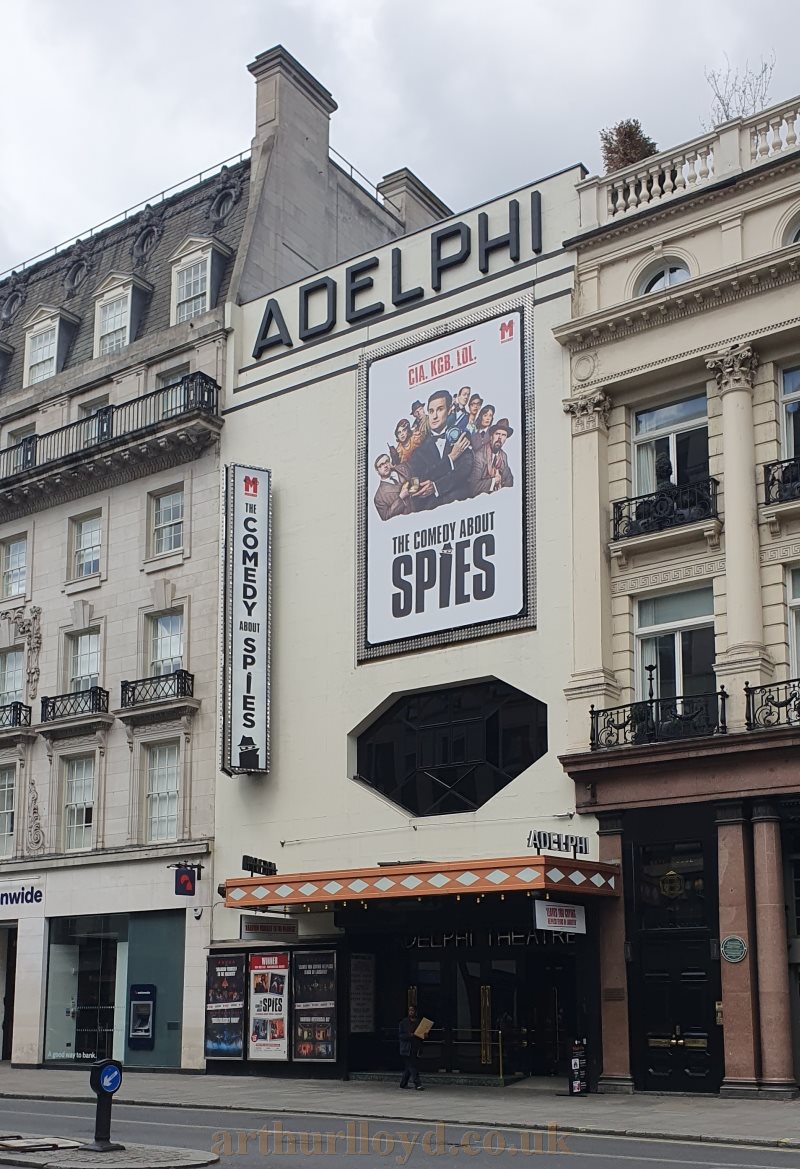
Above - The Adelphi Theatre sporting advertising for the play 'The Comedy About Spies' which is set to open there in August 2026 after refurbishment work to the Theatre has been carried out - Photo M.L. May 2026.


 The
Adelphi Theatre, which is situated on the Strand in London, has a long and involved history stretching right
back to 1806. There have been
four Theatres constructed on this site over the years but the fourth
and present Theatre opened as the Royal Adelphi Theatre on the 3rd
of December 1930 with a musical by Benn W. Levy and Lorenz Hart called
' Ever Green,' there are more details on this Theatre further
down on this page.
The
Adelphi Theatre, which is situated on the Strand in London, has a long and involved history stretching right
back to 1806. There have been
four Theatres constructed on this site over the years but the fourth
and present Theatre opened as the Royal Adelphi Theatre on the 3rd
of December 1930 with a musical by Benn W. Levy and Lorenz Hart called
' Ever Green,' there are more details on this Theatre further
down on this page.

The original Theatre on the site was built in 1806 by Mr. Jay of London Wall to the designs of Samuel Beazley and was known as the Sans Pareil (See lower down on this page for more information on the Sans Pareil.)
The Sans Pareil was sold in 1819 and renamed The Adelphi Theatre, and later became the Theatre Royal Adelphi in October 1829. A new Facade was added to the Theatre in 1840, again designed by Samuel Beazley, the original architect of the Theatre.
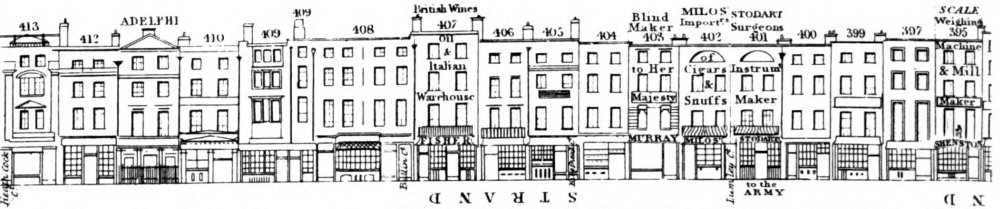
Above - The Adelphi Theatre, Strand as depicted in Tallis's London Street Views 1838 - 1840.
 This
first Adelphi Theatre was replaced in 1858 by a new Theatre, built by J. Wilson to the designs
of T. H. Wyatt.
This
first Adelphi Theatre was replaced in 1858 by a new Theatre, built by J. Wilson to the designs
of T. H. Wyatt.
Right - The first Adelphi Theatre, London - From 'The Playgoer' of 1901 - Courtesy Iain Wotherspoon.
 This building with a capacity of 1,500 was renovated in 1879, and then again in 1887,
when it was also enlarged, this time to the designs of Spencer Chadwick.
This building with a capacity of 1,500 was renovated in 1879, and then again in 1887,
when it was also enlarged, this time to the designs of Spencer Chadwick.
Left - Bull Inn Court and the Nell Gwyne Tavern in 2006 - Photo M.L.
A public house called the Hampshire Hog, the house next door, and the Nell Gwynne Tavern in Bull Inn Court were all bought by the Gattis, who had run the Theatre since 1879, in order to facilitate the enlargement of the Theatre.
The Gattis also built a new enlarged Facade at this time and part of this can still be seen today above the current Crystal Rooms, originally the Adelphi Restaurant, next door to the present Adelphi Theatre's entrance.

Above - The 1840 Samuel Beazley Facade of the first Adelphi Theatre, Strand - From the book 'London' Edited by Charles Knight and Published in 1843

 The second Adelphi Theatre was the scene of a now famous
crime when on the 16th of December 1897 during the run of 'Secret Service' William Terriss was murdered whilst
entering the Theatre by the royal entrance in Maiden Lane which he used
as a private entrance.
The second Adelphi Theatre was the scene of a now famous
crime when on the 16th of December 1897 during the run of 'Secret Service' William Terriss was murdered whilst
entering the Theatre by the royal entrance in Maiden Lane which he used
as a private entrance.
Right - A Plaque on the rear wall of the present Adelphi Theatre in Maiden Lane which reads: William Terriss 1847 - 1897. Hero of the Adelphi Melodramas. Met his untimely end outside this Theatre 16 Dec 1897.
Right - William Terriss - From 'London Town Past and Present' Vol 2 1909.
The stage door of the current Adelphi is in Maiden Lane but back then it was in Bull Inn Court. William Terriss would later have a Theatre named after him, the Terriss Theatre in Rotherhithe, later known as the Rotherhithe Hippodrome.
Horatio Lloyd, Arthur Lloyd's father, was born at his father Robert Lloyd's Hatters Shop at 71 the Strand, opposite the first Adelphi Theatre in 1809, although at this time the Theatre was known as the Sans Pareil.
There now follows details of the second Adelphi Theatre onwards in chronological order.
The Second Adelphi Theatre - 1858
Original name - The Theatre Royal Adelphi

Above - The Entrance to the Second Adelphi Theatre - From a photograph by Alfred Ellis, Upper Baker Street
 The
Second Adelphi Theatre was designed by the architect T. H. Wyatt and originally opened as the Theatre Royal Adelphi on the
27th of December 1858 with
Benjamin Webster's Company in the farce 'Good for Nothing' and the Pantomime
'Mother Red Cap'.
The
Second Adelphi Theatre was designed by the architect T. H. Wyatt and originally opened as the Theatre Royal Adelphi on the
27th of December 1858 with
Benjamin Webster's Company in the farce 'Good for Nothing' and the Pantomime
'Mother Red Cap'.
Right - Part of the Facade of the second Adelphi Theatre is still visible above the current Crystal Rooms, originally the Adelphi Restaurant, and next door to the main entrance of the fourth and present Theatre - Photo M.L. 2006.
 Benjamin Webster was involved with the management
of the Theatre from its opening in 1858 until 1872 when F. B. Chatterton
took over, and had also managed the previous Theatre,
with Madame Celeste, since 1844.
He had taken over sole management of the previous Theatre in 1853 and would later become the proprietor of this Second Theatre during
the management of the Gattis in the late 1870s.
Benjamin Webster was involved with the management
of the Theatre from its opening in 1858 until 1872 when F. B. Chatterton
took over, and had also managed the previous Theatre,
with Madame Celeste, since 1844.
He had taken over sole management of the previous Theatre in 1853 and would later become the proprietor of this Second Theatre during
the management of the Gattis in the late 1870s.
The caption to the photograph above Centre Reads: 'The old Adelphi Theatre was pulled down in the summer of 1858, and the present edifice, the first stone of which was laid by Mr. Benjamin Webster was erected and opened on Boxing Night of the same year.
This theatre was first known as the Sans Pareil, but its name was changed to Adelphi in the year 1820 by Rodwell and Jones. The front, as seen in this view, presents a three-storied building, with pillars resting between the windows on the two upper stories. To the left, on the ground floor, is seen the somewhat narrow entrance to the theatre, and to the right, between columns of polished granite, the doors leading to the restaurant.
Left - A Plan at Dress Circle Level of the second Adelphi Theatre in 1858, showing additions made to the old site - From The Builder, December 11th, 1858. References to Plan. A. Box staircase. B. Loggia (over pit entrance). CCC. Corridor behind boxes. DD. Stairs to upper boxes. EE. Stall's to stalls and proscenium boxes. FF. Queen's box and saloon. GG. Private boxes. H. Gallery staircase. I. Urinals and closets. K. Ladies' cloak-room. LL. Fire-escapes. M. Corridor to Queen's box. N. Queen's entrance in Maiden-lane.
This restaurant, which occupies almost the whole of the front part of the building, is owned and managed by the proprietors of the Adelphi, Messrs. A. and S. Gatti, and is magnificently furnished, being replete with every thing that constitutes a first-class London restaurant. Between the two entrances is the door leading to the pit.
The gallery and stage-door are in a court connecting the Strand with Maiden Lane. For three-quarters of a century this well-known and popular theatre has been the chosen home of melodrama, and with it are connected the name and fame of Yates, Wright, Paul Bedford, Toole, Madame Celeste, Mrs. Fitzwilliam, Mrs. Keeley, and many other theatrical celebrities.
The present great success of this theatre is undoubtedly due to its indefatigable managers, Messrs. Gatti; and at the announcement of a new piece the lover of melodrama knows that there is a really good treat in store for him. Mr-William Terriss and Miss Millward have been for many years respectively "hero" and " heroine " at this famous theatre.'

Above - The second Adelphi Theatre's Auditorium - From the 'Illustrated Times' January 1st 1859.


Above - Both sides of a programme for 'Down in a Baloon' and 'Notre Dame' at the second Adelphi Theatre on Monday the 24th of April 1871 - Courtesy Jennie Bisset and Brent Fernandez, whose ancestor James Fernandez was in the production along with my own ancestor T. C. King, who was Arthur Lloyd's father in law.
THE NEW ADELPHI THEATRE - From the Illustrated Times, January 1st 1859

 No
holiday spectacle on " boxing-night" was more brilliant or
more pleasing than the Adelphi Theatre, for it was the first night of
its opening. It was not only the reassembling of an audience to meet
old favourites in a bran new theatre beautifully decorated, but the
change which has been worked on the old site came upon the audience
with the agreeable surprise of difficulties surmounted by an ingenuity
that seems almost to have conquered the impossible.
No
holiday spectacle on " boxing-night" was more brilliant or
more pleasing than the Adelphi Theatre, for it was the first night of
its opening. It was not only the reassembling of an audience to meet
old favourites in a bran new theatre beautifully decorated, but the
change which has been worked on the old site came upon the audience
with the agreeable surprise of difficulties surmounted by an ingenuity
that seems almost to have conquered the impossible.
Right - A postcard depicting the second Adelphi Theatre.
Most Londoners have been inside the Adelphi, and will remember it for the most inconvenient theatre that ever was entered. It was of such structure and proportions that you might have imagined an "Assembly Rooms" at an old inn converted into a theatre, and permanently kept in its provisional state. The straightness of the sides, the lowness of the penthouse that run off the back of the pit, the cramped condition of the basket-boxes behind the dress-circle, were personal inconviences to every sense of bodily comfort, sight, and breathing.
The straightness of the sides rendered two-thirds of the seats comfortless, from the necessity of constantly turning to the stage. Yet that house, cramped in size and shape, was the most constantly filled of any in London, for the simple reason that the performances were amusing, and the prices, according to every London standard, by no means extravagant. In the new house there is every guarantee that the performances will be not less amusing-the company is strengthened-the area for developing its faculties is considerably enlarged-the audience is lodged in a building as convenient and comfortable as it is suitable for seeing-and the whole of the improvements are presented to the public at a tariff of prices ranging below the old charges in the Adelphi. Indeed the theatre forms a very decided step in the progress of theatrical improvement.
 This will be better understood by a more particular description. The visitor who enters by the old Strand entrance fancies himself in a dream when he takes his place in the midst of a building about twice as broad as the old audience part, and completely altered in every proportion. The stage is spacious, the proscenium lofty. On each side of the orchestra is a fine range of private boxes; by an exceedingly graceful sweep, a balcony of dress-boxes extends from one side to the other. It projects as in the old house over the pit; but at an elevation so much higher as to remove all sense of oppression from the sight or lungs of those who sit below. The easy and liberal curves which mark the chief forms of the theatre are themselves a source of satisfaction to the eye; the beauty is increased by the brilliant array of dresses in the chief circle; and the dresses are displayed to the utmost advantage by an open trellis-work along the front of the boxes. Above is a handsome ceiling tastefully designed by Sang, and painted in a style at once delicately finished and effective.
Left - Bull Inn Court running alongside the Adelphi Theatre is still there in 2006.
The body of the house has been designed with the special object of securing a complete view from every side. A point was taken rather behind the centre of the stage, and the seats of the audience are ranged within the portion of' a circle, so that the radius on each side is unbroken by any obstacle. There is not a seat in the house, even at the extreme corners of the side, which does not command the whole front of the stage, and that centre point; while from every side but the very extremest corners, the whole of the stage to the back and along each side is perfectly in view, and may, in fact, be seen almost by a direct front view. Behind the projecting balcony which forms the dress-circle is a row of private boxes, each containing four seats, the boxes themselves being open, lofty, commanding a good view of the scene, and enjoying as perfect a freedom of ventilation as the foremost row of the balcony. Above these is a range of upper boxes; and in a third tier an amphitheatre of stalls, with a gallery behind.

Above - The Auditorium and Stage of the second Adelphi Theatre in 1858 - From The Builder, December 25th 1858.
 The improvement in front of the lights is only correlative to the improvement behind. The stage is spacious, but not an inch of room is wasted. Both in lateral width and in loftiness the amplest room is taken for scenic effect, and the machinery behind will assist in rendering the illusion as perfect as possible. Some of the minor improvements will exemplify the tendency of the whole.
Right - The Rear and stage door of the fourth and present Adelphi Theatre in Maiden Lane in 2006.
The flaps which are thrown up when certain portions of the scenery are raised from below, are here abolished; for every part of the stage is "practicable"-can be removed at pleasure, even to the whole, if necessary, without traps or flaps. Thus the flooring can be made to correspond exactly to the exigencies of the scenery, and depth as well as height and breadth can be given to the scene. As a whole, the theatre stands next to Covent Garden and Drury Lane for space. The proscenium itself is 38 feet high by 35 feet wide-several feet larger each way than the procenium of either the Lyceum, Olympic, or Princess's. The whole theatre has seats for 1,500 persons, but this estimate allows such ample accomodation for each that one may fairly say the new building will accomodate 2,000 with far greater comfort to themselves than ever the old one did one-half that number. The mode of lighting is simple, but brilliant in the extreme, the whole building being illuminated from the ceiling with one of Stroud's patent sun-lights. The light itself is concealed, though its effect is increased by an exquisitely formed chandelier-a glittering mass of cut-glass coronets, prismatic feathers, lustres, and spangles...


Above - Both sides of a Programme for 'Sarah's Young Man' and 'Proof' at the Adelphi Theatre probably in November 1878 - Courtesy Tim Trounce.
 ...The
new theatre has another advantage: the visitor does not simply purchase
his right of admission; as in the case of the Russian theatres, he rather
purchases his seat, and he is the tenant of it for the night. Excepting
the back part of the pit and gallery, the place may be taken for the
whole evening: so that as soon as the admission money is paid, whether
in the early part of the day or the evening, the theatre-goer has secured
his seat for the night without any ulterior trouble, without any chance
of having it taken from him, and without any extra fee. There is no
half-price.
...The
new theatre has another advantage: the visitor does not simply purchase
his right of admission; as in the case of the Russian theatres, he rather
purchases his seat, and he is the tenant of it for the night. Excepting
the back part of the pit and gallery, the place may be taken for the
whole evening: so that as soon as the admission money is paid, whether
in the early part of the day or the evening, the theatre-goer has secured
his seat for the night without any ulterior trouble, without any chance
of having it taken from him, and without any extra fee. There is no
half-price.
Left - A colour postcard depicting the second Adelphi Theatre.
Nor is the audience barely admitted and allowed space for existence; on the contrary, personal convenience is consulted in every detail and every accessory. In the first place, space enough is secured for bodily ease; the width of the seats in the orchestra-stalls, for example, is two feet, an ample allowance even for crinoline, permitting change of posture at the desire of the sitter. The passages which give admission to the various parts of the house are spacious, simple in their construction, and easy of access.
At most theatres, the refreshments are either of a very inferior kind, repulsive in their look, and poisonous in their tendencies; or they are doled out at enormous prices. The department has hitherto, in fact, been "farmed" by outsiders, whose object has been to extort the largest return for the outlay and whose interest has not at all been identified with the welfare of the house. Mr. Webster has settled all difficulties by taking this department in his own hand; he has scoured refreshments by those purveyors who have a character at stake, and who will supply viands of the best quality. Drinks, for example, will come from Sainsbury's whose lemonade is made of lemons. In some theatres the arrangements for taking charge of the cloaks combine mortification with extortion.
 Ladies of families which are too homely to keep their
carriages, and are not ambitious to pass through London in full-dress,
are compelled tostand
in the outer hall in order that they may be allowed todeposit cloaks
and bonnets in a corner under a staircase and submit to the galling
extortion of the attendants: in the new theatre this abuse is abolished.
Cloak-rooms are provided in which ladies will find every facility for
the toilet; and since fees areabolished throughout the building, there
will be none of that extortion which is so repulsive to the female mind.
Managers even of the most beggarly theatres appear heretofore to have
framed their regulations on the pretence that they were catering only
for " the aristocracy; " and if middle-class visitants came,
they were to be brought to obey the rules and to pay the fees, under
pain of mortification. Mr. Webster sees that theatres must draw the
great average of their revenue from the middle-class, and his regulations
have, for the first time perhaps, placed the middle-class within the
theatre on a footing of complete equality with the highest and wealthiest
in the land.
Ladies of families which are too homely to keep their
carriages, and are not ambitious to pass through London in full-dress,
are compelled tostand
in the outer hall in order that they may be allowed todeposit cloaks
and bonnets in a corner under a staircase and submit to the galling
extortion of the attendants: in the new theatre this abuse is abolished.
Cloak-rooms are provided in which ladies will find every facility for
the toilet; and since fees areabolished throughout the building, there
will be none of that extortion which is so repulsive to the female mind.
Managers even of the most beggarly theatres appear heretofore to have
framed their regulations on the pretence that they were catering only
for " the aristocracy; " and if middle-class visitants came,
they were to be brought to obey the rules and to pay the fees, under
pain of mortification. Mr. Webster sees that theatres must draw the
great average of their revenue from the middle-class, and his regulations
have, for the first time perhaps, placed the middle-class within the
theatre on a footing of complete equality with the highest and wealthiest
in the land.
Right - A Sign about the murder of William Terriss attatched to the Nell Gwynne Tavern in Old Bull Court which still runs alongside the Aldwych Theatre in 2006.
No fear of fire, such as that which must haunt the splendid wood lined theatre of Moscow - the phoenix successor of another splendid building - will harass the mind of the most timid in the Adelphi: the whole is fire-proof and should any hanging or crinoline occasion the most passing alarm of fire, additional doors at the sides fly open at the touch of a spring, and the audience can disperse "in a trice." About another new feature in the new theatre we have some doubt: all the check-takers and box-openers are females.
The above Article was first published in the Illustrated Times, January 1st 1859.
 A short report in the ERA of December the 24th 1887 mentions
the early use of Electric Light being installed in the Theatre saying:-
'With the electric light in use behind the scenes, the risk of fire
in a theatre is minimised to the utmost possible degree; in fact, combustion
from the Swan burner is impossible. Recognising the importance of this
fact, the Brothers Gatti are establishing, in the rear of the Adelphi,
an installation of the electric light, which will illuminate both the
theatre and the restaurant. The installation will cost £15,000,
and 4,000 lights will be supplied by the apparatus.' - The ERA December 24th 1887.
A short report in the ERA of December the 24th 1887 mentions
the early use of Electric Light being installed in the Theatre saying:-
'With the electric light in use behind the scenes, the risk of fire
in a theatre is minimised to the utmost possible degree; in fact, combustion
from the Swan burner is impossible. Recognising the importance of this
fact, the Brothers Gatti are establishing, in the rear of the Adelphi,
an installation of the electric light, which will illuminate both the
theatre and the restaurant. The installation will cost £15,000,
and 4,000 lights will be supplied by the apparatus.' - The ERA December 24th 1887.
Whilst under the Management of Tom B. Davis (shown right) the Theatre was replaced in March 1901 by a new Theatre, this time named the Century Theatre, which was an almost complete reconstruction of the building, see details below. Tom Davis's name can be seen on many of the programme covers on this page.
Right - A photograph of Tom B. Davis, Manager of the Adelphi Theatre, later the Century Theatre, in the early 1900s, and also the Lyric Theatre - From Black & White Budget, September 28th 1901.

Above - Last days of the Second Adelphi Theatre - The Auditorium just prior to demolition in November 1900 - From 'The Playgoer' 1901 - Courtesy Iain Wotherspoon.
The Third Adelphi Theatre / Century Theatre - 1901
 The second Adelphi Theatre was replaced in March 1901 by a new Theatre, this time named the Century Theatre, which was an
almost complete reconstruction of the previous building. The Century
Theatre opened on the 11th September 1901,
now with its stage door in Maiden Lane,
and was built by Frank Kirk to the designs of Ernest
Runtz, and had a capacity of 1,297 which was later increased to
1,500.
The second Adelphi Theatre was replaced in March 1901 by a new Theatre, this time named the Century Theatre, which was an
almost complete reconstruction of the previous building. The Century
Theatre opened on the 11th September 1901,
now with its stage door in Maiden Lane,
and was built by Frank Kirk to the designs of Ernest
Runtz, and had a capacity of 1,297 which was later increased to
1,500.
Right - Demolition of the interior of the Second Adelphi Theatre to make way for the Century Theatre which was built and opened in 1901 - From 'The Playgoer' 1901 - Courtesy Iain Wotherspoon.
The Building News and Engineering Journal reported on the opening of the Century Theatre in their September the 6th 1901 edition saying:- 'The private view of the Century Theatre in the Strand was held yesterday (Thursday). The theatre is really the old Adelphi, the stage of which is left practically intact, and undoubtedly one of the finest in the kingdom, but auditorium, approaches, &c, needed structural revision. With this end in view, plans were prepared for the remodeling of the theatre, and included in the new structure is an adjoining property on the western side, enabling the architects to provide a more spacious crush-room, with managerial offices in addition, besides giving an opportunity for revising the inconvenient approaches to the stalls, which in former times necessitated a journey upward to the circle and downwards again before one's place was reached. This has now been entirely altered, and a wide subway leads from the main entrance and crush-room to both prompt and 0.P. sides of this part of the house.

Above - The Stage of the former Adelphi Theatre being Rebuilt and Refitted for the Theatre's Reincarnation as the Century Theatre in 1901 - From 'The Sketch', 11th September 1901.
 Centrally
situated in the crush-room is the main staircase leading to the foyer
and dress circle with its lounge and saloon, together with the ante-rooms.
The style of decoration is that of the Brothers Adam (whose names are
so intimately associated with the Adelphi and its neighbourhood). Delicate
lilac and yellow tones prevail; marble is in evidence, but not aggressively
so. Gold there is, but not in such quantities as to suggest that the
one idea of decorative art is dependent upon the coveted metal.
Centrally
situated in the crush-room is the main staircase leading to the foyer
and dress circle with its lounge and saloon, together with the ante-rooms.
The style of decoration is that of the Brothers Adam (whose names are
so intimately associated with the Adelphi and its neighbourhood). Delicate
lilac and yellow tones prevail; marble is in evidence, but not aggressively
so. Gold there is, but not in such quantities as to suggest that the
one idea of decorative art is dependent upon the coveted metal.
Right - The Century Theatre Auditorium from the Stage - From 'The Playgoer' 1901 - Courtesy Iain Wotherspoon.
The sight lines are excellent in all parts of the house, but especially so in the dress circle. On the upper circle, in lieu of boxes, the seats have been continued around to the proscenium opening, and the bold arched treatment for this forms, with its draperies, a striking feature. The pit is one of the largest in London, is lofty, well-fitted and upholstered, and has a most comfortable refreshment saloon and excellent emergency exits.

Above - A Painting created by George Richmond in 2018 depicting the Century Theatre, later the Third Adelphi Theatre, in 1901 using the colour pallet mentioned in the ERA articles on this page - Click for an Index to all of George Richmond's Paintings on this site.
 The
prevailing scheme of decoration is ivory white, yellow, old gold, and
electric blue, developed in silk, velvet, and mural coverings and paintings.
There is a Florentine frieze,"Love and Pleasure," over the
proscenium, and a mosaic coved ceiling over the boxes. The Adam's "Caryatides"
and the ivory tints surrounding the panelling harmonise well.
The
prevailing scheme of decoration is ivory white, yellow, old gold, and
electric blue, developed in silk, velvet, and mural coverings and paintings.
There is a Florentine frieze,"Love and Pleasure," over the
proscenium, and a mosaic coved ceiling over the boxes. The Adam's "Caryatides"
and the ivory tints surrounding the panelling harmonise well.
Right - A March 1903 Programme for 'The Worst Woman in London' at the former Century Theatre, by then known as the Adelphi Theatre again.
In all there are 24 dressing-rooms, and the stage is a full "working" one. The fire-resisting appliances are of the most approved pattern, and fully comply with the regulations of the London County Council, including an asbestos fireproof curtain.
 The
heating is on the low-pressure system, and radiators are so placed throughout
the building as to warm the incoming air, and thus prevent draughts.
The ventilation has been carefully attended to by means of inlets and
exhausts. There is a complete installation of electric light, with gas
as a stand-by.
The
heating is on the low-pressure system, and radiators are so placed throughout
the building as to warm the incoming air, and thus prevent draughts.
The ventilation has been carefully attended to by means of inlets and
exhausts. There is a complete installation of electric light, with gas
as a stand-by.
Left - A Programme for 'Veronique' at the former Century Theatre, by then known as the Adelphi Theatre again.
Wilton carpets of electric blue cover the floors, and roomy seats, upholstered in yellow silk rep and velvet, are conspicuous in the best parts of the house. The upper circle is equal to most dress circles, so far as comfort is concerned.
 The
whole of the scheme for the reconstruction of the theatre has been prepared
by Messrs. Ernest Runtz and Co.,
architects, of 10, Wal-brook, E.C.; all the details of the plastic
decoration, and the decorations themselves, have been designed by the
firm, even to the embroidered draperies of the boxes. Mr. Frank Kirk
is the contractor. The Florentine frieze over the proscenium has been
executed by Mr. Charles Buchel.
The
whole of the scheme for the reconstruction of the theatre has been prepared
by Messrs. Ernest Runtz and Co.,
architects, of 10, Wal-brook, E.C.; all the details of the plastic
decoration, and the decorations themselves, have been designed by the
firm, even to the embroidered draperies of the boxes. Mr. Frank Kirk
is the contractor. The Florentine frieze over the proscenium has been
executed by Mr. Charles Buchel.
Right - A 1918 Programme for 'Tina' at the former Century Theatre, by then known as the Adelphi Theatre again.
The proscenium opening is 30ft. by 31ft., the stage is 64ft. wide and 87ft. deep, extending back to Maiden-lane; the height of flies from stage, 28ft. 6in., the distance between fly rails 46ft., and the auditorium is 56ft wide and 77ft. deep from curtain line. There are over 200 stalls, 170 dress circle seats, 250 upper circle seats, and the gallery and pit are very large. The crush room is 33ft. long by 20ft. wide, and the foyer 44ft. 6in. long by 18ft. wide, with deal, columniated recesses at either end.'
The above text in quotes was first published in the Building News and Engineering Journal, September the 6th 1901.
 The Builder also reported on the new Century Theatre, in their September 7th 1901 edition saying:- 'The old Adelphi Theatre in the Strand has been remodelled and renamed. The stage of the old "Adelphi" is left practically intact, but the auditorium, approaches, &c.. have been rearranged, and included in the new structure is an adjoining property on the western side, enabling the architects to provide a more spacious crushroom, with managerial offices in addition, besides giving an opportunity for revising the approaches to the stalls.
Right - The Auditorium and stage of the Century Theatre when it first opened in 1901 - From 'The Sketch', 11th of September 1901.
A subway now leads from the main entrance and crushroom to both prompt and O P. sides of this part of the house. Centrally situate in the crushroom is the main staircase leading to the foyer and dress circle, with its lounge and saloon, together with the ante-rooms, the Adam style of decoration has been the keynote of the architectural treatment.
Considerable improvement has been effected in the auditorium. The private boxes are on the stalls and dress circle level only, eight in all. On the upper circle, in lieu of boxes, the seats have been continued around to the proscenium opening in the stalls. There are upwards of 200 seats. The pit is one of the largest in London; it has a refreshment saloon and emergency exits.
The prevailing scheme of decoration is ivory white, yellow, old gold, and electric blue, developed in silk, velvet, and mural coverings and paintings.

Above - A Painting created by George Richmond in 2018 depicting the Century Theatre, later the Third Adelphi Theatre, in 1901 using the colour pallet mentioned in the ERA articles on this page - Click for an Index to all of George Richmond's Paintings on this site.
The stage was unusually large in the old days, and has been somewhat curtailed by the erection of dressing-rooms on the stage-level for the use of the principal artistes. In all there are twenty-four dressing-rooms. The heating is on the low - pressure system. There is a complete installation of electric light, with gas as a standby.
Westward the elevation has been extended in keeping with the old facade, and a new glazed shelter has been provided over the principal approaches. The whole of the scheme for the reconstruction of the theatre has been prepared by Messrs. Ernest Runtz. & Co. architects, of Walbrook, E.C., and all the details of the plastic decoration, and the decorations themselves, have been designed by them. Mr. Frank Kirk was the contractor. The Florentine frieze over the proscenium was executed by Mr. Charles Buchel. Messrs. Maple & Co. were entrusted with the furnishing. Amongst other firms engaged are the following: Electric installations, Vaughan & Brown; heating, &c. Vaughan & Brown; fireproof curtains and hydrants, Merry weather & Sons; act drop, Charles Hemsley, stained glass, Prest & Co.; sanitary arrangements Barton. The whole of the decorative scheme has been carried out by Mr. Edward Bell, Castle-road, Kentish Town. The proscenium opening is 30ft deep, the stage is 64 ft. wide and 87 ft. deep, extending back to Maiden-lane; the height of flies from stage 28 ft. 6 in.; the distance between fly rails 46 ft.; the auditorium is 56 ft. wide and 77 ft. deep from the curtain line; there are over 200 stalls, 170 dress circle seats, 250 upper circle seats, and the gallery and pit are very large; the crush room is 33 ft. long by 20 ft. wide, and the foyer 44 ft. 6 in. long by 18 ft. wide, with deep columniated recesses at either end.'
The above text in quotes was first published in The Builder, September 7th 1901.


 The
Century Theatre opened on the 11th September 1901,
but the name was short lived and the Theatre's original name of the
Adelphi Theatre was soon revived.
The
Century Theatre opened on the 11th September 1901,
but the name was short lived and the Theatre's original name of the
Adelphi Theatre was soon revived.
Right - Three Programmes for the third Adelphi Theatre, formerly the Century Theatre, 'Camille', 'Arizona', and 'A Queen of Society' all from the early 1900s.
George Edwardes took over the management of the Theatre in 1908 when it became home to Musical Comedies for many years. However, despite all the previous Theatres on the site, the Century Theatre, now known as the Adelphi Theatre again by 1903, was replaced by yet another new Theatre only 30 years later, see below.
The Fourth and Present Adelphi Theatre - 1930

Above - A programme for Gertrude Lawrence in 'Nymph Errant', a play with music by Cole Porter, which opened at the Adelphi Theatre in 1933. Note the original 1930 frontage of the Fourth Adelphi Theatre can be seen in this image, this was altered in 1937 when the black triangular panel was removed and replaced with flat panel we see today.
 Despite
all the previous Theatres on the site, the third Adelphi
Theatre was replaced yet again only 30 years later by a fourth Adelphi
Theatre. This was a reconstruction of the previous Theatre retaining some of the exterior walls and internal structure but completely altering the auditorium, Foyers, and Facade. Despite the radical changes some parts of the previous Theatre still exist including especially the old Balcony Bar which is not accessible to patrons today. Some of the dressing rooms and some staircases backstage appear to be that of the previous Theatre, and the stage house, although modernised, is in fact that of the second Theatre on the site.
Despite
all the previous Theatres on the site, the third Adelphi
Theatre was replaced yet again only 30 years later by a fourth Adelphi
Theatre. This was a reconstruction of the previous Theatre retaining some of the exterior walls and internal structure but completely altering the auditorium, Foyers, and Facade. Despite the radical changes some parts of the previous Theatre still exist including especially the old Balcony Bar which is not accessible to patrons today. Some of the dressing rooms and some staircases backstage appear to be that of the previous Theatre, and the stage house, although modernised, is in fact that of the second Theatre on the site.
Right - A Programme Cover for the Theatre's Opening Production of 'Ever Green' at the Adelphi Theatre in December 1930.
The new Theatre, which is the one still standing today, opened as the Royal Adelphi Theatre on the 3rd of December 1930 with a musical by Benn W. Levy and Lorenz Hart called ' Ever Green.'
 The Bioscope reported on the new Theatre in their November the 19th 1930 edition with the Heading "The Bizarre Adelphi - Unique Interior Treatment", and went on to say:- 'The reconstructed Adelphi Theatre in the Strand, London, due to open next Monday, undoubtedly strikes an entirely new and original note in theatre construction. Built by the Pitcher Construction Co., Ltd., to the plans of E. Shaufelberg, for Musical Plays, Ltd., it will be used, at present, as a legitimate theatre although a commodious projection room has been incorporated.
The front elevation is wholly carried out in contrasting shades of grey and black marble with deep cappings of copper. The beauty of the faience is thoroughly brought out by the deft use of the coloured marble and the unique window settings. A strikingly handsome canopy with a black and white glass front also compels attention.
Left - Something new for the Strand. The dominating centrepiece of this arresting frontage is in black and grey marble - From the Bioscope, 19th November, 1930.
Black Marble Panels
The large vestibule and main waiting foyer leading into the auditorium is richly panelled in black marble, with a deep dado of white, whilst the ceiling is decorated in a most novel manner.
On entering the auditorium, one is immediately struck by the unusual design and beauty of the interior of the theatre. There is a complete absence of curve, in fact the entire conception has been carried out in line and angle, with the angle of 32 degrees as the master note. In keeping with this entirely new conception, the decorative scheme has been specially designed to blend and yet to bring out the strange beauty of the theatre.
 The lower half of the walls and fronts of the two circles has been panelled in wood of a deep orange colour, perfectly plain, polished and with no decorative motif whatsoever. This, with the general colour scheme of orange, green and gold, with bronze insets on the underside of the circles, gives a most bizarre and opulent atmosphere.
Right - This Perspective of the new Adelphi's interior by the architect, Ernest Schaufelberg, gives an impression of its refreshing modern style, but does not adequately suggest the brilliancy of the lighting and the colour scheme - From the Bioscope, 19th November, 1930.
One of the most striking features of this theatre is the exquisitely beautiful treatment of the deep oblong dome of the ceiling. Created to be indicative of a jewel casket, by deft use of line, angle and incised planes, it is richly decorated in dark green fading through pale green to gold which give the impression of velvet. The silver and glass centrepiece has been fitted with specially designed different lighting effects to represent jewels. The whole is shown up in strong relief by deep orange concealed lighting.
Stage Forty Feet Deep
 The proscenium opening, which is practically square, has a width of 38 ft. with a stage depth of 40 ft. The stage apparatus, grids, bridge, etc., is of the latest type and is of steel throughout; a complete counterweight system is installed.
The whole of the stage and decorative lighting of the theatre has been devised and carried out by the Strand Electric & Engineering Co.
The auditorium decorative lighting will embody a unique combination of very effective cornice lighting, combined with wonderful glass fittings, which will be controlled by means of a specially designed motor-driven dimmer. Stage lighting will be an entirely new and original design.
Left - The auditorium of the Adelphi Theatre - From The Sphere, December 20th 1930.
An electrically-driven revolving stage has been installed, so that changes of scenes can be made on the back half whilst the front scene is being played. This has necessitated the provision of a cyclorama cloth and the absence of sky borders.
The cyclorama is illuminated by a bank of 36 Strand Electric panorama lanterns mounted on a special framework. The lanterns are divided on to six circuits, so that complete colour changing and blending can be obtained.

Above - THE FOYER OF THE NEW ADELPHI: This strikingly reconstructed theatre is the work of Mr. Ernest Schauftelberg. The old roomy lounges and lobbies remain, but transformed under the modern decorists' hand. Proportion has been the be-all and end-all of the architect's aim. Black marble, deep rose doors, Lalique fountain lights and sun-ray lighting (which give warmth as well as illumination) combine with jewelled ceiling lights to give an effect definitely modernised - From The Sphere, December 20th, 1930.

Above - The Foyer of the Adelphi Theatre in January 2023 with its magnificent Art Deco Ceiling and Lighting still in place 93 years after the Theatre's original construction in 1930 - Photo M.L.
Twin Lighting Bridge
 The old electric battens for the time being have been dispensed with, and in their place Strand Electric arena lanterns used. A twin special lighting bridge has been erected on the proscenium arch, and on the lower section a series of 17 in. "Sunray" lanterns and "Seecol" spots have been installed. On the upper bridge specially designed spotting arcs, with iris diaphragms, have been installed on the prompt and O.P. side of the auditorium, with special spotting boxes, complete with similar spotting arcs arranged for the bridge.
Right - A Scene from the Adelphi Theatre's opening production of 'Ever Green' - From the ILN, 13th December 1930.
Behind the upper circle a special chamber has been provided to house the 100 ampere spots. Controlling the new lighting, a new remote controlled switchboard has been installed, complete with "Sunset" dimmers.
Strand Electric have also carried out the whole of the lighting, power and heating installed in the building.'
The above text in quotes, and some of the accompanying images, were first published in the Bioscope, November 19th, 1930.
 The Architect's Journal also reported on the new Adelphi Theatre, in their 3rd of December 1930 edition, along with some of the images shown here, saying:- 'The reconstructed Adelphi Theatre is designed with a complete absence of curves. Externally and internally the entire conception is carried out in straight lines and angles, the angle of 32 degrees being used as the master note.
It is built for Musical Plays, Ltd., and is intended for use as a legitimate theatre, although a projection room has been incorporated in the plans.
Right - The Facade of the Adelphi Theatre when it first opened in 1930 - From The Architect's Journal, 3rd of December 1930. The Image has been enhanced to improve on the original scan.
The Architect's Journal's caption for the exterior image shown right says 'The upper portion of the main façade of the reconstructed Adelphi Theatre. It is in black and grey marble with cappings of copper, and a metal canopy with a black and white glass front. The new theatre is designed by E. Schaufelberg, and is announced to open tonight with "Ever Green," a musical play staged by Charles B. Cochran.'
In the stalls and two circles seating is provided for 1,500 persons. The proscenium opening is practically square, and has a width of 38 ft. and a stage depth of 40 ft. The stage embodies many new innovations, not only in the lighting but in the method of handling the scenery. An electrically-driven revolving stage has been installed, so that changes of scenes can be made on the back half whilst the front scene is being played. This has necessitated the provision of a cyclorama cloth and the absence of sky borders, somewhat on the system now in vogue on the Continent.

Above - The Entrance Vestibule of the Adelphi Theatre when it first opened in 1930 - From The Architect's Journal, 3rd of December 1930.
The Architect's Journal's caption for the above image of the entrance vestibule says 'On the left is seen the staircase leading up to the dress circle, and one of the two box offices. On the extreme right are the doors to the stalls. The walls are lined with black marble. Both box offices have chromium plated grilles and red curtains. The ceiling is treated in colours of gold, green amber, black and red. The interior doors generally are red, with black surrounds and chromium-plated handles.'
Considerable public attention was riveted on the work during its final stages owing to the big hustle performed by the builders to keep to the schedule. It is understood that the theatre was to open on November 24, and that the owners were to pay Mr. Cochran a penalty of £450 for every day they were late in handing over the theatre.

Above - The Auditorium and Safety Curtain of the Adelphi Theatre when it first opened in 1930 - From The Architect's Journal, 3rd of December 1930.
 The Architect's Journal's caption for the above image reads:- 'In the auditorium, looking from the dress circle. Seating accommodation is for 1,500 persons. The lower half of the walls, and the fronts of the dress and upper circles, are lined with plain sheets of sycamore of amber colour, polished. The general colour scheme is green and gold, with a drop curtain, and hangings to the boxes and exits in red picked out in gold and green. Seats are of rainbow colour. The carpet is fawn.'
Right - The panel in the ceiling of the auditorium has a silver and glass centrepiece designed to give different lighting effects, and is decorated in colours from green to gold - From The Architect's Journal, 3rd of December 1930.
 Near views of the ceiling lights appear on the facing page (Shown Right and Left).
The ceiling of the dress circle is also boldly decorated in green and gold. It extends the full width of the theatre, over the gangway, behind the back row of seats - From The Architect's Journal, 3rd of December 1930.
At the sides of the boxes are amber lights; above them are special boxes containing spotting arcs. The balustrade of the orchestra pit, ash trays, etc., are chromium plated.'
For the Plans shown below the Architect's Journal's caption says 'The architect's drawings of the longitudinal section and plans. The stalls and dress circle are entered from the Strand through three pair of swing doors, to the left of which a separate and independent entrance is planned to the upper circle. A revolving stage is provided.'

Above - Ernest Schaufelberg's Plans of the Adelphi Theatre in 1930 - From The Architect's Journal, 3rd of December 1930.
The above text in quotes, accompanying Images, and Caption Descriptions, were originally published in the Architect's Journal, 3rd of December 1930.
Photographs of the Adelphi Theatre's Opening Production of Ever Green in 1930

Above - A Scene from the Adelphi Theatre's opening production of 'Ever Green' - From The Sphere, December 13th, 1930. Caption reads:- 'On a revolving stage the great fair scene in "Ever Green" at the new Adelphi Theatre, the various attractions of which are displayed on a stage which revolves to bring a continuous succession of different booths before the audience

Above - A Scene from the Adelphi Theatre's opening production of 'Ever Green' - From the ILN, 13th December 1930.

Above - Curtains Calls at the Adelphi Theatre's opening production of 'Ever Green' - From the ILN, 13th December 1930.
The Present Adelphi Theatre's Opening and Production History
 The present Adelphi Theatre was built by Pitcher Construction
Company to the designs of Ernest Schaufelberg. The Theatre opened as the Royal Adelphi Theatre on the 3rd of December 1930 with a musical by Benn W. Levy and Lorenz Hart called 'Ever Green.' The capacity on its opening was 1,400. The 'Royal' was dropped from the Theatre's name in 1940 and it is known
today as the Adelphi Theatre.
The present Adelphi Theatre was built by Pitcher Construction
Company to the designs of Ernest Schaufelberg. The Theatre opened as the Royal Adelphi Theatre on the 3rd of December 1930 with a musical by Benn W. Levy and Lorenz Hart called 'Ever Green.' The capacity on its opening was 1,400. The 'Royal' was dropped from the Theatre's name in 1940 and it is known
today as the Adelphi Theatre.
Right - The Adelphi Theatre showing Charles Cochran's 'Ever Green' which opened the Theatre in 1930 - From The Builder, 5th of December 1930.
In Mander & Mitchenson's wonderful book 'The Theatres of London' first published in 1961, they summed up the Adelphi Theatre's first four decades of productions nicely, which I have edited down to its essentials here, saying:- 'The theatre reopened on December 3 with Ever Green, under the management of Charles B. Cochran. This was the first of a series of successes to be produced here by Cochran, and there followed Grand Hotel by Vicki Baum in 1931; Helen! an opera bouffe (1932); Words and Music, the revue in which Noel Coward was responsible for all the lyrics and music (1932); Nymph Errant, a play with music by Cole Porter (1933); Magnolia Street, a play by Louis Golding and A. R. Rawlinson (1934); Stop Press, a revue presented by Clifford Whitley (1935).
 Cochran returned with Follow the Sun, another revue on a lavish and spectacular scale (1936); and Home and Beauty, A. P. Herbert's Coronation revue (1937). Balalaika, a musical play produced in December 1936, left the Adelphi to continue its run elsewhere, but returned to its first home in February 1938 to complete its 570 performances.
Left - A Programme for 'Bless The Bride' at the fourth and present Adelphi Theatre in 1949.
 The next years are not outstanding, and include a mixture of revues, musicals and plays. A revival of Dear Octopus in 1940 gave London playgoers their last glimpse of the great Marie Tempest. Opera and ballet were staged in the early war years until, in 1942, a revival of Ivor Novello's The Dancing Years opened and ran 969 performances (its original production at Drury Lane was broken by the outbreak of war in 1939).
Right - A Bust of Sir Charles Cochran by Peter Lambda, presented to the Adelphi Theatre on its opening can still be seen in the Theatre's front of house today - Photo M.L. January 2023.
 Alter this there is nothing or importance to recall until Cochran returned to the theatre presenting A. P. Herbert's Big Ben in 1946, followed by Bless the Bride in 1947 and Tough at the Top in 1949.
Left - A Programme for the 1000th performance of 'The Dancing Years' at the fourth and present Adelphi Theatre on Monday the 21st of September 1942. The programme is signed by Ivor Novello himself - Courtesy Malcolm Kidby.
In 1950 Jack Hylton, who had become lessee of the theatre during the run of The Dancing Years, began a series of revues, featuring broadcasting stars, which were to be the main attractions for the next six years. Auntie Mame (1958) with Beatrice Lillie, and Blitz!, which opened in April 1962, proved to be spectacular successes.
 They were to be followed by Dora Bryan's revue, Six of One, in September 1963 which ran for 306 performances. The next successful musical production was Maggie May running for 499 performances, then came the return of Anna Neagle, under the management of Harold Fielding, in Charlie Girl in December 1965 which continued until 1971 with well over 2000 performances, followed by Meet Me in London starring Tommy Steele. A very successful revival of Show Boat in July 1971 and of The King and I in October 1973 kept the theatre busy well into the following year.' - Text (Edited) from Mander & Mitchenson's 'The Theatres of London'.
Right - The Adelphi Theatre showing Beatrice Lillie in 'Auntie Mame', a role which she played in the original Broadway run and then revived at the Adelphi Theatre, London in 1958 - Photo Courtesy Gerry Atkins.
Later successful productions at the Adelphi Theatre included 'My Fair Lady' in 1979, 'Poppy' in 1983, 'Me and My Girl' in 1985, which ran until 1993, 'Sunset Boulevard' from 1993 to 1997, and 'Chicago' in 1997, which became the longest running production in the Theatre's History, this was followed by 'One Man, Two Guvnors' in 2011, 'Sweeney Todd' in 2012, 'The Bodyguard' in 2012, 'Made in Dagenham' in 2014, 'Kinky Boots' from 2015 to 2019, 'Waitress' in 2019, and 'Back to the Future', the musical version of the much loved film which opened in August 2021 and closed in April 2026.
After the closure of 'Back to the Future' restoration and alteration of the Theatre's main Facade to the Strand and alterations to the foyer and box office are planned to improve the look of the Theatre and enhance its accessibility. Internally the auditorium and dressing rooms are also to be refurbished for a reopening later in the year.
The Adelphi Theatre is currently co-owned by Nederlander Theatres and LW Theatres and run by LW Theatres. You may also be interested in the Adelphi Theatre Project which aims to document the Theatre's History and performances throughout its long and involved life.
A Seating Plan for the Adelphi Theatre in 1930

Above - A Seating Plan for the Adelphi Theatre - From 'Who's Who in the Theatre' published in 1930 - Courtesy Martin Clark. Click to see more Seating Plans from this publication.
Photographs of the present Adelphi Theatre in more recent years

Above - The Auditorium and Stage of the Adelphi Theatre during the run of the 'Back to the Future' musical in November 2022 - Photo M.L.

Above - The Auditorium of the Adelphi Theatre during the run of the 'Back to the Future' musical in November 2022 - Photo M.L.

Above - The Auditorium Balcony of the Adelphi Theatre in January 2023 - Photo M.L.

Above - DeLorean cars parked up outside the Adelphi Theatre for the opening of the much anticipated musical version of 'Back to the Future' on the 13th of September 2021. The show was first produced at the Manchester Opera House in February 2020 and received rave reviews but its 3 month run was cut short due to the Coronavirus Pandemic and the closing down of Theatres all over the Country in March 2020. The show went on to run at the Adelphi Theatre until April 2026 - Photo M.L.

Above - The Fourth and Present Adelphi Theatre during the run of Andrew Lloyd Webber's production of 'Evita' in October 2006.

Above - The Adelphi Theatre during the run of the musical 'Joseph and the Amazing Technicolor Dreamcoat' in April 2009

Above - The Adelphi Theatre during production for Derren Brown's 'Enigma,' in June 2009

Above - The Adelphi Theatre in August 2009 advertising 'The Rat Pack' - Photo M.L.

Above - The Adelphi Theatre in February 2010 during previews for the Andrew Lloyd Webber musical 'Love Never Dies' which opened on Tuesday the 9th of March 2010 and closed in August 2011. The show continued the story of the phenomenally successful 'Phantom of the Opera' which has been playing at Her Majesty's Theatre since 1986.

Above - The Adelphi Theatre advertising the National Theatre's production of 'One Man Two Guvnors' which opened at the Theatre in November 2011 - Photo M.L.

Above - The Adelphi Theatre in March 2012 advertising the Chichester Festival production of 'Sweeney Todd' Starring Michael Ball and Imelda Staunton - Photo M.L.

Above - The Adelphi Theatre in March 2013 during the run of 'Bodyguard' - Photo M.L.

Above - The Adelphi Theatre during the run of 'Made in Dagenham' in October 2014 - Photo M.L.

Above - The Adelphi Theatre during the run of 'Kinky Boots' in September 2015 - Photo M.L.

Above - The Adelphi Theatre during the run of 'Waitress' in February 2019 - Photo M.L.
The Sans Pareil, 409 - 412 Strand, London - 1806
From - The Romance of London Theatres by Ronald Mayes
(The first Theatre on the site of the Adelphi Theatre)
 THE,
Sans Pareil (shown right) stood on the site of the present Adelphi Theatre in the Strand, and was built by one John
Scott. This gentleman was a colour maker of the Strand, who had amassed
a large fortune by the manufacture of a washing blue called the "Old
True Blue."
THE,
Sans Pareil (shown right) stood on the site of the present Adelphi Theatre in the Strand, and was built by one John
Scott. This gentleman was a colour maker of the Strand, who had amassed
a large fortune by the manufacture of a washing blue called the "Old
True Blue."
Scott was fond of entertaining actors, and his daughter conceiving a passion for the stage, persuaded him to build a theatre. He was rash enough to invest £10,000 in buying the leases of some ruinous old property at the side, and in the rear, of his dwelling house, and built a small theatre, which he christened the Sans Pareil.
Despite the previous disastrous failures of "outside" speculators, John Scott's venture succeeded beyond all expectations. The house opened in 1806 with an entertainment written and delivered by Miss Scott, consisting of songs, recitations and imitations. John Scott, as manager, used to take off his coat, go into the cheap part of the house and pack the audience close together, thus, he says, increasing his takings by £5 a night. The performances were varied by displays of fireworks.
Early prices charged were: boxes 4s.; pit, 2s.; gallery, 1s., with half -price to the boxes at 8.30 p.m. Doors were opened at 5.30 p.m., and the performance commenced at 6 30.
It was not long before the Sans Pareil became a thorn in the side of the patent theatres, when dramatic fare took the place of the earlier style of entertainment. Miss Scott seems to have been a clever girl, who was the vital spark of the company. She not only performed in all the pieces, save pantomimes, but wrote them nearly all. On three-fourths of the programmes there was a line in italics stating that "the whole of this evening's entertainment is written by Miss Scott."
 At
times it was the scenes and situations which she rearranged, but always
there was some note on the programmes of the day, stating that she was
responsible for many parts of the fare. Her name always had a line to
itself and was printed in very large capitals - this in striking contrast
to the other names of the company. Should of course there be present
a star from Drury Lane or Covent
Garden, due prominence was given it.
At
times it was the scenes and situations which she rearranged, but always
there was some note on the programmes of the day, stating that she was
responsible for many parts of the fare. Her name always had a line to
itself and was printed in very large capitals - this in striking contrast
to the other names of the company. Should of course there be present
a star from Drury Lane or Covent
Garden, due prominence was given it.
This lady was evidently "house proud," too, in that on one occasion she indignantly disowned any connection with any other Scott who might be playing elsewhere, and declared she had never appeared in any other theatre.
Left - The original article from a Tivoli Cinema, Strand, programme.
Burlettas or melodrama were the pieces most appreciated by the audiences, with titles such as "TheRed Robber," "The Old Oak Chest," and "The Amazon Queen."
John Scott was as fortunate with his theatre as he was with his washing dye, and made a second large fortune. He sold the Sans Pareil in 1819 to Messrs. Jones and Rodwell for £25,000, and retired with his daughter. The theatre changed its name with the change of management, and was reopened in the latter part of 1819 as the New Adelphi.
The above text on the Sans Pareil was first published in 'The Romance of London Theatres by Ronald Mayes', and is from a programme for the Tivoli Cinema, Strand, London.
The Morning Chronicle carried a notice in their 16th of October, 1819 edition, on the sale of the Sans Pariel and renaming to the Adelphi Theatre saying:- 'Adelphi Theatre, Strand, late Sans Pareil. - Under the Authority of the Lord Chamberlain. The Public are most respectfully informed, the Theatre having undergone considerable improvements will be opened for the season on Monday next. Preceding the performance, an occasional address will be spoken by Mrs. W. S. Chatterley (of the English Opera House) and Mr. Lee - After which will be presented, an entire new Comic Burletta, called THE GREEN DRAGON; or, I've Quite Forgot! - Between the pieces, a PAS DE TROTS, by the Three Miss Dennetts, from the Theatre Royal, Covent Garden. - To conclude with the Burletta of TOM THUMB, - The Box Office will be open from ten o'clock till four. - Places to be taken of Mr. Irish, Box-Keeper. - A Private Box may be had, Nightly, of Mr. Shaw, who is appointed Comptroller of the Box Office Receipts and Ticket Department. - The Doors to be opened at six o'clock, and the performance to begin precisely at seven. Half-price exactly at half-past eight o'clock. - Boxes, 4s. Pit, 2s. Gal. 1s. - The Morning Chronicle, 16th of October, 1819.
The Adelphi Theatre is currently co-owned and run by LW Theatres.
Some of the Archive newspaper reports on this page were kindly collated and sent in by B.F.
Adelphi Aldwych Ambassadors Apollo Apollo Victoria Arts Cambridge Charing Cross Theatre Criterion Dominion Donmar Warehouse Drury Lane Duchess Tom Stoppard Theatre Fortune Garrick Gielgud Gillian Lynne Harold Pinter Haymarket His Majesty's Leicester Square Theatre London Coliseum London Palladium Lyceum Lyric Menier Chocolate Factory Noel Coward Novello Old Vic Palace Peacock Phoenix Piccadilly Playhouse Prince Edward Prince of Wales Royal Opera House Sadler's Wells Theatre Savoy Shaftesbury Sondheim St. Martin's Trafalgar Theatre Vaudeville Victoria Palace Wyndham's