
The Gielgud Theatre, Shaftesbury Avenue, London
Formerly - The Hicks Theatre / The Globe Theatre

Above - The Gielgud Theatre in April 2014 during the run of 'Blithe Sprit' with Angela Lansbury who had returned to the West End for the first time in nearly forty years - Photo M. L.


 The
Gielgud Theatre is situated on London's Shaftesbury Avenue and originally
opened as the Hicks Theatre on the 27th of December 1906 with a musical play called 'The Beauty of Bath' by Seymour Hicks and
Cosmo Hamilton for whom the Theatre was built.
The
Gielgud Theatre is situated on London's Shaftesbury Avenue and originally
opened as the Hicks Theatre on the 27th of December 1906 with a musical play called 'The Beauty of Bath' by Seymour Hicks and
Cosmo Hamilton for whom the Theatre was built.

The Theatre was designed by the well known and prolific Theatre Architect W. G. R. Sprague and was one of two Theatres designed by him next to each other on Shaftesbury Avenue, see image below. The first of the two Theatres to open was the Hicks, on the 27th of December 1906, and then shortly afterwards the Queen's which opened on the 8th of October 1907.
 Both Theatres were built by Walter Wallis of Balham with frontages of Portland Stone on a site which was formerly an estate
agent's premises, comprising of 35 to 49 Shaftesbury Avenue. There
were also seventeen houses previously standing on the site of the Two
Theatres in Wardour Street, Rupert Street, and Upper Rupert Street,
(now Winnet street).
Both Theatres were built by Walter Wallis of Balham with frontages of Portland Stone on a site which was formerly an estate
agent's premises, comprising of 35 to 49 Shaftesbury Avenue. There
were also seventeen houses previously standing on the site of the Two
Theatres in Wardour Street, Rupert Street, and Upper Rupert Street,
(now Winnet street).
Right - A Programme for 'Brewster's Millions' at the Hicks Theatre in 1907, shortly after the Theatre opened. The play ran for 321 performances - Courtesy Crispin Cockman - Click for details.
The Queen's Theatre was originally a twin with the Hicks, although slightly larger, but it was seriously damaged by bombs during the Second World War and suffered considerable damage to its front of house areas, and especially to its Facade which was completely destroyed. The Queen's Theatre remained closed for nearly 20 years before being rebuilt on more modern lines and reopening in 1959. The Hicks Theatre would later be renamed the Globe Theatre in July 1909, and then the Gielgud Theatre in 1994, details of all the name changes, and more history, can be read below.

Above - The Hick's and Queen's Theatres in 1907 - From the ERA, August 17th 1907.
 The ERA reported on the opening of the Hick's Theatre in their 29th of December 1906 edition saying: 'One of the most noticeable features in the interior arrangements of the new Hicks Theatre, which was opened on Thursday night, is the ample space which is allowed between the rows of seats. Especially is this evident in the stalls and dress circle, where the moving from one seat to another does not involve any measure of discomfort to those already in their places.
Right - A rare image of the Hicks Theatre, from a Programme for 'Brewster's Millions' at the Hicks in 1907.
There is nothing displeasing to the eye in the decorations which have been carried out in a warm ivory-white tone with plain gold enrichments. The upholstery, carpets, curtains, and wallpaper are of a pretty rose du Barri colour, which gives an aspect of warmth to the whole.
The theatre throughout is constructed of fire resisting material, the auditorium, saloons, and staircase being entirely of concrete and steel, and the stage throughout of teak or other hard wood, and the building generally embodies all the latest improvements.
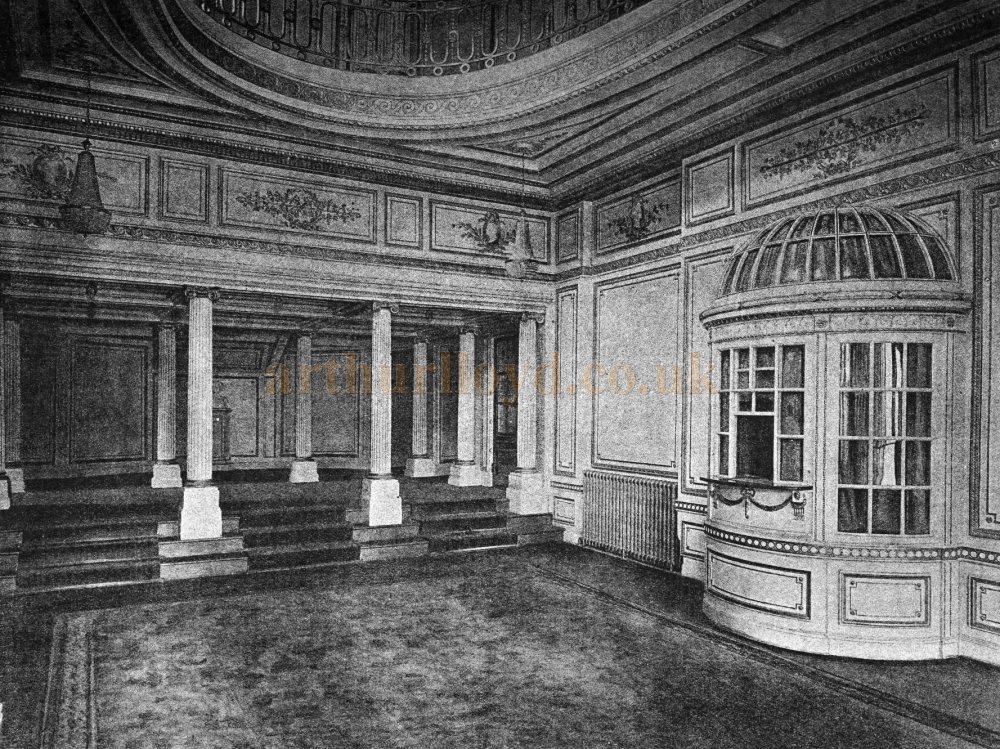
Above - The Foyer of the Hicks Theatre in 1907 - From The Architect, 15th of November 1907, wrongly attributed by them in their journal to the Aldwych Theatre which had the same architect, W. G. R. Sprague.
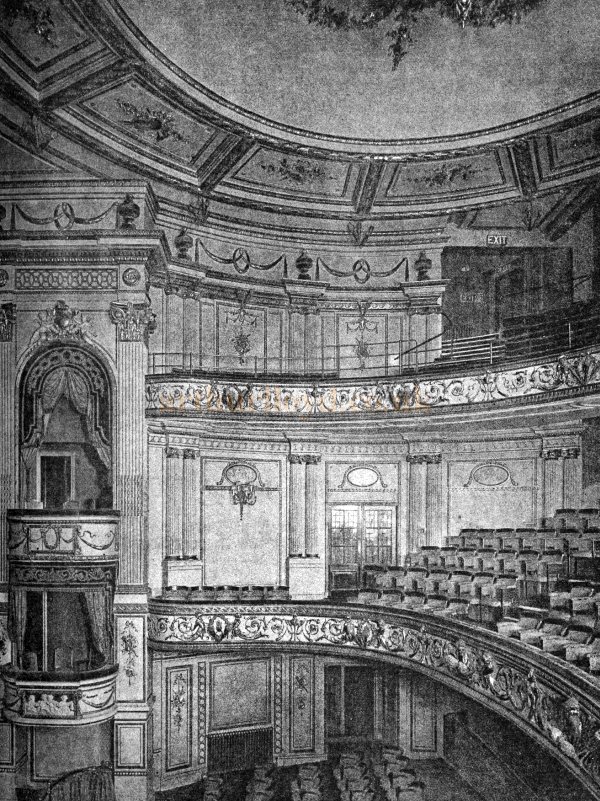 The auditorium, which has accommodation for about 1,200 persons, with standing space for a further 260, is constructed on the two-tiered principle, seating some 180 stalls at the lowest level, with a good pit at the rear. A fine roomy dress-circle, having eight rows and seating 300 persons, occupies the first tier, and on the second tier is the family circle, slightly raised, above which is a spacious gallery. The auditorium is 50ft. wide by 70ft. deep, and the interior of the house has been designed by Mr. W. G, R. Sprague on a circular plan, the walls forming the segment of a circle. The dome and covings of the main circle present a very fine effect, and there is nothing garish in the scheme of embellishment. Nor could the visual sense be in any way offended by the electric lights, which are artistically toned down without prejudice to their illuminating power.
Right - The Auditorium of the Hicks Theatre in 1907 - From The Architect, 15th of November 1907, wrongly attributed by them in their journal to the Aldwych Theatre which had the same architect, W. G. R. Sprague.
An atmosphere of pleasurable anticipation made itself felt on this, the opening night. It could scarcely have been connected with the play, which was The Beauty of Bath, transferred from the Aldwych Theatre. It was not the first night of a new piece, but it was the first night of a new theatre, and when Mr. Karl Kiefert's excellent orchestra struck up the National Anthem, it was with the utmost enthusiasm that the audience rose to honour the occasion. Then followed a number of popular airs, all admirably played, and ending with "For Auld Lang Syne." Immediately on the appearance of Miss Ellaline Terris in her part of the Beauty of Bath, as well as, later, of Mr. Seymour Hicks as the sailor lover, the whole house manifested its good wishes by uniting in thunderous and continued applause, which lasted for some seconds, and slightly interrupted the progress of the play. At the conclusion the boisterous cheering indicated that nothing would satisfy the spectator but a speech, late as the hour was. So Miss Terris, appeared once more before the footlights, and in her winsome manner expressed her delight at the reception. "Mr. Frohnian begs to thank you for your great kindness to-night," she said, "and he hopes you have been comfortable in our new theatre. I hope so too. For ourselves, all I can say is that we thank you from the bottom of our hearts, and that I wish you all a happy and prosperous New Year". Then the National Anthem was again played to indicate closing-time, but the audience would not accept the hint, and resumed the hearty clapping of hands, which meant that they required a speech from Mr. Seymour Hicks. Mr. Hicks obeyed the mandate, and briefly expressed his hearty thanks.

Above - The Hicks Theatre in a drawing by its architect W. G, R. Sprague before it was built - From The Sketch, 15th March 1905.
 Considering the difficulties associated with the opening of a new theatre, the performance of The Beauty of Bath went with commendable smoothness. Miss Ellaline Terriss, of course, brought her accustomed charms of individuality and acting to the role of Betty, and her singing of "How do you known when a little girl's in love?" was characterised by that vivacity of tone and expression and accompanying movement that have helped to make her so popular among playgoers.
Right - A Programme for 'The Village' at the Globe Theatre in 1927, formerly the Hick's Theatre.
Buoyant and breezy, Mr. Hicks gave us a rare specimen of a spirited naval lieutenant, full of life and jollity. Miss Rosina Filippi was altogether a delightful personage as Mrs. Alington, and Miss Sydney Fairbrother was seen and admired in her capital sketch of an ex-Bloomsbury lodging-house keeper. Mr. Murray King as the gay Sir Timothy Bun, Mr. William Lugg as the aristocratic Viscount Bellingham, Mr. Stanley Brett as the entertaining actor, Mr. Beverley, Mr. Laurence Caird as the inane Lord Quorn, Miss Maudl Darrell as the engaging actress, Miss St. Cyr, and Miss Florence Lloyd as Lady Bun, not to mention the other members of the company, ably supported Miss Terriss and Mr. Hicks.'
The above text in quotes was first published in the ERA, 29th of December 1906.
The Hick's Theatre opened on the 27th of December 1906 with a musical play called 'The Beauty of Bath', which, as reported in the article above, was a transfer from the Aldwych Theatre. The Hick's Theatre would quite quickly have a change of name as it was renamed the Globe Theatre in July 1909. See image and details below.

Above - The Globe Theatre during the run of 'Nude With Violin' in 1958 - Courtesy Gerry Atkins.

 The
auditorium of the Globe Theatre, formerly the Hicks Theatre, had a capacity
of 970 and was constructed on three levels, Stalls, Upper Circle, and
Gallery.
The
auditorium of the Globe Theatre, formerly the Hicks Theatre, had a capacity
of 970 and was constructed on three levels, Stalls, Upper Circle, and
Gallery.
Right - A Programme for 'Biography' at the renamed Globe Theatre in 1934 . And a Programme for 'Call It A Day' at the Globe Theatre in 1935. The play opened in October 1935 and ran for 509 performances.
Although the Upper is now called the Dress, and the Gallery is now known as the Upper, and the boxes were removed from the rear of the Upper in 1950, the Theatre remains in much the same form as it did in 1906.

 This
Globe Theatre should not be confused with the Globe Theatre on Newcastle
Street, which was demolished when London's Aldwych, named after the
Old Wych Street, was constructed.
This
Globe Theatre should not be confused with the Globe Theatre on Newcastle
Street, which was demolished when London's Aldwych, named after the
Old Wych Street, was constructed.
Left - A Programme for 'Call It A Day' at the Globe Theatre in 1936. The play opened in October 1935 and ran for 509 performances. And a Programme for 'They Came by Night' at the Globe Theatre in 1937.
This vast operation began in the last years of the nineteenth century and was not finally completed until after the First World War. Four Theatres were demolished during the early stages of the work. The Olympic Theatre in Wych Street and the Opera Comique in the Strand were closed in 1899, and the Globe Theatre in Newcastle Street shut its doors in 1902. This was followed by the closure of the Gaiety Theatre in the Strand in June of the same year.

Above - A Seating Plan for the Globe Theatre, probably 1920s.

Above - A Seating Plan for the Globe Theatre - From 'Who's Who in the Theatre' published in 1930 - Courtesy Martin Clark. Click to see more Seating Plans from this publication.

 The
Hicks Theatre, or the Globe Theatre as it was known from 1909,
was renamed yet again in 1994, this time to the Gielgud Theatre.
The
Hicks Theatre, or the Globe Theatre as it was known from 1909,
was renamed yet again in 1994, this time to the Gielgud Theatre.
Right - A Programme for 'While The Sun Shines' at the Globe Theatre in 1943. And a Programme for 'Robert's Wife' at the Globe Theatre in 1938.
The name change was partly in celebration of the actor John Gielgud but also because of the newly opened recreation of Shakespeare's Globe Theatre on London's South Bank which, it was thought, would have caused major confusion to the Theatre going public if there were two Globe Theatres in one City.
The Gielgud Theatre is currently owned and run by Delfont Macintosh Theatres. You may like to visit the Theatre's own website here. Some images relating to the Gielgud Theatre and it's history are shown below.


Above - A Programme for 'The Prisoner' with Alec Guinness at the Globe Theatre in 1954

Above - Shaftesbury Avenue in June 1977 showing the Lyric, Apollo, Globe, and Queen's Theatres - Photo M.L. 1977.

Above - The Gielgud Theatre during the run of 'The Canterbury Tales' in October 2006.

Above - Shaftesbury Avenue showing four of London's West End Theatres in a row, the Lyric Theatre, the Apollo Theatre, the Gielgud Theatre, and the Queen's Theatre in October 2006 - Photo M.L.

Above - A Photograph showing the Gielgud Theatre and the Queen's Theatre in October 2006 - Photo M.L. The Gielgud and the Queen's were both designed by W. G. R. Sprague as a pair.

Above - The Gielgud Theatre in March 2007 during the run of Peter Shaffer's 'Equus' with Daniel Radcliffe and Richard Griffiths, and whilst refurbishment work to the frontage was being carried out.

Above - The Gielgud Theatre during the run of 'Hair' in April 2010
Adelphi Aldwych Ambassadors Apollo Apollo Victoria Arts Cambridge Charing Cross Theatre Criterion Dominion Donmar Warehouse Drury Lane Duchess Tom Stoppard Theatre Fortune Garrick Gielgud Gillian Lynne Harold Pinter Haymarket His Majesty's Leicester Square Theatre London Coliseum London Palladium Lyceum Lyric Menier Chocolate Factory Noel Coward Novello Old Vic Palace Peacock Phoenix Piccadilly Playhouse Prince Edward Prince of Wales Royal Opera House Sadler's Wells Theatre Savoy Shaftesbury Sondheim St. Martin's Trafalgar Theatre Vaudeville Victoria Palace Wyndham's