
The Prince Of Wales Theatre, Coventry Street, London
Formerly - The Prince's Theatre
Introduction - The Prince's Theatre - Renaming to the Prince of Wales Theatre - Folies Bergere - The Current Prince of Wales Theatre - The 2003/05 Refurbishment of the Prince of Wales Theatre - Other Leicester Square Theatres and Cinemas

Above - The Prince Of Wales Theatre in April 2014 during the run of the acclaimed Broadway Musical 'The Book of Mormon' - Photo M. L.


 The
Prince of Wales Theatre which stands on the corner of Coventry Street
and Oxendon Street in London's Leicester
Square today is actually the second Theatre
to be built on the site since the late 19th century.
The
Prince of Wales Theatre which stands on the corner of Coventry Street
and Oxendon Street in London's Leicester
Square today is actually the second Theatre
to be built on the site since the late 19th century.

There is more information on the current Theatre below but first a chronological history of the site since the 1880s.
Right - A Pre 1905 Seating plan for the original Prince of Wales Theatre, formerly the Prince's Theatre.
 The
first Theatre on the site opened as the Prince's Theatre on Friday the
18th of January 1884 with a production of the Comedy 'The Palace of Truth' by W.
S. Gilbert, of Gilbert & Sulivan fame, and a production of the
Comedy 'In Honour Bound,' by Sydney Grundy (see programmes right and below)
The
first Theatre on the site opened as the Prince's Theatre on Friday the
18th of January 1884 with a production of the Comedy 'The Palace of Truth' by W.
S. Gilbert, of Gilbert & Sulivan fame, and a production of the
Comedy 'In Honour Bound,' by Sydney Grundy (see programmes right and below)
Right - The opening night programme for the Prince's Theatre on the Friday the 18th of January 1884 - Courtesy Alison Piano - Click to see the whole programme enlarged.
 The
Prince's Theatre, with a capacity of 960, was designed by the prolific
Theatre Architect C. J. Phipps as part of a development which also included an Hotel and Restaurant.
The
Prince's Theatre, with a capacity of 960, was designed by the prolific
Theatre Architect C. J. Phipps as part of a development which also included an Hotel and Restaurant.
Left - An image of the original Prince's Theatre and the Prince's Hotel - From a programme for 'La Poupee' in 1897.
 Edgar Bruce, who had previously been actor manager at
the Prince of Wales Theatre in Tottenham Street since 1880, and had made a
large profit from his production there of 'The Colonel,' by F. C. Bernand,
was forced to leave that Theatre when it was condemned by the Metropolitan
Board of Works in 1882.
Edgar Bruce, who had previously been actor manager at
the Prince of Wales Theatre in Tottenham Street since 1880, and had made a
large profit from his production there of 'The Colonel,' by F. C. Bernand,
was forced to leave that Theatre when it was condemned by the Metropolitan
Board of Works in 1882.
Right - C. J. Phipps' handwritten planning application letter to the Metropolitan Board of Works, 11th January 1883 - Courtesy David Spink and Roger Fox - Click to see the whole document.
Flushed with his success at the Tottenham Street Theatre however, Edgar Bruce then purchased land in Coventry Street and set about having a new Theatre built for him there.
 Unable to call his new Theatre the Prince of Wales Theatre, as the Tottenham Street one was still standing, he named his new Theatre the Prince's Theatre, after the then Prince of Wales instead, although it would later be renamed the Prince of Wales Theatre in
October 1886, see details below
Unable to call his new Theatre the Prince of Wales Theatre, as the Tottenham Street one was still standing, he named his new Theatre the Prince's Theatre, after the then Prince of Wales instead, although it would later be renamed the Prince of Wales Theatre in
October 1886, see details below
Left - C. J. Phipps' Ground Plan for the original Prince's Theatre reproduced in July 1935, two years before the Theatre was demolished, to make way for the new Prince of Wales on the same site - Click to Enlarge.
The plan shown left was most likely copied from the original 1880s ones by C. J. Phipps and then modified for any changes over the years such as the renaming of the auditorium tiers. To see this plan enlarged and its accompanying plans click here.


Above - A Programme for the first production at the Prince's Theatre in January 1884; the Comedy 'The Palace of Truth' by W. S. Gilbert, of Gilbert & Sulivan fame, and a production of the Comedy 'In Honour Bound,' by Sydney Grundy - Courtesy Simon Moss, stagememories - From the John Cannon Collection - A Programme for the Opening Night of this Production on the Friday the 18th of January 1884 can be seen here.
 The
Prince's Theatre opened on the 18th
of January 1884 with
a production of the Comedy 'The Palace of Truth' by W.
S. Gilbert, of Gilbert & Sulivan fame, and a production of the
Comedy 'In Honour Bound,' by Sydney Grundy, see programme above.
The
Prince's Theatre opened on the 18th
of January 1884 with
a production of the Comedy 'The Palace of Truth' by W.
S. Gilbert, of Gilbert & Sulivan fame, and a production of the
Comedy 'In Honour Bound,' by Sydney Grundy, see programme above.
The Pall Mall Gazette printed a review of the opening and a sketch of the auditorium the next day in their 19th of January 1884 edition saying: 'Last night a most brilliant audience witnessed the opening of the Prince's Theatre in Coventry-street, which for its size, the beauty of its decorations, its admirable arrangement, and its sumptuous equipment entitle it to take the highest place among London theatres.
Right - A sketch of the principle entrance of the Prince's Theatre.
The theatre has been built for Mr. Bruce by Mr. Phipps, the well-known architect of many playhouses, and both he and the spirited manager, Mr. Edgar Bruce, well deserved all the praise which was showered upon them last night for the complete success that has attended their united efforts.
The theatre stands upon a plot of land bounded by Coventry-street, Oxendon-street, Whitcomb-street, and Whitcomb-court, and has, entrances from each of these four streets, the principal one being at the corner of Coventry and Oxendon streets.
 There
are three fine doorways opening into a circular vestibule, affording
entrance to the stalls, balcony, and private boxes. Three other entrances
to the first-circle, the pit, and the gallery, and a separate entrance
to the Royal box, are in the Oxendon-street facade. There are besides
these other exits, thus making two exits from every floor, which will
always be open and available. The entrances, staircases, foyer, are
entirely external to the main block of the theatre, and are treated
in unison with the architecture of the hotel, which occupies a position
of the frontage, in the French Renaissance style.
There
are three fine doorways opening into a circular vestibule, affording
entrance to the stalls, balcony, and private boxes. Three other entrances
to the first-circle, the pit, and the gallery, and a separate entrance
to the Royal box, are in the Oxendon-street facade. There are besides
these other exits, thus making two exits from every floor, which will
always be open and available. The entrances, staircases, foyer, are
entirely external to the main block of the theatre, and are treated
in unison with the architecture of the hotel, which occupies a position
of the frontage, in the French Renaissance style.
Left - A sketch of the vestibule of the Prince's Theatre.
The floor of the vestibule and the staircase are constructed of marble. The foyer for the balcony has an arcade of circular-headed windows on the street side, and this design is repeated on the opposite and flank wails, the openings being divided by Corinthian pilasters, resting on a panelled dado.
 The ceiling is richly ornamented, and, together with the walls,
decorated in ivory white and gold. The doors and dado are painted a
deeper colour. The floor is made beautiful with marble mosaic.
The ceiling is richly ornamented, and, together with the walls,
decorated in ivory white and gold. The doors and dado are painted a
deeper colour. The floor is made beautiful with marble mosaic.
Right - A sketch of the Grotto at the Prince's Theatre.
The visitors to the stalls have a foyer of similar size on the lower level, and this, together with the smoking-room under the vestibule, are decorated and fitted up in the Moorish style. Here the walls and ceiling are white, the floor blue mosaic, and the doors and recesses in the walls green. A small fountain is at the end of the foyer.
The smoking-room is circular, following the shape of the vestibule over, and in the centre is a kiosk for refreshments. Opening out of the vestibule and situate under the pavement of the street is a grotto and fernery.
After passing through the stalls foyer a corridor runs entirely round the theatre, giving access to both sides of the stalls.
 The
scheme of the auditory comprises: stalls of eight rows and a spacious
pit on the street level; balcony of six rows on the first floor; first
circle of six rows on the second floor, and gallery on the third floor.
The
scheme of the auditory comprises: stalls of eight rows and a spacious
pit on the street level; balcony of six rows on the first floor; first
circle of six rows on the second floor, and gallery on the third floor.
Right - A pre 1905 seating plan for the Prince's Theatre, later the Prince Of Wales Theatre.
There are eight private boxes on either side of the proscenium, special care having been taken in arranging the lines of the house that these should have a good view of the stage. The Royal box is on the lower or stalls level on the prompt side of the stage, having a boudoir attached to it, and a special entrance from Oxendon-street without a step. It may be mentioned here that from every seat in the house an admirable view of the stage is obtained.
Left - A sketch of the auditorium, stage, and private boxes of the Prince's Theatre, Coventry Street - From the Pall Mall Gazette 19th January 1884.
The general tone of the decoration is ivory white, cream colour and gold, the gilding being in large masses. Rich colour is derived from the hangings to the private boxes, and the coverings of the seats, which are of red orange plush. The walls of the various tiers are covered with embossed paper of a Venetian red tone, the private boxes being lined with a Japanese paper of a dull gold colour.

Above - A sketch of the Prince's Box at the Prince's Theatre.
The stage is divided from the auditory by a solid brick wall carried up to a considerable height, separating both roofs. There are only two openings in this wall other than the proscenium opening, and these are closed with iron doors, while the large opening is fitted with a patent hydraulic iron curtain, similar to that at the Royal Lyceum Theatre, Edinburgh (designed also by Mr. Phipps).

Above - A sketch of the Oriental Lounge at the Prince's Theatre.
The curtain measures 32 ft. 6 in. wide by 26 ft. 6 in. high, and is constructed of two screens of wrought iron plates 1/8th in. thick, forming a double division with an air space between of 6 in. It is raised bodily by hydraulic rams fitted on either side of the stage opening, and worked by the man at the prompter's box by a lever (like those used on railways). The curtain is raised or lowered in 30 sec. The stage is spacious, and has a more than usual width. The height enables all scenery to be taken up without rolling or doubling, and the cellar below is 20 ft. deep. The theatre is most brilliantly lighted by the Swan incandescent electric lamps.'

Above - A Sketch of the Balcony Foyer of the Prince's Theatre.
The above text (edited) in quotes and accompanying sketch of the auditorium was first published in the Pall Mall Gazette, 19th of January 1884 - Other Sketches Courtesy Delfont Mackintosh Theatres.
The Renaming of the Prince's Theatre to the Prince of Wales Theatre

 The Prince's Theatre had opened on the 18th of January 1884 with a production of the Comedy 'The Palace of Truth' by W.
S. Gilbert, of Gilbert & Sulivan fame, and a production of the
Comedy 'In Honour Bound,' by Sydney Grundy.
The Prince's Theatre had opened on the 18th of January 1884 with a production of the Comedy 'The Palace of Truth' by W.
S. Gilbert, of Gilbert & Sulivan fame, and a production of the
Comedy 'In Honour Bound,' by Sydney Grundy.
Right - A Programme for 'L'Enfant Prodigue' at the Prince of Wales Theatre in 1891 - Click to see the entire programme.
The next year saw the much loved and still well known Lillie Langtry perform in 'Princess George' and 'The School forScandal' which was to set the stage for a whole host of famous celebrities of the day performing at the Theatre including Martin Harvey, Mrs Patrick Campbell, Charles Hawtrey, and Marie Tempest.
Right - An early postcard depicting the original Prince of Wales Theatre, formerly the Prince's Theatre.

 Although
the Theatre originally opened as the Prince's Theatre it would soon
be renamed, only two years later, to the Prince of Wales Theatre on
October the 4th 1886 for the
opening of the Comic Opera 'La Bearnaise.'
Although
the Theatre originally opened as the Prince's Theatre it would soon
be renamed, only two years later, to the Prince of Wales Theatre on
October the 4th 1886 for the
opening of the Comic Opera 'La Bearnaise.'
Left - A programme for 'The Man From Blankley's' under the management of Frank Curzon, at the Prince of Wales Theatre in April 1901 - Click to see entire programme. And a programme for 'The Only Way' under the management of Martin Harvey, at the Prince of Wales Theatre in April 1899 - Click to see entire programme.
This was made possible when the other Theatre of the same name in Tottenham Street had been taken over by the Salvation Army to be used as a Hostel.
By the 1900s the Prince of Wales had become well known for its comic operas and musicals.
And by 1919 the Prince of Wales Theatre had become the home for many of Noel Coward and Ivor Novello's revues with famous names such as Gertrude Lawrence, Jack Buchanan, Beatrice Lillie and Jessie Matthews performing in them.


Above - A Programme for 'La Poupee' at the Prince of Wales Theatre in 1897, A Programme for 'King of Cadonia' at the Prince of Wales Theatre in 1908, and The Playgoer of 1910 reports on the play 'Inconstant George'. - Click the covers for more details.
Folies Bergere
 In
1932 a new period began at the Prince of Wales when Charles Clore took
control of the Theatre and began putting on lavish revues which eventually
became London's own version of the 'Folies Bergere'.
In
1932 a new period began at the Prince of Wales when Charles Clore took
control of the Theatre and began putting on lavish revues which eventually
became London's own version of the 'Folies Bergere'.
A string of 'Folies' shows followed, all rather risqué for the time and featuring lavish costumes, beautiful dancers, singers, magicians, acrobats, and elaborate sets.
Right - A Programme for 'Folies Bergere - Paris Fantaisie' at the Prince of Wales Theatre in 1933 - Click for details.
In 1935 Alfred Esdaile took over the Theatre but continued with the same policy.
These 'Folies' shows, which ran continuously from 2pm to midnight, 4 times a day, were an enormous success and would eventually provide the funds necessary to build a new Theatre to replace the aging 1884 one.


Above - Scenes from 'Ca C'Est Paris, at the Prince of Wales Theatre in 1933 - Courtesy British Pathe


Above - A Theatre Token for 'Ca C'est Paris' at the Prince of Wales Theatre in 1933 - Courtesy Alan Judd
The Second and Current Prince of Wales Theatre, Coventry Street

Above - The exterior of the Prince of Wales Theatre during the run of 'Blue Magic' with Shirley Bassey and Tommy Cooper in 1958 - Courtesy Gerry Atkins.
 The first Prince of Wales
Theatre was always a successful Theatre and put on a great many productions
but the size of the stage and capacity of its auditorium proved to be
a major issue for the elaborate 'Folies Bergere' style revue shows which
had been running at the Theatre since 1932.
The first Prince of Wales
Theatre was always a successful Theatre and put on a great many productions
but the size of the stage and capacity of its auditorium proved to be
a major issue for the elaborate 'Folies Bergere' style revue shows which
had been running at the Theatre since 1932.
Flush with their success, and the considerable profits they brought in, by the mid 1930s the owners decided that the present Theatre should be replaced by a new one. Consequently in 1936 the well known Cinema and Theatre Architect, Robert Cromie, was brought in to design a new Theatre to be built on the same site.
Right - A Programme for the 'Casino De Paris' at the new Prince of Wales Theatre which was produced in the 1950s - Kindly Donated by Sue Wilde.
 On the 19th of December 1936 the Times
Newspaper reported on the proposed new Theatre saying: 'The Prince
of Wales's Theatre is to be demolished and rebuilt immediately after
Christmas. There will be no change in the present policy or management.
A sum of £350,000 is involved.
On the 19th of December 1936 the Times
Newspaper reported on the proposed new Theatre saying: 'The Prince
of Wales's Theatre is to be demolished and rebuilt immediately after
Christmas. There will be no change in the present policy or management.
A sum of £350,000 is involved.
The theatre will close on Saturday evening, January 16, when a farewell gala performance will be given. It is hoped that it will be broadcast and that several famous actors and actresses who started their careers at this theatre will take part. The architect of the new building is Mr. Robert Cromie.
Left - Gracie Fields laying the Foundation Stone for the new Prince of Wales Theatre on the 17th of June 1937 - From The Sphere , 26th of June 1937.
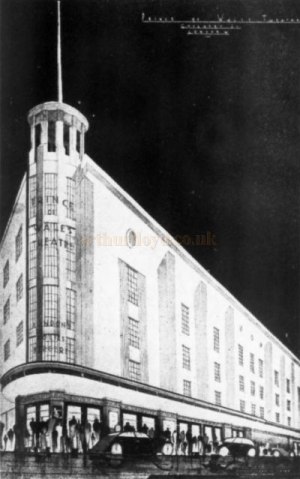 The new theatre will be nearly twice as large as the present one. There
will be 1,500 roomy seats — roughly twice as many as there are
at present. There will be only one tier, 27ft. from the stage. There
will be bars convenient to all parts of the theatre, including an especially
large one with small shops and side shows attached to the stalls, entered
through a cocktail bar. In it will be a snack counter, a band, anda
dance floor with experts giving lessons in the latest dances, and cabaret
turns during the intervals of the ordinary stage show.
The new theatre will be nearly twice as large as the present one. There
will be 1,500 roomy seats — roughly twice as many as there are
at present. There will be only one tier, 27ft. from the stage. There
will be bars convenient to all parts of the theatre, including an especially
large one with small shops and side shows attached to the stalls, entered
through a cocktail bar. In it will be a snack counter, a band, anda
dance floor with experts giving lessons in the latest dances, and cabaret
turns during the intervals of the ordinary stage show.
Right - A perspective drawing of the design, by Robert Cromie, for the new Prince of Wales Theatre in Coventry Street, Piccadilly. It will be nearly twice as large as the old building, now almost demolished. The new building, estimated to cost £350,000, will be opened in August - From The Architect's Journal, 4th of March 1937.
A conjurer, palmist, and lightning artist will also be engaged for the entertainment of patrons using the bars. Dressing rooms will be provided with a barber's shop and manicurists.

Above - After laying the foundation stone of the new Prince Of Wales Theatre in London in June 1937, Gracie Fields sings to the workmen. (Note that part of the old theatre auditorium is still visible in this picture) - From the archives of the Radio Times Hulton Picture Library.
TELEVISION APPARATUS
 The
theatre will have a television projection installation, and talking
film apparatus and wiring for broadcasting will also be fitted. An electric
organ in the orchestra will be used in conjunction with the theatre
band. The orchestra pit will be designed not only to rise, but also
to part and swing back on to the sides of the stage on reaching stage
level. The proscenium will be 45ft. wide — twice the present width.
There will be a movable revolving stage which can be transferred to
any part of the ordinary stage as required. It will also be possible
for it to be brought forward over the footlights and band.
The
theatre will have a television projection installation, and talking
film apparatus and wiring for broadcasting will also be fitted. An electric
organ in the orchestra will be used in conjunction with the theatre
band. The orchestra pit will be designed not only to rise, but also
to part and swing back on to the sides of the stage on reaching stage
level. The proscenium will be 45ft. wide — twice the present width.
There will be a movable revolving stage which can be transferred to
any part of the ordinary stage as required. It will also be possible
for it to be brought forward over the footlights and band.
Right - A Programme for 'Folies Bergere' at the new Prince of Wales Theatre, which was revived in the 1950s - Kindly Donated by Sue Wilde.
 There will be a "running-track"
- similar to an escalator, but on the flat - running from one side of
the stage to the other. Air-conditioning-will ensure an even temperature
and pure air throughout the theatre.'
There will be a "running-track"
- similar to an escalator, but on the flat - running from one side of
the stage to the other. Air-conditioning-will ensure an even temperature
and pure air throughout the theatre.'
The above text in quotes was first published in The Times, 19th, December 1936.
This article from The Times above seems rather ahead of its time, especially the reference to Television Projection at a time when Television itself was in its infancy. As far as I am aware the Theatre was not installed with this feature or the elaborate orchestra pit mentioned.
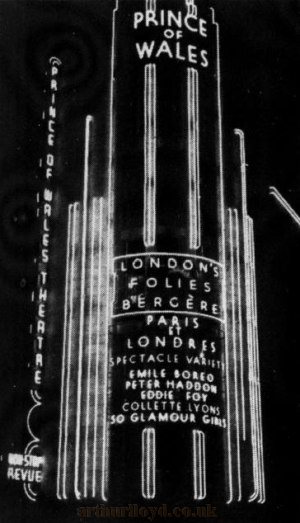
Left - The Prince of Wales Theatre at night showing the advertising and architectural neon lighting on the main facade - From The Electrical Review, 12th of November 1937.
It was however, fitted with a revolve which had a large outer ring with a smaller central disc which could turn and lift, but not lower, as at the London Palladium, and was used on occasions for Sunday Night on TV when the Palladium was not available. The Theatre was also fitted with a Birkitt counterweight system but this and the revolve were removed at the time of the recent refurbishment in 2003/5 (See photos below).

Above - The Revolve Lift mechanism under the stage of the Prince of Wales Theatre shortly before its removal during renovations in 2003/5 - Courtesy Roger Fox.

Above - The Birkitt counterweight system at the Prince of Wales Theatre shortly before its removal during renovations in 2003/5 - Courtesy Roger Fox.
On the 16th of January 1937 the last production at the original Prince of Wales Theatre, a revue called 'Encore Les Dames,' came to an end and the Theatre closed its doors for the final time. The old Theatre was then quickly demolished so that a new Theatre of the same name could be built on the site. The foundation stone for the new Prince Of Wales Theatre was laid by Gracie Fields on the 17th of June 1937.
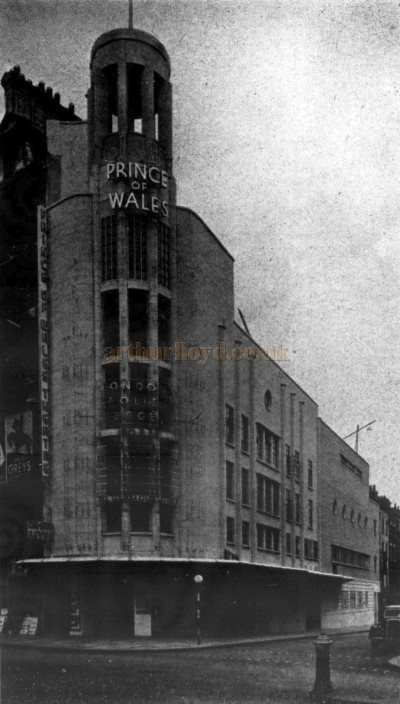 The Builder reported on the construction of the new Prince of Wales Theatre in their 5th of November 1937 edition, along with some of the images shown here, saying:- 'Demolition of the old theatre, at the corner of Coventry and Oxendon-streets, W., commenced on January 25, 1937. It is interesting to note that the new building stands upon exactly the same site as its predecessor, but has twice the latter's capacity, a larger stage, and a great deal more accommodation for the public, the artists and the management.
Right - The Exterior of the Prince of Wales Theatre looking down Oxendon Street - From The Builder, 5th of November 1937.
Access is easier for the public, as the new stalls floor is level with the street. The circle is brought forward as far as possible to create an atmosphere of intimacy which as unique in a theatre of this size - the circle front is only 21 ft. away from the orchestra and barely 11 ft. high above the stalls. This arrangement does not diminish the visibility of the stage from the rear stalls seats, as there is no excessive overhang.
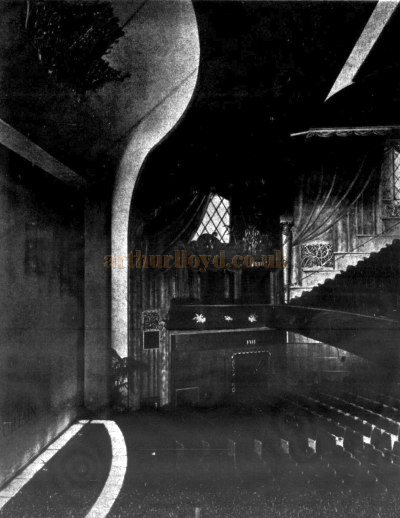 The auditorium is 84 ft. wide and 60 ft. deep, as compared with the old auditorium, which was only 43 ft. wide and 57 ft. deep. By careful planning and the use of cantilever construction, the actual floor area has been doubled. As both the stalls and the circle are designed upon geometrically accurate rakes, the sight-line from every seat in the house is excellent.
Left - The Auditorium of the Prince of Wales Theatre - From The Builder, 5th of November 1937.
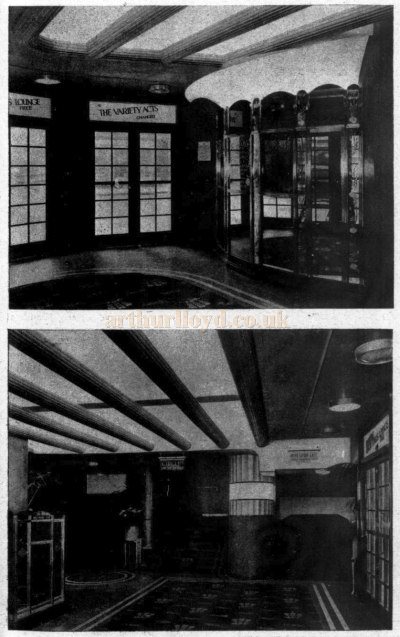 Much thought has been expended in arranging the dressing-rooms. Amenities in the theatre are a cocktail bar, an American bar at circle level, a grand saloon and tea-room, and facilities for ladies' and gentlemen's hairdressing.
The artists will find a green-room, bathrooms and a large canteen at their service, while the management have spacious offices immediately over the entrance hall, and their own rehearsal rooms on the premises.
Right - The Foyer and Entrance Hall of the Prince of Wales Theatre - From The Builder, 5th of November 1937.
A fully-equipped projection department is provided for the projection and stage sound amplification and sound mixing - together with room for the installation of television when the time comes. The stage has automatic counter-weights for the scenery, and a revolving centre-stage has been incorporated.
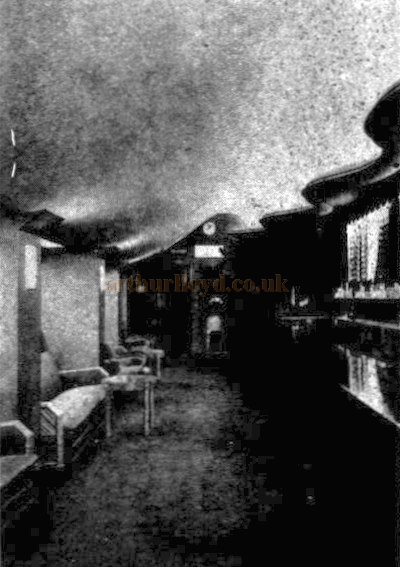 There will be no footlights in the ordinary sense. The acting area is flood-lit from remote-controlled lamps on the balcony front, and an illuminated glass panel takes the place of the stage float, and this is extended all round the orchestra rail to form a promenade accessible from the stage at each end or from the centre by a rising electric platform. Steps are also arranged at each end down to the stalls floor.
Left - The American Bar at the Prince of Wales Theatre - From The Builder, 5th of November 1937.
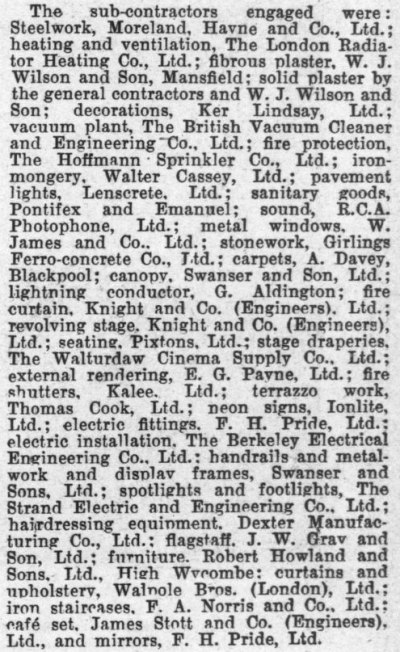 Wardrobes, workshops, electricians' room, band-room, etc., are situated in the basement, while the principal dressing-rooms are easily accessible from the prompt side.
Right - Sub Contractors for the construction of the Prince of Wales Theatre - From The Builder, 5th of November 1937.
The whole auditorium was designed by the architect to give a sense of luxury, but with an airy spaciousness. The decorative motif adopted is a stylised drapery - the gold stage tableaux curtains are repeated in gilded plaster work on the side walls - dressed round illuminated panels representing windows with elaborately modelled features over the boxes. The stalls walls are panelled all round in flush figured walnut with pilasters and architraves of engraved peach mirror. The carpets and upholstery are in a cardinal purple.
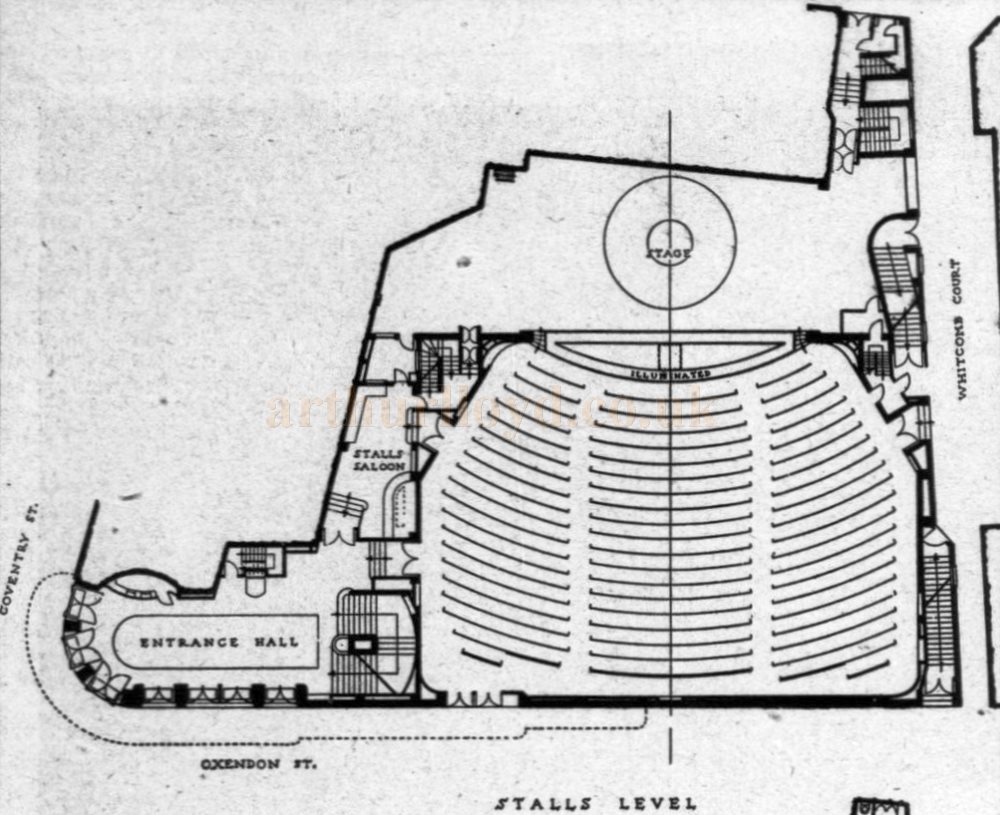 Robert Cromie's Stalls Level Plan for the Prince of Wales Theatre in 1937.
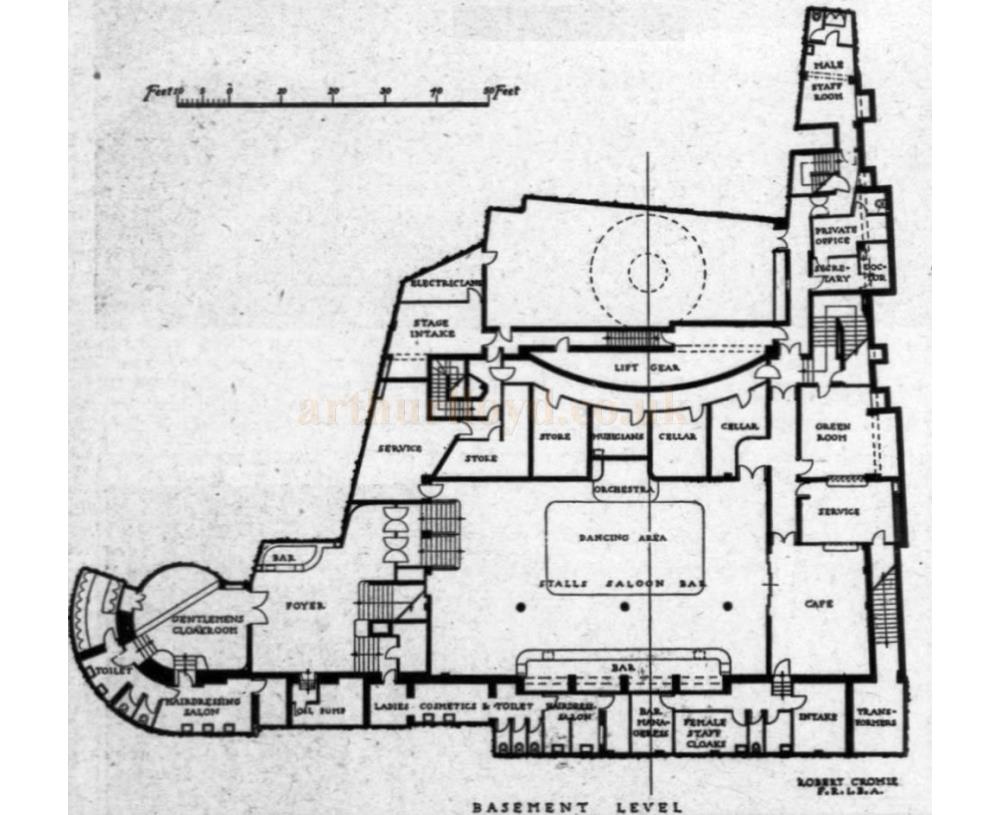 Robert Cromie's Basement Plan for the Prince of Wales Theatre in 1937.
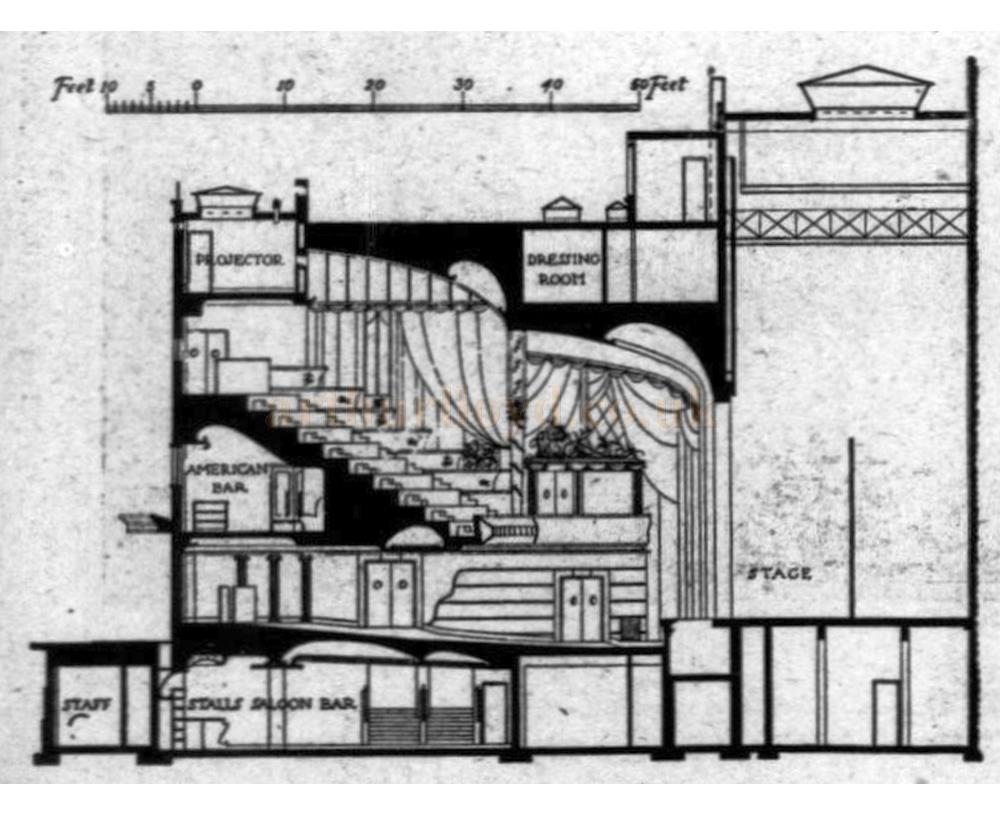 Robert Cromie's Longitudinal Plan for the Prince of Wales Theatre in 1937.
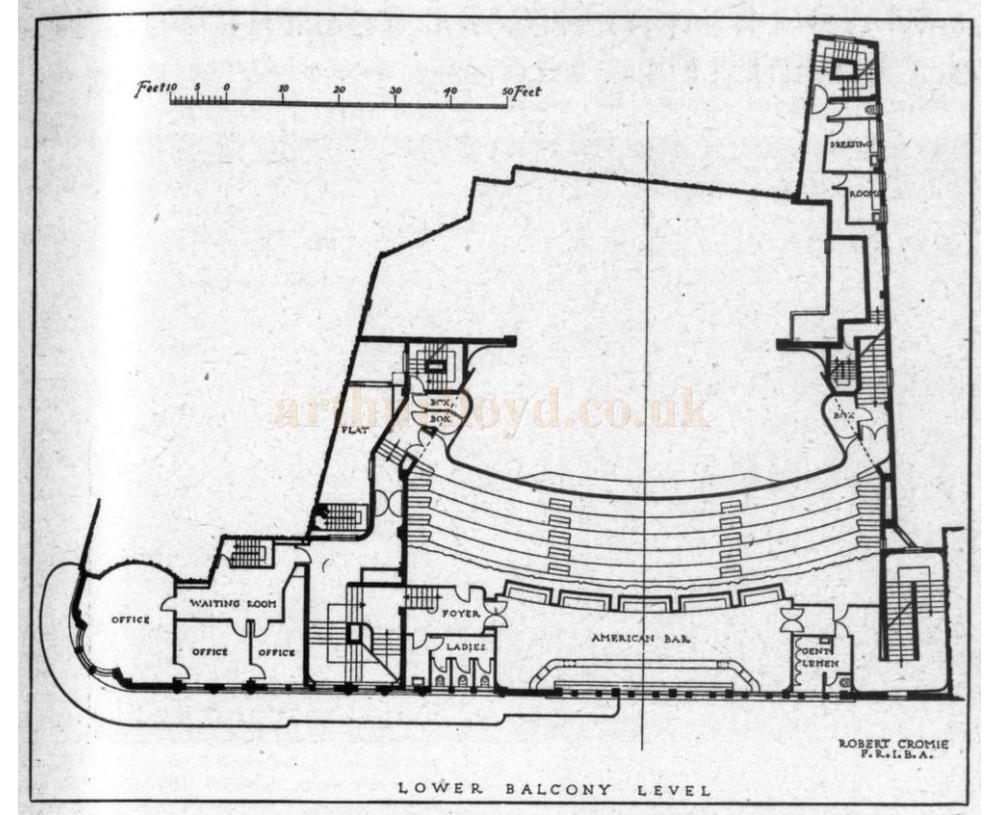 Robert Cromie's Lower Balcony Level Plan for the Prince of Wales Theatre in 1937.


Above - Robert Cromie's Plans for the 1937 Prince of Wales Theatre - From The Builder, 5th of November 1937.
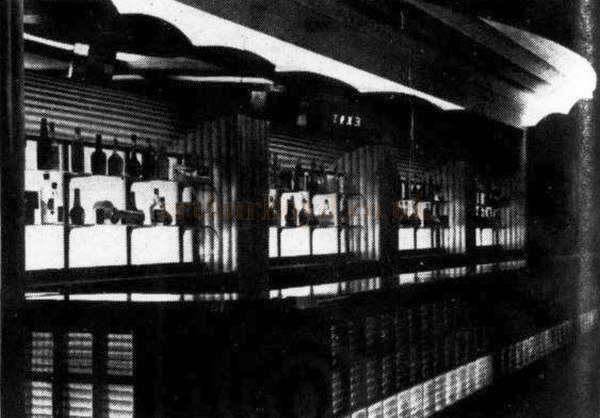 A special feature has been made of the grand saloon - about 80 ft. by 40 ft., with a counter 46 ft. long for quick service, a dance floor and orchestra. The counter itself is built of blocks of glass illuminated from behind.
Right - The American Bar at the Prince of Wales Theatre - From The Electrical Review, 12th of November 1937.
Externally the building is of white stone. The tower on the Coventry-street corner contains the boiler-house and air-conditioning plant. The consulting structural engineers were Messrs. S. W. Budd, M.I.C.E.; the consulting electrical engineer, Mr. Basil Davis, M.I.E.E., and the general contractors, the Marfix Co., Ltd.'
The above text in quotes was first published in The Builder, 5th of November 1937.

 The
new Prince of Wales Theatre opened on the 27th of October 1937 with
a production of the Review 'Les Folies de Paris et Londres,' which was
a continuation of the non stop reviews which had been staged successfully
at the earlier Theatre since 1932, first by Charles Clore, and then
later by Alfred Esdaile.
The
new Prince of Wales Theatre opened on the 27th of October 1937 with
a production of the Review 'Les Folies de Paris et Londres,' which was
a continuation of the non stop reviews which had been staged successfully
at the earlier Theatre since 1932, first by Charles Clore, and then
later by Alfred Esdaile.
Right - A Programme for 'Revue Folies de Can-Can' at the new Prince of Wales Theatre in 1938 - Click to see the entire programme. And the 1937 Prince of Wales Theatre, Coventry Street, in its original form, whilst the production of 'The Full Monty' was playing at the Theatre in 2002- Photo M.L.
In the 'Revue Folies De Can-Can' Programme (shown right) Alfred Esdaile wrote a piece about the new and old Prince of Wales Theatres which I have reproduced below. These reviews were an attempt at an English version of the well known French 'Folies Bergeres' and continued at the Theatre until the Musical Comedy 'Present Arms' opened in May 1940.
 Dear
Patrons, The opening revue of the new theatre was an undoubted success
as you are probably aware. In spite of the fact that the theatre was closed for close
on a year for rebuilding, when we re-opened it last October with identically
the same policy it was soon obvious that our old friends and patrons
had not forgotten us, for they simply flocked to see the biggest non-stop
revue which has ever been staged in London.
Dear
Patrons, The opening revue of the new theatre was an undoubted success
as you are probably aware. In spite of the fact that the theatre was closed for close
on a year for rebuilding, when we re-opened it last October with identically
the same policy it was soon obvious that our old friends and patrons
had not forgotten us, for they simply flocked to see the biggest non-stop
revue which has ever been staged in London.
Right - A Photograph of Alfred Esdaile - From a Programme for 'Revue Folies de Can-Can' at the Prince of Wales Theatre in 1938 - Click to see the entire programme.
Without a doubt "Les Folies de Paris et Londres" was far and away the most elaborate and ambitious non-stop entertainment ever devised. The new theatre, large and luxurious, with every modern stage contraption and convenience only added to the splendour of this magnificent entertainment, which, after a run of over 400 performances, and playing to many thousands of people, came to an end on Saturday, February 19th.
We have always prided ourselves on being able to prophesy the length of our runs on the first night of a new show. With a theatre twice as large as the old one we frankly thought that if we gave our first show a four months' run - equal to 8 months in the old theatre, which was half the size - we would not only be asking a lot of it but would also be giving it as long a run as we dared. Happily, or unhappily as the case may be, for once we were wrong. "Les Folies de Paris et Londres" could vastly have run several more weeks with business as it was, and the West End very full just now of visitors to London for the British Industries Fair and other things which always send theatre receipts up with a bang.
 However,
this new production "Revue Folies de Can-Can" was scheduled
for production on February 23rd and contracts, apart from many other
considerations, made it impossible for us to delay this production,
so here it is, in for a run which, we are convinced, will at least equal
its predecessor, but in our humble though carefully considered opinion,
easily exceed it. Good and successful though our first show was, it
has only needed a look at the rehearsals, the costumes and the scenery to realise that this new show must easily be more successful than the
last.
However,
this new production "Revue Folies de Can-Can" was scheduled
for production on February 23rd and contracts, apart from many other
considerations, made it impossible for us to delay this production,
so here it is, in for a run which, we are convinced, will at least equal
its predecessor, but in our humble though carefully considered opinion,
easily exceed it. Good and successful though our first show was, it
has only needed a look at the rehearsals, the costumes and the scenery to realise that this new show must easily be more successful than the
last.
Left - Caption reads: 'One of Our Glamour Girls'. I am told that the model was Diane Boyd and the photograph was also used on a B.A.T. Modern Beauties series of cigarette cards. Card no.16 [7th series]. M.L.
We thought we had done our best with the last show but somehow with the worries connected with the opening of the new theatre off our minds, we have been able to concentrate entirely on this new show to an extent I did not realise possible when we opened the new theatre last October. The larger stage and its mechanical contrivances had not been tried out then. Now, with the experimental stage past, I have been able to do all sorts of things I did not realise were possible when I was opening the last show with only an ink and paper knowledge of what the stage and its mechanics were going to be like. More than this, we have been able to secure costumes and effects for this show which easily outclass anything we have ever had before, elaborate as some of our shows have been.
We do not think you will be slow to realise that there is something about this production which, even with our good record, not merely goes one better but is a very good deal better than anything we have ever accomplished. Each time I devise and produce a new show I think to myself "Well, it's just impossible to do better than this." I have said this so often because it seems that when one has exhausted one's ideas in one production, new and better ones will be so hard to find, but somehow or other new ones have come along and we have always been able to achieve what I thought was impossible, that is a better production than the last on each occasion.
 We
feel sure you will be pleased to see Ronald Frankau (shown right) with Renee Roberts
and Monte Crick back again. They were associated with some of our most
successful productions including the most successful we ever did in
the old theatre. With them we have an entirely new cast with the exception
of Bernard Clifton, one of the most attractive juvenile leads we have
had, and we are very glad to have him with us again in a second show.
We
feel sure you will be pleased to see Ronald Frankau (shown right) with Renee Roberts
and Monte Crick back again. They were associated with some of our most
successful productions including the most successful we ever did in
the old theatre. With them we have an entirely new cast with the exception
of Bernard Clifton, one of the most attractive juvenile leads we have
had, and we are very glad to have him with us again in a second show.
We are sure you will notice the youth and beauty the female side of our new company, which, after a census, we find has an average age of only 18. This must be a record for a West End show.
One thing more, and the most important of all. While we are naturally proud of our efforts and our successes, we are conscious, only too conscious in fact, that none of this would have been possible, but for the continued and regular support of so many people we are pleased to call friends as well as patrons. People who have been coming to see our shows off and on for the last 5 or 6 years.
The most amazing thing about the opening of the new theatre, even on the first night was the extraordinary homeliness about the place. With so many of the old staff and many musicians in the orchestra, and artistes on the stage there was really very little strange about our opening night. Apart from the glamour attached to any ordinary first night, the electrifying excitement which usually accompanies the opening of a new theatre was missing to a most peculiar extent. It seemed as if we were just carrying on exactly the same as before, but in different surroundings. You, our patrons cannot fail to notice this I feel sure. I only hope we can rely upon your continued support throughout what I hope will he a very long career for this lovely new theatre.
With my thanks for all you have helped me to do. Yours very truly ALFRED ESDAILE.
Above text from a Programme for 'Revue Folies de Can-Can' at the Prince of Wales Theatre in 1938 - Click to see the entire programme.

Above - The Oxendon Street elevation of the 1937 Prince Of Wales Theatre before the 2003/5 renovation. The former Trocadero Restaurant is visible in the distance. - Photo M. L. 2002.
 After
the above mentioned review period ended at the Prince of Wales Charlie
Chaplin's film 'The Great Dictator' was shown at the Theatre in December
1940. Non stop reviews then returned for a short while but only until
George Black took over the reigns and presented 'Happidrome' at the
Theatre, which would later be produced very successfully by the BBC
at the New Cross Empire.
After
the above mentioned review period ended at the Prince of Wales Charlie
Chaplin's film 'The Great Dictator' was shown at the Theatre in December
1940. Non stop reviews then returned for a short while but only until
George Black took over the reigns and presented 'Happidrome' at the
Theatre, which would later be produced very successfully by the BBC
at the New Cross Empire.
Right - Detail from a 1948 Variety Programme advertising the forthcoming BBC 'Happidrome' Radio show to be performed at the New Cross Empire.
 Eventually
the Prince of Wales passed into the hands of Moss
Empires and a string of successful plays and musicals followed at
the Theatre including 'No Orchids for Miss Blandish' in 1942, 'Strike
a New Note' in 1943 with the comedy entertainer and impressionist Sid
Field, who also appeared in 'Strike It Again' at the Theatre in
1944. Mae
West appeared at the Theatre in 'Diamond Lil' in 1948, and Katherine
Dunham appeared there in 1948.
Eventually
the Prince of Wales passed into the hands of Moss
Empires and a string of successful plays and musicals followed at
the Theatre including 'No Orchids for Miss Blandish' in 1942, 'Strike
a New Note' in 1943 with the comedy entertainer and impressionist Sid
Field, who also appeared in 'Strike It Again' at the Theatre in
1944. Mae
West appeared at the Theatre in 'Diamond Lil' in 1948, and Katherine
Dunham appeared there in 1948.
Left - A 1950s Poster for a Val Parnell and Bernard Delfont's Twice Nightly Christmas Show at the Prince of Wales Theatre with Billy Cotton and Archie Andrews - Courtesy Chris Woodward. Also on the Bill for this show were the stars from 'Educating Archie'; Peter Brough, Archie Andrews, Ronald Chesney, and Ossie Noble. And the Billy Cotton Band with Alan Breeze and Doreen Stephens, and the Marquis and Family of Chimpanzees, and Les Rayner & Betty.
 In 1949 Sid Field returned to great acclaim at the Prince of Wales
Theatre playing the part of Elwood P. Dowd in 'Harvey' which would later
be played by James Stewart in the film of the same name. The play ran
for 610 performances but sadly this was to be Field's last part as he
died from a heart attack at his home in Richmond during the run of the play at the age of only 45 on the 3rd of February
1950.
In 1949 Sid Field returned to great acclaim at the Prince of Wales
Theatre playing the part of Elwood P. Dowd in 'Harvey' which would later
be played by James Stewart in the film of the same name. The play ran
for 610 performances but sadly this was to be Field's last part as he
died from a heart attack at his home in Richmond during the run of the play at the age of only 45 on the 3rd of February
1950.
Right - A Programme for ''Paris to Piccadilly' with Norman Wisdom at the Prince of Wales Theatre which was produced in the 1950s - Kindly Donated by Sue Wilde - Click to see the entire Programme.
 Shortly
after this the Theatre became home to Reviews and Variety again with
many of the shows produced in the style of the earlier 1930s 'Folies
Bergere' productions. This continued until the play 'The World of Susic
Wong' opened in November of 1959 and ran for two years until August
1961.
Shortly
after this the Theatre became home to Reviews and Variety again with
many of the shows produced in the style of the earlier 1930s 'Folies
Bergere' productions. This continued until the play 'The World of Susic
Wong' opened in November of 1959 and ran for two years until August
1961.
Left - A poster for 'Mister Venus' staring Frankie Howerd, at the Prince of Wales Theatre in October 1958. The music for the show was written by Trevor H. Stanford who would later become better known as Russ Conway. - Poster courtesy Terry Horner whose comprehensive website on Russ Conway can be seen here.
Shortly afterwards the Prince of Wales Theatre was host to the Royal Variety Performance which was staged there on the 6th of November 1961 in the presence of the Queen Mother and the Duke and Duchess of Kent. Among those performing were Acker Bilk, the Temperance Seven, Sammy Davis Junior, Maurice Chevalier, and Shirley Bassey, see images below.

Above - The Queen Mother shaking hands with Maurice Chevalier, and the Duchess of Kent talking to Shirley Bassey, at the 1961 Royal Variety Performance which was held at the Prince of Wales Theatre on the 6th of November that year - From the ILN, 18th of November 1961.
 In 1963 the Theatre was completely redecorated and two years later
the Proscenium, stage, and Orchestra Pit were remodeled.
In 1963 the Theatre was completely redecorated and two years later
the Proscenium, stage, and Orchestra Pit were remodeled.
A great many productions were subsequently staged at the Theatre, the most notable of which were 'Funny Girl,' starring Barbara Streisand in 1966, 'Sweet Charity' in 1967, 'Promises Promises' in 1969, which ran for two years, 'The Threepenny Opera' in 1972 with Vanessa Redgrave Diana Quick, and Barbara Windsor, 'The Plumber's Progress' in 1976 with Harry Secombe and Simon Callow, 'Underneath the Arches' in 1982, which became the longest run at the Theatre for 13 years and was about the famous comedy duo Flanagan and Allen, who had themselves appeared at the Theatre in 1945.
Right - A programme for 'Aspects of Love' at the Prince of Wales Theatre - Courtesy Greg Radcliffe.
And then came 'Aspects of Love' in 1989 which broke all previous records at the Theatre, running for 1,325 performances. Later successes were 'West Side Story', 'Fosse', 'The Witches of Eastwick', 'Rent', and 'The Full Monty.'

Above - A 1970s Seating Plan for the Prince of Wales Theatre before the 2003 refurbishment and change to the auditorium's layout.
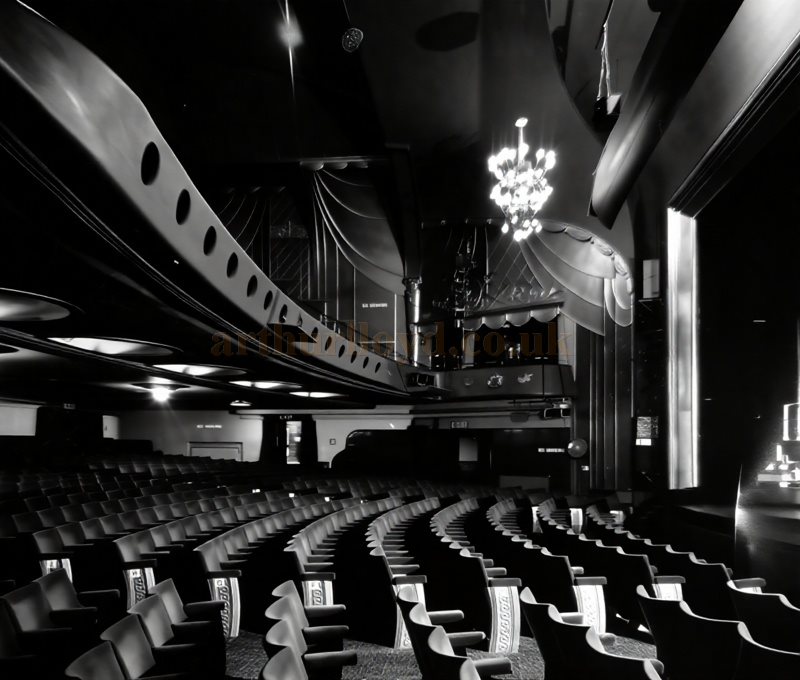
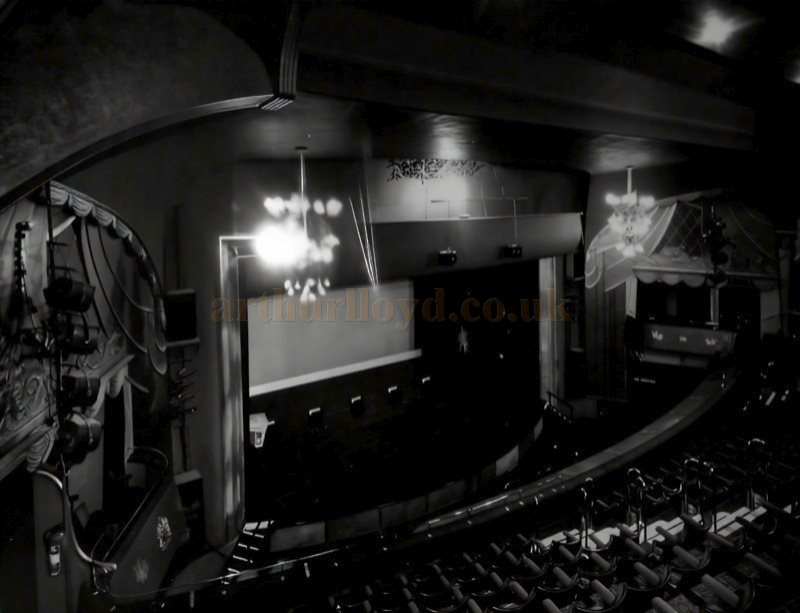
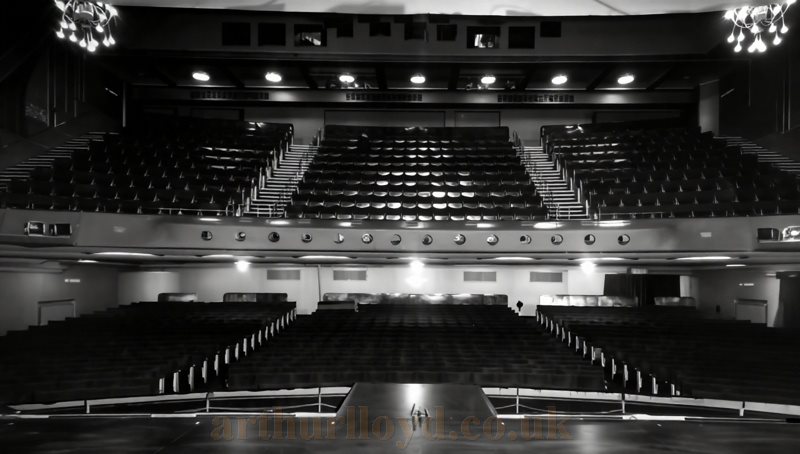
Above - The Auditorium of the Prince of Wales Theatre in the 1980s - From Photographs displayed in the Theatre's FOH areas whilst I was working there in 2010, the images have been enhanced to remove artefacts - M.L. 2010.
The 2003/05 Refurbishment of the Prince of Wales Theatre

Above - The exterior of the Prince of Wales Theatre, after its refurbishment in 2005 - Photo M.L.
In July of 2003 the Prince of Wales closed its doors for a while when it underwent major restoration by the Delfont Mackintosh Group who spent some £7.5 million refurbishing the Theatre and bringing it into the 21st Century with a much improved auditorium and far better front of house facilities.

Above - The 2005 refurbished auditorium of the Prince of Wales Theatre in a photograph by Alberto Arzoz - With kind permission (c) Delfont Mackintosh Theatres.

Above - The 2005 refurbished auditorium of the Prince of Wales Theatre in a photograph by Alberto Arzoz - With kind permission (c) Delfont Mackintosh Theatres.

Above - The 2005 refurbished auditorium of the Prince of Wales Theatre in a photograph by Alberto Arzoz - With kind permission (c) Delfont Mackintosh Theatres.
 The
Theatre was reopened by Prince Charles, the Prince of Wales, on the
10th of June 2004 who then attended a Gala performance of 'Mamma Mia!'
in aid of the Prince's Trust. This phenomenally successful show had
previously run at the Prince Edward
Theatre for five years before transferring to the newly renovated
Prince of Wales Theatre, and by the 1st of November 2008 had clocked
up 4,000 performances.
The
Theatre was reopened by Prince Charles, the Prince of Wales, on the
10th of June 2004 who then attended a Gala performance of 'Mamma Mia!'
in aid of the Prince's Trust. This phenomenally successful show had
previously run at the Prince Edward
Theatre for five years before transferring to the newly renovated
Prince of Wales Theatre, and by the 1st of November 2008 had clocked
up 4,000 performances.
 Right - Crowds throng Oxendon Street for the Red Carpet opening
of the acclaimed Broadway Musical 'The Book of Mormon' at the Prince
of Wales Theatre on the 21st of March 2013.
Right - Crowds throng Oxendon Street for the Red Carpet opening
of the acclaimed Broadway Musical 'The Book of Mormon' at the Prince
of Wales Theatre on the 21st of March 2013.
Left - A sculpture which takes pride of place in the foyer of the Prince of Wales Theatre - Caption reads: 'To Commemorate the re-opening of the Prince of Wales Theatre. This sculpture was unveiled on the 10th June 2004 by his Royal Highness the Prince of Wales' - Photo M.L. July 2009.
The show transferred to the Novello Theatre in September 2012 and continued to do exceptionally good business. The Prince of Wales Theatre went on to stage the Beatles Musical 'Let it Be' in 2012, and then in 2013 it became home to the acclaimed Broadway Musical 'The Book of Mormon' which opened on the 21st of March 2013.
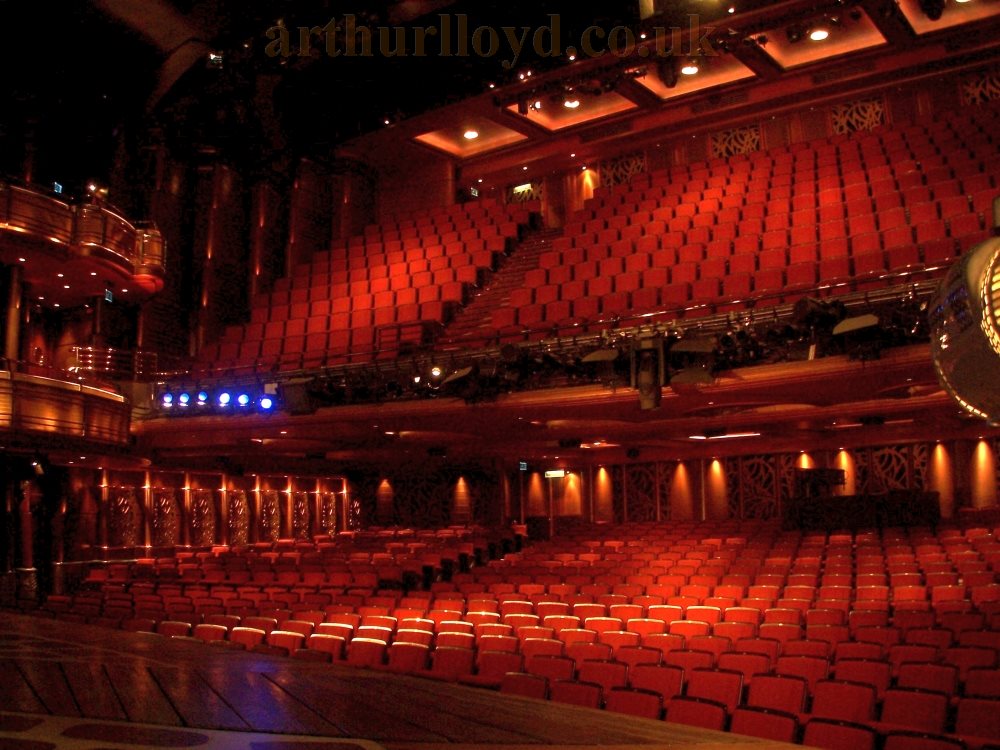
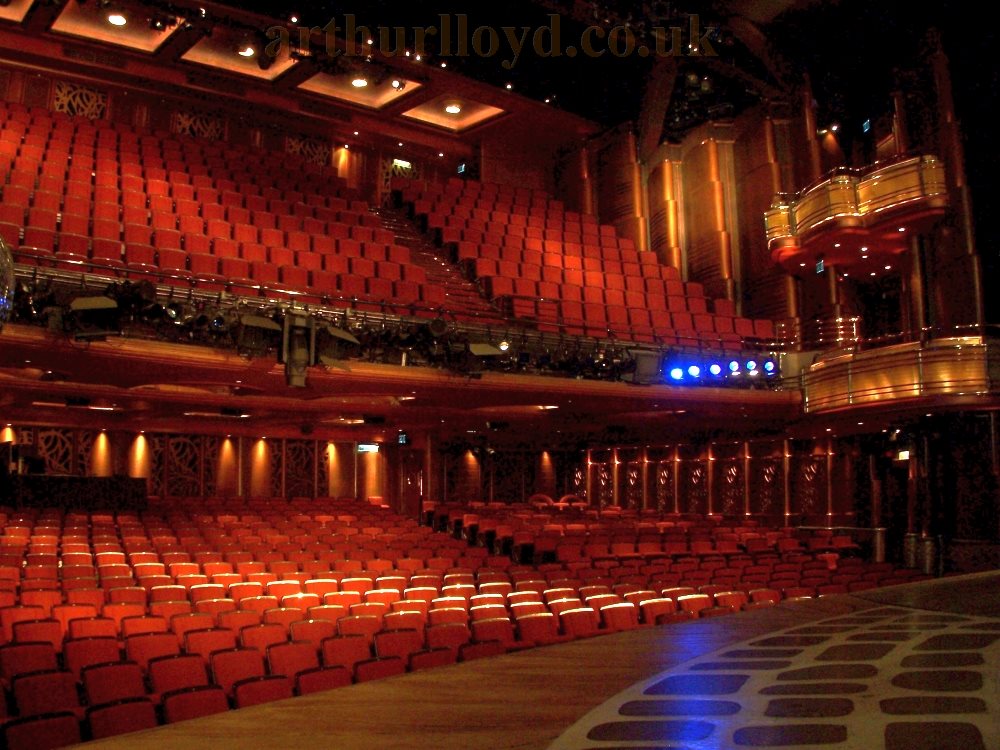
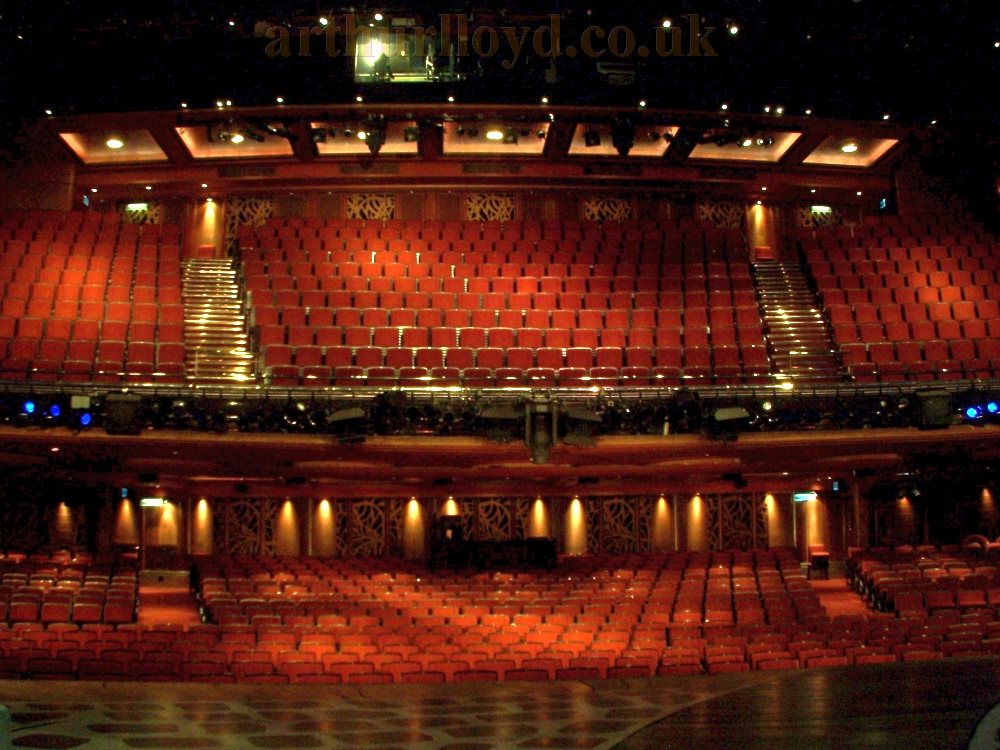
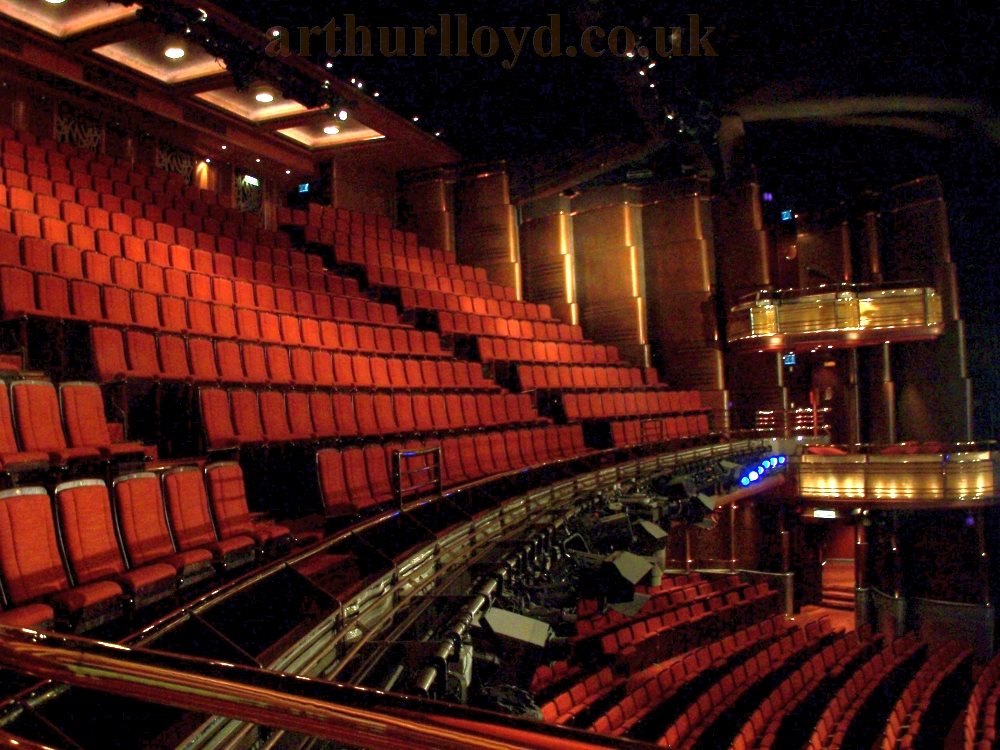

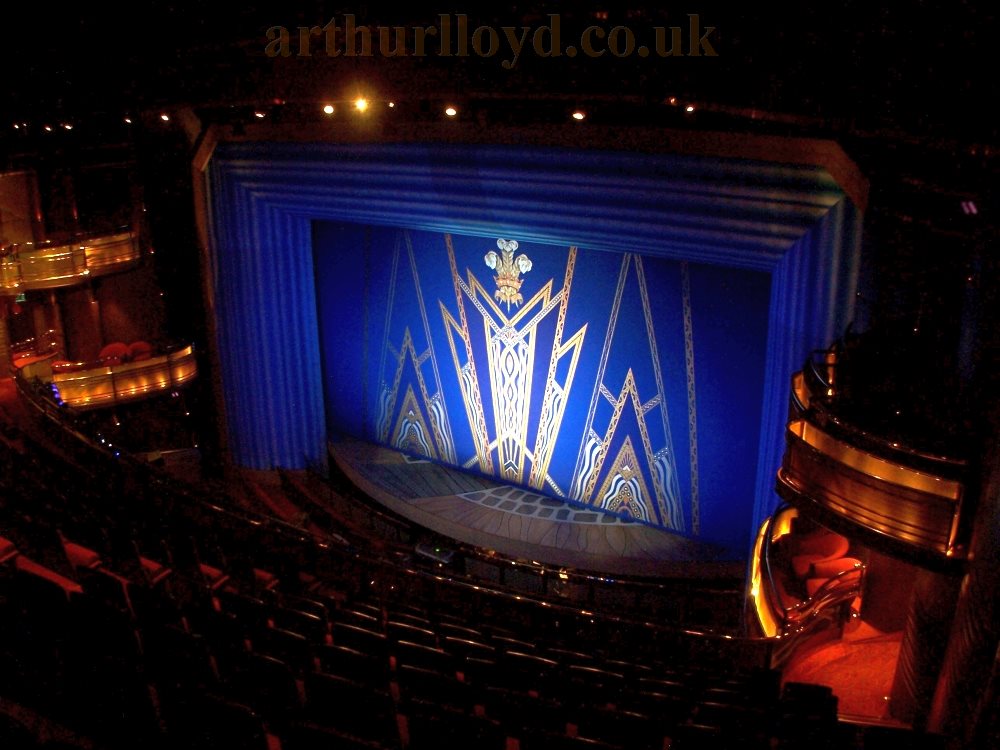


Above - The Auditorium of the Prince of Wales Theatre whilst I was working there in 2010 - Photos M.L.

Above - The Prince Of Wales Theatre during the phenomenally successful run of 'Mamma Mia.'

Above - An expectant audience queues for the Evening performance of Mama Mia at the Prince of Wales Theatre in November 2011. The side elevation of the building was altered in 2004 to include these new windows which reveal the Theatre's bar and bring to life what was previously a rather bland face to the public.

Above - The Prince Of Wales Theatre during production for 'Let It Be' in September 2012 - Photo M. L.
Today the Grade II Listed Prince of Wales Theatre has a capacity of 1,133 and is owned and managed by Delfont Mackintosh Theatres Limited, you may like to visit their own Website here.
Some of the archive newspaper reports on this page were collated and kindly sent in for inclusion by B.F.
Adelphi Aldwych Ambassadors Apollo Apollo Victoria Arts Cambridge Charing Cross Theatre Criterion Dominion Donmar Warehouse Drury Lane Duchess Tom Stoppard Theatre Fortune Garrick Gielgud Gillian Lynne Harold Pinter Haymarket His Majesty's Leicester Square Theatre London Coliseum London Palladium Lyceum Lyric Menier Chocolate Factory Noel Coward Novello Old Vic Palace Peacock Phoenix Piccadilly Playhouse Prince Edward Prince of Wales Royal Opera House Sadler's Wells Theatre Savoy Shaftesbury Sondheim St. Martin's Trafalgar Theatre Vaudeville Victoria Palace Wyndham's