
The London Pavilion, 1, Piccadilly Circus, Westminster
Formerly - The London Pavilion Music Hall, 4½, Tichbourne Street
Introduction - First Theatre - Second and Present Theatre - 1900 Remodelling - Cochran's Revues - 1934 Reconstruction - V. J. Day Photographs - The London Pavilion as a Cinema - 1981 Closure and 1986 Conversion to Rock Circus - Present Day - The London Pavilion from 'Fifty years of a Londoner's life' 1916

Above - The London Pavilion in January 2011, whilst being used as a Ripley's Believe it or not Museum - Photo M. L. 2011.

 This
prominent building, which has dominated the north side of Piccadilly Circus
since 1885, and which has been put to a number of different 'experience' type uses over recent decades, is in 2023, being converted for use as a tourist hostel. The building is actually however, the former London Pavilion Music Hall which was originally constructed by the Peto Brothers with
an interior designed by James Ebenezer Saunders and elevations by R.
J. Worley. The Theatre was at the time the most lavishly appointed variety hall yet seen in London. The London Pavilion opened on Monday
the 30th of November 1885 and was the first building erected at
the Piccadilly Circus end of the then newly created Shaftesbury Avenue,
and was for many years one of the most popular music
halls in London.
This
prominent building, which has dominated the north side of Piccadilly Circus
since 1885, and which has been put to a number of different 'experience' type uses over recent decades, is in 2023, being converted for use as a tourist hostel. The building is actually however, the former London Pavilion Music Hall which was originally constructed by the Peto Brothers with
an interior designed by James Ebenezer Saunders and elevations by R.
J. Worley. The Theatre was at the time the most lavishly appointed variety hall yet seen in London. The London Pavilion opened on Monday
the 30th of November 1885 and was the first building erected at
the Piccadilly Circus end of the then newly created Shaftesbury Avenue,
and was for many years one of the most popular music
halls in London.
 The
present London Pavilion was however,
the second music hall with this name to be built in the area. The first
building was in Tichbourne Street, part of which is now Windmill Street,
and was originally an entertainment room attached to the Black Horse
Inn. The Music Hall, which was designed by the architect Mr. Wood of
35, Foley-Street, and was constructed by roofing in an irregularly shaped
yard attached to the Inn, was built for Loibl and Sonnhammer and opened
in 1859.
The
present London Pavilion was however,
the second music hall with this name to be built in the area. The first
building was in Tichbourne Street, part of which is now Windmill Street,
and was originally an entertainment room attached to the Black Horse
Inn. The Music Hall, which was designed by the architect Mr. Wood of
35, Foley-Street, and was constructed by roofing in an irregularly shaped
yard attached to the Inn, was built for Loibl and Sonnhammer and opened
in 1859.
Right - The original London Pavilion Music Hall in 1880. - Click to enlarge.
This first London Pavilion was said to have been designed in the Swiss style, in reports in contemporary newspapers, and the scenery for the Hall was created by Mr. Wallace with the chandeliers being created by Defies & Son. There was no charge for entrance to the Hall.
The ERA carried a notice about the London Pavilion in their 23rd of October 1859 edition saying: 'This magnificent establishment, fitted up most luxuriously and elegantly is now open. When lit up the Pavilion is really gorgeous. The Cafe and Smoking Saloons are fitted up with regard to comfort, and well supplied with periodicals. The refreshments first-class. American and Dutch Bowls, Jardin d'Hiver, Music, Promendae, and Rifle Galleries. Sarkozy will preside over the Orchestra. The inimitable Sam Collins every night - Admission free.' - The ERA, 23rd October1859.
 The
Pavilion was an instant success and would be reconstructed several times
over the following years. In November 1860 the Hall was reopened after a short closure for reconstruction consisting
of 'enlarging and improving' the Music Hall. A notice in the ERA stated: 'If you wish to spend a pleasant evening come and try. Admission,
by refreshment-ticket, Sixpence. Six of the most splendid Bowling Alleys,
open daily at Twelve O'clock, pm.' - The ERA,
18th November 1860.
The
Pavilion was an instant success and would be reconstructed several times
over the following years. In November 1860 the Hall was reopened after a short closure for reconstruction consisting
of 'enlarging and improving' the Music Hall. A notice in the ERA stated: 'If you wish to spend a pleasant evening come and try. Admission,
by refreshment-ticket, Sixpence. Six of the most splendid Bowling Alleys,
open daily at Twelve O'clock, pm.' - The ERA,
18th November 1860.
Left - Just readable on the sign attached to the old London Pavilion and shown in the photograph above were Mr. G H Macdermott, Mr. James Fawn, Mr. Arthur Lloyd, Mr. Fred Albert, and Miss Bessie Bellwood.
 Indeed
the London Pavilion was so popular that in 1862 a gallery was added to the north and east sides of the building, and
then further 'improvements' were carried out in 1876.
Indeed
the London Pavilion was so popular that in 1862 a gallery was added to the north and east sides of the building, and
then further 'improvements' were carried out in 1876.
Right - The auditorium of the first London Pavilion Music Hall after it had been enlarged several times and galleries had been added in 1862.
A notice in the Era on the 17th of July 1870 read: 'The London Pavilion. Unequaled for its Amusements and universally patronised as a favourite Lounge. First-rate Talent continues to grace the Programme, which embraces a fund of popular Entertainment. The risible faculties are kept in perpetual motion by Arthur Lloyd, J. H. Stead (“the Cure”) and Harry Liston; whilst the more serious disposed have ample to admire in the effective singing of Miss Ada Herminie and Miss Barrie. In Serio-Comic, Miss Kate Bella continues to shine; as a Necromancer Professor Beaumont still astonishes and as the Great Lady Tenor Miss Florence Wreghitt is incomparable. The Sisters Lotto and Jessie, the Sisters Lindon (Comic Duettists), James Doughty and his Performing Dogs and Messrs. Lawson and Garte (the amusing “blacks”), are also added to the numerous attractions.' - The Era – 17th July 1870.
In 1878 Loible announced that there would be further enhancements to the London Pavilion and he created a competition for architects to design plans for the enlargement of the Theatre. The winner was announced at a dinner on the 30th of May 1878 and the successful architect was J. T. Robinson. However, progress was halted by land transactions for the creation of a major new road which was to be constructed nearby called Shaftesbury Avenue. Consequently the site of the London Pavilion, then under the ownership of R. E. Villiers, was acquired by the Metropolitan Board of Works and the Music Hall closed on March the 25th 1885 and was then demolished.
 However, the London Pavilion had been so successful in its earlier form
that it would soon be rebuilt into a magnificent Theatre and it is said
that it was Arthur Lloyd's success
in the old Hall that made the building of the new one possible, partly
because he became such a regular and ever popular fixture there over
the years, and partly, because of his great success there.
However, the London Pavilion had been so successful in its earlier form
that it would soon be rebuilt into a magnificent Theatre and it is said
that it was Arthur Lloyd's success
in the old Hall that made the building of the new one possible, partly
because he became such a regular and ever popular fixture there over
the years, and partly, because of his great success there.
As mentioned above, the old system of free entry was gradually transformed into a pricing structure based on ticket sales as a means of entry to the Hall. Something which would soon catch on all over London and the Provinces.
Left - An image of Tichbourne Street around 1802 showing (near right) Week's Museum, the building which would later become part of the first London Pavilion, and the building which preceded the Black Horse Inn which had not yet been built at this time.
 In an interview with Arthur
Lloyd by The ERA in July 1890 Arthur says that: "he remembers when admission to the Pavilion
was free, and the management recouped themselves by charging sixpence
for every glass of liquor sold.
In an interview with Arthur
Lloyd by The ERA in July 1890 Arthur says that: "he remembers when admission to the Pavilion
was free, and the management recouped themselves by charging sixpence
for every glass of liquor sold.
Right - A programme for the London Pavilion with Arthur Lloyd on the Bill in February 1st 1892. Click to see the entire programme.
At that time it was not always crowded, but gradually the attendance got larger, then sixpence and a shilling were imposed as the prices. In the process of years two rows of the pit were set apart as stalls, and two shillings charged, and so, little by little, the present elaborate and costly palaces of amusement were formed."
Speaking
of the London Pavilion to the ERA on another occasion Arthur said: "Here I was
an enormous favourite; and I am sure Mr Loibl would be the first to
acknowledge that my popularity contributed very largely to the prosperity
of the place, though I got nothing like the salary that a star of equal
magnitude can command today. Then the best seats in the place could
be had for sixpence.
Left - Click to see a Special Feature on this London Pavilion Programme for July 1892.
I constantly tried to persuade Loibl to increase the price, and he did so tentatively, till at length the whole floor, with the exception of a promenade, consisted of half-crown seats. The climax was reached when at great outlay Mr Loibl bought Kahn’s museum and was able to utilise it’s site for structural improvement of the Pavilion." - Arthur Lloyd, July 1890.
The Second and Present London Pavilion

Above - An early postcard of the London Pavilion, Piccadilly Circus, London.
 The
construction of Shaftesbury Avenue in 1885 and the reconstruction of the streets which faced it, Piccadilly, Regent
Street, and the Haymarket, resulted in the creation of Piccadilly Circus
much as we see today, and a new building on a grand scale was constructed
as its centerpiece, the new London Pavilion.
The
construction of Shaftesbury Avenue in 1885 and the reconstruction of the streets which faced it, Piccadilly, Regent
Street, and the Haymarket, resulted in the creation of Piccadilly Circus
much as we see today, and a new building on a grand scale was constructed
as its centerpiece, the new London Pavilion.
Right - A Silk programme featuring Arthur Lloyd at the London Pavilion on Monday the 15th of February 1886, just a few months after the Theatre opened - Click to enlarge.
The new London Pavilion opened on Monday the 30th of November 1885 with a Music Hall Bill, preceded by a performance of 'God Save the Queen' followed by 'God Bess the Prince of Wales' which was sung by the Pavilion Choir and Miss Constance Loseby singing the solo verses. Arthur Lloyd, who had been such a regular at the old Hall, was here for the opening of the new one too, accompanied by many of the leading players of the day.
The Builder reported on the new London Pavilion, along with a sketch and plans of the Theatre, in their December 26th 1885 edition saying:- 'The new buildings of the " London Pavilion " Music-hall and Restaurant have been erected on the commanding site in Tichborne-street, Haymarket, formed by the construction of the new street from Regent-circus to Holborn. This site, which has frontages in Piccadilly, Great Windmill-street, and the new street of about 135 ft., 165 ft., and 155 ft. respectively, has been greatly improved by the demolition of the block of buildings at the east corner of Regent-circus, thus giving an uninterrupted view down Piccadilly and Regent-street...

Above - A Sketch showing the new London Pavilion in 1885 - From The Builder, December 26th 1885.
...The elevations up to the capping of the plinth and also the columns have been executed in Portland stone, the upper portions of the elevations in Bath stone (Westwood Ground). The carving has been done by Mr. A. Lonnie, of Portland-place North, Clapham-road, who is also executing the carving to the woodwork in the Restaurant. The iron grilles have been executed by Messrs. Brawu & Co., of Clement- street, Birmingham. The Restaurant, which is situated at the corner of Piccadilly and the new street, will consist of a buffet on the ground-floor, a public dining-room on the first floor, private dining-rooms on the second floor, and kitchens, &c., on the third floor. The buffet is 17 ft. high and the dining-room 22 ft. 6 in. The latter will have a gallery running round two sides. The upper portions of these rooms, including the ceilings and also the upper portions of the staircase, will be finished in canvas plastering by the Frame-makers' Association, of Red Lion - square, Holborn. The buffet and dining-room are to be panelled in walnut. The walls of staircase are finished with marble and tiles. The marble-work was executed by Messrs. Houghton, of Great Portland-street; and the wall tiling by Messrs. Doulton & Co., of Lambeth. Messrs. Ebner have the mosaic paving and parquet flooring to the buffet and dining-room, &c., in hand. Messrs. Goddard & Co., of High-street, Peckham, are fitting up the building with lifts. The whole of the public portion of the Restaurant and the Music-hall has been fitted up with electric light on the incandescent principle by Mr. Cannon, of London-road. The elevations of the entire block and interior of the Restaurant are from the designs of Mr. Robert J. Worley, of Cannon-street, Mr. Ebenezer Saunders, of Finsbury-circus, being the architect for the interior of the music-hall...

Above - Plans of the new London Pavilion Music Hall and Restaurant in 1885 - From The Builder, December 26th 1885.
...Great credit is due to Messrs. Peto, the contractors for the buildings, for the rapidity with which they have carried out their contract, which was signed on March 2nd, 1885. The last performance in the old hall took place on the evening of March 26th last, and Messrs. Peto then obtained entire possession of the site (which was covered with buildings) on April 5th, the first brick being laid on May 11th and the first stone on May 18th. The work has proceeded continuously both night and day with the exception of Sundays. The Pavilion was completed for the inspection of the Magistrates on September 25th. It may be interesting to know that the following materials were used in the construction:— About one million and a half bricks, which were laid at the rate of about 40,000 a day; 5,500 ft. cube of Portland stone and 35,000 ft. cube of Bath stone; 60 tons of lead, 90,000 ft. cube of timber, and 1,600 square yards of the Doulton-Peto fireclay flooring (of which we gave a section showing the construction in our last number, p. 877). The use of this latter enabled the contractors to strike the centreing directly the flooring was fixed, and to proceed with the plastering at once; 350 men were employed on the building during the day and 150 at night. The building was completed in four months and seven days after the first stone was laid.'
The above text in quotes was first published in the Builder, December 26th 1885.
The Entr'acte printed a review of the opening night production at the new London Pavilion in their 5th of December 1885 edition saying: 'After Miss Loseby had retired from the stage, there began what we may describe as the entertainment of the music-hall proper. Messrs. De Voy, Leclercq and Co. tendered one of their farcical sketches, and were followed by Miss Amy Verte, a lady who contributed a series of characteristic dances in the costumes which she adopted with much celerity.
 The
Sisters Watson sang duets, and repeated their mimicry of that inane
specimen of humanity called the "masher;" while Miss Rosee
Heath sang tunefully, and danced neatly and cleverly. Mr. Harry Randall
was the first comique to assert himself, and it may be said that he
did this in a manner which testified to the song influence he exercises
over a miscellaneous audience. His songs were vociferously applauded.
The
Sisters Watson sang duets, and repeated their mimicry of that inane
specimen of humanity called the "masher;" while Miss Rosee
Heath sang tunefully, and danced neatly and cleverly. Mr. Harry Randall
was the first comique to assert himself, and it may be said that he
did this in a manner which testified to the song influence he exercises
over a miscellaneous audience. His songs were vociferously applauded.
Left - The London Pavilion in January 2011, whilst in use as a Ripley's Believe it or not Museum - Photo M. L. 2011.
Next to Mr. Randall came Miss Alice Brookes, a tuneful singer and an admirably neat dancer; while to her succeeded Mr. Pat Feeney, an excellent Irish comedian, the whole of whose expressed sentiments were not, however, entirely in favour on Monday.
Mr. Fred Albert followed on with his usual topical staple, and was succeeded by the Pavilion Choir, who sang "Faerie Voices" under circumstances which could scarcely be called cheering. Then Madame Garetta tendered her pretty entertainment with her army of handsome pigeons. Mr. Chirgwin with his budget of eccentricities created plenty of merriment by his humorous references and his manifestations of light comedy, and Mr. Arthur Lloyd prospered well until his political references caused just a little fermentation...

Above - An expectant audience waiting to enter the London pavilion in the early 1900s - From 'Living London' Volume II Section II by George R. Sims.
 ...Mr.
G.H. Macdermott was so out of voice as to be unable to sing; but to
show there was nothing like an intended breach of faith, the popular
comedian was brought to the footlights by Mr. Villiers just to speak
an excuse, and thus show the honourableness of his intentions. Mrs.
Lennard Charles sang with excellent spirit and with success, and the
Pinauds gave one of the very best grotesque "shows" that has
ever been tendered on any stage, which Mr. G.W. Hunter exhibited all
that dryness which has brought him such a fund of popularity.
...Mr.
G.H. Macdermott was so out of voice as to be unable to sing; but to
show there was nothing like an intended breach of faith, the popular
comedian was brought to the footlights by Mr. Villiers just to speak
an excuse, and thus show the honourableness of his intentions. Mrs.
Lennard Charles sang with excellent spirit and with success, and the
Pinauds gave one of the very best grotesque "shows" that has
ever been tendered on any stage, which Mr. G.W. Hunter exhibited all
that dryness which has brought him such a fund of popularity.
Right - The London Pavilion still sporting its original name if you look hard enough, in January 2011 - Photo M. L. 2011.
Miss Nellie Richards negotiated a new lease of favour by her tuneful contributions, and Mr. Charles Godfrey again afforded proof of his power to do justice to that material where manifestations of dramatic force are vitally necessary. Miss Nelly Farrell in genuinely Irish song once more asserted her supremacy, while the last feature of the programme was supplied by the Frediani Troupe, who gave an acrobatic display. During the evening Mr. Villiers, in a few happy phrases, addressed the audience.'
The above text in quotes was first published in the Entr'acte, 5 December 1885.

Above - The London Pavilion and Piccadilly Circus - From 'The Survey of London - London North of the Thames', by Sir Walter Besant, published in 1911.
 A couple of weeks before the new London Pavilion opened the ERA visited the building and printed a report on its construction in their
21st of November edition saying: 'One of the most remarkable features
in connection with the recent improvements in the neighbourhood of Piccadilly-circus
has been the rate of pulling down the old London Pavilion and putting
up a new one in its place. The old building was closed after the performance
on March 25th, and within a week from that date the ground was cleared.
The excavations for the foundations of the new buildings were commenced,
and by May 11th the first of the foundation bricks was laid. By May
18th the brickwork was level with the Street, and the first of the stones
was laid. The stones, from Westwood ground, near Box, a quarry of "Bath
Stone," were shaped before being taken to the building, and, as
the use of the electric light enabled continuous progress to be made,
the stonework of the building was finished by July 30th.
A couple of weeks before the new London Pavilion opened the ERA visited the building and printed a report on its construction in their
21st of November edition saying: 'One of the most remarkable features
in connection with the recent improvements in the neighbourhood of Piccadilly-circus
has been the rate of pulling down the old London Pavilion and putting
up a new one in its place. The old building was closed after the performance
on March 25th, and within a week from that date the ground was cleared.
The excavations for the foundations of the new buildings were commenced,
and by May 11th the first of the foundation bricks was laid. By May
18th the brickwork was level with the Street, and the first of the stones
was laid. The stones, from Westwood ground, near Box, a quarry of "Bath
Stone," were shaped before being taken to the building, and, as
the use of the electric light enabled continuous progress to be made,
the stonework of the building was finished by July 30th.
Right - Another silk programme for the London Pavilion, with Arthur Lloyd on the Bill, for the 6th of December 1886 - Courtesy Phill Winer.
The structure will always hold this place in the history of London building - that it is the first in which electric light has been employed for night work, and is, for its size, the most rapidly erected. The work certainly reflects great credit on the skill and energy of Messrs Peto Brothers, who were entrusted with the building. Those who, judging by the palatial block from without, expect to find the New London Pavilion double the size of the old one, will be not a little disappointed. The holding capacity of the auditorium is certainly larger, but it must still be called a small hall, and the idea of smallness will perhaps be enhanced by the presence of no fewer than fourteen private boxes. The splendid height of the interior, though, will come as a welcome surprise to every visitor, whose surprise will give place to delight when it is discovered that there is a sliding roof, and that the ceiling decorations, as well as the allegorical paintings over the proscenium, are of the most artistic character, being from the brush of Signor Codina...

Above - A sketch of the auditorium of the 1885 London Pavilion which shows the ornate work of the Plastic Decoration Company. The Theatre was constructed by the Peto Brothers with an interior designed by James Ebenezer Saunders and elevations by R. J. Worley, at the time it was the most lavishly appointed variety hall yet seen in London.
 ...The
whole of the work of decoration has been designed and carried out by
Mr E. W. Bradwell, whose son, by-the-way, has contributed some very
pretty and effective floral paintings to walls and mirrors. The general
scheme of decoration is in cream and gold, and in the private-box lounge
the eye will be pleased with the rich renaissance patterns in crimson
and gold that cover the doors and the walls; and that, with the handsome
mirrors, give the whole place an appearance of elegance and comfort
in pleasant combination.
...The
whole of the work of decoration has been designed and carried out by
Mr E. W. Bradwell, whose son, by-the-way, has contributed some very
pretty and effective floral paintings to walls and mirrors. The general
scheme of decoration is in cream and gold, and in the private-box lounge
the eye will be pleased with the rich renaissance patterns in crimson
and gold that cover the doors and the walls; and that, with the handsome
mirrors, give the whole place an appearance of elegance and comfort
in pleasant combination.
Right - An undated postcard of the London Pavilion in its early years.
The first balcony, with private boxes like the commodious one above it, is supported on handsome pillars, and it is noticeable that all the staircases are fitted with handrails as an additional means of safety when the building is crowded. All the floors are fitted with elegantly appointed lavatories, and as an instance of the liberality with which Mr Villiers has gone to work we may mention that that for ladies on the grand tier is approached by marble steps...

Above - A Painting by George Richmond depicting the Peto Brothers Auditorium of the London Pavilion in 1885. The painting was inspired by the engraving shown higher up on this page, and the colours were gleaned from the contemporary articles also shown on this page - Click for an Index to all of George Richmond's Paintings on this site.
...The stage is of good proportions, and is fitted with all the latest appliances. There are commodious dressing-rooms for the artists who may be engaged, and we observe that the height of the building will admit of the lifting of scenery without rolling. The electric light, as well as gas, will be used for the illumination of the building, and we may repeat that for those who may be privileged to attend on the opening night a surprise is in store. The event is fixed for Monday, the 30th inst., and so great is the demand for seats already that we learn on good authority that as much as £20 has been offered for a private box. Through the courtesy of Mr Villiers, who, by-the-way, will retain the services of the indefatigable Mr Sam Adams for the position of manager, we are able to give some idea of the inaugural proceedings. The National Anthem will be sung ay the whole company and full chorus, who will follow with "God Bless the Prince of 'Wales," the solo verses being taken by Miss Constance Loseby, who subsequently will have the honour of singing the first song on the stage of the new establishment. Then the strong company engaged will proceed with their turns, and that a liberal programme will be supplied the following names will show. They are Charles Godfrey, G. W. Hunter, Arthur Lloyd, Pat Feeney, Fred Albert, Chirgwin, G. H. Macdermott, De Voy and Leclercq, Harry Randall, the Pinauds, in a new entertainment exclusively prepared for this hall, Mrs Lennard Charles, Miss Jessie Mayland, Miss Amy Verte, Miss Alice Brooks, Miss Rosee Heath, the Sisters Watson, Miss Nellie Richards, Miss Nellie Farrell, Madame Garetta, and the Frediani Troupe. The Pavilion choir will supplement the list, and by permission will sing the popular "Fairie Voices."'
The above text in quotes was first published in the ERA, 21st November 1885.


Above - From Left to Right - London Pavilion programmes for 1892 1892 1894 1898 1900 1902 1908 1913 - Click for details.

Above - The London Pavilion in January 2011, whilst being used as a Ripley's Believe it or not Museum - Photo M. L. 2011.
As mentioned above, the new London Pavilion opened on Monday the 30th of November 1885 with Arthur Lloyd on the Bill along with a host of other celebrated Music Hall artists. Arthur Lloyd would go on to perform at the Pavilion for many years. The month after the Theatre opened the Observer reported on his Boxing Night performance there in their December the 27th 1885 edition saying:- 'This Reconstructed and favourite place of entertainment at the West End was last night crammed to its upmost capacity, and many who sought admission could not be accommodated even with standing room. The Entertainments were of a varied and especially attractive character for Boxing Night, some of the best known music hall artistes having been engaged for the season. Mr. A. Lloyd and Miss Katty King - the former in his topical song and the latter in her dancing - were well appreciated, as were also Pat Casham's Irish songs and dancing, and the acrobatic performances of the Wurteinburg troup. - The Observer, December 27th 1885.
In May 1894 a Programme consisting of many different well known Music Hall Stars of the day was produced at the London Pavilion, including songs and sketches by Albert Chevalier, Gus Elen, Eugene Stratton, R. G. Knowles, James Fawn, Herbert Campbell, Dan Leno, Harry Randall, the Brothers Griffiths, J. W. Rowley, Miss Duggan, Miss Harriet Vernon and Mdile. Marguerito. The 'piece de resistance', as the Echo (London) of Saturday the 19th of May 1894 called it, was a military sketch called 'Balaclava' with Charles Godfrey in the Lead, an image of which can be seen below.
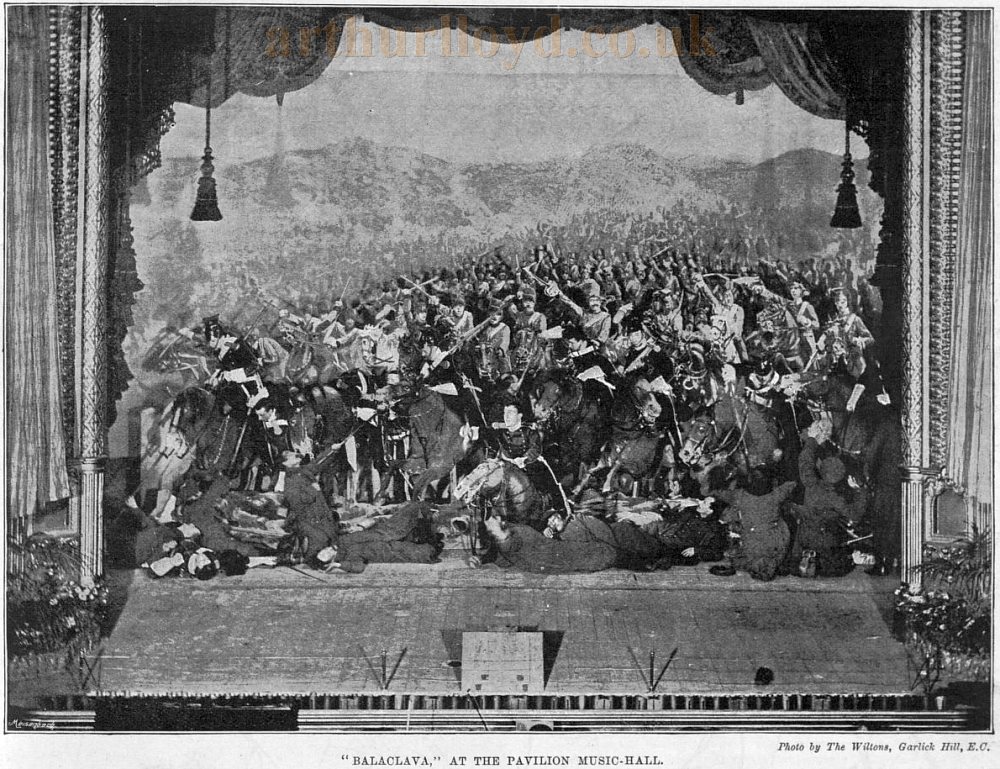
Above - A Scene from 'Balaclava' which was performed at the London Pavilion in May 1894 - From The Sketch 23rd of May 1894.
1900 Remodelling of the Theatre

Above - Piccadilly Circus showing the London Pavilion and Criterion Theatre in 1907 - From the 'Premier Photographic View Album of London' 1907.
 The
London Pavilion was closed after the last performance on Saturday the 2nd of June 1900 for the remodelling of its auditorium and Front of House areas which was projected to be completed in five months with a reopening in October 1900.
The
London Pavilion was closed after the last performance on Saturday the 2nd of June 1900 for the remodelling of its auditorium and Front of House areas which was projected to be completed in five months with a reopening in October 1900.
Right - An Advertisement for the London Pavilion carrying a notice about its closure for rebuilding - From the Daily Telegraph & Courier (London), Saturday the 2nd of June 1900.
The alterations were carried out to the designs of Wylson & Long, and included the widening of the proscenium, lowering of the stage, and altering the Theatre's seating to account for the new site lines. The Theatre was also redecorated in white or cream and gold, while the upholstery and silk panellings on the walls, which were executed by Shoolbred & Co., and Mr. Lyon, of Holborn, were of a warm terra-cotta hue.
 The Architectural Review reported on the changes in a late 1900 edition, along with the three images shown here, saying:- 'The Pavilion has in its time seen many changes, each to a state more luxurious than the previous one, since the time when it was started as a specimen of cafe chantant in 1859 by Messrs. Loibl & Sonnhamer. It is a far cry from the old hall covering a part of the yard of the Black Horse, where the Pavilion originated, to the present gorgeously decorated building; but it is only a matter of just over forty years, which fact tends to show how the public taste and demand for comfort and luxury has advanced.
Left - The Second Circle Buffet at the London Pavilion in 1900 - From a late 1900 edition of the Architectural Review.
The first Pavilion stood on practically the same site as the present one before the scheme of improvement, including the formation of Shaftesbury Avenue, passed the Metropolitan Board of Works and necessitated its destruction. The building erected after that by Messrs. Worley & Saunders was the existing one, or rather the shell of it, as the whole place has been gutted, reconstructed, and decorated internally by Messrs. Wylson & Long during the last six months.
The hall is now brought up to date and on a level footing with its many rivals, which have increased so enormously in number since fifteen years ago, when the Alhambra was the only local counter-attraction. The stage has been dropped some four feet, and the proscenium opening widened, while the old level floor has now a good slope, and the bars on either side of the stage are done away with; a novel feature of the new scheme being the removal of these two bars to a saloon constructed under the orchestra, approached from either side under the stage boxes. It is a good-sized room, ventilated directly from the street outside, and decorated in a similar manner to the rest of the house in cream and gold, with crushed strawberry-coloured silk panels.

Above - The Stalls Saloon of the London Pavilion in 1900 - From a late 1900 edition of the Architectural Review.
 The first circle and the upper circle have been entirely remodelled, the old columns having been done away with, and their places taken by four stanchions which support the entire structure.
These circles are supported on cantilevers, and are now of a horseshoe shape in plan, a great improvement on the old one, shaped like a long U with a long row of boxes on either side, which have been done away with, their places being taken by a stage box and three at the first circle level.
Right - The Auditorium and Stage of the London Pavilion in 1900 - From a late 1900 edition of the Architectural Review.
The way in which those nearest the stage have been treated is very successful, being connected to the proscenium by the entablature being carried round and returned above a Corinthian column on the outer side of the first box.
The two other boxes are treated with small columns with car-touches and brackets above.
The doors to the boxes are sliding, saving thus a deal of valuable space.
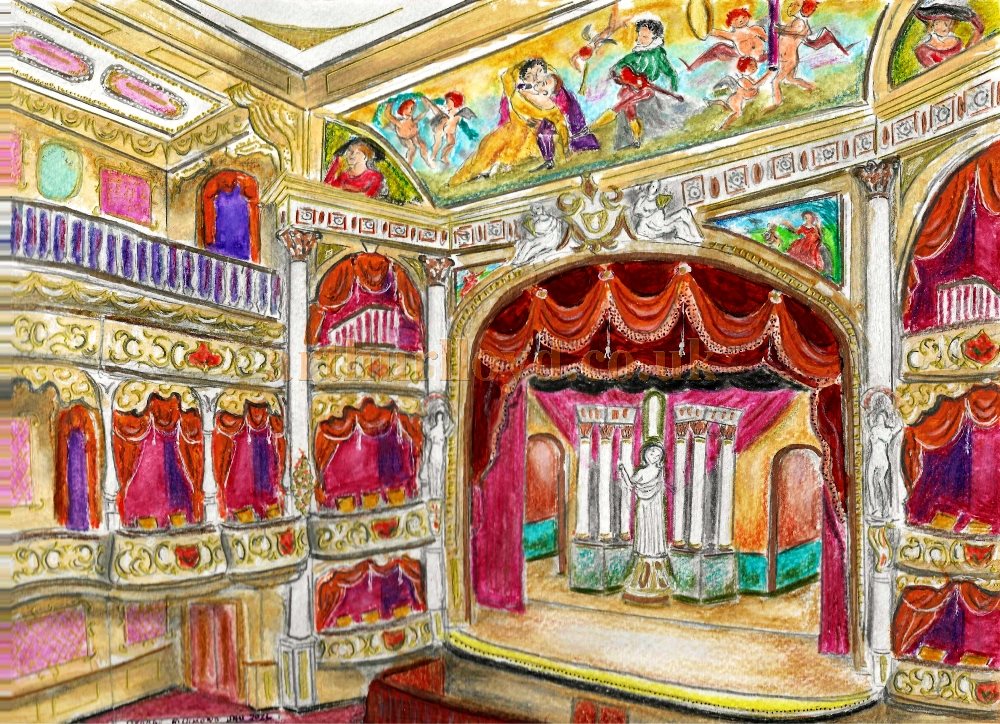
Above - A Painting by George Richmond depicting the remodelled auditorium and stage of the London Pavilion in 1900. George says that the painting is based on the photograph shown above and that the colours used are from a combination of press reports on the Theatre of the time. He has also added the fresco over the proscenium which depicts the phrase 'If Music be the food of love, play on' with the cherubs on the right carrying 'The Staff of Life' and the ones on the left 'The Garland of Celebration'. The little one in the middle blowing the horn is there because he needed something to fill in the gap as the original photograph just showed a mass of black and was illegible. It is actually based on a 16th century painting so George cannot claim any credit for the idea, he just needed something to fill the gap - Click for an Index to all of George Richmond's Paintings on this site.
The groups of sculpture on either side of the proscenium are pretty, but there does not seem to be any excuse for their existence. The fronts to the balconies are decorated with painted panels with rococo scrollwork ornament in between. The old sliding roof remains, though entirely redecorated in blue, cream, and gold, with painted panels in the cove of allegorical subjects. The whole of the decorations are carried out in Louis XV. style in cream and gold, and is very effective, giving a good relief to the painted panels. The panelling in the upper parts of the house between the Corinthian pilasters looks very well, as do also some of the less pretentious parts of the house where treated only in white.'
The above text in quotes was first published in a late 1900 edition of the Architectural Review.

Above - Piccadilly Circus showing the London Pavilion and Criterion Theatre - From 'London Described By Great Writers' by Esther Singleton, 1907.
 The refurbishment of the Theatre took a little longer than expected but it reopened on the 12th of November 1900 with an all star variety performance featuring Dan Leno, Eugene Stratton, Harry Randel, George Robey and many others.
Right - An Advertisement for the Reopening of the London Pavilion in November 1900 - From the Morning Post, 12 of November 1900.
The London Pavilion continued to be used for music hall and variety for many years but by 1912 it had started to become home to a string of musicals too, starting with 'Oh! Molly' on September the 2nd that year. This was followed by 'The Ha'rum Lily on December 9th. 1913 saw 'The Passing Show opening on August 4th then 'Alice-Up-to-Date' on December 29th. In 1914 'A Lucky Miss' was produced, opening on the 13th of July, and the following year, 1915, saw 'Honi Soit' opening on September the 6th. 'Pick-a-Dilly' opened on the 18th of April 1916 and then 'Cheerio!' on February 21st 1916 and 'Any Old Thing' on December the 8th the same year.

Above - A Sketch of the Auditorium of the London Pavilion when it Reopened in November 1900 - From the Daily Express, Monday the 12th of November 1900.
Cochran's Revues

Above - A Postcard showing Piccadilly Circus and the London Pavilion, advertising 'Cochran's Revue'. There are several buses in the photo advertising 'Here Comes the Bride' at the Piccadilly Theatre, this opened on the 20th of February 1930 and ran for 175 performances so the photo would have been taken around that time.
 In 1918 C. B. Cochran took over
the building but the musicals continued unabated with 'As You Were'
opening on August the 3rd and 'Afgar' which opened on September the
17th 1919 and was the first
of the London Pavilion musicals to be recorded.
In 1918 C. B. Cochran took over
the building but the musicals continued unabated with 'As You Were'
opening on August the 3rd and 'Afgar' which opened on September the
17th 1919 and was the first
of the London Pavilion musicals to be recorded.
Right - Programme Covers for 'Fun of the Fayre', 'Phi-Phi', and 'Chochran's Revue of 1926' at the London Pavilion.
'Fun of the Fayre' opened on October the 17th 1921 and the second original cast recording of a musical at the Pavilion was produced to celebrate it. In 1922 'Phi-Phi opened on August the 16th and in 1923 'Dover Street to Dixie' opened on May the 31st. 1925 saw 'On With the Dance' opening on April the 30th, which was Noel Coward’s first important Revue show, originally titled 'Cochran's’ Revue' prior to its opening in London. Then in 1926 the first of Cochran's Revues by name opened at the London Pavilion on April the 29th, carrying the name 'Cochran's Revue of 1926'.

Above - An Article by C. B. Cochran on his Revues at the London Pavilion - From the Sunday Dispatch, 8th of April 1934.
 November
1926 saw the opening of 'Black Birds' at the Pavilion. This
was followed by the opening of 'One Dam Thing After Another' on May
the 20th 1927.
November
1926 saw the opening of 'Black Birds' at the Pavilion. This
was followed by the opening of 'One Dam Thing After Another' on May
the 20th 1927.
Right - A selection of programme Covers for the London Pavilion.
 On
March the 22nd 1928 'This Year of Grace' opened at the Pavilion and
was followed by 'Lucky Girl' in January 1929, and 'Wake up and Dream'
on march the 27th the same year. 1930
saw 'Cochran's Revue of 1930 open, followed by 'Cochran's Revue of
1931' the following year, see programme covers above.
On
March the 22nd 1928 'This Year of Grace' opened at the Pavilion and
was followed by 'Lucky Girl' in January 1929, and 'Wake up and Dream'
on march the 27th the same year. 1930
saw 'Cochran's Revue of 1930 open, followed by 'Cochran's Revue of
1931' the following year, see programme covers above.
Films were also being shown at the London Pavilion during this period, one of which can be seen in the advertisement for 'The Christian' shown right, a B&W silent film based on the novel by Hall Caine, which opened at the London Pavilion on the 16th of April 1923.
Right - An Advertisement for 'The Christian' which opened at the London Pavilion on the 16th of April 1923.
 Another advertisement for a film at the Pavilion during this period, for 'Hell's Angels' from 1930, can be seen below. The success of film showings at the Theatre, and indeed at Theatres all over the Country, would soon see the London Pavilion being reconstructed for full time Cinema use in 1934, see details below.
Left - The penultimate variety programme for the London Pavilion in its 1885 / 1900 form for March the 26th 1934 - Click to see more of the programme and press cuttings about the reconstruction in 1934.

Above - An Advertisement for Howard Hughes' Film 'Hell's Angels' showing on the 'New Giant Screen' of the London Pavilion in 1930 whilst the Theatre was still in Variety use - From the Weekly Kinema Guide of 1930.
Reconstruction of the London Pavilion in 1934

Above - The Vestibule of the London Pavilion after the 1934 Reconstruction - From The Builder, 14th of September 1934.
 In
1932 the Theatre was returned to Variety use,
often entitled 'Non Stop Variety' but the last of these variety shows ended on the evening of the 7th
of April 1934 when the building was closed for reconstruction.
The
works began shortly after the Theatre's closure in April 1934 and were
carried out by Frank Matcham
& Company to the designs of their architect F. G. M. Chancellor.
In
1932 the Theatre was returned to Variety use,
often entitled 'Non Stop Variety' but the last of these variety shows ended on the evening of the 7th
of April 1934 when the building was closed for reconstruction.
The
works began shortly after the Theatre's closure in April 1934 and were
carried out by Frank Matcham
& Company to the designs of their architect F. G. M. Chancellor.
Right - The Auditorium of the London Pavilion after the 1934 Reconstruction - From The Builder, 14th of September 1934.
The reconstruction cost £70,000 and was carried out by F. G. Minter Ltd and Trollope & Colls Ltd. Works included the removal of the boxes, enlargement of the proscenium, removal of all the original decorative plasterwork, and enlargement of the foyer.
The reconstruction took 21 weeks and the London Pavilion reopened with Douglas Fairbanks in the Film 'The Private Life of Don Juan' on the 5th of September the same year as a 1,200 seat Cinema with stage facilities.
The Builder reported on the changes in their 14th of September 1934 edition, along with some of the images shown here, saying:- 'The present front of the London Pavilion dates from 1885. The interior, which was rebuilt in 1900, remained unchanged until this year, and has now been completely reconstructed. The boxes and side promenades have been removed, and the two circles reconstructed on modern lines, giving more seating accommodation.
The proscenium has been widened from 23 ft. to 35 ft., during which operation the whole of the roof and stage wall had to be supported. Immediately over the proscenium has been formed an organ chamber capable of holding an organ of the largest type.

Above - An Illustrated Article on the 'Passing' of the London Pavilion in 1934 - From The Sphere, 14th of April 1934.
 The treatment of the auditorium has been carried out on simple lines, devoid of mouldings. The centre of the new ceiling is occupied by a large double-tiered dome, flanked on either side by long elliptical-shaped domes, within which is concealed in troughs the lighting of the interior of the building. The stalls area has been enlarged and the rake of the floor has been increased. The auditorium is decorated very simply, the walls being in beige, with various features picked out in green and walnut, to harmonise with the seats and carpet, which are in green and brown.
Right - A Sketch showing Workmen removing the seating at the London Pavilion in preparation for the Theatre's Reconstruction in 1934 - From the Daily Express, 9th of April 1934.
Extensive alterations have been carried out to the main entrance in Piccadilly, where a spacious vestibule has been formed. This, with its pay and advance pay boxes and approaches to waiting rooms, has been treated in a rich manner, the cornices and pilasters being in silver leaf, and the walls of green and silver texture, with a marble floor and skirting, the whole illuminated from the hidden troughs in the cornices.
The main exterior alteration is at this entrance. The piers have been removed and a range of glazed walnut doors have been inserted, surrounded by marble pilasters and framing, in which are decorated chromium and green poster frames and ventilation grilles. Surmounting the entrance is a new canopy, 50 ft. long by 12 ft. deep, of a modern type treated in green and silver cellulose, brilliantly illuminated. A new entry has been formed in Shaftesbury-avenue, with a canopy on similar lines.

Above - Plans for the Reconstruction of the London Pavilion in 1934 - From The Builder, 14th of September 1934.
 Messrs F. G. Minter, Ltd., were the main contractors, and the following firms were associated with the work: Smith Walker, all steelwork; Maple and Co., Ltd., fibrous plaster; Kingsmill Metal Co., metal work and canopies; Frank Burkitt, Ltd., fire-proof curtain; Concrete Ltd., concrete steppings; Art Pavements, Ltd., all marble work; F. Knight and Co., radiator grilles, poster frames, etc.; Campbell Bros., internal decoration and exterior painting; Geo. Wright, Ltd., spiral staircases, etc.; Davis, Bennett and Co., Ltd., sanitary fittings; F. G. Minter (Decorations), Ltd., decoration to main vestibule; Ragusa, asphalt; Clarke and Vigilant and Co., Ltd., sprinklers; Scaffolding (Great Britain), Ltd., scaffolding; Berkeley Electrical Engineering Co., Ltd., electric lighting; Jeffries and Co., heating and ventilating.
Right - A commemorative Stone at the London Pavilion originally laid in 1885 by Robert Edwin Villiers and then added to in 1933 by Trollope & Colls Limited for the reconstruction of the Theatre for Cinema use in 1934 - Photo M.L. August 2009.
The "Tubelight" architectural lighting in the entrance vestibule, lobbies, staircase, and in the chandelier fittings in the stalls and balcony bars was designed by Associated Architectural Industries. Messrs. Frank Matcham and Co. are the architects.'
The above text in quotes was first published in The Builder, 14th of September 1934.
The Commemorative Stone shown right was placed on the Western elevation towards the rear of the Theatre facing Shaftesbury Avenue and reads: 'This stone, the first in the new street was laid by Robert Edwin Villiers 8th June 1885 - Reconstructed by Trollope & Colls Limited 1933.' - Photo M.L. August 2009.

Above - The Circle of the London Pavilion on its reopening on the 5th of September 1934 - From ILN, 14th of September 1934.
The reconstruction of the London Pavilion had taken 21 weeks and the Theatre eventually reopened with the Douglas Fairbanks Film 'The Private Life of Don Juan' on the 5th of September 1934. The new London Pavilion was a 1,200 seat Cinema with stage facilities, although they were rarely used. After the Reconstruction, Films would go on to be the main attraction at the Theatre for many decades afterwards.
The London Pavilion was to become a very successful Cinema and was home to several box office smashes and major premiers including the Beatles 'Help' and 'A Hard Days Night' and several Bond Films, you can see some photographs of the Theatre during this period below.
V. J. Day Photographs outside the London Pavilion
On VJ Day, on the 15th of August 1945, thousands of people celebrated the end of the Second World War by crowding into the streets around Piccadilly Circus. The three photos below show the scenes of jubilation outside the London Pavilion, which was showing 'Blood on the Sun' at the time, recorded on camera by one chap from the US Army Air Corp as he was in the UK at the time, kindly sent in by his nephew Glen Jaross.


Above - Thousands of people celebrating outside the London Pavilion at the end of the Second World War on VJ Day, 15th of August 1945, recorded on camera by a chap from the US Army Air Corp kindly sent in by his nephew Glen Jaross.
Photographs of the London Pavilion as a Cinema

Above - The London Pavilion during the run of 'Dual Alibi' with Herbert Lom and Phyllis Dixey in 1947 - Courtesy Oliver Dixey

Above - The London Pavilion advertising 'Rock Around The Clock' with Bill Haley and his Comets and the Platters in a photograph taken on the 30th of July 1956 - Courtesy Allan Hailstone.

Above - The London Pavilion advertising 'This is Baby Doll' in a photograph taken on the 3rd of January 1957 - Courtesy Allan Hailstone.

Above - A wonderful Colour Photograph shot in Coventry Street in 1959 / 60 showing the corner of the London Pavilion during the run of the film 'Some Like It Hot' with Marilyn Monroe, Tony Curtis and Jack Lemmon. The film's London Premier was at the London Pavilion on the 14th of May 1959 - Photograph Courtesy Lyle K. Anibal whose father Lyle W. Anibal was in the U.S. Air Force at the time and took the photo whilst he was stationed in London.

Above - The Auditorium of the London Pavilion in 1971, long after its Reconstruction for Cinema use in 1934 - Courtesy Andrew Ward who says 'I was Assistant Manager there in 1971 and thought that the place was something like a castle, with passages, cellars and hidden rooms. There were organ chambers, although an organ had never been installed. I found the coupling bars from when 3D had been shown on interlocked projectors in the 1950s. One room contained a leather case wherein was a top hat. Down in the basement was accommodation for performing dogs. Back in 1965 the Richard Lester film 'Help', starring The Beatles, had its Royal Pemiere there, and the Manager's office became Princess Margaret's private toilet.'

Above - Lou Phillips, Chief Projectionist of the London Pavilion, shown here in 1971 with one of the Pavilion’s Westar Projectors - Courtesy Andrew Ward who says 'In common with other West End cinemas of the day, the Pavilion was equipped with three projectors to provide continuous running in the event of a breakdown or maintenance, the Pavilion’s three Westars were equipped with Westrex sound and BALCMA Autoarcs.'
1981 Closure and 1986 Conversion to Rock Circus
Sadly the Pavilion's Cinema success was not to last forever and on the 26th of April 1981 the London Pavilion closed as a Cinema for the last time and then remained dark for many years whilst all sorts of proposals for it future were proposed. Eventually in 1986 the Theatre was completely gutted for conversion into shops and tourist attractions including Madame Tussauds 'Rock Circus.'

Above - Demolition of the interior of the London Pavilion in 1986 - From 'The History of the London Pavilion' a book commissioned by Grosvenor Square Properties Group PLC to celebrate the opening of the refurbished building on the 22nd of July 1988.
 The
conversion in 1986 saw the interior of the London Pavilion completely
gutted but the exterior was restored to its former 1885 grandeur, and was seen for the first time for decades without the plethora
of neon signs which had previously adorned the building.
The
conversion in 1986 saw the interior of the London Pavilion completely
gutted but the exterior was restored to its former 1885 grandeur, and was seen for the first time for decades without the plethora
of neon signs which had previously adorned the building.
Right - The London Pavilion in November 2007, whilst branded as part of the London Trocadero - Photo M. L. 07.
Two stories were also added to the top of the building and the whole scheme was carried out to the designs of Chapman Taylor Architects. The London Pavilion reopened on the 22nd of July 1988.
In the 1990s an underground passage was created between the London Pavilion and the Trocadero and the whole complex was rebranded The Trocadero with various shops, cinemas, arcades, and restaurants such as the rainforest Cafe and Planet Hollywood utilising the space.
The Madame Tussauds 'Rock Circus' attraction at the London Pavilion closed in September 2001 and the building was later rebranded again when it became home to the London version of 'Ripley's Believe It or Not!' in August 2008. Ripley's closed down suddenly in September 2017 though and the building then remained empty and awaiting a new use until it was eventually converted for a reopening as Gunther von Hagen's Body World's Museum Experience in October 2018.
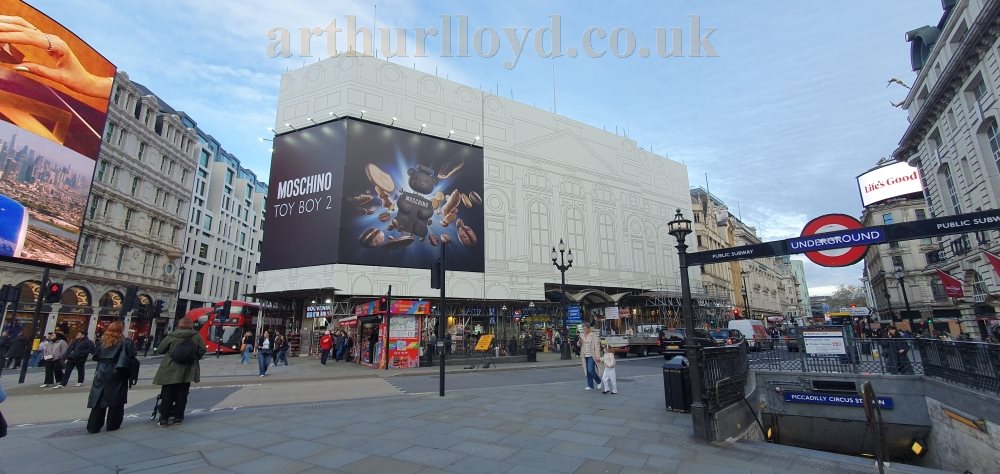
Above - The London Pavilion, once again shrouded in scaffolding and being redeveloped, this time in November 2025 for its conversion into an Hotel - Photo M.L.
In 2023 work began on gutting the building internally and converting it into a 964 bed Tourist Hostel, it seems that this once magnificent Theatre and Music Hall is now well and truly past its entertainment period. Thankfully the exterior of the building is Grade II Listed but its a great shame that the interior has been allowed to be so systematically destroyed over the years.

Above - The London Pavilion in January 2011, whilst in use as a Ripley's Believe it or not Museum - Photo M. L. 2011.

Above - The former London Pavilion here transformed into 'Body Worlds' in a photograph taken during the Coronavirus Pandemic in March 2020 - Photo M.L.
The London Pavilion - From 'Fifty years of a Londoner's life'
By Henry George Hibbert 1916

Above - A photograph of the London Pavilion in 1896

Above - The London Pavilion covered in advertising signs which is how it remained until the building's exterior was restored in 1986.
 There
is no more remarkable instance of the development of the music
hall than that furnished by the London Pavilion, though it has no
claim to antiquity, and though at this moment it seems to be backward
in the race. Half-a-century ago it was a typical "sing- song."
Many a still active noceur can remember when in return for a trifling
payment at the door he received a voucher entitling him to its full
equivalent in drink or tobacco to be consumed at scattered tables. Then,
the Pavilion became the first music hall de luxe at the West
End. It was floated as a limited liability company, and began an
epoch of frenzied finance, from the effects of which the variety
theatre as a commercial enterprise has hardly yet recovered. The
immense profits earned by the London Pavilion appealed to the imagination,
especially of the ultra respectable investor. Clergymen and district
visitors abounded among its shareholders.
There
is no more remarkable instance of the development of the music
hall than that furnished by the London Pavilion, though it has no
claim to antiquity, and though at this moment it seems to be backward
in the race. Half-a-century ago it was a typical "sing- song."
Many a still active noceur can remember when in return for a trifling
payment at the door he received a voucher entitling him to its full
equivalent in drink or tobacco to be consumed at scattered tables. Then,
the Pavilion became the first music hall de luxe at the West
End. It was floated as a limited liability company, and began an
epoch of frenzied finance, from the effects of which the variety
theatre as a commercial enterprise has hardly yet recovered. The
immense profits earned by the London Pavilion appealed to the imagination,
especially of the ultra respectable investor. Clergymen and district
visitors abounded among its shareholders.
Right - A Postcard of the London Pavilion in its early years.
Half the music halls in the city were seized upon by unscrupulous promoters, who filled their own pockets and, for the most part, left their dupes to face a scandalous liquidation. From such a debacle some of the finest properties of to-day were raised. But many music halls which in private hands had prospered fairly well were long hampered by overcapitalisation and discredited by the unimpressive, or worse, character of their directorates.
As for the Pavilion, it is built on the stable-yard of an inn, wherein some of the paraphernalia of the funeral of the Duke of Wellington was prepared. For a long time the adjoining Black Horse Inn enjoyed a right of light by way of a window, into the hall; and a solicitor was sent to negotiate, with plenary powers and a cheque-book, the troublesome aperture. He found a new landlord, who rudely interrupted his overtures with the remark: "If you've come to talk about that cursed window you can save your breath. I've had it bricked up this very morning! "
 The
gallery of the first hall had but two sides. The third was occupied
by a horrible collection of "scientific" specimens called
Dr Kahn's Museum, whose last owner was the father of a now distinguished
actor.
The
gallery of the first hall had but two sides. The third was occupied
by a horrible collection of "scientific" specimens called
Dr Kahn's Museum, whose last owner was the father of a now distinguished
actor.
Left - A Press Cutting for Arthur Lloyd at the London Pavilion on August the 30th 1902.
The first proprietors of the London Pavilion, Loibl and Sonnhammer by name, made much money out of Arthur Lloyd, among the first performers habitually styled "Great," who persuaded them to abolish the refreshment coupon, and to establish a scale of admission prices. It is a curious characteristic of the London Pavilion that it has always been dependent on a particular comic singer - in succession, Leybourne, Macdermott, Charles Coborn, Dan Leno.
Sonnhammer separated from Loibl, and established Scott's Restaurant. Loibl a while later made a monstrous deal with the old Metropolitan Board of Works, to whom he sold the property for £109,347. He set up his sons, Edward and Robert, in a well-known bric-a-brac shop in Wardour Street, and himself ran Long's Hotel. The Pavilion was leased to Edward Villiers, who had been a pompous and uninteresting comedian at the Haymarket, and one of many managers of the Canterbury Music Hall. First as lessee and manager of the Pavilion, then as the dominant director of its board, he proved a shrewd financier and an astute showman. In 1882 the Referee charged him with permitting "foul and festering stuff to be brazed forth in defiance of decency and decorum," and paid £300 for the privilege. Villiers lived to a great age; so did his colleague and survivor, Hugh Astley, a brother of jolly old sporting Sir John. Astley's attitude as chairman of a board meeting, when an expensive engagement was under consideration, was masterly, " It's a lot of money," he would say, nodding sagaciously. " It's a devilish lot of money. Of course if the fellow's a draw - there you are. But if he's not - where are you ? " a pronouncement which always left him free to comment on the event: " What did I always tell you? "
 For
years the Oxford Music Hall was
conducted on old-fashioned lines, without event, in the interests of
the heirs of one Syers. After some vicissitudes it was disposed of to
a limited liability company and linked up with the Pavilion and the Tivoli - the "Syndicate," as it was
simply known, having for its dominant spirit Henry Newson Smith, a city
accountant, who first saw the possibilities of the music
hall from the point of view of high finance; and who let its strenuous
life kill him just as he neared supremacy.
For
years the Oxford Music Hall was
conducted on old-fashioned lines, without event, in the interests of
the heirs of one Syers. After some vicissitudes it was disposed of to
a limited liability company and linked up with the Pavilion and the Tivoli - the "Syndicate," as it was
simply known, having for its dominant spirit Henry Newson Smith, a city
accountant, who first saw the possibilities of the music
hall from the point of view of high finance; and who let its strenuous
life kill him just as he neared supremacy.
Right - A postcard showing the London Pavilion in 1928.
Where once the Tivoli stood, at the corner of Adam Street and the Strand, is now an impleasant pit, its future all un-certain. During its brief life of twenty-five years no star arose at the Tivoli, no name is inseparably associated with it as that of Sam Cowell was with the Canterbury, that of Leyboume with the Royal, Holborn, that of Macdermott with the London Pavilion. Truly enough, most of the popular favourites of its generation appeared there. But its programmes were shaped in accordance with routine rather than distinguished by sensational discoveries. The nearest approach to one was the exploitation of Lottie Collins in her dance, "Ta-ra-ra-boom-de-ay," which had already been done elsewhere and which had had an unspeakable origin in America. Its English edition was deftly and discreetly made by Mr Richard Morton.
What may be said of the Tivoli was that it developed from the model of the London Pavilion, a type then new to the West End, and it retained to the last, in entertainment and in entourage, a certain characteristic of the music hall as distinguished from the variety theatre.
It was another outgrowth of an inn. Many a still young Londoner can recall the four streets - John, Robert, James and William Streets - built by the brothers Adam, who gave their Christian names to their handiwork, and after whom this particular district was called the "Adelphi," from the Greek word signifying brothers. The site was occupied by Durham House, a palace built by Anthony de Beck, Bishop of Durham in Edward L's reign. Here Henry VIII gave a great tournament on his marriage with Anne of Cleves. And here, after centuries, young London learned to drink lager beer in the so-called Tivoli Bier Garten, a saloon adorned by vast and daring pictures. The cellars ran towards those mysterious "Dark Arches" beloved of sensational writers about London life in Mid-Victorian days.
Should the Tivoli disappear (with that inestimable benefit of a liquor licence, for which the London Hippodrome and the London Coliseum so desperately strive), it will leave the Strand without a music hall; though there were predecessors. The Tivoli stood within a stone's throw of the Coal Hole and the Cider Cellars, from which Thackeray drew his Cave of Harmony and Back Kitchen - not exactly, it should be noted. They combined to form an impression. Farther east was the Dr Johnson, another prehistoric music hall. And there was actually the Strand Musick Hall, where the "Great" Alfred Vance, and "Jolly John" Nash alternated with the masque of Comus! The Strand is often cited as the forerunner of the Gaiety Theatre. The truth is, the Strand Musick Hall occupied a site which formed little more than the entrance hall of the first Gaiety. Here, maybe, Vance sang:
 "Slap,
bang, here we are again.
"Slap,
bang, here we are again.
Here we are again; here we are again,
Slap bang, here we are again -
Such jolly dogs are we!"
The Tivoli Music Hall, with an associated restaurant, opened, just short of twenty-five years ago, with great eclat. Edward Terry was the chairman and added to words of condescension toward the new art a pious hope that there was money in it. There was not. The Tivoli came to grief.
Left - A Postcard showing the Tivoli Theatre, Strand - Sent in 1908.
It was seized upon and reconstructed by Newson Smith, and it became, in his hands - the quotation is apt in that it fitted him too - the "fair embodiment of fat dividends." Its social side was important. It was the rendezvous of managers and artists from the world over. Once, it became the rendezvous of a particularly smart kind of "sportsmen," but that is another story and comes into the history of the great Goudie bank frauds, not of this occasion. The veteran Charles Morton was the figure-head of the new Tivoli - his half-way house between the Alhambra and the Palace. And the late George Adney Payne, ensuing to Newson Smith, was its dominant influence - a big, cavalry kind of man, to whom the greatest artist was "my lad," and who was probably the last music hall magnate whom a hundred-guinea serio respectfully but affectionately addressed as "Guv'nor." With Payne's death the genius of showmanship departed from the Tivoli. Its difficulties and dissensions became acute. It fell, languid and grateful, into the arms of the Strand Improvement Schemers.
The above text on the London Pavilion is from 'Fifty years of a Londoner's life' by Henry George Hibbert 1916.
Information for this page on the London Pavilion was obtained from many different sources including the Theatres Trust, the ERA archives, the Entr'acte, Mander & Mitchenson's 'Theatres of London', Brent Fernandez, Emmi Birch., John Culme's Footlight Notes, 'Fifty years of a Londoner's life' by Henry George Hibbert 1916, 'The History of the London Pavilion' commissioned by Grosvenor Square Properties Group PLC 1988, the Arthur Lloyd archive, and London Pavilion programmes. London Pavilion Musical details were kindly sent in by David Cunard.
If you have any more interesting images for the London Pavilion that you would be willing to share please Contact me.