
The National Theatre, South Bank, London
Introduction - The Olivier Theatre - The Lyttleton Theatre - The Dorfman / Cottesloe - The Shed / Temporary Theatre - Times Article on the proposed National Theatre in 1967 - Observer article on the proposed National Theatre 1967

Above - The National Theatre in July 2008 - Photo M.L.


 The
National Theatre complex was designed by the architect Denys
Lasdun and opened in 1976. The complex was originally comprised
of three Theatres, the Thrust staged Olivier Theatre,
the Proscenium arched Lyttleton Theatre, and
the highly adaptable Cottesloe Theatre. There
were also numerous foyer spaces, bars, and a restaurant Front of House,
and vast areas backstage to house the artistes and technicians who continuously
created the Theatre's numerous productions.
The
National Theatre complex was designed by the architect Denys
Lasdun and opened in 1976. The complex was originally comprised
of three Theatres, the Thrust staged Olivier Theatre,
the Proscenium arched Lyttleton Theatre, and
the highly adaptable Cottesloe Theatre. There
were also numerous foyer spaces, bars, and a restaurant Front of House,
and vast areas backstage to house the artistes and technicians who continuously
created the Theatre's numerous productions.
 The
National Theatre complex was first conceived in the 1960s while the
National Theatre Company itself was thriving in its then home, the Old
Vic Theatre, just a short walk away from the current building.
The
National Theatre complex was first conceived in the 1960s while the
National Theatre Company itself was thriving in its then home, the Old
Vic Theatre, just a short walk away from the current building.
The National Theatre company's first production at the Old Vic was 'Hamlet' which stared Peter O'Toole and opened on the 22nd of October 1963.
Left - The River Frontage of the National Theatre in July 2008. - Photo ML
The site on the South Bank of the Thames, next to Waterloo Bridge, was cleared and building work began on the new National Theatre in 1969.
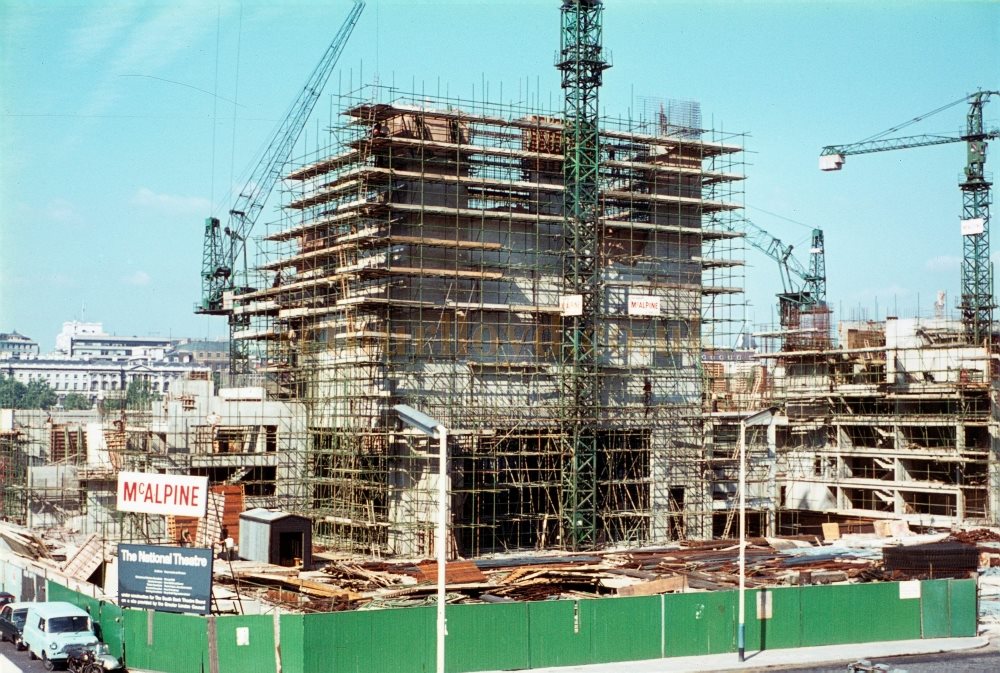
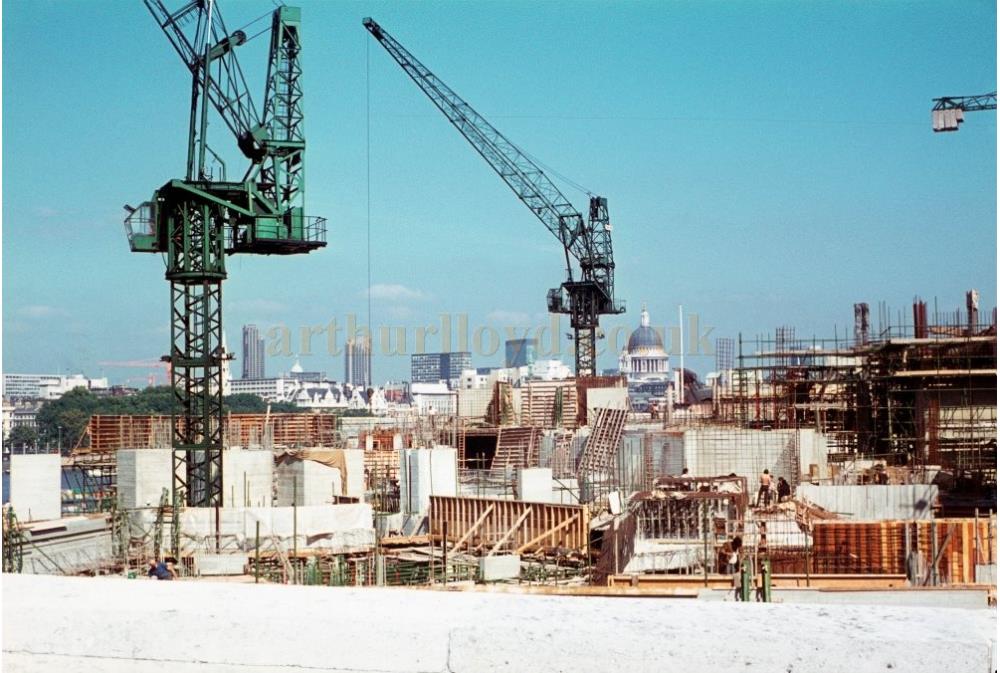
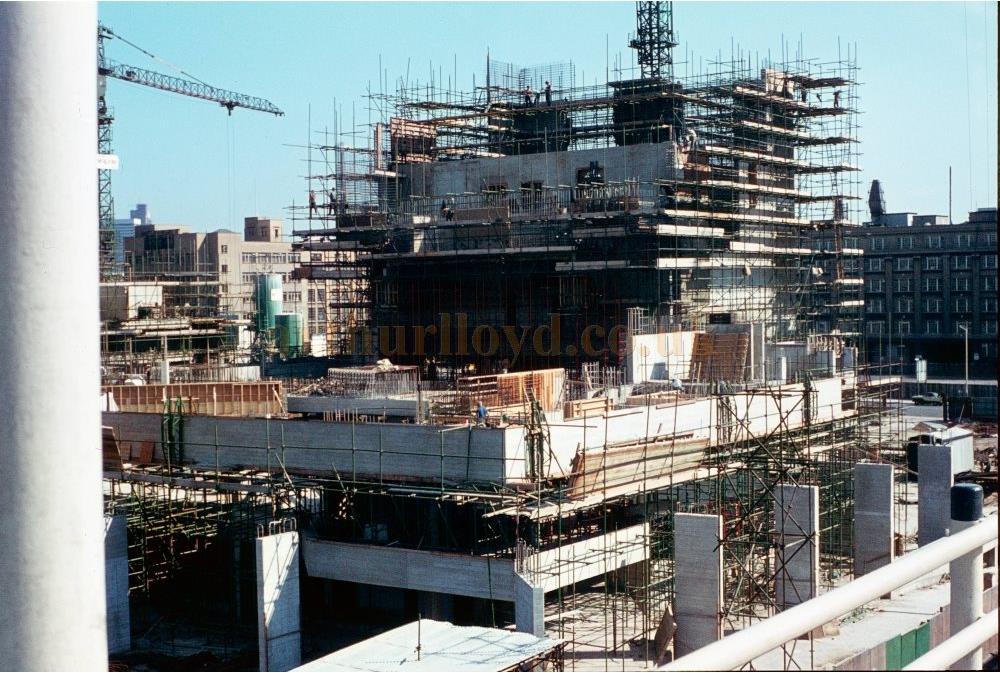
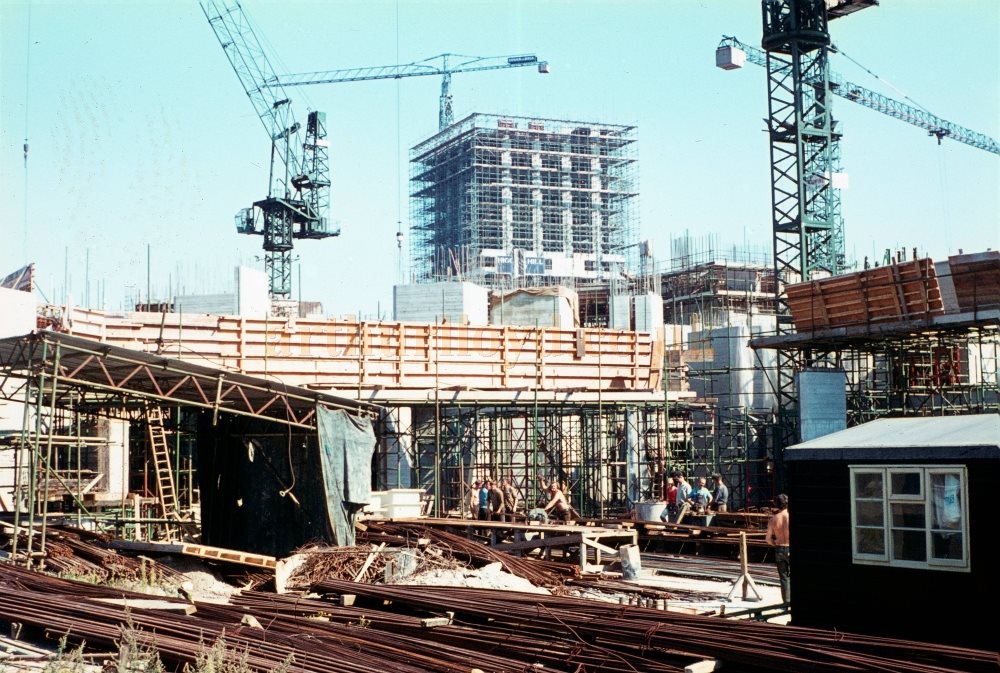
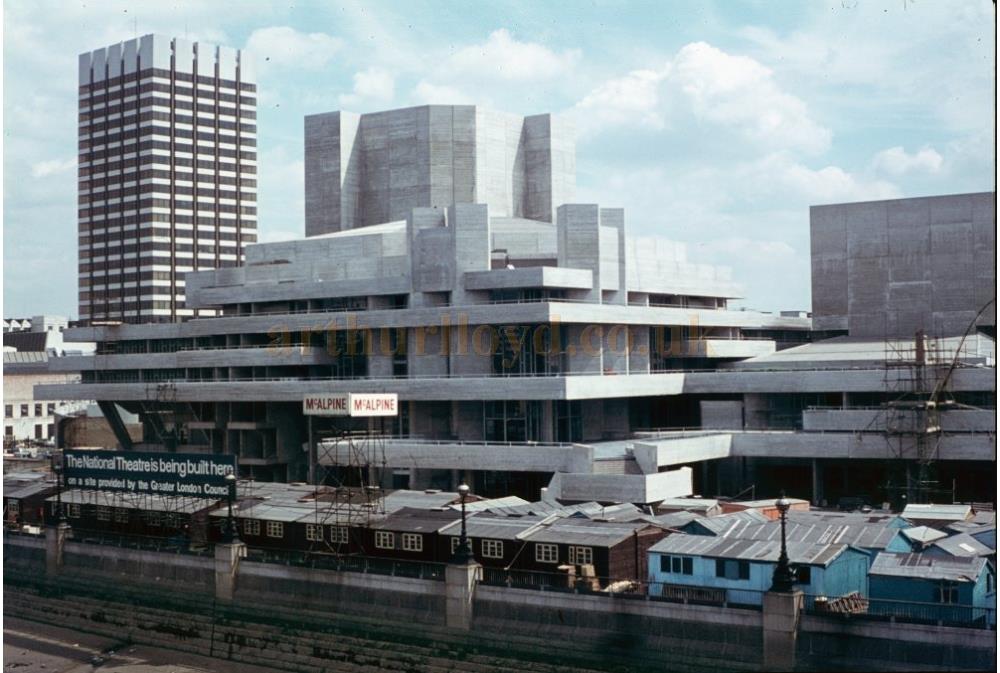


Above - The National Theatre under construction in 1971 from a series of photographs taken by Roy Follett on the 8th of September 1971 and a photograph by Roy Follett of the site nearing completion in 1974/75 - Courtesy Paul Thacker.
The first Theatre in the complex to open was the Lyttleton on the 16th of March 1976 with Peter Hall's production of 'Hamlet' with Albert Finney in the leading role. 'Hamlet' was also the first production when the National Theatre Company first opened at the Old Vic in 1963.
 Next
to open was the Olivier Theatre on the 4th of
October 1976 with the Peter Hall Production of Marlowe's 'Tamburlaine
The Great.' The official opening of the National Theatre Complex by
the Queen took place a few weeks later, when she attended a production
of 'Il Campiello' on the 25th of October 1976.
Next
to open was the Olivier Theatre on the 4th of
October 1976 with the Peter Hall Production of Marlowe's 'Tamburlaine
The Great.' The official opening of the National Theatre Complex by
the Queen took place a few weeks later, when she attended a production
of 'Il Campiello' on the 25th of October 1976.
 Last
to open was the Cottesloe Theatre, which opened
on the 4th of November 1977 with a visiting production of Ken Campbell's
'Illuminatus,' which was a bottom numbing eight hours long.
Last
to open was the Cottesloe Theatre, which opened
on the 4th of November 1977 with a visiting production of Ken Campbell's
'Illuminatus,' which was a bottom numbing eight hours long.
Left - A Ticket stub for Tom Stoppard's excellent play 'Jumpers' with Michael Hordern in the lead role, at the National Theatre's Lyttleton Theatre on Monday the 21st of April 1977, just a year after the Theatre opened.
The original Artistic Director of the National Theatre Company at the Old Vic was the much loved actor Laurence Olivier who had headed the Company since 1963, but in November 1973 he resigned his position due to ill health. Sir Peter Hall then took up the mantel and oversaw the move to their new home on the South Bank in 1976.
 Sir Peter Hall was eventually succeeded by Richard Eyre in 1988, who's production
of the musical 'Guys and Dolls' which first opened at the Olivier
Theatre on the 9th of March 1982, was the first in a long line of
highly successful Musicals produced by the company over the ensuing years. Richard Eyre was eventually
succeeded by Trevor Nunn in 1997, who in turn handed over the mantel to Nicholas Hytner in 2003, Hytner was then followed by Rufus Norris who took over as Director in April
2015.
Sir Peter Hall was eventually succeeded by Richard Eyre in 1988, who's production
of the musical 'Guys and Dolls' which first opened at the Olivier
Theatre on the 9th of March 1982, was the first in a long line of
highly successful Musicals produced by the company over the ensuing years. Richard Eyre was eventually
succeeded by Trevor Nunn in 1997, who in turn handed over the mantel to Nicholas Hytner in 2003, Hytner was then followed by Rufus Norris who took over as Director in April
2015.
Right - The rear of the National Theatre where all the sets are created for the Theatre's many productions.
On October the 22nd 2013 the Company celebrated its 50th anniversary and a number of special events were arranged to celebrate the event. A two part Arena Documentary was also produced by the BBC for broadcast on the 24th and 31st of October 2013 telling the story of the National Theatre. And a live broadcast of a special show highlighting the Company's 50 years was shown on the BBC on Saturday the 2nd of November 2013.
The National Theatre is a Grade II Listed Building which, in 2013 / 2014, underwent a major £70 million redevelopment plan called NT Future. However, ten years later, in 2024, another project to upgrade the whole complex was launched, with £26.4m funding from the Government, and £35m of private sector philanthropy raised from NT supporters, along with a fundraising campaign for the remainder of the proposed cost of £125m overall. The project is dubbed 'Stories Start Here', and consists of major upgrades to the National Theatre's infrastructure, part of which involves closing the Dorfman Theatre from November to the middle of 2025 for major renovations, early details of the whole project can be found here.

Above - The rear of the National Theatre in October 2015 showing the newly constructed Max Rayne Centre
There now follows details for each of the Theatres in the National Theatre Complex.
You may like to visit the National Theatre's own Website here.
The
Olivier Theatre
 The
Olivier Theatre was named after Sir Laurence Olivier, who was the original
Artistic Director of the National Theatre Company at the Old
Vic. It is the biggest of the three Theatres in the National Theatre
Complex and was modeled on the ancient Greek Theatre in Epidaurus.
The Theatre was designed with an open thrust stage which projects into
a fan shaped auditorium and has a capacity of over 1,100.
The
Olivier Theatre was named after Sir Laurence Olivier, who was the original
Artistic Director of the National Theatre Company at the Old
Vic. It is the biggest of the three Theatres in the National Theatre
Complex and was modeled on the ancient Greek Theatre in Epidaurus.
The Theatre was designed with an open thrust stage which projects into
a fan shaped auditorium and has a capacity of over 1,100.
Right - The vast Fly Tower of the Olivier Theatre can be seen here thrusting out of the National Theatre Complex in July 2008. Photo ML
The Theatre opened on the 4th of October 1976 with the Peter Hall Production of Marlowe's 'Tamburlaine The Great.' The official opening by the Queen of the whole National Theatre Complex took place a few weeks later, on the 25th of October 1976.
The Olivier Theatre, which is some three floors up, has an innovative drum revolve, which consists of three semi circular segments, two of which can be lowered to the ground floor of the building and are interchangeable so that sets can magically revolve out of sight and be replaced with new ones revolving back up to stage level. Something which has been used to great effect in several productions.

Above - A 1970s Seating Plan for the Olivier Theatre
 The
Olivier Theatre has had a great many successes over the years and it's
production of Guys and Dolls in 1982 was one of the most successful
in its history. The best selling musical went on tour to the Bristol
Hippodrome and later all around the country, eventually ending up
in the West End at the Prince
of Wales Theatre for several years. The production was also revived
at the National Theatre in November 1990 for two special performances
in memory of the late Ian Charleson, who had played Sky Masterson in
the 1982 production, and then revived again as a complete recreation
of the original in 1996.
The
Olivier Theatre has had a great many successes over the years and it's
production of Guys and Dolls in 1982 was one of the most successful
in its history. The best selling musical went on tour to the Bristol
Hippodrome and later all around the country, eventually ending up
in the West End at the Prince
of Wales Theatre for several years. The production was also revived
at the National Theatre in November 1990 for two special performances
in memory of the late Ian Charleson, who had played Sky Masterson in
the 1982 production, and then revived again as a complete recreation
of the original in 1996.
Right - A Programme for Richard Eyre's original National Theatre production of 'Guys and Dolls' which opened at the Olivier Theatre in 1982.
 I have a great fondness for the Olivier Theatre myself as I worked there for seven years in the lighting department during
the 1980s on productions including The Life of Galileo, Hiawatha, Man and Superman, A Month in the Country, The Shoemaker's Holiday, Much Ado About Nothing, The Hypochondriac, The Oresteia, Guys and Dolls, Don Quixote, Danton's Death, Schweyk in the Second World War, Lorenzaccio, The Rivals, Tales from Hollywood,
I have a great fondness for the Olivier Theatre myself as I worked there for seven years in the lighting department during
the 1980s on productions including The Life of Galileo, Hiawatha, Man and Superman, A Month in the Country, The Shoemaker's Holiday, Much Ado About Nothing, The Hypochondriac, The Oresteia, Guys and Dolls, Don Quixote, Danton's Death, Schweyk in the Second World War, Lorenzaccio, The Rivals, Tales from Hollywood,  Jean Seberg, Saint Joan, Mandragola, A Little Hotel on the Side, Animal Farm, Coriolanus, The Government Inspector, Pravda, A Chorus of Disapproval, The Critic, The Real Inspector Hound, Yonadab, The Threepenny Opera, Jacobowsky and the Colonel, Animal Farm, Pravda, and Antony and Cleopatra.
Left - A Programme for 'The Threepenny Opera' at the National Theatre's Olivier Theatre which was first produced there in 1986. And Right - A Programme for the National Theatre's fantastic production of Bertolt Brecht's 'Schweyk' which was first produced at the Olivier Theatre on the 23rd of September 1982.
 The
Olivier Theatre was designed with an innovative power flying system, powered lighting cradles, a Rank Strand TCS Lightboard powered by a PDP-11 Mini Computer, details here,
and because the Theatre was situated three
floors above ground level there was also a huge scenery lift behind the stage which was used for transporting sets and equipment
back and forth to ground level.
The
Olivier Theatre was designed with an innovative power flying system, powered lighting cradles, a Rank Strand TCS Lightboard powered by a PDP-11 Mini Computer, details here,
and because the Theatre was situated three
floors above ground level there was also a huge scenery lift behind the stage which was used for transporting sets and equipment
back and forth to ground level.
Left - A Programme for the National Theatre's production of 'Don Quixote' which was first produced at the Olivier Theatre with Pail Scofield as Don Quixote del la Mancha on the 18th of June 1982.
Tragically, a serious accident occurred with the scenery lift at the Olivier Theatre whilst I was working there in the 1980s, when the hydraulics failed and the lift collapsed during a change of sets, killing one crew member and halting production at the Theatre for the evening. A truly shocking experience, still seared into my memory all these years later.

Above - The Auditorium of the Olivier Theatre in September 2017 whilst an expectant and packed audience awaits the National Theatre's wonderful production of Stephen Sondheim's 'Follies'. The show starred Imelda Staunton who had first appeared on the Olivier Theatre's stage in the National Theatre's production of 'Guys and Dolls' way back in 1982.
A list of all the productions in the Olivier Theatre from 1976 to 2006 can be seen by clicking the Productions Link below.
Olivier Productions
Olivier Theatre Productions From 1976 to 2006
Below is a list of productions that have taken place at the National Theatre's Olivier Theatre from 1976 to 2006, as listed in the Theatre's archive. The dates are for the month, day, and year of the press night of each production. All productions were performed on the main stage of the Olivier Theatre except 'Platform Performances' which are stated as being performed in the Stalls or Foyer etc.
09/16/1976 Tamburlaine the Great
10/20/1976 Il Campiello
12/2/1976 Counting the Ways
01/21/1977 Tales from the Vienna Woods
03/17/1977 Julius Caesar
04/21/1977 Volpone
06/18/1977 The Madras House
09/15/1977 The Plough and the Stars
11/9/1977 The Country Wife
02/2/1978 The Cherry Orchard
04/14/1978 Brand
05/27/1978 Macbeth
08/4/1978 The Woman
09/22/1978 The Double Dealer
11/24/1978 Strife
02/5/1979 A Fair Quarrel
03/2/1979 The Fruits of Enlightenment
06/15/1979 Undiscovered Country
07/27/1979 As You Like It
09/28/1979 Richard III
10/26/1979 Amadeus
12/7/1979 The Wild Duck
03/14/1980 Othello
05/23/1980 Sisterly Feelings
08/8/1980 The Life of Galileo
10/10/1980 The Romans in Britain
11/25/1980 Hiawatha
01/17/1981 Man and Superman
02/13/1981 A Month in the Country
06/13/1981 The Shoemaker's Holiday
08/7/1981 Much Ado About Nothing
10/16/1981 The Hypochondriac
11/20/1981 The Oresteia
02/26/1982 Guys and Dolls
06/10/1982 Don Quixote
07/15/1982 Danton's Death
09/16/1982 Schweyk in the Second World War
03/4/1983 Lorenzaccio
04/2/1983 The Rivals
08/26/1983 Tales from Hollywood
10/29/1983 Jean Seberg
02/10/1984 Saint Joan
04/12/1984 Guys and Dolls
06/8/1984 Mandragola
08/3/1984 A Little Hotel on the Side
09/21/1984 Animal Farm
10/31/1984 The Ancient Mariner
12/1/1984 Coriolanus
01/25/1985 The Government Inspector
04/26/1985 Pravda
07/25/1985 A Chorus of Disapproval
08/1/1985 A Chorus of Disapproval
09/6/1985 The Critic
09/6/1985 The Real Inspector Hound
11/25/1985 Yonadab
03/6/1986 The Threepenny Opera
07/11/1986 Jacobowsky and the Colonel
10/1/1986 Animal Farm
10/6/1986 Pravda
11/8/1986 The Pied Piper
12/11/1986 King Lear
02/26/1987 Six Characters in Search of an Author
04/3/1987 Antony and Cleopatra
05/14/1987 A Small Family Business
09/17/1987 Macbeth
09/24/1987 Medea
12/5/1987 Countrymania
02/25/1988 'Tis Pity She's a Whore
05/2/1988 The Shaughraun
07/7/1988 Rescuers Speaking
10/14/1988 Bartholomew Fair
12/3/1988 The Magic Olympical Games
01/27/1989 Hedda Gabler
03/10/1989 Hamlet
04/20/1989 Ghetto
10/2/1989 Kenneth Branagh
10/16/1989 The Magic Carpet
11/18/1989 The Good Person of Sichuan
02/9/1990 Peer Gynt
02/22/1990 Olivier: Hamlet to Hollywood
03/5/1990 Stephen Sondheim
03/22/1990 The Trackers of Oxyrhynchus
04/12/1990 The School for Scandal
05/4/1990 Trackers in Athens, Delphi and London: Olivier Taplin
05/25/1990 The Crucible
08/21/1990 Stephen Fry
10/1/1990 Harold Pinter
10/2/1990 Racing Demon
10/4/1990 More Tales from the Magic Carpet
10/19/1990 Douglas Adams
12/1/1990 The Wind in the Willows
12/31/1990 Richard Briers
01/4/1991 Dario Fo and Franca Rame
01/30/1991 T S Eliot's 'Four Quartets'
02/12/1991 Tony Harrison
03/22/1991 Susan Sontag
04/19/1991 Sir Yehudi Menuhin
04/26/1991 The Miser
05/10/1991 Dialogue: Steven Pimlott and Jeremy Sams
05/23/1991 Derek Walcott
06/8/1991 The White Devil
08/2/1991 The Resistible Rise of Arturo Ui
09/4/1991 Peter Greenaway
09/11/1991 Heathcote Williams' Autogeddon
09/16/1991 Feminism - Past, Present and Future
09/24/1991 Martin Amis
10/4/1991 Murmuring Judges
10/14/1991 Arthur Miller
10/15/1991 Dialogue: David Hare and Richard Eyre on Murmuring Judges
11/1/1991 The Wind in the Willows
11/11/1991 Vanessa Redgrave
11/27/1991 Alan Bennett
12/4/1991 Ned Sherrin's Theatrical Anecdotes
02/6/1992 Dialogue: Evelyn Glennie and Dominic Muldowney
02/21/1992 Simon Callow
03/6/1992 The Recruiting Officer
03/13/1992 Dialogue: Nicholas Hytner and Michael Ratcliffe
03/20/1992 Dirk Bogarde
04/6/1992 Pygmalion
05/20/1992 Jay McInerney
07/3/1992 A Midsummer Night's Dream
09/25/1992 Square Rounds
10/23/1992 Dragon
12/5/1992 Jo-Jo the Melon Donkey Olivier Cathedral Window; National
Theatre
12/10/1992 Spitting Image
12/11/1992 The Work of Kenneth Macmillan
02/12/1993 Trelawny of the "Wells"
03/26/1993 Macbeth
04/2/1993 Richard Eyre: Utopia and Other Places
05/26/1993 Patsy Rodenburg: Working with Words
09/23/1993 The Absence of War
10/6/1993 Margaret Atwood
10/15/1993 The David Hare Trilogy Debated
11/5/1993 Peter Brook
11/22/1993 Tony Kushner
11/24/1993 Dirk Bogarde
12/1/1993 The Wind in the Willows
12/17/1993 Toad and Co's Christmas Special Olivier Stalls Foyer, National
Theatre
01/7/1994 Theatre Quiz
03/8/1994 Edward W Said
03/14/1994 Tony Curtis
03/15/1994 Garrison Keillor
03/25/1994 Johnny on a Spot
05/14/1994 Pericles
06/22/1994 Jeanette Winterson
07/1/1994 The Seagull
08/3/1994 Arthur Miller
09/1/1994 The Devil's Disciple
09/12/1994 Nadine Gordimer
09/20/1994 William Boyd
09/30/1994 Dirk Bogarde
10/18/1994 Richard Eyre
11/4/1994 Joseph Heller
11/8/1994 A S Byatt and Marina Warner
12/15/1994 The Wind in the Willows
01/20/1995 The Merry Wives of Windsor
01/27/1995 Dialogue: Terry Hands and Genista McIntosh
03/10/1995 Women of Troy
04/7/1995 Under Milk Wood
06/14/1995 Dialogue: Under Milk Wood
09/18/1995 A Little Night Music
09/29/1995 Dialogue: Matthew Warchus on Volpone
09/29/1995 Volpone
10/9/1995 Dirk Bogarde
10/19/1995 Amos Oz
11/4/1995 Mother Courage and her Children
11/21/1995 Alan Bennett
11/24/1995 Dialogue: David Hare and Jonathan Kent
12/4/1995 Glen Baxter's Wonder Book of Sex
12/8/1995 Simon Callow on Orson Welles
12/11/1995 Tom Stoppard
12/18/1995 Oscar Wilde Stories
04/13/1996 The Prince's Play
04/25/1996 Steven Berkoff
04/29/1996 P D James and Ruth Rendell
06/3/1996 Romantic Drama: Hugo and Schiller
06/10/1996 Peter O'Toole
06/13/1996 Gay Literature
06/21/1996 Jay McInerney
07/20/1996 The Red Balloon
08/30/1996 A Little Late Night Music
09/17/1996 The Oedipus Plays
09/21/1996 Dialogue: on The Oedipus Plays
10/21/1996 Dialogue: Bill Alexander and Simon Callow on The Alchemist
10/25/1996 Twenty Years on the South Bank
12/9/1996 Guys and Dolls
12/23/1996 Theatre Quiz
01/10/1997 Jeanette Winterson
02/13/1997 Colin Dexter
04/11/1997 The Caucasian Chalk Circle
04/28/1997 Dialogue: Simon McBurney
05/1/1997 Paul Theroux
05/8/1997 The Persecution and Assassination of Marat as Performed by
the Inmates of the Asylum of Charenton under the Direction of the Marquis
de Sade
05/23/1997 Dialogue: Jeremy Sams
05/29/1997 Sherwin B Nuland
07/25/1997 Celebriteas Olivier Foyer, National Theatre
07/31/1997 'Snakehips'
08/1/1997 Celebriteas Olivier Foyer, National Theatre
08/8/1997 Celebriteas Olivier Foyer, National Theatre
08/15/1997 Celebriteas Olivier Foyer, National Theatre
08/22/1997 Celebriteas Olivier Foyer, National Theatre
08/29/1997 Celebriteas Olivier Foyer, National Theatre
09/12/1997 An Enemy of the People
09/29/1997 Richard Eyre
10/9/1997 The Roald Dahl Treasury
10/24/1997 The National Theatre Book
11/10/1997 Srebrenica: The Case Against Dr Karadzic and General Mladic
11/12/1997 Harry Enfield
11/12/1997 Srebrenica discussion
12/9/1997 Peter Pan
01/15/1998 John Fraser as J M Barrie: The Man Who Wrote Peter Pan
02/5/1998 Flight
03/12/1998 'Playing Peter'
03/20/1998 Brecht's War Primer
04/14/1998 Offstage\Onstage: Costume Design and Making Olivier Stalls,
National Theatre
04/14/1998 Offstage\Onstage: Props and Armoury Olivier Stalls, National
Theatre
04/14/1998 Talkshow: Peter and Wendy
04/15/1998 Offstage\Onstage: Set Design and Scene Painting Olivier Stalls,
National Theatre
04/15/1998 Offstage\Onstage: Stage Management and Theatre Administration
Olivier Stalls, National Theatre
04/17/1998 Offstage\Onstage: Directing and Writing Olivier Stalls, National
Theatre
04/17/1998 Offstage\Onstage: Sound and Lighting Olivier Stalls, National
Theatre
06/4/1998 Brassed Off
06/23/1998 Dialogue: Paul Allen
07/6/1998 Oklahoma!
08/14/1998 David Hersey
10/12/1998 Antony and Cleopatra
11/9/1998 Tony Harrison
12/30/1998 Theatre Quiz
01/7/1999 NT 2000: Peter Pan
01/14/1999 NT 2000: The Playboy of the Western World
01/22/1999 NT 2000: Pygmalion
01/29/1999 NT 2000: The Circle
02/1/1999 NT 2000: Juno and the Paycock
02/5/1999 NT 2000: Journey's End
02/8/1999 NT 2000: The Front Page
02/18/1999 NT 2000: Private Lives
03/6/1999 Troilus and Cressida
04/5/1999 Candide
04/26/1999 NT 2000: Serjeant Musgrave's Dance
05/7/1999 NT 2000: A Man for All Seasons
05/28/1999 Money
06/8/1999 NT 2000: The Ruling Class
06/9/1999 NT 2000: The Philanthropist
06/11/1999 NT 2000: Sleuth
06/15/1999 NT 2000: Home
06/16/1999 NT 2000: AC/DC
06/18/1999 NT 2000: The Norman Conquests
06/30/1999 Offstage\Onstage: The Olivier Theatre
07/1/1999 Talkshow: Private Lives
07/2/1999 Talkshow: Candide
07/9/1999 NT 2000: East
07/12/1999 After Juliet
07/12/1999 The King of the Castle
07/13/1999 The Devil in Drag
07/13/1999 The Pilgrimage
07/16/1999 NT 2000: Abigail's Party
07/20/1999 NT 2000: Educating Rita
07/29/1999 NT 2000: Translations
07/30/1999 NT 2000: True West
08/27/1999 Summerfolk
09/10/1999 NT 2000: The Romans in Britain
09/24/1999 NT 2000: Good
09/27/1999 NT 2000: Top Girls
10/8/1999 NT 2000: Run for Your Wife
10/11/1999 NT 2000: Glengarry Glen Ross
10/14/1999 NT 2000: Victory
10/20/1999 NT 2000: Bouncers
10/25/1999 NT 2000: Pravda
11/1/1999 NT 2000: Observe the Sons of Ulster Marching Towards the Somme
11/4/1999 NT 2000: Road
11/8/1999 NT 2000: My Mother Said I Never Should
11/29/1999 The Merchant of Venice
12/6/1999 The Elves and the Shoemakers Olivier Stalls Foyer, National
Theatre
12/11/1999 Honk! The Ugly Duckling
04/4/2000 The Villains' Opera
06/3/2000 David Edgar on Alber Speer
06/3/2000 Gitta Sereny on Albert Speer
06/29/2000 Jude Kelly on Singin' in the Rain
07/29/2000 Garden
08/10/2000 Talkshow: House/Garden Olivier Theatre, National Theatre
and Lyttelton Theatre
09/4/2000 Romeo and Juliet
09/15/2000 Cuba, Si!
09/18/2000 Theatre of Debate: Medicine and Humanity I: Cell Mates by
Sara Clifford
09/21/2000 Richard Eyre and Nicholas Wright: Changing Stages
09/22/2000 Theatre of Debate: Medicine and Humanity II: The Diagnosis
by Steve Waters
09/29/2000 Barbara Windsor
10/3/2000 Theatre of Debate: Medicine and Humanity III: Wicked Problems
by Nicola Baldwin
10/5/2000 Theatre of Debate: Medicine and Humanity IV: Playing God by
Rhiannon Tise
10/6/2000 Theatre of Debate: Medicine and Humanity V: Juggling with
Chainsaws by Jonathan Hall
10/16/2000 Peer Gynt
12/4/2000 Shakespeare on Screen: Romeo and Juliet
02/3/2001 The Cherry Orchard
02/23/2001 Remembrance of Things Past
03/12/2001 Di Trevis on Remembrance of Things Past
03/22/2001 NT25: 1976 Jumpers
04/4/2001 Alain de Botton: How Proust Can Change Your Life
04/10/2001 The Ramayana: The Legend of Prince Rama
05/11/2001 The Winter's Tale
05/18/2001 Nicholas Hytner Platform
06/4/2001 Timothy West
07/12/2001 The Relapse or Virtue in Danger
07/13/2001 Happy Endings Olivier Stalls Foyer, National Theatre
07/14/2001 Emperors and Clowns Olivier Stalls Foyer, National Theatre
08/7/2001 Vera Gottlieb on The Cherry Orchard
09/6/2001 Cloudstreet
09/12/2001 Clement Freud
09/19/2001 John Mortimer
09/29/2001 Luther
10/22/2001 NT25: the Building
10/25/2001 NT25: the Directors
10/26/2001 NT25: the Chain Play
11/12/2001 Linbury Biennial: Designing the New
12/3/2001 South Pacific
03/8/2002 Masterclass with Fiona Shaw
05/8/2002 Bacchai
05/20/2002 Colin Teevan on Bacchai
05/21/2002 Peter Hall on Bacchai
06/27/2002 Voyage
07/8/2002 Shipwreck
07/19/2002 Salvage
09/12/2002 Peter Ustinov
09/13/2002 Judi Dench
09/26/2002 Susan Stroman
10/22/2002 Alan Ayckbourn
10/25/2002 William Dudley on The Coast of Utopia
12/11/2002 Anything Goes
02/15/2003 Love's Labour's Lost
03/21/2003 And finally... Trevor Nunn
03/28/2003 Pericles
05/6/2003 Henry V
05/19/2003 Nicholas Hytner introduces The Travelex £10 Season
05/29/2003 His Girl Friday
06/6/2003 Jack O'Brien on His Girl Friday
06/10/2003 Harold Pinter: War
06/20/2003 Nicholas Hytner on Henry V
07/14/2003 Simon Callow - Henry IV Part II Olivier Foyer, National Theatre
07/17/2003 Edmond
10/7/2003 Tales from the Vienna Woods
10/17/2003 Richard Jones on Tales from the Vienna Woods
11/21/2003 Review: The Travelex £10 Season
12/20/2003 His Dark Materials - Part 2
12/20/2003 His Dark Materials -Part 1
01/5/2004 His Dark Materials: Nicholas Hytner
01/8/2004 His Dark Materials: The Design
01/9/2004 His Dark Materials: Philip Pullman
01/20/2004 His Dark Materials: Nicholas Wright
02/20/2004 His Dark Materials: The Daemon Puppets
02/25/2004 His Dark Materials: William Blake's The Marriage of Heaven
and Hell
03/5/2004 On the Marionette Theatre
03/15/2004 Dr. Rowan Williams and Philip Pullman
04/10/2004 Cyrano de Bergerac
04/29/2004 Peter Hall
05/17/2004 Measure for Measure
06/1/2004 NT25: 1984 (Wild Honey)
06/2/2004 Simon McBurney on Measure for Measure
06/10/2004 Germaine Greer: Measure for Measure - Why Vienna?
06/22/2004 National Theatre: Brutalist Beauty?
07/9/2004 A Funny Thing Happened On The Way To The Forum
09/10/2004 Stuff Happens
09/15/2004 J Michael Walton. Routine Business - Plautus in the Market
Place
09/15/2004 Plautus Play Reading - Casina
10/14/2004 National Headlines: Farming ' We've a Problem' by Paul Jepson
10/21/2004 National Headlines: Health: Aaron
10/28/2004 Stephen Sondheim on the National's revival of A Funny Thing
Happened on the Way to the Forum.
10/29/2004 Edward Hall on A Funny Thing...
11/20/2004 His Dark Materials - Part 1
11/30/2004 His Dark Materials - Part 2
05/4/2005 Henry IV Part 1
05/4/2005 Henry IV Part 2
06/16/2005 The UN Inspector Olivier Theatre, NT
09/12/2005 Playing With Fire
11/15/2005 Coram Boy
12/15/2005 Once in a Lifetime
04/12/2006 The Royal Hunt of the Sun
The
Lyttleton Theatre

Above - The large square Fly Tower of the Lyttleton Theatre can be seen here rising above the original box office and long bar area of the National Theatre in July 2008. Photo ML
The
Lyttleton Theatre was the first Theatre in the complex to open It was
named after Oliver Lyttleton who was the first chairman of the National
Theatre Board. It is a conventional Theatre designed with an adjustable
proscenium and regularly shaped auditorium which can seat nearly 900
people.
Right - A Programme for Tom Stoppard's excellent play 'Jumpers' with Michael Hordern in the lead role, at the National Theatre's Lyttleton Theatre on Monday the 21st of April 1977, just a year after the Theatre opened.
The stage was fitted with two enormous sliding platforms which could transport an entire set from the wings or the rear of the stage onto the stage itself, so creating seamless scene changes, and like the Olivier Theatre was fitted with a Rank Strand TCS Lightboard powered by a PDP-11 Mini Computer, details here.
The Theatre opened on the 16th of March 1976 with Peter Hall's production of 'Hamlet', with Albert Finney in the leading role. Hamlet was also the first production when the National Theatre Company first opened at the Old Vic in 1963.
A list of all the productions in the Lyttleton Theatre from 1976 to 2006 can be seen by clicking the Productions Link below.
Lyttleton Productions
Lyttleton Theatre Productions From 1976 to 2006
Below is a list of productions that have taken place at the National Theatre's Lyttleton Theatre from 1976 to 2006, as listed in the Theatre's archive. The dates are for the month, day, and year of the press night of each production. All productions were performed on the main stage of the Lyttleton Theatre except 'Platform Performances' which are stated as being performed in the Stalls or Foyer etc.
03/16/1976 Hamlet
03/17/1976 John Gabriel Borkman
03/20/1976 Happy Days
03/20/1976 Watch it Come Down
04/12/1976 No Man's Land
06/3/1976 The Playboy of the Western World
06/18/1976 Blithe Spirit
07/8/1976 Weapons of Happiness
07/17/1976 James Galway Music Evening
09/21/1976 Jumpers
11/4/1976 The Force of Habit
11/17/1976 Tartuffe
11/23/1976 La Dispute
01/21/1977 Counting the Ways
03/3/1977 Summerfolk
03/29/1977 The Magic Drum
04/30/1977 The Devil is an Ass
05/4/1977 Measure for Measure
06/13/1977 Divinas Palabras
08/16/1977 Don Giovanni
10/12/1977 The Lady from Maxim's
12/5/1977 Sir Gawain and the Green Knight
12/21/1977 The Guardsman
04/7/1978 Plenty
09/1/1978 The Philanderer
11/10/1978 Betrayal
05/18/1979 Close of Play
08/24/1979 Death of a Salesman
02/2/1980 Thee and Me
08/22/1980 Watch on the Rhine
11/6/1980 The Caretaker
08/4/1981 Translations
05/7/1982 Uncle Vanya
08/14/1982 Way Upstream
09/9/1982 The Importance of Being Earnest
10/18/1982 Major Barbara
01/21/1983 A Map of the World
04/3/1983 The Trojan War Will Not Take Place
06/9/1983 Inner Voices
07/28/1983 You Can't Take it With You
12/10/1983 Cinderella
01/9/1984 Where the Wild Things Are
02/24/1984 Master Harold... and the Boys
04/6/1984 Venice Preserv'd
05/15/1984 Golden Boy
07/3/1984 Arthur Miller
07/13/1984 Wild Honey
10/19/1984 Rough Crossing
02/21/1985 The Road to Mecca
04/13/1985 Martine
06/28/1985 The Tragedy of The Duchess of Malfi
10/4/1985 Mrs Warren's Profession
11/7/1985 Love for Love
02/6/1986 Brighton Beach Memoirs
05/15/1986 Dalliance
07/23/1986 The Petition
09/15/1986 The Magistrate
10/30/1986 Tons of Money
12/19/1986 Coming in to Land
01/23/1987 School for Wives
05/11/1987 The Hairy Ape
06/10/1987 Hamlet
06/17/1987 Miss Julie
06/26/1987 Fathers and Sons
07/31/1987 The Wandering Jew
10/28/1987 Tomorrow was War
11/5/1987 Arthur Miller
11/13/1987 Waiting for Godot
01/25/1988 Cat on a Hot Tin Roof
06/17/1988 The Changeling
09/26/1988 The Secret Rapture
10/17/1988 Mountain Language
11/24/1988 A Question of Attribution
11/24/1988 An Englishman Abroad
01/19/1989 Speed-the-Plow
02/16/1989 Juno and the Paycock
03/31/1989 The March on Russia
06/22/1989 The Grapes of Wrath
09/14/1989 Uncle Vanya
10/9/1989 Suicide for Love
10/17/1989 Jack Lemmon
10/20/1989 In A Version By
10/26/1989 Salome
11/27/1989 Antony Sher
12/7/1989 Whale
01/5/1990 Bent
03/5/1990 Sunday in the Park with George
04/5/1990 The Role of the Church of England in the 1990s
05/11/1990 Ian McEwan
05/24/1990 Musicals
05/29/1990 Arthur Miller
06/4/1990 Sondheim's Cut-Out Songs
06/5/1990 All the World's a Globe
06/7/1990 Clive James
06/22/1990 King Lear
06/30/1990 Richard III
09/5/1990 My Children! My Africa!
09/11/1990 John Kani in Conversation with Mary Benson
09/14/1990 My Children! My Africa!: A Discussion with Derrick Swartz
and Godfrey Brandt
09/20/1990 Hamlet
09/22/1990 Ion Caramitru
09/24/1990 V S Naipaul
10/10/1990 Dancing at Lughnasa
10/24/1990 Kurt Vonnegut
10/25/1990 Doris Lessing
10/29/1990 Anthony Burgess
11/8/1990 Andrew Davies
11/9/1990 Writing off the Wall
11/14/1990 The Kingdom of Desire
11/17/1990 Music from the Kingdom of Desire
11/21/1990 Is British Theatre Colour-Blind or Colour Conscious?
12/6/1990 Alan Bennett
12/12/1990 Robert Sturua
12/14/1990 Dirk Bogarde: Up to Now
12/20/1990 A Christmas Cracker
02/7/1991 The Visit
02/23/1991 The Trial
03/12/1991 Alan Ayckbourn
03/15/1991 Alice's Diner
03/19/1991 Griff Rhys Jones
04/25/1991 Théâtre de Complicité
04/29/1991 Michael Pennington on the English Shakespeare Company
05/20/1991 Antony Sher
06/4/1991 Discussion: Long Day's Journey into Night
06/21/1991 Napoli Milionaria
07/1/1991 Peter Tinniswood in conversation with Michael Parkinson
07/10/1991 Julian Barnes
07/24/1991 Beachcomber: JB Morton
09/12/1991 Michael Holroyd
09/27/1991 Jeanette Winterson
10/4/1991 Grand Kabuki
10/21/1991 Poets Take the Stage: Ted Hughes
10/22/1991 Poets Take the Stage: Wendy Cope
10/23/1991 Poets Take the Stage: Grace Nichols
10/24/1991 Poets Take the Stage: Tony Harrison
10/25/1991 Poets Take the Stage: Fiona Pitt-Kethley
10/26/1991 Poets Take the Stage: John Hegley
10/30/1991 Germaine Greer
11/15/1991 Alan Bleasdale
11/21/1991 The Madness of George III
12/6/1991 The Sea
12/19/1991 Theatre Verse
01/13/1992 Judi Dench and Sam Mendes
01/31/1992 The Night of the Iguana
02/24/1992 Discussion: Biographical Plays
03/11/1992 Patsy Rodenburg: Working with the Voice
03/24/1992 Lou Reed
03/27/1992 The Heart of the World: Nik Cohn in conversation with Gordon
Burn Lyttelton Theatre, National Theatre
04/3/1992 Stage Lighting: Richard Pilbrow
04/25/1992 Le Bourgeois Gentilhomme
06/5/1992 Toni Morrison
06/12/1992 Brian Johnston
06/19/1992 Ian McEwan
06/23/1992 Joseph Brodsky
09/5/1992 An Inspector Calls
09/21/1992 Paul Theroux
10/8/1992 Jeanette Winterson
10/14/1992 Alice Walker
10/23/1992 Doris Lessing
10/29/1992 Le Baruffe Chiozzotte
10/30/1992 Giorgio Strehler
11/3/1992 By Myself - Dirk Bogarde
11/9/1992 Sei Personaggi in Cerca d'Autore
11/16/1992 Needles and Opium
11/18/1992 The Lear Diaries: Brian Cox
11/19/1992 Robert Lepage
12/1/1992 Carousel
01/5/1993 Theatre Quiz
02/12/1993 Patricia Routledge
04/5/1993 Arcadia
04/14/1993 Tom Stoppard
06/1/1993 Stephen Sondheim
06/3/1993 Declan Donnellan and Nick Ormerod
06/11/1993 Inadmissible Evidence
06/18/1993 Di Trevis
07/5/1993 The Wooster Group
07/9/1993 Gayatri Spivak
07/28/1993 Kenneth Branagh
10/11/1993 Machinal
10/19/1993 Susan Hill
10/22/1993 Dialogue: Stephen Daldry and Fiona Shaw
11/1/1993 The Times Talk: Peter Hall
11/4/1993 Granville Barker's Prefaces to Shakespeare
11/8/1993 Imran Khan
11/17/1993 Mario Vargas Llosa
12/1/1993 By Faith and Daring
01/10/1994 Camille Paglia: Sex, Art and American Culture
01/19/1994 Conversation with McKellen
02/18/1994 The Rape of the Lock
02/22/1994 Stephen Spender
03/11/1994 The Birthday Party
03/30/1994 Dialogue: Jay Parini and Elaine Steinbeck on John Steinbeck
04/15/1994 Les Parents Terribles
04/26/1994 John Betjeman: letters and poems
05/4/1994 Dialogue with Jeremy Sams
05/18/1994 Laurens van der Post
05/20/1994 Dialogue: Phyllida Lloyd and Jonathan Lunn
05/23/1994 Maya Angelou
06/24/1994 Alison Lurie
07/5/1994 Wole Soyinka
07/10/1994 Sweet Bird of Youth
07/21/1994 Steven Berkoff: Over
07/29/1994 Broken Glass
09/9/1994 Peter Carey
09/16/1994 The Children's Hour
10/6/1994 Poetry Day at the National: Poets on Stage
10/7/1994 Alan Bennett
10/17/1994 Ian McEwan
10/21/1994 John Irving
11/11/1994 John Pilger
11/18/1994 Mordecai Richler
11/25/1994 Out of a House Walked a Man
12/7/1994 P J O'Rourke
12/13/1994 Théâtre de Complicité
12/30/1994 Theatre Quiz
01/11/1995 The World Encyclopedia of Contemporary Theatre
01/25/1995 Oliver Sachs
02/24/1995 What the Butler Saw
03/3/1995 Dialogue: Phyllida Lloyd
03/8/1995 Lauren Bacall in conversation with Dirk Bogarde
03/21/1995 The Actor's Ways and Means discussed by Vanessa Redgrave
and Corin Redgrave
04/3/1995 Martin Amis
04/4/1995 Michael Palin
04/19/1995 The Man Who
05/4/1995 The Man Who Company
05/13/1995 Absolute Hell
05/24/1995 Dialogue with Anthony Page
05/26/1995 Antony Sher
06/16/1995 Compromising Identities?
06/19/1995 Invisible Heroines
06/23/1995 Josephine Hart and Iris Murdoch
06/26/1995 Dialogue: Mary Soames and Richard Eyre
07/7/1995 La Grande Magia
07/18/1995 John Updike
07/26/1995 Election Results 26 July 1945
07/30/1995 Making Scenes
09/1/1995 Wild Oats
09/11/1995 Dialogue: Jeremy Sams on Wild Oats
09/21/1995 Stephen Sondheim
09/25/1995 Germaine Greer
10/6/1995 Poetry Day '98: Sounds Good
10/13/1995 The Way of the World
10/31/1995 Paul Muldoon
12/9/1995 Rosencrantz and Guildenstern are Dead
12/27/1995 Theatre Quiz
01/8/1996 Diana Rigg: No Turn Unstoned
01/9/1996 Restoration Women
02/6/1996 Hamlet: A User's Guide
02/29/1996 William Blake's Songs of Innocence and Songs of Experience
03/15/1996 Mary Stuart
04/15/1996 The Hamlet Industry
04/19/1996 Roddy Doyle
04/26/1996 Blue Remembered Hills
05/3/1996 Ian McKellen
06/12/1996 Iain Banks
07/5/1996 John Gabriel Borkman
07/14/1996 BT National Connections: ...what I really, really want!
07/18/1996 Dialogue: John Gabriel Borkman
09/9/1996 Peter Ackroyd
09/21/1996 The Seven Streams of the River Ota
09/24/1996 Dialogue: on The Seven Streams of the River Ota
10/2/1996 Claire Bloom
10/10/1996 Our World Ourselves - Poetry Day: War Poetry and Poetry of
Conscience
10/14/1996 Alec Guinness
10/15/1996 Ned Sherin
10/25/1996 Death of a Salesman
11/7/1996 Maureen Lipman
11/14/1996 Suzanne Moore
11/15/1996 Richard Wilson
11/22/1996 Dialogue: on Death of a Salesman
11/26/1996 Genista McIntosh
12/12/1996 John Berger
12/13/1996 Sons and Mothers
01/4/1997 Elsinore
01/10/1997 Dialogue: Robert Lepage
01/23/1997 The Homecoming
01/28/1997 Patsy Rodenburg
03/3/1997 Lady in the Dark
03/20/1997 Nina Bawden
03/21/1997 Graham Swift
04/15/1997 Virago Voices
04/18/1997 Election Arts Debate
04/21/1997 Hanif Kureishi
04/22/1997 Gillian Slovo
04/24/1997 Naomi Wolf
05/12/1997 Gerald Kaufman
05/28/1997 Edmund White
06/6/1997 Sarah Dunant and Clare Longrigg
06/13/1997 Amy's
07/3/1997 Anthony Minghella
07/11/1997 BT National Connections: I'll tell you what I want...
07/14/1997 BT National Connections: Suitable Language?
07/17/1997 Dialogue: Lady in the Dark
07/18/1997 Peggy Ramsay
08/29/1997 Chips with Everything
09/17/1997 Dialogue: Christopher Hampton
09/30/1997 Les Fausses Confidences
10/3/1997 Terence Stamp
10/10/1997 Dialogue: Tom Stoppard
10/16/1997 Closer
10/28/1997 Judi Dench
12/1/1997 Jeanne Moreau
12/8/1997 Closer: Late Night Platform
12/12/1997 Christopher Fry
12/29/1997 Theatre Quiz
01/12/1998 Graham Trew sings Housman
01/16/1998 Richard Pilbrow
01/20/1998 Libby Purves
02/13/1998 The London Cuckolds
03/2/1998 Garrison Keillor
03/6/1998 Peter Ackroyd
03/10/1998 Melvyn Bragg
03/13/1998 Arabella Weir and Charlie Higson
03/17/1998 Happy Birthday Brecht
04/16/1998 Children's Stories
04/17/1998 Talkshow: Mr and Mrs Doodle
04/28/1998 P D James and John Mortimer
05/21/1998 Othello: The Travellers Return
06/4/1998 Litz Pisk: The Actor and his Body
06/5/1998 Patsy Rodenburg
06/19/1998 The Prime of Miss Jean Brodie
07/3/1998 Dialogue: Terry Johnson
07/8/1998 Dialogue: Phyllida Lloyd
07/28/1998 Steven Berkoff
07/31/1998 John Barrymore: Shakespearean Actor
08/19/1998 Tarry Flynn
09/5/1998 Cleo, Camping, Emmanuelle and Dick
10/2/1998 John Mortimer
10/12/1998 Joe Orton: The Lost Plays - The Visitors
10/13/1998 Joe Orton: The Lost Plays - Fred and Madge
10/14/1998 Joe Orton: The Lost Plays - Leonie Orton
10/23/1998 Judi Dench
10/27/1998 Mary Soames
11/14/1998 Betrayal
11/23/1998 Harold Pinter
12/2/1998 Fiona Shaw
12/3/1998 Paul Theroux
01/23/1999 The Forest
02/4/1999 NT 2000: The Widowing of Mrs Holroyd
02/11/1999 NT 2000: Plunder
02/12/1999 NT 2000: Machinal
03/10/1999 NT 2000: An Inspector Calls
03/12/1999 NT 2000: A Streetcar Named Desire
03/17/1999 The Colleen Bawn
03/23/1999 NT 2000: Death of a Salesman
03/24/1999 NT 2000: The Pink Room (Absolute Hell)
03/26/1999 NT 2000: The Deep Blue Sea
04/6/1999 NT 2000: Waiting for Godot
04/9/1999 NT 2000: Long Day's Journey Into Night
04/14/1999 Geometry of Miracles
04/19/1999 NT 2000: Look Back in Anger
04/20/1999 NT 2000: The Hostage
04/22/1999 NT 2000: A Taste of Honey
04/30/1999 NT 2000: The Caretaker
05/7/1999 Private Lives
05/17/1999 NT 2000: Saved
05/18/1999 NT 2000: Loot
05/20/1999 NT 2000: The Amen Corner
05/24/1999 NT 2000: The Odd Couple
05/25/1999 NT 2000: Rosencrantz and Guildenstern are Dead
05/27/1999 NT 2000: A Day in the Death of Joe Egg
05/28/1999 Peter Brook
06/3/1999 Sparkleshark
07/2/1999 Storyreading: Things that Go Bump in the Stalls
07/9/1999 Look Back in Anger
09/9/1999 NT 2000: The Dresser
09/13/1999 NT 2000 Readings: Love on the Dole
09/14/1999 NT 2000 Readings: A Raisin in the Sun
09/15/1999 NT 2000 Readings: The Lady's Not for Burning
09/21/1999 The Colour of Justice: The Stephen Lawrence Inquiry
09/22/1999 NT 2000: Quartermaine's Terms
10/8/1999 Remember This
10/29/1999 NT 2000: The Normal Heart
11/3/1999 Diary of One Who Vanished
11/9/1999 NT 2000: Our Country's Good
11/15/1999 NT 2000: The Trackers of Oxyrhynchus
11/16/1999 NT 2000: The Madness of George III
11/19/1999 NT 2000: Angels in America
11/22/1999 NT 2000: My Night with Reg
11/23/1999 NT 2000: The Steward of Christendom
11/25/1999 NT 2000: The Seven Streams of the River Ota
12/2/1999 Battle Royal
12/15/1999 NT 2000: Closer
12/17/1999 NT 2000: The Weir
12/20/1999 Closer
12/21/1999 NT 2000: The Final Curtain... 100 Plays in 45 Minutes
12/22/1999 Theatre Quiz
02/1/2000 Ann Reinking - Platform
02/7/2000 Donald Woods Platform
02/8/2000 Janet Suzman
02/9/2000 Platform- Fiona Shaw on Widower's Houses
02/10/2000 John Kani and Winston Ntshona
02/14/2000 Platform- Pauline McLynn
02/16/2000 Talkshow: The Oresteia
02/17/2000 Edward Petherbridge: Letters from the Clouds and other Residences
02/22/2000 Talkshow: Honk! The Ugly Duckling
03/3/2000 Baby Doll
03/10/2000 Judi Dench Platform
03/13/2000 Peter Hall Platform
03/17/2000 Talkshow: Summerfolk
03/20/2000 Talkshow: Baby Doll
03/24/2000 Glenn Close Platform
04/7/2000 Simon Callow Platform
04/11/2000 Michael Pennington on Twelfth Night
04/12/2000 Bernard Kops Platform
05/15/2000 Albert Speer
06/28/2000 Ian MacNeil on Albert Speer
07/15/2000 Hamlet
07/29/2000 House
08/10/2000 Talkshow: House/Garden Olivier Theatre, National Theatre
and Lyttelton Theatre
09/29/2000 Noises Off
10/6/2000 Michael Frayn on Noises Off
10/16/2000 Anthony Holden: Shakespeare and Hamlet
11/17/2000 Shakespeare on Screen: Hamlet
12/1/2000 Life x 3
01/3/2001 The Island
01/19/2001 Farewell, Sweet Prince: Simon Russell Beale
02/2/2001 Mnemonic
03/5/2001 My Fair Lady
05/4/2001 Edward Albee on Marriage Play/Finding the Sun
05/11/2001 Tanika Gupta on The Good Woman of Setzuan
07/9/2001 The Far Side of the Moon
08/24/2001 Mother Clap's Molly House
09/17/2001 All My Sons
09/19/2001 NT 25: 2000 (All My Sons)
10/4/2001 John Mills
10/11/2001 Jitney
11/15/2001 Linbury Biennial: Designing the Old
11/30/2001 No Man's Land
12/9/2001 Simon McBurney on Mnemonic
12/14/2001 The Wonder of Sex
01/17/2002 John Lahr
02/14/2002 The National Theatre of Brent
02/23/2002 Tartuffe
05/18/2002 The Powerbook
05/23/2002 Transformation Platform: John Hegely
05/24/2002 Transformation Platform: Ian McEwan
05/29/2002 Transformation Platform: Edna O'Brien
05/30/2002 Transformation Platform: On The PowerBook
05/31/2002 Transformation Platform: Alain de Botton
06/11/2002 A Prayer for Owen Meany
07/4/2002 The Adventures of the Stoneheads
07/23/2002 The Birds
08/20/2002 Play without Words: the housewarming
09/28/2002 A Streetcar Named Desire
11/22/2002 A Streetcar Named Desire
11/30/2002 She Stoops to Conquer
12/7/2002 A Laughing Matter
01/18/2003 The Tragedy of The Duchess of Malfi
02/20/2003 David Garrick 'Acting Masterclass'
02/27/2003 Rehearsing: What is it? Why do it? Part two
03/6/2003 Playwriting: Writing for Theatre
04/9/2003 Jerry Springer - The Opera
04/29/2003 NT 2000: Roots
07/7/2003 Jumpers
07/10/2003 Saskia Reeves - Much Ado About Nothing
07/14/2003 Zeno's Paradox, infintesimals, the limit of polygons and
other conundrums from Jumpers
07/22/2003 Tom Stoppard on Jumpers
07/25/2003 Will Self on Dorian
08/2/2003 Three Sisters
08/18/2003 I Didn't Look Like Jerry Before
09/16/2003 We Slept Our Way to a National Theatre Production
11/7/2003 Jumpers Revisited
11/17/2003 Mourning Becomes Electra
12/10/2003 Play without Words: the housewarming
01/5/2004 Matthew Bourne on Play Without Words
01/17/2004 Helen Mirren
02/12/2004 Democracy
03/12/2004 Michael Simkins
03/16/2004 Denis Quilley: A Celebration Friends and colleagues remember
the late Denis Quilley
04/3/2004 The Permanent Way
04/6/2004 Jocelyn Herbert at the National
04/14/2004 John Gielgud's Letters
04/16/2004 Discussion on The Permanent Way
04/23/2004 Michael Gambon
05/1/2004 Antony Sher: Beside Myself
05/8/2004 The History Boys
06/12/2004 Iphigenia at Aulis
09/18/2004 Buried Child
11/5/2004 Faber 75th David Hare
01/14/2005 Harriet Walter on Other People's Shoes
01/27/2005 A Minute Too Late
03/15/2005 The House of Bernarda Alba
04/22/2005 The History Boys’ End of Term Revue
07/12/2005 Aristocrats
07/15/2005 Peter Hall: Shakespeare's Advice to the Players
09/23/2005 The History Boys Revival Tour
11/1/2005 Pillars of the Community
11/12/2005 Just For Show
01/23/2006 The History Boys Revival World Tour
01/28/2006 Two Thousand Years
04/25/2006 The Voysey Inheritance
The Dorfman Theatre
Formerly - The Cottesloe Theatre
With details of the temporary Shed Theatre / Temporary Theatre
The Dorfman Theatre originally opened as the
Cottesloe Theatre, named after Lord Cottesloe, who was the chairman
of the South Bank Board when the Theatre first opened. The Theatre was
created out of an originally unplanned space in the building and opened
on the 4th of November 1977 with a visiting production of Ken Campbell's
'Illuminatus,' which was a bottom numbing eight hours long.
The original Cottesloe Theatre was a small oblong space which was very versatile. The audience could be seated at either end or indeed, all around a stage which could be centre or at either end too.
 The
Cottesloe Theatre could accommodate around 400 people and considering
it was an afterthought to the original plans, was very successful and
much loved by Actors and Audiences alike.
The
Cottesloe Theatre could accommodate around 400 people and considering
it was an afterthought to the original plans, was very successful and
much loved by Actors and Audiences alike.
However, the Cottesloe Theatre was closed on the 23rd of February 2013 for reconstruction and a proposed reopening as the Dorfman Theatre in February 2014.
Right - A photograph of the National Theatre's temporary 'Shed Theatre' in May 2013 - Photo M.L.
Meanwhile a new 225 seat Temporary Theatre called the Shed Theatre, a large red building on the river frontage of the National, was constructed to house the Cottesloe's productions whilst reconstruction of the Cottesloe itself was carried out. The Shed's opening was in April 2013 and was built to run until the new Dorfman Theatre's proposed opening in February 2014. The rebuilding of the Cottesloe / Dorfman Theatre took longer than expected however, and the license to use the 'Shed' name for the temporary Theatre was only given for a year as another performance space in Yorkshire also carried the name. The Shed's name was consequently changed in 2014 to, appropriately enough, 'The Temporary Theatre' and its license was extended to 2017. However, it was announced in April 2016 that the Theatre would close after the last performance of the play 'Another World: Losing Our Children to Islamic State' on the 7th of May 2016.

Above - The National Theatre's 'Temporary Theatre' being removed in June 2016 - Photo M.L.
Reconstruction of the former Cottesloe Theatre was completed in October 2014 and included enlarging the seating capacity to 450, installing more comfortable seats with better sight-lines and enlarging the Theatre's foyer spaces. The Theatre reopened as the Dorfman Theatre on Monday the 13th of October with a production of 'Here Lies Love', a musical inspired by the life of Imelda Marcos, written by 'Talking Heads' front man David Byrne, and Fat Boy Slim DJ Norman Cook. The Theatre was named in honour of the Travelex Chairman who donated £10 million to the refurbishment.
In 2024 it was announced that the Dorfman Theatre would close again in November 24 for 'Urgent' renovations and infrastructure upgrades and is not proposed to reopen until the middle of 2025. Upgrades will include rewiring of the Theatre, a replacement of its scenery lift, flying system, lighting control and dimmers. This is all part of a £125m overall upgrade to the whole NT complex called 'Stories Start Here', details here.

Above - The National Theatre's restored riverside frontage in September 2017, after the removal of the former temporary Shed Theatre in the summer of 2016.
A list of all the productions in the Cottesloe Theatre from 1976 to 2006 can be seen by clicking the Productions Link below.
Cottesloe Productions
Cottesloe Theatre Productions From 1976 to 2006
Below is a list of productions that have taken place at the National Theatre's Cottesloe Theatre from 1976 to 2006, as listed in the Theatre's archive. The dates are for the month, day, and year of the press night of each production.
11/7/1977 Lavender Blue
07/18/1977 East
07/1/1977 The Camilla Ringbinder Show
12/6/1977 Motocar
07/29/1977 Metamorphosis
11/22/1977 Babel's Dancer
06/15/1977 Old Movies
12/20/1977 The Hunchback of Notre Dame
07/4/1977 Bow Down
08/24/1977 Sir is Winning
03/31/1977 Strawberry Fields
06/2/1977 To Those Born Later
04/21/1977 The Passion
08/13/1977 For the West
07/11/1977 Kemp's Jig
08/11/1977 Judgement
05/9/1977 Sell-Out
12/5/1977 Richard III Part Two
11/1/1977 The Fall of the House of Usher
03/4/1977 Illuminatus!
11/15/1977 Half-Life
02/11/1978 Love Letters on Blue Paper
06/22/1978 American Buffalo
03/23/1978 Lark Rise
10/27/1978 The World Turned Upside Down
11/23/1978 Has "Washington" Legs?
04/14/1978 Don Juan Comes Back from the War
01/7/1978 But You're A Woman!
05/3/1978 Last Summer in Chulimsk
03/2/1978 Last Summer in Chulimsk
12/8/1978 Herod
02/14/1979 The Long Voyage Home
06/2/1979 Dispatches
08/9/1979 Wings
11/29/1979 A Country Calendar
11/7/1979 Candleford
11/14/1979 Lark Rise
08/12/1980 Line 'Em
07/9/1980 A Lesson from Aloes
10/25/1980 The Crucible
01/18/1980 Hughie
02/26/1980 The Iceman Cometh
06/15/1981 One Woman Plays
02/5/1981 The Ticket-of-Leave Man
05/19/1981 Serjeant Musgrave's Dance
04/2/1981 Don Juan
10/1/1981 Caritas
08/4/1981 The Mayor of Zalamea
12/3/1981 True West
10/9/1982 Victoria Station
10/9/1982 A Kind of Alaska
10/9/1982 Other Places
01/21/1982 Summer
04/16/1982 The Prince of Homburg
09/4/1982 The Spanish Tragedy
06/24/1982 The Beggar's Opera
11/19/1982 A Midsummer Night's Dream
08/2/1982 Caucasian Chalk Circle
10/9/1982 Family Voices
02/9/1983 Kick for Touch
02/19/1983 Small Change
07/7/1983 The Fawn
09/15/1983 Glengarry Glen Ross
10/13/1983 Antigone
05/16/1983 Macbeth
11/18/1983 Master Harold... and the Boys
12/12/1984 The Nativity
07/4/1984 Anton Chekhov
12/18/1984 The Passion
11/19/1984 Up for None
09/27/1984 Fool for Love
07/26/1984 As I Lay Dying
10/23/1984 The Garden of England
01/20/1984 Strider - The Story of a Horse
04/25/1984 Animal Farm
09/13/1984 Carrington
11/6/1985 Five Play Bill
01/9/1985 Doomsday
09/23/1985 Festival of New Plays
12/3/1985 The Cherry Orchard
11/6/1985 In the Blue
11/6/1985 A Twist of Lemon
10/3/1985 True Dare Kiss
11/6/1985 Bouncing
11/6/1985 Sunday Morning
11/6/1985 Up for None
04/21/1986 An Act of Faith
01/27/1986 Torquato Tasso
Down Cemetery Road: The Landscape of Philip Larkin 1922-1985
03/8/1986 Futurists
09/4/1986 Wrecked Eggs
03/24/1986 The Women
06/26/1986 Neaptide
12/4/1986 Long Time Gone
04/25/1986 Only Fourteen Lines: a selection of Shakespeare's sonnets
09/4/1986 The Bay at Nice
02/13/1986 Not About Heroes
08/19/1986 A Matter of Life and Death
07/31/1986 The American Clock
09/10/1987 Ting Tang Mine
07/16/1987 Mean Tears
03/19/1987 Yerma
01/15/1987 Three Men on a Horse
02/6/1987 A View from the Bridge
10/9/1987 Entertaining Strangers
04/1/1987 ILEA Drama Festival
05/28/1987 Black Poppies
01/6/1987 Bopha!
10/28/1987 Space
04/14/1987 Macbeth
04/30/1987 Rosmersholm
10/4/1988 Russell of the Times
12/3/1988 Making History
08/5/1988 Mrs Klein
12/15/1988 Fuente Ovejuna
01/11/1988 Love Songs of World War III: The Adrian Mitchell Songbook
05/10/1988 Cymbeline
09/15/1988 When We Were Women
03/22/1988 The Committee project
02/6/1988 A Place with the Pigs
09/15/1988 When We Were Women
10/19/1988 Roots
05/2/1988 The Winter's Tale
04/25/1988 The Tempest
05/24/1989 Tango Varsoviano
09/1/1989 Man, Beast and Virtue
07/6/1989 The Long Way Round
07/26/1989 Schism in England
09/25/1989 The Magic Carpet
03/4/1989 Bed
12/11/1989 Sue Townsend
10/6/1989 Edward Asner
09/16/1989 Innokenti Smoktunovsky
06/10/1989 The Voysey Inheritance
10/19/1989 Ma Rainey's Black Bottom
07/16/1990 Max Stafford-Clark
11/20/1990 Opera - Interpreting the Classics
12/6/1990 Tectonic Plates
10/11/1990 Dialogue: Once in a While the Odd Thing Happens
09/13/1990 Once in a While the Odd Thing Happens
08/2/1990 Piano
05/3/1990 Berenice
11/2/1990 The Shape of the Table
06/15/1990 After the Fall
09/27/1990 Two Morleys
03/2/1990 A S Byatt
05/31/1990 The Craft of Comedy
07/20/1990 The Work of John Dexter
03/12/1990 John Mortimer
03/28/1990 Abingdon Square
02/1/1990 Racing Demon
03/18/1991 Translations: From French Page to English Stage
05/14/1991 Anthony Minghella
12/10/1991 Monstrous Regiment
09/12/1991 At Our Table
12/20/1991 Ken Campbell
01/4/1991 Accidental Death of an Anarchist
07/12/1991 The Coup
11/28/1991 The Little Clay Cart
04/19/1991 Black Snow
07/2/1991 Young People on Young Theatre
06/12/1991 Dialogue: Philip Prowse and Michael Ratcliffe
05/13/1991 Margaret Forster
10/10/1991 Ivor Cutler
07/19/1991 Mustapha Matura
03/28/1991 Spike Milligan
11/6/1991 Nell Dunn
11/18/1991 Ranjit Bolt
04/9/1991 Ben Okri
02/25/1991 Christopher Hampton
04/12/1991 Michael Wilcox
02/18/1991 Warren Mitchell
12/6/1991 Dialogue: Jatinder Verma and Shobana Jeyasingh
06/17/1991 Dialogue: Keith Dewhurst and Dr Julie Curtis on Bulgakov
11/19/1991 Fidelis Morgan: Female Playwrights of the Restoration
09/25/1991 Adrian Mitchell's Greatest Hits
01/15/1991 Brian Cox: Salem to Moscow
10/11/1991 'Kings' by Christopher Logue
03/11/1991 Invisible Friends
02/4/1991 White Chameleon
02/4/1992 Maria St Just Remembers Tennessee Williams
07/6/1992 Not in Front of the Audience
06/22/1992 Songs of the Jewish Diaspora
07/14/1992 Young People on the World's Stage
09/29/1992 Small Screen Stories
03/5/1992 Marina Warner
12/8/1992 Tour de Farce: Brian Rix
11/12/1992 Stages
06/10/1992 The Rise and Fall of Little Voice
02/20/1992 Uncle Vanya
01/17/1992 Angels in America: Millennium Approaches
08/7/1992 The Street of Crocodiles
05/28/1992 Robert Lepage
02/2/1992 Stage Design II: Bob Crowley
01/10/1992 Yvonne Brewster
04/7/1992 Fay Weldon
07/10/1992 Marsha Hunt
03/19/1992 Ben Okri
05/8/1992 Tariq Ali
05/27/1992 Peter Ackroyd
10/12/1992 Eleanor Bronn
09/16/1992 Dialogue: Stephen Daldry and Giles Croft
10/28/1992 An Actor Adrift - Yoshi Oida
06/1/1992 Nick Dear
09/23/1992 Perspectives: Two
11/6/1992 Clive Barker
09/22/1992 Perspectives: One
01/24/1992 Dialogue with Tony Kushner
03/4/1992 Dialogue: Pam Gems and Sean Mathias
10/29/1992 Dialogue: Gerald Scarfe and Terry Jones
02/7/1992 Declan Donnellan and Nick Ormerod
10/26/1992 A S Byatt
09/17/1992 Kings
04/30/1992 Needles and Opium
10/9/1993 Pigspurt, or Six Pigs from Happiness
05/7/1993 Strictly Unscripted: More than Words can Say
06/30/1993 Guillermo Gómez-Peña
09/29/1993 Theatre Architecture: The Role of the Building
03/17/1993 Margaret Forster on Daphne du Maurier
05/6/1993 Strictly Unscripted: Making them Laugh
02/22/1993 Stage Design III: John Napier
04/29/1993 Strictly Unscripted: A Lonely and Miserable Life?
06/28/1993 Peter Adegboyega Badejo
01/28/1993 The Day After Tomorrow
10/8/1993 Jamais Vu
04/21/1993 The Neighbour
04/21/1993 Springboards: New Work from Studio Theatres
05/12/1993 He Who Saw Everything
02/25/1993 Mr A's Amazing Maze Plays
11/12/1993 Angels in America: Perestroika
02/9/1993 Dialogue: Keith Waterhouse and Willis Hall
05/5/1993 Baby Doll
07/8/1993 The Mountain Giants
02/5/1993 Shere Hite
04/28/1993 Hove
01/13/1993 Dialogue: Neil Bartlett and Giles Croft
07/1/1993 Criminal Literature
06/21/1993 Rustom Bharucha
12/30/1993 Anoman Obong: a contemporary Javanese wayang kulit
03/9/1993 Fringe First
06/11/1993 Edmund White on Genet
01/21/1993 Stage Design I: Jocelyn Herbert
03/2/1993 Alan Ayckbourn
12/17/1993 Shakespeare: The Truth
02/19/1993 Brian Moore
04/5/1993 Robin Day
02/11/1993 Alan Bates
04/13/1993 Brian Keenan
09/9/1993 Sue Townsend
03/23/1993 Vikram Seth
04/30/1993 Strictly Unscripted: Where Do You Get Your Ideas From?
10/4/1993 Helen Suzman
12/8/1993 Theatre and War
06/7/1993 Alan Clark
10/9/1993 Recollections of a Furtive Nudist
05/22/1993 Sweeney Todd
02/7/1994 William Archer and Bernard Shaw
05/16/1994 Peter Brook's Theatre Day
12/9/1994 Arnold Wesker
06/3/1994 Dialogue: Katie Mitchell and Genista McIntosh
07/7/1994 The Culture of the Bestseller
10/6/1994 Poetry Day at the National: Poets for Today
09/28/1994 Colin Thubron
01/20/1994 The Skriker
11/22/1994 Landscape
11/1/1994 Alice's Adventures Under Ground
09/15/1994 Two Weeks with the Queen
12/22/1994 Timothy West
07/21/1994 Le Cid
05/26/1994 Rutherford and Son
05/9/1994 Irene Worth's Portrait of Edith Wharton
01/31/1994 Dialogue: Judith Weir
11/17/1994 Will Self
01/28/1994 Caryl Churchill
05/6/1994 The Empty Space and After
06/13/1994 Alan Hollinghurst
04/25/1994 Susie Orbach: What's Really Going On Here?
10/6/1994 Poetry Day at the National: Poets on Poetry
07/8/1994 Dialogue: John Caird and Pam Gems
01/14/1994 Grandchildren of Albion
10/6/1994 Poetry Day at the National: Poets in Cabaret
07/29/1994 Dialogue: Jonathan Kent and David Hare
09/21/1994 Dialogue: Mary Morris and Giles Croft
10/25/1994 Mrs Jordan's Profession: Claire Tomalin
10/11/1994 John Mortimer
07/1/1994 Slavs! - thinking about the longstanding problems of virtue
and happiness
05/3/1994 The Man Who
11/13/1995 John Julius Norwich
11/10/1995 Blake Morrison and Susan Wicks
12/13/1995 A Tribute to the Work of Paul Eddington
03/17/1995 Dialogue: Annie Castledine and Kenneth McLeish
01/13/1995 Dialogue with Winsome Pinnock
03/13/1995 Hanif Kureishi
07/21/1995 Discussion: The Titus Andronicus Company
10/19/1995 Cyrano
05/26/1995 Richard II
08/4/1995 The Machine Wreckers
02/2/1995 Dealer's Choice
01/17/1995 Howard Brenton
07/10/1995 Richard Ford
09/12/1995 Billie Whitelaw
02/10/1995 Dialogue: Patrick Marber and Nicholas Wright
03/31/1995 The Astronauts and the Playwright
03/10/1995 Making Plays: Richard Nelson and Colin Chambers
09/19/1995 Simon Armitage
01/18/1995 The Men Who Know
03/23/1995 The Blue Ball
04/27/1995 Skylight
09/20/1996 Contrasts in Comedy: Maria Aitken and Janet Suzman
01/10/1996 Dialogue: Naseeruddin Shah and Lalit Mohan Joshi
02/14/1996 Pat Barker and Miranda Seymour
01/12/1996 Barry Humphries
03/1/1996 Dialogue: David Lan on The Ends of the Earth
03/7/1996 Dora Bryan's Theatrical Reminiscences
01/17/1996 Tribute to Ken Saro-Wiwa
02/5/1996 Dialogue: Pam Gems and Judith Collins on Stanley
03/25/1996 Dear Dodie: Dodie Smith Remembered
10/29/1996 Andrew Neil
04/18/1996 The Designated Mourner
12/2/1996 Dialogue: John Crowley and Peter Oswald
08/28/1996 Blinded by the Sun
11/14/1996 Fair Ladies at a Game of Poem Cards
12/12/1996 The Cripple of Inishmaan
01/24/1996 Stanley
02/23/1996 The Ends of the Earth
10/2/1996 Violin Time
07/20/1996 Dialogue: War and Peace
10/11/1996 Our World Ourselves - Poetry Day: Loud and Clear
06/28/1996 John Lahr
07/12/1996 Black British Writing
07/1/1996 Jonathan Harvey
01/16/1996 Julian Barnes
10/4/1996 Clive James
11/8/1996 Margaret Drabble
04/1/1996 Melvyn Bragg
06/20/1996 Shakespeare's Globe
04/9/1996 Wicked: Women's Wit and Humour
05/10/1996 Richard E Grant
10/18/1996 Hermione Lee on Virginia Woolf
09/4/1996 Dialogue: on Blinded by the Sun
09/12/1996 Writing from Wales
10/30/1996 Caryn Franklin
10/7/1996 Our World Ourselves - Poetry Day: Samuel Beckett Reading
04/26/1996 Sebastain Faulks
06/8/1996 War and Peace
02/19/1997 Jenni Murray
02/24/1997 Susannah Clapp on Bruce Chatwin
02/26/1997 Christopher Hampton
03/11/1997 Wilbur Smith
01/21/1997 Nancy Meckler and Martin Sherman
02/17/1997 David Hare: A Defence of the New
03/3/1997 John Strasberg
09/3/1997 Dialogue: Arnold Wesker
11/14/1997 Mutabilitie
09/25/1997 The Invention of Love
05/22/1997 Closer
03/21/1997 King Lear
02/3/1997 Twelfth Night
02/6/1997 Cardiff East
01/22/1997 Benjamin Whitrow as E M Forster 'In His Own Words'
10/15/1997 Michael Holroyd on GBS
03/14/1997 Geoff Mulgan
06/16/1997 Esther Freud
09/15/1997 Ian McEwan
06/3/1997 Dialogue: Patrick Marber
04/30/1997 Words of Madness
09/2/1997 Joyce Grenfell's Letters
10/6/1997 Claire Tomalin on Jane Austen
06/2/1997 Helen Dunmore and Penelope Lively
12/2/1997 Molly and Sophie Parkin
10/27/1997 Charles Handy: The Hungry Spirit
10/13/1997 Dialogue: Sam Mendes
09/10/1997 John Drummond on Serge Diaghilev
10/23/1997 Adrian Mitchell
10/17/1997 Theatre Stories
08/1/1997 Othello
07/9/1998 Dialogue: Sebastian Barry
10/19/1998 Humphrey Carpenter on Dennis Potter
07/20/1998 Marsha Hunt
01/30/1998 Dialogue: Kevin Elyot and Ian Rickson
10/9/1998 Poetry Day '98: John Agard, Roger McGough and Matthew Sweeney
10/16/1998 Deborah Bull
12/21/1998 Dulcie Gray
09/26/1998 Haroun and the Sea of Stories
07/25/1998 Pidgin Macbeth
05/21/1998 Copenhagen
01/15/1998 The Day I Stood Still
06/5/1998 Helen Dunmore and Barbara Trapido
04/21/1998 De Profundis
02/5/1998 Michael Ignatieff
07/2/1998 Tony Bullimore
01/9/1998 Dialogue: Frank McGuinness
06/22/1998 Muriel Spark
06/25/1998 Douglas Hurd
04/28/1998 John Irving
03/26/1998 William Boyd
03/11/1998 The New Feminism Debate
06/25/1998 Jonathan Coe and Jim Crace
04/21/1998 A Pocket Guide to Shakespeare's Plays
04/20/1998 Just, Not Fair
06/1/1998 Dialogue: Michael Blakemore and Michael Frayn
10/9/1998 Poetry Day '98: The Funny Side
10/5/1998 Poetry Day '98: Glyn Maxwell and Andrew Motion
06/26/1998 Alison Lurie
10/6/1998 Poetry Day '98: Sara Kestelman
12/9/1998 21 Years of the Cottesloe Theatre
06/2/1999 NT 2000: Zigger Zagger
The Mysteries
12/16/1999 Doomsday
12/7/1999 The Nativity
07/30/1999 The Darker Face of the Earth
03/1/1999 NT 2000: Night Must Fall
12/11/1999 The Passion
07/7/1999 Gizmo
07/9/1999 After Juliet
03/5/1999 NT 2000: Our Town
The Mysteries
05/11/1999 NT 2000: Who's Afraid of Virginia Woolf?
05/4/1999 NT 2000: Billy Liar
05/13/1999 NT 2000: Oh What a Lovely War
10/5/1999 NT 2000: Insignificance
10/27/1999 NT 2000: Fences
05/5/1999 The Two Gentlemen of Verona
07/10/1999 Friendly Fire
06/11/1999 The Merchant of Venice
04/16/1999 Sleep with Me
02/4/1999 The Riot
07/2/1999 Offstage\Onstage: The Cottesloe Theatre
09/24/1999 The Oresteia: The Home Guard
09/17/1999 NT 2000: Noises Off
06/29/1999 Talkshow: The Merchant of Venice
07/8/1999 Don't Eat Little Charlie
07/8/1999 Early Man
07/7/1999 Can You Keep a Secret?
11/18/1999 The Oresteia: The Daughters of Darkness
05/19/1999 Rose
03/4/1999 NT 2000: Waiting for Lefty
10/18/1999 NT 2000: Masterpieces
01/19/1999 NT 2000: Rutherford and Son
01/26/1999 NT 2000: Hobson's Choice
07/9/1999 Taking Breath
01/8/1999 NT 2000: The Voysey Inheritance
01/27/1987 A Yorkshire Tragedy: Not so New as Lamentable and True
03/17/1999 NT 2000: Men Should Weep
02/26/1999 NT 2000: Murder in the Cathedral
02/24/1999 NT 2000: Love on the Dole
01/15/1999 NT 2000: Strife
03/8/1999 NT 2000: Gaslight
03/30/1999 NT 2000: The Mousetrap
01/21/1999 NT 2000: Hindle Wakes
02/22/1999 NT 2000: The Children's Hour
03/19/1999 NT 2000: The Lady's Not For Burning
06/22/1999 NT 2000: The Cheviot, the Stag and the Black, Black Oil
02/19/1999 NT 2000: Once in a Lifetime
05/14/1999 NT 2000: The Royal Hunt of the Sun
03/29/1999 NT 2000: Dry Rot
05/10/1999 NT 2000: The Knack
09/7/1999 NT 2000: Nicholas Nickleby
10/4/1999 NT 2000: Master Harold... and the Boys
06/23/1999 NT 2000: Comedians
07/23/1999 NT 2000: Bent
11/11/1999 NT 2000: Racing Demon
07/10/1999 The King of the Castle
07/15/1999 NT 2000: Dusa, Fish, Stas and Vi
07/21/2000 Picasso's Women IV: Beside Picasso
09/25/2000 Caroline Blakiston: Black Bread and Cucumber, Part One
06/11/2000 Picasso's Women I: Olga and Francoise
07/18/2000 Picasso's Women III: Eva and Dora
07/14/2000 Picasso's Women II: Marie- Therese and Jacqueline
06/12/2000 Tanika Gupta and Indhu Rubasingham on The Waiting Room
12/14/2000 Ladies of Letters
07/25/2000 Picasso's Women V: Fernande and Jacqueline
09/15/2000 The Cherry Orchard
06/30/2000 All My Sons
Widowers' Houses
04/7/2000 Blue\Orange
09/5/2000 Dramatic Events
05/19/2000 Michael Kustow: Theatre at Risk
06/7/2000 Joe Penhall on Blue/Orange
07/28/2000 Picasso's Women VI
07/24/2000 Christopher Bigsby on All My Sons
06/23/2000 Celia's Secret
08/7/2000 That Was Satire That Was
09/26/2000 Caroline Blakiston: Black Bread and Cucumber, Part Two
09/4/2000 Julie Taymor
10/13/2000 Tom Courtenay
10/20/2000 Peter Nichols
04/28/2000 NT 2000: A Raisin in the Sun
10/5/2000 Further than the Furthest Thing
05/25/2000 The Waiting Room
10/27/2000 Adrian Mitchell: All Shook Up!
11/3/2000 In Extremis
08/25/2000 Ken Campbell's History of Comedy: Part One - Ventriloquism
11/3/2000 De Profundis
11/17/2000 Remembrance of Things Past
07/12/2001 Lagna
04/19/2001 NT25: 1980 (The Life of Galileo
03/26/2001 In-Yer-Face Theatre
05/23/2001 NT25: 1983 (The Rivals)
03/2/2001 Fiona Buffini on The Playboy of the Western World
06/1/2001 Howard Katz
05/2/2001 Finding the Sun
08/3/2001 Humble Boy
04/2/2001 A Midsummer Night's Dream
07/14/2001 After Juliet
02/14/2001 The Playboy of the Western World
03/9/2001 The Walls
05/16/2001 NT25: 1982 (Guys and Dolls)
04/17/2001 NT25: 1979 (Amadeus and Death of a Salesman)
05/10/2001 NT25: 1981 (The Oresteia)
01/16/2001 Greek Play Readings: Dianeira
07/14/2001 Les Juifs de Salonique...
07/13/2001 Time on Fire
04/10/2001 Colin Teevan on The Walls
08/31/2001 NT25: 1995 (A Little Night Music)
01/8/2001 Diary of a Madman
08/27/2001 NT25: 1977 (Bedroom Farce)
04/10/2001 Colin Teevan on The Walls
03/1/2001 Greek Playreadings: Ajax by James Kerr
07/13/2001 Sunnyside
07/12/2001 A Peasant of El Salvador
07/11/2001 Ticking
07/11/2001 Electric Halos
05/2/2001 Marriage Play
02/27/2001 Greek Playreadings: Achilles - a narrative for performance
by Elizabeth Cook
11/2/2001 The Good Hope
09/21/2001 Sian Phillips
11/16/2001 David Garrick and the Birth of Modern Theatre
09/14/2001 NT 25: 1998 (Copenhagen)
02/9/2002 The Syringa Tree
05/24/2002 Vincent in Brixton
11/2/2002 Mappa Mundi
04/8/2002 Measure for Measure
12/6/2002 The Talking Cure
09/7/2002 Ivanov
05/6/2002 Hinterland
06/28/2002 Frozen
02/28/2002 Hinterland
01/28/2002 Susannah York - The Loves of Shakespeare's Women
02/21/2002 Theatre in a Cool Climate
05/7/2002 Richard Eyre and Nicholas Wright on Vincent in Brixton
05/14/2002 Dominic Dromgoole: The Full Room
05/22/2002 Christopher Riopelle - Vincent: the Man
05/31/2002 Achilles with Elizabeth Cook
06/7/2002 Iph... by Colin Teevan
06/14/2002 Harriet Walter on Lady Macbeth
06/21/2002 A Celebration of The Warp
09/17/2002 Katie Mitchell on Ivanov
10/7/2002 Shakespeare's Words
12/13/2002 Introduction to Jung
12/16/2002 Christopher Hampton on The Talking Cure
12/18/2002 Introduction to Freud
02/19/2002 John Kani and Winston Ntshona
05/23/2003 Elmina's Kitchen
02/8/2003 The Threepenny Opera
04/2/2003 Scenes from the Big Picture
02/21/2003 Honour
08/30/2003 Democracy
11/7/2003 The Pillowman
07/3/2003 Power
01/31/2003 Oliver Ford Davies: Playing Lear
02/12/2003 Tim Baker: The Threepenny Opera
08/8/2003 Jane Lapotaire: Time Out of Mind
09/12/2003 Sheridan Morley: Asking for Trouble
09/19/2005 Michael Frayn on Democracy
09/30/2003 Nick Dear on Power
10/6/2003 Martin Jarvis
10/9/2003 Richard Eyre
11/18/2003 Defying Hitler by Sebastian Haffner
04/6/2004 Julian Fellows
01/24/2000 Rehearsed reading of 'Antigone'
Alain de Botton: Status Anxiety
05/10/2004 Improbable Theatre on Lifegame
01/13/2004 The Permanent Way
06/4/2004 Ghislaine Kenyon: A Nose for Art
05/5/2004 Lifegame
04/6/2004 NT25: 1978 (Plenty)
06/21/2004 Joan Bakewell
09/30/2004 Primo
06/7/2004 Sue Lloyd: Rostand - The Man who was Cyrano
04/30/2004 Sing Yer Heart Out For The Lads
06/1/2004 The False Servant
08/3/2004 The Night Season
06/24/2004 Channels (Hungary): Car Thieves by Ákos Németh
06/17/2004 Channels (Hungary): The Stonewatcher by János Háy
06/18/2004 Channels (Hungary): The Fourth Gate by Péter Kárpáti
11/2/2004 Malcolm McDowell - Lindsay Anderson: A Personal Remembrance
10/21/2004 The Mandate
07/13/2004 Historic Connections 3 : Pinocchio: The Federal Theater Project
Musical
09/14/2004 Alan Strachan on Michael Redgrave
09/17/2004 Michael Blakemore
10/4/2004 Rebecca Lenkiewicz & Lucy Bailey
11/9/2004 Antony Sher
09/13/2005 Two Thousand Years
10/4/2005 Paul
02/17/2006 Southwark Fair
03/10/2006 Burn
03/10/2006 Chatroom
03/10/2006 Citizenship
05/11/2006 The Overwhelming
Two
theatres in one with a prom beside the Thames
The Times, November 23rd 1967

Above - A model of the National Theatre viewed as from Somerset House, with Waterloo Bridge on the right. Details of the proposed £7,400,000 National Theatre, described by Sir Laurence Olivier as "something of a marvel", were announced yesterday, and the Greater London Council will now discuss the project with the Government. J. M. Richards, our Architectural Correspondent, here describes the design with its two auditoria, tiers of terraces, and separate studio theatre.
The external form of Mr. Denys Lasdun's National Theatre has - in accordance with the best architectural precepts - been generated from within by the design of its two auditoria.
 These
auditoria, as well as the building and its approaches, were exhibited
yesterday in the shape of fully detailed models when the architect's
adaptation of his earlier design to the new site downstream of Waterloo
Bridge was made public by Lord Cottesloe, chairman of the South Bank
Theatre Board.
These
auditoria, as well as the building and its approaches, were exhibited
yesterday in the shape of fully detailed models when the architect's
adaptation of his earlier design to the new site downstream of Waterloo
Bridge was made public by Lord Cottesloe, chairman of the South Bank
Theatre Board.
Right - A Plan of the complete site.
The incorporation in the building of two auditoria, one in amphitheatre form and the other with a proscenium stage, follows the earlier design and the early decision by the board that a single auditorium, however ingeniously made adaptable to various production techniques, would be an undesirable compromise, besides - since it would have to provide at least 2,000 seats - falling short of the ideal in audibility and visibility.
Separate approach
The main fan-shaped auditorium with an open stage seats 1,165 people in two stepped tiers, designed to focus attention on the acting area and to avoid the possibility of members of the audience confronting each other across the stage.
The smaller auditorium, seating 895, is rectangular, with a conventional proscenium stage, opening up, however, to give a maximum proscenium width of 52ft. It is on a lower level and has its own foyers and approaches, since the two theatres are to operate simultaneously.
At the lower levels they and their service areas are incorporated in the one building, but higher up they emerge as identifiable structures, and their separate low-pitched roofs and rectangular fly-towers dominate the architectural composition.
As in Mr. Lasdun's earlier designs these powerful vertical elements are contrasted with a strongly horizontal stratification lower down, created by the tiers of open-air terraces which extend, and correspond to, the tiers of foyers and promenading spaces surrounding the auditoria.
 The
lowest of these terraces is a continuation of the terraces outside the
Festival Hall and the Queen Elizabeth Hall, and is connected to them
beneath the land arch of Waterloo Bridge. This terrace will therefore
he permanently open to the public as a riverside promenade.
The
lowest of these terraces is a continuation of the terraces outside the
Festival Hall and the Queen Elizabeth Hall, and is connected to them
beneath the land arch of Waterloo Bridge. This terrace will therefore
he permanently open to the public as a riverside promenade.
Left - The interior of the main auditorium with its open stage.
The upper terraces can be opened in the same way, or restricted to the use of the theatre audiences as outdoor foyers, equipped with infrared heaters.
The building will be entered from several levels - that of Waterloo Bridge, that of the concert-hall terrace and that of the riverside walk. By car it Will be approached via the east side from Upper Ground, where there is a ramp to the basement car park.
On the east side also it the entrance to the separate studio theatre, to seat 200, designed for Production experiments and at the back of the site is a long low block of top-lit workshops.
The whole promises a vigorous piece of architecture, sculpturally inventive as are all Mr. Lasdun's buildings, and well suited to its position on the curve of the river. Construction will be reinforced concrete, but full details of the materials to be used are not yet available.
The treatment of the tiers and terraces (which are to be extensively planted) and of the roof spaces will in this instance have unusual importance, demanding quality and interest in their finishes, because, in spite of its bulk, the building will frequently be seen from above - for example, from Waterloo Bridge.
 Immediately
downstream is the Semi-derelict area of Commercial Wharf and Nelson's
Wharf; an area stretching as far as Blackfriars Bridge, whose future
the Greater London Council is at present studying, and which may be
developed for housing.
Immediately
downstream is the Semi-derelict area of Commercial Wharf and Nelson's
Wharf; an area stretching as far as Blackfriars Bridge, whose future
the Greater London Council is at present studying, and which may be
developed for housing.
If this is done it will provide an answer to those who deplore the concentration of cultural buildings on the South Bank, removed from the living fabric of London.
Right - Programme for the National Theatre's production of 'Jacobowsky & the Colonel,' a programme which was given away free to the audience of the Olivier Theatre on the occasion of the National Theatre's 10th Birthday on the 25th of October 1986. - From my own collection. M.L.
Such further development, however, lies in the future; so indeed does the National Theatre itself until the money to build it is forthcoming.
Last year the Government promised to provide half the £7,500,000 it was estimated to cost and the G.L.C. the other half. Revised estimates of the cost of the redesigned theatre and its equipment, worked out to the last detail, show that Mr. Lasdun has managed to reduce the cost to £7,400.000.
This is something of an achievement in view of the 5 per cent increase in building costs, the increased seating capacity, more car parking, and the greater complexity of the stage equipment and lighting.
1973 hope
 The
architects report and estimate have been with the G.L.C. since November
8, and a clarification of the council's intentions is now awaited, especially
in view of the impression already given that the Tory majority, which
took office after the undertaking was entered into, may intend to drive
a harder bargain by including its own valuation of the site in its contribution.
The
architects report and estimate have been with the G.L.C. since November
8, and a clarification of the council's intentions is now awaited, especially
in view of the impression already given that the Tory majority, which
took office after the undertaking was entered into, may intend to drive
a harder bargain by including its own valuation of the site in its contribution.
Right - A plan of the Lower Theatre (proscenium stage).
The design as now made public has been approved by the South Bank Theatre Board and is fully ready to go on to the construction stage. It is not a luxury building, simply the building required to fulfill all the purposes of a national theatre. Any attempt to economize in cost at this stage would, in the long run, be nothing but loss.
Lord Cottesloe, emphasized however, that, even if the Government and the G.LC. raised no difficulties, no substantial sum would be required for about 18 months while preliminary work went forward. If all goes as it is hoped, the new national theatre could be ready for use by January, 1973.
Text and images above (except the programme image) from an article printed in the Times, November the 23rd 1967.
Prelude to Act One
From The Observer, November 26th 1967
IAN NAIRN discusses the new designs for the National Theatre.

Above - View from Waterloo Bridge: the open-stage theatre, left, and the proscenium theatre, right.
'THE question of financial implications cannot be entertained today': thus Lord Cottesloe, at last week's press conference on the proposed National Theatre on the South Bank site, designed by Denys Lasdun.
So it was Hamlet without the Prince, for the long-awaited theatre is scheduled to cost £7,400,000, half to be found by the Government and half by the GLC (an endowment of £3,500 a seat by 2,000 organisations would pay for it; it is worth thinking about). This is a drop of £100,000 on the original estimates of March 1966; taking into account a 5 per cent increase in the cost of building and increased theatre capacities and services, it is equivalent to a cost reduction of £750,000.
Last year's scheme was for a combined theatre and opera house, on a site between the London County Hall and the Festival Hall. The two buildings were designed to step down in a series of descending terraces from sides to centre, framing the Shell Building and, with luck, rescuing the South Bank from the consequences of that massive hulk.
Downstream
 The
opera house was then axed from the programme; the GLC, perhaps with
an eye to a convenient extension of County Hall - what a notable addition
to the South Bank that would be! - offered an alternative site immediately
downstream from Waterloo Bridge. The change in site made Lasdun's problems
easier, for the basic thinking on the auditoria had been done anyway,
and road access is very much less thorny than it would have been from
the level site alongside Belvedere Road. So now it is 'tied like an
umbilical cord to Waterloo Bridge,' and hence tied to London, too.
The
opera house was then axed from the programme; the GLC, perhaps with
an eye to a convenient extension of County Hall - what a notable addition
to the South Bank that would be! - offered an alternative site immediately
downstream from Waterloo Bridge. The change in site made Lasdun's problems
easier, for the basic thinking on the auditoria had been done anyway,
and road access is very much less thorny than it would have been from
the level site alongside Belvedere Road. So now it is 'tied like an
umbilical cord to Waterloo Bridge,' and hence tied to London, too.
The basis of the plan is the provision of two auditoria: a proscenium-stage theatre with a capacity of 900 and an open-stage one with a capacity of 1,200. The sizes are a reflection of geometry, not relative importance; the architect feels that 900 seats is about the maximum for a proscenium stage if everyone is going to see and hear perfectly. Using the same visual and aural criteria the plan of the open stage - with the auditorium shaped in a quadrant of a circle - will provide one-third more accommodation.
These two theatres make a reentrant corner towards Waterloo Bridge; proscenium with a main entrance at embankment level, open stage with a foyer 20 feet above, half way between river and bridge-parapet. Externally each subsequent level is expressed with a deep balcony; these terraces will have concrete balustrades which look much more massive in the model than they are likely to in reality, because the core of the theatre will be translucent, at least at night.
The new site was confirmed in March this year; models and 100 page report were produced in seven months. And that, says Lasdun is 'fast work in my trade.' Fast work indeed; fast work, also, to leapfrog half of one good design a quarter of a mile and come up with something which looks equally good and equally inevitable.
Sure-footed
It is impossible to imagine the theatrical experience in detail, even with sketches and models, but the design has a sure-footedness which could be wrecked only by monstrous miscalculations over the internal finishes. And that, with Lasdun, is not likely to happen.
Put shortly I believe in this design, and not least because the architect says that 'the architecture isn't there.' It deserves to be started now, as an act of faith in our national potential, and even in the present gloomy financial climate there is one ray of hope - no major payments will be required in the next 18 months. And if we are not out of the wood by then, we will deserve a National Poorhouse, not a National Theatre.
Text and images above from The Observer November 26th 1967.
You may like to visit the Website of the National Theatre here.