
The Patagonian Theatre, North Strand, London
Part of the Exeter Change / Exchange - Later - The Exeter Hall / The Strand Palace Hotel
The Patagonian Theatre / Exeter 'Change - The Exeter Hall - The Strand Palace Hotel

Above - The Exeter Change in 1821, the Patagonian Theatre was situated in a large room at the top of the building between 1776 and the 1790s - From 'Haunted London' 1880.

 The
Patagonian Theatre was created in a large room above the Exeter-Change,
sometimes called the Exeter Exchange, which itself was built on the
site of the old Burleigh House on the
Strand in London.
The
Patagonian Theatre was created in a large room above the Exeter-Change,
sometimes called the Exeter Exchange, which itself was built on the
site of the old Burleigh House on the
Strand in London.
Right - A cutting from The Daily Advertiser of the 22nd of October 1776 reports on the opening of the Patagonian Theatre, Exeter 'Change.
The Theatre opened on Saturday the 26th of October 1776 and the Morning Chronicle reported on the building in their 28th of October 1776 edition saying: 'In consequence of the advertisments which have appeared for the last fortnight, announcing the opening of "The Beautiful PATAGONIAN Theatre from Dublin, in the Great Room over Exeter-'Change," we went to that Great Room, on Saturday evening, and were not a little surprised to find that the apparent Bull was in some measure justified on the grounds of truth and demonstration.
 The great room over Exeter 'Change does really hold a theatre —
we can't say a very beautiful one, but something so snug, neat,
and trim, that we care not whether it was brought from Dublin its own self, or from any other part of the globe, resting contented
with being enabled to declare that it is well adapted to the convenience
of a small audience or spectatory.
The great room over Exeter 'Change does really hold a theatre —
we can't say a very beautiful one, but something so snug, neat,
and trim, that we care not whether it was brought from Dublin its own self, or from any other part of the globe, resting contented
with being enabled to declare that it is well adapted to the convenience
of a small audience or spectatory.
The stage part being calculated for the exhibition of wooden puppets, is necessarily narrowed and curtailed of that "fair proportion" which the exhibition of living puppets indispensably requires. It is however as well of its kind as either of our larger theatres, and if we may judge at all from the first sample, it will as rarely call for animadversion.' The Morning Chronicle, 28th of October 1776.
Left - A cutting from the New Daily Advertiser from the 10th of November 1778 advertises a production of 'The Jovial Crew' and 'The Lunar Ambassador' at the Patagonian Theatre, Exeter Change.
The Patagonian Theatre was mostly associated with puppet shows and with its small stage and an auditorium capable of seating around 200 people, it also put on small scale productions from various sources such as 'The Recruiting Sergeant' in 1777. The Theatre also produced the occasional Christmas Pantomime such as 'The Witches or Harlequin Sailor' in December 1776, and 'The Miller's Daughter; or Harlequine's Funeral' with music by Dibdin in December 1777.
 In Richard Daniel Altick's 'The shows of London' he writes on the Patagonian
Theatre saying 'By Some time in the 1770s Exeter Change was taken over
by a longtime tenant, a businessman named Thomas Clark who had expanded
his stick shop to include cutlery and other hardware and a complete
line of equipment for military and naval officers en route to their
foreign stations.
In Richard Daniel Altick's 'The shows of London' he writes on the Patagonian
Theatre saying 'By Some time in the 1770s Exeter Change was taken over
by a longtime tenant, a businessman named Thomas Clark who had expanded
his stick shop to include cutlery and other hardware and a complete
line of equipment for military and naval officers en route to their
foreign stations.
Above Right - A report in the Morning Post & Daily Advertiser of the 24th of November 1777, on the Patagonian Theatre.
Eventually he accumulated a fortune of £300,000 and paid the then enormous sum of £7,000 a year in income tax; but never was he known to spend more than a shilling for dinner. Clark put the multipurpose hall to a new use, as a theatre for the popular one-man "entertainments" (songs and recitations) of the elder Charles Dibdin, the composer and dramatist. Subsequently, under Dibdin's management (1776- 1781) the hall was occupied by a puppet acting company, the Patagonian Theatre, which had originated in Dublin and during its long London run performed some forty plays, half of which, chiefly ballad operas, were adapted by Dibdin from the human theatre.'
The above text in quotes is an extract from 'The shows of London' by Richard Daniel Altick.
The Patagonian Theatre was closed by the 1790s and the Exeter Change was eventually demolished to make way for the building of the Exeter Hall, see below.
If you have any more information or images for this Theatre that you are willing to share please Contact me.
The Exeter Hall, 1831

Above - An Early Engraving showing the Main Entrance to the Exeter Hall on the Strand.
 The Exeter Hall was built between the years 1829 and 1831 on the site of the
former Exeter 'Change. The hall was designed by John
Peter Gandy who was the brother of the architect Joseph Michael Gandy.
The Exeter Hall, which was primarily used for religious and philanthropic
meetings, opened on March the 29th 1831 and consisted of two main rooms, the larger of which could accommodate
over 4,000 and the smaller about 1,000. The Exeter Hall was also used
as a Concert venue.
The Exeter Hall was built between the years 1829 and 1831 on the site of the
former Exeter 'Change. The hall was designed by John
Peter Gandy who was the brother of the architect Joseph Michael Gandy.
The Exeter Hall, which was primarily used for religious and philanthropic
meetings, opened on March the 29th 1831 and consisted of two main rooms, the larger of which could accommodate
over 4,000 and the smaller about 1,000. The Exeter Hall was also used
as a Concert venue.
Right - A Programme for a performance of Handel's 'Messiah' at the Exeter Hall in March 1864 - Courtesy Simon Moss, stagememories.
Volume five of the book 'London', which was edited by Charles Knight and published in 1843, has some details on the Exeter Hall, along with two accompanying engravings shown here, which reads:- 'In 1829 the Strand was deformed by an ill-shaped clumsy building called Exeter 'Change, of which an account has already been given. The wild beasts at Exeter 'Change were lions of the town quite as much as those of the Tower. The menagerie was removed in 1832.
"Passing one day," says Mr. Leigh Hunt, ''by Exeter 'Change, we beheld a sight strange enough to witness in a great thoroughfare - a fine horse startled, and pawing the ground, at the roar of lions and tigers. It was at the time probably when the beasts were being fed."
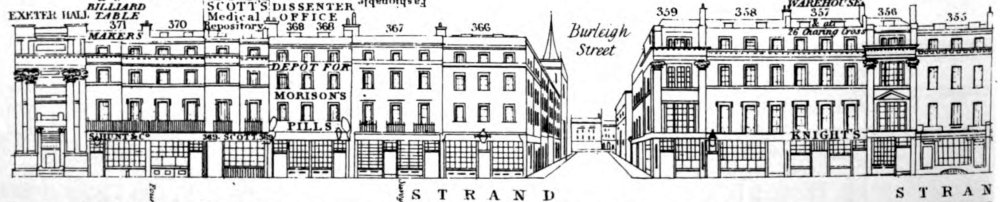
Above - The Exeter Hall and Strand as depicted in Tallis's London Street Views 1838 - 1840. The site is today occupied by the Strand Palace Hotel.
 When it was determined to pull down the old 'Change and widen the street, several persons of influence in the religious
world proposed a scheme for building a large edifice, which should contain
rooms of different sizes, to be appropriated exclusively to the uses
of religious and benevolent societies, especially for their anniversary
meetings, with committee-rooms and offices for several societies whose
apartments were at that time crowded in houses taken for the purpose,
as is the case at present with several scientific bodies, who might
take a hint on the subject, and erect a large building for their joint
accommodation.
When it was determined to pull down the old 'Change and widen the street, several persons of influence in the religious
world proposed a scheme for building a large edifice, which should contain
rooms of different sizes, to be appropriated exclusively to the uses
of religious and benevolent societies, especially for their anniversary
meetings, with committee-rooms and offices for several societies whose
apartments were at that time crowded in houses taken for the purpose,
as is the case at present with several scientific bodies, who might
take a hint on the subject, and erect a large building for their joint
accommodation.
Right - Exeter Hall - From the book 'London' Which was edited by Charles Knight and Published in 1843.
Exeter Hall was completed in 1831. It attracts little attention from the passenger, as the frontage is very narrow, and the exterior simply consists of a lofty portico formed of two handsome Corinthian pillars, with a flight of steps from the street to the Hall door. But when any great meeting is assembled, or is about to break up, there is no mistaking the place. The building stretches backward and extends to the right and left a considerable space. The Strand entrance leads to a wide passage, which at the extremity branches off into transverse passages. Two flights of steps, which meet above, lead to the great Hall, ninety feet broad, one hundred and thirty-eight long, and forty- eight high. It will hold four thousand persons, and, with scarcely any discomfort, a much larger number...

Above - The Interior of Exeter Hall - From the book 'London' Which was edited by Charles Knight and Published in 1843
...The ranges of one half the seats rise in an amphitheatrical form, and the platform, at one end, is raised about six feet, and will accommodate five hundred persons. The "chair" in the front is not unlike that of Edward the Confessor in Westminster Abbey. The speakers, near the front, are accommodated with chairs, behind which rise rows of benches. Two flights of steps extend from the front row to the entrances at the back.
Eight or nine years ago the capacity of the great Hall was enlarged by the erection of a gallery at the end opposite the platform, and two or three years afterwards the curve of the platform on each side was extended into galleries reaching a considerable distance into the middle of the room along the walls. When the Hall is quite filled the sight is grand and striking...'
The above text in quotes was first published in 'London' edited by Charles Knight, 1843.
The Strand Palace Hotel, 1909

Above - The Strand Palace Hotel shortly before it opened in September 1909. The Hotel was built on the site of the former Exeter Hall and Patagonian Theatre on the Strand in London - From The Tatler, 15th of September 1909.
 The Exeter Hall had opened on March the 29th 1831 and continued in business for many year but it was eventually closed and demolished in 1907. The Strand
Palace Hotel was then built on the site for Joseph Lions, opening just two years later on Tuesday the 14th of September 1909. The Illustrated London News reported on the imminent opening of the Hotel in their 11th of September 1909 edition saying:- 'Messrs. Joseph Lyons and Co., who have done so much to reform and revolutionise the catering business, have added one more to their already numerous establishments. Their grand new Strand Palace Hotel, situated in the heart of the Strand, will be opened to the public on Tuesday. The principal novel feature of the hotel will be the prohibition of tips, which have always been an annoyance and embarrassment.
The Exeter Hall had opened on March the 29th 1831 and continued in business for many year but it was eventually closed and demolished in 1907. The Strand
Palace Hotel was then built on the site for Joseph Lions, opening just two years later on Tuesday the 14th of September 1909. The Illustrated London News reported on the imminent opening of the Hotel in their 11th of September 1909 edition saying:- 'Messrs. Joseph Lyons and Co., who have done so much to reform and revolutionise the catering business, have added one more to their already numerous establishments. Their grand new Strand Palace Hotel, situated in the heart of the Strand, will be opened to the public on Tuesday. The principal novel feature of the hotel will be the prohibition of tips, which have always been an annoyance and embarrassment.
Right - An Advertisement for the imminent opening of the Strand Palace Hotel in 1909 - From the Globe, 2nd of September 1909.
Though the tariff will be on popular lines, the hotel will be thoroughly up-to-date in luxurious accommodation. Some idea of its size may be gained from the fact that it will be possible to cater for 800 people at once in the restaurant, grill-room, and winter garden, and the number of bedrooms is 470. Each one of these contains, in addition to comfortable furniture, a marble basin with hot and cold water laid on.
The total charge for bed, breakfast, bath, etc., is 6s., and for a double room, 11s. Luncheon at 6d. will be served from twelve to three, and a half-a-crown table-d'hote dinner between six and nine. Mr. Joseph Lyons entertained a large gathering at an inaugural luncheon on Monday last.' - The Illustrated London News, 11th of September 1909.

Above - A Google StreetView Image showing the Strand Palace Hotel in July 2022, the Hotel was built on the site of the former Patagonian Theatre and Exeter Hall in 1909 - Click to Interact.
The Strand Palace Hotel is still in business today but the site's long entertainment history stretching right back to 1776 when the Patagonian Theatre first opened there is well and truly over.
Some archive newspaper reports on this page were collated and kindly sent in for inclusion by B.F.