
The Life of an Actor
An Autobiography by H. F. Lloyd, Comedian
Late of the Theatre Royal Edinburgh and Glasgow
Index
CHAPTER ONE
INTRODUCTORY AND RETROSPECTIVE
 In
accordance with the oft- repeated requests of many friends that I should
put into print some recollections of my long career as an actor, I venture
with some misgivings, I confess-to come before the public in a (to me)
entirely new character, namely that of an "author". Before
entering upon my professional experiences, however it may not be out
of place that I should say a word or two about the family
tree of which I am a branch; and the more so from the fact that
a biographical sketch of myself, concocted
some years ago for a Glasgow periodical, was grossly inacurate-and,
in some parts indeed, laughably false- from beginning to end.
In
accordance with the oft- repeated requests of many friends that I should
put into print some recollections of my long career as an actor, I venture
with some misgivings, I confess-to come before the public in a (to me)
entirely new character, namely that of an "author". Before
entering upon my professional experiences, however it may not be out
of place that I should say a word or two about the family
tree of which I am a branch; and the more so from the fact that
a biographical sketch of myself, concocted
some years ago for a Glasgow periodical, was grossly inacurate-and,
in some parts indeed, laughably false- from beginning to end.
Many persons have been under the impression that I sprang from a theatrical stock. Such however is not the case. Neither my father, mother, nor any of their relatives were ever behind the scenes of a theatre, or ever saw me on the stage. My father was born in Wales; and from some family misunderstanding, ran away from a home of the independence when a mere las. (Sic) Finding his way to London, he there got into business, and there settled down until retiring for good and all to Chertsy. He was the only one either on his own or my Mother's side who had gone into trade. His relatives went into the Army and the Church, and those of my Mother into the Navy. My maternal Grandfather was Captain Gill, whose son became Admiral Thomas Gill, Moreover, three of my uncles were captains in the Navy, one of them, Captain Jeffrey, being the author of the work on Van Diemen's Land, and the discoverer of several islands in that part of the world, some of which he named after the family. My brother George has large properties in Geelong and Hobart Town, and is the Author of "Thirty Years In Tasmania." I have five brothers, all-lucky fellows-independent, except the youngest, a dentist in Calcutta, and two sisters, one married to the son of Dr. Slade, a celebrated London Physician, and the other widow of a Lieutenant Fernel, who was killed in the Indian Mutiny.
 I
trust that in putting on record these jottings as to my pedigree I shall
not be ------ emotional. My simple notion was that they might be found
not altogether uninteresting to some among a public who have for so
many years so generously approved of my proffesional efforts.
I
trust that in putting on record these jottings as to my pedigree I shall
not be ------ emotional. My simple notion was that they might be found
not altogether uninteresting to some among a public who have for so
many years so generously approved of my proffesional efforts.
Left - Horatio Lloyd from an article in The Bailie, 1876, - Courtesy James Francis.
I may add that whatever is stated in the following chapters can be depended upon as within my knowledge-excepting, of course, incidents taking place before my time, and which were related to me by others. And now, good friends, in setting the work, such as it is, before you, let me commend it-my little offering-my first-to your kindly care and indulgence. I send it forth to the world a stranger, unknown and dependent for support on its own unpretending merits. Be charitable then; take it in, and grant it an occasional smile by way of encouragement. Should it ever unhappily, on better acquaintance, be deemed unworthy of your support, be lenient with it, for my sake; and I, as a parent, promise it shall never do so any more. H.F. Lloyd Glasgow May, 1886.
MY BIRTH AND EARLY RECOLLECTIONS
"Good luck! What have we here? Mercy on's, a barne; a very pretty barne! A boy child, I wonder?" - The Winters Tale
"Horatio - or I do forget myself" - Hamlet
ICANNOT begin at an earlier period than that denoted by the title of this chapter; and moreover, as I cannot from recollection give an accurate narrative of the stirring events which occurred on the day that I was born, and for some time thereafter, pray accept from hearsay what I believe to be true. The date of my introduction into this piping world was a great day for London; it was a general holiday. Bow bells were ringing a merry peal- drums roiling- trumpets blowing- all was bustle and excitement; so I was told.
 Can
you imagine why such an honour was done me? No? Then I will tell you.
Two great events were taking place at the same time; the first being
no less than the birth of a son and heir to the house of Lloyd,
and the second-the celebration of Lord Mayor's day.
Can
you imagine why such an honour was done me? No? Then I will tell you.
Two great events were taking place at the same time; the first being
no less than the birth of a son and heir to the house of Lloyd,
and the second-the celebration of Lord Mayor's day.
Left - The Site of 71 The Strand in 2003.
At twelve o'clock on 9th November, 1815, (see note below) as the grand precession was escorting the Lord Mayor elect on his way to be installed, I, amid raptures of delight and admiration, made my first appearance on any stage at No. 71 Strand, London. (See here for more information on Horatio's father Robert Lloyd and his Hatters shop at 71, Strand.)
(Note that in several articles on this site Horatio's birth is stated variously as 1805, 1808, 1809 and 1815. The correct date is the 9th of November 1807. I have details of his Christening at St. Sepulchre, Newgate, London on the 25th December 1807 with his brother George Thomas Lloyd which states his date of birth as 1807.)
I was a most decide hit. My aunt Mary exclaimed. "He's the most intelligent infant I ever beheld:" nurse declared I was "a duck of a baby, a regular model:" and pa, who had stood gazing on his bright production in silent wonder, mingled with approbation, proudly observed that I "Could not be otherwise than a perfect specimen with such a man for a father." My poor Mother looked lovingly on me as I lay " mewling and puking in the nurse's arms, and predicted that I should be Lord Mayor of London some day or other.
She couldn't account for it, but there was something or other that seemed to tell her so." I never have been yet, however, although I have been very near to one on several occasions. Mother said also that I appeared as much elated as the joyous events of the day, as themselves, or the public, for I, "actually laughed" when I was born. Nurse said I "only smiled" but mother persisted in it's being a bona-fide laugh; and, as it is considered imprudent to contradict ladies at such times, nurse artfully agreed. "Now , when she com'd to think on't," she said, "for sartin sure it wor a larf; cos as how what brought it home more partiklar to her mind was that at that very moment I did it I nearly slipped through her fingers as she wor a liftin' me out of a pan of warm water. It wor a laugh, sure enough- in fact, a reg'lar roar." My Father quietly suggested that the latter was probably the correct word, as he had a notion that the water in the pan was nearly boiling hot at the time. When the time came that I should have a Christian name formally bestowed upon me, I narrowly escaped being called Ezekeil. My Godfather had actually forwarded that name to the clergyman, when my mother interfered at the very last moment, and so the child was christened as Horatio Frederick.
"BARTLEMY FAIR" AND ITS EFFECTS
I cannot now say with certainty what was the first time that I was taken to a place of amusement; but as the Yankees say, I rather guess a visit to Bartholomew Fair-called by the Cockneys "Bartlemy Fair"- is responsible for laying the foundations of my juvenile transgressions. This once famous gathering, as old stagers will remember, was held in Old Smithfield Market ground in the month of September, If I don't mistake. It lasted for over three days, and it's opening was a very big affair indeed. At twelve O'clock noon, the Mayor and the Sheriffs in their State carriages and court robes, with the trumpeters and other officials, came on the scene and drove slowly round the ground. Having made the circuit a herald proclaimed the Fair to be opened: after which his Lordship and the Sheriff entered one or two of the better class of shows, and witnessed a portion of the entertainments. Upon the retiral of the authorities, the business of amusement commenced in earnest amid the uproar of drums, trumpets, gongs, bells, and every conceivable form of instrument calculated to make the most noise and attract most customers to the various shows. To this greatest gathering of its kind, then I was taken, for the first time, by my paternal parent at an early age. I was simply thunderstruck. We first visited the famous Richardson's show, an immense theatrical booth, with a company of, I should think, not fewer than 40 in all, men and women, who made an immense display in costume outside on the "parade." There we saw a tragedy and a pantomime, with a comic song between, the whole performances being got over in about half an hour. The name of the tragedy is lost to me, all I remember being that, at the end, a bad man went below in red fire, while the ghost of a lady stood behind watching his decent. But the pantomime! O, the pantomime! - I was in ecstasies. The clown especially-never shall I forget the early impression made on me by that clown. We then visited Wombell's, and saw the man put his head into the lion's mouth; and next we patronised Adam's Circus, where to my inexpressible delight, there was another clown. I cared for nothing else; and as we walked homeward from the Fair, I mentally determined that some day I would be a clown myself. On our arrival at home I hastened to tell my mother, and to her astonishment, entered the room turning head over heals at the same time crying- "Here we are!" I then told her all that I could remember of the grand sights I had that day seen, a recital which lasted until my bed-time. On turning in I fell into a restless sleep, for I was riding horses, dancing on tight-ropes, and playing clowns all through it.
 On
awakening in the morning, I commenced by tumbling A La Clown on the
bed, and, after dressing, endeavoring to balance myself on my head in
the corner. In short, I began the day standing on my head and finished
the day by nearly breaking it- as you shall hear. Feeling convinced
that the tight-rope walking feat could easily be accomplished, I determined
to have a trial at it. To this end, I procured a clothes' line, one
end of which I secured to the Kitchen table. Then taking a kitchen chair
to a distance, I tied the other end of the line around the top rail,
pulled it straight, and whitened it, as I had seen the clown do with
a piece of chalk at the Circus. Then I bethought me of that most important
requisite, the balancing-pole. I have, said I, and pulled out the handle
of a long broom. All being prepared I got the two maid-servants to sit
at the other end of the kitchen as the audience, and witness the performance.
I then took off my jacket, mounted the table, took the pole in hands,
amid generous applause of the "audience," and put my foot
on the rope. The immediate result was that down it went, and me along
with it, whilst the chair, being pulled forward with great force, struck
me heavily on the forhead, cutting it. There I lay, stunned and bleeding,
for some time quite unconscious; and, on recovering my senses, found
my mother and the servants bathing my head. The scar caused by this
occurence remains visible to this day; so you see that on early impression
has left a lasting one. My juvenile mania for acting grew more furious
as I grew older,its development being favored by the fact that my father
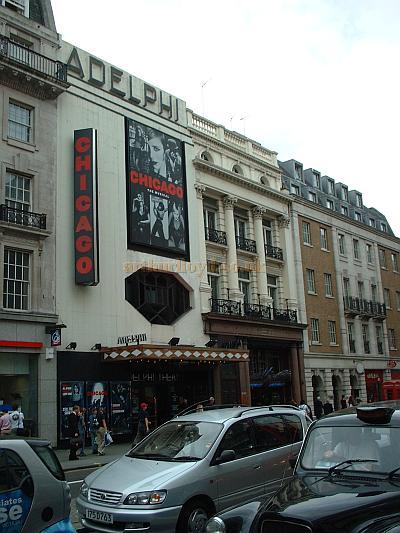
having so many "orders" given him for the Adelphi
Theatre, opposite us in the Strand,
I was a constant frequenter at that house. I got dresses made, sang
comic songs in character whenever we had an evening party at home-including
"Tippety-Witchet," painted and made up as a clown, one result
of which latter was a little serious. It ended in my poisoning my lips
with red ochre, so that I was for some under the doctor's hands. Thus
cautioned about clowning, I turned my attention to Tragedy; and there
were occasions on which, while our foreman-a strict Methodist-was singing
Wesleyan hymns, accompanying himself on the fiddle, in the back of the
counting-house, I might have been found spouting Shylock, with a pair
of home-made tin scales and a carving knife, calling loudly for my "pound
of flesh" - in the front Warehouse.
On
awakening in the morning, I commenced by tumbling A La Clown on the
bed, and, after dressing, endeavoring to balance myself on my head in
the corner. In short, I began the day standing on my head and finished
the day by nearly breaking it- as you shall hear. Feeling convinced
that the tight-rope walking feat could easily be accomplished, I determined
to have a trial at it. To this end, I procured a clothes' line, one
end of which I secured to the Kitchen table. Then taking a kitchen chair
to a distance, I tied the other end of the line around the top rail,
pulled it straight, and whitened it, as I had seen the clown do with
a piece of chalk at the Circus. Then I bethought me of that most important
requisite, the balancing-pole. I have, said I, and pulled out the handle
of a long broom. All being prepared I got the two maid-servants to sit
at the other end of the kitchen as the audience, and witness the performance.
I then took off my jacket, mounted the table, took the pole in hands,
amid generous applause of the "audience," and put my foot
on the rope. The immediate result was that down it went, and me along
with it, whilst the chair, being pulled forward with great force, struck
me heavily on the forhead, cutting it. There I lay, stunned and bleeding,
for some time quite unconscious; and, on recovering my senses, found
my mother and the servants bathing my head. The scar caused by this
occurence remains visible to this day; so you see that on early impression
has left a lasting one. My juvenile mania for acting grew more furious
as I grew older,its development being favored by the fact that my father
having so many "orders" given him for the Adelphi
Theatre, opposite us in the Strand,
I was a constant frequenter at that house. I got dresses made, sang
comic songs in character whenever we had an evening party at home-including
"Tippety-Witchet," painted and made up as a clown, one result
of which latter was a little serious. It ended in my poisoning my lips
with red ochre, so that I was for some under the doctor's hands. Thus
cautioned about clowning, I turned my attention to Tragedy; and there
were occasions on which, while our foreman-a strict Methodist-was singing
Wesleyan hymns, accompanying himself on the fiddle, in the back of the
counting-house, I might have been found spouting Shylock, with a pair
of home-made tin scales and a carving knife, calling loudly for my "pound
of flesh" - in the front Warehouse.
SCHOOL DAYS AT "DOTHEBOYS' HALL"
"And then the whining schoolboy, with his satchell
And shining morning face, creeping like snail
Unwillingy to school." As You Like It.
At about the age of six years I was first sent to a day-school, composed of small girls and boys, and kept by a rheumatic old lady, who was always half asleep or half tipsy. She would call us to her table to go over the A, B, C, but before getting through with the lesson she would be snoring. This was a signal for all to slink quietly away from her, and commence a game of "Blind man's buff" or Honeypots." The noise we made over the game would wake her up suddenly, when she would scream out at the top of her voice- "You imps of Satan, get home-get home! I shall teach no more till the day after to-morrow-I'm going to have two days' rheumatiz. 'Matilda! (to her slavey) two-pennorth of Jackey (gin).'" One week completed my educational career at "Miss Smith's establishment for young ladies and Gentlemen," which I left well grounded in the English alphabet-that is to say, up to the seventh letter thereof. After this I was sent to a first-class "preparatory academy," on leaving which I was placed in Mr Pike's boarding school at Edmonton. On going home from here for the midsummer holidays, I had a serious illness (pleurisy), the only one, I am happy to say, I ever had in my lifetime. I was just then between nine and ten years old, and grew so tall of my age and so weak, that, on my recovering from the illness, I was obliged for some time to be led about by a person on each side supporting me. I continued growing until I was fifteen, when I had attained the enormous height of 5 feet 4 inches, at which I have stuck ever since.

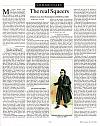 The Times Literary Supplement published this part of Horatio's Autobiography
in the 19 & 26 December 2003 issue because
of its interesting references to Charles Dickens.
The Times Literary Supplement published this part of Horatio's Autobiography
in the 19 & 26 December 2003 issue because
of its interesting references to Charles Dickens.
'The
Real Squeers' 'Dickens
may have been unjust to Dotheboys Hall'
Published 19 & 26 December 2003 - £2.50
EXPERIENCES WITH "MR SQUEERS"
But what I consider the most interesting period of my school days has now to be referred to. It was the twelve months or thereabouts, which, after leaving Pike's, I spent at Bowes academy, by Greta Bridge, Durham, immortalised in "Nicholas Nickleby" as "Dotheboys' Hall," Yorkshire, and the headmaster of which was a most worthy and kind-hearted, if somewhat peculiar, gentleman named William Shaw, whom Dickens, to suit his own purposes, chose to pillory as Mr Squeers. I can see him now as plainly as I did then, and can testify to the truth of the outward presentment of the man as described by Dickens, and depicted by his artist in the pages of the novel-allowing, of course, for both being greatly exaggerated. A sharp, thin, upright little man, with a slight scale covering the pupil of one of the eyes. Yes. There he stands with his Wellington boots and short black trousers, not originally cut too short, but from a habit he had of sitting with one knee over the other, and the trousers being tight, they would get "ruck'd" half way up the boots. Then the clean white vest, swallow tailed black coat,white neck tie, silver-mounted spectacles, close cut iron-grey hair, high crowned hat worn slightly at the back of his head-and there you have the man.
But what was the school itself like? And how about the poor Smikes?-it may be asked. Well I can answer as to that, and maintain the truth of every word I write. It was a fine large establishment, with every accommodation required. It was in a lovely situation, surrounded by a beautiful garden, the beck running past at the foot of the hill, and the romantic ruin of Bowes Castle within a hundred yards of the house, just outside the garden wall. The interior of the house was kept scrupulously clean, twelve female servants at least being employed. The food was excellent, and as much as you could eat: the boys well clad-shoemakers and tailors on the premises-for be it known that the boys were clothed as well as boarded and educated, and all, if my memory be correct, for some £20 a year. No such thing as a Smike was to be seen here, and there was less punishment for inattention than in any other school I ever attended. "Save in the way of kindness," I never, except once, knew Mr Shaw to lift his hand to a boy the whole time I was there. He would walk around the school room, look over us while writing, and here and there pat a boy on the head, saying "good boy-good boy; you'll be a great man some day, if you pay attention to your lessons." If a lad was ill, he would sit by his bed-side and play the flute-on which he was an adept-for an hour or two together to amuse him. And this was the man whom Dickens transformed into the illiterate tyrannical, brutal pedagogue Squeers!
THE REAL HOME OF THE SMIKES
I remember, however, another school, of the type described by Dickens. There, indeed, you might have found many a Smike. Boys in rags, half starved, and otherwise cruelly used, and taught scarcely anything, except haymaking, carting manure, and kindred departments of industry. They were continually running away and almost as regularly caught, brought back, and frightfully punished. Schools like this there were in Yorkshire which deserved all the exposure they got. But, as it so happened that none of them at the time had a headmaster sufficiently outre or striking in appearance to make a good character of, poor William Shaw, who had the misfortune to be peculiar both in person and manners, was transferred from the headship of his own happy establishment and made the Squeers of "Dotheboys Hall," Yorkshire. It broke his heart. A few years ago, when at Barnard castle, my son Arthur and I walked over to Bowes to see the old place. As we passed the church-yard-in the middle of which stood the old ruin-close to the gate, the first thing that caught my eye was a tombstone on which was graven, "Sacred to the memory of William Shaw, &c." His daughter, a very pretty and ladylike girl, married a wealthy farmer, and, at the time we saw it, had the house as a private residence. The old school room at the back, however, she allowed to go to ruin.
A REMINISCENCE OF DICKENS
Iam aware that it is an old story now, but I trust the reader will excuse me devoting the remainder of this chapter to a few facts bearing on the acquaintanceship of Charles Dickens with the man who he held up to public contempt and indignation as Squeers. Some years ago I received from an old school-fellow at Bowes, settled in London, a letter in which, after recalling many pranks of our school days, he goes on to say:- "By the by, how strange that none of Charles Dicken's friends ever mentioned that he was at Dotheboys Hall. I see no disgrace in it, indeed. I think there is much credit due to our old usher Mackay that many of his pupils have turned out so well in life. In fact, I'm thinking of writing to the Telegraph, stating that Dickens received the best part of his education at Shaw's. Do you remember a nice smart boy that sat directly under Shaw's desk, who used to act in our private theatricals, a great favourite of Shaw's who never passed him without saying a word of encouragement to him? This was Dickens, Shaw little thought that the boy he was so praising would be his ruin in after life, &c., &c.-Yours sincerely, M.S."
Understand I have no recollection of this, as it was long after my correspondent that I went to Shaw's, and I left before him. I remember the private theatricals well, but whether Dickens was there in my time, or was there at all, I cannot say. I remember the boy well from the description, but not his name. Oddly enough, the writer of the letter above quoted was the very boy I have referred to as being the one exception who was chastised by Mr Shaw in my presence. A few years ago, when passing through Barnard Castle (which is just three miles from Bowes), I myself heard that Dickens had resided there for some time. The same barber that shaved me had attended him often.
He (the barber) pointed out to me a little inn close by as the house in which Dickens lodges, and added that he used to walk over to Bowes two or three times a week, that he was known to be always writing, and that no one could make out who or what he was. After the novel appeared, however, its author was put down by all the people thereabouts as the man who used to write so much, and inquire so particularly about Bowes.
But furthur. In the year 1871 my son Arthur, myself, and one or two others, made a short professional tour in England. Amongst the towns we visited was Sunderland. We put up there at the Palatine Hotel, then kept by a Mr Thompson, and remained for a week. At night, after our entertainment was over, we used to sit in the bar parlour, and there one evening we met an old lady of the name of Ewebank, an aunt of Mrs Thompson. In the course of conversation she informed me that she came from Barnard Castle. I felt rather interested at this, and asked her if she had known a Mr Shaw of Bowes. "Intimately," she replied, "for years." I then inquired if she had ever seen Dickens, the author of "Nicholas Nickleby." "See him," she answered, "why, he lived with us at Barnard Castle for months; my husband kept the King's Head, where he stayed." This was the very little inn that, as I have mentioned, was pointed out to me by the barber, and so I got more anxious to hear all I could from the old lady. Accordingly, I next asked- "Did you know John Browdie?" "Quite well," she said; "his real name was John F---, of Broadiswood, a farmer, and he married a Miss Dent, a cousin of Miss Shaws." In continuing, Mrs Ewebank told me that Dickens walked two or three times a week to Bowes to see Mr Shaw, and often spent the day there; That he was always writing, and was supposed by them to be a commercial traveler. On her asking him once if he had known Mr Shaw long, he replied, "Since I was a boy; but I haven't seen him for some time until lately. I lived in the neighborhood then." After he left the King's Head she never saw or heard of him again; but, when the novel came out, they all said-"that must be the man who was always here, and was so often at Mr Shaw's."