
The Scala Theatre, 58 Charlotte Street and Tottenham Street
Formerly - The New Rooms in Tottenham Street / The King's Concert Rooms / The Cognoscenti Theatre / The New Theatre / The Regency Theatre / The West London Theatre / The Queen's Theatre / The Fitzroy Theatre / The Prince of Wales Royal Theatre
Introduction - The Regency Theatre / The Prince of Wales' Royal Theatre - The Scala Theatre - Working at the Scala Theatre - The Scala Theatre as a Picture House - The Merry Widow - Babes in the Wood
See also Neil Sean on the Scala Theatre here

Above - A Google StreetView image of Scala House, Charlotte and Tottenham Streets, which stands on the site of the former Scala Theatre today - Click to Interact.

 The
Scala Theatre was situated on Charlotte Street and Tottenham Street,
London, and was opened by Lady Bancroft on the 19th of December 1904.
The Theatre was designed by the well known Theatre Architect Frank
T. Verity and had a capacity on opening of 1,139, with a stage 30'
6" wide by 54' deep
The
Scala Theatre was situated on Charlotte Street and Tottenham Street,
London, and was opened by Lady Bancroft on the 19th of December 1904.
The Theatre was designed by the well known Theatre Architect Frank
T. Verity and had a capacity on opening of 1,139, with a stage 30'
6" wide by 54' deep
Right - The Charlotte Street Facade of the 1904 Scala Theatre.
The Scala Theatre was however, built on part of the site of the former Prince of Wales Royal Theatre which had itself been erected on the site of a series of previous houses of entertainment with a multitude of different names.
 Entertainment on the site first began when a new building
opened on Tottenham Street in 1772 called, appropriately enough, 'The
New Rooms in Tottenham Street'.
Entertainment on the site first began when a new building
opened on Tottenham Street in 1772 called, appropriately enough, 'The
New Rooms in Tottenham Street'.
The New Rooms in Tottenham Street had many alterations and name changes throughout its history. It was variously known as the King's Concert Rooms, Cognoscenti Theatre, New Theatre, Regency Theatre, Tottenham Street Theatre, West London Theatre, Queen's Theatre, Fitzroy Theatre, and finally the Prince of Wales Royal Theatre before it was demolished to make way for the building of the Scala Theatre in 1904.
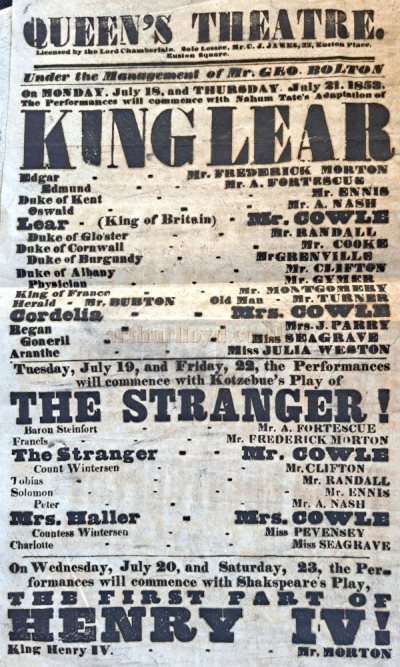
Left - A Bill for 'King Lear' and other pieces at the Queen's Theatre, Tottenham Street in July 1853 whilst under the Management of Charles James James - Courtesy Simon Moss, stagememories.
There is much information on the old and new Theatres in the opening night report for the Scala Theatre transcribed below, and the history of one of its former incarnations, the Regency Theatre, is described in an 1832 report directly below.
The Regency Theatre, Tottenham Street
From an article dated 1832
Later - The Prince of Wales' Royal Theatre

Above - A watercolour of the Regency Theatre, Tottenham Street in 1817, later the Prince of Wales Theatre and part of the site of the later Scala Theatre, Charlotte Street - From a Print dated 1832 - Courtesy Caroline Blomfield
 This Theatre is built on the site
of His Majesty's late Concert Rooms for Ancient Music, first suggested
and established by the late Earl of Sandwich, under the sanction of
the King, and after honoured in bearing the name of his Rooms. Their
Majesties several times visited the musical performances at this place;
but it being found too small and inconveniently situated to accommodate
the numerous subscribers, the Hanover Square Rooms were engaged, and
the Ancient Concerts for many years have been performed there.
This Theatre is built on the site
of His Majesty's late Concert Rooms for Ancient Music, first suggested
and established by the late Earl of Sandwich, under the sanction of
the King, and after honoured in bearing the name of his Rooms. Their
Majesties several times visited the musical performances at this place;
but it being found too small and inconveniently situated to accommodate
the numerous subscribers, the Hanover Square Rooms were engaged, and
the Ancient Concerts for many years have been performed there.
Right - A Poster for the Regency Theatre of Variety for the 8th of February 1819 - Courtesy Gavin Sandeman. The Bill which is advertising 'Richard the III' amongst other pieces, appears to feature Edmund Kean but in fact his name was used in relation to a wager that Mr. Roach would perform equally as well as Kean! This was probably done just to have Kean's name on the Poster, thereby enticing people to watch the performance.
Hyde the Trumpeter afterwards rented these premises, and they were called Hyde's Rooms, for Concerts. On his quitting them they were untenanted for some time, and very much out of repair, when Colonel Greville engaged them, fitted them up in an elegant manner, and instituted his celebrated Pic Nic Society, which made so much noise and glee among the fashionable world, that it was thought it would considerably hurt the regular theatres; indeed, so much so, that the proprietors of the two winter houses interfered, and endeavoured to stop their Performances; however, the Dilettanti opened under a sort of agreement with Sheridan and Richardson, that not more than ten representations should take place each season, and no hired performers of any existing theatre to act in them. The parts to be acted BONA FIDE by ladies and gentlemen, and to be inserted on their cards, "With Consent of the Proprietors of the established Winter Theatres." Such an agreement was assented to and hastily signed by Col. Greville, who immediately after withdrew his signature. Their motto was, "On fait ,ce qu'on peut, et non ce qu'on veut" - We do what we can, but not what we wish. They commenced on the 15th of March 1802, with a prologue by Greville, and an interlude, written by and principally acted by himself, founded on the difficulty and opposition he had experienced in forming the society; and two French proverbs, Zing Zing and Les Foux, acted by French people. The company then retired to the refreshment rooms, and the audience part of the Theatre was in a few minutes converted into a supper room, for the audience to return and partake of a cold collation. After supper catches and glees were introduced, accompanied by a grand pianoforte; and the company departed about half past twelve o'clock. The subscription for the season was five guineas, and in lieu of Pic Nic one guinea, 'with six bottles of wine for the season, half white, half red, no wine being allowed to be sold on the premises: the subscription to be paid to Messrs. Coutts and Co.
The Society continued here for some time, and several full plays were acted, occasionally assisted by actresses and actors from winter houses. Captain Sowden, who went up in the balloon with Garnerin, and compared Epping Forest to a gooseberry-bush, was Greville's official man in the stage direction. Sowden was the same who, in 1810, appeared at the Haymarket Theatre, by the name of Stapleton, in Dennis Brulgruddery, and was afterwards engaged by the Drury Lane Company at the Lyceum, and in both instances completely failed. Richard Choyee Sowden, alias Stapleton, died in August 1811, at Islington, in the thirty-first year of his age. He was a man of singular and eccentric habits, had been a captain in the navy, and driven to the stage by necessity, after squandering away his property, having at twenty-one inherited six thousand pounds.
In the year 1808, Saunders (the father of Master Saunders, the rider) fitted up the interior of this place in a very temporary manner, and opened it for horse-riding principally, but had some trifling stage performances, which was attended by very low company, and lasted but for a short period, though he made every possible exertion to fill his house, by parading the whole troop of performers through the streets and squares of the neighbourhood daily.
1n 1810, Mr. .J . Paul, a pawnbroker in Upper Mary-le-bone Street, who had made some property by his business (solely for the purpose of gratifying his wife's ambition to perform, and for which she was but very indifferently qualified), took the Rooms on lease, pulled down the fittings-up within the walls, built an elegant little Theatre, adorned the outside, erected a portico to the entrances, and opened with Love in a Village as a burletta, contrary to Act of Parliament, Mrs. Paul playing Rosetta. A very few weeks terminated their career, and Paul became a bankrupt.
The Theatre was afterwards let to several speculating managers; and some tradesmen who had been for many years respectably situated in business, were infatuated enough to embark in this ruinous concern, and lost their all: among whom ranked as the chief, Mr. Spragg, printer; and Mr. Cooke, the dyer and hot-presser: the latter of whom did not long survive the misfortunes he had entailed on himself.

Above - A watercolour of the auditorium of the Regency Theatre, Tottenham Street in 1817 - From a Print dated 1832 - Courtesy Caroline Blomfield
 Penley,
the brother of the late actor of Drury Lane,
was one of the first adventurers that engaged the place after Paul's
failure, but with very little success, commensurate with his expectation.
Of the Drury Lane Penley, an anecdote is at present in circulation,
of rather a ingular nature. The late Mr. Raymond, with several of his
brother comedians (among whom was Mr. Penley), having, about two years
since, made a party to enjoy a day at Greenwich,
previous to dinner amused themselves in the Park, and, among other diversions
of the mimic party, a sham duel was proposed, and performed: in which
it was Mr. Raymond's part to fall; Mr. Penley was appointed to the office
of sham-undertaker; but afterwards, quitting the stage and commencing
the business of an upholsterer and real undertaker, performed in earnest
that last office to his departed brother actor and friend, Mr. Raymond,
on Sunday, October 28th, 1817,
when the latter was buried in the-churchyard of St. Paul, Covent Garden,
attended to the grave by his theatrical brethren of both houses, in
thirty-five mourning coaches, a cavalcade of thirteen private carriages
closing the procession.
Penley,
the brother of the late actor of Drury Lane,
was one of the first adventurers that engaged the place after Paul's
failure, but with very little success, commensurate with his expectation.
Of the Drury Lane Penley, an anecdote is at present in circulation,
of rather a ingular nature. The late Mr. Raymond, with several of his
brother comedians (among whom was Mr. Penley), having, about two years
since, made a party to enjoy a day at Greenwich,
previous to dinner amused themselves in the Park, and, among other diversions
of the mimic party, a sham duel was proposed, and performed: in which
it was Mr. Raymond's part to fall; Mr. Penley was appointed to the office
of sham-undertaker; but afterwards, quitting the stage and commencing
the business of an upholsterer and real undertaker, performed in earnest
that last office to his departed brother actor and friend, Mr. Raymond,
on Sunday, October 28th, 1817,
when the latter was buried in the-churchyard of St. Paul, Covent Garden,
attended to the grave by his theatrical brethren of both houses, in
thirty-five mourning coaches, a cavalcade of thirteen private carriages
closing the procession.
Right - W. S. Penley as 'Rev. Robert Spalding' in 'The Private Secretary' - From A set of 25 cigarette cards depicting Theatre Stars of the Day - Issued by John Player & Sons in 1916.
The season in which the Regency Theatre most prospered was when Cobham (afterwards of Sadler's Wells and the Surry Theatre) performed the parts of Marmion, and Gloucester, in Jane Shore; both of which pieces brought crowded houses. Indeed, this gentleman's performance of Marmion attracted such notice, that it is said Mr. Kemble, who purposely went to see him play the part, gave his opinion, that, had his figure been equal to his conception, action, and delivery, he would have become one of the greatest ornaments to the stage. But even Cobham did not possess the power to draw sufficient company beyond a season; and the novelty ceasing, the Regency gradually fell into decay.
Mrs. Powell, formerly of Drury Lane and Covent Garden Theatres, who on several occasions had successfully been (in both those Theatres) a substitute for Mrs. Siddons, condescended to appear on these boards; and Fitzwilliam, the present favourite at the Surry Theatre, is indebted to the Regency Theatre for his first introduction to a London audience. The confined scale, however, of the establishment, prevented any manager from securing long the service of a favourite actor; none of which have ever considered the Regency engagement otherwise than a prelude to better situations, of which they have invariably availed themselves with the first convenient opportunity.
December 5, 1814, the lease was sold by auction, by Robins; the only bidders were, Watson, the Cheltenham manager; and Beverley, formerly of Covent Garden Theatre, in a-minor department. Beverley made the first bidding fifty guineas, which the assignees would have gladly accepted, and, rather than not have got rid of it, would have presented it to any one. They bid against each other till it was knocked down to Beverley at three hundred and ten guineas. The conditions of sale stated the privilege of keeping open all the year, upon a magistrate's license - the Theatre to have cost 4000 l. upon a term of thirteen years from Christmas 1813, at the very low rent of 177 l - sold by order of the assignees, and the money to be paid in three months: it was stated that the taxes were 35 1. that the moveable property was worth 300 1. and the Theatre was usually let for 20 1. a week.
If the present occupier can possibly make it answer, it must be by reducing the expenses to a very low scale indeed, and employing the whole of his family in the concern. Their chief support is from-the half price.
The entrance to the King's Ancient Concert Rooms was (prior to the converting them into a Theatre) in Pitt Street, communicating with John Street, Tottenham Court Road, and Charlotte Street, Rathbone Place.
The Committee of the Musical Fund held their meetings here; and every quarter a part of them attended, to receive the statement, and settle the claims on their establishment. All orphan children of Musicians belonging to the Fund were apprenticed from this place. The premium given is twenty pounds; and ten pounds to each for working tools, &c. at the expiration of their apprenticeship.
The above text was first published in 1832 and is courtesy Caroline Blomfield.
The Prince of Wales Theatre, Tottenham Street

Above - The Prince of Wales Theatre, Tottenham and Charlotte Street in 1903 shortly before its demolition for the building of the Scala Theatre in 1904 - Courtesy Caroline Blomfield.
 The Regency Theatre would later be restructured and renamed the Prince of Wales Royal Theatre for its opening by Marie Wilton, othewise known as Lady Bancroft, and her Husband, on the 15th of April 1865. The Theatre was run by them until it was eventually closed in 1880.
Right - A Framed Poster for 'Magic Toys' and 'Caste' being performed at the Prince of Wales Theatre, Tottenham Street under the Management of Marie Wilton in April 1867 - Courtesy Roger Fox.
After the Theatre's closure in 1880 Edgar Bruce then took over the Lease and ran the Theatre for a couple of years until it was eventually condemned by the Metropolitan Board of Works and closed down again in 1882.
Edgar Bruce subsequently went on to build a new Theatre in Coventry Street, called the Prince's Theatre on its opening in 1884, although it was later renamed the Prince of Wales Theatre in 1886, a name it retains to this day.
Meanwhile the Tottenham Street Theatre, having been condemned in 1882, was never to reopen for theatrical use again and instead was used as a shelter by the Salvation Army for its last few decades, it was eventually demolished in 1903 for the building of a new Theatre on the site called the Scala Theatre, which opened in December 1904, see details below.
An image of the auditorium of the former Prince of Wales Theatre, long after it had been closed in 1882, and sketched in 1896, can be seen below.

Above - An 1896 sketch of the auditorium of the Prince of Wales Theatre, Tottenham Street and Charlotte Street after it had been closed for many years - Courtesy Caroline Blomfield. The sketch in the top right corner of the image is of Squire Bancroft and Marie Effie Bancroft who ran the Theatre from 1865 to 1880.
The Scala Theatre

Above - A Google StreetView image of Scala House which stands on the site of the former Prince of Wales Theatre and the later Scala Theatre. - Click to Interact. Note, the buildings adjoining the Theatre in Tottenham Street can be seen in both of the above images.
 In 1904 a new Theatre was built
on the site of the former Prince of Wales Royal Theatre by Messrs. Allen & Sons to the designs of the well known Theatre
Architect Frank T. Verity.
The new Theatre had a capacity of 1,139 and a stage 30' 6" wide
by 54' deep opened on the 19th of December 1904 as the Scala Theatre, a name it would retain until its eventual
demolition in 1969.
In 1904 a new Theatre was built
on the site of the former Prince of Wales Royal Theatre by Messrs. Allen & Sons to the designs of the well known Theatre
Architect Frank T. Verity.
The new Theatre had a capacity of 1,139 and a stage 30' 6" wide
by 54' deep opened on the 19th of December 1904 as the Scala Theatre, a name it would retain until its eventual
demolition in 1969.
Right - A Painting of the Auditorium and Stage of the 1904 Scala Theatre by George Richmond who says 'The colour scheme given on this page is Craigleith stone walls and white marble decoration with bronze embellishments. I was able to find a color sample of the stone and I think I have managed to get pretty close to this, the red accents are also authentic.' - Click for an Index to all of George Richmond's Paintings on this site.
The Building news and Engineering Journal reported on the opening of the Scala Theatre in their 23rd of December 1904 edition saying:- 'The Scala Theatre, Charlotte street, Fitzroy-square - which occupies the site of the old Prince of Wales' Royal Theatre - was opened on Monday by Lady Bancroft. The outside of the building is plain, but inside the walls are of stone, the pillars of marble, while the balcony rails, ornaments, and almost all the visible metalwork are of solid bronze.
The theatre takes its name from the marble staircase - in Italian La Scala - which is its principal feature, and which breaks away on either side from the street level into flights of ivory veined marble steps leading to the orchestra stalls.
From every seat in the house there is an uninterrupted view of the stage, and foyers and cloakrooms are provided for all parts. The seating of the house has been disposed of as follows:- Stalls, staircase stalls, balcony, pit, and gallery. A special feature of the interior is the orchestra, which has been sunk after the manner of the Wagner Theatre. There are numerous exits. The stairways and passages are broad, and as nearly as possible straight, and every door from the auditorium leads direct into the street.
The theatre has been built by Messrs. Allen and Son from plans by Mr. Frank Verity, which, with one exception, were approved by the London County Council. The house will hold about 1,300 people.'
The above text in quotes was first published in the Building news and Engineering Journal, 23rd of December 1904.


Above - Frank T. Verity's Plans for the Scala Theatre - From The Architects' Journal 1925.
The
Times also reported on the opening of the Scala Theatre in their
20th of December 1904 edition
saying: 'The new Scala Theatre, which has been built by Cavaliere Edmund
Distin-Maddick on the site of the old Prince of Wales's Royal Theatre
in Charlotte-street, Fitzroy-square, was opened yesterday afternoon
by Lady Bancroft. As Miss Marie Wilton, Lady Bancroft was intimately
associated with the old theatre, which, under her management, was raised
to a more prosperous position than it had ever enjoyed, and which subsequently
fell upon evil days.
Right - The Charlotte Street Facade of the 1904 Scala Theatre.
After the departure of the Bancrofts, the "Queen's Dust-hole," as it came to be irreverently called, acquired the unenviable reputation of being impossible from the theatrical point of view. Even the Salvation Army, which can work wonders, abandoned the place after giving it a trial, and what was not so many years ago the resort of all that is most brilliant and distinguished in English society came to be regarded as a melancholy example of the vicissitudes of fortune.
 The old house came into existence 141 years ago. It was
erected in 1700 on a portion of the site of the Scala Theatre by one
Signor Pasquale, an Italian, and, although a building of diminutive
proportions compared with present-day theatres, it afforded a home in
the course of its history to a very large number of theatrical stars.
Among these may be mentioned Mrs. Yates, Mrs. Fitzwilliam, the charming
Mrs. Nesbitt, and the famous Madame Celeste, who here made her first
appearance in England. Madame Vestris and Charles Mathews were also
frequently seen on the boards of the old house, but it was reserved
for Miss Marie Wilton, of whom Charles Dickens wrote, "I call her
the cleverest girl I have ever seen on the stage in my time, and the
most singularly original," to make it really famous in the annels
of the British theatre.
The old house came into existence 141 years ago. It was
erected in 1700 on a portion of the site of the Scala Theatre by one
Signor Pasquale, an Italian, and, although a building of diminutive
proportions compared with present-day theatres, it afforded a home in
the course of its history to a very large number of theatrical stars.
Among these may be mentioned Mrs. Yates, Mrs. Fitzwilliam, the charming
Mrs. Nesbitt, and the famous Madame Celeste, who here made her first
appearance in England. Madame Vestris and Charles Mathews were also
frequently seen on the boards of the old house, but it was reserved
for Miss Marie Wilton, of whom Charles Dickens wrote, "I call her
the cleverest girl I have ever seen on the stage in my time, and the
most singularly original," to make it really famous in the annels
of the British theatre.
Left - A Map showing the position of the Scala Theatre from a programme for 'The Purple Mask' - Courtesy Roy Cross.
Here were produced the famous Robertson comedies - Society, Ours, Caste, School, Play, and M.P., here, too, it was, in the words of a living writer, "that Frederick Lemaitre appeared, that Napoleon and D'Orsay rubbed shoulders with Dickens and Thackeray, that once there was a difficulty in finding a seat for Gladstone, and that Beaconsfield received a memorable ovation."
 A
house with such traditions could hardly pass away without leaving' deep
regrets in many minds, and among those who watched its decline with
sorrow was the creator of the new theatre, an Englishman who is a fitting
successor to Signor Pasquale, since he has many and close Italian relations
and has for nearly twenty years held the post of surgeon to the Italian
Hospital in London. Dr. Distin-Maddick has caused a remarkable and beautiful
theatre to be built on the site of the old one, and he has done so,
he declares, in obedience to a directing finger guiding him through
the many cares and difficulties he has encountered in the attainment
of his desire. Hence the motto blazened over the two Royal boxes, which
are the only boxes in the house - "La Forza del Destino" (the
power of fate). Possibly, although he does not say so, there is more
than an accidental similarity between the first half of the Cavaliere's
name and the word destino which figures in the device he has
adopted.
A
house with such traditions could hardly pass away without leaving' deep
regrets in many minds, and among those who watched its decline with
sorrow was the creator of the new theatre, an Englishman who is a fitting
successor to Signor Pasquale, since he has many and close Italian relations
and has for nearly twenty years held the post of surgeon to the Italian
Hospital in London. Dr. Distin-Maddick has caused a remarkable and beautiful
theatre to be built on the site of the old one, and he has done so,
he declares, in obedience to a directing finger guiding him through
the many cares and difficulties he has encountered in the attainment
of his desire. Hence the motto blazened over the two Royal boxes, which
are the only boxes in the house - "La Forza del Destino" (the
power of fate). Possibly, although he does not say so, there is more
than an accidental similarity between the first half of the Cavaliere's
name and the word destino which figures in the device he has
adopted.
Right - A programme for 'The Purple Mask' at the Scala Theatre - Courtesy Roy Cross. In the cast were A. Walker, Dennis Trent, Gwen Compton, Nona Wynne, Margaret Yarde, Henry Vibart, Dorothy Ripley, Alice Moffat, Russell Thorndike, Walter Menpes, Ernest H. Paterson, C. H. Croker-King, Amy Brandon-Thomas, Horton Cooper, Matheson Lang, Edward Y. Rae, Saunder Bowen, Margaret Yarde, Betty Belloc, Walter Plinge, Owen James, Alexander Denby, Frederick Mackay, Leyton Cancellor, Alice Phillips, Herbert Rea, Chas. R. Stone, W. R. Stavely, Alex. Richards, and Alfred Brandon.
Be this as it may, there can be no doubt that the planning and building of this theatre, which has cost a very large sum of money to complete, has been a labour of love to Dr. Distin-Maddick. The ideas now realized were his own; in the carrying of them into effect the creator of the new theatre has had the assistance of Mr. Frank Verity, the architect, to whose professional ability and zeal he pays the highest tribute of praise. The name given to the new house is an indication of its principal and most remarkable feature. It is called the Scala because that word, which has given a name to the most famous theatre in Italy, means in English "staircase," and the staircase in this house breaks away with a gentle decline on either side below the balcony (or dress circle as it is called in most theatres) and leads, by a magnificent flight of ivory-veined marble steps, to the orchestra stalls.
 At
the top of the house is the gallery, an admirable one both for seeing
and for hearing, since there is a free view of the whole of the stage
from every seat. The seating of the house has been disposed of as follows:—Stalls,
staircase stalls, balcony, pit, and gallery. For the pit it is claimed
that is without an equal, and it is perhaps not too large a claim to
make for this part of the house, which is extremely well planned and
appointed. A special feature of the interior is the orchestra, which
has been designed so as to be in harmony with the rest of the house.
It is sunk after the manner of the Wagner Theatre, and is a most commodious
and comfortable place for the musicians to occupy during the performance
of their part of the entertainment.
At
the top of the house is the gallery, an admirable one both for seeing
and for hearing, since there is a free view of the whole of the stage
from every seat. The seating of the house has been disposed of as follows:—Stalls,
staircase stalls, balcony, pit, and gallery. For the pit it is claimed
that is without an equal, and it is perhaps not too large a claim to
make for this part of the house, which is extremely well planned and
appointed. A special feature of the interior is the orchestra, which
has been designed so as to be in harmony with the rest of the house.
It is sunk after the manner of the Wagner Theatre, and is a most commodious
and comfortable place for the musicians to occupy during the performance
of their part of the entertainment.
Left - A programme for 'Judgement at Chelmsford' at the Scala Theatre on the 26th June 1947.
The Royal boxes are on the right and left of the stage. That on the right is the King's box and that which faces it is reserved for the use of the Prince of Wales. A Georgian design has been adopted in these boxes, which add greatly to the beauty of the building. Every precaution has been taken to ensure; the safety of the audience. There are numerous and perfect exits. The stairways and passages are broad, airy, and as nearly as possible straight, and every door from the auditorium leads direct into the street. The building is, moreover, perfectly fireproof, since it is constructed of steel, stone, marble, concrete, and bronze. Enough has been said to show that in the Scala Theatre London possesses one of the most interesting, safe, and beautiful of its places of public entertainment.
 It
only remains to be added that the stage and all the rooms for the accommodation
of those who appear upon it are equally remarkable for the enlightened
and even lavish attention which has been bestowed upon them. No detail
appears to have been overlooked which could minister to the comfort
either of the public or the artists, and the result is what must be
regarded as a model theatre.
It
only remains to be added that the stage and all the rooms for the accommodation
of those who appear upon it are equally remarkable for the enlightened
and even lavish attention which has been bestowed upon them. No detail
appears to have been overlooked which could minister to the comfort
either of the public or the artists, and the result is what must be
regarded as a model theatre.
Right - A programme for 'The Maid of the Mountains' at the Scala Theatre in April 1949.
The theatre has been built by Messrs. Allen and Son from plans which, with one exception, were approved by the London County Council, whose demands in regard to theatre construction are known to be stringent in the interest of the public. With regard to the point upon which the designs were not sanctioned, Dr. Distin-Maddick willingly admits that the refusal of the Council proved their judgment to be correct, and pays a high tribute to the Council and its officials for the treatment he has received at their hands. As regards accommodation it may be said that the house will hold about 1,300 people. The main entrance of the Scala Theatre was opened by Lady Bancroft, who was received by Dr. Distin-Maddick, at 3 o'clock in the afternoon, and a reception subsequently took place, at which there were present, among many others, Sir Squire Bancroft, Mr. F. Dickens, R.A., Mr. W. S. Gilbert, Mr. Humphry Ward, Miss Constance Collier, Mr. Harry Nicholls, Mr. Berman Vezin, Mr. John Hare, Mr. Tito Mattel, Mr. Martin Harvey, Miss Lily Banbury, Mr. and Mrs. George Alexander, Mr. Herbert Waring, Miss Lena Ashwell, Mr. and Mrs. Weedon Grossmlth, Mr. and Mrs. Forbes Robertson, Sir Algernon West, Miss Olga Nethersole, Mr. and Mrs. Lionel Monckton, and Miss Florence St. John...

Above - The auditorium of the Scala Theatre, Charlotte Street, London - From 'London Theatres and Music Halls' 1850 - 1950' by Diana Howard.
 ...At
4 30 the National Anthem was sung and the curtain was then rung up,
and Lady Bancroft advanced upon the stage amid loud cheers. Lady Bancroft
said that Dr. Distine-Maddick had long been determined that she should
be the first to tread those boards publicly. (Cheers.) It was a matter
of sentiment with him, and as a matter of sentiment she was sure they
would all think it was appropriate that it should be so (cheers), for
on that very ground stood the dear old Prince of Wales's Theatre. (Cheers.)
When she had the honour to unlock the door that day to welcome them
to that beautiful house it was, let them believe her, with feelings
of very deep emotion. Her thoughts went back through the long vista
of years, and she remembered the opening night of the dear little theatre
over which she used to preside. (Cheers.) She was herself, as it were,
but a few minutes before the doors opened on the opening night - how
nervously it was!- she was perched on a small ladder nailing up the
last muslin curtain. (Laughter.)
...At
4 30 the National Anthem was sung and the curtain was then rung up,
and Lady Bancroft advanced upon the stage amid loud cheers. Lady Bancroft
said that Dr. Distine-Maddick had long been determined that she should
be the first to tread those boards publicly. (Cheers.) It was a matter
of sentiment with him, and as a matter of sentiment she was sure they
would all think it was appropriate that it should be so (cheers), for
on that very ground stood the dear old Prince of Wales's Theatre. (Cheers.)
When she had the honour to unlock the door that day to welcome them
to that beautiful house it was, let them believe her, with feelings
of very deep emotion. Her thoughts went back through the long vista
of years, and she remembered the opening night of the dear little theatre
over which she used to preside. (Cheers.) She was herself, as it were,
but a few minutes before the doors opened on the opening night - how
nervously it was!- she was perched on a small ladder nailing up the
last muslin curtain. (Laughter.)
Right - A Programme for 'The Historical Pageant of the Mayflower' at the Scala Theatre in October 1925.
 It
was a simple little theatre, but lofty hopes were centred in it, and
being young she was not afraid. Lucky for her it was that she possessed
so much courage, for at the last moment her friends warned her that
the West-end public would never
come so far out of their way. Well, time told a different tale. (Cheers.)
Indeed, an old apple-woman who used, in former days, to stand outside
the old theatre, waited and waited and waited until the performance
was over, and when the audience had quite departed, and the lest carriage
turned the corner, she gave vent to her feelings in these words "Wal
if these is yer haristocrats, give me the rough's! I've only taken 4d.
and got a bloomin' cold on the top of it, and all for nothing!"
(Laughter and cheers.)
It
was a simple little theatre, but lofty hopes were centred in it, and
being young she was not afraid. Lucky for her it was that she possessed
so much courage, for at the last moment her friends warned her that
the West-end public would never
come so far out of their way. Well, time told a different tale. (Cheers.)
Indeed, an old apple-woman who used, in former days, to stand outside
the old theatre, waited and waited and waited until the performance
was over, and when the audience had quite departed, and the lest carriage
turned the corner, she gave vent to her feelings in these words "Wal
if these is yer haristocrats, give me the rough's! I've only taken 4d.
and got a bloomin' cold on the top of it, and all for nothing!"
(Laughter and cheers.)
Left - A Programme for 'The Historical Pageant of Faith and Freedom' at the Scala Theatre in September and October 1926.
The old lady departed and was never seen again. But seriously, if she might venture to own that she had now and then been vain enough to lay such flattering unction to her soul as to believe that some seeds were sown there on ground that proved to be not altogether barren, that, she confessed, was pleasant both to her and to her husband. (Cheers.) It must ever be their pride to recollect that they numbered at various times as members of their company in the little theatre which once stood there her dear old friend Mr. John Hare, Miss Ellen Terry, Mr. and Mrs. Kendal, Mrs. John Wood, Miss Addison - the original Bella in School - Mr. John Clayton, Mr. Arthur Cecil, Mr. Forbes Robertson, and many other distinguished servants of the public. (Cheers.) That day she had compared the modest little house with the grandeur of that beautiful building. But yet very humble parents had often given to the world a genius.
There, from the ashes of that tiny theatre, had risen that noble building. She cordially congratulated Dr. Distin-Maddick, and she also cordially congratulated his architect, on the splendid result of what had been all along, she knew, a labour of love. (Cheers.) What the aim and scheme of that theatre was to be she did not know, but were it hers she would work very hard to make it a national theatre where a play by Shakespeare should be acted at least once a week. (Cheers.) That she thought would be a worthy memorial and fitting tribute to the memory of the world's greatest poet. (Cheers.) She could not thank too heartily Dr. Distin-Maddick for all his courtesy, for his respect and regard for the dear old theatre, and with all her heart she wished that the new theatre might inherit the success and honour which were so freely bestowed upon its ancestor. (Loud cheers.)'
The above text in quotes was first published in The Times, 20th December 1904.
A year after the Theatre opened the Builder reported on the Scala Theatre in their 2nd of December 1905 edition, along with two wonderfully detailed photographs of the auditorium, shown below, saying:- 'We have much pleasure in giving two illustrations, from photographs, of the interior of the Scala Theatre, which affords an example of a reform in the architectural treatment and decoration of theatre interiors that we have long advocated but never expected to see. As a general rule, a theatre interior seems to be considered only an opportunity for a kind of pie-crust decoration in a riot of plaster and gilding; and it is a positive refreshment to see a play in a house which is designed on dignified and severe architectural lines. Possibly, with one or two more theatres carried out in this manner, audiences may get educated up to it. At present (and no wonder, after all the bad habits they have got into) they evidently are not, and it was amusing to overhear the complaints of the occupants of the stalls, when we visited the theatre, as to its coldness of appearance, and so on. People are so used to gewgaw in theatres that an architectural treatment seems at present beyond their comprehension. Yet in fact this quietness of treatment in the architecture of the house is really a scenic advantage, as it gives more emphasis to the scenery and the figures on the stage, which should be the principal point of the coup d'oeil. It is almost needless to add that the drop-curtain is a simple unadorned crimson curtain, not bedizened either with a land¬ scape or with sham loops and festoons...

Above - A wonderfully detailed photograph of the Auditorium of the Scala Theatre - From The Builder, December 2nd 1905.
...The staircases on each side, which give or suggest the name to the house, were we believe an idea of the management, accepted and turned to account by the architect. They are of no particular practical use, unless an occupant of the stalls wishes to look for a friend in the balcony between the acts, but they certainly make a very pleasing architectural feature, and give an individuality to the interior.
It is quite a relief to find real marble in a theatre, instead of "compo." We must admit (and we regret it) that the jointing of the arch over the proscenium is a sham jointing; the material is an artificial stone which appears in this case to have been put up en bloc. It might, we should think, have been made in voussoir blocks, and built as a genuine arch, which would have been more satisfactory to one's architectural conscience. But this is the only criticism we have to make.
The architect of the theatre is Mr. Frank T. Verity, who sends us the following notes on the work:— "The theatre is situated midway between Oxford-street and Fitzroy-square, and built on the site of the old Prince of Wales's Royal Theatre, and adjoining property on what is practically an island site. The old house came into existence 145 years ago, when, in 1760, Signor Pasquali erected the playhouse which attained the height of its popularity in the days of the Bancrofts.
The plan of the auditorium is strictly academical, from which the architectural treatment of the interior has grown, its main features being the marble staircases on each side of the house connecting the stalls and dress-circle, and passing under the two boxes. The house is a two-tier one, the gallery being practically a continuation of the upper-circle tier. The dress-circle and stalls are approached from Charlotte-street through a spacious vestibule, on either side of which ticket offices and cloakrooms are placed; the seating accommodation of the house is for 1,400 persons...

Above - A wonderfully detailed photograph of the Auditorium of the Scala Theatre - From The Builder, December 2nd 1905.
...The plan determined the elevation treatment of the walls, the chief motif consisting of a superimposition of the Doric and Ionic order's, after the manner of Palladio; this has been divided into bays in which the exit doors and boxes are composed as features in scale with the orders; great care has been taken to carry the main architectural lines completely round the auditorium, and to preserve all centres. The proscenium wall is designed in a similar manner; the cornice of the lower order is carried over the arched opening, and the space above filled with a sculptured architectural panel in low relief. The fronts to the circles are formed of gilt-iron railings, presenting a contrast with the stone and marble of the wall surfaces. The construction throughout has been rendered thoroughly fireproof.
The chief materials used for the decoration are as follows:— Pavonazza marble for sur-base, columns, pilasters, and doorways, bronze for caps, bases, and other decorative work, and stone composition resembling Craigleith stone for the wall surfaces. The wood doors are of teak, maple bolection mouldings, and maple veneer being used for exposed surfaces.
The general contractors for the work were Messrs. Allen & Sons, of Kilburn; the steel construction being carried out by Messrs. Richard Moreland & Sons; the marble work and stone composition by Messrs. Farmer & Brindley, Westminster Bridge-road."'
The above text in quotes was first published in The Builder, 2nd December 1905.
 Another
report on the Scala Theatre appeared in the book 'Modern Theatre Construction'
by Edward Bernard Kinsila, Architect and Theatre Specialist, published
in 1917. I have transcribed
the text below, along with its two accompanying images:
Another
report on the Scala Theatre appeared in the book 'Modern Theatre Construction'
by Edward Bernard Kinsila, Architect and Theatre Specialist, published
in 1917. I have transcribed
the text below, along with its two accompanying images:
'...The third will be a brief description of the interior of an existing but rarely used theatre, "The Scala" of London. This is recognized as the most beautiful theatre in England, and at the time of its erection was probably the finest theatre of its kind in the world. It is the result of the munificence of a wealthy man, and although situated on a little known street in a comporatively poor quarter of London it is built and decorated in perfect taste. In fact, the magnificence of the building is manifest at its very threshold.
Right - The Auditorium and Stage of the Scala Theatre - From 'Modern Theatre Construction' by Edward Bernard Kinsila, 1917.
The interior is of exquisitely designed marble; the seats are luxurious, and the decorations classic and imposing. All about the interior of the auditorium are indications of a distinct advance in the evolution of a modern play-house. Yet this wonderful edifice, boasting of its superior accommodations and noble decorations, stands idle today because of its unwisely chosen location.
The side walls are of hewn blocks of unpolished white marble, arranged in severely square panels, bordered with cunningly devised polished marble pilasters of a corresponding color and topped with burnished bronze capitals.
 As
in most London theatres,
the stalls or best seats are located below the street level in the front
part of the main floor, yet they are readily accessible by open stairways
with broken flights of steps that descend on either side of the house
from the balcony level.
As
in most London theatres,
the stalls or best seats are located below the street level in the front
part of the main floor, yet they are readily accessible by open stairways
with broken flights of steps that descend on either side of the house
from the balcony level.
The resting platform in the middle of the stairs is surmounted by an open Roman Doric arch, supported on ornamental columns of like design. In the upper niches of the space underneath these arches are installed comfortable state boxes. There is a dress circle (balcony) and a family circle (second balcony) both comfortably furnished with roomy low-backed arm-chairs. The orchestra and pit, too, have chairs of this kind that aid in giving passage space between the rows.
Left - The Auditorium of the Scala Theatre - From 'Modern Theatre Construction' by Edward Bernard Kinsila, 1917.
The proscenium opening is a model of simplicity, with its flatly curved top and severely draped front curtain. There is no stage projection, and the orchestra well is buried out of sight beneath the stage front. Stately figures and effective ornaments, with classic column bases and capitals of bronze, help to decorate the marble side walls, the dead white of which is relieved by the warmth of dark rich hangings and draperies.'
The above text in quotes was first published in 'Modern Theatre Construction' by Edward Bernard Kinsila, 1917.
Despite the hopes of Lady Bancroft the Scala Theatre never really had the success of the previous Theatres on the site, as can be read in the article above, although one remarkable event did occur when The London Co-operative Society’s Joint Education Committee sponsored a highly successful week-long run of Handel’s oratorio Belshazzar in an operatic staging, which commenced on the 16th of May 1938.
 The
production was produced by John Allen and it was the first time that
it had been performed in almost 200 years. Alan
Bush conducted the 300-strong massed choir and Randall Swingler
adapted the original text, shortening it by some 30 minutes, thus simplifying
the story and reducing the cast.
The
production was produced by John Allen and it was the first time that
it had been performed in almost 200 years. Alan
Bush conducted the 300-strong massed choir and Randall Swingler
adapted the original text, shortening it by some 30 minutes, thus simplifying
the story and reducing the cast.
Right - Scala House, Charlotte Street, London, which now stands on the site of the former Scala Theatre - Photo M.L. 04.
The Scala was home, in its later years, to many a famous name, the Theatre even played host to the Beatles who were there for a week filming, inside and out, for a concert for their new film 'A Hard Days Night' in March 1964.
The Scala Theatre was demolished in 1969 to make way for an office building which was named Scala House (Shown Right) in recognition of the site's former occupant.
The new building had a small 350 seat cinema situated in its basement which was initially run by an independent called the 'Other Cinema', but this was later renamed the Scala Cinema. However, even this closed in the 1980s when Channel Four Television moved into the building. The Scala Cinema Club, who were running the Cinema at the time, then decamped to a new Scala Cinema which they created in the circle of the former King's Cross Cinema in July 1981. Today Scala House is in office and residential use.


Above - A war time programme for Tom Arnold and Ivor Novello's Production of Lewis Carroll's 'Alice in Wonderland' at the Scala Theatre in 1943 - Courtesy Paul Cameron. Programme notes included instructions on what to do if an air raid sounded. In the cast were Geoffrey Dunn, Elizabeth Aicken, Kristina Blore, Roma Beaumont, Julian Somers, Basil Coleman, Barry Gasney, Philip Desborough, Deri Vaughan Roberts, Ann Bibby, Petrena Lowthian, Ronald Bruce, Franklyn Dyall, Daphne Anderson, Felicity Andraea, Hugh Thurston, Antony Groser, Phyllis Morris, Carol Dodgson, Basil Coleman, Roy Ellet, Sidney Young, Peter Yardley, Sybil Thorndike, Franklyn Dyall, Peter Murray, Eugene Leahy, Peter Diminuantes, Elizabeth Aicken, and Richmond Nairn.
The Scala Theatre by Alan Chudley
 I knew the Scala theatre very well during the 1950s; it was not,
by far, my favourite theatre, it was too far off the West
End track to attract very many professional productions, indeed
other than the annual six week run of "Peter Pan" which ran
each year from the world war two until the Scala closed, for many years
this was the only professional production. The rest of the year the
Scala was used for a motley collection of purposes, including musical
productions by amateur companies such as the London Transport Players,
showcase productions, rehearsals of other professional shows, filming,
television & radio recording and trade showings of films.
I knew the Scala theatre very well during the 1950s; it was not,
by far, my favourite theatre, it was too far off the West
End track to attract very many professional productions, indeed
other than the annual six week run of "Peter Pan" which ran
each year from the world war two until the Scala closed, for many years
this was the only professional production. The rest of the year the
Scala was used for a motley collection of purposes, including musical
productions by amateur companies such as the London Transport Players,
showcase productions, rehearsals of other professional shows, filming,
television & radio recording and trade showings of films.
Right - A programme for 'Peter Pan' at the Scala Theatre in 1951 - Courtesy Alan Chudley.
The Scala lacked the atmosphere of other theatres and seemed a cold and unfriendly theatre. The Stage Door was said to have been the main entrance of the Prince of Wales Theatre which stood on the site prior to the Scala. The back stage: "Pooh-Bar" at the Scala which rejoiced in the sobriquet of "Boggie," who was more or less the resident stage manager cum electrician, was also cold, unfriendly and unhelpful. This splendid man took great delight in showing you his pride and joy; "The Short Sammy," which was a short length of compartment lighting batten which he claimed came from The Oxford Theatre.
For many years the standard lighting system in theatres was from Footlights and overhead battens.When Gaslight was replaced by electricity, colour circuits were then possible. For a long time the lamps for these were 60 watt carbon filament lamps which could be dipped in coloured lacquer. With the coming of gas filled lamps in the 1920s, this was no longer possible, and lead to the introduction of compartment battens whereby each lamp had its own compartment, Sunray reflector and gelatine colour filter. These were first made by Strand Electric at the behest of Adrian Samoiloff, a refugee from Russia, who, using complimentary colours, was able to produce such effects as changing George Robey attired in a Black Diner Jacket to a Negro in Green Striped pyjamas. This became known as "Samoiloff Lighting" and the battens as "Sammie's." Loie Fuller, a famous dancer, used Samoiloff Lighting together with Ultra Violet lighting to great effect. Her Electrician was Percy Boggis ( known in the West End theatres as; " Boggie"). This man was an expert in trick lighting in the 1920s and 1930s and at one time ran his own company. So it would appear that Percy Boggis was to Stage lighting at that date what Percy Court was to stage management.
I am sorry to see any theatre go, but the Scala always was in my time very much a White Elephant. Alan Chudley.

Above - Details from a programme for 'Peter Pan' at the Scala Theatre in 1951 - Courtesy Alan Chudley.
The Scala Theatre as a Picture House
The Scala Theatre - Mr. Charles Urban
From the Cinema News and Property Gazette of 1912
The Scala Theatre, the London home of Kinemacolor in Charlotte Street, W., has been the means of introducing a new public to the moving picture.
When Mr. Charles Urban, the leader in many important developments in cinematography, notably the educational and travel film in the early days, and more recently the new science of motion pictures in natural colours, committed himself to his bold experiment of presenting a complete programme of pictures under the conditions and at the prices at West End theatres, he relied upon attracting a special class of people to his theatre.
From a long experience gained during the years that he was responsible for the bioscope displays at the Alhambra and the Palace Theatres, Mr. Urban came to the conclusion, which has since proved to be amply justified, that the "stalls" are interested in pictures if they are put before them under conditions to which they are accustomed.
Conception of an Idealist
 The
Scala Theatre, of the interior of which an illustration appears on this
page, is the conception of an idealist, and is the work of the well-known
architect, Mr. Frank T.
Verity, F.R.I.B.A. More than any other theatre
in London it consults the comfort of the audience, even at some
sacrifice of seating accommodation. The continuous show is unknown here.
Performances are given twice daily, and last for three hours each. The
stage-management of the show is what will appeal to the visitor who
knows something about entertainment from behind the scenes. Each picture
is introduced in a few short phrases by a gentleman who also males any
necessary explanations during the projection of the subject. There is
a full orchestra, under able leadership, which discourses excellent
music during all pictures suited to such an accompaniment. An "effects"
worker of considerable skill does much to complete the realism of the
Kinemacolor subjects by reason of their endowment of natural colour.
The
Scala Theatre, of the interior of which an illustration appears on this
page, is the conception of an idealist, and is the work of the well-known
architect, Mr. Frank T.
Verity, F.R.I.B.A. More than any other theatre
in London it consults the comfort of the audience, even at some
sacrifice of seating accommodation. The continuous show is unknown here.
Performances are given twice daily, and last for three hours each. The
stage-management of the show is what will appeal to the visitor who
knows something about entertainment from behind the scenes. Each picture
is introduced in a few short phrases by a gentleman who also males any
necessary explanations during the projection of the subject. There is
a full orchestra, under able leadership, which discourses excellent
music during all pictures suited to such an accompaniment. An "effects"
worker of considerable skill does much to complete the realism of the
Kinemacolor subjects by reason of their endowment of natural colour.
Left - The auditorium of the Scala Theatre, Charlotte Street, London - From the Cinema News and Property Gazette in 1912.
The Question of "Effects."
No expense is spared by the management to add to the effect of the pictures or the entertainment of the audience. Pipers and a drum and fife band are maintained at the present moment in order to improve the presentation of a single reel of the Indian Series, which is drawing such large and enthusiastic audiences to the Scala. A choir of vocalists is in attendance, though their duties, it may be, only consist in rendering a stave of the National Anthem during the performance.
The twice-weekly change of programme, which seems to have got the rest of the picture houses in its grip, finds no recognition at the Scala. Apart from the fact that the theatre draws its audience from the whole of London instead of from the immediate locality, so attractive are the Kinemacolor pictures to many of the patrons that they come to see the same programme time after time. The Coronation, the Unveiling of the Queen Victoria Memorial, and the Investiture at Carnarvon, remained in the programme for many months last year and never failed to win the most enthusiastic plaudits. As far as the signs of the times can be read at present, we may be seeing their Majesties' Indian Tour at the Scala at Christmas.
The above article was first published in the Cinema News and Property Gazette in April 1912.
Jacqueline Burton in 'The Merry Widow' at the Scala Theatre in the late 1940s

Above - Jacqueline Burton in a production of 'The Merry Widow' at the Scala Theatre in the late 1940s - Courtesy Helen Burton.
 A visitor to the site, Helen Burton, has kindly sent in some photographs
of her mother, Jacqueline Burton, performing in 'The Merry Widow' at
the Scala Theatre in the late 1940s. Helen writes: ' My mother's name
was Jacqueline Burton, her maiden name was Bishop, so at the time she
appeared at the Scala Theatre, she would have been Jacqueline Bishop.
She was an amateur actress and I guess she must have appeared at the
theatre just after the Second World War. She was born on the 11th of
January 1930 and died on the 3rd of July 2007.
A visitor to the site, Helen Burton, has kindly sent in some photographs
of her mother, Jacqueline Burton, performing in 'The Merry Widow' at
the Scala Theatre in the late 1940s. Helen writes: ' My mother's name
was Jacqueline Burton, her maiden name was Bishop, so at the time she
appeared at the Scala Theatre, she would have been Jacqueline Bishop.
She was an amateur actress and I guess she must have appeared at the
theatre just after the Second World War. She was born on the 11th of
January 1930 and died on the 3rd of July 2007.
 My father recalls going
to pick her up after her rehearsals. He says he didn't want to take
the chance on any of the rest of the cast walking her home!
My father recalls going
to pick her up after her rehearsals. He says he didn't want to take
the chance on any of the rest of the cast walking her home!
Right - Jacqueline Burton and two other members of the cast of 'The Merry Widow' at the Scala Theatre in the late 1940s - Courtesy Helen Burton.
As further background information, my mother also appeared in a film, aged 8, called 'The Londoners' (1939). It was one of the first of the documentary genre by the famous documentary maker, John Grierson, and it was shown in cinemas across the country. She played the dormouse in a scene from Alice in Wonderland in the section on children's education.
Left - Jacqueline Burton in an unknown production at the Scala Theatre in the late 1940s - Courtesy Helen Burton.
She had never seen herself in the film. She remembered filming day but she never knew what became of it. She was evacuated to Exeter and was staying with a Mrs Stone, who came back from the cinema one day and told her she had seen her in a film called the Londoners. So in 2003 I got a copy made for her as a Christmas present and she watched it for the first time.'
Above text in quotes, and photographs Courtesy Helen Burton.
A Programme for a Christmas Pantomime 'Babes in the Wood' at the Scala Theatre


Above - Pages from a programme for a Christmas pantomime 'Babes in the Wood' at the Scala Theatre, year unknown.
Archive newspaper reports on this page were collated and kindly sent in for inclusion by B.F.