
Theatres and Halls in Hammersmith, London
The Gaumont Palace / Apollo - The King's Theatre - The Lyric Theatre / Lyric Hall / Lyric Opera House - The Hammersmith Palace / Temple of Varieties - A Chat with Acton Phillips - The Commodore Theatre
The Eventim Apollo, 45 Queen Caroline Street, Hammersmith
Formerly - The Gaumont Palace Theatre / Odeon

Above - A Google StreetView Image showing the Apollo, Hammersmith in September 2024 - Click to Interact.

 The Eventim Apollo, Hammersmith is today one of Britain's
best preserved Super Cinemas. The Theatre was designed by the well known
Theatre Architect Robert Cromie,
and originally opened as the Gaumont Palace Theatre on the 28th of March 1932.
The Eventim Apollo, Hammersmith is today one of Britain's
best preserved Super Cinemas. The Theatre was designed by the well known
Theatre Architect Robert Cromie,
and originally opened as the Gaumont Palace Theatre on the 28th of March 1932.
The Theatre was built primarily as a Cinema but was equipped with a large and fully equipped stage, 20 dressing rooms, a Compton Theatre Organ, a cafe, and a vast auditorium in the Art Deco Style with seating for 3,487 people on two levels.
Right - The Auditorium of the Gaumont palace Theatre, Hammersmith - From the Kinematograph Weekly, March 17th 1932.
The Bioscope reported on the new Gaumont Palace in their 6th of April 1932 edition saying:- 'Now that the tumult and the shouting have died I thought it might perhaps be appropriate to look dispassionately over the Gaumont Palace, Hammersmith, and, by the courtesy of General Manager Jack Read, allowed myself a ramble over it a few days ago.
Unfortunately, it is not easy to be dispassionate about the theatre, for its majesty of appearance quickly invests the beholder with a sense of enthusiasm, an impression which is seconded by the proportions of the interior.

Above - A Drawing of the Exterior of the Gaumont Palace Theatre, Hammersmith - From The Bioscope, 17th of June 1931.
It is a great pity that the magnificent sweep of the main facade is obscured by a public house, for otherwise it would exercise a tremendous fascination on anybody approaching from the direction of Hammersmith Broadway. That apart, the upper half of the elevation is already plain to the view, and practically dominates the skyline south of the Broadway. Its huge gold name, spreading over the full width of the upper mass, leaves no doubt as to the nature of the building, and for once makes the title of the theatre one of its biggest publicity magnets.
Four Entrances to Circle
 The broad sweep of the facade gives it an added dignity, and not even the close proximity of the offending "pub" can destroy the effect of the magnificent group of columns extending along the central part of the frontage over the series of nine entrance doors.
Right - The Tea-Room at the Gaumont Palace Theatre, Hammersmith - From the Kinematograph Weekly, March 17th 1932.
To get into the Gaumont Palace one has to pass through a somewhat bewildering series of chambers and corridors. Inside the main street doors is a long, narrow hall, with pay boxes at each end, a secondary group of swing doors bringing the patron into the general foyer - the distributing area. From here into the stalls is by way of a further long corridor, spreading across the full width of the building, and from here through a series of four further pairs of doors into the auditorium - at last.
Those who prefer the circle have an equally arduous journey. From the foyer, wide stairways at each end rise up to the big cafe and restaurant immediately above it, and the road from there is through another corridor similar to that behind the stalls, and so into the circle itself by any of four mouths. That the circle should be served by so many entrances is an indication of the proportion of the building a balcony designed to carry over 2,000 persons needs adequate approaches and exits...

Above - An impression of the atmosphere of the Gaumont Palace is given by this photograph of the interior, which shows the attractive treatment of walls and ceiling. The projection ports are at the back of the big ceiling recess - From the Bioscope, 6th April 1932.
 ...When first told that the balcony carried more seats than the stalls I thought it a stretch of imagination, but a view of this part of the theatre revealed how it is possible for this to be the case.
Right - Construction of the Gaumont Palace Theatre, Hammersmith - From the Kinematograph Weekly, March 17th 1932.
The auditorium being fan-shaped, the back of the house carries many more seats per row than the front; moreover, the circle extends far beyond the back of the stalls, right over the cafe behind, and so allows a vast seating area in the upper part of the theatre. So far back does the circle actually lie that only the last eight or nine rows of stalls are covered by it.
A secondary advantage of this constructional feature is that the front of the balcony does not interfere with the travel of the organ music to the rear of the stalls. Although the organ chambers are above the stage, behind a beautiful metal grille, the sound can travel direct, so that even anybody standing at the back of the auditorium gets the full benefit of this fine Compton instrument.
With the visitor inside the auditorium, the decorative scheme offers itself for commendation or condemnation. In the case of this Gaumont Palace it is nothing but the former. The delicate horizon green which provides the general background is soothing of itself, and the absence of grotesqueries allows an atmosphere of restfulness to he maintained all through.
Beautiful Stage Hangings
The high ornamental features about the two forward exits, geometric at the base, but more imaginative above, show Mr. Cromie at his best, and the recesses above the front circle exits are equally worthy of praise. A touch of other hands appears in the ceiling, however, where two recesses are reminiscent of the New Victoria.
The irregular shape of these combines with the cunning use of lights behind their cornices to provide a most attractive result. In fact, the generous admixture of concealed lighting, hanging fittings and other ornamental sources of illumination throughout the house has been devised to excellent purpose, without any wastage of light.
The proscenium opening is of the same mighty proportions as the rest of the theatre and is filled with a beautiful range of curtains in gold and rich greens. The handsome safety curtain, with its delicate mechanism, is also a joy to behold.
Furnishings in the auditorium are dominated by the deep green of the chairs, which are of a uniform shade throughout. The floors are laid with the familiar red "G.B." pattern carpet, and this, I think, supplies one jarring note. One would have thought that in so luxurious a building some novelty might have been introduced in covering the floors.
Restrained Treatment of Foyer
The entrance foyer and the café above are worth a second look. In the former, the modern treatment of the necessary notice boards and signs, its marble floor and the restrained nature of its decorative treatment, are a happy introduction to the beautiful treatment of the theatre proper. The cafe is distinguished by similar decoration and is welded to the foyer by having an open well in the floor...

Above - This further view of the Gaumont Palace, Hammersmith, shows how the broad curve of the exterior has been transmitted to the interior. The Cafe-restaurant seen here is one of the most attractive parts of an attractive theatre- From the Bioscope, 13th April 1932.
...There is so much to attract the eye in the theatre that much more space could be devoted to extolling it. Complete and exclusive descriptions of the theatre have, however, appeared in earlier issues of the Bioscope, and I must be content to add mine to the showers of congratulations that have fallen on the company, on Mr. Cromie, the architect, and everyone concerned with the realisation of this magnificent addition to the amusement facilities of West London. B. C.'
The above text in quotes was first published in the Bioscope, April 6th 1932.

Above - Brief Details and a wonderful Cutaway image of the Gaumont Palace Theatre, Hammersmith in 1932 - From the Kinematograph Weekly, 18th February 1932.
In 1962 the Theatre was renamed Odeon, showing Films on its giant Cinema Screen exclusively. However, exclusive Cinema use ended in August 1984 when it became home to Live theatre use again, as Concerts and Live Shows became the main fair, with only the occasional films shown in-between live dates.
In 1992 the Theatre was renamed the Apollo, Hammersmith and was operated by Clear Channel, who reinstated the original Compton Organ, which had been in storage for a number of years. In 2007 the Theatre was run by the MAMA Group, and later by HMV, but was bought by Stage C in 2012 for £32 million.
This Grade II* Listed Theatre today has a capacity of 3,419 and is largely unaltered from Robert Cromie's original design. The Theatre has played host to numerous well publicised events over the years including Concerts, Stage Musicals, Opera, Ballet, and of course, something it is now famous for, the broadcasting on Television of its live stand up Comedy Shows.
AEG Live bought the Theatre in 2012 and in June 2013 they closed it so that they could carry out a multi million pound renovation and restoration project to restore the Theatre to its 1932 splendour, and reopen it in September 2013. There is an article about the restoration of the Theatre, with many images, from the Evening Standard here. At the time of writing the Theatre is currently called the Eventim Apollo, Hammersmith.
You may like to visit the Theatre's own Website here.
If you have any more information or images for this Theatre that you are willing to share please Contact me.
The Lyric Theatre, Lyric Square, King Street, Hammersmith
Formerly - The Lyric Hall / The Lyric Opera House, The Lyric Theatre, Bradmore Grove, Hammersmith
Introduction - The Lyric Hall - The Lyric Opera House - The Lyric Theatre, Bradmore Grove - Demolition and Preservation of the Auditorium - The Lyric Theatre, King Street - Ballet at the Lyric Theatre 1944 - Revudeville at the Lyric Theatre, 1932

Above - A Google StreetView Image of the Lyric, Hammersmith - Click to Interact.
 What
is remarkable about the Lyric Theatre on Lyric Square, Hammersmith today
is that although it is a functioning Theatre it is not actually on the
original site in which it was built. The Theatre was originally built
on Bradmore Grove, Hammersmith in 1888 as a Music Hall called the Lyric Hall,
which was later reconstructed on the same site and reopened as the Lyric
Opera House on the 17th of November 1890.
Five years later the Theatre was again reconstructed on the same site,
this time to the designs of the renowned Theatre
Architect, Frank Matcham and reopened
on the 20th of July 1895. In 1899 the Theatre was reconstructed
and enlarged, especially front of house, again to the designs of Frank
Matcham.
What
is remarkable about the Lyric Theatre on Lyric Square, Hammersmith today
is that although it is a functioning Theatre it is not actually on the
original site in which it was built. The Theatre was originally built
on Bradmore Grove, Hammersmith in 1888 as a Music Hall called the Lyric Hall,
which was later reconstructed on the same site and reopened as the Lyric
Opera House on the 17th of November 1890.
Five years later the Theatre was again reconstructed on the same site,
this time to the designs of the renowned Theatre
Architect, Frank Matcham and reopened
on the 20th of July 1895. In 1899 the Theatre was reconstructed
and enlarged, especially front of house, again to the designs of Frank
Matcham.
 Left
and Right - A programme for Gilbert & Sulivan's 'H.M.S. Pinafore'
and 'After All' at the Lyric Opera House in December 1897 - Courtesy Alison Piano. Note the image of the Original Bradmore Grove
Theatre on the cover.
Left
and Right - A programme for Gilbert & Sulivan's 'H.M.S. Pinafore'
and 'After All' at the Lyric Opera House in December 1897 - Courtesy Alison Piano. Note the image of the Original Bradmore Grove
Theatre on the cover.
The Theatre ran for many years in this form, on its original site on Bradmore Grove, until it was demolished in 1969. However, the Lyric's auditorium was painstakingly removed before the demolition and then completely reconstructed inside a modern building off King Street ten years later, in what is today known as Lyric Square.
There is more on the present building below but there now follows details of the original Theatre on Bradmore Grove, Hammersmith.
The Lyric Hall / The Lyric Opera House, The Lyric Theatre, Bradmore Grove, Hammersmith

Above - The Lyric Opera House, Bradmore Grove, Hammersmith - From an early programme for the Theatre printed in Diana Howard's 'London Theatres and Music Halls 1850 - 1950' and held at the Hammersmith Public Library
 On
Bradmore Grove, Hammersmith in 1888 a Music Hall was built to the designs
of Isaac Mason called the Lyric Hall. This building had a very short
life and two years later was reconstructed to the designs of F. &
H. Francis & Sons and reopened as the Lyric Opera House on the 17th
of November 1890. The auditorium
consisted of two levels, stalls and one circle.
On
Bradmore Grove, Hammersmith in 1888 a Music Hall was built to the designs
of Isaac Mason called the Lyric Hall. This building had a very short
life and two years later was reconstructed to the designs of F. &
H. Francis & Sons and reopened as the Lyric Opera House on the 17th
of November 1890. The auditorium
consisted of two levels, stalls and one circle.
Right - An early programme for the Lyric Opera House, Hammersmith - Printed in Diana Howard's 'London Theatres and Music Halls 1850 - 1950' and held at the Hammersmith Public Library.
 Five years later the Theatre was again reconstructed, this time by
the Chamberlen Brothers, to the designs of the renowned Theatre
Architect, Frank Matcham, who gutted the
building and rebuilt the Theatre within the walls of the original structure.
The new auditorium, decorated by De Jong, was constructed on three levels;
stalls, circle, and gallery, capable of holding 1,000 people. And the
Theatre was equipped with new stage 23' 10" wide by about 17' deep,
with a new fly tower allowing scenery to be flown out rather than using rolled cloths as in the old Theatre.
Five years later the Theatre was again reconstructed, this time by
the Chamberlen Brothers, to the designs of the renowned Theatre
Architect, Frank Matcham, who gutted the
building and rebuilt the Theatre within the walls of the original structure.
The new auditorium, decorated by De Jong, was constructed on three levels;
stalls, circle, and gallery, capable of holding 1,000 people. And the
Theatre was equipped with new stage 23' 10" wide by about 17' deep,
with a new fly tower allowing scenery to be flown out rather than using rolled cloths as in the old Theatre.
Left - The back of a programme for Gilbert & Sulivan's 'H.M.S. Pinafore' and 'After All' at the Lyric Opera House in December 1897 - Courtesy Alison Piano. Note the image of the Original Bradmore Grove auditorium and seating plan.
The new Lyric Theatre was opened on the 20th of July 1895 by Lilly Langtry who gave an Address by Wilton Jones. This was followed by a production of the drama 'A House of Lies', and the two act play 'Dora'.
 This
new Theatre was so successful that in 1899 the building was again reconstructed and enlarged, especially front
of house, again to the designs of Frank Matcham.
The ERA printed a review of the new building in
their 21st of October 1899 edition saying:- 'Mr Acton Phillips's theatre,
since its reconstruction from the design of Mr
Frank Matcham, has received a very large amount of patronage from
the local public, so much so that its accommodation has had to be increased,
and this occurs principally in the additions to the front of the house.
This
new Theatre was so successful that in 1899 the building was again reconstructed and enlarged, especially front
of house, again to the designs of Frank Matcham.
The ERA printed a review of the new building in
their 21st of October 1899 edition saying:- 'Mr Acton Phillips's theatre,
since its reconstruction from the design of Mr
Frank Matcham, has received a very large amount of patronage from
the local public, so much so that its accommodation has had to be increased,
and this occurs principally in the additions to the front of the house.
Right - The auditorium of the Lyric Opera House, Bradmore Grove, Hammersmith, now situated in the present day Lyric Theatre off Kings Street, Hammersmith - From Diana Howard's 'London Theatres and Music Halls 1850 - 1950'.
At the rear of the dress-circle a large and handsome saloon has been erected, and this occupies the vacant space over the entrance vestibule and offices, &c. The saloon is fitted up and furnished in a most artistic manner, the ceiling being in raised decoration and the walls covered with leather paper, and the whole richly furnished and lighted by electricity. The approach to this room is by a wide staircase, the walls and ceiling being similarly decorated. A large retiring room has been added, fitted up with all the latest improvements...

Above - The Lyric Opera House, Bradmore Grove, Hammersmith - From the ERA, 21st of October 1899 - To see more of these Sketches click here.

Above - The Auditorium and Stage of the Matcham designed original Lyric Theatre, Hammersmith - Courtesy Roger Fox.
 ...The
exterior has been for some months in the hands of the builders. Their
work now being completed, the result is as shown in the accompanying
illustration. The old building, which used to fall back some distance
from the main wall on the first tier, has now been brought forward,
and it greatly enhances the appearance of the exterior. The front consists
of yellow bricks pointed with red stone ornamentation. The handsome
windows are provided with ornamented leaded lights. There is a quantity
of elaborate iron work, and a graceful balcony at each end of the building.
All the woodwork and doors are of "Post-office" red, which
gives a warm appearance and harmonises with the stonework. The entrance
hall is new, the walls being of Hendon stone and faience work, with
ceilings of raised Cordova work delicately decorated. The whole of the
entrance hall and the dress circle tier, from which the approach to
the new saloon bar runs, have been handsomely adorned, and velvet curtains
of a particularly rich terra cotta colour have been added.
...The
exterior has been for some months in the hands of the builders. Their
work now being completed, the result is as shown in the accompanying
illustration. The old building, which used to fall back some distance
from the main wall on the first tier, has now been brought forward,
and it greatly enhances the appearance of the exterior. The front consists
of yellow bricks pointed with red stone ornamentation. The handsome
windows are provided with ornamented leaded lights. There is a quantity
of elaborate iron work, and a graceful balcony at each end of the building.
All the woodwork and doors are of "Post-office" red, which
gives a warm appearance and harmonises with the stonework. The entrance
hall is new, the walls being of Hendon stone and faience work, with
ceilings of raised Cordova work delicately decorated. The whole of the
entrance hall and the dress circle tier, from which the approach to
the new saloon bar runs, have been handsomely adorned, and velvet curtains
of a particularly rich terra cotta colour have been added.
Left - A Wartime programme for the Ballet Rambert at the Lyric Theatre, Hammersmith in a repertory of their original Ballets in September 1944.
Altogether the alterations have been a decided improvement to the front of the house, and have been completed from the designs of the well-known architect, Mr Frank Matcham, and under his supervision. The building work has been done by Messrs Chamberlain Brothers. Messrs Acton Phillips and Son are to be congratulated on the effect of the improvements in their pretty theatre.'
The above text in quotes was first published in the ERA, 21st of October 1899.


Above - A programme for the pantomime 'Puss in Boots' which opened at the Lyric Hammersmith on Monday the 27th of December 1965 and played twice daily at 2.30 and 7.00 - Courtesy Roger Fox who says:- 'I think that this version was around for some time as I came across graffiti in a dressing room at the Theatre Royal Winchester which referred to Hughie Green having suffered there!'. In the cast were Olwyn Atkinson, Patrick Duggan, Susan Reid, Barbara Lewis, Len Lowe, Barrie Gosney, Harry Corbett and Friends, Hughie Green, Mitzi Maguire, Jasmine Dee, Monica Rose, Tony Holland, Vic Hallums, William Shearer, and The Dee Dancers. And A programme for 'The French Mistress' one of the last shows to play the Lyric Hammersmith - Courtesy Roger Fox. In the cast were Barry Sinclair, Pamela Pitchford, Victor Woolf, Michael Wade, Michael Reeves, Jennifer Wood, Gary Taylor, Donald Torr, and Clarkson Rose.

Above - Details from a programme for 'The Idiot' at the Lyric Hammersmith which opened on the 5th of March 1962 - Courtesy Roger Fox who says:- 'Unfortunately it has some scribbles on the right hand page, but it is worth reproducing just because of the cast. Just think what many of them went on to do.'

Above - The Lyric Theatre, Hammersmith Closed and Awaiting Demolition in the late 1960s - From The ILN, June 1972.
The Lyric Theatre ran for many years in this form until it was closed in 1966 and then, after a public inquiry, demolished in 1969. However, the Lyric's auditorium was painstakingly removed before the demolition and then completely reconstructed inside a modern building off King Street ten years later, in what is today known as Lyric Square. See details and images below.

Above - Demolition of the old Lyric Theatre, Bradmore Grove, Hammersmith in 1969. Click to see many more photographs of the Theatre before and during the auditorium's preservation, and during the Theatre's demolition before the subsequent reinstatement of the auditorium in its new home on Lyric Square, Hammersmith - Photograph courtesy Vernon Burgess of the Fulham and Hammersmith Historical Society.
The Lyric Theatre, Lyric Square, King Street, Hammersmith

Above - A Google StreetView Image of the Lyric Theatre, Lyric Square, Hammersmith - Click to Interact
 What
is remarkable about the Lyric, Hammersmith today is that although it
is still a functioning Theatre it is not actually on the original site
in which it was built.
What
is remarkable about the Lyric, Hammersmith today is that although it
is still a functioning Theatre it is not actually on the original site
in which it was built.
After a public inquiry in 1969, the original Theatre was demolished but the auditorium was preserved and then completely reconstructed inside a modern building off King Street, Hammersmith in 1979, which was situated on part of the site of the former Hammersmith Palace Theatre, demolished in 1950.
Consequently you may now enter through an unexceptional 1970s building on Lyric Square and find yourself, two stories up, in Frank Matcham's 1895 Victorian Rococo auditorium.
Right - The auditorium of the Lyric, Hammersmith today - Courtesy The Lyric Hammersmith.
Although the auditorium was recreated the dimensions were modified slightly to fit in the new shell. The proscenium was widened by about 4 foot and the height was extended to match. In fact the whole auditorium was then stretched to fit in with the new dimensions, including raising the ceiling, and new lighting positions were cleverly fitted into the ceiling, disguised by mesh where plaster would have previously been.
The auditorium of the current Lyric Theatre is built on three levels, Stalls and two circles, and can accommodate around 537. The stage has a proscenium width of 29 foot and a depth of 27 foot.

Above - The Auditorium of the Lyric Theatre, Hammersmith during the run of the pantomime 'Jack & the Beanstalk' in December 2017 - Courtesy Kraig Thornber, who played Dame Lotte Trottalot in the production.

Above - The auditorium and stage of the Lyric, Hammersmith - Courtesy Philip Meech and The Lyric Hammersmith.

Above - The Ceiling of the Lyric, Hammersmith during the run of the Pantomime 'Jack and the Beanstalk' in December 2017. Compare this with the original ceiling of the Theatre when it was situated on Bradmore Grove, Hammersmith in 1888.

Above - The auditorium of the Lyric, Hammersmith - Courtesy The Lyric Hammersmith.
 The
new Lyric Theatre on Lyric Square, King Street, Hammersmith, was opened
by the Queen in 1979 and, apart from the main Theatre itself, also housed
a small Studio Theatre which could accommodate 120 people.
The
new Lyric Theatre on Lyric Square, King Street, Hammersmith, was opened
by the Queen in 1979 and, apart from the main Theatre itself, also housed
a small Studio Theatre which could accommodate 120 people.
In 2004 redevelopment of the building took place when the original small entrance on King Street was replaced by a new entrance on Lyric square.
The changes also included adding a new Box Office, new rehearsal and workshop spaces, and a cafe at street level. The work was carried out to the designs of the architect Rick Mather.
In 2012 work was begun on another redevelopment of the Lyric which included the building of new Drama, Dance, Film, and TV recording studios, a small Cinema for 60, and a new bar and cafe for its patrons. The expansion was completed in November 2014.
Right - The auditorium of the Lyric, Hammersmith today - Courtesy The Lyric Hammersmith.
There is a very nice photograph of the Lyric's auditorium by Ian Grundy on his Flickr site here, and one of the stage here.
You may also like to visit the Lyric Hammersmith's own website here.
If you have any more information or images for this Theatre that you are willing to share please Contact me.

Above - The Auditorium of the Lyric Theatre, Hammersmith during the run of the pantomime 'Jack & the Beanstalk' in December 2017 - Courtesy Kraig Thornber, who played Dame Lotte Trottalot in the production.
A 1970s Seating Plan for the Lyric Hammersmith

Above - A 1970s Seating Plan for the Lyric Hammersmith
The Lyric Theatre's 'New Star Of The Ballet?' by Herbert Farjeon, 1944
 BALLET,
ballet, ballet. As soon as one company leaves, another arrives.
BALLET,
ballet, ballet. As soon as one company leaves, another arrives.
Or, maybe, two arrive - as, last week, LUNCHTIME BALLET at the Cambridge, BALLET RAMBERT At Hammersmith Lyric.
Time was when we seemed able to think of ballet only in terms of Russia. Looking over my old articles I find one written in 1918 headed "A Plea for an English Ballet - The Need for a Permanent Institution."
I wish I could claim that and the Wells Ballet as cause and effect. For the Wells Ballet has no equal in England. Great were the days when you could see it for sixpence.
Right - Wartime programme for the Ballet Rambert at the Lyric Theatre, Hammersmith in a repertory of their original Ballets in August 1944. This article was found inside the programme.
'It Should Be Free'
 At the New the cheapest Seats were
a shilling. Sad but understandable. Now at the Prince's (where Helpmann and Fonteyn will follow the opera season) they have
gone up to eighteen pence. In the name of Baylis, why?
At the New the cheapest Seats were
a shilling. Sad but understandable. Now at the Prince's (where Helpmann and Fonteyn will follow the opera season) they have
gone up to eighteen pence. In the name of Baylis, why?
In a properly civilised country it would be possible to enjoy the best ballet, the best drama, the best music free. Revolutionary? Hardly. We enjoy the best pictures free at our public galleries.
But as to the Rambert Ballet. Often it is charming. Don't miss "Jardin aux Lilas," a dark, delicate, emotional gem with thwarted love for its theme and costumes of supreme beauty by Hugh Stevenson.
Nor should you miss Sara Luzita. Mme. Rambert not only has trained but is training some of our finest dancers. Sara Luzita looks like becoming one. On the other hand, you may miss "Swan Lake Act II" - a sorry failure on a stage too small where huntsmen too stiff aim at swans far too galumphing.
Above text from a press cutting found inside a Wartime programme for the Ballet Rambert at the Lyric Theatre, Hammersmith in a repertory of their original Ballets in August 1944.
Revudeville
at the Lyric Hammersmith, 1932
 The
success of 'Revudeville' at the Windmill
Theatre encouraged Laura Henderson to try out these Revues in other
Theatres.
The
success of 'Revudeville' at the Windmill
Theatre encouraged Laura Henderson to try out these Revues in other
Theatres.
Left - A Programme for the Windmill Theatre's Revudeville, here being staged at the Lyric Theatre, Hammersmith during the management of Nigel Playfair in 1932 - Courtesy Maurice Poole.
 In 1932 the Lyric Hammersmith staged a production of Revudeville,
and in February 1937 the Piccadilly
Theatre began showing 'Revudeville Pot-Pourrie' for a short time.
A notice in the Windmill's Xmas Revudeville programme reads:
In 1932 the Lyric Hammersmith staged a production of Revudeville,
and in February 1937 the Piccadilly
Theatre began showing 'Revudeville Pot-Pourrie' for a short time.
A notice in the Windmill's Xmas Revudeville programme reads:
'Owing to the remarkable demand by provincial Theatres for Revudeville to be staged in their separate towns, Mrs. Laura Henderson has decided to embark on another project, and for the purpose has taken the Lyric Theatre, Hemmersmith for one month at which to start a No. 1 Touring Company of Revudeville. This has been produced entirely by Miss Eva Bradfield, who has been responsible for all the productions in the Windmill Theatre for the last seven months, and we can promise all patrons of this theatre who care to take a journey down to Hammersmith, an entertainment on considerably larger lines than that attempted here, and one which will be outstanding in every respect.'
The above mentioned Tour began on the 26th of December 1932 and ran for just 4 weeks. Vivian Van Damm wrote an article about this tour in a Windmill Theatre programme of 1932 which reads:
 'I
am receiving many letters from patrons all over the Country begging
me to change my programme weekly of fortnightly, and much as I should
love to be able to please all and sundry who make this request, I would
ask you to realise what it means to put on an absolute and complete
change of programme every three weeks, including as it does four new
production numbers which take considerable time to devise and rehearse,
and in addition a minimum of 67 new dresses have to be made for each
show.
'I
am receiving many letters from patrons all over the Country begging
me to change my programme weekly of fortnightly, and much as I should
love to be able to please all and sundry who make this request, I would
ask you to realise what it means to put on an absolute and complete
change of programme every three weeks, including as it does four new
production numbers which take considerable time to devise and rehearse,
and in addition a minimum of 67 new dresses have to be made for each
show.
Right - A Postcard showing the Lyric Restaurant on Hammersmith Broadway.
It certainly would be a marvelous thing for us if we could please everybody in this respect, but unfortunately at the moment that is not possible. One day however, judging by the way in which Revudeville is forging ahead in the esteem of the British public, I may be in a position to give you very good news regarding a further scheme, and whilst I am on this subject, I should like to take this opportunity of informing you that a complete new version of Revudeville, which is eventually going on tour, is being rehearsed and will be put on at the Lyric, Hammersmith (the house which Sir Nigel Playfair made so famous with "The Beggar's Opera") commencing on Monday, Dec. 26th, for four weeks only.
This production will be on the same lines as the present show we give here but with entirely different numbers and if you and your friends happen to be in that neighbourhood and want to have an hour or so of delightful entertainment, I can do no better than recommend you look to the Lyric, Hammersmith and see what we can do when we go out for a big show. The Lyric, of course, is a much larger theatre than the Windmill, and the show will naturally be on a bigger scale.' - Vivian Van Damm - From a Windmill Theatre Programme of 1932 - Courtesy Maurice Poole.
If you have any more information or images for this Theatre that you are willing to share please Contact me.
The King's Theatre, 178 - 180, Hammersmith Road, Hammersmith
Later - The King's Studio
Introduction and Opening - Later History - The BBC King's Studio - 50 year Jubilee Article

Above - The King's Theatre, Hammersmith, from a postcard.
 The King's Theatre, Hammersmith was designed by the well known Theatre Architect W.G.R.
Sprague and opened on the 26th December 1902 with a production of the Pantomime 'Cinderella'. The Theatre was situated at 178 - 180 Hammersmith
Road, which at the time of writing was the site of a building
called Kings House (numbered 174 Hammersmith Road) on the eastern side
of the junction of Hammersmith Road and Rowan Road, and adjacent to
Latymer Court. The Theatre had a massive seating capacity of over 3,000 when it first opened.
The King's Theatre, Hammersmith was designed by the well known Theatre Architect W.G.R.
Sprague and opened on the 26th December 1902 with a production of the Pantomime 'Cinderella'. The Theatre was situated at 178 - 180 Hammersmith
Road, which at the time of writing was the site of a building
called Kings House (numbered 174 Hammersmith Road) on the eastern side
of the junction of Hammersmith Road and Rowan Road, and adjacent to
Latymer Court. The Theatre had a massive seating capacity of over 3,000 when it first opened.
Right - A Programme for 'Cinderella' at the King's Theatre Hammersmith in 1952, 50 years after the opening production of 'Cinderella' was produced at the King's Theatre in December 1902 - Click for an article by Lupino Lane on this production and biog.
The Times Newspaper reported on the opening of the King's Theatre in their 27th of December 1902 edition saying:- 'Crowded and appreciative audiences at the afternoon and evening performances of Cinderella at the King's Theatre, Hammersmith, showed that the inhabitants of that populous district welcome the new theatre, due to the enterprise of Mr. J. B. Mulholland, which opened its doors yesterday for the first time. The care which has been bestowed upon the comfort of the playgoers, as well as the admirable pantomime upon the boards, promise well for the success of the latest of London's theatres.
 A few words should be said first as to the building itself, which is in the Hammersmith-road, within easy reach of the Addison-road, West Kensington, and Shepherd's-bush stations.
Left - An early postcard showing the King's Theatre, Hammersmith.
There is seating accommodation for over 3,010 people, and the accommodation is genuine, for the seats are so sloped that a good view may be obtained of the stage from any part, and even the matinee hat will be robbed of some of its terrors. In the pit, which is most capacious, each seat is separate and may be lifted up, and the rows of seats are sufficiently far apart for comfort, while in the gallery the seats are upholstered. There are two tiers in the auditorium, the dress circle and balcony being on the first, and the amphitheatre and gallery on the second tier, and as they are supported on the cantilever principle there are no pillars to obstruct the vision. The proscenium is of unusual size, yet by the aid of an ingenious arrangement its width can be adjusted to suit the requirements of particular productions. Special attention has been paid to exits, fire protection, electric lighting, heating, and ventilating. Mr. Mulholland has given proof of his belief that Hammersmith can support a first-class theatre by providing it...

Above - An early postcard showing the Entrance Hall, Box Office, and Exterior of the King's Theatre, Hammersmith.
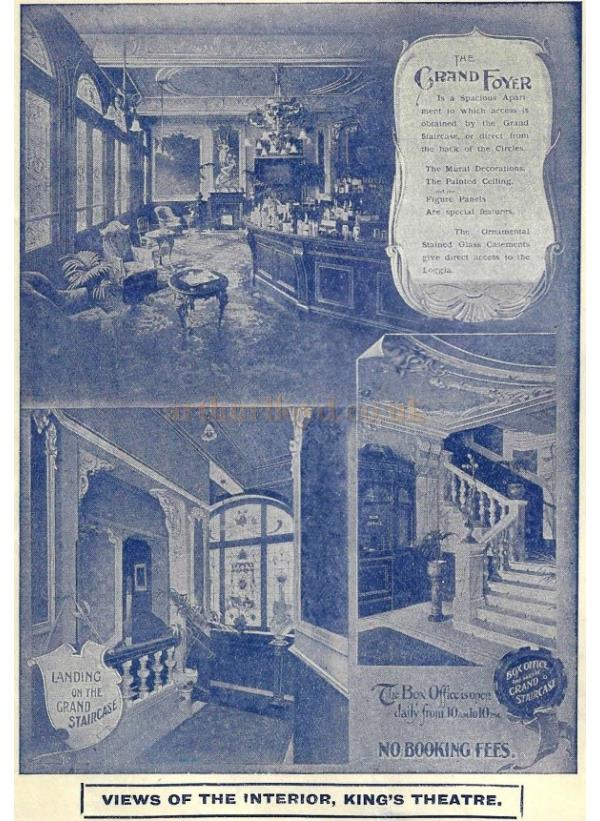
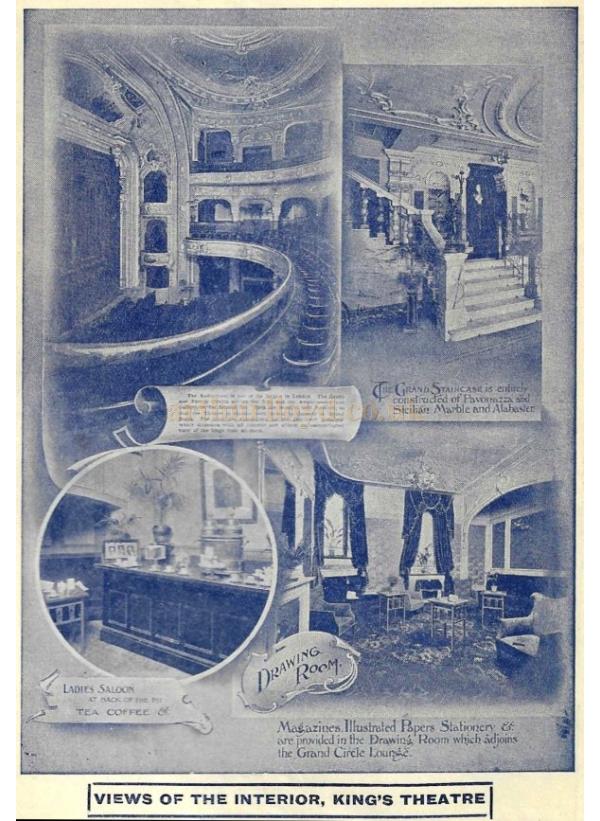
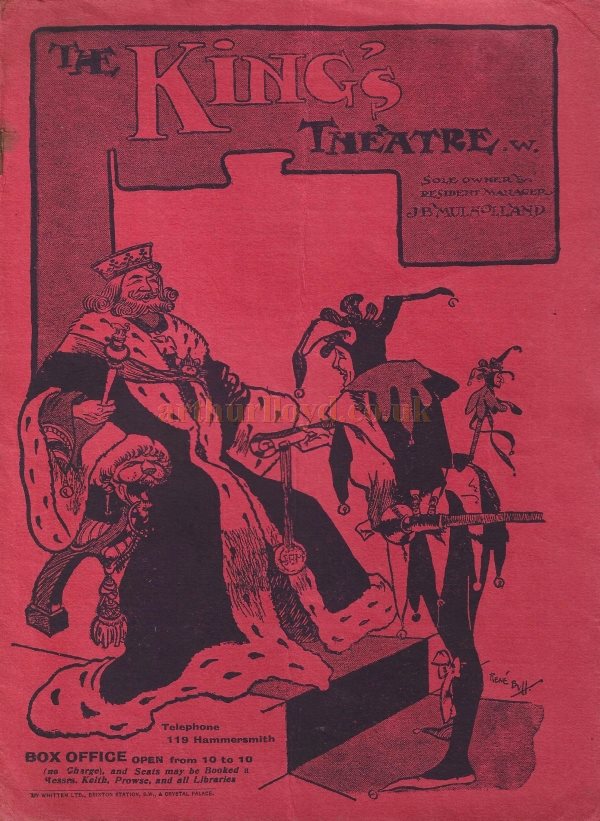 A Programme for 'The Soldier's Wedding' at the King's Theatre, Hammersmith in December 1907 which features many images of the Theatre's interior - Courtesy Simon Moss, stagememories.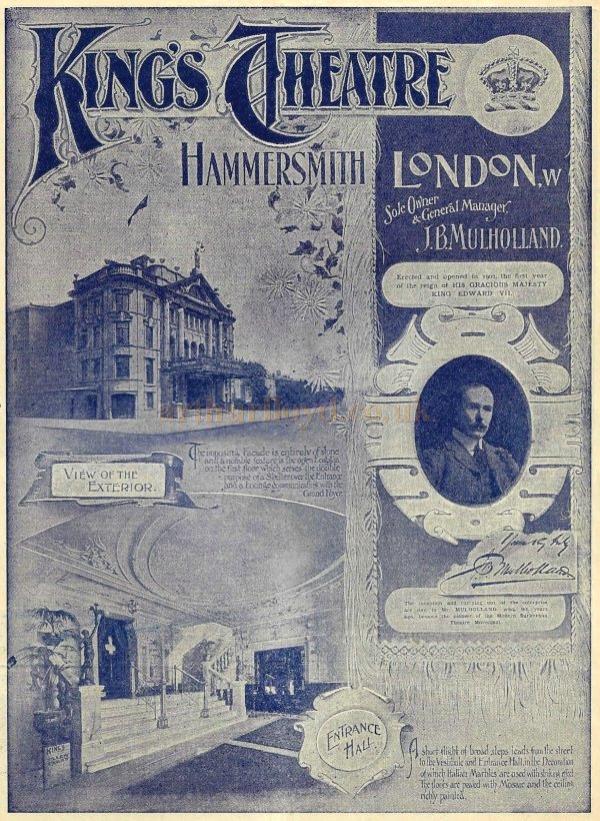




...The children of the world have listened to the story of Cinderella for ages, and will never tire of it. Perhaps no less difficult a task than to determine its origin would be to discover the origin of the pantomime traditions with which it has been overlaid since it appeared upon the stage.
Right - A Programme for 'The Soldier's Wedding' at the King's Theatre, Hammersmith in December 1907 which features many images of the Theatre's interior - Courtesy Simon Moss, stagememories.
In this version, written by Mr. J. Hickory Wood, the Fairies Crystal and Deadly Nightshade, the Ormuzd and Ahriman of the nursery, contend for the right of influencing the fate of little Cinderella for good or evil, a contest which has its inevitable end in the confusion of the power of darkness. Miss Lulu Valli, who plays Cinderella, wears at first the scarlet cap with which she was vested in the picture of Sir John Millais. She is a dainty little person, who danced and sang well, and displayed just a little shyness, which, since it is so suitable to the part, was by no means unacceptable. Miss Millie Linden as the Prince acted very well, and easily surpassed the average " principal bow" of suburban pantomime. For the rest, the Baron, Mr. J. W. Wilson, was "funny without being vulgar," and the actors in the other humorous parts, Mr. W. Hebden and Mr. C. Norton as the two sisters, Miss B. Waring as the Baroness, Mr. J. B. Montague as the page, and Rezene and Robini as Hob and Nob, who instal themselves in Poverty Hall, the Baron's house, as the broker's men, worked hard and secured many a laugh. Miss Hilda Blanche as Fairy Crystal and Miss Rossie Ralph as Deadly Nightshade did justice to the supernatural element, and now and again led their attendant sprites in the dance "of woven paces and of waving hoods." Owing to the illness of Miss Dearing the part of Dandini was taken by Miss May Austin...

Above - A Sketch showing the cast of 'Cinderella' at the newly opened King's Theatre, Hammersmith in December 1902 - From the Times Newspaper, 27th of December 1902.
 ...The music, composed by Mr. B. Simpson, was pleasing, and, of course, some airs already known to the public were introduced. "Rocking," sung by Miss Lindon, was received with enthusiasm, and the Sunflower song was prettily sung by the Prince and Cinderella.
Right - A Postcard from 1902 showing J. F. Wyllie's Happy Family Ponies outside the King's Theatre, Hammersmith on the Theatre's opening production of 'Cinderella'.
The scenery deserves its meed of praise. The ball-room was exceptionally pretty, and the flight of stairs up which Cinderella runs was apparently of glass through which shone hidden lights. In the finial scene, at Cinderella's wedding, great play is made with electric lights, the car whereon the happy pair are seated, which is drawn by four Shetland ponies, was a blaze of magical lights, and the throne was resplendent.'
The above text in quotes was first published in the Times Newspaper, 27th of December 1902.

Above - An early postcard showing the King's Theatre, Hammersmith.
 The King's Theatre opened on the 26th December 1902 and would go on to have a long and productive history as a variety Theatre and playhouse. Some details of its various productions can be read in the Golden Jubilee article shown below.
Right - A Programme for George Edward's Daly's Theatre Company in the musical comedy 'A Yankee at the Court of King Arthur' which was staged at the King's Theatre, Hammersmith in 1930. The Theatre was being run in conjunction with the Wimbledon Theatre at this time.
During the 1950s and early 1960s, the Theatre was put to use by the B.B.C., as the King's Studio, for live and recorded radio broadcasts, and also for television. Between the 18th of January 1953 and the 5th of April 1953, ten episodes of The Goon Show were recorded at the King's Theatre.
Despite its long and successful career, as a live Theatre and a BBC Radio and Television Studio, sadly the Theatre was closed and demolished in 1963.
Some of the above details were kindly sent in by John Hughes.
The King's Theatre reaches its Golden Jubilee
FIFTY YEARS OF THEATRICAL HISTORY
By PHILIP J. BENNETT
(Reprinted from The West London Observer, December 12th, 1952)
AT
1 p.m. on December 26th, 1902,
The King's Theatre, Hammersmith opened its doors to the public for the
first time with the pantomime "Cinderella". During the 50 intervening years since that opening day, almost every
British actor and actress of any claim whatsoever to fame has appeared
on its stage.
Right - A Programme for 'Cinderella' at the King's Theatre Hammersmith 1952 - Click for article by Lupino Lane on this production and biog.
Thumbing through, its programmes is like turning the pages of a theatrical "Who's Who." Names that will never die, commencing with those giants of the Edwardian era, who today are still the yardstick by which Thespian talent is measured, are there in profusion. Names like Beerbohm Tree, Sir Henry Lytton, Sir John Martin-Harvey, Matheson Lang, Sir Charles Hawtrey, Marie Tempest, Sir C. Aubrey Smith, Mrs. Patrick Campbell. Names that were then, and still are, household words, familiar to us all.
 During
the years when musical comedy was in its heyday, the No.1 companies
of George Edwardes and George Dance made frequent appearances at the
King's Theatre and there were many seasons of Gilbert and Sullivan and
the Carl Rosa Opera Company.
During
the years when musical comedy was in its heyday, the No.1 companies
of George Edwardes and George Dance made frequent appearances at the
King's Theatre and there were many seasons of Gilbert and Sullivan and
the Carl Rosa Opera Company.
Left - A Programme for 'The Courage of Silence' at the King's Theatre, Hammersmith - Week of May 22nd 1905
 More recently the programmes carry the names of our modern stars --
Donald Wolfit, Ivor Novello, Noel Coward, Godfrey Tearle, Eileen Herlie,
Fay Compton, Ruth Draper... but one could go on for a long time without
exhausting the list of names covering every facet of the entertainment
world. Names of plays that are still running and plays that have been
long forgotten.
More recently the programmes carry the names of our modern stars --
Donald Wolfit, Ivor Novello, Noel Coward, Godfrey Tearle, Eileen Herlie,
Fay Compton, Ruth Draper... but one could go on for a long time without
exhausting the list of names covering every facet of the entertainment
world. Names of plays that are still running and plays that have been
long forgotten.
Right - A Programme Page Advertising Ruth Draper at the King's Theatre, Hammersmith in the 1930s - Courtesy Roger Fox.
The programmes of this famous Hammersmith theatre are in very truth the pages of theatrical history.
Always noted for its adherence to the real pantomime tradition, the King's jubilee presentation of "Cinderella" will differ little in essentials from that first "Cinderella" in 1902. Many scenes are the same, and one of the featured attractions is still the "magnificent crystal coach drawn by real Shetland ponies." In this instance, the wording on both the first programme and the one for 1952 is almost identical.
 An
interesting link with the opening of the King's was disclosed when a
Mr. Viner (now at Ongar, Essex) visited the theatre to book seats for
a party for the jubilee pantomime. In conversation with the manager,
it was revealed that his reason for doing this was a somewhat sentimental
one.
An
interesting link with the opening of the King's was disclosed when a
Mr. Viner (now at Ongar, Essex) visited the theatre to book seats for
a party for the jubilee pantomime. In conversation with the manager,
it was revealed that his reason for doing this was a somewhat sentimental
one.
When the actual construction was begun, Mr. Viner was the youngest employee of the contractors on the site and as such was chosen to lay the very first brick of the theatre, a distinction he now recalls with pride.
Left - A Programme for 'Mary Rose' at the King's Theatre, Hammersmith Week of Feb 28th 1921.
 A long-standing family connection between direction and management
is also a noteworthy feature of the theatre. The present direction is
in the hands of the Trustees of the late J. B. Mulholland, owner and
founder. His son, Mr. J. V. Mulholland is the licensee, and the manager
is Mr. Anthony Pigott, son of Mr. Thomas J. Pigott, general manager
to J. B. Mulholland and the trust for 40 years.
A long-standing family connection between direction and management
is also a noteworthy feature of the theatre. The present direction is
in the hands of the Trustees of the late J. B. Mulholland, owner and
founder. His son, Mr. J. V. Mulholland is the licensee, and the manager
is Mr. Anthony Pigott, son of Mr. Thomas J. Pigott, general manager
to J. B. Mulholland and the trust for 40 years.
Of recent years, the King's Theatre has been extensively used by the B.B.C. for live broadcasts and also for television. (See note)
Right - An Advertisement for 'Goody Two Shoes' at the King's Theatre, Hammersmith for the Christmas period 1947/48 - From the Kensington News and West London Times, 2nd of January 1948. See Programme and review below.
Could some of those now dead and gone stars of the early days of the theatre peep in during a modern telecast. and discover that the production was being seen by millions of people in their own homes, they would assuredly think that black magic and witchcraft were rife in the modern theatre.


Above - An Unusually shaped Programme for the Pantomime 'Goody Two Shoes' at the King's Theatre, Hammersmith for the Christmas period 1947/48. In the cast was Frank Formby, brother of George Formby, along with Ivy Luck, Janice Adair, Clarkson Rose and many others. A visitor to the site, Mrs Lynda Thain, saw this production when she was a child and says that she was horrified to see Clarkson Rose apparently take a canary out of its cage and eat it! Everyone else was laughing however.
 It may be interesting to our readers to learn what was written about
the King's Theatre at its opening in 1902.
It may be interesting to our readers to learn what was written about
the King's Theatre at its opening in 1902.
Referring to the pantomime, the 'West London Observer" of 26th December, 1902, says "Grand Fairy Pantomime 'Cinderella and the Little Glass Slipper' . . . on a scale of completeness and with a wealth of Gorgeous Scenery, Superb Dresses, Charming Effects, Magnificent Company, Beautiful Ballets and numerous auxiliaries." What more could one want?
Right - A Review of 'Goody Two Shoes' at the King's Theatre, Hammersmith for the Christmas period 1947/48 - From the Kensington News and West London Times, 2nd of January 1948. See Programme above.
It was the first theatre to be constructed on the cantilever system, dispensing with all columns and affording an uninterrupted view of the stage from all parts of the house.
Press comments in 1902 on the building's amenities and architectural features were flattering and widespread, extending even to France where a Parisian journal carried quite a lengthy report on the opening.
This Hammersmith theatre was evidently something of a nine days' wonder when it first opened.
The 1952/53 production of "Cinderella" like that first one 50 years ago, will undoubtedly be a landmark in the long list of this famous theatre's pantomime successes and will be well worthy of the King's Golden Jubilee.
The above text is from a programme for 'Cinderella' with Lupino Lane at the King's Theatre Hammersmith in 1952/53. Reprinted from The West London Observer, December 12th, 1952. Images from my own collection - M. L.
If you have any more information or images for this Theatre that you are willing to share please Contact me.
The Hammersmith Palace, 82 King Street, Hammersmith
Formerly - The Town Hall Tavern / The Temple Theatre of Varieties / The Palace of Varieties - Later - The Palace Cinema

Above - An early photograph of the Temple of Varieties, Hammersmith, later the Hammersmith Palace
The Palace of Varieties, or Hammersmith Palace as it was sometimes known, was built in 1898 and was a reconstruction of the former Temple of Varieties which was situated in King Street, Hammersmith. The Temple of Varieties started life as a Music Hall attached to a public house called the Town Hall Tavern in the 1880s, a precise opening date is not currently known, but on the 20th of February 1882, Arthur Lloyd opened the week there at the top of the bill, his encore song being 'Take it Bob'.
 The
Hall was originally run by Theodore Gordon who started the venture by putting on 'Smoking Concerts' on Saturday
nights, and then, 'more and more frequently'. This he continued for
several years. Gordon also ran many other Halls, including the Sun
Music Hall which he managed for 18 years. There is more on Theodore
Gordon here.
The
Hall was originally run by Theodore Gordon who started the venture by putting on 'Smoking Concerts' on Saturday
nights, and then, 'more and more frequently'. This he continued for
several years. Gordon also ran many other Halls, including the Sun
Music Hall which he managed for 18 years. There is more on Theodore
Gordon here.
Arthur Lloyd is known to have performed at the Temple of Varieties, along with Albert Chevalier and many other well known Music hall artistes of the time, in a benefit for Rob Cunningham in July 1884 whilst the Hall was under the management of Theodore Gordon.
Right - A Cutting from the ERA of the 26th of July 1884 on a Benefit for Rob Cunninham at the Temple of Varieties, Hammersmith.
Arthur Lloyd also appeared here in a Benefit for Theodore Gordon in February 1884 where the ERA remarked:- 'Mr Arthur Lloyd, who was most enthusiastically received, sang two of his songs which have been most favourably noticed very recently - namely; "The Improver" and "Tra-la-la," in such a manner as to justify all the applause of which he was the worthy recipient.'
The Temple of Varieties was run by Acton Phillips Jnr., for a period from 1884 until 1897 when it was sold to J. C. Coe and reconstructed and reopened as the Palace of Varieties in 1898. Phillips would also run the Lyric Opera House in Hammersmith from 1891. More on Acton Phillips can be read below.
When J. C. Coe acquired the Music Hall in 1897 he soon set about having it reconstructed. He hired the architect W. M. Brutton to design the new Theatre for him and on Monday the 7th of November 1898 it opened for business as the Hammersmith Palace of Varieties. The ERA reported on the new Theatre shortly before it opened in their 5th of November 1898 edition saying:- 'It will be remembered that Mr J. C. Coe, the proprietor of this popular suburban variety house, determined soon after his acquisition of the property to make such structural alterations as practically amounted to rebuilding. He entrusted the plans to Mr W. M. Brutton, the well-known London architect, and the result is a worthy addition to the numerous pleasure houses that are springing up in all parts of Suburbia.
The façade is finished with a tower, carried out in a style somewhat different to the usual run of London buildings, the design being of a free French character in Doulton stone and red brick. The wrought iron shelter to the grand entrance is a very fine piece of work. It is somewhat after the design of the architect's work at the Alhambra, London, the grills over being used for lighting up the front.
On entering the grand vestibule, which is ornamented with Moorish tiles, our attention is at once drawn to a richly decorated circular ceiling. From this vestibule we get to the stalls and pit-stalls, and at once become convinced of the elegant and spacious proportions of the hall.
The fauteuils are upholstered in rich ruby velvet, harmonising with the richly coloured Brussels carpets, and have a most comfortable and elegant appearance. The buffet bars on all tiers are situated so as to give a full view of the stage, and are accessible from spacious promenades. The occupants of the balcony and the gallery have evidently been well considered, as from every seat a splendid view of the stage is to be obtained. Considering the great length in comparison with the width, the arrangements of the side balconies give a dressy appearance to the spacious main balcony running across the hall.
The decorations are carried out in a harmony of cream and gold, and the side walls are embellished with a very bold design in connection with the chaste illustration that enriches the ceiling, the beauty of the colour scheme being heightened by pictures and painted panels. The latest improvements in electric lighting and the most modern heating and ventilating apparatus have been established throughout the whole building. Electricity also illuminates the stage. Most convenient entrances and exits have been arranged. The stage, with a depth of 36ft. and a width of 40ft., will allow of the production of elaborate spectacular sketches, which can be mounted in a manner quite equal to any theatrical piece. The artists have not been forgotten in the matter of comfort and convenience, and their dressing rooms, which are almost entirely separated from the stage, the only communication being through an iron door, are replete with comfort. The whole of the work, involving an expenditure of about £30,000, has been carried out by the builders, Messrs Godson and Sons, in the short time of fourteen weeks. Messrs De Jong are responsible for the decorations, and Messrs Vaughan and Brown have installed the electric plant, which in itself lends grace and prettiness to an interior that will, we feel sure, be considered one of the most tasteful in suburban London. The general manager of the Hammersmith Palace is Mr Charles Hector, a gentleman of considerable experience, both before and behind the footlights. The opening is announced for Monday next.'
The above text in quotes was first published in the ERA, 5th November 1898.
 The
Hammersmith Palace opened on Monday the 7th of November 1898 and would be in use as a Variety Theatre up until 1909 when it was closed
for alterations by the renowned Theatre
Architect Frank Matcham. The Theatre then
reopened on the 24th of January 1910,
still operating as a Variety Theatre but also showing early moving pictures.
The
Hammersmith Palace opened on Monday the 7th of November 1898 and would be in use as a Variety Theatre up until 1909 when it was closed
for alterations by the renowned Theatre
Architect Frank Matcham. The Theatre then
reopened on the 24th of January 1910,
still operating as a Variety Theatre but also showing early moving pictures.
Right - A postcard showing King Street, Hammersmith with the Hammersmith Palace on the left.
In 1913 Charles Gulliver became manager of the Palace but variety continued under his reign until 1928 when the Theatre was taken over by Greater London Theatres and Cinemas Ltd. Under their management the Theatre went over to both variety and Cinema use and by the mid 1930s the Theatre had been renamed the Palace Cinema, although variety was still staged there occasionally.
The Palace Cinema closed in the late 1940s and was eventually demolished in 1950. The site was later used for the construction of the Kings Mall Shopping Centre and the new Lyric Theatre which had Matcham's 1895 Lyric auditorium from Bradmore Grove reconstructed inside its 1970s shell.
If you have any more information or images for this Theatre that you are willing to share please Contact me.
London Local Managers - A Chat with Acton Phillips
From the ERA, 24th November 1900
 The
enterprising and entertaining Mr Acton Phillips, the proprietor of the Lyric Opera House, Hammersmith, was duly elected
an alderman of the newly created Borough of Hammersmith (by Act of Parliament)
on Nov. 9th, and he is justly proud that he should he so honoured to
fill such a position in the first election of the Borough on the occasion
of the appointment of its premier Mayor. Besides being an energetic
theatrical manager, Mr Phillips has long taken an interest in parochial
affairs, and was for ten years a faithful vestryman, holding various
offices. He is also one of the governors of the Latimer Foundation,
which was originated for the purpose of providing a good education at
inexpensive rates - there are two schools, the upper and the lower,
which turn out many scholars during the year.
The
enterprising and entertaining Mr Acton Phillips, the proprietor of the Lyric Opera House, Hammersmith, was duly elected
an alderman of the newly created Borough of Hammersmith (by Act of Parliament)
on Nov. 9th, and he is justly proud that he should he so honoured to
fill such a position in the first election of the Borough on the occasion
of the appointment of its premier Mayor. Besides being an energetic
theatrical manager, Mr Phillips has long taken an interest in parochial
affairs, and was for ten years a faithful vestryman, holding various
offices. He is also one of the governors of the Latimer Foundation,
which was originated for the purpose of providing a good education at
inexpensive rates - there are two schools, the upper and the lower,
which turn out many scholars during the year.
Right - A photograph of Acton Phillips by H. Stiles - From the ERA, 24th of November 1900.
"Yes, my late father and I always took the greatest interest in things theatrical," says Mr Phillips, retrospectively. "My father, I may say, began his connection, more or less, with the stage over fifty years ago - not professionally, but casually, as it were. He was a friend of Mrs Chatterton, the wife of the famous Drury-lane manager, before she married F. B. C., while his wife was a sister of Dick Shepherd, of the Surrey and other theatres, besides which my father was a bosom friend of Mr H. G. Lake.
Well, we were always at the theatres before and behind, and could walk in and out almost when we pleased at Drury lane and the Princess's. Of course, as a youngster, this delighted me, and as I had a taste for the violin, I took lessons of Mr W. C. Levey, of Esmeralda fame. He used to write and arrange all the music for the Walter Scott - cum - Andrew Halliday dramas at the Lane, as well as for the pantomimes. Also much of the music for the Princess's and Adelphi Theatres, when Mr Chatterton for a time was in partnership with Ben Webster, and also when he ran, as he did foolishly, all three houses on his own account. I fancy that triple arrangement was his undoing. Drury-lane Theatre is enough, I should think, for any man to manage at a time.
However, that is neither here nor there. It was while W. C. Levey was conducting at the Lane - and what a lot of pretty ballads he wrote - that from time to time I played the fiddle in the orchestra there - as an amateur of course. And I may say, in parenthesis, that I have been first violinist, also as an amateur, for twenty years with the Handel Festival Band.
It
was in 1884 that my father,
having retired from business, yet still willing to work, invited me
to go into partnership to acquire and carry on the Town
Hall Tavern, Hammersmith, and the Theatre of Varieties,
which stood in the rear. Then, as now, though the place has been rechristened
the Palace of Varieties, it is affectionately
referred to as the T.O.V. or Tov. - and this house and that act as excellent feeders to each other. Nothing like having
two places of amusement close together. Give good shows at each, and
they will help to create and swell two audiences.
Left - An early photograph of the Temple of Varieties, Hammersmith, later the Hammersmith Palace.
Well, I joined my father - I was proprietor of the famous Cock Tavern at Kilburn at the time, the house that Dick Turpin and other gentry of the road were wont to refresh at after a good haul on Hampstead-heath. I expect - and we soon began to build up the old place in a double sense - artistically and architecturally. Prior to 1884 the house was a sort of music and smoking concert hall, but sketches were always a feature. It was the first variety house in or near London to give them regularly. It was managed for a long time by Theodore Gordon, of the Sun Music Hall, Knightsbridge, but, honestly, it was not a financial success."
 Then
Messrs Acton Phillips, pere et fils, commenced operations, and
gradually made the house a success, and ran it without intermission
until 1897, having seven years
previously acquired the Lyric Opera House, as
they rechristened the old building. It is interesting to note that the
Messrs Phillips introduced a skyful of stars to the London boards, that
is to say, artists who have since become "constellations,"
including Marie Lloyd, and all her sisters. Marie Lloyd made her debut
at a legitimate hall at the old Theatre of Varieties as an "extra turn," with the proviso that if she "went"
she was to stay. The engagement was made for a week, and was so encouraging
that it ran into over four months.
Then
Messrs Acton Phillips, pere et fils, commenced operations, and
gradually made the house a success, and ran it without intermission
until 1897, having seven years
previously acquired the Lyric Opera House, as
they rechristened the old building. It is interesting to note that the
Messrs Phillips introduced a skyful of stars to the London boards, that
is to say, artists who have since become "constellations,"
including Marie Lloyd, and all her sisters. Marie Lloyd made her debut
at a legitimate hall at the old Theatre of Varieties as an "extra turn," with the proviso that if she "went"
she was to stay. The engagement was made for a week, and was so encouraging
that it ran into over four months.
Right - Marie Lloyd - From 'Music Hall at The Palace' a production at the Brighton Palace Pier Theatre.
With Dan Leno, too, they entered into his first London contract, though, through the impossibility of fixing the dates, he played a previous turn at the Middlesex. Dan Leno, though he was very successful with a "Milkman" song, was chiefly engaged for his clog and step dancing. "In 1897 we sold the Theatre of Varieties to devote all our time to the Lyric Opera House, which we had opened in October, 1891. Up to the previous named year we, of course, ran both the houses. We took the place from Baron Grant when it was in a parlous state, and, as in the case of the Varieties, we had to work and build and rebuild until you see it what it is. By the way Mr Horace Sedger, who was about to open the Lyric Theatre in Shaftesbury-avenue, claimed the title, and brought an action against us. But we proved that we were the first to use it, and so we gained the day without having to pay any costs. We opened as a stock theatre with a stock company, breaking the bills every now and then to take in a touring piece. Indeed, we can lay claim to being the very pioneers of the suburban stock and travelling company theatres.
Our first programme consisted of Lost in London, with David James, junior, Alfred Courtney, Harry Cornwall, Elsie Chester, and Eugenie Vernie in the cast. To give you an idea of the thoroughness with which we presented our pieces and made our selections, during the first few months we had such well-known people playing here as Stanislaus Calhaem, J. G. Taylor, Frederick Merer (now at the Grand, Fulham), Lionel Wallace, Bassett Roe, Kenneth Black, J. R. Crauford, Harry Ashford, Arthur Escourt, Alfred B. Cross, Henry Dana (now of Her Majesty's), and Charles Lauri; Misses Amy M'Neil, Leah Marlborough, Ethel Sarjeant, and many others too numerous to mention or remember. Dramas of all kinds, from Drury-lane downwards, were our fare."
As the Messrs Acton Phillips at the Varieties constantly had new sketches done, so at the Lyric Opera House they kept to their old system of travelling companies and "stock." And indeed, Mr Acton Phillips, since the death of his father in May, 1899, has carried on the house on the same laudable plan.
"We have done a pantomime every year," says Mr Phillips, "and this is our tenth - The Forty Thieves due early next month, produced by my stage and general manager, Mr John M. East, my able lieutenant, who has been here close upon ten years. Our first pantomime was Dick Whittington. The Forty Thieves will he a pure pantomime, such as the children love, and is from the pen of Mr Brian Darley - come and see some of the preparations."
So into the splendid paint-room we went, and saw the artistes busily engaged on their congenial and genial tasks, and the property men making props and masks of all kinds for the delectation and delight of the youngsters. Everything is done at the Lyric Opera House in a systematic way, and the appliances and the management and the offices are in striking contrast to what one met with in the suburbs and the provinces even fifteen years ago. Mr Phillips has a splendid practice of keeping all his programme, which from time to time he has bound into volumes for ready reference. A most enjoyable chat and a most enjoyable man, and we take our leave after a very pleasant half hour or so of easy and agreeable conversation.
The above article on Acton Phillips was first published in the ERA, 24th November 1900.
The Commodore Theatre, 395 King Street, Hammersmith, London
Later - Alpha Bingo Club / Mecca Bingo Club

Above - The Commodore Theatre, Hammersmith nearing completion in 1929 - From The Bioscope, September the 4th 1929.
 The Commodore Theatre was situated on King Street, Hammersmith and was built for the independent operator Commodore National Theatres Ltd.
Right - The Commodore Theatre, Hammersmith - From The Architects' Journal, 13th of November 1929.
The Theatre was designed in the Neo Classical Style by the well known Theatre Architect George Coles as a Cine Variety Theatre with full Stage Facilities, and opened on the 16th of September 1929 with the film 'Show Boat'. On its opening it could accommodate 3,136 people in its vast auditorium which was constructed on two levels, Stalls and one Circle. It was equipped with a Standaart Theatre Organ, and had its own 40 piece orchestra. The Theatre's stage was 28 feet deep with a 50 foot wide proscenium opening, and there were eight dressing rooms for artistes. There was also a café and Dance Hall for its patrons.

Above - The Entrance Hall of the Commodore Theatre, Hammersmith - From The Bioscope, 25th of September 1929.
The Bioscope reported on the new Commodore Theatre shortly before it opened in their 4th of September 1929 edition saying:- 'What will undoubtedly be one of the most interesting cinemas in London is just nearing completion in King's Street, Hammersmith. As the accompanying illustrations show, the building is of a most impressive character and will quickly become one of Hammersmith's landmarks. Architecturally, thanks to the design of Mr. George Coles, F.R.I.B.A., the building is simple, massive and entirely pleasing. There is a welcome absence of unnecessary ornament, a skilful use of large plain surfaces and, in the decorative scheme, a restraint which forms an agreeable contrast to some recent "palaces." Ornament has not been spared where ornament is really necessary to support the structural design and carry forward the general scheme; but the use of ornament has, in the main, been restrained. It is already possible to see that the colour scheme is one that will be cool and restful without garishness and without any dangerous tendency to divert attention from the stage itself. In the auditorium the screen will dominate the eye, and though there are stretches of illuminated Venetian landscape running backward into the hall from the proscenium arch on each side, these are relatively unobtrusive.
Designed for Talkies

Above - The Auditorium and Stage of the Commodore Theatre, Hammersmith nearing completion in August 1929 - From The Bioscope, 4th of September 1929.
The house, which will seat about 3,500 patrons, is said to be the first house in this country specifically designed as a "talker" house. The general shape of the auditorium and the lay-out of the balcony certainly suggest a house with attractive acoustic properties. Western Electric apparatus has been installed, with three talking screens at different distances from the curtain, and the talking installation was made with remarkable efficiency and thoroughness by the W.E. people, who swamped the building with engineers, carried out the installation in all its details and disappeared with commendable promptitude.
A Unique Balcony
Returning for a moment to the auditorium, one of the most striking features is the successful design of the balcony, on which. Mr. Coles cannot be sufficiently complimented. This balcony is extremely deceptive. It seats 1,000 people in comfort, but is still pleasingly compact and intimate. It is so designed that, although the rake is ample, it is quite inoffensive and the whole balcony has an air of openness and spaciousness not hitherto, so far as we are aware, approached in any theatre. There is not a hint of that crowded, precipitous slope, immensely distant from the screen, which describes so many modern cinema balconies.
Spaciousness in the Stalls

Above - The Auditorium and Organ of the Commodore Theatre, Hammersmith - From The Bioscope, 25th of September 1929.
In the stalls, the design is equally remarkable because, though the balcony is so enormous, it is quite unnoticeable to the stall patrons. In most cinemas the stall patron is acutely conscious of the balcony over his head. He has a shut-in, pressed-down feeling and a sense of remoteness from the stage. In the Commodore this feeling is entirely absent; one might be in a separate cinema altogether from the balcony. There is a deep and spacious dome in the underside of the balcony which gives a sensation of loftiness and spaciousness and an uninterrupted access to the screen which should be very helpful to the sound engineers. We do not know of a theatre where stall and balcony seating arrangements have been designed with such pleasing effect.
Enormous Electrolier

Above - A Painting by George Richmond depicting the Auditorium and Stage of the Commodore Theatre, Hammersmith in 1929. The Painting was suggested by the B&W image shown on this page, colours were described in contemporary newspapers as being 'restrained and refined' but were not detailed so George has used artistic licence to depict the colour scheme - Click for an Index to all of George Richmond's Paintings on this site.
A feature of the interior is the enormous central electrolier made by the General Electric Company and weighing a ton. Seats by Lazarus are spacious and comfortable, and the designers have wisely avoided any tendency to ram in seats wherever possible. The stage is amply large enough for stage presentation, which will be a feature of the Commodore programmes. During the opening performance, for instance, the stage will accommodate an orchestra of 120 pieces, together with a dancing troup, so that little more need to be said in that direction.
One-Man Stage Equipment
 The stage equipment is of the one-man type, easily handled, very compact and silent in operation. Four screens, one silent and three talkers, are available. The lighting system is controlled in duplicate, one board being on the back wall of the projection booth and the other on the side wall at the back of the stage. Either board can be used for all lighting and colour controls board on the stage has an overriding master-control for use when necessary. This equipment is by Electrical Installations, Ltd., and is compact and businesslike to a degree.
Right - The G.E.C. Batten Equipment at the Commodore, Hammersmith - From the Kinematograph Weekly, 3rd of October 1929.
Unequalled Canopy Lighting
A feature of the exterior of the house is the canopy, which has more lights than any similar canopy in this country. No fewer than 540 60-watt lamps are fitted, and as there are, in addition, on the front of the building twelve 500-watt flood lamps and a large Neon sign, the effect on the glazed tile surface at night can easily he imagined.
The theatre has, needless to say, the latest 'equipment in heating, ventilating, automatic sprinklers and all those many and various accessories, including the supply of ozoned air, which are recognised as being essential to the modern cinema. There is ample dressing-roorn accommodation and subsidiary services. The Commodore will run a special five-course tea service in a beautifully decorated and spacious restaurant on the balcony floor.
In the Projection Room
 The Projection room has a throw of about 157 ft., the Projectors being Ernernann heads fitted with Hall & Connolly lamps and G.E.C. spot-lights with rear controlled colour screen similar to the well-known Brenkert type. The projection room itself is spacious, well lit and ventilated. There is an ample battery of accumulators in an adjoining building, out of doors, to enable the show to carry on in emergencies. The main electrical supply is taken from two different different lighting services at 220 and 440 volts.
Left - An Advertisement by G.E.C. for their lighting installation at the Commodore Theatre, Hammersmith - From the Kinematograph Weekly, 19th of September 1929.
The organ installed is a "Standaart," with organ chambers concealed on the left-hand side behind the pelmets which drape the Venetian scenes. It is intended to maintain a large and first-class orchestra in addition to the organ until such time as the public show signs of being uninterested in direct orchestral music - a very remote possibility. The musical director will be Joseph Muscant, late of the Broadway, Stratford, and the Piccadilly, Manchester. The organist is Harry Davidson, of the Majestic, Leeds. The stage director is E.C. Lilly, late of the Broadway, Stratford; the house manager is H.E. Shirley, from the Broadway, Stratford, his assistant being E. A. Augarde, from the Picture House, Croydon, and the New Gaiety, South Norwood.
The General Manager
The general manager is James Sabel who was for several years general manager of the Metropolitan Electric Theatres, Ltd., which had twelve halls in London and provinces. He was also for five years accountant with the Stoll Film Company in particular association with their production activities. Mr. Sabel is a young, courteous and extremely competent executive who seems likely to go a long way in the industry. He is particularly keen on publicity, and it is interesting to mention the thorough way in which the public have been apprised of the new cinema.
Publicizing the Theatre
 Between five and six hundred 16-sheet posters, and sixty 48-sheet posters as well as 1,800 double crown were released at the beginning of this week, all urging the public to "salute the Commodore." The central feature of the design is a Commodore (in full colour) of the Nelson period, and this design has been registered by the company for its publicity purposes.
Right - A Replica of the old Mississippi floating Theatre toured the country to advertise the opening of the film 'Show Boat' which opened the Commodore Theatre, Hammersmith in September 1929 - From The Sunday Pictorial, 15th of September 1929.
Some 150 bus-side advertisements and 25 tram-sides carried the same teasers, and these will be replaced in the course of a week or so with specific announcements indicating the opening date of the new theatre. A large number of positions have been taken on the Underground Railway stations for these posters, and it can safely be said that no London traveller will remain ignorant of the advent of this new and important addition to London's houses of entertainment.
The Entertainment

Above - The Auditorium and Stage Safety Curtain of the Commodore Theatre, Hammersmith in 1929 - From The Architects' Journal, 13th of November 1929.
The programmes will include special presentations, there will be a Commodore troupe of Tiller Girls, special musical and dramatic presentations, orchestral numbers from the stage, organ solos and, of course, the picture programme. Judging by the provisions already made for the first thirteen weeks, audiences will have plenty to talk about once the house is opened. The opening date is set for September 14th, and the present state of the building suggests that the various contractors will have no difficulty whatever in working to this date. The opening will be officially carried out by the Mayor of Hammersmith.
One of London's Best
In its present state it is, of course, a little difficult for anyone to form a fair impression of the new house, but we hope to have an opportunity of going over it in the course of a few days when furnishings and decorations are all completed. Meantime, it is possible for us to say that the Commodore will easily take its place as one of the best designed and most comfortable houses in London. It is owned by the Commodore National Theatre, Ltd., and we have reason to believe that there may be interesting news regarding this company in the near future.'
The above text in quotes was first published in The Bioscope, 4th of September 1929.

Above - A Google StreetView Image showing the site of the former Commodore Theatre, Hammersmith in July 2008 - Click to Interact.
Despite the above article suggesting an opening date for the new Commodore Theatre it in fact opened two days later on the 16th of September 1929. Having been designed for Cine Variety, for the first few years the Commodore did indeed pursue this policy, with film and stage productions being the regular programming, but in 1933 when the Theatre was taken over by Associated British Cinemas the stage shows were ended and the orchestra was let go so that the Theatre could be used for film showings only. However, in the late 1950s a period of staging pop concerts on the Commodore's stage was tried out and proved to be quite successful so this was an occasional feature for the rest of its time as an ABC Theatre.
ABC closed the Theatre on the 8th of June 1963 however, and it was then converted for Bingo as the Alpha Bingo Club which later became a Mecca Bingo Club until 1981 when it was closed and then demolished in early 1982. The site of the Theatre was subsequently used for the construction of an office building called Quantas House, see image above, which housed the original foundation stone of the Theatre in its entrance when it was first opened.
Some of the later information for this Theatre was gleaned from the excellent Cinema Treasures Website.
If you have any more information or images for this Theatre that you are willing to share please Contact me.