
Kilburn, London, Theatres & Halls - Past & Present
Kiln Theatre / Tricycle - Grange Theatre - Town Hall 1880s - Gaumont State Theatre - Maida Vale Picture House - Theatre Royal / Kilburn Theatre of Varieties / Kilburn Picture Palace - Kilburn Empire / Kilburn Vaudeville Theatre / Essoldo Cinema / Broadway Theatre - Kilburn - An Article from the Face of London 1956
The Kiln Theatre, Kilburn High Road
Formerly - The Forester's Hall / Tricycle Theatre

Above - The Tricycle Theatre, Kilburn in April 2009 - Photo M.L.

The Kiln Theatre in Kilburn High Road originally opened as the Tricycle Theatre in 1980 and was a conversion from a former 1929 meeting hall called Forester's Hall. Sadly the Theatre was almost completely destroyed by fire only a few years later in 1987, which had begun in a timber yard next door to the building. However, the Theatre was rebuilt and expanded to include new FOH areas in 1989.
In 1998 the Theatre was enhanced again by the building of an adjoining Cinema and by the mid 2000s the complex housed a 230 seat Theatre, a 300 seat Cinema, a Visual Arts Studio called the Paintbox, a small Studio Theatre called the James Baldwin Studio, an Art Gallery, Cafe, and rehearsal rooms.
On the 5th of September 2018 the Theatre was reopened as the Kiln Theatre after a two year closure whilst a £7million refurbishment took place. This included the enlargement of the capacity of the main Theatre to 292 individual seats, rather than bench seating, enhancements to the whole building's accessibility, and modern lighting and stage equipment being installed, with a wider stage. The entrance hall was also opened up, revealing previously hidden original features of the former Forester's Hall building, more toilets were installed, and a new Cafe on the Kilburn Road was also constructed.
The Kiln Theatre is a Registered Charity and says that it aims to produce world class theatre that provokes, entertains and appeals to the exceptionally diverse society in Brent and beyond.
You may like to visit the Kiln Theatre's own Website here.
If you have any more information or images for this Theatre that you are willing to share please Contact me.
The Theatre Royal, 254-256 Belsize Road, Kilburn
Formerly - The Town Hall - Later - The Kilburn Theatre of Varieties / The Cinematograph Theatre / The Kilburn Picture Palace / The Kilburn Palace

Above - Belsize Road and the Kilburn Palace during the run of the film 'The Prince of Adventurers' circa 1927 - Courtesy Ken Mansfield.
 The
Theatre Royal, Kilburn was a conversion from the former community Town
Hall which was originally built in the 1880s.
More on the Town Hall below.
The
Theatre Royal, Kilburn was a conversion from the former community Town
Hall which was originally built in the 1880s.
More on the Town Hall below.
The Theatre was altered in 1895 when much of the building was reconstructed and a fireproof curtain was installed between the stage and auditorium and the Theatre is known to have had a capacity of 514 at this time.
Right - A Programme for 'Sir Richard Whittington And His Cat' at the Theatre Royal, Kilburn in 1897. - Click to see the Entire Programme.
In 1900 the Theatre was taken over by A. E. Oliver and redecorated and reopened on the 12th of March 1900 as the Kilburn Theatre of Varieties (See ERA article below).
However, a proposed replacement Theatre had been documented in the Building News and Engineering Journal the previous year, to be designed by the architects Palgrave and Co, but in the end the Theatre Royal was altered instead. An image of the proposed new Theatre and a Ground Plan for it can be seen below.

Above - A Sketch of the Proposed Kilburn Palace of Varieties (Not Built) - From the Building News and Engineering Journal, May 26th 1899. Caption Reads:- 'This plate illustrates the design of a proposed new Palace of Varieties, which is about to be commenced, with some slight modification in the elevation, on the site of the existing Theatre Royal, which is fully licensed as a theatre and music-hall, and which will also absorb the adjoining property known as Barnes' Depository. The property will have a frontage to Belsize-road (facing Kilburn station, L and N. W. Ry.) of 82ft., and to Kilburn Priory of 89ft. The interior will be constructed on the cantilever system without columns, proscenium opening 30ft., width of stage 64ft., and depth 31ft. The latest fire appliances will be used, and the building will be lighted by electricity. Messrs. Palgrave and Co., of Victoria-street, S.W., are the architects.'

Above - A Ground Plan for the Proposed Kilburn Palace of Varieties (Not Built) - From the Building News and Engineering Journal, May 26th 1899.
Although a new Theatre to replace the Theatre Royal was proposed in 1899, as documented above, in the end the old Theatre was just altered instead. The ERA printed a review of the altered Theatre Royal and its opening night variety show in their 17th of March 1900 edition saying: - 'The growth of variety theatres in our suburbs is one of the remarkable features of the closing years of the century. From Brixton to Battersea, from Holloway to Hammersmith, from Deptford to Denmark-hill, the masses are well catered for, and the popular vote is certainly secured in every establishment where the variety banner is hung out. The latest suburb to fall into line is Kilburn, where, by the enterprise of Mr A. E. Oliver, who heads a small syndicate, the local theatre that has long owed allegiance to drama has been brought under the aegis of the more cosmopolitan entertainers of the halls. The place wears a new aspect with its chaste and bright decorations, its comfortably upholstered seats, its prettily embellished proscenium, and its excellent system of incandescent gas lighting; and on Monday, when the new order of things was inaugurated, the house was filled in every corner, and jubilation reigned among the packed and perspiring throng.
Kilburn has a large and ever-growing population, and as the metropolis is throwing out its octopus-like feelers further west, there should be no doubt of the success of the venture. Indeed there is a population sufficient to support it within short radius; and it only requires a spirited and up-to-date policy to command the most extensive patronage among the local dwellers. It is fortunate for the directorate that Mr Oliver thoroughly knows the requirements of the neighbourhood - a knowledge gained during his long connection with the Metropolitan and the West London Theatre.
 On
Monday he was overwhelmed by the congratulations of a cohort of friends,
whom he specially thanked in a neat speech from the stage. Herr Vorzanger,
who has had considerable orchestral experience, conducts the band, and
the opening item of the special entertainment was, as a matter of course,
"God Save the Queen," the solo being takes by Mr Valentine
Smith, the audience joining in the chorus with heart and voice."
On
Monday he was overwhelmed by the congratulations of a cohort of friends,
whom he specially thanked in a neat speech from the stage. Herr Vorzanger,
who has had considerable orchestral experience, conducts the band, and
the opening item of the special entertainment was, as a matter of course,
"God Save the Queen," the solo being takes by Mr Valentine
Smith, the audience joining in the chorus with heart and voice."
Left - A map showing the position of the Theatre Royal, Kilburn - From an 1897 Programme.
A principal item of the long and varied entertainment that followed was a shortened version of Muritana, Vincent Wallace's ever-popular opera, which was presented by Mr Valentine Smith and his company. It must be confessed that the audience did not exhibit a very tolerant attitude towards the work, which might, under less exciting circumstances, have been listened to with patience and even appreciation. Those in front were attuned to a spirit of mirth, and such fun as has been supplied by the librettist was voted feeble and old-fashioned. The melodies, however, could not fail to make a favourable impression; and "Let me like a soldier fall," which is written quite in the patriotic vein, very naturally evoked a storm of cheers. It was given with considerable vigour by Mr Valentine Smith.
The principal comedian of the opening bill was Mr Arthur Roberts, who evinced all the humour that has made him so popular on both stages. The spoof ballad of Mr Roberts went with a bang, and he was heard to great advantage in "It was on the tip of my tongue," a subject that is cleverly treated by the author.
Mr George Beauchamp at once got in touch with the audience with "How-de-do-de," a selection from his repertoire that has added much to his reputation, both in this country and in the Antipodes, and his unctuous style sent the audience into fits of laughter. Mr Mark Melford and company are welcome everywhere, and their engagement at Kilburn is a wise and enterprising move on the part of the management. The sketch presented is Nonsuited, which first evoked laughter at the London Pavilion. Mr Melford as the barrister who browbeats the plaintiff and puts very embarrassing questions to the fair defendant, reminds us occasionally of Buzfuz of immortal memory; but his forensic patter is ever chastened by the saving grace or humour, the asides at the expense of an imaginary judge being especially rich.
A most favourable impression was created by the Wolfovsky troupe of Russian singers and dancers, who gave a lively and spirited exhibition of the Slavonic national dances, and sang a volkslied with quaint effect. Frazer and Mac with much acceptance introduced the burlesque element into their musical doings; the Musical Palmers evinced all their well-known skill in a quartet of brass instruments; the Sisters Slater played the banjo admirably; Kitty Emmett displayed neatness of execution in her Dutch clog dance; Miss Marie Tyler was welcome in a descriptive song; Mr Fred Herbert displayed his usual readiness in topical verses; Miss Venie Belfry proved herself an attractive comedienne; and the entertainment had other contributors in Mr Harry Wenburn, Mr St. John Emlyn, Mr Fred Adams, the Morton Trio, the Musical Howards, Mr Fred Lenore, Miss Rose Conroy, Mr Walter Norman, Miss Ruby Bijou, Mr Joe Mac, Mr George Adams, Mr George Mackney, Miss Edith Constance, the International Troupe, Miss Jenny Mirette, and others.
The stage was under the able direction of Messrs George Fuller and David Hart. Several telegrams of congratulation were sent to Mr Oliver in the course of the evening. The management gives an excellent seat for a shilling, the upper circle is eighteenpence, orchestra stalls are priced at two shillings, and fauteuils at half-a-crown.'
The above text in quotes was first published in the ERA, 17th of March 1900.

Above - The Kilburn Palace during the run of the film 'The Prince of Adventurers' circa 1927 - Courtesy Ken Mansfield.
 In
August 1909 the Theatre began
showing early films as well as stage shows and became known as the Cinematograph
Theatre and then the Kilburn Picture Palace.
In
August 1909 the Theatre began
showing early films as well as stage shows and became known as the Cinematograph
Theatre and then the Kilburn Picture Palace.
Right - The site of the Theatre Royal, Kilburn in August 2009. Part of the facade shown here is that of the original Theatre but very little else of the building remains - Photo Courtesy Greg Radcliffe.
Under the management of the Kilburn Picture Palace Ltd in 1916 improvements were made to the building so that the seating capacity could be enlarged to 1,775 and the name was changed to the simpler Picture Palace.
Charles Gulliver who also owned the Empire, Kilburn, ran the Theatre in the 1920s but in 1928 United Picture Theatres LTD took over the building, although UPC would be taken over themselves two years later by Gaumont British Theatres LTD in 1930.


Above - A Programme Card for forthcoming attractions at the Kilburn Palace in October 1935 - Courtesy Eileen Gibbs.
Ten years later Gaumont closed the Picture Palace in in 1940 and the building was then left empty for a number of years until it was converted into a Function Hall later in the decade.
The building was converted into a nightclub called Shannon's in 1953 but this didn't last long and soon it was being used as a warehouse.
Decca Recordings LTD then took over the building and demolished the auditorium, leaving the frontage partly in place, which it still is today although the building is currently under threat of demolition.
If you have any more information or images for this Theatre that you are willing to share please Contact me.
The Town Hall, Belsize Road, Kilburn
Later - The Theatre Royal
The Town Hall, Kilburn was built in the 1880s and would later be converted into the Theatre Royal. The Hall was sometimes used to stage Amateur Productions on its stage, below is a sketch from the 'Illustrated Sporting and Dramatic News' which illustrates one such company and who they were playing in a production there in January, 1883.

Above - Sketches illustrating Amateur players in a production at the Kilburn Town Hall - From the 'Illustrated Sporting and Dramatic News,' January the 20th, 1883.
The Kilburn Empire, 9-11, The Parade, Kilburn, London
Also known as the New Kilburn Empire / Kilburn Vaudeville Theatre / Essoldo Cinema / Broadway Theatre / Quazar Lazar Game Centre

Above - An early postcard view showing the Kilburn Empire Theatre - Courtesy Peter Williams whose father worked at the Theatre from 1931 until he was called up for the war.
 The
Kilburn Empire was situated on the Parade in Kilburn, and was built in 1906 to the designs of the architect Frederick W. Hingston,
who also built the Putney Hippodrome.
The
Kilburn Empire was situated on the Parade in Kilburn, and was built in 1906 to the designs of the architect Frederick W. Hingston,
who also built the Putney Hippodrome.
However, there were problems with the licensing of the building once completed and because of this it was not able to be opened to the public. The well known Theatre Architect, W. G. R. Sprague was then brought in to redesign the Theatre and consequently it didn't actually open until 1908.
Right - A variety Programme for the Kilburn Empire Theatre in July 1920 - Click for details.
The Theatre's auditorium was built on three levels, Stalls and Pit seating 133 and 496, the Circle seating 454, and the Gallery seating 546, with a total capacity of 1,913. The Theatre's stage was fitted with Animal Traps and there were also Elephant Pits below the stage for the provision of Variety acts which featured animals.
 The 1910 Stage Yearbook listing for the Kilburn Empire read:- 'Proprietors, London Theatres of Varieties, Limited; Managing Director, Mr. Walter Gibbon; Manager, Mr. C. Foster-Marner; Booking Circuit, Gibbons- Barrasford; Musical Director, Mr. Horace Sheldon. Music and dancing license. Holding capacity, 2,500. Stage, 29ft. by 48ft. Proscenium opening, 38ft. 4in. Electric light. Band rehearsal, 1 o'clock. No matinee day. Bars the Metropolitan.'
 The Empire opened as a Variety Theatre and this would be the main stay at the Theatre for many years afterwards, including
the showing of early films during the variety entertainments.
The Empire opened as a Variety Theatre and this would be the main stay at the Theatre for many years afterwards, including
the showing of early films during the variety entertainments.
Left - The Auditorium of the Kilburn Empire according to a Programme for the Theatre in 1919. However, the same image is also used in a programme for the Putney Hippodrome, if you can clear this up please Contact me. - Right - A Programme Cover for 'The Show World' at the Kilburn Empire, under the actor manager Tod Slaughter, in July 1928 - Courtesy Ron Knee.
The Arthur Lloyd Trio is known to have performed at the Kilburn Empire in December 1910 in a Variety show along with many others. Arthur Lloyd himself died in 1904 but his children carried on performing his pieces as the Arthur Lloyd Trio for many years afterwards.

Above - A sketch of the Kilburn Empire Theatre - From a Programme for the Theatre in 1914.


Above - A Programme for the Pantomime 'The Forty Thieves' at the Kilburn Empire in December 1918 - Courtesy Peter Roger.
The Kilburn Empire would stay open during the troubled years of the First World War and continue for many years afterwards, see wartime images and more history below.

Above - A poster for Harry Day's Musical Burlesque 'Frolics' produced at the Kilburn Empire whilst it was being run by Chas Gulliver, who would go on to run the Theatre Royal, Kilburn in the 1920s. Poster year is not stated but as it mentions War Pictures and G. H. Chirgwin, who is on the bill and died in 1922, it must have been during the first world war. Monday January 15th 1917 is the only year that this date fell on a Monday during the first world war.


Above - A WW1 era photograph of George Blackwell (Canadian Black Watch) and another Kilburn-raised soldier, who became his brother-in-law, holding a New Kilburn Empire poster for 'Oceans Away' - Courtesy Linda Phelan, granddaughter of George Blackwell, who says:- 'The photograph has a Post Card type back and it was pointed out to me by a Black watch historian that the two men are wearing each others caps in the photo.' Linda would like to know if the photograph was taken at the Theatre or in a Studio, or if anyone can shed a little more light on the photograph, perhaps You Know.
In 1927 the Empire Theatre began showing films exclusively on Sundays whilst still maintaining Variety during the week.

Above - Peter Williams writes: 'The Floor Staff of the Kilburn Empire taken in September 1939. The person with the hat is probably Johnny Pennifer of Weston Place who was often mentioned in conversation when I used to listen to stories about the Kilburn Empire which sadly I was too young to remember in detail. My father, James Williams, and he both started at the Kilburn Empire on the same day after leaving school together as they were neighbours in the same road, they also left the Kilburn Empire on the same day and went to the Tower Of London and joined up together to serve in the war. This is most probably the reason the pictures were taken. The person on the end in the shirt was the manager "Bill" I believe. He was also a Projectionist. The other people I have no knowledge of. - Picture and information Courtesy Peter Williams whose father worked at the Kilburn Empire from 1931 until he was called up for the war.'

 During Nat Tennen's management of the Kilburn Empire in
the 1940s he would often write a little piece in the programmes about
forthcoming attractions at the Theatre, here is one from December 1947:-
During Nat Tennen's management of the Kilburn Empire in
the 1940s he would often write a little piece in the programmes about
forthcoming attractions at the Theatre, here is one from December 1947:-
'Dear Patron -- Next week I am presenting the one and only Tod Slaughter in "MARIA MARTEN" or "THE MURDER IN THE RED BARN", the famous old-time melodrama, with the incomparable Tod Slaughter in the leading role. Patrons have my personal guarantee of a first-class evening's entertainment. The demand for seats for our Xmas shows, "WHERE THE RAINBOW ENDS" and "ALADDIN", is very heavy, so please book as early as possible to avoid disappointing the youngsters. Thanking you for your greatly esteemed patronage. I remain, Yours very sincerely, NAT TENNENS.'
Right - James Williams in September 1939, aged 22, most probably on the leaving day before joining up. Interesting because it was taken on the roof top area of the Kilburn Empire. - Picture and information Courtesy Peter Williams whose father worked at the Kilburn Empire from 1931 until he was called up for the war. And A Variety Programme Cover for the Kilburn Empire - Click for details of two Variety Programmes, one for 1914, and one for Good-By-EE' with Harry Tate at the Theatre in 1917.

Above - The Essoldo Cinema, Kilburn, formerly the Kilburn Empire Theatre, during the run of the film 'Shane' with Alan Ladd, probably in 1953.
 Plays,
Variety, and Sunday films continued until 1949 when the Theatre was
sold to Essoldo at which point live theatre ended in the building and
it was renamed the Essoldo Cinema. However, the BBC did use the Theatre
on Sundays as a studio, and Variety Bandbox was broadcast live from
the Theatre for a number of years.
Plays,
Variety, and Sunday films continued until 1949 when the Theatre was
sold to Essoldo at which point live theatre ended in the building and
it was renamed the Essoldo Cinema. However, the BBC did use the Theatre
on Sundays as a studio, and Variety Bandbox was broadcast live from
the Theatre for a number of years.
Right - A programme for 'Where The Rainbow Ends' which was at the Kilburn Empire from the 24th of December 1947 to the 10th January 1948 - Courtesy Peter Williams. - Click to see entire Programme.
 In
1970 the Essoldo closed for major alterations to the building, including
covering the original Facade in Blue Cladding, hiding the ceilings in
the Foyers with suspended modern ceilings, and radically altering the
auditorium by extending the circle to the front of the stage to create
a new Cinema space above the Stalls with a capacity of 471, and hiding
the original Stalls of the Theatre completely.
In
1970 the Essoldo closed for major alterations to the building, including
covering the original Facade in Blue Cladding, hiding the ceilings in
the Foyers with suspended modern ceilings, and radically altering the
auditorium by extending the circle to the front of the stage to create
a new Cinema space above the Stalls with a capacity of 471, and hiding
the original Stalls of the Theatre completely.
Left - A Programme for 'Room at the Inn' at the Kilburn Empire in December 1947.
Classic Cinemas bought the building in 1972 and ran it until late in 1973 when it was closed again, this time to be converted back into a live Theatre and renamed the Broadway Theatre. Several shows were produced there but it was never very successful and by 1981 the Theatre was again closed down.

Above - The old Kilburn Empire looking very sorry for itself in its guise as the Broadway Theatre in the late 1970s - Courtesy Peter Williams

 A
short period as a Cinema again was unsuccessful too and the Theatre
stayed dark from April 1981 until 1984 when it was put back into use
temporarily by a religious organisation.
A
short period as a Cinema again was unsuccessful too and the Theatre
stayed dark from April 1981 until 1984 when it was put back into use
temporarily by a religious organisation.
Right - A variety Programme Cover for the Kilburn Empire in 1919 - Click to see details of two Variety shows at the Empire, one with Marie Lloyd, and one with Little Tich. And James Williams outside the Kilburn Empire. Taken in January 1931 when aged just 14. Proudly wearing The Doorman Uniform which was the first job he had held since leaving School. - Picture and information Courtesy Peter Williams whose father worked at the Kilburn Empire from 1931 until he was called up for the war.
The final insult to this once beautiful Variety Theatre was when it was taken over and renamed the Quazar Lazar Game Centre, and used as a Paint Balling Gaming Space.
The Theatre was demolished in 1994 and an hotel called the Plaza Hotel was built on the site, which was later to become the Marriort Hotel, Kilburn. (See image below).
If you have any more information or images for this Theatre that you are willing to share please Contact me.

Above - The Marriott Hotel, on the site of the Kilburn Empire in April 2009 - Photo M.L.
The Grange Theatre, 234 Kilburn High Road, Kilburn

Above - The former Grange Theatre, Kilburn, in April 2009 - Photo M.L.
The Grade II Listed Grange Theatre was designed in the Baroque style by Edward A. Stone who also designed the Maida Vale Picture House, Kilburn, and was built for the North Metropolitan Circuit as a Super Cinema, opening on the 30th of July 1914 with the film, 'She Stoops to Conquer,' which was supported by the Keystone Cops, both silent films accompanied by the Grange's own organ, which on opening was a Nicholson & Lord, although this was later replaced by a Wurlitzer. The Theatre was promoted at the time as being Britain's largest purpose built Cinema and boasted a seating capacity of 2,028.
The auditorium was on two levels, Stalls and one Circle, and the Circle was unusual for a Cinema in that it was extended down towards the proscenium on both sides in the form of slips which would have been fine for Theatrical performances but would have been a bad position in which to watch films. The auditorium was entered from a large foyer with an oval galeried rotunda which also had stairs leading to a Tea Room and the Circle. The Theatre was also equipped with a stage for live acts and dressing rooms which were both extended and improved in later years, and in the 1920s the Theatre regularly hosted live Variety shows along with its films.
In 1929 the Grange was bought by Gaumont British Theatres, who would also go on to run the later Kilburn State Cinema nearby. Eventually Rank took over the company and in June 1975 they closed the Grange because there simply wasn't the audience for two huge cinemas in Kilburn at the time. The last films to be shown at the Theatre were 'The Ghoul,' and 'I Don't Want to be Born,' on the 14th of July 1975.
The Theatre was then converted into a Nightclub which opened as Butty's on the 23rd of February the following year in 1976. The Club would later be renamed the 'National Ballroom' and later still it became the popular Irish live music venue, the 'National Club.'
In the Spring of 1999 the National Club was closed and the building was unused for several years until it was bought by an evangelical church group who would later be embroiled in a scandal regarding the sexual misconduct of a preacher with the congregation.
In 2009 the Grange is currently owned by the 'United Church of the Kingdom of God,' a Brazilian based religious organisation.
If you have any more information or images for this Theatre that you are willing to share please Contact me.
The Maida Vale Picture House, 140 Maida Vale, Kilburn
Formerly the Maida Vale Picture Palace / Carlton Rooms - Later The Islamic Centre

Above - The former Maida Vale Picture House, Kilburn in April 2009 - Photo M.L.
The Maida Vale Picture House was designed by Edward A. Stone, who also designed the Kilburn Grange Theatre. The Cinema originally opened as the Maida Vale Picture Palace on the 27th of January 1913 with a showing of the film 'Behind the Mask.' The Cinema was fitted with it's own Organ and also regularly featured a small orchestra to accompany its films.
The auditorium, built on two levels, Stalls and Balcony, with boxes, could seat 1,500 in all, and featured a domed ceiling and a screen of some 20 by 15 foot. Although the Cinema began life showing silent films by 1916 the Theatre was showing early talkies using Edison's Kinetophone system.
 In
1921 the Picture Palace was taken over by Scala (Maida Vale) Ltd., and
a few years later in 1923 the name was changed to the Maida Vale Picture
House. A Wurlitzer Organ was installed in 1927 when Associated Provincial
Picture Theatres took over the building, which apparently was not appreciated
by local residents who complained of the volume of the new organ disturbing
their peace.
In
1921 the Picture Palace was taken over by Scala (Maida Vale) Ltd., and
a few years later in 1923 the name was changed to the Maida Vale Picture
House. A Wurlitzer Organ was installed in 1927 when Associated Provincial
Picture Theatres took over the building, which apparently was not appreciated
by local residents who complained of the volume of the new organ disturbing
their peace.
Right - The former Maida Vale Picture House, Kilburn in April 2009 - Photo M.L.
In 1929 the Picture House was taken over by Gaumont British, who would later go on to run the Kilburn State, and had recently taken over the nearby Grange Cinema, Kilburn. Gaumont installed sound in the Theatre but success was not to continue and in 1940 the Theatre was closed for the last time.
For a short while the Theatre was used as a restaurant, and it was then turned into a dance hall called the Carlton Rooms from where regular live broadcasts were made of the most popular dance bands of the day. As is so often the case, eventually the building was converted for Bingo use, this time by Mecca in 1961, and is currently in use as an Islamic Centre.
If you have any more information or images for this Theatre that you are willing to share please Contact me.
The Gaumont State Theatre, Kilburn High Road, Kilburn

Above - The Gaumont State, Kilburn in April 2009 - Photo M.L.

 The
Gaumont State Theatre, which is situated on the Kilburn High Road, was built for the Hyams brothers
and designed by the well known Theatre and Cinema Architect George Coles. The Theatre opened under the ownership of Gaumont Super Cinemas
on Monday the 20th of December 1937.
The
Gaumont State Theatre, which is situated on the Kilburn High Road, was built for the Hyams brothers
and designed by the well known Theatre and Cinema Architect George Coles. The Theatre opened under the ownership of Gaumont Super Cinemas
on Monday the 20th of December 1937.
Right - The Opening Night Souvenir Programme for the Gaumont State Theatre, Kilburn - Click to see the Entire Programme. And A ticket for the Gala opening of the Gaumont State on December 20th 1937 - Click for more images and information.
 The Theatre was built as a Super Cinema with a green Italian Renaissance
interior, and an exterior which is said to have been designed as a homage to the then recently
built Empire State Building in New York, with a giant 120 foot tower
which housed the Theatre's own radio studio.
The Theatre was built as a Super Cinema with a green Italian Renaissance
interior, and an exterior which is said to have been designed as a homage to the then recently
built Empire State Building in New York, with a giant 120 foot tower
which housed the Theatre's own radio studio.
Left - The opening week 'Tour of the State Theatre' Programme - Click to see the Entire Programme plus many more images.
The Theatre had a large and fully equipped stage with 35 counterweighted flying bars in its large fly tower, and was used a great deal over the years hosting Variety, Pantomimes, Circus, Ballet and Concerts when it wasn't showing films, and sometimes even when it was.


Above - A Selection of Programme covers from the Gaumont State, Kilburn - Click to Enlarge.
 The
Gaumont State was equipped with a Strand Electric Grandmaster Lighting Control,
the latest state of the art lanterns with remote control semaphore colour
changers in the circle front, and four colour recessed proscenium lighting,
remarkably all of which remains in the Theatre today.
The
Gaumont State was equipped with a Strand Electric Grandmaster Lighting Control,
the latest state of the art lanterns with remote control semaphore colour
changers in the circle front, and four colour recessed proscenium lighting,
remarkably all of which remains in the Theatre today.
Right - The Foyer of the Gaumont State, Kilburn in April 2009 - Photo M.L.
The State also boasted workshops, dressing rooms, an orchestra pit with a lift, and a rising and revolving platform for the 4 Manual Wurlitzer organ console which was located on the stage left side of the proscenium. The organ had 16 Ranks and a grand piano attached. The Organ and Console remain today in fine working order although sadly the Piano attachment was destroyed when vandals broke into the Theatre and dropped the Iron Curtain on it some years ago.
 On
its opening the State had a massive auditorium capable of seating 4,004
people on two levels, 1,356 in the Balcony and 2,648 in the Stalls.
The Theatre also had a separate dance hall and a 400 seat restaurant
built above the Willesden Lane entrance.
On
its opening the State had a massive auditorium capable of seating 4,004
people on two levels, 1,356 in the Balcony and 2,648 in the Stalls.
The Theatre also had a separate dance hall and a 400 seat restaurant
built above the Willesden Lane entrance.
The Gaumont State Theatre was the largest Super Cinema ever built in England and is the third largest ever to have been built in the United Kingdom. The auditorium is now the largest surviving of its kind in the Country.
Left - The Foyer and Main Entrance of the Gaumont State, Kilburn in April 2009 - Photo M.L.
 The opening
night performance on the 20th of December 1937 was a live show billed
as an 'All Star Variety Show,' which featured among others, Gracie Fields,
Larry Adler, George
Formby, and Henry Hall and his Band.
The opening
night performance on the 20th of December 1937 was a live show billed
as an 'All Star Variety Show,' which featured among others, Gracie Fields,
Larry Adler, George
Formby, and Henry Hall and his Band.
Right - The Grand Staircase leading from the Foyer to the Balcony of the Gaumont State, Kilburn in April 2009 - Photo M.L.
The whole show was broadcast live by the BBC and must have been something of a spectacular night with the audience wondering at the lavishness and sheer scale of this new Super Cinema. The opening Variety show was then continued for the rest of the week and then the first film programmes began, starting with 'Wee Willie Winkie' and 'Big Business,' followed by a different live show.
A fascinating film of the opening of Gaumont State from the Huntley Film Archives showing crowds gathering outside and a tour of the interior including the projection room, workshops, dressing rooms etc., can be seen here.
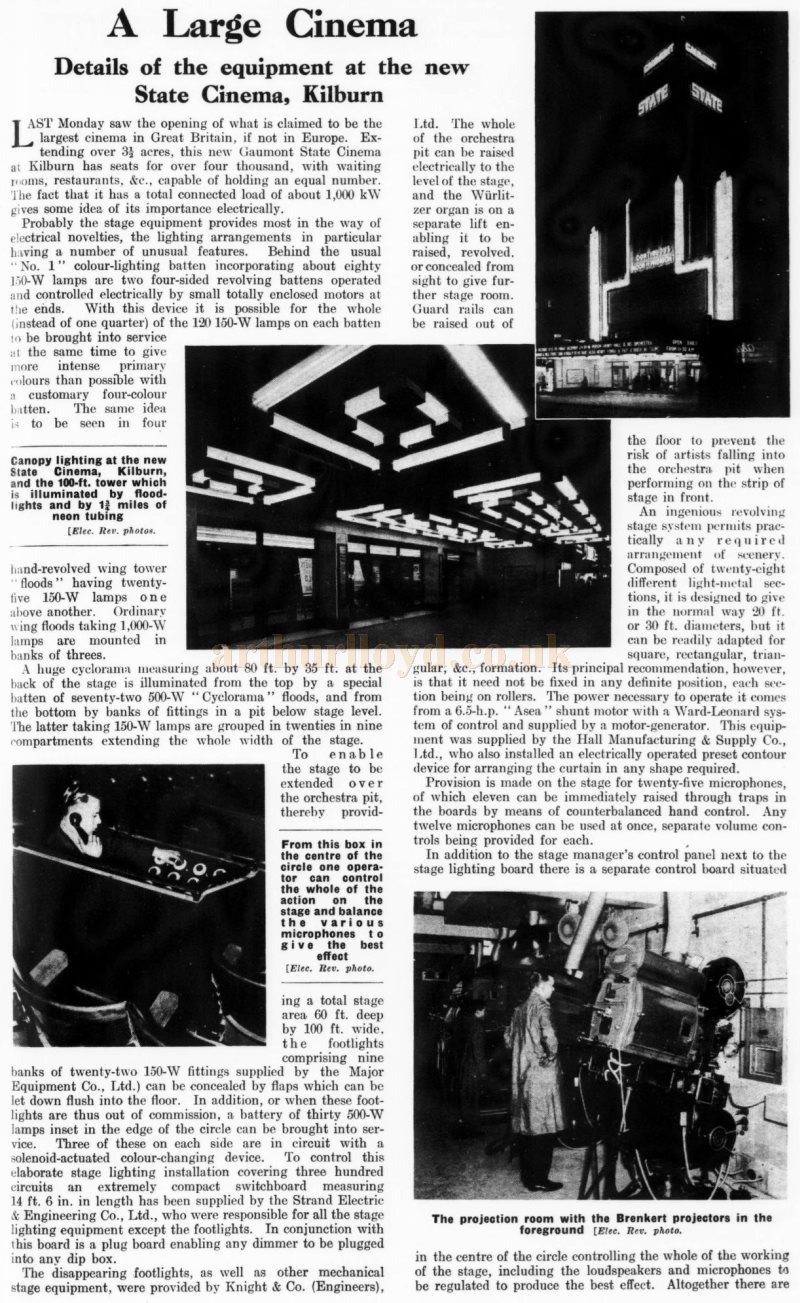
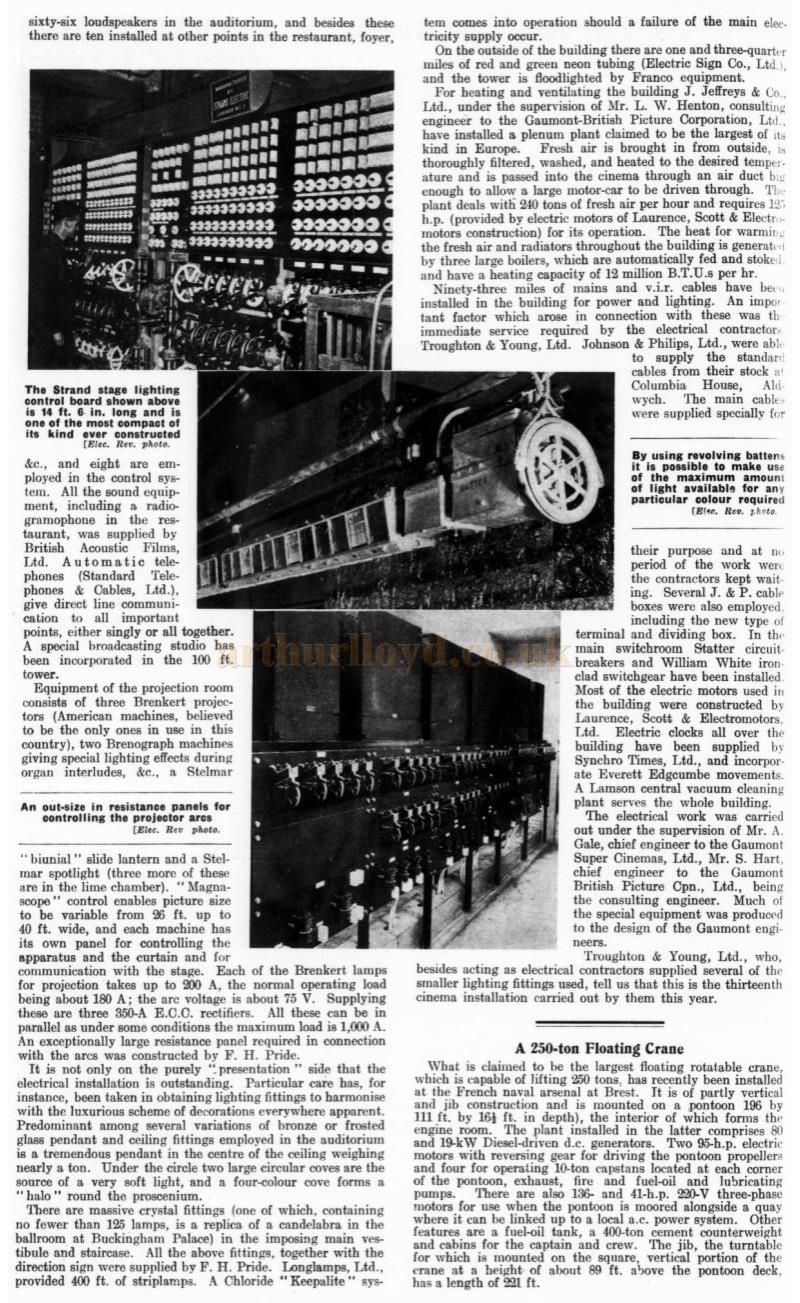


Above - A Two Page Report on the Gaumont State Theatre, Kilburn - From The Electrical Review, 24th of December 1937.
The Gaumont State Theatre had first opened on Monday the 20th of December 1937, and for its first anniversary, in December 1938, the Theatre put on an 'Anniversary Presentation' for the week of the 12th of December with 11 acts and a cast of over 100. The following week 'Circus Time' was presented by G. B. Chapman Ltd., on the 19th of December, and included a plethora of live animals. A special Anniversary Programme for all this can seen below.
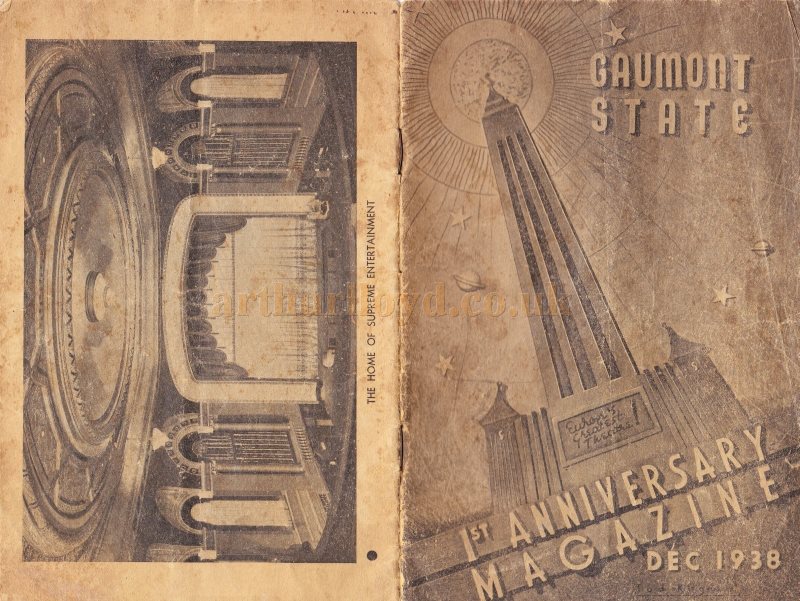
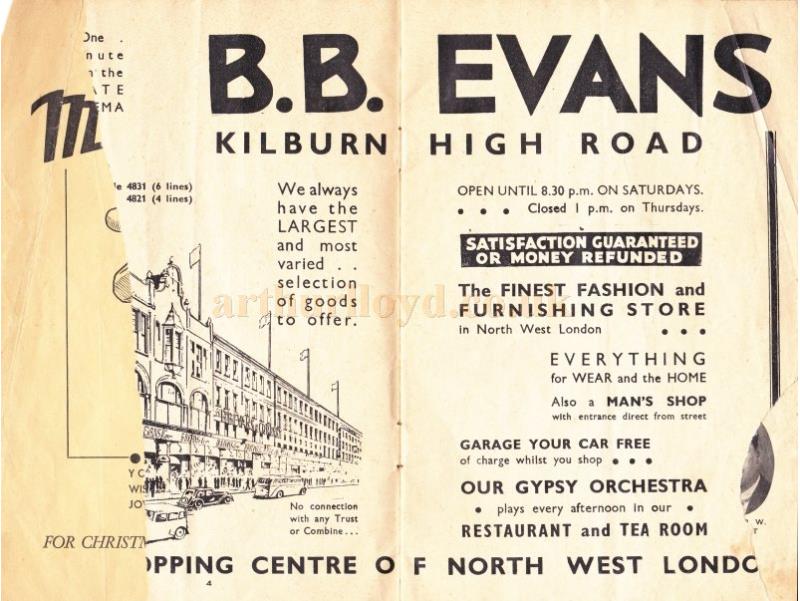
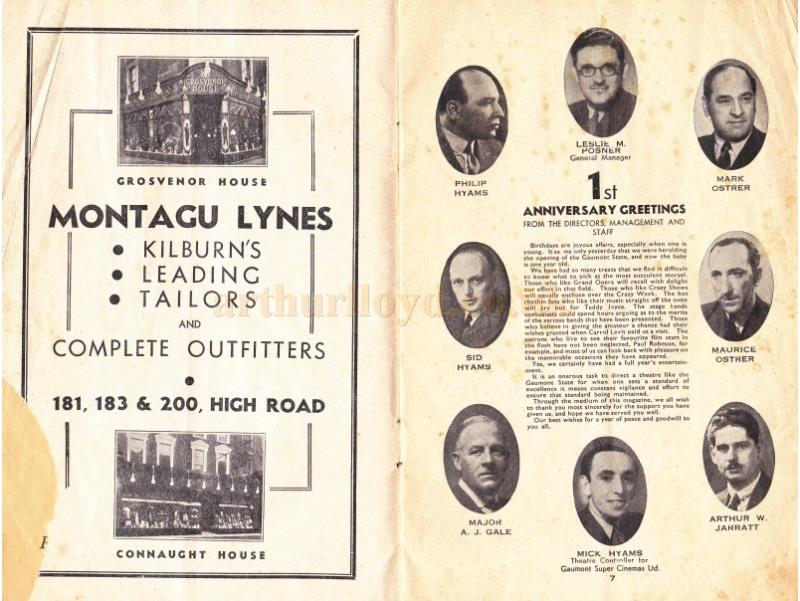
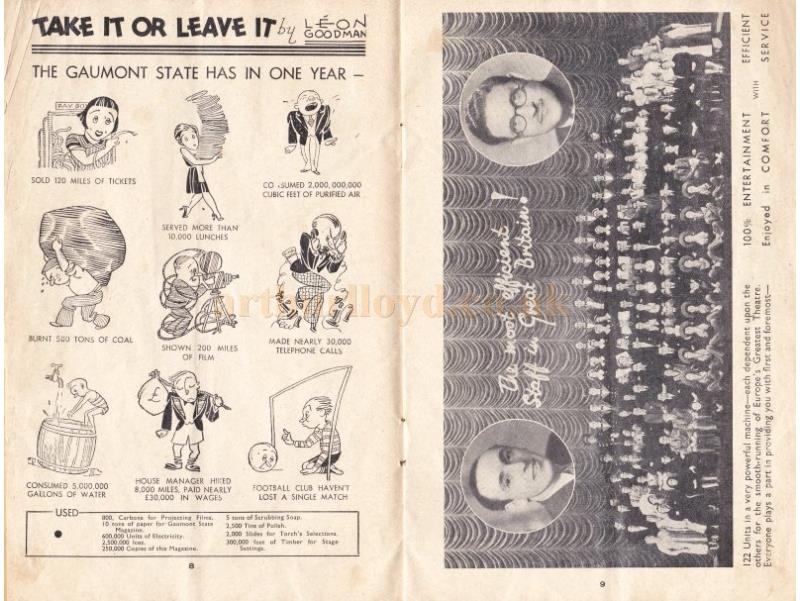
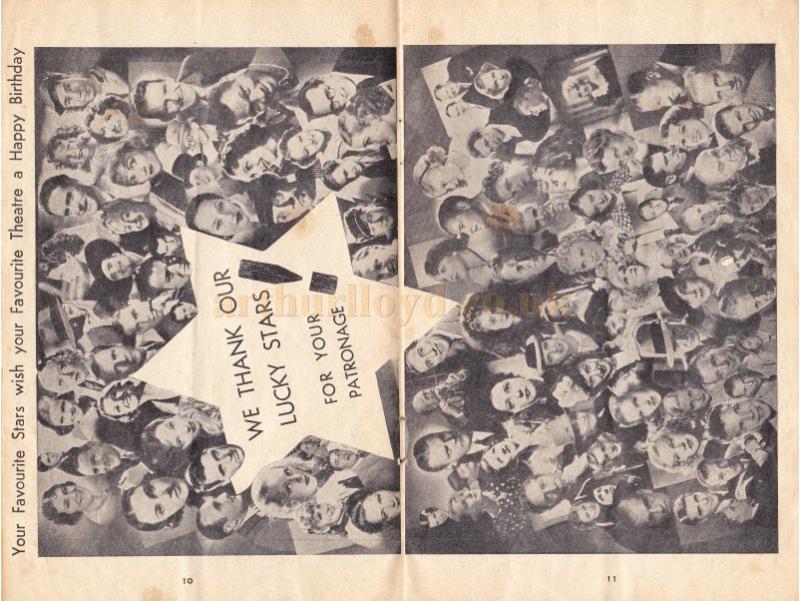
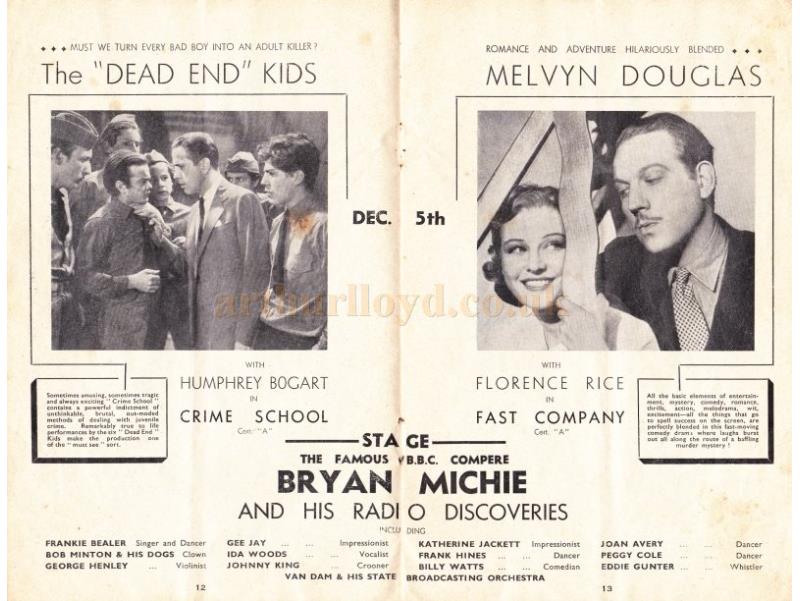
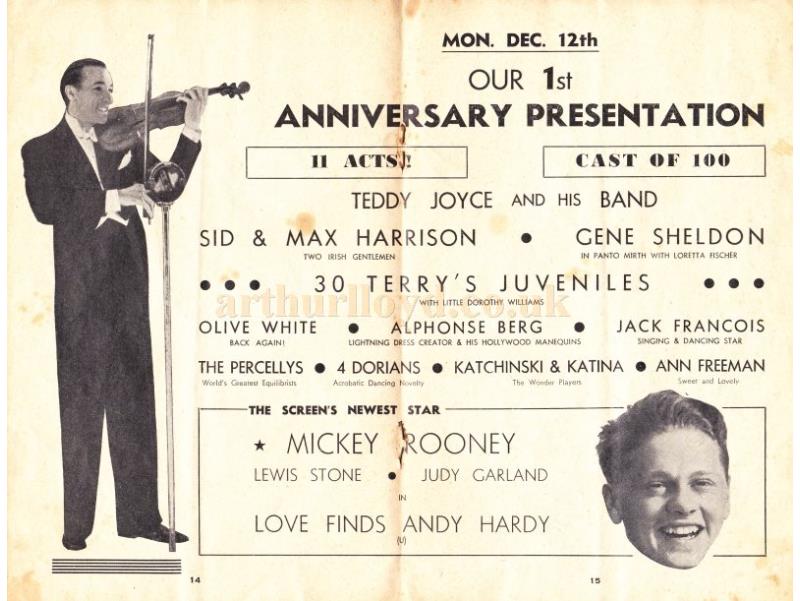
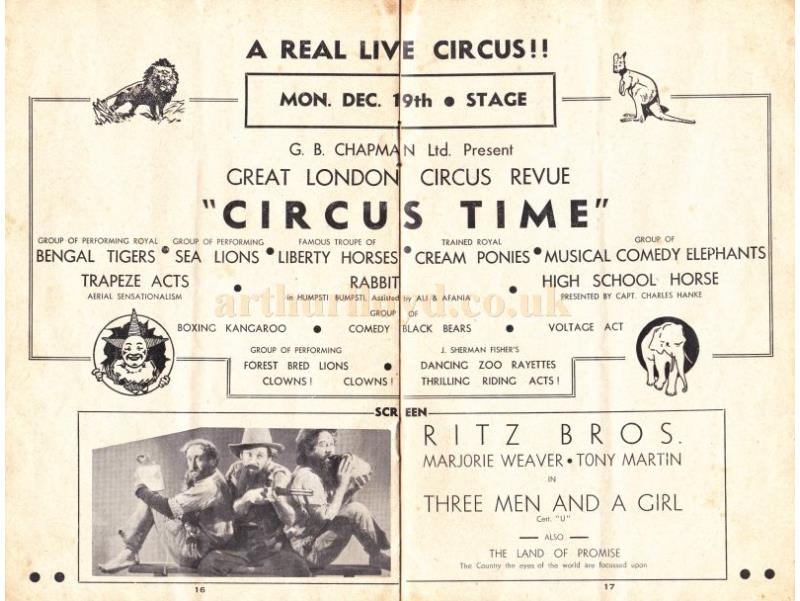
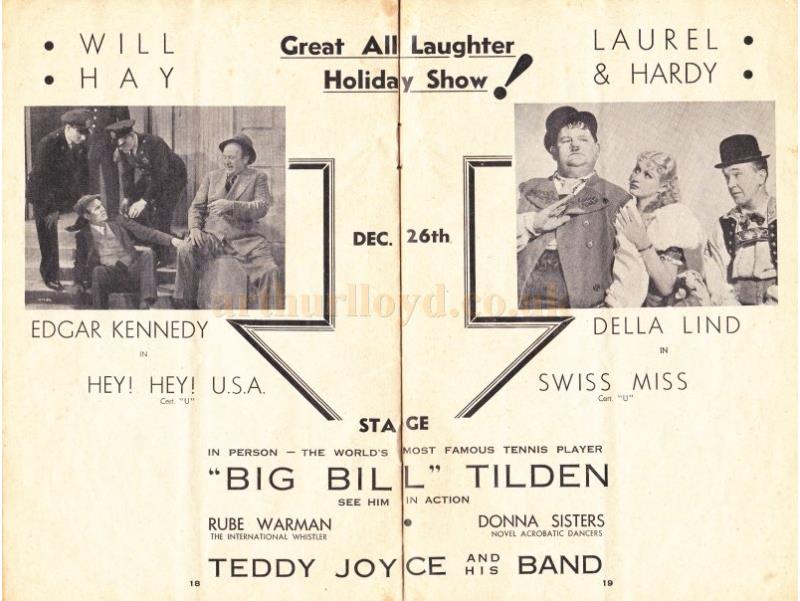
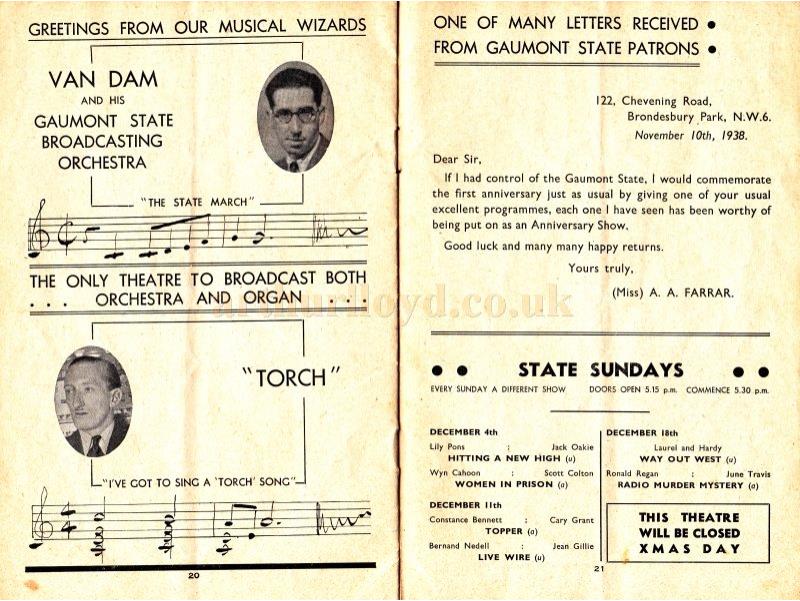
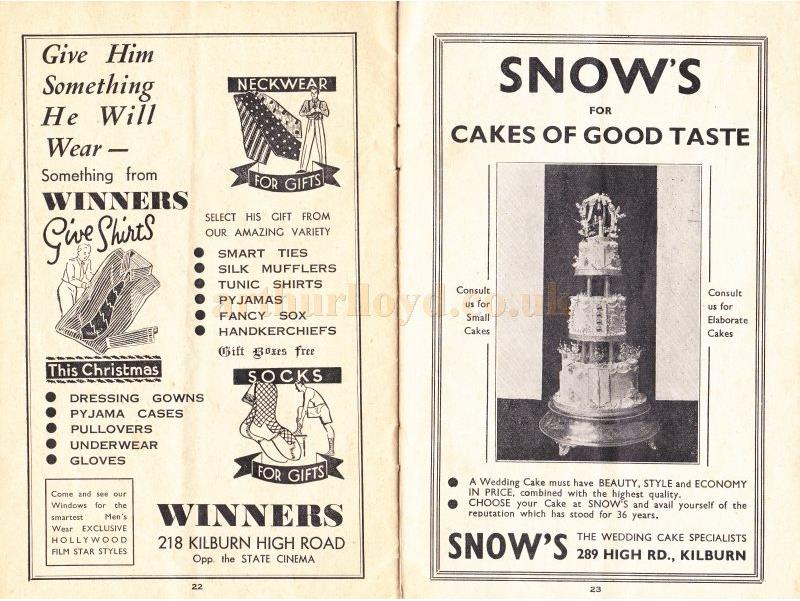
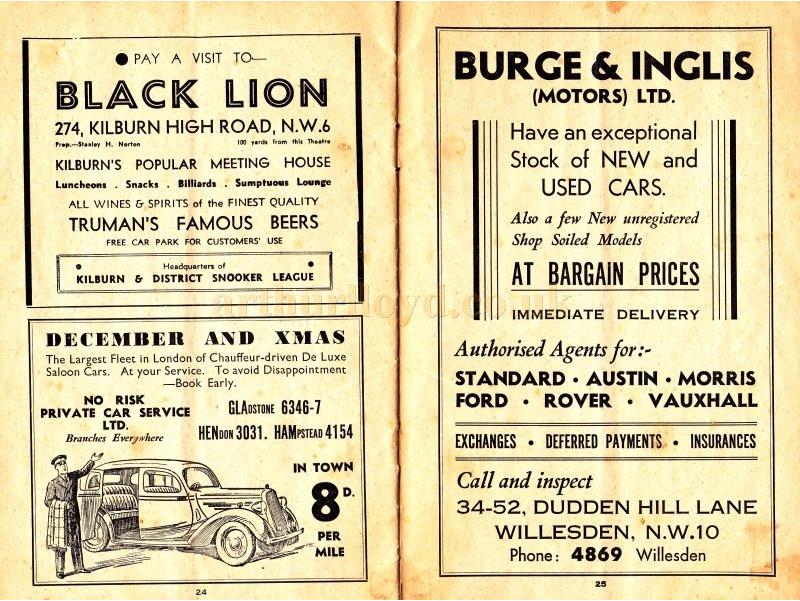
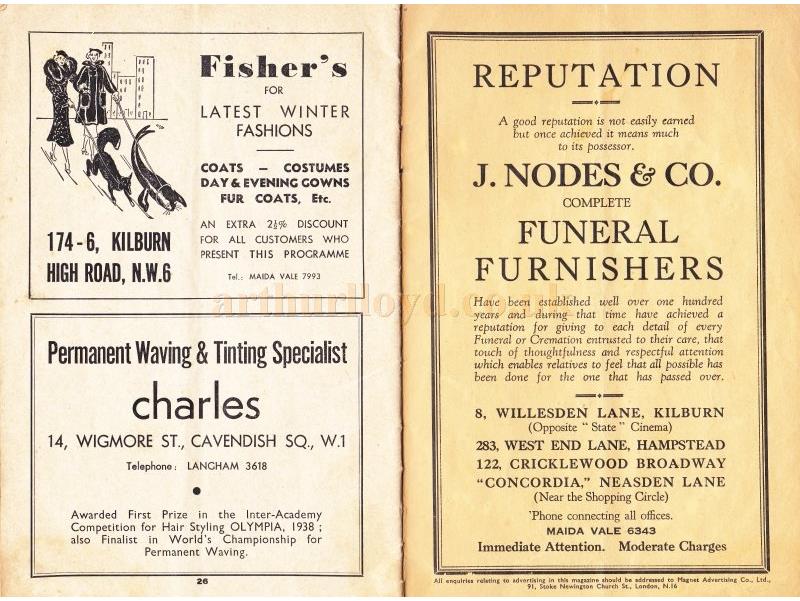


Above - The 1st Anniversary Programme for the Gaumont State Theatre, Kilburn in 1938 - Kindly Donated by Diana Matthews.
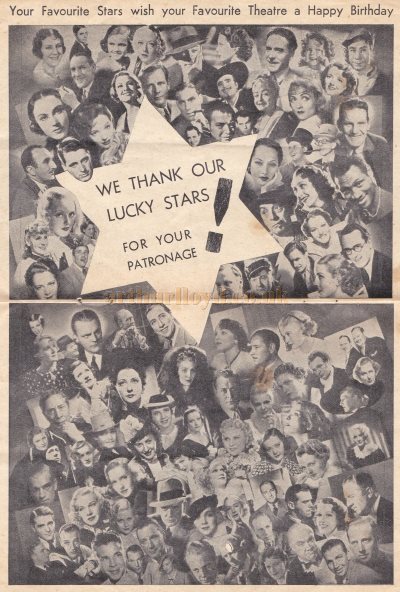 A note in the programme, shown above, from the Directors, Management, and Staff of the Theatre read:- 'Birthdays are joyous affairs, especially when one is young. It seems only yesterday that we were heralding the opening of the Gaumont State, and now the baby is one year old. We have had so many treats that we find it difficult to know what to pick as the most succulent morsel.
Right - Some of the stars who were featured in films or live shows at the Gaumont State Theatre for its first year in business - From the Theatre's 1st Anniversary Programme of December 1938 - Kindly Donated by Diana Matthews.
Those who like Grand Opera will recall with delight our effort In that field. Those who like Crazy Shows will equally enthuse over the Crazy Week. The hot rhythm fans who like their music straight off the oven will cry out for Teddy Joyce. The stage bands enthusiasts could spend hours arguing as to the merits of the various bands that have been presented...
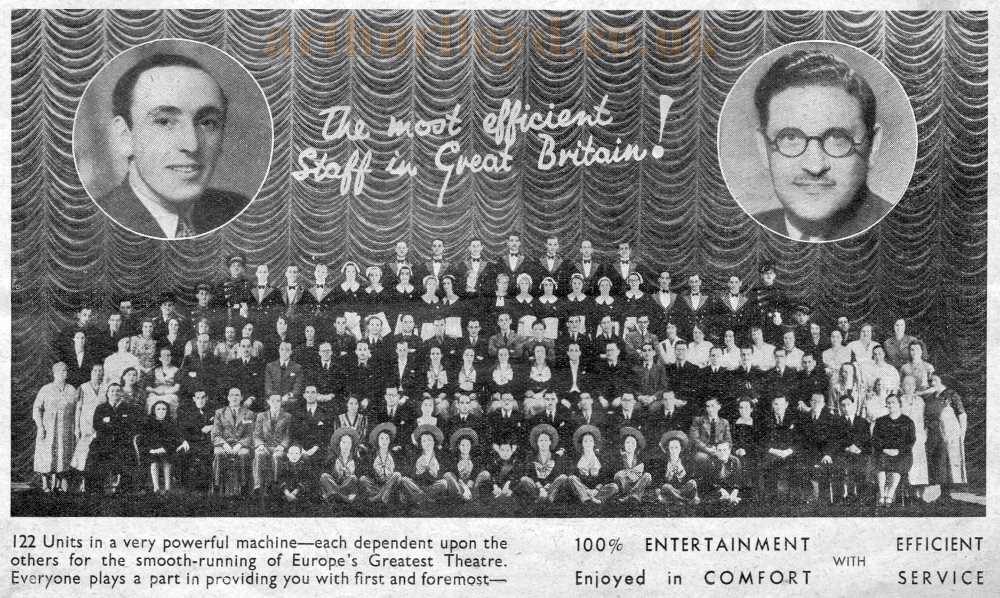
Above - The Staff of the Gaumont State Theatre, Kilburn as shown in the Theatre's 1st Anniversary Programme of December 1938 - Kindly Donated by Diana Matthews.
 Those who believe in giving the amateur a chance had their wishes granted when Carrot Levis paid us a visit. The patrons who like to see their favourite film stars in the flesh have not been neglected. Paul Robeson, for example, and most of us can look back with pleasure on the memorable occasions they have appeared. Yes, we certainly have had a full year's entertainment.
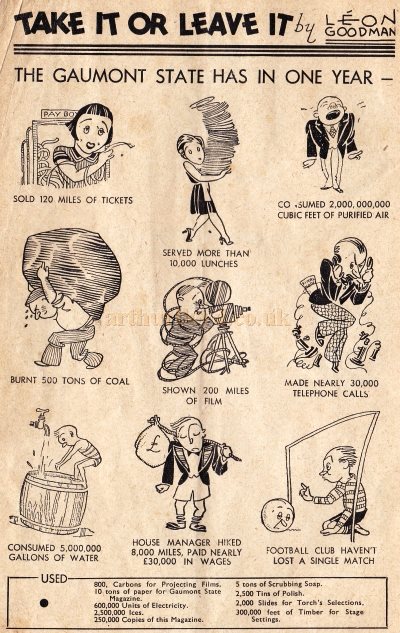
Right - Some Statistics for the Gaumont State Theatre's First year in Business - From the Theatre's 1st Anniversary Programme of December 1938 - Kindly Donated by Diana Matthews.
It is an onerous task to direct a theatre like the Gaumont State for when one sets a standard of excellence it means constant vigilance and effort to ensure that standard being maintained.
Through the medium of this magazine, we all wish to thank you most sincerely for the support you have given us, and hope we have served you well. Our best wishes for a year of peace and goodwill to you all.'
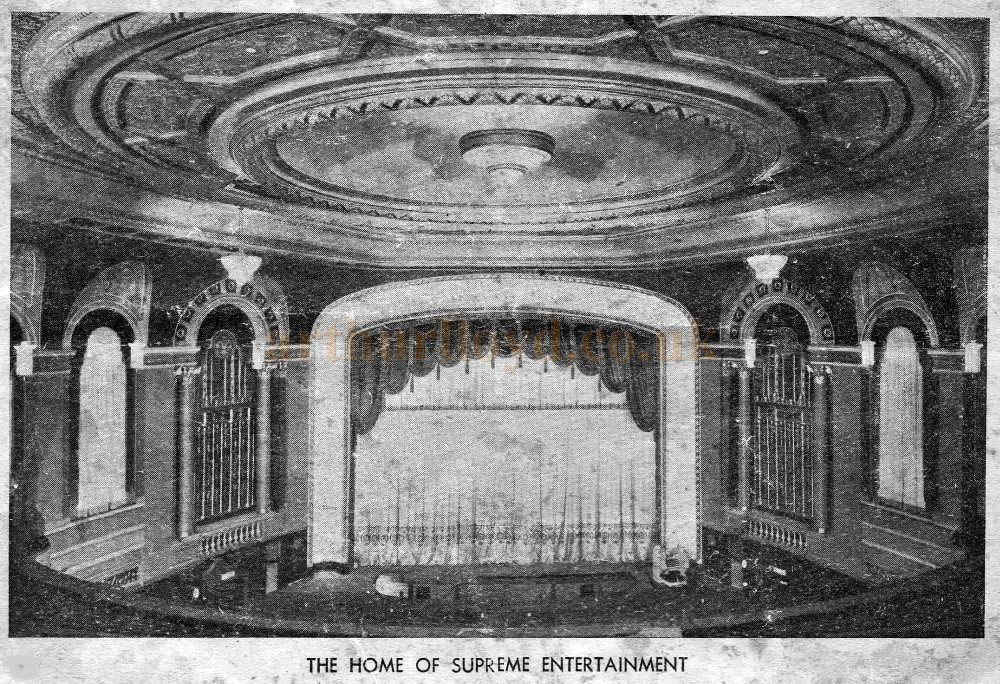
Above - The Auditorium of the Gaumont State Theatre, Kilburn as shown in the 1st Anniversary Programme for the Theatre in December 1938 - Kindly Donated by Diana Matthews.
The
Gaumont State Theatre had first opened in December 1937 and was very successful putting on all manor of shows, concerts and films, but had to close down at the start of the war in 1939. However, it reopened for weekend shows
from 1940 and then reopened full time again in 1944.
Right - The Grand Staircase leading from the Foyer to the Balcony of the Gaumont State, Kilburn in April 2009 - Photo M.L.
 In the 1950s the Gaumont State put on a number of 'Jazz Jamboree' Sunday
concert productions featuring all the big names from the Jazz Circuit.
In the 1950s the Gaumont State put on a number of 'Jazz Jamboree' Sunday
concert productions featuring all the big names from the Jazz Circuit.
Left - A Gala Performance Ballet Programme with Alicia Markova & Anton Dolin at the Gaumont State, Kilburn in November 1949.
In March 1957 a former space below the restaurant which had been used for people waiting to enter the Cinema, was converted into a Dance Studio called the 'Victor Sylvester Dance Studio.'
 The Theatre closed on the 16th of January 1960 after being taken over
by the Rank Organisation so that conversion work could be carried out
on the building. The rear of the Stalls was converted into a ballroom
with a false wall built from the Stalls floor to beneath the Balcony
Front. The Front Stalls and Balcony were still used for Cinema however.
This rear Stalls area was later converted for Bingo.
The Theatre closed on the 16th of January 1960 after being taken over
by the Rank Organisation so that conversion work could be carried out
on the building. The rear of the Stalls was converted into a ballroom
with a false wall built from the Stalls floor to beneath the Balcony
Front. The Front Stalls and Balcony were still used for Cinema however.
This rear Stalls area was later converted for Bingo.
Right - A Programme for Jazz Jamboree on Sunday the 23rd of October 1955, featuring Tommy Trinder as Compere, the M.S.B.C Jamboree Band, Tony Crombie & His Orchestra, The Ray Ellington Quartet, Tubby Hays & His Orchestra, Ted Heath & His Music, the Tony Kinsey Quartet, the New Jazz Group,Jack Parnell & His Orchestra, the Ronnie Scott Orchestra, Ronnie Aldrich & the Squadronaires, and the Tommy Whittle Orchestra.
In 1975 a second smaller Cinema was created in the Theatre's original Restaurant space and opened on the 23rd of November 1975 with a capacity of 202.

Above - The Waiting Area and entrance to the Balcony of the Gaumont State, Kilburn in April 2009 - Photo M.L.

Above - The Stage and Auditorium of the Gaumont State, Kilburn in a photograph taken from the Balcony in April 2009 - Photo M.L.

Above - The 'Hall' Pre-Set Contour Curtain and Controller at the Kilburn State - From The Hall Stage Equipment catalogue of the late 1950s - Courtesy Roger Fox. - Note the Piano in the Pit, which was later destroyed by vandals. - Caption reads: 'The illustration shows the stage at the 'State', Kilburn, London, with the 'Hall' Contour Curtain in use for band setting, in conjunction with a 'Hall' Mobile Band-Rostrum. The versatile curtain gear is specially suitable for concert halls and cine-variety theatres, giving an almost unlimited range of designs and is ideal for lighting effects. The Controller is easily set, and by the push of the Controller button, the curtain drapes gracefully to the pre-set design. New designs can be reset in a matter of seconds.'

Above - The Auditorium of the Gaumont State, Kilburn in a photograph taken from the Stage in April 2009 - Photo M.L.
 On
the 18th of September 1980 the main Cinema closed completely and the
smaller screen soon followed on the 10th of October the following year.
All that was left was Bingo, which was still taking place in the rear
of the Stalls, which had been walled off in 1960.
On
the 18th of September 1980 the main Cinema closed completely and the
smaller screen soon followed on the 10th of October the following year.
All that was left was Bingo, which was still taking place in the rear
of the Stalls, which had been walled off in 1960.
Right - The Strand Electric Grand Master Lighting Control stll in position in the Stage Left Wing of the Gaumont State, Kilburn in April 2009 - Photo M. L.
This wall was removed however, after a short while, so that the entire
Theatre could be converted for Bingo. This was achieved by anti-raking
the Stalls to the height of the Stage level, creating stairs from the
Stalls on either side of the auditorium, up to the Balcony Front, and
re-steping the Balcony so that tables and chairs could be placed in
the front section whilst the rear of the Balcony was walled off to head
height and left unused. The Stage was also altered at this time, by
creating a box inside the area with a false ceiling and walls, and creating
a  Bar
at the former rear of the stage. However, no serious damage was done
to the stage house, and the counterweight system, Iron Curtain, and
original Stage Floor were all retained for possible future reinstatement.
Bar
at the former rear of the stage. However, no serious damage was done
to the stage house, and the counterweight system, Iron Curtain, and
original Stage Floor were all retained for possible future reinstatement.
Thus the whole building was used for Bingo from 1980, when it was also designated as a Grade II Listed Building, until it was sold to new owners in 2007 and was subsequently closed down whilst plans for its future were in progress.
Left - The Wurlitzer Organ Console of the Gaumont State, Kilburn in April 2009 - Photo M. L.
The Gaumont State Theatre now has a Grade II* Listing and its future looked promising when it was taken over by the Ruach Inspirational Church of God in 2009 who stated that it was their intention to restore the Theatre to its original state by reinstalling the Stage and Stage House so that it could once again house live shows, reopen the original Restaurant Space as a Cafe, and reinstate the original colour scheme to the interior, including reinstating the original Stalls and Balcony raking. If this plan came to fruition it was hoped that, although it was being used as a Church, the Gaumont State Theatre would look as grand as it did when it first opened over 70 years ago. However, most of this work has never actually taken place, so far anyway, apart from reinstating the Rake in the Circle, and the Church is hoping for planning consent for 'Change of Use' of the Theatre which was still pending in 2025. They did however, put on the first concert at the former Theatre for 50 years when as part of the 'Kilburn Music Mile Festival' the Theatre was used for a concert performance by the Royal Philharmonic Orchestra with Anna-Jane Casey and Iain Mackenzie as vocalists on the 6th of November 2025. Church use continues however, and one can only hope that this magnificent Theatre will one day go back to its original purpose.

Above - Inside the Fly Tower at the Kilburn State in a photograph taken from the Fly Floor on stage left. The roof of the temporary box which is currently filling the stage for its Bingo incarnation can be seen at the bottom of the picture, and the back of the Iron Curtain, which has been welded into place, is also visible to the left. - Photo M.L. April 2090.

Above - The Projection Room of the Gaumont State, Kilburn in April 2009 - Photo M. L.

Above - The Foyer of The Gaumont State, Kilburn in a photograph taken from the Balcony Stairs in April 2009 - Photo M. L.
Click here to see the Opening Night Souvenir Programme for the Gaumont State
Theatre, Kilburn.
Click here to see
the opening 'T'our of the Theatre' Programme plus many more images.
Click here to see tickets for the opening of the Gaumont State on December 20th
1937.
Kilburn - From The Face Of London by Harold P. Clunn 1956
Marylebone and Paddington, are illuminated on the east side, belonging to Marylebone, by tall new electric-light standards, whereas the west side, belonging to Paddington, is now brilliantly illuminated by powerful new gas standards. Doubtless the better plan is to give one municipality, the entire control of those thoroughfares which form the dividing lines, as in the case of Oxford Street, which is entirely under the control of Marylebone although the south side belongs to the City of Westminster. The Regent's Canal, which crosses Edgware Road at the junction with Maida Vale, follows an open course on the west side, and is flanked by Maida Avenue on the south and Blomfield Road on the north. These resemble the canal-lined streets of Bruges or Rotterdam. Several attractive-looking blocks of flats have been erected in Maida Avenue directly overlooking the canal.

Above - Kilburn High Road - From and early postcard
To the west of Maida Vale, between Harrow Road and Kilburn Park, is another handsome quarter of Paddington, containing many wide streets and avenues lined with large private houses and blocks of flats. Those between Sutherland Avenue and the Regent's Canal are about sixty years old. Most of the houses here are similar to those of Bayswater and Kensington, but those centred round Sutherland Avenue, Lauderdale Road, and Elgin Avenue are of much more recent construction and consist largely of non-basement houses and blocks of flats. Little more than forty years ago a large part of the ground upon which these newer houses have been built was still open land, although it had long since become surrounded on every side by streets and houses stretching towards Kilburn and Harrow Road. Two fine thoroughfares, Sutherland Avenue and Elgin Avenue connect Maida Vale with Harrow Road, and running diagonally between them is Lauderdale Road, consisting almost entirely of modern four storied blocks of flats faced with red brick. Many blocks of flats have also been erected in Elgin Avenue, but semidetached houses have been mostly built in Ashworth Road and Biddulph Road, connecting Elgin Avenue and Lauderdale Road. At the junction of Clifton Gardens and Warrington Crescent is the handsome Gothic church of St Saviour's, with a square tower.
This pleasant quarter of the town has the advantage of being very accessible from the West End by means of the Bakerloo Tube. This part of London suffered severely from air raids during both World Wars and much damage was done to property, notably in Warrington Crescent, Elgin Avenue and Randolph Avenue, as well as in the vicinity of Abbey Road, St John's Wood, and near Lord's Cricket Ground. To the north of' Elgin Avenue is the Paddington Recreation Ground. It was purchased for £33,000 and is bordered on the south and west sides by four-storied blocks of flats. This is Paddington's only park and is attractively laid out with flower gardens, bowling greens, a race-course, a children's playground and a large refreshment pavilion. In Kilburn Park Road is St Augustine's Church, a handsome Gothic edifice crowned by a tower with a lofty spire. At the corner of Kilburn High Road and Priory Road is the Kilburn Empire, which is now a cinema.
 Kilburn,
the district to the north of Maida Vale, was once famous for 2 spring
of mineral water belonging to a drinking house called Kilbourn Wells.
The house, with its adjoining grounds, was situated close to the turnpike
gate at the southern end of what is now the very busy shopping thoroughfare
of High Road, Kilburn. It stood on the site of a hermitage which was
afterwards converted into a nunnery called Kilburn Priory, of which
nothing now remains.
Kilburn,
the district to the north of Maida Vale, was once famous for 2 spring
of mineral water belonging to a drinking house called Kilbourn Wells.
The house, with its adjoining grounds, was situated close to the turnpike
gate at the southern end of what is now the very busy shopping thoroughfare
of High Road, Kilburn. It stood on the site of a hermitage which was
afterwards converted into a nunnery called Kilburn Priory, of which
nothing now remains.
Right - An early photograph of the Priory Tavern on Belsize Road, Kilburn, circa 1927 - Courtesy Ken Mansfield.
In the eighteenth century Kilburn Wells, being only two miles distant from Oxford Street or a morning's walk from the centre of London, was a favourite resort of visitors, who came here to drink the waters and to indulge in refreshments, music and dancing. .A printed brochure on the water, described by an eminent physician, was given gratis to people visiting the wells. The Old Bell Tavern, long since rebuilt, marks the site of the original house in Kilburn High Road. The mineral spring stood close to the site now covered by the Kilburn station of British Railways, Midland Region. The turnpike gate at the southern end of the High Road, Kilburn, was abolished in 1868.
Until after 1870 Kilburn was situated on the fringe of the metropolis and consisted principally of one long street forming a part of the main Edgware Road. The whole of the vast territory on the east, extending to Finchley Road and Hampstead, was then open country, and the great urban district of Willesden on the west was non-existent. High Road, Kilburn, is one of the most lively shopping centres of semi-suburban London and together with Shoot-up Hill and Cricklewood Broadway, forms the boundary line between Willesden and Hampstead. It is about three quarters of a mile long and contains many excellent shops, the largest of which is the extensive drapery store on the east side of Messrs B. B. Evans & Company Limited, now owned by Messrs Thomas Wallis, & Company Limited of Oxford Street. Near the junction of Kilburn High Road and Willesden Lane now stands the Gaumont State Cinema, one of the largest in London. It was erected in 1936 and is crowned by a lofty square tower. Higher up is the Kilburn Grange Cinema, at the back of which is a small public park, formerly the private grounds of a mansion called the Grange. This is tastefully laid out with flower gardens, tennis courts, a children's playground and a girls' gymnasium.
A century ago Willesden, then called Wilsdon, was a retired village five miles from Oxford Street, and a favourite walk was then from Kilburn Wells through Willesden Lane, passing by Brondesbury House, the former seat of Lady Salisbury and after of Mr Coutts Trotter. Another very pleasant walk was from the Paddington Canal to Willesden by way of Kensal Green. To-day the borough of Willesden includes Brondesbury, Harlesden, Kensal Rise and part of Cricklewood, and the important railway junction of British Railways, Midland Region.
The population, which in 1891 was 61,255, had increased by 1931 to 184,410, and in 1949 was estimated at 181,320. The Town Hall, in Dyne Road, is a building of red brick with stone dressings but is now considered to be too small for this great new borough.
The Face Of London by Harold P. Clunn 1956
Archive newspaper reports on this page were collated and kindly sent in for inclusion by B.F.