
Theatres and Halls in Fulham, London
The Granville Theatre, Walham Green, Fulham Broadway - The Grand Theatre / Fulham Theatre / Shilling Theatre - The Forum Theatre / ABC / Cannon / MGM / Cineworld
The Granville Theatre of Varieties, Walham Green, Fulham Broadway
History - Television Use - Demolition

Above - The Granville Theatre, Walham Green - From a variety programme for the Theatre in March 1938

 The Granville Theatre of Varieties was built
on a very small triangular piece of land, in Walham Green, now called
Fulham Broadway, bordered by Fulham road, Vanston Place, and Jervan
Place. It was originally intended to purchase the entire island site,
but for some reason, this was not possible. Two shops and offices adjoined
the Theatre and for many years a showroom of the 'Gas Light & Coke
Company' was situated at the far end of the site. The Theatre opened
on the 19th September 1898 with a capacity 1,122 people.
The Granville Theatre of Varieties was built
on a very small triangular piece of land, in Walham Green, now called
Fulham Broadway, bordered by Fulham road, Vanston Place, and Jervan
Place. It was originally intended to purchase the entire island site,
but for some reason, this was not possible. Two shops and offices adjoined
the Theatre and for many years a showroom of the 'Gas Light & Coke
Company' was situated at the far end of the site. The Theatre opened
on the 19th September 1898 with a capacity 1,122 people.
Right - The Auditorium of the Granville Theatre in 1949 - From 'The Pub Music Hall' by Harold Scott published in the Architectural Review, March 1949.
The Capital raised to build the Theatre was £20,000 which consisted of 20,000 shares at £1 each. The backers and directors of the company formed to build the Theatre was unusual at the time in that it was instigated by a consortium led by Herbert Campbell, Dan Leno, and Harry Randall, all stars of the Music Hall, together with Henry Joyner, G.E.S. Venner - secretary, and Fred Williams. Mr Jesse Sparrow being general manager.
 The
Theatre was designed by the famous Victorian
architect Mr Frank Matcham, who used all
his skill to create a Variety Theatre on such
a small cramped site. The exterior façade was in the style of
'Queen Anne'. The ERA newspaper stated in its
5th of March 1898 edition:
'Over the handsome entrance doors the walls will be carried up with
a circular corner, crowned with a terracotta minaret, and from this,
large sweeping scrolls lead up to the highest part of the building,
which is crowned by two bold towers, with ornamental railings at the
top'. The ERA 5th of March 1898 . The walls were faced with red bricks and terracotta dressings.
The
Theatre was designed by the famous Victorian
architect Mr Frank Matcham, who used all
his skill to create a Variety Theatre on such
a small cramped site. The exterior façade was in the style of
'Queen Anne'. The ERA newspaper stated in its
5th of March 1898 edition:
'Over the handsome entrance doors the walls will be carried up with
a circular corner, crowned with a terracotta minaret, and from this,
large sweeping scrolls lead up to the highest part of the building,
which is crowned by two bold towers, with ornamental railings at the
top'. The ERA 5th of March 1898 . The walls were faced with red bricks and terracotta dressings.
Left - A variety programme for the Granville Theatre, Walham Green for March 21st 1938, with Mable Somers, Horace & Edna, Harry Shiels, Holmes & Furlow, Papello & Assistant, Carr & Finch, Rita Bernard, Terry Wilson, and Micky Maxis Monkeys on the Bill.
Over the entrance was an iron and glass canopy. Upon entering the entrance vestibule a box office was on the left, ahead was a staircase leading to the dress circle and promenade, and also entrance to the stalls. The decoration of the vestibule and corridors was of raised plasterwork panels in the style of Louis the fourteenth ornamentation in blue and gold.
One of Frank Matcham's clever solutions to the cramped site was to place the staircases one over the other thus gaining valuable space. The whole of the ground floor consisted of fourteen rows of stalls, (there being no pit) fitted with tip up chairs, with the floor richly carpeted. The entrance to the stalls was from the corner vestibule along an open verandah type corridor, from which a view of the stage was obtained, the corridor ending at the stage end of the building and down wide steps at the side of the stage into the auditorium. There were four exits on this level.
 In
a chat I had with Mr Norman Fenner some years ago, then a member of
the Frank
Matcham Society and archivist at the Richmond
Theatre, who remembered well his visits to the Granville Theatre,
he said that 'the ladies toilet in the stalls was a bit of an embarrassment
as it led straight off the stalls, with only one cubicle, which meant
the ladies having to queue in the auditorium.'
In
a chat I had with Mr Norman Fenner some years ago, then a member of
the Frank
Matcham Society and archivist at the Richmond
Theatre, who remembered well his visits to the Granville Theatre,
he said that 'the ladies toilet in the stalls was a bit of an embarrassment
as it led straight off the stalls, with only one cubicle, which meant
the ladies having to queue in the auditorium.'
Downstairs in the basement was a refreshment saloon, underneath the Entrance Vestibule above. Above the stalls was the balcony, being 6 rows of seats with fixed backs richly upholstered in velvet. There being no stage boxes, the balcony front extending almost up to the proscenium arch. There was a large refreshment saloon situated to the side. Above the balcony was the gallery constructed of concrete steps with seat padding on the edges.
Right - A programme for Frank H. Fortescue's comedy review 'Come, Look and Chuckle' at the Granville Theatre, Walham Green March 28th 1938.
The circle and gallery were built on the cantilever system, everyone having a clear uninterrupted view of the stage, there being no supporting pillars in view. All tiers were built of steel and concrete.
The proscenium was 25 feet wide and 25 feet high, of square picture frame design, however the stage was very shallow being only 10 feet deep. Height from stage to grid was 45 feet, height to under the fly rail of 18 feet clearance, and the distance between the fly rails was 30 feet. The House tabs (stage curtain) was of rich copper colour, and was raised in an unusual way, in that for a third of the way it would ascend up in the usual manner, and then it would continue to lift upwards from the corners, until a clear view of the stage was opened up. There was also an asbestos safety curtain fitted and various hydrants. The stage, dressing rooms, and auditorium were all heated by hot water.

Above - A photograph of a model Theatre design of the Granville Theatre, created by David Garratt from photographs of the auditorium - Courtesy David Garratt.
The decoration of the auditorium was unusual. The ERA newspaper stated in its 5th of March 1898 edition:- 'Mr Matcham has for some time been considering a new material for decorating Theatres, and has hit on the happy idea of utilising Faïence work (perhaps better known as Doulton ware) for this purpose. The whole of the circle fronts, proscenium, and ceiling, together with the side walls of the auditorium, are now being covered with this material, and the architect claims for the novelty, not only durability, but a considerable saving in redecoration, as a sponge and water will be all that is required in the way of cleaning.' Mosaic painting also adorned the walls and draperies were of light blue.

Above - A photograph of a model Theatre design of the Granville Theatre, created by David Garratt from photographs of the auditorium - Courtesy David Garratt who says 'Included is my Interpretation of a Model Theatre Victorian stage set. Based upon a venetian street scene by William Telbin for Kean's 1853 production of 'The Merchant of Venice' at the Princess's Theatre London'.
Here are listed the principal companies involved in the building and furbishment of the Theatre: Contractors for the foundations – Mr Charles Wall of Chelsea. Contractors of the superstructure – Mr C. Gray Hill of Coventry. Electric light - Messrs Laing Wharton & Down. Gas fittings – Messrs James Stott & Co. Plumbing – Messrs Finch & Co. Hot water heating – Messrs Oldroyd & Co of Leeds. Hydrants – Messrs Shand Mason & Co. Faïence work – Mr Alfred Whitehead of Leeds. Plaster work and decorative paintings – Messrs F. De Jong & Co. Upholstery – Messrs H. Lazarus & Son. Tip up chairs – Messrs Fred Harper & Co, and Messrs H. Lazarus & Son. Curtains- Messrs A.R. Dean Ltd of Birmingham. Carpets – Messrs J. Dean & Co Ltd. Scenery by Mr Richard Douglas of Islington London.
A Memorial stone was laid by Mr Herbert Campbell which read, 'This stone, was laid on September 1st 1898 by Herbert Campbell' followed by the names of the proprietors, the architect and the builder. The ERA stated in its 3rd of September 1898 edition that 'the onlookers being moved to much mirth by the comical comments on the proceeding by the irrepressible Dan Leno. Mr Campbell, having declared the memorial stone well and truly laid, was presented by Mr Matcham with the silver trowel he had used.' The ERA, 3rd September 1898.

Above - A postcard depicting the Granville Theatre, Walham Green, Fulham Broadway
The Theatre opened on the 19th September 1898 with a capacity 1,122 people, and Dan Leno topping the Bill. Other famous artistes to play the Granville Theatre over the years were Gus Ellen, Marie Lloyd, Marie Loftus, Gracie Fields, George Robey, Naughton and Gold and Tod Slaughter, etc.

Above - A postcard showing the Granville Music Hall, Fulham circa 1908 - Courtesy Sandra Chestney
 In 1929 behind the stage house, the two shops were purchased and demolished,
allowing the shallow stage to be deepened and a dressing room block,
on Vanston Place, to be added to the Theatre. However the Theatre only
closed for one week to facilitate the deepening of the stage. The extension
was built whilst the Theatre was operational, and all that remained
was to demolish the rear wall of the stage house into the enlarged new
deeper stage.
In 1929 behind the stage house, the two shops were purchased and demolished,
allowing the shallow stage to be deepened and a dressing room block,
on Vanston Place, to be added to the Theatre. However the Theatre only
closed for one week to facilitate the deepening of the stage. The extension
was built whilst the Theatre was operational, and all that remained
was to demolish the rear wall of the stage house into the enlarged new
deeper stage.
Left - A variety programme for the Granville Theatre, Walham Green for January 17th 1938, with Lyndon & wilson, Casa & Nova, Joyce & Shields, Eddie Arnold & Johnny, Forde & nolan, Morny Cash, Ambree Sisters, and Mitchell & Peru on the Bill.
The Theatre continued to present Variety, and during the 1914/18 war, free concerts were given to wounded soldiers. Then variety alternated with straight drama. It closed during 1939 later re-opening again with Variety. There was another closure period in 1945, and when it reopened it presented a season on Grand Guignol (the décor of the Theatre contributing to the atmosphere). Bernard Delfont bought the Theatre in 1947, but the expected resurgence in variety after the war never blossomed.
During this period the Granville's stage and auditorium were used for the filming of the interiors of the 'Regency Theatre' in the 1952 film 'Tread Softly', some theatre exteriors were filmed at London's Palace Theatre.
Conversion into Television Studio
 In
1955 the Granville Theatre was bought by Associated Rediffusion who converted the Theatre
into a TV studio known by them as Studio 6. The orchestra pit was made
flat but the stalls still retained their rake making it somewhat difficult
to operate the camera's. The making of programmes there commenced on
the 7th August 1955. One of the first series filmed was called 'The
Granville Melodramas'. A series of Victorian plays which proved
surprisingly popular. It changed ownership several times, during which
time commercial films, T.V. Adverts, and popular TV programmes were
made there, such as 'Opportunity Knocks'. Then Industrial films were
produced. The Granville TV Studio Ltd is listed in Kemp's International
Film and Television Directory in 1968.
In
1955 the Granville Theatre was bought by Associated Rediffusion who converted the Theatre
into a TV studio known by them as Studio 6. The orchestra pit was made
flat but the stalls still retained their rake making it somewhat difficult
to operate the camera's. The making of programmes there commenced on
the 7th August 1955. One of the first series filmed was called 'The
Granville Melodramas'. A series of Victorian plays which proved
surprisingly popular. It changed ownership several times, during which
time commercial films, T.V. Adverts, and popular TV programmes were
made there, such as 'Opportunity Knocks'. Then Industrial films were
produced. The Granville TV Studio Ltd is listed in Kemp's International
Film and Television Directory in 1968.
Right - A Variety Programme for 'Take A look' at the Granville Theatre in May 1952 - Courtesy Roy Cross.
A company called Granville Television was formed by William (Bill) Stewart and Peter Lloyd, both originally from ATV. Bill Stewart's daughter remembers the lease for the Granville running out and her father was unable to renew it. Thus television making ended at the Granville. Ewart Studio's bought the cameras. It was a film studio for 13 years, closing in 1968. There is a great deal more information on the Granville Theatre's Television years here and here. After this the Theatre was then abandoned, closed and lay empty until it was demolished in 1972, details below.

Above - A Variety Programme for 'Take A look' at the Granville Theatre in May 1952 - Courtesy Roy Cross.
Demolition of the Granville Theatre

Above - The Auditorium of the Granville Theatre prior to its demolition - From The London Archaeologist Winter 1971.
 In
September 1971 planning permission was granted to demolish the Granville
Theatre, to be replaced with an office block. Protests from Fulham History
Society and letters to local Hammersmith Borough Council and the Greater
London Council Historic Buildings Division were made. However, it was
too late, the Granville was lost due to action not being taken earlier. Very quickly a demolition team moved in and the Theatre was no more.
This caused an outcry, leading directly to the formation in 1972 of
the 'Save
London's Theatres Campaign'. The Campaign realised that legislation
was needed to protect theatres, and was instrumental with others, in
securing the necessary support to set up 'The
Theatres Trust'.
In
September 1971 planning permission was granted to demolish the Granville
Theatre, to be replaced with an office block. Protests from Fulham History
Society and letters to local Hammersmith Borough Council and the Greater
London Council Historic Buildings Division were made. However, it was
too late, the Granville was lost due to action not being taken earlier. Very quickly a demolition team moved in and the Theatre was no more.
This caused an outcry, leading directly to the formation in 1972 of
the 'Save
London's Theatres Campaign'. The Campaign realised that legislation
was needed to protect theatres, and was instrumental with others, in
securing the necessary support to set up 'The
Theatres Trust'.
Right - A Variety Poster for the Granville Theatre, Walham Green - Courtesy Elton Maryon whose Grandfather, Gus Elton, is featured on the Poster, more information on Gust Elton can be found below. Also on the Bill were Jack Mayer, Alan Kitson, Susan and Mandy, Jill Jayes, F. W. Lovell, Kidd & Tracey, Astor and Carlton, Jenny Hayes, Lesie Rickards, and the Donzolon Trio.
The Granville Theatre was an amazing Theatre, with it's unusual unique Faïence tiled decoration and clever use of such a small cramped site. It's a great shame that it is not still standing for today's generation to experience its intimacy and beautiful decoration.

Above - A Google StreetView Image of the Site of the former Granville Theatre, Fulham in September 2022 - Click to Interact.
The above article on the Granville Theatre was very kindly written for this site by David Garratt in 2011, and is © David Garratt 2011. It was updated by M.L. in July 2024.
If you have any more images for this Theatre that you are willing to share please Contact me.
About Gus Elton
 Gus
Elton was a Music Hall comedian and
one of the original members of the Fred Karno Company of Comedians.
He was the principal comedian in numerous summer seasons around the
country including seven years from 1932 to 1939 in Walter Paskin's "Come
to the Show" on Wellington Pier, (in 1936 amongst the company was
a very young dancer called Dora Bryan).
Gus
Elton was a Music Hall comedian and
one of the original members of the Fred Karno Company of Comedians.
He was the principal comedian in numerous summer seasons around the
country including seven years from 1932 to 1939 in Walter Paskin's "Come
to the Show" on Wellington Pier, (in 1936 amongst the company was
a very young dancer called Dora Bryan).
Gus appeared in many shows that played at Music Halls around the country, including Archie Pitt's "Orders Is Orders" and "Cockneys on Parade". He wrote his own material as well as for others, including "The Gladiator" which was a success for 'The Daft Lad From Yorkshire', Bunny Doyle. His bill matters included: 'London's Popular Mimetic Comedian'; 'Popular Cockney Comedian' 'Renowned Comedian & Impressionist' and when appearing on the same bill with "Monsewer" Eddie Gray in 1938 at The Hippodrome Balham, 'Nearly a Lady'.
Right - A publicity shot of Gus Elton when he was appearing in a summer season in Hastings - Courtesy Elton Maryon.
He was described as a comedian 'that could "hold" his audience without uttering a word', his humour 'always clean and homely' and 'at his best in "ad lib" sketches' and 'His mobile features and tireless voice were assets to his fun making.' Gus was an experienced Panto Dame and his last performances were as 'Dame Durden' in the 1947-48 "Babes in the Wood" pantomime at The Grand Theatre in Swansea alongside Clifton James ("I was Monty's double") as Baron Stoney Broke. When Gus was appearing at Lowestoft with Charlie Chaplin, for a joke one evening they entertained patrons of a hotel. Charlie playing the violin and Gus singing. Unfortunately for them the 'hat' was taken round and the first man who was approached was the manager of their show who instantaneously dismissed both of them!
The above information and poster for Gus Elton was kindly sent in by his Grandson Elton Maryon in 2015.
The Grand Theatre, Putney Bridge Approach and Fulham High Street, Fulham
Later - The Fulham Theatre / The Shilling Theatre / Grand Theatre
Introduction - Opening Report

Above - The Grand Theatre, Fulham when it first opened in 1897 - From The Sketch, September 1st 1897.
 The
Grand Theatre, Fulham was built by Pattinsons and Sons for Alexander
F. Henderson and designed by the respected Theatre
Architect, W. G. R. Sprague, with decorations
by Mr De Jong. The Theatre opened on Monday the 23rd
of August 1897 with a production
of 'The Geisha'.
The
Grand Theatre, Fulham was built by Pattinsons and Sons for Alexander
F. Henderson and designed by the respected Theatre
Architect, W. G. R. Sprague, with decorations
by Mr De Jong. The Theatre opened on Monday the 23rd
of August 1897 with a production
of 'The Geisha'.
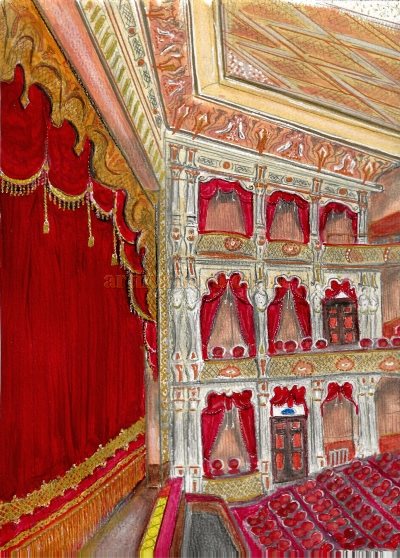
Right - A Painting by George Richmond depicting the Auditorium of the Fulham Grand Theatre of 1897 - Click for an Index to all of George Richmond's Paintings on this site.
The Fulham Grand's auditorium was built on four levels, stalls, dress circle, balcony, gallery, and boxes, and on the Theatre's opening could accommodate 2,239 people seated and standing, although this was later reduced to a more modest 1,132.
 A Full Page Advertisement for the opening of the Theatre can be seen below, and more specific details of the Theatre's opening can be read here.
Left - A Bill for 'The Silver King' at the Fulham Theatre on the 13th of October 1902 - Courtesy David Hampton. The Poster forms part of a display at The Rock Entertainment Emporium in Abbotsbury Road Weymouth.
Sometimes known simply as the Fulham Theatre in the early 1900s, from 1912 the Theatre was often in use as a Cinema called the Shilling Theatre, but by 1937 it was renamed the Grand Theatre again, showing live productions, although on Sundays it still showed Films.

Above - A Full Page Advertisement for the opening of the Grand Theatre, Fulham - From the Stage Newspaper 19th August 1897.

Above - The Grand Theatre, Fulham - From a postcard posted in 1907 - Courtesy Sandra Chestney.
 The Theatre closed down in 1950 and then stood empty until it was finally
demolished in 1958. An office block called Redbank House was then built
on the site.
The Theatre closed down in 1950 and then stood empty until it was finally
demolished in 1958. An office block called Redbank House was then built
on the site.
Right - The cover of a Robert Arthur Illustrated Journal Programme for the Drury Lane production of 'The Bondman' at the Fulham Theatre for the week beginning September 30th 1907. See Cast Details Below. The programme also has details for Robert Arthur's Camden Theatre, Coronet Theatre, and Kennington Theatre.
After it closed the Grand Theatre was used extensively in the film 'Escape by Night' which you can watch on YouTube here. The film featured Sid James as an Italian Gangster before he rose to fame in the Carry On films. There are many scenes set in the Theatre's derelict auditorium and stage starting about 19 minutes in, including a few shots of its exterior too.
A report on the opening of the Fulham Grand Theatre can be read below.

Above - The centre page of a Robert Arthur Illustrated Journal Programme for the Drury Lane production of 'The Bondman' by Hall Caine at the Fulham Theatre for the week beginning September 30th 1907. In the cast were Oswald Lingard, Cecil A. Collins, Arthur Bawtree, W. H. Rotheram, Norman Wrighton, F. J. Waller, Scrope Quentin, Frederick Chappell, John Grant, Madge Lanerton, Lilian Mayne, Frank Edwards, Philip Lawton, Beatrice Whitney, Gertrude Helene, Arthur Clarence, Florence Hunt, Julia Willis, F. Lyons, James Law, Arthur L. Blair, A. Rowland, Franklin Gregory, A. L. Burke, Alfred Humbert, Lewys Aldwin, Philip Penrose, William Evans, Hannah Abrahams, Miss Richardson, Ettie Howard, Misss M. Wellings, Emily Mayhew, and Grace Chalmers. Also on the page are details of forthcoming productions at the Fulham Theatre including the Pantomime 'Robinson Crusoe', the play 'The Stronger Sex' direct from the Apollo Theatre, Marie Studholme in 'My Darling' direct from Hick's Theatre, the play 'The Prodigal Son' direct from Drury Lane Theatre, and Ellen Terry in 'Captain Brassbound's Conversion'.
A Report on the Opening of the Fulham Grand Theatre
From the ERA, 28th of August 1897

Above - W. G. R. Sprague's Fulham Grand Theatre - From an early postcard.
Mr Alexander F. Henderson's beautiful New Grand Theatre at Fulham was opened on Monday last by Mr George Edwardes's Geisha company in The Geisha. The view of the front of the house was even more effective under artificial illumination than by daylight. The stately pillars which support the portico stood out, creamy-white, against the delicate shadows cast by it; and under the pure rays of the electric lamps every detail of the ornamentation was observable. This was especially the case with respect to the handsome group of statuary at the top of the building, the contours of which were vividly defined; while the ruddy transparency of the circular stained-glass windows was agreeably warm and rich. The vestibules, now completely decorated and swept, showed magnificently; and the auditorium, with its creamy tints touched with gold, and its ruby-coloured curtains and crimson lamp shades, as bright, comfortable, and cheerful as could be desired.

Above - An extract from a Programme for 'Mrs. Gorringe's Necklace' at the Fulham Theatre, 23rd September 1903.
With Mr Alex. F. Henderson to see that everything in front went smoothly, to hospitably receive his many friends, and to be as ubiquitous as is humanly possible, even to a manager on the opening night of his Theatre, all went without a hitch. After the usual chorusing of the National Anthem, Mr Henderson, who was received with enthusiastic acclamation, appeared and said:-
 "Ladies
and Gentlemen, - My first duty is to offer you a sincere and hearty
welcome. It is very gratifying to me to see this very large audience
here to-night, for it assures me that no mistake has been made in erecting
this Theatre in your midst. In going over the map of this vast metropolis
I found within a radius of few miles a population approaching half a
million, souls without any place of amusement. This led me to approach
a friend, and a very dear friend. I am very pleased to see him here
to-night. He is too modest to come on the stage, but I am sure he shares
with me the pleasure in welcoming you. When we discussed the question
of building a Theatre in this neighbourhood, he at once said yes, and,
moreover, it shall be a Theatre of no mean order, and, ladies and gentlemen,
I think you will agree with me that in this particular he has kept his
word.
"Ladies
and Gentlemen, - My first duty is to offer you a sincere and hearty
welcome. It is very gratifying to me to see this very large audience
here to-night, for it assures me that no mistake has been made in erecting
this Theatre in your midst. In going over the map of this vast metropolis
I found within a radius of few miles a population approaching half a
million, souls without any place of amusement. This led me to approach
a friend, and a very dear friend. I am very pleased to see him here
to-night. He is too modest to come on the stage, but I am sure he shares
with me the pleasure in welcoming you. When we discussed the question
of building a Theatre in this neighbourhood, he at once said yes, and,
moreover, it shall be a Theatre of no mean order, and, ladies and gentlemen,
I think you will agree with me that in this particular he has kept his
word.
Left - W. G. R. Sprague's Fulham Grand Theatre - From an early postcard.
As lessee and manager it is my determination to place before you absolutely first-class attractions, and it will be my constant desire to study the comfort of all; whether it be my friends in the gallery or my patrons in the stalls. I do not intend to keep your time any longer, as I am sure you are most anxious to witness the beautiful play that I have been fortunate enough to secure for my opening attraction. I dare not leave the stage without introducing to you Mr Sprague, the architect. No words of mine can express the excellent work he has done, not only in this Theatre, but in all the others that he has so successfully built. I should like to draw your attention to two very important and remarkable features in this Theatre. The one is the total absence of columns in the auditorium, thus affording an uninterrupted view from all parts of the Theatre, the other is, although my first wish will naturally be to fill the Theatre, it can, if necessary, by means of the perfect system of exits, be emptied in under two minutes. On mentioning Mr Sprague I must not forget to express my sincere appreciation of the very valuable services rendered by everyone connected with the building, particularly to Messrs Pattinsons and Sons, the contractors; Messrs Vaughan and Brown, who have carried out the electric lighting so successfully; and to Messrs Lucas and Pyke, the consulting engineers, whose advice and assistance have been of the greatest possible value. Mr De Jong's decorations also, I think you will agree with me, are very beautiful. I once more have to thank you sincerely for your presence here to-night, and the very enthusiastic reception you have given to the opening of this Theatre"...
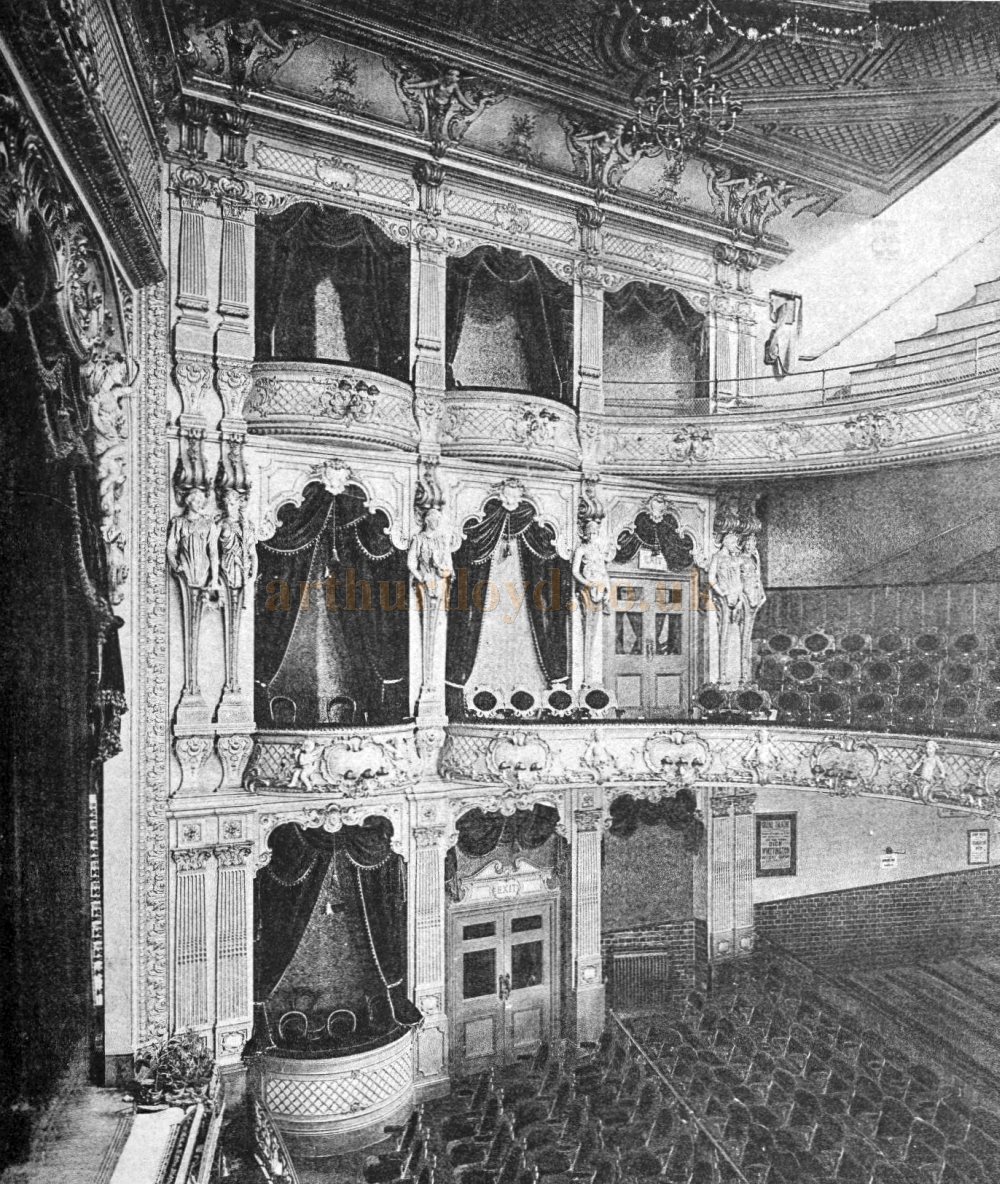
Above - The Auditorium of the Fulham Grand Theatre - From The Architect, 22nd of May 1903. The Auditorium is similar to that of Sheffield's Lyceum Theatre, also designed by W. G. R. Sprague in 1897.
 ...The-electric
lighting and heating arrangements of the new Theatre are elaborate.
The generating plant consists of a Crossley high-speed gas-engine, an
Easton, Anderson, and Goolden dynamo, and a large set of E.P.S. accumulators.
These are arranged so that the dynamo is at night time always independent
of the accumulators, which are of sufficient power to light the whole
Theatre. In this way the engine and dynamo will, as a rule, furnish
the power, but in case of breakdown or overload certain circuits can
be at once switched over to the accumulators.
...The-electric
lighting and heating arrangements of the new Theatre are elaborate.
The generating plant consists of a Crossley high-speed gas-engine, an
Easton, Anderson, and Goolden dynamo, and a large set of E.P.S. accumulators.
These are arranged so that the dynamo is at night time always independent
of the accumulators, which are of sufficient power to light the whole
Theatre. In this way the engine and dynamo will, as a rule, furnish
the power, but in case of breakdown or overload certain circuits can
be at once switched over to the accumulators.
Right - An extract from a Programme for 'Mrs. Gorringe's Necklace' at the Fulham Theatre, 23rd September 1903, also advertising the forthcoming production of J. M. Barrie's 'Quality Street' from the Vaudeville Theatre.
The engine-room occupies one corner of the basement, and, as is often the case in such plants, this corner was awarded to the engineering department because it was too irregular in shape for other purposes. Hence, although the plant is well arranged, no small amount of care and forethought had to be given to it by the consulting engineers. The gas-engine is one of Crossley's 20-h.p. nominal high speed engines of the type introduced about two years ago for electric lighting direct. The normal speed of this engine is 210 revolutions per minute, and the maximum horse-power indicated when running at this speed is about 72, while some 59 b.h.p. can be obtained. The consumption of gas per brake horse-power at Fulham is yet to be tried, but with gas equal to that supplied in Manchester the makers expect this will be about 18'9 cubic feet. The lubrication of the large end of the connecting-rod brasses is so imaged that the engine can be run long periods without stopping for oiling, which is a great advantage for electric lighting. This engine drives, by means of a link belt, a four-pole dynamo, capable of giving 410 amperes at 110 volts or 327 amperes at 140 volts when :running at a speed of 850 revolutions per minute...

Above - The Cast List from a Programme for 'Mrs. Gorringe's Necklace' and ' Miss Hilary Regrets' at the Fulham Theatre, 23rd September 1903, including Charles Wyndham, Alfred Bishop, Leslie Faber, Eille Norwood, and Reginald Walter.
...The foundations of both engine and dynamo are special on account of the fact that the level of the lower part of the foundations is lower than the high-water mark of he River Thames. The subsoil being gravel the water vas found to give trouble when building. The following arrangements were adopted to give freedom from vibration, and at the same time to prevent the water flooding the foundations...

Above - An advertisement for Ellen Terry in 'Captain Brassbound's Conversion' at the Fulham Theatre in October 1907
 ...The
first step was to put in a thin layer of some six inches of concrete.
On this two layers of creosoted railway sleepers were placed, the sleepers
in the upper layer being placed at right angles to those in the lower
layer, on which a galvanised iron tank was placed of sufficient depth
to bring the upper edge at least a foot above the high-water mark.
...The
first step was to put in a thin layer of some six inches of concrete.
On this two layers of creosoted railway sleepers were placed, the sleepers
in the upper layer being placed at right angles to those in the lower
layer, on which a galvanised iron tank was placed of sufficient depth
to bring the upper edge at least a foot above the high-water mark.
 Inside
the tank two more layers of sleepers were put before the concrete was
recommenced. Planks were then placed around the tank so as to leave
a space of three inches between them and it, and inside the planks the
concrete block was formed.
Inside
the tank two more layers of sleepers were put before the concrete was
recommenced. Planks were then placed around the tank so as to leave
a space of three inches between them and it, and inside the planks the
concrete block was formed.
Right - A photograph of Ellen Terry who was performing in 'Captain Brassbound's Conversion' at the Fulham Theatre in October 1907 and the Camden Theatre in September 1907.
This block is some six 'feet thick under the bed-plate of the engine and under the outside bearing. The space between the wood planks and the tank was then filled in with sawdust, to prevent the transmission of vibration from the block to the tank, and hence to the main building.
The above text on the opening of the Fulham Grand Theatre was first published in the ERA, 28th of August 1897.

Above - A Postcard showing W. G. R. Sprague's Grand Theatre, Fulham with a closed notice on its facade.
The Grand Theatre closed down in 1950 and then stood empty until it was finally demolished in 1958. An office block called Redbank House was subsequently built on the site.
The Forum Theatre, 142 Fulham Road, Fulham, South Kensington
Later - ABC / Cannon / MGM / Cineworld
See also - The Forum Theatre, Kentish Town - The Forum Theatre, Ealing

Above - Cineworld, Fulham, formerly the Forum Theatre, in August 2009 - Photo M.L.
 The Forum Theatre, Fulham, South Kensington was built for Herbert
A. Yapp's Wyanbee Theatres circuit and designed by John
Stanley Beard and A. Douglas Clare and opened on the 18th of December
1930 with the film 'The Storm' and a variety show on stage accompanied by a 24 piece orchestra and featuring Clapham
& Dwyer. The Theatre was also equipped with a Compton 3Manual /
8Rank organ.
The Forum Theatre, Fulham, South Kensington was built for Herbert
A. Yapp's Wyanbee Theatres circuit and designed by John
Stanley Beard and A. Douglas Clare and opened on the 18th of December
1930 with the film 'The Storm' and a variety show on stage accompanied by a 24 piece orchestra and featuring Clapham
& Dwyer. The Theatre was also equipped with a Compton 3Manual /
8Rank organ.
This was the first of three Forum Theatres built for Herbert Yapp by Beard, the others were the Forum, Kentish Town, today a concert venue called O2 Forum; and the Forum, Ealing which was largely demolished in 2009 leaving only the facade in place, but was later replaced by a Filmworks Leisure Complex including an 8 Screen Picturehouse.
Right - The Auditorium of the Forum Theatre, Fulham - From The Bioscope, December 17th 1930.
The auditorium of the Forum Theatre, Fulham was decorated in the Classical style with Romanesque embellishments and a huge 80 foot coffered dome taking pride of place in the ceiling's centre. Built on two levels, stalls and one circle, the auditorium could accommodate some 2,200 people. For another image of the auditorium in its original guise click here.
The Forum's fully equipped stage was 30 foot deep with a 45 foot wide proscenium opening, and there were eight dressing rooms for its variety artistes. Above the foyer of the Theatre was a cafe.
The ERA reported on the new Forum Theatre the day before it opened in their 17th of December 1930 edition saying:- 'There was a Press view on Monday morning of this imposing new Cinema, in South Kensington, which is to to open to the public to-morrow. Mr. J. Stanley Beard, F.R.I.B.A., the architect, showed a party round the new building, and his comments were very interesting. Mr. John F. Farquharson, M.I. Struct. E., who was responsible for the steelwork, was also of the party. Mr. Beard told our representative that not only has the Forum a Roman name, but it is in every sense a Roman theatre. Its proportions he claims are perfect. The safety curtain, which is by Mr. George, Murray, A.R.A., is painted to represent the Forum at Rome.
Built for Mr. Herbert Yapp, who has long been associated with the film business, the Forum was designed by Mr. Beard. As its name suggests, inspiration has been found in the architecture of the ancients and adapted to modern requirements. The theatre has a circular entrance hall. The main features of the elevation commanding the Fulham-road, are four Corinthian pillars and the amber and blue glass windows of the tea room. Steel-framed windows and cream and blue glazed tiles make an altogether pleasing exterior. The circular entrance hall has marble walls and a marble stairway leads to the circle.
It has been the ambition of Mr. Yapp and Mr. Beard to create in the Forum a modern theatre of big seating capacity, which would still retain the intimacy between audience, and screen, so desirable in an English theatre. With this object in view the circle has been designed in the shape of a semi-horse-shoe. No seat in the theatre - and the capacity is well over 2,000 - is so far away that the occupant will feel isolated, and the front of the circle is only 45 feet from the stage. We tested the comfortable seats, made in Wycombe, Bucks. One of the most striking features of the auditorium is the huge dome, which has a span of over 80 feet, and has been lined with sound-resisting felt to prevent echo. Eight red Corinthian pillars command the walls of the auditorium, four on each side. Between them have been introduced delicate mural paintings of Italian pastoral scenes, also by Mr. Murray. The predominating colour scheme is turquoise blue and gold, which is enhanced by rich concealed lighting. Another novel note is the lighting cleverly concealed in a niche of the pillars supporting the Proscenium Arch, so that the whole of the arch itself can be illuminated without disturbing any other stage or auditorium lighting effect. There is a double Proscenium frame.
The operating department is situated on the ground floor at the back of the stalls, as it is the contention of the architect and directors that by this method the best and clearest pictorial results are obtained on the screen, as the arc lights do not have to pierce the vast amount of tobacco smoke, which is unavoidable in a picture theatre. Here too, are accommodated the spot lights for stage illuminations. A horizontal ray is thus procured, as the projection is at right-angle to the screen.
In order to eliminate draughts caused by the usual ventilating system, the Roman principle of heating has been adapted and applied. Under floor-ducts and a series of pipes running at regular intervals throughout the stalls will, it is hoped, prove efficient in warming the atmosphere at the points where draughts usually occur. There are also heating pipes under every third row of seats. The organ chamber is situated under the stage. The stage has a depth of 30 feet and is 60 feet wide. It is of oak with a large scene dock and this has a separate entrance. There are two large chorus dressing-rooms, two for male principals and two for lady principals, all fitted with the latest appliances and conveniences.
It is good news that a policy of variety in the cinema is to be followed at the Forum, and the opening programme, as well as subsequent ones, will introduce the latest talkies, a real "flesh and blood" symphony orchestra, and some excellent variety turns.'
The above text in quotes was first published in the ERA 17th of December 1930.

Above - A Sketch showing Stanley Beard's proposed exterior for the Forum Theatre, Fulham, South Kensington - From The Bioscope, 30th of July 1930.
The ERA also reported briefly on the opening of the Forum Theatre in their 24th of December 1930 edition saying:- 'South Kensington's magnificent new picture theatre, the Forum, which was described in last week's The Era, was opened on Thursday night, the ceremony being undertaken by Councillor Gordon Bird, the Mayor of Kensington. He was supported on the stage by Mr. Herbert Yapp, managing director, and Mr. Stanley Beard, the architect; and there were also present Sir Arthur Yapp, Mr. Walter Forde, Mr. John Maxwell, Mr. J. V. Bryson, Mr. Donald Calthrop, the Mayoress of Chelsea and the Mayor of Fulham. Included in the programme was a highly interesting film depicting the construction of the new theatre, and the other pictures were "The Storm," and a Mickey Mouse cartoon. There were also some capital stage turns by Clapham and Dwyer, Don and Luis, and the Forum festivities Girls. - The ERA, 24th of December 1930.

Above - Images of the Forum Theatre, Fulham - From The Bioscope, December 17th 1930.
In 1935 Wyanbee Theatres sold the Theatre to Associated British Cinemas but the Theatre wasn't renamed ABC until 1961. Later in the 60s the Theatre's original Compton Organ was removed, and then in June 1974 the Theatre was closed and converted into a three screen Cinema by closing off the circle and fitting one screen there, and then providing two screens in the former stalls. The following year a fourth screen was created by converting a squash Court which had previously occupied the Theatre's original car park.
In 1977 the Theatre was further expanded when the former circle screen was divided into two. Another screen, built above the former squash court, means that the Cinema, currently owned by Cineworld, presently has six screens.
To see some more early photos of the Forum Theatre click here.
Archive newspaper reports on this page were collated and kindly sent in for inclusion by B.F.