
Theatres and Halls in Winchester
Theatre Royal - Royal Theatre - New Theatre - Palace Theatre - Winchester Theatre - Corn Exchange - Regent Cinema - Regent Theatre - The Regal - The Picture House
The First Theatre in Winchester
"Mutton downstairs; Ham upstairs" by Alan Chudley
 The
very first theatre in Winchester was in the Market Place circa 1620,
here were nine butchers stalls and a slaughter house, above was a hall
55 feet by 25 feet it was here after the reformation that that itinerant
actors performed; they walked from town to town, paid for the hire of
the hall and for printing and also for the candles which provided the
stage lighting of the time; they shared the takings equally even down
to the very candle stubs. Hence, as one wag put it, mutton downstairs
and hams upstairs. Ham being a mediocre actor, it is said that these
actors used the skins from hams to remove their make-up. Circa 1774
The Salisbury Company of Comedians presented 18 performances here and
made improvements by adding Boxes.
The
very first theatre in Winchester was in the Market Place circa 1620,
here were nine butchers stalls and a slaughter house, above was a hall
55 feet by 25 feet it was here after the reformation that that itinerant
actors performed; they walked from town to town, paid for the hire of
the hall and for printing and also for the candles which provided the
stage lighting of the time; they shared the takings equally even down
to the very candle stubs. Hence, as one wag put it, mutton downstairs
and hams upstairs. Ham being a mediocre actor, it is said that these
actors used the skins from hams to remove their make-up. Circa 1774
The Salisbury Company of Comedians presented 18 performances here and
made improvements by adding Boxes.
Right - An Advertisement for the Market Hotel, Winchester - Courtesy Alan Chudley.
Above text Courtesy Alan Chudley.
Arthur Lloyd is known to have performed in Winchester 1871, 1879
The Theatre Royal, Jewry Street, Winchester
Formerly The Royal Theatre
Vignette of a Daisy Date
The Theatre Royal, Winchester by Alan Chudley
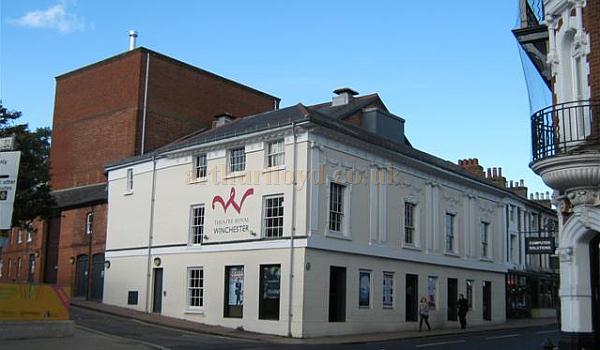
Above - The Theatre Royal, Winchester in 2010 - Courtesy KR.

 Today,
if you walk along Jewry Street in Winchester you will see the delightful
little Theatre Royal, this has been refurbished, the Stage House rebuilt
and enlarged, and new front of house facilities erected next to the
Theatre on land where once stood two retail outlets.
Today,
if you walk along Jewry Street in Winchester you will see the delightful
little Theatre Royal, this has been refurbished, the Stage House rebuilt
and enlarged, and new front of house facilities erected next to the
Theatre on land where once stood two retail outlets.
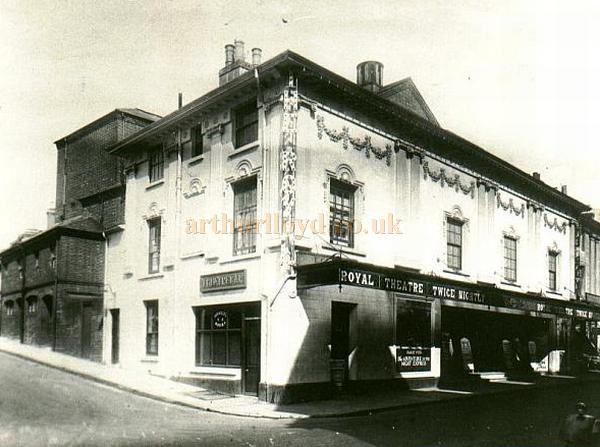
Right - The Theatre Royal, Winchester, Circa 1920s - Courtesy Alan Chudley
What has survived almost intact is the original auditorium, of stalls, Circle and two bow fronted boxes each side which are slips to the circle, there is elaborate plasterwork on the circle and box fronts, and without doubt this is the best example of an early Cine -Variety in this country. Alas it was not always thus, in it's early days from 1914 until 1922 when The Royal Theatre as it was then, presented live entertainment as well as "pictures" the Royal Theatre was what was known in the profession as "A Daisy Date," a theatre where you would be lucky to get out with a profit.
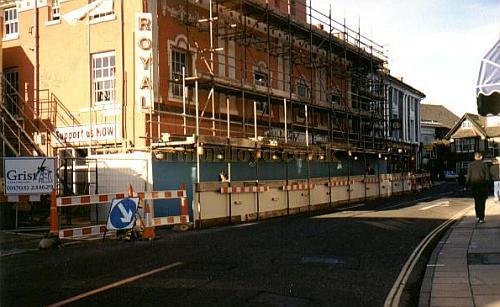
Above - The Theatre Royal, Winchester undergoing major refurbishment in 1999 - Photo Phil Yates, Courtesy Alan Chudley
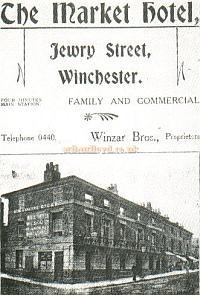
It all started circa 1910 when two local businessmen John and Jimmy Simpkins opened The Palace Theatre within the historic St John's House in Winchester Broadway. It is John Simpkins Ghost that is said to haunt the Theatre Royal to this day. The Palace was hardly the height of luxury, with a flat floor and a motley collection of seats and benches, Variety artistes performed on the platform stage in front of the Cinema screen. The Variety artistes at this date were colloquially known as "Lantern Coolers"; they performed between short films to allow the projectors chance to cool down. Never the less, such was the success of the Palace Theatre that very soon the Simpkins Brothers were looking for a site on which to build a proper theatre, and finally choose The Market Hotel.
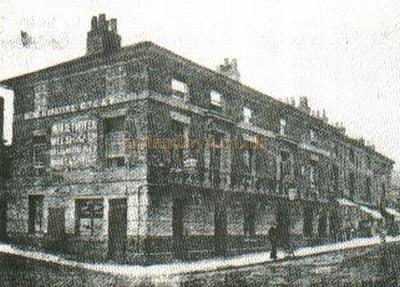 The
Market Hotel stood on the corner of Jewry Street and Tower Street, on
the other side, on Tower Street, is the City's library. This opened
in 1838 as the City's Market
and Corn Exchange. With the coming of the railways in the 1840s,
a railway which it was said would only carry Prawns and Parson, Prawns
from Southampton and Parsons to Winchester,
it was also to carry salesmen to the Market and to accommodate them
the Market Hotel was erected in 1850.
The
Market Hotel stood on the corner of Jewry Street and Tower Street, on
the other side, on Tower Street, is the City's library. This opened
in 1838 as the City's Market
and Corn Exchange. With the coming of the railways in the 1840s,
a railway which it was said would only carry Prawns and Parson, Prawns
from Southampton and Parsons to Winchester,
it was also to carry salesmen to the Market and to accommodate them
the Market Hotel was erected in 1850.
Right - The Market Hotel, Winchester - Courtesy Alan Chudley.
For many years the Market Hotel was many things to many men but by 1913 it had outlived it's original purpose and was up for sale, The Royal Theatre was built within the shell and the yard of the Market Hotel. The architect chosen for this task was the local architect, Bertram Cancellor, who had at one time been the City's Mayor and not FGM Chancellor as attributed in "The Guide to British Theatres 1750 - 1950"

Above - Two shops next door to the Theatre Royal, Winchester being demolished during major refurbishment of the Theatre to make way for new dressing rooms and better FOH facilities in 1999 - Photo Phil Yates, Courtesy Alan Chudley.
 The
Palace closed on the 22nd August 1914,
and operations were moved, lock, stock and projector to the Royal Theatre
the following Monday which opened with a programme of Variety and Pictures. The Variety acts included Edward Harold, "The Singing
Lifegaurdsman", and The Millar Sutcliffes in "Highland Games."
This was the type of entertainment presented for the next year or so
when the Royal became a full time Theatre until the summer closure of
1920, after which it was announced the Royal would reopen with a policy
of Films and Drama.
The
Palace closed on the 22nd August 1914,
and operations were moved, lock, stock and projector to the Royal Theatre
the following Monday which opened with a programme of Variety and Pictures. The Variety acts included Edward Harold, "The Singing
Lifegaurdsman", and The Millar Sutcliffes in "Highland Games."
This was the type of entertainment presented for the next year or so
when the Royal became a full time Theatre until the summer closure of
1920, after which it was announced the Royal would reopen with a policy
of Films and Drama.
Right - The Safety Curtain at the Theatre Royal, Winchester in 2010 - Courtesy KR.
In fact there were very few live shows until 1922 when the Royal became a full time Cinema until 1974 when it closed. There was to have been a supermarket on the site but a local Ginger Group thought otherwise, and the result is the splendid Theatre Royal that you will see today. The full story of the Theatre Royal is to be chronicled in a book to be published by my Friend Phil Yates in 2009.
 I
will only mention a few of the Live shows presented in the Daisy Date.
I
will only mention a few of the Live shows presented in the Daisy Date.
The Percy Lodge Stock Company in "The Coastguards Daughter," in which the juvenile lead was Chesney Allen of Flanagan and Allen fame, see Mansfield theatres on this site.
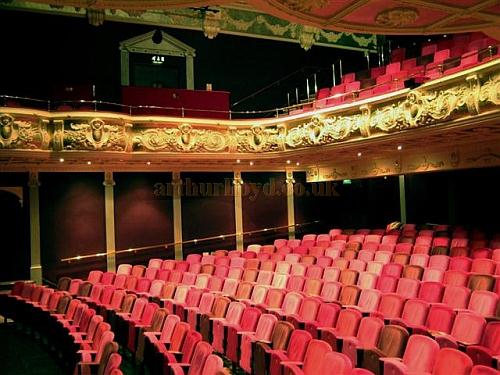
Left - The auditorium of the Theatre Royal, Winchester in 2010 - Courtesy KR.
"The Earl and the Girl" with Elsie Carlisle as the Girl who was later to gain fame on the Radio during the 1930s and 1940s. This show first saw the light of day at the Adelphi Theatre in London, in 1903 where it ran for 373 performances and toured for many years thereafter. This was a major production and the mind boggles as to how this show was staged on the Royal's tiny stage, then only 12 feet deep on the Prompt side.
"Seven Days Leave," a very popular play of the time which opened at London's Lyceum on Valentines Day 1917 and ran for 711 performances, and had three companies on tour.
 Archie
Pitt's Famous revue "Mr Tower of London" which starred the
then unknown Gracie Fields, who became a Star when Sir
Oswald Stoll booked the revue to fill in an odd week at London's Alhambra Theatre in 1923.
Archie
Pitt's Famous revue "Mr Tower of London" which starred the
then unknown Gracie Fields, who became a Star when Sir
Oswald Stoll booked the revue to fill in an odd week at London's Alhambra Theatre in 1923.
Arthur Rigby brought one of the few pantomimes; "Red Ring Hood." This man was a well known comedian at the time, his Variety act; "Clara The Cleaner", was in the same vein as Norman Evans'; "Over the Garden Wall." Arthur was also a popular Pantomime Dame.
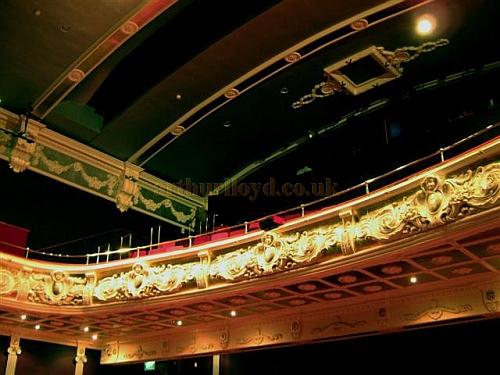
Right - The auditorium of the Theatre Royal, Winchester in 2010 - Courtesy KR.
Lillie Langtry, a well known comedienne appeared in Variety with her jaunty songs and dances, and who was billed on the Australian Tivoli Circuit as; "The Electric Spark." Lillie was English and should not be confused with;" Mrs Langtry, the Jersey Lily" who often toured in America and was known there as "England's most beautiful women and England's worst Actress."
Several amateur concert parties appeared including "The Radio Lights," this was the Royal Flying Corps concert party from Worthy Down, near Winchester. Dave Willis was the comedian, billed as "Scotland's Charlie Chaplinm," he later found fame in the resident summer shows at Glasgow Pavilion.
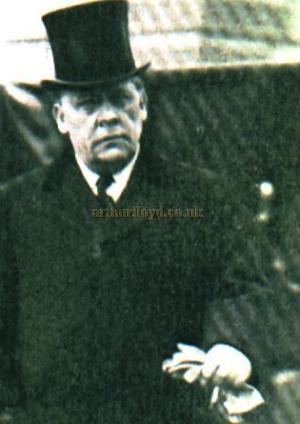 Horatio
Bottomley came in September 1915 with his;"Patriotic Recruiting Lecture". The history books
have not been kind to the Notorious Horatio Bottomley; a Financier,
he also backed plays, including one for WS Penley which was not a success.
WS Penely asked Bottomley to back another play in which he had great
faith, Bottomley refused and lived to regret it, for this play was "Charles's
Aunt." A Member of Parliament, a Racehorse Owner, an editor of
John Bull and above all a spell binding orator, he could charm money
from the tightest fists.
Horatio
Bottomley came in September 1915 with his;"Patriotic Recruiting Lecture". The history books
have not been kind to the Notorious Horatio Bottomley; a Financier,
he also backed plays, including one for WS Penley which was not a success.
WS Penely asked Bottomley to back another play in which he had great
faith, Bottomley refused and lived to regret it, for this play was "Charles's
Aunt." A Member of Parliament, a Racehorse Owner, an editor of
John Bull and above all a spell binding orator, he could charm money
from the tightest fists.
Left - Horatio Bottomley - Courtesy Alan Chudley.
This Soi Distant patriot ended his recruiting lecture thus; "If I were a younger man the my God I would be fighting along side you shoulder to Shoulder, God Bless you Jack, God bless you Tommy", at which point Bottomley would, with a degree of showmanship appear to collapse in tears. "I am sorry for that show of emotion, I have been working under a great strain, the Kaiser has told his airman, Get Bottomley at all costs".
The press of the day made much sport over this. But Bottomley was to be vindicated, during the last air rade of the war Bottomley's home was indeed bombed. Bottomley later served 5 years in prison for fraud, on release and towards the end of his life he appeared at London's Windmill Theatre in the tableau Revue; "Revudeville." Bottomley was indeed Pure Theatre.
It was a sad day in June 1974 for the Theatre Royal's Cinema projectionist when the Cinema closed for good, he chalked on his call board "Theatre Royal, Winchester 1914 -1974 RIP." Perhaps in the light of things to come he should have written; "The Theatre Royal is dead, long live the Theatre Royal."
Above text and images Courtesy Alan Chudley.
"VARIETY IS BACK"
 Thus
proudly announced the posters outside the Theatre Royal Winchester for
the week of 13th October 1979. Indeed Variety was back for the first time in almost 60 years, sadly the variety audience
was not back and the show played to peanuts, even the Saturday Night
was barely ½ full and even then most of the audience came from
outside Winchester.
Thus
proudly announced the posters outside the Theatre Royal Winchester for
the week of 13th October 1979. Indeed Variety was back for the first time in almost 60 years, sadly the variety audience
was not back and the show played to peanuts, even the Saturday Night
was barely ½ full and even then most of the audience came from
outside Winchester.
Right - Programme for 'Showtime' at the Theatre Royal, Winchester in 1979.
 The
show was called "Show Time" with Jack Seaton, Comedian; Jenny
Maynard, Impressions; Don Estelle from TVs It a'int half hot mum; Roger
Carne with Canasta, Ventriloquist; Terri Carol, Paper Tearer, and David
Carter, Sound.
The
show was called "Show Time" with Jack Seaton, Comedian; Jenny
Maynard, Impressions; Don Estelle from TVs It a'int half hot mum; Roger
Carne with Canasta, Ventriloquist; Terri Carol, Paper Tearer, and David
Carter, Sound.
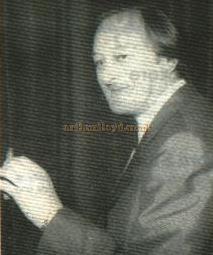
Left - Jack Seaton.
Showtime might not have been the best Variety show that I ever saw, never the less it was a very entertaining little show that deserved far better support.
Several of the acts were Variety stalwarts that I came across in my own days in Twice Nightly Variety. Terri Carol was considered good enough to appear in The Royal Variety Performance.
 I
worked with Terri Carol during 1947 at the Aldershot
Hippodrome; then she was '"Tearina" tearing her way through
life. She also tore a strip off me, that week in the absence of the
resident stage manager, I was in the prompt
corner, and Terri objected to being in number 4 spot, the usual
spot for that type of act.
I
worked with Terri Carol during 1947 at the Aldershot
Hippodrome; then she was '"Tearina" tearing her way through
life. She also tore a strip off me, that week in the absence of the
resident stage manager, I was in the prompt
corner, and Terri objected to being in number 4 spot, the usual
spot for that type of act.
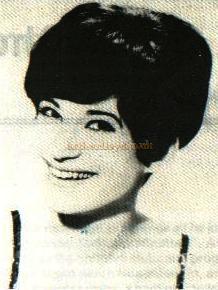
Right - Jenny Maynard.
 It was a Keith Devon Bill and he would not
change the running order so that was that.
It was a Keith Devon Bill and he would not
change the running order so that was that.
Left - Don Estelle.
Roger Carne often worked in Variety for Will Hammer at the New Royal Bournemouth where Roger lived. He too came to Aldershot Hippodrome several times and our sister the Kingston Empire.
 The Winchester Theatre Royal was at that date little changed from its
days as a Daisy date and was staffed entirely by Volunteers under a
salaried manager Barry Anscombe.
The Winchester Theatre Royal was at that date little changed from its
days as a Daisy date and was staffed entirely by Volunteers under a
salaried manager Barry Anscombe.
Above text and some images Courtesy Alan Chudley.
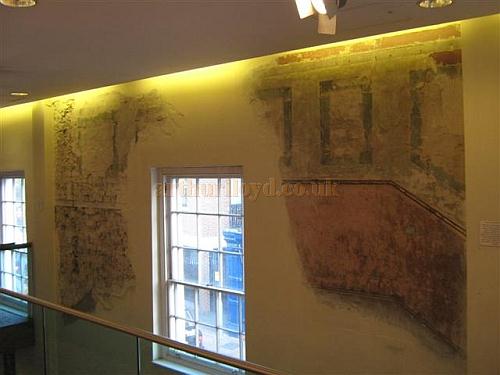
During the recent alterations to the FOH areas of the Theatre Royal, some original parts of the paintwork and plasterwork were uncovered and it was decided to preserve them as a relic of the past and they thus survive, surrounded by modernity! KR.
Right - Part of the original decorations of the Theatre Royal, Winchester, still preserved in the Theatre today - Courtesy K.R.
You may like to visit the Winchester Theatre Royal's own Website here.
The New Theatre, Park Avenue, Winchester
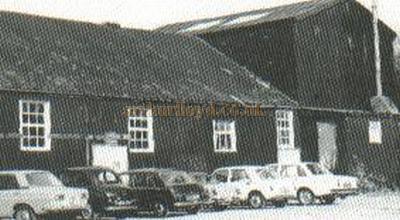
Above - The New Theatre, Winchester - Courtesy Alan Chudley
This was another short lived Daisy Date in Winchester from 1927 until 1940, when it closed with the opening of the Union / ABC Ritz. It was a former Garrison Theatre, taken down and re-erected in Park Avenue, it was called "The New Theatre," and known locally as the Black Shed, which was an apt description of the theatre.
As with the Royal Theatre, there were from time to time Live Stage shows, but the New Theatre operated mainly as a second release Cinema.
Above text and image Courtesy Alan Chudley.
The Palace Theatre, St John's House, Winchester Broadway
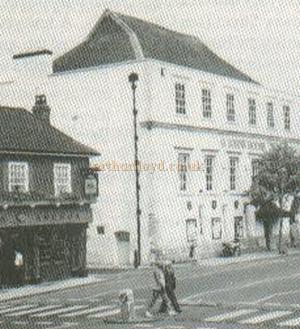
Above - St. John's House, Winchester, this building was later to become the Palace Theatre - Courtesy Alan Chudley.
 The
Palace Theatre, Winchester opened on the 8th of September 1910 with a programme of; "Pictures and Vaudeville", presented
by "The Coleman's Picture and Vaudeville Company." The Vaudeville
acts are said to have included The Belmoir Sisters, and the films
being shown were 'At the mercy of the Tides,' 'Soap in her Eyes,'
and "Betty's Removal.'
The
Palace Theatre, Winchester opened on the 8th of September 1910 with a programme of; "Pictures and Vaudeville", presented
by "The Coleman's Picture and Vaudeville Company." The Vaudeville
acts are said to have included The Belmoir Sisters, and the films
being shown were 'At the mercy of the Tides,' 'Soap in her Eyes,'
and "Betty's Removal.'
Right - The interior of St John's House Banqueting Hall, Winchester in the early 20th Century, just before it became the Palace Theatre - Courtesy Alan Chudley.
John and Jimmy Simpkins opened The Palace Theatre within the historic St John's House in Winchester Broadway. It is John Simpkins Ghost that is said to haunt the Theatre Royal to this day. The Palace was hardly the height of luxury, with a flat floor and a motley collection of seats and benches. Variety artistes performed on the platform stage in front of the Cinema screen.
The Variety artistes at this date were colloquially known as; "Lantern Coolers"; they performed between short films to allow the projectors chance to cool down. Never the less, such was the success of the Palace Theatre that very soon the Simpkins Brothers were looking for a site on which to build a proper theatre, and finally choose The Market Hotel.
The Palace closed on the 22nd August 1914, and operations were moved, lock, stock and projector to the Royal Theatre the following Monday which opened with a programme of Variety and Pictures.
There seems also to have been some cinema activity in St. John's House between 1907 & 1909, when the projector was with the audience in the main hall. This would have had to have ceased with the coming of the Cinematograph acts of 1910 which required the projector to be housed in a fireproof chamber, away from the audience. The last time that I was in the building in the mid 1990s the projection ports through which the films would have been projected were still visible.
Above text Courtesy Alan Chudley.
A visitor to the site, Anna Farthing, says:- 'Just read in Lena Ashwell's 'Modern Troubadours, A Record of the Concerts at the Front' that she took the Palace Theatre, Winchester as a base for her Concert Parties, that ran extensive operations both in the UK and France (and as far as Egypt). It seems she took the lease in 1917 and artists were based there while they waited for permits. While there they performed both at local army bases (Lark Hall) and hospitals, and at naval base at Portsmouth.' - Anna Farthing.
Details of this are on page 193 of the book and a brief extract can be read below:-
...During the early part of 1918, owing to the great movement of the armies, the permits came through very erratically. Very often a whole party would be arranged for, and the permits at the last moment would be cancelled. There was one delightful well-known music-hall artist who cancelled all his engagements to go out, and at the very last moment he had to be told at the office that the permit had been cancelled. Of course we dreaded a few recriminations with regard to broken contracts, wasted time, etc., but he most delightfully said, "Well, they have all been put to a great deal more inconvenience than I have."
It was owing to this difficulty that it seemed advisable to have a small base for work in England, somewhere where the artists could be employed during the time that their permits were held up. I therefore in 1917 took the small Palace Theatre, Winchester, where we played plays and gave concerts, and from there visited the surrounding camps, such as Lark Hill, Warminster, etc. Hospital work was very necessary around Winchester, and General Slater expressed his opinion that the parties were the best form of medicine the men could have. Of course we were delighted to help in this way, but our main object was to keep the parties together, so that when the passes came through they would be ready to start off immediately for France... - Lena Ashwell's 'Modern Troubadours, A Record of the Concerts at the Front'.
Lena Ashwell also ran the Kingsway Theatre in London for many years, either side of WW1.
The Winchester Theatre, Jewry Street

Above - A Google StreetView Image of Sheridan House which was built on the site of the Winchester Theatre - Click to Interact
This was a typical Georgian Country Playhouse which opened in 1785 with a production of "The Rivals." Gas lighting was introduced circa 1838 by which time the days of the Country Playhouse were almost over, the Prawns and Parsons Railway took theatre goers to the London Theatres.
The last performance was held on 6th May 1861 when J.W. (Joey) Gordon brought his Vaudeville company from Southampton. It was Joey who open what was later to become the Southampton Palace of Varieties, a king pin in the Frank Mc Naughton Circuit. The Winchester Theatre was then sold to a builders merchant who gutted the interior.
A modern building; "Sheridan House" now stands on the Jewry street site whose facade is said to be a replica of the Winchester Theatre
Above text Courtesy Alan Chudley.
If you have any more information or images for this Theatre that you are willing to share please Contact me.
The Corn Exchange, Winchester
Later The Regent Cinema / Regent Theatre
Not a constant place of Entertainment

Above - A crowd poses on the steps of the Regent Theatre, Winchester during WW1 - Courtesy Maurice Friedman, The British Music hall Society.
Winchester's Corn Exchange, now the Citiy's Library, in turn became a Dancehall, a Skating Rink, the Regent Cinema, and for a short while under the management of the Simpkins Brothers, the Regent Theatre. Live performances were also give on occasions in the Winchester Guildhall and the two Art Deco Cinemas. (See below.)
Above text Courtesy Alan Chudley.
If you have any more information or images for this Theatre that you are willing to share please Contact me.
The Regal, Winchester
Later The Odeon Cinema
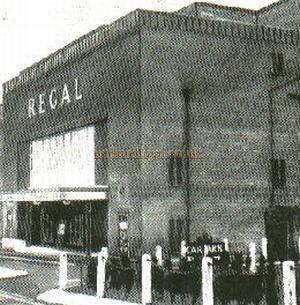
Above - The Regal, Winchester - Courtesy Alan Chudley.
The Regal, later the Odeon operated from 1933 until 1989 when it closed and was demolished. There is no doubt about the architect of this theatre, he was Robert Cromie whose other works include the 1937 rebuild of the Prince of Wales Theatre, London and what is today the Hammersmith Apollo. This Theatre, its Compton Organ flogged for 50 quid to a garrison Church, was later twined up into smaller studio cinemas. One night stands and the odd full week of Variety was staged from time to time.
Above text Courtesy Alan Chudley.
More information on the Regal can be found on the excellent Cinema Treasures Website here.
If you have any more information or images for this Theatre that you are willing to share please Contact me.
The Ritz, Winchester
The Ritz was conceived for Union Cinemas during the mid 1930s by the architect Sam Beverly, this was to have been a larger building then that which opened in April 1940. There was to be a full theatre stage with a fly tower, dressing rooms and an organ.
Union Cinema often presented a Variety show as part of the evening's entertainment and favoured County Towns like Winchester. However, by early 1937, due to the rapid expansion of the Union Cinema Circuit, the company was in serious financial trouble, which was made worst with the death of the Union Cinemas chairman, David Bernard in September of that year, when the company's shares collapsed. Within a month, ABC Cinemas had taken over the entire Union Circuit, including the yet to be built Winchester Ritz.
W.R. Glen, the ABC house architect redesigned the Ritz on a less ambitious scale, sans Fly-tower, sans organ. The Ritz operated as a first release Cinema with occasional one night charity variety shows for a little over twenty years until it became a Bingo Hall.
Above text Courtesy Alan Chudley.
If you have any more information or images for this Theatre that you are willing to share please Contact me.
The Picture House Cinema, High Street, Winchester
The picture House, Winchester's Armchair Cinema, in the High street opened in the first years of the twentieth century, shortly before the Theatre Royal and closed in 1936, the building is now used for retail purposes.
Above text Courtesy Alan Chudley.
If you have any more information or images for this Theatre that you are willing to share please Contact me.