
Theatres and Halls in Coventry, West Midlands
The Belgrade Theatre - The Albany Theatre - The Theatre Royal / Empire - The Hippodrome / Coventry Theatre - The Royal Opera House - The Alexandra Theatre - The Parkgate Concert Hall
The Belgrade Theatre and B2 Studio, Belgrade Square, Coventry

Above - A Google StreetView Image of the Belgrade Theatre, Coventry - Click to Interact

The Belgrade Theatre was the first Civic Theatre to be built in Britain after the Second World War and, along with the new Coventry Cathedral, was designed as a 'Symbol of Optimism' after the destruction of large swathes of the City during the war.
The Theatre's two tier auditorium could seat 858 when it was first opened by Princess Alexandra in 1958. The Belgrade name comes from the former Yugoslavian City of Belgrade which had gifted the timber used in the Theatre's auditorium. The Theatre rapidly became known for its innovative programming and new plays with early members of the Theatre's Company including now well known names such as Trevor Nunn, Ian McKellen, John Gunter, Joan Plowright, Michael Crawford, Frank Finlay and Leonard Rossiter. The Theatre is also well known for having started the 'Theatre-in-Education movement' in the 1960s.

Above - A Google StreetView Image of the Belgrade Theatre and B2 Studio, Coventry - Click to Interact
 In
September 2007 the Theatre was reopened after a major refurbishment
costing some £12 million, this included a second auditorium for
the Theatre, the new B2 Studio Theatre, which was officially opened
by Prince Edward on the 5th of February 2008.
In
September 2007 the Theatre was reopened after a major refurbishment
costing some £12 million, this included a second auditorium for
the Theatre, the new B2 Studio Theatre, which was officially opened
by Prince Edward on the 5th of February 2008.
Right - A Google StreetView Image of the Belgrade Theatre's Main Entrance in which you can actually take a tour inside the Theatre.
You may like to visit the Theatre's own Website here.
If you have any more information or images for this Theatre that you are willing to share please Contact me.
The Albany Theatre, 53 Butts Road, Coventry
Formerly - The Great Hall / The College Theatre

Above - A Google StreetView Image of the shared entrance to the Albany Theatre and Premier Inn, Coventry - Click to Interact.
The Albany Theatre is situated within the former Coventry Technical College on Butts Road, which opened in 1935, although today the Theatre shares its entrance with the Premier Inn, Earlsdon Park. It began life as the College's Lecture Theatre and was originally known as the Great Hall, it would later go on to be used for musical concerts during the war years. It closed in January 2009 when the College was acquired for redevelopment but the Theatre itself was refurbished and reopened as the Albany Theatre in February 2013 with new dressing rooms and technical equipment.
Today the Theatre, with its impressive art deco interior, is home to local school productions, musical theatre societies, community groups, and professional productions including an annual pantomime.
You may like to visit the Theatre's own Website here.
If you have any more information or images for this Theatre that you are willing to share please Contact me.
The Hippodrome Theatre, Hales Street, Coventry
Later - The Coventry Theatre / ABC Cinema / Apollo Theatre / Gala Bingo

Above - The Coventry Hippodrome during the run of 'Song of Norway in October 1949 - Courtesy Allan Hailstone.
 The
Coventry Hippodrome Theatre, that some people may still remember today,
opened in 1937, and was the third Theatre in Coventry to bear the Hippodrome
name. The first Theatre with the Hippodrome name had opened in 1884 and was situated on Pool Meadow. This was replaced by a new Theatre
on Hales Street in 1906.
The
Coventry Hippodrome Theatre, that some people may still remember today,
opened in 1937, and was the third Theatre in Coventry to bear the Hippodrome
name. The first Theatre with the Hippodrome name had opened in 1884 and was situated on Pool Meadow. This was replaced by a new Theatre
on Hales Street in 1906.
Right - A Poster for a Variety show at the Second Coventry Hippodrome Theatre on June 20th 1921 - Courtesy Stephen Wischhusen.
 December 1936 saw the construction of yet another
new Hippodrome Theatre, situated next door to the former, which closed
in October 1937. After the new Theatre opened on the 1st of November
1937 the former was then demolished. The new Hippodrome Theatre with
its Art Deco interior was much larger than the former however, with
close to 2,000 seats.
December 1936 saw the construction of yet another
new Hippodrome Theatre, situated next door to the former, which closed
in October 1937. After the new Theatre opened on the 1st of November
1937 the former was then demolished. The new Hippodrome Theatre with
its Art Deco interior was much larger than the former however, with
close to 2,000 seats.
In March 1955 the Theatre's name was changed to the Coventry Theatre under the management of S. H. Newsome.
Left - Details and Images of the Coventry Theatre - From a programme for the Pantomime 'Mother Goose' at the Coventry Theatre at Christmas 1956 / 57 - Kindly Donated by Mary Shuker.
The Theatre later became part of the EMI group that owned the ABC Cinema Circuit and was sometimes in use as an ABC Cinema when live shows were not on.
In 1979 the Theatre's name was changed to The Apollo but even this closed on the 6th of June 1985 and its final years were then relegated to becoming a Gala Bingo Hall.
The Theatre was finally demolished in 2002 to make way for the new Millennium Place.
Some images of the Theatre over the years can be seen below. And an article on the Hippodrome's Pantomime years can be read below.

Above - Billy Eckstine on stage at the Coventry Hippodrome on the 24th of May 1955 - Courtesy Allan Hailstone.

Above - An expectant audience queues outside the Coventry Hippodrome for a recording of a Radio Luxembourg programme called 'People Are Funny' on the 26th of September 1954 - Courtesy Allan Hailstone.

Above - The Coventry Hippodrome during a recording of a Radio Luxembourg programme called 'People Are Funny', sponsored by PYE Television, on the 26th of September 1954 - Courtesy Allan Hailstone.

Above - Act 19 of a Variety show at the Coventry Hippodrome in October 1955 - Courtesy Allan Hailstone.
COVENTRY HIPPODROME PANTOMIMES 40 YEARS AGo
By Alan Chudley, 2003

Above - The Coventry Hippodrome during the run of Can-Can on the 7th of May 1956 - Courtesy Gerry Atkins
 It
is almost a year ago that they demolished the old Coventry Hippodrome
(Shown Above). Dam their eyes! Forty years ago it was the premier pantomime date in the Midlands.
It
is almost a year ago that they demolished the old Coventry Hippodrome
(Shown Above). Dam their eyes! Forty years ago it was the premier pantomime date in the Midlands.
Right - Billy Eckstine on stage at the Coventry Hippodrome on the 24th of May 1955 - Courtesy Allan Hailstone.
The Hippodrome was a big theatre, almost 2,000 seats, nearly twice the size of the Belgrade with a fly tower which meant that you could put on much larger and spectacular scenes than you can at the Belgrade, but the Coventry Council eventually achieved an ambition that germinated forty years ago and pulled the poor old place down.
The pantomimes were magical and it was a 52 weeks in the year job manufacturing that make believe land. The scenic workshops in the old Plaza cinema and the wardrobe department at a disused garage in Quinton Road worked on pantomime land all the year.
Apart from the Hippodrome, pantomimes were also presented at the Alhambra Theatre Bradford, the Hippodrome Theatre Brighton, the Lyceum Theatre Sheffield and the Hippodrome Theatre Dudley by Sam Newsome who was the presiding genius and producer at the Hippodrome...

Above - A Selection of Pantomime Programmes for the Coventry Theatre in the 1950s and 60s - Kindly Donated by Mary Shuker whose Mother Patricia Shuker was an avid Theatre goer for over 60 years.
...Sam Newsome built the theatre in the thirties and opened it despite the opposition of Cinema. He kept it open despite the German bombs during the war, and made it the show place of the midlands in the fifties and early sixties.
When times started to get hard after the advent of television in 1963 Newsome asked the council to give him some relief on his rates. In their wonderful wisdom they refused and set in motion a chain of events that resulted in that hole in the ground on the corner of Hales Street where the theatre used to be.
The above text was written in 2003 and very kindly sent in for inclusion on the site by its author, Donald Auty.
Also see Pantomime economics of fifty years ago by Donald Auty, and this article on Britain's Hippodrome Theatres.
If you have any more information or images for this Theatre that you are willing to share please Contact me.
The Theatre / The Theatre Royal / The Empire Theatre of Varieties, Smithford Street, Coventry

Above - The Empire Theatre, Coventry - From the Midland Daily Telegraph, 16th of February 1939.
The first permanent theatre building was erected in 1819 by Sir Skears Rew, a local businessman. Like other theatres of the period, the Royal ran a stock company for about two months in the year and was part of a local circuit. It suffered the general downturn in attendances during the 1840s and 1850s but managed to stay afloat whereas many others closed permanently. The interior was modernised in 1857 along the lines of newer theatres but initial public enthusiasm soon faded and it became a music hall in 1865.


Above - An entrance token for the Coventry Music Hall - Courtesy Alan Judd
Drama returned in 1868 with various stock companies but these gradually gave way to national touring companies who would stay for a week at a time and move on elsewhere. William Bennett, who took over in 1880, did much to improve the building but it was too small and inconvenient to provide for the elaborate productions then on the road. Bennett built the nearby Opera House for these shows and turned the Royal into the Empire Theatre of Varieties in 1889.
 Although this was a period of music hall boom, audiences gradually dwindled to the point where the theatre became
uneconomic to run. Competition from two pub music halls did not help.
Even stars like Charles Coborn and Arthur
Lloyd could not reverse the financial state and the Empire closed
permanently at Christmas 1895 and was demolished around 1903.
Ellen Terry played there in November 1880.
Although this was a period of music hall boom, audiences gradually dwindled to the point where the theatre became
uneconomic to run. Competition from two pub music halls did not help.
Even stars like Charles Coborn and Arthur
Lloyd could not reverse the financial state and the Empire closed
permanently at Christmas 1895 and was demolished around 1903.
Ellen Terry played there in November 1880.
The above text is a concise history of the Empire, kindly written for this site by Ted Bottle. Ted Bottle is the author of 'Coventry's Forgotten Theatre, The Theatre Royal and Empire' published by Badger Press, shown here, in which he describes the Theatre's fascinating history in detail and includes glimpses of other Coventry Theatres and Music Halls, with an informative background of nineteenth Century English Provincial Theatre.
Arthur Lloyd is know to have performed at the Empire Theatre of Varieties, Coventry in 1895
T. C. King, who was Arthur Lloyd's father in law and father of Katty King, Arthur's wife, headed a week of classics at the Theatre Royal, Coventry in January 1884. The productions that week were 'Othello,' 'Ingomar,' The Merchant Of Venice,' and 'Hamlet.'
If you have any more information or images for this Theatre that you are willing to share please Contact me.
The Opera House, Hales Street, Coventry
Formerly - The Royal Opera House
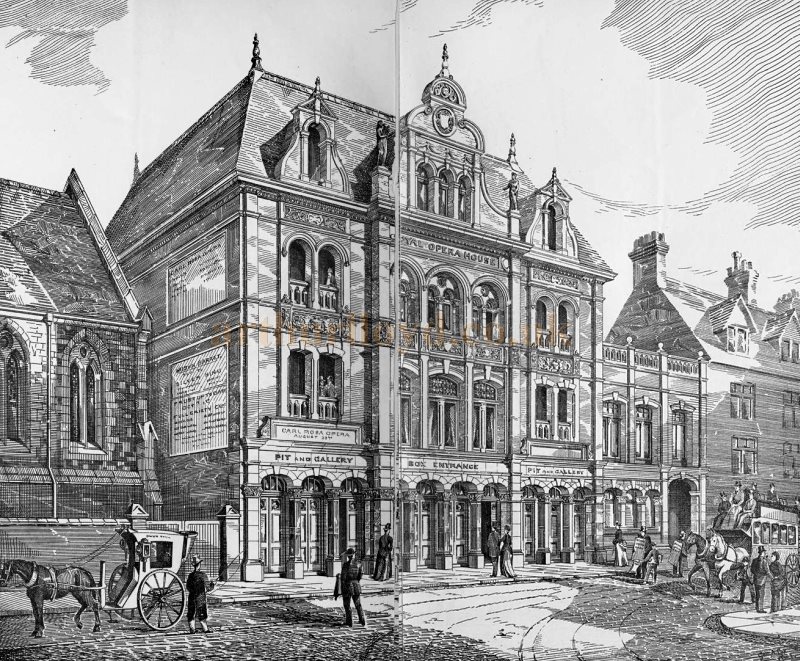
Above - A Two page Stitched Image showing the Opera House, Coventry as originally built in 1889 - From The Architect, 4th of February 1889.
 The
Royal Opera House, as it was first known in 1889, was situated on Hales Street in Coventry and was built for William Bennett who had been running the old Theatre Royal on Smithford Street, Coventry since 1880. His new Theatre opened on the 25th of March 1889 with a production of 'A Midsummer Night's Dream'.
The
Royal Opera House, as it was first known in 1889, was situated on Hales Street in Coventry and was built for William Bennett who had been running the old Theatre Royal on Smithford Street, Coventry since 1880. His new Theatre opened on the 25th of March 1889 with a production of 'A Midsummer Night's Dream'.
Right - An Advertisement for the opening of the Royal Opera House Coventry - From the Coventry Herald, 22nd March 1889.
The Theatre was built at a cost of £9,000 and designed by Essex & Nicol Architects of Birmingham, with consultation by the well known Theatre Architect C. J. Phipps. The auditorium was built on four levels, Stalls and three circles and could accommodate 2,000 people. The Theatre had a Stage of 30 foot deep by 70 wide, with a Proscenium opening of 24 foot, which meant that it was equipped with considerable wing space for such a small stage.
The ERA reported on the new Theatre in their 16th of March 1889 edition saying:- 'The New Royal Opera house, Coventry, which has been built by Mr William Bennett, will be opened on the 25th inst. with a performance of A Midsummer Nights Dream by Mr F. R. Benson's specially organised company, and is pronounced to be a handsome structure, which, "for elegance and comfort in front and large sonic and mechanical resources behind," will compare favourably with any theatre, not only in the Midlands but throughout the provinces.
 An account of this latest addition to provincial houses has already appeared in these columns. Since then, however, the internal decorations, by Messrs Goodall and Co., have advanced apace. They are carried out in two shades of terra-cotta and white, enriched with gilding. The fronts of the boxes are ornamented at intervals with medallions of celebrated compose, authors, poets, &c. The ceiling, which is dome-shaped, is decorated in harmony with the general scheme of colour, the centre being occupied by a very handsome sun-burner.
Large provincial touring companies with elaborate sets will appreciate the unusual facilities afforded for the reception of heavy scenes, it being possible to back a van right into the scene dock, which is level with the street. Actors and actresses will note with pleasure the arrangements made for their comfort and safety. The dressing-room block, which adjoins the stage, is entirely separated from the other parts of the building by solid brick walls, and is built wholly of fireproof material, no timber being used except the sashes to the windows and the doors. All these are arranged for ready exit, the staircases being continued through the roof, which is flat, so that in case of fire the actors and actresses may escape thereon, descending to the ground by an iron staircase which is fixed outside the wall of the dressing-room block. Neither has the safety of the employees been neglected, as a door of communication between the fly floor and the dressing-room block allows for the escape of any workmen who may be in the upper parts of the house.
Left - A Poster for 'Plucky Nipper' at the Royal Opera House, Hales Street, Coventry on Monday, July 9th 1906 - Courtesy Stephen Wischhusen.
The lines of sight are eminently satisfactory, as there is not a seat in the whole house that has not an uninterrupted view of the stage. Altogether, the theatre at Coventry supplies evidence of that new departure in building provincial dramatic temples which has become necessary in this age of luxury and taste, and Mr Bennett has been fortunate in his satiation of Messrs Essex and Nicol, of Birmingham, as his architect. The works have been carried out by Mr Gray Hill, contractor, of Coventry.
The above text in quotes was first published in the ERA, 16th of March 1889.

Above - The Opera House, Coventry in its later years around 1949-50 - Courtesy Allan Hailstone.
The Coventry Opera House was first opened by William Bennett on the 25th of March 1889 and he would go on to run the Theatre until his death in April 1911. William Bennett was something of a legend in theatrical circles for many years, and apart from running several other Theatres during his career, including the old Theatre Royal, Coventry, he also opened the Shakespeare Theatre in Clapham and the Duchess Theatre in Balham, both in London.
The Coventry Opera House was altered by W. G. R. Sprague in 1898 when the auditorium's Dress Circle frontage was changed and further alterations were carried out to the Gallery and the Proscenium Arch, with decorations by F. De Jong and Co. Electric Lighting was also installed at this time, and the Theatre reopened with a production of 'The Ladder of Life' on the 1st of August 1898.
The Theatre was closed again in March 1928 whilst under the ownership of Dudley Bennett and his wife, this time for major reconstruction. It was said that 300 Workmen were labouring day and night for 8 months to complete the Theatre for its reopening with the musical comedy 'Hit the Deck', direct from the London Hippodrome, on Monday the 5th of November 1928. The design of the newly rebuilt Opera House was by Perry W. Brown and Son of Newcastle and construction was by W. Jones and Sons. Decorations were carried out by Sellors and Co.
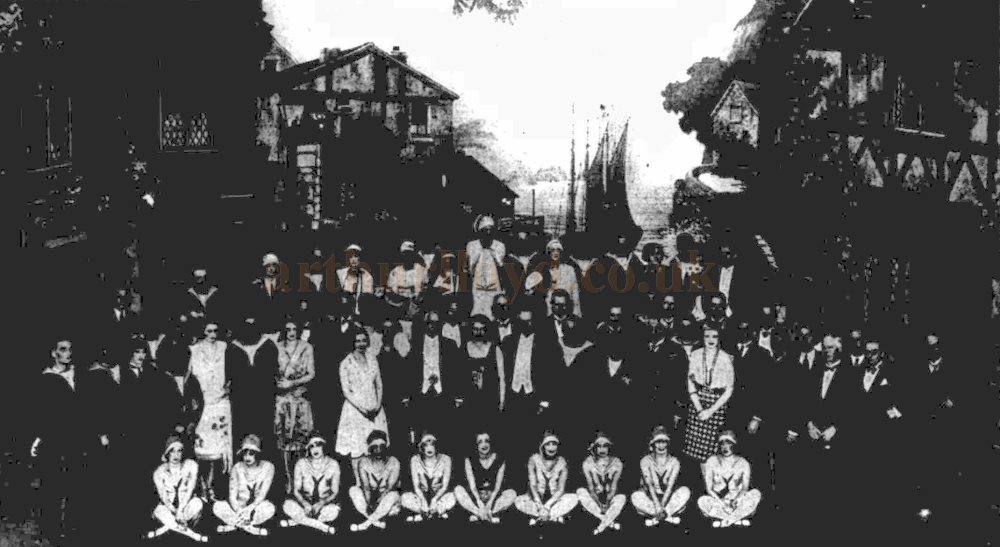
Above - A group photograph secured on Monday night, on the occasion of the opening of the new Opera House, Coventry. The picture was taken at the conclusion of the performance of the musical play, "Hit the Deck" by Messrs. Macdonald and Young's Company. The group includes, in addition to the members of the company, the Mayor of Coventry (Alderman Fred Lee), who declared the new theatre open, the Mayoress (Mrs. Lewis), the Mayor Designate (Alderman A. J. Makepeace), Mrs. H. G. Dudley Bennett (licensee of the theatre), Mr. W. Dudley Bennett. Mr. W. D. Nicoll. Messrs. Perry Browne and Son, Newcastle-on-Tyne (architects of the new opera House), Mr. W. H. Jones, (of Messrs. W. H. Jones and Son. Limited, the builders), the City Engineer (Mr. E. H. Ford), and the Chief Constable (Captain Hector) - From The Coventry Herald, 9th / 10th November 1928.
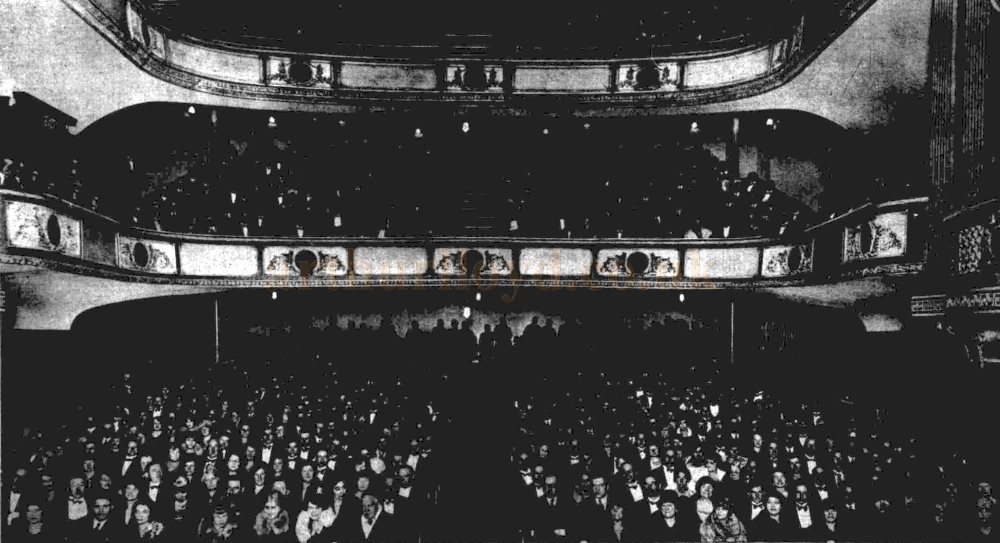
Above - The Opening night Audience of the reconstructed Opera House, Coventry on the 5th of November 1928 - From The Coventry Herald, 9th / 10th November 1928.
 The Theatre was damaged by a fire on 12th July 1938 and its stage was partially destroyed, luckily the Safety Curtain was down at the time so the fire didn't spread to the auditorium, although it was effected by smoke damage. Rebuilding resulted in reconstructing the stage and fitting a revolving stage, reseating and redecorating the auditorium, and constructing a modernised facade, all to the designs of W. S. Hattrell & Partners. The Theatre reopened on the 8th of August 1938 with a production of the comedy 'Three Blind Mice' which had been playing at the Theatre when the fire had broken out in July.
Advertisements for the Theatre afterwards always stated that it was the only Theatre in the Midlands to be fitted with a revolving stage. It continued to be run as a repertory house when it reopened with regular changes of plays by the Coventry Repertory Company.
Right - Demolition of the Opera House, Coventry - From the Coventry Evening Telegraph, 23rd of November 1961.
The Theatre was damaged by bombs during the Second World War in 1940 but it was reopened the following year as a Cinema with a projection box at the back of the stage.
Although there had been plans to reopen the Opera House as a live Theatre again after the war this never came to fruition sadly, and on the 9th of September 1961 the Theatre was closed for the last time and was subsequently demolished.
If you have any more information or images for this Theatre that you are willing to share please Contact me.
The Alexandra Theatre / Picturedrome, Ford Street and Cox Street, Coventry
Later - Theatre One / Mustard Nightclub

Above - A Google StreetView Image of the former Alexandra Theatre, Coventry - Click to Interact
The Alexandra Theatre was situated on the corner of Ford Street and Cox Street, Coventry and was originally opened as the Alexandra Picturedrome in 1917 by Elijah Strong, who was the landlord of the General Wolfe Hotel in nearby Foleshill Road. The Theatre was a conversion from a former Coffee House which is noted as having been the first meeting place of the Coventry Labour Party. The Cinema's auditorium was constructed behind the original Coffee House. The Theatre is also noted as being one of the first to experiment with 3D Films in the 1920s. After Elijah Strong died the Theatre was bought by Harold T. A. Philpot in the mid 1930s.

Above - The Alexandra Theatre, Coventry in the 1930s or 1940s
Damaged in the early part of the war the Theatre was sold on to Hugh Orr but building restrictions at the time meant that he could only make the building water tight. However, he acquired equipment from other damaged Cinemas and reopened the Theatre in January 1941. The Theatre had a Cinemascope Screen and stereo sound installed in 1955.

Above - The view from the roof of the Alexandra Theatre, Coventry in the 1930s or 1940s, showing the Theatre's sign from the back.
The Alexandra was closed in 1968 and refurbished, then reopened in 1970 with the new name of 'Theatre One', it was still a single screen Cinema then, but it was split into a two screen Cinema in 1972, and in 1974 yet another screen was added. The foyer was damaged by a fire in 1978. Hugh Orr died in 1979 and the Alexandra was taken over by its then manager, Brian Saunders, who in 1989 spent some £65,000 on its refurbishment.

Above - The view from the roof of the Alexandra Theatre, Coventry in the 1930s or 1940s, showing the Elastic Inn and the Sydenham.
The Theatre was sold in 1991 and converted into a nightclub called Mustard but this too closed after a few years and a planning application to demolish the building and build student accommodation on the site, with retail units on the ground floor, was approved in 2011.
Some of the above information was gleaned from a very nice article about it on the website of 28 Days Later which also has some interesting present day images of the inside of the building here.
If you have any more information or images for this Theatre that you are willing to share please Contact me.
The Parkgate Concert Hall, and Apollo Concert Room, Little Park Street, Coventry
Formerly - The King's Head Public House / The Parkgate Inn
John Judd of Coventry took over the licence of the Kings Head Public House, Little Park Street in 1847. The following year he extended the building to the rear and created the Parkgate Concert Hall, opening on the 22nd of July 1848. The main room of this was called the Apollo Concert Room. The Concert Hall was open every evening with 'first class Vocalists and a Pianist' and could accommodate some 350 people.
John Judd and Co also ran the Holders Hotel and Music Hall in Coleshill Street Birmingham in the 1870s.
The above information on the Parkgate Concert Hall was kindly sent in by Shirley Smith (nee Judd).
If you have any more information or images for this Theatre that you are willing to share please Contact me.