
The Novelty Theatre, Great Queen Street, Holborn, London
Later - The Folies Dramatiques Theatre / The Jodrell Theatre / The New Queen's Theatre / The Eden Palace of Varieties / The Great Queen Street Theatre / The Kingsway Theatre
The Novelty Theatre - The History of the Novelty Theatre - The Kingsway Theatre - Closure and Demolition
See also in this area: The Theatre Royal, Holborn - The Embassy Theatre, High Holborn - The Holborn Empire / Weston's Music Hall - The Holborn Theatre - The Holborn Restaurant - Images of High Holborn - Disappearing London.

Above - The Novelty Theatre, Great Queen Street, Holborn - From a wood engraving in the Illustrated Sporting and Dramatic News of the 7th of October 1882.

 The
Novelty Theatre was situated on Great Queen Street, which is today a subsidiary of Kingsway,
but was originally a subsidiary of Little Queen Street before Kingsway was constructed
in its place, see maps below. The Theatre was designed by the architect Thomas
Verity and opened on the 9th of December 1882 with the comic opera 'Melita or the Parsee's Daughter.' The Theatre's main entrance was on Great Queen Street but it's Gallery
Entrance and Stage Door were at the rear
of the building in Parker Street.
The
Novelty Theatre was situated on Great Queen Street, which is today a subsidiary of Kingsway,
but was originally a subsidiary of Little Queen Street before Kingsway was constructed
in its place, see maps below. The Theatre was designed by the architect Thomas
Verity and opened on the 9th of December 1882 with the comic opera 'Melita or the Parsee's Daughter.' The Theatre's main entrance was on Great Queen Street but it's Gallery
Entrance and Stage Door were at the rear
of the building in Parker Street.
Right - The site of the Novelty Theatre in September 2019. The Theatre was situated where the modern office building stands today, and next door to No 7 Great Queen Street which can still be seen in the photograph.
The ERA reported on the Theatre's opening in their 16th of December 1882 edition saying:- 'The opening of a new London theatre last Saturday night was an event of considerable interest to playgoers; and although there were many rival attractions, the Novelty Theatre was well filled.
The decorations, which, of course, were displayed to greater advantage when the theatre was fully lighted, have been carried out with great taste by Mr. E. W. Bradwell. The entrances and exists of the Novelty will bear comparison with those of much larger theatres.
A handsome vestibule is the first approach to the theatre, and the visitor passes through rich curtains to the stalls and boxes. It is claimed for this theatre that special precautions have been taken against fire or panic as there are double exits from each part of the building, and the floors are constructed of concrete. The entrance to the pit is in Great Queen Street, by the side of the stall entrance; the gallery entrance being in Parker Street, at the back of the theatre...

Above - The Auditorium of the Novelty Theatre, Great Queen Street, Holborn - From a wood engraving in the Pictorial World of 1882, and reprinted in Mander & Mitchenson's 'Lost Theatres of London' 1968.
...The prevailing colours employed in decorating the auditorium are peacock blue and dark crimson plush. The proscenium resembles a picture frame, and, instead of a drop curtain of the old-fashioned type, there are curtains made of embossed silk of the colour of old gold, having a rich yet harmonious effect.
 The
dress circle projects considerably over the pit, and causes the theatre
to look smaller than it really is, the number of seats being a little
over one thousand, while an altogether new feature in the arrangements
is the numbering of the pit seats, so that they can be secured in advance
and reserved for the evening, as in more expensive portions of the house.
The
dress circle projects considerably over the pit, and causes the theatre
to look smaller than it really is, the number of seats being a little
over one thousand, while an altogether new feature in the arrangements
is the numbering of the pit seats, so that they can be secured in advance
and reserved for the evening, as in more expensive portions of the house.
Left - A Map of Holborn before Kingsway was constructed over Little Queen Street, showing the position of the Novelty Theatre between Great Queen Street and Parker Street. Also shown on the map is the The Embassy Theatre on High Holborn, and the future site of the Holborn Restaurant on Little Queen Street, which was later to become Kingsway - From 'The Fascination of London / Holborn and Bloomsbury' by Sir Walter Besant 1836-1901.
 The theatre is the property of a company, Mr. Somers Bellamy being
the manager, Mr. E. E. Marriott the secretary, and Mr. Harrington Baily
acting-manager. The announcement that light comic opera would form the
sole entertainment of the opening night was doubtless an attraction
to many, as that kind of fare is much in vogue.
The theatre is the property of a company, Mr. Somers Bellamy being
the manager, Mr. E. E. Marriott the secretary, and Mr. Harrington Baily
acting-manager. The announcement that light comic opera would form the
sole entertainment of the opening night was doubtless an attraction
to many, as that kind of fare is much in vogue.
Right - A Map of Holborn with the position of Kingsway overlaid, showing the Novelty Theatre, The Holborn Restaurant and the Embassy Theatre. - From 'The Fascination of London / Holborn and Bloomsbury' by Sir Walter Besant 1836-1901.
The opera chosen for the opening was a three-act work entitled Melita; or, the Parsee's Daughter, the composer being Mr. Henry Portet, and the author of the libretto Mr. Juba Kennerley.'
The above text in quotes was first published in the ERA, 16th of December 1882.

Above - Sketches of the opening production of 'Melita' at the Novelty Theatre - From the Illustrated Sporting and Dramatic News, 23rd of December 1882.
 The Novelty Theatre had first opened on the 9th of December 1882 but the
following year it's name was changed to the 'Folies Dramatique
Theatre' when it reopened with the comedy 'Ascot' and 'Les Cloches de
Corneville' on the 29th of March 1883.
The Novelty Theatre had first opened on the 9th of December 1882 but the
following year it's name was changed to the 'Folies Dramatique
Theatre' when it reopened with the comedy 'Ascot' and 'Les Cloches de
Corneville' on the 29th of March 1883.
Right - An Advertisement for the opening of the Folies Dramatique Theatre - From the St. James's Gazette, Thursday 29th of March 1883.
The Theatre's name was soon changed back to the Novelty Theatre however, on the 5th of January the following year when it reopened with a production of 'The New Magdalen' and 'The Wilfull Ward' on the 5th of January 1884.
In 1888 the Theatre had another change of name, this time opening as the Jodrell Theatre on the 22nd of October that year with an opera by the Russian National Opera Company entitled 'The Demon'. The Jodrell name came from Mrs. Churchill Jodrell, who had taken the Theatre for a season, she was related to Randolph Churchill, the father of Winston Churchill.

Above - A newspaper cutting about the Jodrell Theatre - From 'The Queen' Saturday October the 6th 1888.
The following year in 1889 the Theatre reverted once again to its original name of the Novelty Theatre when it reopened with a production of Henrik Ibsen's 'The Dolls House' on the 7th of June 1889.
A year later another change of name, this time to the New Queen's Theatre when it reopened with the drama 'The Corsican Brothers' on the 4th of August 1890, but by the end of the month the name reverted to the Novelty Theatre again when the comedy 'Light O' Day' opened on the 30th of August 1890.
Four years later the name was changed yet again, this time to the Eden Palace of Varieties, when the Theatre reopened with 'Twice Nightly' Music Hall on the 26th of March 1894 under the management of Charles Morritt. However, this was not to last long and by August the Theatre reverted once again to its original Novelty Theatre name.
In 1896 a tragedy occurred at the Novelty Theatre when an actor, Mr. Temple Cozier, was stabbed and killed by Mr. Wilfred Franks, another actor in a play they were performing in. The tragedy was deemed an accident and 'Death by Misadventure' at the Coroner's inquiry but they recommended that 'Dangerous weapons should not be used upon the stage'.
 For the next four years the Theatre was open only occasionally
and by June 1898 it had been closed
completely.
For the next four years the Theatre was open only occasionally
and by June 1898 it had been closed
completely.
An interesting Article on the History of the Novelty Theatre, published in the ERA of 1896, can be read here.
Two years later, with a completely reconstructed interior, the Theatre reopened as the Great Queen Street Theatre, a little later than first advertised, on the 24th of May 1900 with a production of 'A Little Ray of Sunshine'.
Right - An advertisement for the proposed opening of the Great Queen Street Theatre - From the South London Press, 12th of May 1900. The Theatre actually opened on the 24th of May 1900.
 The ERA reported on the changes briefly in their 19th of May 1900 edition saying:- 'Mr. W. S. Penley's new house, the Great Queen-Street Theatre, which is to be opened on Thursday next, is one of the prettiest little playhouses imaginable.
Left - W. S. Penley, the famous comedian of 'Charley's Aunt' fame, who opened his new playhouse, the Great Queen Street Theatre, with 'A Little Ray of Sunshine' on the 24th of May 1900 - From The Sketch, 23rd May 1900.
The original house was rather tall and gaunt, and by a clever architectural rearrangement the height has been agreeably lessened. Both before and behind the house has been improved, and, to a large extent, remodelled. The decorations in gold and pink and white, with dark salmon pink in the upholstery, have a very happy and soothing effect of colour.' - The ERA, 19th of May 1900.
Renaming to the Kingsway Theatre

Above - The derelict and bomb damaged Kingsway Theatre in 1955 - From the Illustrated London News, 22nd January 1955.
 The final name change for the Novelty Theatre was seven years after the last and this time it would be for the last time.
Right - An Advertisement for the opening of the Kingsway Theatre - From the Daily Mirror, Saturday October the 5th 1907.
The Theatre had been partly reconstructed and redecorated and then reopened as the Kingsway Theatre with a production of 'A Maker of Men' and Irene Wycherley' on the 9th of October 1907.

Above - A Seating Plan for the Kingsway Theatre - From 'Who's Who in the Theatre' published in 1930 - Courtesy Martin Clark. Click to see more Seating Plans from this publication.
 The Sporting Life reported briefly on the new Kingsway Theatre in their 5th of October 1907 edition saying:- 'Before the cutting of Kingsway the old Great Queen-street theatre was a most inconvenient one to get at, and scarcely attracted attention as one passed down the dirty old street. Now Kingsway goes by the end of Great Queen-street, about twenty yards from the theatre entrance and the Piccadilly and Brompton Tube Railway Station lying at the corner of Kingsway and Holborn and is only about one hundred yards away. Thus with buses from all parts passing through Kingsway, with the underground L.C.C. trams also passing that way, and the tube system connecting up all parts of London, the Kingsway Theatre becomes one of the easiest playhouses to get to in the West End. With any decent luck and good plays Miss Lena Ashwell Should make a success of the old theatre under the new name.
Right - A Programme for Charles Hawtrey's Farcical Comedy 'The Private Secretary' at the Kingsway Theatre in December 1926.
 On Thursday afternoon she held a reception, and the whole house was crammed with guests, among whom were Sir Edward Clarke, Sir Charles and Lady Wyndham, Mr Hayden Coffin, Mr Farren Soutar, Mr H. D. Beveridge, Miss Lillian Braithwaite, Mrs and Miss Cyril Maude, Mrs G. P. Huntley, Mr Tom Browne, and many other distinguished people.
Left - A programme for 'Marigold' by L. Allen Harker and F. P. Pryor, which opened at the Kingsway Theatre on the 21st of April 1927 and went on to run for 642 performances, also being revived in 1929. The cast in this production included Agnes Lowson, Mary Barton, Katie Johnson, Jean Cadell, Angela Baddeley, Edmond Beresford, Beatrice Wilson, Hubert Harben, Deering Wells, Anthole Stewart, John Harlow, Alan Stevenson, Laurence Ireland, and Perceval Clark.
The new style of decoration is most dainty, the colour scheme being white and rose du Barry. The opening night will be Wednesday, October 9, when "Irene Wycherley" by Anthony P. Wharton, will be presented, with Miss Lena Ashwell and Mr Norman Kinnel in the cast.' - The Sporting Life, 5th of October 1907.
Closure and Demolition of the Kingsway Theatre
 The Kingsway Theatre was to be this Theatre's last incarnation as it
was to close suddenly on the 11th of May 1941 during the run of 'While Parents Sleep', an early theatrical victim of the second world war.
The Kingsway Theatre was to be this Theatre's last incarnation as it
was to close suddenly on the 11th of May 1941 during the run of 'While Parents Sleep', an early theatrical victim of the second world war.
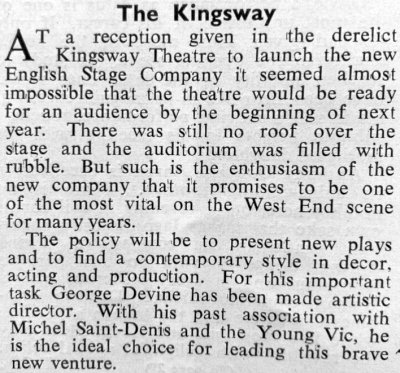
A later proposal in 1955 by the English Stage Company to restore and reopen the bomb damaged Theatre was reported in the Plays and Players magazine of September 1955, see article shown right, but this idea was eventually abandoned due to the prohibitive costs involved. They would instead take the Royal Court Theatre the following year.
Right - An article on the English Stage Company's plans to reopen the Kingsway Theatre in 1955 - From Plays and Players Magazine of September 1955 - Courtesy Martin Clark.
Due to the considerable damage to the stage and auditorium suffered during the blitz the Theatre remained closed and derelict until it was finally demolished in 1959. After its demolition the site of the Theatre became an Office Block and an extension of Newton Street into Great Queen Street. The article shown below, from the Stage Newspaper of 1959, sums up the sadness of this old Theatre's demise.

Above - An Article from the Stage Newspaper of the 22nd of January 1959 on the demolition of the Kingsway Theatre, and a letter in response published in the Stage, 19th of February 1959 .
The History of the Novelty Theatre
From the ERA, 29th of August 1896
The recent tragedy at the Novelty Theatre has brought this house into prominence than it has ever had vouchsafed it since its original opening in 1882. The gentlemen who speculated in the erection of this house were not very wise in their choice of a site, though he mooted plan at the time of cutting a thoroughfare from the Strand to Holborn, if carried out, would, of course, have made it excellent. If Long-acre was out of the way for the old Queen's Theatre, certainly Great queen-street is not more convenient, and this fact of position has largely contributed to the neglect under which the Novelty Theatre has laboured.
There the first piece produced, on the opening night, Dec. 11th, 1882, was a dead failure. It was entitled Melita; or, The Parsee's Daughter, a very uncomic comic opera, in three acts, written by Mr Juba Kennerley and composed by Henry Pontet. The theatre was only open about a fortnight, and then the shutters were put up.
The theatre was then advertised as an amateur house, and a half-hearted attempt was made to turn it into a dramatic students' academy, but this scheme was soon abandoned, and under the foolish name of the Folies-Dramatiques the doors opened again with the London production of Ascot, a new and original farcical comedy, by Percy Fendall, March 29th, 1883. This play had already been tried at Oldham in 1879. It was found very much wanting in town. It was vulgar and trivial, many of the performers were amateurs, and the play was damned.
Under the management of Mr Fairlie, a comic opera in three acts, with lyrics by Henry S. Leigh, and music by Strauss, was the next production. The translator of the libretto, it was patently from the German, was not named. Prince Methusalem, as the piece was called, was lavishly mounted and produced, May 19th, 1883, but it was too long and too feeble, and once again the place became deserted.
A change, however, came over the fortunes of this unfortunate temple of the drama in January, 1884, when Miss Nelly Harris became lessee, and revived on the 5th Wilkie Collins's New Magdalen, with Miss Ada Cavendish in her original character of Mercy Merrick, first played by her at the Olympic, May 19th, 1873. This ran until the second week in March, when Nita's First, by T. G. Warren, was placed in the evening bill. On March 4th was produced a new and original four-act drama, at a matinee, entitled The Barringtons, written by S. J. Adair Fitz-Gerald and John H. Merrifield. It went on tour later in the year. In this, by the way, Miss Maude Millett made her first professional appearance on the stage. On April 12th The Country Girl was revived, with Misses Kate and Susie Vaughan, Messrs William Farren, Charles Sugden, John Bannister, and Fred Kerr. This was run for some time with Nita's First. Then on May 1st The Country Girl was shelved in favour of Lalla Rookh, an extravaganza by Horace Leonard, with music by P. Bucalossi. Misses Kate Vaughan, Susie Vaughan, Minnie and Dot Mario, and Messrs Harry Nicholls, W. H. Denny, Adair Fitz-Gerald, and Fred Storey were in the cast, and the piece was a great success. Nita's First and the extravaganza drew crowds nightly for many weeks.
On July 22nd, for a benefit performance, Mr A. C. Calmour's Cupid's Messenger was first produced, with Mr F. H. Macklin as Sir Philip Sydney, Miss Kate Rorke as Mary Herbert, Miss Maud Milton as Lady Constance Howard, and Miss Lesley Bell as Lucette. In August Mr W. Yardley's burlesque The Scalded Back took the place of Lalla Rookh, and Miss Vaughan went on tour. Later in the year Homespun was produced, and did not attract, and then a comic opera by James Mortimer and Edward Solomon entitled Polly.
On Nov. 20th, 1881, Lottie, a new comedy, in three acts, was put on, and though it was splendidly acted by, amongst others, Messrs Harry Nicholls, Harry Parker, W. H. Day, and Percy Bell, and Misses Lydia Cowell, Dolores Drummond, and Lesley Bell, it was not strong enough to stand against the adverse criticisms of the press.
1885 was an uneventful year for the Novelty Theatre, it being seemingly doomed to ill-fortune. The Japs, a burlesque, by Harry Paulton and Mostyn Tedde, was the only real success of the year. But this was condemned by the newspapers. However, it drew very well, supported by Mr Willie Edouin, Mr Lionel Brough, and Miss Alice Atherton.
On March 25th, 1886, the theatre still in the hands of Mr Edouin, a new and original burlesque, in two acts, written by George Dance, and entitled Oliver Grumble, was successfully produced and had a fair run. The players were Messrs Willie Edouin, Arthur Williams, Misses Alice Atherton, Edith Blande, Emily Spiller, and Florence Dysart.
On July 14th and 16th, 1886, a new English opera entitled Florian was presented. The book was by D. Latham, and the music by Miss Lila Walter. Mr Ben Davies and Mr Max Eugene and Misses Griswold and Burgon took the chief parts in these very promising performances. On Nov. 16th a three-act drama entitled A Woman Outwitted, by Edwin Drew, was tried, and on the 17th, Paul and Virginia, a drama, in five acts, by Richard Davey, founded on Bernardin St. Pierre's novel.
The year of 1887 opened with some promise with Dux Redux; or, a Forest Tangle, a poetic play, in three acts, by Mr James Rhoades, on Jan. 18th. For copyright purposes, a three-act adaptation, by Miss Hilda Hilton, was given of one of Ouida's novels, and entitled Princess Carlo's Plot, Jan. 31st. The Charitable Man, a farcical comedietta, was produced on March 15th. It was by Henry Barry, and rather unique. Stepping Stones, by George Fox, a comedy, in three acts, sought publicity on May 7th, but was played only once. Then at a matinee on June 18th The Punch Bowl; or, the Royal Brew, a comic opera, by T. Murray Ford, with music by John Storer. This was a very good piece and worth putting in the evening bill. But it disappeared.
In September Miss Harriett Jay became the manageress, and started her season on Sept. 18th with The Blue Bells of Scotland, by Robert Buchanan. This was a good play, well cast and well acted, but somehow it failed to catch on, and on Oct. 6th another piece was given. This was Fascination, by Harriett Jay and Robert Buchanan, with a splendid cast including Messrs Henry Neville, Edward Righton, George Canninge, and Scott Buist; Miss Jay, Miss Alice Yorke, and Miss Ethel Hope.
This management soon came to an end, and then Miss Cooper-Parr, a grandniece of Fenimore Cooper, elected to give a matinee of a curious play called Sidonic. Miss Cooper-Parr acted the title part, and received adequate support from many London actors. On the same afternoon a farce called Good Business was produced and caused much laughter. This was from the pen of J. K. Henry.
The next year's record (1888) begins on March 31st, when Nita's First was revived, and Mr J. K. Jerome's adaptation of Le Luthier de Cremone of Copoee was played. On April 19th Mr T. G. Warren's Bonny Boy was placed in the bill with a good company, and the piece had a short career. A copyright performance of She, founded on Rider Haggard's novel, by Miss Clo Graves and William Sidney, was given on May 10th. On the afternoon of June 20th Laura; or, Lore's Enchantment, by an unknown writer, was presented, and on the same day a comedietta by Edith E. Cuttrell called The Wrong Envelope.
On Oct. 22d Mrs Churchill Jodrell became lessee of the Novelty Theatre, and modestly christened it the Jodrell Theatre. She first produced Rubinstein's grand opera The Demon, which was not badly received, and later she put on Mr James Mortimer's comedy The Alderman; this was Nov. 24th. But this did not set the Thames on fire, and after a brief struggle the Jodrell closed its doors.
During the greater part of 1889 the Novelty Theatre did not open, except for a few trial performances, such as Mr W. Archer's version of Ibsen's Doll's House, which was presented on June 7th, with Messrs Herbert Waring, Charles Charrington, and Royce Carleton; Misses Janet Achurch, Gertrude Warden, and Blanch Eversleigh in the cast. The theatre was managed by W. K. Hervey. On Nov. 30th Mr George Turner reopened the Novelty with The Spy; a Story of the American Rebellion, but it was a terrible piece, and once again the theatre lacked a tenant.
Another bid for fortune was made in January, 1890 when on the 27th Mr Mark Melford revived his Kleptomania, with himself in the principal part, and produced another work from his pen called The Best Man Wins.
A fresh start was begun in August by renaming the theatre the New Queen's, with G. F. Tolhurst and J. A. Cave as managers. The Corsican Brothers was played from the 4th, and several pieces were revived during the next few weeks. Brien M'Cullough appeared there on Aug. 30th with a sensational piece called Light 0' Day, and that is all for that year.
The new year, 1891, brought forth on Jan. 3d a highly sensational drama called A Social Pest, by Frederick Vanneck. It attracted for some time. For copyright purposes Waiting for the Train, by A. A. Wilmot, was given Feb. 6th. A genuine spurt came with "Baby" Benson and The Wild Primrose, a four-act musical variety drama. Miss Marguerite Fish and her husband, Charles Warren played well with a decent company including Gilbert Vernon and J. G. Wilton, who was excellent in a character old man. This was on Feb. 7th. On March 9th a new comedietta, by A. A. Wilmot, called Lott and Art, was added to the programme. On March 25th a new patriotic sketch, Gran-u-Aille, was presented, and on June 30th a four-act drama, by Duncan Campbell and Marcus Quain, called Winning Defeat, was produced for the first time. It won it.
Right Against Might, by M. White, a comedy-drama, in three acts, was performed July 27th, and on Nov. 17th Bess, an original play by Mrs Oscar Beringer, was copyrighted prior to its production in America by Miss Genevieve Ward and Mr W. H. Vernon.
On Boxing Day, 1891, a pantomime, Cinderella, by H. Buckstone Clair, with music by Henry Parks, was actually produced here, and drew for a time.
Winifred's Vow, a three-act musical play by John Douglass, was the first novelty in 1892 - March 19th. On April 9th The Unknown was revived for a short time. Dan the Outlaw was given May 14th, written by Jessie Robertson. Mr Mathews Monk tried his hand at managing this disastrous house by reviving The Serious Family and Family Jars, but the experiment was soon abandoned.
Neither in 1893 nor in 1894 was anything of the slightest importance even tried at the theatre, which seemed sunk as low as it could go. Nor is there anything of the least interest to record of last year. Inded, the theatre, except for one or two attempts to run it at cheap prices with variety shows, has been mostly shut up. During the last few months Miss V. St. Lawrence has made laudable efforts to please the public with sensational and other plays by means of frequent changes of programme and company, and everybody wishes her good luck in her spirited venture.
The above article on the History of the Novelty Theatre was first published in the ERA, 29th of August 1896.
If you have any more information or images for this Theatre that you are willing to share please Contact me.