
The Pavilion Theatre and Wonderland, Whitechapel Road, Stepney
Introduction and First Theatre - The 1858 Rebuild - The 1871 Reconstruction - The 1894 Rebuild - Closure and Demolition - Owners - The Effingham / The East London Theatre / Wonderland
See also in this area - Wilcox's Music Hall
The Pavilion Theatre, 191-193 Whitechapel Road, Stepney and Baker's Row
Other Names - Royal Clarence Theatre / Eastern Opera House / New Royal Pavilion Theatre

Above - A detail from a printed (photolithographed) card showing the Pavilion Theatre, Whitechapel Road, circa 1900 - Courtesy Fred Cooper.

 The Pavilion Theatre, Whitechapel
first opened on Easter Monday, the 16th of April 1827,
with a production of the 'Military Recreation' 'Advance Guard'. The
Theatre opened under the management of Wyatt and Farrell, who at first
were unable to get a licence for the Theatre but operated it without
one anyway. The opening production was written by Farrell who had written
a number of earlier pieces too. The opening night also included productions
of 'Friends at Court' a 'Spanish Recreation' written for the event by
I. H. Amherst; 'Kiss In The Ring', a 'Terpsichoral Recreation', and
a 'Petit Recreation' entitled 'Speculation, or Visitor's Wanted'. In
the productions were Jackson Chapino, Mr. prior, Mr. Goff, Mr. Shoard,
Mr. Nicholson, Mr. J. Jones, Mr. Marquis, Mr. Conquest, Mr. Chapman,
Miss Webb, Miss Burrell. Miss Ross, Miss Recki, Miss Boyle, Miss Brown,
and Mrs. Beverly.
The Pavilion Theatre, Whitechapel
first opened on Easter Monday, the 16th of April 1827,
with a production of the 'Military Recreation' 'Advance Guard'. The
Theatre opened under the management of Wyatt and Farrell, who at first
were unable to get a licence for the Theatre but operated it without
one anyway. The opening production was written by Farrell who had written
a number of earlier pieces too. The opening night also included productions
of 'Friends at Court' a 'Spanish Recreation' written for the event by
I. H. Amherst; 'Kiss In The Ring', a 'Terpsichoral Recreation', and
a 'Petit Recreation' entitled 'Speculation, or Visitor's Wanted'. In
the productions were Jackson Chapino, Mr. prior, Mr. Goff, Mr. Shoard,
Mr. Nicholson, Mr. J. Jones, Mr. Marquis, Mr. Conquest, Mr. Chapman,
Miss Webb, Miss Burrell. Miss Ross, Miss Recki, Miss Boyle, Miss Brown,
and Mrs. Beverly.
Right - The Baker's Row Entrance to the Royal Pavilion Theatre, Whitechapel - From The Illustrated London News of 1856 - Courtesy Ian Munro.
The main body of the Theatre was constructed on the site of several former dwelling houses on the street then known as Baker's Row, which is today called Vallance Road. Contemporary reports state that the Theatre was situated at Baker's Row, however the main entrance to the Theatre would later be situated on the Whitechapel Road when the Theatre was rebuilt in 1858 where a long tunnel from this entrance took patrons to the Theatre proper.
 The Pavilion's opening Bills in 1827 announced that the Theatre had a spacious centre chandelier of beautiful
Variegated Glass designed and executed by Mr. Simmonds of Crown Street,
and illuminated with gas; Ornamental appendages by Mr. J. Richardson;
and Ornamental Brass Decorations by Mr. T. Richardson. The Theatre had
a new Act Drop depicting scenes from the Royal Pavilion and Chain Pier
in Brighton and was painted
by Mr. P. Phillips of the Royal Surrey Theatre.
The Pavilion's opening Bills in 1827 announced that the Theatre had a spacious centre chandelier of beautiful
Variegated Glass designed and executed by Mr. Simmonds of Crown Street,
and illuminated with gas; Ornamental appendages by Mr. J. Richardson;
and Ornamental Brass Decorations by Mr. T. Richardson. The Theatre had
a new Act Drop depicting scenes from the Royal Pavilion and Chain Pier
in Brighton and was painted
by Mr. P. Phillips of the Royal Surrey Theatre.
Left - The Baker's Row Entrance to the Royal Pavilion Theatre, Whitechapel in an image dated July 1832 - From the Yale Center for British Art, Paul Mellon Collection.
The ceiling, proscenium, and lower circle boxes were designed and painted by Mr. Linguard. The burnished gold ornaments were by Mr. Aglen and assistants. The upper Circle was executed by Mr. Matthews. Scenery painted by Mr. Coyle, and the interior of the boxes were decorated under the direction of Mr. H. Phillips and assistants. The architect responsible for the whole Theatre was Mr. J. Lewis. Prices for the Theatre at its opening were Boxes 4s, Pit 2s, Gallery 1s, doors opened at 6 and the entertainment commenced at 6.30.
A contemporary writer in 1851 remarked that:- 'The Royal Pavilion Theatre, Whitechapel Road, is a neat theatre at the eastern extreme of the metropolis; and, being subject to little competition, it has proved a successful speculation. The entertainments are much varied; for, though under the same restrictions as other minor theatres, it is less liable to obstruction in consequence of its great distance from the patents. The performance commences at half-past six; boxes, two shillings; pit,one shilling; gallery, sixpense.'
 Right - Destruction of the Pavilion Theatre, Whitechapel
- Early in the morning of the 13th, this theatre was entirely destroyed
by fire. The cause is unknown, and some attribute it to the spontaneous
combustion of oily tow or lamp-black in the painting loft. 'The Builder'
16th February 1856 - Courtesy
Ian Munro.
Right - Destruction of the Pavilion Theatre, Whitechapel
- Early in the morning of the 13th, this theatre was entirely destroyed
by fire. The cause is unknown, and some attribute it to the spontaneous
combustion of oily tow or lamp-black in the painting loft. 'The Builder'
16th February 1856 - Courtesy
Ian Munro.
Sadly this first Pavilion Theatre was destroyed by fire on the 13th of February 1856, see image below.
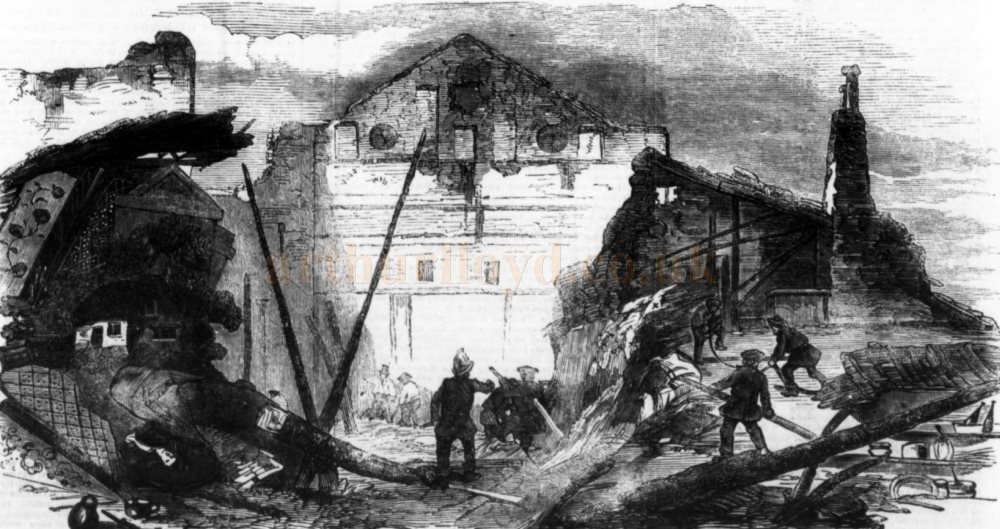
Above - The remains of the Pavilion Theatre, Whitechapel after fire destroyed the building on the 13th of February 1856 - From the ILN, 23rd of February 1856.
The Rebuilt Pavilion Theatre of 1858
 The first Pavilion Theatre was destroyed by fire in February 1856 but it was soon rebuilt and reopened as the New Royal Pavilion Theatre
on Saturday the 30th of October 1858. The Theatre was built
by Temple G. Tenney to the designs of the architect G. H. Simmonds.
The first Pavilion Theatre was destroyed by fire in February 1856 but it was soon rebuilt and reopened as the New Royal Pavilion Theatre
on Saturday the 30th of October 1858. The Theatre was built
by Temple G. Tenney to the designs of the architect G. H. Simmonds.
Right - A Painting by George Richmond depicting the Auditorium and Stage of the Pavilion Theatre, Whitechapel Road during a Rehearsal in 1858. Colours are from the Artist's Imagination - Click for an Index to all of George Richmond's Paintings on this site.
The Illustrated London news reported on the rebuild in their 6th of November 1858 edition saying:- 'Such is the name of the new theatre erected on the site of the old Pavilion at Whitechapel, with the further addition of "The Great Nautical Theatre of the Metropolis." It will be recollected that the former building was burned down on the 13th of February, 1856.
The present edifice has been erected at the cost of the daughter of the late Mr. Charles Conaughton (Mrs. Donald Munro), who is the lessee of the premises. The decorations of the interior, with the chandelier, &c., have been provided and fitted up by Mr. John Douglass, who has taken the new house upon an agreement for sub-lease from Mrs. Munro. The design for the new structure was supplied by Mr. Simmonds, architect, 7, Great Alie-street. The builder by whom the requisite operations had to be carried out was Mr. Tolley, of Lomb-street, Spital-square. The space of ground occupied by the new theatre extends to nearly half an acre.
It was a originally intended that the theatre should be completed and opened early in October but it was ultimately found impossible to effect this object until last Saturday, the 30th, when the public were admitted to the performance, though much yet remains to be done with the building, which, when quite finished, will prove as elegant as it is capacious. Nearly three times the size of the old Pavilion, the new Royal reminds us of the dimensions of the great patent theatres, Drury Lane or Covent Garden, though its extreme elegance somewhat takes off from the impression of its size. This is a proof of taste rather than otherwise. The actual area of the building is somewhat irregular but it measures on one of its side. 310 feet, and on the other 123.
The pit is calculated to seat 2000 persons. The chief entrance, leading to the pit and box, is in Whitechapel-road, and is constructed of Portland stone and corrugated iron, carried on piers and arches. In immediate connection with this "superb Parisian Avenue," as it is called, are saloons, waiting-rooms, and other conveniences. The entrances to the galleries face respectively White-street, Mile-end New Town, and Charles-street.
Internally, the space occupied by the "theatre saloons," dressing-rooms, stage-shop, and other offices, is 158 feet by 123 feet 6 inches. The box tiers, of which there are three, are approached by four stone staircases, in fireproof communication with each corner of the building. The box tiers themselves measure 23 feet from the wall-line to their frontage, leaving a clear glace of 40 feet circle, and 50 feet to the footlights. The house has been planned to seat comfortably an audience of 3500 persons. The stage is of colossal size, being 70 feet wide, and 58 from the floatlights to the back wall.

Above - The Auditorium from the Stage of the Pavilion Theatre, Whitechapel in 1858 - From the Illustrated London news, 6th of November 1858.
The interior is splendidly decorated. The embellishments are generally of dead white and gold; and the fronts of the boxes are crimson velvet, the curtains being also of the same colour. The ceiling, likewise, is gorgeously painted, and in the centre is suspended a superb chandelier, manufactured by Defries and Son. Like all the works of this firm, the design of it is exceedingly elegant and unique. It is composed of chains principally of richly-cut glass, so drooping as to form draperies of crystal; a mass of lucid metal, brilliant in prismatic hues, sufficient to illuminate alone this enormous building, contains 300 lights, all hidden behind spangles. These are so cut as to increase the light threefold. Aided by the reflecting power of the glittering mass that surrounds them, they make it appear as if there were one thousand lights, and produce a light equal to that number; added to which there are fourteen spangled lanterns so arranged as to light above and below. Thus there are two rows of lanterns formed, each containing three burners, so concealed as to throw a dazzling brilliancy around. Those, consequently, increase the light to an extent that it would require a mathematician to calculate.
As we have said above, the house opened on Saturday, on which occasion was performed a piece in two acts, entitled "The Sailor's Home," which was illustrated with some exceedingly effective scenery, and some very good acting. Miss Harriet Gordon, Mr. Alfred Rayner, Mr. J. F. Young, Mr. William Smith, Mr. Henry Butler, and Mrs. Edwin Yarnold are all performers of excellent reputation, and bore part in the piece, which was eminently successful. Naval engagements and picturesque tableaux were repeated in triumphant succession. An Hibernian entertainment by Mr. Sam Collins, and Mr. Egerton Wilks's "Windsor Castle," concluded the opening performance. The theatre was numerously attended, and the entire business of the evening was crowned with unanimous applause.'
The above text in quotes was first published in the Illustrated London news, 6th of November 1858.
The Reconstructed Pavilion Theatre of 1871
The Theatre was reconstructed again in 1871 by the architect J. T. Robinson. The Building News and Engineering Journal reported briefly on this in their 22nd of September 1871 edition saying:- 'The New Pavilion Theatre, Mile End, was reopened on Monday last, after great alterations and improvements, under the direction of Mr. J. T. Robinson, architect, of Haverstock-hill. The decorations have been executed by Messrs. Pashley, Newton, Young, & Co., and the large new sunlight has been fitted up by Messrs. Hulett & Co, of High Holborn. The theatre will now seat more than 4,000 persons.'
The ERA also reported on the new Pavilion Theatre, and in greater detail, in their 17th of September 1871 edition saying:- 'Reflective persons who mingle with the streams of people which pour along the great Eastern thoroughfare between Aldgate and Mile-End, especially in the evening, when the tide of traffic is at its highest, cannot fail to ask "Where do all these thousands dwell?" and " How do they live?".
Many of them go through more open and pleasant neighbourhoods beyond the Whitechapel road, but multitudes of them reside thereabouts. A large proportion of the inhabitants of this populous locality work hard, fare meanly; and live in small, scantily furnished, and unsalubrious abodes, and therefore need recreation of a cheerful and elevating character more than any others of the people of London.
Mr. Morris Abraham has spiritedly and successfully laboured to supply this want during the last sixteen years at the popular place of amusement which was first known as the "Effingham," but which, since it was enlarged and improved a few years ago, has been called the "East London."
He has now become Lessee of the "Pavilion," which was erected in 1857 in the place of its predecessor, which was destroyed by fire. Under the direction of Mr. John Douglass this place did well for a while, but it has not known prosperity of any long continuance lately. There are good reasons for believing that success will attend the new Management. Mr. Abrahams has begun his enterprise in a manner which shows that he expects, and means to deserve, that large measure of public support which is necessary to render the carrying on such a vast concern profitable.
The edifice has been greatly altered and improved, and has been embellished and furnished in a style which proves that neither pains nor expense have been spared in executing the design of making the place one of the most beautiful and comfortable Theatres in the Metropolis. Few would imagine from the narrow, plain frontage in the Whitechapel-road that a splendid Theatre, capable of accommodating more than four thousand persons, was situated behind it. Attention is attracted to the place by fine lamps and illumination devices, the light of which can be seen from afar.
The entrance lobbies are brilliant and inviting. Mirrors, gilding, and lively colours meet the eye before the gay boxes are reached. The Theatre, it will be remembered, is approached by an unusually long tunnel-like passage. This has been transformed into a lovely glittering arcade. On the left-hand side are numerous recesses; in these are placed plants and flowers, behind which are mirrors. Looking-glass, surrounded by gilt frames, is used to ornament the pilasters between the alcoves and the opposite wall. The corridor is lighted by about a dozen crystal gaseliers, which hang from the ceiling of it. Another splendid gasalier sheds its radiance in the Entrance Hall. These were executed by Mr. Morris Defries.
A magnificent sunlight, fixed near the pretty ceiling of the Theatre, most effectively illuminates the interior. This has been supplied and put up by Messrs. Hulett and Co., of High Holborn. The decorations, which have been executed by Messrs. Pashley, Newton, Young, and Co., of Red Lion-square, are of a chaste character, and give the place an elegant rather than a gorgeous appearance. White, pink, French grey, and mauve are the principal colours which have been used. These quiet, delicate hues are relieved by a tasteful and not too lavish employment of gold.
The panels of the gallery front are ornamented with devices representing a quiver containing arrows and a flambeau placed across each other obliquely. A kind of gilded lattice work forms the chief portion of the embellishment of the front of the box tier. In the centre of this is a medallion of Shakespeare, and on either side the effigies of other dramatic authors are placed. The ornaments are very creditable to Mr. H. Spry, who designed them for the firm before named. The private boxes are fitted in the most luxurious style. They have scarlet silk velvet curtains, and the floors are covered with expensive Brussels carpet. The seats in the stalls and open boxes are stuffed and covered with red leather. Linoleum has been laid down in the box passages and the walls of the same are covered with striped crimson paper. Mr. Williamson, of Oxford-street, has had charge of the upholstery department.
An entirely new stage and proscenium have been constructed. The former is sixty feet deep, and has been lade with ample and excellent mechanical appliances by Mr. J. H. Watson. The proscenium is an exceedingly elegant one. At the crown of its arch are the Royal Arms of Great Britain, set with tags and skilfully emblazoned. A new beautiful act-drop, representing an Italian lake and mountains with a vineyard and houses, and forming a picture in a frame, surrounded by the semblance of roped crimson curtains, has been painted by Messrs. Gordon and Harford.
Spacious refreshment saloons, comfortably furnished and tastefully adorned, have been provided. The transformation of the place has been effected in an admirable manner under the direction of J. T. Robinson, Esq., of Haverestock-hill, who has officiated as architect and surveyor.
The Theatre opens on Monday next with a new drama by Mr. E. Towers. Messrs. Rogers, Fenoulhet, Smythes, and Cracknell are the scene painters. The company is to consist of the popular East London performers, with the addition of other able artistes. Mr. Isaac Cohen is to be the stage-director of the new establishment.'
The above text was first published in the ERA, 17th of September 1871.
Despite the glowing report of the Theatre in the ERA of 1871 shown above, by 1887 it's clear that it was a bit of a death trap. A report in the Saturday Review of Politics, Literature, Science and Art on Saturday the 23rd of July 1887 says:- 'The Pavilion, in Whitechapel, is not so large as the Standard but as a rule it seems to be far better attended, and cannot be said to be in anything like a perfect state. The pit, it is true, has nominally two exits; but, as one of these runs into a long vault by which the pit stalls, the boxes, circle, and those who escaped by the extra door of the gallery would also have to fly for their lives in case of a panic, it would be far better if the exit on the Prompt side only were used. In other words, it amounts to this - that the entire audience, with the exception of say half the gallery, would have to escape by a long tunnel, some twenty feet wide and some sixty yards long. There is no extra exit that we could see to either the pit stalls, private boxes, boxes, or circle and the extra exit from the gallery runs on to the one staircase which has to serve for private boxes, the circle, and what are called the boxes. There is no electric light and there are no oil lamps; and, altogether, the Pavilion is in about as bad a way as it well could be. One has only to stand in the tunnel any night when the crowd is escaping after the performance to arrive at this melancholy conclusion' - The Saturday Review, 23rd of July 1887.
In Chapter 25 of Ernest A. E. Woodrow's 1895 Concert-Halls and Assembly-Rooms the boxes of the 1871 Pavilion Theatre are mentioned briefly when he talks about the boxes at the Buda-Pesth, Somossy Orpheum, saying- '...these are somewhat similar in arrangement to what used to be called the omnibus boxes in the London theatres frequented by our forefathers, the last survival of which was destroyed when the Pavilion Theatre, Whitechapel, was rebuilt last year.' ( Details below).
By 1892 the Theatre was said to have had a capacity of 2,650 with 174 in the Stalls, 436 in the Pit, 417 in the Dress Circle, 690 in the Grand Circle, and 85 in the Boxes.
The Rebuilt Pavilion Theatre of 1894

Above - A printed (photolithographed) card published by M&A Roberts of 293 Whitechapel Road, showing the Pavilion Theatre, Whtechapel Road, circa 1900 - Courtesy Fred Cooper who says: 'The view is of Whitechapel Road, looking east towards the Mile End Road, and the most prominent buildings are the Pavilion Theatre (with the Pavilion Refreshment Rooms to its left), and, further to its left, the building that I believe was, until recently, the Academy Drama School. Further along the road are the premises of A. Lacy, Chemist, then the gable end sign of 199, London Distillery Company. The Academy Drama School Building was, I believe, built in 1898. The street scene is a busy one with lots of horse-drawn vehicles (omnibuses, carriers' carts, pedestrians) but no sign of a single motor vehicle (so I presume around 1900 or thereabouts).'
 The Theatre was rebuilt again in 1894 to the designs of the architect Ernest
Runtz. Shares were issued to the public to finance the rebuilding. The old Theatre closed on the 21st of September 1894 and rebuilding took three months with the Theatre reopening with a production of the Pantomime 'Babes in the Wood' on Boxing Day, 26th of December 1894.
The Theatre was rebuilt again in 1894 to the designs of the architect Ernest
Runtz. Shares were issued to the public to finance the rebuilding. The old Theatre closed on the 21st of September 1894 and rebuilding took three months with the Theatre reopening with a production of the Pantomime 'Babes in the Wood' on Boxing Day, 26th of December 1894.
The ERA reported on the changes to the Theatre in their 22nd of December 1894 edition saying:- 'The new and very handsome Pavilion Theatre, Mile-end, will be opened on Boxing Day.
The old house, re-erected in the November of 1858, was closed for rebuilding last September. The entrances, exits, and passage ways are ample, there being a separate approach from the main road for stalls, boxes, and grand circle, new ground having been acquired for the pit entrance.
Right - The Prospectus for the Pavilion Theatre, Whitechapel - From The Stage Newspaper, 15th of March 1894.
The ceiling of the gallery has been raised several feet. The auditorium seems much larger than before. The decorations are in cream, gold, and blue, the latter hue being employed for the greater portion of the upholstery, including the drapery of the private boxes.
The tableau curtain is of plush, and its folds are, when raised, just visible within the proscenium border. The whole of the auditorium has been reseated. Mr Ernest Runtz, the architect, may be warmly congratulated on his work.
 The drop curtain is adorned with a striking picture of the Tower
Bridge, painted by Mr J. Harker. Rooms for ladies and children only,
in which fruit and non-intoxicants will be sold, will supply a long-felt
want. In each of the general refreshment rooms there will be a temperance
bar.
The drop curtain is adorned with a striking picture of the Tower
Bridge, painted by Mr J. Harker. Rooms for ladies and children only,
in which fruit and non-intoxicants will be sold, will supply a long-felt
want. In each of the general refreshment rooms there will be a temperance
bar.
A great extension has been made in the stage. The roof has been carried 33ft. higher, and on the west side a painting room on the ground level has been added. Adjacent are commodious dressing-rooms, and at the rear of the stage are other dressing-rooms with fireproof floors.
Left - An audience leaving the Whitechapel Pavilion in the early 1900s - From 'Living London' Volume II Section I by George R. Sims.
In the basement there is a room for the orchestra, with music store and emergency exit. Iron circular staircases have been provided. The electric light is utilised behind the curtain, the auditorium being illuminated by incandescent gas burners.
The terra-cotta frontage of the building in the Whitechapel road is grand and imposing, and a circular opening above the first floor will allow of scenes from the drama in course of representation, or public announcements, being displayed by the aid of a magic lantern. The orchestra will be a strong one, with Signor G. D. La Camera as conductor.'
The above text in quotes was first published in the ERA, 22nd of December 1894.

Above - A Stitched Two Page Photograph showing the Exterior of the Pavilion Theatre, Whitechapel in 1895 - From The Architect, 15th of February 1895.
 The Architect also reported on the newly rebuilt Theatre in their 15th of February 1895 edition, along with some of the images shown here, saying:- 'On Tuesday, December 18 last, this theatre, having been closed for three months and reconstructed in that time, opened its doors to the public. (NB this was for a private viewing of the Theatre which wouldn't actually open to the public until the 26th of December 1894).
Right - The Auditorium and Boxes of the Pavilion Theatre, Whitechapel - From The Architect, 15th of February 1895.
The first theatre on the present site was erected in the year 1827. It was burned down on February 13, 1856, and reopened on November 30, 1858, under the title of the "New Royal Pavilion Theatre, or the Great Nautical Theatre of the Metropolis," having been rebuilt by the late Mrs. Donlad Munroe in the interim.
Practically the main walls are the only portion of the theatre of 1858 left standing, and even they have been considerably extended. The task of altering and adding to the property was commenced in August last, but it was not until September 21, when the theatre was closed, that the very extensive alterations were seriously started. Within one week of this date the work of demolition was almost complete, and it is difficult to realise that in so short a period so much has been accomplished.
 The one approach from the main road (always a drawback to this theatre, by reason of the intermixing of pit, boxes and stalls) has been entirely remodelled, and is appropriated to the stalls, boxes and grand circle only, and for the pit a large area of ground has been acquired and a new approach erected adjoining the principal entrance.
Left - A Terra-Cotta Figure of 'Tragedy' featured on the Facade of the Pavilion Theatre, Whitechapel - From The Architect, 15th of February 1895.
The main entrance in Whitechapel Road has been entirely reconstructed; the design is Renaissance of simple yet bold outline. It is built entirely of terra-cotta, manufactured by Messrs. Doulton.
 The three approaches are separated by Doric pilasters and piers surmouted by an entablature of the same order with a balustrade over. From the end piers rise coupled Corinthian pilasters surmounted by a semicircular arch 16 feet in diameter.
Right - A Terra-Cotta Figure of 'Comedy' featured on the Facade of the Pavilion Theatre, Whitechapel - From The Architect, 15th of February 1895.
Somewhat recessed on the first floor is the Board-room, above which is a circular opening for illuminated advertisements and notices of the entertainments taking place. The space surrounding this circular opening is occupied by figures of Tragedy and Comedy, with Cupids and drapery above. The whole of these have been modelled by Mr. William Neatby, who has appreciated his subject and carried out the work in a masterly manner.

Above - The Saloon Bar at the Pavilion Theatre, Whitechapel - From The Architect, 15th of February 1895.
 Those who remember the old refreshment bars (now entirely absorbed by the approaches) will appreciate the improvements in this department. In place of the cramped accommodation, spacious and cheerful saloons have been arranged on the site of adjoining property.
Right - A Stitched Photograph of the Grand Circle Temperance Bar at the Pavilion Theatre, Whitechapel - From The Architect, 15th of February 1895.
Teetotal bars, with fruit and confection rooms for ladies and children, in addition to the ordinary buffets, are provided. The whole of the bar fittings have been specially prepared by Messrs. Farrow & Jackson.

Above - The Pit Bar at the Pavilion Theatre, Whitechapel - From The Architect, 15th of February 1895.
The auditorium has been considerably altered, the old ceiling removed and a new one erected at a greater height, thereby giving an uninterrupted view from the gallery. This ceiling, a special feature in the building, is designed in the style of the French Renaissance, the centre portion being clouded and richly painted by Messrs. Nepperschmidt & Hermann with allegorical figures and cupids; the boxes, too, have been transformed and enriched with classic columns, &c., the circle and box fronts have also been improved. The level of the pit and stalls has been altered, and the house generally has lost its former dwarfed appearance, and is now lofty, well ventilated and of good proportion.

Above - The Auditorium, Stage, and Proscenium of Pavilion Theatre, Whitechapel - From The Architect, 15th of February 1895.
The whole of the auditorium has been redecorated, re-seated and reupholstered, the latter portion of the work being entrusted to the well-known firm of A. R. Dean, of Bull Street, Birmingham. The general scheme of decoration is in modified primary tints, viz. terra-cotta walls of "Muraline," with Axminster carpets to correspond, old gold and electric blue upholstering, and the circles treated in blues, creams and gold. A handsome plush tableau curtain now replaces the old green cloth, and an act drop of the latest East End improvement, to wit, the "Tower Bridge," has been painted by that popular scenic artist, Mr. J. Harker, of Lyceum and Haymarket fame.

Above - The Auditorium from the Stage of the Pavilion Theatre, Whitechapel - From The Architect, 15th of February 1895.
 Probably the most extensive alterations have been made on the stage. Here the old roof has been removed, the building carried 32 feet higher, and a huge mansard formed, having a total span of 64 feet. On the west side the stage has been extended and a painting room provided; beyond this is a suite of cosy dressing-rooms, with every appliance for the comfort and convenience of the artistes. At the back of the stage the dressing-rooms have been entirely reconstructed with fireproof floors and partitions. On the stage level are the hall, green-room and quick change room, whilst in the basement a room for the orchestra is provided, with music store, &c., and emergency exit.
Right - A Ground Plan of Ernest Runtz's Pavilion Theatre, Whitechapel - From The Architect, 15th of February 1895.
Here, too, is the chamber for the electric installation by Messrs. Moody Brothers, of 66 Victoria Street, Westminster, replacing the old limelight apparatus. A new stage has been laid, with all modern improvements, by the company's stage machinist, Mr. J. Wicks; iron circular staircases replace old wooden ones, and in fact all stage appliances have been completely modernised at great cost, thus enabling the company to place before the public productions hitherto impracticable at this theatre.
Gas is still adhered to, except for the stage, as before mentioned, the auditorium being lighted by incandescent gas-burners, which have been supplied by the Incandescent Gas Company, of Westminster. There is a complete set of hydrants in the building, supplied by Merryweather Co., of Greenwich.
 The company have endeavoured to bring this theatre thoroughly up to date, feeling that in doing so and giving good value for money, the success of this old-established property will not only be maintained thereby but largely increased.
The company desire to acknowledge and thank the contractors, Messrs. Colls & Sons, of 5 Coleman Street, E.C., for the very excellent and expeditious manner in which they have carried out the whole of the exceedingly heavy and responsible structural alterations and decorative work.
Left - A First Floor Plan of Ernest Runtz's Pavilion Theatre, Whitechapel - From The Architect, 15th of February 1895.
To Mr. T. J. Collins, of Messrs. Colls & Sons, who had the management of the works, and to Mr. Jarvis, their foreman, great praise is due for their indefatigable efforts and organisation, and also to Mr. G. McLean Ford, A.R.I.B.A., who acted as clerk of the works throughout. The whole of the structural and decorative work has been carried out from the designs and drawings and under the personal superintendence of Mr. Ernest Runtz architect (of the firm of Messrs. S. Walker & Runtz), 22 Moorgate Street, London, E.C. The mosaics are by the Vitreous Mosaic Co. The photographs from which the illustrations are taken are by the Wiltons, Limited, with the exception of the front, which is by Mr. A. Binnie.'
The above text in quotes was first published in The architect, 15th of February 1895.
The Pavilion Theatre Closure and Demolition

Above - A Google StreetView image showing the site of the former Pavilion Theatre, Whitechapel in July 2012 - Click to Interact. Note that the buildings next to the Theatre in the early photograph shown above are still there in this image and the site of the Theatre itself is still vacant in this image.
 The Pavilion Theatre, Whitechapel had first opened in 1827 and its last rebuilding had been in 1894. In its later years it became a Yiddish Theatre for a while and was successful with the local Jewish population but it would eventually close its doors when it changed ownership in 1935.
Right - A Google StreetView image showing the still vacant site of the former Pavilion Theatre, Whitechapel in October 2024 - Click to Interact.
For a brief period after its closure in 1935 Boxing Matches were shown there and in 1936 it was reported that the Theatre might be rebuilt as a Cine Variety Theatre but these plans never came to fruition and instead it remained vacant for the rest of its life. The former Theatre was later hit by bombs during the war in 1940, destroying the auditorium roof and leaving it open to the sky. The now derelict Theatre was never repaired or reopened and was eventually demolished many years later in 1962. Amazingly the site of the former Theatre has never been redeveloped and was still vacant at the time of writing in 2025, over 60 years after the Theatre was demolished.
Harold P. Clunne wrote briefly on the former Theatre in his book 'The Face of London' in 1957 saying:- 'On the north side of Whitechapel Road, which also contains the principal shops, stood until 1940 the Pavilion Theatre at the corner of Vallance Road, which was principally devoted to Jewish drama. It was originally built for a floorcloth factory, but in 1828 it was converted into a commodious house of entertainment. On 10 February 1856 it was destroyed by fire, but was rebuilt in the following year. The southern end of Vallance Road leading from Whitechapel Road to Bethnal Green Road has been destroyed in the air raids of 1940 and so also has the Pavilion theatre.' - From 'The Face of London' by Harold P. Clunne 1957.
Pavilion Theatre Owners
A visitor to the site, Ian Munro, whose Great Aunt was the much loved Music Hall favourite Marie Lloyd, has recently sent in some information and images relating to the Pavilion Theatre, Whitechapel. He says:- 'The Pavilion Whitechapel was owned by my family for many years, and The Builder in 1858 recorded that the developer at that time was my Great Grandmother Elizabeth Munro. The architect of the 1894 works was her son-in-law, Ernest Runtz. The land in what was Baker's Row was in the possession of her father, Charles Connaughton, in 1851. The Munro family had financial interests in a number of music halls, quoted in my grandparents' wedding announcement in The Era, 29th of April 1899 as being in Middlesbrough, Southampton & Hastings, and my grandfather Donald was a Director of the Pavilion, Whitechapel, and the Crown Theatre Peckham, both designed by Ernest Runtz. Marie Lloyd acquired the tenancy of a pub in Hastings for her father, John Wood. My grandmother, Daisy Wood, was Marie's sister. An academic in Italy has put up a biographical website which can be found here. I have put up on my website a page summarising information on Marie Lloyd and the site generally may be of passing interest.' - Courtesy Ian Munro.
Some archive newspaper reports on this page were collated and kindly sent in for inclusion by B.F.
If you have any more information or images for the Pavilion Theatre that you are willing to share please Contact me.
The
Wonderland / Rivoli Cinema, 236-7 Whitechapel Road, Stepney
Previously - The East London Theatre / Earl of Effingham Saloon / New Garrick Theatre / Effingham Saloon / Effingham Theatre / New East London Theatre / East London Theatre / Jewish Theatre / Wonderland / Rivoli Cinema
There have been four buildings of entertainment on the site of The Wonderland, in Whitechapel Road. The first was a saloon called the Earle of Effingham which was built in 1834. This was later converted into a Theatre with a capacity of 2,150 and ran variously under the names of the New Garrick Theatre and the Effingham Theatre until 1867.
In 1867 a new Theatre was built on the site, called the New East London Theatre. The Builder reported on the new Theatre in their October 12th 1867 edition saying:- ' A new theatre, to be in future known as "The East London," is to be opened this week. It is situated in the Whitechapel-road, and occupies the site of the Effingham Theatre. To make room for the new theatre the old Effingham and some adjoining houses have been swept away, and a building has been erected in their stead, capable, it is estimated, of accommodating 4,000 persons. It possesses a large stage. There are two tiers of boxes. Those nearest the stage are fitted up for the accommodation of private parties. The centre of the first row of boxes is to be the dress-circle. The centre portion of the second tier is the amphitheatre, and behind that the gallery. The architect was Mr. Hudson, and the builders were Messrs. Palmer & Sons.' - The Builder, October 12th 1867.
The Building News and Engineering Journal also reported on the new Theatre in their October 18th 1867 edition saying:- 'The New Effingham Theatre - New theatres are now the order of the day, and, however stagnant all other branches of trading enterprise may be, the providers of public amusements show no symptoms of fatigue and faint-heartedness.
Whitechapel has long boasted of one large and elegant theatre - the Pavilion - and it now has another, the Effingham, known for some years as a "saloon," and for the last fifteen or twenty years as a large and well-conducted local theatre. This house and some adjoining buildings have been pulled down, and a new theatre, called "The East London," has been erected in their stead, capable, it is estimated, of accommodating 4,000 persons.
The new East London Theatre is one of the prettiest at present to be found in East London. It possesses a large stage. A new drop-scene has been painted for the theatre by Mr. J. Gates, formerly of the Lyceum Theatre. The front of the pit is devoted to stalls. There are two tiers of boxes. Those nearest the stage are fitted up for the accommodation of private parties. The centre of the first row of boxes is the dress circle, or rather the half circle. The architect was Mr. Hudson, and the builders Messrs. Palmer and Sons.'
The above text in quotes was first published in the Building News and Engineering Journal, October 18th 1867.
 The
East London Theatre had a fairly short life as it was burnt down on
the 16th of March 1879. A new
building was later built on the same site in 1897 and opened as The Wonderland, designed for the production of Yiddish
plays, and also as a museum and exhibition hall.
The
East London Theatre had a fairly short life as it was burnt down on
the 16th of March 1879. A new
building was later built on the same site in 1897 and opened as The Wonderland, designed for the production of Yiddish
plays, and also as a museum and exhibition hall.
Right - Ready to Pass in at Wonderland.
H. Chance Newton wrote about Wonderland in his book 'Music Hall London' saying:- 'To those amusement-seekers who may prefer to take their variety entertainment in a rough-and-ready form there are still such haunts as that Whitechapel resort fancifully named "Wonderland." In this big hall are provided entertainments of the most extraordinary description. They include little plays, songs, and sketches, given first in Yiddish dialect and afterwards translated into more or less choice English by, as a rule, a Hebraic interpreter. This interpreter often improves the occasion by calling the attention of kind - and mostly alien - friends in front to certain side shows consisting of all sorts of armless legless, skeleton, or spotted " freaks " scattered around the recesses of this great galleryless hall. When once the "freaks" have been examined, or the "greeners" and other foreign and East-End "sweated" Jew toilers have utilised the interval to indulge in a little light refreshment according to their respective tastes, the Yiddish sketches and songs - comic and otherwise - are resumed until closing time.
It is, however, on its Boxing Nights (which in this connection means Mondays and Saturdays) that "Wonderland" is to be seen in its most thrilling form. Then it is indeed difficult either to get in or to get out. In the first place it is hard to get in because of the great crowds of hard-faring - often hard-faced - East-End worshippers of the fistic art. In the second place, if you do contrive to get in you speedily find yourself so hemmed in by a sardine-like packed mob that all egress seems hopeless...'
Text above text in quotes was first published in 'Music Hall London' by H. Chance Newton - Click to read the whole article.
Wonderland would later became a Boxing Hall and then a Drill Hall. Later still, on the same site, arose the Rivoli Cinema which would be destroyed, along with the Pavilion Theatre in the same road, during the Second World War. Harold P. Clunne wrote about this in his book 'The Face of London' saying:- 'Retracing our steps along Brick Lane to Whitechapel Road, we note the blitzed ruins of the Rivoli Cinema on the south side of the street which stood next to St Mary's, Whitechapel, Underground Station. It occupied the site of Wonderland, a famous East End boxing resort, which was destroyed by fire about forty years ago.' - 'The Face of London' by Harold P. Clunne 1957.
Anderton & Haslam at Wonderland 1896
A visitor to the site, Stephen Smith, has recently sent in some information about Wonderland whilst researching the firm of Anderton and Rowland who were amusement caterers that still travel in the West Country today. He has discovered that Messrs. Anderton & Haslam set a show up for six weeks from Christmas Eve 1896 - 1897 in Wonderland when it was being managed by Mr J. Woolf. They advertised that there were "Spaces to let for side shows, shooting saloons, stalls, phonographs, automatic machines, etc." Wonderland marked the zenith in the show's history and the event was reported in The Era thus:
"The enterprising caterers for popular amusement, Mesrrs Anderton and Haslam have been doing literally 'roaring' trade at Whitechapel this Christmas with their untamable lions, side shows and variety items... and what a sight it is to see the seething crowd of Eastenders thronging round the submissive camels and oscillating elephant on the floor of the gaily decorated hall! We confess we are lost in admiration of that elephant. He is evidently a philosopher. The cries of the showmen, the music and the laughter, and applause move him not; and when he is used as a pair of steps to fix the net for the expert trapeze performance of the Brothers Bloomfeld he is still steady and stoical. The 'improving' character of such a menagerie as Anderton & Haslam's assisted by their excellent and instructive catalogue, can hardly be over-estimated."
Stephen's research notes that along with the circus were a number of supporting side shows, including Miss Beatrice, the 'Queen of the Midgets' and the tattooed man with 397 designs on his body: As the crowd were taken around the cages in the menagerie they were furnished with fascinating facts about their occupants. For example the racoons 'have been known to carry their food upwards of three miles to wash it.' A journalist present in the crowd added the comment: "We fancy some of the Whitechapelites whom we observed would object to carrying themselves, let alone their food, three hundred yards for a similar purpose.
Reynold's newspaper also visited Whitechapel in January 1897: "The talk of London is Captain Rowland with his untamable lions appearing afternoon and evening with Anderton & Haslam's Double Menagerie and Circus. The Greatest Performance in London."
The Illustrated Police News remarked that: "Whilst Islington people have their World's Fair, folks who inhabit London's eastern hemisphere possess a kindred resort on a smaller scale in Mr J. Woolf's house of entertainment. Shooting galleries and all sorts of side shows have done a roaring trade. The great attractions, however, are Messrs. Anderton & Haslam's menagerie and circus. Holiday makers never tire of gazing at wild beasts behind the bars, and the ugly snarls of tigers or hyenas draw the crowd away from other inmates of the dens, camels and vultures and serpents, but of course the centre of interest is the cage where Nero, the the forest lion, stalks up and down waiting for the tamer; Mr Arthur Rowland. This young man figures largely in the programme, not only with the lions but with the ponderous elephant.
Punch remarked: "Herr Fritz has some wonderful talking donkeys and performing dogs, and Mdlle Levita manipulates snakes with the art of an Indian Charmer."
Stephen continues: "The Whitechapel show proved a huge success, with over 45,000 people passing through the turnstiles by New Year and the press proclaiming it "The greatest show ever seen in London at the price of admission."
Professor Anderton reported to The Era during the run of the show: "Thanks to all friends for their kind congratulations." There were still several weeks to go and he was eager for the success to continue, so he advertised for more acts, saying: "Wanted startling novelties that work on raised platform, nothing too big... live and let live our motto, good luck to everybody."
Anderton & Haslam at Wonderland in 1896 - Courtesy Stephen Smith.
Some archive newspaper reports on this page were collated and kindly sent in for inclusion by B.F.
If you have any more information or images for the Pavilion Theatre that you are willing to share please Contact me.