
Theatres in Finsbury Park, London
The Park Theatre - The Finsbury Park Empire - The Astoria, Finsbury Park
The Park Theatre, Clifton Terrace, Finsbury Park, London

Above - The Park Theatre, Finsbury Park in June 2024 - Photo M.L.

 The
Park Theatre is situated on Clifton Terrace and was a conversion of
a former office building by David Hughes Architects.
The
Park Theatre is situated on Clifton Terrace and was a conversion of
a former office building by David Hughes Architects.
The Theatre was the brainchild of its Artistic Director, Jez Bond, and its Creative Director, Melli Bond who had been searching for a building to house a new Theatre in the area.
The Theatre cost £2.6 million to construct and fit out, and was partly financed by the addition of two apartments which helped offset the cost of construction.
Right - The late Alan Rickman, shown here visiting the construction site of the Park Theatre in June 2012 - Courtesy the Park Theatre.
The fundraising campaign for the Park Theatre was supported by a number of well-known theatre artists including Maureen Lipman, Sir Ian McKellen, and the late Alan Rickman, (shown above right). The Theatre opened in May 2013.

Above - An Audience at the Park Theatre's Park 200 Space - Courtesy the Park Theatre.
In addition to offices and the café-bar (on the ground floor and mezzanine), the building has two dedicated theatre spaces. The Park200 has a thrust stage with 199 fixed seats on three sides, including a Circle on the second floor. The Space has been used in the round for several productions. The Park90 is a single-level flexible auditorium which can seat up to approximately 100 in a variety of configurations.

Above - An Audience at the Park Theatre's Park 90 Space - Courtesy the Park Theatre.
 The
two spaces are equipped with full theatrical lighting and sound systems
as well as paging, cue lights and show relay, and both have skylights
that can be blacked out electronically.
The
two spaces are equipped with full theatrical lighting and sound systems
as well as paging, cue lights and show relay, and both have skylights
that can be blacked out electronically.
Backstage there are three dressing rooms, a green room, wardrobe, offices and prop stores. An additional room, the Morris Space on the top floor, is used for workshops, classes, meetings, rehearsals and performances for up to 60 people.
Right - A plaque bearing the traditional masks of Comedy and Tragedy which is situated in the Park Theatre's bar but which was originally part of the decorative plasterwork of the original Lyric Theatre, Hammersmith.
Interestingly the Theatre has a plaque bearing the traditional masks of Comedy and Tragedy in its bar which was part of the decorative plasterwork in the original Lyric Theatre, Hammersmith. The piece was donated by one of the Park Theatre's patrons. More information on the piece and photographs of it in situ today can be found here.
The Theatre also owns some of the former seats from the Watford Palace Theatre, which have been reupholstered in faux leather. Six are on the main staircase, four in the café, and ten others are scattered in other parts of the building. More on how the Theatre ended up with these seats can be seen here.

Above - A Google StreetView Image of the Park Theatre, Finsbury Park in May 2015 - Click to Interact.
You may like to visit the Park Theatre's own Website here.
If you have any more information of images for this Theatre that you are willing to share please Contact me.
The Finsbury Park Empire, St. Thomas's Road and Prah Road, Finsbury Park, London
Introduction and History - Opening - Closure and Demolition - People's Plaque - Brian Kendal on the Empire - Donald Auty on the Empire

Above - The Finsbury Park Empire during the run of 'Gay Party' in 1929 - Courtesy Nigel Dutt whose Grandfather Amar Dutt alias Linga Singh, toured the country up and down with his "spectacular illusions" from 1910 until he died while on a date at West Bromwich.
 The
Finsbury Park Empire was designed by the now renowned Theatre
Architect, Frank Matcham for Moss
Empires Ltd and constructed at a cost of £45,000. The Theatre opened on Monday the 5th of September 1910 with a variety show.
The
Finsbury Park Empire was designed by the now renowned Theatre
Architect, Frank Matcham for Moss
Empires Ltd and constructed at a cost of £45,000. The Theatre opened on Monday the 5th of September 1910 with a variety show.
Right - A Twice Nightly Variety Programme for the Finsbury Park Empire for the week of the 9th of September 1912 - Click to See the entire Programme.
The Theatre had been proposed as far back as 1905 and was reported on briefly in the Builder of November that year, saying:- 'Proposed Finsbury Park Empire. The Theatres and Music Halls Committee reported that they had considered plans, submitted by Messrs. F. Matcham & Co., on behalf of Moss's Empires, Ltd., showing the arrangements proposed to be adopted in the erection of a music-hall, to be known as the Finsbury Park Empire, on a site at the junction of St. Thomas's-road and Prah-road, Finsbury Park, and in respect of which an application has been made for a music and dancing licence. Accommodation is shown for an audience of 2,138 seated, and 535 standing. They stated that they are considering the whole question of standing in places of public entertainment, and they thought that the applicants should be informed that the approval of the present plans is subject to any decision that may be arrived at hereafter by the Council with regard to the question of standing in places of public entertainment. The Committee's recommendation was agreed to.' - The Builder, November 25th 1905.

Above - The Exterior of the Finsbury Park Empire at night showing Billing for Tony Brent, Gladys Morgan, Billie Anthony, and Max Bacon - Courtesy Martin Clark.
Despite the oppositions to standing room reported in the above article, the building of the Theatre did eventually go ahead, and the capacity was even larger when the Finsbury Park Empire opened five years later in September 1910. The Stage Newspaper reported on the Theatre's Opening in their September the 8th 1910 edition saying:- 'This, the latest, of the Moss' Empires, was opened to the public on Monday, when its accommodation for 3,000 was not equal to the demand for admission.

Above - The Auditorium of the Finsbury Park Empire - Courtesy Martin Clark.
Those who remember what strenuous opposition the scheme met with, alike from conscientious objectors and those whose interests were elsewhere, it is a matter for astonishment that the scheme ever materialised at all. The idea of providing a place of entertainment for this important neighbourhood was conceived before the Marlborough was built; and has therefore been simmering in the minds of projectors for years.
It seemed until about two years ago likely to remain an idea impossible of realiisation since the opposition to the granting of a license was so solid and persistent - indeed, at one time the owners of the site advertised it for sale. However, "all things come to those who wait," and patience and perseverance have at last met with their reward.

Above - The Auditorium and Stage of the Finsbury Park Empire - Courtesy Martin Clark.
 That a license was eventually granted and the conditions
are fresh in the memories of those who followed the course of events.
Now a splendid and moat luxurious building has been erected from the
design of Messrs. Frank Matcham
and Co., which, under the control of the Moss'
Empires Limited, will be devoted to variety on the twice-nightly principle.
That a license was eventually granted and the conditions
are fresh in the memories of those who followed the course of events.
Now a splendid and moat luxurious building has been erected from the
design of Messrs. Frank Matcham
and Co., which, under the control of the Moss'
Empires Limited, will be devoted to variety on the twice-nightly principle.
Right - A Programme for 'Tricks' at the Finsbury Park Empire in April 1926 - Courtesy Ron Knee Archive. See cast details below.
Although the exterior presents few striking features, the interior is quite charming, and, moreover; admirable from every point of view. Upon one's entering, the first thing which strikes one is the spaciousness and airiness of the place. So well proportioned and so charmingly symmetrical is this addition to London palaces of variety, that its vast size never intrudes upon the spectator, whose admiration is centred upon the boldness and grace of the sweeping lines of the main structure.

Above - A Programme for 'Tricks' at the Finsbury Park Empire in April 1926 - Courtesy Ron Knee Archive.


Above - A Selection of different styles of programme covers for the Finsbury Park Empire between the 1940s and 1960s - Courtesy Martin Clark.
 The colour scheme (pale cream and gold), which is employed
with excellent effect throughout the house, is an aid to the harmonious
contour, as are the decorations, which are simple and unobtrusive. The
curtains, carpets, and upholstery, which are a deep and quiet red, impart
this necessary warmth to the general tone of the house. The-drop curtain
which is of tapestry in low tones, in which red predominates, is also
happily chosen.
The colour scheme (pale cream and gold), which is employed
with excellent effect throughout the house, is an aid to the harmonious
contour, as are the decorations, which are simple and unobtrusive. The
curtains, carpets, and upholstery, which are a deep and quiet red, impart
this necessary warmth to the general tone of the house. The-drop curtain
which is of tapestry in low tones, in which red predominates, is also
happily chosen.
Right - A Variety Programme Cover for the Finsbury Park Empire from September 1948 - Courtesy Stuart Daglish. On the Bill were The Skating Merinos, The Henderson Twins, The Falcons, Len Young, Val Setz, The Valmar Trio, Richman & Jackson, and Ted Heath and his Music.
The proscenium is framed by two massive, polished marble pillars, and is spanned by a graceful arch with scrolled ends. The width of the stage opening is, 48 ft., and the depth 40 ft. With regard to other matters which concern the convenience and comfort of the audience nothing but praise can be accorded. The rake of the floor of the house, as well as the circles and gallery, is so ample that a good view of the stage can be obtained from any seat in the house. As to exits the house occupying an island site is provided with them on every side. Special arrangements have been made so as to avoid collisions between the outgoing and incoming visitors.

Above - The Auditorium and Stage of the Finsbury Park Empire showing the proscenium - Courtesy Martin Clark.


Above - Four Wartime Variety Programmes for the Finsbury Park Empire - Courtesy Linda Chadwick - Click the covers to see the programmes in their entirety and enlarged.
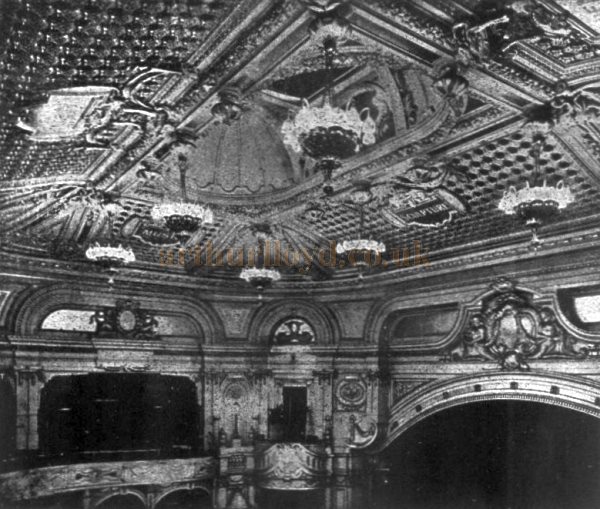 The ventilation of the auditorium has also received particular
attention, as a proof of which the roof, beside being provided with
the modern sliding panel, is also perforated in an ingenious and decorative
manner, which should carry off the heated air when the slide is closed.
The ventilation of the auditorium has also received particular
attention, as a proof of which the roof, beside being provided with
the modern sliding panel, is also perforated in an ingenious and decorative
manner, which should carry off the heated air when the slide is closed.
Right - The Auditorium Ceiling of the Finsbury Park Empire - From The Illuminating Engineer, July 1915.
The seats in the better parts of the house are of the tip-up kind, and are excellent in the cheaper sections. The lobbies at the main entrance are a combination of oak and plaster work. Taking all these things into consideration, we think the management are entitled to adopt as a motto Addison's line from Cato, which they print on the top of their programmes "'Tis not in mortals to command success, etc."'
The above text in quotes was first published in the Stage Newspaper, September the 8th 1910.
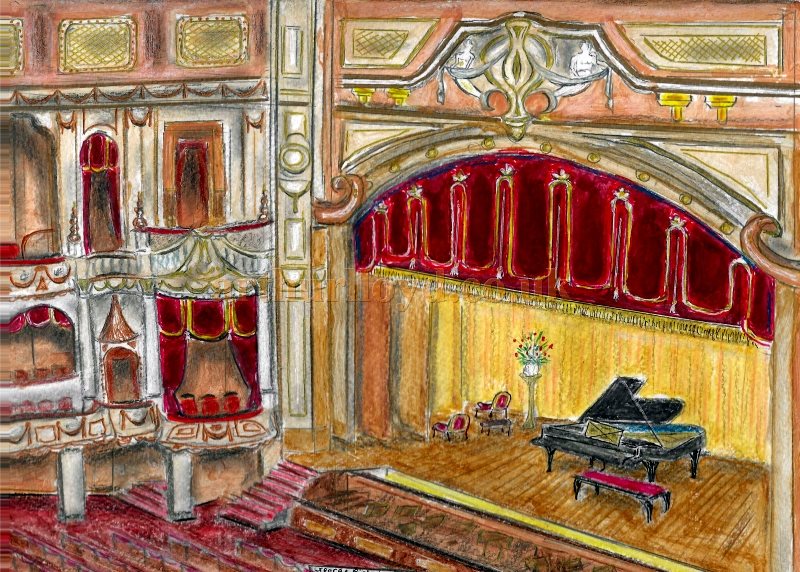
Above - A Painting by George Richmond depicting the Finsbury Park Empire and its Stage, set up for a performance by Gracie Fields, who performed there in the early 1930s - Click for an Index to all of George Richmond's Paintings on this site.


Above - A Variety Programme and ticket stubs for the Finsbury Park Empire from October 1945 - Courtesy Derek Key.
The Opening Performance at the Finsbury Park Empire
From the Stage Newspaper, September the 8th 1910

Above - The Finsbury Park Empire during the run of 'Make it a Party' - From the Moss Empires Jubilee Brochure of 1949
 'As was to be expected under the circumstances,
the opening performance on Monday was a most successful and enjoyable
function from the first turn to the last, and every seat in the vast
auditorium was occupied immediately after the opening of the doors.
As soon as the audience had comfortably settled itself, after the National
Anthem had been rendered by Mr. Fred Camp's excellent orchestra, the
honour of the first artist to perform in the new building fell to George
Ege whose clever Scotch song and dance were heartily applauded. The
Daunton-Shaw Troupe of Australian Trick Cyclists followed with their
well-known act, after which May Henderson delighted everyone with her
nigger songs and patter. *
'As was to be expected under the circumstances,
the opening performance on Monday was a most successful and enjoyable
function from the first turn to the last, and every seat in the vast
auditorium was occupied immediately after the opening of the doors.
As soon as the audience had comfortably settled itself, after the National
Anthem had been rendered by Mr. Fred Camp's excellent orchestra, the
honour of the first artist to perform in the new building fell to George
Ege whose clever Scotch song and dance were heartily applauded. The
Daunton-Shaw Troupe of Australian Trick Cyclists followed with their
well-known act, after which May Henderson delighted everyone with her
nigger songs and patter. *
Right - A Variety Poster for the Finsbury Park Empire for August 1955 - Courtesy Chris Woodward.
One of the principal items on the programme was that provided by Mme. Fanny Moody and Mr. Charles Manners, the well-known operatic artists, who, it is almost needless to state, had a most enthusiastic reception. Mme. Moody gave admirable renderings of such favourite compositions as Tosti's "Good-bye" and "Last Rose of Summer," while Mr. Manners employed his fine voice upon "Tomorrow will be Friday" and "Father O'Flynn," to both of which he gave splendid expression. Bert Coote and company, including J. 0. Aubrey and Ada Russell, appeared with much humorous and dramatic success in A Lamb on Wall Street. Artistic and deservedly applauded were the songs given by Helen Trix, particularly the one sung in boy's costume, and the Victorian crinoline number, entitled "Fifty Years Ago." Siems, an exceptionally smart coin and card manipulator; the Motramos in their amusing musical comedy act; and the Kirbys, in a laughable comedy pot-pourri, also met with emphatic success in a programme which included some interesting coloured pictures by the American Bioscope. Mr. Ernest Wighton is the courteous acting manager.'
The above text in quotes was first published in the Stage Newspaper, September the 8th 1910.
Closure of the Finsbury Park Empire

Above - The Finsbury Park Empire fitted with a Lead Glazed Frieze - From a 1920s Lion Foundry Company Catalogue - Courtesy Clive Greathurst.
 The
Finsbury Park Empire had opened on Monday the 5th of September 1910 with a variety show and would go on to be
the area's main variety Theatre for many years, but with the coming
of Cinema and Television, like so many other variety Theatres around
the Country, it was forced to close on the 7th of May 1960.
The
Finsbury Park Empire had opened on Monday the 5th of September 1910 with a variety show and would go on to be
the area's main variety Theatre for many years, but with the coming
of Cinema and Television, like so many other variety Theatres around
the Country, it was forced to close on the 7th of May 1960.
Right - A poster for a twice nightly variety show at the Finsbury Park Empire from Monday the 22nd of December 1941 - Courtesy Tony Craig whose mother Jessie Jewel was on the Bill along with the great Max Miller and others.
There was a lot of public opposition to the closure and the Variety Artiste's Federation, Equity, the National Association of Theatrical and Kine Employees, and the Musician's Union were all staunchly in favour of keeping it in business. Leslie Macdonald, the Managing Director of Moss' Empires at the time, offered them the Theatre for the price of its demolition and rebuilding as an office block, and offered to throw in all the scenery and equipment and its furniture and fittings for free, but clearly this was too high a price for the unions to afford. For the previous two years the Theatre's Books showed that it had made an operating loss of £13,933 so it was no surprise that Moss' Empires wanted to sell it, but clearly they thought that a better price could be obtained for demolition than as a going concern.
 The Theatre closed on the 7th of May 1960 and was then used as a scenery
store and rehearsal space for several years until it was eventually
purchased by Islington Council using a Compulsory Purchase Order on
the 17th of July 1964. The Theatre was then demolished in April 1965
and an apartment building called Vaudeville Court was erected on the
site, shown left.
The Theatre closed on the 7th of May 1960 and was then used as a scenery
store and rehearsal space for several years until it was eventually
purchased by Islington Council using a Compulsory Purchase Order on
the 17th of July 1964. The Theatre was then demolished in April 1965
and an apartment building called Vaudeville Court was erected on the
site, shown left.
Left - A Google StreetView Image of Vaudeville Court, which stands on the site of the former Finsbury Park Empire - Click to Interact.
If you have any more information of images for this Theatre that you are willing to share please Contact me.
Islington People's Plaque Unveiling for the Finsbury Park Empire, 10th of October 2017

Above - The Mayor of Islington Councillor Una O'Halloran, Chas McDevitt, Adam Borzone, Mark Fox, and residents of Vaudeville Court and the Pearly Kings, pose for a photograph at the unveiling of the Islington People's Plaque for the Finsbury Park Empire on the 10th of October 2017 - Courtesy Adam Harrison.
In 2017 an "Islington People's Plaque" was awarded to the Finsbury Park Empire after the residents of Vaudeville Court (which now stands on the site) had suggested the idea for the annual history plaque, which is voted for by the people of Islington. On Tuesday the 10th of October 2017 the People's Plaque was proudly unveiled by the local Mayor with two Pearly Kings and various residents of Vaudeville Court. Also in attendance was Mark Fox, the Chairman of the Frank Matcham Society, who made a speech about the great architect, and this building which had opened on the 5th of September 1910. It began as a large 2,000 seat Music Hall and many of the shows and stars from the London Palladium in the West End had played there.
 Adam Borzone, the Chairman of the British Music Hall Society, reminded us that those stars had included Laurel and Hardy, Harry Houdini, W. C. Fields, Max Miller, and Gracie Fields. Britain's first all women's variety show had been presented there, with Marie Lloyd topping the bill. In more recent years Tony Hancock, Shirley Bassey, Max Bygraves, Cliff Richards & The Drifters had all played there in the 1950's.
Right - The Mayor of Islington Councillor Una O'Halloran, Chas McDevitt, Adam Borzone, and Mark Fox at the unveiling of the Islington People's Plaque for the Finsbury Park Empire at Vaudeville Court on the 10th of October 2017 - Courtesy Adam Harrison.
 Chas McDevitt of skiffle and "Freight Train" fame had played the great Finsbury Park Empire and talked with affection about the backstage staff and the great feel between the wide stage and that large auditorium. Chas had been on the very last bill which had closed the Theatre on the 7th of May 1960.
Left - A Variety Poster for the Finsbury Park Empire - Courtesy Chris Woodward.
Sadly the building was demolished in April 1965. It had been used as a scenery store for it's last years. How humiliating. Another of the great Music Halls culled and one of Frank Matcham's superb buildings lost. "Matchless Matcham" had earned that nickname by constructing Theatres with great sight lines, without pillars. The Dress and Upper Circles appeared to float magically over the Stalls. Frank had pioneered safety with multiple Fire Exits and push bar safety doors that opened outwards into the street. Ventilation and audience comfort had been one of his strengths and he certainly knew how to make the relationship between the stage performer and the audience special and this old Theatre had been "special".
Guests at the unveiling of the Plaque shared many happy memories of the building we had come to celebrate and one of my favourite stories was about the British magician P. T. Selbit. He had an ambulance parked outside the Theatre and instructed stage hands to carry buckets of what appeared to be blood around the building to rack up the tension and excitement before the famous "sawing the lady in half" illusion which was performed for the very first time anywhere in the world upon that stage in January 1921. No artists was injured on that occasion and audiences have been applauding again and again ever since.
 Tragically there will not be anymore laughter, or applause, heard in that Theatre ever again... but those of us who gathered in St Thomas's Road on Tuesday the 10th of October did applaud long and loud for the splendid new plaque which marks the site of the Finsbury Park Empire.
Right - The Islington People's Plaque for the former Finsbury Park Empire which was unveiled at Vaudeville Court on the 10th of October 2017 - Courtesy Adam Harrison.
The above article on the unveiling of the Islington People's Plaque for the Finsbury Park Empire, along with its accompanying photographs, was kindly written and sent in for inclusion on the site by Adam Harrison in October 2017. The article and images are © Adam Harrison 2017.
A Child's Eye View of the Finsbury Park Empire
By Brian Kendal
 When
I first entered this world in late 1930, my father was a professional
violinist working in London. That time was very bleak for the music
profession, for talking films had come to the cinemas and whereas a
few years earlier, each cinema had its own orchestra, now they were
no longer needed and many hundreds of good musicians were looking for
work.
When
I first entered this world in late 1930, my father was a professional
violinist working in London. That time was very bleak for the music
profession, for talking films had come to the cinemas and whereas a
few years earlier, each cinema had its own orchestra, now they were
no longer needed and many hundreds of good musicians were looking for
work.
Right - A Variety Programme for the Finsbury Park Empire on Monday the 6th of January 1919, with Vesta Tilley, Harrow Bros, The Great Trampola, Four Clovelly Girls, W. V. Robinson, Lucille Benstead, and Gilday & Fox - Click to see entire Programmme.
 For
several years my father was able to get seasonal jobs at holiday resorts
such as Bournemouth, Scarborough and Clacton, but as I approached school age,
it became necessary to find a permanent home.
For
several years my father was able to get seasonal jobs at holiday resorts
such as Bournemouth, Scarborough and Clacton, but as I approached school age,
it became necessary to find a permanent home.
My parents found a flat in Anerley in South London, but at first things were even worse. Except for a few one-off jobs such as concerts on the Embankment my father did not work for over six months.
Left - A 1939 Programme for the Finsbury Park Empire - Courtesy Brian Kendal. More pages from this programme are shown below.
Each day dad would walk from Anerley to Archer Street, where all the agents were, in the hope of picking up a gig or, better still, a week or more work. The street was invariably crowded with out of work musicians, most of whom could not even afford a cup of tea at the local café.
I remember that he briefly had a job doubling; in this, two theatres ran alternate stage and screen shows. The orchestra played a spot on one stage and then immediately jumped into a coach to go to the other theatre whilst the first was showing a film. They then played their spot at the second theatre and again into the coach to be back in time to play their second spot at the first theatre. In this way they could play three spots in each of two theatres each day.
 His
luck then changed and he was offered a job in the pit band at Penge
Empire. Shortly after this he was moved to lead the orchestra at
the New Cross Empire and soon after
was again moved to lead the orchestra at the Finsbury
Park Empire.
His
luck then changed and he was offered a job in the pit band at Penge
Empire. Shortly after this he was moved to lead the orchestra at
the New Cross Empire and soon after
was again moved to lead the orchestra at the Finsbury
Park Empire.
One night, he was coming home from Finsbury Park Empire on the train and he alighted, as usual, at Crystal Palace Low Level station. He sniffed the air and asked the porter "has there been a fire". There had - Crystal Palace had burned down!
Right - Details from the 1939 Programme for the Finsbury Park Empire - Courtesy Brian Kendal.
He had not been at Finsbury Park Empire very long when I was involved in a serious road accident that resulted in a prolonged stay in hospital followed by several months recuperation at my grand parents' home in Yorkshire. When I returned to London, my parents had moved to a new flat in Grange Park - just a few stops down the railway line from the Finsbury Park Empire.
One of the great advantages of working at the Empire was that families were offered two complementary tickets for the front stalls Monday night first house performance. This became my weekly treat.
The Finsbury Park Empire was No. 2 on the Moss Empires Circuit (No. 1 was the Palladium), and so we saw all the great acts of the day. I am continually amazed that I still remember so many of the shows and artists. I well remember the comedians who later became the Crazy Gang. I think it was Nervo and Knox who did a house decorators sketch in which they were trying to place a plank across two trestles. The plank was off centre and it never fitted so they carried on singing "It's a little bit too short, turn it round the other way".
 Tommy
Handley brought ITMA to the stage, but we were very disappointed as
it did not transfer well from the radio. Arthur Askey and "Stinker"
Murdoch did a hilarious sketch purporting to be in their flat on the
top of Broadcasting House. One gag was that every time Arthur crossed
the stage he tripped over a mat. The mat was removed but he still tripped
every time he went where the mat had been. He also sang his popular
nonsense songs. Another frequent act was Forsythe, Seamon and Farrell.
Charlie Forsythe and Eleanor Farrell were both quite big people and
their act started as if it were a singing duet but soon disintegrated
into hilarious comedy with Addie Seamon joining in.
Tommy
Handley brought ITMA to the stage, but we were very disappointed as
it did not transfer well from the radio. Arthur Askey and "Stinker"
Murdoch did a hilarious sketch purporting to be in their flat on the
top of Broadcasting House. One gag was that every time Arthur crossed
the stage he tripped over a mat. The mat was removed but he still tripped
every time he went where the mat had been. He also sang his popular
nonsense songs. Another frequent act was Forsythe, Seamon and Farrell.
Charlie Forsythe and Eleanor Farrell were both quite big people and
their act started as if it were a singing duet but soon disintegrated
into hilarious comedy with Addie Seamon joining in.
Left - Details from the 1939 Programme for the Finsbury Park Empire - Courtesy Brian Kendal.
Max Millar also appeared but I was too young and innocent to understand his double entendres.
Two other acts that were popular were Blackaman on Koringa - both fakirs, climbing stairs of swords, being buried alive and hypnotising snakes and crocodiles etc.
Whole shows were devoted to speciality acts. For the spectacular show "Switzerland" an ice rink was built on the stage. The magician Dante presented an evening of magic in "Sim Sala Bim" and Brian Michie presented a very youthful cast in "Youth takes a Bow".
 For
this we took along my girlfriend from next door and her mum. At one
point of this show, the youthful cast came down into the audience and
I was rather miffed when my girlfriend got up and danced with Ernie
Weissman (later Ernie Wise). At the time she was six years old and I
was all of eight!
For
this we took along my girlfriend from next door and her mum. At one
point of this show, the youthful cast came down into the audience and
I was rather miffed when my girlfriend got up and danced with Ernie
Weissman (later Ernie Wise). At the time she was six years old and I
was all of eight!
Right - Programme details for the Finsbury Park Empire with William Kendall as Musical Director in 1939 - Courtesy Brian Kendal.
When the normal Musical Director, then Eric Ogden, was away, my father took his place on the rostrum and it was on one of these times that Adelaide Hall was on the bill.
On the Thursday night, George Black was in the audience and after the show, immediately went backstage and offered Miss Hall a contract to appear at the Palladium. She was so delighted that she sent a bottle of whisky down for my father and a case of beer for the rest of the orchestra.
Many other acts still spring to mind, to name a few Billy Scott Coomber and his singing Mounties (or Sailors, Soldiers or Airmen depending on their uniforms!), Hutch, Dougie Wakefield and the lads from Lancashire who always started his second spot with "We've been practicing very hard behind these blinds and we're acrobats - I'm Acro and they're bats". I also remember Jack Doyle, the singing heavyweight boxer, Freddie Bamberger and Pauline (a singing duo), Billie Russell, comedian (In the last war the zeppelins came over and shelled all my peas), Sid Walker and, of course the great comedians - Jimmy James, Rob Wilton, Wilson, Keppel and Betty, Vic Oliver and Ben Lyon and Bebe Daniels, Elsie and Doris Waters (Gert and Daisy) and Revnell and West (the Long and Short of it).
 Other
odd memories were that at one period my Uncle Les, one of dad's younger
brothers, was playing as his repet (second violin) when he met and married
one of the showgirls from an Ernie Lottinger show, with Ben Warris acting
as his best man.
Other
odd memories were that at one period my Uncle Les, one of dad's younger
brothers, was playing as his repet (second violin) when he met and married
one of the showgirls from an Ernie Lottinger show, with Ben Warris acting
as his best man.
When the war started, by government decree, the theatre was dark for a couple of weeks, but then carried on much as before. However, in November 1940, during the blitz, an oil bomb fell into the gents toilet and more or less burned itself against the tiles. But this was sufficient to close the theatre.
Left - Details from the 1939 Programme for the Finsbury Park Empire - Courtesy Brian Kendal.
My father was then without work and he realised that there would be little likelihood of work in music for the duration of the war. He therefore decided to return to our home town of Rotherham and seek employment in the steel works, for he had completed a apprenticeship before becoming a full time musician. This he did for a couple of years before he was offered a job with a touring orchestra. When this ended he joined ENSA and later the Liverpool Philharmonic.
For myself, I still had an association with theatres, for our family was well known at the Regent Theatre, Rotherham, where my father had been Musical Director in the 1920s. Many of my parent's friends were still working there and on Friday nights we entered by the stage door, I was deposited in the auditorium whilst they made use of the Stalls Bar. Here I was exposed to Northern Comedians for the first time - but that is another story.
This article was especially written for this site by By Brian Kendal.
THE FINSBURY PARK EMPIRE
By Donald Auty
 This
was the tryout date for all the variety bills before they were sent
out on tour and Cissie Williams
reigned supreme over the artistes that she booked with a rod of iron.
It was a wonderful Matcham house with a fantastic
atmosphere.
This
was the tryout date for all the variety bills before they were sent
out on tour and Cissie Williams
reigned supreme over the artistes that she booked with a rod of iron.
It was a wonderful Matcham house with a fantastic
atmosphere.
David Wilmot was the manager and he went on to the Palladium when it closed. He was a great one for maximising the revenue and because it was in the inner suburbs all the pros used to go there to pass in on the card on a Monday and Tuesday first house. If you were on your own he passed you in free if there were two of you he gave you one free and made you pay for one. Needless to say very few turned up in pairs.
Right - A Variety Programme for the Finsbury Park Empire dated August the 11th 1958 - On the bill were The Empire Orchestra, Susie, Eddie Gray, Arthur English, Danny Gray, The Mackell Twins, Diana Decker, Max and Harry Nesbitt, and Herscel Henlere.
Sid Kaplin was musical director with a very good 12-piece orchestra. He came there from the Holborn Empire when it was bombed and remained to the end. He had an awesome reputation with the artistes. He would pretend that their band parts were unreadable and then charge them for rewriting the dots.
 He
also had a friend who was a photographer and used to bully the turns
into having photographs taken of the act. You can still find some of
them with the logo at the bottom taken at the Finsbury Park Empire.
He was on commission of course. I got on very well with him but he became
very embittered towards the end. I understand that he departed for Canada
a couple of days after the place closed and was never seen or heard
of again.
He
also had a friend who was a photographer and used to bully the turns
into having photographs taken of the act. You can still find some of
them with the logo at the bottom taken at the Finsbury Park Empire.
He was on commission of course. I got on very well with him but he became
very embittered towards the end. I understand that he departed for Canada
a couple of days after the place closed and was never seen or heard
of again.
Alf Padgwick was the stage manager and loved his Scotch. He lived a life in fear of Cissie Williams and moved to the Victoria Palace when the theatre closed. He said he felt twenty years younger there without Cissie breathing down his neck every Monday night.
Left - A Variety Programme for the Finsbury Park Empire dated September the 22nd 1958. On the Bill were Nick Lundon & Pam, Jackie German, Joe Baker & Jack Douglas, Ann & Bobbie Black, The Rosinas, Peggy Cavell, and Billy Cotton with his Band.
The end was very sad, they took the seats out when it closed and it became a scenery store and a place to rehearse. I rehearsed a Coventry Spring Show there in the early sixties and it was not a good experience to look out at the decaying seat-less auditorium from the empty stage.
Moss Empires let the building go and it was eventually demolished as being dangerous. A block of flats now stands on the site.
This article forms part of a larger piece on Moss Empires' Theatres in the Fifties, and was kindly written for this site by Donald Auty.
A visitor to the site, David Bryceson, has sent in some memories of the Finsbury Park Empire, David writes: 'I have very fond memories of the Finsbury Park Empire - my father used to take me there every Wednesday in the late 50s early 60s to see the up and coming rock n roll stars of the day - Marty Wilde, Cliff Richard, Lonnie Donegan, Gene Vincent, Eddie Cochram, Adam Faith etc. Great days! The theatre was briefly used after its closure - in 1961. The Cliff Richard film The Young Ones (theatre scenes) were filmed there. Also worth noting on your excellent pages that the flats that were put up in place of the Theatre were named Vaudeville Court.' - David Bryceson.
The Astoria Theatre, 232-236 Seven Sisters Road, Finsbury Park, London
Later - The Paramount Astoria / Odeon Astoria / Odeon / Rainbow Theatre

Above - The Finsbury Park Astoria - From the Theatre's Opening Night Programme - Courtesy Ron Knee Archive.
 The
Astoria Theatre in Finsbury Park was built by Edward
Albert Stone and opened on the 29th of September 1930 with a showing
of the Film 'Condemned' and an opening night Gala Stage show which included
artistes from the three other Astoria Theatres in London which were
all built for the independent film exhibitor Arthur Segal.
The
Astoria Theatre in Finsbury Park was built by Edward
Albert Stone and opened on the 29th of September 1930 with a showing
of the Film 'Condemned' and an opening night Gala Stage show which included
artistes from the three other Astoria Theatres in London which were
all built for the independent film exhibitor Arthur Segal.
Right - The Opening Souvenir Programme for the Finsbury Park Astoria on the 29th of September 1930 - Courtesy Ron Knee Archive - Click to see the entire programme.
The Finsbury Park Astoria was the fourth and last of this chain of Theatres to be built for Arthur Segal and like the others had an auditorium decorated in the 'Atmospheric' style. This particular one had an auditorium designed in a lavish Spanish Moorish design carried out by the interior decorators Marc-Henri and G. Laverdet.
The first of the four Astorias to be built for Segal was the Astoria, Brixton, he then went on to build the Astoria, Old Kent Road, which has since been demolished; the Astoria in Streatham which is now an Odeon Cinema; and finally the Finsbury Park Astoria. Stone also built the former Astoria Theatre in Charing Cross Road and the Astoria, Brighton.
The Theatre was built as a Super Cinema with a single screen and an auditorium capable of seating 3,040 people in some comfort. There was a fully equipped stage which was 35 foot deep, and Fly Tower, 12 dressing rooms, a cafe situated in the Circle Foyer, and in the main Foyer was a fountain complete with live Goldfish. The Theatre also boasted a twin console Compton 3 manual, 13 Rank Theatre organ which was inaugurated by G.T. Pattman.

Above - The Auditorium of the Finsbury Park Astoria when it first opened - From the Opening Souvenir Programme for the Finsbury Park Astoria on the 29th of September 1930 - Courtesy Ron Knee Archive - Click to see the entire programme.

Above - The Auditorium of the Finsbury Park Astoria when it first opened - From The Bioscope, October 1st 1930.

Above - An Illustrated Article on the new Finsbury Park Astoria - From the Bioscope, 1st of October 1930.

Above - The Projection Box at the Finsbury Park Astoria when it first opened in 1930 - From The Bioscope, 1st of October 1930.

Above - The Main Entrance to the Finsbury Park Astoria in 1931 - From The Bioscope, 18th of February 1931.
In December 1930, not long after it was built, the Theatre was taken over by Paramount Pictures, and in November 1939 it was taken over again, this time by Oscar Deutsch's Odeon Theatres Ltd. During the 1960s the Theatre became a regular concert venue hosting one night concerts by all the big stars of the day but was back in use as a Cinema by 1970 and renamed the Odeon. However, this was not to last long and on the 25th of September 1971 the then owners, the Rank Organisation, closed the Theatre with a final screening of 'Gorgo' and 'Twisted Nerve.'
By November 1971 the Theatre was re christened the Rainbow Theatre and it reopened on the 4th of November as a major Concert Venue, hosting on its first night' the internationally renowned Rock Group 'The Who.' This auspicious start for the Rainbow was to continue and the Theatre became famous for its headline acts until it finally closed on the 24th of December 1981.
 Sadly, despite being Listed after its closure no new uses for this
giant building in North London were found and the Theatre lay empty
until 1995 when the 'United Church of the Kingdom of God' bought the
building and set about restoring it for their use as a Church. The restoration
took many years and was not finally completed until 1999.
Sadly, despite being Listed after its closure no new uses for this
giant building in North London were found and the Theatre lay empty
until 1995 when the 'United Church of the Kingdom of God' bought the
building and set about restoring it for their use as a Church. The restoration
took many years and was not finally completed until 1999.
Right - A Google StreetView Image of the former Finsbury Park Astoria in September 2024 - Click to Interact.
The Finsbury Park Astoria Theatre is now a Grade II* Listed building and although in use as a Church, the building's future looks secure.
There is a great deal more information and images for the Finsbury Park Astoria from the Theatre's Opening Souvenir Programme here.
If you have any more information of images for this Theatre that you are willing to share please Contact me.