
Theatres and Halls in Scarborough, North Yorkshire
The Stephen Joseph Theatre - Opera House - Futurist Theatre - Kiralfy's Arcadia - Catlin's Arcadia - Palladium Picture House - Arcadia Theatre - Aquarium - Theatre Royal - Spa Theatre / Gothic Saloon / Spa Saloon / Spa Music Hall - Floral Hall - Alexandra Music Hall - Capitol Theatre - Pierrots and Pierrettes in Scarborough - The Londesborough Rooms / Londesborough Theatre - The Royal Pantheon Music Hall / Newsomes Alhambra Circus / The Prince of Wales Theatre
Also see in this area - Yorkshire Theatres
The Stephen Joseph Theatre and McCarthy Theatre, Westborough, Scarborough
Formerly - The Odeon Cinema

Above - A Google StreetView Image showing the Stephen Joseph Theatre, Scarborough - Click to Interact.

The Stephen Joseph Theatre was originally constructed as a large Cinema for the Oscar Deutsch Chain of Odeon Theatres, designed by the architect Harry Weedon, and assisted by Robert Bullivant. The Theatre first opened on the 28th of March 1936 with a showing of the 1935 film 'The Ghost Goes West'. It's opening was attended by the well known actor Charles Laughton who was born in Scarborough in 1899. The Theatre's original auditorium, which could seat 1,711 on two levels, was unusual for an Odeon Theatre as it was decorated with 'elaborate plasterwork' by Mollo & Egan. And although a large Theatre it was not fitted with a stage so was always designed to be used only as a Cinema.
This would all change however, after it was closed in October 1988 and had laid derelict for five years. The building was then restructured, creating a new smaller 165 seat Cinema, called the McCarthy Theatre, in the original circle of the former Odeon, and a new live Theatre in the former stalls of the original building, called the Stephen Joseph Theatre. Joseph was a theatre director and pioneer of theatre in the round, details here.
The new Cinema had some of the original plasterwork from the Odeon installed in its auditorium, and its films are still projected from the original projection box. It also had refurbished seating and new carpet woven to the original Odeon carpet design. At the same time the exterior of the building and its original cafe were restored to their original condition.
The Stephen Joseph Theatre was constructed in the Stalls of the former Odeon as a Theatre in the Round with seating for 404, opening with the premier of 'By Jeeves' in April 1996; a production which was a collaboration between Alan Ayckbourn and Andrew Lloyd Webber, and was very successful, eventually transferring to Broadway in 2001.
The architect for the conversion of the former Odeon into a smaller Cinema and a live Theatre was Harry Osborne of Osborne Christmas Associates, and the conversion itself is reported to have cost around £5 million.
The Stephen Joseph Theatre is a regular home for the premier productions of Alan Ackbourn's plays, and he directs two productions every year; once the Theatre's Artistic Director, today he is known as the Theatre's Director Emeritus.
You may like to visit the Theatre's own Website here.
Some of the above information for this Theatre was gleaned from the excellent Cinema Treasures Website.
If you have any more information or images for this Theatre that you are willing to share please Contact me.
The Opera House, St Thomas Street, Scarborough
Formerly - The Grand Circus / Prince of Wales Circus / Zalvas Hippodrome / The New Hippodrome - Later - The Opera House Casino
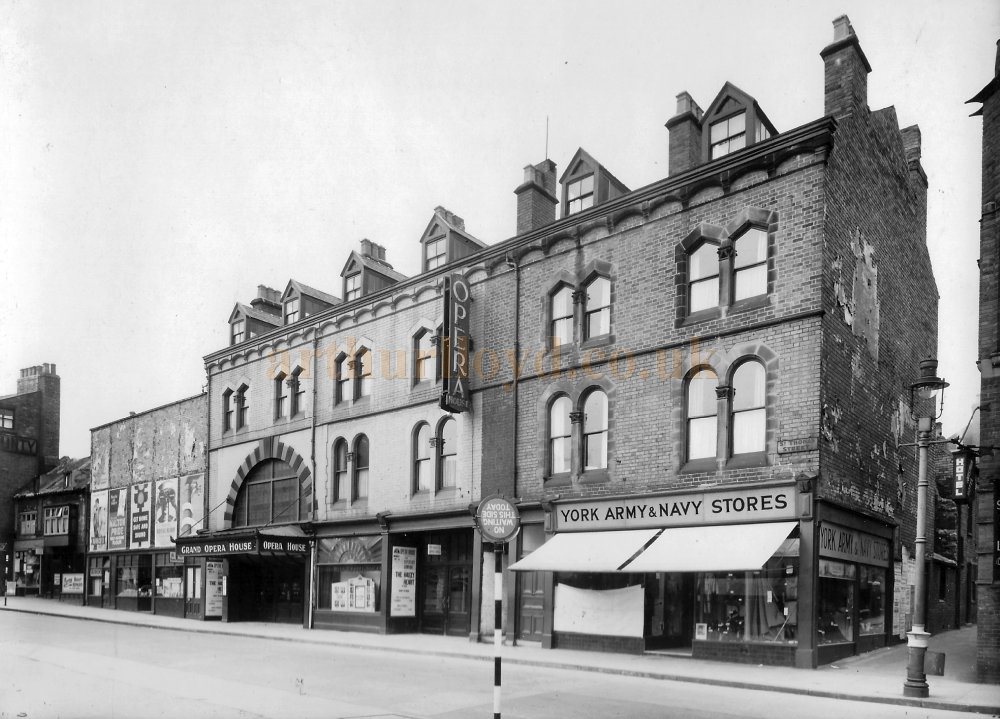
Above - The Opera House, Scarborough in June 1948 - Courtesy Joe Staines whose father Geoffrey Staines was director of productions at the Theatre Royal York from 1941–1958. From 1947, the York Repertory Company alternated its weekly productions between York and the Opera House Scarborough. Photograph originally produced by Walker Studios Ltd.
 The
Theatre which until recently stood in St. Thomas Street, Scarborough
and was sadly demolished in 2004, was known to all as the Scarborough
Opera House, but what may be less well known is that it was built on
the site of a former wooden circus building called Charles Adnam's Grand
Circus. This Wooden Circus was built by John Petch in 1876 and then almost completely reconstructed the following year by Frank
Tugwell when it changed ownership and was renamed Hengler's Grand
Circus.
The
Theatre which until recently stood in St. Thomas Street, Scarborough
and was sadly demolished in 2004, was known to all as the Scarborough
Opera House, but what may be less well known is that it was built on
the site of a former wooden circus building called Charles Adnam's Grand
Circus. This Wooden Circus was built by John Petch in 1876 and then almost completely reconstructed the following year by Frank
Tugwell when it changed ownership and was renamed Hengler's Grand
Circus.
Right - The Stage and Stalls of the Scarborough Opera House in 1990 - Courtesy Ted Bottle.
 Two years later there was another change of name, this
time to the Prince of Wales Circus in 1878,
and then in 1900 it was renamed
Zalvas Hippodrome. Eight years later and another change of name, this
time to the New Hippodrome in 1908.
(See Entrance Tokens Below.)
Two years later there was another change of name, this
time to the Prince of Wales Circus in 1878,
and then in 1900 it was renamed
Zalvas Hippodrome. Eight years later and another change of name, this
time to the New Hippodrome in 1908.
(See Entrance Tokens Below.)
Left - A Tin Plate Sign for the Scarborough Hippodrome saying 'Open every evening, Twice Nightly, 7 and 9', which originally accompanied a second one placed on the main entrance doors of the Theatre during its time as the 'New Hippodrome Scarborough' between 1908 and 1910 - Courtesy Martin Wood.
 In 1910 there was another change
of name, to the Opera House and finally this one stuck, although there
was a 'Grand' put in front of the Opera House for a while.
In 1910 there was another change
of name, to the Opera House and finally this one stuck, although there
was a 'Grand' put in front of the Opera House for a while.
Right - The Auditorium of the Opera House, Scarborough in the 1930s, Courtesy The Theatres Trust.
The Scarborough Opera House was designed by Frank Tugwell and, until its demolition in 2004, was one of the last remaining buildings designed by him still in existance. A photograph of the exterior of the Opera House in 1989 by Ian Grundy can be seen here. The horse shoe shaped auditorium of the Opera House was on three levels with three boxes either side of the proscenium, one of which was in an unusual ash-tray shape (see images below).
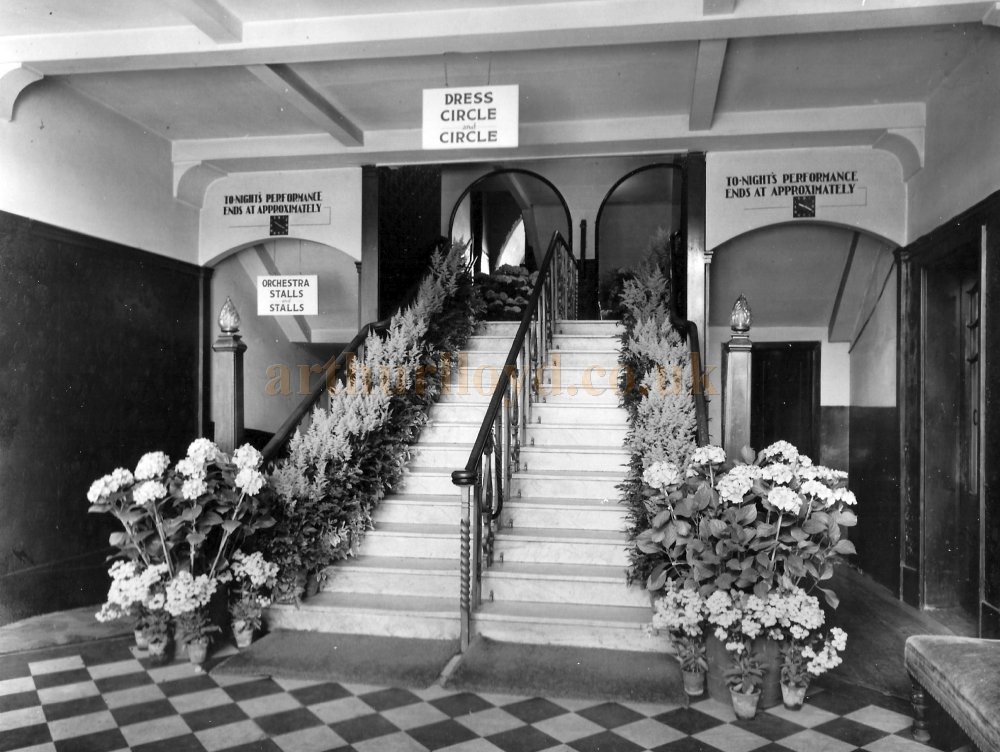
Above - The Foyer, Staircases, and Entrances to the Auditorium of the Opera House, Scarborough in the 1940s and 50s - Courtesy Joe Staines whose father Geoffrey Staines was director of productions at the Theatre Royal York from 1941–1958. From 1947, the York Repertory Company alternated its weekly productions between York and the Opera House Scarborough. Photograph originally produced by Walker Studios Ltd.

Above - The auditorium of the Scarborough Opera House in 1990 - Courtesy Ted Bottle.

Above - The auditorium of the Scarborough Opera House in 1990 - Courtesy Ted Bottle.


Above - An Entrance Token for the 1908 New Hippodrome, Scarborough, the name which preceded the Opera House - Courtesy Alan Judd.
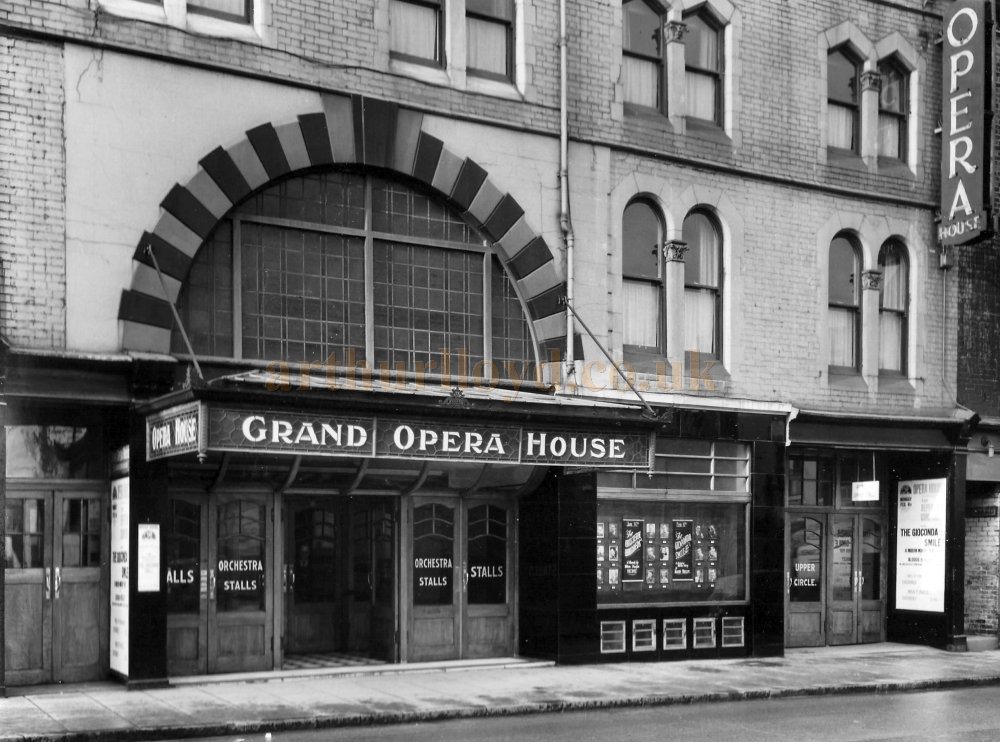
Above - The Opera House, Scarborough in January 1950 - Courtesy Joe Staines whose father Geoffrey Staines was director of productions at the Theatre Royal York from 1941–1958. From 1947, the York Repertory Company alternated its weekly productions between York and the Opera House Scarborough. Photograph originally produced by Walker Studios Ltd.
 In
1948 the Box Office was rebuilt and this simple task didn't go quite
as smoothly as was predicted, you can read more about this in the article
below.
In
1948 the Box Office was rebuilt and this simple task didn't go quite
as smoothly as was predicted, you can read more about this in the article
below.
Right - Six 1948 Season Programmes for the Opera House Scarborough which was being run at the time by the York Repertory Company, and produced by Geoffrey Staines, who ran two companies at this time alternating weekly with the York Theatre Royal.
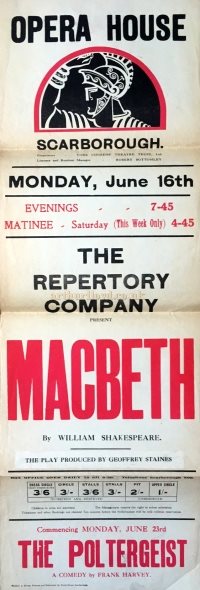
Far Right - A Poster for the York Theatre Royal's Repertory Company Production of 'Macbeth' at the Scarborough Opera House in June 1947 - Courtesy Joe Staines whose father Geoffrey Staines was director of productions at the Theatre Royal York from 1941–1958. From 1947, the York Repertory Company alternated its weekly productions between York and the Opera House Scarborough.
1976 saw a much needed refurbishment of the Theatre and it was re-roofed at the same time. A new bar was also added at the rear of the Theatre at this time too.
The Theatre closed after the 1995 season and slowly fell into disrepair. And sadly the Grade II listed Theatre was demolished in 2004 after the auditorium was flooded, and the foyer block ruined after a series of arson attacks. A Casino called the Opera House Casino was then built on the site, you may like to visit their own website here. Some more images and information on the Scarborough Opera House can be seen below.

Above - A Google StreetView Image of the Opera House Casino, Scarborough, constructed on the site of the former Opera House, demolished in 2004 - Click to Interact.
The Last two seasons at the Opera House, Scarborough


Above - The last two Minstrel Spectacular Programmes presented at The Royal Opera House, Scarborough in 1994, and 1995 - Courtesy Keith Hopkins.

Above - A Poster for the 1994 Minstrel Spectacular at The Royal Opera House, Scarborough - Courtesy Keith Hopkins - Poster Reproduced with the kind permission of John Redgrave who produced the last two Minstrel shows at Theatre.
ALTERATIONS AND REPAIRS - By PENNY PLAIN
From a Scarborough Opera House Programme for December 6th 1948
The appearance of our recently completed new Box, Office, with its added amenities to both patrons, and staff, has caused considerable appreciative comment, but during its construction there were many occasions when both patrons and management felt the work was taking an unconscionable time, especially when, in spite of previous assurances to the contrary, the work progressed throughout the height of our busy season.
 The necessity of providing more convenient and additional
booking facilities had long been occupying the minds of the administrators
of the Opera House, but it was not until the 24th May of this year that
the actual work commenced. Prior to this, when making the preliminary
survey, our architects found a section of the flooring of both the existing
Box Office and the site of the new was seriously affected with dry rot
of the fungal type, necessitating the immediate insertion of temporary
supports,
The necessity of providing more convenient and additional
booking facilities had long been occupying the minds of the administrators
of the Opera House, but it was not until the 24th May of this year that
the actual work commenced. Prior to this, when making the preliminary
survey, our architects found a section of the flooring of both the existing
Box Office and the site of the new was seriously affected with dry rot
of the fungal type, necessitating the immediate insertion of temporary
supports,
 On
wider examination the space below was found to be an old cellar which
had, at some previous date, been partially filled with clay and rubble.
To complete the required excavation about 54 tons of such material were
removed. Water seepage, which had for a long time been a matter of some
concern and believed to originate from underground springs situated
some distance behind the Opera House, proved to amount to a depth of
1 inch following heavy rains. This discovery necessitated the provision
of a special drainage system.
On
wider examination the space below was found to be an old cellar which
had, at some previous date, been partially filled with clay and rubble.
To complete the required excavation about 54 tons of such material were
removed. Water seepage, which had for a long time been a matter of some
concern and believed to originate from underground springs situated
some distance behind the Opera House, proved to amount to a depth of
1 inch following heavy rains. This discovery necessitated the provision
of a special drainage system.
 As
work progressed various cracks in the plaster-work became apparent,
and these were traced to a settlement in the large wooden beam extending
across the display window. It was found that the weight of the main
front elevation resting on this beam was crushing its supporting walls.
To deal with this satisfactorily the whole of the front was demolished
and a complete new window installed which will, in due course, be faced
in clack vitrolite with chromium-plated steel windows in the plinth.
As
work progressed various cracks in the plaster-work became apparent,
and these were traced to a settlement in the large wooden beam extending
across the display window. It was found that the weight of the main
front elevation resting on this beam was crushing its supporting walls.
To deal with this satisfactorily the whole of the front was demolished
and a complete new window installed which will, in due course, be faced
in clack vitrolite with chromium-plated steel windows in the plinth.
During the period of subsidence heavy baulks of timber were inserted to, support the main, central column as the settlement affected the floors above, including the Manager's private flat, so that doors became impossible to close.
 As
can be appreciated, the tracing of these additional defects and effecting
their remedy involved additional time, but are really believed to have
been a blessing in disguise as serious consequences might have developed
had they remained undiscovered much longer.
As
can be appreciated, the tracing of these additional defects and effecting
their remedy involved additional time, but are really believed to have
been a blessing in disguise as serious consequences might have developed
had they remained undiscovered much longer.
On the 30th October, the staff were able to conduct business from the new Box Office, and it is hoped that by the time our patrons read this article the foyer will be free of all obstruction. There still remain, of course, various "finishing touches" to be carried out, but the delay in their completion does not seriously detract from the efficient working of the new scheme. Delivery of the grilles for the four Box Office windows is still awaited owing to the shortage of the required materials, which necessitated the order being placed with an outside firm instead of locally, as was originally intended.
 The
provision of the four booking windows has proved a very useful amenity
by assisting those patrons who wish to reserve seats for other than
the current performance. One window is solely for bookings during the
early part of the week, the second for Permanent Seatholders, the third
for reservations during the second half of the week, and the fourth
is used exclusively by Upper Circle patrons, for whose added convenience
a new ticket machine has been installed.
The
provision of the four booking windows has proved a very useful amenity
by assisting those patrons who wish to reserve seats for other than
the current performance. One window is solely for bookings during the
early part of the week, the second for Permanent Seatholders, the third
for reservations during the second half of the week, and the fourth
is used exclusively by Upper Circle patrons, for whose added convenience
a new ticket machine has been installed.
The completed scheme includes a cloakroom with the necessary counter immediately opposite the Box Office, and a specially designed ladies' toilet suite in the basement.
The above text is from a December 6th 1948 Opera House Scarborough Programme. Advertisements are from various 1948 Season Programmes.
Arthur Lloyd is known to have performed in Scarborough in 1867, 1879, 1886.
If you have any more information or images for this Theatre that you are willing to share please Contact me.
The Theatre Royal, Scarborough

Above - The Theatre Royal, Scarborough - From 'The Playgoer' in 1901 - Courtesy Iain Wotherspoon.
 The
Theatre Royal, Scarborough, which is shown above, was built in 1771
for Thomas Bates, a celebrated comedian of the time, by the Reverend
Thomas Haggit, a clergyman of the Church of England. However, this
Theatre replaced an even earlier Theatre Royal which is said to have
existed since 1733, see article below.
The
Theatre Royal, Scarborough, which is shown above, was built in 1771
for Thomas Bates, a celebrated comedian of the time, by the Reverend
Thomas Haggit, a clergyman of the Church of England. However, this
Theatre replaced an even earlier Theatre Royal which is said to have
existed since 1733, see article below.
When the picture above was taken in 1901 the 1771 Theatre was already 130 years old. There was a small article printed along with the image in the Playgoer which reads thus:- 'Few theatres existing can boast so historic a dramatic record as the Theatre Royal, Scarborough. The Rev. Thomas Haggitt, a clergyman of the Church of England, built it just one hundred and thirty years ago for Thomas Bates, a celebrated comedian of the day, who controlled it for about forty years, when it was purchased by Stephen Kemble (brother of Mrs.Siddons), since which time nearly every popular actor and actress have appeared on its boards. The house is now owned by Mrs. Ilenry Mayhew, who has in Mr. F. P. Morgan a capable, courteous, and most enterprising manager.'
Right - A Poster for 'Pizarro' and 'Corsican Brothers or The Compact of Death' at the Theatre Royal, Scarborough for Thursday the 23rd of July 1857 - Courtesy Neil Pearson. In the cast were C. H. Simms, Miss Cattle, E. Cameron, Miss Murray, G. F. De Vere, Mr. Charles, Mr. Sterne, Ely Loveday, W. J. Evans, Frederick Hastings, W. Holland, J. Tyrrell, Mr. Blyde, Mr. Benson, Miss Conway, and Miss E. Crane.Prices were Boxes3s, Pit 2s, Gallery 1s.
The above text and Theatre image are from 'The Playgoer' of 1901 - Courtesy Iain Wotherspoon.
A letter published in the ERA on the 26th of November 1881 gives some more details on the early history of the Theatre Royal saying:- '
ANCIENT THEATRES
TO THE EDITOR OF THE ERA
Sir,--In your last week's issue a letter appeared giving an account of the antiquity of the Richmond Theatre, erected in 1766. Allow me to mention one of a still earlier date - the Theatre Royal, at Scarborough, which has been at least a century and a half in existence, as we find from records of its past career that it was in the year 1733 under the management of a Mr Kerregan.
An old local work, in speaking of the amusements of the visitors at that time, thus alludes to the theatre:- In the afternoon plays are acted, to which most of the gentry in town resort; Kerregan is now here with his company, and (allowing for scenes and decorations) they perform several plays very well. After the play is over, it is customary for visitors to go to the Long-room, where they dance or play till about nine, and then sup in company. Rooms, balls, public teas, breakfasts, and the playhouse are all, undoubtedly, staple entertainments, and all of them (especially the two last) abundantly gratifying at Scarborough; the actors being in general solicitous to perform their respective parts with taste, and many of them prove successful in the art of pleasing. The theatre is also well adapted to accommodate the spectators." A more detailed account of this ancient theatre, once the property of the Kemble family, was furnished to The Era Almanack in 1873, under the title of "The Stage at Scarborough." The theatre is now the property of Mr W. R. Beverly. It is fifty years since Mdlle. Celeste appeared on this stage in The French Spy. Trusting this relic of the past may receive favourable notice, I remain, yours truly, C. MEADLEY, Scarborough, November 23d, 1881.'
The above text in quotes was first published in the ERA 26th of November 1881.
Arthur Lloyd is known to have performed in Scarborough ten years after the production in the poster shown above right in 1867, and again in 1879 and 1886.
If you have any more information or images for this Theatre that you are willing to share please Contact me.
The Spa Theatre, Cleveland Way, Scarborough
Formerly - The Gothic Saloon / Spa Saloon / Spa Music Hall

Above - A Google StreetView Image of the Scarborough Spa Complex and Theatre - Click to Interact
 The
Spa Theatre, Scarborough which still stands today was first built in 1879 and opened in June that year, although the official opening was on the
2nd of August 1880. The Theatre
was designed by Verity and
Hunt and constructed on the first floor of a complex comprising
a Music Room, a restaurant, two ballrooms and an open-air Sun Court
for daytime concerts and dancing. There is more information on the present Theatre below.
The
Spa Theatre, Scarborough which still stands today was first built in 1879 and opened in June that year, although the official opening was on the
2nd of August 1880. The Theatre
was designed by Verity and
Hunt and constructed on the first floor of a complex comprising
a Music Room, a restaurant, two ballrooms and an open-air Sun Court
for daytime concerts and dancing. There is more information on the present Theatre below.
Right - A Programme cover for the 1958 season at The Spa Theatre, Scarborough.
 Today's Spa Theatre however, actually replaced the earlier Gothic
Saloon of 1839, which was designed by Henry
Wyatt and built by John Barry, later considerably altered by Sir Joseph Paxton and G. H. Stokes in 1858.
Today's Spa Theatre however, actually replaced the earlier Gothic
Saloon of 1839, which was designed by Henry
Wyatt and built by John Barry, later considerably altered by Sir Joseph Paxton and G. H. Stokes in 1858.
Left - Henry Wyatt's 1839 Gothic Saloon, Scarborough.
Paxton's Music Hall / Saloon replacement for the earlier Gothic Saloon opened on the 20th of September 1858 with a series of concerts. The opening of the New Music Hall was reported on in the Illustrated London News of the 2nd of October 1858 saying:- 'The saloon is approached from the west by a colonnade 188 feet long, and occupies a position at the south end of the old Music Hall, with which it is connected by a spacious vestibule or refreshment saloon.
Over the colonnade, which is raised so as to form a terrace four feet above the ground-line of the esplanade, is a promenade extending round the south end and the side of the building facing the sea. This promenade is at the gallery level, and is supported on cast-iron columns with ornamental brackets...

Above - A Lithograph by J. N. Carter depicting Joseph Paxton's New Music Hall Scarborough of 1858 - Courtesy Michael Kemp.
 ...The plan of the building externally is that of a parallelogram, with projections at the angles to break the outline; the architectural features of the exterior are simple, but characteristic of the purpose to which the building is to be appropriated. The principal facade consists of a series of compartments formed by plain pilasters, between which is a segmental or semicircular-headed window. Above these is a moulded stone cornice and blocking course, with pedestals over each pilaster; the angular towers or projections, which contain the staircases to galleries and external promenades, have double pilasters at the angles, and are raised above the other parts of the building and finished with a stone balustrade.
Right - A Programme for the Spa Saloon, Scarborough for August the 14th, 1871 - Courtesy Simon Moss, stagememories.
The external walls are built of Whitby stone, lined on the inside with brick, and inclose an area that, with the galleries, will acomnmodate 2000 persons - the internal dimensions of the building being ninety-seven feet six inches long, fifty-seven wide, and forty four high. The roof of the central part is of the kind usually known as the Mansard roof, and is strongly framed on the inside with curved ribs twelve inches by seven inches, and thirty-two foot span; the whole is supported on ornamental cast-iron columns seven inches in diameter and eighteen feet from centre to centre.
 The orchestra, which is placed at the south end of the saloon, is capable of holding fifty performers; and underneath it are retiring rooms for the conductor and musicians.
Left - An Early Programme for the Spa Saloon, Scarborough - Courtesy Simon Moss, stagememories.
The entire surface of the walls, which are lined, together with the vaulted ceiling, with wood, for the purpose of assisting the sound, are to be decorated by Mr. Crace, of London, who has already executed a portion with considerable taste and skill; and when entirely finished the general appearance of the interior, particularly when brilliantly lighted on the occasion of evening concerts by the sun-burners which have been provided for that purpose, will, no doubt, be highly effective and satisfactory.'
The above text in quotes (edited) was first published in the Illustrated London News, 2nd October 1858.

Above - Joseph Paxton's 1858 Scarborough Spa Music Hall on fire in 1876 - From the Illustrated Sporting and Dramatic News of the 13th of September 1876.
Paxton's Music Hall had first opened in 1858 but was gutted by fire on the night of the 8th of September 1876. The Illustrated Sporting and Dramatic News of the 13th of September 1876 reported on the destruction, along with the image shown above, saying:- 'On Friday night a scene, terrible in its grandeur, was witnessed at that fashionable place of resort, Scarborough Spa. A large and fashionable company had attended the Spa in the evening, and had listened to the performance of Herr Lutz's band, and it was not till ten o'clock that the company had dispersed. In addition to the ordinary attractions of the Spa, a grand bazaar was being held in the saloon in aid of Church objects in St. Mary's Parish, Scarborough, and the fire was discovered just as the building was being closed for the night. The alarm was raised by Lady Sitwell's maid, who while leaving the hall saw sparks begin to drop from the roof. Directly molten lead began to fall, and a scene of the greatest consternation at once ensued. The danger was imminent before those in charge of the bazaar had time to think of removing any of the effects. The fine painting, "The man of Sorrows," valued at £6,000, was removed without damage. The fire is said to have been caused by the concentrated heat in-the gas "sunlights" suspended from the roof. The building is well insured. It was built from the design of Sir Joseph Paxton about 18 years ago.' - The Illustrated Sporting and Dramatic News, 13th September 1876.

Above - The Scarborough Spa Complex in the early 1890s - From 'Round the Coast' by George Newnes, Ltd, 1895.
 Despite the terrible fire of 1876, documented above, the building was eventually reconstructed and the new Spa Theatre, which was a part of the replacement Complex, and still stands today, opened in June 1879, with an official opening on the
2nd of August 1880.
Despite the terrible fire of 1876, documented above, the building was eventually reconstructed and the new Spa Theatre, which was a part of the replacement Complex, and still stands today, opened in June 1879, with an official opening on the
2nd of August 1880.
Right - The Spa Complex, Scarborough - From an early Postcard.
The Spa Theatre was designed by Verity and Hunt and constructed on the first floor of the new complex which comprised of a Music Room, a restaurant, two ballrooms and an open-air Sun Court for daytime concerts and dancing.
What is not generally realised is the fact that today's Spa Theatre was not purpose built. It was originally to have been a Grand Hall and Floral Lounge together with associated meeting rooms, bars etc., but for some reason a very late change of use caused the Floral Lounge part of the structure which was essentially complete, to be converted into a Theatre...

Above - The Scarborough Spa Complex in the early 1890s - From 'Round the Coast' by George Newnes, Ltd, 1895.
...This late adaption to Theatre use has marred the Spa Theatre ever since. Ian Grundy writes:- 'Having the appearance of an end-of-pier Theatre the Spa Theatre is nevertheless around the fifteenth oldest surviving working theatre in the UK, and has been little altered. The auditorium is laid on three levels, stalls (extending unusually deeply under the inserted balcony), side balconies (which originally ran around three sides of the hall), and a steeply raked balcony added after the hall was completed, replacing the original rear and side balconies at the level of the existing side ones...

Above - The auditorium of the Spa Theatre, Scarborough - Courtesy Adrian Tonner whose grandfather, Moses Halladjian, took the photograph and was a freelance photographer in Scarborough from 1925 to 1937.
...Operationally the Theatre lacks adequate access to the stage, which itself is too small, has insufficient flying height and has a particularly awkward arrangement of dressing rooms. It was slightly altered around the beginning of the 20th century when the proscenium was brought forward a small amount to enlarge the stage.
 The ceiling above the stage still retains the decoration which used to adorn the now rather bare expanse in the auditorium, this could easily have been reinstated in the recent renovation (and would probably have aided the acoustic in the hall), a sad omission in a grade 2* listed building.
Right - Above the stage of the Spa Theatre today, showing the surviving moulded ceiling from before the stage was extended into the auditorium - Courtesy Ian Grundy.
The proof of this lies in the Adrian Tonner photograph shown above and my own photograph shown right which shows the ceiling above the stage (behind the proscenium arch). This is the rear corner of the stage and the moulded ceiling survives here. There is also the extreme awkwardness of the rear balcony and the lack of any sensible backstage layout and access.' - Ian Grundy.

Above - The Scarborough Spa Complex in the early 1890s - From 'Round the Coast' by George Newnes, Ltd, 1895.
 Ted
Bottle, whose photographs of the Spa Theatre are shown below writes:-
'The Scarborough Spa Theatre is a most delightful place - very intimate
building designed by Verity
and Hunt with an ornate frieze above the proscenium. Note the footlights,
a forbidden word in the theatre business but I liked them. They added
warmth and an air of mystery when played on the tabs. Like many other
theatres it is reputed to be haunted. At the evening performance prior
to my photographic visit, someone in the audience was rather upset by
the appearance of someone not of this world, so the management told
me.' - Ted Bottle.
Ted
Bottle, whose photographs of the Spa Theatre are shown below writes:-
'The Scarborough Spa Theatre is a most delightful place - very intimate
building designed by Verity
and Hunt with an ornate frieze above the proscenium. Note the footlights,
a forbidden word in the theatre business but I liked them. They added
warmth and an air of mystery when played on the tabs. Like many other
theatres it is reputed to be haunted. At the evening performance prior
to my photographic visit, someone in the audience was rather upset by
the appearance of someone not of this world, so the management told
me.' - Ted Bottle.
A regular visitor to the site, Keith Hopkins, writes:- 'I am still having hours of pleasure from the Arthur Lloyd website. Today I looked at Scarborough where I appeared for twelve years - 8 at the Spa Theatre, 2 at the Opera House (the last show 'THE MINSTRELS' packed them in for 2 seasons), 1 at The Futurist, and another at The Grand Hotel.
Right - The Chairman on stage at the Spa Theatre in 1989 - Courtesy Keith Hopkins.
I was thrilled to see my Chairman's table in the photographs of the Spa theatre. A couple of photographs taken in 1989 at The Spa Theatre (shown right and below) show the original blue velvet swag curtain and the same table, only slightly changed. We did 3 changes of programme 1 modern variety, 1 O.T.M.H., and one play, all in repertoire. 6 dancers 2 spec acts, 2 singers and a comic! Happy days!' - Keith Hopkins.
The Grade II Listed Spa Theatre today has capacity of 570 including 168 seats at balcony level.
You may like to visit the Theatre's own website here.
If you have any more information or images for this Theatre that you are willing to share please Contact me.

Above - Performers and Chairman on stage at the Spa Theatre in 1989 - Courtesy Keith Hopkins.

Above - Photograph of the Auditorium and Stage of the Spa Theatre, Scarborough in 1990 - Courtesy Ted Bottle

Above - Photograph of the Auditorium and Stage of the Spa Theatre, Scarborough in 1990 - Courtesy Ted Bottle

Above - Photograph of the Auditorium from the Stage of the Spa Theatre, Scarborough in 1990 - Courtesy Ted Bottle.

Above - Frank Tugwells Ocean Ballroom part of the Spa Complex which was added in 1924/5 and brutally altered in 1968 - Photograph courtesy Adrian Tonner whose grandfather, Moses Halladjian, took the photograph and was a freelance photographer in Scarborough from 1925 to 1937.
The Floral Hall, Scarborough
Later - The Scarborough Bowls Centre

Above - A Postcard depicting the Floral Hall and Alexandra Gardens, Scarborough - Courtesy Adrian Spawforth from his wonderful site 'Postcards of Scarborough.'
 The
Floral Hall, Scarborough was not so much a Theatre in its early days
but a large open Conservatory housing entertainments such as the popular
Pierrot shows of the time, see photographs below.
The
Floral Hall, Scarborough was not so much a Theatre in its early days
but a large open Conservatory housing entertainments such as the popular
Pierrot shows of the time, see photographs below.
The Hall began life as the Alexandra Gardens, an open air venue, but quickly had a glass roof constructed over it to turn it into a theatrical space.
Right - A 'Summer Spectacular' programme for the Floral Hall Theatre, Scarborough, undated but probably early 1970s. In the show were Freddie (Parrot Face) Davies, Lonnie Donegan, The Dallsa Boys, Ayshea, Robert Young, and the Fred Peter's Dancers.
In 1987 the local Council deemed the Floral Hall building unsafe and withdrew its license saying it would cost £500,000 to make it safe, a sum they were unable or unwilling to find.
The Theatre never reopened and it was demolished in 1989. The site of the Floral Hall is today home to the Scarborough Bowls Centre.

Above - A 'Summer Spectacular' programme for the Floral Hall Theatre, Scarborough, undated but probably early 1970s.

Above - A Postcard showing the interior of the Floral Hall, Scarborough - Courtesy Adrian Spawforth from his wonderful site 'Postcards of Scarborough.'

Above - The Cafe in the Floral Hall, Scarborough - Courtesy Adrian Tonner whose grandfather, Moses Halladjian, took the photograph and was a freelance photographer in Scarborough from 1925 to 1937
Photographs of Pierrots and Pierrettes performing in Scarborough

Above - A Photograph of Pierrots and Pierrettes performing in Scarborough - Courtesy Adrian Tonner. The man at the front of the Pierrots, at the bottom of the steps (with his arms outstretched), is Will Catlin who created the Arcadia and Futurist in Scarborough. More photographs from this set are shown below.


Above - A selection of Photographs of Pierrots and Pierrettes performing in Scarborough - Courtesy Adrian Tonner whose grandfather, Moses Halladjian, took the photographs and was a freelance photographer in Scarborough from 1925 to 1937. The venue could have been the Floral Hall or the Spa Theatre.
The Futurist Theatre and Cinema, Foreshore Road, Scarborough
Formerly - Kiralfy's Arcadia / Catlin's Arcadia
History - The Futurist Theatre in the 60s / 70s - Demolition

Above - A Google Streetview image of the former Futurist Theatre, Scarborough - Click to Interact
 The Futurist Theatre was designed by F.
A. Tugwell and was originally built as a Cine-Variety Theatre called the New Arcadia, opening in 1921 with a capacity
of 2,393. The Theatre was constructed on the site
of the former Kiralfy's Arcadia, later Catlin's Arcadia (see image below),
which had opened in July 1903 and was closed and demolished in 1920 to make way for the new Theatre.
The Futurist Theatre was designed by F.
A. Tugwell and was originally built as a Cine-Variety Theatre called the New Arcadia, opening in 1921 with a capacity
of 2,393. The Theatre was constructed on the site
of the former Kiralfy's Arcadia, later Catlin's Arcadia (see image below),
which had opened in July 1903 and was closed and demolished in 1920 to make way for the new Theatre.
Right - A programme for 'The Black & White Minstrel Show of 1972' at the Futurist Theatre, Scarborough.
The first new part of the complex to open was the Ice Cream and Soda Fountain Saloon, later known as the American Bar. This was under the rear stalls of the Theatre and in more recent times was the Arcadia Amusement arcade and finally the Emporium. It threw open the doors at the start of the summer season show at the New Arcadia on 14th May 1921 and was described in the press saying:- 'In the decoration and lighting of the American Bar, the colour and treatment have been allowed to run riot, the plaster in here being original in the extreme, and modelled as the site required, never repeating, with the faint tangled effect of tree and foliage, with bunches of fungus in a colour scheme of carmine and blue intertwining the green pergola, with a cloud effect beyond. Tubular splatter lights with fantastic painted panels on a black and white check floor complete a scheme which is always different.' - Local Press report.

Above - A Postcard depicting Catlin's Arcadia, Scarborough - Courtesy Adrian Spawforth from his wonderful site 'Postcards of Scarborough.' The New Arcadia Theatre, later the Futurist Theatre, was opened on its site in 1921.
Two months later 'The Cinema Magazine' of July 7th 1921 carried a good description of the Futurist as it opened, described by Val Prince, the interior designer:- 'The decorative scheme embraces a lavish use of many strong yet harmonious tints on a cream biscuit and pink ground, all of which are pulled together by the intermingling of black, toned by the softening hues repeated in the lighting treatment in which white light is entirely eliminated. The whole effect is obtained by the use of balloon lights, which I have found so harmonious where strong contrasts are to be dealt with. Added to this, a range of concealed many-coloured lamps illuminate a cloud and star treatment in the dome, giving a soft and atmospheric effect with a feeling of distance.
The proscenium and stage are constructed in moulded plaster in black white and gold stripes, surmounted by a pierced dome always emitting a pale rose light between the tracery. The electrically operated curtains are black, painted with bold splashed of pink, blue, green and gold, making a suitable set for singer or concert party.
The orchestra has an open rostrum giving a full view of the leader, a spot lime from the dome flooding him, or any section of the players, with multi coloured lights as desired, whilst a pleasing tone of blue and violet is thrown on the foliated background from a range of concealed lights. On either side of the stage is a very fine organ, the pipes of which treated in dull silver, and flanked with fine plaster treatment in pink, turquoise blue and black makes a bold finish to the stage end of the house...'
Note: In fact the organ, which cost the huge sum of £5,000 (just over two hundred thousand pounds today) was not complete upon opening, though it could be played. It was finally finished in August, and had been designed and built by Abbot & Smith as a 3 manual 45 stop instrument which preceded the later Wulitzers and Comptons adopted by the main cinema circuits. In 1928 it was rebuilt by Sumner & Barnes of York.
The Cinema Magazine's Val Prince article continues by saying:- '...The walls on the ground and balcony floors are panelled with original treatments of lines and squares with a wing effect on the sides, all modelled especially and never repeating, forming frames to the many original paintings in oils which fill the spaces. On the remaining walls and ceilings, designs in bold black line are made use of, with many coloured discs from which the balloon lights are suspended, always staggered and appearing as it were in mid air.
The seating is all deep crimson, on a jazz carpet very strong and erratic in design.
The handling of the lighting in the house has been a special feature, and I always advocate a coloured effect between the exhibiting of each picture, which gives a rest to the eyes, especially noticeable where long films are concerned, the soft colour being a great relief. This is automatically worked by the dimmers from the curtain control, which at the end of a picture slowly close over the screen and vanish in the same way on the opening of the curtains for a fresh picture exhibit.
The entrance and staircase are treated in a similar theme, and with the painted panels, the fine marble and wood setting giving a pleasing effect under the pierced vari-coloured grid which surmounts the ceiling. In the pay-box quite a feature has been made in the mingling of chased woodwork and specially designed leaded lights, also carried out in the entrance and barrier doors.' - The Cinema Magazine, July 7th 1921.
The decorative scheme for the Theatre was carried out by Val Prince Decorations Ltd, to the personal design and supervision of Val Prince. Automatic curtain control was provided by Becks of Shaftesbury Avenue, London; Lights were manufactured by Durolite Manufacturing Company of Penge, London; woodwork was by T. W. Plaxton of Scarborough and carpets and draperies by Tonks of Scarborough. The faience tiling on the front was supplied by Halthern Station Brick and Terracotta Company, and fixed by Plaxtons, the wall paint came from Art Pavements and Decorations Ltd.
Two days before the Theatre opened the Scarborough Evening News reported on the Theatre in their 25th of June 1921 editions saying:- 'The screen which is of patent material and on which the pictures will be projected considerably larger than is commonly done, is surrounded by curtains of painted plaster, and are therefore fire-proof. Over the centre of the orchestra and in front of the circle is a perforated illuminated dome in which an impression of clouds and stars is created, but the main feature is the subdued lighting from a large number of various coloured hidden lamps. Somewhat startling is the mixture of colours here and in other parts of the theatre, but the whole effect is one of subdued warm tones. Hanging from the roof are balloon lights, which are a good imitation of toy balloons containing electric globes. In keeping with the idea of non-conformity and complete irregularity these groups of balloons are not suspended at any regular distance from the roof nor are they in any symmetrical form. They are what is technically known as staggered which is equivalent to saying they are in no form at all. Altogether there are between four and five hundred separate scattered lights in the theatre and not one white one. The blending of the coloured lights reacts on the more daring colours of the painted surfaces.
To turn to matters of more practicable importance, the comfortable tip-up chairs and especially the adequate space between the rows are sure to meet with the approval of patrons. Every seat in the building is of the tip-up style and from all of them an uninterrupted view of the screen, which is set back a good distance on the stage, can be obtained. In the spacious circle and beneath it there are no pillars to shut out the view.
The super-cinema will seat somewhere about 2,700 people and though designed pre-eminently as a cinema, the stage has all the necessary appointments for light opera, plays and oratorios.
There are no less than eleven public entrances and exits to the building, all of which are of fire-proof construction with stairs five feet wide.
It is claimed that the rapidity with which the demolition of the old Arcadia, the excavating and building of the retaining wall, in which 2,500 tons of concrete were used, and the erection of the new theatre has beaten all records and that Mr Plaxton with his staff, has achieved the almost impossible. Labour of every sort had to be enticed by judicious advertising and imported from all parts of the country.
In planning the building advantage has been taken of the most modern form of American construction and though in this country at the present time there are numerous very large theatres in the course of construction, there is nothing that embodies to such an extent the most modern features of moving picture theatre design.' - The Scarborough Evening News, 25th June 1921.
The above report states in one section that there were 'no pillars to shut out the view' but there were a small number of pillars in the rear stalls and it seems unlikely that they were inserted at a later date. As is recorded above and contrary to most reports the Futurist was a Cine-Variety Theatre and had stage shows most Sundays and on occasional other nights of the week. It was fully equipped as a Theatre from opening and had a stage which Ian Grundy estimates was at least 18 feet in depth. In 1921 for example Ian finds an advertisement on Sunday the 2nd of October 1921 for 3:00pm and 8:00pm the Coldstream Guards Band on-stage. Seats were bookable in advance at 1/7d (8 pence in todays money, but taking inflation into account that would equate to around £3.30 in 1921).
A somewhat surprising advert was published in December 1921 for a performance at 8:15pm on Christmas Day. Entitled The Messiah it consisted of carols, organ solos and orchestral items and involved a full chorus.
On Friday 18th November 1927 Anna Pavlova and her company together with the corps de ballet and orchestra from the Royal Opera House Covent Garden presented for one night only an evening of Ballet. The first part was devoted to a series of dances based on Chopin's works – the members of the Corps de ballet were in the conventional white ballet tutus and a moonlight effect was created by the lighting. The Futurist stage with its dark curtain and no other scenery or properties accentuated the performance which relied entirely on its artistic atmosphere and adherence to classic ideals. The remainder of the programme consisted of thirteen dances in character costumes to the music of some of the best known composers. The audience paid a warm tribute, recalling Pavlova many times. As a closing item Pavlova and Laurent Novikoff danced a serenade which again brought forth a storm of applause.
In November 1957 plans were approved for a radical redesign of the Theatre which would include a new wider proscenium constructed 4 feet forward from the original, giving more room on stage, a new metal safety curtain and drencher system, the construction of six new dressing rooms on the Theatre's roof, and three new bars in the Theatre itself. At the same time the Theatre's organ, which had been rarely used since the end of the war, was removed. The 1958 season show, 'The Cyril Stapleton Band Show' had finished on Saturday the 20th of September, presented on the original 1921 stage, and work began on altering the Theatre shortly afterwards, the work was carried out to the designs of architect Captain J. H. Ritson, who would be associated with the Theatre for many years.
The work took so long that the incoming show, the 'The Big Show', would only have time for one full rehearsal before it went live on the 13th of June 1959, the headliners for this show were Cyril Stapleton (again) and Frankie Howerd.
 In 1967/8, whilst under the control of Robert Luff, the Theatre was redesigned again, this time by Cassidy, Farrington
& Dennys and expanded to include a new and much larger stage over
much of the site of the by then closed Arcadia Theatre next door, giving the stage an extra 15 feet of depth.
In 1967/8, whilst under the control of Robert Luff, the Theatre was redesigned again, this time by Cassidy, Farrington
& Dennys and expanded to include a new and much larger stage over
much of the site of the by then closed Arcadia Theatre next door, giving the stage an extra 15 feet of depth.
Right - A Poster for 'Minstrel Showtime' celebrating the 40th anniversary of 'The Black & White Minstrels', at the Futurist Theatre, Scarborough - Courtesy Keith Hopkins. On the Bill for this variety production were Keith Harris, Orville & Cuddles, Gary Driscoll, Keith Hopkins, Cerdic Monarch, Wayne Dobson, Kerry Mackenzie, and The Minstrel Dancers.
In 1969 a £100,000 facelift was undertaken in time for the Return of the Black & White Minstrels. This would be equivalent of £1.4million today. This included modernising the foyers, creating a 'Minstrel Lounge' within the old Arcadia space, and the 'Minstrel Bar' within the Arcadia Buffet. A nightclub was also created in what had formerly been the ballroom called the Top Spot, decorated by the theatrical designer Robert St John Roper. At this time the exterior and interior were also radically altered, apparently against the wishes of Robert Luff himself. The Futurist had originally had an exterior faced with Italianate style faience which was now hidden behind a new exterior of yellow panels, although the former was still partly visible higher up the frontage.
The Theatre always had a large auditorium with a capacity of over 2,000 people, and consisted of stalls and one circle which was partly supported by columns, later the auditorium also included boxes either side of the proscenium even though they had no view of the stage, (see paragraph below). Six large boxes were also constructed above the rear circle during the 1960s alterations. Unusually the stage of the Futurist Theatre was situated above the Foyer which meant that no traps were able to be fitted into the stage.
A visitor to this site, James Bettley writes:- 'With regard to the little "boxes" on either side of the Futurist's proscenium arch (which indeed directly faced the audience and had no view of the stage, nor were ever populated) were not created as part of 1968's refurbishments but came some years later. Only intended as mock boxes, these were a way of making a feature out of the disused, arched openings high up in the wall from which showgirls like the Television Toppers and Tiller Girls once emerged to descend spiral glass staircases to stage level. The openings in the wall came with the new, wider proscenium in the late 'fifties and once the staircases were removed much later, the remaining apertures just curtained off looked very odd and the addition of moulded box fronts matching the front of the balcony made the obsolete openings at least look like part of the overall auditorium scheme.' - James Bettley, who also writes on the Futurist Theatre in the 60s and 70s below.
The Futurist Theatre was demolished in 2018, more details on this below.
Some of the above information was kindly sent in by Ian Grundy.
If you have any more information or images for this Theatre that you are willing to share please Contact me.
The Futurist Theatre in the 60s / 70s by James Bettley

Above - A Postcard depicting the Futurist Theatre, Scarborough - Courtesy Adrian Spawforth from his wonderful site 'Postcards of Scarborough.'
When planned, the Futurist was to have been called the Majestic Super Cinema. My father remembered the concert parties which used to put on shows on the sands and he believes one such party was called The Futurists. Will Catlin produced such a concert party of Pierrots and this may account for the late change of the cinema's name.
As a boy, I bought a ticket to stand at the rear of the stalls for an "All seats sold" first house performance of "The Black & White Minstrel Show" during its first, record-breaking season. I simply wanted to see the inside of the huge Theatre and vividly remember entering the auditorium and seeing what seemed like acres of red plush seats gradually filling and more stage lighting than I had ever seen in one venue. The stage was still relatively shallow and was still without a fly tower but the show was nevertheless very colourful and spectacular. The safety curtain rose in two halves due to no flying height and revealed rich, red crushed velvet house tabs which opened sideways on a motorised track.
I subsequently saw most of the summer shows there during the 'sixties and by the early 'seventies I was the assistant manager of London's Victoria Palace Theatre and got to know Robert Luff, the "Minstrels" producer as the V.P. was the home of the new West End version of the show called "The Magic of the Minstrels". Robert Luff by then owned the Futurist Theatre and the Royal Hotel in Scarborough. On discovering my York origins and my love of his Futurist, he very kindly asked me to consider being the Futurist's general manager - a post he was looking to fill. Flattered and tempted, I declined as I had not long moved to London and felt I should remain with Moss Empires. In 1973 I became the manager of Bristol Hippodrome (the Theatre where the Minstrels had played a short season just before the show's legendary seasons in Scarborough).

Above - Details from a programme for 'The Black & White Minstrel Show of 1972' at the Futurist Theatre, Scarborough.
From the late 'fifties to the mid 'sixties, the Futurist and adjacent Arcadia Theatres enjoyed a successful "exchange" arrangement with Blackpool's Opera House and Grand Theatre respectively. On being developed from the Palladium Picture House, the Arcadia Theatre started as the home of summer season revue but once the Futurist began presenting spectacular variety shows, the Arcadia presented comedy and staged summer-long farces starring some very famous names. "Saturday Night at the Crown" starred Thora Hurd and Freddie Frinton, "Friends and Neighbours" (which transferred to London for a run at the Victoria Palace) starred Glen Melville, Danny Ross and Mollie Sugden, "Pillar to Post" also starred Glen Melville and Danny Ross while "What a Racket" starred Albert Modley. Like the big shows next door, these farces played twice nightly Monday to Saturday and the neighbouring Theatres must have constituted a gold mine for Catlins Scarborough Entertainments Ltd. The Futurist shows would play Blackpool's Opera House either the year before or after while the Arcadia comedies would likewise play Blackpool's Grand Theatre. Once Robert Luff acquired Catlins, being a producer as well as a Theatre owner, he would take his Futurist shows to resort Theatres like Bournemouth Pavilion and Paignton's Festival Theatre.
A few years ago, the Futurist's last manager - the welcoming and enterprising Andrew Nisbet - very kindly showed me around the Theatre he and I loved so much. Whilst on the stage, I recalled the erstwhile Arcadia, a Theatre he was too young to remember. He smiled as I described the smaller Theatre and then said "Come and have a look over here". We entered a store room on audience left which went even further back than the Futurist's back stage wall. He pointed out the brickwork on one of the walls at right angles to the Futurist stage and I found to my amazement that I was standing on what had been the Arcadia's stage. The brickwork clearly showed the proscenium of the Arcadia from the actors' point of view. The opening had been bricked up but the outline of the arch was unmistakeably visible and vindicated my boyhood memory of just how it once appeared. The revelation also showed that the 1968 enlargement of the Futurist stage actually took only a small part of the Arcadia, perhaps a fifth of its overall width. This would explain the former Arcadia's later use as an indoor market as so much spare space remained following the construction of the Futurist's new stage house.
The Futurist has long been my second favourite Theatre (the London Palladium being number one) and today (3/7/2018) I visited Scarborough for the first time in several years. The sight which faced me as I descended Bland's Cliff was one I never hoped to see. The stage house and proscenium arch were gone and there was the sweeping, handsome auditorium, open to the elements and being nibbled away by the demolition team and somewhat cruelly illuminated by the bright sunshine. I left Scarborough with a very heavy heart but with many wonderful memories of the vast and magnificent Theatre which played a significant part in both my life and career.
A photographic memory is a mixed blessing but I'm so grateful for being able to remember the Futurist in detail and in all its guises since first admiring its façade from the sands in 1957 when I believe Frankie Howerd was starring in a spectacular revue from London's Prince of Wales Theatre.
The above reminiscences on the Futurist Theatre were kindly sent in by James Bettley in July 2018.
Demolition of the Futurist Theatre in 2018
 The Futurist had the distinction of being the fifth largest Theatre
in the country outside of London but for many years had been threatened with closure and demolition.
In July 2013 plans to redevelop the Theatre's site were rubber stamped
despite objections from locals and campaigns to save the Theatre. In
November 2013 a petition signed by more than 4,000 people was handed
to the Council in an effort to save the Theatre from demolition, and the Theatres Trust objected to the plans to demolish the building, which at the time was at number 12 on its Theatres at Risk Register, but despite all this in November 2017 it was announced that Secretary of State had refused to call in the Scarborough Borough Council's decision to demolish the Theatre.
The Futurist had the distinction of being the fifth largest Theatre
in the country outside of London but for many years had been threatened with closure and demolition.
In July 2013 plans to redevelop the Theatre's site were rubber stamped
despite objections from locals and campaigns to save the Theatre. In
November 2013 a petition signed by more than 4,000 people was handed
to the Council in an effort to save the Theatre from demolition, and the Theatres Trust objected to the plans to demolish the building, which at the time was at number 12 on its Theatres at Risk Register, but despite all this in November 2017 it was announced that Secretary of State had refused to call in the Scarborough Borough Council's decision to demolish the Theatre.
Right - The Futurist Theatre, Scarborough being demolished in June 2018 - Photo Dave Barry, courtesy Jason Mullen.
The Theatre had closed in 2014 and all hope of it being saved was crushed when demolition of the Theatre was begun in the summer of 2018. Some photographs of the demolition in progress in June 2018 by Dave Barry and kindly sent in by Jason Mullen, and others by Alfred Mason and the Save The Futurist Facebook Group, can be seen below. Jason Mullen says that the photos record the 'sad end to a building that was one of the last surviving 1920's super cinemas and the destination of so many summer season performers such as Ken Dodd (many times over the years) and bands including the Beatles in 1963.'


Above - The Futurist Theatre, Scarborough being demolished in June 2018 - Photos Dave Barry, courtesy Jason Mullen.


Above - The Futurist Theatre, Scarborough being demolished in July 2018 - Courtesy Alfred Mason.


Above - The Futurist Theatre, Scarborough being demolished in July 2018 - With kind permission of the Save the Futurist Theatre Facebook Group.

Above - An Observation Wheel temporarily constructed on the site of the former Futurist Theatre in August 2019 - Courtesy Jason Mullen.
If you have any more information or images for this Theatre that you are willing to share please Contact me.
The Palladium Picture House, Foreshore Road, Scarborough
Later - The Arcadia Theatre

Above - The Futurist Cinema and Arcadia Theatre, formerly the Palladium Picture House, from a programme for 'Catlin's Showtime' at the Arcadia Theatre in 1952 - Courtesy Maria Andrew, Norwich Theatre Royal
 The
Palladium Picture House was originally built as a Cinema in 1912 and was situated next door to Kiralfy's Arcadia
Theatre.
The
Palladium Picture House was originally built as a Cinema in 1912 and was situated next door to Kiralfy's Arcadia
Theatre.
When Kiralfy's Arcadia was closed and demolished in 1920 to make way for the building of the Futurist Theatre, the Palladium Picture House was renamed the Arcadia Theatre, and was then used for live Theatre until it closed in 1968.
Right - A programme for 'Catlin's Showtime' at the Arcadia Theatre in 1952 - Courtesy Maria Andrew, Norwich Theatre Royal.
The Futurist Theatre next door, which was built as a cine-variety Theatre, had been used for live theatre and Cinema since it opened in 1921, and was expanded in 1968 so that a new larger stage could be built over the site of the Arcadia Theatre, formerly the Palladium Picture House, and that was the end for the Arcadia Theatre.
If you have any more information or images for this Theatre that you are willing to share please Contact me.

Above - A programme for 'Catlin's Showtime' at the Arcadia Theatre in 1952 - Courtesy Maria Andrew, Norwich Theatre Royal
The
Aquarium, Scarborough

Above - A Postcard depicting the Scarborough Aquarium - Courtesy Adrian Spawforth from his wonderful site 'Postcards of Scarborough.'
The Aquarium, Scarborough was built by Eugenius Birch, in 1877 and was demolished in 1968. The following text is courtesy Lynn Pearson from her book 'The People's Palaces, Britain's Seaside Pleasure Buildings' 1870-1914:
'Birch moved on to design the exotic Indo-Moorish Scarborough Aquarium, which cost £111,000 and opened on Whit Monday 1877. Unlike the Brighton Aquarium, which still exists (though much altered), almost nothing is left of the Scarborough Aquarium, which was sited beneath the Valley Bridge. It covered 2 ¼ acres, was lit by 1,600 gas jets and had a wildly extravagant interior, with long vistas of Moorish arches and much of the decoration based on that of Hindu temples, notably Binderabund, which Birch had used as a model for his Blackpool North Pier Indian Pavilion of 1874. At 36 ft square, one of the tanks was the largest in the world and held 300 tons of water; it was sometimes used for swimming exhibitions. The Aquarium buildings included a concert hall, reading room, dining room and fernery and, with its Japanese theatre and villages, the whole was something of a 19th century theme park. Red, buff and black encaustic tiles with a central hawthorn blossom pattern ornamented the dados, while those used on the floor were patterned with shells, seaweed, starfish and dolphins. Amid this colourful mass of international motifs, English pastoral scenes in oils were intended to add light and interest to the concert hall...
...Despite Birch’s reputation, the Scarborough Aquarium was not a financial success, and it was sold in 1886 to the manager of Blackpool Winter Gardens, William Morgan, for £5,150. Morgan’s policy of charging 6d admission for an entire day’s entertainment made the Aquarium briefly successful. A swimming bath was added in 1893, a theatre in 1907 and a skating rink in 1909, but the crowds stayed away; by 1914 the Aquarium was in the hands of liquidators. Scarborough Council ran the buildings as Galaland between 1925 and 1966, but demolition, and the loss of one of the best of the seaside pleasure palaces, came a few years later..'
Above text in quotes is courtesy Lynn Pearson from her book 'The People's Palaces, Britain's Seaside Pleasure Buildings' 1870-1914.
Arthur Lloyd is known to have performed at the Aquarium, Scarborough in 1886
The Alexandra Music Hall, Aberdeen Walk, Scarborough

Above - The facade of the former Alexandra Music hall, Scarborough in July 2018 - Courtesy Alfred Mason.
The Alexandra Music Hall, on Aberdeen Walk, Scarborough was built next to the Old Spa Vaults in 1858. The exterior consisted of five tall arched windows on the first two levels and a small attic level above with five square windows. There was a wide ornate staircase leading from the left side of the ground floor entrance to the auditorium which was situated on the first and second floor of the building and had one horseshoe shaped balcony which was supported by cast iron columns and had three rows of seating down each side of the auditorium and eight at the rear, neither level was raked and the auditorium was much like many music halls of the period such as Wiltons, or the Britannia, Glasgow.
In 1998 the owners applied for demolition of the building which by then was in a very sorry state. The Theatres Trust along with English Heritage were alerted to the situation and the Hall was hastily Spot Listed Grade II but this didn't stop further applications for demolition in September of the same year. The Theatres Trust were allowed by the owners to make an inspection of the building but only if they kept their finding quiet until the proposed development was completed.

Above - The facade of the former Alexandra Music hall, Scarborough in July 2018 - Courtesy Alfred Mason.
I am told that the auditorium of the Alexandra Music Hall was later demolished for the construction of retail premises on the first and second floors of the former Music Hall's auditorium footprint. The Facade however, was retained and is still in evidence today, see photographs above.
Arthur Lloyd is known to have performed in Scarborough in 1867, 1879, 1886 and it is very likely that he appeared at the Alexandra Music Hall but so far I haven't been able to find any proof of this.
Some of the above information was gleaned from the Theatres Trust Guide. If you have any more information on this building, or images you are willing to share please Contact me.
The Capitol Cine-Variety Theatre, Ablemarle Crescent, Scarborough
Later - Classic Cinema / Mecca Bingo

Above - A Google StreetView Image of the Capitol, Scarborough - Click to Interact
The Grade II Listed Capitol Theatre on Albermarle Cresent, Scarborough opened on the 11th of March 1929 with a showing of the 1927 silent film 'The Garden of Allah.' Indeed the Theatre opened just before the introduction of sound to early cinema and was equipped with a Fitton & Haley Organ with 2 manuals and 27 stops. The organ was opened by J A. Ainsworth.
The Theatre was built as a large Cine-Variety Theatre and had a large stage with fly tower and an orchestra pit, and dressing rooms for artists but was very rarely used for live productions. The auditorium has a single balcony and a recessed proscenium designed in the Classical style with a Greek / Roman frieze above.
There is a 1960s shot of the exterior of the Capitol here.
The Theatre was taken over by Classic Cinemas in the 1970s and renamed the Classic Cinema, still showing films but with Bingo often being played in the Stalls area. The Theatre then passed into the hands of Mecca Bingo and was operated by them from 1977.
The Theatre was Listed Grade II in 1996 and the Theatre's organ was removed shortly before this although some parts of it still survive in storage.
In 2013 some work was done to repair the facade of the building when Teracotta blocks were replaced at high level, but the deterioration continued and eventually it was forced to close in 2025.
In 2026 plans were unveiled by the Capitol Theatre Trust for a £10 million project aimed at restoring the Theatre and bringing it back into use as a Live Theatre. A consultation on the plans is set to begin on the 19th of September 2026, there are some details on the BBC News Website here.
If you have any more information or images for this Theatre that you are willing to share please Contact me.
The Londesborough Theatre, Westborough, Scarborough
Formerly - The Londesborough Rooms

Above - A Google StreetView Image of the site of the former Londesborough Theatre - Click to Interact.
 The Londesborough Rooms opened on 14th November 1871. It was built for Mr Waddington, pianoforte manufacturer of York, who owned the adjacent shop, and was designed by Messrs Stewart & Bury of Scarborough.
Right - A Programme for the Savoy Theatre Company on tour in 'A Princess of Kensington' and 'Merrie England at the Londesborough Theatre, Scarborough in August 1903 - Courtesy Simon Moss, stagememories. The Programme shows a photograph of the Theatre's Entrance.
The Gazette provided an opening description of the building saying:- 'It is an elegant hall remarkably well adapted to concert purposes. At the furthest end is an elevated orchestra capable of holding a considerable number of performers. The seats for the audience are moveable in the body of the room so that no difficulty is in the way when it is required for use as a ballroom, and side seats are placed in 2 tiers up and down each side and not facing the orchestra in the usual way. The gallery seats are in three tiers the two upper tiers being at such a gradient as to admit their occupants' easy viewing of every part of the room except immediately below them.'
From the above description one can discern that the upper level was very steep, and that many seats had a poor view of the stage! After only six months extensive alterations took place to remove the concert platform and install a stage. It reopened on 13th July 1872 as the Londesborough Theatre.
The new Theatre caused some concerns for the owners of the Theatre Royal in the Town, and before it was constructed the ERA published a Licence Notice in their 7th of January 1872 edition about it, here calling it the Pavilion, saying:- 'New Theatre at Scarborough - On Friday, the 29th ult., a Special Sessions was held at the Court-house, before the Mayor (Dr. W. F. Rooke), John Haigh, Esq., Alderman Champley, W. Holden, J. F. Sharpin, J. Kirby, and H. Smith, Esqs., when an application was made by Mr. Cornwall, solicitor, on behalf of Mr. W. A. Waddington, Proprietor of the Londesborough Rooms, for a dramatic licence for the new Theatre, to be called the Pavilion. He said that Mr. Waddington had expended a large sum of money in the erection of those premises, and that since they had been open the concerts given there had been attended by most fashionable audiences. He contended, with some earnestness, that the present Theatre Royal was not adapted for the requirements of the time, and that the building for which he applied for a licence would accommodate 1,200 people, and was in every way adapted for first-class entertainments. Mr. Taylor, solicitor, opposed the application, on behalf of Mr. Wybert Reeve, the Lessee of the Theatre Royal, showing the injury that would result to him if such a licence were granted, and read a long letter from that gentleman stating the grounds of his opposition, the principal of which was that the present Theatre was equal to the requirements of the town. The Magistrates, after some consideration of the subject, unanimously granted the licence.' - The ERA, 7th of January 1872.
Despite the opposition to the conversion of the Londesborough Rooms into a Theatre, and the eventual rebuild itself, the new Londesborough Theatre did not last for long as in November 1913, after a short run of the musical "Dorothy" by the Scarborough Philharmonic Society, the Londesborough closed to enable a complete internal rebuild to take place again. The interior was stripped to the outer walls and a totally new Theatre was constructed to the design of Mr Watson of Leeds. Included in the rebuild was a projection room and the Theatre opened, for one night only with a film, on July 11th 1914. From Monday 13th it reverted to stage shows with a variety bill headed by George Formby.
After the war stage performances gradually declined until 1925 when cinema seems to have completely taken over, the last recorded production being "The Geisha Girl". With a narrow proscenium which did not cope with cinemascope, it was among the weakest of Scarboroughs cinemas and it closed 19th September 1959. At that point much of the building was not in use. The stage still held scenery high up in the fly tower, including an act-drop depicting the Foreshore Road (presumably pre first world war), the dressing rooms, not used for 34 years, the spacious dress circle bar, the cavernous basement which was claimed to be the home of one of only two artificial ice skating rinks in Europe all had been abandoned. It was sold for £27,500 in August 1959, and demolition began on the 3rd of June 1960, completed on the 26th of August.
A photograph of the Theatre can be seen on the excellent Cinema Treasures Website here.
Much of the above information, and some of the text, was kindly sent in by Ian Grundy.
If you have any more information or images for this Theatre that you are willing to share please Contact me.
The Royal Pantheon Music Hall, North Street, Scarborough
Formerly - Newsomes Alhambra Circus - Later - The Prince of Wales Theatre

Above - A Google StreetView Image showing the rough position of the site of the former Royal Pantheon Music Hall, Scarborough - Click to Interact.
The Royal Pantheon Music Hall was situated on North Street, Scarborough, close to the former Theatre Royal. The Hall was a reconstruction of Newsomes Alhambra Circus which was itself housed in the premises of a former riding school. Admission to the Pantheon was: Reserved seats 1/-; pit 6d; balcony 3d, prices which in today's money would be quite affordable.
The Pantheon was described in the Gazette as:- 'being one of the most comfortable in town. It is well ventilated; entrances are skilfully constructed with carpeted staircases to the pit and boxes. The pit and gallery are also commodious and well seated. The decorations appear to blend harmoniously, the boxes are lined with crimson wallpaper and hung with draperies of a chaste design, and the balcony front is well executed with green and gold by Mr Evans, scenic artist from the Royal Surrey Theatre in London. There is a new act drop by the same talented artist who has chosen for his subject the Doge of Venice marrying the Adriatic – it has an imposing appearance and is a picture of great merit.' - The Gazette.
A small advertisement in the ERA of the 26th of January1868 gives some more details saying:- 'Scarborough Royal Pantheon Music Hall, situate close to the Theatre Royal, and within view of the principal thoroughfare, Newborough-street, TO BE LET, on Lease, with immediate possession, consisting of Large Public Hall, 72 feet long by 52 feet wide, recently decorated, warmed with grates and stove; Spacious Gallery; Stage, 25 feet deep by 50 feet wide, with handsome Proscenium, Act Drop, Drop Scenes, and Wings, all newly painted; Orchestra, Twenty Argand-light Gas-float, with Wing and Border Lights; Private Stage-door; Parlour, well fitted-up; Public Bar, with two Four-pull Beer-engines; Cellar and private Dwelling-house. Gas and Water laid on. Show-lamp over principal entrance. Wine and Beer Licence attached. Rent, £3 10s per week, payable weekly. Fixtures to be taken at a fair valuation. Usual prices of admission Reserved Seats, ls. ; Pit. 6d. ; Gallery, 3d. Incoming Tenant to insure Premises, and keep the same in thorough repair, inside and outside, and to pay all expenses of Lease. Apply to William Willow, Broom Lodge, Scarborough.' - The ERA 26th of January 1868.
The building was later renamed the Prince of Wales Theatre but was closed before the end of the century and by 1892 had become a furniture showroom. The building itself survived into the 1960's but was demolished when North Street was realigned, it stood where the road now bends to meet St Thomas Street next to what is today a T K Maxx.
Some of the above information was kindly sent in by Ian Grundy.
If you have any more information or images for this Theatre that you are willing to share please Contact me.
Archive newspaper reports on this page were collated and kindly sent in for inclusion by B.F.