
The Empire Theatre, Beckenham Road, Penge (Now High Street, Penge)
Later - The Essoldo Penge

Above - An Early Postcard showing the Penge Empire Theatre.

 The
Empire Theatre, Penge was situated on a corner site on the Beckenham
Road, which is today known as the High Street, and had previously been the site of a Council Depot. The Theatre was designed
by the well known Theatre Architect W. G. R Sprague and was conceived in 1913,
but wouldn't open until April 1915 due to the outbreak of World War One.
The
Empire Theatre, Penge was situated on a corner site on the Beckenham
Road, which is today known as the High Street, and had previously been the site of a Council Depot. The Theatre was designed
by the well known Theatre Architect W. G. R Sprague and was conceived in 1913,
but wouldn't open until April 1915 due to the outbreak of World War One.
The inaugural opening of the Theatre was on the 3rd of April 1915 and was a concert production by James Glover's Drury Lane Orchestra and several well known singers, but the opening week for the public, which began on Monday the 5th of April, was a twice nightly variety show headed by the much loved music hall artist Marie Lloyd at the top of the Bill.
Right - A programme for 'The Bing Boys Are Here' at the Penge Empire, February 18th 1935 - Courtesy Roy Cross - Click to see more of this programme.
I'm not sure what the original seating capacity was but by 1946 it is stated that it was 1,516, consisting of Fauteuils 220, Stalls 256, Pit Stalls 160, Circle 380, and Gallery 500. The stage at this time was 29 foot deep with a proscenium opening of 38 foot wide, and there were 12 dressing rooms for artistes.
 The Stage Newspaper reported on the
opening of the Theatre in their 8th of April 1915 edition saying: 'There should be a good, steady local public for the
handsome new Empire at Penge, which was formally opened to the public
at a concert and inaugural ceremony on Saturday afternoon.
The Stage Newspaper reported on the
opening of the Theatre in their 8th of April 1915 edition saying: 'There should be a good, steady local public for the
handsome new Empire at Penge, which was formally opened to the public
at a concert and inaugural ceremony on Saturday afternoon.
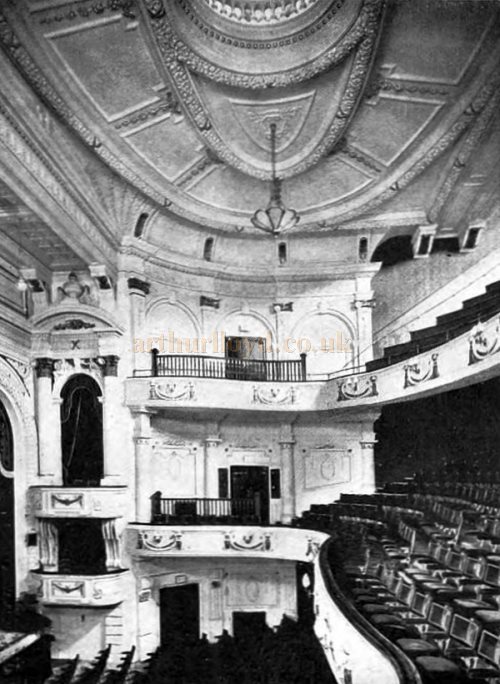
Left - The Auditorium of the Penge Empire Theatre when it first opened in 1915 - From an Advertisement for John Tanner & Son, who supplied the Plasterwork for the Theatre, in The Architectural Review of 1916.
Situated, as it is, at a prominent corner of the Beckenham Road, well-served by an electric tram system, and within a few minutes' walk of Penge Station (L. C. and S.E.R.), its only present rival, as far as one can see, is the Crystal Palace on Sydenham Hill; and it is easy to predict that the dwellers in the rapidly-developing, residential districts of Penge, Anerley, Norwood, Sydenham, and so on, while re-serving the Crystal Palace for special occasions, be drawn in goodly numbers to so cosy and attractive a meeting place o' nights - the more so as Mr. Clarence Sounes, who is the chairman and managing director of the proprietors, The Penge Empire Theatre, Limited, is determined to make it a family resort in the real and most comprehensive sense of the term.
 He
gave voice to that worthy ambition in the course of a happy and humorous
speech before a large audience of personal friends and invited local
residents on Saturday afternoon, and also said how proud and happy he
was to be in at the birth of so handsome a theatre upon the eve of the
thirty-fifth anniversary of his entry into "the" profession.
His old friend "Jimmy" Glover (who was present with his Band),
had been at the Lane only twenty-one years,
but he, the speaker, had made his appearance at the National play-house
as far back as thirty-five years ago. He concluded by heartily thanking
all the artists who had attended that after-noon - they were all personal
friends of his - and also the architect.
Mr, James M. Glover, who responded on behalf of the artists, was also
in a pleasantly humorous mood.
He
gave voice to that worthy ambition in the course of a happy and humorous
speech before a large audience of personal friends and invited local
residents on Saturday afternoon, and also said how proud and happy he
was to be in at the birth of so handsome a theatre upon the eve of the
thirty-fifth anniversary of his entry into "the" profession.
His old friend "Jimmy" Glover (who was present with his Band),
had been at the Lane only twenty-one years,
but he, the speaker, had made his appearance at the National play-house
as far back as thirty-five years ago. He concluded by heartily thanking
all the artists who had attended that after-noon - they were all personal
friends of his - and also the architect.
Mr, James M. Glover, who responded on behalf of the artists, was also
in a pleasantly humorous mood.
Right - A programme for '1,001 Marvels ' at the Penge Empire, May 27th 1935 - Courtesy Roy Cross - Click to see more of this programme.
The Penge Empire, which has been erected at a cost of something like £16,000, and at which two performances are to be given nightly, has an elaborate and up-to-date electrical installation which ensures excellent lighting effects both on the stage and in the auditorium. The heating and ventilation schemes, the last-named including a sliding roof, are also well up to modern efficiency, while the seating capacity may be described as that of the average suburban house. It is built upon the cantilever system, and the interior colour-scheme combines cinnamon-brown upholstery, white and gold mural decorations, and powder-blue carpeting. Mr. J. Collins is the joint manager.
 Saturday
afternoon's inaugural concert was a most enjoyable affair, and the large
audience fully appreciated the many good things set before them. Principle
items came from Mr. J. M. Glover and his Drury
Lane Band, in several instrumental selections; Courtice Pounds with
most artistic renderings of "On the Road to Mandalay" and
"Songs of Araby"; Nelson Jackon with his smart stories and
"Potted Shakespeare" at the piano; and The Royal Four, who
specially distinguished themselves as harmonising comedians. The last
named clever gentlemen, apart from their excellent singing, won much
favour by their effective appearance as old-time "mashers"
in evening dress, as distinct from the latter-day and now almost happily
extinct "nut"; and one of their company, the basso, has a
keen sense of humour, which was greatly relished. Other artists were
Madeline Yvonne, soprano; Emile Hayes, vocalist; Mlle. Mahella, Italian
prima donna; Charles Pond, in "Coming Out"; Marie Stuart,
vocalist; Donald Ferguson, baritone; Rhona Colley, contralto; and Josephine
La Barte, with songs at the piano.
Saturday
afternoon's inaugural concert was a most enjoyable affair, and the large
audience fully appreciated the many good things set before them. Principle
items came from Mr. J. M. Glover and his Drury
Lane Band, in several instrumental selections; Courtice Pounds with
most artistic renderings of "On the Road to Mandalay" and
"Songs of Araby"; Nelson Jackon with his smart stories and
"Potted Shakespeare" at the piano; and The Royal Four, who
specially distinguished themselves as harmonising comedians. The last
named clever gentlemen, apart from their excellent singing, won much
favour by their effective appearance as old-time "mashers"
in evening dress, as distinct from the latter-day and now almost happily
extinct "nut"; and one of their company, the basso, has a
keen sense of humour, which was greatly relished. Other artists were
Madeline Yvonne, soprano; Emile Hayes, vocalist; Mlle. Mahella, Italian
prima donna; Charles Pond, in "Coming Out"; Marie Stuart,
vocalist; Donald Ferguson, baritone; Rhona Colley, contralto; and Josephine
La Barte, with songs at the piano.
Left - A programme for 'This Year of Carnival' at the Penge Empire, November 4th 1935 - Courtesy Roy Cross - Click to see more of this programme.
This week's bill includes The Riogoku Family, The Bell Hattons, The Kenna Brothers, The Royal. Four, The Mitchell Brothers, Ada Oxley, The Stella Girls, Celia Celeste, George D'Albert, and The Empire Pictorial Chronicle. Marie Lloyd heads the bill on Monday.
The whole of the scenery has been supplied by Mr. Francis H. Bull.'
The above text in quotes was first published in The Stage, 8th April 1915.

Above - A Sketch of the new Penge Empire - From the Norwood News, 2nd April 1915.
 The Penge Empire opened on the Monday the 5th
of April 1915, with a twice
nightly variety show headed by the much loved music hall artist Marie Lloyd at the
top of the Bill, and the Theatre would go on in this vein for many years.
The Penge Empire opened on the Monday the 5th
of April 1915, with a twice
nightly variety show headed by the much loved music hall artist Marie Lloyd at the
top of the Bill, and the Theatre would go on in this vein for many years.
The Empire was taken over by Gaumont Theatres in May 1928 but continued in live theatre use, although at some point a projection box was built into the stage for the showings of films by rear projection.
Right - A Programme for the Globe Players production of 'An Inspector Calls' at the Penge Empire in June 1948 - Courtesy Phillip Paine. In the cast were Anthony Pelly, Leslie Yeo, Beryl Andrews, Cicely Hullett, Paddy McQueen, David Crosse, and Geoffrey Lumsden.
 In
December 1946 Moss Empires took over the
lease of the Theatre and repaired some damage which had been caused
in the blitz.
In
December 1946 Moss Empires took over the
lease of the Theatre and repaired some damage which had been caused
in the blitz.
The Theatre reopened at Christmas with the pantomime 'Cinderella' written and produced by Charles Henry with dances arranged by Joan Sherman Fisher. Audrey Hewitt (shown left) played the leading role and Archie Glen played Buttons with Elsie Winsor as Prince Charming, Jane Blair as Dandini, and George Pughe as the Squire, Pughe also managed the Company.
Left - Audrey Hewitt playing 'Cinderella' at the newly reopened Penge Empire in 1946 - Courtesy Michael Worsley who says:- 'After a career with Moss Empires, George Black, Tom Arnold and Francis Laidler in pantomime and revue, Audrey later married the world famous ventriloquist Arthur Worsley, my mother and father.'
The opening production of Cinderella was followed in January by the Penge Repertory Company, 'The Globe Players', in Noel Coward's 'This Happy Breed'. The Globe Players were a successful Company at the Empire and would go on to put on many plays after this one. The following year, 1947, the Theatre was bought by Reginald Salberg and although live theatre use still continued, the writing was on the wall for the Empire and its live theatre days were soon to end.
 The Theatre was taken over by Essoldo Cinemas in 1949 and it
reopened as the Essoldo Penge on the 31st of October the same year with the film 'Command Decision',
still using the rear projection box on the stage. The advertisement for this is shown right and states that the Grand Xmas Panto would be 'Babes in the Wood' so stage use was still viable despite the change of name.
The Theatre was taken over by Essoldo Cinemas in 1949 and it
reopened as the Essoldo Penge on the 31st of October the same year with the film 'Command Decision',
still using the rear projection box on the stage. The advertisement for this is shown right and states that the Grand Xmas Panto would be 'Babes in the Wood' so stage use was still viable despite the change of name.
Right - An Advertisement for the renaming of the Penge Empire to the Essoldo - from the Norwood News, Friday 28th of October 1949.
The resident manager of the Theatre at the time of the sale, A. R. Healey, who had been at the Theatre for the previous two years, left at this time, along with his assistant manager, Ivy Cross, who had been working at the Theatre for the previous 10 years.
The Court Players later staged a repertory season on the Theatre's stage the following March, but it wasn't long before live productions were abandoned and the Theatre went over to full time Cinema use.
 Later the Essoldo would
become the first suburban Cinema to be fitted for Cinemascope.
Later the Essoldo would
become the first suburban Cinema to be fitted for Cinemascope.
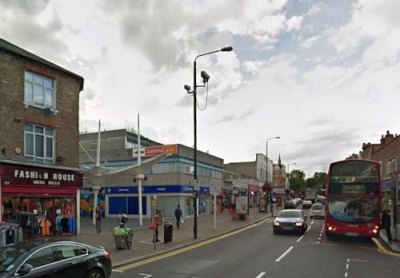
Left - A Google StreetView Image showing the site of the former Penge Empire in June 2012 - Click to Interact.
A new projection box was fitted into the rear stalls for this event, partly installed by 20th Century Fox, and the Cinema showed its first Cinemascope film, 'The Flight of the White Heron' on the 7th of June 1954, accompanied by a soundtrack in four track magnetic stereophonic sound.
The Essoldo continued showing films for the next six years but its days were numbered and the last films shown at the Cinema were 'Jazzboat' with Anthony Newley and '12 to the Moon' with Ken Clarke on the 9th of April 1960. The Theatre was then demolished and its site was used for a retail development.

Above - A Page from the Norwood News featuring an article about the Penge Empire and its reincarnation as the Essoldo - From the Norwood News, 11th of September 1959.
Some of the information for the latter years of this Theatre were gleaned from the excellent Cinema Treasures website.
If you have any more information or images for this Theatre that you are willing to share please Contact me.