
Theatres in Brixton, London
The Astoria Theatre / Brixton Academy / O2 Academy - The Empress Theatre / Granada Cinema - The Brixton Theatre - The Electric Brixton / Palladium Picture Playhouse / Regal / ABC / ACE Cinema / Fridge - The Electric Pavilion / Ritzy Cinema
The O2 Academy, 211 Stockwell Road, Brixton, London SW9
Formerly - The Brixton Astoria Theatre / Brixton Acadamy
The Astoria Theatre - Opening - Later History - The Don Dansie Collection - Atmospheric Design

Above - A Google StreetView Image showing the Brixton Academy in July 2021, formerly the Astoria Theatre - Click to Interact.

 The O2 Academy in Brixton which people will be familiar with today as a Music Venue was built in 1929
and originally opened as the Brixton Astoria Theatre. The Theatre was designed by T. R. Somerford and Edward Albert Stone as a Super
Cinema with full stage facilities, and had an
exterior designed in the Italian Renaissance Style, whilst its auditorium was decorated
by Marc Henri in the 'Atmospheric' Style.
The O2 Academy in Brixton which people will be familiar with today as a Music Venue was built in 1929
and originally opened as the Brixton Astoria Theatre. The Theatre was designed by T. R. Somerford and Edward Albert Stone as a Super
Cinema with full stage facilities, and had an
exterior designed in the Italian Renaissance Style, whilst its auditorium was decorated
by Marc Henri in the 'Atmospheric' Style.
The Theatre opened on the 19th of August 1929 with the film 'The Singing Fool' starring Al Jolson, and a live show on its Stage called 'Hullo Every Body'.
Right - The Main Entrance to the Brixton Astoria when it first opened with Al Jolson in the film 'The Singing Fool' in August 1929 - From The Builder, 23rd of August 1929.
Shortly before the Theatre opened the Stage Newspaper carried a notice saying: 'A stage said to be larger than that of Drury Lane and an auditorium capable of seating 4,000 are two of the features of the new Astoria, Brixton, which opens on August 19. The stage will be used for ballets and other specialties. On the opening night vaudeville acts, which form part of the programme, will be relayed to 2. L.O.' - The Stage Newspaper.
 The Theatre was the first of four Astoria Theatres to be built in
London for the independent film exhibitor, Arthur Segal. Following the
building of the Astoria, Brixton Segal went on to build the Astoria,
Old Kent Road, which has since been demolished; the Astoria in Streatham which is now an Odeon Cinema; and the Finsbury
Park Astoria, which has since been converted into a church. Stone
also built the former Astoria
Theatre in Charing Cross Road and the Astoria,
Brighton.
The Theatre was the first of four Astoria Theatres to be built in
London for the independent film exhibitor, Arthur Segal. Following the
building of the Astoria, Brixton Segal went on to build the Astoria,
Old Kent Road, which has since been demolished; the Astoria in Streatham which is now an Odeon Cinema; and the Finsbury
Park Astoria, which has since been converted into a church. Stone
also built the former Astoria
Theatre in Charing Cross Road and the Astoria,
Brighton.
 Left - One of the two Compton Organ Consoles at the Astoria Theatre, Brixton when it first opened in 1929 - From The Bioscope, 14th of August 1929.
On its opening on the 19th of August 1929, with the film' The Singing Fool' with Al Jolson, the Brixton Astoria was stated as being able to accommodate some 4,750 people in it's fantastic 'Atmospheric' auditorium.
Right - Edward Albert Stone, Architect of the Astoria Theatre, Brixton - From the Kinematograph Weekly, 15th of August 1929.
The Theatre had a fully equipped stage some 40 foot deep, a Compton 3 Manual / 12 Rank organ which was inaugurated by George Pattman, an unusually placed projection box, which was hung underneath the Circle, and a restaurant for use by the Theatre's patrons.


Above - Photographs of the Auditoium of the Brixton Astoria when it first opened - From The Builder, 23rd of August 1929. More photographs of the Brixton Astoria can be seen in the Don Dansie Collection below.
 The Builder reported on the new Astoria, Brixton in their 23rd of August 1929 edition, along with some of the images shown here, saying:- 'This new cinema has been built on a site bounded by the Stockwell-road and Stockwell Park-walk, just off the Brixton-road. The main elevation is to the Stockwell-road, although the cinema proper occupies but the corner of that frontage, the remainder being taken up by shops.
Terra-cotta faience has been used for the construction of the entrance, the remainder of the building being in brick with some reinforced concrete. The cinema is the first in Great Britain to be designed in the so-called "atmospheric style. The interior, by means of scenery actually built into the structure, is intended to represent an Italian garden and landscape. This design, in which sculpture, columns, and hanging shrubbery are incorporated, lines both sides of the auditorium, and an attempt to gain unity is made by linking the two sides together with a colonnaded balcony running across the top of the proscenium arch.
Right - The General Contractors for the Brixton Astoria, - From The Builder, 23rd of August 1929 - Click to Enlarge.
The seating is in a dull green to represent grass and the flooring in a crazy pavement design. Seating is divided between the stalls, with 2,750, and the balcony, with 1,250. In addition, there is standing room for a further 1,750.
 All seats are gained from the Stockwell-road entrance, steps to either side of the hall leading to balcony level. Exits are variously disposed around the building.
Left - The Astoria Theatre, Brixton under construction in early 1929 - From the Kinematograph Weekly, 17th of January 1929.
The cinema is wired for "talkies," but there is a full-sized stage, complete with the latest system of counterweighting for light and scenery battens. Dressing-rooms, band-rooms, etc., are amply provided, as it is intended to give presentations on the stage. 
Right - An Advertisement for the Opening of the Astoria Theatre, Brixton in 1929 - From the Norwood Press and Dulwich Advertiser, 9th of August 1929.
The theatre is self-contained, as carpenters' shop, scene painting rooms, etc., are provided on the premises. A restaurant lounge is placed on the balcony level. A turbine vacuum-cleaning plant, is installed, with 25 cleaning points distributed at vantage points throughout the building. The "Carrier" system of ventilating plant is in operation.'
The above text in quotes was first published in the Builder, 23rd of August 1929.

Above - E. A. Stone's Plan of the Brixton Astoria - From The Builder, 23rd of August 1929.
The Opening of the Brixton Astoria

Above - People Queuing up for the Opening of the Astoria Theatre, Brixton in 1929 - From The Bioscope, 21th of August 1929.
 The Stage Newspaper reported on the
imminent opening of the Astoria in their 15th of August 1929 edition saying:
'Opening to the public next week with a film programme, including "The
Singing Fool," and variety, the management
of the new Astoria announce the kinema as London's landscape theatre.
The Stage Newspaper reported on the
imminent opening of the Astoria in their 15th of August 1929 edition saying:
'Opening to the public next week with a film programme, including "The
Singing Fool," and variety, the management
of the new Astoria announce the kinema as London's landscape theatre.
Right - The Atmospheric Auditorium of the Astoria Theatre, Brixton in 1929 - From the Picturegoer, 1st of October 1929.
The Plaza and the Regal came to us as atmospheric theatres. The terms practically mean the same, the auditoriums being decorated with landscapes in perspective. The new house, however, has gone further in the attempt to convey the impression that the auditorium is in the open. The house has a seating capacity of 4,750 and it situated in the Stockwell Road (corner of Brixton Road). The dome represents the sky, the illumination being on the concealed plan.
The flooring of the entrance hall is of marble, specially brought from the Continent. Five pairs of doors give admittance to the interior vestibule, from which the staircases, each over 10 ft. wide, give access to an upper vestibule, foyer, and balcony, with cafe and tea lounge.

Above - The Cafe and Tea Lounge of the Astoria Theatre, Brixton - From an Advertisement for Lloyd Loom Furniture in The Bioscope, 14th of May 1930.
 The stalls floor is reached through a hall in the centre of which is
a beautifully designed luminous fountain, water pouring from four masks
over a glass trough, below which are many coloured lights. Here there
is a soda fountain and kiosks for the sale of chocolate and cigarettes.
The stalls floor is reached through a hall in the centre of which is
a beautifully designed luminous fountain, water pouring from four masks
over a glass trough, below which are many coloured lights. Here there
is a soda fountain and kiosks for the sale of chocolate and cigarettes.
Right - An Early Sketch of the Astoria Theatre, Brixton by its Architect Edward Albert Stone - From the Kinematograph Weekly, 7th of April 1927.
The general decorative scheme of the auditorium is like other 'atmospheric' houses, designed to give the impression of an Italian garden. The ceiling is 120 ft. by 146 ft., with lighting apparatus which gives morning, noon, and night effect.

 Cyprus trees flank each
side of the proscenium, and the side walls give the appearance of a
terraced garden seen through graceful colonnade. On either side are
towers, one of which contains the organ. Statues are in the alcoves,
which are a feature of the wall decoration (Shown Left).
Cyprus trees flank each
side of the proscenium, and the side walls give the appearance of a
terraced garden seen through graceful colonnade. On either side are
towers, one of which contains the organ. Statues are in the alcoves,
which are a feature of the wall decoration (Shown Left).
Left - A statuette with a label marked 'E. A. Stone for Brixton Astoria' - Kindly sent in by its present owner James Benger - And a photograph of another of the Astoria's Auditorium Statues From the Kinematograph Weekly, 15th of August 1929.
The top of the proscenium is a mediaeval Italian bridge with gates leading to a balcony. From this balcony artistes and chorus will sing. Special attention has been paid to the needs of stage production, and everything possible has been hastened for the presentation of big spectacular shows.

Above - A Drawing of the Astoria Theatre, Brixton Foyer by its Architect Edward Albert Stone - From the Kinematograph Weekly, 15th of August 1929.
 The stage is 100 ft wide, 37 ft. deep. There are fourteen dressing
rooms, two chorus rooms, band rooms, carpenters' shops, wardrobe room,
and music libraries. The fireproof curtain is claimed to be the biggest
in the country, and can be raised in thirty seconds and lowered in twenty.
The stage is 100 ft wide, 37 ft. deep. There are fourteen dressing
rooms, two chorus rooms, band rooms, carpenters' shops, wardrobe room,
and music libraries. The fireproof curtain is claimed to be the biggest
in the country, and can be raised in thirty seconds and lowered in twenty.
Right - Manager Charles Penley working on a model of his big setting for 'Ups and Downs' at the Astoria Brixton in 1929 - From The Bioscope, 4th of December 1929.
The curtain is of gold fireproof silk, with appliqué work and facings of pink and brown. Seven hundred yards of material were used in its construction. An orchestra of twenty-five musicians, with Charles Coles as leader, will be under the direction of Fred Kitchen, and G. T. Pattman will be the solo organist. The general manager is Charles Penley, with G. Still as assistant.' The Stage Newspaper, 15th August 1929.

Above - An Advertisement for the Opening of the Astoria Theatre, Brixton in 1929 - From the Daily Mirror, 15th of August 1929.

Above - Charles Penly and the Staff of the Brixton Astoria, including the Astoria Rodeny-Hudson Girls photographed in the stage setting which proved so successful on the Opening night - From the Kinematograph Weekly, 29th of August 1929.

Above - An Article on the Opening of the Astoria Theatre, Brixton - From the Kinematograph Weekly, 15th of August 1929.

Above - A Full Page Article on the Opening of the Astoria Theatre, Brixton - From the Norwood News, 16th of August 1929.
Later History

Above - The Astoria, Brixton, whilst under the ownership of Odeon Cinemas in the 1950s - Courtesy Philip Dansie, whose father, Don Dansie, worked at the Theatre for over 50 years as Chief Engineer.
A short piece in the Stage Newspaper of January 23rd 1930 shows just how well the Astoria was doing in its first year of operation:- 'Harry Myers was leaning against that famous wall, against which so many agents have leaned, and interrupted his conversation with Eddie Bayes to greet me and tell me how many thousands of people have paid for admission to the Astoria, Brixton, since this palatial kinema-variety theatre opened. It was an astonishing figure, and Mr. Myers delivered it with an air of complete satisfaction which one could not do other than reflect. Even Mr. Bayes exchanged his usual friendly grin for a slightly wider one, which is presumably the estimable Mr. Bayes way of showing his complete satisfaction. Indeed, we all congratulated one another on Mr. Myers's figures in the spirit of geniality which pervaded the evening.' The Stage Newspaper, January 23rd 1930.

Above - An advertisement in The Stage of May the 8th 1930 for Fred Kitchen's 'What Have I Done', "The marvelous Valse Song Success. A smashing success at the Brixton Astoria, wonderfully played and sung by Fred Kitchen and his Boys."
 The
Astoria Theatre ran as a cine variety Theatre for many years but eventually
began showing a lot more films than stage shows. A return to variety however did occur in October 1957, after the nearby Empress
Theatre closed and was converted into a Cinema.
The
Astoria Theatre ran as a cine variety Theatre for many years but eventually
began showing a lot more films than stage shows. A return to variety however did occur in October 1957, after the nearby Empress
Theatre closed and was converted into a Cinema.
Right - A cutting from The Stage on Shirley Bassey's performance at the Brixton Astoria in October 1957. Also on the Bill for this variety show were Jimmy Wheeler, Tony Fayne and David Evans, Howard Jones and Reggie Arnold, Walthon and Dorraine, Richman and Jackson, Jean and Peter Barbour, and McAndrews and Mills. It was a once nightly show at 8pm Monday, Tuesday, and Friday, and twice nightly Wednesday, Thursday, and Saturday at 6.40 and 8.55.
The Astoria was taken over by Paramount in December 1930, who would later go on to sell the building along with their other Cinemas, to Odeon in November 1939. Later still the name was changed to the Odeon Astoria. And eventually, whilst under the ownership of the Rank Organisation, the Astoria was finally closed as a Cinema on the 29th of July 1972 with the films 'Red Sun' and 'The Looking Glass War.'
The Astoria was later converted into a nightclub called the Sundown Discotheque. This only lasted for 4 months however and then it was proposed that the building be demolished. Thankfully this never happened and the Theatre was used instead as a Warehouse by the Rank Organisation for several years.
In 1974 the Theatre was Listed Grade II.
In 1982 the Theatre was re-launched as a Concert Venue called 'Fair Deal' and opened on the 12th of March with UB40, but this was unsuccessful and the operators went bankrupt. Fair Deal closed the following month.
The following year the Theatre was reopened as a Concert Venue again, this time called The Academy, on the 7th of October 1983 with the Japanese Group 'Eek - a - mouse.'

Above - The Auditorium and Stage of the Brixton Academy during an event held in 2009 - Photo M.L.
 In this guise the Brixton Academy has been
very successful but over the years the Theatre suffered some damage
to its spectacular auditorium, especially the plasterwork by Marc Henri.
In this guise the Brixton Academy has been
very successful but over the years the Theatre suffered some damage
to its spectacular auditorium, especially the plasterwork by Marc Henri.
Right - The Brixton Academy at night in July 2009, formerly the Brixton Astoria Theatre - Photo M.L.
In March 1990 the Theatre's Listed status was upgraded to Grade II*
In 2006, under a sponsorship deal with the Mobile Telephone Company O2, the building was substantially renovated in an attempt to restore the building to its former glory. The auditorium Stalls are now empty of their original seating and so the building has a huge capacity as a result, some 4,921 people can squeeze into the former Astoria Theatre on any given night.
You may like to visit the O2 Academy's own Website here.
If you have any more information or images for this Theatre that you are willing to share please Contact me.
Photographs of the Brixton Astoria Theatre
From the Don Dansie Collection
Don Dansie worked at the Brixton Astoria Theatre for over 50 years. He started at the Theatre as junior engineer before the war but returned afterwards as Chief Engineer. His son, Philip Dansie, who has sent in the photographs shown below, often accompanied his father at the Theatre, and began helping him out from the early age of 13. He often lent a hand during the changeovers between films, working the hand pulled screen tabs, and sometimes operating the Berkeley lighting Switchboard which was situated on a gallery above the stage and can be seen in the photographs.
 The Astoria, Brixton, whilst under the ownership of Odeon Cinemas in the 1950s - Courtesy Philip Dansie.
 The Foyer and Vestibule of the Astoria Brixton in the 1950s - Courtesy Philip Dansie.
 The Foyer and Vestibule of the Astoria Brixton during the run of 'The Greatest Show On Earth in 1952 'As the official publicity for the film had failed to arrive my father did this.'
 The Auditorium and stage of the Astoria Brixton in 1929 - Courtesy Philip Dansie.
 The Auditorium of the Astoria Brixton in 1929 - Courtesy Philip Dansie.
 The Auditorium of the Astoria Brixton in 1929 - Courtesy Philip Dansie.
 The Auditorium of the Astoria Brixton in 1929 - Courtesy Philip Dansie.
 The Projection Room at the Brixton Astoria in the late 1940s - Courtesy Philip Dansie..
 Derek Toogood in the Brixton Astoria's Generator Room which Generated DC power for the Projection Room, late 1940s - Courtesy Philip Dansie.
 Don Dansie in the Plenum Plant for Air Conditioning at the Brixton Astoria in the late 1940s - Courtesy Philip Dansie.
 The Boiler Room at the Brixton Astoria in the late 1940s - Courtesy Philip Dansie.
 The Boiler Room Oil Tank at the Brixton Astoria in the late 1940s - Courtesy Philip Dansie.
 The Boiler Room and Derek Toogood, Assistant Engineer, at the Brixton Astoria in the late 1940s - Courtesy Philip Dansie.
 The Brixton Astoria's Berkeley Switchboard, for stage and house lighting in the late 1940s - Courtesy Philip Dansie.
 The Brixton Astoria's Berkeley Switchboard, for stage and house lighting, and Don Dansie operating it, in the late 1940s - Courtesy Philip Dansie.


Above - Photographs of the Brixton Astoria Theatre - From the Don Dansie Collection. Don was Chief Engineer at the Brixton Astoria for over 50 years. Many thanks to Philip Dansie for sending in these wonderful and evocative images from his father's collection of photographs of the Brixton Astoria Theatre in its early years, and for allowing them to be displayed on this site.
Atmospheric Decoration by J. F. Mead
From a supplement to Kinematograph Weekly, April 26th 1928


Above - A Double page spread on Atmospheric Decoration by J. F. Mead - From a supplement to Kinematograph Weekly, April 26th 1928.
The Empress Theatre, Bernay's Grove, Brighton Terrace, Brixton
Also known as - The Empress Theatre of Varieties / Empress Music Hall / Granada Cinema
Reconstruction of the Empress Theatre in 1931

Above - A sketch of the Empress Theatre, Brixton - From the ERA, 17th of December 1898 - To see more of these Sketches click here.
 The
Empress Theatre, Brixton was designed by Wylson
and Long and built for W. H. Burney and W. J. Grimes by the contractors
T. L. Green, of Eagle-street, Red Lion-square. The Theatre opened on
Boxing day 1898 with a variety show. The Empress had a seating capacity of 1,260 on three levels, stalls
and pit, Dress Circle and Gallery, and a large stage 60 foot wide by
40 deep.
The
Empress Theatre, Brixton was designed by Wylson
and Long and built for W. H. Burney and W. J. Grimes by the contractors
T. L. Green, of Eagle-street, Red Lion-square. The Theatre opened on
Boxing day 1898 with a variety show. The Empress had a seating capacity of 1,260 on three levels, stalls
and pit, Dress Circle and Gallery, and a large stage 60 foot wide by
40 deep.
Right - An early variety programme for the Empress Theatre, Brixton - On the Bill were Johnny Cecil, Doreen Girls, The Musical Godfreys, Sadie Simpson, Hal Chapter, The Gascoignes, Ina Lorrimer, Haines & Borthwick, The Donnas Trio, Andy McLeod, May Mars, Mona Garrick, Archie Royer, Johnson & Hart, Carter's Ten Dixie Girls, and the Empress Pictures. - The Programme is part of a collection of material from Ethel Bourne and Mona Garrick who were solo performers but also performed as part of their family act 'The Five Sisters', see card below.
Arthur Lloyd is also known to have performed at the Empress Theatre, Brixton in 1900, 1901, 1902.
A few weeks before the Empress Theatre opened, the ERA set off to Brixton to take a look at the building, their article in their 17th of December 1898 edition is a fascinating read as it shows just how much still had to be completed on the building, and what a chaotic state it was in so close to its opening. Theatres were being built all over the Country during this period and they were going up at a fantastic rate, the following article shows what it was like to be there at the time, and how hard the craftsmen must have worked to get the buildings open on time:-
"Midst pleasures and palaces," particularly the latter in the finishing stages, "there is no place like home," so soliloquised a human wreck, seated upon an upturned bucket in the remotest recesses of the new Empress which has arisen at Brixton, as he resigned himself to the worst, and proceeded to disentangle fresh wet plaster from his personal belongings, and mentally calculated how many quarts of benzine would be required to remove the paint from his coat, which was now, like Joseph's, a veritable coat of many colours.
 "Although disclaiming any intention of eclipsing the Alhambra,
or wiping out the Empire, the
proprietors of the new Empress Theatre of Varieties, Messrs Grimes and
Burney, have fully made up their minds to provide the playgoer of suburban
Brixton with an establishment which shall be at once as comfortable
and as attractive as these palaces of pleasure, and this with the aid
of their architects, Messrs Wylson
and Long, they are in a fair way of accomplishing. During the summer
the building has made good progress, and it is now emerging from the
chrysalis stage into a thing of beauty and a joy for ever."
"Although disclaiming any intention of eclipsing the Alhambra,
or wiping out the Empire, the
proprietors of the new Empress Theatre of Varieties, Messrs Grimes and
Burney, have fully made up their minds to provide the playgoer of suburban
Brixton with an establishment which shall be at once as comfortable
and as attractive as these palaces of pleasure, and this with the aid
of their architects, Messrs Wylson
and Long, they are in a fair way of accomplishing. During the summer
the building has made good progress, and it is now emerging from the
chrysalis stage into a thing of beauty and a joy for ever."
Above Left - The Five Sisters - From an early Postcard and part of a collection of material from Ethel Bourne, a contralto vocalist, and Mona Garrick, a character actress, who often appeared individually or as part of their family act 'The Five Sisters'
The foregoing paragraph was the innocent cause of our opening soliloquy, for on the strength of it we had been deputed to spy out this land of promise, and accordingly made our raid one morning this week. There was no difficulty in finding the place, as everybody in the neighbourhood knew all about it, and approaching from Brixton-hill we obtained a first view of a really very striking front, the whole dominated by a handsome and lofty turret, the entire composition forming a valuable addition to the architectural beauties of Brixton.
 The
main entrance is situated at the corner immediately under the turret.
Passing through a vestibule we reached a spacious hall, in which is
placed the box-office, and from which an entrance is obtained to the
stalls, boxes, and balcony. Here we met the general contractor Mr Green,
who received us with unruffled serenity.
The
main entrance is situated at the corner immediately under the turret.
Passing through a vestibule we reached a spacious hall, in which is
placed the box-office, and from which an entrance is obtained to the
stalls, boxes, and balcony. Here we met the general contractor Mr Green,
who received us with unruffled serenity.
Right - A Variety programme for the Empress Theatre, Brixton for the week commencing 29th September 1930.
Our instructions, however, were to find one of the architects, and as Mr Wylson was luckily, or unluckily, in the building, we set out under the charge of Mr Gillson, the foreman, in search of him. We sighted him on the stage in company with Mr Strode, of Messrs Strode and Co., who are doing the electric lighting, heating, &c., but he proved a perfect up-to-date phantom, who could give the Surrey trapdoor specialists a start, and then finish first. Once we saw him in the dome superintending Mr Boekbinder's superb decorations, but when after a frantic scramble along scaffolds and ladders we reached the spot, he was reported to have just gone to inspect Messrs Merry weather's fireproof curtain, which was being got into position. So after having raced three times round the building, amidst a perfect tornado of plaster, paint, and general debris, we reached the cellars, and sat down on the aforesaid bucket, refusing to move another step. However, Mr. Wylson's partner, Mr Charles Long, came to the rescue, and when we had explained he kindly offered to show us round, but we had scarcely entered upon the scene when we were seized upon by Mr Vaughan, the managing-director of Messrs Vaughan and Brown, who insisted upon our visiting the stage to inspect his gas arrangements, which seemed to be very complete. We understood his firm are also responsible for the canopies and hydrants. The noise of hammering shouting, &c., made it impossible to talk, so we adjourned outside to the front, and gazed upon its architectural beauties anew. Here the architect pointed out that the pit and gallery have also entrances from the main front, and the comfort of the pittite is fully insured by an ample glass canopy which will run round the entire front of the building.
Entering from the box-office hall (which is to be made a telling feature, with marble mosaic by Messrs Diespeker and Co., and Japanese leather decorations), one is surprised at the size of the interior, which provides seating accommodation for 1,500 people, and the liberal scale upon which everybody and everything is being provided for, and the ingenuity displayed by the designers in dealing with the accessories. The auditorium measures some 75ft. by 64ft. in the clear, and is surmounted by a lofty saucer-shaped dome, which should render the place cool in summer, and at the same time give the interior a wonderfully light and airy appearance. There are two excellent balconies, or tiers, of fireproof construction throughout, and two boxes on each side. The ground floor is to be divided into the usual stalls and fauteuils, and is designed to such a capital rake (as, indeed, is the whole house) as should make the occupant of the backmost seat consider himself on equal terms with the man in the front. When it is known that the whole of the seating and furnishing is in the hands of Messrs Shoolbred and Co. the comfort of the house may be taken for granted. At the back are the usual refreshment facilities, whilst the promenades are practically dispensed with, a matter which I take it will not cause much grief in Brixton. The approach from the balcony, after leaving the box-office and ascending a handsome staircase, is through a very neat little vestibule (off which will be found the den of the courteous manager. Mr E. V. Page, late of the Cambridge, who will have charge of the fortunes of this enterprising show), into what can only be described as one of the best dress-circles within the radius, that is to say, when it is finished. Its present stage is slightly chaotic. There is to be a nice lounge and bar in connection with this tier, and granted a good performance such as the proprietors promise, and a moderate entrance fee, this part of the house should be exceedingly popular.
 In
the upper tier or gallery, patrons of the house will be agreeably surprised
at the completeness of the arrangements, and the attention to detail
which has been bestowed to secure the comfort of this usually neglected
portion of the auditorium. It is needless, perhaps, to say that the
cloak room and lavatory accommodation is ample, and the sanitary specialist
will not find a peg to hang himself upon, to say nothing of his objections.
In case of fire, or panic, there is a separate emergency exit provided
for every portion of the house, exclusive of the entrance, whilst fire
hydrants and buckets will be strewn around in reckless profusion regardless
of cost.
In
the upper tier or gallery, patrons of the house will be agreeably surprised
at the completeness of the arrangements, and the attention to detail
which has been bestowed to secure the comfort of this usually neglected
portion of the auditorium. It is needless, perhaps, to say that the
cloak room and lavatory accommodation is ample, and the sanitary specialist
will not find a peg to hang himself upon, to say nothing of his objections.
In case of fire, or panic, there is a separate emergency exit provided
for every portion of the house, exclusive of the entrance, whilst fire
hydrants and buckets will be strewn around in reckless profusion regardless
of cost.
Left - A Seating Plan for the Empress Theatre, Brixton, from a Variety Programme for the week commencing 29th September 1930.
The stage is entirely cut off from the auditorium by an asbestos fireproof curtain, which will, moreover, be fitted with a water spray attachment, rendering the spread of fire practically impossible. The premises are lighted throughout by electricity, with a secondary system of gas lighting in case of failure, and an efficient heating plant is being put down. The internal decorations, in the French Renaissance style, are carefully designed, and will, when completed, be a credit to Mr Boekbinder, the decorator, and commend themselves to every connoisseur of architectural detail, and considerably enhance the fine effect of the interior. The tableaux curtains and tip-up chairs, and the general drapery, will be upholstered in silk plush of a beautiful crimson colour, and the whole decorations throughout will be lavishly enriched with old gold.
Behind the scenes is provided a first-rate stage, 60ft. wide by 40ft. deep, with a proscenium opening 30ft. wide, and of a proportionate height, the gridiron being so arranged as to allow the scene cloths to be taken up without folding or rolling. And last, but not least, there are the dressing-rooms, which are of fire-proof construction throughout, well lighted, and will be fitted with every possible convenience for the benefit of that worthy band upon whom the brunt of the evening's work falls. Talking of bands reminds me that not only has the much adjured trombone and his fellow creatures been provided with a snuggery, but even the ubiquitous and grimy gasman has his own little sanctum. In fact, go where you will everybody seems provided for, and every proposal you may meekly suggest has been promptly forestalled by the long-suffering architects, who, however, assure us that any suggestion addressed to them, or the proprietors, would receive careful attention. The Empress is to be opened on Boxing Day.'
The above text in quotes was first published in the ERA, 17th of December 1898.
 Just a week before the Theatre was officially
opened a viewing of the building was arranged for interested parties
and the ERA printed another review, this time
of the occasion and the building itself, in their 24th of December 1898 edition saying:- 'Messrs W. H. Burney, W. J. Grimes (the proprietors),
and E. V. Page (manager) were "at home " on Thursday evening
at the new Empress Theatre, Brixton, to a crowd of friends and well-wishers,
who had been invited to view that newest addition to London's amusement
palaces - the Empress, Brixton. Neither of the gentlemen mentioned seemed
to have had their spirits damped by the recent decision of the London
County Council to restrict their refreshments to watery decoctions;
for had they not turned their backs on the Spring-gardens fanatics and
sought the more gracious authority of the Lord Chamberlain with perfectly
satisfactory results?
Just a week before the Theatre was officially
opened a viewing of the building was arranged for interested parties
and the ERA printed another review, this time
of the occasion and the building itself, in their 24th of December 1898 edition saying:- 'Messrs W. H. Burney, W. J. Grimes (the proprietors),
and E. V. Page (manager) were "at home " on Thursday evening
at the new Empress Theatre, Brixton, to a crowd of friends and well-wishers,
who had been invited to view that newest addition to London's amusement
palaces - the Empress, Brixton. Neither of the gentlemen mentioned seemed
to have had their spirits damped by the recent decision of the London
County Council to restrict their refreshments to watery decoctions;
for had they not turned their backs on the Spring-gardens fanatics and
sought the more gracious authority of the Lord Chamberlain with perfectly
satisfactory results?
Right - A Twice Nightly Variety programme for the Empress Theatre, Brixton for the week commencing October 17th 1955.
The new place is a valuable addition to the architectural beauties of suburban Brixton; and though it does not face the main road, its handsome and lofty turret attracts the attention of all wayfarers to its striking facade. On entering the theatre from the box-office vestibule, paved in ceramic mosaic work, the visitor is at once impressed by the size of the interior, which provides seating accommodation for 1,500 people, and the ingenuity displayed by the designers, Messrs Wylson and Long, in dealing with accessories.
 The
light and airy appearance of the auditorium, which measures 75ft. by
64f t. in the clear is accentuated by the chaste embellishments, by
Mr J. Boekbinder, of the domed ceiling. This is divided into nine panels,
each ornamented by a heraldic device of griffins, in white fibrous plaster,
clawing a shield in a delicate shade of pink. An old-gold groundwork
throws up the design, which would be more effective still were the electroliers
handsomer and larger.
The
light and airy appearance of the auditorium, which measures 75ft. by
64f t. in the clear is accentuated by the chaste embellishments, by
Mr J. Boekbinder, of the domed ceiling. This is divided into nine panels,
each ornamented by a heraldic device of griffins, in white fibrous plaster,
clawing a shield in a delicate shade of pink. An old-gold groundwork
throws up the design, which would be more effective still were the electroliers
handsomer and larger.
Left - A Twice Nightly Variety programme for the Empress Theatre, Brixton for the week commencing October 17th 1955, including Bruce Forsyth, the 'Incredible Character.'
Again we see Mr Boekbinder's work over the proscenium, which bears on each top corner a reclining female figure - one being Euterpe, the other Terpsichore. Above the two boxes, placed on each side of the proscenium on the dress circle level, are paintings, for which Mr Boekbinder is also responsible, somewhat after the manner of the artists who flourished in the days of Madame Du Barry. The allegorical subjects, which are similar in conception, suggest cupids frolicking in rose gardens, and are beautifully painted. The artist, who has done so much for the internal decoration of our more important theatres and music halls, has every right to be proud of these pictures. The ends of the private boxes on each side are set off by two boldly modelled winged caryatides.
 The prevailing tints of the decorative work in the interior are cream
and gold, relieved by a delicate pink, whilst the spandrel of the proscenium
arch is liberally embellished in gold mosaic. The fronts of the tiers
are enriched with scroll work in white fibrous plaster; and the deep
crimson paper which will shortly line the walls will be in admirable
accordance with the general decorative scheme.
The prevailing tints of the decorative work in the interior are cream
and gold, relieved by a delicate pink, whilst the spandrel of the proscenium
arch is liberally embellished in gold mosaic. The fronts of the tiers
are enriched with scroll work in white fibrous plaster; and the deep
crimson paper which will shortly line the walls will be in admirable
accordance with the general decorative scheme.
Right - A Bill for the Brixton Empress advertising a 'Gala Night' and the 'Big New Attraction - Film Fun' featuring Freddie Frinton and supporting cast - Courtesy Maurice Poole.
There are two excellent tiers - a balcony and gallery - constructed on the cantilever principle, thus affording maximum amount of stage view by dispensing with supporting columns; and the ground floor seating throughout has a good rake, that enables every occupant to obtain a clear and uninterrupted view of the performance. Every device that can increase the comfort of the audience seems to have been thought of. The floors are softly carpeted in crimson, and the same colour dominates the rich silk plush-covered and luxuriously-upholstered fauteuils and pit stalls. The lovely plush curtain, too, is crimson, embroidered with a Renaissance design - in character with the decorations of the house - in old gold. For this curtain, the upholstery, the seating, and the furnishing Messrs James Shoolbred and Co. are responsible, the work being carried out under the able direction of Mr Ridout.
In the upper tier or gallery an agreeable surprise awaits one in the completeness of the details and the attention bestowed to secure the comfort of this usually neglected portion of the auditorium. Every regard has been paid to safety. The house is of fireproof construction, and in addition to eight separate entrances and exits there is an abundance of fire appliances on each floor, and the stage is entirely separated from the auditorium by an asbestos fireproof curtain, which is, moreover, fitted with a waterspray attachment, rendering the spread of fire practically impossible. All doors are made to open outwards, and are fitted with patent automatic panic bolts.
 Behind the scenes is provided a first-rate stage, 60ft. wide by 40ft.
deep, with a proscenium opening, 30ft. wide, and of a proportionate
height large enough to accommodate big spectacular productions, the
gridiron being so arranged as to allow the scene cloths to be raised
without folding or rolling, and all the most approved machinery and
accoutrements are provided for scenic effects of a most elaborate description.
The dressing-rooms (of fireproof construction) are well lighted, and
fitted with every convenience for the benefit of the artists.
Behind the scenes is provided a first-rate stage, 60ft. wide by 40ft.
deep, with a proscenium opening, 30ft. wide, and of a proportionate
height large enough to accommodate big spectacular productions, the
gridiron being so arranged as to allow the scene cloths to be raised
without folding or rolling, and all the most approved machinery and
accoutrements are provided for scenic effects of a most elaborate description.
The dressing-rooms (of fireproof construction) are well lighted, and
fitted with every convenience for the benefit of the artists.
Left - A Programme cover for a Variety show at the Empress Theatre, Brixton for January the 7th 1957 - Courtesy Philip Paine. On the Bill were Martin & Gaye, Pottre & Carole, Trio Hoganas, Jean & Jackie Dawson, and Max Miller, who was billed as "The Pure Gold of the Music Hall".
The building, which we hope is about to lift its head to the eternal summer of prosperity, has been erected by Mr T. L. Green, contractor, of Eagle-street, Red Lion-square. The plastic and other decorations have been executed by James M. Boekbinder, the electric lighting and heating by Strode and Co., the upholstery, seating, and furnishing by Jas. Shoolbred and Co., the canopies and gas lighting by Vaughan and Brown, under the experienced direction of Mr Vaughan, the fire-curtain and appliances by Merryweather and Co., the mosaic and marble work by Diespeker and Co., the stage appliances by Lyons and Co, the constructional ironwork by Dennett and Ingle, and the scenery by that clever artist in distemper Richard H. Douglass.
The hall opens on Monday, under the able management of Mr E. V. Page, who was for fifteen years the popular director of the Cambridge, under the late Will Riley's proprietorship. Mr Page has been most successful in his Boxing Day list, for he has secured Tom Leamore, G. W. Hunter, Kate Carney, Sisters Preston, Arthur Lennard, Clara Wieland, the Lennards, Harry Pleon, T. W. Barrett, the Brown and Kelly Combination, in My Wife's Baby, and Edison-Thomas's Life-size Pictures.
The above text in quotes was first published in the ERA, 24th of December 1898.
The Building News and Engineering Journal also reported briefly on the soon to be opened Empress Theatre in their 23rd of December 1898 edition saying:- 'The new Empress Theatre of Varieties, near Brixton Station, is approaching completion, and will be opened on Boxing Day. It is being built from plans by Messrs. Wylson and Long, of King William street, Strand, the contractor being Mr. Green, and Mr. Gillson foreman of works.
The electric lighting is by Messrs. Strode and Co., and the decorations, which are French Renaissance in style, by Mr. Bookbinder. The mosaic decoration is by Messrs. Diespecker and Co.
The theatre provides seating accommodation for 1,500 people. The auditorium measures some 75ft. by 64ft. in the clear, and is surmounted by a lofty saucer-shaped dome. There are two balconies, or tiers, of fireproof construction throughout, and two boxes on each side. The ground floor is to be divided into the usual stalls and fauteuils, and is designed with a steep rake from the front. The stage, 60ft. wide by 40ft. deep, is cut off from the auditorium by an asbestos curtain, provided by Messrs. Merryweather and Co.'
The above text in quotes was first published in the Building News and Engineering Journal, 23rd of December 1898.
In 1902 a Souvenir medal was given out at the Empress Theatre in Brixton to celebrate the coronation of Edward VII. One of these Souvenir medals can be seen below.
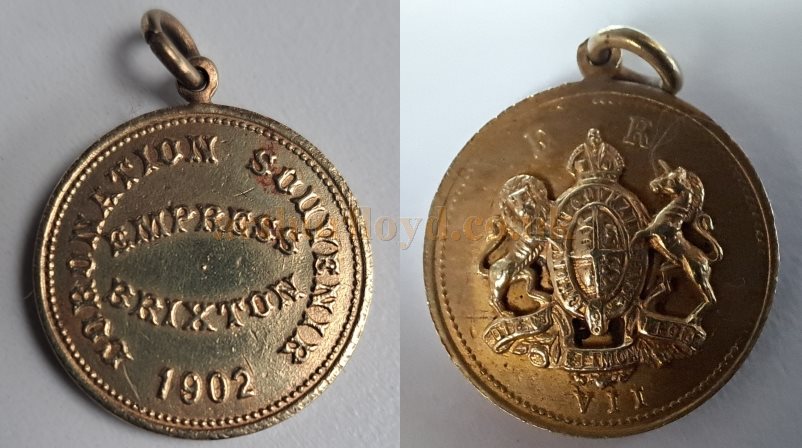
Above - A Souvenir medal given out at the Empress Theatre in Brixton to celebrate the coronation of Edward VII in 1902 - Courtesy Simon Moss, stagememories.
Reconstruction of the Empress Theatre in 1931

Above - The Empress Theatre being reconstructed in 1930 - From the Theatre's Opening Programme - Courtesy Ron Knee Archive.
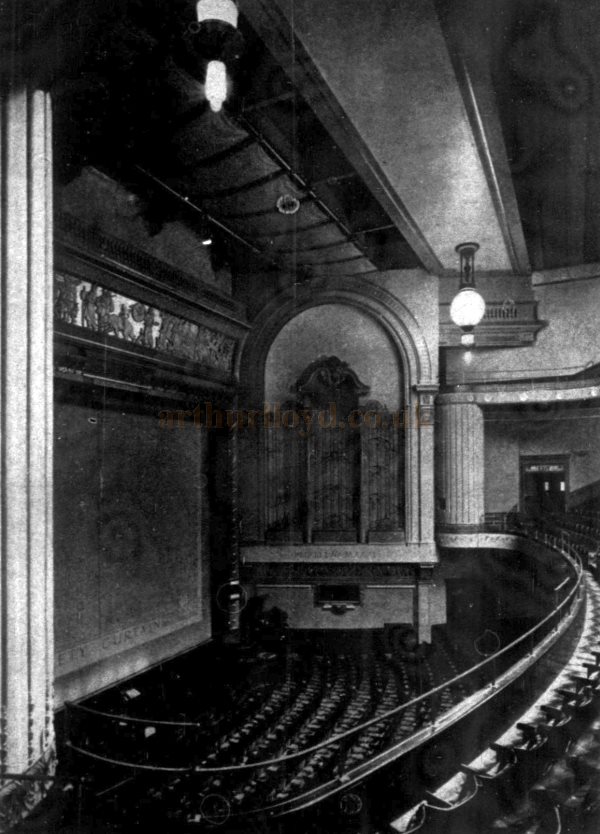 The Empress Theatre, Brixton had originally opened on Boxing
day 1898 with a variety show and had continued in this vein for the next 32 years before being
acquired by new owners, Variety Theatres Consolidated, in 1930, who also
acquired additional land adjoining the Theatre and set about reconstructing
the building to the designs of Andrew Mather.
The Empress Theatre, Brixton had originally opened on Boxing
day 1898 with a variety show and had continued in this vein for the next 32 years before being
acquired by new owners, Variety Theatres Consolidated, in 1930, who also
acquired additional land adjoining the Theatre and set about reconstructing
the building to the designs of Andrew Mather.
Right - The Auditorium of the reconstructed Brixton Empress Theatre - From the Builder, 30th of October 1931.
The auditorium was remodelled in the Art Deco style, now seating some 2,000 people, and the exterior was modernised at the same time.
The Builder reported on the changes in their 30th of October 1931 edition saying:- 'In the rebuilding of this theatre it was desired to incorporate as much of the old structure in the new building as was found or could be made possible. For this reason the back wall of the stage, two street frontages, together with certain exit staircases and dressing-room accommodation, were left standing.
The whole of the remainder of the building, floors, circles, stage and dressing-room accommodation was swept away and the house replanned to cover the extended site made available by the acquisition of adjoining properties.
In planning the theatre, the comfort of the patron has been the first consideration. Ample space is allowed for every seat, and an uninterrupted view of all parts of the stage is obtained. The house is primarily intended for the presentation of variety entertainment, and therefore every seat has been kept well within easy hearing distance of the stage.
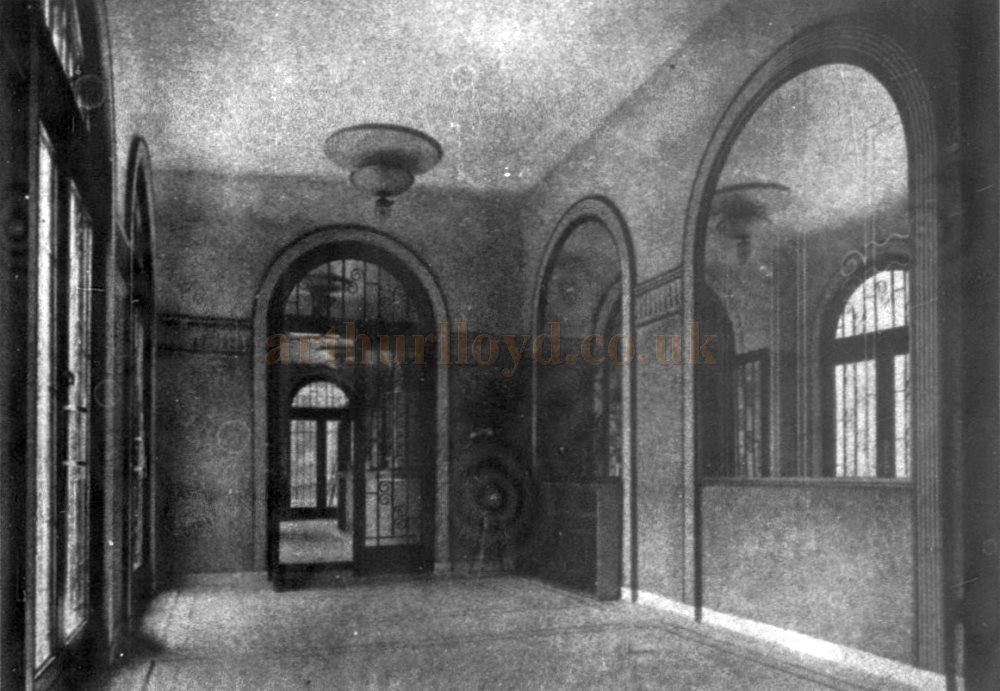
Above - The Entrance Hall of the reconstructed Brixton Empress Theatre - From the Builder, 30th of October 1931.
 Apart from the actual seating accommodation, with the necessary entrances and exits, ample additional space is provided in the form of entrance foyers and buffets. The entrance hall and stairs leading to front of circle and stalls are part of the old structure rearranged and decorated and with an entirely new staircase leading to foyer and back of first circle. Every part of house has its own foyer and refreshment counter easily approached and of ample size.
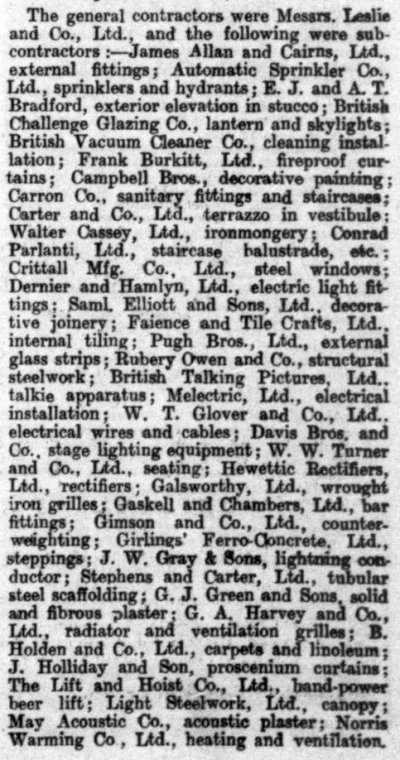
Right - The Contractors responsible for the reconstruction of the Brixton Empress Theatre - From the Builder, 30th of October 1931.
A novel feature in the interior treatment is the introduction of spotlight towers between the two circles. Full decorative advantage has been taken of these features, and they overcome the difficulty of incorporating the balcony fronts with the rest of the decorative scheme.
In the treatment of the entrance hall, staircase and various foyers, a contrast to the auditorium scheme has been arranged The stalls foyer has been finished in old oak and low relief modelled plaster in a style similar to the foyer of the old house. The seating is of the same pattern and comfort for all parts of the house. Mr. Andrew Mather. L.R.I. B.A., is the architect.'
The above text in quotes was first published in The Builder, 30th of October 1931.
After the reconstruction of the Empress was completed the Theatre reopened on the 19th of October 1931 with a variety show with acts including Lily Morris, Jenny Howard, and Hilda Monday, see opening programme below.


Above - The Opening Night Programme for the Brixton Empress Theatre on the 19th of October 1931 - Courtesy Ron Knee Archive.
It is thought that the sculptor Hermon Cawthra created the frieze which was situated above the proscenium of the newly reconstructed Empress Theatre, images of which were found recently amongst the papers of Hermon Cawthra in Leeds and are shown below. If you have any more information on the frieze please Contact me here.


Above - The Hermon Cawthra Frieze thought to have been installed at the newly reconstructed Empress Theatre Brixton in 1930 - Courtesy Gordon Lawson.

Above - The Brixton Empress Theatre when it first reopened in 1931 - From an Advertisement for Chloride Storage Batteries in The Bioscope, 16th December 1931.
 After the reopening of the Empress
Theatre on the 19th of October 1931 the Theatre then continued as a
Variety Theatre until the mid 1950s. However, the popularity of Cinema
and the demise, across the country, of Variety in the 50s, affected the Empress just like most Theatres and in 1957
the Theatre was converted for Cinema use and renamed the Granada Cinema.
After the reopening of the Empress
Theatre on the 19th of October 1931 the Theatre then continued as a
Variety Theatre until the mid 1950s. However, the popularity of Cinema
and the demise, across the country, of Variety in the 50s, affected the Empress just like most Theatres and in 1957
the Theatre was converted for Cinema use and renamed the Granada Cinema.
Right - A Family Photograph showing the Brixton Empress during its time as a Variety Theatre with 'Talkies' presented on Sundays - Courtesy Colin Davies, whose relatives had a complete orchestra, 'The Seven De Guise Seymours', featured in the photograph, who toured the UK and Europe. Colin says 'Fortunately, one of them had a camera and recorded their nomadic life for a period of about 20 years. This photo is one of them.'
I am told that the Theatre reopened as a Music Hall for a short period around 1963 / 64 when a visitor to this site, Keith Chessun, remembers seeing Etty King and Joe Brown performing there. Keith says that the stage door keeper at the time was an old Music Hall turn called Jolly Marsh.
By the 1970s cinema was on the wane too, this time because of television, and the old Empress, now the Granada, was forced to have yet another change of use, this time to Bingo.
In 1978 the Theatre was faced with demolition for reuse of the land for office space. The Stage Newspaper reported on the situation as shown below:-

Above - An article in the Stage Newspaper of November the 9th 1978 reports on the imminent demise of the Empress Theatre, Brixton.
 Despite
the threat to the Empress in 1978 it would be some years before the
threat became more serious. The final insult for this once magnificent
Theatre was when Bingo finished and the building was temporarily used
as a furniture store. The writing was on the wall from then onwards
and in 1992 the Theatre was demolished to make way for residential development.
Despite
the threat to the Empress in 1978 it would be some years before the
threat became more serious. The final insult for this once magnificent
Theatre was when Bingo finished and the building was temporarily used
as a furniture store. The writing was on the wall from then onwards
and in 1992 the Theatre was demolished to make way for residential development.
Right - The Housing Estate on Bernay's Grove, Brighton Terrace, Brixton which was built on the site of the former Empress Theatre / Granada Cinema in 1992 - Photo M.L. 2008.
For images of the Theatre in several of its guises see this site.
Arthur Lloyd is known to have performed at the Empress Theatre, Brixton in 1900, 1901, and 1902.
If you have any more information or images for this Theatre that you are willing to share please Contact me.
Alan Chudley writes on the Brixton Empress Theatre and the VTC circuit
 I knew the Brixton Empress in the
mid-1940s, Together with the Metropolitan,
The Palaces at Chelsea, East
Ham and Walthamstow,
this was all that remained of the VTC circuit; ( Variety Consolidated
Theatres,) the South London Palace being
lost during the war years. As I knew the Empress it had been largely
rebuilt in 1931 in the sprit of an Art Deco cinema. There were two Large
circles but no boxes. Unusually for a Variety
Theatre, the Empress had counterweight flying, no doubt due to the
fact that the, then, major supplier of such Systems; "Halls"
was based in Brixton.
I knew the Brixton Empress in the
mid-1940s, Together with the Metropolitan,
The Palaces at Chelsea, East
Ham and Walthamstow,
this was all that remained of the VTC circuit; ( Variety Consolidated
Theatres,) the South London Palace being
lost during the war years. As I knew the Empress it had been largely
rebuilt in 1931 in the sprit of an Art Deco cinema. There were two Large
circles but no boxes. Unusually for a Variety
Theatre, the Empress had counterweight flying, no doubt due to the
fact that the, then, major supplier of such Systems; "Halls"
was based in Brixton.
Right - Variety Programme details for the Empress Theatre, Brixton in February 1945 - Courtesy Alan Chudley.
 Sadly this counterweight flying caused the death of the Stage Manager
who was using a counterweight bar to move some radiators under the stage;
a stupid operation as the counterweight bar on return to the stage would
be out of balance. The bar shot up towards the grid, the stage managers
foot was caught in a chain attached thereto, he was taken upwards, hit
his head on a gantry crossing the stage and fell over 20 feet to his
death.
Sadly this counterweight flying caused the death of the Stage Manager
who was using a counterweight bar to move some radiators under the stage;
a stupid operation as the counterweight bar on return to the stage would
be out of balance. The bar shot up towards the grid, the stage managers
foot was caught in a chain attached thereto, he was taken upwards, hit
his head on a gantry crossing the stage and fell over 20 feet to his
death.
Left - Variety Programme details for the Empress Theatre, Brixton in February 1945 - Courtesy Alan Chudley.
With the coming of commercial television in 1955 VTC was taken over by Granada, who wanted the Chelsea Palace for use as a television Studio. Text courtesy - Alan Chudley.
If you have any more information or images for this Theatre that you are willing to share please Contact me.
The Brixton Theatre, Coldharbour Lane, Brixton
Also known as - The Brixton Theatre and Opera House / Melville Theatre

Above - A Postcard showing the Brixton Theatre, Brixton
 The
Brixton Theatre was built next door to the Tate Library in Brixton by
the renowned Theatre Architect, Frank Matcham in 1896.
Opening on the 21st of September that year with a production of 'The
Sign of the Cross' with Wilson Barrett in the role of Marcus Superbus,
the Theatre, with a capacity of 1,504, was home to plays, small touring
productions, and Christmas Pantomimes. The
auditorium was built on three levels, Stalls and Pit, Dress Circle,
and Gallery, with several Boxes.
The
Brixton Theatre was built next door to the Tate Library in Brixton by
the renowned Theatre Architect, Frank Matcham in 1896.
Opening on the 21st of September that year with a production of 'The
Sign of the Cross' with Wilson Barrett in the role of Marcus Superbus,
the Theatre, with a capacity of 1,504, was home to plays, small touring
productions, and Christmas Pantomimes. The
auditorium was built on three levels, Stalls and Pit, Dress Circle,
and Gallery, with several Boxes.
Right - A programme for 'The Silent House' at the Brixton Theatre - Click to see entire programme.
The Penny Illustrated Paper and Illustrated Times on Saturday September the 19th, 1896 printed a review of the new Theatre saying: 'New Theatre at Brixton - The popular South London suburb of Brixton has followed the example of' Camberwell and Stratford, and has now a fine playhouse of its own. The foundation-stone of which was laid by Sir Henry Irving more than two years ago. The main entrance is in the tower-like front, surmounted by a cupola, facing Brixton Oval, and adjoining the Tate Free Library. Two railway stations, Brixton and Loughborough Junction, are within a stone's throw, and there is a constant service of trams and busses to all parts from the theatre...

Above - A reprint of a postcard showing the Brixton Theatre which was situated mostly behind the Tate Library, the stage house can be seen to the right of the photo and the main entrance is to the left of the Tate Library - Courtesy Roger Fox.
 ...On
account of the difficulties of the site which Mr.
Frank Matcham, the architect,
has had to encounter, the building is perhaps less impressive from without
than from within, where everything is most artistic and comfortable.
A spacious staircase leads to a semi-circular crush-room, and thence
to the different parts of the house, which will accommodate fully two
thousand people. The pit is said to be one of the finest yet devised
- each row being higher than the one in front, giving every-one a complete
view of the ample stage, which is cut off from the auditorium by a thick
proscenium wall and a fireproof curtain that can be lowered in eight
seconds.
...On
account of the difficulties of the site which Mr.
Frank Matcham, the architect,
has had to encounter, the building is perhaps less impressive from without
than from within, where everything is most artistic and comfortable.
A spacious staircase leads to a semi-circular crush-room, and thence
to the different parts of the house, which will accommodate fully two
thousand people. The pit is said to be one of the finest yet devised
- each row being higher than the one in front, giving every-one a complete
view of the ample stage, which is cut off from the auditorium by a thick
proscenium wall and a fireproof curtain that can be lowered in eight
seconds.
The patrons of the gallery will have every reason to be satisfied with the accommodation there provided; and the glass and iron shelters will make things comfortable until the doors open. The electric lighting installation is very complete. Next Monday afternoon, Sept. 21, the theatre will open its doors with "The Sign of the Cross," in which Mr. Wilson Barrett will sustain the role of Marcus Superbus. Mr. Charles Rider Noble is the manager.'
The above text in quotes and image right from the Penny Illustrated Paper and Illustrated Times, Saturday September the 19th, 1896.
The Ritzy Cinema, which was also built next door to the Theatre, on the other side, in 1911, has occupied part of the site of the Brixton Theatre since the Cinema was enlarged in the 1990s.

Above - The Brixton Theatre and Tate Library - From a Postcard sent in 1907
 The ERA also reported on the new Brixton Theatre
in their 29th of September 1896 edition saying:- 'A large number of theatre proprietors, managers,
actors, journalists, and others interested, availed themselves of
the opportunity afforded them on Friday afternoon of privately viewing
the new Brixton Theatre, of which Mr T. Phipps Dorman is the owner,
and Mr Charles Rider-Noble is the manager.
The ERA also reported on the new Brixton Theatre
in their 29th of September 1896 edition saying:- 'A large number of theatre proprietors, managers,
actors, journalists, and others interested, availed themselves of
the opportunity afforded them on Friday afternoon of privately viewing
the new Brixton Theatre, of which Mr T. Phipps Dorman is the owner,
and Mr Charles Rider-Noble is the manager.
Right - A Programme cover for the pantomime 'Cinderella' at the Brixton Theatre from the 26th of December 1929, see another programme cover from this production below left, and cast details below centre.
 On entering the main corridor which leads to the staircase, the visitor
cannot fail to be struck by the artistic paintings on each side. In
this corridor is also the foundation stone, bearing an inscription
testifying to the fact that it was laid by Sir
Henry Irving, in May, 1894.
On entering the main corridor which leads to the staircase, the visitor
cannot fail to be struck by the artistic paintings on each side. In
this corridor is also the foundation stone, bearing an inscription
testifying to the fact that it was laid by Sir
Henry Irving, in May, 1894.
Left - A Programme cover for the pantomime 'Cinderella' at the Brixton Theatre from the 26th of December 1929, see another programme cover from this production above right, and cast details below centre.
The theatre itself reminds one of its near neighbour, the Metropole at Camberwell, both in regard to size and general appearance.
From all parts of the house an uninterrupted view of the stage can be obtained, a matter of no inconsiderable importance to the future patrons of this new South-West London place of amusement - Mr Frank Matcham, the architect, is to be congratulated on the skill he has shown in designing the theatre, while the decorations are bright and pretty and in good taste. The visitors were not chary in their expressions of admiration at the appearance of the interior, and it was generally admitted that everything had been done to make the new building as complete as possible, and suitable for the purposes for which it is to be used...

Above - Cast Details from a Programme for the pantomime 'Cinderella' at the Brixton Theatre from the 26th of December 1929, see two programme covers from this production above.
 ...Amongst the company present on Friday were Mr James Perfect, sen.,
Mr James Perfect, jun., Mr Milton Bode, Mr Albert Fredericks. Mr George
Conquest, Mr Tom Craven, Mr Marshall Moore, Mr A. F. Henderson, Mr
and Mrs Garthorne, Mr Lionel Brough, Mr Luigi Lablache, Mr and Mrs
Richard Douglass, Mr and Mrs Sydney Paxton, Mr
William Morton,Mr William Greet, Mr Thos. Catling, Mr Machin,
Mr Bennett, Mr Batley, Mr Linfoot, Mr Frank
Matcham, Mr C. Rider-Noble (manager), Mr Lambert (acting-manager),
Miss Haidee Wright, Miss Louie Frear,and many others. During the
afternoon the theatre orchestra, under the direction of Mr T. E. Turrell,
played a selection of music.'
...Amongst the company present on Friday were Mr James Perfect, sen.,
Mr James Perfect, jun., Mr Milton Bode, Mr Albert Fredericks. Mr George
Conquest, Mr Tom Craven, Mr Marshall Moore, Mr A. F. Henderson, Mr
and Mrs Garthorne, Mr Lionel Brough, Mr Luigi Lablache, Mr and Mrs
Richard Douglass, Mr and Mrs Sydney Paxton, Mr
William Morton,Mr William Greet, Mr Thos. Catling, Mr Machin,
Mr Bennett, Mr Batley, Mr Linfoot, Mr Frank
Matcham, Mr C. Rider-Noble (manager), Mr Lambert (acting-manager),
Miss Haidee Wright, Miss Louie Frear,and many others. During the
afternoon the theatre orchestra, under the direction of Mr T. E. Turrell,
played a selection of music.'
Right - The site of the Brixton Theatre in 2008, 101 years after the postcard shown above - Note that the Tate Library is still as it was when the Theatre was there and that the Ritzy Cinema, built in 1911 now occupies part of the site of the Theatre too - Photo M.L.
The above text in quotes was first published in the ERA, 29th September 1896.
The Theatre was renamed the Melville Theatre in 1940, after Frederick Melville, who ran the Theatre from 1907 to 1934 and 1936 to 1938, but was destroyed shortly afterwards by a high explosive bomb on the 8th of November 1940 and subsequently demolished. The Tate library next door survives to this day.
If you have any more information or images for this Theatre that you are willing to share please Contact me.
The Electric Brixton, Brixton Hill, Brixton
Formerly - The Palladium Picture Playhouse / Regal Cinema / ABC / Ace Cinema / The Fridge

Above - A Google StreetView Image of the Electric Brixton, formerly the Palladium Picture Playhouse - Click to Interact.
 The
Electric Brixton, which people will know today as a music and concert
venue, originally began life as the Palladium Picture Playhouse in March 1913.
The
Electric Brixton, which people will know today as a music and concert
venue, originally began life as the Palladium Picture Playhouse in March 1913.
The Theatre is situated on Brixton Hill, next door to the Brixton Town Hall, and was built by Gilbert Booth and opened as the Palladium Picture Playhouse on the 20th of March 1913, the day after the Angel Picture Theatre opened in Islington. The Palladium had a capacity on opening of around 1,200 people on two levels, Stalls and Balcony.
Right - A Real Photograph of the Palladium Picture Playhouse, Brixton with its original Baroque Frontage in 1914, just a year after it opened.
The Cinema News and Property Gazette reported on the opening of the Brixton Palladium in their March 19th 1913 edition saying:- 'The latest addition to Brixton's places of entertainment, the palatial Palladium, adjoining the Town Hall, which will be opened to-morrow (Thursday) by Davison Dalziel, Esq., M.P., is a fine addition to this suburb. Erected in the Doric style of architecture, it lends considerable beauty to the Municipal Buildings, so much so that one hardly knows where these end and the new theatre begins.' - The Cinema News and Property Gazette, March 19th 1913.
 Another
article in the March 26th edition of the Cinema News and Property Gazette
reports on H. Lazarus & Son's problems with fitting out the Theatre
saying:- 'A great feat was accomplished by Messrs. H. Lazarus and Son.
Limited, who supplied the elegant and comfortable seating, comprising
1,500 of their latest tip-ups, the beautiful draperies, curtains, and
brasswork, as through great pressure in having so many contracts to
carry out for Easter, including the Angel
Cinema, Islington, and many other places in London and the provinces, a large
portion of the iron seat standards got delayed on the railway in transit
from their foundry, which gave them only two days to carry out their
work; everything was accomplished, and the Brixton Palladium opened
as advertised with out a hitch.' - The Cinema News and Property Gazette,
March 26th 1913.
Another
article in the March 26th edition of the Cinema News and Property Gazette
reports on H. Lazarus & Son's problems with fitting out the Theatre
saying:- 'A great feat was accomplished by Messrs. H. Lazarus and Son.
Limited, who supplied the elegant and comfortable seating, comprising
1,500 of their latest tip-ups, the beautiful draperies, curtains, and
brasswork, as through great pressure in having so many contracts to
carry out for Easter, including the Angel
Cinema, Islington, and many other places in London and the provinces, a large
portion of the iron seat standards got delayed on the railway in transit
from their foundry, which gave them only two days to carry out their
work; everything was accomplished, and the Brixton Palladium opened
as advertised with out a hitch.' - The Cinema News and Property Gazette,
March 26th 1913.
Left - A Detail from the Real Photograph (shown above right) of the Palladium Picture Playhouse, Brixton with its original Baroque Frontage in 1914, just a year after it opened. The Cinema is advertising 'Ceasless Entertainment from 2 to 11pm Daily.
Another piece in the same edition of the Cinema News and Property Gazette goes into more detail saying:- 'Messrs. Lazarus and Son, the seat manufacturers, certainly completed a marvellous performance in the furnishing of the Brixton Palladium. "How we did it at Brixton" should be the title of their new booklet. It appears that at the last moment the railway company somehow or other lost the ironwork of the seating, and after much strenuous work and labour they only succeeded in getting the last 60 seats delivered at the theatre about 28 minutes before it opened. With their marvellous organisation they succeeded in screwing them down just as the Lord Mayor and Mr. Dalziel, M.P., were entering for the opening, the last two carpenters having to sink under the seats to hide their dirty aprons and perspiring faces.' - The Cinema News and Property Gazette, March 26th 1913.
 Another
piece in the same edition of the Cinema News and Property Gazette speaks
of the politeness of the Palladium's door staff saying:- 'It is a genuine
pleasure to be able to record that I have at last discovered the acme
of politeness on the part of the picture-attendant. This embodiment
of all the virtues is to be found in the stalwart specimen of humanity
who does duty in the main entrance of Brixton's Palladium.
Another
piece in the same edition of the Cinema News and Property Gazette speaks
of the politeness of the Palladium's door staff saying:- 'It is a genuine
pleasure to be able to record that I have at last discovered the acme
of politeness on the part of the picture-attendant. This embodiment
of all the virtues is to be found in the stalwart specimen of humanity
who does duty in the main entrance of Brixton's Palladium.
Right - A period postcard showing the Brixton Palladium.
I know of many who hold similar positions who might with advantage take a leaf out of the man's book, or who might do worse than pay a visit to Brixton one afternoon or evening to witness his methods of dispensing courtesy to those with whom his calling brings him in contact. My congratulations to Mr. Stretton Walker upon this valuable acquisition to a staff which has evidently been selected with great tact.' - The Cinema News and Property Gazette, March 26th 1913.
 The Palladium was renamed 'The Palladium Cinema'
in 1929 when ABC bought the building. And in 1956 the Theatre was renamed
again, this time to 'The Regal' when the building was reconstructed.
Sadly this included destroying the original facade in a program of modernisation,
(See image right.)
The Palladium was renamed 'The Palladium Cinema'
in 1929 when ABC bought the building. And in 1956 the Theatre was renamed
again, this time to 'The Regal' when the building was reconstructed.
Sadly this included destroying the original facade in a program of modernisation,
(See image right.)
The Cinema was renamed 'ABC Brixton' on the 20th of October 1963 and then renamed again in October 1977 when an independent operator took over the building, this time to the 'Ace Cinema.'
Right - A Real Photograph of the ABC Cinema, Brixton, formerly the Palladium Picture Playhouse, in the 1970s with a radically modernised Facade. The Cinema is advertising the film 'Dirty Harry.'
The Ace closed down on the 28th March 1981 and the building was then converted for Music and Concert performances, occasional Film showings, and for a while it was even used as a Roller Disco.
 This
eventually closed down too and subsequently a fire damaged part of the
auditorium. However, the building was repaired and further converted,
this time into a nightclub called 'The Fridge' (see image left) which
opened on the 8th of June 1985 and remained a very popular nightclub
and music venue until 2010 when the owners went into receivership.
This
eventually closed down too and subsequently a fire damaged part of the
auditorium. However, the building was repaired and further converted,
this time into a nightclub called 'The Fridge' (see image left) which
opened on the 8th of June 1985 and remained a very popular nightclub
and music venue until 2010 when the owners went into receivership.
Left - The Fridge Nightclub, Brixton Hill, formerly the ABC Cinema / Palladium Picture House, in 2008. Note that the Town Hall, next door, is still visible and unchanged despite all the changes to the Theatre - Photo M.L.
The building was then purchased by Dominic Madden and a £1 million refurbishment has seen the venue being transformed into a state of the art music venue which Madden hoped would fill the gap left by the demolition of the Astoria Charing Cross Road in 2009.
The venue was renamed 'Electric Brixton' for its reopening on August the 28th 2011 and despite all the changes over the years it has now survived for over 100 years.
You may like to visit the website of the Electric Brixton here.
If you have any more information or images for this Theatre that you are willing to share please Contact me.

Above - A caricature by Matt Sandford of an unknown pianist at the Brixton Palladium Picture Playhouse in 1914 - Courtesy Mark Taylor, who is trying to find out who he was. Mark says 'In the front of the scrapbook which the sketch comes from there is a sketch of some Sal.....? House Eckington which may be where he lived. There is also quite a lot a lot on Trinity College of Music including an autographed page by Herbert Greenslade - So he was quite an accomplished pianist. There are also articles about the break up of the Dave Clark Five (so there may be a connection there). A name also appears in the scrapbook, Lawrence Elliott of 55, Millbrook Road, Edmonton, there is a Lawrence Elliott of Edmonton, in the 1901 census - recorded as being 3 years old, and a Edmund Lawrence Victor Elliott as 14 years old in the 1911 Census. I can't remember where I saw it (possibly in WWI navy/military records) but this latter configuration of the name appears with a D.O.B of 23/6/1897. If this is the same person then it would make him about 17 in the illustration.' If you can identify the pianist in the sketch please Contact me.
The Ritzy Cinema, Coldharbour Lane, Brixton
Formerly - The Electric Pavilion

Above - Brixton's Ritzy Cinema, formerly the Electric Pavilion, in 2008 - Photo M.L.
 The Ritzy Cinema was built for Israel Davis next door to the Brixton
Theatre and originally opened as the Electric Pavilion on the 24th of March 1911. The Theatre was designed by the architects E. C. Homer & Lucas, and originally seated upwards of 800 people.
The Ritzy Cinema was built for Israel Davis next door to the Brixton
Theatre and originally opened as the Electric Pavilion on the 24th of March 1911. The Theatre was designed by the architects E. C. Homer & Lucas, and originally seated upwards of 800 people.
Right - The Pavilion Brixton in 1925 - From The Bioscope, 23rd of April 1925.
The Kinematograph Weekly reported on the new Electric Pavilion in their 30th of March 1911 edition saying:- 'What the pioneers of the moving picture industry would say were they to take a glimpse at the interior of some of the palatial buildings now being erected and devoted to moving pictures, we know not. Certain it is, however, that the standard of excellence in construction, the degree of comfort provided, and the sumptuousness with which interiors are upholstered and decorated, has reached a height which few could have dreamed of, and fewer still could have hoped for.
In the Electric Pavilion, Brixton, opened on Friday last by the Mayor of Lambeth, Mr. John Bott, J.P., one can almost imagine that the zenith has been reached, even in regard to picture theatres. In business parlance, it may be described in words which we heard uttered by more than one of those present at Friday's opening "The Top Line." The residents even of aristocratic Brixton, should be proud of this, the latest addition to their playhouses. Upon what is known as the Oval - adjacent to the Free Library and the Brixton Theatre, the latter of which it dwarfs into almost insignificance - Mr. Israel Davis has erected, from his own designs, a building which, exteriorly, is an ornament to Brixton's leading thoroughfare, and interiorally is striking testimony to the builders' artistic taste and business acumen. On every hand, evidence is apparent of the master mind in matters kinematographical, whilst in regard to the necessary adjuncts of furnishing, decoration, harmonising of colour, and the thousand and one things in which the fertility of the female brain stands pre-eminent, we rather imagine that the artistic taste of Mrs. Davis is to be detected.
Passing through massive walnut entrance doors, we gain the vestibule, beautifully decorated and upholstered. At either side are a short flight of fine marble stairs leading to the auditorium. Here the eye is charmed with choice carving and marble, relieved by panels of vieu rose, which, in combination with a delicate cream shade, is the prevailing tone employed throughout.
Profiting by previous experience at Highgate and Clapham Road, Mr. Davis has made one of the finest rakes at any hall in London, and no matter where a patron is seated, an uninterrupted view of the screen is obtained.
The interior is never in darkness, suffused light being provided by electroliers decorated with charming little bead shades. The richly carpeted floor is occupied by some eight or nine hundred comfortable tip-ups; supplied by Lazarus and Co., of Great Eastern Street, who did the whole of the upholstery. On either side of the draped screen, 20 by 15, are alcoves filled with choice plants, and the picture, which has 110 feet throw, is projected by Butcher's No. 12 Empire machines, and is a model of what a picture should be.
Music is provided by a Steinway Grand Piano, a two manual pipe organ supplied by Murdoch's, the Auxetophone, Vivaphone, and Animatophone.
The auditorium is heated by gas radiators, and cooled by electric fans, and the air is purified by means of a disinfector, which sprays perfumed antiseptic.
Mr. Sydney Lawrence is the able manager, Mr. Pushee being the chief operator, and Miss Davis the capable pianiste.
The whole of the electric installation was designed by Mr. Basil Davis, and carried out by the A.G. Electric Co., the staff liveries were supplied by Messrs. Landy and Berlin, of Brixton, and the excellent film service is in the hands of the Walturdaw Company.
The theatre is open continuously each day, and on Sunday for charity. At the opening ceremony, there was a large gathering of the elite of Brixton. The Mayor of Lambeth in declaring the theatre open, wished Mr. Davis every success, and spoke in eugolistic terms of the building, which he described as a very great improvement to the district, and a credit to the Borough of Lambeth. Mr. Davis briefly thanked His Worship, and promised that no efforts would be lacking on his part to put before the inhabitants of Brixton an entertainment which would not only be worthy of the place, but would be above reproach.'
The above text in quotes was first published in the Kinematograph Weekly, 30th of March 1911.
The Electric Pavilion had first opened on the 24th of March 1911 with seating for around 800 people and this was still the situation later in 1937 when it became known as the Brixton Pavilion. In 1954 the Cinema was altered by George Coles.
The Cinema was enlarged in the 1990s and the exterior restored in 1994, and it now occupies part of the site of the former Brixton Theatre next door. Even today the Ritzy Cinema, as it is now known, still retains much of its original plasterwork including the swagged ceiling and panelled walls along with the original proscenium arch. Today however, the Theatre has five screens with the main auditorium seating around 350 people rather than the original 800, as the seats are larger and more comfortable and there is more space between the seats and the rows. The other four screens seat 174, 113, 108 and 52 respectively.
The Ritzy Cinema holds the distinction of being the oldest Cinema in South London which is still in use today and is a Grade II Listed Building. The Cinema is currently run by Picturehouse Cinemas.
You may like to visit the Cinema' own Website here.
If you have any more information or images for this Theatre that you are willing to share please Contact me.
Some of the archive newspaper reports on this page were collated and kindly sent in for inclusion by B.F.