
Memories of Show Business by Percy G Court, 1953
CHAPTER ONE
Index and Preface
In a yard of the Royal Artillery Barracks, which faces Woolwich Common, were some windows, of the Royal Artillery Theatre: it was now designated a theatre, it was originally known as the R.A. Recreation Rooms, even whilst under this name, and to the noise from the skittle alley, famous theatrical stars, performed, without complaint and, to blazon their names to posterity, viz. Fred Leslie afterwards at the Gaiety, London; Belle Bilton afterwards, the Duchess of Clancarty; Stratton and Horace Mills and Frank Seeley.

Above - Postcard of the Royal Artillery Barracks, Woolwich. The Royal Artillery Theatre can be seen to the right of the picture, with ventilators visible on the roof above the auditorium. - Courtesy the Val Earl Collection.
 The
windows had a wide sill, and frequently a small boy could be seen peering,
through a chink of the curtains, at the actors and performers: The boy
was stage struck, he vowed - that he too - would be an actor. The boy
was twelve years of age - when he had the price of admission - four
pence, he scorned the perilous perch of the window sill, to watch the
show in comfort. At fourteen years of age - the boy was appointed to
Peck and Cavy, coach builders, much against his wish, the wage was four
shillings a week - for the first year, rising to twelve shillings at
eighteen years of age. Twenty pounds was paid as a premium by his parents:
but the young man still had an urge to go on the stage, therefore, he
had been many times to local concerts, in which he made some little
success, and with this assurance, he approached an entertainment secretary
of a social club for an engagement on a Saturday night. This proved
a success - the reward was six shillings and a return date, other clubs
and concerts followed - and at the age of eighteen, the apprenticeship
to the coach builder came to an end, and the wage although now one pound
a week was offered. The lad pointed out that he could earn that amount
on a Saturday night alone, by singing at a couple of concerts; but it
was not so easy as that: for although there was no cinema in those days,
it was lucky if you could always book two concerts, so a wider field
had to be explored. This included small music halls, called "Free
and Easy's". The Mitre Music Hall at Woolwich was my first, then came "Lovejoys" at Peckham,
The Three Crowns, North Woolwich, Alhambra Theatre, Sandgate in Kent,
The Criterion at Southend-on-Sea. Likewise
there was the big clubs viz. Hatcham, Liberal Club, Drill Hall, Blackheath,
South Bermondsey Liberal Club, The Jews Club at Spitalfields, The Mildmay,
Stoke Newington - yet with all this, it was a fight to get the engagements,
although if one is lucky like my pal Hugh E. Wright, he became a star
in farcical comedy: so again I must try to procure engagements into
the "halls" that really mattered.
The
windows had a wide sill, and frequently a small boy could be seen peering,
through a chink of the curtains, at the actors and performers: The boy
was stage struck, he vowed - that he too - would be an actor. The boy
was twelve years of age - when he had the price of admission - four
pence, he scorned the perilous perch of the window sill, to watch the
show in comfort. At fourteen years of age - the boy was appointed to
Peck and Cavy, coach builders, much against his wish, the wage was four
shillings a week - for the first year, rising to twelve shillings at
eighteen years of age. Twenty pounds was paid as a premium by his parents:
but the young man still had an urge to go on the stage, therefore, he
had been many times to local concerts, in which he made some little
success, and with this assurance, he approached an entertainment secretary
of a social club for an engagement on a Saturday night. This proved
a success - the reward was six shillings and a return date, other clubs
and concerts followed - and at the age of eighteen, the apprenticeship
to the coach builder came to an end, and the wage although now one pound
a week was offered. The lad pointed out that he could earn that amount
on a Saturday night alone, by singing at a couple of concerts; but it
was not so easy as that: for although there was no cinema in those days,
it was lucky if you could always book two concerts, so a wider field
had to be explored. This included small music halls, called "Free
and Easy's". The Mitre Music Hall at Woolwich was my first, then came "Lovejoys" at Peckham,
The Three Crowns, North Woolwich, Alhambra Theatre, Sandgate in Kent,
The Criterion at Southend-on-Sea. Likewise
there was the big clubs viz. Hatcham, Liberal Club, Drill Hall, Blackheath,
South Bermondsey Liberal Club, The Jews Club at Spitalfields, The Mildmay,
Stoke Newington - yet with all this, it was a fight to get the engagements,
although if one is lucky like my pal Hugh E. Wright, he became a star
in farcical comedy: so again I must try to procure engagements into
the "halls" that really mattered.
 I
was still living at home with my parents, and the dates were not coming
in. I was wondering if a return to coach building would be more prudent.
At this time early 1897,
I was passing the R.A.
Theatre, when curiosity caused me to peep - then enquire - at the stage door, if my services in any capacity
- would be of any use. The bills displayed a three weeks engagement
of Harry Bruce - presents "The Two Hussars", followed by a
"(K)night in Armour", then the third week "On Distant
Shores". These shows were dramas, and very popular. I was informed
that the only engagement to offer was the post of stage carpenter, who
was urgently required to help in the staging for the last week of "On
Distant Shores". After questions, I was tried out to make some scenery which included
a boat - a model was produced and after accepting the job, I showed
my ability, which pleased my new employer, and so completed the boat.
I
was still living at home with my parents, and the dates were not coming
in. I was wondering if a return to coach building would be more prudent.
At this time early 1897,
I was passing the R.A.
Theatre, when curiosity caused me to peep - then enquire - at the stage door, if my services in any capacity
- would be of any use. The bills displayed a three weeks engagement
of Harry Bruce - presents "The Two Hussars", followed by a
"(K)night in Armour", then the third week "On Distant
Shores". These shows were dramas, and very popular. I was informed
that the only engagement to offer was the post of stage carpenter, who
was urgently required to help in the staging for the last week of "On
Distant Shores". After questions, I was tried out to make some scenery which included
a boat - a model was produced and after accepting the job, I showed
my ability, which pleased my new employer, and so completed the boat.
Left - A Poster for 'Playbill' by Terence Rattigan at the Royal Artillery Theatre, Woolwich, which was the last production at the Theatre from the management of Wheeler & Salisbury in March 1950 - Courtesy Michelle Bowen.
It was agreed that I should tour with the company for thirty shillings per week, all fares would be paid until the end of the tour. I found I could obtain Board and Lodge - about twelve to fourteen shillings per week. That settled, the next town was at the Theatre Royal, Aldershot, it was a very small stage in comparison to a modern stage, it was lit by gas. The focus lighting was lime light energised by oxygen and hydrogen or common gas - every theatre was served similarly without exception, and it was not until 1898 that a few London theatres, changed, and installed a plant of electric lighting. Most of the theatres, manufactured their own oxygen, having a retort apparatus - which included a boiler and pipe in the shape of a worm, which was heated by a Bunsen burner. The worm pipe passed through a trough of constant cold water to be stored for use in a gasometer. Black oxide of manganese was used in its manufacture.
Limelight was the only form of "Focus" lighting that Sir Henry Irving would tolerate. Absolutely "no" to electric lighting, and when he sometimes played at Drury Lane Theatre; instead of The Lyceum Theatre, the lighting plant was always limelight. No form of electric light supplanted it.
 Now
the lad's name is Percy Court. and my work was mostly connected with
carpentry. I was detailed to cut eight small traps, in the stage at Aldershot to prepare for
the staging of "On Distant Shores". These traps were approximately
four inches square; the incision was cut at an angle of twenty degrees.
This would allow the small piece to be replaced after use. These small
traps were used for an effect of fire - flames bursting through the
stage. The scene was a ship on fire.
Now
the lad's name is Percy Court. and my work was mostly connected with
carpentry. I was detailed to cut eight small traps, in the stage at Aldershot to prepare for
the staging of "On Distant Shores". These traps were approximately
four inches square; the incision was cut at an angle of twenty degrees.
This would allow the small piece to be replaced after use. These small
traps were used for an effect of fire - flames bursting through the
stage. The scene was a ship on fire.
Right - Variety Programme at the Theatre Royal, Aldershot - Courtesy Alan Chudley.
On the joists which held the stage, a small shelf was made directly below each trap. About twelve inches from the underside of the stage was placed a small tin, which held, charcoal, sawdust and gunpowder: this and a lycopodium pot which belched a flame, of about six to nine feet, yet perfectly harmless. The lycopodium pot, looked like a funnel with a claywarden pipe mouth piece in the centre of the funnel. At its top - was a very small tin, soldered to it - this was filled with methylated spirit, and the top of the funnel - holes were pierced to allow the lycopodium to be blown through to the flame of the spirit, and - with the finishing touch - setting alight the tin of gunpowder, it gave a good climax to the finale of this scene. I add that the gunpowder was set alight by a very long taper which was inserted (for safety) into a bamboo cane.
 Whilst
I was cutting these traps I noticed a man watching me - till at length
he asked me what I was doing - and who gave me permission, for the cutting
of the stage. Well - I could only answer him - by suggesting that he
should enquire from the proprietor or the manager of the company. Now
this man turned out to be the proprietor of the Theatre
Royal viz. Clarence Sounes, and through these circumstances I eventually
had the good fortune, to work for him for just over forty years - seven
years at the Grand Theatre Woolwich,
three and half years at Theatre
Royal Aldershot and thirty years at Empire
Kingston-on-Thames. When I retired The Kingshot Syndicate, sent
me £50.
Whilst
I was cutting these traps I noticed a man watching me - till at length
he asked me what I was doing - and who gave me permission, for the cutting
of the stage. Well - I could only answer him - by suggesting that he
should enquire from the proprietor or the manager of the company. Now
this man turned out to be the proprietor of the Theatre
Royal viz. Clarence Sounes, and through these circumstances I eventually
had the good fortune, to work for him for just over forty years - seven
years at the Grand Theatre Woolwich,
three and half years at Theatre
Royal Aldershot and thirty years at Empire
Kingston-on-Thames. When I retired The Kingshot Syndicate, sent
me £50.
Left - The Kingston Empire in 1939 - From a Kingston Empire programme - Courtesy Alan Chudley
 From
the Theatre Royal Aldershot we were to play at the Grand Opera House Liverpool and this theatre
was in Paradise Street near the fish market, afterwards called Kellys
Liverpool (now demolished by bombs). Liverpool in those days, was very
prosperous. During my three weeks stay, I made the trip to New
Brighton - visiting the world famous "egg and ham parade".
I went by steamboat - six pence return. I should think it would be five
or six miles each way. Liverpudlians seemed to sport themselves in their
thousands, donning their gayest clothes (it was Sunday) even to having
brass nails to adorn their footwear - clogs.
From
the Theatre Royal Aldershot we were to play at the Grand Opera House Liverpool and this theatre
was in Paradise Street near the fish market, afterwards called Kellys
Liverpool (now demolished by bombs). Liverpool in those days, was very
prosperous. During my three weeks stay, I made the trip to New
Brighton - visiting the world famous "egg and ham parade".
I went by steamboat - six pence return. I should think it would be five
or six miles each way. Liverpudlians seemed to sport themselves in their
thousands, donning their gayest clothes (it was Sunday) even to having
brass nails to adorn their footwear - clogs.
Right - Programme for Kelly's Theatre, Liverpool - Courtesy Alan Chudley.
Oldham was our next town - the town of clogs and shawls. The theatre was The New Empire in Waterloo Street. It had just been built and was the most modern in England - holding capacity about sixteen hundred people, it was of two tiers, and no piers - or pillar supports. It was called the cantilever system - shortly afterwards every new theatre was of the same construction. Whilst at this theatre, I was given small parts to play, although I had to work at carpentry during the mornings of each day. We were constantly adding new scenery and properties to each production. Now here I would point out that there was another carpenter engaged, a Mr Dick Clarke, and although he was a very industrious man, he was not capable of bench work. Therefore he was limited to look after the settings. The proprietor Mr Harry Bruce seemed to find fault with Dick's work. Then at the end of the second week he gave him notice of discharge, which would take effect at the close of the third week at Oldham. I never knew that Mr Clarke had to go: he had been with this company over two years - well I was amazed, when the proprietor gave me a few extra shillings, with a note in my packet informing me - from such a date - I was to take Mr Clarke's place and that he was pleased with my advancement. Well this was not quite the sort of promotion that I anticipated, and I took sides with Mr Clarke. He was a married man, so I told Mr Bruce that if Mr Clarke is sacked I would go too; and without saying any more I quit, and took the early train, on the following morning from Mumps Station, Oldham. So after twelve weeks I arrived back at Woolwich Arsenal Station about eight in the evening. July 1897.
My parents admonished me in no uncertain fashion and then I realised I was wrong, but, I had made a mistake, and I was sorry. I would have to make a fresh start and I looked about and booked a concert for Saturday and Sunday. I made a little success, but here it was summer, which is always a bad time for theatrical folk: I could not find work but at the end of a fortnight, I heard that a carpenter was wanted by Ronald Grahame who was proprietor of Honour Bright Co. The leading lady was Gracie Grahame a well known comedienne. It was at the Elephant and Castle Theatre, S.E., so I presented myself at the Stage Door. I was lucky.
 I
had an interview with Mr Grahame and I was engaged for thirty five shillings
per week; my job was to keep the scenery in good repair - and supervise the sets as soon as I had a firm grip
of each scene. I was instructed by Mr Carter Livesey, a well known character
actor, who was also the Stage Director and some assistance from Arthur
Marchant, the Property Master. To this was added a small part. Our next
town was Brighton - and the
theatre was the "Eden
Theatre" in North Street. It is now renamed the Grand Theatre.
Originally it was a Circus.
I
had an interview with Mr Grahame and I was engaged for thirty five shillings
per week; my job was to keep the scenery in good repair - and supervise the sets as soon as I had a firm grip
of each scene. I was instructed by Mr Carter Livesey, a well known character
actor, who was also the Stage Director and some assistance from Arthur
Marchant, the Property Master. To this was added a small part. Our next
town was Brighton - and the
theatre was the "Eden
Theatre" in North Street. It is now renamed the Grand Theatre.
Originally it was a Circus.
Right - The Grand Theatre, North Street Brighton, formerly the Eden Theatre. - Click for details.
"Honour Bright" was an old fashioned drama; where the villain pursues the heroine through forests, over roof tops, to a church belfry. Then in a big safe where a lady detective bums the lock away - opens the safe - amidst a shower of sparks, and releases the heroine. The new electric carbon light - or arc-light (actually strands of fuse wire), was placed around the keyhole and handle of the safe. The sparks spluttered and dropped on the stage, with the climax - the opening of the safe: to find the heroine - trussed and gagged inside. Other scenes included a house top in New York in a forty storey tenement. The hero walks over the roofs by crossing the telephone wires, then climbs through a top window - where the heroine is imprisoned, smashes the window and saves his sweetheart by sliding down a rope to the street below. Well this is a rough outline of the show "Honour Bright" and with this show it laid the foundation of my future career.
From Brighton we travelled to Rochdale which was a long journey - and with it - was a week's vacation. We were due on the following week but Mr Grahame, the proprietor said he would pay me my full week's salary if I would lend a hand, to put up some bills - known as "fly posting". This was to take place late on the coming Saturday night - and as it was a long way from home - I assented.
It was arranged that the advance agent - "a very tall American - Arthur Howard" would advise me and with the assistance of the property master - we should paste up large posters displaying notices "Come and see a woman, saved by electricity" - "See a woman in flames", etc. etc. I carried the bills, "props" as he was called - carried the paste in a bucket and the advance agent dictated the positions - where to stick the posters. We met on Saturday night at twelve. Then we started off down the main street, in the town where Gracie Fields was born some years after. The bills were plastered over derelict shops, then over lamp posts, on doors of houses, on tarpaulins of greengrocers vans and again over the windows of a public house but - alas - a policeman was watching and he demanded to know - what right - we had in this escapade?: To which our advance agent - Arthur Howard replied that if he said any more - he would paste the policeman to a hoarding and the "Copper" wisely went away whilst we again attacked footpaths, on gates, more windows and then the policeman came back - and with him twenty more policemen who - invited us to march to the police station as their guests to stay for the night We were bailed out on the following morning by Mr Grahame. On Tuesday we were to appear before the "Beak" magistrate - the town was in an uproar but laughter was the key note after viewing the posters. The Advance Agent was fined £2 - or - the Property Master was fined £1 and I too - was "milked" of £1 Golden Sovereign but Mr Grahame paid and it seemed as if it was worth all the trouble, ie the Theatre Royal Rochdale - was filled to capacity at each performance. Cinemas were unknown at this time although a small reel - or picture did occupy a place in a variety programme, in some Halls. Generally the time was about ten minutes and so the above incident created a stir in the town which helped to fill the coffers at the Box Office.
Our next town was Huddersfield - at the Theatre Royal. This theatre had a small plant of electrical equipment and here we were able to recharge our batteries (six in number). These batteries were used - you will remember in the scene with the "SAFE" and the means by which it was opened. The method of use was fixing wires to the batteries - and from them a wire to a carbon which was held in a rubber folder - leaving about six inches bare. An ordinary large file, bound round at its "tang" with rubber is held in the right hand, the carbon with the left, as each hand touches the iron plate over the key hole of the safe: a shower of sparks and flashes of light are helped by the fuse wires melting - this was very spectacular and effective. It held the audience - spellbound.
 Manchester followed Rochdale and we opened
at the Osborne
Theatre in the Oldham, Road. This theatre was owned and managed
by William "Willie" Broadhead with his two sons William and Percy. By now I was playing a nice long
part, and I had made good with the management. During the week Percy
Broadhead invited me to view a theatre in construction at Openshaw,
to be later named the "Metropole"
- this is just over three miles away. We drove in a pony and trap -
across waste ground - and after arrival, a proposition was put to me
- how would I like to be the new stage carpenter at the Metropole. I
replied that I would like time to consider, and thanked him for his
offer. Manchester at that
time was a great commercial city, humming with life and trade, huge
lorries laden with cloth, bales of textiles of all description, foundry's
were making huge boilers, in fact mills and factories seemed everywhere.
Manchester followed Rochdale and we opened
at the Osborne
Theatre in the Oldham, Road. This theatre was owned and managed
by William "Willie" Broadhead with his two sons William and Percy. By now I was playing a nice long
part, and I had made good with the management. During the week Percy
Broadhead invited me to view a theatre in construction at Openshaw,
to be later named the "Metropole"
- this is just over three miles away. We drove in a pony and trap -
across waste ground - and after arrival, a proposition was put to me
- how would I like to be the new stage carpenter at the Metropole. I
replied that I would like time to consider, and thanked him for his
offer. Manchester at that
time was a great commercial city, humming with life and trade, huge
lorries laden with cloth, bales of textiles of all description, foundry's
were making huge boilers, in fact mills and factories seemed everywhere.
Left - Programme extract with details of forthcoming attractions at various Mancheter Theatres from a Music Hall Bill at the King's Theatre, Manchester for Monday the 10th of December 1906 - Courtesy Anthony Scott.
The Broadhead family had only one theatre The Osborne; but in years to follow - sixteen theatres with a seating capacity of fifteen hundred was the average, were all built by them around Manchester and its suburbs. Here are the theatres and places of entertainment that I can remember exclusive of the Broadhead Circuit: Theatre Royal Manchester, near it was Fox's Bar where every "pro" met during the week with Madam Fox herself as mine host, The Old Tivoli Music Hall - next door, across the road The Grand Theatre of Varieties and a few doors away The Comedy Theatre owned by Gill Hardacre a well known character - who toured the policeman's "Bullock" version of Mast Lynne". In. Oxford Street was the famous Princess Theatre, a replica of The Gaiety in the Strand whose motto was to stage musical comedy. Opposite was the St James Theatre, and nearby the noted Palace Theatre of Varieties, where every star of repute in the world has performed - graced its boards. Two halls must be labelled as halls of entertainment. St. James's Hall, and the larger Free Trade Hall, where exhibitions, worthy of any that may be seen elsewhere in the world have crammed its portals and auditoriums. It reminds me of a miniature Coliseum Rome; capable of holding six or more thousand people. In Deansgate the shopping centre of Manchester was The Old Queen's Theatre, now the Opera House and out farther is Theatre Royal Salford Most of the theatres are in the very centre of Manchester - I am sorry I have forgotten an old theatre "Hartes" of Openshaw, originally a circus, constructed of wood, converted into a theatre but burnt down during a play of Rice Cassidy's God of War in 1897.
From Manchester as in succession came the towns of Blackburn - at the old Wooden Theatre, The Princess now extinct then at The Royal Leicester - this theatre had a generating oxygen plant. Little boys used to lay on the gas bags, at the side of the stage for equalising the pressure. This theatre is one of the patent theatres, holding a Royal Charter, and for the comfort of actors - a very comfortable "Green Room" where one could rest. Now we go to Birmingham to the Queen's Theatre owned by Clarence Sounes where drama was played throughout the year.
 To
keep order in the theatre - an old pugilist was engaged by Billy Plimmer.
The next stop was at The
Palace Theatre in the Haymarket at Newcastle,
a real old blood and thunder theatre where it was house full all the
year around. From Newcastle to Sunderland was only a short distance. We played at The
Theatre Royal.
To
keep order in the theatre - an old pugilist was engaged by Billy Plimmer.
The next stop was at The
Palace Theatre in the Haymarket at Newcastle,
a real old blood and thunder theatre where it was house full all the
year around. From Newcastle to Sunderland was only a short distance. We played at The
Theatre Royal.
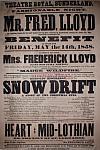
Right - A Poster for Fred Lloyd at the Theatre Royal, Sunderland in 1858.
Here too they had a big horizontal engine and plant to generate their own electricity, and we took advantage to charge our six batteries, which were placed on a small flat truck, as each battery weighed nearly half hundred weight. The electrician of the theatre, informed us that he would willingly recharge our batteries, It would save sending - as was our usual practice - to Heywoods, Manchester for the recharge. So - the batteries were wired up to the switchboard and left overnight. The lead to the batteries again was plugged to a stage plug.
On the following evening an assistant electrician, whose job was to see that all the passages of the theatre, were duly lit before the audience were admitted, went to the switch board and plugged into the pilot lights and passages; then went his usual round of the theatre. He arrived at last in the Upper Gallery and viewed with amazement. The chandeliers, from the roof of the auditorium - lights - going up then down and up again, he was dumbstruck for he knew that he had not put in the main switch for the ceiling lights. He rubbed his eyes. He shouted, but no answer - he could not find out "why" this phenomenon - and so had to wait until the head electrician arrived, but he too was non- plussed. In the interim the lights were dimming, and then finally went out: yet no conclusion to this unaccountable episode. Well the show began and it was not until before the scene at the "SAFE", that the mystery was solved. The batteries failed - and it was only the quick thinking of the local electrician who managed a shower of sparks from a lead of wire to the switchboard - that saved the situation.
Our tour continued to Consett, Durham, York to Coatbridge a suburb of Glasgow, Scotland. Then to Leith outside Edinburgh etc., etc. and we finished the tour at The Theatre Royal Blyth Dec 5 1897.
I returned home for one week - then journeyed to Ramsgate, where I opened with my first pantomime. Here I will say that I presented a pantomime every year (war years - on service deleted) until 1948 when I managed and staged managed "Jack and the Beanstalk" for Bertram Montague at the Hippodrome, Wolverhampton which was to be my last pantomime. This pantomime was my first at the Sangers Palace Theatre - named after Lord George Sanger - which was at the top of Harbour Street. I felt very excited, for to me this had an appeal, quite different to the dramas, that was my usual job. The cast was Annie Cohen, who played the title role of the show "Red Riding Hood". Bros McGrath played the robbers, Tommy Solly, well known comedian of the north in the role of Baron. Rehearsals were for a fortnight. I was given all sorts of scenery to make, with trap doors etc. There were forty in the company and it was a big success. We played two weeks only at Ramsgate. From there to National Palace of Varieties, Croydon. Eustace Joy, a well known character, was the resident manager. This theatre was converted from Hales Circus. Our company was large and the dressing rooms very few - and small: a disused elephant house adjoining, was the accommodation for Jordisans troupe of sixteen dancers. No heating arrangements were to be found in dressing rooms at this period. Even the auditorium was limited to a few small gas radiators. The conditions in some theatres were very primitive, whilst the travelling facilities were likewise. Companies had their own carriages on the railroad. These were heated by two footwarmers to each compartment. After a couple of hours they became stone cold. Scenery today is transported in large fifty foot covered trucks. In these early days it was sixteen foot open trucks - generally speaking two were coupled together to make it into one - thereby avoiding friction to the cloths of scenery which were from thirty to thirty five feet in length and after the loading - tarpaulins were lashed all round each truck against the weather conditions. It was a hard job for the staff who travelled with a big production. Special conditions are in force regarding trucks, and to concessions relating to the theatrical fares. As today little has changed: the greater number of passengers, allows more trucks etc.
 After Croydon, again I visited the Royal
Aldershot with a stay of a fortnight. Then to the Queens Theatre,
Longton in the Potteries. Here, added to the pantomime,
was the "Oscinematoscope" demonstrated by Spencer Clarke,
from the Empire Leicester Square. The apparatus was fixed to the book rest, centre of the circle: no protection,
no cinema box, but just the open machine, which sounded like a gatling
gun - as the spool was turned by hand: which afterwards dropped into
a clothes basket. Primitive conditions indeed.
After Croydon, again I visited the Royal
Aldershot with a stay of a fortnight. Then to the Queens Theatre,
Longton in the Potteries. Here, added to the pantomime,
was the "Oscinematoscope" demonstrated by Spencer Clarke,
from the Empire Leicester Square. The apparatus was fixed to the book rest, centre of the circle: no protection,
no cinema box, but just the open machine, which sounded like a gatling
gun - as the spool was turned by hand: which afterwards dropped into
a clothes basket. Primitive conditions indeed.
Left - Programme for 'Pygmalion' at the Theatre Royal, Aldershot in 1950 - Courtesy Alan Chudley.
The picture portrayed a railway station, the train coming into the station, with the travellers alighting from the train. If the picture was dim, a bucket of water and a syringe was used to drench the "Cloth" on which the pictures were shown - this had a salutory effect, and the picture was more defined, but we had to abandon this new entertainment - which London acclaimed as a modern wonder. Again we travelled to the Opera House Buxton, in the mountains where we packed the theatre at each show. Then to Victoria Theatre, Burnley. This theatre was built over shops in the centre of the town. Metropole Bootle, Liverpool was our next date. This was in dockland - you can guess that it was wise never to be alone. Some of these theatres, which had stages, twenty to thirty feet above the level of the street, made it very difficult in handling the scenery, thereby jeopardising sufficient time for adequate rehearsals on Monday after arrival. The pantomime finished at The Osborne Theatre Manchester, 27th March 1898. Due notice was placed on the call board - thanking everybody but each had to pay their own fares home.
During this time, I was gaining knowledge of theatrical stage craft, I searched in each theatre for new and old secret devices, which afterwards stood me well, yet now I was out of a job.