
Theatres and Halls in Blyth, Northumberland
Phoenix Theatre - Theatre Royal - Hippodrome - Gaiety Theatre - Cinemas
See also Theatres in Berwick, Northumberland
The Theatre Royal, Trotter Street and Jefferson Street, Blyth, Northumberland
Formerly - The New Theatre
With some information on the earlier Theatre Royal, Waterloo Road, Blyth

Above - An early postcard photograph of the Theatre Royal, Blyth - Courtesy Maurice Friedman, British Music Hall Society

 The Theatre which stood on the corner
of Trotter Street and Jefferson Street in Blyth, Northumberland, from 1900 until 1984, was
built for Arthur Jefferson (the father of Stan Laurel) who had previously been
running the Theatre Royal, on Waterloo Road, Blyth, since 1893,
and had performed there as an actor for many years previous to that.
The Theatre which stood on the corner
of Trotter Street and Jefferson Street in Blyth, Northumberland, from 1900 until 1984, was
built for Arthur Jefferson (the father of Stan Laurel) who had previously been
running the Theatre Royal, on Waterloo Road, Blyth, since 1893,
and had performed there as an actor for many years previous to that.
The New Theatre, as it was called when it first opened in 1900, was built to replace the earlier Theatre Royal on Waterloo Road, and was designed by the architects J. C. Maxwell and William Hope. The Theatre was constructed by J. and W. Simpson at a cost of £13,000. The Simpsons had also constructed the earlier Theatre Royal. The New Theatre opened on Monday the 5th of February 1900 with a production of the Morell and Mouillot's Company in 'The Geisha'.
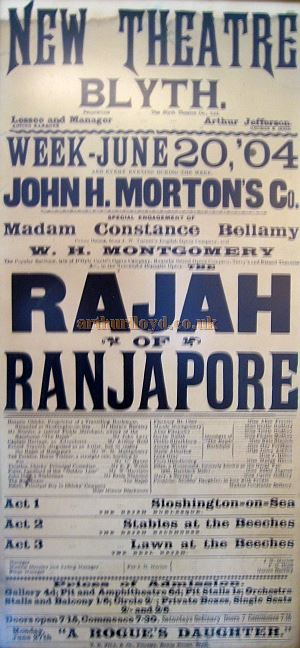
Right - A Poster for 'The Rajah of Ranjapore' at the New Theatre, Blyth in June 1904 whilst under the management of Arthur Jefferson - Courtesy Trevor Harder.
 The Theatre later got a warrant to be called the Theatre Royal and so this 1900 Theatre would eventually become the third Theatre Royal in Blyth. The first had opened in 1870 on Waterloo Road, and was run by Richard Fynes until its eventual destruction
by fire on Saturday the 11th of February 1888.
The Second Theatre Royal, also run by Richard Fynes, was built by J.
and W. Simpson, on the site of the first and opened in November 1888.
This Theatre had a proscenium opening of 22 foot and a stage some 40
foot wide by 32 foot deep. Arthur Jefferson took over this second Theatre Royal in 1893 and then had the New
Theatre built to replace it in 1900.
The Theatre later got a warrant to be called the Theatre Royal and so this 1900 Theatre would eventually become the third Theatre Royal in Blyth. The first had opened in 1870 on Waterloo Road, and was run by Richard Fynes until its eventual destruction
by fire on Saturday the 11th of February 1888.
The Second Theatre Royal, also run by Richard Fynes, was built by J.
and W. Simpson, on the site of the first and opened in November 1888.
This Theatre had a proscenium opening of 22 foot and a stage some 40
foot wide by 32 foot deep. Arthur Jefferson took over this second Theatre Royal in 1893 and then had the New
Theatre built to replace it in 1900.
Left - A Poster for the provincial touring production of Franz Lehar's 'Merry Widow' at the Theatre Royal, Blyth on Monday the 21st of March 1910 - Courtesy Trevor Harder.
The Stage Newspaper reported on the opening of the New Theatre in their February 8th 1900 edition saying:- 'From the outside there is nothing particularly to attract the ordinary passer-by save the unusually large dimensions, but as soon as one passes within the main entrance one is at once struck by the lavish ornamentation of the interior. A large mahogany pay-box faces the doors, and a massive brass chandelier lights up the hall. To the right are the stairs, which are of marble, leading to a spacious crush-room, whence the entrance to the circle and balcony is reached...

Above - A photograph of the Theatre Royal, Blyth in 1912 - Courtesy Maurice Friedman, British Music Hall Society.
...To the left of the first landing are the rooms of Mr. Jefferson, the lessee, and Mr. Good, the manager. On the same landing are the usual cloak rooms. The circle takes the usual crescent form, and is fitted throughout with patent-tip-up chairs in old gold figured plush; the same chairs are also fitted to the balcony. At the rear of the circle to the right and left are carpeted passageways to the boxes. The latter are fitted with great taste, also in old gold. On the left of the circle the circle bar is situated; it is fitted in an elaborate fashion. On the same level is a temperance cafe. There is also an open verandah, which will no doubt prove most acceptable to smokers, in summer time especially. The front of the circle is ornamented with sea-horses done in the fibrous plastic work, with gilt mouldings.
The orchestra stalls are fitted with tip-up chairs in red plush. The pit stalls, just behind, have padded seats. The ordinary pit is seated with plain polished wood seats. On the left a commodious bar is provided, well furnished. The gallery has been cleverly arranged, and accommodation provided for several hundreds, in that quarter. It is also provided with a refreshment bar, also of the island description. A special feature of the internal construction is that from all parts a full view of the stage is obtainable. The ceiling has been cleverly painted to represent a lightly-tinted sky, with birds etc.
he stage is very commodious; the dimensions are 40ft. by 50ft.; stage to grid, 50ft. Large property rooms and paint-frame are also provided. The comfort of companies visiting the theatre has been seen to in a liberal manner, nine dressing-rooms, fitted with hot and cold water being provided.
A lift has been placed to take artists' baggage to the upper rooms. This is Mr. Jefferson's idea; we believe it is the only one in the provinces. Seven exits are provided, and also the usual fire appliances.'
The above (edited) text in quotes was first published in the Stage, February 8th 1900.
The Theatre was a touring house from its opening, although it did stage repertory seasons on occasions. Later, like so many other Theatres around the Country, it was used as a cinema, one of the first in the Essoldo Theatres chain. The Theatre finally closed in 1964 and was then used as a warehouse for a while before being abandoned and standing empty until it was finally demolished in 1983 to make way for a car park and a toilet. There is some more information on the Theatre Royal, Blyth below.

Above - The Theatre Royal, Blyth in 1980, just a few years before its demolition. - Photo Courtesy Trevor Harder.
 Avisitor to the site, Trevor Harder, has kindly sent in some information
about the Theatre Royal, Blyth. Trevor says:' I am originally a native
of Blyth in Northumberland, although I am now happily resident in
sunny Spain. The Theatre Royal, Blyth was built by Arthur Jefferson,
(father of Stan Laurel) and opened it’s doors in 1900.
Avisitor to the site, Trevor Harder, has kindly sent in some information
about the Theatre Royal, Blyth. Trevor says:' I am originally a native
of Blyth in Northumberland, although I am now happily resident in
sunny Spain. The Theatre Royal, Blyth was built by Arthur Jefferson,
(father of Stan Laurel) and opened it’s doors in 1900.
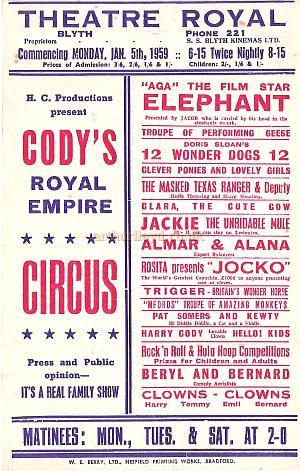
Right - A Programme for Cody's Royal Empire Circus at the Theatre Royal, Blyth - Courtesy Trevor Harder. - On the Bill were AGA, the film star elephant, a Troup of performing geese, Doris Sloan's 12 Wonder Dogs, Clever Ponies and Lovely Girls, the Masked Texas Ranger, and Jackie, the unridable Mule, amongst others.
TheTheatre was designed by Hope and Maxwell and had a beautiful auditorium, with 1,200 seats, a large stage and electric lighting. The latter innovation was regarded as new fangled, and gas was available from the adjacent gas works.
Arthur Stanley Jefferson, better known today as Stan Laurel, worked there as call-boy, then a bit player, in his early days. (Stan was the second son of Arthur (AJ) Jefferson, theatrical impresario and manager, and Margaret (Madge) Metcalf, a well-known actress of the day. He changed his name to Laurel when he was established in the USA, upon a suggestion by Mae Dahlberg, his partner at the time. - Courtesy Eric Willloughby)
 From
its early days, the Royal was a touring house, supplemented by repertory
seasons and later as a cinema. Many great stars played there, apart
from young Laurel, including Gracie Fields, Charley Chaplin, (with Fred Karno’s company), in the days before they gained their stardom.
From
its early days, the Royal was a touring house, supplemented by repertory
seasons and later as a cinema. Many great stars played there, apart
from young Laurel, including Gracie Fields, Charley Chaplin, (with Fred Karno’s company), in the days before they gained their stardom.
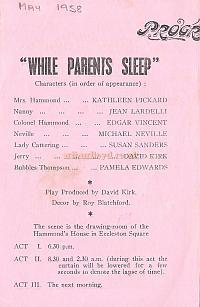
Left - A Programme for 'While Parents Sleep' at the Theatre Royal, Blyth in 1958 - Courtesy Trevor Harder.
 The
Theatre was bought by Sol. Sheckman, one of his first Essoldo houses,
and he always had a soft spot for the Royal. Like most provincial
Theatres, it staggered from one crisis to another in the 1950’s;
finally closing its doors in 1964. It was later purchased by the uninspired
local council, who allowed it to decay for a further two decades,
before final demolition in 1984.
The
Theatre was bought by Sol. Sheckman, one of his first Essoldo houses,
and he always had a soft spot for the Royal. Like most provincial
Theatres, it staggered from one crisis to another in the 1950’s;
finally closing its doors in 1964. It was later purchased by the uninspired
local council, who allowed it to decay for a further two decades,
before final demolition in 1984.
The site is now a town centre car park, with a public toilet. I said they were uninspiring!
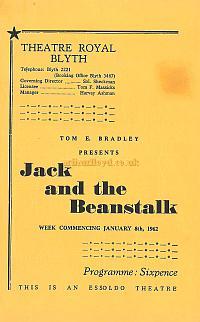
Right - A Programme for the pantomime 'Jack and the Beanstalk' at the Theatre Royal, Blyth - Courtesy Trevor Harder.
I managed to salvage a few pieces of the beautiful plasterwork from the auditorium. I mounted these and they are now on permanent display in the Phoenix Theatre, Blyth, along with some of my framed pre WW1 posters.'
The text above and its accompanying programmes was kindly sent in by Trevor Harder.
The Phoenix Theatre, Beaconsfield Street, Blyth, Northumberland

Above - A Google Street View of the Phoenix Theatre, Blyth - Click to interact.
The Phoenix Theatre opened in 1997 and was built with the aid of a grant from the National Lottery and other local funding. The Theatre has seating for 300 people and includes a rehearsal space, bar and Foyer. The Phoenix Theatre is used for professional and amateur productions and came about after the Blyth Arts and Community Association's original Theatre, in a converted church, had been condemned due to an unsafe roof in 1994.
You may like to visit the Phoenix Theatre's ow Website here.
The Hippodrome Theatre, Blyth, Northumberland
The Hippodrome Theatre, Blyth was built in 1902 and was only used until 1920.
The Theatre was demolished in 1927.
If you have any more information or images for this Theatre that you are willing to share please Contact me.
The Gaiety Theatre of Varieties, Quay Road, Blyth, Northumberland
Formerly - The Assembly Rooms / Wests’ Picture House - Later - The Eric Tolhurst Centre

Above - A Google Street View of the former Gaiety Theatre, Blyth - Click to interact.
The Gaiety Theatre of Varieties, Blyth was built in 1906 and was a conversion from the former Assembly Rooms. The building was severely damaged during the First World War when the roof was destroyed, and again during the Second World War. The building was later used as a factory for the making of a diverse range of products by the Cooknell Brothers. A fire in 1960 damaged the building but it was repaired. In 1969 the Blyth Valley Council bought the building and used it as a training centre for youth projects and in 1996 it was renamed the Eric Tolhurst Centre and used by various charitable organisations. The building is unrecognisable as a former Theatre today.
If you have any more information or images for this Theatre that you are willing to share please Contact me.
Cinemas in Blyth, Northumberland

Above - The former Roxy Cinema, Blyth during its Mecca Bingo years in November 2009 - Courtesy Paul Bland
 There
have been several Cinemas operating in Blyth over the years including
The Wallaw, The Central, The Roxy (see photo above), and The
Essoldo. Most closed in the 60s and 70s but the Wallaw Cinema didn't
close until 2004 and is today a Wetherspoon's Pub and restaurant.
There
have been several Cinemas operating in Blyth over the years including
The Wallaw, The Central, The Roxy (see photo above), and The
Essoldo. Most closed in the 60s and 70s but the Wallaw Cinema didn't
close until 2004 and is today a Wetherspoon's Pub and restaurant.
Right - The former Wallaw Cinema, Blyth before its conversion to a Wetherspoon's Pub, in a photograph taken in November 2009 - Courtesy Paul Bland.
Wetherspoon's have done a very sympathetic job and preserved the Cinema's classic art deco interior. Their own website with some internal images can be found here.
There was also a cinema called the Plaza in Newsham, a part of Blyth, which is apparently still standing and is now in use as the Temple of Yaweh. There are details of the Wallaw and other Blyth Cinemas on the Cinema Treasures website here.


Above - The former Wallaw Cinema, Blyth before its conversion to a Wetherspoon's Pub, in a photograph taken in November 2009 - Courtesy Paul Bland.
If you have any more information or images for Theatres and Cinemas in Blyth that you are willing to share Please Contact me.