
Theatres and Halls in Burnley, Lancashire
Empire Theatre - Mechanics Centre - Palace Hippodrome Theatre - Gaiety Theatre - Early Theatre Royal - Theatre Royal - Victoria Theatre / Opera House - The Tivoli Picture House - The Empress Picture House - Andrew's Picture House / Roxy - Music Halls
See also in this area - The Nelson Palace Theatre - Blackburn Theatres - Rawtenstall Theatres
The Mechanics Theatre, Manchester Road, Burnley
Formerly - The Mechanics Institute / Mechanics Arts & Entertainment Centre

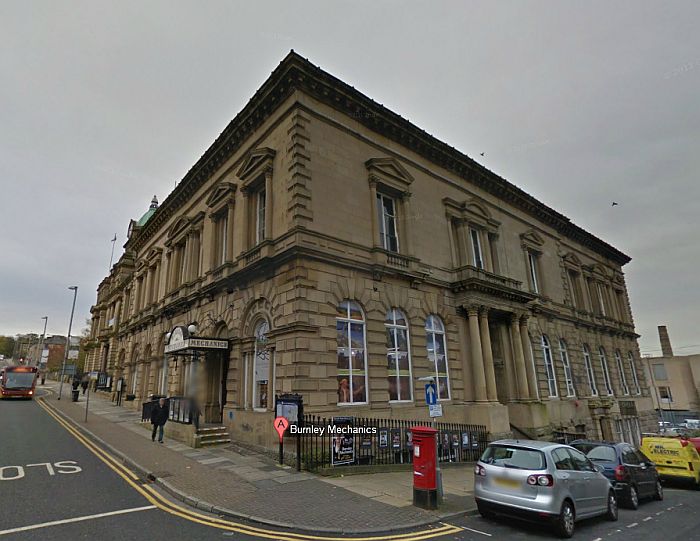
Above - The Mechanics Theatre, Burnley in October 2018 - Courtesy Philip Paine.

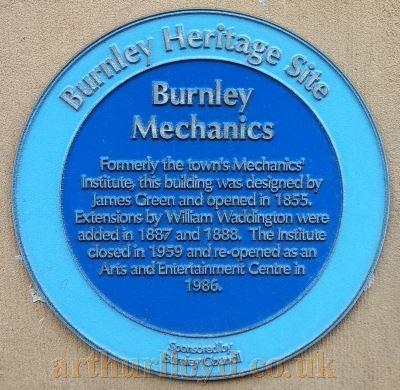
The Mechanics Theatre in Burnley was originally designed by the architect James Greene and opened as the Mechanics Institute in 1855 as a place for the social, cultural, and educational enhancement of the community. Having served the town for over a century the Mechanics was eventually wound up by its trustees in 1959.
The building was then purchased by the Council in 1961 and was leased out to all manner of companies for various activities such as cabaret, bingo, and even a ballroom, until it finally closed in 1979.
 The building then fell into disrepair until in 1986 Burnley Borough
Council redeveloped the building as an arts and entertainment centre
by spending £250,000 on repairs to the structure, and adding a
multipurpose Theatre on the first floor of the building with seating
for 400 people. The Theatre was designed to be used by amateurs and
professional touring companies, and could also be used for dances and
exhibitions. On the ground floor of the building a tourist information
centre was installed along with a box office for the Theatre, a display
area and catering facilities. The basement was leased to Mid-Penine
Arts.
The building then fell into disrepair until in 1986 Burnley Borough
Council redeveloped the building as an arts and entertainment centre
by spending £250,000 on repairs to the structure, and adding a
multipurpose Theatre on the first floor of the building with seating
for 400 people. The Theatre was designed to be used by amateurs and
professional touring companies, and could also be used for dances and
exhibitions. On the ground floor of the building a tourist information
centre was installed along with a box office for the Theatre, a display
area and catering facilities. The basement was leased to Mid-Penine
Arts.
Left - A Burnley Heritage Site Plaque situated on the Mechanics Theatre, photographed in October 2018 - Courtesy Philip Paine.
 The Mechanics is a Grade II Listed building and the Theatre has a flat
stage of 7.5 metres deep, with a proscenium opening of 8.7 metres, and
a grid height of 6.2 metres.
The Mechanics is a Grade II Listed building and the Theatre has a flat
stage of 7.5 metres deep, with a proscenium opening of 8.7 metres, and
a grid height of 6.2 metres.
Right - A Google Street View Image of the Mechanics Theatre, Burnley - Click to Interact
The Burnley Mechanics Institute building is today owned and operated by Burnley Council, you may like to visit the Theatre's own website here.
If you have any more information or images for this Theatre that you are willing to share please Contact me.
The Empire Theatre of Varieties, St James Street, Burnley
Later - The New Empire / Empire Music Hall / Gala Bingo

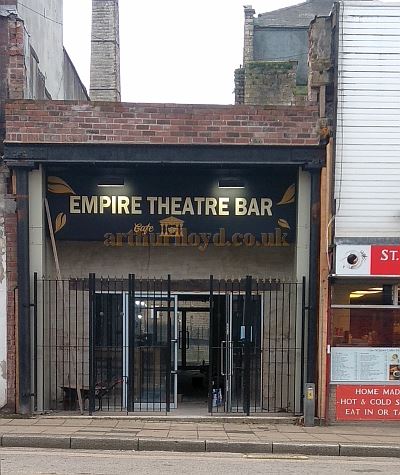
Above - A Google Street View Image of the former main entrance to the Empire Theatre, Burnley - Click to Interact. The Theatre's former entrance foyer can be seen here whilst being used as a bar and cafe called The Empire Theatre Bar.
 The
Empire Theatre is situated on St James Street, Burnley, and was built for W. C. Horner, Manager
of the slightly earlier and adjoining Victoria Opera House, it was designed
by the architect G. B. Rawcliffe,
who had also designed the neighbouring Victoria Opera House. The Empire Theatre opened on Monday the 29th of October 1894 with a variety show and could originally seat
1,935 people.
The
Empire Theatre is situated on St James Street, Burnley, and was built for W. C. Horner, Manager
of the slightly earlier and adjoining Victoria Opera House, it was designed
by the architect G. B. Rawcliffe,
who had also designed the neighbouring Victoria Opera House. The Empire Theatre opened on Monday the 29th of October 1894 with a variety show and could originally seat
1,935 people.
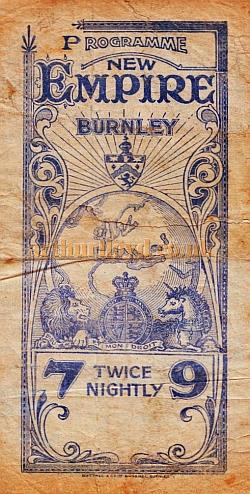
Right - An early Twice Nightly Variety Programme for the Burnley Empire - Courtesy Martin Moore - See cast details below.
The Stage reported on the opening of the Empire, Burnley in their November the 1st edition saying: 'On Monday was opened for the first time the new Empire Theatre of Varieties at Burnley which has been erected and completed by the Directors of the Victoria Opera House, Limited, by whom the future management of the building (delegated to Mr. W. C. Horner, the managing director) will be carried on.
Although of a plain and unpretentious character both internally and externally, the place is fitted up with the most modern appliances necessary for the protection of the public as well as for their entertainment. The stage and its fittings are of the most complete description, containing all the usual paraphernalia of a first class theatre.
The auditorium consists of stalls and pit on the ground floor, with balcony and gallery over, accommodating altogether about 1,500 persons. At the back of the pit and each gallery is a promenade. Each gallery has an independent stone staircase two yards wide (being twelve inches over the regulation width). These staircases are of a unique character, as they are both contained within the same walls and occupy only the ground floor of one, a scheme invented by the architect (Mr. G. B. Rawcliffe) in 1881, but never before put into practice...
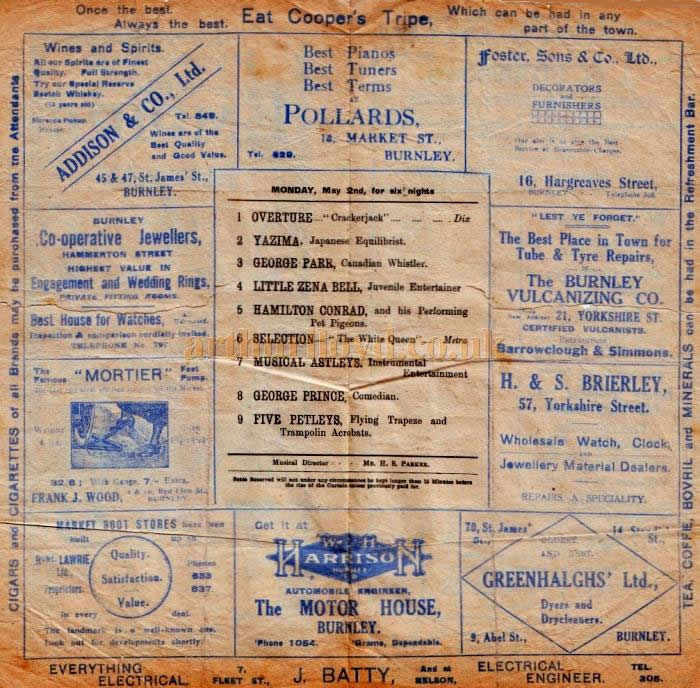
Above - Cast details from an early Twice Nightly Variety Programme for the Burnley Empire - Courtesy Martin Moore - On the Bill were Yazima, George Parr, Little Zena Bell, Hamilton Conrad, George Prince, and the Five Peters.
 ...In
addition to these ordinary stairs, there are iron emergency stairs outside
the building from both galleries. The stalls and pit also have separate
exits, as well as the stage, the latter having two exits to Newton-court
(one 9ft. wide), and an iron bridge in addition communicating with the
Victoria passages and Tanner-street. It will thus be seen that the matter
of exit has been regarded as of primary importance in all departments.
...In
addition to these ordinary stairs, there are iron emergency stairs outside
the building from both galleries. The stalls and pit also have separate
exits, as well as the stage, the latter having two exits to Newton-court
(one 9ft. wide), and an iron bridge in addition communicating with the
Victoria passages and Tanner-street. It will thus be seen that the matter
of exit has been regarded as of primary importance in all departments.
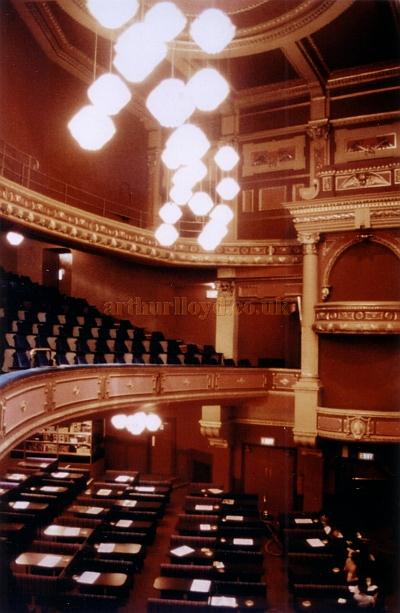
Right - The auditorium of the Burnley Empire whilst in use for Bingo in 1982 - Courtesy Ted Bottle.
The stage and ceiling space over the entire building is fitted with sprinklers, fed direct from the Corporation mains. In addition to this a 500 gallon cistern with fire appliances is being fixed over the stage, in case of the mains being off. There are large refreshment rooms adjoining the staircases on each floor. The pit floor is of concrete with three wood block passages; the galleries are of iron and steel construction, covered by wood, plaster &c. A covered verandah will extend over the four principle entrances to serve as shelter to the public. The stage is very roomy, with a capital opening, and fitted up with all the modern appliances, traps &c., and with a large scene dock. The dressing-rooms are very comfortable, and will be appreciated by the artists.
A crowded audience greeted the overture and the rise of the curtain on the opening night, and a somewhat lengthy programme was satisfactorily gone through. The artists engaged are Miss Jenny Valmore (who was compelled to sing five songs), J. C. Rich, Graceful Gertrella, Barcello and Millay, Miss Nellie Lovell, the Sisters Paris, Catawhela, Frank Coyne, and O'Conner and Brady.'
The above text in quotes was first published in the Stage, 1st November 1894.
In 1911 the respected Theatre Architect, Bertie Crewe reconstructed the auditorium of the Theatre with a new seating capacity of 2,100. The Theatre reopened on Monday the 11th of September 1911 and the Burnley Gazette reported on the occasion in their 13th of September 1911 edition saying:- 'The handsome new structure which has taken the place of the old Empire Music Hall was opened as a variety theatre on Monday evening. A good many Burnley people had already been privileged to make themselves acquainted with this latest addition to the recreative resources of the town, for there was an invitation assembly on Saturday afternoon, when a large company inspected the elegant appointments of the new Empire. Music was provided by the new Empire and Victoria orchestras, and light refreshments were served...
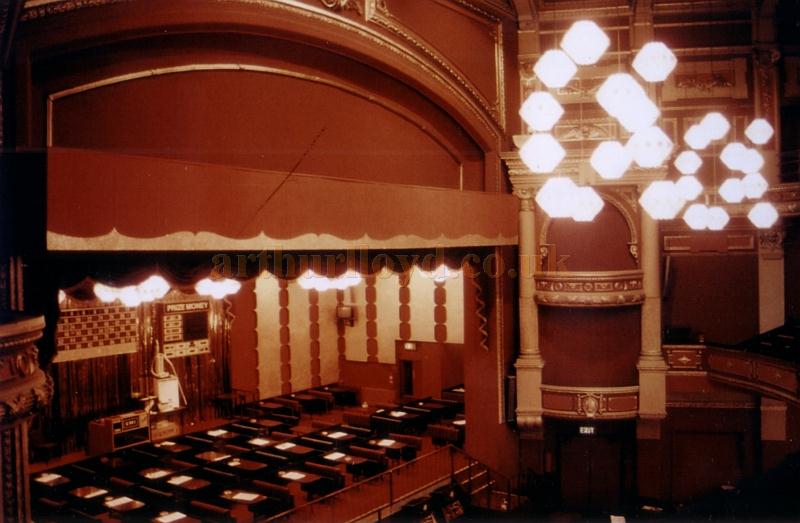
Above - The stage and auditorium of the Burnley Empire whilst in use for Bingo in 1982 - Courtesy Ted Bottle.
...But Monday was the opening night for business, and the new venture had a splendid send off. The place was crowded in every part and on all hands the management were congratulated on providing Burnley with such a beautiful and elaborately appointed theatre. The elegant design was no less admired than the dainty ornamentations, while the architect (Mr. Bert Crewe) [sic] was admitted to have achieved a triumph in the general compactness of the whole building. The unerring accuracy of sight line which gives a full view of the stage from every nook and corner of the house and brings the occupants of the furthest away seat in pit, circle or gallery within easy hearing distance of the stage. The proprietors have spared no expense in equipping Burnley with one of the finest theatres in the North of England, and the appreciation expressed by the crowded house on Monday must have been very gratifying to Mr. W. C. Horner, the enterprising manager and those associated with him. For the opening week Mr. Horner has been fortunate in securing a programme of exceptional merit. There is not a dull moment in the whole show and every turn aroused the hearty approval of the crowded house on Monday.'
The above text in quotes was first published in the Burnley Gazette, 13th of September 1911.
 The Theatre reopened on Monday the 11th of September 1911 with a variety show, and would go on in the same veign for many years until, in
1938, the Theatre was converted for cinema use by the Architects Lewis
and Company of Liverpool, and
the seating capacity was reduced to 1,808 in the process.
The Theatre reopened on Monday the 11th of September 1911 with a variety show, and would go on in the same veign for many years until, in
1938, the Theatre was converted for cinema use by the Architects Lewis
and Company of Liverpool, and
the seating capacity was reduced to 1,808 in the process.
However, it is still Bertie Crewe's 1911 auditorium that remains to this day despite several changes of use and recent serious neglect.
Like so many other Theatres around the Country the Empire was eventually converted for Bingo use in 1970 but even this ceased in 1995 and the Theatre, despite being a Grade II Listed building, has been empty ever since, and is in serious decline, and listed as one of the Theatres Trust's buildings at risk.
Right - The seriously dilapidated Cow Lane elevation of the Burnley Empire in October 2018 - Courtesy Philip Paine.
A recent suspected arson attack further damaged the building, and in 2018 a Bar and Cafe was allowed to operate in the former Foyer of the Theatre.
In 2018 the 'owners of last resort', the Duchy of Lancaster, who are not responsible for the building's upkeep or restoration, put the Theatre up for auction with a starting price of just £1, and also offered it as a gift to the local Council, in the hope that someone would be able to revive the Theatre's fortunes.
A local campaign group, then called Burnley Empire Limited, but now known as the Burnley Empire Trust, were successful in acquiring the Theatre, with support from the Theatres Trust. Their campaign to try and save the Theatre is ongoing and details can be found here. And much detail can also be found on the Theatres Trust website here.
There are some good internal photographs of the Theatre in May 2016 here. And a report on the Theatre's history and the campaign to save it, along with more photographs, can be found here.
If you have any more information or images for this Theatre that you are willing to share please Contact me.
Memories of working at the Burnley Empire by Alan Simpson
A Visitor to the site, Alan Simpson, has sent in some of his memories of working at the Burnley Empire during its Cinema years. Alan says:- 'I certainly remember the Empire cinema, I used to work there as the second projectionist. The Chief projectionist was a lady called Gladys Clarke. Nothing wrong with this except the only way to get in the projection box was through the gents toilet in the circle. I have lots of stories about the Empire and the Empress and the Tivoli where I have also worked.
One story, we were part of the Star cinema group and were getting new projectors, well they were new to us. Now I am getting technical, every projector has it’s own peculiarities like the distance from the projector to the screen, this is what we call the throw, some cinemas like the Empire had a very long throw and others have a short throw. The cinema where we got the projector was on normal films four by three, or wide screen, it did not really matter, but cinemascope was totally different. To look at a frame of cinemascope film was like looking at a Lowery painting of matchstick men. To see cinemascope it should be twice as wide as it is tall. To get this effect the projectors had special lenses, a backing lens plus a large spreading lens, each lens was set up to one projector, they could not be changed from one projector to the other.
 Now back to the story, we closed down on the Saturday night, the engineers
were waiting for us to close, as the last reel on one machine finished
they were taking it apart. On Sunday they were connecting things together,
it was a complete system, sound as well. We had to start while they
were still connecting things on the second projector. The second feature
film was in wide screen so that was OK. So we were up and running, interval
came and went ok. Now for the main feature film in cinemascope.
Now back to the story, we closed down on the Saturday night, the engineers
were waiting for us to close, as the last reel on one machine finished
they were taking it apart. On Sunday they were connecting things together,
it was a complete system, sound as well. We had to start while they
were still connecting things on the second projector. The second feature
film was in wide screen so that was OK. So we were up and running, interval
came and went ok. Now for the main feature film in cinemascope.
Left - The former main entrance to the Burnley Empire in October 2018, here shown being renovated and used as a bar and cafe called The Empire Theatre Bar - Courtesy Philip Paine.
I forget the film but it starred Anita Ekberg. It was a Roman gladiator type of film. We started but the lenses could not be set up properly. The picture went from one of the boxes to the other, now when Anita came on the screen in a bikini type of outfit, oh my! Now Anita is a very well endowed lady but when she came on our screen she had part of her bust in one box and the rest in the other, and her cleavage WOW! The engineers did their best to sort things out but it needed to be empty more or less to get it sorted. You can imagine what the comments from the audience were. The next morning the chief engineer came to set things up properly but not before he had seen the film as we had seen it. He found it very amusing.
Another story is one that frightened me to death. Before I start if you look at the picture of the side of the Empire and you look up you will see a lump sticking out, this was the rewind room, and at the end of the building you cannot see it but there was an old door with a little dirty window in it.
 I was in the rewind room rewinding a reel of film that we had just
shown when I heard the film transport arrive with the films we were
going to show the next week. Now if we were getting any publicity we
would get notice of what we had to do with it, we had not received any.
We were going to show 'The Mummy' staring Peter Cushing & Christopher
Lee. When I had finished rewinding I said to Gladys that I would take
my break and bring the films up. To get to the films I had to go down
the back stairs which were lit by one forty watt bulb at the top and
one at the bottom which was at the top of the next flight of stairs.
As I got to the last bend I stopped dead in my tracks and I will admit
I let a scream out and flew back up the stairs to the box. Gladys was
very concerned, “What’s up Alan?” “I don’t
know what it is but there is something at the bottom of the stairs!”
I was in the rewind room rewinding a reel of film that we had just
shown when I heard the film transport arrive with the films we were
going to show the next week. Now if we were getting any publicity we
would get notice of what we had to do with it, we had not received any.
We were going to show 'The Mummy' staring Peter Cushing & Christopher
Lee. When I had finished rewinding I said to Gladys that I would take
my break and bring the films up. To get to the films I had to go down
the back stairs which were lit by one forty watt bulb at the top and
one at the bottom which was at the top of the next flight of stairs.
As I got to the last bend I stopped dead in my tracks and I will admit
I let a scream out and flew back up the stairs to the box. Gladys was
very concerned, “What’s up Alan?” “I don’t
know what it is but there is something at the bottom of the stairs!”
Right - The seriously dilapidated Cow Lane elevation of the Burnley Empire in October 2018 - Courtesy Philip Paine.
She phoned down to the manager, he said that he would be straight up. He came up with Maurice the commissionaire, they brought up three torches and we went down the stairs, when we got to the lasy bend we must have looked like The Three Stooges as first one head appeared round the corner, and then the second head, then the third one, each one above the other, with torches shinning. When all the lights of the torches shone on what was at the bottom of the stairs...
It was an imitation mummy stood there, but the F.T.'s men had positioned it so it was standing in the orange light from the street light. Both Maurice and the manager let out a little gulp. We had a good laugh about it. Then reality struck us, we were at the back stairs but we needed to be round the front. How do we get it there? We could have taken it upstairs but we would have had to go through the auditorium, not a good idea. The only other choice was to go outside and carry it through the streets. This is what we did, three of us carrying a large mummy up Cow Lane and along St. James street, one at the front and one at the back, and me in the middle. A comment from the manager was that if anyone said anything they would get tis shoved somewhere where the sun des not shine. Luckily no one said anything. It took the pride of place next week in the foyer, I felt like kicking it every time I went Passed it. I hope you enjoy my stories. All true.' - Alan Simpson 2014.
The Victoria Theatre, St. James' Street, Burnley
Formerly - The Victoria Opera House

Above - A 2009 Google StreetView Image of the site of the former Victoria Theatre, Burnley - Click to Interact.
 The
Victoria Theatre was situated on St. James' Street, Burnley, next door to the slightly later Empire Theatre, and took 18 months to
construct, at a cost of £10,000. It originally opened as the Victoria Opera House in August 1886.
The
Victoria Theatre was situated on St. James' Street, Burnley, next door to the slightly later Empire Theatre, and took 18 months to
construct, at a cost of £10,000. It originally opened as the Victoria Opera House in August 1886.
Right - An early photograph of the Victoria Theatre, Burnley - Courtesy Mike Townend who says 'The Victoria Theatre is on the right and this was taken just before the Theatre opened. It was on the site of Goodham Hill cotton mill which was demolished in 1883 to make room for road widening.'
The Theatre was designed by the architect G. B. Rawcliffe who would go on to design the adjoining Empire Theatre, in 1894. The Victoria's exterior was in the Italian style with Doric and Corinthian pilasters, cornices and entabletures. The auditorium, with a capacity of 2,000 people, was decorated in cream and gold on a rich red base, and was constructed on three levels, with raked stalls and pit, a horse-shoe shaped dress circle upholstered in crimson plush, and an octagonal gallery level topped by a circular domed ceiling. The Victoria's stage was 57 foot wide by 39 foot deep with 7 dressing rooms below it.
The Stage Newspaper printed a review of the Theatre in their 13th of August 1886 edition saying: 'The handsome structure which has, within the last eighteen months, been rapidly erected and completed upon one of the most excellent sites in St. James' Street, the principal thoroughfare of the enterprising town of Burnley, promises to rival any of the Thespian houses at present standing in the County Palatine, and will hold its own with many of the finest in the provinces.
 Almost every conceivable improvement which could be brought to bear
upon a building of this nature has been introduced in the construction
and completion of this house, and the whole may, with judgment, be pronounced
unique, the highest praise being due to the architect, Mr.
G. B. Rawcliffe, of Burnley, for his untiring energy and undoubted
skill in bringing about such a successful remit. The owners of the building
are Messrs. Pemberton Bros., a local firm of upholsterers, who estimate
to have spent £10,000 upon its construction.
Almost every conceivable improvement which could be brought to bear
upon a building of this nature has been introduced in the construction
and completion of this house, and the whole may, with judgment, be pronounced
unique, the highest praise being due to the architect, Mr.
G. B. Rawcliffe, of Burnley, for his untiring energy and undoubted
skill in bringing about such a successful remit. The owners of the building
are Messrs. Pemberton Bros., a local firm of upholsterers, who estimate
to have spent £10,000 upon its construction.
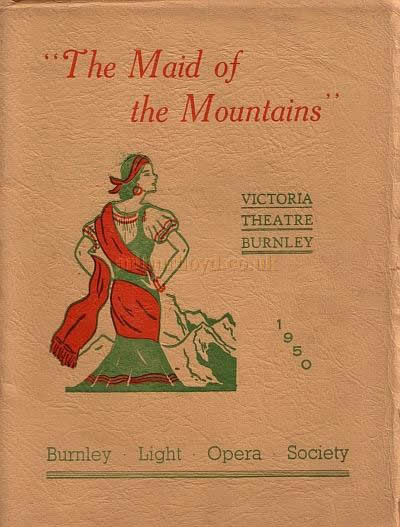
Left - A programme for 'The Maid of the Mountains' by the Burnley Light Opera Society at the Victoria Theatre, Burnley for the week beginning Monday, November the 6th 1950.
The style of the architecture of the frontage of the building is Italian, with Doric and Corinthian pilasters cornices and entabletures. The principal vestibule in St. James' Street, which is eleven feet wide, is paved with handsome Minton tiles, and is flanked on either aide with large mirrors, which cover the whole of the vestibule walls, and thus produce a grand effect, as the innumerable reflections of lamps, pilasters and statuary convey the idea of never-ending vistas of illuminated corridors. All the staircases, which are five feet wide and of stone, are made without corners, to prevent accidents.
The sloping floor of the pit is twenty yards square, and above it are two tiers of galleries of the form known as "horse-shoe." The lower or dress circle is upholstered in crimson plush velvet, and extends round both sides of the house. To all parts of the house are separately attached refreshment and cloak rooms, lavatories, etc., and, in addition, a smoking balcony, which overhangs the river, can be reached from the dress circle. The proscenium and gallery fronts are of ornamental, fibrous plaster, from special designs by the architect. The upper part of the house is octagonal in shape, and is surmounted by a circular dome ceiling, so that the acoustic properties of the building should he excellent.
The stage is fifty-seven feet wide, and thirty-nine feet deep, and is not a shade less than that of the Leeds' Grand, while underneath it are seven dressing roams (which average fourteen feet square), all fitted up with heating apparatus and hot and cold water, and each of which is ventilated by a special flue carried through to the ceiling. The roof of the stage is also supplied with several ventilators.
The foul air of the auditorium is taken away by air-grids, placed under all the galleries, connected with flues running up the walls, the latter being carried into an iron trunk under the main ceiling and then branched into a large ventilator or patent extractor 8 feet in diameter, which is fixed under the centre gas light. The latter contains 171 jets. Fresh air is admitted by means of air-grids, 9 inches by 6 inches, placed under each window and connected with the atmosphere outside by a moveable air grating which can be regulated from the inside. The building throughout is heated on the low pressure system.
 The decorative colouring is chiefly confined to the woodwork and to
the proscenium and gallery fronts, the latter being finished in cream
and gold on a rich red ground. The walls are merely coloured, the plaster
not being sufficiently dry to receive a more delicate and artistic handling.
The building is practically fire-proof, the pit door being of concrete,
7 inches thick, and the galleries of iron construction. The woodwork
is painted with fire-proof cyanite paint, and a hose and water supply
are attached to each side of the stage, while the top of the proscenium
is so arranged that if necessary a complete curtain of water can be
made to fall and cut off the stage from the auditorium. In addition
to the four ordinary staircases for egress, is an additional or emergency
staircase to be used only in case of fire, and which is connected with
the gallery and dress circle.
The decorative colouring is chiefly confined to the woodwork and to
the proscenium and gallery fronts, the latter being finished in cream
and gold on a rich red ground. The walls are merely coloured, the plaster
not being sufficiently dry to receive a more delicate and artistic handling.
The building is practically fire-proof, the pit door being of concrete,
7 inches thick, and the galleries of iron construction. The woodwork
is painted with fire-proof cyanite paint, and a hose and water supply
are attached to each side of the stage, while the top of the proscenium
is so arranged that if necessary a complete curtain of water can be
made to fall and cut off the stage from the auditorium. In addition
to the four ordinary staircases for egress, is an additional or emergency
staircase to be used only in case of fire, and which is connected with
the gallery and dress circle.
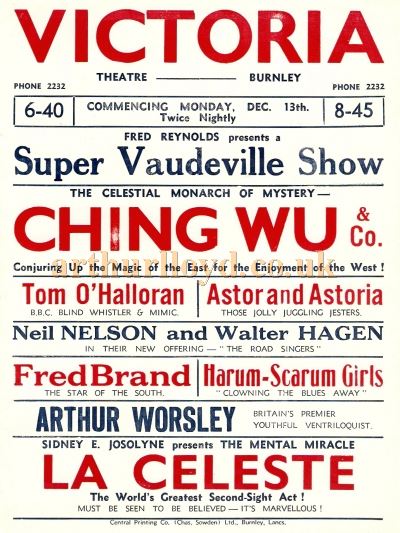
Right - A Poster advertising a 'Super Vaudeville Show' at the Victoria Theatre, Burnley - Courtesy Chris Woodward.
The stage is amply supplied with wings, borders, chamber and other sets from the brush of Mr. J. T. Vennimore, and the appointments of the stage have been well catered for by Mr. J. Presley, the permanently engaged stage-carpenter. It will thus be readily seen that the Victoria Opera House, which will seat 2,000 persons, is sufficiently provided to satisfy all modern requirements.
It only remains to be added that the management is in the hands of Mr. W. C. Horner, who is well-known to many provincial managers as a caterer for the local Mechanics' Hall, and who, without doubt, will spare no effort to render all the productions at this house both artistically and financially successful.'
The above text in quotes was first published in the Stage, 13th August 1886.
During the war, in November 1940, Burnely residents were delighted to find that the now renamed Victoria Theatre had become the temporary home of the Old Vic Company as it was deemed too unsafe for them to carry on in London. The Company remained at the Victoria Theatre through 1942, and in 1952 the Govenors of the Old Vic and Sadler's Wells placed a bronze plaque in the vestibule of the Victoria Theatre to show their appreciation, which was unveiled by Tyrone Guthrie on Friday the 7th of March 1952.
According to the Lancashire Telegraph, in February 1937 a variety show was produced at the Victoria Theatre which was broadcast live on national radio. Included in this production were 'The Four Aces' and the 'Victoria Theatre Orchestra' conducted by Jess Linscott who would become the manager of the Theatre in the 1940s and was still there when it was sold by its owners G.L.M. Amusements Ltd. for around £50,000 in March 1955 when it was closed and subsequently demolished.
If you have any more information or images for this Theatre that you are willing to share please Contact me.
The Palace Hippodrome Theatre, Burnley
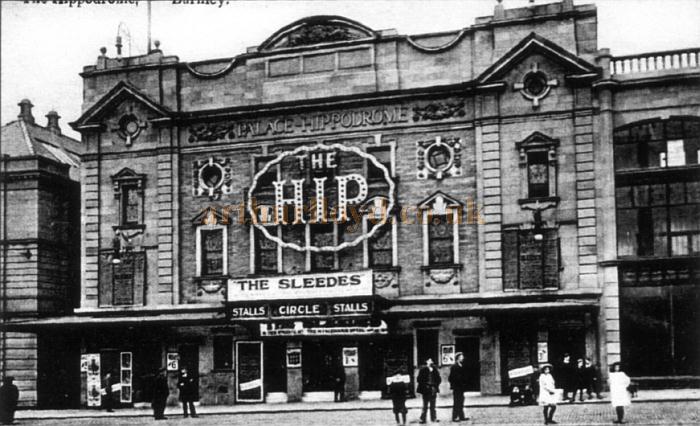
Above - The Palace Hippodrome Theatre, Burnley, during the run of 'The Sleedes' - Courtesy Geoff Lord.
The Palace Hippodrome Theatre, Burnley was built as part of the MacNaghten Vaudeville Circuit and opened with a musical burlesque called 'High Jinks or Fun on the Sands' on Monday, December the 7th 1907. The Theatre was designed by the architect Richard Horsfall from Halifax. The Theatre was built as a variety Theatre and although it was in constant competition with the nearby Empire Theatre it continued with this policy for many years.
 In
1930 the Theatre was bought by Herbert Hartley and W. B. Holt, both
of whom ran Theatres nearby, Hartley's Nelson
Palace, and Holt's Blakpool Hippodrome. However, they continued to run the Palace, Burnley as a
variety Theatre, opening with a production called 'Showtime' with Florence
Smithson and Hal Bert.
In
1930 the Theatre was bought by Herbert Hartley and W. B. Holt, both
of whom ran Theatres nearby, Hartley's Nelson
Palace, and Holt's Blakpool Hippodrome. However, they continued to run the Palace, Burnley as a
variety Theatre, opening with a production called 'Showtime' with Florence
Smithson and Hal Bert.
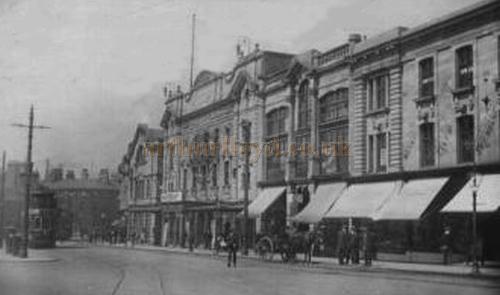
Right - A postcard showing the Palace Hippodrome Theatre, Burnley, posted in 1919.
The following year ABC took over the running of the Theatre and introduced Cine Variety there in January 1931, continuing with this policy until 1937 when Jess H. Linscott took over and began running variety shows again without film interludes. Linscott was also running the Victoria Theatre in the town at the same time, and was MD of the orchestra at the Palace, a busy man. Under Linscott the Theatre continued with variety until 1939 when it closed for a short period and was then taken over by ABC again, in September, who used the Theatre as a Cinema until 1941, when it returned to live theatre again under the management of the Butterworth circuit (FJB Theatres). Under Butterworth the Palace was used for variety, review, musicals, and even repertory seasons until July 1946 when the final performance of 'HP Sauce' was given.
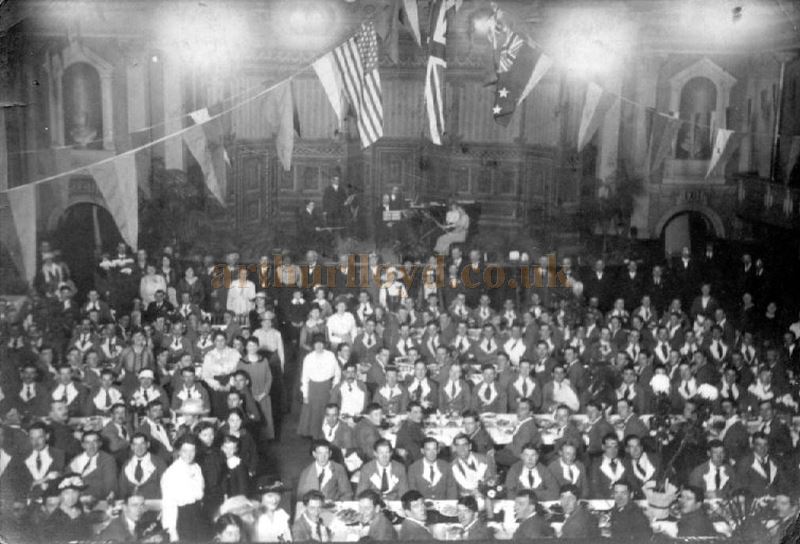
Above - Wounded Soldiers Tea at the Palace Hippodrome Theatre, Burnley for armistice week, 1918 - Courtesy Mike Townend.
The Theatre was then taken over by the Marks Circuit who put on various productions for a short while but it was soon showing films again, although it was host to Sunday concerts and the occasional pantomime. Marks gave the Theatre up in 1954 and went dark for a while. But in October the same year it was taken over by the Buxton Circuit who redecorated the Theatre, which had become very tired looking by this time, and converted it for Cinemascope, although the stage equipment was retained for future use.
In 1957 the Theatre was converted again so that it could show films or live theatre and reopened on December the 30th with the tour of 'Disc Doubles.' This was followed by the pantomime 'Cinderella' and then variety for 8 weeks. Buxton gave up the building in the summer and it then went back to films again under the management of Star Cinemas, although it did still show the odd live show as well, including pop concerts, pantomimes, and occasional twice nightly variety.
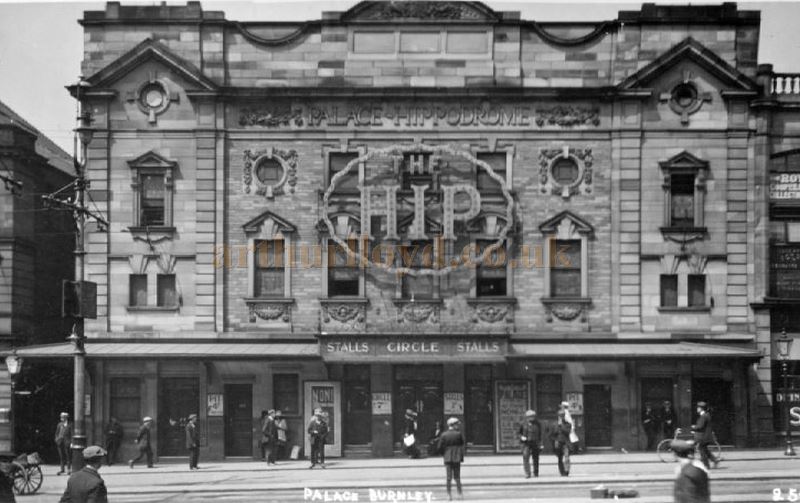
Above - A Postcard view of the Palace Hippodrome Theatre, Burnley - Courtesy Mike Townend.
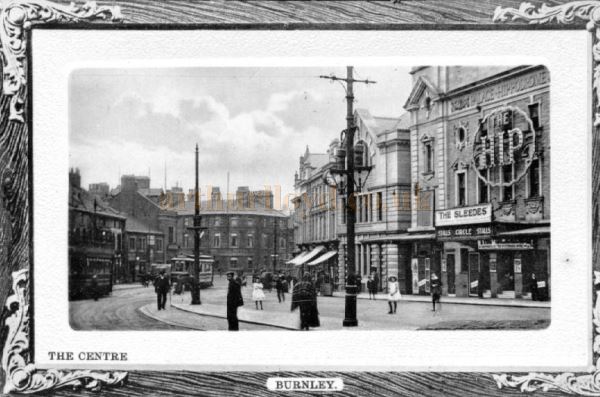 In 1962 the Palace Theatre started to house Bingo nights at the weekends
and films during the week, but did do a short run of live Theatre by
local amateurs in 'Annie Get Your Gun' and a professional production
of 'The Service Show' which turned out to be the last professional production
at the Theatre.
In 1962 the Palace Theatre started to house Bingo nights at the weekends
and films during the week, but did do a short run of live Theatre by
local amateurs in 'Annie Get Your Gun' and a professional production
of 'The Service Show' which turned out to be the last professional production
at the Theatre.
Right - A Postcard view of the Palace Hippodrome Theatre, Burnley - Courtesy Mike Townend.
Then it went back to Bingo but did show amateur productions again in 1963 and 1964. However, after this Bingo went full time until in 1971 even that transferred to the Empire and the building was shut up and remained so until it was eventually demolished in 1974.
The above information on the Palace Theatre was gleaned from an article by Geoff Lord in 'Old Theatres Magazine' issue 6, Geoff Lord worked at the Theatre for many years and was kind enough to let me display his photograph of the Theatre to accompany this article.
If you have any more information or images for this Theatre that you are willing to share please Contact me.
The Gaiety Theatre of Varieties and Opera House, Grimshaw Street and Parker Place, Burnley
Formerly - Culeen’s Grand Circus - Later The Gaiety Theatre
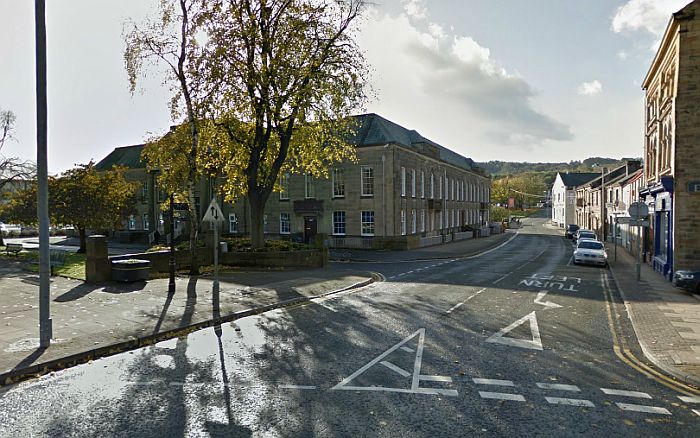
Above - A Google StreetView Image of the site of the former Gaiety Theatre, Burnley - Click to Interact
The Gaiety Theatre, Burnley opened on the 15th of September 1884 and was situated opposite the Cattle Market Hotel at the junction of Grimshaw Street and Parker Place on the site of what is now the magistrates court, which was itself built around 1930. The Theatre was originally built as Culeen’s Grand Circus and opened on the 22nd of February 1880. A notice in the ERA of the 21st of June 1884 advertises the opening of the Gaiety Theatre saying: Burnley Gaiety Theatre of Varieties and Opera House (late Culeen's Circus) - Licensed pursuant to Act of Parliament, - Mr Charles T. Owen, late Proprietor of the Royal Albert and the Royal Alexandra Music Halls, Glasgow, begs to inform the Profession that he has made arrangements with Mr T. Culeen to open the above building as a Variety Theatre on September 15th, 1884. All First-class Artistes in every Branch (Gymnasts excepted) please write in at once for vacant dates... Three days silence may be considered a polite negative. - The ERA 21st of June 1884.
The ERA carried another short notice on the opening of the Gaiety in their 20th of September edition saying: 'Gaiety Theatre of Varieties - Manager, Mr C. Owen - This large and convenient house was opened on Monday last before a crowded audience. The Marchants, sketch artists; Mr Tom Coyne in Irish songs, N. C. Bostock, Miss Emily Rebus, the "Great" Emblow in his magical entertainment, and the Hibbs minstrel quartette appeared. - The ERA 20th September 1884.
 In
May 1886 the original owner
of the building, T. Cullen, was being mentioned in the press as the
Proprietor of the Gaiety Theatre and his General Manager, J. F. Scott,
was putting on drama instead of variety productions.
In
May 1886 the original owner
of the building, T. Cullen, was being mentioned in the press as the
Proprietor of the Gaiety Theatre and his General Manager, J. F. Scott,
was putting on drama instead of variety productions.
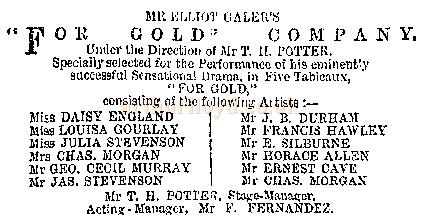
The following year, 1887, Fred Fernandez, the brother of James Fernandez, and Acting Manager for Cheevers and Kennedy's 'Irish Elopement Company', put on his show of Songs and Dances at the Gaiety on November 21st 1887. (See cutting right). Fred Fernandez had previously put on 'For Gold' at the Theatre Royal, Burnley in September 1882.
The Gaiety Theatre was demolished in 1916.
If you have any more information or images for this Theatre that you are willing to share please Contact me.
Early Theatre Royal, Boot Street, Burnley
There is a report in the Blackburn Standard of the 12th of October 1853 which says that W. H. Riley was granted a licence to perform plays in Burnley. He erected a commodious wooden Theatre on Boot Street, which was called the Theatre Royal.
I have no further information about this Theatre at present but a later Theatre Royal in Burnley, situated on Brown Street, is detailed below.
If you have any more information or images for this Theatre that you are willing to share please Contact me.
The Theatre Royal, Brown Street, Burnley
Formerly - The Burnley public Hall / Gillespie's Varieties
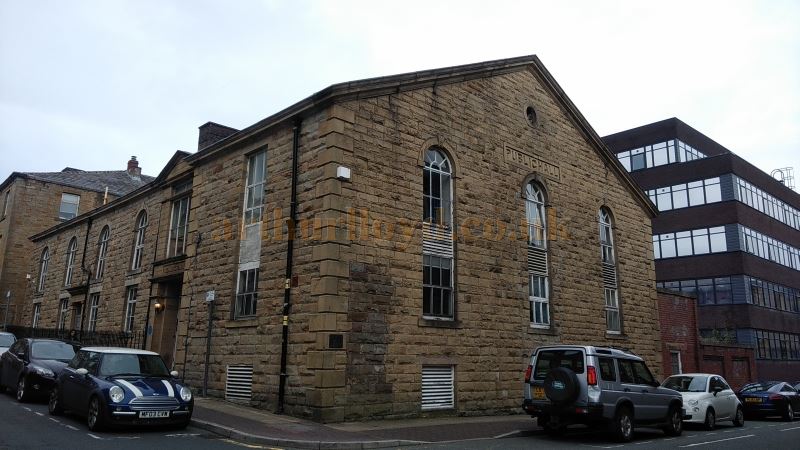
Above - The former Public Hall / Theatre Royal, Burnley in October 2018 - Courtesy Philip Paine.
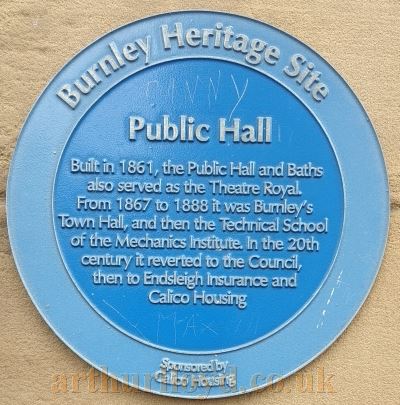
The Theatre Royal, Burnley was originally opened as Burnley's Public Hall in 1861, a reconstruction of a former Mill building, and was situated next door to the town's Public Baths on Brown Street. In 1867, shortly after being altered and redecorated, the building was bought by the Burnley Corporation at auction and it was thought that it might be turned into offices but this didn't happen and the building instead became a Town Hall.
The Hall was also often also in use as a Theatre, sometimes called Gillespie's Varieties and sometimes the Theatre Royal. The Gillespie's name came from it's manager from 1884. The last mentions in the Stage of the Theatre under this name were on the 28th of September 1888 and the 22nd of February 1889. The 1888 add read:- 'Wanted for Gillespie's Varieties, Burnley. Music Hall Artists, Specialities, &c., for October 1st, 8th, and dates onwards.' And the February 1889 add read:- 'Wanted for Gillespie's Varieties, Burnley, Music Hall Artists, Feb 25th onward.' However, this season was not to last long because whilst still under Gillespie's management the Theatre was destroyed by fire on the morning of Thursday the 6th of June 1889 shortly after four o'clock.
The fire was originally thought to have been started by someone smoking in the gallery but later turned out to have probably been arson as the seat of the fire was found to have originated in two separate places in the Theatre. The Stage reported on the fire in their June the 14th 1889 edition saying 'On Thursday morning in last week fire broke out in the T.R. Burnley, the property of Mr. James Gillespie, and in a very short time, despite the efforts of the local fire brigade, the building was completely gutted.
'The stage had been occupied on the Wednesday evening by Messrs. Whaling and Courtney's Variety Co, comprising the following artists: - The Courtney Brothers, Mr. Sam Stream, Mdme. Grace F. Valence, Mr. Robert Templeton, and Miss Violet Templeton, Mr. Harry Dawson, Messrs. Ray and Robins, Major Gans, and Mr. Harry Whaling.
The variety performance concluded at 10.30 o'clock, and Mr. William Gillespie (a son of the proprietor) locked up the place about an hour later. At about ten minutes past four P.C. Croxford was coming along Brown-street when he had his attention drawn to the building, which was then found to be full of dense smoke. On the information being given at the fire brigade station, the brigade soon mustered in full force.
Shortly after the arrival of the brigade the roof began to burn through in several places, each giving way of the timbers being followed by the upleaping of the flames and dense showers of sparks. Some of the portions of the burning roof in its descent brought down the gallery with a crash. A part of the main wall at the rear, near to Bethesda school, also fell inwards. Eventually the fire began to give way, but it was nearly seven o'clock before it was fully extinguished, and firemen were left playing upon the still smoldering ruins for about an hour longer.
It should be mentioned that the theatre was fitted up with sprinklers and also hydrants, together with the necessary lengths of hose in case of any emergency, but the fierce blaze along the front of the stage made it impossible for anyone to get at the sprinklers and get them to work, and when discovered the fire had already so damaged some of the hose as to render it useless. A three-inch water pipe was also laid along inside the theatre, to supply the fire extinguishing apparatus, having been put in about eighteen mouths ago, but when the galleries fell down this pipe was twisted up, and so the water ran to waste. After making a careful examination of the rains under the stage, and in the pay-boxes near the gallery steps, Superintendent Slater has come to the conclusion that there are very clear indications of how the fire originated. What is of greater importance he is absolutely certain that the building was fired intentionally, and that two fires were set going at the same time. Almost every particle of scenery and stage furniture was consumed, including a valuable piano and harmonium.
The company, who, with the exception of Mr. Sam Stream and Major Gana, had all saved their clothing and baskets through the energy and bravery of Mr. W. Gillespie, gave a concert and entertainment, under the patronage of the Mayor, at the Mechanics Institute, on Friday and Saturday evenings, and were fairly well patronised.
Mr. Gilespie has borne up admirably under the loss, and much sympathy is felt for him amongst the licensed victuallers in the town and district. The total loss is estimated at about £3,000, no portion of which is covered by insurance.'
The above text in quotes was first published in the Stage, June the 14th 1889.
A few weeks later a letter in the Stage from Dawson, Tailor, and Co., Limited sort to correct some of this information saying: 'Sir - In your issue of June 14th you publish an account of the destruction by fire of the above theatre, and in that account you state that the theatre was fitted up with "sprinklers" which were of no use, as, owing to the fierceness of the blaze, it was impossible to get at them.
As this statement is likely to be very much misunderstood, would you allow us to state that there were no "sprinklers" in the Burnley Theatre, but simply a system of perforated pipes over the stage, into which water had to be turned through a valve opened by hand.
"Sprinklers" - or more correctly, "Automatic Sprinklers" - do not depend on human agency to bring them into operation. They are absolutely self-acting, the heat itself opening the sprinkler heads, which distribute a heavy and continuous shower of water on the very seat of the fire, at the same time sounding a loud alarm on a gong outside the building.
The "Grinnell" Automatic Sprinkler is fitted in the new Theatre Royal, Bolton, the Theatre Royal, Blackburn, and the York Theatre belonging to the Corporation of that city, who adopted the system after careful investigation of its merits. In December last, the "Grinnell" acted most successfully at the Bolton Theatre in an explosion in the lime light room during a performance, and altogether it has put out nearly 500 actual fires. We must add that most of the large theatres in the United States are protected with Automatic Sprinklers. - We are, dear Sir, yours truly, Dowson, Taylor, and Co., Limited.'
The above text in quotes was first published in the Stage, June the 28th 1889.
 Despite the fire the Theatre Royal seems to have been
rebuilt, or been considered for rebuilding, as an advertisement appeared
in the Stage in August 1908 saying that the Theatre Royal, Burnley, under the management of John
Leopold Junior, was putting on plays by his father, John Leopold Senior,
with his own Company, in 'The Houseboat' and a sketch called 'The Stadium.'
However, no more adds appeared for the Theatre so what became of this
idea is currently a mystery.
Despite the fire the Theatre Royal seems to have been
rebuilt, or been considered for rebuilding, as an advertisement appeared
in the Stage in August 1908 saying that the Theatre Royal, Burnley, under the management of John
Leopold Junior, was putting on plays by his father, John Leopold Senior,
with his own Company, in 'The Houseboat' and a sketch called 'The Stadium.'
However, no more adds appeared for the Theatre so what became of this
idea is currently a mystery.
The building later became home to the Technical School of the Mechanics Institute, and later still it was reacquired by the Town Council who eventually passed it on to and insurance Company. Today it is being used for housing by Calico Housing.
Right - A Burnley Heritage Site Plaque situated on the former Public Hall / Theatre Royal building, in a photograph taken in October 2018 - Courtesy Philip Paine.
If you have any more information or images for this Theatre that you are willing to share please Contact me.
The Tivoli Picture House, Colne Road, Burnley
The Tivoli Picture House was situated on Colne Road in North West Burnley and was designed by W. Heap who also designed the Empress Picture House in Burnley, both Theatres opened in 1912. The Tivoli had an auditorium on two levels, stalls and one circle with a proscenium width of 30 foot. Sound equipment was installed by Western Electric in 1930.
The Theatre was closed in 1965 and converted for Bingo use but this didn't last long and the Theatre was demolished in 1973.
A Visitor to the site, Alan Simpson, has sent in some of his memories of working at the Tivoli as a projectionist, Alan says:- 'I used to work at the Tivoli. Now all the equipment at the Tiv was cheap, the cinemascope lenses were one lump instead of a backing lens and a spreading lens. Each reel of film lasted about 20 mins so we had to change from one machine to the other. All the other cinemas had a device so it could be done by one operator, not the tiv it had to be done by the dowsers, one on and the other one off, it was a two handed operation, the chief projectionist did this while I switched the sound over.
We were showing a film called 'The Baby and The Battleship' a very young Richard Attenborough was one of the stars. We changed over to my projector so it was my turn to look after things. Jack, the chief operator, had his reel out and rewound the film in no time then he was outside having a smoke. I got the next reel laced up ready for showing when I looked at the screen and I could not believe my eyes, a battleship was sailing merrily across the screen when the whole picture started sliding down the screen and was shining on the back of people's heads. So I ran outside to him crying "Jack the battleship we were showing has bloody well sunk". He had used the dowsers that hard that the prism in the lens had slowly fallen over. We were in a pickle we only had one projector so we had to shut down every 20 mins to lace the next reel up. If you were at the Tivoli that night SORRY.
One time we found an old room, I don’t think anyone really knew it was there, we had to break in. When we got in we found an old cardboard box, when we opened it we found a box of slides, some would have been worth quite a bit of money now. Two of them I remember well, one of the slides just said "A COLLECTION WILL NOW BE TAKEN". It was a proper painted slide but it did not say what the collection was for. We tossed it around and everyone was in, so on Saturday night the usherettes were with their empty ice cream trays, and we put the slide on and the usherettes walked down the aisles collecting. When they got back with quite a bit of money they said that no one had asked what the collection was for but it paid for a couple of rounds of drinks in the Byerden house club!
The other slide, there was no way we would ever show that slide, all it said (all properly painted) was "PLEASE DO NOT SPIT ON THE CARPETS!" - Alan Simpson 2014.
If you have any more information or images for this Theatre that you are willing to share please Contact me.
Andrew's Picture House, Ormerod Street, Burnley
Later - The Roxy
Andrew's Picture House was situated in Ormerod Street, Burnley, and was built in 1909. The Theatre later had a change of name to The Roxy but was destroyed by fire in the 1950s. A Visitor to the site, Alan Simpson, has sent in some of his memories of the Roxy, Alan says:- ' I had been working at the Empire as Second projectionist then I moved to the Empress as a full time projectionist, but after about a year or so I was putting more hours in than the mice that lived there. I got told that my old job was going spare so I went and got my old job at the Empire back. I was working my notice at the Empress when one night the manager of the Roxy came up to see me, the word had got round that I had been sacked and he was offering me the chief at the Roxy. But I told him that I was not going to let them down, he understood and told me the job would be open for me if I wanted it. He told me that the man he was setting on, he was not keen on, and did not really want to set him on. Sunday came and I started back at the Empire. That night The Roxy burnt down, we were told that something had been left on. I have always wondered would it still be there if I had taken the job?' - Alan Simpson 2014.
If you have any more information or images for this Theatre that you are willing to share please Contact me.
The Empress Picture House, Accrington Road, Sandygate, Burnley
The Empress Picture House was situated in Accrington Road, Sandygate, Burnley and designed by W. Heap, who also designed the Tivoli Picture House in Burnley, both Theatres opened the same year in 1912.
The Empress was later enlarged and extended in 1914 and could by then accommodate some 1,100 people in its two level auditorium, stalls and one circle. The proscenium opening was 24 foot wide. The Theatre was operated by J. Bradley and was the flagship Cinema in the Bradley Circuit.
Like the Tivoli it was also wired for sound by Western Electric, but a year later in 1931. The Cinema was damaged by fire in April 1950 but was repaired and reopened the following year.
The Empress closed in the 1960s and was then converted for Bingo use but has since been demolished.
If you have any more information or images for this Theatre that you are willing to share please Contact me.
Music Halls in Burnley
There are various mentions of Burnley Music Halls in the ERA archives but I have not followed them up yet.
In 1860 - 1862 there was a Poet’s Corner Music Hall in Burnley, Proprietor J. Mosedale.
In 1864 there was a Hall Inn Music Hall in Burnley, JM Mayes manager.
In Sep 1866 there is mention of the New Market Music Hall, Burnley, proprietor John Sagar, to open on 10th Sep 1866 (confusing as to whether this was 1st opening.)
In 1869 there was a People’s Music Hall in Burnley, established 1867, and possibly another name for the Theatre Royal.
If you have any more information or images for this Theatre that you are willing to share please Contact me.