
Theatres, Music Halls, and Cinemas in Camberwell, London
Camberwell Palace of Varieties / Oriental Palace of Varieties - Metropole Theatre / Empire Theatre / Empire and Picture Palace / New Empire Cinema / Odeon Cinema - Rosemary Branch / People's Palace of Varieties / Lovejoy's - The Castle / Bijou Palace of Varieties / Godfrey's Castle Music Hall - The Athenaeum - The Essoldo Cinema / Golden Domes / The Rex - The New Grand Hall Cinematograph Theatre / Grand Cinema - The Camberwell Central Cinema The Coronet - The Regal - The Lava Rink - The Surrey Masonic Hall - Cinemas in Camberwell
See also in this area - Peckham Theatres
The Camberwell Palace of Varieties, 23 - 31 Denmark Hill, Corner of Orpheus Street, Camberwell
Later - The Palace Cinema - Earlier Proposed Theatre but not built - The Oriental Palace of Varieties
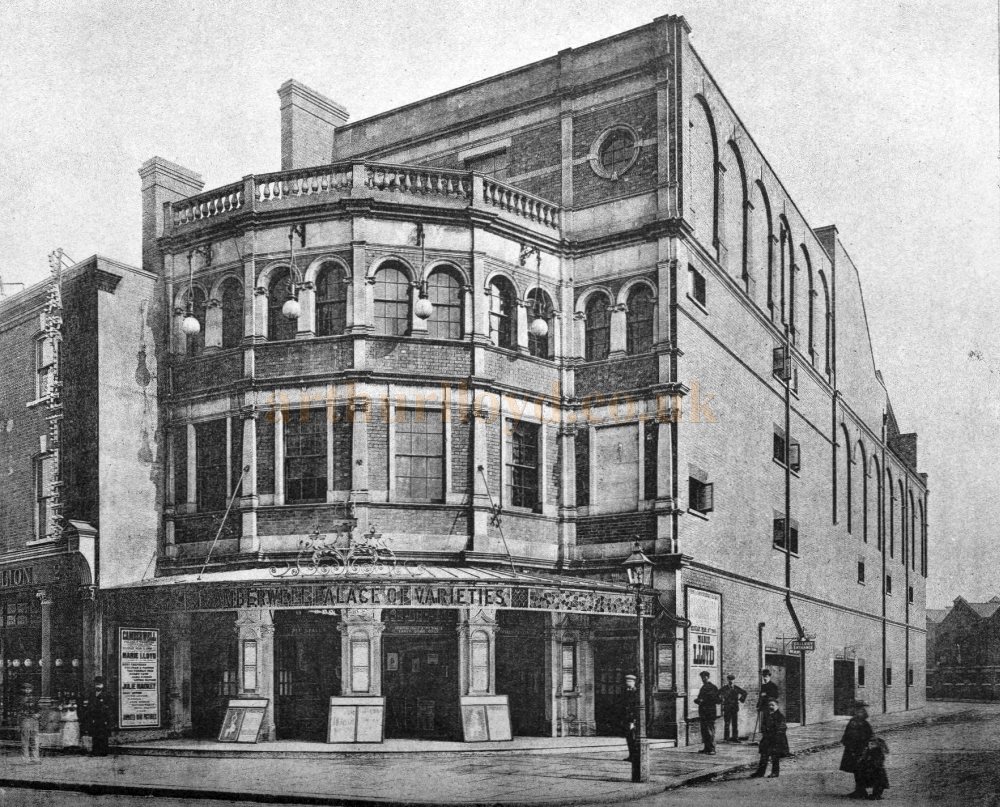
Above - The Camberwell Palace of Varieties with Marie Lloyd on the Bill in 1903 - From The Architect, 22nd of May 1903.

 The
Camberwell Palace of Varieties was situated on the corner of Orpheus
Street, on the east side of Denmark Hill, and just down the road from
the Metropole Theatre on the west side, (the Metropole
would later become the Empire Theatre). The Camberwell
Palace opened on Monday the 20th of November 1899 and had an auditorium on three levels, stalls and pit, balcony, and
gallery, and, with its boxes, had a capacity on opening of 2,117.
The
Camberwell Palace of Varieties was situated on the corner of Orpheus
Street, on the east side of Denmark Hill, and just down the road from
the Metropole Theatre on the west side, (the Metropole
would later become the Empire Theatre). The Camberwell
Palace opened on Monday the 20th of November 1899 and had an auditorium on three levels, stalls and pit, balcony, and
gallery, and, with its boxes, had a capacity on opening of 2,117.
Right - A Google StreetView Image of the site of the Camberwell Palace today - Click to Interact.
 The Theatre was designed by the architect Ernest
A. E. Woodrow, who would go on to design the Clapham
Grand Theatre in 1900, which
is now the only completely surviving example of his work. The Camberwell
Palace was built by C. Gray Hill, of Coventry,
for its general manager, Jesse Sparrow (Shown Left), who would also run the Clapham
Grand, the Granville, Walham-green,
and the Palace, Croydon.
The Theatre was designed by the architect Ernest
A. E. Woodrow, who would go on to design the Clapham
Grand Theatre in 1900, which
is now the only completely surviving example of his work. The Camberwell
Palace was built by C. Gray Hill, of Coventry,
for its general manager, Jesse Sparrow (Shown Left), who would also run the Clapham
Grand, the Granville, Walham-green,
and the Palace, Croydon.
Left - Jesse Sparrow, General Manager of the Camberwell Palace when it opened in 1899 - From The South London Press, 11th of November 1899.
Some years earlier another Music Hall was proposed for the site of the Camberwell Palace called the Oriental Palace of Varieties but although it is sometimes reported today that the Oriental was actually built in 1896 on the same site, this is not what happened. A Company was set up in March 1896 called the Oriental Palace of Varieties Ltd., formed to purchase the land and freehold properties on Denmark Hill, including the Golden Lion Public House and a piece of land which was being used as a bowling green, a skittle alley, stables, and an oasthouse behind, in order to create a site for the new Theatre of some 2,748 square yards. (The Golden Lion dated back to at least 1747). Jesse Sparow was the Manager of the Oriental Palace Company and the well known Music Hall entertainers, Dan Leno and Herbert Campbell, were the Directors.
By April 1896 some plans had already been drawn up for the Oriental and then disapproved by the Council as they did not comply with regulations. This was all to do with the proposal to construct a new public thoroughfare beside the Theatre, 30 foot wide, when regulations stipulated it should be at least 40 foot wide, which would mean the Company acquiring additional properties. This problem rumbled on until October 1897 when the Company submitted new plans which met the required regulations but then the Council had more questions about the Theatre itself and the time it would take to build it, they wanted it finished within six months, presumably because of the disruption it would cause. However, by November 1897 the Company was in trouble, a general meeting of the Oriental Palace of Varieties LTD., was held in the Golden Lion Pub to discuss whether they should sell up and dispose of their assets. It turned out that the properties they had bought and planned to buy were too expensive and the land they freed up was not large enough, indeed they would have to buy further land costing another £10,000 to make the project work. The Company's debts were already up to £5,800 by this time and shareholders were advised that the scheme should not go ahead under the present management. The Company was then wound up and a new Company called the Camberwell Palace of Varieties Company acquired the ownership of the assets etc for £27,500. There was some debate as to whether these two Companies were actually one and the same but in the end a new provisional Licence was passed for the new Company to build a Theatre on roughly the same site and the project was back on, albeit with a slightly different management, and a new name.
Three months later, in February 1898, the plans for the Camberwell Palace of Varieties had been prepared by the architect Ernest Woodrow, and this time, thankfully, all was well with the proposal. The foundation stone was laid on Monday July the 3rd 1899 by the well known Music Hall artiste, Vesta Tilley. The ERA reported on the occasion in their 8th of July 1899 edition saying: 'Music Hall enterprise is certainly not lacking in South London, and its latest pleasure house, the Camberwell Palace of Varieties, which has risen on the site of the music hall that was projected a year or two since as the Oriental, will be opened to the public in a few months, at latest on Boxing Day.
 The
main features of the building, as we saw it on Monday, is an immense
girder, a forest of scaffold poles, and a mass of excellent brickwork.
On the day in question, however, the scene was brightened by pretty
costumes, belonging to well-known faces, ladies of the profession, who
had come to support their sister in art, Miss Vesta Tilley, in laying
the memorial stone of the new establishment.
The
main features of the building, as we saw it on Monday, is an immense
girder, a forest of scaffold poles, and a mass of excellent brickwork.
On the day in question, however, the scene was brightened by pretty
costumes, belonging to well-known faces, ladies of the profession, who
had come to support their sister in art, Miss Vesta Tilley, in laying
the memorial stone of the new establishment.
Right - Vesta Tilley - From the ERA, July 8th 1899.
It was a happy thought on the part of the directors to ask Miss Tilley to perform the ceremony. She certainly considered it a great honour, but it was an honour conferred where honour is due. The proceedings were opened by the presentation of a handsome bouquet, and Mr Ernest Woodrow, the architect, having endowed her with a handsome silver trowel, she spread the cement in the orthodox fashion, the stone was lowered, and she declared it well and truly laid.
After the cheering had subsided, Mr Woodrow made a few remarks concerning the building. He was instructed to prepare the plans only in February last, and he did not think any architect had ever been so fortunate as he had been in his contractor, Mr C. Gray Hill, of Coventry, who had worked most expeditiously. He explained that the width of the auditorium was 62ft., depth, 76ft.; depth of stage, 27ft. 9in.; and width of proscenium opening, 30ft. The height of the stage from floor to gridiron is 50ft.
Mr Jesse Sparrow said the directors desired him to express their deep obligations to Miss Vesta Tilley for laying the commemoration stone—a duty she had performed in her accustomed graceful manner, and he only hoped that when the building was opened she would be amongst the first to give them the benefit of her services—a remark which was greeted with prolonged applause.
That hall, Mr Sparrow went on to say, was syndicated with the Grand and the Granville, and he would hope, with Addison, that, although it was not in mortals to command success, they would do their best to deserve it. Mr Walter De Frece returned thanks on behalf of his wife, Miss Vesta Tilley, for the honour they had shown her in asking her to be the chief instrument in that day's function. When she received the request of the directors, she thought someone more worthy might have been chosen (cries of " No, No "), but she gladly gave her consent to what had been such a pleasant proceeding. He might also say on her behalf that she would be delighted to sing the first song in the new Camberwell Palace of Varieties. At the conclusion of Mr De Frece's speech there were loud calls for Miss Tilley, and she came to the front and said a brief word or two of thanks.'
The above (edited) text in quotes was first published in the ERA, 8th July, 1899.

Above - The auditorium of the Camberwell Palace - From the ERA, 2nd of December 1899 - To see more of these ERA Sketches click here.
The ERA visited the Theatre again just before it opened and reported on what they saw in their 18th of November 1899 edition saying: 'Another lordly pleasure house for the people now rears its head in the southern suburbs, and, in the new Camberwell Palace of Varieties, which was privately viewed on Friday afternoon by a large number of shareholders, their friends, and a considerable sprinkling of managers and artistes, emphasises in the most striking manner the immense advance that has been made, and that continues to be made, in the beauty, comfort, and convenience of London's variety house.
Mr Woodrow received a large number of congratulations from the numerous visitors on Friday. What may be at once conceded to the genius of the planner is that, though the house is really a very large one, it has the cosiest appearance possible. This much-to-be-desired quality has been obtained by means of the warm tones that are seen everywhere. The new house opens on Monday with an excellent company, and the inauguration will be commenced in loyal fashion by the singing on the stage of the National Anthem...
The interior of this new theatre is striking, both in the rich treatment of colour employed by Mr Ernest A. E. Woodrow, the architect of the building, and in the lines of the "fronts" adopted by him. On entering the auditorium one is at once impressed with the bold manner in which the three private boxes at each side of the proscenium on the balcony tier have been designed. The architectural detail and the colouring is Saracenic, a style which Mr Woodrow is said to have chosen on account of the opportunities which it provided for a treatment of detail, both in form and colour, suited to an auditorium of the large dimensions of this theatre.
 The chief tone of the ceiling is blue relieved with a strong red. The
proscenium is gold with an old gold pelmet, and drop curtain embroidered
in a blue Moorish design. The drapery to the private boxes is of a soft
blue embroidered with old gold, to afford a contrast and, at the same
time, to harmonise with the act-drop.
The chief tone of the ceiling is blue relieved with a strong red. The
proscenium is gold with an old gold pelmet, and drop curtain embroidered
in a blue Moorish design. The drapery to the private boxes is of a soft
blue embroidered with old gold, to afford a contrast and, at the same
time, to harmonise with the act-drop.
The carpet which covers the whole of the area floor is also of a blue tone, but to counteract the effect, and to provide warmth and comfort to the eye, the whole of the chairs are of a rich red velvet, and the walls at the back of the auditorium are covered in a deep red paper.
Right - A Painting of the interior of the Camberwell Palace by George Richmond who says 'The painting is based on a drawing on this page from the ERA of December 1899. The colours and placement of these in the painting are as detailed in the same issue.' - Click for an Index to all of George Richmond's Paintings on this site.
The private boxes and front part of the house have, however, been very differently treated, and a specially designed Moorish paper applied. The whole effect is one of repose, in spite of the daring experiment of the architect to employ a warm colour scheme to the auditorium instead of the much repeated treatment of cream and gold. The whole of this decorative work has been most artistically executed under Mr Woodrow's personal directions, by Messrs Campbell, Smith, and Co., while Messrs Fred Harper and Co. have worked their draperies with due regard to the effect as a whole.
As to the general plan of the theatre, it is a far larger house than one would suppose from external appearance. The auditorium is 62ft. wide and 76ft. 6in. deep, with a proscenium opening 30ft., and a stage 28ft. deep. The Camberwell Palace can boast of more exits than any house in London of the same size. There are no less than six direct exits into the street from the pit or area level. There are three staircases, 4ft. 6in, wide, from the balcony, and three more of the same width from the gallery. The building, including the Golden Lion public-house, is isolated on all sides, affording every means of providing such an unusual number of exits.
The structure is absolutely and entirely fireproof, built of bricks, concrete, and steel cantilevers embedded in concrete. There are no columns, the modern method of construction with steel cantilevers being employed by the architect. The most important point in theatre planning from the public and manager's point of view has not been forgotten, for we can say without fear of contradiction that there is not one seat in stalls, pit, balcony, or gallery, where the whole width and depth of the stage cannot be entirely seen. The rake of the pit floor is more than the ordinary pitch, and yet there is no sensation of excessive height from even the back row of the gallery.
Reverting to the decorations, a departure has been made in the auditorium and bars by the liberal use of coloured leaded glass. The spaces under the private boxes are treated thus, and a brilliant effect is thereby obtained, and a "furnishing" effected to a space in the house always useless and usually empty and cold. Mr Woodrow, the architect, who at one time was in the theatres department of the L.C.C., was a pupil of the late Mr C. T. Phipps, F.S.A. (sic). Last year he carried out the rebuilding of Collins's Music Hall, and he is now engaged upon the completion of the drawings for the New Grand Palace at Clapham-junction. Every detail at Camberwell has been carried out under his personal and direct supervision and superintendence.
 The building is warmed throughout by hot water radiators, and the ventilation
assured by a sliding roof, lantern lights over the gallery, electric
exhaust fans under the balcony and pit ceilings, and a large louvre
ventilator over the stage. The stage is divided from the auditorium
by a double asbestos curtain and iron door, and the dressing-rooms are
behind the stage in a distinct block and a separate fire risk.
The building is warmed throughout by hot water radiators, and the ventilation
assured by a sliding roof, lantern lights over the gallery, electric
exhaust fans under the balcony and pit ceilings, and a large louvre
ventilator over the stage. The stage is divided from the auditorium
by a double asbestos curtain and iron door, and the dressing-rooms are
behind the stage in a distinct block and a separate fire risk.
Left - A poster for 'A Strip From Broadway' at the Camberwell Palace in the 1950s.
The structure has been raised by a contractor who has had large experience in theatre buildings, for Mr C. Gray Hill, of Coventry, has erected the Granville Theatre of Varieties, Walham-green, the Shakespeare Theatre, Clapham-junction, and many other theatres. Of the other contractors employed we may mention that the steel work and cantilevers have been carried out by Messrs Richard Moreland and Son, of Old-street, St. Luke's; the roof iron work by Messrs H. Young and Co., of Pimlico. The decorations have been worked out by the well-known firm of Messrs Campbell, Smith, and Co. The building and stage has been lit throughout by electric light, the work being executed by the well-known firm of Messrs Laing, Wharton, and Down, who have had vast experience in theatrical lighting. The upholstery has been executed by Messrs F. Harper and Co., of City-road. The hot water installation has been put in by Messrs Charles P. Kinnell and Co., of Southwark street. The fire appliances and fire curtains by Messrs Merry weather. Mr Rossiter has acted as clerk of work, and Mr Steane general foreman.'
The above (edited) text in quotes was first published in the ERA, 18th November, 1899.

Above - The Camberwell Palace in 1931 sporting advertising for the 2 reel MGM Comedy Film 'Laurel - Hardy Murder Case' and a Stage Show called 'Hello Everybody' - From the Bioscope, 4th of February 1931.
The Theatre was designed as a Variety Theatre and it survived in this form for many decades, although it wasn't long before Film shows began to be added to the Variety Bills in the early 1900s. In 1908 the architect of the Apollo Theatre in Shaftesbury Avenue, Lewin Sharp, was responsible for some major alteration to the Camberwell Palace.
In September 1932 the Theatre was taken over by Associated British Cinemas who fitted the building with a Western Electric sound system and converted it into a Cinema called the Palace Cinema, with a more modest capacity of 1,396.
In 1940 Associated British Cinemas opened their new Regal Cinema in Camberwell Road and sold the Palace to the Hyams Brothers who operated it under their subsidiary 'Loughborough Playhouses Ltd.' This was not to last long however, and on the 18th of April 1943 the Cinema was closed.
The building was then reopened on the 26th of April the same year as a Variety Theatre again under the name of the Camberwell Palace Theatre.
In 1948 the Theatre became home to the 'Court Players' a repertory theatre company who would eventually be replaced at the Theatre by another rep company called 'The Under Thirty Group' in 1954.
A visitor to this site, Mike Thomas, has sent in some memories of the Camberwell Palace during this period, he says:- 'In 1950/1951 my mother (Lilian Thomas) joined the Camberwell Palace as a cashier and soon became the Box Office Manager. The overall Manager for the theatre (possibly still Regis) was Gilbert Oscroft. When I was thirteen (1954) I was given a job "part-time" as a "Lime" Boy. I would rush home from school (Archbishop Tenisons) do my homework and the get on up to the Palace for "Curtain Up!". I would set up the two lamps ready for my friend Teddy Scott, who was about seventeen and had another job. The level of anxiety when the intro music started and he had not appeared was dreadful and I had to prepare for the worst, although he did always show up! I earned 10 shillings a night while my school pals were getting 5 bob a week for their paper rounds. Sometimes I would have to work in the bar or on the door. This was all fun except for the night when Charlie and Eddie Richardson refused to show their tickets and threw me over a pile of barrels stacked up in the corridor. They were OK after that! Great fun when you were 13/14 years old! I would not have the nerve to operate one of those Lime lights today!!' - Mike Thomas.
After this the Theatre began showing so called 'girlie shows' in the style of the earlier Windmill Theatre Revues and found itself in trouble in 1956 when the nineteen year old Peaches Page was found moving whilst on stage in the nude. She claimed that a mouse had frightened her but her protestations would not avoid her being sacked.
 The Theatre closed for the last time after the last performance of 'French Design' on Saturday the 28th of
April 1956 and the staff of 60 people were let go, it then stood derelict for many years. Its end nearly came several times afterwards when a series of fires, mostly started by children playing in the derelict building, almost set the Theatre on fire. One fire on the stage in 1959, and another under the stage in 1961, and a third fire on the second floor in 1962, all could have gutted the building, but luckily they were all put out by the fire brigade, but its days seemed numbered.
The Theatre closed for the last time after the last performance of 'French Design' on Saturday the 28th of
April 1956 and the staff of 60 people were let go, it then stood derelict for many years. Its end nearly came several times afterwards when a series of fires, mostly started by children playing in the derelict building, almost set the Theatre on fire. One fire on the stage in 1959, and another under the stage in 1961, and a third fire on the second floor in 1962, all could have gutted the building, but luckily they were all put out by the fire brigade, but its days seemed numbered.
Right - A Google StreetView Image which shows, to the left, the site of the former Camberwell Palace of Varieties, and, at the top right, the site of the former Metropole Theatre - Click to Interact.
In 1968 the Theatre became part of a proposal for regeneration of the area and a possible restoration of the Theatre was announced but sadly this came to nothing in the end and the Theatre was demolished instead, a sad end for this much loved Camberwell Theatre. A branch of HSBC stands on the site of the Theatre today.
If you have any more information or images for this Theatre that you are willing to share please Contact me.
Camberwell Palace Memories

Above - The Camberwell Palace - From a programme for the Theatre circa 1900.
A visitor to the site, Kathleen Rogers, has submitted part of the memoirs of her Grandfather, Albert Wentworth Davies, who was born in 1902, in which he writes on his visits to the Camberwell Palace when still a young lad growing up in Camberwell saying:- 'During my early years, the stage produced quite a number of cockney singers; Dan Lino, G. H. Chaldwin, Kate Carney, Marie Lloyd and many others. Since the theatre and music halls were well embedded in the Englishman's character even Camberwell had it's local theatre, The Camberwell Palace. It cost two pence to get a seat in the 'Gods' or Gallery. This was far above our means, never the less, we managed to get in. We would duck below the pay window so we couldn't be seen, run up the stair case, which lead to the gallery, and give the doorman, an old fellow called Dick Price, one half penny and he would let us in. Wherever you are old Dick, we all remember you with great affection and may you always. have a seat in the 'Gods'. You gave us our first glimpse of the theatre. The Palace was a veritable wonderland and an escape from the manacles of penury for a brief and enchanting moment. To me it was magic, the proscenium arch and Seraphim and Cherubim and trumpeting angels, the orchestra pit and the animated scene in the circle and pit stalls and the general feeling of gaiety throughout the house. It was recognised that if the gallery acclaimed the play it was a sure sign of success. We applauded everything. How I admired the singing and the singers, I listened with joy to the sentimental music hall songs of those days. They never failed to bring tears to my eyes and a lump in my throat. The moments spent in the theatre were among the few happy ones I can remember.' - Albert Wentworth Davies Courtesy Kathleen Rogers.
The Metropole Theatre, Corner of Denmark Hill and Coldharbour Lane, Camberwell
Later - The Empire Theatre / Camberwell Theatre and Picture House / Empire and Picture Palace / The New Empire Cinema / Odeon Cinema / The Foyer

Above - A 1904 postcard of the Metropole Theatre, Denmark Hill, Camberwell, later the Empire Theatre
 The
Metropole Theatre opened on Monday the 29th of October 1894 with a production by the Comyns Carr's Company of 'Sowing the Wind'.
The Theatre was situated on the east side of Denmark Hill at the junction
of Coldharbour Lane, just up the road from the future Camberwell
Palace of Varieties on the west side, which would open in November 1899.
The
Metropole Theatre opened on Monday the 29th of October 1894 with a production by the Comyns Carr's Company of 'Sowing the Wind'.
The Theatre was situated on the east side of Denmark Hill at the junction
of Coldharbour Lane, just up the road from the future Camberwell
Palace of Varieties on the west side, which would open in November 1899.
Right - A Programme for the Metropole Theatre, Camberwell in 1897.
 The
Metropole Theatre was not a Music Hall like the Camberwell Palace but rather, a playhouse
built to house plays and opera. The Theatre was designed by Bertie
Crewe and W. G. R. Sprague,
and built for J. B. Mulholland who wanted to be able to bring West
End successes to Camberwell.
The
Metropole Theatre was not a Music Hall like the Camberwell Palace but rather, a playhouse
built to house plays and opera. The Theatre was designed by Bertie
Crewe and W. G. R. Sprague,
and built for J. B. Mulholland who wanted to be able to bring West
End successes to Camberwell.
Left - A Programme for 'Our Flat' and 'Quong-Hi' at the Metropole Theatre, Camberwell in March 1898 - Courtesy David Garratt. Click to see the entire programme.
The ERA reported on the construction of the Metropole in their 18th of November 1893 edition saying: 'Mr J. B. Mulholland has for some time been on the outlook for another theatre to work in connection with the Grand Theatre, Nottingham. We note with satisfaction that the plans of a new theatre for Mr Mulholland, to be erected in Camberwell, on a site at the junction of Denmark-hill and Coldharbour-lane, were passed by the Theatres Committee of the London County Council last week, and approved of by the County Council on Tuesday.
 The
site has the advantage of being two miles in every direction from any
existing theatre, and there is no theatrical opposition within a radius
of two and a half miles.
The
site has the advantage of being two miles in every direction from any
existing theatre, and there is no theatrical opposition within a radius
of two and a half miles.
Right - A Seating Plan for the Metropole Theatre, Camberwell in 1898 - From a Programme for 'Our Flat' at the Theatre in March 1898 - Courtesy David Garratt. Click to see the entire programme.
The site has a frontage of about 180 ft. to Coldharbour-lane by 130 ft. to Denmark-hill, both being main thoroughfares. A handsome corner elevation fronting Camberwell-green will be a feature of the building. The theatre will be what is known as a two-tier house—that is to say, it will have a dress-circle and balcony—the latter slightly raised on one tier and gallery on the other, with stalls and pit occupying the ground-floor...
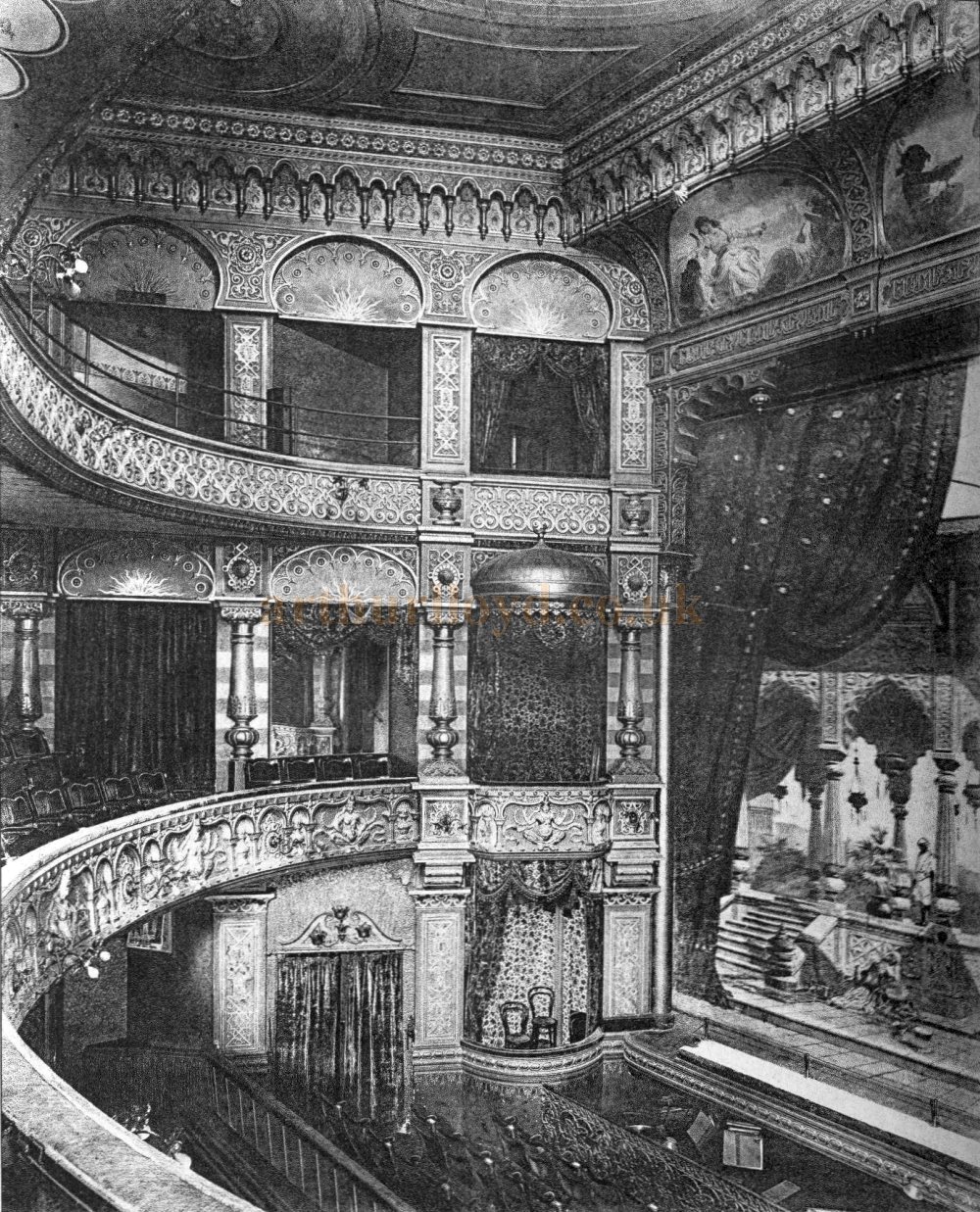
Above - The Auditorium of the Metropole Theatre, Camberwell in 1903 - From The Architect, 29th of May 1903.
 ...All
parts of the auditorium will be provided with special exits, and the
entire building will be constructed of fireproof materials. The circles
and stalls will be approached through a handsome vestibule, measuring
25ft. by 18ft., this and the saloons being divided from the auditorium
by a main wall. The stage measures 70ft. by 40ft., and will be fitted
with all the latest improvements. There will be two exits direct to
the street, one from each side, and the scene door at the back will
permit of a horse and carriage being driven straight on to the stage.
...All
parts of the auditorium will be provided with special exits, and the
entire building will be constructed of fireproof materials. The circles
and stalls will be approached through a handsome vestibule, measuring
25ft. by 18ft., this and the saloons being divided from the auditorium
by a main wall. The stage measures 70ft. by 40ft., and will be fitted
with all the latest improvements. There will be two exits direct to
the street, one from each side, and the scene door at the back will
permit of a horse and carriage being driven straight on to the stage.
Right - A Programme for 'A Midsummer Night's Dream' at the Metropole Theatre, Camberwell in 1895.
 The
artist's dressing-rooms, numbering ten, will be in a separate block
of buildings, all having access to the street without crossing the stage,
and each room possessing direct ventilation from the open air.
The
artist's dressing-rooms, numbering ten, will be in a separate block
of buildings, all having access to the street without crossing the stage,
and each room possessing direct ventilation from the open air.
Left - The Foyer of the Metropole Theatre, Camberwell - From a Programme for 'Our Flat' at the Theatre in March 1898 - Courtesy David Garratt. Click to see the entire programme.
A ballet room and band room are also provided. The site has been admirably utilised by the architects, Messrs Crewe and Sprague, who have, moreover, embodied a number of Mr Mulholland's suggestions, the result of practical experience, which have been of great value.
The comfort of the artistes has been most carefully considered; the heating, ventilation, and sanitation having received special attention. It is intended that building operations shall commence, weather permitting, this side of Christmas, and that the house shall be opened early in the autumn of next year. Judging by the plans and specifications, the new London theatre should be one of the most complete and comfortable playhouses in the metropolis. Mr Mulholland will continue to make Nottingham his headquarters, but the convenient train service will enable him to devote himself vigorously to both his enterprises.
The above text in quotes was first published in the ERA, 18th of November 1893.

Above - The Auditorium of the Metropole Theatre, Camberwell - From a Programme for 'Our Flat' at the Theatre in March 1898 - Courtesy David Garratt. Click to see the entire programme.
Construction began on the Metropole Theatre in December 1893 and some six months later, when nearing completion in July 1894, Reynolds Newspaper printed a report on the occasion of the lifting of the main roof girder into position in their 8th of July 1894 edition saying:- 'Yesterday afternoon, without any particular splash or ostentatious blowing of trumpets, this theatre, which has been quietly but steadily progressing since December last, entered upon its semi-final stage...

Above - A very rare Photograph of the construction of the Metropole Theatre, Camberwell in 1894 - © M.L.

Above - A very rare Photograph of the construction of the Metropole Theatre, Camberwell in 1894 - © M.L.
 ...It seems that in the case of any important enterprise, the building
and kindred trades affected, regard the hoisting into position of the
main girder, or "principal," of the roof, as the beginning
of the end, as far as they are concerned.
...It seems that in the case of any important enterprise, the building
and kindred trades affected, regard the hoisting into position of the
main girder, or "principal," of the roof, as the beginning
of the end, as far as they are concerned.
Right - A Painting of the interior of the Metropole Theatre, Camberwell by George Richmond. The painting is based on a photograph shown further up on this page, and the colour scheme is from a contemporary programme which is tinted buff and green - Click for an Index to all of George Richmond's Paintings on this site.
All the auditorium walls being complete, yesterday was fixed upon for this informal ceremony. Pioneered by Mr. Brongh, the clerk of the works, and Mr. Pattinson, the building contractor, the more venturesome of the party proceeded to mount a wilderness of ladders and scaffoldings, presently to emerge upon what will be the roof over the gallery, at a height of some 65ft. All being ready, Mr. Mulholland, the owner, gave the signal; the ponderous beam was swung out, and was placed in position. The orthodox flag was then hoisted upon a tall mast specially fixed for the occasion, and was greeted with three ringing cheers from the small army of men engaged on the job. The workmen on the job were regaled in a manner in keeping with the occasion and the thirsty weather, while the owner, the architects, and the builders, received the congratulations of the visitors upon the splendid progress made, and the excellent prospects of London's latest playhouse...

Above - A very rare Photograph of the construction of the Metropole Theatre, Camberwell in 1894 - © M.L.
It is confidently anticipated that the theatre will be opened during September. Mr. J. B. Mulholland, of the Grand Theatre, Nottingham—a gentleman who has had a varied and practical experience in theatrical management—is the sole proprietor of the new theatre, which will be carried on under his personal supervision. He is sanguine as to the dramatic possibilities of the enormous neighbourhood of which his theatre is the centre.'
The above text in quotes was first published in Reynolds Newspaper, 8th of July 1894.

Above - The Empire Theatre, Camberwell, formerly the Metropole Theatre, in a photograph taken post 1906
 The
Metropole Theatre didn't open until Monday the 29th of October 1894 in the end, but would then be so successful that Jesse Sparrow, who
also ran the Clapham Grand, the Granville,
Walham-green, and the Palace, Croydon,
soon had the idea of building another Theatre in Camberwell, just up
the road from the Metropole. This was built in 1899 and called the Camberwell Palace.
The
Metropole Theatre didn't open until Monday the 29th of October 1894 in the end, but would then be so successful that Jesse Sparrow, who
also ran the Clapham Grand, the Granville,
Walham-green, and the Palace, Croydon,
soon had the idea of building another Theatre in Camberwell, just up
the road from the Metropole. This was built in 1899 and called the Camberwell Palace.
The Metropole itself would later be renamed the Camberwell Empire Theatre in 1906 and by 1912 early Biscope pictures were being shown as part of the Variety shows (See Programme Right and photograph above).
Right - A Twice Nightly Variety Programme for the Empire Theatre, Camberwell on Monday September the 23rd, 1912. (Formerly the Metropole Theatre.) Pictured on the cover are the Proprietress at the time, Cissy Lawson, and the Managing Director, John Lawson - The Bill for this show included Deer & Daring, The Three Cunards, Resco & Resco, A play called 'Again A Woman' with Cissie Lawson, Charles King, and Bertram Burleigh, also on the Bill were Cissie's Bioscope, The Denninsons, Mona Garrick, Will Last, The Almas, Jack Green and Company, Miss Iron Curtain, Scholey & Sechley, Mark Anton, and Frank Mayo, and a sketch entitled 'The Bargain' with W. F. Cram, Victor Broom, Bill Harkens, and Lillian Deane.
 In 1918 Films had become so
popular that the Theatre went over to mixed use with Films and Live
productions both being shown, and its name was changed to the Camberwell
Theatre and Picture House, run by Associated Cinematograph Theatres.
In 1918 Films had become so
popular that the Theatre went over to mixed use with Films and Live
productions both being shown, and its name was changed to the Camberwell
Theatre and Picture House, run by Associated Cinematograph Theatres.
Left - Cissie Lawson as 'Sally in our Alley', she was also the Proprietress of the Camberwell Empire in 1912 - Courtesy Gillian Brown.
In 1924 the Theatre went over to full time Cinema use as the Camberwell Empire and Picture Palace. And in 1930, having been equipped for sound, it was renamed the New Empire Cinema, although it did still stage variety shows on its stage occasionally.

 In May 1937 the Theatre was bought by Odeon Theatres who demolished
the building so that they could build a new Odeon Cinema on the site.
In May 1937 the Theatre was bought by Odeon Theatres who demolished
the building so that they could build a new Odeon Cinema on the site.
Right - A Programme for 'The Man Who Came Back' and 'I'm Sorry!' at the Camberwell Empire in March 1916 - Courtesy Keith Hopkins.
The new Odeon Cinema was designed by the architects Andrew Mather and Keith P. Roberts for Oscar Deutsch's Odeon Theatres Ltd., and opened on the 20th of March 1939 with the Film 'Men With Wings.' The auditorium was designed in the Art Deco style on two levels, stalls and one circle, and had a large seating capacity of 2,470. Indeed it was the fourth largest Cinema built for the Odeon Circuit at the time.
The original Metropole / Empire Theatre had had its main entrance on the corner of Denmark Hill and Coldharbour Lane but the new Odeon Cinema instead had two identical entrances, one on each of these roads. The Cinema was damaged several times during the war in 1944 but each time was repaired and kept open. But by the 1970s attendances had dropped off significantly and the stalls had to be closed, along with the Denmark Hill entrance, so that the Cinema could carry on operating, but with the reduced capacity of 986 using the Circle only.
The Odeon Cinema closed on the 5th of July 1975 after the last showing of the film 'The Night Porter,' which surprised the locals who had heard nothing about it. The building then stood empty and unused until it was converted into a 'Dicky Dirts' store in January 1981 (see photo here). But this was not to last long and when the Company folded, the place stood empty until the spring of 1993 when it was finally demolished.
A new building, called The Foyer, which was designed as sheltered accommodation for the homeless, was then constructed on the site (See Photograph Below).

Above - The Foyer, built on the site of the former Metropole Theatre / Empire Theatre / Odeon Cinema, Camberwell - Photo M.L. April 2010.
If you have any more information or images for this Theatre that you are willing to share please Contact me.
The Athenaeum, Camberwell New Road, Camberwell

Above - The former Athenaeum Public House, Camberwell New Road, Camberwell - Photo ML April 2010
The Athenaeum Public House on Camberwell New Road is said to have been home to entertainments such as Music Hall in its early years. The building still survives and has two date plaques near the roof, one reading 1697, which is presumably the date it was first constructed, and the other 1912, when it looks to have been rebuilt. The building is no longer a public house but is now home to offices and shops.
If you have any more information or images for this Theatre that you are willing to share please Contact me.
The Surrey Masonic Hall, Camberwell New Road, Camberwell
The Surrey Masonic Hall stood on the north side of Camberwell New Road, not far up the road from the New Grand Cinamtograph Theatre. See location here, old photo here, and a poster here. Apart from being a Masonic Lodge it was also the home of the South London Institute of Music, and often used to show the general public places and events from far away. In 1881 there was an art exhibition there depicting a voyage around the world, including such places as China, Japan, India. Persia, Egypt, and Australia.
A Company was set up to build the Surrey Masonic Hall in 1872, which was announced in the Freemason's magazine of November that year, and the foundation stone was laid by Colonel Burdett on the 20th of May 1874. The Hall was designed and built by Br John Oliver and completed on Wednesday the 19th of April 1876.
The opening of the Surrey Masonic Hall was reported in the ERA on the 23rd of April 1876, who said: 'In consequence of the rapid strides which the Ancient order of Freemasonry has taken since the Prince of Wales was enrolled and subsequently became Grand Master of English Freemasonry, a new Home has been found necessary, for the members of it living in the southern districts of London. The Hall in the Camberwell has been the entire work of members of the Craft. Br E. Clark and Br John Oliver, the architect and builder, having both obtained high honours in their respective Lodges, and all the share-holders who found the money are also necessarily members of the Order.
The first stone of the building was laid by Colonel Burdett, Provincial Grand Provincial Grand Master, who was surrounded by some of the most eminent members of the Craft on the 20th of May, 1874, and a portion of the building was consecrated to Masonry by Lord Skelmersdale on the 14th of July, 1875, and two or three Lodges hare met in the Hall for a few months past, but it was only on Wednesday that the main portion of the edifice was completed. The building comprises a splendid Hall, 95ft. long, 40ft. wide, and 35ft high, in which gatherings of the Craft can take place, and when not so engaged can be used for other purposes.
In order to identify the completion of this building with one of those great objects, the distinguishing features of Freemasonry, it was determined that it should be given to a charitable purpose, and accordingly a grand opening ball was arranged, the proceeds to he devoted to the benefit of the Royal Institution for Girls, and a body of something like 150 Stewards, belonging to different Lodges, came forward to render assistance to make the occasion a success. Br L. Larlham, one of the Directors of the Surrey Hall Company, obtained a dispensation from the Most Worshipful Grand Master to allow the members of the Order to appear in their Masonic clothing, with all the ornaments and jewels within their respective Lodges, a privilege but rarely granted on such occasions.
The event came off last Wednesday night, and was one of the most splendid gatherings ever witnessed is Freemasonry. Mr. Dan Godfrey's quadrille band was in attendance, and was directed by Mr Godfrey, who is himself a member of the Craft. Br John Jarvis was a most efficient master of the ceremonies. Everything went off in the most satisfactory manner, and it is expected that the excellent charity referred to will derive substantial benefit from the opening of the Surrey Masonic Hall.'
The above text in quotes was first published in the ERA on the 23rd of April 1876.
If you have any more information or images for this Theatre that you are willing to share please Contact me.
The Father Redcap, Camberwell Green, Camberwell


Above - The former Father Red Cap Music Hall, Camberwell - Photo ML April 2010
The former Father Red Cap Public House which is shown in the photograph above is a rebuild which was constructed in 1853 of an earlier Public House on the same site. The building also housed one of Camberwell's early Music Halls where, according to Mary Boast, in her 'Story of Camberwell', 'On 2nd December, 1867, the audience here could enjoy "the great W J Collins, a banjoist from America, a Shakespearean sketch, Professor Davis in the renowned rope trick, and Mr Mucus Hellmore in his great delineation of Mephistopholes" '
If you have any more information or images for this Theatre that you are willing to share please Contact me.
The Castle, Castlemead Estate, Camberwell
Formerly the Bijou Palace of Varieties / Godfrey's Castle Music Hall

Above - The Castle Public House, Camberwell, on the site of an earlier one of the same name which was home to the former Bijou Palace of Varieties and Godfrey's Castle Music Hall - Photo ML April 2010
The Castle Public House, on the Castlemead Estate, Camberwell Road, was built roughly on the site of an earlier pub of the same name, which was home, from 1875 to 1889, to the Bijou Palace of Varieties, later known as Godfrey's Castle Music Hall.
If you have any more information or images for this Theatre that you are willing to share please Contact me.
The Rosemary Branch Music Hall, 263 Southampton Way, Camberwell and Peckham
Later - The People's Palace of Varieties / Lovejoy's / Cornwall Hall

Above - A Google StreetView Image of the site of the former Rosemary Branch Public House / Lovejoy's Music Hall / People's Palace of Varieties, Southampton Way and Commercial Way, near the boundary between Peckham and Camberwell - Click to Interact.
One of the earliest Music Halls in Camberwell and Peckham was the Rosemary Branch Music Hall which was attached to the Rosemary Branch Tavern, a very early Public House, which was run by the pub's Landlord James Smith at the time the Music Hall opened in 1849. The Tavern and Music Hall were situated on the corner of Southampton Way and Commercial Way, near the boundary between Peckham and Camberwell.

Above - The Rosemary Branch Tavern in 1800 - From the Peckham and Dulwich Section of 'Old and New London' Volume 6 published in 1897, which says of the establishment:- 'The "Rosemary Branch" tavern, in Southampton Street, which stands at the junction of the Commercial Road, although possessing but a local reputation at the present time, was a well-known metropolitan hostelry at the commencement of the century. The old house, which was pulled down many years ago, was a picturesque structure, with rustic surroundings... The grounds surrounding it were most extensive, and horse-racing, cricketing, pigeon-shooting, and all kinds of out-door sports and pastimes were carried on within them; just as at Belsize a century ago. The grounds have now been almost entirely covered with houses.'
In Frederick Willis's book 'Peace and Dripping toast, memories of the 1890s' he said that the Music Hall attached to the Rosemary Branch was:- 'a long, shabby room adjoining the tavern, furnished with chairs and tables, and illuminated with flaming gas brackets. At one end -- a stage with footlights screened with blue painted glass. A Chairman sat in front of the stage facing the audience. He wore the most deplorable evening dress. Another gent sat at the piano on the stage. Everybody seemed to he drinking and talking while a man in shirt sleeves was dashing about with a tray loaded with glasses of beer. Each turn was announced by the Chair. He rapped with his hammer both to attract attention and to assist applause. A tall gent sang a song about his wife, his trouble and strife.'
The Music Hall was taken over by Thomas Garniss in 1863 who renamed it the People's Palace of Varieties, but it was sometimes later referred to as Lovejoy's Music Hall after Alexander Frederick Lovejoy took it over in 1878. A Poster for the venue in March 1884, which can be seen here, still refers to it as the People's Palace of Varieties however, with the proprietor still being A. F. Lovejoy and the Manager being E. S. Bower. The Music Hall was later still renamed the Cornwall Hall. A Housing Estate occupies the site at the time of writing in 2017.
If you have any more information or images for this Theatre that you are willing to share please Contact me.
Cinemas in Camberwell
The Odeon Theatre, 90 Denmark Hill, Camberwell
Above - The site of the former Odeon Cinema, Camberwell - Photo ML April 2010.
The Odeon Cinema on Denmark Hill was built on the site of the former Metropole Theatre. The Cinema was designed by the architects Andrew Mather and Keith P. Roberts for Oscar Deutsch's Odeon Theatres Ltd., and opened on the 20th of March 1939 with the Film 'Men With Wings.' The auditorium was designed in the Art Deco style on two levels, stalls and one circle, and had a large seating capacity of 2,470. Indeed it was the fourth largest Cinema built for the Odeon Circuit.
The Cinema was damaged several times during the war in 1944 but each time was repaired and kept open.
By the 1970s attendances had dropped off significantly and the stalls had to be closed, along with the Denmark Hill entrance, so that the Cinema could carry on operating, but with the reduced capacity of 986 using the Circle only.
The Odeon Cinema closed on the 5th of July 1975 after the last showing of the film 'The Night Porter,' which surprised the locals who had heard nothing about it.
The building then stood empty and unused until it was converted into a 'Dicky Dirts' store in January 1981 (see photo here). But this was not to last long and when the Company folded the place stood empty until the spring of 1993 when it was demolished.
A new building, called The Foyer, which was designed as sheltered accommodation for the homeless, was then constructed on the site.
There is more information on the Odeon and the history of the site in the listing for the Metropole Theatre here.
The New Grand Hall Cinematograph Theatre, Grand Cinema, Camberwell New Road, Camberwell

Above - The former Grand Hall Cinematograph Theatre, Camberwell New Road - Photo ML April 2010
The New Grand Hall Cinematograph Theatre was opened in 1912 and had a capacity of 840. It was situated opposite the Athenaeum and close to the Surrey Masonic Hall on Camberwell New Road.
The Theatre was later renamed to the simpler Grand Cinema which continued showing films until it closed in 1968.
The building was subsequently converted into a snooker hall but became very run down over the years. In the summer of 2014 it was finally demolished to make way for a development including 27 residential units, retail facilities, a members-only snooker club, and a restaurant / wine bar. The redevelopment forms part of the wider regeneration of the Camberwell Green Conservation Area.

Above - The site of the former Grand Hall Cinematograph Theatre / Grand Cinema, Camberwell after demolition in July 2014 - Courtesy Rose Freeman.
If you have any more information or images for this Theatre that you are willing to share please Contact me.
The Camberwell Central Cinema, Wells Street, now Wells Way, Camberwell
Later - The Coronet Cinema
The Camberwell Central Cinema was built in about 1914. It was located on the corner of Wells Street, now Wells Way, and New Church Road, opposite St. Georges Church, Camberwell. See Map.
In 1918 it was renamed the Coronet which was an Independent Cinema showing 'Third Run' Films.
The Cinema closed in 1947 or 1948 and by the 1960s had been demolished, although some remains including a few low walls and part of the stage still survived on the site. Nowadays the site is just parkland.
If you have any more information or images for this Theatre that you are willing to share please Contact me.
The Essoldo Cinema, 22 - 32 Denmark Hill, Camberwell
Formerly - The Golden Domes Picture Theatre / Rex Cinema

Above - The former Essoldo Cinema, Denmark Hill, Camberwell, formerly the Golden Domes / Rex Cinema - Photo ML April 2010
The Golden Domes Picture Theatre on Denmark Hill, Camberwell was built for the Davis Family in 1913 and had an auditorium designed in the Baroque style, with a capacity of 746 and a proscenium opening of 35 foot. The building operated a Cine Variety policy right up to the late 1930s.

Above - A page advertising coming attractions from a programme for the Golden Domes, Camberwell in June 1927 - Courtesy John Ricks.

Above - A page advertising coming attractions from a programme for the Golden Domes, Camberwell in June 1927 - Courtesy John Ricks.
The building was refurbished and reopened as the Rex Cinema on the 13th of January 1952 by the Southan Morris Group, but was taken over by Essoldo Cinemas on the 26th August 1954. However the Cinema was not renamed The Essoldo Cinema until the 8th of January 1956.
The Cinema closed on the 1st of August 1964 after the last showing of the film 'Perseus Against the Monsters' and 'Gun Duel in Durango'. A photograph of the Theatre in August 1964 can be seen here.
The building was subsequently converted into a supermarket and is unrecognisable today now that its elaborate facade has been removed.
If you have any more information or images for this Theatre that you are willing to share please Contact me.
The Regal Cinema, 262-274 Camberwell Road, Camberwell
Later - ABC / Jasmine Bingo Hall / Gala Bingo

Above - The former Regal Cinema, Camberwell Road - Later the ABC Cinema / Jasmine Bingo Hall / Gala Bingo - Photo ML April 2010
Building work began on the Regal Cinema on Camberwell Road, in 1939 for D. J. James who intended it to be called the Florida Cinema. The Cinema was designed by Leslie H. Kemp and despite the outbreak of war building work was allowed to be completed. However, by the time it was finished it had been bought by Associated British Cinemas.
The Cinema opened on the 17th of June 1940 and was one of the largest Cinemas in London's suburbs, with an Art Deco auditorium capable of seating some 2,470 people. Opening during the war however, proved to be a little risky as it was bombed just three months later in September 1940 and several people lost their lives. Despite the bombing though, the Cinema was quickly repaired and reopened on the 6th of October the same year.
On the 17th of December 1961 the Cinema was renamed ABC and survived as such until it closed on the 27th of October 1973 after the final showing of 'Billy The Kid' and 'Wicked, Wicked'.
The Cinema was then converted for Bingo use by Alpha Bing, later taken over by Jasmine Bingo, and then Gala Bingo which closed unexpectedly in February 2010.
This Grade II Listed building with its splendid Art Deco auditorium has now been bought by a church and is in the process of being converted for church use at the time of writing in April 2010.

Above - The entrance foyer to the former Regal Cinema, Camberwell Road - Later the ABC Cinema / Jasmine Bingo Hall / Gala Bingo - Photo ML April 2010
The Lava Rink, Grove Lane, Camberwell

Above - A postcard showing the the Lava Skating Rink, Grove Lane, Camberwell - Courtesy Jack Mcinroy
Camberwell was also home to an unusual form of entertainment when in 1876 one of the first Roller Skating Rinks was built opposite Denmark Hill Station on Grove Lane. It became known as the Lava Link because it was floored with a layer of Lava from Mount Vesuvius
The building was also home to the first English game of Roller Hockey in 1885, or Rink Polo as it was sometimes called, and proved very popular with the local public who would throng to the matches held there.
The Lava Rink remained in this form until the outbreak of war in 1914 when it was converted into a military depot.
The building was destroyed by fire around 1920.

Above - The site of the former Lava Rink, Grove Lane, Camberwell - Photo ML April 2010
If you have any more information or images for this Theatre that you are willing to share please Contact me.
The information on this page was gleaned from various sources including Newspaper Archives, Local Libraries, the excellent Cinema Treasures Website, and the informative little book called 'The story of Camberwell' by Mary Boast. Thanks also to Brent Fernandez for his tireless help in finding out information from the archives of the ERA etc. If you find any errors on this page or can help enhance it with your own images or information please Contact me.
You may also like to visit the SE5 Forum for Camberwell here, whose tagline is 'Working together for a better Camberwell.'