
Evans’s Supper Rooms, 42 King Street, Covent Garden
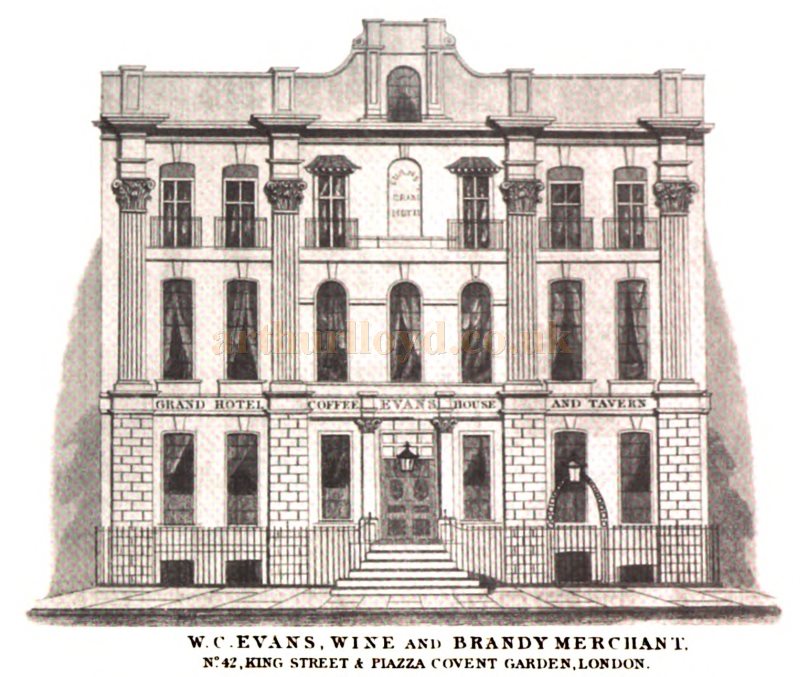
Above - W. C. Evans Wine and Brandy Merchants, 42 Kings street, Covent Garden, later Evan's Super Rooms and Music Hall - From Tallis's London Street Views 1838 - 1840.


 On
King Street, Thomas Archer House, is the finest of its kind in the
whole of Covent Garden. The original building constituted the end one
in the Piazza, and it was a worthy home for Admiral Edward Russell,
the fourth Earl of Bedford's grandson.
On
King Street, Thomas Archer House, is the finest of its kind in the
whole of Covent Garden. The original building constituted the end one
in the Piazza, and it was a worthy home for Admiral Edward Russell,
the fourth Earl of Bedford's grandson.
The present building which worthily replaced it in 1717 has changed much through the years inside, but the beautiful exterior has survived more or less intact.
Right - Evans's Supper Rooms and Music Hall, King Street, Covent Garden.
The house is named after its architect, who eventually inherited it after marrying into a branch of the Russell family. It became a hotel in 1772 and developed into an extremely fashionable one called the Star.
It was then taken over by a Covent Garden Theatre comedian, W. C. Evans, and became Evans's Hotel and Supper Rooms. One Paddy Green followed him and, in 1856, built a sumptuous music hall at the back of the house. It thrived for many years on the slightly bewildering policy of catering for 'steady young men who admire a high class of music but avoid theatres and the ordinary run of music halls'. The performances were by men and boys, who sung glees and madrigals. Ladies were admitted grudgingly and allowed to see and hear from behind a screen.
The National Sporting Club came into possession later-from 1891 until the thirties-the performers were still men but now delivering blows instead of ballads.
Above text (edited) From 'The Covent Garden Guide' 1980.
Arthur Lloyd is known to have performed here only once, as he says in an interview with the ERA reporter.

Above - Evans's Music Hall - From 'Fifty years of a Londoner's Life' by H. G. Hibbert, Published in 1916 - Courtesy Alfred Mason.
Evans's - From 'Bright Lights Big City, London Entertained 1830-1950'
By Gavin Weightman
 The
term music hall was an old one,
for there were many concert rooms in London, but it was given a new
meaning in the 1850s. It was chosen
deliberately to conjure up an air of respectability, for not all the
forerunners of these new establishments were places of what came to
be called family entertainment.
The
term music hall was an old one,
for there were many concert rooms in London, but it was given a new
meaning in the 1850s. It was chosen
deliberately to conjure up an air of respectability, for not all the
forerunners of these new establishments were places of what came to
be called family entertainment.
Right - A sketch which gives some idea of what Evans's was like, the person on stage - apparently number 22 on the bill - is struggling to hold the attention of an audience heavily engaged in eating, drinking and talking. From 'Lost Empires: the phenomenon of theatres past, present and future' by Nigel Fountain.
A number of places compete for the honour of being the first ever of this new kind of music hall. The term appears to have been first used by the Surrey Music Hall, formerly the Grapes Tavern, in the 1840s.
But the story of the Canterbury hall in Westminster Bridge Road, Lambeth, which in time became the most famous of Victorian music halls (Charlie Chaplin's father appeared there at the end of the nineteenth century), gives a clear indication of how tastes were changing.
In Shakespeare's day it had been a hostelry for pilgrims and took the name of the Canterbury Arms after the abolition of the monasteries.
 It
had long been known as a place for entertainment when it was
taken over by a publican, Charles Morton,
in 1849. Taking as his model
the song and supper room Evans's, in Covent Garden, Morton built his
first hall.
It
had long been known as a place for entertainment when it was
taken over by a publican, Charles Morton,
in 1849. Taking as his model
the song and supper room Evans's, in Covent Garden, Morton built his
first hall.
Left - Bill for Evans's Supper Rooms.
Evans's was housed in the basement of what had once been a Georgian hotel.. It was founded by a Mr W. C. Evans, a chorister at nearby Covent Garden a useful reminder that the antecedents of music hall were very widespread.
He called it Late Joy's (the building had originally been a hotel named Joy's). Evans's was for men only, and many lewd songs were sung as well as comic turns.
 Evans
retired, in 1844, handing
over to another former chorister known as Paddy Green, who re-built
the supper room and reformed the nature of the entertainment provided.
Women were allowed to watch the entertainments, which included a choir
of men and boys singing madrigals, ballads, and selections from operas,
with piano or harmonium accompaniment, from an upper gallery if they
were prepared to give their name and address a protection against
prostitution.
Evans
retired, in 1844, handing
over to another former chorister known as Paddy Green, who re-built
the supper room and reformed the nature of the entertainment provided.
Women were allowed to watch the entertainments, which included a choir
of men and boys singing madrigals, ballads, and selections from operas,
with piano or harmonium accompaniment, from an upper gallery if they
were prepared to give their name and address a protection against
prostitution.
Right - 42 King Street, Covent Garden.
Evans's opened at 8pm, but did not really begin to hum until after midnight, when Paddy Green, snuff box in hand, officiated over a range of performances drawn from the best artists appearing at the pleasure gardens such as Vauxhall.
Evans' was simply the most popular of a number of West End song and supper rooms, which included the Coal Hole in the Strand, the Cyder Cellars in Maiden Lane, Covent Garden (an American Fat Boy hamburger joint is now on the derelict site) (This land has now been built on again and is currently a Porterhouse pub/wine bar. M.L.) and the Mogul in Drury Lane (site now the New London Theatre (today the Gillian Lynne Theatre M.L.)).
 Outside
the central area were all the free and easies in public houses,
often with their pleasure gardens around, in which the drinking and
jollity was encouraged with all kinds of comic turns and singalongs.
Outside
the central area were all the free and easies in public houses,
often with their pleasure gardens around, in which the drinking and
jollity was encouraged with all kinds of comic turns and singalongs.
Left - The site of Evans's Supper Rooms, Covent Garden in 2003 - The building's interior had recently been completely demolished and modernised.
With such a demand for entertainment, some of the best amateur performers were being encouraged by high fees to turn professional, and they would appear at many different places to earn their living.
Above Text (edited) From Bright Lights. Big City, London Entertained 1830-1950, by Gavin Weightman.
Evans's Supper Rooms
From 'Old & New London' by Edward Walford 1897
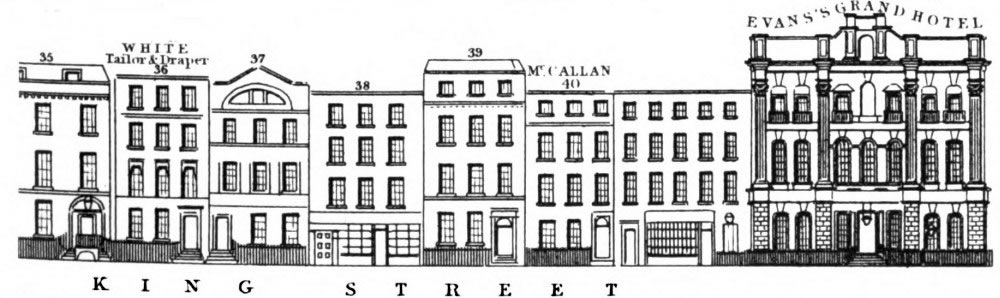
Above - Evans's Grand Hotel, King Street, Covent Garden, later Evans Supper Rooms and Music Hall, as Depicted in Tallis's London Street Views 1838 - 1840.
In the north-west corner of Covent Garden is "Evans's Hotel," supper-rooms, and music-hall. The house is a fine specimen of a London mansion of the olden time. It was built originally in the reign of Charles II., and was for a time the residence of Sir Kenelm Digby, as we learn from Aubrey's "Lives:" - "Since the restoration of Charles II., he (Sir Kenelm Digby) lived in the last faire house westward in the north portion of Covent Garden, where my Lord Denzill Holles lived since. He had a laboratory there. I think he dyed (died) in this house."
 The
mansion was subsequently altered, if not rebuilt, for the Earl of Orford,
better known by the name of Admiral Russell, the same who, in 1692,
defeated Admiral de Tourville, near La Hogue, and ruined the French
fleet. From the Earl of Orford it passed to the Lords Archer. The house,
which is said to have been the first family hotel established in London,
is built of fine red brick, and down to about the year 1850,
when considerable alterations were made in its appearance, the façade
was thought to resemble the forecastle of a ship. The front of the house,
still used as an hotel, is remarkable for its magnificent carved staircase,
and for at least one elegantly painted ceiling, which remains in its
original state.
The
mansion was subsequently altered, if not rebuilt, for the Earl of Orford,
better known by the name of Admiral Russell, the same who, in 1692,
defeated Admiral de Tourville, near La Hogue, and ruined the French
fleet. From the Earl of Orford it passed to the Lords Archer. The house,
which is said to have been the first family hotel established in London,
is built of fine red brick, and down to about the year 1850,
when considerable alterations were made in its appearance, the façade
was thought to resemble the forecastle of a ship. The front of the house,
still used as an hotel, is remarkable for its magnificent carved staircase,
and for at least one elegantly painted ceiling, which remains in its
original state.
Right - Evans's interior - From 'Old & New London' Edward Walford 1897.
At the end of the last, and during the early part of the present century, when used as a dinner and coffee-room only, it was called in the slang of the day, "The Star," from the number of men of rank by whom it was frequented. Indeed, it is said that previous to the establishment of clubs, it was no unusual occurrence for nine dukes to dine there in one evening.
The rooms on the left hand of the entrance are used by the members of the Savage Club, composed mainly of dramatists and dramatic authors.
"Evans's" is thus described by a writer in Once a Week, in 1867: - "About twenty years ago the list of metropolitan concert-rooms was headed by 'the Cyder Cellars' and 'Evans's.' The entertainments to be found in such places were not very select; but while the former has disappeared altogether, the latter has been altered and purged. The surviving establishment, half supper-room and half music-hall, and one of the 'lions of London,' is situated at the western extremity of Covent Garden Piazza. It is subject to peculiar and stringent regulations. Ladies are not admitted, except on giving their names and addresses, and then only enjoy the privilege of watching the proceedings from behind a screen. The whole of the performances are sustained by the male sex, and an efficient choir of men and boys sing glees, ballads, madrigals, and selections from operas, the accompaniments being supplied on the piano and harmonium… The new hall, one of the most elaborately ornamented in London, was erected from designs by Mr. Finch Hill. Its proportions are certainly fine, and the decorations cost about £5,000. On the occasion of our last visit to 'Evans's,'we heard standard music, English, German, and Italian, performed with admirable spirit, precision, and delicacy. The performances commence at eight o'clock; and we recommend 'Evans's' to the notice of steady young men who admire a high class of music, see no harm in a good supper, but avoid theatres and the ordinary run of music-halls. The so-called café is a spacious room, supported by pillars, and hung round with portraits of actresses. Previous to the erection of the new hall, the chamber thus adorned was used as the singing-room."
The present hall, to which the café forms a sort of vestibule, is on a level with the cellars in front, and runs out at the rear of the house, occupying a plot of ground which was formerly the garden of Sir Kenelm Digby. At a later period it contained a cottage in which the Kemble family occasionally resided, when in the full tide of their popularity. According to tradition, it was in this cottage that their talented daughter, Miss Fanny Kemble, was born. The hall is about 33 feet high, and as many wide; it is about 72 feet long from end to end; and with the old room, through which it is approached, the entire length is 113 feet. The carved ceiling, richly painted in panels, is supported on either side by a row of substantial columns with ornamental capitals, from which spring bold and massive arches; these columns help also to support the gallery, which extends along the two sides and one end of the hall, and in which are the private screened boxes alluded to above. The hall is well lighted by sun-light burners; it is also well ventilated, well conducted, well served, and therefore well patronised. A numerous army-corps of waiters, including a battalion of boys in buttons, flit noiselessly about, attending to the creature comforts of the visitors, who, between the hours of ten and twelve, are continually dropping in to enjoy a hot supper and listen at the same time to the charming melodies provided for their delectation.
Sir William Alexander, Earl of Stirling, the poet, resided in 1637 in a house in the north-west corner of Covent Garden; here also Thomas Killigrew, the wit, was living between the years 1637 and 1662. The site was afterwards occupied by Denzil Holles, Sir Harry Vane, Sir Kenelm Digby; Lord Crewe, Bishop of Durham; and Russell, Earl of Orford. The house was subsequently taken by Lord Archer, who married Sarah, the daughter of Mr. West, some time President of the Royal Society. Mr. West's. library and collection of prints, coins, and medals, were sold in this house, and occupied the auctioneer six weeks in the disposal of it. After the above sale in 1773, the mansion was converted into a family hotel, by a person named David Low, and is said to be the first of the kind established in London. About 1790, a Mrs. Hudson became proprietor. Her advertisements were curious; one ends thus - "Accommodation, with stabling, for one hundred noblemen and horses." After one or two more changes in the proprietorship, the hotel came into the hands of Mr. W. C. Evans, of Covent Garden Theatre, whose name has ever since been associated with it. In 1844 he retired, and Mr. John Green became proprietor and manager. This gentleman, who was well known in the musical profession as "Paddy Green," was a man of rather eccentric character; he died in December, 1874. The new music-hall was built in 1856.
Evans's Supper Rooms - From 'Old & New London' by Edward Walford 1897.