
The Canterbury Theatre, 143 Westminster Bridge Road, Lambeth, London
Formerly - The Canterbury Hall / Canterbury Music hall - Later - The Canterbury Theatre of Varieties
Introduction - The Canterbury Music Hall - The Canterbury Theatre - Matcham's Reconstructed Canterbury Theatre - Programmes for the Canterbury Theatre - Later History and Demolition - Contemporary Articles - Special Feature on the Canterbury Music Hall

Above - An early sketch of the interior of the Canterbury Music Hall.

The history of this early place of entertainment, known variously as the Canterbury Hall, the Canterbury Music Hall, and the Canterbury Theatre, is long and involved. It was situated on Westminster Bridge Road in Lambeth, London, and is often referred to as the first of the great Music Halls.
The first Canterbury Hall was erected for Charles Morton in 1852 on the site of an old skittle-alley adjacent to his Canterbury Tavern, and paid for out of the profits on drinks which he'd made there during the free entertainments originally offered at the Tavern.
 Morton is said to have been inspired to build the Canterbury by his enjoyment as a regular patron of Evans's in Covent Garden. There was no admission charge for this early Canterbury Music Hall and although a few professional
singers were paid, Morton's early patrons were mostly entertained by unpaid amateurs.
Morton is said to have been inspired to build the Canterbury by his enjoyment as a regular patron of Evans's in Covent Garden. There was no admission charge for this early Canterbury Music Hall and although a few professional
singers were paid, Morton's early patrons were mostly entertained by unpaid amateurs.
Right - An early engraving showing the exterior of the Canterbury Theatre of 1876, the successor to the Canterbury Music Hall of 1852.
The Canterbury Hall, as it was originally called, proved so popular that in 1854 Charles Morton was able to replace it by a new and larger Music Hall, which cost some £25,000 to construct and fit out, and now had a large platform stage for its artistes to perform on, and an auditorium with a surrounding balcony on three sides, which could accommodate almost 1,500 people.
The new Canterbury also had a picture gallery full of 'excellent paintings' which due to its position near the Thames, and the gallery itself, eventually gained it the colloquial name of 'The Royal Academy over the Water'.
However, some of the builders of this Music Hall were not as fortunate as Charles Morton would be with the project, and ended up insolvent and in Prison. The Morning Post reported on the case in their September the 15th 1856 edition saying:- 'Re Daniel Lansdown - This insolvent, a builder, was opposed by Mr. Reed, for a creditor named Long, and supported by Mr. Douse. It appeared that the insolvent had made an assignment for his creditors. He had built Canterbury Music-hall for Mr. Morton. The price was, he said, £5,111. He had been paid £3,475, and considered Mr. Morton owed him £1,600. The matter had been referred to arbitration, and to his surprise he was found to be indebted to Mr. Morton in the sum of £257. He had been in prison since December, and could not attend the arbitration. The arbitration had disappointed his expectations. The Chief Commissioner thought the assignment was a very unhappy matter, but after the time he had been in prison he should give him his discharge when certain matters were set right.' - The Morning Post, 15th September 1856 - Courtesy Judith Woodlock, GG Granddaughter of Daniel Lansdown .
The case was adjourned till the next day and it seems Daniel Lansdown was released from prison shortly afterwards. Charles Morton however, would go on to run the Canterbury successfully for many years, but he would eventually sell it to R. E. Villiers, who would rebuild the Theatre in 1876, details below.

Above - The Canterbury Theatre of 1876 - From The Builder, 16th of September 1876.
The 1876 rebuilt Canterbury Theatre, designed by Albert Bridgman for R. E. Villiers, was a much larger three tier Theatre, still situated on the same site as the old Music Hall, but now extended into the site previously occupied by several adjoining houses. The Theatre cost over £40,000 to construct and opened as the Canterbury Theatre on Saturday the 30th of September 1876.
The Builder reported on the new Canterbury Theatre, along with the engraving shown above, and shortly before the Theatre opened, in their 16th of September 1876 saying:- 'We give in our present number a view (shown above) of the principal entrance to the "Canterbury," rebuilt for Mr. R. E. Villiers, from the designs of the late Mr. Albert Bridgman, architect, whose lamented death at the early age of thirty-five years, and at the most eventful period of his brief professional career, we announced at the beginning of the present year.
All those who remember the Canterbury Hall of former years, and they are probably many, will doubtless be surprised at the transformation since their last visit. The new building will be opened to the public on the date of our present issue. The "Canterbury," which covers an area of 27,000 superficial feet, or about two-thirds of an acre, will be an attractive place of entertainment.
 The principal entrance is from the Westminster Bridge-road, in close proximity to the South-Western Railway, and opposite the Lambeth Baths, two houses next Carlisle-street having been purchased and removed for this purpose.
Right - A Google StreetView Image of the site of the former Canterbury Theatre, between Carlisle Street and Upper Marsh, and fronting the Westminster Bridge Road - Click to Interact.
The facade is of stone, of 35 ft. frontage, and four stories in height, profusely sculptured, and surmounted by a lofty curb roof decorated with metal work. The top story comprises one large circular window, designed for the purpose of displaying revolving scenes, and the announcement of the "Canterbury."
The floor of the arcaded entrance is paved with tiles, and leads, past the pay-offices, first into an aquarium, which is a spacious and handsome compartment, surrounded with fish-tanks, already supplied with interesting specimens. The tanks are well lighted, and have a constant air and water supply.
Passing from the aquarium through a loggia, from which are approached, by means of a spacious flight of stone steps, the billiard-rooms, arranged on the first floor of this part of the building, together with the various management offices, - we enter the fernery, this portion of the building being covered with a glass roof. Here a picturesque sight greets the eye, drooping ferns in nooks of rockwork and rippling streams line the footway on either side, whilst the walls, for a height of some 10 ft., consist of silvered glass, reflecting a scene yet unreached, - the cave fernery, with varied plants. The pendent rooks and stalactites above, and the cooling streams beneath; the staircase, balcony, and promenade in the distance; together with the chief entrance to the great hall - all combine to form a striking scene of its kind. A turn to the left on passing through the cave reveals an arcaded vista of considerable distance, with water, rock, and fern. Leaving the staircase, we approach the entrance to the fauteuils, a distance of 200 ft. from the Westminster Bridge-road.
We are now within the hall. This is 100 ft. in length from the orchestra to the back wall, and is 70 ft. wide. The balcony, supported on iron columns, is 13 ft. from the floor, having a double curve at the springing of the horse-shoe. 12 ft. above this is the gallery-floor, with a curved front similar to the balcony below, but set back 2 ft. Springing from the top of the second tier of columns, which are 15 ft. apart, is a series of vaulted arches encircling the building, and curved towards its centre to a height of 13 ft., leaving a complete oval. From this height springs a second hollow curve to a further height of 9ft., leaving an oval opening to the sky of 40 ft. by 20 ft., to cover which is provided a semicircular iron and glass dome, at a height of 60ft. from the floor, capable of being opened or closed in twenty seconds. This dome is of considerable weight, and rolls by means of simple machinery on two iron girders placed longitudinally, which in turn rest upon two lattice girders, 4 ft. 6 in. deep, the whole width of the building and clear above the roof: the arrangement is patented.
The upper cove of the roof is painted to imitate sky, with a bottom border of trelliswork interweaved with flowers and ferns. The spandrels of the vaults and arches beneath are decorated in colour and gold. From the springing of the vaults are groups of palms and ferns, spreading and filling the spandrels. The upper half of the columns throughout are decorated to form palm-trees, the caps being of spreading and drooping leaves; from which spring five pendants for gas to each column. The balcony and gallery fronts are of bold ogee shape, with large hollow mould at bottom, and are ornamented in carton-pierre of different patterns, with a basket of flowers and ferns every 10 ft. apart. The decorations of the proscenium front are of the same character, - palm-trees and leaves, profuse in colour and embellished with gold. The oval central light contains a ring of gas-jets, 9 in. apart, to each of which is fixed a thirteen-star light, each 4 in. in diameter.
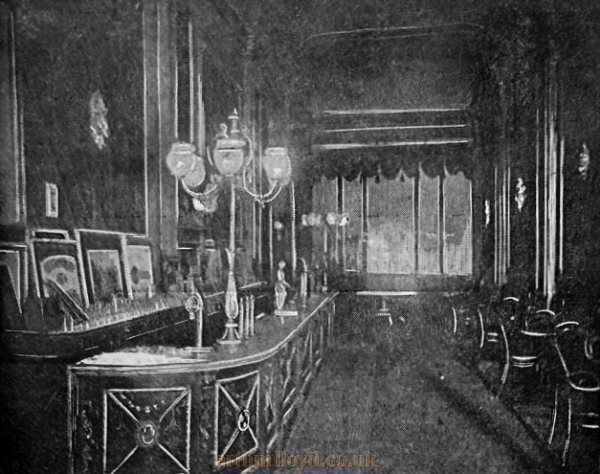
The stage is 70 ft. by 30 ft., and the proscenium 40 ft. by 40 ft. Communicating with the hall is the lounge and picture-gallery, 70 ft. by 24 ft., fitted for refreshment accommodation. The counter fronts are of polished ebony, and the tops of the counters and tables of Mexican onyx. This apartment is also decorated and is lighted with three sunlights and three wrought brass standards on the counters.
The balcony is approached by the main stairs through the fernery. The gallery entrances, however, are in Upper Marsh (the original main entrance to the "Old Canterbury"); the approaches are by means of double staircases, of fireproof materials, to prevent crush, and have separate means of exit. There is also a distinct "pass" stair, in stone, from the gallery to the balcony floors. The professionals engaged also enter from Upper Marsh, there being commodious dressing and retiring rooms for them on the first, second, and third floors, having direct communication with the stage.
The ground-floor rises from the orchestra backwards at the rate of 1ft. in 4ft., which, whilst it gives a good view of the stage, admits of spacious cellarage underneath over the whole area, which communicates with that under the lounge, and has convenient access from Upper Marsh.
The contractors for the hall were Messrs. Bracher & Son, the Westminster Bridge-road building and aquarium being previously built. Mr. W. Bradwell has executed the carton-pierre work and other decorations; Mr. Somerville constructed the sliding roof-light; Mr. Cannon, the gasfittings; and Mr. Radclyffe, of Holborn, the rockwork and gardening. Mr. H. Taylor has been the general foreman of the works; the whole of which, when completed, will have cost nearly 40,OOOL.
Mr. H. H. Bridgman succeeded his brother as architect, and under his superintendence, in conjunction with Mr. Chas. Dunch, the works have been carried out, with the aid at all times of the enterprising proprietor.'
The above text in quotes was first published in The Builder, 16th September 1876.
 The ERA later reported enthusiastically on the Theatre's imminent opening in their 24th of September 1876 edition saying:- 'This marvellously elegant edifice, which is sure to become the talk of London - if not of the whole world of pleasure seekers - opens its doors to the public this (Saturday) evening, and to those whose good fortune it will be to secure admission we may promise the most enjoyable surprises; first in the inspection of the entrances; secondly in a glance at the beauties of the Hall itself; thirdly in a peep at that extraordinary mechanical device a sliding roof - by which good ventilation is to be secured; fourthly in a visit to the adjoining saloon, with its costly and elegant surroundings; and lastly in the numerous attractions which are to occupy the stage, and which will introduce a large number of the most popular artistes of the day.
Right - A Poster for a Benefit performance for A. Thioden at The Canterbury Theatre on Thursday the 26th of March 1885 with Arthur Lloyd on the Bill, amongst a plethora of other Music Hall Artists of the time, Click to Enlarge and to read a review of the event.
Our columns have already contained an exhaustive description of the place, and it would be superfluous to speak further of the caverns, the grottoes, the rock work, the foliage, the fountains, the rippling streams, the columns formed as palm trees with wide-spreading leaves, the richly-ornamented panels in gilt frames, and with quilted amber satin; the counters in black and gold, and with tops of Mexican onyx marble; and of a hundred other devices of luxury, giving evidence of the most liberal expenditure, and of a desire on the part of those at the head of affairs to promote the comfort, the convenience, and the enjoyment of those who favour the establishment with their patronage.
Our business now is with the programme to be presented. Most prominent in this will be found the new ballet, entitled Ceres, which has for a considerable time been in preparation under the direction of M. Dewinne, who claims the credit of its invention and arrangement. Of this ballet we shall not attempt to tell the story. We doubt if it has one; but we may hint that before the end is reached we are permitted to peep at the place to which Prosepina, the daughter of Ceres and Jupiter, was carried by Pluto, and which, although said to be paved with good intentions, is never named to ears polite.
 This is indeed a weird scene, evidently suggested by one of those strange and terrible pictures by which Martin was wont to fright the nervous from their propriety - or, perhaps, we ought to say from their impropriety. It is in this scene we get one of the most attractive features of the ballet, each dancer carrying a cup, which, opened, discloses to view a demon head. The groupings throughout are most effective, and what we suppose must be called the Transformation Scene boasts so many beauties that words would but faintly describe them, the vision being absolutely satiated with light and life, and colour and brilliancy, as above the tastefully posed nymphs with their baskets of fruit and flowers rises "glorious Apollo" in the radiant chariot of the sun.
Left - A Programme for the Canterbury Theatre in March 1880 - Courtesy Troy Murphie. See Cast Details below.
The corps-de-ballet has evidently been selected with great care, and it numbers some hundred of the most comely and clever of the professors of the saltatory art. The services of that eminent artiste Mille. Pitteri have been secured at great expense for the position of premiere danseuse assoluta, and those who would see the poetry of motion to perfection will do well to watch the graceful, sylph-like movements of Miss Ada Wilson, to whom also has been assigned a responsible position.
The ballet also boasts a well-trained chorus, which, without being seen, will supply a vocal accompaniment of a very enjoyable character. Mr E. Frewin, who conducts a large and efficient band, has arranged some capital music; the scenery reflects credit on the skill of Mr W. Hanns; and the name of Mr Alfred Thompson is a sure guarantee for the most exquisite taste in the designs of the dresses.

Above - A Programme for the Canterbury Theatre in March 1880 - Courtesy Troy Murphie.
The inaugural programme will also present a cantata, composed expressly for the occasion by Mr G. Fox, and which has as a theme Edgar Allan Poe's well-known poem "The Bells." This will be interpreted by the "Canterbury choir," with as principals Miss Annie Beauclerc, Miss Russell, Mr Hubert Challoner, Mr Ap. Herbert, and Mr Neale Campbell. The "great Mackney," whose name was a tower of strength to the old Canterbury, will very properly make his appearance at the new, and may be relied on to furnish abundant amusement by his remarkable versatility. Mr Fred. Foster and Mr Fred. Laroche will supply the indispensable comic songs. M. and Madame Gelubcke will introduce some of their grotesque and mirth-provoking duets; the pretty face and animated style of Miss Angie Pelham will be welcome in serio-comic personations; Mr Doughy will add variety by the doings of his canine wonders; and the lovers of acrobatic entertainment will find plenty to admire in the astonishing feats of the Lentons. Further we are promised a quadrille diabolique and a comic ballet by the Josset troupe, and thus an entertainment of a splendid description will be completed.
We notice that the acting management has been intrusted to Mr Alfred Young, and that Mr Tressider will superintend matters upon the stage; Mr Edwin Villiers, of course, superintending the whole concern. We may add that the prices of admission have been arranged on a very moderate scale.'
The above text in quotes was first published in the ERA, 24th of September 1876.
The newly constructed Canterbury Theatre of 1876 proved to be a very popular place of entertainment and was often patronised by Royalty; the then Prince of Wales, later King Edward VII, the Duke of Cambridge, and the Duke and Duchess of Teck, were all said to have visited the Canterbury Theatre over the ensuing years.
The Theatre also had a succession of different managements over the proceeding years. R. E. Villiers passed the Theatre on to Edward Garcia in 1878, but he soon passed it on to J. Bauin, a former manager of the Alhambra Theatre. Bauin would be succeeded by Crowder and Payne in 1882.
Frank Matcham's Reconstructed Canterbury Theatre 1889
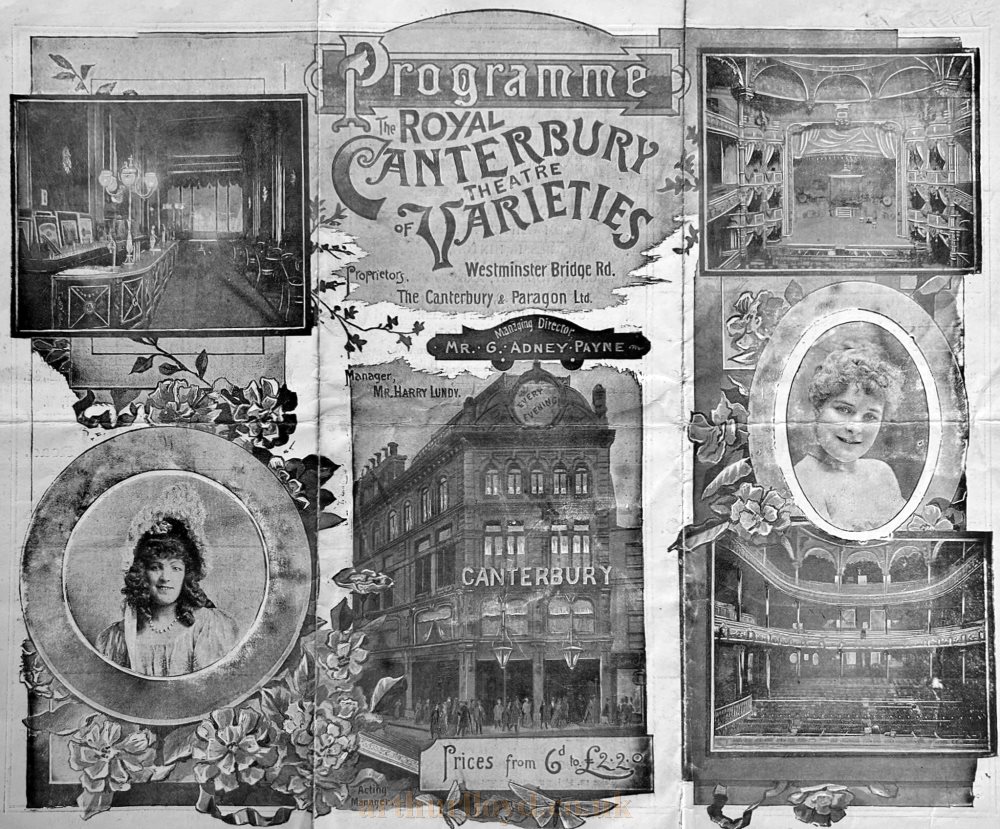
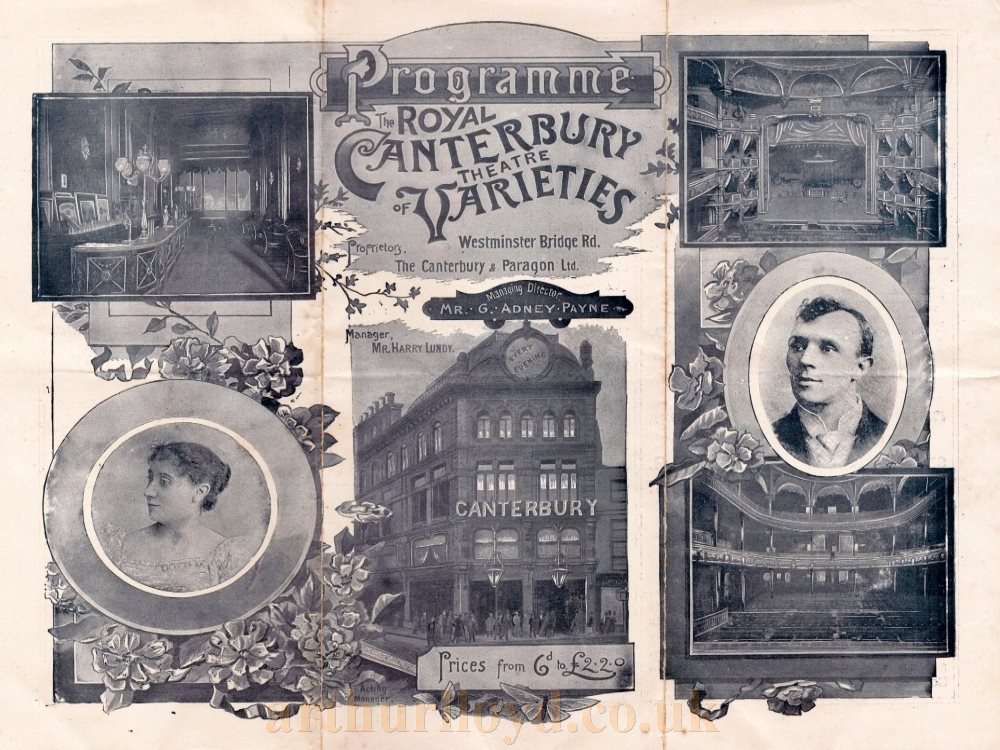
Above - A Programme for the Canterbury Theatre of Varieties for the 11th of December 1893 showing views of the exterior and interior of the Matcham rebuilt Theatre of 1889 - Courtesy Tony Tribe. On the Bill for this production were F. W. Darby, Marie Kendall, A Sketch called 'Tatters', J.W. Hall, The Kellinos, Kate James, Pat Rafferty, Ethel Buchanan, Lockhart's Performing Elephants, The Sisters Preston, George Adams, Ada Blanche, Prof. Duncan, Charles Godfrey in 'The Night Alarm', Lizzie Howard, and The Boissett Troup in 'The Bricklayers'.
 The now renowned Theatre Architect Frank Matcham altered and redecorated the Canterbury Theatre a few years later in 1889. The changes included demolishing the old private boxes and adding new tiers of boxes on either side of the proscenium, and reconstructing the fronts and sides of the balcony and gallery.
Right - A Programme for the Canterbury Music Hall dated Wednesday 28th February 1900, kindly donated by the late John Moffatt. Click for a Special Feature on this programme.
The ERA reported on Matcham's redesigned Theatre in their 26th of July 1890 edition saying:- 'The Canterbury Theatre of Varieties is now undergoing extensive alterations and complete redecoration from the plans of Mr Frank Matcham, architect. The alterations comprise the demolition of the very unsightly and uncomfortable private boxes at the sides of the balcony, and the construction of new tiers of boxes on each side of the proscenium. The sight lines have been much improved by the reconstruction of the fronts and sides of the balcony and gallery. Spacious promenades are arranged on each side of the stalls, fauteuils, and balcony, raised above the seats, so that an uninterrupted view of the stage can be obtained from all parts.
An entirely new scheme of lighting by gas has been introduced by means of sunlights, on a new principle, so that no damage by smoke can occur to the decorations, which are being carried out in Indian style, and are most elaborate and rich in ornament.
 The whole of the old raised papier-mache work has been stripped off, and is being replaced with fibrous plaster ornamentation. The sliding roof is still retained, but the whole is painted in a deep blue, picked out with stars. The circular corners are now concealed by a new ornamental ceiling, having in the centre two large sunlights, which are sufficient to illuminate the whole of the vast auditorium. A square opening is thus formed in the centre, which has open balustrading carried round the same, and the whole has a most novel and artistic effect. The large coved ceiling is divided out by ornamental ribs, and the panels thus formed are filled out with very fine paintings, representing Indian idols.
Left - A Programme cover for the Canterbury Theatre in July 1913 - Courtesy Peter Charlton.
The coffers over columns have beautifully designed open ornamental arches, and they are continued round the whole building. The three panels over the proscenium are filled in with artistic Indian subjects, painted on a gold ground, representing music, comedy, and tragedy. An entirely new proscenium front has been formed, with bold cantilever work at the corners, and ornamental columns area carried up on each side, with elephants and Nubian riders.
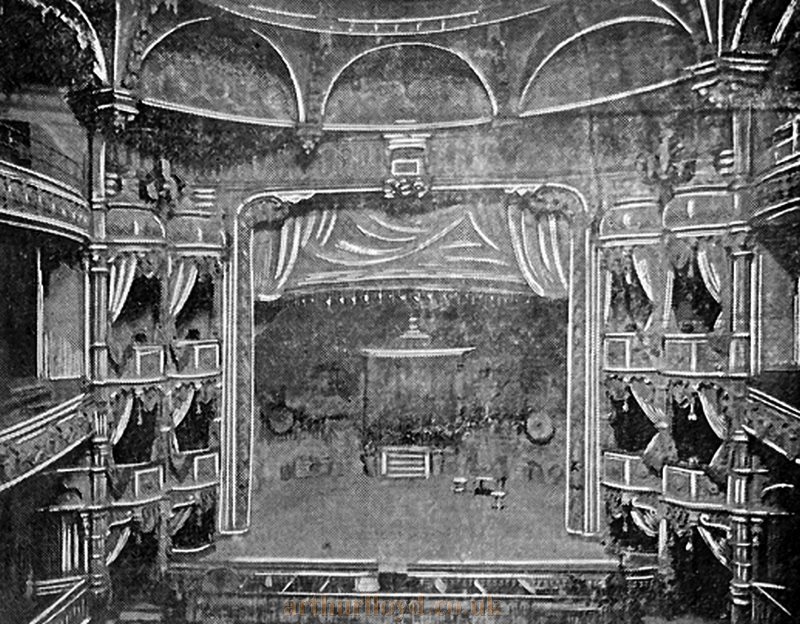
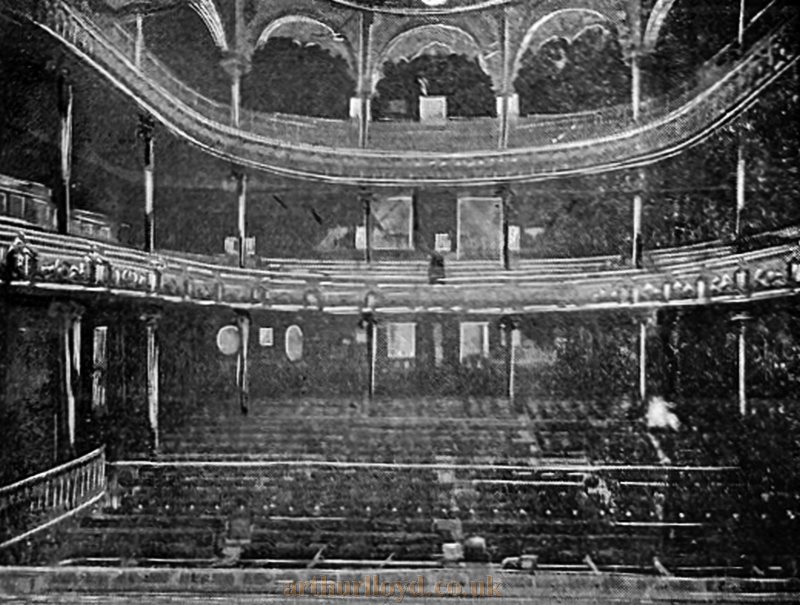
Above - Two Views of the Auditorium and Stage of the Matcham rebuilt Canterbury Theatre of 1889 - From A Programme for the Theatre for the 11th of December 1893 - Courtesy Tony Tribe.
 There will be ten new private boxes in all, five on each side, with anterooms in conjunction. The stage boxes correspond in design to the entrance to the stalls, and over each are arranged four boxes, in two tiers, divided in the centre by a large imitation palm-tree, and at the sides with rich ornamental columns. The top of the boxes is covered by minarets, and the whole is richly decorated in gold and colours.
Right - The Canterbury Theatre's packed auditorium in 1912 - From a Nostalgia Postcard from 1951 - kindly donated by the late John Moffatt.
New balcony and gallery fronts are provided, and are decorated to correspond with the general scheme. The walls of the auditorium are covered with a warm Indian paper, specially designed, and the side walls are divided out with pilasters and open ornamental work arches. The ceilings under balcony and gallery are covered with anaglypta, and picked out in colour to correspond with the rest of the work. There is no doubt that great care and study have been given to the decorations by Mr Matcham, and when completed they will give Mr Payne and the directors reason to congratulate themselves that they possess the handsomest theatre of varieties in London.
The finely proportioned and much frequented lounge is also having attention, the ceiling being artistically decorated, representing a sky, with birds and branches of trees introduced. The three square skylights in the ceiling have been covered with richly decorated plaster panels, picked out in gold and colour. The walls and remainder of lounge are similarly decorated to correspond.
 It is intended to decorate the entrance and other portions of the building later on. The greater portion of the work is at present concealed from the audience, but it is proposed to open the whole to their view on Monday, the 28th inst., when the great alterations effected in the building will no doubt greatly surprise the habitues.
Left - The Bar of the Matcham rebuilt Canterbury Theatre of 1889 - From A Programme for the Theatre for the 11th of December 1893 - Courtesy Tony Tribe.
Tire following firms have been engaged in the work:- Constructions and alterations, by W. Salter; fibrous plaster decoration, by the Plastic Decoration Co.; painting ceiling and artistic decoration, by Campbell Smith and Co.; gas fitting, by Vaughan and Brown; upholstery and curtains, by Atkinson and Co.'
The above text in quotes was first published in the ERA, 26th July 1890.
Ten Programmes for the Canterbury Theatre 1890s to 1905
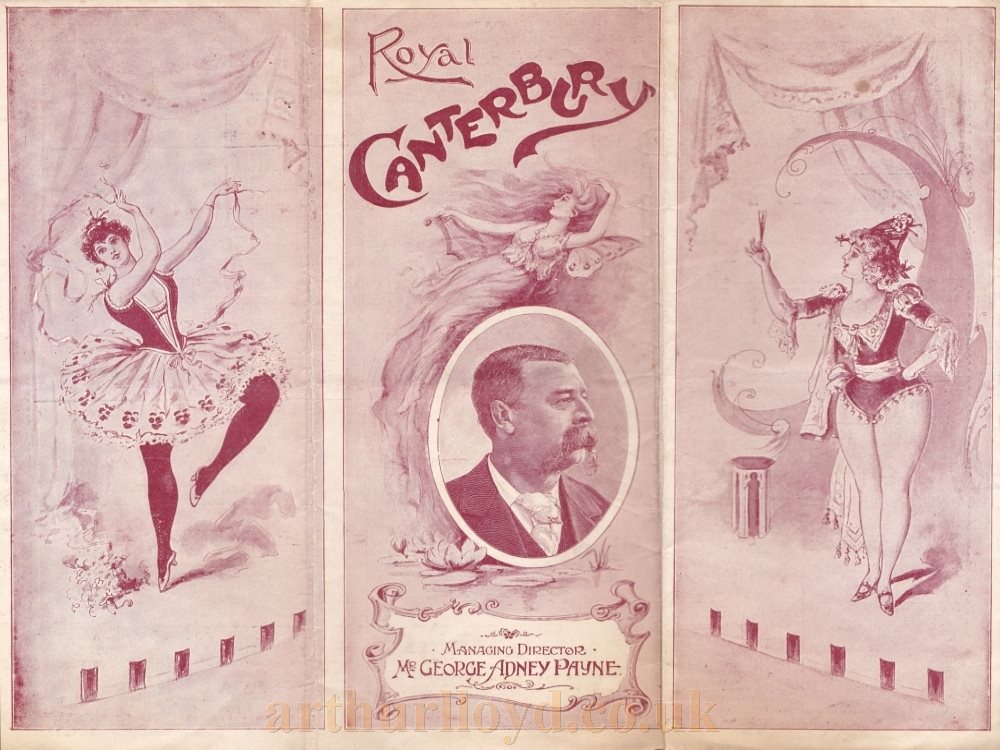
 Programmes for the Canterbury Theatre from the 1890s to 1905 - Kindly Donated by Tony Tribe.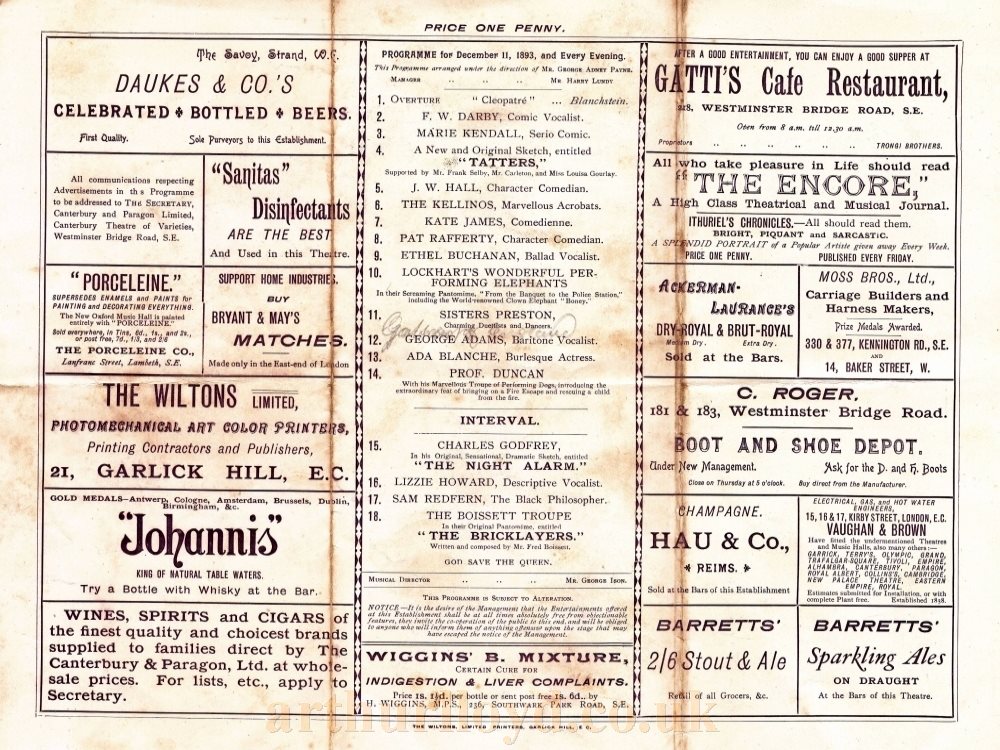
 Programmes for the Canterbury Theatre from the 1890s to 1905 - Kindly Donated by Tony Tribe.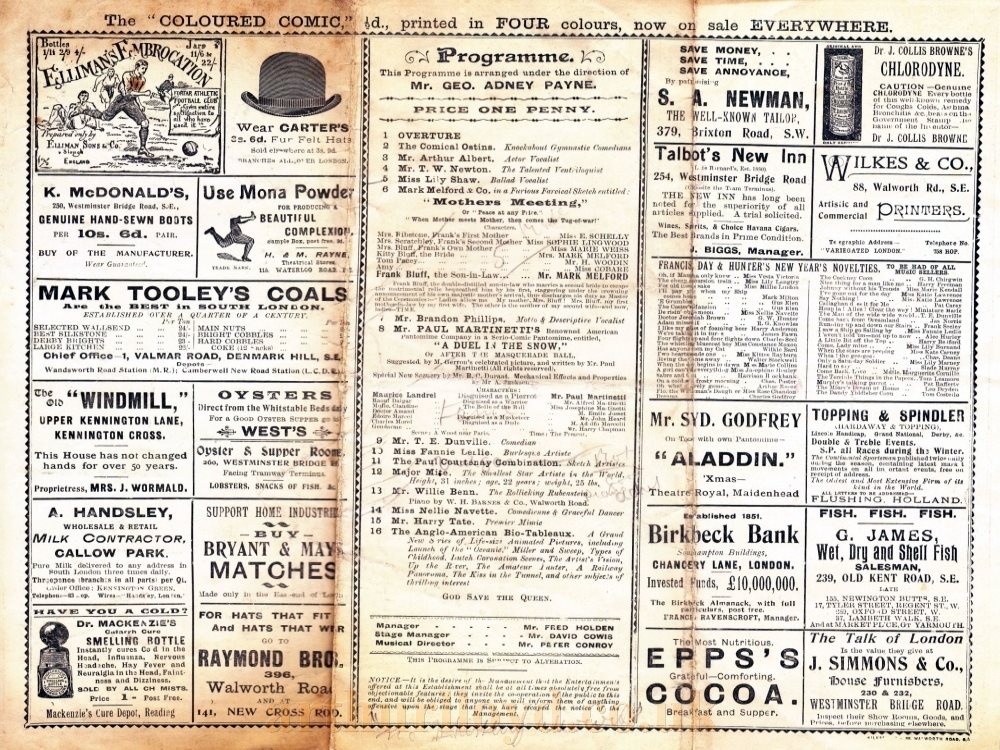
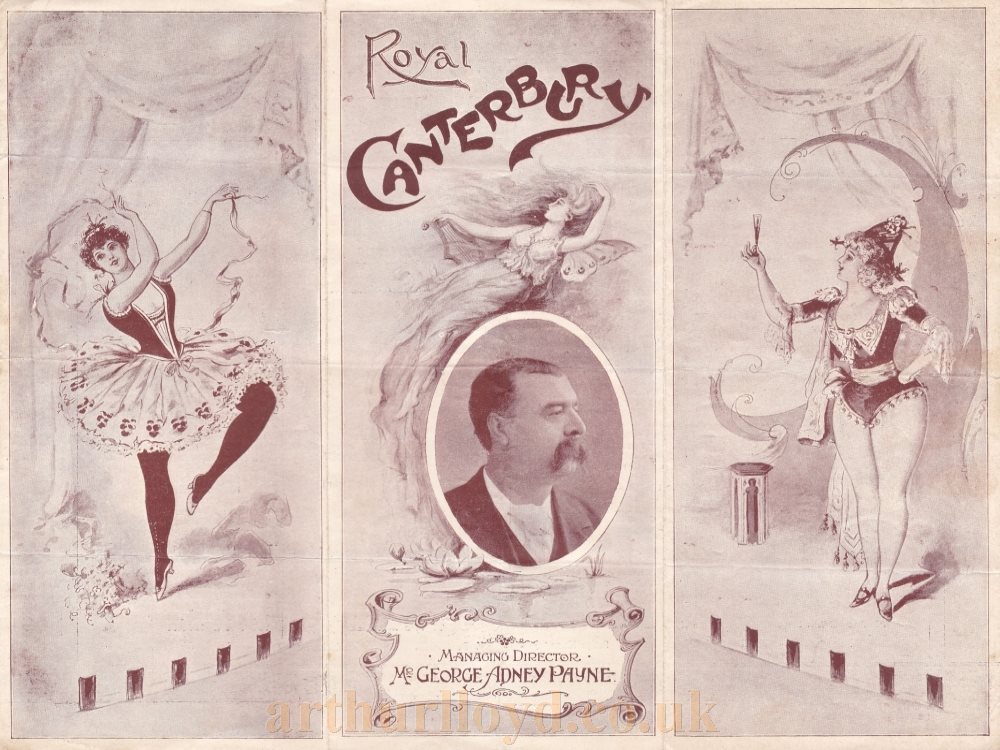 Programmes for the Canterbury Theatre from the 1890s to 1905 - Kindly Donated by Tony Tribe.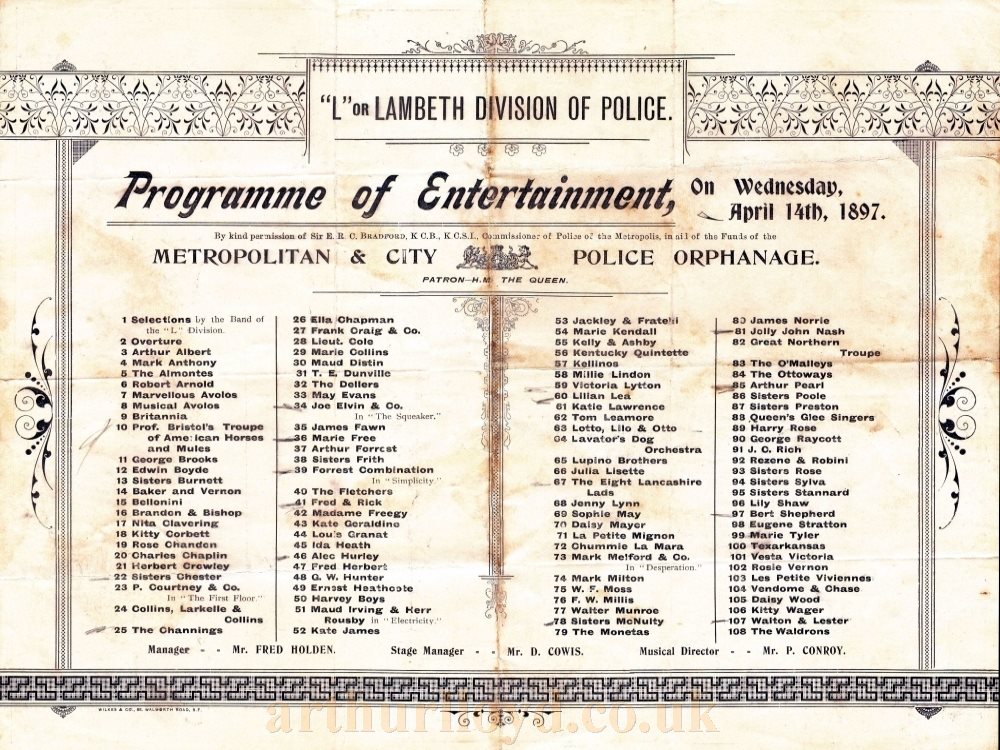
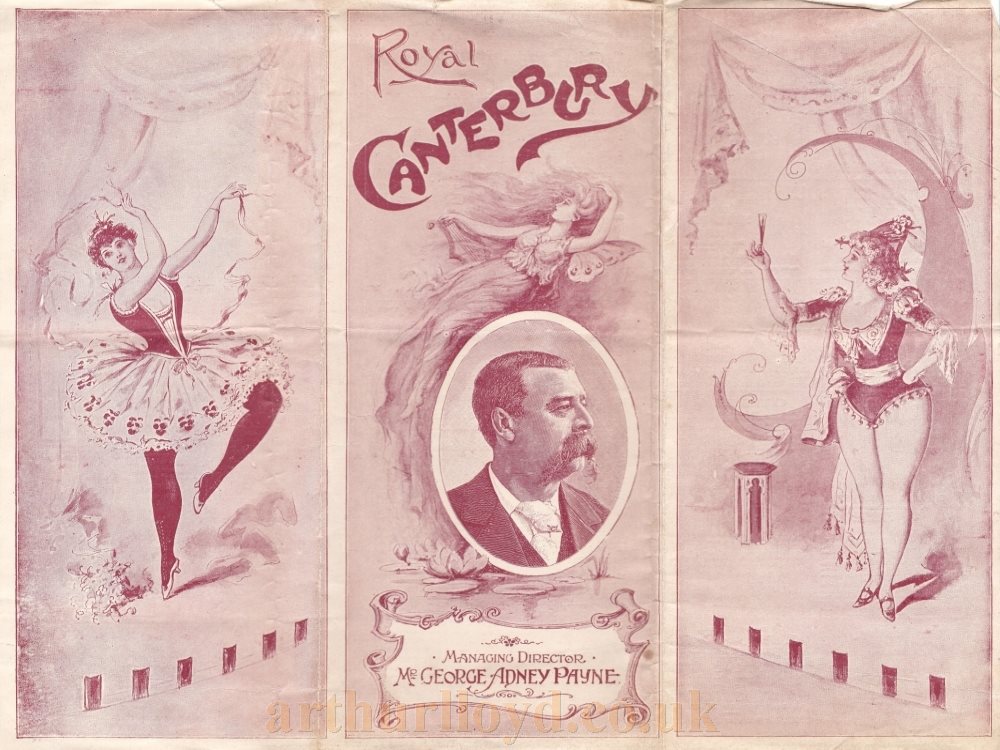 Programmes for the Canterbury Theatre from the 1890s to 1905 - Kindly Donated by Tony Tribe.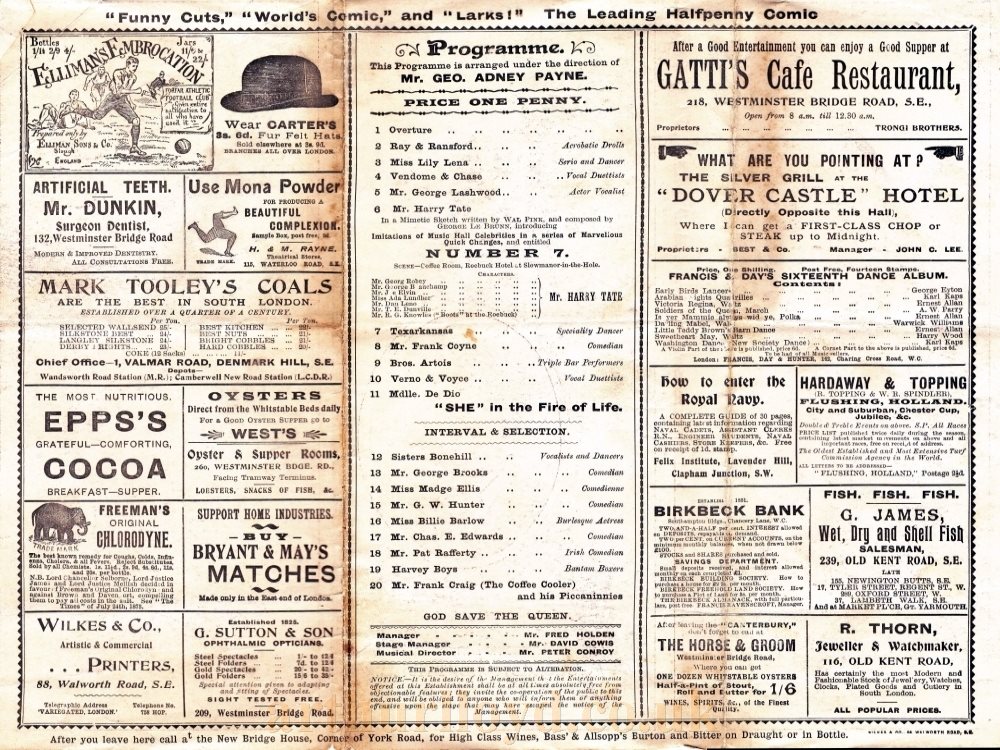
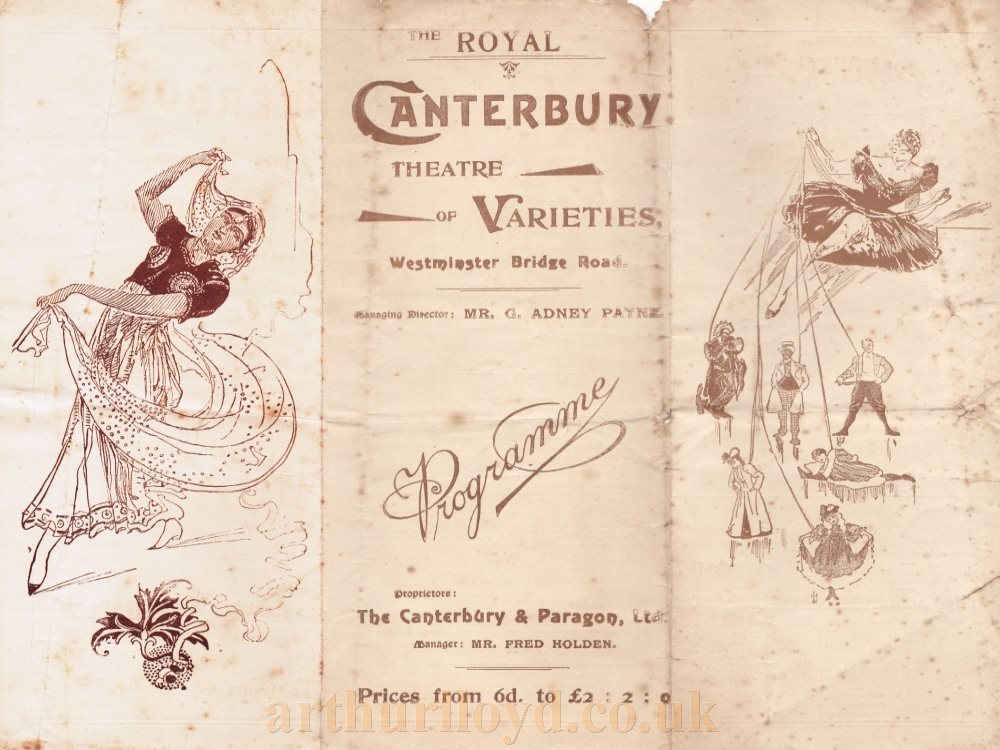 Programmes for the Canterbury Theatre from the 1890s to 1905 - Kindly Donated by Tony Tribe.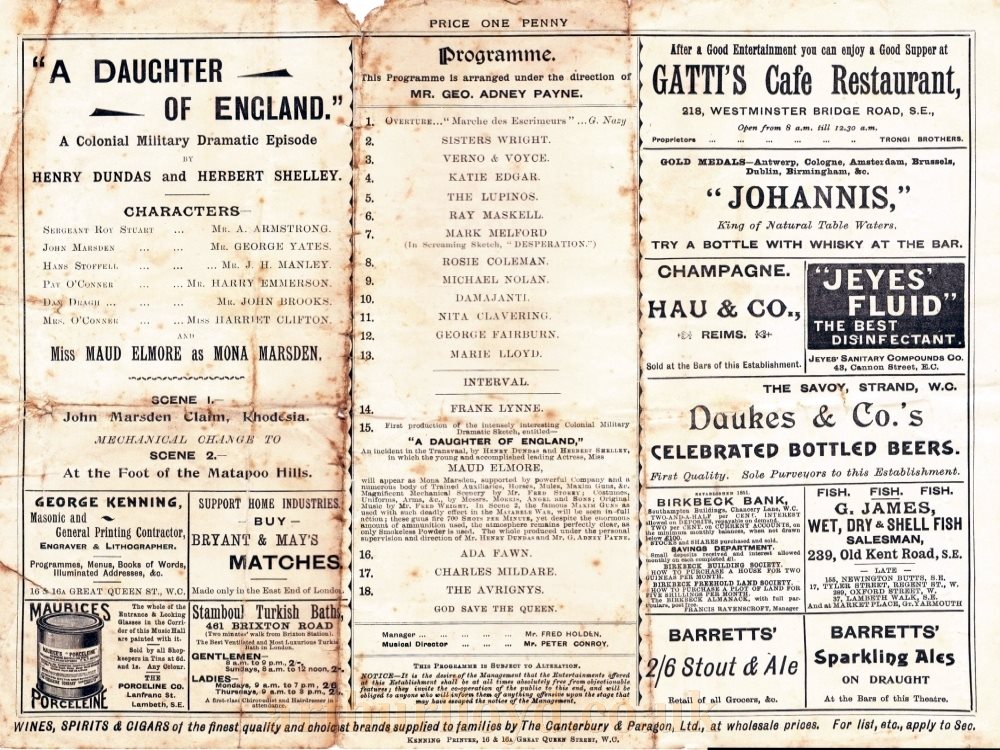
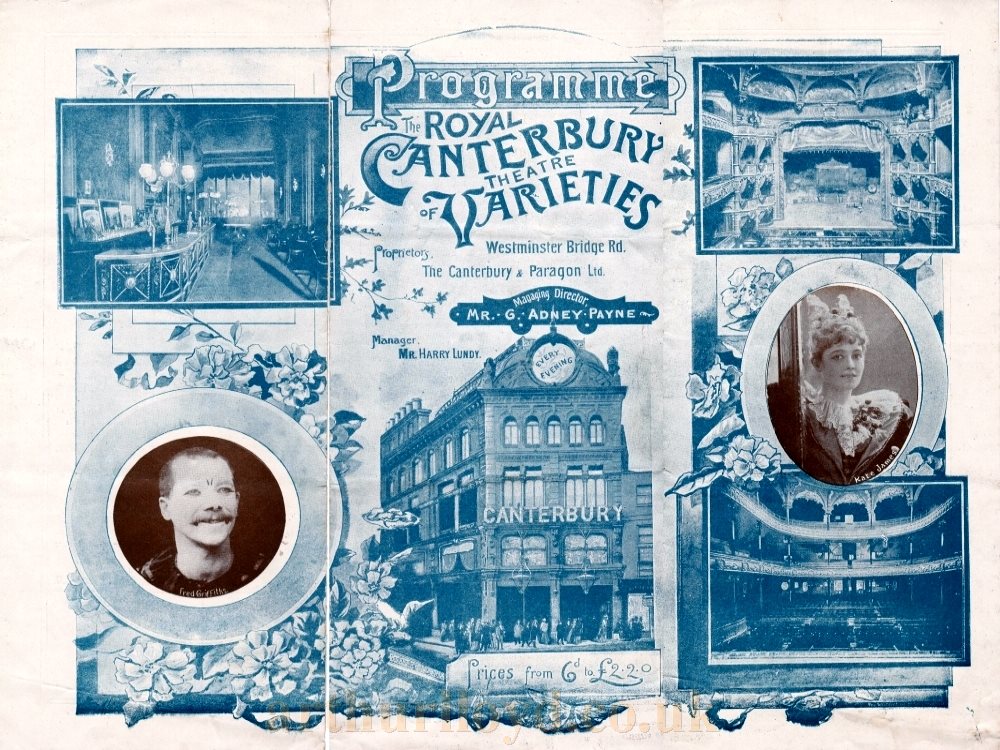 Programmes for the Canterbury Theatre from the 1890s to 1905 - Kindly Donated by Tony Tribe.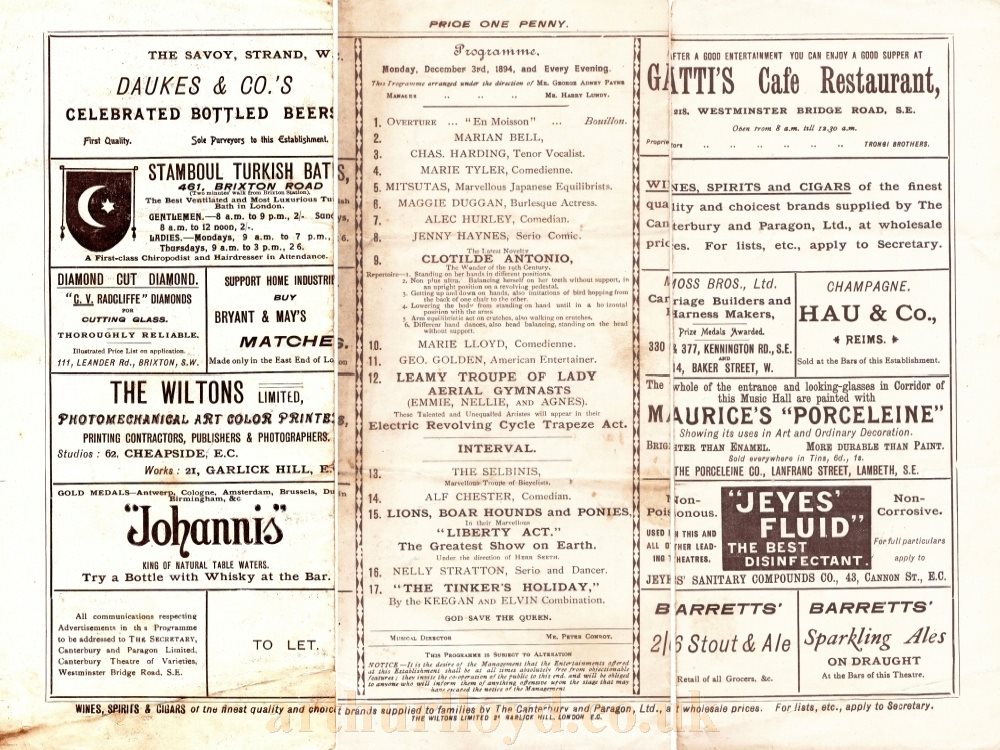
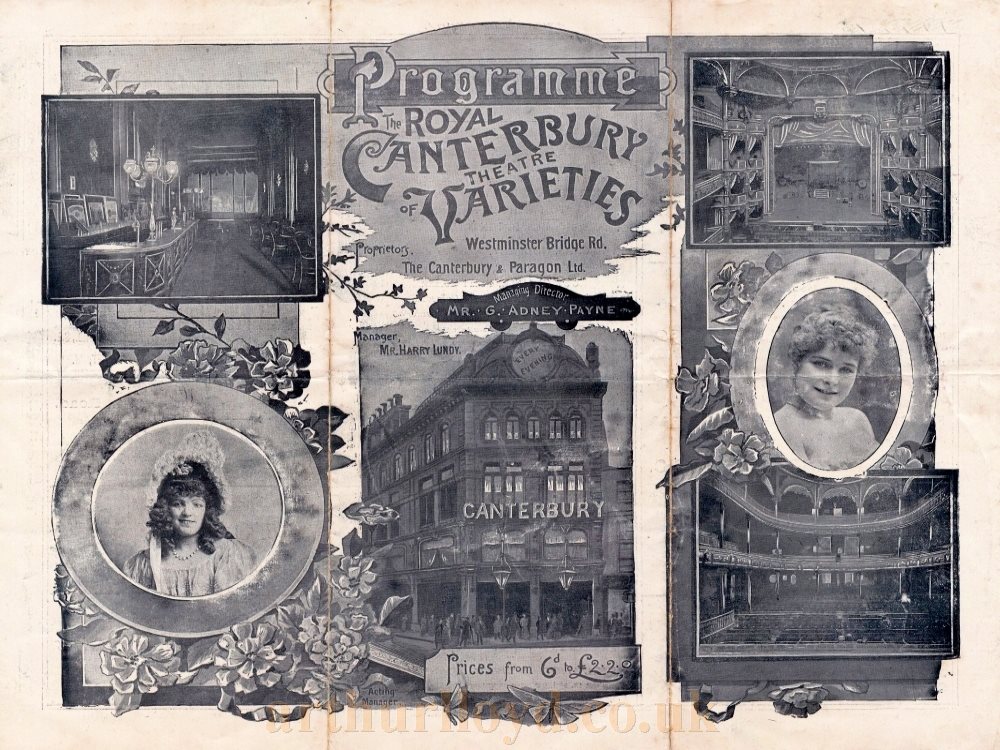 Programmes for the Canterbury Theatre from the 1890s to 1905 - Kindly Donated by Tony Tribe.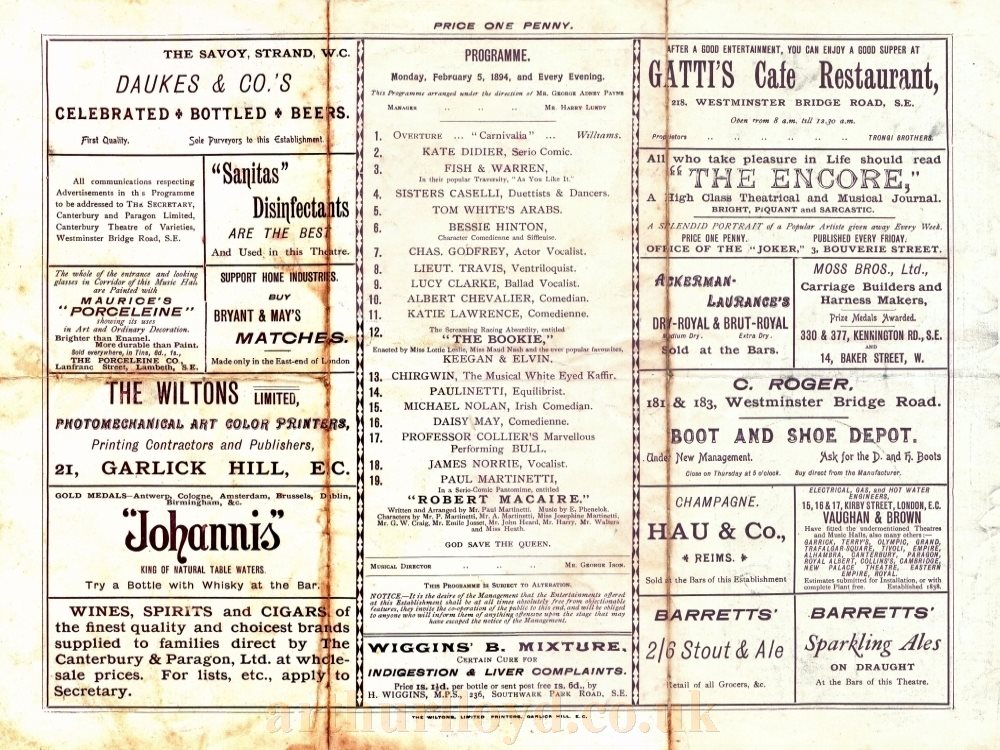
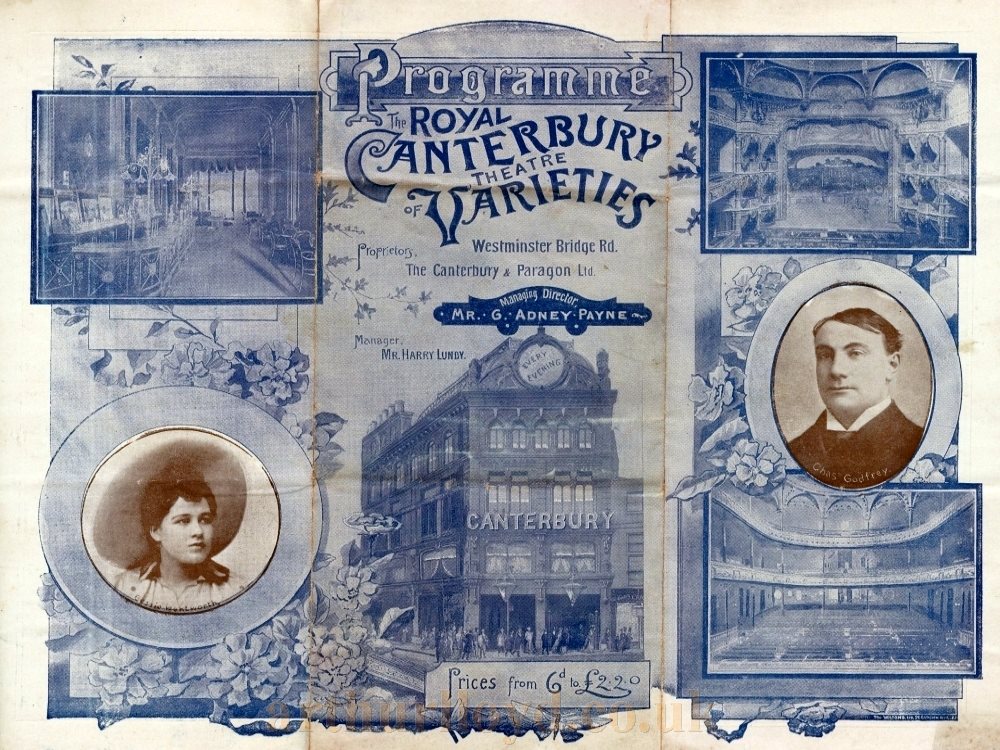 Programmes for the Canterbury Theatre from the 1890s to 1905 - Kindly Donated by Tony Tribe.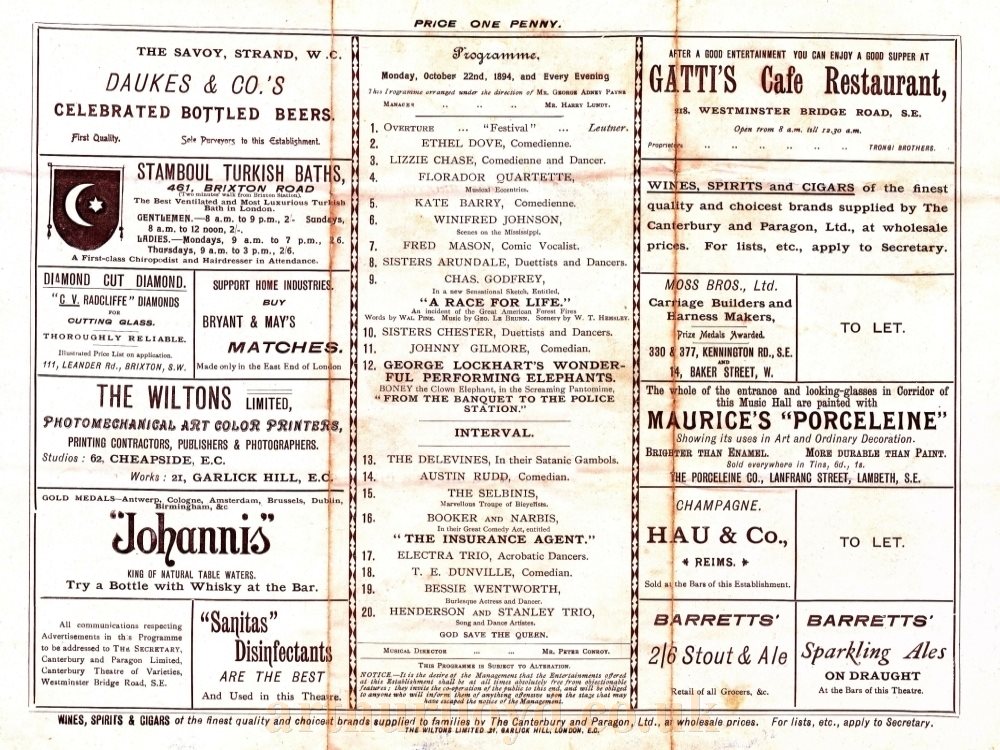
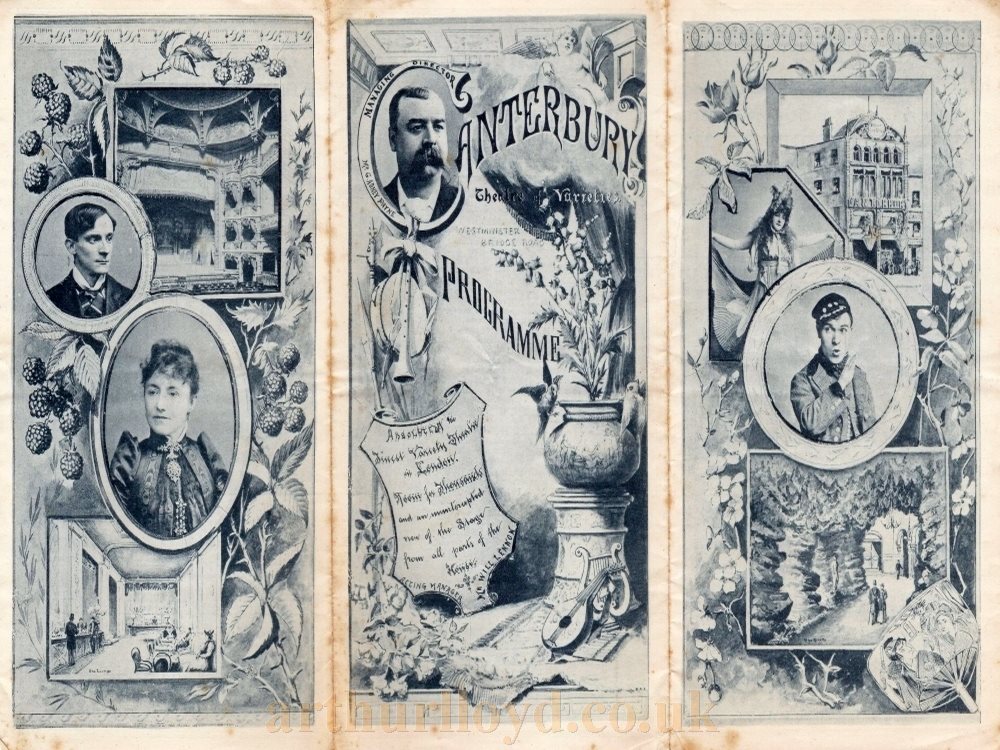 Programmes for the Canterbury Theatre from the 1890s to 1905 - Kindly Donated by Tony Tribe.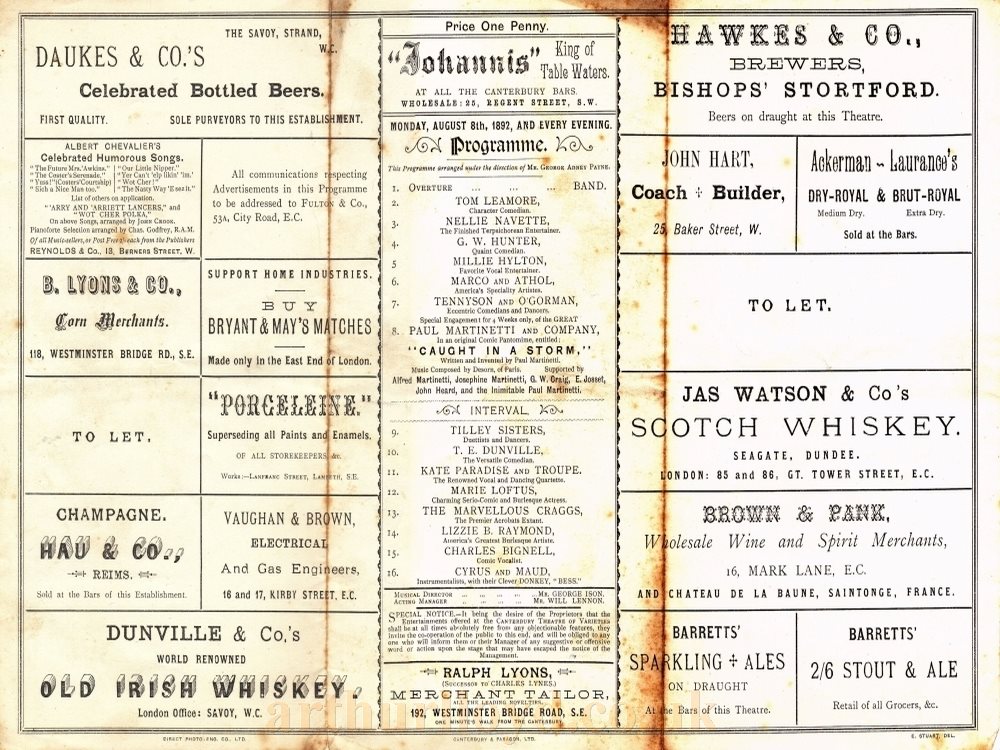
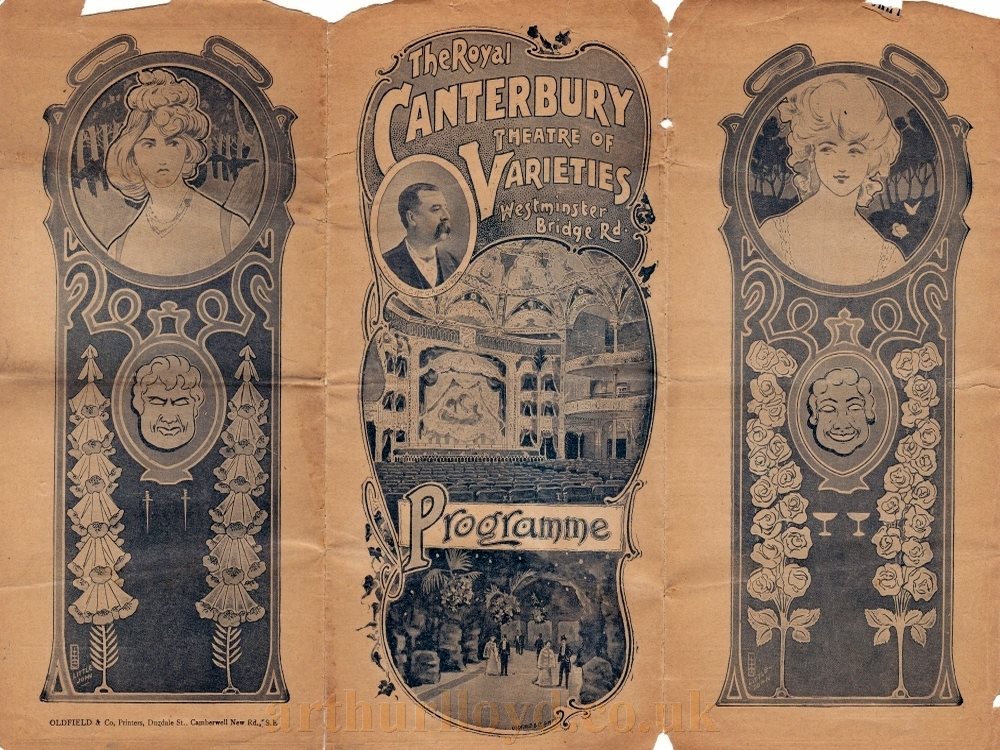 Programmes for the Canterbury Theatre from the 1890s to 1905 - Kindly Donated by Tony Tribe.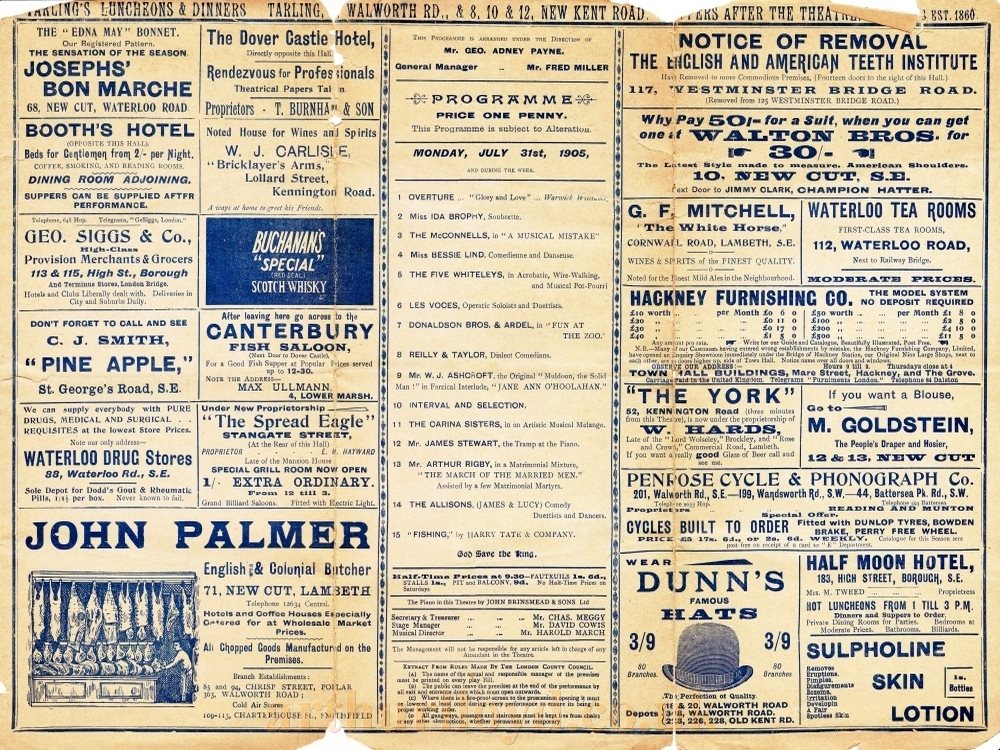


Above - Ten Programmes for the Canterbury Theatre 1890s to 1905 - Kindly Donated by Tony Tribe.
Later History and Demolition of the Canterbury Theatre
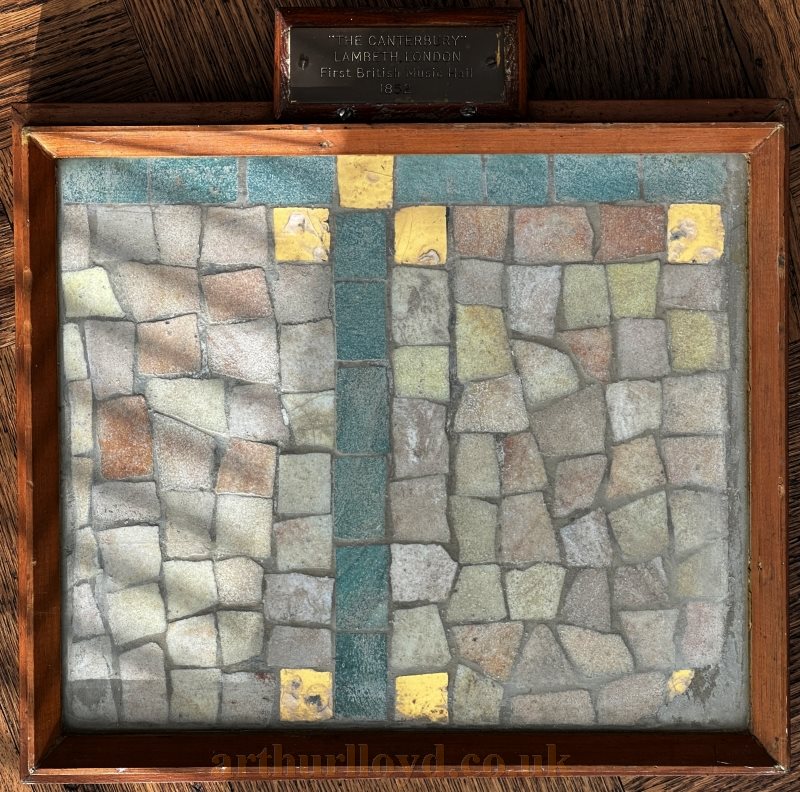
Above - A Framed Section of Mosaic from the Canterbury Theatre's Proscenium Arch thought to have been removed sometime between the Theatre being bombed in 1942 and its demolition in 1955 - Courtesy David Ryan who says that he believes the item came from the collection of the Late Roy Hudd who died in 2020.
 Matcham's redesigned Canterbury Theatre had opened on the 28th of August 1890, and although very successful for many years afterwards its popularity as a Music Hall and later as a Variety Theatre would eventually decline, as did most of the Music Halls of the period in the end.
Right - A Flyer for a Charity Matinee at the Canterbury Theatre on the 18th of January 1897 for the benefit of the Theatre Manager Fred Holden, who is pictured - Courtesy Simon Moss, stagememories.
The Theatre was later used as a Cinema and it is said that 'drastic price reductions' helped for a while, but the second world war would be the end for this Theatre when it was bombed in 1942. The Theatre then stood empty and derelict for many years before eventually being demolished in 1955.
 Left - Another piece of Mosaic from the proscenium arch of the Canterbury Theatre - Courtesy Tony Craig who says: 'A very good family friend, Al Fuller, went down with a hammer & chisel and hacked off a couple of chunks many years ago, when what was left of the Theatre was open to the elements. He kept one piece, and gave the other piece to my Mom (Jessie Jewel). Al... when he was younger, took over Ronnie Tates' part, when Ronnie continued to do the acts of his Father... Harry Tate, Ronnie then called himself Harry Tate Jr. (hope that all makes sense!), Later Al formed a high energy comedy singing & dancing act with Jeanette (who he married) as Al Fuller & Jeanette.'
Arthur Lloyd is known to have performed at the Canterbury Theatre on many occasions, including 1862, 1863, 1864, 1870, 1871, 1880, and 1885 - Also see details of a Playbill for Arthur Lloyd at The Canterbury Theatre, and this Special Feature on the Canterbury Music Hall.
There is more information on the Canterbury Theatre and its history in the contemporary articles shown below.
Some contemporary articles on the Canterbury Theatre
The Canterbury
From 'The Sketch' of May 1879
The Canterbury occupies a peculiar position. Whatever it may be it is neither regarded as a theatre nor a music hall. It is, in fact, a melange of the Aleazar, the Eldorado, and the London Oxford. A music hall to the British workman, who smokes his pipe and drinks his beer while listening to the humours of Arthur Lloyd and other star comiques. A pleasant lounge to the young man with the crush, crutch and toothpick, who would be bored to death by any particular dramatic entertainment. To one indeed, the Canterbury offers many attractions.If he does not wish to weary himself by going through the severe work of sitting through the performance, he has the alternative of smoking a cigarette in the pretiest saloon in London. If he wishes to listen to Mr. Frewin's orchestra without tiring his sight by looking over the footlights, the fauteuils are so comfortable that he can close his eyes and doze at his ease.
 On Wednesday evening last-Derby night the Canterbury programme was
more than usually attractive. The overture was Aubert's DominoNoir.
Then Miss Emily Kean and Mr. Mills for a brief while amused the audience.
To them succeeded our old favourite, Arthur
Lloyd, the most deservedly popular of comic singers. There is
a finesse about Arthur Lloyd's fun that is carefully studied, and
it is never too broad. A certain amount of slang and double entendre
a comic singer is obliged to indulge in, or he will hardly hit the
taste of his audience. Yet, of most music-hall favourites, Arthur
Lloyd is least given to attempts to win ill-merited applause by questionable
methods.
On Wednesday evening last-Derby night the Canterbury programme was
more than usually attractive. The overture was Aubert's DominoNoir.
Then Miss Emily Kean and Mr. Mills for a brief while amused the audience.
To them succeeded our old favourite, Arthur
Lloyd, the most deservedly popular of comic singers. There is
a finesse about Arthur Lloyd's fun that is carefully studied, and
it is never too broad. A certain amount of slang and double entendre
a comic singer is obliged to indulge in, or he will hardly hit the
taste of his audience. Yet, of most music-hall favourites, Arthur
Lloyd is least given to attempts to win ill-merited applause by questionable
methods.
But, at present, the chief and real attraction of the Canterbury programme is the carefully arranged and charmingly mounted ballet of Pat in Paradise. Miss Nelly Power, whose name has been so long associated with " the Hall over the water " that it would hardly seem the Canterbury at all if her name were not displayed upon the posters, sustains the part of Larry O'Leary with all that fun and vivacity which have invariably distinguished her among leading actresses of burlesque. The songs that fall to her share are delivered with the most dainty archness, and her dancing is as spirited as it is graceful. Larry finds a most fairy-like little Nora in Miss jonghmans. But the interest in the ballet commences with the Enchanted Scene in the Fairy Dell, when Erina, Kevin, and Shamroc accompanied by their fairy, court, appear under the lime-light. By a most careful contrivance the powerful rays of the electric lamp are tinted with divers hues, and flash across the stage in different directions, so that while from the right falls a vivid blaze of blue, from the left streams an equally dazzling flood of green. The effect is most bizarre and striking, and reflects the highest credit upon Mr. Sabin, the optician and electrician of the establishment. The dancing in the ballet is admirable. Mlle. Ada, the fair premiere danseuse has all the grace and marked finish of style of Mlle Gillert. Although somewhat apt to linger over each pose, she is yet never absolutely at rest, and her style is full of memories of the ballet in its older and better days She attempts no wonders, but thoroughly deserves the credit of never failing in what she does attempt. Miss Phyllis Broughton as Kevin, King of the Fairies, dances with much spirit, and is evidently a favourite with Mr. Villiers' audience. The setting of the ballet is as good as it can be, and the harmonies of colour effected by the aid of the variegated limelight are most artistic.
In the second ballet, Etherca, is introduced a new and Startling effect. Mlle Ariel, the danscuse, floats like a bird through the air, now mounting from the stage to the flies, now again descending, and now, crossing from right to left, or left to right, apparently without the least exertion. That mechanical assistance is somehow rendered to this most fascinating lady must be obvious; but the strongest field-glass fails to detect either rope or wire, and for the present, at any rate, the flight of Ariel is a "quaint apparition," the mystery of which is unsolved. With two such ballets, an evening can be very pleasantly passed. Indeed, the Canterbury is one of the pleasantest of our London lounges. The sliding roof preserves the atmosphere fresh, cool, and pleasant. The fauteuils ale Most comfortable The attendance is all that could, be wished. What better praise can one bestow upon a music-hall than to say that in it the visitor is cornpletely at his ease.
The above article was first published in 'The Sketch', May 1879.
A description of the new hall is given in J. E. Richie's contemporary survey of the capital's amusements, 'The Night Side Of London'
A well-lighted entrance attached to a public house indicates that we have reached our destination. We proceed up a few stairs lined with handsome engravings, to a bar, where we pay sixpence if we take a seat in the body of the hall, and ninepence if we ascend into the gallery. We make our way leisurely along the floor of the hall, which is well lighted, and capable of holding 1,500 people. A balcony extends round the room in the form of a horse-shoe. At the opposite end to that at which we enter is a platform, on which are placed a grand piano and a harmonium on which the performers play in the intervals when the previous singers have left the stage.
The chairman sits just beneath them. It is dull work for him, but there he must sit drinking and smoking cigars from seven to twelve o'clock. The room is crowded, and almost every gentleman has a pipe or cigar in his mouth. Evidently the majority present are respectable mechanics or small tradesmen with their wives and daughters and sweethearts. Now and then you see a midshipman, or a few fast clerks and warehousemen. Everyone is smoking, and everyone has a glass before him; but the class that come here are economical and chiefly confine themselves to pipes and porter.
Bright Lights, Big City - London Entertained 1830-1950, by Gavin Weightman
At this time new music halls, not necessarily on the lines of the Canterbury, were springing up on the sites of old singing saloons in many parts of London. The entertainment was a moveable feast the same stars could do the rounds and it was in the comfort and lavishness of the surroundings that the new impresarios competed. They came to draw more and more of their profits from the entrance fee, though the sale of drink and food remained important and was one reason why music halls were generally more profitable and thus attracted greater investment than theatres.
You may also be interested in this Special Feature on the Canterbury Music Hall.
George Robey and the 1907 FA Cup Winners on Stage at the Canterbury Music Hall
A visitor to the site, Tom Crawshaw, says:- 'My daughter Jane Crawshaw, who is a professional actress, was recently asked to do a piece for a documentary film about the early days of football in Britain. Her Gt Gt Grandad Tommy Crawshaw was a famous footballer in his day. He Captained Sheffield Wednesday to win the FA Cup Final vs Everton in 1907 and celebrated with his team after the match at the Canterbury Music Hall where George Robey topped the bill.' An extract from a book about Sheffield Wednesday, 'Wednesday' by Keith Farnsworth, mentions the event saying:- 'After the final, the team stayed in London for a few days, and were invited to the Canterbury Music Hall, where George Robey, known as "the Prime Minister of Mirth", was topping the Bill. Naturally, perhaps, Robey had the Cup-winners on stage during his act; and, as the players went up, Crawshaw asked "Shall I have to say owt?" and was relieved when Robey shook his head. Then, when the audience stopped applauding, the comedian suddenly said: "And now Tommy Crawshaw will tell us all about how Wednesday did it." Crawshaw remembered: "I was lost for words. But I managed somehow. Mind you, I think they were mostly amused by my Yorkshire accent, and probably didn't understand much of what I said!"' - Courtesy Tom Crawshaw.
If you have any more information or images for this Theatre that you are willing to share please Contact me.
Some of the archive newspaper reports on this page were collated and kindly sent in for inclusion by B.F