
Nottingham Theatres and Halls
Early Theatre Royal - Royal Alhambra Music Hall - Present Theatre Royal - Theatre Royal Centenary - Empire Theatre - The Empire and Theatre Royal by Donald Auty - Hippodrome Theatre / Gaumont Cinema - Malt Cross Music Hall - First Playhouse - Current Playhouse - Grand Theatre - Crown & Cushion / Coleno's Varieties / Varney's - Bulwell Olympia - King's Theatre / Gaiety Palace of Varieties - Albert Hall - Kinema Picture Theatre, Sherwood
See also: Mansfield, Nottinghamshire, Theatres and Halls / The Palace Theatre, Newark on Trent
The Theatre Royal and Concert Hall, Theatre Square, Nottingham
Formerly Parliament Street

Above - The Theatre Royal and Concert Hall, Nottingham in 2011 - Courtesy Ralph Stephenson

 The
Theatre Royal, Nottingham first opened on Monday the 25th of September 1865 with a production of 'School
for Sandal' (See Bill Right). The Royal was the second Theatre designed by the well known Theatre Architect, C.
J. Phipps and was constructed by J. and W. Lambert on Parliament
Street, which now forms part of Theatre Square. The Concert Hall, which
now stands next door to the Theatre Royal, was built in 1969 on the
site of the former Empire Theatre which was itself
built in 1898. The Theatre
Royal was altered by Phipps in 1870,
and again by the renowned Theatre
Architect Frank Matcham in 1897.
Further alterations in 1977 attempted to return the Theatre back to
Phipps' original although with varying degrees of success. A more detailed
history of the Theatre Royal follows.
The
Theatre Royal, Nottingham first opened on Monday the 25th of September 1865 with a production of 'School
for Sandal' (See Bill Right). The Royal was the second Theatre designed by the well known Theatre Architect, C.
J. Phipps and was constructed by J. and W. Lambert on Parliament
Street, which now forms part of Theatre Square. The Concert Hall, which
now stands next door to the Theatre Royal, was built in 1969 on the
site of the former Empire Theatre which was itself
built in 1898. The Theatre
Royal was altered by Phipps in 1870,
and again by the renowned Theatre
Architect Frank Matcham in 1897.
Further alterations in 1977 attempted to return the Theatre back to
Phipps' original although with varying degrees of success. A more detailed
history of the Theatre Royal follows.
Right - The opening night Bill for 'School for Scandal' at the Theatre Royal, Nottingham on the 25th of September 1865 - From the Theatre's Centenary Year Programme in 1965.
 The
year after the Theatre Royal opened shares were offered in the Company
of 2,000 at £10 each and the prospectus, part of which is shown
left, was printed in the ERA on the 1st of April, 1866, saying:-
The
year after the Theatre Royal opened shares were offered in the Company
of 2,000 at £10 each and the prospectus, part of which is shown
left, was printed in the ERA on the 1st of April, 1866, saying:-
'In the rapid development which, since the passing of the Inclosure Act, has taken place in the Town of Nottingham, and the increased number of its Inhabitants - exceeding, with those of the immediate neighbourhood, 110 thousand - the want of a New Theatre, adequate to these changes, was long felt to be a desideratum.
This want has been met in the erection, by Messrs J. and W. Lambert, of the New Theatre in Parliament-street - one of the most complete and attractive, perhaps, to be found within the Provinces.
The House, which is constructed to seat 2,200 persons, has been erected from designs by C. J. Phipps, Esq., F.S.A. of London and Bath, and possesses all those constructive advantages which characterise the best Theatres of the present day.

Above - The Theatre Royal, Nottingham - From the Moss Empires Jubilee Brochure of 1949
 In
embarking originally in this undertaking the Messrs. Lambert were actuated
by a desire to elevate the popular taste, and erect a Theatre worthy
of their native town. They believed that they should best accomplish
this by accepting, in the first instance, the entire responsibility,
and they accepted it accordingly, relying upon their fellow-townsmen,
when the building should be finished to join them in the undertaking,
and to assist them in their endeavours to make the Theatre - what they
are satisfied it may be made - a place of innocent recreation and of
moral and intellectual culture.
In
embarking originally in this undertaking the Messrs. Lambert were actuated
by a desire to elevate the popular taste, and erect a Theatre worthy
of their native town. They believed that they should best accomplish
this by accepting, in the first instance, the entire responsibility,
and they accepted it accordingly, relying upon their fellow-townsmen,
when the building should be finished to join them in the undertaking,
and to assist them in their endeavours to make the Theatre - what they
are satisfied it may be made - a place of innocent recreation and of
moral and intellectual culture.
Right - A poster for the Pantomime 'Cinderella' at the Theatre Royal, Nottingham from the 24th of December 1935. - Courtesy Stephen Wischhusen.
 Having
completed their work, and started the enterprise under such circumstances
as to afford every guarantee of success, they have now determined to
apply to it that Joint Stock principle which is so successfully and
generally in operation in regard to almost every form of enterprise
and investment, and which appears peculiarly applicable to an undertaking
of this description. Arrangements have, therefore, been made for a transfer
to a Joint Stock Company, Limited, of the Theatre, with the Saloons
and Dwelling-house adjoining and the outbuildings and approaches thereto,
for the sum of £15,000, and of the extensive Machinery, Scenery,
Properties, and Effects, belonging to the Theatre for the sum of £3,000,
the amount expended thereon by the Messrs. Lambert.
Having
completed their work, and started the enterprise under such circumstances
as to afford every guarantee of success, they have now determined to
apply to it that Joint Stock principle which is so successfully and
generally in operation in regard to almost every form of enterprise
and investment, and which appears peculiarly applicable to an undertaking
of this description. Arrangements have, therefore, been made for a transfer
to a Joint Stock Company, Limited, of the Theatre, with the Saloons
and Dwelling-house adjoining and the outbuildings and approaches thereto,
for the sum of £15,000, and of the extensive Machinery, Scenery,
Properties, and Effects, belonging to the Theatre for the sum of £3,000,
the amount expended thereon by the Messrs. Lambert.
Left - The auditorium of the Theatre Royal, Nottingham today - Courtesy David Garratt.
To provide for these amounts not more, it is believed, than one half of the proposed Capital of the Company will have to be called up, as a considerable portion of the purchase money may, if required, be borrowed on security of the property.
From the success which has attended the Theatre since its opening on the 25th of September last, there cannot be a doubt that the undertaking will prove a highly remunerative investment.
 In
the arrangement for purchase Messrs. Lambert have agreed to accept £5,000
of the purchase money in Shares marked fully paid, and to act, in the
first instance, as two of the Directors of the Company. The remaining
shares (except such as have been already subscribed for by the other
Directors), are now offered to the General Public.
In
the arrangement for purchase Messrs. Lambert have agreed to accept £5,000
of the purchase money in Shares marked fully paid, and to act, in the
first instance, as two of the Directors of the Company. The remaining
shares (except such as have been already subscribed for by the other
Directors), are now offered to the General Public.
Right - The Theatre Royal, Nottingham - From an early postcard.
Each application for Shares, in the annexed form, must be accompanied by the payment of 10s. per Share, which may be paid to the Company's Bankers. Should no allotment be made the money so paid will be returned, free of any deductions; or, if the allotment made be less than the number of Shares applied for, the amount so paid will be applied towards the payment of the deposit on allotment of such number of Shares as may be allotted.
Applications for Shares may be addressed to the Solicitors of the Company, of whom Prospectuses may be obtained.'
The above text in quotes was first published in the ERA, April 1st 1865.

Above - C. J. Phipps's Dress Circle Plan for the Theatre Royal, Nottingham - From 'Building Illustrations Private Houses, Public Buildings and Warehouses' A collection of illustrations assembled chiefly from the Architect, the Buildings news and the Builder, published in various issues between ca. 1862-1872.
 In 1870, just 5 years after the Theatre
first opened, C. J. Phipps was called back in to the Theatre to alter his original auditorium.
Works included replacing the pillars either side of the proscenium,
which were previously considered huge and ugly, by new light and elegant
ones, which also made the stage a little wider and the view from the
sides of the auditorium better. A new Act Drop by Gordon was also created
to finish this off. The front of the stage was also lowered at this
time, something which would happen again in 1897 so the site lines of this Theatre seem to have been a continuous problem
in the early years. New boxes were also added either side of the auditorium
so that the previous three boxes on either side now became two tiers
of four on either side plus two slips on either side of the Dress Circle,
bringing the total boxes up to twelve. And the whole auditorium was
cleaned and redecorated.
In 1870, just 5 years after the Theatre
first opened, C. J. Phipps was called back in to the Theatre to alter his original auditorium.
Works included replacing the pillars either side of the proscenium,
which were previously considered huge and ugly, by new light and elegant
ones, which also made the stage a little wider and the view from the
sides of the auditorium better. A new Act Drop by Gordon was also created
to finish this off. The front of the stage was also lowered at this
time, something which would happen again in 1897 so the site lines of this Theatre seem to have been a continuous problem
in the early years. New boxes were also added either side of the auditorium
so that the previous three boxes on either side now became two tiers
of four on either side plus two slips on either side of the Dress Circle,
bringing the total boxes up to twelve. And the whole auditorium was
cleaned and redecorated.
Right - A Programme for 'The New Wing' and 'Boys Will Be Boys' at the Theatre Royal, Nottingham on Monday the 13th of June 1892 - Courtesy John Lamb. In the cast were Ernest Percy, Sydney Barraclough, Gordon Harvey, Eardley Turner, Richard Purdon, F. Douglas, Lionel Rae, Maggie Hunt, Blanche Wolseley, Emmie Merrick, and Lizzie King who was the daughter of T. C. King, Arthur Lloyd's Father in Law.
For some six years until 1896 the Theatre Royal was managed by H. Cecil Beryl before he went off to Glasgow to take over a number of Theatres there including its Royal Princess's Theatre, Gorbals.
In 1897 the Theatre Royal was extensively reconstructed and refurbished by Henry Vickers, of Nottingham, to the designs of the renowned Theatre Architect, Frank Matcham. This was the start of a long lease of the Theatre from the Nottingham Theatre Company.
The lessee from 1897 was the newly formed limited company The Robert Arthur Theatres Ltd which had Theatres in Scotland such as Her Majesty's in Dundee and in England, such as the Theatre Royal, Newcastle. Robert Arthur, from Glasgow, now floated his company on the Stock Exchange.
He presented the whole range of plays, opera, revues and pantomimes until the company ran out of funds in 1912. At this point Michael Simons of Glasgow, chairman of the Theatre Royal, Glasgow and founder of Howard & Wyndham Ltd, became chairman of the Robert Arthur group and the Arthur Theatres operated under the same directors and managers of Howard & Wyndham. When the long lease ended in 1924 the Royal was bought outright by Moss Empires.
Reconstruction included lowering the stage and pit floor by some 2 foot and removing and replacing the original upper circle, gallery, and boxes, altering exit and entrance staircases, altering the stage house and rebuilding the dressing room block, basically a complete reconstruction of the Theatre.

Above - Matcham's 1897 Theatre Royal Nottingham auditorium before the 1977 reconstruction - Courtesy John West
 The
Theatre Royal's 'Grand Reopening Night' was on Monday the 6th of September 1897, but shortly before this
the ERA reported on the changes to the building
in their 28th of August edition saying: 'The Theatre Royal, Nottingham,
which was erected in 1865,
and is to be reopened on Monday, with One of the Best, has been
undergoing extensive alterations. The pit floor has been lowered about
2f., as also has the stage, which has been given a slight shade more
dip from the back to the front. This alteration has necessitated the
shortening of all the timber supports, and the cellars underneath have
had to be lowered accordingly. The stage is about 64f t. wide and 50ft.
in depth. A new orchestra, part of which is concealed under the stage,
has been built.
The
Theatre Royal's 'Grand Reopening Night' was on Monday the 6th of September 1897, but shortly before this
the ERA reported on the changes to the building
in their 28th of August edition saying: 'The Theatre Royal, Nottingham,
which was erected in 1865,
and is to be reopened on Monday, with One of the Best, has been
undergoing extensive alterations. The pit floor has been lowered about
2f., as also has the stage, which has been given a slight shade more
dip from the back to the front. This alteration has necessitated the
shortening of all the timber supports, and the cellars underneath have
had to be lowered accordingly. The stage is about 64f t. wide and 50ft.
in depth. A new orchestra, part of which is concealed under the stage,
has been built.
Right - A Programme for 'A Life of Pleasure' at the Theatre Royal, Nottingham for the week of Monday the 17th of September 1894 - Courtesy Roy Cross. This Augustus Harris production was originally staged at the Theatre Royal, Drury Lane.
 The
upper circle is now reached by a new staircase, which replaces the old
one, and, emerging into the crush room is another elaborate staircase,
which is to be used as an exit. The staircase leading to the gallery
is built outside the building, and is connected by a sloping corridor.
It is a fine structure, and is about 6ft. in width. The old gallery,
which accommodated 800, and the upper circle and dress-circle, each
capable of seating about 300, have been removed, and new ones of more
modern construction have taken their places.
The
upper circle is now reached by a new staircase, which replaces the old
one, and, emerging into the crush room is another elaborate staircase,
which is to be used as an exit. The staircase leading to the gallery
is built outside the building, and is connected by a sloping corridor.
It is a fine structure, and is about 6ft. in width. The old gallery,
which accommodated 800, and the upper circle and dress-circle, each
capable of seating about 300, have been removed, and new ones of more
modern construction have taken their places.
Left - Cast details from a programme for 'A Life of Pleasure' at the Theatre Royal, Nottingham for the week of Monday the 17th of September 1894 - Courtesy Roy Cross. The Company consisted of Miss Beaumont Collins, Miss Belle Valpy, Lizzie Aubrey, Bessie Harrison, Walter McEwen, Migill Martyn, Ernest Montefiore, Oyril Melton, Charles Dodsworth, William Dempsey, James Collins, Jarvis Widdicombe, Henry Cooper, James Mason, J. Robinson, Miss Herman, F. Maynard, Lane Bayliff, Bertie Kingston, George Cook, Lydia Cantwell, Jessie Cantwell, Fanny Eaton, and Miss R. Talbot. The play was written by Augustus Harris and Henry Pettitt, with incidental music composed by J. M. Glover.
The arrangement of the gallery will enable its occupants to get a much better view of the stage than they formerly had, as the steppings, numbering nine, have a rise of nearly 18in. each. The same remark applies to both the upper circle and dress-circle, where the construction has been steeper, though much more modified than the gallery. The new level to the dress-circle is 2ft. higher than the old one, and is approached by four steps leading from the foyer room.
 The
dress-circle saloon is now entered by a new entrance, and access to
the gentlemen's lavatory is gained from the saloon, whereas it was formerly
entered from the front of the building. New ladies' cloak rooms and
lavatories have been erected in close proximity to both the dress-circle,
upper circle, and gallery, the latter having been provided with a saloon
on a large scale. The corridors which were formerly in use in the dress-circle,
upper circle, and gallery have entirely disappeared, and the space taken
up by the same has been added to the auditorium.
The
dress-circle saloon is now entered by a new entrance, and access to
the gentlemen's lavatory is gained from the saloon, whereas it was formerly
entered from the front of the building. New ladies' cloak rooms and
lavatories have been erected in close proximity to both the dress-circle,
upper circle, and gallery, the latter having been provided with a saloon
on a large scale. The corridors which were formerly in use in the dress-circle,
upper circle, and gallery have entirely disappeared, and the space taken
up by the same has been added to the auditorium.
Right - A programme for Hamilton Dean and his company performing in 'When we were young' at the Theatre Royal, Nottingham on July 24th 1933.
 All the boxes have been removed, and new ones fixed in
their places. The old staircase leading to the gallery is to be used
as an early entrance and exit only from this part of the house.
All the boxes have been removed, and new ones fixed in
their places. The old staircase leading to the gallery is to be used
as an early entrance and exit only from this part of the house.
Left - A postcard showing the Theatre Royal, Nottingham in 1905.
The old marble staircase is about the only old part remaining intact. It has been thoroughly overhauled, and the extensive decorations carried out in connection with it make it appear bright and attractive. While the entrance to the pit remains in the same position slight improvements and alterations have been made. There are two alarm exits from the floor of the theatre, one through the crush room, and the other by way of the old early entrance adjoining the Clarendon Hotel.
 The
whole of the dressing-rooms have been cut off, and a new block has been
built at the rear of the stage. They are exceedingly well fitted up,
and will, doubtless, be found more comfortable than the old ones, which
presented a dismal appearance.
The
whole of the dressing-rooms have been cut off, and a new block has been
built at the rear of the stage. They are exceedingly well fitted up,
and will, doubtless, be found more comfortable than the old ones, which
presented a dismal appearance.
Right - The Auditorium ceiling of the Theatre Royal, Nottingham today - Courtesy David Garratt.
New carpenters' shops have been built, and the modern constructed scenery docks, with movable doors, will enable the scenery shifters to carry out their duties expeditiously. The whole of the steps are of artificial stone, specially cast in position, and will not be so liable to accident as the ordinary stone steps. The decorations, which have been made from new designs prepared by Mr Frank Matcham, the architect, are in fibrous plaster, and of the period of Louis XIV. The cost of the alterations will make a " big hole" into five figures. The theatre, which will accommodate about 3,000, will be lighted by electricity on an extensive and artistic scale. Mr Henry Vickers, of Nottingham, is he contractor.'
The above text in quotes was first published in the ERA, 28th August 1897.

Above - The Theatre Royal, Nottingham during the run of 'Can-Can' on the 25th of June 1956 - Courtesy Gerry Atkins.
 The Theatre Royal has been refurbished
and altered on several occasions including, radically, in 1977 when
the auditorium was altered in an attempt to convert it back to Phipps' auditorium of 1865.
The Theatre Royal has been refurbished
and altered on several occasions including, radically, in 1977 when
the auditorium was altered in an attempt to convert it back to Phipps' auditorium of 1865.
This is generally thought to have been a mistake as it destroyed much of Matcham's later reconstruction of the auditorium in the process.
Right - A Programme for 'The Silver Slipper' at the Theatre Royal, Nottingham on the 12th of May 1902 - Courtesy Max Carter - See cast details below.
The Theatres Trust says of the changes:- 'It is a pity that the old proscenium was demolished in 1977 and replaced by the present arrangement of giant Corinthian columns awkwardly surmounted by the curiously shaped arch springing directly off the capitals. Matcham’s distinctive second balcony level boxes and their plasterwork canopies were also at that time removed in favour of the present upper boxes, which are poorly-related to the new proscenium and expose areas of blank wall. These are the less favourable points in what was otherwise a magnificent revitalisation of the old theatre.' - The Theatres Trust.

Above - A Programme for 'The Silver Slipper' at the Theatre Royal, Nottingham on the 12th of May 1902 - Courtesy Max Carter.
During the 1977 refurbishment of the Theatre the backstage areas were also rebuilt and the grid was raised, a new side stage and scene dock, and new dressing rooms were also added. New larger bars and foyers were incorporated front of house. The facade of the Theatre was also altered slightly, although it does remain much in its original Phipps' design of 1865, but with new return-bays, and the restoration of the original balustrades and urns. The manager at this time was Leonard Claxton, and he became assistant manager to Barrie Stead when the Theatre reopened.

Above - The auditorium of the Theatre Royal, Nottingham today - Courtesy David Garratt.
The Theatre now forms part of the 'Royal Centre' which incorporates the Theatre itself and the Royal Concert Hall, which was completed in 1983, and was built on the site of the former Empire Theatre next door. The old Theatre Royal dressing rooms were originally on part of this site too, and between the Empire being demolished and the construction of the Concert Hall the land was in use as a car park.
You may like to visit the Theatre Royal's own website here.
Some of the information for this Theatre was kindly sent in by Graeme Smith.
The Centenary of the Nottingham Theatre Royal in 1965

Above - The Theatre Royal with its imposing frontage. Inset: Manager Frank Mathie who came to the Royal from the Empire Theatre, Glasgow.
 In
1965 the Theatre Royal, Nottingham celebrated
its Centenary with a production of 'My Fair Lady' direct from the Theatre
Royal, Drury Lane, where it had previously clocked up some 3,000
performances. The souvenir programme (shown right) for this production
included many images of the Theatre, past and present, along with a
history of the building, and a foreword by Leslie A. Macdonnell, the
managing director of Moss Empires Ltd at the time, all of which I have transcribed here:-
In
1965 the Theatre Royal, Nottingham celebrated
its Centenary with a production of 'My Fair Lady' direct from the Theatre
Royal, Drury Lane, where it had previously clocked up some 3,000
performances. The souvenir programme (shown right) for this production
included many images of the Theatre, past and present, along with a
history of the building, and a foreword by Leslie A. Macdonnell, the
managing director of Moss Empires Ltd at the time, all of which I have transcribed here:-
Foreword by Leslie A. Macdonnell
 I will never ever forget meeting the Nottingham Press for the first time
on taking over my Managing Directorship of Moss' Empires. The first
question I was asked was, "Who is going to take over the Theatre
Royal, Marks & Spencers or somebody?" I replied, shocked and
amazed, that if the people of Nottingham wanted the Theatre Royal it
would be kept open.
I will never ever forget meeting the Nottingham Press for the first time
on taking over my Managing Directorship of Moss' Empires. The first
question I was asked was, "Who is going to take over the Theatre
Royal, Marks & Spencers or somebody?" I replied, shocked and
amazed, that if the people of Nottingham wanted the Theatre Royal it
would be kept open.
Left - Leslie A. Macdonnell, Managing Director of Moss Empires Ltd in 1965.
We have tried our best for Nottingham and Nottingham has supported us. "My Fair Lady" looks as though it is going to be set for a record-breaking run and while I cannot promise that the Theatre Royal will be open in another 100 years time, we'll try our best. - Thank you Nottingham. - Leslie A. Macdonnell, Managing Director of Moss Empires Ltd.
Theatre Royal, Nottingham History by Harry Martin

Above - The Theatre as it was in 1895 - much the same as today - only the pedestrian and vehicular traffic betray the years between
Opening
night at the Theatre Royal was Monday, the 25th September, 1865.
Harry Martin describes that momentous occasion and tells the story of
the oldest theatre of its kind in the provinces which, on Monday, the 27th September, 1965, will celebrate its Centenary.
The year 1865 was a memorable one. It saw a series of events which are now important entries in the history books: slavery was finally abolished in the United States; President Lincoln was assassinated (in a theatre !); Nottingham's General Booth founded the Salvation Army; Lister introduced antiseptics . . . .
Right - The opening night Bill for 'School for Scandal' at the Theatre Royal, Nottingham on the 25th of September 1865 - From the Theatre's Centenary Year Programme in 1965.
Here in Nottingham, the Nottingham Industrial Exhibition was held; the Forest Football Club was formed; the School (now College) of Art was founded. But the most glittering occasion in the town was the opening of the new Theatre Royal.
 On
that first of many First Nights a hundred years ago, the citizens of
Nottingham donned their finest clothes and flocked to "The new
home prepared for the dramatic muse in Nottingham" which, according
to the Nottingham Review, was "in every way worthy of her habitation".
On foot and in horse-drawn carriages they came to fill the 2,000 seats
in the opulent crimson and gold auditorium of "one of the handsomest
theatres out of London."
On
that first of many First Nights a hundred years ago, the citizens of
Nottingham donned their finest clothes and flocked to "The new
home prepared for the dramatic muse in Nottingham" which, according
to the Nottingham Review, was "in every way worthy of her habitation".
On foot and in horse-drawn carriages they came to fill the 2,000 seats
in the opulent crimson and gold auditorium of "one of the handsomest
theatres out of London."
Left - Detail from the Centenary Programme for 'My Fair Lady' at the Theatre Royal, Nottingham in 1965.
They were greeted by 17-year-old Madge Robertson (later Dame Madge Kendall) who spoke a prologue specially written for the occasion. Then, the house lights (171 gas jets forming a "sunlight" in the centre of the dome) dimmed and the curtain rose on a production of Sheridan's School for Scandal. The cast comprised "an admirable company of artistes selected with great care from the principal theatres of London and the provinces". At the last curtain call, Manager Mr. Montgomery stepped forward to declare the theatre's purpose "to present first-class entertainment . . . but in providing the solids of the banquet we shall not neglect the trifle. The gay and witty burlesque will follow, and, in due season, King Pantomime." In a final burst of rhetoric he demanded what was there "to prevent the drama from fulfilling its greatest mission, namely a teacher of highest morality, nay, even the gentle handmaiden of religion ?"
 But
19th century opinion was somewhat divided on this point. Certain clergymen
in the town were not too enamoured by this "handmaiden'; of their
calling; indeed, they regarded her as something of a strumpet. Outraged
they thundered against the theatre through the medium of pamphlets such
as that composed by the Rev. A. Hervey. In his righteously indignant
Nottingham Theatre — A Warning, he deplored its establishment thus:
- It was thought by the right-hearted that to expend Fifteen Thousand
Pounds upon a Play House, in a town where efforts are daily put forth
to improve the morals and religion of the young would have been the
height of folly and sin."
But
19th century opinion was somewhat divided on this point. Certain clergymen
in the town were not too enamoured by this "handmaiden'; of their
calling; indeed, they regarded her as something of a strumpet. Outraged
they thundered against the theatre through the medium of pamphlets such
as that composed by the Rev. A. Hervey. In his righteously indignant
Nottingham Theatre — A Warning, he deplored its establishment thus:
- It was thought by the right-hearted that to expend Fifteen Thousand
Pounds upon a Play House, in a town where efforts are daily put forth
to improve the morals and religion of the young would have been the
height of folly and sin."
Right - Ship Lane in 1864 - a year before the Royal was opened.
This was a very different viewpoint to that expressed by the two men who had spent that £15,000 (no mean outlay in those days when the fare to America as advertised by one Nottingham shipping agency was £2. 16s.) Lace dressers John and William Lambert saw the legitimate stage as an influence for good in the town and called upon their fellows to "assist them in their endeavours to make the theatre a place of innocent recreation and of moral and intellectual culture."
They had commissioned architect C. J. Phipps to design a "splendid temple of drama". It took six months to build and was described in glowing terms by a contemporary writer ; "Viewed from Wheeler Gate and the adjoining portions of the Market Place, the facade presents a very picturesque and classic boundary to the vista of the new street that is to take the place of the now nearly obsolete Sheep Lane" (the "new street" was, of course, Market Street).
 Risking
the fire and brimstone with which they were threatened by the Church
militant in its opposition to the theatre, the paying public formed
avid queues at the box office. A private box in those days cost from
one to two guineas, dress circle seats 2/6d., upper circle 1/6d., the
pit 1/- and a seat in the 'gods' 6d.
Risking
the fire and brimstone with which they were threatened by the Church
militant in its opposition to the theatre, the paying public formed
avid queues at the box office. A private box in those days cost from
one to two guineas, dress circle seats 2/6d., upper circle 1/6d., the
pit 1/- and a seat in the 'gods' 6d.
Right - How 19th Century Nottingham saw its Theatre Royal - looking up the brand new Market Street.
True to its word, the management continued to provide first-class entertainment. On the 2nd October, 1865, the Theatre Royal proudly presented The Haymarket Burlesque of Ixion . . . produced on the same scale of splendour and completeness as produced at that theatre."
And it has continued to do to ever since. The list of famous 'names' who have appeared at the Royal reads like a Who's Who of Show Business: Ellen Terry, Sir Henry Irving, Matheson Lang, Seymour Hicks and Fred Terry. And, more recently, Sir Donald Wolfit, Anna Neagle, Albert Finney and Peter O'Toole are but a few. Its audiences have witnessed almost every form of live show; burlesque and ballet, pop music and grand opera, drama and pantomime, Victorian melodrama, drawing room comedy. Whitehall farce, kitchen sink drama . . . the Royal has staged it all and given it a fair, if critical hearing.
Nottingham was recently described as "theatre-minded" by Mr. Leslie A. Macdonnell, the Managing Director of Moss Empires, who took control of the theatre when the lease of the Robert Arthur Theatres Company expired in 1924. And this is why the Royal has staged so many world premieres and pre-London productions. Its audience is regarded 'in the business' as a reliable
 barometer
by which to gauge the climate of opinion. Tap it with a new play, see
which way the wind blows in Nottingham and it's a fair indication of
whether or not someone will feel an (over) draught in the West
End !
barometer
by which to gauge the climate of opinion. Tap it with a new play, see
which way the wind blows in Nottingham and it's a fair indication of
whether or not someone will feel an (over) draught in the West
End !
Left - Zena Dare and the Cast of My Fair Lady cut the cake celebrating 100 years of the Theatre Royal, Nottingham in 1965. - Caption Reads: - 'My Fair Lady Celebration At The Royal - Seventy-eight year-old Zena Dare (centre) who has starred as Mrs. Higgins in this production of My Fair Lady since it opened at Drury Lane 3000 performances ago, cuts the cake celebrating the occasion.
Nottingham's appreciation of the best in entertainment stems from that happy day when two of its sons built a theatre "worthy of the town". That town is no less proud of it now than it was then. And it is appropriate that the legend My Fair Lady should adorn the Centenarian of Theatre Square on the occasion of her 100th birthday. It sums up our feelings towards her after a century of being entertained in RoyaLstyle. - Harry Martin 1965.
The above text and images are from a programme for the Theatre Royal, Nottingham's Centenary in 1965.
The Empire Theatre of Varieties, Theatre Square, Nottingham
Formerly South Sherwood Street

Above - The Nottingham Empire Theatre - From the Moss Empires Jubilee Brochure of 1949
 The
Empire Theatre, Nottingham was built as a variety Theatre for Oswald
Stoll in 1898, next door
to the 1865 Theatre
Royal, and opened on Monday the 28th of February 1898 with two performances
of an opening variety show. The Theatre was designed by the renowned Theatre Architect, Frank
Matcham who had in 1870 reconstructed
the Theatre Royal.
The
Empire Theatre, Nottingham was built as a variety Theatre for Oswald
Stoll in 1898, next door
to the 1865 Theatre
Royal, and opened on Monday the 28th of February 1898 with two performances
of an opening variety show. The Theatre was designed by the renowned Theatre Architect, Frank
Matcham who had in 1870 reconstructed
the Theatre Royal.
Right - A Variety Programme for the Nottingham Empire on Monday may 27th 1935 - Acts included the Barry Twins and Molly, Mr. Thomas, The Vive Cleveres, Connie Graham, Nat Gonella and His Georgians, Stan Pell and Stan Little, Steffani and his 16 Singing Scholars, Art Frank, and D'Amsell and Boy.
The ERA printed a report on the opening of the Empire Theatre in their 5th of March 1898 edition saying: 'It is only bare truth to say that the Nottingham Empire Theatre, opened on Monday evening, rivals in internal elegance and in the comfort of its arrangements the best music halls in the provinces. Indeed, the cities are very few which can boast a variety hall so well arranged and so charmingly furnished and decorated. The interest of all local amusement-seekers had been for some months centred on the structure in South Sherwood-street daily progressing towards completion, but it is safe to say that their anticipations were more than fully realised when, as the curtain rose on the Dolce Quartet prepared to sing the National Anthem, the full power of the electric light illumined a really brilliant scene.
 It
will be remembered that when at the close of 1896 the Theatre Royal changed hands it was expected
that it would be turned into a music hall,
but the syndicate which purchased it came to the conclusion that it
would be a pity to divert from its ancient channel of amusement a theatre
so popular as the Royal, and the offer to take it on a long lease coming
apropos from Mr Robert Arthur, it was thought advisable to accept his
offer and build a new up-to-date music hall on the land adjoining the
theatre which had been included in the original purchase.
It
will be remembered that when at the close of 1896 the Theatre Royal changed hands it was expected
that it would be turned into a music hall,
but the syndicate which purchased it came to the conclusion that it
would be a pity to divert from its ancient channel of amusement a theatre
so popular as the Royal, and the offer to take it on a long lease coming
apropos from Mr Robert Arthur, it was thought advisable to accept his
offer and build a new up-to-date music hall on the land adjoining the
theatre which had been included in the original purchase.
Left - A postcard showing the Empire Theatre, Nottingham, and the Theatre Royal to the left of the picture
Thus the Theatre Royal and the Empire Palace are absolutely distinct interests. The Theatre Royal is leased for a long term of years to the Robert Arthur Theatres Company (Limited), whilst the Empire is the undertaking of the Nottingham Theatre of Varieties, Limited, of which Mr H. E. Moss, a gentleman widely known in the music hall profession for enterprise and acumen, is the chairman, while the managing-director is Mr Oswald Stoll, of Cardiff, representative of a family which for many years has held the highest position in the world of variety entertainment.
 The
ground immediately adjoining the Theatre Royal on the South Sherwood-street
side was selected as the site destined for the reception of the future
variety theatre, and active operations were commenced in June last year.
The architect was Mr
Frank Matcham, whose experience in regard to theatrical designing
is probably unique.
The
ground immediately adjoining the Theatre Royal on the South Sherwood-street
side was selected as the site destined for the reception of the future
variety theatre, and active operations were commenced in June last year.
The architect was Mr
Frank Matcham, whose experience in regard to theatrical designing
is probably unique.
Left - A Variety Programme for the Nottingham Empire on Monday 28th November 1938 - Acts included The Vanstrattans, Harry Coady, Frank Marx & Iris, Gaudsmith Brothers & Company, Bill Rolls & Dorothy, Kingsley & Forde, and Henry Hall & His Orchestra.
The first steps were, of course, to pull down the shops before mentioned, which extended from the dress-circle entrance of the Royal to the yard leading to the entrance of the Royal to the yard leading to the present stage entrance to the theatre. The greatest obstacle to this portion of the operations lay in the disposal of the immense quantity of scenery stored in the Royal scene dock, which was likewise situated among the shops. This difficulty overcome, and the alterations entered upon by Mr Robert Arthur once completed, the work of erecting the music hall was rapidly proceeded with.
 The auditorium presents a remarkably gorgeous spectacle. The scheme
of decoration is Oriental in character, and Indian methods in regard
to art have been largely drawn upon. The two boxes which flank the stage
are surmounted by pagoda-like gilded domes, and two grinning idols guard
each side of the procenium.
The auditorium presents a remarkably gorgeous spectacle. The scheme
of decoration is Oriental in character, and Indian methods in regard
to art have been largely drawn upon. The two boxes which flank the stage
are surmounted by pagoda-like gilded domes, and two grinning idols guard
each side of the procenium.
Right - The Auditorium of the Nottingham Empire Theatre - Courtesy Mike Blakemore.
The ceiling and circle fronts are resplendent with blue and gold colouring, the hues which are the predominating features of the scheme. So far as the ceiling itself is concerned, there is sufficient work of an interesting nature to occupy the eye for a considerable time. The general effect is so exceptional that it is impossible by a detailed description to give a really adequate idea of the work, but a few of the leading designs may be briefly indicated. Large models of elephants' heads stand out boldly at each corner, supporting the ceiling, and there are four huge tablets representing Indian tapestry, depicted in the peculiar colours which are characteristic of this material. Finely-executed hand-painted designs upon various subjects are let into the ceiling here and there, and nearing the centre are more representations of Indian gods and sun rays, displayed in relief. Exactly in the centre is fixed a glass sliding roof, after the style of the Pavilion and Canterbury, among other London halls. This can be removed and replaced in the short space of time of half a minute, the mechanism being extremely simple. There are upwards of 100 electric lights in the auditorium, most of which are in the form of "shower" electroliers. Over forty descend from the ceiling, while thirty are fixed round each circle.
 The
entrances are all situated in South Sherwood-treet. The visitors to
the grand circle and fauteuils are admitted from the street to a crush-room.
A wide and easy flight of stone steps leads to a well-appointed lounge,
which extends from one side of the circle to the other. At each end
is placed a cloak-room, that destined for the use of ladies being to
the right hand. The staircase and lounge walls are covered with thick
leather paper of very handsome appearance, in maroon and gold. At the
back of the grand circle a series of roomy boxes, similar to those at
the London Empire, have been
placed.
The
entrances are all situated in South Sherwood-treet. The visitors to
the grand circle and fauteuils are admitted from the street to a crush-room.
A wide and easy flight of stone steps leads to a well-appointed lounge,
which extends from one side of the circle to the other. At each end
is placed a cloak-room, that destined for the use of ladies being to
the right hand. The staircase and lounge walls are covered with thick
leather paper of very handsome appearance, in maroon and gold. At the
back of the grand circle a series of roomy boxes, similar to those at
the London Empire, have been
placed.
Left - A Bill for 'Call Us Mister!' at the Nottingham Empire in the 1950s - Courtesy Maurice Poole.
The seats in the grand circle, stalls, and fauteuils are all on the tip-up principle, upholstered in old gold plush, which imparts to the auditorium a very warm and comfortable appearance. The fauteuils are reached from the circle, the arrangement in this respect being similar to that which obtains at the Theatre Royal. A pierced barrier, carved into small balustrades, surrounds the circle, which contains six rows of seats. There are three rows of the fauteuils, and many rows of stalls. The pit has several rows of well-cushioned benches, while the balcony is provided with seats which are similarly padded. Behind the balcony is situated the gallery, which is able to accommodate a large number of occupants. The line of sight throughout the building is admirable, and there is not a seat in the theatre which does not command an uninterrupted view of the stage. Ample attention has been given to the exit doors, several of which will, of course, only be requisitioned in case of emergency. Should necessity arise the hall should be cleared in two and a-half minutes, so that the safety of the audiences is practically ensured. There is also an emergency staircase from the balcony to the street.
At the back of the stage the arrangements are of a most complete character. The stage, which is 35ft. wide, with a 30ft, proscenium opening, is equipped with every appliance necessary for the production, if required, of a spectacular piece. There are bridges, cuts, traps, and vampires. The flies are 53ft. from the stage. The electric light is to be used for the footlights and battens, while electric projectors take the place of the limes. Bulbs of three colours constitute the foot and proscenium lights. The electric switchboard is, in fact, a very elaborate affair. A complete instalment of gas has, however, been laid on, in the event of any mishap with the electrical plant. The dressing-rooms, which are ten in number, have been arranged with a view to the comfort of their temporary inmates, and contain both hot and cold water...

Above - A Painting by George Richmond depicting the Auditorium of the Nottingham Empire in 1898. The painting is inspired by the B&W image on this page, with the dark blue colours, and gold hues, gleaned from the ERA article on this page - Click for an Index to all of George Richmond's Paintings on this site.
...The façade in South Sherwood-street certainly does not prepare the passer-by for the ornate appearance of the auditorium. Before leaving the subject mention should be made of Mr J. Greenman, who, in the responsible position of resident clerk of the works for Mr Matcham, has superintended the erecting of the music hall from the commencement. Mr Greenman has accomplished much valuable work in connection with the building operations. Smartly uniformed attendants on Monday looked after the bestowal of visitors, and in every respect the hall presented the aspect its title implies - a theatre of varieties.
The performance at each " house " was exactly the same, and there was a big audience at each, certain members of the Corporation being present at the first "house'' by invitation. Miss Lydia Yeamans-Titus sang and acted delightfully. Mr F. J. Titus accompanied her with taste and skill. Stelling and Revell on the triple bars were clever and comical; Kara did some almost incredible jugling; Miss Rose Elliott's singing was pleasing; and Crowley, a male soprano, excited astonishment and applause.
 A
capital turn was that of the Welsh Prize Glee Singers, who sing with
great taste and sweetness, Fratelli Riccobono exhibited their marvellously
trained horses and dog; Little Major Leslie's eccentricities were amusing;
and the darkey doings of Beatty and Bentley were droll to a degree.
The acting-Manager is Mr James Wynes, and the deputy acting-manager,
Mr T. Gerald Morton.'
A
capital turn was that of the Welsh Prize Glee Singers, who sing with
great taste and sweetness, Fratelli Riccobono exhibited their marvellously
trained horses and dog; Little Major Leslie's eccentricities were amusing;
and the darkey doings of Beatty and Bentley were droll to a degree.
The acting-Manager is Mr James Wynes, and the deputy acting-manager,
Mr T. Gerald Morton.'
Right - A Bill for 'Peep Show' at the Nottingham Empire in 1957 - Courtesy Maurice Poole.
The above text in quotes was first published in the ERA, 5th of March 1898.
The Empire Theatre continued as a variety Theatre for many years but eventually found itself home to so called 'girly shows' and their like, see programme cover right. But even this wouldn't save the Theatre in the end and in 1969 the Theatre was demolished to make way for road widening and new box office for the adjacent Theatre Royal. The Royal Concert Hall stands on the Empire's site today.
Arthur Lloyd is known to have performed at the Nottingham Empire Theatre in 1900.
The Empire and Theatre Royal, Nottingham
From 'Moss Empires' Theatres in the Fifties' by Donald Auty

Above - Early postcard of Theatre Square, Nottingham showing the Hippodrome (Centre), the Theatre Royal, (Right), and to the far right of the image, part of the Empire Theatre.
These two theatres adjoined each other, the Empire was a Matcham house and the Theatre Royal was originally Phipps but rebuilt by Matcham at a later date. The Empire housed variety and the Theatre Royal musicals and plays.
Tim Tillson was the manager of both houses and a martinet of the first order. He moved to the Palace Manchester shortly after the Empire closed. I had many a row with him because the man was entirely inflexible and also used to try and levy absurd contra charges at the end of the week A friend of mine once put on the settlement sheet on a Saturday night 'signed under duress' and there was a great rumpus back at the head office in Cranbourne Mansions on the following Monday morning.
Harry Hackworth was musical director at both houses and furnished pit orchestras of any size as required from a pool of local musicians.
The dock doors of both theatres were side by side and there is a story of how the show loads went into the wrong theatres one morning and it was not discovered until a cloth for a Shakespeare production was hung at the Variety Empire. I bet the stage staff loved transferring the loads and made sure that it never happened again.
Uncle Bob was stage manager at the Theatre Royal at the back end and spent most of his time in the Turf Tavern across the Road. We used to load him onto a bus with instructions to the driver to put him off outside his house on most nights.
When Tim Tillson moved to Manchester Frank Mathie took over. He came down from the Glasgow Empire when it closed. He used to enter the theatre through the stage door in the morning as all old time managers did in order to make sure that all the backstage staff were there and working and insisted on the safety curtain being raised during the morning so that he could see what was happening on stage. They don't make them like Frank any more.
When Frank retired Lenard Claxton the assistant took over and fought valiantly for the theatre and was in a lot of ways responsible for its survival. He stayed on when the corporation took over and retired a few years ago.
The Empire was demolished in the sixties (1969) and the concert hall now stands on the site.
(The Stage Manager at the Empire was George Rainburn who went to Brighton Hippodrome when the Empire closed - Alan Chudley.)
The Theatre Royal was refurbished with a magnificent new backstage and part of the frontage when the corporation took over in the seventies. It is still an extremely vibrant theatre. With the auditorium as it was in the Phipps days. The plaster work is specially listed and protected and you cannot drill into it in order to put up lamps or Kirby wires.
The above text on the Theatre Royal and Empire, Nottingham is from 'Moss Empires' Theatres in the Fifties' by Donald Auty and was very kindly sent in by him for inclusion on this site.
The Theatre Royal, St Mary's Gate, Nottingham
Formerly - The Theatre, Nottingham - Later The Royal Alhambra Music Hall


Not to be confused with the present Theatre Royal which is still operating in Nottingham today and is described above, from the mid 1700s to the mid 1800s there was a much earlier Theatre Royal operating in St Mary's Gate, Nottingham which was first opened in 1760. The Theatre was originally known simply as The Theatre, Nottingham, but later became known as the Theatre Royal.
Right - Five early Posters for the Theatre, Nottingham from 1831 to 1839 - Kindly sent in by Patricia Akers whose great grandfather William Lowe appeared in the productions. William Lowe was an actor and singer who lived in Burton Street close to where the present Theatre Royal is situated today. By day he ran his own business as a whip maker.
In 1835 the Theatre was renovated which included adding a new Pit, replacing the Box seating, and redecorating the House.
 It was again redecorated in 1839 probably due to the effects of allowing smoking in the auditorium and the use of gas lighting.
Left - Actor William Lowe, who performed in the productions shown in the posters above, and his wife Sarah Lowe - Courtesy Patricia Akers.
In 1840 the Theatre was altered and the Gallery enlarged for the opening of 'Ducrow's Equestrian Soirees' which opened on the 30th of November there. The following year the Theatre was redecorated again for its reopening season in October 1841.
 In 1847 the Theatre was redecorated yet again and a new proscenium and scenery were reported to have been added, the reporter also mentioned that although the decorations would render the Theatre more suitable for the 'present taste' there was nothing that could be done about the 'peculiar construction' of the Theatre.
Left - An early entrance token for the Royal Alhambra music hall, Nottingham - Courtesy Paul Withers of Galata Print.
 The
Theatre Royal was finally closed down in the late 1850s and it was then altered for use as a Music hall, reopening as the Royal Alhambra Music Hall in April 1865. This continued for several decades until it was finally closed, and its fixtures and fittings were sold off, in October 1883.
The
Theatre Royal was finally closed down in the late 1850s and it was then altered for use as a Music hall, reopening as the Royal Alhambra Music Hall in April 1865. This continued for several decades until it was finally closed, and its fixtures and fittings were sold off, in October 1883.
Right - A Bill for a Benefit for Mr. Pope and a performance of 'Provoked Husband' and 'No Song, No Supper' or 'The Lawyer in the Sack' at the St Mary's Gate Theatre Royal on August the 12th 1804 - Courtesy Alan Chudley.
The Theatre's 'leader of the orchestra', Samuel Kirk, who was also one time lessee of the Theatre, and had worked in both its incarnations as the Theatre Royal and the Alhambra Music hall, died a month after the Music Hall closed down, having worked there for 45 years.
After the Theatre was striped out it was then converted into a restaurant. But this was later closed due to it becoming a haunt of prostitutes, and the building then became a Lace Warehouse around the turn of the Century.
The building was destroyed by bombs during the war.
If you have any more information or images for this Theatre that you are willing to share please Contact me.
The Former Playhouse, Goldsmith Street, Nottingham
Formerly Pringles Picture Palace / Goldsmith Street Picture House / New Repertory Theatre / Little Theatre

Above - The Little Theatre during the run of 'The Merchant of Venice' Circa 1945 - Courtesy Alan Chudley
 The
first Playhouse Theatre in Nottingham was built in Goldsmith Street
and originally opened as Pringles Picture Palace in 1910.
This Theatre was built as a Cine-Variety Theatre and was equipped with
a very small stage of only 12 foot deep by 18 foot wide, with a height
of just 20 foot and no fly tower.
The
first Playhouse Theatre in Nottingham was built in Goldsmith Street
and originally opened as Pringles Picture Palace in 1910.
This Theatre was built as a Cine-Variety Theatre and was equipped with
a very small stage of only 12 foot deep by 18 foot wide, with a height
of just 20 foot and no fly tower.
Right - Programme for 'Arms and the Man' at the Nottingham Playhouse - Courtesy Alan Chudley
 By
the 1940s it was in use as a repertory Theatre called the Little Theatre
or New Repertory Theatre.
By
the 1940s it was in use as a repertory Theatre called the Little Theatre
or New Repertory Theatre.
Left - Programme for 'Lucky Dip' at the Little Theatre, Nottingham in 1945 - Courtesy Alan Chudley
In 1948 the building became the Nottingham Playhouse whose company, led by Val May and Frank Dunlop, became very successful despite the hugely limiting effects of the Theatre's tiny stage. Eventually the Playhouse Company had a new Theatre built for them in 1963 (See Below) and the original Theatre became a furniture retail shop before being converted into a public House.
If you have any more information or images for this Theatre that you are willing to share please Contact me.
The Current Playhouse, Wellington Circus, Nottingham
The current Nottingham Playhouse was built by Peter Moro who was involved with the designs of the interior of the Royal Festival Hall in London. The Theatre opened in 1963 with Sir Tyrone Guthrie’s production of Shakespeare's Coriolanus. The Theatre was built with a conventional proscenium arched stage and an auditorium which seated 770 and was constructed from concrete which was visible in its interior walls.
To see a 360 degree image of the stage and auditorium today click here.
In 1996 the Playhouse received a Grade II Listing, and in 2004 the Theatre received Heritage Lottery Funding and other grants totaling nearly £2 million to fund the building of a new bar and restaurant for the Theatre called 'Cast' and a new educational space. The Playhouse currently seats 750 people.
You may like to visit the Playhouse's own website here.
If you have any more information or images for this Theatre that you are willing to share please Contact me.
The Malt Cross Music Hall, 16 St James Street, Nottingham
The Malt Cross in Nottingham's St. James Street was built in 1877 as a Public House and Music Hall by William Taylor for a Mr. Welson who was actually a plumber by trade.
The Hall, on the ground floor of this three storey building is around 45 foot long by 30 foot wide. There is a balcony around the three sides opposite the stage supported by iron columns. There was also another balconied space built below the main hall which was used as a restaurant. Music Hall ceased at the Malt Cross by 1914.
In 1997 the Hall was restored and now functions as a bar, restaurant, gallery, and performance venue.
For a 360 degree image of the Malt Cross today click here.
You may like to visit the Malt Cross Website here.
If you have any more information or images for this Theatre that you are willing to share please Contact me.
The Hippodrome Theatre, Theatre Square, Nottingham
Later - The Gaumont Cinema
Also see - Nottingham Hippodrome Memories by Ralph Stephenson

Above - Bertie Crewe's drawing of the proposed Royal Hippodrome, Nottingham - From the Era, 21st of March 1908.
 The
Nottingham Hippodrome was designed by the respected Theatre Architect Bertie Crewe in 1908 and opened on the 28th of September that year. The Theatre was the last of the Hippodromes to be built for Thomas Barrasford who died in Brighton in 1910, within two years of the
Nottingham Hippodrome being opened.
The
Nottingham Hippodrome was designed by the respected Theatre Architect Bertie Crewe in 1908 and opened on the 28th of September that year. The Theatre was the last of the Hippodromes to be built for Thomas Barrasford who died in Brighton in 1910, within two years of the
Nottingham Hippodrome being opened.
Right - A Variety Programme for the Nottingham Hippodrome for Monday the 8th of April 1912 - Courtesy John Lamb. On the Bill were Mary Neil, Les Wartanas, Lillian Gould, Ted Karno and Company, Royal Kino Juveniles, Tennyson & Wallis, The Diabolical Box, Jack Walsh, and H. Franklin and the Standards.
The Era reported on the construction of the Nottingham Hippodrome in their 21st of March 1908 edition saying:- ' A worthy addition to the palatial edifices devoted to variety is this year to be made in Nottingham, and plans for the imposing building have been prepared by Mr. Bertie Crewe, the famous architect. The house will be run in conjunction with the Barrasford tour, which at present comprises upwards of thirty places of entertainment in this country and on the Continent. The building is being erected by the Nottingham Hippodrome, Ltd., of which Mr. Thos. Barrasford is the manging-director, and the contractors are Messrs. Parkinson and Sons of Blackpool.
The new house will occupy a commanding corner site in an elevated position, with every means of access from all parts of the city and outlying districts. Constructed on thoroughly up-to-date and most modern principles, the theatre will be adapted in every conceivable way to the comfort and convenience of the audience, and the absence of columns of any sort in the auditorium will ensure a clear view of the stage from all parts, while a substantial rake in the pit level will ensure that the sight line in that portion of the house will be uninterrupted. Tie pit, it may be added, is an exceptionally commodious one, and has four gang ways for ingress and egress.
 The building, which will be designed in terra-cotta and red brick, will have an elevation of English renaissance, and its handsome frontage, surmounted by an elegant cupola, will make an acceptable embellishment to the thoroughfare.
The design of the new house will be that of Louis XVI., with which style the whole scheme of decoration will be in harmony. At the principal entrance will be a portico, leading to a foyer laid with marble mosaic, of which material the staircase is also composed.
Left - An early image showing the Auditorium of the Nottingham Hippodrome - Courtesy David Baxter.
A fine box-office will occupy the centre, and a few steps from the entrance hall will be found a handsomely-appointed waiting room which will serve the purposes of a lounge during the enteracts. On the floor of the lounge will be elegant Turkey carpets and rugs, and within the auditorium an elaborate tableau curtain and draperies to the boxes will give a finish to the decorative scheme. The seating capacity of the house, which will have two tiers, will he upwards of 2,600. There will be four private boxes, and thirteen rows of seats in the circle, and the stalls will be equally commodious, having eleven rows of tip-up armchairs of the latest and most-approved pattern. One of the finest galleries in the country will be provided for that part of the house having thirteen rows of seating, and possessing no less than five gang-ways, all leading to exits.
 The auditorium is 84t. wide and 74ft. deep, and the stage has a width of 84ft. and a depth of 40ft. The proscenium opening, which will be framed by handsome marble columns, is 39ft. 6in. in height by 42ft. wide, and the height from the stage to the grid is 60ft., so that the most elaborate production can be accommodated.
Right - A 1920s Postcard view of Theatre Square, Nottingham showing the Hippodrome Theatre, later the Gaumont Cinema Centre, and the Theatre Royal to the right.
A much appreciated concession to the comfort of patrons of the pit and gallery will be found in waitiing-rooms at both parts, which will be available during inclement weather to the public waiting for the doors to open.
 The convenience of the artists has not been neglected, and ample dressing-room accommodation will be furnished. Every precaution, too, has been taken for the safety of the audience, numerous exits being provided from all parts. The house will be lighted, ventilated (electrically), and heated on the most up-to-date principles, and the best fireproof materials utilised.
Left - A Google StreetView Image of Theatre Square, Nottingham in May 2023 - Click to Interact. To the right can be seen the Theatre Royal, and Centre the site of the former Hippodrome Theatre / Gaumont Cinema.
Included in the upper part of the building, but apart from the theatre itself, will be a number of well-appointed suites of offices, which will be let to anyone who desires to employ them for trading purposes.
Building operations will be begun immediately, and the theatre will be opened in September, the edifice thus being erected in the amazingly short space of six months.'
The above text in quotes was first published in the ERA, 21st of March 1908.

Above - A 1950s Postcard view of Theatre Square, Nottingham showing the Hippodrome Theatre / Gaumont Cinema Centre, and the Theatre Royal to the right.
The Nottingham Hippodrome, as reported in the Era article above, took six months to build and did indeed open in September that year, on the 28th of September 1908 in fact. The Theatre then went on to have a successful run as a variety Theatre, often with showings of the early moving pictures as part of the programing. Originally built for Thomas Barrasford the Theatre was later taken over, after his death in 1910, by T. A. Edwardes who by that time was running many Theatres in the Midlands.
The Hippodrome was later taken over by the Provincial Cinematograph Theatres Chain who would then close it as a live Theatre in October 1927, refurbish the building, and reopen it as a Cine Variety Theatre on the 7th of November 1927. At this time a new Wurlitzer Theatre Organ was also installed.

Above - The George Hames Band on stage at the Nottingham Hippodrome in 1934 - Courtesy Stephen Wells whose father Joesph Wells is the middle trumpeter in the photograph. Stephen says 'The George Hames band was based in Loughborough, where the eponymous George founded a music and record shop. There were many bands bearing the name, including accordion ensembles, string groups and childrens' marching bands, mainly made up of people who went for instrumental lessons in the studios attached to the shop. They seem to have dominated the amateur music festivals in the region. I suppose this was a jazz or jazz-oriented big band. My dad was a semi-professional trumpeter in various groups before and immediately after the war, and played bugle and cornet in the army. In about 1950 he moved to Ilkeston, where I was born, and he served as mayor of the borough 1972-73.
Later taken over by Gaumont British Theatres in February 1929, and managing to get through the war mostly unscathed, the Theatre was renamed the Gaumont Cinema in February 1949. Gaumont altered the Theatre for Cinemascope in the mid 1950s and this marked the end of its live theatre usage and the stage was mothballed.
The end came for this Theatre in 1971 when its then owners the Rank Organisation closed it on the 16th of January that year and the Theatre was then demolished in February 1973. An office building called Barrasford House, after the Theatre's original owner, was then constructed on the site.
There is more information on the Nottingham Hippodrome and the later Gaumont Cinema in an article written for this site by Ralph Stephenson in March 2011 below.
Nottingham Hippodrome Memories by Ralph Stephenson
Above - Early postcard of Theatre Square, Nottingham showing the Hippodrome (Centre), the Theatre Royal, (Right), and to the far right of the image, part of the Empire Theatre.
 The Hippodrome, Nottingham was a big Theatre,
the exterior in the later Victorian style – even if it was built
in Edwardian times; ignore the sign and it could have been an insurance
company or bank head office.
The Hippodrome, Nottingham was a big Theatre,
the exterior in the later Victorian style – even if it was built
in Edwardian times; ignore the sign and it could have been an insurance
company or bank head office.
Right - The Nottingham Hippodrome can be seen to the right of this early postcard.
The interior was all Georgian revival period; lots of ornate gilt paint with red plush, not only on carpets and seats, but lining the front of the balconies and the drapes in the two-tier side boxes which augmented the classic “horseshoe” shaped auditorium with three circle levels above the stalls; a dress circle, circle and the upper circle (or ‘the gods’ as they were known) so high that only the ceiling, chandeliers and projection box were higher.
The tier angle up there was 33 degrees! Never plush in its day, they were the cheap ticket area with separate access staircases, box office, bar, toilets and exits. There weren't even seats but terraced benches -Victorian values indeed!
It had long been closed when I arrived at ‘The Hippo’ in 1962, aged 15, as a trainee projectionist at The Gaumont cinema (Rank second circuit) as it was by then - and had been for some time. Projection staff did have access to the gods, our “other” route down to the backstage and backyard entrance, but it was also somewhere to watch the week’s films from on breaks in the 12 hour day!
 Quite
a lot remained functioning backstage while the auditorium was almost
completely untouched. Changing to cinema function then didn't mean becoming
a two or three screen multiplex, that was still nearly four years in
the future when Rank’s first circuit Odeon in Nottingham became
the UK’s first major twin screen house.
Quite
a lot remained functioning backstage while the auditorium was almost
completely untouched. Changing to cinema function then didn't mean becoming
a two or three screen multiplex, that was still nearly four years in
the future when Rank’s first circuit Odeon in Nottingham became
the UK’s first major twin screen house.
Part of the stage, in front of the cinema screen with the sound speakers behind, was still used for regular presentations of live music acts included in our Saturday morning Rank Teen Club, mainly ‘pop’ or ‘beat’ groups (this just before ‘rock band’ took over as a term.) A local DJ also hosted dancing to ‘records’ first, and after the musical mayhem came the movies.
The stage control board in the stage-right wings still operated the screen ‘tabs’ (curtains) providing background to stage acts, and the stage footlight tabs. Along with the footlights and sidelights, the safety curtain had, by law, to still function too. Rows of indicator lights on this board showed systems for backdrops, cueing and even the trapdoors still worked.
Left - A Poster for the Leon Salberg Pantomime 'Bo-Peep' at the Nottingham Hippodrome for January the 21st 1924, a production which was performed with a similar cast at the Birmingham Alexandra Theatre the following year. - Courtesy Stephen Wischhusen.
Officially, because of my age, I was not allowed backstage alone very often, my role in Teen Shows was operating a high ‘key’ spotlight up on the front of ‘the gods’ – however, on other days during my breaks I sometimes cautiously explored those areas. Extra front stage was actually the boarded-over orchestra pit but underneath I found it still existed, although the entrance doors were locked. I was once given a glimpse inside by the Polish caretaker and boiler stoker, Jan, who had the keys. Very dusty chairs and music stands were still in place awaiting the orchestra that never returned! A grand piano stood by the stage left in the auditorium and was routinely kept tuned but I never heard it formally played.
Backstage areas in old Theatres all have common aspects which I first found at the Gaumont; the brick walls are likely painted a unique shade of green to about 5ft. in height divided by a thin once-white line and peeling paint of a sad cream shade, long darkened by dust above that. Black electricity conduit piping is everywhere along walls and all corridor lighting is in frosty glass fronted ‘bulkhead’ fixtures, alongside gas lighting too - still required then for all Exit sign boxes in the building. Floors are usually stone and cold. All steps are red Cardinal brand polished with white lines on the edges and sides and there is always the universal background smell of the same disinfectant. Behind the screen and speakers there was a vast stage area and the scenery “dock” high doors remained with their electric drives still working too. Cleared of most paraphernalia it was still kept clean once a month. Overhead were the ‘fly’ walkways. Our small army of women cleaners kept the screen clean once a week with a special extension tube vacuum brush working from a stage outlet of the house vacuum “ring main” the compressor supplying this was in the boiler room basement area along with the two generators which supplied the DC current for the film projector carbon arc lighting. Heavy backdrop frames must still have been up in the flys because there were the usual clusters of ropes coming down to the wooden tie-off frames either side of the stage and steel weave cables descending to hand driven geared cranking winches.
Underneath, corridors of dressing rooms, band rooms and open, wire mesh fronted, store rooms held a variety of disused equipment, amongst which was an early Trix public address system amplifier and microphone I yearned to own from the first time I saw it. Daring to ask one day if it could be sold to me our Chief said he’d think it over but had reached no decision before I left. Safely escorted by another projectionist in the course of daily work we’d occasionally go along the same corridors, I pretending to see the areas for the first time!.

Above - A Company Photograph for an unknown production at the Nottingham Hippodrome - Courtesy Noel Skinner, who says: 'My Grandfather, stage name Harry Cassidy, was on the music halls and I believe among other people he worked with were Charlie Chaplin and Stan Laurel, he is standing 3rd from the right in the natty bowler in this Photo.' If you know who any of the people in the cast or on the posters behind them were, or can pinpoint the date please Contact me here.
In the auditorium three chandeliers were suspended, the central one a real Phantom of the Opera behemoth, one could imagine Lon Chaney sending crashing into the stalls. Somewhat akin to the mother ship in Close Encounters when lit and seen from the gods, funnily enough, its nickname was “the UFO”! The two flanking chandeliers were only a third the size. All were lowered in one week, once a year, for bulb replacement and cleaning of the many glass compartments. They were controlled by hand cranked winches in the space between the auditorium ceiling and the roof called “the voids” – I was never allowed in there!
A “winch down night” meant that two projectionists stayed on for an hour’s overtime to lower “the UFO” carefully to the auditorium floor, because of its weight. This saved time for cleaning it and raising it again the next day. The smaller chandeliers only needed half an hour and one man per winch to lower.
The film storage and rewind room of the projection box had been added to the roof where several wooden duck-board walkways provided safe routes to the void's door and also to the dome high above the main entrance on the corner of Goldsmith and Woollaton Streets. This was an open to the air cupola serving no purpose other than decoration and shelter for pigeons but had wonderful views of Nottingham to offer, day or night, perched as it was atop the hill that forms a main artery city junction still called Theatre Square. Originally, The Hippodrome shared the square with (going clockwise) the County Hotel, Theatre Royal, The Empire variety Theatre, The News Exchange music hall pub, The Scala Theatre (and later cinema) and a music hall on Upper Parliament Street that became The Odd Hour News Theatre in the 1930s but closed in the mid ‘50s. Their rear entrance on Woollaton Street faced the south side of the Hippodrome.

Above - A Company photograph for a 'Twice nightly production of 'The demon of the Cellar' at the Nottingham Hippodrome in July 1910. Underneath the poster on the left it says 'Twoeedduns', and the other poster to the right advertises 'Six Brothers Luck'. - Photo Courtesy Matt Downs. If you know who any of the people in the cast were, or have more information on these two productions please Contact me here.
To return to our main entrance, the steps would survive demolition and become part of the replacement building. The box office was on the right and a sales kiosk to the left, stairs by both led to an immaculately curved (and preserved) dress circle corridor lounge, in light Wedgewood Regency blue with gold wall fittings against striped wallpaper. Centre to these staircases was the broad one down to the stalls. The lobby was staffed by the ticket box lady and the sales kiosk lady, the senior and junior uniformed commissionaires and assistant manager in evening dress! The stalls and circles also had two uniformed usherettes each – full employment indeed.
My last visit, as a customer once more, was in 1969 (The Thomas Crown Affair, Steve McQueen) and not much had changed except the upper circle had closed, possibly a couple of years previously, doubtless due to declining regular audience.
Notice to close came from Rank Theatres Division in mid-1971 “quite suddenly” according to the last manager, and demolition followed in 1973. By then I’d lived in Brighton, then London for two years and never saw that ultimate indignity of any large building which always seems especially poignant when it’s a cinema or Theatre under the wrecking ball.
The above article on the Hippodrome, Nottingham was kindly written for this site and sent in for inclusion on it by Ralph Stephenson in March 2011.
If you have any more information or images for this Theatre that you are willing to share please Contact me.
The Grand Theatre, 2, Radford Road, Hyson Green, Nottingham
Later - Nottingham Repertory / Grand Cinema

Above - The Grand Theatre, Nottingham from a programme for 'New Muldoon's Pic-Nic', 3rd of October 1892
 The
Nottingham Grand Theatre was built for Councillor Morrison by E. Long
and opened on Monday the 1st of February 1886.
The Theatre was about a mile from the City Centre on Radford Road, Hyson
Green. The first Lessee of the Grand was Emily Kennion, of the Theatre
Royal, Leicester. The Grand's stage was deeper then the Theatre
Royal's at 85ft., and had a width of 57ft, 6in. The width of the
proscenium opening was 28ft with a height of 32ft. The Theatre's auditorium
was built on three levels, stalls and pit, dress circle, gallery, and
two boxes on the ground floor, and could accommodate 2,600 people, seated
and standing.
The
Nottingham Grand Theatre was built for Councillor Morrison by E. Long
and opened on Monday the 1st of February 1886.
The Theatre was about a mile from the City Centre on Radford Road, Hyson
Green. The first Lessee of the Grand was Emily Kennion, of the Theatre
Royal, Leicester. The Grand's stage was deeper then the Theatre
Royal's at 85ft., and had a width of 57ft, 6in. The width of the
proscenium opening was 28ft with a height of 32ft. The Theatre's auditorium
was built on three levels, stalls and pit, dress circle, gallery, and
two boxes on the ground floor, and could accommodate 2,600 people, seated
and standing.
Right - A programme for 'The Octoroon' at the Grand Theatre, Nottingham on the 3rd of October 1891 when the General manager was J. B. Mulholland (pictured) - Courtesy Max Carter. See cast details below.
The Theatre was equipped with a scene painting gallery some 30 foot above the fly floor, and had a basement beneath the stage of 32 foot so that scenery could be lowered under the stage. Accommodation for artistes was very large with 17 dressing rooms reached from corridors on either side of the stage, a large ballet room on stage left, and a green room behind the stage with store rooms, an armoury, and rooms for management also included.

Above - A programme for 'The Octoroon' at the Grand Theatre, Nottingham on the 3rd of October 1891 - Courtesy Max Carter.
 The ERA reported on the Grand Theatre in their 6th
of February 1886 edition saying:
'In previous issues we have given descriptions of the progress made
with this building in its course of construction, and this week we are
enabled to announce its practical completion and opening to the public.
For an account of this last named our readers are referred to our provincial
columns.
The ERA reported on the Grand Theatre in their 6th
of February 1886 edition saying:
'In previous issues we have given descriptions of the progress made
with this building in its course of construction, and this week we are
enabled to announce its practical completion and opening to the public.
For an account of this last named our readers are referred to our provincial
columns.
Right - A programme for 'New Muldoon's Pic-Nic' at the Grand Theatre, Nottingham on the 3rd of October 1892 when the General manager was J. B. Mulholland (pictured). See cast details below.
The building has been erected by Mr Councillor Morrison, and is situated in a thickly populated part of the town. It is, however, a considerable distance from Nottingham Market-place; but whether this circumstance will militate against its future success or popularity can be proved only by experience. There is a service of trams running from the centre of the town past the theatre, and this we understand is to be increased. Nottingham, is now well provided with theatres, and no doubt between the Royal, with its brilliant history, and the new theatre there will be a friendly rivalry for patronage, which we hope may prove of advantage to the public and to the pecuniary benefit of both establishments. The lessee of the new theatre is Mrs Emily Kennion, of the Theatre Royal, Leicester, and the general manager is Captain T. R. Kennion...

Above - A programme for 'New Muldoon's Pic-Nic' at the Grand Theatre, Nottingham on the 3rd of October 1892

Above - Cast Details from a programme for 'New Muldoon's Pic-Nic' at the Grand Theatre, Nottingham on the 3rd of October 1892.
 ...The
theatre is a handsome structure, with most of the latest improvements.
The auditorium consists of dress circle, pit, and gallery, there being
no upper circle or amphitheatre, as in many such like buildings. The
whole of the seats are so constructed that a view of the entire stage
can be had from all parts of the house. The floor of the pit rises with
a considerable pitch, which will be found a great advantage to the occupants
of that region. Seating accommodations here provided for 800, and, in
addition, there is a promenade at the back giving room for 300 more.
The Seats in the pit are comfortably upholstered, and provided with
back rails. The dress circle is arranged to seat 500 people, and at
the back, from side to side, runs a promenade. This is 57ft. long, and
from all parts of it a full view of the stage can be had. The seats
are upholstered with crimson velvet, and the space is ample between
the rows to allow of easy passage in and out. The gallery has seating
capacity for nearly 1,000 persons.
...The
theatre is a handsome structure, with most of the latest improvements.
The auditorium consists of dress circle, pit, and gallery, there being
no upper circle or amphitheatre, as in many such like buildings. The
whole of the seats are so constructed that a view of the entire stage
can be had from all parts of the house. The floor of the pit rises with
a considerable pitch, which will be found a great advantage to the occupants
of that region. Seating accommodations here provided for 800, and, in
addition, there is a promenade at the back giving room for 300 more.
The Seats in the pit are comfortably upholstered, and provided with
back rails. The dress circle is arranged to seat 500 people, and at
the back, from side to side, runs a promenade. This is 57ft. long, and
from all parts of it a full view of the stage can be had. The seats
are upholstered with crimson velvet, and the space is ample between
the rows to allow of easy passage in and out. The gallery has seating
capacity for nearly 1,000 persons.
The auditorium is lighted by a magnificent sun-light, supplied by Messrs Strode, of London. Attached to it is a ventilating shaft to carry off the products of the gas consumption. Of private boxes there are but two, and these are on the ground floor, close to the proscenium, and overlooking the orchestra. Opening off the entrance corridor to the pit is a large refreshment-bar, and there is a smaller bar on the dress circle level.
Right - A Poster for 'My Sweetheart' at the Grand Theatre, Nottingham for December the 14th 1896 - Courtesy David Hampton. The Poster forms part of a display at The Rock Entertainment Emporium in Abbotsbury Road Weymouth.
 Ventilation
is a matter that has been well attended to. The stage in depth measures
85ft., and in breadth 57ft, 6in. The width of the proscenium is 28ft.,
with a height of 32ft. Over the flies, about 30ft. above the stage,
is the scene-painting gallery. Beneath the mezzanine floor (8ft. below
the stage floor) is a depth of 32ft., so that the largest piece of scenery can be lowered out of sight.
Ventilation
is a matter that has been well attended to. The stage in depth measures
85ft., and in breadth 57ft, 6in. The width of the proscenium is 28ft.,
with a height of 32ft. Over the flies, about 30ft. above the stage,
is the scene-painting gallery. Beneath the mezzanine floor (8ft. below
the stage floor) is a depth of 32ft., so that the largest piece of scenery can be lowered out of sight.
Left - A Seating Plan for the Grand Theatre, Nottingham from a programme for 'New Muldoon's Pic-Nic' on the 3rd of October 1892.
Staircases ascend from the stage to corridors leading on the one side to the actors' and on the other to the actresses' dressing-rooms, of which there are seventeen, including two special rooms for "stars," These rooms are warmed with gas stoves, and water is laid on in each. The green-room is at the back of the stage, and there are also property and furniture store-rooms, armoury, managers' rooms, &c. Adjoining the left hand corridor is a large dressing-room for members of the ballet. All these apartments have fireproof floors and walls. The same precaution has been taken all through the building where possible. Should a fire unfortunately occur, there are two tanks of water above the stage, holding 1,500 gallons each, which can be made to discharge their contents almost instantaneously. There are also two hydrants available.
 As
to the decorations, they are characterised by good taste. The prevailing
tint of the 'walls is French grey. The ceiling is of rectangular shape,
with a large central panel round the sunlight, and smaller ones on each
side. The centre panel is ornamented with a mythological painting, and
at the corners are busts of Macready, Bacon, Shakespeare, and Byron.
The smaller panels are embellished with floral designs. The front of
the gallery is covered with classical figures, whilst the dress circle
in front is ornamented with chaste embossed work. Over the proscenium
are the words "All the world's a stage." An act drop has been
specially painted, representing King Charles raising the standard in
Nottingham, most of the figures on the picture being taken from authentic
sources.
As
to the decorations, they are characterised by good taste. The prevailing
tint of the 'walls is French grey. The ceiling is of rectangular shape,
with a large central panel round the sunlight, and smaller ones on each
side. The centre panel is ornamented with a mythological painting, and
at the corners are busts of Macready, Bacon, Shakespeare, and Byron.
The smaller panels are embellished with floral designs. The front of
the gallery is covered with classical figures, whilst the dress circle
in front is ornamented with chaste embossed work. Over the proscenium
are the words "All the world's a stage." An act drop has been
specially painted, representing King Charles raising the standard in
Nottingham, most of the figures on the picture being taken from authentic
sources.
Right - The back of a programme for 'New Muldoon's Pic-Nic' at the Grand Theatre, Nottingham on the 3rd of October 1892.
Means of egress and ingress are apparently ample, it being estimated that a full house could he emptied in three minutes. The most attractive features of the entrance are an ornamental iron portico, illuminated by two large and tastefully constructed lamps, and handsome iron gates, which admit the public to a spacious and brilliantly decorated corridor. This is ornamented with seventeen large mirrors, fitted into arched spaces, eight on each side, and a large one at the end reaching to the floor. The walls are faced with Minton tiles for about 4ft. high, whilst between the mirrors above are chaste pilasters. In the entrance hall, at the foot of the grand staircase, is a handsome fountain, and groups of statuary, the lighting being by means of an elegant chandelier.'
The above text in quotes was first published in the ERA, 6th of February 1886.
The Grand Theatre continued in this form until it was closed on the 12th of June 1920 for refurbishment and then reopened on the 20th of September as the Nottingham Repertory Theatre. However, this was not very successful and the Theatre closed again on the 28th of June 1924 and was sold to Gaumont British who converted it for Cinema use. The Cinema opened on the 19th of October the following year, 1925, and in January 1926 the Theatre was renamed the Grand Cinema.
In 1946 the building was taken over by Provincial Cinematograph Theatres Ltd and was then run by them for a decade until they closed the Cinema on Saturday the 29th of September 1956.
The Theatre's final end came when it was demolished in 1964.
If you have any more information or images for this Theatre that you are willing to share please Contact me.
The Crown & Cushion, Nottingham
Later Walker's / Coleno's Varieties / Varney's
The Crown & Cushion was built in 1876.
The Theatre was working until 1908 and was eventually demolished.
If you have any more information or images for this Theatre that you are willing to share please Contact me.
The Bulwell Olympia Theatre, 68 Main Street, Bulwell, Nottingham
Later - The Olympia Variety Theatre / Woolworth's
Also see - The Bulwell Olympia Guestbook

Above - The Former Bulwell Olympia Theatre in its early years.
 The
Bulwell Olympia Theatre was situated on Main Street, Bulwell, and was built by Frederick Bull, opening on Monday
May the 17th 1915 with a Variety show and a showing of the film 'Revenge of Thomas Atkins'. The Theatre
continued in this vein until it closed in March 1922, and then remained
closed until January 1928 when it reopened as a home for Drama.
The
Bulwell Olympia Theatre was situated on Main Street, Bulwell, and was built by Frederick Bull, opening on Monday
May the 17th 1915 with a Variety show and a showing of the film 'Revenge of Thomas Atkins'. The Theatre
continued in this vein until it closed in March 1922, and then remained
closed until January 1928 when it reopened as a home for Drama.
Right - A Variety Programme for the Olympia Theatre, Bulwell - Courtesy Alan Chudley.
In October 1931 a Coal Mine beneath the Theatre subsided forcing the Theatre to close in December but the building was repaired and reopened the following February. Subsidence occurred again in May 1939 however, and large cracks in the supporting walls of the building began to appear, and the balcony front started to sag. This forced the Theatre to close again and it remained so until the end of the war when it was reopened as a Cinema.

Above - A Programme for 'A Date With Eve' at the Olympia Theatre, Bulwell in October 1949 - Courtesy Alan Chudley.
The Theatre returned to live shows in January 1949 when Cecil Grace refurbished the house and re-equipped the Theatre with a new lighting system by Furse of Nottingham. It reopened on the 1st of January as the Olympia Variety Theatre where productions included Variety and Pantomime in the winter months and films in the summer, but the Theatre soon resorted to showing mostly touring 'Girlie Show'.

Above - The Bulwell Olympia Guestbook
A guesthouse in Bulwell was a regular home for the artistes of these shows whilst staying in the town, run by a Mr and Mrs Household, whose Guestbook can now be seen on the site here.

Above - The Former Bulwell Olympia Theatre after it had been converted for use as a F. W. Woolworth's Store in the early 1950s.
The Olympia Theatre was closed for the last time on Saturday the 12th of July 1952 and was then altered for use as a Woolworth's store which opened in December the following year, see photo above. Although at the time internally much remained of the Theatre, its facade and foyer were later removed around 1970 to allow a more modern entrance into the store, see photo here. In the early 2000s Woolworth's vacated the building and it was put to use as a B&M supermarket. At the time of writing in 2023 parts of the old Theatre still remain in the building, the auditorium block, dressing rooms, and stage house are still there although altered to accommodate a goods lift, and apparently the shop's warehouse which is situated in the former balcony still retains the Theatre's ceiling and some statues. Some external photos by Ian Grundy of the former stage door and dressing room block can be seen here and here.
Some of the information on the Bulwell Olympia was provided by Alan Chudley and Ian Grundy, and also the excellent Cinema Treasures Website where two of the photographs were also sourced under a Public Domain Licence.
If you have any more information or images for this Theatre that you are willing to share please Contact me.
The King's Theatre, Market Street, Nottingham
Formerly - The Alexander Skating Rink / Talbot Palace / Temperance Palace of Varieties / The Gaiety Palace of Varieties - Later - The Scala Cinema - Classic - Cannon

Above - The Gaiety Palace of Varieties, Nottingham, which was later to become the King's Theatre - Courtesy Alan Chudley
Charles B. Cox, proprietor of the Talbot Hotel in Nottingham's Market Street, built the Alexander skating rink (135 feet by 40 feet), in the yard next to his inn. It was sunk 18 feet below ground level in the belief that this would help keep it warm in winter and cool in summer. The opening took place on 27th December 1875, with a resident band which played periodically.
 Cox was in trouble from the start because he allowed waiters to serve alcoholic drinks from the Talbot to skaters and observers but the rink had no excise licence.
Right - An Advertisement for the Nottingham Talbot Palace - From the Era, 18th of February 1877.
The increasing popularity of skating led Cox to construct a larger rink at what was to become the Victoria Hall, whereupon he converted the Alexander into a Palace of Varieties. Some other public houses also ran 'music halls' but most were short lived except the Crown and Cushion which ended up as Varney's.
By 1877 the Talbot Palace had a small stage with trapezes and gymnastic appliances fixed to the ceiling. The flat floor was covered with small tables where customers could partake of light refreshments during the performances. The three sided balcony, initially for spectators, was included in the seating arrangements and around 1,500 people were allowed into the hall. Once nightly performances started at 8.00 pm and lasted a couple of hours, including an interval. The seven or eight acts were introduced by Carl Brennir, manager and chairman, who often sang songs as a turn. Most of the acts were musical in some aspect and this kept the orchestra busy, which also provided an overture and interval music, and was highly praised in the press. Reuben Hodges was the long standing musical director.
The majority of acts can be thus categorised; singing, dancing, vocal comedy, illusionists, gymnasts, ventriloquists and 'coloured' artists from South America. 'Serpentillo', a contortionist appeared as a human snake in an appropriate skin, and he could dislocate his neck so that it hung loose. He did this once too often, passed out and died in the wings.
The stage is likely to have had a proscenium surround from the start as in 1877 a new scenic cloth, depicting the area of Nottingham around the Palace, was acquired and probably used as the act-drop. It would have been rolled as there was no fly tower.
In 1878, the Palace was refused a dramatic licence, as was the Alhambra (former Theatre Royal) which meant that the music halls' licence permitted no more than three people on the stage at any one time which ruled out farces and sketches with four or more people. This ban was eventually revoked but it is not known when. During the alterations of 1964, an armoured glass screen was found which had been used for a performance of the Pepper's ghost sketch, which required a mirror and magic lantern below stage. Pepper's Ghost was, at one time, all the rage but, like 'The Corsican Brothers' with its unique trap, it fell into obscurity. Some well known artists were regular visitors to the Palace, Sam Torr being the best known. He is associated with the Nottingham Malt Cross Music Hall and the Leicester Empire. Others included: Bessie Bonehill, Vesta Tilley, Jenny Hill, her daughter Peggy Pryde, Tom Costello, Marie Lloyd, Herbert Campbell, Arthur Lloyd, Gus Elen, Lottie Collins and others. Before the late 90s, the Palace was a No: 1 music hall, there being no other serious contenders. Varney's, at the Crown and Cushion where Fred Karno appeared as a small boy in the gymnastic act, 'The Two Olvenes', did not charge for admission but relied on the sale of drink to pay the bills. This often led to rowdyism and press adverts stating that 'strict order was in force', did not sound totally reassuring.
Without a drinks licence, the venue was named the Temperance Palace of Varieties for many years. Admission prices remained stable – stalls 1/-, pit 6d and balcony 3d – for years. Occasionally, some artists worked more than one slot on the bill but the star attraction was always advertised to appear at 9.30pm. Curiously, these turns did not close the programme as happened in the later variety halls.
In the summer of 1889, the balcony was widened by three feet all round to increase accommodation and a new stalls entrance effected. Ada Webb, high diver of the world, used a crystal tank on stage to demonstrate underwater feats. Other water tank acts appeared from time to time which must have posed problems touring the apparatus.
Carl Brennir became lessee as well as manager in 1890 and oversaw further alterations (unspecified) to the balconies to provide extra seating. Some amazing acts were seen including Charles Fontaine who first traversed a high wire in sabots, then on roller skates and finally on stilts. Cyclops and Vulcan, muscular athletes, offered £50 (a huge sum then) to anyone in the audience who could perform their feats including lifting several 56 lb weights and breaking chains with their hands. They retained their money.
After the 1891 summer break, four pink coloured 'punka-wallas' were fitted to the house and when wafted, they kept the temperature down in hot weather. (So much for sinking the premises into the ground). A large electric lamp lit the Market Street entrance.
An unusual turn of three veterans of the battle of Balaclava (Crimean War) went through the drill of their day, demonstrating sword exercises and speaking of their experiences. This was very different to the normal acts.
The Sheridans were unable to appear one Monday in 1892 due to their props and luggage having gone astray en-route, although the rest of the bill played normally, however Brennir generously gave each member of the audience a ticket for any other night of the week when the Sheridans would be appearing. Sketches began to be more regular and popular so the licence issue, referred to earlier, had been resolved. By this time, Varney's, which had an array of different previous names, appears to have closed regarding entertainment.
The Palace proceeded, as before, until 1898 which proved to be a pivotal year. Carl Brennir retired on February 28th, the day that the Empire in South Sherwood Street, opened, and set up to paint pictures which were sold. He had two benefit nights, which were well patronised as he was a popular figure. Immediately, the Empire reduced the role of the Palace to that of a number two hall and only a handful of well known artists worked it – Charles Coburn, Harry Champion, Mark Sheridan – before they, along with other stars, were booked into the Empire. The Palace later closed and was advertised to let by Arthur Cox, the nephew of Charles. There were no takers. By November it had undergone various alterations, the side galleries were narrowed to improve sight-lines from the pit but the front gallery was extended to compensate for the loss of seating. The ground floor was raked and filled with benches. Additional exits were made and electricity replaced gas. It was decorated in the Moorish style and plaster mouldings adorned the three balcony fronts.
 The Cox family paid for these alterations pinning their hope of a success and recouping their expenditure. It was intended to call the venue the Tivoli but this was changed to Gaiety at the last moment. It opened on a twice nighty basis with a bill of artists unknown today.
Right - A Report on the opening of the Nottingham Gaiety - From the Era, 31st of December 1898.
The entertainment format gradually changed; dramatic sketches were more common with some in the musical comedy style. The summer recess of 1899 saw new scenery installed and the stage enlarged – no details. Arthur Cox sued the Norbury Sisters for failing to appear in September 1899 as they had mischievously taken a better date in Plymouth and were fined £4 for their trouble. Miss D'Aldin, the world's only female sword swallower, graced the boards whilst animated pictures were increasingly seen as part of the bill.
A major change occurred on Christmas Eve 1901 when the lease was taken over by Frank Macnaghten, who added the Gaiety to his large circuit of theatres. He changed the name to the King's, probably in honour of the ascension of Edward VII to the throne. It eschewed variety and offered twice nightly touring drama. Although the Royal and Grand also offered plays, those at the King's were of a more meaty, sensational and melodramatic kind. One reviewer wrote that the patrons liked their theatrical fare served up with strong and distinctive flavours. Another complained that the emotional parts were overdone, but the audiences loved it all and were reported as crowding the house most nights including Mondays.
 Examples of titles can be summarised: 'Her One Great Sin', 'The King of Crime', 'The Streets of London', 'The executioner's daughter', (see review shown right), 'City of Sin', 'Voice from the Grave', and so forth. Pantomimes were offered each year.
Left - A review of 'The executioner's daughter' at the King's Theatre, Nottingham in 1902 - From the Nottingham Evening Post, 16the of September 1902.
Early doors at 6.30 pm were introduced in 1903 and patrons paid extra to sit for an hour in the auditorium before the play started. Drama in the first half of the programme and variety in the second was introduced in 1906 with matinees mid week at 3.00 pm.
 The impression is given that the theatre was seeking a stable policy as the same diet of plays was probably becoming less popular. This occurred in June 1906 when films only were shown from then on.
Right - An Advertisement for the showing of a twice nightly 'Picture Drama' at the King's Theatre, Nottingham in 1912 - From the Nottingham Evening Post, 16the of November 1912.
 It was now basically a full time cinema and the end of the venue as a live theatre, apart from the odd soloist.
Left - A report on the success of film showings at the King's Theatre, Nottingham - From the Nottingham Journal, 18th of June 1908.
It advertised itself as the King's Theatre in the press until the end of 1912 when it closed on December 28th for major alterations. It reopened on 22nd March 1913 as the Scala cinema. When films became less popular, it underwent many metamorphic changes before being demolished in 1996.
The above article on the King's Theatre was written by Ted Bottle and kindly sent in for inclusion on this site in June 2020.

Above - The Scala Cinema, Nottingham as it appeared when E. C. Morris, the Manager, showed 'The Ghost Train' - From The Bioscope, 6th June 1928.
A visitor to the site, Ralph Stephenson, says: 'The Scala cinema closed in mid 1963 and was due for demolition but was reprieved and reopened as the Classic 1 & 2 in December 1964 as a twin cinema, where one section was a news and cartoon theatre and the other a full single screen house (in the style of Studios 1 & 2, Oxford street, London) showing first runs, often of 'Continental' releases - the staple diet of the later years of the Scala - boasting a licensed bar and luxury 'armchair' style seating, so references elsewhere to the Odeon being the first twin screen in the UK are not strictly true, the Scala had beaten Rank by a year! The news and cartoon theatre side of the operation was rather over-optimistic as Pathe News, Pathe Gazzette and News of the Week (formerly 20th Century Fox News) newsreels ended the same year or shortly thereafter leaving only Movietone which amazingly lasted another decade. The building was later taken over by Cannon who then ran it until its closure in 1966. Interestingly, the Classic group also took over and renamed the previously mentioned Studio One & Two in Oxford Street as Classic 1 & 2 and obviously got on a roll by opening similar houses in the provinces only to have got the news theatre side of it badly wrongly timed of course. - Ralph Stephenson.
If you have any more information or images for this Theatre that you are willing to share please Contact me.
The Albert Hall, Nottingham

Above - An early Photograph of the 1910 rebuilt Albert Hall, Nottingham
Nottingham's original Albert Hall was designed by a local Nottingham architect Mr. Watson Fothergill and was commissioned by the Good Templars as a Temperance Hall. Building work began in September 1873 and despite some early problems with funding the Hall was eventually completed at a cost of £14,000.

Above - An early Photograph of the interior of the original Albert Hall, Nottingham
 In 1901 the Hall was sold to a
syndicate of local business men for £8,450 and converted into
a Wesleyan Methodists Mission Hall which reopened in the following year.
In 1901 the Hall was sold to a
syndicate of local business men for £8,450 and converted into
a Wesleyan Methodists Mission Hall which reopened in the following year.
On the 22nd of April 1906 this original Albert Hall was totally destroyed by fire.
Right - Postcard showing the fire which destroyed the Albert Hall, Nottingham on the 22nd of April 1906.
The back of the postcard (right) reads: 'I expect you would read about this in the paper. I didn't know about it untill after Chapel, but I went to have a look. It was still burning, It's the first time I have seen one burning. They were throng there with the water. This is just as it was when burning. Annie had asked me if I wanted to go to the Albert Hall instead of Wesley, on Sunday night but we didn't. If we had we should have got there to see it blazing. I have never been there and shant now. From M D Ri.'
Undeterred by the fire however, the Methodists set about a rebuild, this time employing the architect A. E. Lambert, who had previously designed the Midland Station. The new Albert Hall which was built in the style of a Music Hall or Theatre opened on the 15th of September 1910 and many concerts and other entertainments were put on there over the following years.
In 2008 the Albert Hall is still going strong and is billed as Nottingham and the East Midlands' Central Conference Venue. You may like to visit the Hall's own Website here.
If you have any more information or images for this Theatre that you are willing to share please Contact me.
The Kinema Picture Theatre, Corner of Haydn Road and Cameron Street, Sherwood, Nottingham
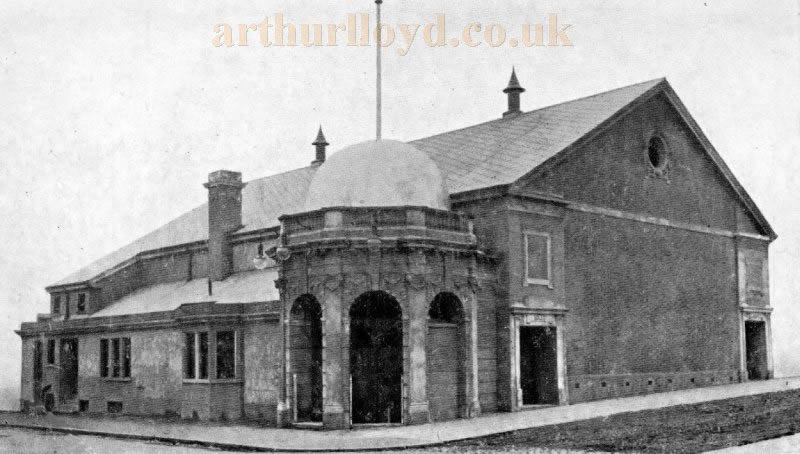
Above - An early Postcard View of the Kinema Picture Theatre, Sherwood, Nottingham.
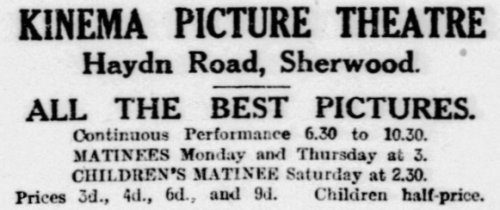 The Kinema Picture Theatre was situated on the corner of Haydn Road and Cameron Street in Sherwood, Nottingham and first opened on Thursday the 4th of September 1913 with a showing of the film 'Adrift on Life's Side'.
Right - An early Advertisement for the Sherwood Kinema Picture Theatre - From the Nottingham Football Post, 27th of September 1913.
The Cinema was designed by the architects Lawrence, Bright and Son of Nottingham and constructed by Maule and Co., also of Nottingham. The Cinema had seating for 800, originally all on one raked stalls level, but a balcony would be constructed in 1931 to improve the capacity of the Cinema by 300.
The Kinematograph Weekly reported on the new Cinema in their 11th of September 1913 edition saying:- 'Nottingham's latest picture house, the Kinema Picture Theatre, Haydn Road, Sherwood, was opened last Thursday. An excellent program was submitted, which included Hepworth's feature, "Adrift on Life's Side." The proprietor of the hall is Mr. H. B. Stevens, of Manchester, Salford and Nottingham, while the manager is Mr. J. Lewsley, who fitted the entire electric installation.
Externally the Kinema has an imposing appearance, with a large "silver" dome and flagstaff. The entrance hall is octagonal, richly decorated with fumed oak panelling, with triple entrance doors and a large glass-front box-office. In the interior a useful scheme of decoration has been adopted: a dado in lincrusta walton attracts one's notice, while the walls, of an old gold tint, are relieved with tapestry panels in white ornamental frames.
An efficient system of ventilation has been installed, whilst hot water pipes running under the floor, together with radiators, ensure adequate heating. The architects were Messrs. Lawrence, Bright and Son, of Nottingham, and the builders Messrs. Maule and Co., also of Nottingham.
A National gas engine in the basement generates power for the whole building. There is seating for 700-800 persons in tip-ups. The floor has a rake of one in nine and a clear view of the screen is obtainable from every seat in the house.
An excellent picture is obtained by the operator, Mr. W. Taylor, with two Pathe machines on a throw between 70-80 feet to a 13ft. by 17ft. screen. The performance is continuous from 6.30 to 11.30 each evening with matinees on Mondays and Thursdays at 3, and a spec!al children's matinee on Saturdays at 2.30. A pianist supplies suitable accompaniments.'
The above text in quotes was first published in the Kinematograph Weekly, 11th of September 1913.
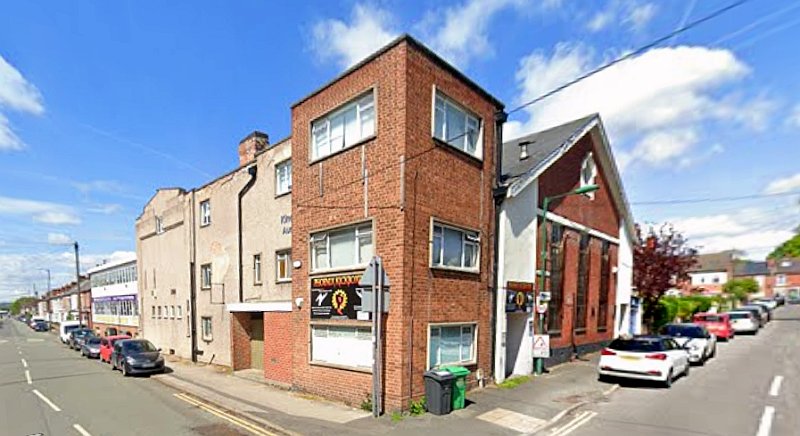
Above - A Google StreetView Image showing the former Kinema Picture Theatre, Sherwood, Nottingham in May 2022 - Click to Interact.
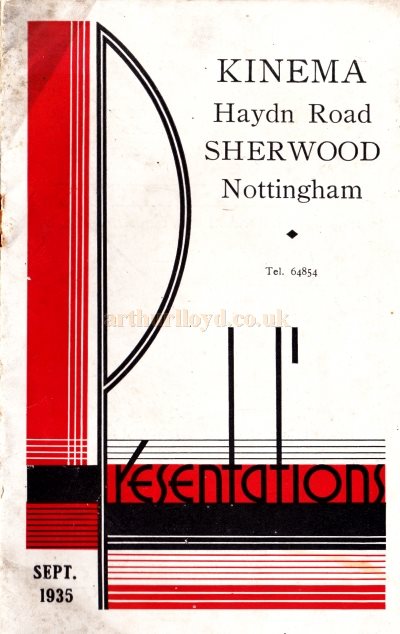 The Sherwood Kinema had first opened in September 1913 showing all the early silent films, accompanied by a pianist, but in 1930 the then Manager, Charles Woodward, who had been running the Cinema since 1918, installed a British Thompson-Houston sound system for the showing of 'Talking Pictures' with a reopening on the 10th of November 1930 with a showing of the 'Talkie' Pictures 'Sunny Side Up' and Harold Lloyd's 'Welcome Danger'.
Right - A 'Coming Attractions' Programme for the Kinema, Haydn Road, Sherwood, Nottingham for September 1935 - Kindly Donated by Julian Cook. See the Full Programme Below.
The following year Charles Woodward had the Cinema altered by the architects Bright & Thoms of Nottingham. The Cinema closed on the 1st of June for the alterations which included the construction of a new Balcony to increase the capacity of the house by 300, and re-seating the auditorium with blue tip up chairs, and re-decorating the auditorium in a more modern style. The roof of the building was altered at the same time and a new projection box was fitted along with a new ventilation and heating system. The Cinema reopened under the Management of Charles Woodward Jnr., on Monday the 3rd of August 1931, with a showing of the film 'Canaries Sometimes Sing'.
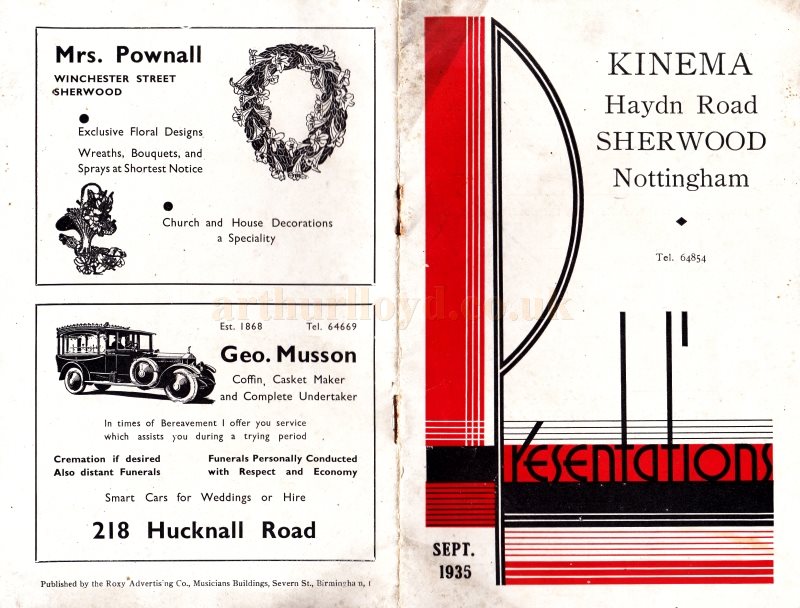
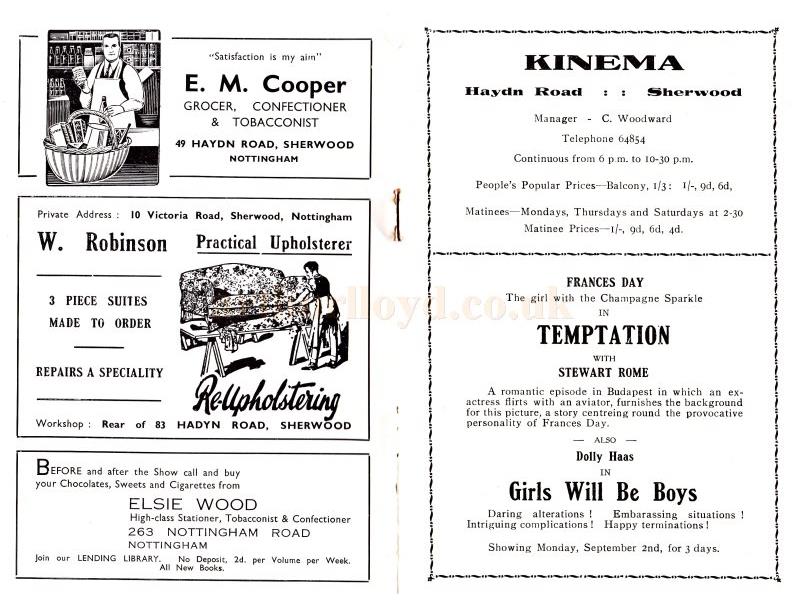
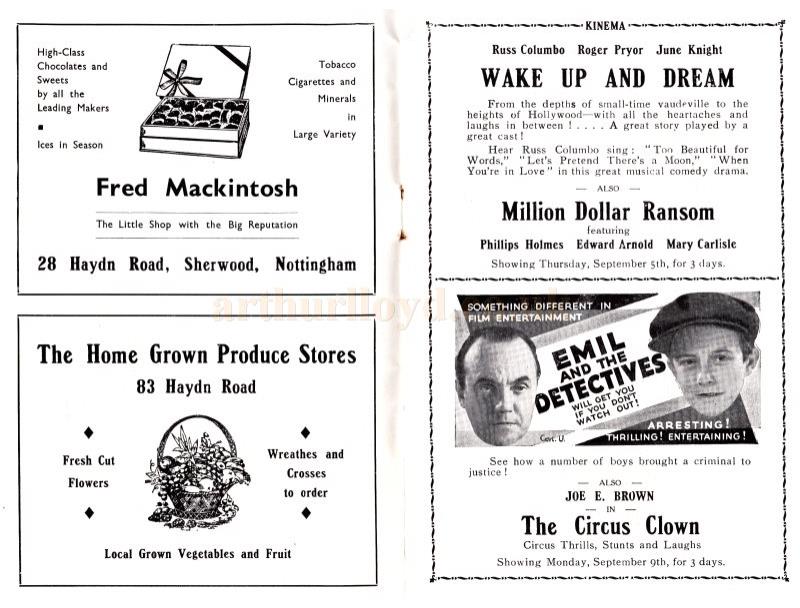
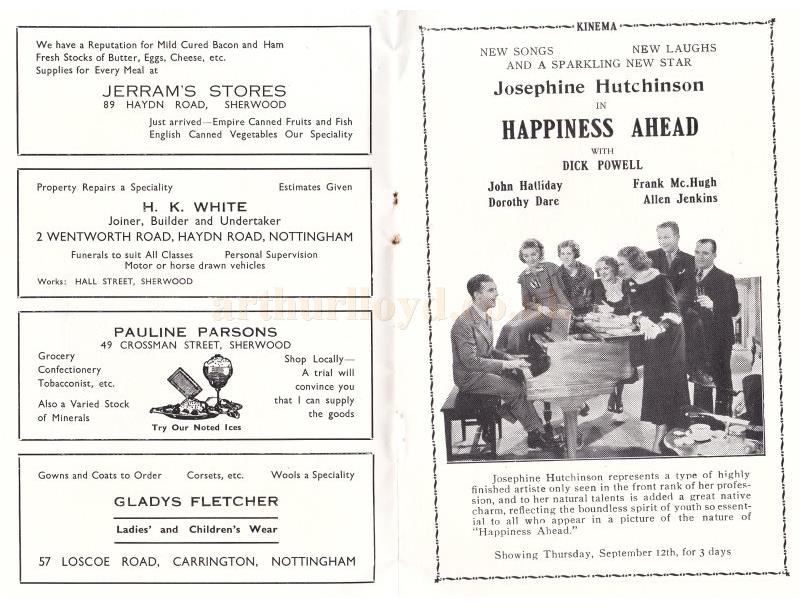


Above - A 'Coming Attractions' Programme for the Kinema, Haydn Road, Sherwood, Nottingham for September 1935 - Kindly Donated by Julian Cook.
Running for another decade the Cinema was eventually closed at the outbreak of the Second World War in 1939 and then repurposed in 1941 for use as a furniture warehouse by Phillips Furniture Stores. In 1944 it was requisitioned by the army as a Headquarters for the 1806 (Sherwood) Squadron of the A.T.C. which opened there on the 22nd of April 1944.
After the war the building was put to light industrial use again, and is today in use as a Family Kickboxing Centre called Phoenix Kickboxing, but it has never gone back to its original Cinema use. Charles Woodward, the Manager of the Cinema from 1918 to 1931 died in 1963 at the age of 74.
If you have any more information or images for this Theatre that you are willing to share please Contact me.
Some archive newspaper reports on this page were collated and kindly sent in for inclusion by B.F.