
An Indian Summer by Alan Chudley - The Lights flicker for Variety Theatre
 The 1920s, a decade which W. McQueen Pope described
as the decade when the Footlights Flickered but never quite went out.
This was a decade when many theatres were turned into Cinemas.
The 1920s, a decade which W. McQueen Pope described
as the decade when the Footlights Flickered but never quite went out.
This was a decade when many theatres were turned into Cinemas.
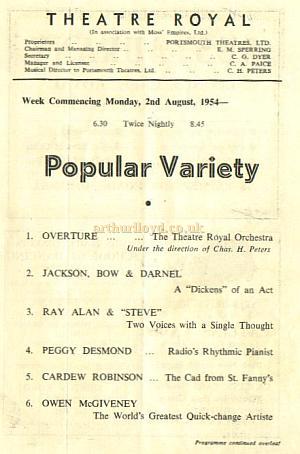
Right - Variety programme for the Theatre Royal, Portsmouth - Courtesy Alan Chudley.
It all more or less started when in 1919 three Theatrical Magnets were knighted for services to wartime entertainment for the armed forces during world war one. They were Alfred Butt, Oswald Stoll, and Walter de Frece. In early 1921 Frece retired from theatrical activity to enter politics, the result of this was that he sold his company; The Variety Theatres Controlling Company, to The London Theatres of Variety, a company which in 1924 sold off many of it's large theatres to become Cinemas. These included the Hippodromes at Putney, Poplar, and Woolwich, the Empire Croydon, the Palace Camberwell, and the Grand Clapham, other managements soon followed suit.
 The
Roaring Twenties might have been a great time for the well-healed, but
many working class families found the Twenties was a decade when they
had to tighten their belts, because employment was difficult to find
and employers were cutting wages. Most working class families had one
good night out each week, and instead of the Theatre
and Variety Houses, they went to the less expensive cinemas, or
the Flicks as they were then known; it therefore made common sense for
the managers to turn there theatres over to films. And so it was until
the late 1930s when the large cinema circuits came into being; Union,
Granada, ABC, Gaumount British and Odeon.
The
Roaring Twenties might have been a great time for the well-healed, but
many working class families found the Twenties was a decade when they
had to tighten their belts, because employment was difficult to find
and employers were cutting wages. Most working class families had one
good night out each week, and instead of the Theatre
and Variety Houses, they went to the less expensive cinemas, or
the Flicks as they were then known; it therefore made common sense for
the managers to turn there theatres over to films. And so it was until
the late 1930s when the large cinema circuits came into being; Union,
Granada, ABC, Gaumount British and Odeon.
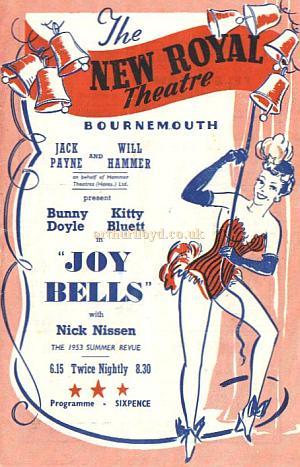
Left - Programme for 'Joy Bells' at the Theatre Royal, Bournemouth - Courtesy Alan Chudley.
 Then
the smaller theatres had to descend the scale and become second release
cinemas, often being castigated as the local Flea-pit, Scratcher or
Bug-house. Several cinema managers then returned some of the cinemas
to their rightful role as live theatres again. Freddie Butterworth brought
back to live use, the Savoy Scunthorpe, the Theatre Royal Lincoln, the
Palace Grimsby, the Empire
Bristol the Bedford Camden Town and a
few others. Such was his success that other mangers returned cinemas
to live theatre, including Teddy Hinge and Solly Sheckman, the founders
of the Essoldo circuit (named after Solly, Ester and Dorothy, his wife
and daughter,) who brought back to live use, among others The Eden Theatre
Bishop Auckland, the Theatre
Royal Blyth and the Theatre
Royal Middlesbrough.
Then
the smaller theatres had to descend the scale and become second release
cinemas, often being castigated as the local Flea-pit, Scratcher or
Bug-house. Several cinema managers then returned some of the cinemas
to their rightful role as live theatres again. Freddie Butterworth brought
back to live use, the Savoy Scunthorpe, the Theatre Royal Lincoln, the
Palace Grimsby, the Empire
Bristol the Bedford Camden Town and a
few others. Such was his success that other mangers returned cinemas
to live theatre, including Teddy Hinge and Solly Sheckman, the founders
of the Essoldo circuit (named after Solly, Ester and Dorothy, his wife
and daughter,) who brought back to live use, among others The Eden Theatre
Bishop Auckland, the Theatre
Royal Blyth and the Theatre
Royal Middlesbrough.
Right - 'Popular Variety' at the Theatre Royal, Portsmouth - Courtesy Alan Chudley.
The Regent (Theatre Royal) Rotherham was also brought back to live use, and many others, some lasted until the mid 1950s, others only a few years. Then after world war two when building restrictions were eased even more important cinemas returned to live use after refurbishment and re-equipping, including the Empire Chatham. Then the Theatre Royal Portsmouth returned to the fold in October 1948, which was repainted, had new house tabs made and a new Strand lighting system controlled by a Grand Master switchboard. The first production after 16 years as a cinema being "Roy Limbert's Shavian Players from Malvern." There then followed big name Variety, booked by Moss Empires (who were also the Bookers for the other Portsmouth Theatre; the Kings Southsea.) This was to replace the bombed out Portsmouth Hippodrome just across the street from the Theatre Royal.
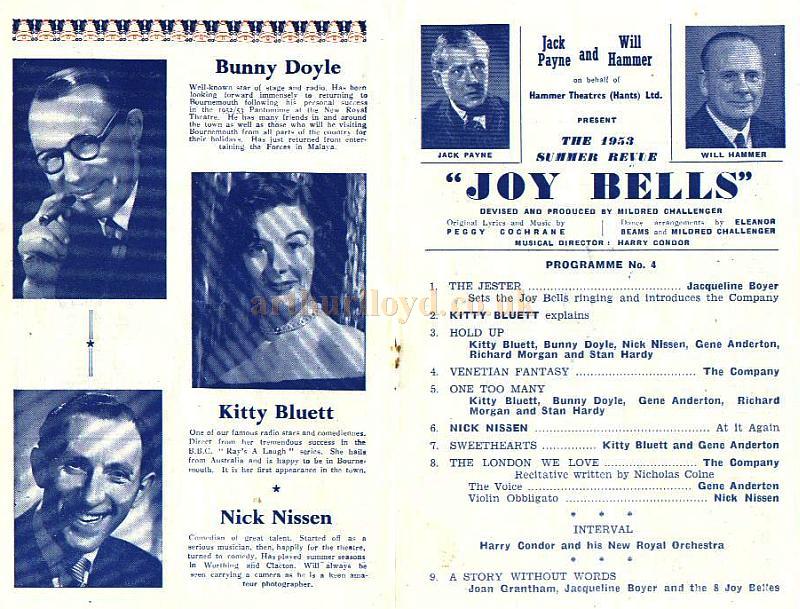
Above - Programme for 'Joy Bells' at the Theatre Royal, Bournemouth - Courtesy Alan Chudley.
 About
this time, Will Hammer refurbished the Theatre
Royal Bournemouth, although this house had not became a cinema in
the 1920s, and reopened it with a mixture of Big Name Variety,
Summer Revues and Pantomime. This house
had closed as a theatre in the early 1930s. Another house on a smaller
scale to return to the fold was The Olympia
Bullwell, 4 miles north east of Nottingham,
a cinema since 1932. Cecil Grace refurbished this house and re-equipped
the theatre with a new lighting system by Furse of Nottingham.
About
this time, Will Hammer refurbished the Theatre
Royal Bournemouth, although this house had not became a cinema in
the 1920s, and reopened it with a mixture of Big Name Variety,
Summer Revues and Pantomime. This house
had closed as a theatre in the early 1930s. Another house on a smaller
scale to return to the fold was The Olympia
Bullwell, 4 miles north east of Nottingham,
a cinema since 1932. Cecil Grace refurbished this house and re-equipped
the theatre with a new lighting system by Furse of Nottingham.
Right - Variety Programme for the Olympia Theatre, Bulwell - Courtesy Alan Chudley.
In 1950 the Derby Hippodrome was reopened as a live theatre again, by Stoll Theatres, to replace their Grand Theatre in that city, which had become a dancehall, and at the end of 1950 The Regent Kings Cross (Euston Palace of Varieties) was returned to Variety too, by Park Theatres Ltd. This was refurbished and equipped with a new Atlas fluorescent lighting system, but sadly, despite big names such as Max Miller, the Regent was too near the Finsbury Park Empire to succeed and barely lasted a year. Park Theatres Ltd also returned to live use the Empire at Swindon.

Above - Programme for 'A Date With Eve' at the Olympia Theatre, Bulwell - Courtesy Alan Chudley.
This then was the Variety Theatre's Indian summer, but by the mid-1950s the Indian summer was over, and this time the Footlights not only flickered, they went out altogether.
The above article was kindly written for this site by Alan Chudley.