
Morecambe Theatres and Halls
Winter Gardens / Victoria Pavilion Theatre - Devonshire Hall - Morecambe Baths, Palace, and Aquarium - Alhambra Theatre - Royalty Theatre / Cinema - Assembly Rooms
The Winter Gardens, Morecambe
Formerly - The Victoria Pavilion Theatre

Above - A Google Streetview image of the Morecambe Winter Gardens in 2018 - Click to Interact.
 The
Morecambe Winter Gardens' Theatre opened as a Music
Hall called the Victoria Pavilion Theatre in 1897,
and was designed by Mangnall
& Littlewood in consultation with the renowned Theatre
Architect Frank Matcham. The Theatre was
built beside the earlier Winter Gardens and Empress Ballroom.
The
Morecambe Winter Gardens' Theatre opened as a Music
Hall called the Victoria Pavilion Theatre in 1897,
and was designed by Mangnall
& Littlewood in consultation with the renowned Theatre
Architect Frank Matcham. The Theatre was
built beside the earlier Winter Gardens and Empress Ballroom.
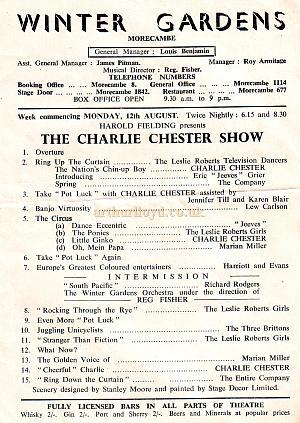
Right and Below - A Programme for 'The Charlie Chester Show' at the Morecambe Winter Gardens in 1957 - Courtesy Susan Clarke.
 The Winter Gardens closed in the 1970s and much of the
building was demolished in 1978 after the complex had fallen into dereliction.
The Theatre itself closed in 1977 but has survived due to its Listed
Status and the work of the The Friends of The Winter Gardens.
The Winter Gardens closed in the 1970s and much of the
building was demolished in 1978 after the complex had fallen into dereliction.
The Theatre itself closed in 1977 but has survived due to its Listed
Status and the work of the The Friends of The Winter Gardens.
The Friends of The Winter Gardens worked to protect the building, and campaigned for its restoration. In 2006 they formed a Trust called the Morecambe Winter Gardens Preservation Trust Limited, who in February the same year purchased the building.
The Trustees said that they were working hard with the help of officers of Lancaster City Council and the North West Development Agency to put together capital funding for the interior restoration, and were hoping to gain part of the £45m of grants in the Government's coastal resorts funding. The Trust also put together an application for Lottery funding.

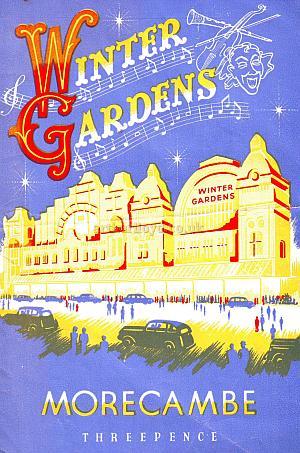
Above - An early postcard depicting the Winter Gardens, Morecambe.
 I was told in August 2021 that the Winter Gardens' restoration project is today well underway and has received substantial funds. The restoration is being achieved by a group of volunteers led by Professor Vanessa Toulmin a local lady who has researched and written extensively about working class culture and Fairgrounds (Her family had the fairground behind the Winter Gardens).
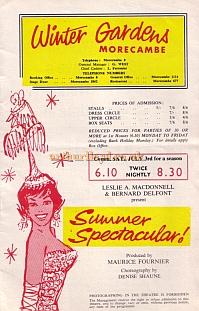
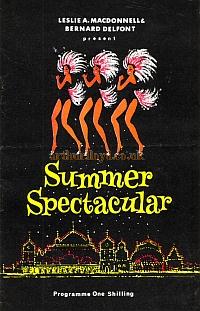
Right and below - A programme for a Leslie A. Macdonell & Bernard Delfont 'Summer Spectacular' show at the Winter Gardens, Morecambe - Courtesy Roy Cross. In the cast were Joe Church, Sheila Buxton, Colin Crompton, the Whychwoods, the Tiller Girls, the Lavedos, David Whitfield, and a Company of dancers.
I am told the restoration work on the Winter Gardens is going well and the venue should reopen soon. You may like to visit the Morecambe Winter Gardens Preservation Trust's own Website here for further details.
For more information and images on the Winter Gardens you may like to read Donald Auty's article on the venue written in 2005 here.

Above - Detail from a programme for a Leslie A. Macdonell & Bernard Delfont 'Summer Spectacular' show at the Winter Gardens, Morecambe - Courtesy Roy Cross.

Above - A page from the catalogue of Dean and Co who were theatre decorators, providing plasterwork, seating, drapes and most other decorative items to make your theatre look its best. This shows their work at Morecambe's Winter Gardens' Victoria Pavilion Theatre, note the Opera House name which was never actually used, however the architects and the fact that Matcham was only the Consultant Architect are confirmed - Courtesy Roger Fox.
The Royalty Theatre, Market Street, Morecambe
Formerly - The Assembly Rooms / Royalty Theatre and Opera House / Morecambe Repertory Theatre
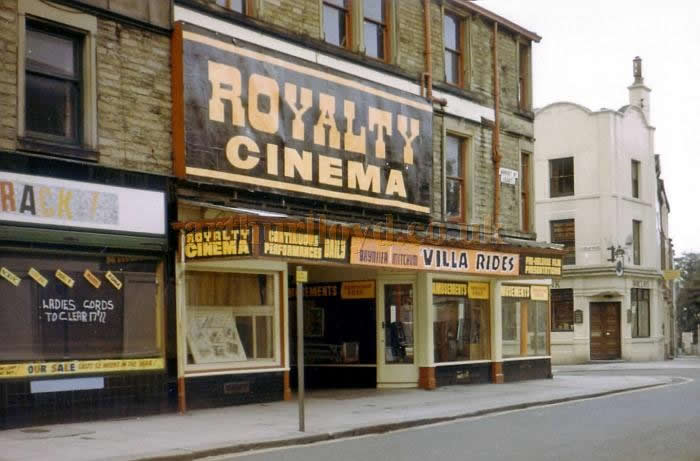
Above - The Royalty Theatre in use as a cinema in the 1960s showing the film 'Villa Rides' - Courtesy Harry Rigby

 The
Royalty Theatre was constructed by J. Edmondson for its owner Mr. J.
Jowett, and built on the site of the former Assembly Rooms in Morecambe,
and originally opened as the Royalty Theatre and Opera House on the
4th of April 1898 with a production
of 'The Sign of the Cross'. The Theatre was designed by the renowned Theatre Architect Frank
Matcham, and was intended to be open all year round as it was thought
that the town had a pressing need for theatrical entertainment in the
winter months. The furnishings, decorations and fibrous plasterwork
for the Theatre were carried out by A. and R. Dean of Birmingham,
and the auditorium was designed in the Louis XV Style in cream and terra-cotta
with blue and gold draperies etc. The stage of the Theatre was laid
by John Dixon, formerly of the Batley Theatre, with all the usual fittings
of the time, and was lit by electricity and gas.
The
Royalty Theatre was constructed by J. Edmondson for its owner Mr. J.
Jowett, and built on the site of the former Assembly Rooms in Morecambe,
and originally opened as the Royalty Theatre and Opera House on the
4th of April 1898 with a production
of 'The Sign of the Cross'. The Theatre was designed by the renowned Theatre Architect Frank
Matcham, and was intended to be open all year round as it was thought
that the town had a pressing need for theatrical entertainment in the
winter months. The furnishings, decorations and fibrous plasterwork
for the Theatre were carried out by A. and R. Dean of Birmingham,
and the auditorium was designed in the Louis XV Style in cream and terra-cotta
with blue and gold draperies etc. The stage of the Theatre was laid
by John Dixon, formerly of the Batley Theatre, with all the usual fittings
of the time, and was lit by electricity and gas.
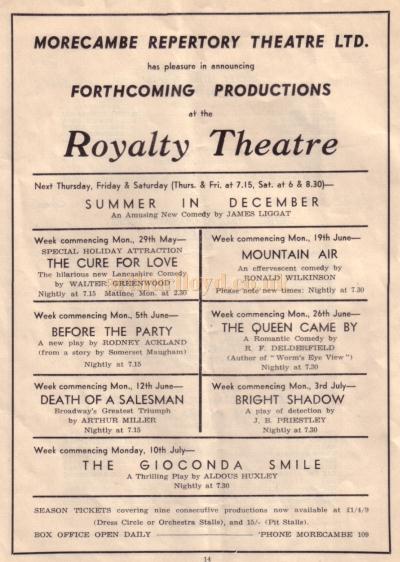
Right - A page from a programme for the Morecambe and Heysham Drama 'One Act Play Festival' detailing the forthcoming productions in December 1950 at the Royalty Theatre, Morecambe - Kindly donated by David Lowndes.
The Theatre could accommodate some 1,500 people with stalls seating for 160, pit 850, dress circle 55, upper circle 120, ampitheatre 110, gallery 250, boxes 10, and standing room for upwards of 450. On its opening the Theatre was managed by Kourad Leigh and the orchestral director was Louis Myers. Scenery for the opening production of 'The Sign of the Cross' was painted by T. J. Stephenson. This was preceded by a choral singing of the National Anthem from off stage and joined in by a packed audience.
The cast for the opening production were Philip Cunningham, Sylvia Cavalho, A. M. Munro, W. H. Sams, Frank Vernon, Wm. Lockhart, Lilla Wilde, Maud Warrillow and a large ensemble.
The ERA reported on the building itself a month before it opened, in their 5th of March 1898 edition saying: 'This new theatre, erected on the site of the old Assembly Rooms, is now nearing completion, and will be opened on April 4th next by Mr Wm. Greet's Sign of the Cross company. Morecambe is a flourishing watering-place, and up to now has not been provided with a properly equipped theatre. Mr J. Jowett has come to the rescue, and with the assistance of Mr Frank Matcham the well-known theatrical architect, has provided the town with a charming playhouse, a veritable triumph of architectural skill, showing what can be done on a small piece of ground by one who knows how to utilise every foot of available space.
The theatre is well provided with entrances and staircases and saloons, and is daintily furnished and decorated. There are two exits from each part of the house. The stalls and dress-circle have comfortable tip-up chairs; there is also a large pit, and the tier over the dress-circle is divided into amphitheatre and gallery. Two private boxes are provided on each side of the stage opening with draperies of light blue plush. The auditorium is artistically decorated in cream and terra-cotta. The sight lines are excellent. and elegance - combined with the comfort and safety of the public - has evidently been the principal consideration. The stage, which is divided by a safety asbestos curtain, is large enough to accommodate any show on the road. The dressing. rooms are exceptionally well lighted and ventilated.' - The ERA, 5th of March 1898.
The Theatre went on to entertain the Morecambe public for many years and a plethora of well known actors trod its boards, including Josephine Tewson who met Leonard Rossiter there in 1954, Robert Stephens who made his first appearance there, and the much loved British theatre, film, and television actress Thora Hird, who is well known for her association with the Royalty as she was born in the house next door in 1911. Thora also made her stage debut at the Royalty at the age of just two months, carried on stage by her father in a play directed by him, her father was resident Stage Manager of the Theatre at the time. He didn't really want his daughter to become an actress though so she began her working career at the local Co-op. Theatre was in Thora's blood however, as her mother was also an actress, and she later went on to make her London Theatre debut in 1940, and then returned to her roots and joined the Morecambe Repertory Theatre Company at the Royalty, which was formed in 1948. Mervyn Pinfield, who was a well known Television producer in the 50s and 60s, and went on to work on producing live dramas for the BBC at Alexandra Palace, was Theatre Manager and Director of the weekly rep at the Royalty Theatre for four years before working for the BBC.
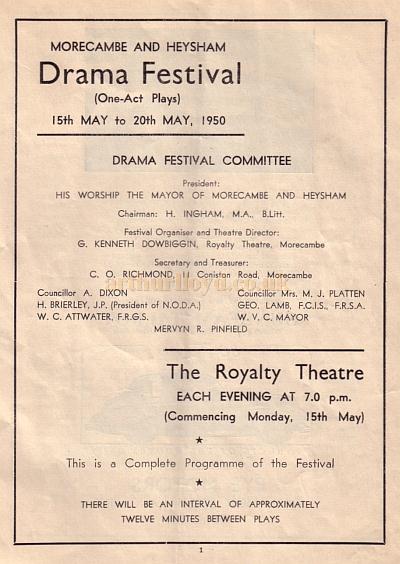
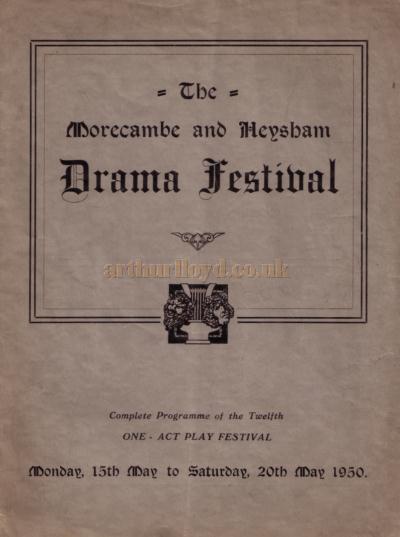 In
the late 1940s and early 1950s the Royalty Theatre was also home to
the Morecambe and Heysham Drama 'One Act Play' Festival, a programme
for which can be seen here. In the programme there is an article about
the Festival which I have transcribed below.
In
the late 1940s and early 1950s the Royalty Theatre was also home to
the Morecambe and Heysham Drama 'One Act Play' Festival, a programme
for which can be seen here. In the programme there is an article about
the Festival which I have transcribed below.
THE MORECAMBE AND HEYSHAM DRAMA FESTIVAL
FOREWORD
We have pleasure in introducing our adjudicator for the 1950 One-Act Play Festival, Mr. Sydney Hewitt. In addition to adjudicating many major Festivals, Mr. Hewitt is Drama Adviser to C.E.M.A. (Northern Ireland), The Ulster Drama League, and the Northern Ireland Federation of Boys' and Girls' Clubs. He is Instructor in Drama to the Ministry of Education and to the Youth Committee for Northern Ireland, and is adjudicator to the Royal Navy, the Army Education Corps and the Scottish Community Drama Association. He is also a member of the Guild of Drama Adjudicators. There is no doubt that Mr. Hewitt has had an extremely wide experience in Drama in all its aspects and we feel certain that he will quickly establish himself as a friend of our Morecambe audiences and of the teams playing in the Festival.
This year the Committee have decided to abolish all Prize Money (except to the author of the Original Play winning Class VII), and instead are donating £2 to each team entering the Festival to assist them in meeting the expenses entailed by their entry. Whilst
 we
fully realise that this grant will not be sufficient to cover the expenses
of any team playing in the Festival, we feel that this scheme is a very
considerable step forward and we know that it has the approval of the
teams themselves (a vote taken from the teams entering the 1949 One-Act
Play Festival showed that over 90 per cent were in favour of the abolition
of Prize Money and the introduction of a grant).
we
fully realise that this grant will not be sufficient to cover the expenses
of any team playing in the Festival, we feel that this scheme is a very
considerable step forward and we know that it has the approval of the
teams themselves (a vote taken from the teams entering the 1949 One-Act
Play Festival showed that over 90 per cent were in favour of the abolition
of Prize Money and the introduction of a grant).
The Festival is entirely independent and receives no financial aid from any one. It is not run by the Corporation or by the Royalty Theatre management, although it receives very useful help and support from both these sources. It is the declared policy of the Royalty Theatre management and of the Festival Committee that the professional artistes shall not suffer any financial loss due to the Committee renting the Theatre and a financial arrangement has always been in existence which ensures this. It will be realised, therefore, that the border line between a loss and a small profit is very narrow, and the Committee are deeply grateful to the residents of Morecambe and Heysham and to their many friends in other parts of the country who have—by their support—enabled the Festival to show a small profit for many years now. These profits have been used to build up a Reserve Fund to meet any contingency, and when this has been firmly established any profits made will be used for the improvement of the Festival—the granting of £2 to each team is one of the first steps in this direction.
We thank you for your support and sincerely hope that we may have the pleasure of meeting you again at the Full Length Play Festival in November.
The above text is from a programme for the Morecambe and Heysham Drama 'One Act Play Festival' - Kindly donated by David Lowndes.
The Royalty Theatre was another victim of the Country wide Theatre closures during the 1950s and it was then converted for Cinema use as the Royalty Cinema. However even this was eventually demolished to make way for the Arndale centre which now occupies the site, opening in 1972.
If you have any more information or images you are willing to share for this Theatre please Contact me.
The Devonshire Hall, 13-17 Devonshire Road, Morecambe
Later The Hothouse
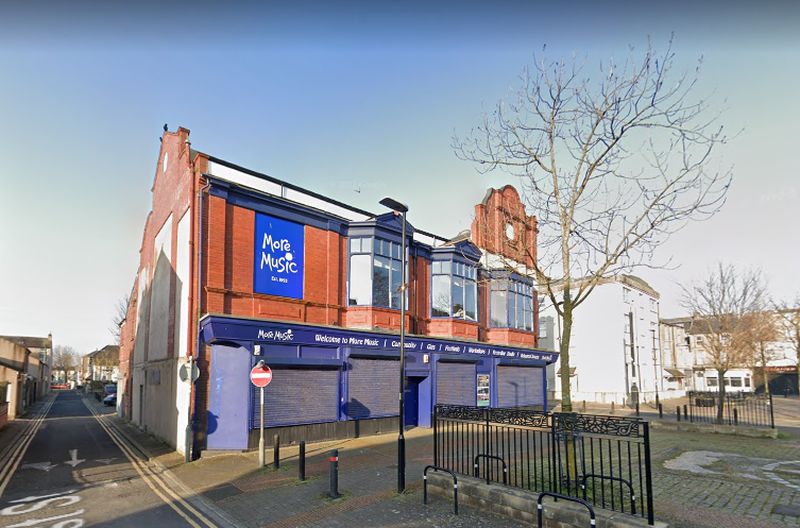
Above - A Google StreetView Image of the former Devonshire Hall, Morecambe in March 2022 - Click to Interact.
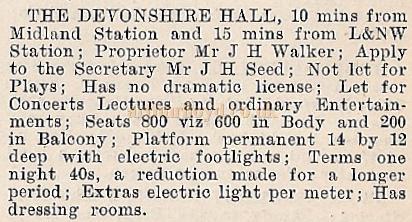 The
Devonshire Hall, Morecambe was built as a Music
Hall in 1899 with seating
for 800 on two levels. It also had dressing rooms, and a small stage
of 14 by 12 feet lit by electric footlights.
The
Devonshire Hall, Morecambe was built as a Music
Hall in 1899 with seating
for 800 on two levels. It also had dressing rooms, and a small stage
of 14 by 12 feet lit by electric footlights.
Right - A contemporary cutting from the 'Dangerfield General Entertainment Guide of 1901 - Courtesy Roger Fox.
Back in 2010 the building was something of a hidden gem as although the Ground Floor was in use, and had been for many years, by a company called 'More Music' as a musical community centre, studio, rehearsals rooms, and offices, collectively called 'The Hothouse', above them, undisturbed and unused for years, were the remains of the original Music Hall (See Photos Below).
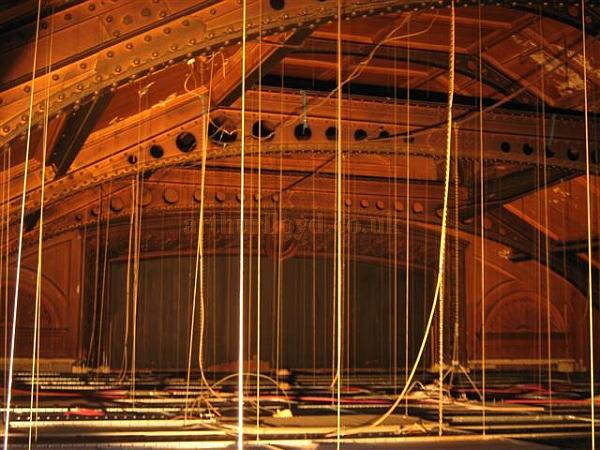
Above - The remains of the original Devonshire Hall, Morecambe lie hidden above the false ceiling of More Music, Morecambe - Photo 2010 Courtesy KR.
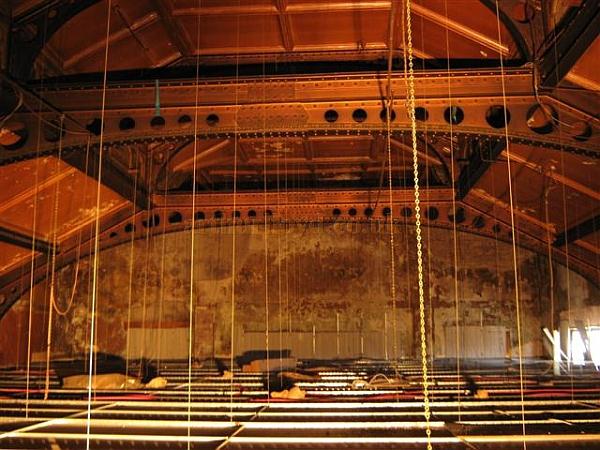
Above - The remains of the original Devonshire Hall, Morecambe lie hidden above the false ceiling of More Music, Morecambe - Photo 2010 Courtesy KR.
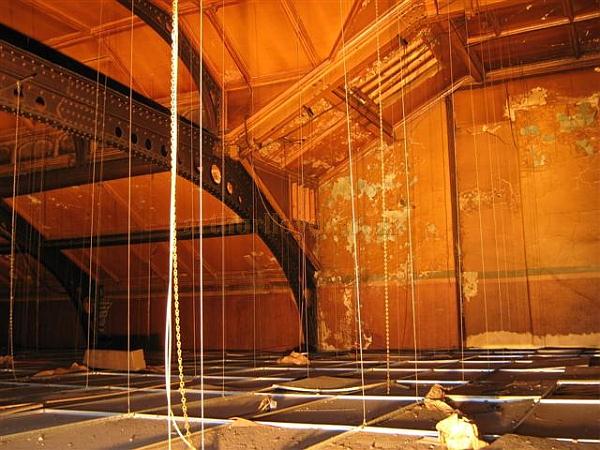
Above - The remains of the original Devonshire Hall, Morecambe lie hidden above the false ceiling of More Music, Morecambe - Photo 2010 Courtesy KR.

Above - The remains of the original Devonshire Hall, Morecambe lie hidden above the false ceiling of More Music, Morecambe - Photo Courtesy Peter Charlton 2008.
The upstairs of the Devonshire Hall had been used as a Snooker Hall called 'The Dev' from the 1930s whilst downstairs was used as a paint factory and then a shop until More Music took over the lower part in 1996. A visitor to this site, Dave Woods, tells me that his grandfather Fred Woods worked for J. W. Bland, painters and decorators, who were based there for many years and used the premises to mix paint for decorating jobs. One of the biggest jobs they did was to paint the Midland Hotel every year in the off season, there is a large photo of the building being painted on one of the landings there, with ladders in place.
In 2008 More Music acquired the whole building with the hope of being able to incorporate the original upstairs of the Music Hall into their workspace so that they could become a music training and education centre for the North West. In 2011 they carried out extensive refurbishment of the building incorporating office space, and a studio and performance space which could accommodate 220 people in the former music hall upstairs. Most of the original features of the Music hall are still hidden above false ceilings however.
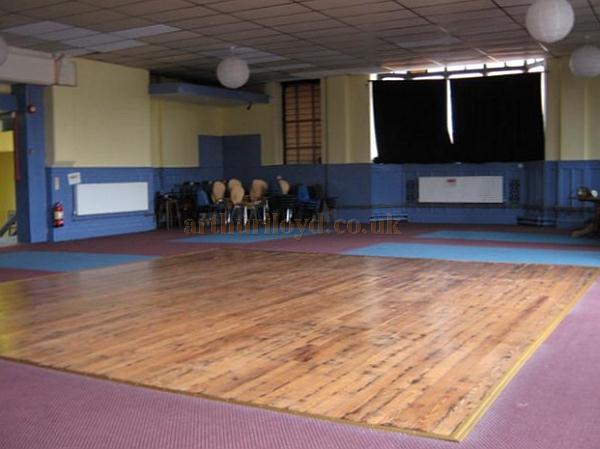
Above - The Ground floor of the former Devonshire Hall in use as a home for More Music, Morecambe - Photo 2010 Courtesy KR.
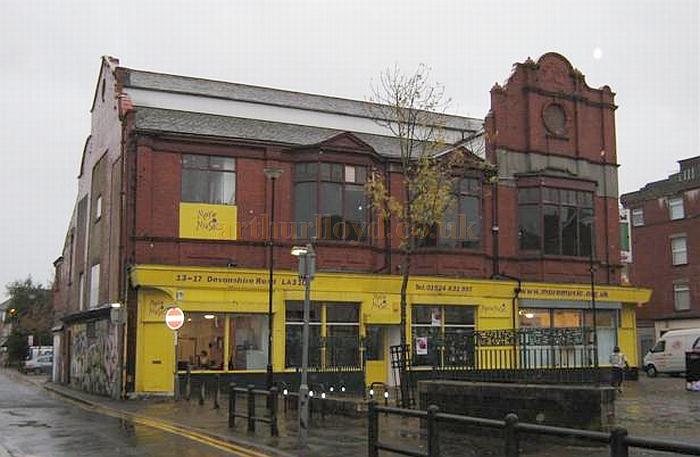
Above - The former Devonshire Hall, Morecambe in 2010 - Courtesy KR.
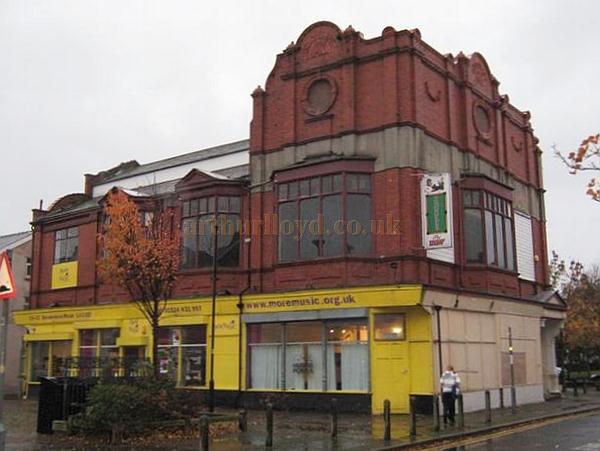
Above - The former Devonshire Hall, Morecambe in 2010 - Courtesy KR.
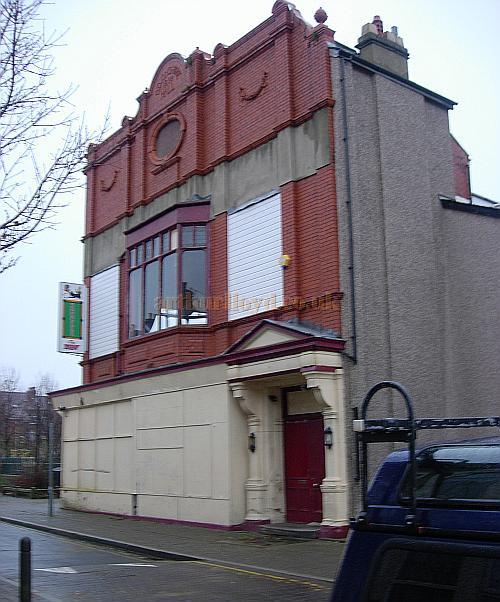
Above - The Side elevation of the Devonshire Hall, Morecambe in 2008 - Courtesy Peter Charlton.
The Morecambe Baths, Palace, and Aquarium - Regent Park, Regent Road, Morecambe.
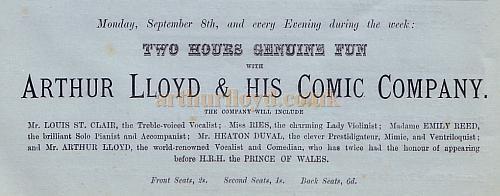
Above - Advertisement from a September 1st 1879 programme for Morecambe Aquarium advertising Arthur Lloyd & his company appearing in 'Two Hours Of Genuine Fun' for the following week.
 This
popular park was once Morecambe's principal entertainment centre called
the Summer Gardens. Built in the 19th Century they included a circus,
ballroom, aquarium, conservatory, café,
racecourse and a boating pool. The racecourse was surrounded by a
wide dyke which was used for skating in the winter.
This
popular park was once Morecambe's principal entertainment centre called
the Summer Gardens. Built in the 19th Century they included a circus,
ballroom, aquarium, conservatory, café,
racecourse and a boating pool. The racecourse was surrounded by a
wide dyke which was used for skating in the winter.
Abandoned from the mid 1890s, the land was eventually bought by Morecambe Council in 1924. Over £25,000 was spent in creating the new Park which opened in 1926. The Park has recently had a face-lift and remains popular for its fine bowling greens.
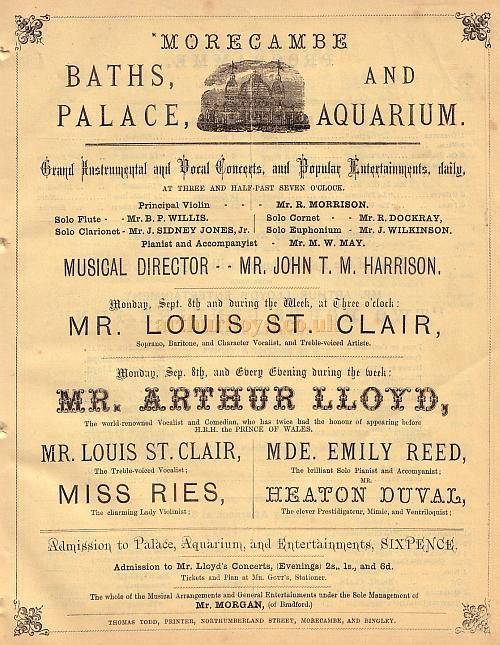
Above - Programme cover for Morecambe Aquarium
for week of 8th September 1879
The previous week the tour was in Harrogate.
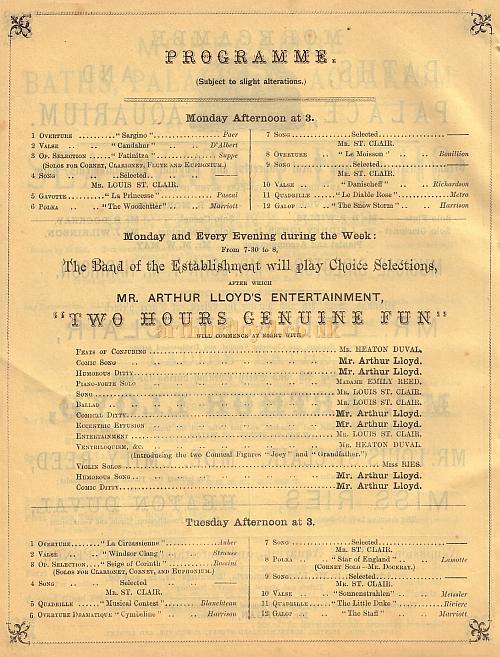
Above - Programme for Morecambe Aquarium for week
of 8th September 1879
The previous week the tour was in Harrogate.
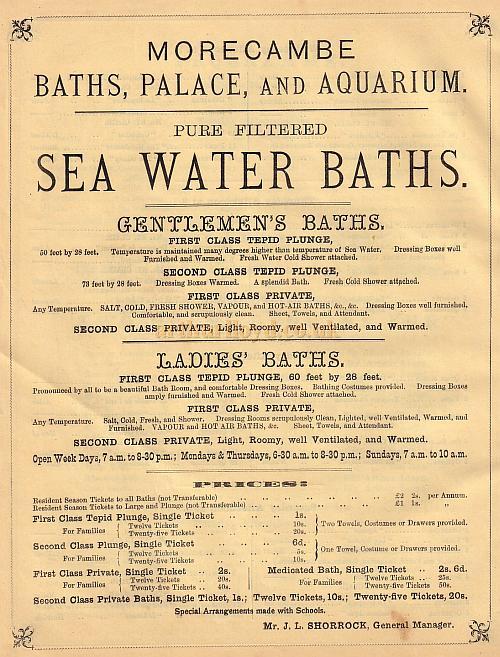
Above - Back of Programme for Morecambe Aquarium
for week of 8th September 1879
The previous week the tour was in Harrogate.
The Alhambra Theatre, The Promenade, Morecambe
Later - The Astoria Cinema / Carleton Club / C2 Nightclub
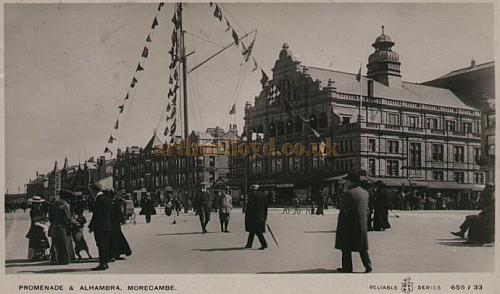
Above - Morecambe Alhambra Theatre and sea front Promenade - From a postcard 1910
 The Alhambra Palace Theatre as it was known when it first opened in Morecambe in 1901 was situated in a building on the Morecambe Promenade at the corner of Regent Road and oposite the West End Pier, and consisted of a market, a restaurant, shops and offices on the ground floor and the Theatre above.
The Theatre was built for John Gardner and John Scott to the designs of the Morecambe Architect Herbert Howarth as a Music Hall and Variety Theatre and could seat 1,400 people when it first opened on the 4th of April 1901.
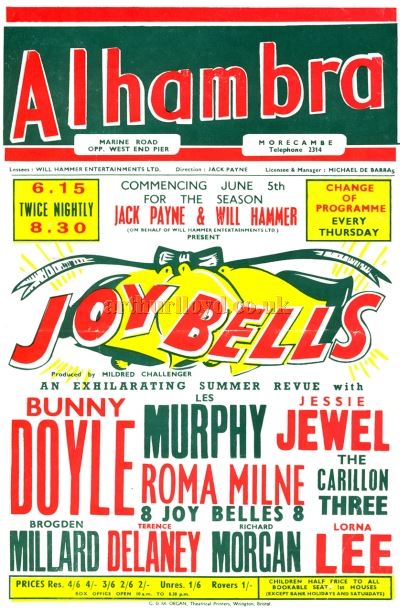
Right - A Handbill for the summer review entitled 'Joy Bells' at the Alhambra Theatre, Morecambe in 1954 - Courtesy Tony Craig whose mother Jessie Jewel featured in the review.
The Stage Newspaper reported on the new Theatre on the day it opened, in their 4th of April 1901 edition saying:- 'The Alhambra, Morecambe. This is the title of the latest of the places of amusement in Morecambe. It opens its doors for the first time to-day (Thursday), and is situated at the West-end of the town, and directly facing the West-end Pier (which was opened just five years ago this Good Friday). The house, erected on the site of the late West End Market, or Fancy Bazaar, forms a handsome pile, built during the past eighteen mouths for the proprietors, Messrs. Councillors Gardner and Scott, by Mr, John Edmondson, a local contractor, from designs supplied by Mr. H. Howarth, also a local architect.
 It is built of white freestone, and presents an imposing appearance from all points of view. The concert hall proper is above the ground floor, and consists of area and balcony, which provide accommodation for 4,000 people. There are also four private boxes. A special feature in the construction of the floor is that it drops towards the proscenium, which gives an uninterrupted view of the stage from all parts of the hall. In the balcony there are two rows of seats and a promenade behind, seats being arranged at end of the balcony facing the stage from floor to ceiling. On each side of the balcony there is a door leading to an outside promenade, which extends around three sides of the building, commanding an extensive view of the bay and surrounding scenery.
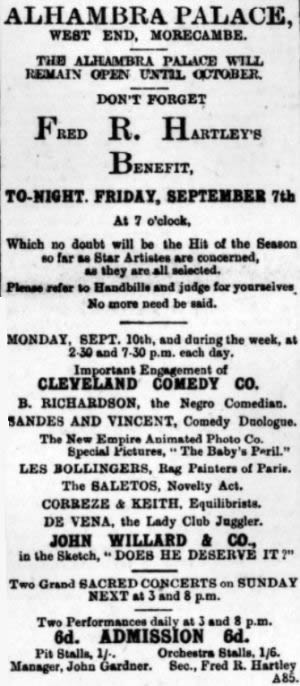
Left - A 1906 Advertisement for the Alhambra Palace, Morecambe - From the Lancaster Standard and County Advertiser, 7th September 1906.
The furnishing and decorations were placed in the experienced hands of Messrs. A. and R. Dean of Birmingham. The decorations are of a most elaborate character. The whole of the ceiling, proscenium, private boxes, and balcony front are worked in handsomely-modelled fibrous plaster in Rich French Renaissance design, the front of the gallery being formed with boldly-modelled work, with large lion's heads, from which are suspended electric light brackets. The colouring of the various designs is of a light and delicate character, picked out in tones of buff, pale blue, and gold. Large plate-glass mirrors are also placed at convenient centres. The upholstering is especially rich, the tip-up chairs being in copper and blue, and a carpet being laid to match.
The stage is of good dimensions, and is fitted up in the latest manner. The scenery, which has been painted by Mr. T. H. Stephenson, a capable artist of local repute, is also of an up-to-date character. The building is lighted throughout with electricity, generated on the premises by means of two powerful Crossley gas engines of 59 and 37 h.p. respectively, three large chandeliers of twenty lights each being suspended from the roof of the hall.
The exterior of the building is lighted by means of powerful arc lamps, fixed at intervals around the building. The entrance hall and staircase are decorated by means of polished Staffordshire tiles, the prevailing colours being cream and dark green, which have been worked into panels up the staircase.
The opening ceremony is fixed for tonight, when the local member of Parliament (Mr. N. W. Helme) will perform that ceremony. A capital entertainment will follow, and a notice of this will appear next week.'
The above text in quotes was first published in the Stage Newspaper, 4th of April 1901.
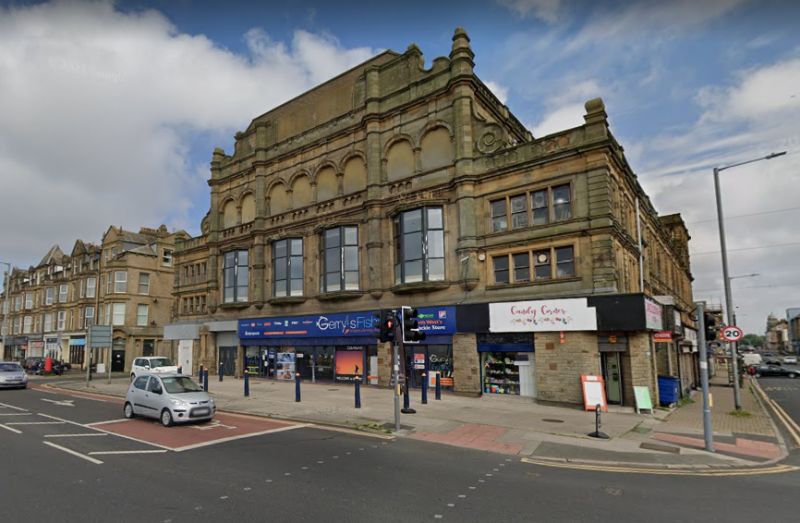
Above - A Google StreetView Image of the former Alhambra Palace, Morecambe in June 2021 - Click to Interact.
The Alhambra Palace had first opened on the 4th of April 1901 with a variety show and carried on in this vein for many years, including the showing of early films from 1909 onwards. In the 1920s the Theatre was equipped with sound projectors for the latest 'Talkie' films and the Theatre was renamed the Astoria Super Cinema, although it did show live Variety shows on its stage along with the films.
The Theatre was closed at the outbreak of war in September 1939 and didn't reopen until it was all over at the end of 1945. A year late it reopened under its original name of the Alhambra Palace Theatre with live performances only.
Sadly the Theatre was gutted by fire internally in 1970 and even though the auditorium was repaired it never went back to live theatre and was instead converted for use as a discothèque. Later it was further altered for Nightclub use as the Carleton Club and later C2 Nightclub.
The Morecambe Alhambra is noted as having been the location where the 1960 film 'The Entertainer' starring Laurence Olivier was shot.
If you have any more information or images you are willing to share for this Theatre please Contact me.
The Winter Gardens and Victoria Pavilion Theatre, Morecambe by Donald Auty 2005
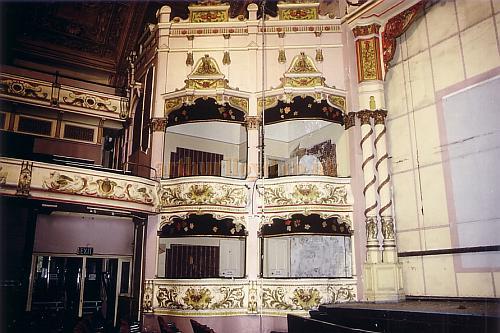
Above - The Auditorium of the Winter Gardens' Victoria Pavilion Theatre, Morecambe in 1990 - Courtesy Ted Bottle.
 This
theatre was part of a complex that contained a ballroom, bars and restaurants
and there was also a fairground at the rear. It is one of the largest
in Britain, almost 3000 seats and was opened in 1898. Matcham was the architect. Moss
Empires acquired it in 1954 along with the fairground so the theatre
and complex manager was also the fairground manager.
This
theatre was part of a complex that contained a ballroom, bars and restaurants
and there was also a fairground at the rear. It is one of the largest
in Britain, almost 3000 seats and was opened in 1898. Matcham was the architect. Moss
Empires acquired it in 1954 along with the fairground so the theatre
and complex manager was also the fairground manager.
This theatre never really paid its way during the Moss years and would be closed for long periods in the Winter. It was very successful however in the summer for a long period of time when it was the home of the Black and White Minstrels.
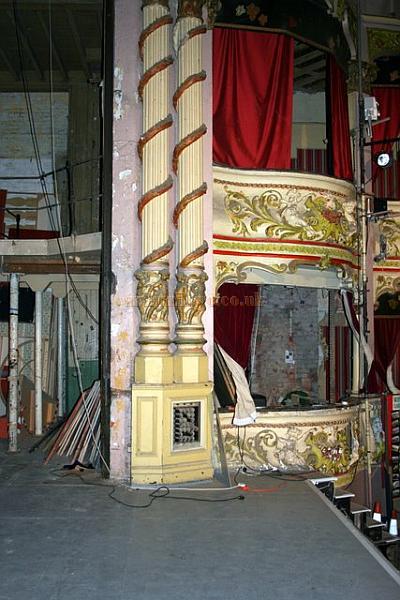
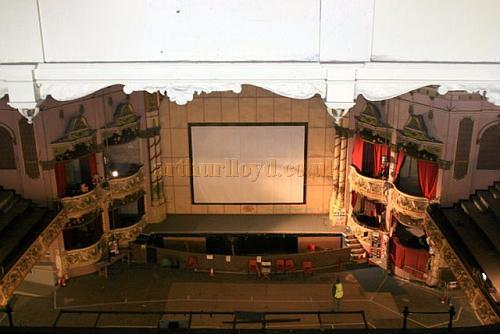
Right - The Auditorium and Stage of the Winter Gardens' Victoria Pavilion Theatre, Morecambe during assessment work for the proposed renovation of the Theatre in September 2008 - Courtesy Roger Fox. Note the act number boards which are still in place and are in the unusual position at the base of the proscenium columns.
Louis Benjiman who later became the last managing director of Moss Empires was the first Manager for the company from 1954 when it took over. He was succeeded by Wililiam Bevan who stayed there until the complex closed in the early sixties.
The objectionable Scottish stage manager from the Leeds Empire was transferred here after it closed he was supposed to be well out of the way here. He soon created the same bad atmosphere backstage as he had done at Leeds. The manager was taxing him about his behavior outside on the fairground one morning and the objectionable stage manager punched him on the jaw and laid him out. That was the end of the objectionable Scottish man as far as Moss Empire was concerned and it was not before time.

Above - Auditorium of the Winter Gardens' Victoria Pavilion Theatre, Morecambe in 1990 - Courtesy Ted Bottle.
 When
the populations of the Lancashire and Yorkshire industrial towns and
cities started to go to Spain for their holidays Morecambe quickly
became a cemetery with lights as Eric Morecambe called it.
When
the populations of the Lancashire and Yorkshire industrial towns and
cities started to go to Spain for their holidays Morecambe quickly
became a cemetery with lights as Eric Morecambe called it.
Right - The Auditorium and Stage of the Winter Gardens' Victoria Pavilion Theatre, Morecambe during assessment work for the proposed renovation of the Theatre in September 2008 - Courtesy Roger Fox.
The Winter Gardens closed in the mid sixties and the complex fell into dereliction. The fair ground was closed and cleared and all buildings within the complex except the theatre were demolished. The poor old place now stands forlornly in the middle of waste ground but it is intact. There are plans to reopen it as a tribute to the late Thora Hird who was born in the town but there is a desperate shortage of money for the project so it is doubtful if it will happen. There is also the question of viability because Morecambe is now almost a ghost town. The theatre is a listed building and it would be nice to see the dear old place open again.
The Above article was written for this site by Donald Auty and is from his article on Moss Empires in the 50s written in 2005.
Arthur Lloyd is known to have performed in Morecambe in 1886, 1879.