
Theatres and Halls in Harrogate, North Yorkshire
The Royal Spa - Empire Theatre / Gaiety Theatre - Harrogate Theatre / Grand Opera House - The Kursaal / Royal Hall
Also see in this area - Yorkshire Theatres
The Harrogate Theatre, Oxford Street, Harrogate
Formerly - The Grand Opera House

Above - A Google StreetView Image of the Harrogate Theatre - Click to Interact

 The
Harrogate Theatre was designed by Frank
Tugwell, who also built the Scarborough
Opera House. The Theatre opened as the Grand Opera House on the
11th of January 1900.
The
Harrogate Theatre was designed by Frank
Tugwell, who also built the Scarborough
Opera House. The Theatre opened as the Grand Opera House on the
11th of January 1900.
Right - The Auditorium of the Grand Opera House, Harrogate in 1986 - Courtesy Ted Bottle.
This intimate little Theatre was refurbished in 1972 and currently has a capacity of 500. The Theatre is a Grade II Listed building.
You may like to visit the Theatre's own Website here.
If you have any more information or images for this Theatre that you are willing to share please Contact me.
The Royal Hall, Ripon Road, Harrogate
Formerly - The Kursaal

Above - The Royal Hall, Harrogate in October 2021, formerly the Kursaal - Courtesy Philip Paine.
 The Harrogate Royal Hall, as it is known today,
was originally opened as the Harrogate Kursaal on the 28th of May 1903 but the name was changed during the first world war as it seemed more
patriotic. The Hall was designed by Robert Beale and the renowned Theatre
Architect, Frank Matcham. The Building
News and Engineering Journal carried a small notice in their August
11th 1899 edition saying:-
'The assessor in the Harrogate Kursaal Competition, Mr. Frank Matcham,
architect, 9, Warwick-court, W.C, has given his award, which is as follows:—
First premium (£150), Mr. R. J. Beale, Westminster Chambers, 9,
Victoria-street, S.W.; second premium (£100), Messrs. Eade and
Johns, Ipswich; third premium (£75),
Messrs. Crosby and Power 9, St. Martin's-street, W.C.'
The Harrogate Royal Hall, as it is known today,
was originally opened as the Harrogate Kursaal on the 28th of May 1903 but the name was changed during the first world war as it seemed more
patriotic. The Hall was designed by Robert Beale and the renowned Theatre
Architect, Frank Matcham. The Building
News and Engineering Journal carried a small notice in their August
11th 1899 edition saying:-
'The assessor in the Harrogate Kursaal Competition, Mr. Frank Matcham,
architect, 9, Warwick-court, W.C, has given his award, which is as follows:—
First premium (£150), Mr. R. J. Beale, Westminster Chambers, 9,
Victoria-street, S.W.; second premium (£100), Messrs. Eade and
Johns, Ipswich; third premium (£75),
Messrs. Crosby and Power 9, St. Martin's-street, W.C.'
Right - A Plaque situated on the Royal Hall, Harrogate, formerly the Kursaal, detailing its history - Courtesy Philip Paine.
 The Theatres
Trust says of the Royal Hall that it is:- 'an unusual example of Frank
Matcham’s architecture of entertainment. It is quite unlike any other piece of extant work
by Matcham. He was originally appointed by the Harrogate Corporation
to be the judge of an architectural competition to design a new place
of entertainment within the town.
The Theatres
Trust says of the Royal Hall that it is:- 'an unusual example of Frank
Matcham’s architecture of entertainment. It is quite unlike any other piece of extant work
by Matcham. He was originally appointed by the Harrogate Corporation
to be the judge of an architectural competition to design a new place
of entertainment within the town.
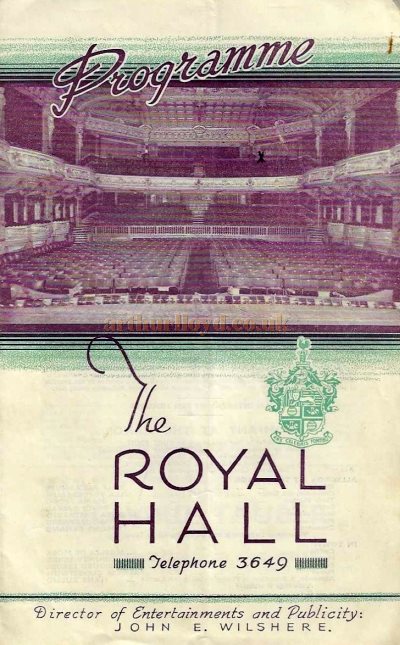
Left - A Programme for the Contemporary Dance Theatre's Twelfth Season of 'Ballets Jooss' at the Harrogate Royal Hall in October 1944 - Courtesy Simon Moss, stagememories.
The winning entry was submitted by Robert Beale, and the designs appeared in The Builder. The Corporation’s expectation could not be realised within their budget figure and the site was drastically reduced before the scheme was developed. The final building bears little resemblance to Beale’s competition drawings and owes much more (especially in the interior) to the direct involvement of Matcham as a notably ‘hands-on’ consulting architect.'
The Building was extensively restored between 2006 and 2008 and is today billed as a 'venue for events, arts and entertainment.'
You may like to visit the Royal Hall's own website here.
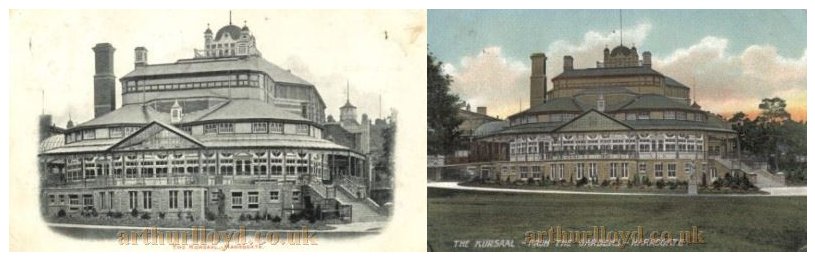
Above - Two early Postcards showing the Harrogate Kursaal - Courtesy George Eglese.

Above - An Early Photograph showing the interior of the Harrogate Kursaal.

Above - A Google StreetView Image of the Royal Hall, Harrogate - Click to Interact.
If you have any more information or images for this Theatre that you are willing to share please Contact me.
The Empire Theatre, Cheltenham Mount, Harrogate
Later - The Gaiety Theatre / Cardamom Black Restaurant

Above - The Empire Theatre, Harrogate in 1988 - Courtesy Ted Bottle
The Empire Theatre, Harrogate was originally built as a Methodist Chappel in 1872 but was converted into a Theatre in 1910. The Theatre was renamed the Gaiety in 1930 but closed in 1931. The building's history after this was very untheatrical. For a number of years it was used as a garage and in the 1950s it was owned by Fridel Dalling-Hay as Beans Toy Shop which also sold prams and had a large model bear in front of the shop.
In the 1970s the FOH area was converted to a restaurant and then enlarged in the 1980s to incorporate the auditorium. The Proscenium arch was restored in the 1980s and is unusual in that instead of plaster it is made entirely of wood. Cast Iron balcony fronts were later installed along the line of the original balcony.
The Theatre was damaged by a fire in 1996 caused by a fire bomb in an adjoining shop set by animal rights activists. The fire did significant damage to the stage area. The proscenium and auditorium survived the fire but were water damaged.
The Theatre is today used for dining as the Cardamom Black Restaurant.
If you have any more information or images for this Theatre that you are willing to share please Contact me.

Above - The Cardamon Black Restaurant in 2014, situated in the former Empire Theatre, Harrogate - Courtesy Jeff Cousins.
The Royal Spa Concert Rooms

Above - An early photograph of the Concert Rooms, Harrogate - Courtesy George Eglese
 In
1571 William Slingsby, drinking from a spring near Knaresborough, noticed
that the water there tasted like the water of the spas on the Continent.
Some years later Timothy Bright, a doctor, made the declaration that
the spring's waters could even heal various ailments.
In
1571 William Slingsby, drinking from a spring near Knaresborough, noticed
that the water there tasted like the water of the spas on the Continent.
Some years later Timothy Bright, a doctor, made the declaration that
the spring's waters could even heal various ailments.
Right - The Cheltenham Pump Room, Later- Royal Spa Concert Rooms, 'Harrogate Wells' - reproduced with kind permission - Harrogate Borough Council, Museum & Arts Royal Pump Room Museum.
In the 18th and 19th centuries, yet more springs were discovered in the area, rich in iron and sulfur, and a town was created around them; Harrogate, which later became one of Britain's most celebrated spa towns. Harrogate was soon offering cures for everything from a bout of gout to cases of nervous tension. Naturally the Spa town blossomed into a very popular place to visit but as the years went by, and science developed more sophisticated medicines and drugs, the use of the Spa waters declined.
 Harrogate
adapted well to this change of values however and transformed itself
into a major conference and exhibition centre. The town's architecture
is predominantly Victorian, built with Yorkshire stone, and has some
of the best examples of Victorian architecture from that period. M.L.
2002.
Harrogate
adapted well to this change of values however and transformed itself
into a major conference and exhibition centre. The town's architecture
is predominantly Victorian, built with Yorkshire stone, and has some
of the best examples of Victorian architecture from that period. M.L.
2002.
Left - Site of the Royal Spa Concert Rooms in 2002 - Courtesy Duncan Branley.
 Arthur
Lloyd is known to have appeared in Harrogate at the Royal Spa
Concert Rooms on September 5th 1879. The following week Arthur was to be found performing in Morecambe.
Arthur
Lloyd is known to have appeared in Harrogate at the Royal Spa
Concert Rooms on September 5th 1879. The following week Arthur was to be found performing in Morecambe.
Right - An Advertisement for Two Hours Of Genuine Fun from The Harrogate Herald - 5th September 1879 - Courtesy Harrogate reference library.
I am indebted to Duncan Branley, Stephen Thompson, and Peggy Thompson for their research into, and subsequent images of, The Harrogate Royal Spa Concert Rooms, and Arthur Lloyd's Harrogate press notice advertising his appearance there.
If you have any more information or images for this Theatre that you are willing to share please Contact me.