
The Royal Strand Theatre, 168-9, Strand, and later Aldwych, London
Formerly - Burford's Panorama / New Strand Theatre

Above - A Google Street View image of the site of the former Royal Strand Theatre in December 2020 - Click to Interact.


 The
Royal Strand Theatre was situated on the Strand in London and was built for Benjamin Lionel Rayner, who was a celebrated
Yorkshire comedian. The Theatre originally opened as a Subscription Theatre
called the New Strand Theatre on the 26th of January 1832 with a production of 'Professionals Puzzled or Struggles at Starting',
followed by a musical comediette 'Mystification! or Visible and Invisible',
and culminating in 'Love's Frailties or Passion and Repentance.' The Theatre was situated at 168-9, Strand and would eventually also encompass part of Surrey Street.
The
Royal Strand Theatre was situated on the Strand in London and was built for Benjamin Lionel Rayner, who was a celebrated
Yorkshire comedian. The Theatre originally opened as a Subscription Theatre
called the New Strand Theatre on the 26th of January 1832 with a production of 'Professionals Puzzled or Struggles at Starting',
followed by a musical comediette 'Mystification! or Visible and Invisible',
and culminating in 'Love's Frailties or Passion and Repentance.' The Theatre was situated at 168-9, Strand and would eventually also encompass part of Surrey Street.
This Theatre should not be confused with the much later Strand Theatre, now the Novello Theatre.
Right - A programme for the farce 'What Happened to Jones' which opened at the Royal Strand Theatre in 1897 and ran for 383 performances, and was the last success for J. S. Clarke as manager at the Theatre - Courtesy Peter Ribbons. See cast details below.
The New Strand Theatre was actually a reconstruction within the walls of an earlier building which had previously housed Burford's Panorama, a show which was first exhibited at 25, Haymarket in 1791 by the artist Robert Barker, who created on canvas a 'Panorama of Edinburgh' which was said to put the spectator in the same position as the artist, as if he or she was actually at the scene. Barker followed this with a 'Panorama of London and Westminster' giving a correct view of the three bridges, this time at 28 Castle Street. Both shows were so successful that he then had a purpose built building erected on the site of the former Leicester House in what is now Leicester Square and the site of the present Empire Theatre.
This opened in June 1793 with a panorama of the 'Fleet at Spithead' which was succeeded in 1794 by another, entitled 'The glorious First of June' which showed Lord Howe's great victory over the French, with the correct positions of all the ships. The panorama then became something of an institution, and all the important events of the times were reproduced there, including the wars of Napoleon, the final attack on the wars in China, the Artic discoveries of Franklin and Parry, the explorations at Nineveh, by Layard, and many others. The panorama passed from the hands, of Robert Barker to those of his son, Henry Aston Barker, who was succeeded by his pupil and painter, John Burford, who eventually had his own building in the Strand called Burford's Panorama which opened in August 1817 and closed in 1828. For a short time the building was then converted and used as a 'Decenting Chapel', but in 1831 it was taken over by Benjamin Lionel Rayner who converted it into a Theatre in the amazingly short time of just seven weeks and reopened it as the New Strand Theatre.

Above - Cast details from a programme for the farce 'What Happened to Jones' which opened at the Royal Strand Theatre in 1897 and ran for 383 performances, and was the last success for J. S. Clarke as manager at the Theatre - Courtesy Peter Ribbons.
 The New Strand Theatre opened within the old building, after internal
reconstruction, on Thursday the 26th of January 1832 and the Bills advertising it's inauguration stated that: 'The Proprietors
of this establishment having built, within the walls of these premises,
an entirely new Interior, substantial and complete in all its parts,
with the closest care and attention to convenience, comfort and elegance;
where seeing hearing and respiration have formed the leading features
of the design; the whole of the design, erection and decorations, under
the superintendence of the Architect, Mr Charles Broad, of the King’s
Theatre; a man of experience and ability. Consisting of a Dress Circle,
First Circle, twelve Private Boxes and Pit.'
The New Strand Theatre opened within the old building, after internal
reconstruction, on Thursday the 26th of January 1832 and the Bills advertising it's inauguration stated that: 'The Proprietors
of this establishment having built, within the walls of these premises,
an entirely new Interior, substantial and complete in all its parts,
with the closest care and attention to convenience, comfort and elegance;
where seeing hearing and respiration have formed the leading features
of the design; the whole of the design, erection and decorations, under
the superintendence of the Architect, Mr Charles Broad, of the King’s
Theatre; a man of experience and ability. Consisting of a Dress Circle,
First Circle, twelve Private Boxes and Pit.'
Right - A Description and Opening Report on the New Strand Theatre - From Bell's Life in London and Sporting Chronicle, 29th of January 1832.
The Theatre was designed by Charles Broad with Scenery by a Mr Hilliard of Edinburgh and embellishing and ornamental parts were by a Mr Blamire of Theatre Royal, Drury Lane. The Theatre was decorated in white, gold, and silver, and tickets were sold off the premises because it had no License, at 4, 3, and 2 shillings. The Theatre's opening was during the last battles between the unlicensed Theatres and the Patent Theatres and the Theatre's opening production of 'Professionals Puzzled' was a skit on this situation.
Just a few weeks after the Theatre opened it was taken over by Mrs. Waylett who had performed in one of the opening pieces but it closed down in November 1832 and wouldn't reopen until the following February with a monologue entertainment by Fanny Kelly. A drama followed this, by Wrench Russell, but the continuing situation with the Patent Theatres caused the Theatre to be closed down again by October the same year, 1833.
The next year, 1834, Mrs. Waylett had another go at making the Theatre work, she tried everything to evade the Patent Laws including free admission, included with an ounce of Losenges for 4 shillings. They even had a real so called Red Indian Chief performing in one show along with his Squaw. Waylett did have one success though, and that was a production of Gilbert A. Becket's burlesque of 'Manfred'. However, in 1835 the Theatre was closed down again by the Patent Houses.
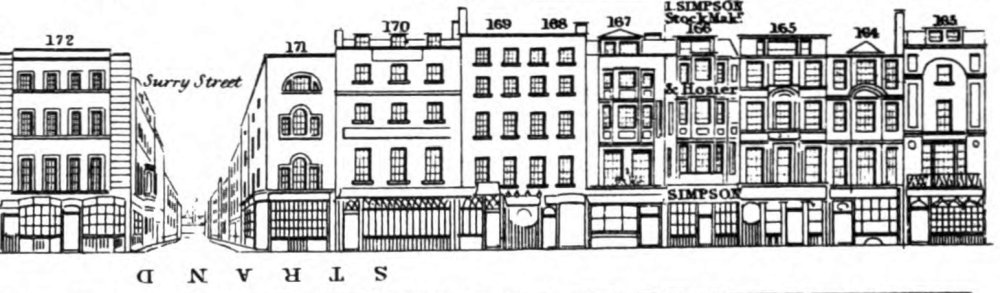
Above - The Strand Theatre at 168 - 9 Strand, as depicted in Tallis's London Street Views 1838 - 1840. In the 1880s the Theatre was rebuilt on an enlarged site with exits and entrances on Surrey Street and Strand Lane, with its stage door on Surrey Street.
 The following year on the 25th of April 1836 the New Strand Theatre was finally put on the same footing as the Olympic and the Adelphi, when it reopened with a production
of the Burletta 'The Painter of Ghent' by Douglas Jerrold, who, with his brother in
law William J. Hammond, had taken up the joint management of the
Theatre. Douglas Jerrold wrote the play and performed in it himself,
his stage debut, and would go on to write many more plays for the Theatre.
The last season for William Hammond at the New Strand Theatre ended on the 19th of October 1839. Hammond had made enough money from his time at the Theatre
to then take over at Drury Lane but
he lost there what he had earned at the previous Theatre.
The following year on the 25th of April 1836 the New Strand Theatre was finally put on the same footing as the Olympic and the Adelphi, when it reopened with a production
of the Burletta 'The Painter of Ghent' by Douglas Jerrold, who, with his brother in
law William J. Hammond, had taken up the joint management of the
Theatre. Douglas Jerrold wrote the play and performed in it himself,
his stage debut, and would go on to write many more plays for the Theatre.
The last season for William Hammond at the New Strand Theatre ended on the 19th of October 1839. Hammond had made enough money from his time at the Theatre
to then take over at Drury Lane but
he lost there what he had earned at the previous Theatre.
Right - A programme for 'Mascotte' which was the last production at the old Royal Strand Theatre before it closed in July 1882 - Click to see entire programme.
The New Strand then had a long and varied career, sometimes closed, sometimes altered, sometimes successful, but it would be closed completely on the 29th of July 1882 after being condemned due to safety concerns, and then completely rebuilt on an enlarged site with exits and entrances on Surrey Street and Strand Lane, with its stage door on Surrey Street. The last production at the old Strand Theatre was 'Mascotte' which closed in July 1882, see Programme Above Right.

Above - The Royal Strand Theatre during the run of 'In the Soup' in August 1900, see a programme and review of this production below.
 The
Theatre reopened as the Royal Strand Theatre on the 18th of November 1882 with a production of 'The
Heir-at-Law' by George Colman which was followed by a musical comedy
entitled 'Frolique!.'
The
Theatre reopened as the Royal Strand Theatre on the 18th of November 1882 with a production of 'The
Heir-at-Law' by George Colman which was followed by a musical comedy
entitled 'Frolique!.'
Right - An Advertisement for the Reopening of the Royal Strand Theatre in 1882 - From the Daily Telegraph & Courier (London), 17th of November 1882.
The ERA reported on the new building in their 18th of November edition saying: 'Since the 29 July the whole of the old theatre has been pulled down, with the exception of a part of the side walls and a portion of the roof; but long before that works were in active operation on the newly acquired land at the back of the theatre. In the new theatre what was formerly the back wall and the whole extent of the stage are now added to the auditory, the present proscenium and curtain being in the exact position of the former back wall. Behind this, and extending as far as the Strand Lane, have been built the stage and dressing rooms.
 The width of the principal entrance in the Strand has been more than
doubled by the acquisition of some adjoining property, so that now the
theatre, which in former times was, perhaps, the worst off in London
in respect of entrance and exit, will be one of the best.
The width of the principal entrance in the Strand has been more than
doubled by the acquisition of some adjoining property, so that now the
theatre, which in former times was, perhaps, the worst off in London
in respect of entrance and exit, will be one of the best.
Left - A Programme for Ralph Lumley's 'In the Soup' which opened at the Royal Strand Theatre on the 28th of August 1900. See a review of this production below.
The theatre has been built from the designs and under the personal supervision of Mr. C. J. Phipps, F.S.A., architect of the Gaiety, the Haymarket, the Savoy, and other theatres. The plans were approved by the Lord Chamberlain and by the Metropolitan Board of Works under the Act of Parliament, and all the latest improvements and suggestions have been carried out.
 The principal approach will be from the
Strand, the entrance opening into a spacious vestibule. The visitors
for the stalls then pass to the left, and those to the balcony or dress
circle to the right, each having a separate corridor and staircase.
The stalls corridor has two staircases, giving access to the auditory
both right and left of the stage; and out of this corridor is another
exit to Surrey Street, which will be always open. This will also form
the entrance for the Royal family when visiting the theatre, and adjacent
is a small retiring room conveniently placed. The pit entrance is in
Surrey Street, and has a staircase 5 ft. wide leading up to the back
of the pit. The gallery has two staircases, one on either side, and
both in Surrey Street. Both these staircases will be always open and
available at all times. The usual stage entrance is, also, in Surrey
Street, by a fireproof corridor under the south side of the pit; but
there are doors leading off the Mezzanine stage directly into Strand
Lane, which can be used whenever necessary.
The principal approach will be from the
Strand, the entrance opening into a spacious vestibule. The visitors
for the stalls then pass to the left, and those to the balcony or dress
circle to the right, each having a separate corridor and staircase.
The stalls corridor has two staircases, giving access to the auditory
both right and left of the stage; and out of this corridor is another
exit to Surrey Street, which will be always open. This will also form
the entrance for the Royal family when visiting the theatre, and adjacent
is a small retiring room conveniently placed. The pit entrance is in
Surrey Street, and has a staircase 5 ft. wide leading up to the back
of the pit. The gallery has two staircases, one on either side, and
both in Surrey Street. Both these staircases will be always open and
available at all times. The usual stage entrance is, also, in Surrey
Street, by a fireproof corridor under the south side of the pit; but
there are doors leading off the Mezzanine stage directly into Strand
Lane, which can be used whenever necessary.
Right - A Review of Ralph Lumley's 'In the Soup' which opened at the Royal Strand Theatre on the 28th of August 1900 - From the Morning Post, 29th of August 1900. The show had a try out at the Theatre Royal, Bournemouth on the 24th of August before coming to London and would later be shown at the Opera House Cheltenham in December 1900.
The auditory of the theatre, though enlarged, still retains the same divisions as before. On the floor are six rows of orchestra stalls, affording seats for 107 persons in armchairs, and behind these is a spacious and convenient pit, three times as large as in the old theatre. On the first tier the balcony has six rows of arm-chairs holding 170, divided into two prices, but without any division or railing. On the second tier is the gallery, holding about 400 persons. There are six private boxes on each side of the proscenium.
All the entrances, passages, and staircases are of brick and stone, the flights of stairs are supported at each end by solid brick walls, having handrails on either side; and there is no part of the theatre which has not two distinct means of egress in case of necessity, all of which will be kept open during time of performance. The stage is separated from the auditory by a solid brick wall, carried up so as to divide the two roofs completely. Water is laid on from the high pressure mains, and hydrants are placed in various parts of the building. The refreshment saloon is adjoining the staircase to the dress circle, and it is intended to construct a smoking-room on the ground floor off the stalls corridor.
The ornamentation of the theatre is Italian Renaissance in character, the box fronts being decorated in white and gold, and this treatment is continued on the ceiling, which is flat and divided by moulded ribs into panels. The whole of the proscenium frame and ceiling is of gold. The walls of the auditory are covered with paper of a dark turquoise and peacock blue tone, with flowers of a brighter colour; and the hangings and curtains are in figured plush of a claret-red colour. The seats are all upholstered in old gold-coloured plush with carpets of a deep red. The whole interior presents a rich, bright, and comfortable appearance.
The contractors who have been engaged upon the works are as follows: - Messrs. Patman and Fotheringham for the whole of the builder's work; Mr. Wood for the stage; Messrs. Jackson and Sons for the ornamental plaster work in box fronts and proscenium; Mr. E. Bell for the painting, papering, gilding and decorating; Messrs. Strode and Co. for the sun-light and the special gas work for the lighting the stage; Mr. Hinkley for the ordinary gas fittings; Messrs. Lyon and Son for the upholstery and seating, the armchairs being the architect's registered design; Messrs. Merryweathers have supplied the hydrants and fire appliances; the act drop and scenery have been painted by Mr. T. E. Ryan; Mr. J. E. Walker has been the architect's clerk of the works.'
The above text in quotes was first published in the ERA, 18th November 1882.

Above - A Google Street View image of the site of the former Royal Strand Theatre in April 2018 - Click to Interact.
 The
new Royal Strand Theatre had just over 20 successful years in business
under various managers but culminated in a musical play called 'Miss
Wingrove', which had only had a few performances when it was closed
on the 4th of May 1905 because
the Theatre had been sold to the Great Northern, Piccadilly and Brompton
Railway.
The
new Royal Strand Theatre had just over 20 successful years in business
under various managers but culminated in a musical play called 'Miss
Wingrove', which had only had a few performances when it was closed
on the 4th of May 1905 because
the Theatre had been sold to the Great Northern, Piccadilly and Brompton
Railway.
Right - An Advertisement for the Auction of Fixtures and Fittings from the Royal Strand Theatre previous to its Demolition in 1905 - From the South London Press, 7th of October 1905.
 The Theatre's fixtures and fittings were auctioned off in October 1905 and the Theatre was then demolished so that the Strand Underground Station
could be built on its site. The station opened in November 1907 and was later renamed Aldwych Station in May 1915.
The Theatre's fixtures and fittings were auctioned off in October 1905 and the Theatre was then demolished so that the Strand Underground Station
could be built on its site. The station opened in November 1907 and was later renamed Aldwych Station in May 1915.
Left - A Map of the Underground in 1907 marking the opening of the New Strand Station on the site of the former Royal Strand Theatre - From the Daily Mirror, 2nd of December 1907.
It was never a very popular station however, as it was just a spur from Holborn Station which was a short walk up Kingsway, and so Aldwych Station was finally closed in 1994 and is today used as a testing station for new London Underground equipment, and often for film shoots and the like. A fascinating Tour of the now long abandoned station can be arranged through Hidden London here.
If you have any more images for this Theatre that you are willing to share please Contact me.