
The Life of an Actor
An Autobiography by H. F. Lloyd, Comedian
Late of the Theatre Royal Edinburgh and Glasgow
Index
CHAPTER THIRTEEN
MURRAY, CALVERT, AND EGERTON AS STAGE MANAGERS
Mr Murray of Edinburgh, was his own stage-manager, and was a wonder in this way. He had been brought up in a great school and under great masters, at Covent Garden Theatre. There was John Kemble, himself, the lessee, who stage-managed the tragedy department, with Fawcett for the comedy, Farley for the melodramatic, and Bologna for the pantomime departments.
Now, Mr Murray had studied under all these talented men, and had watched them well. The result was that he became a proficient in all departments; and, when his brother-in-law, Mr Henry Siddons, purchased the Edinburgh theatre, he made him his stage-manager, in which position he continued until the death of Mrs Henry Siddons, who survived her husband, when he, (Murray) became lessee of the establishment, and remained on until his retiral from the stage.
The next best stage-manager with whom I have come into contact, was the late Mr Charles Calvert, who occupied that position in the Theatre Royal, Glasgow, for a season or two, rather over 20 years ago.
He afterwards went to Manchester and became a theatrical lessee there, where his "Shakespearian revivals" became a feature akin to those of Charles Kean at the Princess's in London some ten years earlier. Mr Calvert's successor in stage-management at the Royal in Glasgow was Mr Henry Egerton, who was overweighted in the situation. All his experience had been acquired as his father's factotum in a minor theatre in Liverpool, where only melodrama was acted. Egerton, though he confessed his ignorance of the higher walks of the drama, worked hard and did his best for his employers, but appeared to be lost in a large establishment.
I remember an instance of 'business' in this piece - as also in that of "The Rivals" - is so excellent that I do not believe it capable of being improved on; and yet I question if any stage-manager of the present day is thoroughly up in it. On the morning to which I refer, Egerton exhibited his usual method of superintending rehearsals of "legitimate" pieces he had never seen. He would stand by for a time quite bewildered, then taking off his hat with his left hand, he would scratch his head with the right, and say;
"I'm blessed if I know anything about these old-fashioned affairs," and occasionally, turning to me, he would add, "I say, Lloyd, you can tell them the business of this scene," or "I suppose it's all right. Wait a moment .... Houghton (the treasurer) wants to see me in the office."
Then away he would go, and remain there gossiping until the end of the rehearsal, when he would return to the stage in a great bustle, exclaiming in surprise;
"Have you finished? All right, then. Good morning, ladies and gentlemen." And then walk out of the theatre.
Poor Egerton! He subsequently became the stage-manager of the Theatre Royal, Dublin, and perished in the flames, when that house was burned down some years ago.
MY UNFORTUNATE VENTURE AS A LESSEE
Ihave now, in course, to refer to an (as it turned out) unfortunate episode in my professional career. In the month of March, 1850, I had learned that Mr Murray's lessee of the Theatre Royal, Edinburgh, expired in September of the year following, and that he had no intention of seeking a renewal of it.
In an evil hour, it occurred to me that I might become his successor. Accordingly, I wrote to Major Arthur Mair, one of the trustees, from whom I received a very kind reply stating that I might depend upon his vote and influence in favour of my application, should I resolve upon formally applying to become lessee of the theatre. He also informed me that the proper channel of further communications on the subject was Mr Joseph Grant, W.S., 30 Drummond Place, Edinburgh.
I accordingly opened a correspondence with that gentleman, and no fewer than upwards of forty letters passed between us on the subject. Only the result, however, needs to be stated.
This was, that a form of lease was drawn up and sent over to me in Glasgow; that I signed it and that it was witnessed at Dr Frank Thomson's house by himself and his two brothers, over a magnum of claret; that I returned it to my agent at Edinburgh; and that I took possession on 29th September, 1851. After thoroughly cleaning and redecorating the house, and effecting sundry alterations and improvements, it was opened on Saturday, 22nd November, 1851.
I had managed to get together an undeniable good company, among the members of which were - Miss Fanny Vining, (Mrs E. L. Davenport), Miss Eliza Nelson, (Mrs H. T. Craven), Miss M. Wilton, (now Mrs Baucroft), Miss Burton (now Mrs Swanborough), Mr E. L. Davenport, Mr Harcourt-Bland, Mr H. Webb, Mr Brindal (so long of the Haymarket), &c. - Mr Alexander Mackenzie being musical director. Perhaps I had better, as before, allow the critic of the Courant, the opening occasion:-
"The theatre reopened on Saturday evening, and, if the opening night can be taken as a test, Mr Lloyd has every prospect of a brilliant and successful season. For some time before the hour of opening, the doors were surrounded by anxious crowds, and when the doors did open, the rush and crush was tremendous.
During the interval before the performances commenced, the audience amused itself by insisting on recognising and bestowing tributes of applause on any well-known person visible in the house. Thus Mr Grainger, on his appearance in the boxes, was saluted with a very hearty round, which only subsided after he had made repeated acknowledgements in the shape of profound bows, to his noisy admirers. Mr Glover was similarly fixed on, and, from his position at the back of one of the boxes, received such applause as he has more frequently obtained at the other end of the house. Mr Wyndham likewise obtained very cordial greeting on being discovered in one of the boxes.
Throughout the evening, the same friendly and good-humoured spirit was visible in the reception of the actors and actresses, especially the two or three with whom the audience had been before acquainted.
After the National Anthem had been sung by the company, the audience standing, and some of them joining in the strain, Mr Lloyd appeared in front of the curtain, and after the applause; which was so long continued, that it began to look as if his more pertinacious admirers did not wish him to speak at all; he delivered the following address:-
"Ladies and Gentlemen, Accept my warmest thanks for this kind, very kind patronage and hearty welcome to your old friend." (Applause). "I appear before you, I confess. under great disadvantage, when I remember how soon I have succeeded my illustrious predecessor." (Cheers) "I feel totally unable to address you in the manner to which you have been accustomed, for:-
"Rude am I in speech,
And little blessed with the set phrase of Murray." - (Laughter)
"I, therefore request you to understand that I feel I am not succeeding to the throne of any ordinary theatrical monarch, but to that of the Napolean of Managers, a good General, too, and an excellent Minister of Finance." (Laughter and applause). "In the first place, Ladies and Gentlemen, may I hope that the alterations and improvements in the house meet with your approbation." (Great cheering).
"In the next place, you will have to sit in judgement on the new performers, who will appear before you tonight for the first time. I request you will give them a patient hearing, sincerely trusting that your verdict will be in their favour. Remember, the peculiarities of new actors require some time to gain on the public, but only favour them with a patient hearing, and I have no doubt that in time they will become favourites." (Cheers).
"Perhaps it will not be out of place to tell you something connected with a circumstance of the same sort which occurred to myself when I had first the honour of appearing before you, upwards of 20 years ago. I remember, the morning after I appeared, going to the news-room to read the criticisms," (A laugh). "fancying that something would be said about myself, for I thought myself much more clever then, than I do now." (Laughter). "I took up the paper. It commenced thus":-
'Last night a Mr Lloyd made his first appearance, and we hope it will be his last.' (Renewed laughter). 'He is supposed to be a comedian. Well! What shall we say of that - the least said the soonest mended.
N.B. - 'Smacks sail from Leith to London twice a week!' (Great laughter and applause).
"This was certainly a very polite hint for me to depart, but as Charles Mathews says, 'I diddled'.
"No, Ladies and Gentlemen, I persevered, and by industry and your kind encouragement, I gradually grew into your favour." (Cheers).
"I trust that I shall long continue so; and only confer the same favour on my performers this evening, and it will be an additional obligation on your obedient, grateful servant." '(Mr Lloyd retired amid renewed, and still more enthusiastic applause)'.
HARCOURT BLAND
In the opening piece, the late Mr Harcourt Bland made his first appearance before an Edinburgh audience, in the character of Sir Charles Coldstream which, the critic I have quoted said, he played "with much good taste and skill, and with a great deal of quiet, gentlemanly humour. On the whole, it was an excellent impersonation, not unworthy of ranking after the inimitable original of Charles Mathews."
The after-piece, H. T. Craven's, "The Village Nightingale," and in which that gentleman, and also Miss Eliza Nelson and Mr H. Webb appeared, also went well; and altogether, I started with a promise which, alas! was not to be fulfilled.
MY MISFORTUNES IN BRIEF
 Iam in no mind to dwell on this period of my
career, and shall, therefore, put in all I have to say about it into
five little notes;
Iam in no mind to dwell on this period of my
career, and shall, therefore, put in all I have to say about it into
five little notes;
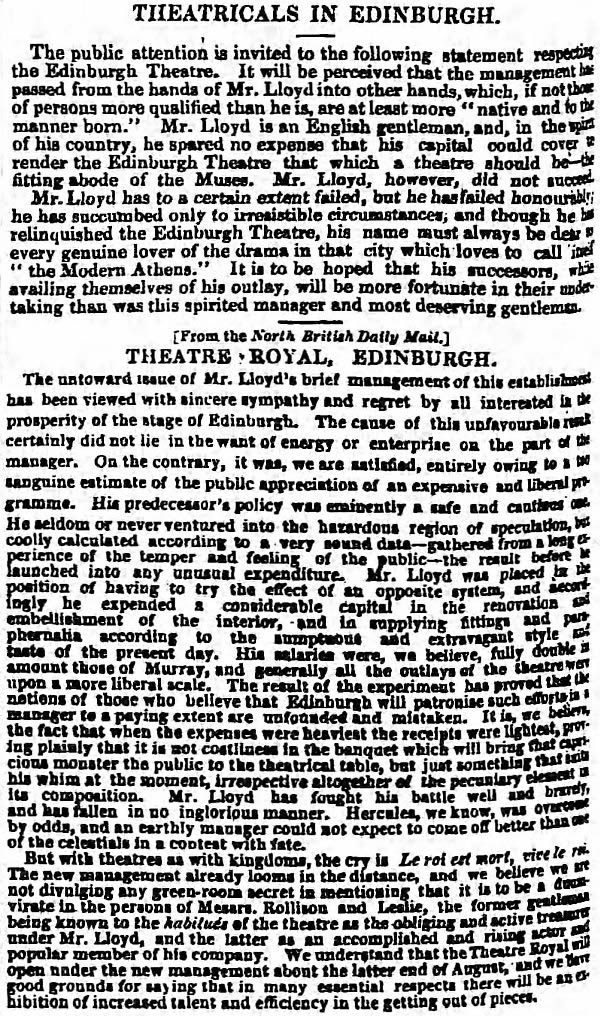
Right - A Report on Horatio Lloyd's brief period of Management at the Edinburgh Theatre Royal - From The Observer of Monday August the 16th 1852, which also included a report from the North British Daily Mail.
No. 1 - My opening night had nearly proved a closing one as well. Half an hour before the time for opening the doors, a smell of burning was perceived on the stage, and smoke was seen issuing from between the lining of the stage private box and the lining on the stage side of it This space had been filled up with sawdust to deaden the sound, and, somehow or other, it had caught fire. The lining next to the stage was immediately torn down, when the sawdust was discovered to be in a red glow, which the sudden admittance of air, caused to burst into a flame. Fortunately, however, we were soon able to get this extinguished; and, after several bottles of lavender water had been thrown about to destroy the smell of fire, the doors were opened.
No. 2 - I had a company upwards of 100 strong, with salaries ranging from £1 to £12 per week.
No. 3 - Very ominous! My opening piece was "Used Up."
No. 4 - My law-agent's name was Bringlon, and he lived in Walker Street. I found that, although my agent, he was at the same time, acting for my successors
No.5 (which ends this strange, eventful history) - I walked out of the Theatre Royal, Edinburgh, as near as may be, twelve months after I had walked into it; a wiser but not a richer man.
IN THE SANCTUARY
The few weeks immediately following, I spent in the beautiful and salubrious neighbourhood of Holyrood House, where it was arranged that during my stay there, I should not be intruded upon by unpleasant visitors. This consummation was effected by means of my being kindly furnished with a document, of which the following is a verbatim copy:-
"At Holyrood House, the thirteenth day of September, One Thousand Eight Hundred and Fifty-two, The which day Horatio Frederick Lloyd, No. 8 Raeburn Place, Edinburgh, was, and hereby is, admitted and received to the Benefit and Privilege of the Sanctury of Holyrood House, whole bounds and precincts thereof; and he was, and hereby is, protected therein accordingly, conform to law.
"Extracted from the Records of the Sanctuary, by me, Clerk of Holyrood House.
(Signed) "William MacMeekan."
BACK TO "ST MUNGO'S BELLS"
Mr Murray's Death
It was in 1851 that Mr Murray retired from the stage, not in very good health, and, as he said thoroughly tired of the profession and everything connected with it. His private theatrical wardrobe he gave away; and, to my surprise, he told me that he had burnt every document reminding him of his long connection with the boards, including a beautifully-kept and interesting diary, extending over twenty-one years.
He left Edinburgh, and, with his wife and family, went to reside at St Andrews, a favourite resort of his, where he used frequently to spend his holidays when he did not go to London. There he died, very suddenly, on the 5th of May, 1852, not a year from the date of his retiral.
I received an intimation of his death, and, a couple of days later, an invitation to the funeral. I went, and was much affected when I reflected on the many years I had spent under him in his exquisitely-managed establishment.
After the ceremony was over, my old friend, Major Sir Hugh Playfair, who was present, came forward to me, and said:- "Lloyd, come and dine with me; I want to tell you some particulars of poor Murray's death."
I went with him accordingly, and, on arriving at his house, we found Professor Balfour waiting for him. Sir Hugh introduced me to the latter, who, in a few minutes after, took his leave. We then dined with the family, subsequently to which Sir Hugh gave me the following account, which I shall give as nearly as possible in his own words.
"From the time he came to settle in St Andrews," said Sir Hugh, "we had become very intimate; and that night he died, he and Mrs Murray were at a small party here. We had some music, and then to supper, after which I ventured to ask him if he would kindly sing us his old song - which no one could sing like him! -'The Fine old Country Gentleman.' - I never saw him in such excellent spirits before; and he consented at once. He got on as usual, until the verse:-
'But time, though old, is strong in flight,
And years went swiftly by:
And autumn's falling leaf foretold
The old man he must die;
He laid him down, and tranquilly
Gave up life's latest sigh, &c'
Just at the words - 'He laid him down,' poor Murray seemed all at once to be choking with emotion. He burst into tears, put his handkerchief to his eyes, and buried his face in it. We never spoke and, after a little, he turned to Mrs Murray and said, "Let us go home, my dear." She at once left the room to prepare for going, and returned quickly, saying, "I'm ready, dear."
We shook hands, and they left. About half an hour later I had a message from Mrs Murray, asking me to come to her immediately. I took my hat and started at once, but when I arrived poor Murray was no more! I asked for an explanation of the melancholy case. Mrs Murray told me that after leaving our house they walked on very slowly, Mr Murray being unusually silent, until getting within about twenty yards of their own door. Then he let go of her arm, hurriedly walked on by himself, got up to the door, took out his key, and let himself in. Leaving his hat on the lobby table, he staggered into the dining-room, sank into his easy chair, leaned back, and expired without uttering one word.
And so, said Sir Hugh, I found him. Mr Murray had often expressed a desire to be buried in the old Abbey Churchyard of St Andrews, with his head to the sea. The latter was a passion with him, and he had once said, "After I am gone - and could such a thing be permitted by my Maker - I should like to hear the sea breaking against the rocks away down below my grave."
With these ideas, he had almost immediately, after settling in St Andrews, acquired a piece of ground in just the site he desired, close to the south wall of the churchyard overlooking the broad bay of St Andrews, which he loved so well to gaze upon. There we laid him, and soon afterwards the spot was marked by a tombstone, on which are chiselled these words:-
Sacred to the Memory of
WILLIAM HENRY WOOD MURRAY,
Grandson of Sir John Murray, Bart., of Broughton,
And who for upwards of forty years was the talented, and
highly-respected
Lessee and Manager of the Theatres Royal and
Adelphi,
Edinburgh.
Born 25th May, 1790
Died 5th May 1855
Requiescat in pace
SOME RECOLLECTIONS OF MURRAY
Of Mr W. H. Murray, I can truly say - "Take him for all in all, I shall not look upon his like again."
I was with him as first low comedian for sixteen years, and during the whole of that time not one angry word passed between us - a pretty good proof that I could not have been a very bad servant or he a very bad master. In point of fact, from first to last he always behaved to me more like a father than a mere employer. He had told me at the outset that, if I paid attention, he would make me - and he did.
By his admirable teaching he had, before very long, made me - I flatter myself - the greatest favourite that ever appeared there. He would watch me at rehearsal, day after day, and when it was over, take me aside and talk to me about the part I had been rehearsing; kindly pointing out and correcting any faults or deficiencies he may have observed, suggesting any telling bit of business, or bye-play, I might introduce. &c. In this sort of instruction, he was a master, and I was a pupil with whom he spared no pains. In return, I became so much attached to him, and had such confidence in his sound judgement generally, that I came to invariably consult him on all my domestic as well as professional affairs, and never had reason to regret following his advice.
Another member of the company in whom he took a special interest was my friend Montague Stanley. I may safely assert that never were there two young fellows in a theatre so much made of by their manager, as Stanley and myself. 'My two boys,' Murray used to call us. But we never presumed upon his partiality for us, seldom addressed him unless spoken to, and never held out a hand to shake until he had first proffered his own; for, be it understood, he was a peculiar man, remarkably staid, as a rule frightfully low spirited, very proud, but withal a perfect gentleman in every sense of the word - the Napoleon of managers, a most strict disciplinarian, straightforward and honourable in all his dealings and a thorough man of business.
His system of management appeared to me to be perfection, everything was gone about so quietly yet so fully, and so punctually. His suggestions were given in the kindliest manner; but, what an eye he had! It was 'an eye like Mars to threaten and commend' - had occasion required.
One thing let me mention, as regards his bearing to myself, personally. At rehearsals, he expected every one, as he himself did, to act - the same as at night. Now this, I could never manage to do. At last he saw how painful the effort was to me, and so gradually I was allowed to do as I pleased in that respect. He would sometimes say to others, loud enough for me to hear, "I don't know what my friend Lloyd intends to do in this situation, so you must be prepared for any nonsense he may introduce."
I have seen Murray act much better in the morning than he did to the audience at night and even when unwell, he has worked hard through his part at rehearsal. This, I have no doubt, was done as an example to these under him.
Mr Murray had a presentiment that he should die suddenly, and this seemed to prey upon his mind a good deal. The probability of such a thing was, of course, not lessened by the fact that after any extra fatigue or exertion he was troubled with a pain at the heart.
A curious notion of his, he mentioned to me on one occasion. It was this, that in the event of his fatal illness being a lingering one, he had long ago requested his friend and medical attendant, Liston, if he thought the end approaching, not to tell him so in words, but quietly to put an orange into his hand, and he should understand what was meant. He further told me that he was once very near getting this signal.
Before I came to Edinburgh, he had a small house at Duddingstone, in which he and the family resided during the Summer months. One night, just before going to bed, the weather being very sultry, he desired to let some fresh air into the room. To this end, he mounted on the dressing-table to lower the upper part of the window, which, coming down with a sudden run, he got overbalanced and fell outwards, landing on his back in the garden beneath from a height of one storey. None of the family knew of the occurrence, until a gentleman passing by, and hearing a moaning in the garden, went into the latter, and found Murray lying there insensible. Having roused the inmates, the gentleman assisted them to carry him into the house, where it was discovered that he had met with, what proved to be, a serious injury to the spine. This confided him to his bed for some months, and ever after his recovery, he wore a belt with an iron plate on it, to protect and support the injured back.
Liston told him afterwards, that he never expected he (Murray), would have got over the accident and that for a considerable time, when he came on his professional visits, he was never without an orange in his pocket.
Let me conclude this imperfect tribute to my old chief, by reproducing a few lines which he wrote in a new album of mine. I had left it at his house in Windsor Street, with the request that he would favour me with an opening contribution. It was returned to me on the morning of Christmas Day, accompanied by a short note, apologising for scribbling them so hurriedly, and here they are:-
A right Merry Christmas
And happy New Year
I wish you, friend Lloyd,
Crown'd with jest and good cheer.
And many returns of them
When I'm away,
As dead as the turkey
You'll dine on today
(signed) W. H. MURRAY, 25th December, 1843
I RETURN TO GLASGOW
On emerging from the sweet security of Hoyrood, referred to at the close of last chapter, I went back to Glasgow, where I found that Mr Edmund Glover had now become lessee of the Theatre-Royal, Dunlop Street. He offered me the same terms as I had formerly at the Prince's Theatre, so I joined his company and remained with him and his representatives until the destruction of the theatre by fire in 1853. During the next seasons all went smoothly in Dunlop Street; it being the custom during the summer recess to take a select portion of the company with us on a tour round, which excursions generally bade me well.
 I
have thus had, among our little companies on these occasions, Miss Ross
Laclerque, Miss Coglan, Miss Falconer, Miss Louisa Gordon, Mr Fitsroy, Mr
Benson, Mr Cecil Murray, &c. In 1854,
in conjunction with Mr David Fisher, I gave an entertainment entitled "facts and Fancies," which was completely successful. In 1856 I took a benefit on occasion of a withdrawal from the Theatre Royal
and the stage proper - for a time only as it proved. Perhaps the circumstances
can be best explained by an extract from the Glasgow Herald's notice
of the occasion:-
I
have thus had, among our little companies on these occasions, Miss Ross
Laclerque, Miss Coglan, Miss Falconer, Miss Louisa Gordon, Mr Fitsroy, Mr
Benson, Mr Cecil Murray, &c. In 1854,
in conjunction with Mr David Fisher, I gave an entertainment entitled "facts and Fancies," which was completely successful. In 1856 I took a benefit on occasion of a withdrawal from the Theatre Royal
and the stage proper - for a time only as it proved. Perhaps the circumstances
can be best explained by an extract from the Glasgow Herald's notice
of the occasion:-
Right - A Poster for Horatio Lloyd's 'Facts and Fancies' at the Minerva Hall Glasgow - Click for more information.
 "Last
night Mr Lloyd took his benefit
and farewell to the stage. As may have been expected on such an occasion
the house was crowded from pit to ceiling. At the conclusion of the
piece-'The Rivals'-Mr Lloyd came forward and spoke as follows:- 'Ladies
and gentlemen, I believe it is customary, on taking a farewell, to look
particularly miserable, and a white pocket-handkerchief occasionaly
produced is very effective.
"Last
night Mr Lloyd took his benefit
and farewell to the stage. As may have been expected on such an occasion
the house was crowded from pit to ceiling. At the conclusion of the
piece-'The Rivals'-Mr Lloyd came forward and spoke as follows:- 'Ladies
and gentlemen, I believe it is customary, on taking a farewell, to look
particularly miserable, and a white pocket-handkerchief occasionaly
produced is very effective.
Left - A Poster for Horatio Lloyd's 'Facts and Fancies' at the Trades Hall Arbroath - Click to enlarge.
However on the present occasion I shall endeavour to look as pleasant
as I can, and as I don't intend to weep, there was no necessity to bring
a cambric. The truth is, Ladies and gentlemen, I intend shortly to meet
you elsewhere, and that is why I do not feel so much the present parting;
in fact, Glasgow will be my home-my headquarters……
The repeated vacations which take place now in theatres, and reductions
of salaries during the summer season which managers seem to think it
necessary to make, have reduced my income so considerably of late that
I am compelled to think of some other means of working the oracle. And
now, ladies and gentlemen, I will tell you my intentions. After I have
finished a short engagement in Edinburgh,
I shall return here to prepare a new entertainment after the style of 'Facts and Fancies,' which was
so successful as many will remember. Now all I ask of you my friends,
is to give me a small share of your patronage. I don't want all 'Live
and let live' is my motto. I only want a very leetle bit of your patronage,
enough to enable me, at the end of a week's labours, to say to a friend
when I meet him, 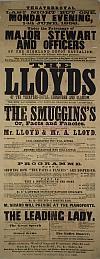 in
an independent manner, 'Will you dine with me to-morrow?' For I assure
you, ladies and gentlemen, in these hard times I have had to pause before
I said to my own children, 'Will you dine
with me to-morrow?' But when I have done so, I will do 'em the credit
to say that they have never insulted me by refusing the invitation;
and I am sure it will be a source of great satisfaction for you to know
that they take their meat extraordinar weel. And now, ladies and gentlemen,
thanking you for your liberal patronage this evening, I bid you farewell!
Before leaving, permit me to introduce to your kind notice a small chip
of the old block.'
in
an independent manner, 'Will you dine with me to-morrow?' For I assure
you, ladies and gentlemen, in these hard times I have had to pause before
I said to my own children, 'Will you dine
with me to-morrow?' But when I have done so, I will do 'em the credit
to say that they have never insulted me by refusing the invitation;
and I am sure it will be a source of great satisfaction for you to know
that they take their meat extraordinar weel. And now, ladies and gentlemen,
thanking you for your liberal patronage this evening, I bid you farewell!
Before leaving, permit me to introduce to your kind notice a small chip
of the old block.'
Right - A Poster for Horatio Lloyd's 'Facts and Fancies' at the Theatre Royal, Aberdeen - Click to Enlarge.
This address, as may have been expected, was received with shouts of laughter and applause and at its conclusion Mr Lloyd brought forward his son Arthur, who, dressed in the nicest imitation of Mrs Florence, sang with great effect the two airs which rendered her so popular during her stay in this city."
The posters above are from a large collection of original Lloyd Posters collected since the mid 1800s by members of the family and found recently after being lost for 50 years. To see all these posters click the Poster Index here.