
The ERA Obituary For Arthur Lloyd

Arthur Lloyd was born in Annandale Street, Edinburgh in 1839. He performed there many times. He died, and was buried in Edinburgh in 1904. Below is a copy of the complete unedited text of The ERA Obituary for Arthur Lloyd, July 23rd 1904. The ERA also printed a Reminiscence of Arthur Lloyd in the same issue which you can see here.
Death Of Arthur Lloyd
 The
news of the death of Mr Herbert Campbell had scarcely been published
in the dailies before we heard of the passing
away of Arthur Lloyd at Edinburgh,
the city in which he was born. Last week we had to record the death
of his daughter in-law, Mrs Harry King Lloyd, and it was while the relatives
were assisting at the sad rites of the burial of this lady that they
learnt the sad tidings.
The
news of the death of Mr Herbert Campbell had scarcely been published
in the dailies before we heard of the passing
away of Arthur Lloyd at Edinburgh,
the city in which he was born. Last week we had to record the death
of his daughter in-law, Mrs Harry King Lloyd, and it was while the relatives
were assisting at the sad rites of the burial of this lady that they
learnt the sad tidings.
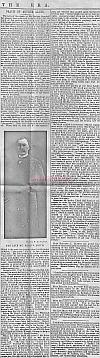
Right - Click to see the Obituary as printed in the ERA 23rd July 1904.
We regret to know that the deserved gentleman, who was highly esteemed and beloved by all whom he came in contact, was a stranger to prosperity in his latterdays. In November, 1900, he had a complimentary matinee at the Royal, but it was not the success it ought to have been, and a movement was on foot to tender him a testimonial benefit that would have been a worthier recognition of his services to the public. Mr H. E. Moss and other gentlemen prominent in the variety world had placed themselves on the committee and Mr Edward Ledger readily assented to hold the office of hon. Treasurer. Arthur Lloyd served the public for half a century, and he always endeavoured to be artistic. He may be said to have died in harness, and it is a pitiful thing that the last days of such an entertainer should have been chilled by poverty.
 The
death of the popular comedian reminds us that he once said, in answer
to an interviewer, My father and I have entertained the British public
for 110 years. For the last fifty years he had been one of the most
famous character comedians, and his father, Horatio
Lloyd, was on the stage as a comedian for sixty years. The son commenced
before the father finished, but the total record of the two remains
at ten years over the century. Mr Arthur Lloyd was born in Edinburgh in 1839, and though he had
travelled and cultivated English as it is supposed to be current, one
could detect a little more than a suspicion of the Scottish accent in
his speech.
The
death of the popular comedian reminds us that he once said, in answer
to an interviewer, My father and I have entertained the British public
for 110 years. For the last fifty years he had been one of the most
famous character comedians, and his father, Horatio
Lloyd, was on the stage as a comedian for sixty years. The son commenced
before the father finished, but the total record of the two remains
at ten years over the century. Mr Arthur Lloyd was born in Edinburgh in 1839, and though he had
travelled and cultivated English as it is supposed to be current, one
could detect a little more than a suspicion of the Scottish accent in
his speech.
Right - An Obituary for Arthur Lloyd printed in the Evening Dispatch Thursday July 21st 1904 - Courtesy Peter Charlton.
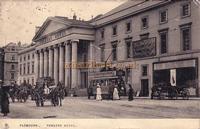 His father was a comedian of the Edinburgh and Glasgow theatres on the old circuit
days. Arthur wished to follow in his footsteps, and was put out, as
it were, when he was only sixteen years of age, with a celebrated manager
of his time, Mr J. R. Newcombe, and was
sent to his theatre at Plymouth Shown Right.
His father was a comedian of the Edinburgh and Glasgow theatres on the old circuit
days. Arthur wished to follow in his footsteps, and was put out, as
it were, when he was only sixteen years of age, with a celebrated manager
of his time, Mr J. R. Newcombe, and was
sent to his theatre at Plymouth Shown Right.
He remained two seasons with him, playing, of course, only very small parts, being, in fact, general utility. After two seasons at Plymouth the young comedian went back to Glasgow. Here it was that Mr Lloyd's genius found it's true bent. In those days of stock companies and circuits the closing season of the theatres used to be called the recess. Now some theatres do not close at all. When they do they call it the vacation.
The Late Mr. Arthur Lloyd
Which is the most classic name is hard to determine. However, the recess did it. It found Arthur Lloyd out. His father was in the habit of filling in the recess by travelling about giving entertainments, and Arthur went with him to assist him. That showed him what he was made for a comic singer impersonating various characters, mostly eccentric or pronounced enough to provide a keen observer of human nature with opportunities of artistic caricatures.
It was in 1861 that the deceased comedian commenced his music hall career. It came about in this way. Two pounds a week was the salary fixed by tradition and practise as the reward of a low comedian; and young Lloyd, although certain of occupation with his father's concert party during the off season, was not by any means so sure of an engagement as a second low comedian when the theatres were at work again. He got many odd engagements to sing at concerts and such like for half a guinea and even a guinea a time, and at length led to the offer of an engagement at four pound a week at the Whitebait Music Hall, Glasgow, which he determined to accept. He started at the old Whitebait Music Hall in Glasgow. It was a room that would hold about two hundred people seated at tables. There was a chairman and a pianist. The proprietor was Mr. James Shearer. There was only one other hall in Glasgow, namely David Brown's, and there didn't seem to be enough business to keep them both going.
 Before
Mr Lloyd commenced at the Whitebait David Brown's place had had a long run of luck with the Vokes family,
the talented members of which were all children then, and consequently
Shearer's had been doing bad business. Shearer told the young singer
that he had saved him from bankruptcy, turned the tide in his favour.
He never looked back again, and egou had to build a big hall. For this
new place he got 34,000 from the Glasgow and South-Western railway to help to make room for their St. Enoch station.
Before
Mr Lloyd commenced at the Whitebait David Brown's place had had a long run of luck with the Vokes family,
the talented members of which were all children then, and consequently
Shearer's had been doing bad business. Shearer told the young singer
that he had saved him from bankruptcy, turned the tide in his favour.
He never looked back again, and egou had to build a big hall. For this
new place he got 34,000 from the Glasgow and South-Western railway to help to make room for their St. Enoch station.
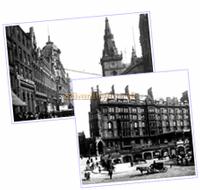
Right - St Enoch Station which was built on the site of the Whitebait Music Hall - A shopping center stands on the site today.
When his father heard the news of his determination to go on the halls he was horror stricken. He had all the old-fashioned hatred of a music hall. My lad, said he, You'll die a drunkard. The fact was that in those days music hall singers were greatly tempted to drink. There was no charge for admission to the hall, but every kind of refreshment was sold at the then high rate of sixpence, while adjacent to the stage door was a room called the green-room, but actually a semi-private bar, through which the professionals had to pass, and wherein they usually spent the interim between their turns, which were two or more in a night. A popular singer often had to oblige with a dozen songs in the evening. Arthur Lloyd remembered his father's unpleasant prophecy, and was never a patron of the green room.
 One
of Mr Lloyd's songs was a Scotch edition by
permission of Sam
Cowell's Railway Porter.
Arthur Lloyd was fortunate in securing an invitation to London very
soon after his provincial debut. He never forgot the journey. One of
his travelling companions was W. G. Ross, the historic singer in the Coal Hole of Sam Hall, Ross had a bottle
of whisky with him, to which he devoted himself with so much assiduity
that he must needs remove the wig he wore, to the especial horror of
an old lady in the carriage. Ross used to be a popular singer of the
long descriptive songs of that day songs that took well nigh half-an-hour
to execute, and detailed the entire plot of a novel or a drama. Ross
was so devoted to these lugubrious compositions that he persistently
sang them long after the public taste had rejected them, and he declined
in public esteem to the point of becoming a chorus singer.
One
of Mr Lloyd's songs was a Scotch edition by
permission of Sam
Cowell's Railway Porter.
Arthur Lloyd was fortunate in securing an invitation to London very
soon after his provincial debut. He never forgot the journey. One of
his travelling companions was W. G. Ross, the historic singer in the Coal Hole of Sam Hall, Ross had a bottle
of whisky with him, to which he devoted himself with so much assiduity
that he must needs remove the wig he wore, to the especial horror of
an old lady in the carriage. Ross used to be a popular singer of the
long descriptive songs of that day songs that took well nigh half-an-hour
to execute, and detailed the entire plot of a novel or a drama. Ross
was so devoted to these lugubrious compositions that he persistently
sang them long after the public taste had rejected them, and he declined
in public esteem to the point of becoming a chorus singer.
Mr Lloyd came to London in 1862 to fulfil engagements at the Sun, Knightsbridge, Marylebone Music Hall, and the Philharmonic, Islington, where Sam Adams subsequently lost a fortune, and which is now replaced by the Grand Theatre, Islington. Lloyd was met at the station when he arrived by his friend Harry Clifton, who advised him to take lodgings at Islington, where his last turn was. So at Islington he sought lodgings, and found them, by the strangest of coincidences, with the old lady whom Ross's bald head had scandalised in the train.
After about two months at the three London halls above mentioned, Mr Lloyd gave up the Sun and the Marylebone engagements, appearing only at the Philharmonic and the Canterbury, then the property and under the management of Mr Charles Morton. Miss Russell, Miss Emily Soldene (then known as Miss Fitzhenry), Mr E St. Aubyn, Mr. K. Green, and Mr E. Jongmanns were then notable members of Mr Morton's companyfor those were the days when the operatic eclections at the Canterbury used to last forty-five minutes. Eventually, Mr Morton established the Oxford, and the company was transported from one hall to the other in capacious omnibuses. Unsworth, the stump orator, was a great popular favourite at the time.
 Among
the music halls at which Mr Lloyd appeared in his earlier days in London
were Weston's , the
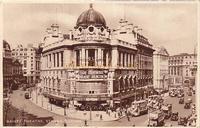
Cambridge, the regent at Westminster, and the Strand,
now the Gaiety Theatre.
Among
the music halls at which Mr Lloyd appeared in his earlier days in London
were Weston's , the
Cambridge, the regent at Westminster, and the Strand,
now the Gaiety Theatre.
Right - The Gaiety Theatre, London - Click for details.
Mr Lloyd recalled in connection with his engagement at the Philharmonic a story that George Leybourne often told him in later years. Leybourne was among the audience one night, and was so delighted with Lloyd's singing that he drew out an old silver watch from his pocket and bumped it on the table in the ardour of his applause. He returned to his home in the north, and astonished his old father with the announcement, Father, I am going to be a comic singer. Thou a comic singer, said the old man, and pray where dost thou get thy comicality? It does not come from thy mother, and Im dammed if it cooms from me!
 His
reminiscences of the London Pavilion were
especially interesting. It was, he once informed us, Originally a
public house with a large stable yard. Messrs Loibl and Sonnhaminer,
two foreigners, acquired the property, roofed the yard over, erected
a gallery at the back, but at one side only - for the other was occupied
by Dr. Kahn's delectable museum of anatomy - and opened the place as
a music hall.
His
reminiscences of the London Pavilion were
especially interesting. It was, he once informed us, Originally a
public house with a large stable yard. Messrs Loibl and Sonnhaminer,
two foreigners, acquired the property, roofed the yard over, erected
a gallery at the back, but at one side only - for the other was occupied
by Dr. Kahn's delectable museum of anatomy - and opened the place as
a music hall.
Left - A Silk Programme for Arthur Lloyd at the London Pavilion in 1886 - Click to enlarge.
 Here I was an enormous favourite;
and I am sure Mr Loibl would be the first to acknowledge that my popularity
contributed very largely to the prosperity of the place, though I got
nothing like the salary that a star of equal magnitude can command today.
Then the best seats in the place could be had for sixpence. I constantly
tried to persuade Loibl to increase the price, and he did so tentatively,
till at length the whole floor, with the exception of a promenade, consisted
of half-crown seats. The climax was reached when at great outlay Mr
Loibl bought Kahn's museum and was able to utilise it's site for structural
improvement of the pavilion. From the time the board of works acquired
the hall there is no need to trace it's history.
Here I was an enormous favourite;
and I am sure Mr Loibl would be the first to acknowledge that my popularity
contributed very largely to the prosperity of the place, though I got
nothing like the salary that a star of equal magnitude can command today.
Then the best seats in the place could be had for sixpence. I constantly
tried to persuade Loibl to increase the price, and he did so tentatively,
till at length the whole floor, with the exception of a promenade, consisted
of half-crown seats. The climax was reached when at great outlay Mr
Loibl bought Kahn's museum and was able to utilise it's site for structural
improvement of the pavilion. From the time the board of works acquired
the hall there is no need to trace it's history.
 Meantime
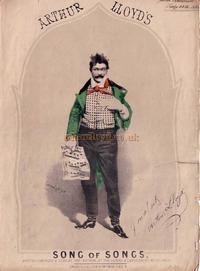
Mr Arthur Lloyd had found it convenient to write his own songs.
Almost his earliest efforts was a medley called The
Song Of Songs, that started from the base of I dreamt that I dwelt
in marble halls with the dark girl dressed in blue. It had a most extraordinary
career of popularity, but did not bring it's author and composer the
large fortune that one sometimes hears of as the guerdon of a comic
song, for he sold the rights of publication for a mere trifle.
Meantime
Mr Arthur Lloyd had found it convenient to write his own songs.
Almost his earliest efforts was a medley called The
Song Of Songs, that started from the base of I dreamt that I dwelt
in marble halls with the dark girl dressed in blue. It had a most extraordinary
career of popularity, but did not bring it's author and composer the
large fortune that one sometimes hears of as the guerdon of a comic
song, for he sold the rights of publication for a mere trifle.
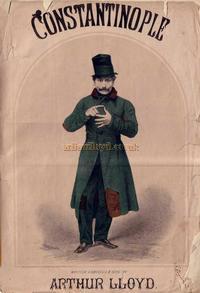
Left - Arthur Lloyd's Song of Songs. - Right - Arthur Lloyd's Constantinople.
Among the more popular successors of The Song of Songs were Not for Joseph, Constantinople, Cruel Mary Holder, The Roman Fall, Take it Bob, Going to the Derby, now inseparable from Over Rowley, One more polka, and I couldn't. Probably of this selection the most successful of all was "Not For Joseph".
The above article was first published in The ERA, July 23rd 1904.