
Horatio Lloyd's Obituaries
The Era, 30 November 1889 - The Glasgow Weekly Herald - 30th November 1899 - The ERA 7th December 1889 - Reynolds's Newspaper 1st December 1889
Mr H. F Lloyd, the popular comedian for over fifty-five years of the Edinburgh and Glasgow theatres, and well known throughout Scotland, died at his residence in Glasgow on Thursday morning at four o'clock. Mr H. F. Lloyd leaves two sons in the proffesion - Mr Arthur Lloyd, the well known comedian, vocalist, and author; and Mr Delarue Lloyd, comic vocalist. The Era, Issue 2671, 30 Nov 1889.
The Glasgow Weekly Herald - 30th November 1889
Death of Mr H. F. Lloyd
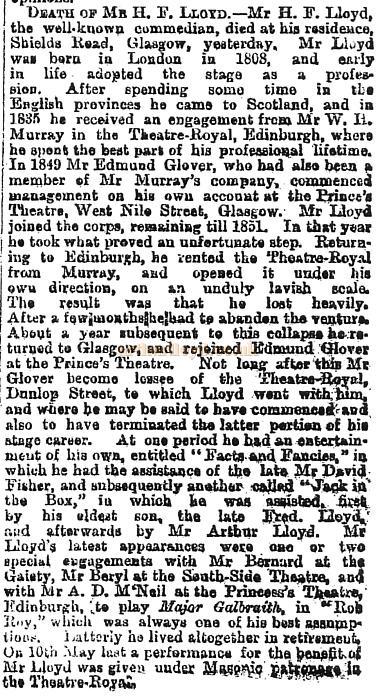 Mr
H. F. Lloyd, the well-known commedian, died at his residence, Shields
Road, Glasgow, yesterday. Mr Lloyd was
born in London in 1808,
and early in life adopted the stage as a profesion. After spending some
time in the English provinces he came to Scotland, and in 1835 he received an engagement from Mr W. H. Murray in the Theatre-Royal, Edinburgh, where he spent the best part
of his profesional lifetime. In 1849 Mr Edmund Glover, who had also been a member of Mr Murray's company,
commenced management on his own account at the Prince's
Theatre, West Nile Street, Glasgow.
Mr Lloyd joined the corps, remaining till 1851.
In that year he took what proved an unfortunate step. Returning to Edinburgh,
he rented the Theatre Royal from Murray, and opened it under his own direction, on an unduly lavish
scale. The result was that he lost heavily. After a few months he had
to abandon the venture. About a year subsequent to this collapse he
returned to Glasgow, and rejoined Edmund Glover at the Prince's
Theatre. Not long after this Mr Glover became lessee of the Theatre-Royal,
Dunlop Street, to which Lloyd went with him, and where he may be
said to have commenced and terminated the latter portion of his stage
career. At one point he had an entertainment of his own, entitled "Facts
and Fancies," in which he had the assistance of the late Fred.
Lloyd, and afterwards by Mr
Arthur Lloyd. Mr Lloyd's latest appearances with Mr Bernard at the Gaiety, Mr Beryl at the south-Side
Theatre, and with Mr A. D. M'Neil at the Princess's
Theatre, Edinburgh, to play Major
Galbraith, in "Rob Roy," which was always one of his best
assumptions. Latterly he lived altogether in retirement. On 10th May
last a performance for the benefit of Mr Lloyd was given under Masonic
patronage in the Theatre-Royal.
Mr
H. F. Lloyd, the well-known commedian, died at his residence, Shields
Road, Glasgow, yesterday. Mr Lloyd was
born in London in 1808,
and early in life adopted the stage as a profesion. After spending some
time in the English provinces he came to Scotland, and in 1835 he received an engagement from Mr W. H. Murray in the Theatre-Royal, Edinburgh, where he spent the best part
of his profesional lifetime. In 1849 Mr Edmund Glover, who had also been a member of Mr Murray's company,
commenced management on his own account at the Prince's
Theatre, West Nile Street, Glasgow.
Mr Lloyd joined the corps, remaining till 1851.
In that year he took what proved an unfortunate step. Returning to Edinburgh,
he rented the Theatre Royal from Murray, and opened it under his own direction, on an unduly lavish
scale. The result was that he lost heavily. After a few months he had
to abandon the venture. About a year subsequent to this collapse he
returned to Glasgow, and rejoined Edmund Glover at the Prince's
Theatre. Not long after this Mr Glover became lessee of the Theatre-Royal,
Dunlop Street, to which Lloyd went with him, and where he may be
said to have commenced and terminated the latter portion of his stage
career. At one point he had an entertainment of his own, entitled "Facts
and Fancies," in which he had the assistance of the late Fred.
Lloyd, and afterwards by Mr
Arthur Lloyd. Mr Lloyd's latest appearances with Mr Bernard at the Gaiety, Mr Beryl at the south-Side
Theatre, and with Mr A. D. M'Neil at the Princess's
Theatre, Edinburgh, to play Major
Galbraith, in "Rob Roy," which was always one of his best
assumptions. Latterly he lived altogether in retirement. On 10th May
last a performance for the benefit of Mr Lloyd was given under Masonic
patronage in the Theatre-Royal.
 The
Glasgow Weekly Herald - 30th November 1899 reproduced with Kind Permission - The
Mitchell Library, Glasgow.
The
Glasgow Weekly Herald - 30th November 1899 reproduced with Kind Permission - The
Mitchell Library, Glasgow.
Left - A Poster for Horatio Lloyd's 'Facts and Fancies' at the Theatre Royal, Trades Hall 1858 - Arbroath - Click to enlarge.
(Note that in several articles on this site Horatio's birth is stated variously as 1805, 1808, 1809 and 1815. The correct date is the 9th of November 1807. I have details of his Christening at St. Sepulchre, Newgate, London on the 25th December 1807 with his brother George Thomas Lloyd which states his date of birth as 1807. )
The ERA 7th December 1889
THE LATE MR. H. F. LLOYD
Mr Horatio Frederick Lloyd, the well-known, popular Comedian, whose death we briefly announced last week, was born in 1808 in the Strand, London, where his father was a hatter, and lived above the shop. The old man wished him to follow his own business. and indeed set, him up on his own account, but young Lloyd felt that was not his vocation. From the many members of the theatrical profession who were customers of his father, he acquired a taste for the stage, and eventually, after some amateur work, he graduated at the age of twenty-one, as a member of Mr Nicholson's company at the Theatre Royal, Newcastle.
Mr Walter Baynham furnishes the following interesting biographical notes of Mr Lloyd's stage career:- Lloyd, so he told me, first appeared at the close of 1829 for a few nights, at the Caledonian Theatre. It was afterwards called the Adelphi, and subsequently was the Theatre Royal, Edinburgh. At that period, the theatre was under the management of a Mr Bass.
From Edinburgh Lloyd went to Dundee, and returned again to the Caledonian Theatre. On Nov. 15th, 1830, he made his first appearance at the Glasgow Theatre Royal, in Dunlop Street, then under the management of Mr Alexander, who had purchased the patent after the burning of the Great Queen Street Theatre.
On the following Monday he writes:- "I first had the honour of meeting in the theatre, the great Edmund Kean. His representations will never be effaced from my mind. They are beyond any description I can give of them."
Lloyd then accompanied Mr Alexander to Dumfries, "Here," he writes, "I first met Mr Phelps. He was very poor then but very studious. I thought him clever, but Mr A. thought otherwise, and discharged him at rehearsal as being incompetent to lead the business. I never saw him again until after he became a London favourite."
In 1832, Lloyd received an offer from Mr W H Murray, of the Theatre Royal Edinburgh. He opened with him on the following Oct.1st. With him, Lloyd remained for sixteen years, "It was," so Lloyd often told me, "the happiest time of my Professional career. He, (Mr Murray), was a gentleman in every sense of the word; a great actor, but a most unassuming man and a splendid stage manager."
Lloyd was never tired of talking of Mr Murray's antecedents, of which he was as proud as if they had been his own. "His grandfather," Lloyd used to say, "of course you know, was Sir John Murray, Bart., of Broughton. His father was an officer in the Hussars, and his sister married Henry Siddons, the son of the great actress." This was Lloyd's favourite theme.
With Lloyd, there were, in the stock company in the Theatre Royal, Edinburgh at that time, Sims Reeves (who was the singing "Walking Gentleman"); Sam Cowell; Leigh Murray, (Walking Gentleman); Barry Sullivan, (Heavy Man); the great Mackay, and Mr Montague Stanley. Mrs Leigh Murray, then Miss Lee, played the leading business.
"The Green Room then," said Lloyd, "was, a Green Room. No one who was out of the place ever thought of entering it, without putting on evening dress. This custom was rigidly observed by Mr Theodore Martin, Mr Aden, and other friends of Mr Murray, who were privileged to enter it."
In 1848, Mr Lloyd joined Mr Glover's management in Glasgow. Here he remained for three years, when he himself, ventured for the first and only time on management. He assumed the reins at the Theatre Royal, Edinburgh, with a company; the expenses of which ruined him.
His leading lady on the occasion, was Miss Fanny Vining. His principal vocalist, Miss Eliza Nelson, the daughter of the composer of "Mary of Argyle." Miss Marie Wilton, (now Mrs Bancroft), the soubrette; Miss Nicol, old woman, and Miss Eliza Arden, comedy. These were supported by actresses, each and all of whom made subsequently a name. Amongst these were Mrs Weston, Miss Josephine Manners, Miss Fanny Bland, Miss Victor, (now of Terry's Theatre), Miss Cruise, and a ballet of sixteen coryphées, headed by Madame St. Louis.
Amongst the gentlemen, were the great American tragedian W. H. Davenport, Harcourt Bland, H. J. Craven, author and dramatist, Mr Edwin Valores, the late Mr Henry Webb, comedian; Mr W. Cooper, Mr George Fisher, uncle of David Fisher; Niccolo Dalian, Paul Dalian, Mr Butler Wentworth, and Mr W. Morgan, the first Husband of the present Mrs J. B. Howard.
The conductor of the orchestra was Mr Alexander Mackenzie, father of the composer of Columba; and the gentleman who presided at the drums, was Mr Toole's long and well-known acting-manager, the late Mr George Loveday.
Lloyd's managerial career proved a disastrous failure, and shortly afterwards, he returned once more to Glasgow, where till the advent of travelling companies in 1864, he was the stock low comedian, at Dunlop Street.
Lloyd, at an early age, was sent to the identical Dotheboys Hall in Yorkshire, where he remained for some time under the tuition of the veritable Mr Wackford Squeers. Mr Lloyd remembered well, the visit of Dickens to the school. Mr Squeers's real name, he says, was Shaw. Lloyd said, he (Shaw) was greatly liked by the boys, to whom he was invariably kind and considerate. When, however, the novelist called on him to get information as to the general character of cheap schools, Shaw gave offence to Dickens by his curt answers, and Dickens, at once, resolved to make the poor school master, (so unlike in character, the representative of the brutal 'schoolmasters' of that part), his original of Mr Squeers. (Read Horatio's description of this in his autobiography here M.L.)
Parents, recognising in the graphic portraiture by Dickens, the form, features and dress of their sons' preceptor, and fearing the scandal attaching to them, which would necessarily follow, if they continued sending their sons to such a man, at once withdrew the children, and all that remains now of school and schoolmaster of "Nicholas Nickleby" is a poor, neglected grave in the churchyard at Greta Bridge, which covers the mortal remains of a kind-hearted, ruined, and brokenhearted man.
I have written about poor Lloyd, as he was when I first saw him. Let me say a word as to what he was, when I last saw him.
 We
stood together on the stage of the Theatre
Royal, Glasgow, when he took his farewell
last May. I forget now all who were there, but I think there was one
or two who, like myself, had served in the old Dunlop Street campaign.
The bright, dapper little figure of my dear, old friend and comrade,
as I had seen it first, was now bent with age. He could scarcely walk
on to the stage, on to which his sons, Arthur and Richard, and I assisted him. His eyes
were sunken; his lip trembled; his voice was all but gone. His sobs,
at taking leave of his dear public, are still painfully ringing in my
ears and I see in place of the bright, genial, merry-faced little man,
with whom I shook hands on a February morning nine and twenty years
ago, a tottering, poor, old figure, with shambling gait, bald-headed,
with a few straggling locks falling down his back.
We
stood together on the stage of the Theatre
Royal, Glasgow, when he took his farewell
last May. I forget now all who were there, but I think there was one
or two who, like myself, had served in the old Dunlop Street campaign.
The bright, dapper little figure of my dear, old friend and comrade,
as I had seen it first, was now bent with age. He could scarcely walk
on to the stage, on to which his sons, Arthur and Richard, and I assisted him. His eyes
were sunken; his lip trembled; his voice was all but gone. His sobs,
at taking leave of his dear public, are still painfully ringing in my
ears and I see in place of the bright, genial, merry-faced little man,
with whom I shook hands on a February morning nine and twenty years
ago, a tottering, poor, old figure, with shambling gait, bald-headed,
with a few straggling locks falling down his back.
Right - Horatio Lloyd and his son Richard Delarue in 1889, the year Horatio died - Courtesy James Francis and Robert Cunningham. Click to enlarge.
I call to mind how the old, strong effort and will to do his best, seemed, like a dying spark, to rise as he nerved himself to make his farewell speech, which, though his voice was changed to the childish treble, yet piped sufficiently to be heard in the vast house; and how at last, he sunk on his son's shoulder, broken down.
He goes to his grave carrying with him, the honoured memory of a loving father and husband; rich in fame as an actor, who was, at all times, one of the most humorous and one of the best, legitimate comedians the stage has ever seen.
The funeral took place on Tuesday at the South Necropolis, Glasgow. The remains of deceased were followed to the grave by his son Arthur Lloyd and sons by his second wife, Mr E L Knapp, (late of Theatre Royal), Messrs Mackay of the Gaiety, Mr Richardson, bookseller, Messrs T. J. and F. Bennett, Mr Cunningham, and about thirty old friends of the deceased, The prayers were read by Mr Tullock. The coffin was covered with beautiful wreaths sent by many sorrowing friends.
(Note that in several articles on this site Horatio's birth is stated variously as 1805, 1808, 1809 and 1815. The correct date is the 9th of November 1807. I have details of his Christening at St. Sepulchre, Newgate, London on the 25th December 1807 with his brother George Thomas Lloyd which states his date of birth as 1807. )
Reynolds's Newspaper 1st December 1889
Mr. Horatio Frederick Lloyd, Comedian, died at Shields Road, Glasgow, on Wednesday morning, at the advanced age of eighty-two years. The deceased, who had performed in every town in the kingdom, was named Horatio because he was born whilst the bells of St Paul's were being tolled for the dead hero of Trafalgar. For the last ten years Mr. Lloyd had resided in Glasgow.
Reynolds's Newspaper 1st December 1889.
(Note that in several articles on this site Horatio's birth is stated variously as 1805, 1808, 1809 and 1815. The correct date is the 9th of November 1807. I have details of his Christening at St. Sepulchre, Newgate, London on the 25th December 1807 with his brother George Thomas Lloyd which states his date of birth as 1807. )