
The Westminster Theatre, 12 Palace Street, London SW1
Formerly - The Charlotte Chapel / St. James' Picture Theatre - Later - The St. James Theatre / The Other Palace
Introduction - The St. James' Picture Theatre - The Westminster Theatre - Arts Centre - Last Production - Demolition and Rebuild - 200 Years of history - The St. James Theatre - The Other Palace Theatre

Above - The Westminster Theatre in 1966 - From a Souvenir Book for the opening of the Westminster Theatre Arts Centre - Courtesy Richard Leigh.

 Situated at 12, Palace Street, Westminster, the Westminster Theatre opened the day before the Saville Theatre, on the 7th of October 1931, with a production of James Bridie's 'The
Anatomist' directed by Tyrone Guthrie.
Situated at 12, Palace Street, Westminster, the Westminster Theatre opened the day before the Saville Theatre, on the 7th of October 1931, with a production of James Bridie's 'The
Anatomist' directed by Tyrone Guthrie.
The Theatre was originally built as a chapel called the Charlotte Chapel by the Rev Dr William Dodd in 1766 (See Image Right.)
Right - The Charlotte Chapel - From a Souvenir Book for the opening of the Westminster Theatre Arts Centre - Courtesy Richard Leigh.
Over the years the Chapel had become more and more dilapidated and less and less used and was eventually sold on and converted into a Cinema called the St. James' Picture Theatre by J. Stanley Beard who reconstructed the interior and built a new frontage, opening in 1923, details below. This was later converted into a live Theatre called the Westminster Theatre, opening in 1931, details and history below. This Theatre was demolished in 2002 and later rebuilt as the St. James Theatre, opening in 2012, and later renamed The Other Palace, full details here. More information on all these incarnations in chronological order can be seen below.
The St. James' Picture Theatre 1923

Above - The St. James' Picture Theatre, Westminster - From The Architect, 18th of May 1923.
 The St. James' Picture Theatre was a conversion of the former Charlotte Chapel, and was designed by J. Stanley Beard who reconstructed
the interior and built a new frontage. The Cinema opened on Monday the 9th of April 1923 with a showing of the Gaumont Film 'Rob Roy' which was released in London on that day.
The St. James' Picture Theatre was a conversion of the former Charlotte Chapel, and was designed by J. Stanley Beard who reconstructed
the interior and built a new frontage. The Cinema opened on Monday the 9th of April 1923 with a showing of the Gaumont Film 'Rob Roy' which was released in London on that day.
Right - The Restaurant at the St. James' Picture Theatre, Westminster, created out of the vaults of the former Charlotte Chapel - From The Architect, 18th of May 1923.
Built as an early Cinema the St. James' Theatre was unusual in that it had four Boxes situated at the back of the Circle, said to have been requested by the Royal Family as it was situated so close to Buckingham Palace. The Theatre also had a small restaurant for patrons. The Theatre's Projection Box was situated at the back of the stalls.
The Architect reported on the new St. James' Picture Theatre, in their 18th of May 1923 edition, along with some of the images shown here, saying:- 'The St. James's Picture Theatre has been erected on the site of the eighteenth century St. Peter's Chapel of Ease in Palace Street. The excavations for the foundations brought to light the fact that the chapel stood on reclaimed land, the walls being supported on an ingenious raft of timber baulks resting on a quagmire. In order to retain as much as possible of the chapel structure its walls were underpinned and a wide concrete foundation laid down. A new fire-misting steel roof has been constructed. The old vaults have been utilised for the purpose of a tea lounge. Some six feet below the vaults two Roman bricks, red and beautifully burnt, were unearthed. A piece of pottery, black-glazed on both side, possibly a portion of a cup, was also brought to light.

Above - The Auditorium of the The St. James' Picture Theatre, Westminster - From The Architect, 18th of May 1923.
 The external treatment of the new theatre is in the Georgian manner. The general interior design is light Classic, with a Greek feeling. On the ground floor the auditorium has a seating capacity of about 550. The balcony will accommodate about 300.
The main charm of the whole theatre rests in the colour scheme which has been carried out in a completely harmonious manner - dove-grey walls with turquoise blue draperies, softened down by the architect's special amber lighting.
Right - An Advertisement for W. J. Furse & Co. Ltd., who supplied and fitted the Electrical Equipment and Seating in the St. James' Picture Theatre - From The Architect, 18th of May 1923.
Mr. Stanley Beard will win unstinted praise in respect to the whole interior colour scheme and decorations. A very fine art metal screen decorates what at some future date will be the organ loft; this screen is the work of Messrs. Starkie Gardner & Co., who are well known for many fine examples of wrought-iron gates throughout the country.
The ventilating and heating is on the Plenum system, installed by the Buffalo Forge Co., Ltd., the air being drawn into a chamber and heated or cooled as the weather conditions demand.
In taking our photographs to illustrate this theatre flashlight powder was used, and it was noticeable that by means of the ventilating plant the smoke was extracted in a remarkably short space of time, demonstrating most effectively the efficiency of the installation.

Above - The Auditorium of the The St. James' Picture Theatre, Westminster - From The Architect, 18th of May 1923.
 The electric light fittings are supplied by Messrs. Gillham & Jones, and include a number of alabaster vases in Classic style; the light from these latter radiates in a soft, warm colour in keeping with the architect's general decorations.
Right - An Advertisement for F. & H. F. Higgs Ltd., Building Contractors of the St. James' Picture Theatre - From The Architect, 18th of May 1923.
Both partners of this business were associated for a number of years with Mr. F. Geere Howard, A.M.I.C.E., of Berners Street, W., who established a reputation for taste and fine craftsmanship. Messrs. F. & H. F. Higgs, Ltd., Station Works, Hinton Road, Herne Hill, S.E., were the general contractors.
The following is the list of principal sub-contractors in addition to those mentioned above: - Constructional engineers, Aston Construction Co., Eagle Wharf Road, N.; exterior façades, Gilbert Seale & Son, 22 Lomond Grove, S.E..; decorative plaster work and French stucco, A. Searle & Co., Putney Bridge Station, S.W.; electric lighting, Furse & Co., 9 Carteret Street, Westminster; electrical generators and projectors and seating, Walturdaw Co., Ltd., 46 Gerrard Street, W.; furnishing and draperies, H. Lazarus & Sons, 10A Great Eastern Street, E.C.; decorative metal work, Strode & Co., 48 Osnaburgh Street, N.W.; vacuum cleaning plant, Sturtevant Engineering Co., Ltd., 147 Queen Victoria Street, E.C.; marble floors, Carter & Co., 29 Albert Embankment, S.E.'
The above text in quotes was first published in The Architect, 18th of May 1923.

Above - The St. James' Picture Theatre, the forerunner to the Westminster Theatre, from an advertisement for 'Furse Electric Curtain Controllers and Lighting Dimmers which the Cinema was equipped with - From The Cinema News and Property Gazette of October 2nd 1924.
 The St. James' Picture Theatre had first opened on Monday the 9th of April 1923. Some years later the Weekly Kinema Guide carried a report on the Cinema and its history in their February 2nd 1930 edition saying:- 'One of London's most elegant and luxurious cinema is the St. James' Picture Theatre. It was built as a Society Picture Theatre, with a Board of directors that included several names prominent in public life and society. Members of the Royal Family have been among the hundreds of distinguished patrons of this theatre, and it is quite independent of any of the big combines.
Right - The Cover of the Weekly Kinema Guide for February 2nd including an image of the St. James' Picture Theatre, Westminster.
The St. James' Picture Theatre was erected on the site of the eighteenth-century St. Peter's Chapel of Ease. It is interesting to record that during the excavations for the foundations, it was found that the Chapel stood on re-claimed land, and an old Roman aqueduct was discovered.
 This brings us back to the days when the Thames spread over the neighbourhood, but a link with an even more remote period was found in the shape of two Roman bricks, red and beautifully burnt, which were unearthed six feet below the vaults. Pieces of pottery, black-glazed on both sides, which were possibly portions of a cup, were also brought to light. The bricks are of the type used by the Ancient Romans in building walls and suggest that there was an old Roman road leading to "Londinium" across the marshy overflow of the Thames. There were undoubted deposits of river mud below the vaults.
Left - The St. James' Picture Theatre, the forerunner to the Westminster Theatre, just before its opening in 1923. The architect J. Stanley Beard is the right hand figure in front of the building - From a Souvenir Book for the opening of the Westminster Theatre Arts Centre - Courtesy Richard Leigh.
It is fascinating to think that Roman Galleys once disembarked their warriors and Caesar's legions tramped to battle, at a spot where now a modern picture theatre stands!
The Chapel of Ease was built in the middle of the eighteenth century, partly on the strength of a £1,000 lottery prize that had been won by the infamous Dr. Dodd.
Dodd was an eloquent preacher and attracted large and fashionable congregations to the Chapel that stood in the middle of some market gardens. Money did not come in quickly enough, and so Dodd forged the name of Lord Chesterfield for over £4,000, later paying the penalty of his crime at Tyburn, where he was hanged!...

Above - The St. James' Picture Theatre, Westminster - From the Weekly Kinema Guide, 2nd February 1930.
 ...Nearly £100,000 was spent on constructing and equipping the present cinema, which took seven years to complete. The building is imposing and dignified, whilst the interior is admirably planned, with a view to perfect screen-sight from every part of the auditorium. Ventilation is secured by the latest plenum system, which draws air in, and after being filtered, washed, and warmed is forced into the auditorium from the ceiling downwards, and finally expels it by means of other fans at a lower Level, and ensures that "Breath of fresh air," which is so necessary.
Right - An advertisement for the St. James' Picture Theatre - From the Weekly Kinema Guide of 1930.
The management is in the capable hands of Mr. Harry Johnson, and the Latest apparatus for talking films is installed. An orchestra plays for the variety artistes, and silent pictures, and is under the direction of Mr. Michael Rubinstein, who is a fine solo violinist as well as a capable conductor.'
The above text in quotes was first published in the Weekly Kinema Guide, February 2nd 1930.
The St. James' Picture Theatre had first opened in 1923 but eventually the plethora of newly built Cinemas on a much grander scale in London put pay to its usefulness and it was closed on the 28th of March 1931 and subsequently converted into a live Theatre called the Westminster Theatre, details below.
The Westminster Theatre 1931
In 1931 the St. James' Picture Theatre came into the hands of A. B. Horne, or Anmer Hall
as he was later known, who set about turning the Cinema into a Live Theatre.
The former Crypt of the Charlotte Chapel, from which the Cinema had been created, was utilised as a new space for the Theatre's dressing rooms, a green
room, and the Stalls Bar.
Right - The Westminster Theatre in 1966 - From a Souvenir Book for the opening of the Westminster Theatre Arts Centre - Courtesy Richard Leigh
The auditorium of the former Cinema was redecorated by Molly MacArthur in pinks, blues, and cream with 'Elephant Grey' carpets. The new Westminster Theatre opened on the 7th of October 1931, and had an auditorium constructed on two levels, Stalls and one Circle. There were also boxes at the rear of the circle and two stage boxes.
Strand Electric's Interesting Equipment


The Bioscope reported on the new Westminster Theatre, and especially its lighting installation, in their 18th of November 1931 edition saying:- 'The new Westminster Theatre, formerly the St. James's Picture House, Palace Street, Westminster, S.W., has been transformed by Mr. Amner Hall into a luxurious repertory theatre. A special stage has been constructed, complete with modem plaster cyclorama and counterweight gearing to manipulate the scenery.
Right - A Programme for 'Valkyrie' by Christen Jul at the Westminster Repertory Theatre in April 1935 - Swipe left or right, or Click the Arrows or Thumbnails to Navigate.
The whole of the scheme of stage lighting has been devised by the Strand Electric & Engineering Co., Ltd., 24, Floral Street, London, W.C. It marks a new step in cyclorama lighting and is the first theatre in London to be equipped with this scheme.
Unlike various Continental systems of cyclorama lighting, which consists of the use of seven different shades of colour, this new method only employs three, namely, red, blue and green. By varying the intensity of these three colours upon the cyclorama plaster face it is possible to obtain any particular hue. This is largely due to the dimming apparatus, the individual units of which are wound on a special formula devised by Messrs. C. Harold Ridge & F. S. Aldred, the well known specialists in cyclorama lighting, and, incidentally, the consulting engineers for the Shakespeare Memorial Theatre.
 The equipment consists of a double bank of Strand Electric "Sunray" Battens at the top, whilst horizon lighting is obtained by means of a double bank of specially constructed "Sunray" Magazine ground rows. Under this lighting the structure of the cyclorama disappears and creates the illusion that one is looking into illimitable space.
Left - A Programme for 'The Cure For Love' by Walter Greenwood at the Westminster Theatre in the late 1940s - Courtesy Roy Cross. In the cast were Renee Asherson, Dorothy Dewhurst, Joan White, Marjorie Rhodes, Jack Rodney, William Heilbronn, Robert Donat, Charles Victor, Iris Vandeleur, Alec Faversham, Jessie Moore, Mamie Thorpe, Audrey Teesdale, Frank S. Strickland, and Humphery Dampier.
 The acting area is illuminated by four "Strand" 1,000-watt Spot Lanterns, concealed in the roof of the auditorium. Side lighting is obtained from two 1,000-watt spots concealed in the sides of the auditorium and within 15 ft. of the stage.
Right - A Programme for 'Frieda' by Ronald Millar which played at the Westminster Theatre in 1946 - Courtesy Michael Jaffé whose Grandfather Carl Jaffé was in the cast. Also in the cast were Barbara Everest, Barbara Couper, Ray Jackson, Ursula Howells, Richard Warner, Jack Allen, Valerie White, and Edgar Norfolk. The play was directed by Irene Hentschel, and the Decor was by Michael Relph by permission of Ealing Studios.
 The switchboard is of the Strand Electric's latest design, with new pattern "Sunset" dimmers. Each dimmer is capable of individual control or of being locked to its colour shaft, and is provided with an engraved scale, so that the scheme of lighting may be definitely set as regards the mixture to obtain the cyclorama effects.
Left - An Advertisement for Strand Electric's Lighting Installation at the Westminster Theatre in 1931 - From The Bioscope, October 21st 1931.
In addition, a sub-board, which entirely operates the various spot lanterns, is arranged in the prompt comer, so that these may be under the direct control of the stage manager himself. In addition to this unique stage equipment, the Strand Electric have also been responsible for the whole of the electric light installation of the building.'
The above text in quotes was first published in the Bioscope. 18th of November 1931.
The Westminster Theatre Arts Centre 1966
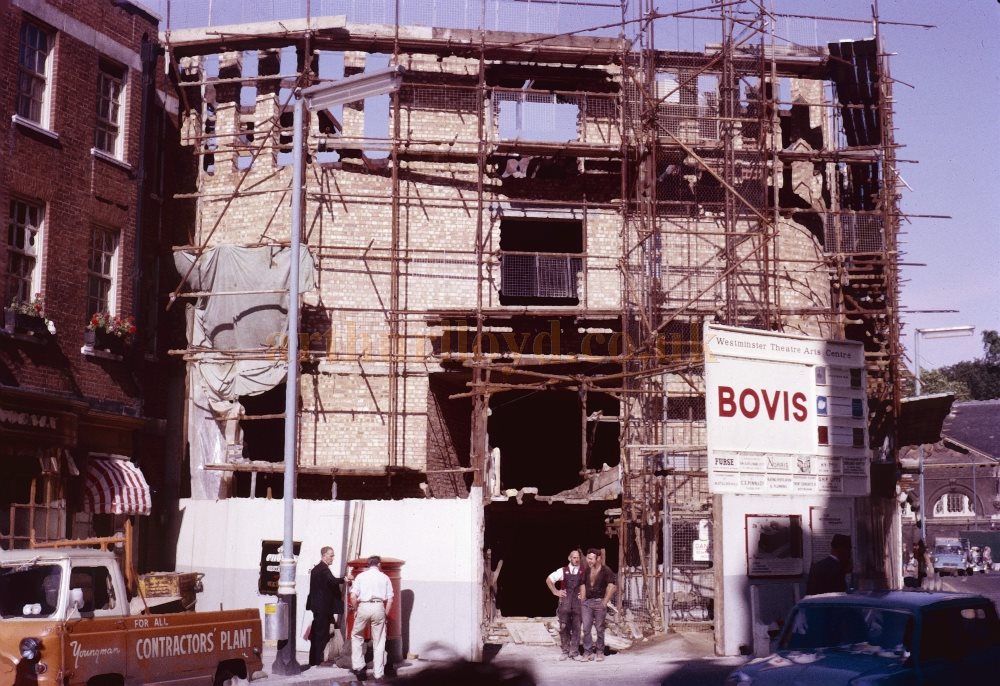
Above - The Westminster Theatre Arts Centre under construction in 1966 from a photograph taken by Roy Follett on the 6th of July 1966 - Kindly sent in by Paul Thacker.
The Westminster Theatre was converted into an Arts Centre in 1966, opening on the 26th of November that year with a performance of the new British musical 'It's Our Country, jack!'. The conversion involved incorporating an adjoing site, almost as large as the Theatre itself, and building new Foyer spaces, dressing rooms, a restaurant, and re-cladding the exterior in Welsh slate. There is more information on this 1966 conversion further down on this page.

Above - A 1970s Seating Plan for the Westminster Theatre.
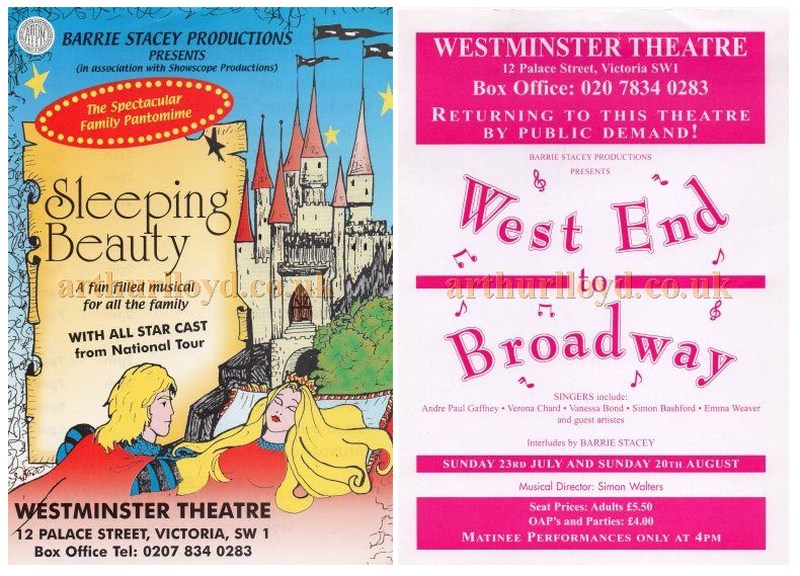
Above - Two Flyers for 'Sleeping Beauty' and 'West End to Broadway' at the Westminster Theatre - Courtesy Keith Hopkins.

Above - A Tea Towel made from pure linen and produced to commemorate the opening of the New Westminster Theatre Arts Centre in 1966 - Very kindly donated by Dixie Cheek who found it in pristine condition in a secondhand store in Bellingham USA. The Inscription on the front of the Theatre in the illustration reads: 'Westminster Theatre. Mr Brown Comes Down The Hill. Peter Howard.' This was a play by Peter Howard about how Christ would have been received had he turned up in the 1960s.
The Last Production at the Westminster Theatre 2002
The last production at the Westminster Theatre was False Impressions' 'Illusion' (See Flyers Below.) The Theatre closed down quite suddenly after campaigners lost their six year fight to save the building from demolition and rebuilding into flats and a small studio Theatre replacement.
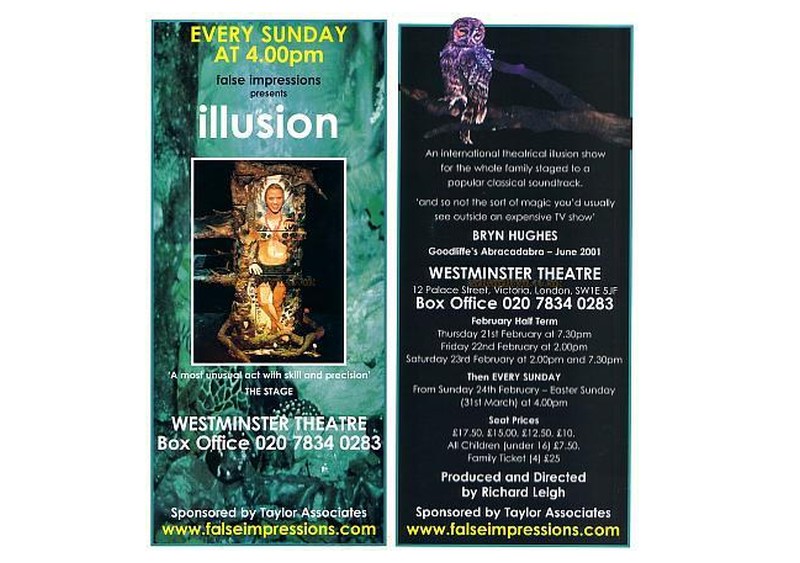
Above - A Flyer for the False Impressions production of 'Illusion' which was the last production at the Westminster Theatre before it closed and was subsequently destroyed by fire on the 27th June 2002 - Courtesy Richard Leigh.
Demolition and details of the Theatre's Rebuild 2002
Demolition work began in February 2002 but was halted when fire broke out and destroyed what remained of the Theatre on the 27th June 2002, only the dressing rooms survived.
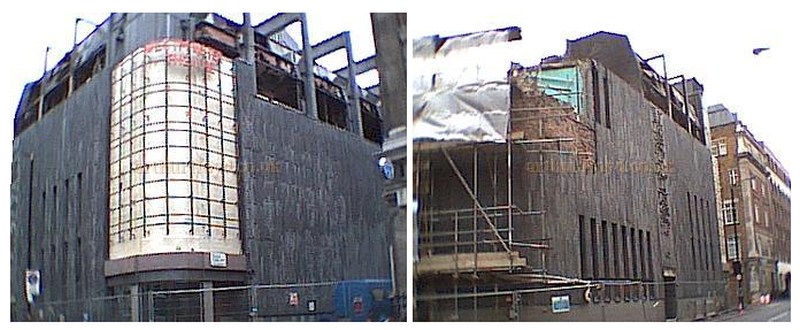
Above - The remains of the Westminster Theatre after fire destroyed the building on the 27th June 2002.
Years of wrangling then took place concerning the site of the Westminster and at times it seemed uncertain weather a replacement Theatre would ever happen. At one point it looked like the replacement would be built for the black theatre company Talawa but when that idea came to nothing the Theatre's future looked even worse.

Above - The site of the Westminster Theatre in September 2008 during building work - Photo M.L
 Since the loss of the original Theatre
and the fire, the Theatres
Trust and Save
London's Theatres Campaign had fought continuously for nearly a
decade, and in May 2009 it seemed their efforts had finally been rewarded. Westminster
Council granted planning permission for a 350 seat main Theatre and
a second smaller 260 capacity Studio Theatre to be built on the site,
which would also include a 100-cover restaurant which it was hoped would
fund the running of the Theatres, much like the very successful Menier
Chocolate Factory in London Bridge.
Since the loss of the original Theatre
and the fire, the Theatres
Trust and Save
London's Theatres Campaign had fought continuously for nearly a
decade, and in May 2009 it seemed their efforts had finally been rewarded. Westminster
Council granted planning permission for a 350 seat main Theatre and
a second smaller 260 capacity Studio Theatre to be built on the site,
which would also include a 100-cover restaurant which it was hoped would
fund the running of the Theatres, much like the very successful Menier
Chocolate Factory in London Bridge.
Right - An artist's impression of the new Westminster Theatre.
The new Westminster Theatre was to be run by a new theatre Company; 'London Aloft' whose business plan and design for the Theatre gave the planning committee confidence to agree to an additional floor of penthouses in order to add sufficient value to fit out the Theatre. Prior to their involvement the Developer and Council had been at stalemate for many years. The Theatres themselves were to be designed by the architect Tim Foster.
It was hoped that the new Westminster Theatre would finally be open for business in late 2010 but this did not come to pass, and although the housing was completed the Theatre spaces remained empty and undeveloped for several more years.
 Sadly
'London Aloft', who were preparing for the Theatre's opening season
in 2010, and had done three years work on the planning of the building,
and who had also had a lease agreed under the Sec 106 agreement, were
then unceremoniously dumped from the project by the Developer.
Sadly
'London Aloft', who were preparing for the Theatre's opening season
in 2010, and had done three years work on the planning of the building,
and who had also had a lease agreed under the Sec 106 agreement, were
then unceremoniously dumped from the project by the Developer.
Left - The St. James Theatre nearing completion in the spring of 2012 - Photo Rob Cable - Courtesy Lucy French, Director of Development for the Theatre.
The Stage described this decision as 'controversial' and Private Eye were less than complimentary about the proposed new operating company.
Eventually the new revised design was given planning permission however, and the replacement Theatre was finally constructed. The Theatre, which would open in September 2012, and be named the St. James Theatre, was the first newly built Theatre complex to be constructed in central London for 30 years and was designed by the architects Foster Wilson with the interior design by Lambart & Browne. The Theatre was renamed 'The Other Palace' in 2016.
There now follows several articles (and many images) about the Westminster Theatre, celebrating the Theatre's conversion into the Westminster Theatre Arts Centre in 1966. The material is from a souvenir book produced to celebrate the Theatre's reopening, kindly loaned to the site by Richard Leigh whose False Impressions production of 'Illusion' was the last production at the Westminster Theatre before it closed and was subsequently destroyed by fire on the 27th June 2002.
Two Hundred Years of History
From a Westminster Arts Centre Souvenir Book celebrating its reopening in 1966

Above - The Auditorium of the Westminster Theatre in 1966 - From a Souvenir Book for the opening of the Westminster Theatre Arts Centre - Courtesy Richard Leigh
 The
Westminster owes its origin to one of the more colourful characters
of the eighteenth century, the Rev Dr William Dodd. Dr. Dodd, popular
preacher, man of letters, social reformer and unsuccessful playwright,
became Chaplain to King George III in 1763. In 1766, with the aid of
his wife's winnings in a lottery and a legacy, he built the Charlotte
Chapel. It was a great success, with the Queen and the Court in regular
attendance.
The
Westminster owes its origin to one of the more colourful characters
of the eighteenth century, the Rev Dr William Dodd. Dr. Dodd, popular
preacher, man of letters, social reformer and unsuccessful playwright,
became Chaplain to King George III in 1763. In 1766, with the aid of
his wife's winnings in a lottery and a legacy, he built the Charlotte
Chapel. It was a great success, with the Queen and the Court in regular
attendance.
Right - The Souvenir Book for the opening of the Westminster Theatre Arts Centre which many of the articles and images on this page are sourced - Courtesy Richard Leigh.
 Eight
years later, however, Mrs Dodd tried to bribe the Lord Chancellor to
give her husband a better living. Dr Dodd was forced to sell his Chapel
and flee the country. When he returned he went from bad to worse, and
the Newgate Calendar says, "he descended so low as to become the
editor of a newspaper".
Eight
years later, however, Mrs Dodd tried to bribe the Lord Chancellor to
give her husband a better living. Dr Dodd was forced to sell his Chapel
and flee the country. When he returned he went from bad to worse, and
the Newgate Calendar says, "he descended so low as to become the
editor of a newspaper".
He became more and more extravagant and finally, by an act of irreparable folly, committed forgery in the name of his old pupil and benefactor the Earl of Chesterfield, for the sum of £4,200. Forgery was still a capital offense. In spite of many efforts to save him, the King was adamant and Dr. Dodd was hanged at Tyburn in June 1777.
The Chapel that he built, however, is now the Westminster Theatre.
It remained a Chapel until it was closed in 1921. A company was set up to convert it into a cinema, and in 1923 the St James' Picture Theatre was opened. Designed by J. Stanley Beard, it was then the last word in West End cinemas.
Eight years later Anmer Hall transformed it into a theatre, named after his old school. It opened in October 1931 with James Bridie's The Anatomist, directed by Tyrone Guthrie, in which Flora Robson achieved a striking success.
Left - Plans of the Westminster Theatre at Foyer and Restaurant Level in 1966 - From a Souvenir Book for the opening of the Westminster Theatre Arts Centre - Courtesy Richard Leigh.
The theatre was bought by the Westminster Memorial Trust in April 1946 as a memorial to men in Moral Rearmament who gave their lives in the War. Since then the Trust has either put on plays of its own choosing or has, at times, let the theatre out to other companies. It has been running the present series of plays since 1961, and will continue to do so indefinitely.
The first production put on by the Trust in 1946 was Alan Thornhill's The Forgotten Factor, which a President of the United States described as "the greatest play to come out of the War". It dealt with issues of home and industry, and people still come to the Westminster who vividly remember seeing it.
The opening of the Arts Centre in November 1966 began a new chapter in the Theatre's history, filled with far reaching possibilities in many fields.
How the Arts Centre Began

Above - The Foyer of the Westminster Theatre in 1966 looking towards the mosaic mural, and showing the panels of Sudan leather on the right - From a Souvenir Book for the opening of the Westminster Theatre Arts Centre - Courtesy Richard Leigh.
 The
Westminster Theatre has been making a unique contribution in recent
years through its plays and films, its conferences, forums and publications,
and in its many other activities.
The
Westminster Theatre has been making a unique contribution in recent
years through its plays and films, its conferences, forums and publications,
and in its many other activities.
Right - The Box Office at the Westminster Theatre in 1966 - From a Souvenir Book for the opening of the Westminster Theatre Arts Centre - Courtesy Richard Leigh.
In an age of mounting violence and conflict, it has shown how to answer bitterness and bridge division; at a time when industry has been called on for increased productivity in the face of many difficulties, it has put new zest and a will to win into workers and management; in a period when human values have been under attack, it has stood for faith and moral standards adequate to meet the stresses of our day. The drama of despair has little appeal to men and women faced with the vast opportunities and daunting dangers of today. They welcome a theatre which goes beyond probing problems to point the road of an answer.
The productions at the Westminster, from tragedy to pantomime, from high spirited musicals to the drama of ideas, have offered entertainment -and much more besides. They have presented a theatre of humanity and hope and constructive ideas.
 So
great has been the response that the Westminster has recently doubled
the size of its buildings and created the new Westminster Theatre Arts
Centre.
So
great has been the response that the Westminster has recently doubled
the size of its buildings and created the new Westminster Theatre Arts
Centre.
Left - The Westminster Theatre Cinema in 1966, which was actually the restaurant most of the time - From a Souvenir Book for the opening of the Westminster Theatre Arts Centre - Courtesy Richard Leigh.
In particular, the Westminster has drawn in the younger generation of our own country and Commonwealth, and of many other lands, and also the industrial workers and management of Britain. They have come in their thousands: the students and young people to find a positive programme and hope for their lives and their countries; the men of industry to find the secret of new initiatives that can lift Britain into the leadership she is meant to offer the modern world. It was a Clydeside shop steward who said, "The Westminster gives men of industry fresh ideas and frees them from old prejudices."
 The
Westminster has carried drama beyond the theatre, and has aimed to make
it part of life in direct ways. More than 300 weekend conferences have
been held in the past seven years on how to apply the ideas of Moral
Re-Armament in the plays to the national issues of the day.
The
Westminster has carried drama beyond the theatre, and has aimed to make
it part of life in direct ways. More than 300 weekend conferences have
been held in the past seven years on how to apply the ideas of Moral
Re-Armament in the plays to the national issues of the day.
Right - The Restaurant of the Westminster Theatre in 1966 , which was able to be converted into a Cinema and Conference Hall - From a Souvenir Book for the opening of the Westminster Theatre Arts Centre - Courtesy Richard Leigh.
As time went on, it became apparent that the Westminster needed a range of new facilities to help realise its aims enlarged foyer space, a restaurant and cinema, library, kitchens, conference rooms, and better accommodation for the actors who serve the theatre so well.
 Four
years ago the Trustees began to plan, in consultation with Peter Howard,
to build on the land beside the theatre which they already owned, and
which was almost as large as the area of the theatre itself.
Four
years ago the Trustees began to plan, in consultation with Peter Howard,
to build on the land beside the theatre which they already owned, and
which was almost as large as the area of the theatre itself.
Left - The Westminster Theatre Kitchen in 1966 - From a Souvenir Book for the opening of the Westminster Theatre Arts Centre - Courtesy Richard Leigh.
Through the brilliant work of the architects, John and Sylvia Reid, they have realised a building of beauty and many-sided usefulness which is a pioneer in its field. It is a masterpiece of planning in the space available, and gives a sense of spacious welcome to all who come. More than fifty countries have contributed to the building of the Arts Centre, which was opened in November, 1966.
The Architects View by John & Sylvia Reid

Above - The Safety Curtain at the Westminster Theatre in 1966 - From a Souvenir Book for the opening of the Westminster Theatre Arts Centre - Courtesy Richard Leigh.
The design and construction of the new Westminster Theatre Arts Centre could hardly have presented a greater challenge. It called for a wealth of complex services and posed many planning problems. It required the alteration and partial reconstruction of a much altered eighteenth century building and the construction of an entirely new one alongside which, in the end, had to blend into one complex.
 The
involved variations in levels was further complicated by the underground
river which runs diagonally across the site. The physical difficulties
of working on a restricted site whilst making major structural alterations
to an old building were both interesting and exasperating.
The
involved variations in levels was further complicated by the underground
river which runs diagonally across the site. The physical difficulties
of working on a restricted site whilst making major structural alterations
to an old building were both interesting and exasperating.
Right - A dressing room at the Westminster Theatre in 1966 - From a Souvenir Book for the opening of the Westminster Theatre Arts Centre - Courtesy Richard Leigh.
To begin with, the requirements for the new Centre called for rather more accommodation than could be contained within the volume of building that we were permitted to construct. The first task therefore was to devise methods of increasing the utilisation of the space available. Thus the Foyer, which provides a generous circulation space for theatregoers, has dimensions similar to those of the stage area which permits its use as a rehearsal area. Similarly the Restaurant can also be used as a lecture theatre and cinema.
 A
cardboard model was required to explain the spatial relationships that
had been evolved. Only after these had proved acceptable to the Trustees
were the services and structural engineers consulted to see if the building
could in fact be achieved owing to the site complications.
A
cardboard model was required to explain the spatial relationships that
had been evolved. Only after these had proved acceptable to the Trustees
were the services and structural engineers consulted to see if the building
could in fact be achieved owing to the site complications.
Left - The Green Room at the Westminster Theatre in 1966 - From a Souvenir Book for the opening of the Westminster Theatre Arts Centre - Courtesy Richard Leigh.
The result is a structure based on reinforced concrete piles with cantilevered foundations and a mixture of load-bearing walls and reinforced concrete frame for the lower part of the building, whilst the upper part hangs from lattice girders of high tensile steel in order to achieve the clear span required over the Conference area.
 Many
new techniques have been developed especially for this building. The
method of employing slate for the external cladding, for example, developed
from a study of the logical applications of the typical properties of
the material as applied to the specific problems of this building.
Many
new techniques have been developed especially for this building. The
method of employing slate for the external cladding, for example, developed
from a study of the logical applications of the typical properties of
the material as applied to the specific problems of this building.
Materials and finishes throughout the building have been chosen for their suitability and for case of maintenance. A high standard of amenity has been set and the Dressing Rooms are probably among the best equipped in existence.
Right - Photograph of the 14 foot in diameter Brick Tunnel which carries the Tyburn River diagonally under the Westminster Theatre Arts Centre, during construction work in 1966 - From a Souvenir Book for the opening of the Westminster Theatre Arts Centre - Courtesy Richard Leigh.
The building has been conceived as a complete entity and even carpets and crockery have been designed as part of this whole.
It is fitting that as the Architects we should speak of the teamwork and cooperation that have contributed to this venture.
We hope that the new Centre will live up to the expectation of all who have given it such able support. We consider it a great privilege to have been able to take part in this exciting venture.
Opening the Arts Centre
 The
opening of the Arts Centre was on Saturday, 26 November, 1966, by Shri
Rajmohan Gandhi, grandson of Mahatma Gandhi and close friend of Peter
Howard, before a crowded assembly from thirty three countries.
The
opening of the Arts Centre was on Saturday, 26 November, 1966, by Shri
Rajmohan Gandhi, grandson of Mahatma Gandhi and close friend of Peter
Howard, before a crowded assembly from thirty three countries.
Right - The Tapestry Room at the Westminster Theatre in 1966 - Caption Reads: 'Showing gifts from the United States: a beautiful Seventeenth Century Flemish tapestry and a portrait of Peter Howard by the British born artist Erling Roberts. The room is a favourite meeting place for students night by night after the play, as well as providing a gracious reception room for the use of the Trust.' - From a Souvenir Book for the opening of the Westminster Theatre Arts Centre - Courtesy Richard Leigh.
After unveiling the memorial stone to Peter Howard, Mr Gandhi declared the building open. "A voice will go out from this Centre", he said, "to which all humanity will respond."
Mrs R M S Barrett then unveiled the plaque commemorating the gift of the Welsh slate, while the Aber Valley Male Voice Choir sang the Welsh National Anthem. His Excellency Sayed Buth Din from the Sudan unveiled one of the panels of the Sudan leather.
 The
whole assembly then entered the Arts Centre and took their places in
the theatre which was crowded to the door. The first act in the new
Arts Centre was its dedication by the Bishop of Colchester,
the Rt Rev Roderic N Coote, DD.
The
whole assembly then entered the Arts Centre and took their places in
the theatre which was crowded to the door. The first act in the new
Arts Centre was its dedication by the Bishop of Colchester,
the Rt Rev Roderic N Coote, DD.
Left - The Lighting Control Room in the Westminster Theatre in 1966 - From a Souvenir Book for the opening of the Westminster Theatre Arts Centre - Courtesy Richard Leigh.
Part of Mr Rajmohan Gandhi's address to the assembly will be found on a following page. After he had spoken, Peter Howard's four grandchildren came up on to the stage and presented him with one of their grandfather's favourite books.
Mrs Howard and her daughter and son-in-law, Mr and Mrs Wolrige Gordon, also addressed the Assembly. Other speakers included the Architect, Mr John Reid, youth from the Commonwealth and trade union speakers who presented a message from trade unionists all over Britain.
In the evening an inaugural dinner was held in the restaurant for a hundred and seventy-two guests. The Guest of Honour was His Highness Prince Richard of Hesse, for many years a friend of Peter Howard and of Dr Frank Buchman.
Afterwards, the guests from all parts of the world assembled in the theatre for a special performance of the new British musical, "It's Our Country, jack!"
Much of the text and many of the images above are from the Souvenir Book produced for the opening of the Westminster Theatre Arts Centre in 1966 and are Courtesy Richard Leigh whose False Impressions production of 'Illusion' was the last production at the Westminster Theatre before it closed and was subsequently destroyed by fire on the 27th June 2002.