
Theatres and Halls in Wakefield, West Yorkshire
The Theatre Royal and Opera House - The Empire Theatre / Gaumont Cinema
Also see in this area - Yorkshire Theatres
The Theatre Royal and Opera House, Westgate, Wakefield
Later - The Alhambra Music Hall / Theatre Royal Opera House / The Essoldo Cinema

Above - The Theatre Royal and Opera House, Wakefield in October 2021 - Courtesy Philip Paine.

 There
has been a Theatre on the same site in Westgate since 1776. The original
Theatre was built by a Wakefield woolstapler James Banks for Tate Wilkinson
(1739 to 1803) an Actor Manager who operated the York circuit of Theatres
which included York, Doncaster, Halifax, Hull, Leeds, Pontefract, and Wakefield from 1768 until
his death. The Wakefield Theatre Royal opened on the 7th September 1776
with a performance of 'The Beggar's Opera'.
There
has been a Theatre on the same site in Westgate since 1776. The original
Theatre was built by a Wakefield woolstapler James Banks for Tate Wilkinson
(1739 to 1803) an Actor Manager who operated the York circuit of Theatres
which included York, Doncaster, Halifax, Hull, Leeds, Pontefract, and Wakefield from 1768 until
his death. The Wakefield Theatre Royal opened on the 7th September 1776
with a performance of 'The Beggar's Opera'.
Right - An illustration of the original 1776 Theatre Royal, Wakefield - From the Theatre's appeal sheet of 1980.
In the Theatre's early years many of the illustrious figures of the time appeared upon it's stage. John Kemble first appeared in 1778, returning ten years later as 'Othello', 'Richard the third' and 'Hamlet'. Sarah Siddons first played Wakefield on the 6th September 1786 as Belvedira in 'Venice Preserved'. Charles Kemble first appeared on 2nd September 1807 as Don Felix in 'The Wonder', and Edmund Kean appeared on 16th July 1819 as 'Richard the Third'. Sarah Siddons first appearance really was by public demand, as theatre goers in Wakefield heard that she was appearing in nearby Leeds, demanded that Wilkinson have her appear at the Theatre Royal.
 A
description of the Theatre is provided by William Senior and published
in 1894: 'Except for it's three
principal doors, side by side, and the iron and glass canopy over them
– a modern excrescence – It's façade differed but slightly
from that of a plain square dwelling house of red brick, dating from
the 18th Century, which are still a striking feature of the street.
A
description of the Theatre is provided by William Senior and published
in 1894: 'Except for it's three
principal doors, side by side, and the iron and glass canopy over them
– a modern excrescence – It's façade differed but slightly
from that of a plain square dwelling house of red brick, dating from
the 18th Century, which are still a striking feature of the street.
Left - A sketch of Tate Wilkinson - From the Theatre's appeal sheet of 1980.
The middle door was distinguished by a round head with a sort of Doric pediment over it. Inside was a plain, rectangular auditorium seating about 1000 people, with it's level pit and two upper tiers. There was an open balustrade of oak round each tier, such as one sees on old fashioned staircases. There was hardly a proscenium arch for the wooden frame through which the stage picture was presented, was hardly more substantial than the scenery.' William Senior 1894.
The Theatre, like others in the York circuit, only opened for performances for two or three weeks a year, relying on the swell of patrons in Wakefield for race meetings.

Above - Frank Matcham's Longitudinal Section drawing of the New Opera House, Wakefield in 1894 - Reproduced in the Theatre's appeal sheet of 1980.
After Tate Wilkinson's death in 1803 the Theatre was managed by successive managers of the Northern circuit until 1839 when the Theatre was then sold to the then lessee Joseph Smedley. In 1865 the Theatre was sold to Nathan Webster and the first public bar established. Arthur Lloyd is known to have performed in Wakefield in 1867. The Theatre later followed a slow decline, being bought in 1871 by John Brooke the landlord of the Black Horse, who changed the Theatre's use to a beer house and Music Hall, changing the name to 'The Alhambra'.
Benjamin Sherwood, who was a local councilor, bought the Theatre in 1883 and refurbished it, reopening it as The Royal Opera House, only to have its licence refused nine years later on the grounds of the building's many defects. The last performance being 'False Evidence' on November 16th 1892. Sherwood then decided that the best course was to demolish the present Theatre and build a new modern replacement. This led him to commission Frank Matcham to design the present Theatre. The old Theatre being demolished in March 1894. The new Theatre cost £13,000 and took 9 months to build.

Above - The Theatre Royal and Opera House, Wakefield in October 2021 - Courtesy Philip Paine.
The new 'Opera House' opened on the 15th October 1894 with Horace Lingard's Number one Comic Opera Company in the burlesque opera 'Brother Pelican'. It was found that the site of the original Theatre Royal was not large enough for the new Theatre and adjacent property was purchased. The ERA edition of 22nd September 1894 describes the new Theatre as follows: 'The front of the Theatre to Westgate has a handsome façade of red brick and cast concrete dressings of a warm cream colour; it is carried up with a large bold gable with scrolls and ball terminals. Between the tall circular windows are niches containing the busts of authors and composers, and over these a bold frieze containing the words Opera House. The entrances are shielded from inclement weather by a glass and iron awning, carried the whole length of the front.' The ERA, 22nd September 1894.
 All
doors were fitted with Brigg's
patent alarm bolts. Principal entrance to the dress circle and balcony
were through a handsome vestibule with a tessellated paved floor. A
wide stone staircase with polished brass handrails directed patrons
left and right at the crush room to either side of the circle. The same
edition of the ERA states: 'a quaintly treated
circular opening in the side of the crush room overlooks the staircase.'
The circle was divided into two parts, Dress Circle in the front fitted
with rows of tip up seats and the back of the circle was the Balcony
with continuous seating covered in velvet. To the rear was a wide promenade.
There were no stage boxes either side of the proscenium, but instead
two boxes situated at either side of the Balcony. The Pit had two separate
exits onto the street, at each rear corner of the auditorium. The floor
was raked and comfortable seats fitted, all with back rests. Above the
Circle and Balcony was the Gallery having two separate staircases giving
exits on each side of the house, and fitted with 11 rows of seats. Ample
retirement rooms were provided together with large refreshment saloons
plus a smoking lounge.
All
doors were fitted with Brigg's
patent alarm bolts. Principal entrance to the dress circle and balcony
were through a handsome vestibule with a tessellated paved floor. A
wide stone staircase with polished brass handrails directed patrons
left and right at the crush room to either side of the circle. The same
edition of the ERA states: 'a quaintly treated
circular opening in the side of the crush room overlooks the staircase.'
The circle was divided into two parts, Dress Circle in the front fitted
with rows of tip up seats and the back of the circle was the Balcony
with continuous seating covered in velvet. To the rear was a wide promenade.
There were no stage boxes either side of the proscenium, but instead
two boxes situated at either side of the Balcony. The Pit had two separate
exits onto the street, at each rear corner of the auditorium. The floor
was raked and comfortable seats fitted, all with back rests. Above the
Circle and Balcony was the Gallery having two separate staircases giving
exits on each side of the house, and fitted with 11 rows of seats. Ample
retirement rooms were provided together with large refreshment saloons
plus a smoking lounge.
Left - The Proscenium of the Theatre Royal and Opera House, Wakefield in 2000 - Courtesy David Garratt.
The auditorium decoration was French Renaissance predominately in gold and blue. The ceiling was divided into 8 panels with figures of the Muses painted inside oval panels. The Proscenium arch was particularly rich in design, boldly molded above which were four panels containing paintings of the four seasons. The centre of the arch having the head of Backus looking down upon the audience. At the side of the proscenium in place of stage boxes, the auditorium walls continued upwards with rich ornamental plaster work, and two panels of comedy and tragedy set on gold mosaic backgrounds, culminating in columns and arches at the top giving a pleasing artistic finish. The fronts of the Circle and Gallery had bold molded plasterwork and carved designs with painted gold mosaic panels. The proscenium and box draperies were amber in colour. The stage was large one, this being one of Frank Matcham's smallest Theatres. The dividing auditorium stage wall was built of brick from basement to roof as a fire break and fitted with an asbestos fire safety curtain, and all pass doors were fitted with iron doors. The Theatre was fitted with fire hydrants and hoses throughout. Backstage there were 10 dressing rooms and ample retiring rooms provided.
 The
builders of the Theatre were F.W. Denholme and Co. Decorations were
by De Jong of London.
Seating and upholstery by Mr A. R. Dean of Birmingham.
Gas fittings and fire proof curtain by Mr Totterton of Leeds and Mr J. P. Briggs acted as Clerk of Works.
The
builders of the Theatre were F.W. Denholme and Co. Decorations were
by De Jong of London.
Seating and upholstery by Mr A. R. Dean of Birmingham.
Gas fittings and fire proof curtain by Mr Totterton of Leeds and Mr J. P. Briggs acted as Clerk of Works.
Right - The Proscenium of the Theatre Royal and Opera House, Wakefield in 2000 showing the head of Backus looking down upon the audience- Courtesy David Garratt.
The early years of the new Theatre had visits from The Doyle Carte, The Moody Manners, and Arthur Rousbey's Opera Companies, together with popular musicals of the day such as 'The Gay Parisienne'. Stan Laurel (of Laurel and Hardy fame) appeared in August 1909 in 'Alone in the World'. Robert Donat appeared as a member of the Stephen Venner Repertory Company in 1926, and Michael Rennie played the Theatre as a member of the Henry Casson Repertory Company in 1939.
 Electric
light was installed in 1898,
and when Drury Lane (running along the west side of the Theatre) was
widened in the early part of the century it was possible to buy some
extra land and build shops on the site, (today the site of 'Mr Matcham's'
Coffee house,) together with adding an additional dressing room and
improving the scene dock access.
Electric
light was installed in 1898,
and when Drury Lane (running along the west side of the Theatre) was
widened in the early part of the century it was possible to buy some
extra land and build shops on the site, (today the site of 'Mr Matcham's'
Coffee house,) together with adding an additional dressing room and
improving the scene dock access.
Left - The auditorium of the Theatre Royal and Opera House, Wakefield in 2000 - Courtesy David Garratt.
Benjamin Sherwood's ownership ended in 1900 upon the breakdown of his marriage. His wife Fanny and sons and daughters took over the management of the Theatre, as Sherwood & Co. The Theatre continued as a receiving house throughout the first world war, but the encroachment of the early cinema began to make its presence felt. In fact a short season of films was shown at the Theatre in the summer of 1916 replacing regular shows. In 1918 Miss Marrion Fawcett brought her newly formed Repertory Company for a season at the Theatre. The Theatre continued with live shows, which slowly turned over to touring Revue's in the early 1920's, together with further visits of Repertory companies.
 Dick
Stephenson took over the running of the Opera House in 1947, leasing
it from the Sherwood's and it became part of R. S.Theatres Ltd. The
Sherwood family finally sold the Theatre for £20,000, to the Gateshead
Empire Palace Limited, run by Solomon Sheckman (the founder of the
Essoldo cinema chain), in the 1950s. Live Theatre continued up until
1954 when the Theatre closed for conversion into a picture house, opening
on the 24th January 1955 with the film 'The Robe' in Cinemascope. The
Theatre was now renamed 'The Essoldo'.
Dick
Stephenson took over the running of the Opera House in 1947, leasing
it from the Sherwood's and it became part of R. S.Theatres Ltd. The
Sherwood family finally sold the Theatre for £20,000, to the Gateshead
Empire Palace Limited, run by Solomon Sheckman (the founder of the
Essoldo cinema chain), in the 1950s. Live Theatre continued up until
1954 when the Theatre closed for conversion into a picture house, opening
on the 24th January 1955 with the film 'The Robe' in Cinemascope. The
Theatre was now renamed 'The Essoldo'.
Right - A Stained glass window in one of the doors at the Theatre Royal and Opera House, Wakefield in 2000 - Courtesy David Garratt.
The Essoldo continued to show films throughout the 50's and 60's, but television took its toll on cinema's and by 1966 the Essoldo closed down on February 5th. The building was leased to Lucky Seven and reopened as a Bingo hall on 22nd September 1966. Bingo continued at the Theatre and in 1973 the property was acquired by Ladbrokes, continuing as a Bingo Hall. It began to be felt that Wakefield was sadly lacking in a Theatre and by 1976 there had been calls for Ladbrokes to transfer there operation over to the Playhouse which by then was known as the Classic Cinema, which was rumoured to be about to close. In 1980 Ladbrokes announced that their Bingo operation was about to close down at the Opera House. Rodney Walker, a Wakefield business man, who was chairman of the Wakefield Festival Company, being keenly aware of the lack of a Theatre in Wakefield called a meeting in April 1981 at the Theatre, to see whether it was possible to bring the Opera House back to life as an operational Theatre again. Support was massive, both from amateur and professional bodies and the local Wakefield Metropolitan District Council. A steering committee was formed which met for the first time on 28th April 1981, electing Rodney Walker as Chairman, and establishing the Wakefield Theatre Trust. By the autumn of 1981 agreement was reached with Ladbrokes to purchase the Theatre for £55,000 and the following May an initial payment of £15,000 was made, giving the Trust immediate and unfettered access to the Theatre. An appeal was launched in May 1982 to raise £400,000 and Joe Parker of the Liverpool based practice of TACP architects was chosen to prepare a restoration scheme. Fund raising continued and by 1984 the refurbishment of the Theatre could begin, with local firm Lemmeleg as principal contractor.

Above - A drawing of the proposed restoration for the facade of the Wakefield Opera House by John West for The Wakefield Theatre Trust and the D.O.E. (now English Heritage) - Courtesy John West.
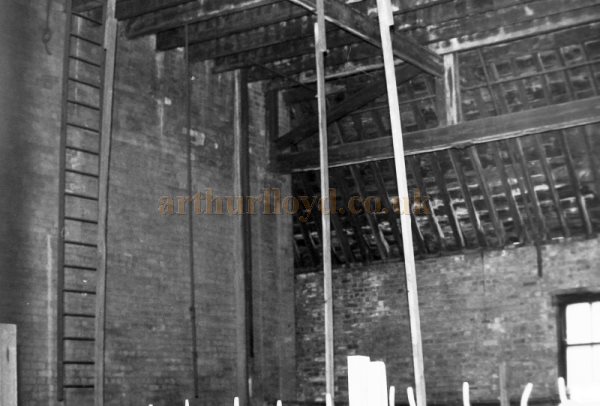 A mammoth task lay ahead. The roof was re-slated in Welsh slate as
per the original Theatre. A mezzanine floor had been installed over
the stage for Bingo use which had to be removed. The existing wooden
grid was re-strengthened and a new counterweight flying system installed
together with a new safety curtain.
A mammoth task lay ahead. The roof was re-slated in Welsh slate as
per the original Theatre. A mezzanine floor had been installed over
the stage for Bingo use which had to be removed. The existing wooden
grid was re-strengthened and a new counterweight flying system installed
together with a new safety curtain.
Right - The upper part of Stage House and Grid of the Wakefield Opera House / Theatre Royal before the False Ceiling used for its Bingo years was removed - Courtesy John West.
The stage floor was extended out into the auditorium, forming an apron stage. This now meant that from the front of the apron stage to the rear of the stalls was only 45 feet in distance. The original Opera House did not have an orchestra pit, and so the refurbishment allowed for an orchestra pit to be excavated and installed. A new concrete floor was laid in the stalls as the original wooden floor was irreparable, and continental style new seating was installed eliminating the central aisle. A new disabled toilet was installed at the rear of the stalls. The circle seating was replaced in the continental style also of 5 rows of seats. The Gallery having 10 rows of seats. The Gallery projection box was dismantled and removed and a new lighting box built at the rear.
 All
plaster work was repaired and replaced where necessary, and the Proscenium
arch was re-gilded using 23¼ carat gold leaf and then burnished.
New electrical wiring was installed and new carpets installed and the
whole auditorium redecorated. Also structural alterations were made
where necessary to comply with today’s safety standards. The original
Sunburner was found in the roof space and reinstated in the ceiling,
however it was decided not to connect it up as the heat would have damaged
the surrounding paintwork. The original painted Muses in the ceiling
panels had been lost (being previously painted over) and Kate Lyons,
a scenic artist at the Leeds Grand
Theatre, repainted these in the Victorian style on jute canvas in
acrylic paint. Eight Muses were installed in the ceiling panels and
the ninth Muse set into the central panel in the dress circle front.
Kate Lyons incorporated Magpies in each picture to represent the Pierides
who were turned into Magpies after losing a contest with the Muses according
to Greek Mythology.
All
plaster work was repaired and replaced where necessary, and the Proscenium
arch was re-gilded using 23¼ carat gold leaf and then burnished.
New electrical wiring was installed and new carpets installed and the
whole auditorium redecorated. Also structural alterations were made
where necessary to comply with today’s safety standards. The original
Sunburner was found in the roof space and reinstated in the ceiling,
however it was decided not to connect it up as the heat would have damaged
the surrounding paintwork. The original painted Muses in the ceiling
panels had been lost (being previously painted over) and Kate Lyons,
a scenic artist at the Leeds Grand
Theatre, repainted these in the Victorian style on jute canvas in
acrylic paint. Eight Muses were installed in the ceiling panels and
the ninth Muse set into the central panel in the dress circle front.
Kate Lyons incorporated Magpies in each picture to represent the Pierides
who were turned into Magpies after losing a contest with the Muses according
to Greek Mythology.
Left - A section of the ceiling of the auditorium of the Theatre Royal and Opera House, Wakefield in 2000 showing the repainted Muses - Courtesy David Garratt.
 A
new two storey Dressing Room block was built at the rear of the stage
house, and the corner shops incorporated into the Theatre to become Mr Matcham's Coffee house on the ground floor
and the upper floor being opened up and incorporated into the Theatre
bar, thus increasing the bar size area. A new box office was installed
with a computerised booking system, and when the Bingo canopy was removed
the original brackets were found and used to support the new canopy.
A
new two storey Dressing Room block was built at the rear of the stage
house, and the corner shops incorporated into the Theatre to become Mr Matcham's Coffee house on the ground floor
and the upper floor being opened up and incorporated into the Theatre
bar, thus increasing the bar size area. A new box office was installed
with a computerised booking system, and when the Bingo canopy was removed
the original brackets were found and used to support the new canopy.
Right - A close up of the proscenium arch plaster work at the Theatre Royal and Opera House, Wakefield in 2000 showing the loss of the original Comedy / Tragedy motifs from the central oval - Courtesy David Garratt.
The present day stage dimensions of the Theatre Royal are: Stage depth 7.92 metres, plus an apron stage of 1.22 metres deep, with a width of 5.13 metres stage left and 5.13 metres stage right. Proscenium opening width 7.26 metres. Height from stage to grid is, up stage 11.53 metres, and down stage 11.89 metres. The orchestra pit (excavated in the 1986 renovations) seats 15 musicians.
Seating capacities varied throughout the Theatre's history. Originally it was 700 seats, by 1907 this was reduced to 420 seats. In 1986 the capacity was 508 and the current capacity is 499 seats.
In February 1979 the Theatre was Grade Two Listed for its interior and overall design of the building.

Above - A Google Street View Image of the Theatre Royal and Opera House, Wakefield in 2017 - Click to Interact.
 The newly refurbished Theatre Royal and Opera House Gala
reopening took place on 16th March 1986. The reason for the name change from the Opera House was that people thought it was going to rival Opera North, so they reverted to the name of the previous Theatre on the site instead, calling it the Theatre Royal and Opera House.
The newly refurbished Theatre Royal and Opera House Gala
reopening took place on 16th March 1986. The reason for the name change from the Opera House was that people thought it was going to rival Opera North, so they reverted to the name of the previous Theatre on the site instead, calling it the Theatre Royal and Opera House.
Right - A Plaque situated on the front of the Theatre Royal, Wakefield commemorating it's architect Frank Matcham - Photo courtesy Philip Paine.
A big driving force in the Theatre's renovation was thanks to the Theatre's own 'Friends' group which was set up in November 1982, raising money and providing voluntary service and practical help.
It was at the Theatre Royal and Opera House, Wakefield, that Arthur Starkie (who was the Centenary Coordinator) formed the Frank Matcham Society in 1994.
In 1994 the Theatre celebrated it's centenary, and the Theatre is today a thriving asset to the city of Wakefield and surrounding district, providing a varied programme of professional and amateur fare, and also has a thriving youth Theatre. You may like to visit the Theatre's own website here.
The above article on the Theatre Royal, Wakefield was written for this site by David Garratt in June 2011. The article and many of its accompanying images are © David Garratt 2011.
The Empire Theatre, Kirkgate, Wakefield
Later - The Empire Super Cinema / Empire Cinema / Gaumont Cinema
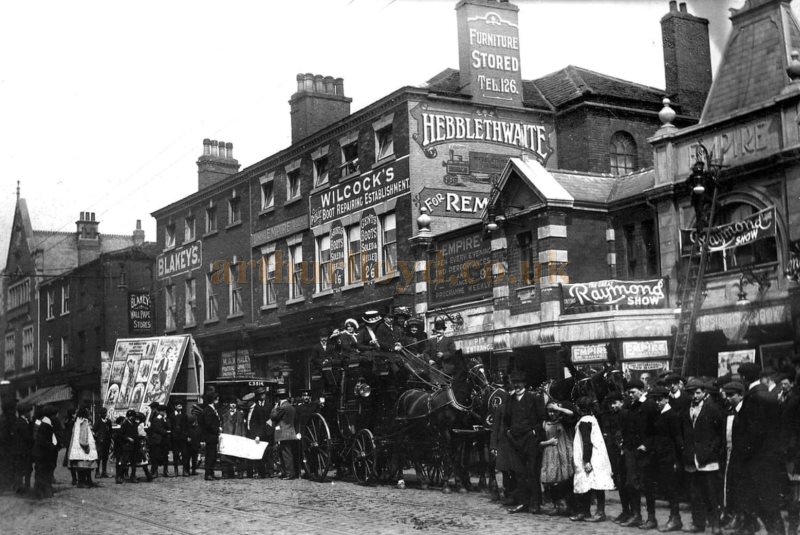
Above - Kirgate, Wakefield and the Empire Theatre in the early 1900s - Courtesy John West.
The Empire Theatre was situated on Kirkgate in Wakefield and opened on Monday the 20th of December 1909. Land for the Theatre's construction was purchased by Sherwood and Company in January 1909, they were the owners of the Wakefield Opera House at the time. The land was known then as Murgatroyd Yard on Kirkgate and covered some 1,075 square yards, and was suggested by the Theatre's Architect Frank Matcham who had also designed the Wakefield Opera House, which had opened in October 1894. Construction of the Empire Theatre was begun almost immediately by Geo Crook and Son of Wakefield and the Foundation Stone for the Theatre was laid by the well known Music Hall Artist Vesta Tilley on the 8th of October 1909. The Theatre cost more than £15,000 to construct and fit out and could seat 2,000 people when it was first opened on Monday the 20th of December 1909 for twice nightly variety shows. The opening show included Fred Karno's Comedy Company in 'The Bailiff' and 'G.P.O.', the singer Ruby Royer, Terpsichorean's Barnes and West, Jugglers and Acrobats Mart and Pep, the Franz Comedy Troupe of Acrobats, and the vocalist Rudge Whitworth.
The ERA reported on the new Wakefield Empire shortly before it opened, in their 27th of November 1909 edition, saying:- 'The frontage of the New Wakefield Empire is to Kirkgate, and the side abuts on Phoenix-street, which has been increased in width to allow of large audiences making a speedy exit through into Kirkgate in the front and to Hardy Croft at the rear. The dressing-rooms abut on this street, so it will be seen that the new building will be nearly isolated.
The principal entrance to the stalls and grand circle is in the centre of the facade to Kirkgate, and is divided into two large openings furnished with iron ornamental gates and flanked each side by shops rounded at the corners with balconies over; the centre portion is carried up above the residential portion over the shops, and contains a large arched window in the centre with the name-panel over containing the word "Empire" in gold letters, and is surmounted with a large square tower with flagpole at top. The facade is flanked at the two ends with bold pediments; the whole is in the Italian style boldly treated, and will make an attractive feature to Kirkgate.
On the left hand of the facade are two wide passages covered with a glass and iron roof, and forms the entrances to the pit and gallery; the former leads to a large waiting-room, from which access is gained to the rear of the pit. The gallery is approached by a wide concrete staircase, and is continued up to the top of the gallery, which forms ample waiting accommodation for this part. In addition to the entrances, separate and distinct exits are provided from every part of the house, which allows for the easy working of the two performances a night.
Features in the designs are fine large lounges for the grand circle and stalls. The former is on the ground floor level, and is comfortably furnished with settees, the floor being carpeted, and the walls and ceilings tastefully decorated. The stalls lounge is on the first floor, and is cleverly arranged in the construction of the circle; it is furnished similarly to the dress circle lounge, and a wide staircase leads down to the side of the stalls, which are similarly furnished and fitted with velvet upholstered tip-up chairs. The pit is at the rear of the stalls, and contains sixteen rows of comfortable upholstered seats, the walls being tiled and the floor formed of wood block paving. The dress circle is fitted up with tip-up chairs and floor carpeted similar to the stalls, and is on novel lines and graceful curves, and continued along the two sides of the circle to the four handsome private boxes adjoining the boldly-designed proscenium, which is furnished with crimson velvet tableau curtains, and the boxes having similar material draperies. The gallery contains eleven rows of comfortable seats, with large promenades at the rear and sides.
The galleries are constructed on the cantilever principle, without columns, so nothing intervenes between the audience and the stage, and a clear and uninterrupted view is obtained from all parts, and thus the sight-lines are exceptionally good. Refreshment saloons for all parts of the building are provided, cut off entirely from the auditorium.
The auditorium is calculated to accommodate about 2,000 persons, and the comfort and safety of this large audience have been given every consideration, there being a fireproof curtain to the stage and hydrants fully equipped with special automatic bolts, fitted to all exit doors, the passages and staircases are all fireproof, so that no danger from fire can be contemplated.
The stage is 50ft. wide and 32ft. 6in. deep, fitted up with all requirements, so that large spectacles can be produced if necessary. The dressing rooms are contained in a separate block at the rear of the stage, and are furnished with every requisite and lighted and well ventilated.
The whole of the building will be installed with the electric light, and with the architect's designs of the decorations carried out as illustrated, Messrs. Sherwood will be proud in the possession of a new theatre of varieties that will compare favourably with any in the country.'
The above text in quotes was first published in the ERA , 27th of November 1909.
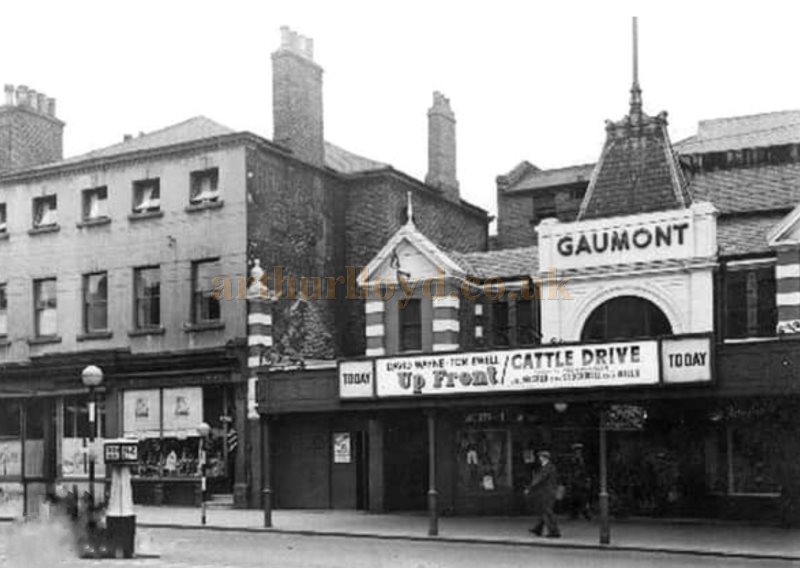
Above - The former Empire Theatre, Wakefield as the Gaumont Cinema in the 1950s - Courtesy John West.
 The Empire Theatre had first opened on Monday the 20th of December 1909 as a Variety Theatre under the ownership of Benjamin Sherwood of Sherwood & Co., who operated it until it was taken over by New Century Cinemas in July 1921, when it was renamed the Empire Super Cinema, a name which was perhaps a little enthusiastic considering it was just showing early silent films.
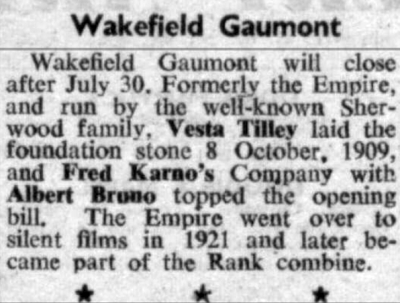
Right - A Notice on the closure of the Wakefield Gaumont in 1960 - From The Stage, 23rd of June 1960.
New Century Cinemas were taken over by Gaumont British in March 1928 and the Theatre was renamed the Empire Cinema, and although it was operated mainly as a Cinema the Stage was still being put to use occasionally by local Amateur Theatre Groups such as the Wakefield Amateur Operatic Society who put on 'The Quaker Girl' at the Theatre in February 1936 and 'Rio Rita' in February 1937.
The Empire was equipped with a British Acoustic Sound System in 1942 for the showing of 'Talkies'.
In May 1950 the Theatre was renamed The Gaumont Cinema and, although Gaumont later merged with Odeon, the Gaumont Name remained until the Cinema was finally closed on the 30th of July 1960 and the building was demolished for the construction of a retail development.
Some of the later information for this Theatre was gleaned from the excellent Cinema Treasures Website.
If you have any more information or Images for this Theatre that you are willing to share please Contact me.