
The New Theatre, George Street, Oxford
Formerly - The New Theatre Royal / The New Theatre / The Apollo Theatre
Built on part of the site of the former Victoria Theatre / Theatre Royale
Introduction - Current Theatre - Previous Theatre
Oxford Theatres

Above - A Google StreetView Image of the New Theatre, Oxford in November 2016 - Click to Interact

 The
New Theatre which stands on George Street, Oxford today opened on the
26th of February 1934 and was designed by the architects William
& T. R. Milburn of Sunderland. The Theatre replaced Drinkwater's 'New Theatre Royale' of 1886,
which was itself built on part of the site of the former 1836 Victoria Theatre / Theatre Royale.
Drinkwater's 'New Theatre Royale' of 1886 was later remodelled by W.G.R.Sprague in 1908 before being demolished
and replaced with the New Theatre of 1934. There is more on the present
Theatre below but first some details of the previous
Theatre on the site.
The
New Theatre which stands on George Street, Oxford today opened on the
26th of February 1934 and was designed by the architects William
& T. R. Milburn of Sunderland. The Theatre replaced Drinkwater's 'New Theatre Royale' of 1886,
which was itself built on part of the site of the former 1836 Victoria Theatre / Theatre Royale.
Drinkwater's 'New Theatre Royale' of 1886 was later remodelled by W.G.R.Sprague in 1908 before being demolished
and replaced with the New Theatre of 1934. There is more on the present
Theatre below but first some details of the previous
Theatre on the site.
Right - The opening Souvenir Brochure for the New Theatre in 1934 - Click to see the whole brochure.
Mr H. G. W. Drinkwater F.R.I.B.A. designed the second Theatre on this site. Fronting onto George Street, like the present Theatre. It was built by Messrs Wilkins and Sons, and was constructed on the site of the former County Court Offices, some houses, and part of the earlier Victoria Theatre / Theatre Royale which had had entrances on Magdalen Street, George Street, and Red Lion Square.
The Theatre opened as the 'New Theatre Royal' on Saturday 13th February 1886. The main entrance to the Theatre was at the corner of the building and led directly into a vestibule of hexagonal shape, being 28 feet long by 14 feet wide and 14 feet high. The floor was in marble mosaic and the walls were panelled to a height of 8 feet. From this vestibule two doors led into a six foot wide corridor which ran around the Dress Circle, at the end of which were access to the Stalls. The inner circle or Pit was entered directly from the entrance vestibule, but the Gallery had a separate entrance in Victoria Place. The Auditorium was handsome and well proportioned forming a circle 48 feet in diameter holding 900 people. The front of the Dress Circle and Gallery were divided by small fluted pilasters and richly panelled. The Stalls seats were upholstered in crimson velvet, with the Dress Circle seats upholstered in rep. The seats in the Pit were padded and had a back rail. The auditorium was lit by a sunlight supplied by Messrs Strode of London, with a ventilating shaft, to carry away gas fumes etc. Opening off the promenade, which surrounded the pit, was a refreshment bar with another one in the circle.

Above - A photograph of the 1886 'New Theatre' Oxford during the run of 'Two Roses' - From the New Theatre's opening souvenir brochure of February 1934. Caption reads:- 'The New Theatre, Oxford, photographed during the visit of Ben Greet's Company in May, 1888. Note the steps on the left which are said to have led to the old Ice House'.
The proscenium was 24 feet square with the stage being 33 feet deep having all the necessary sloates, slides, traps, and bridges fitted, under the supervision of Mr H.B. Bridges from The Prince of Wales Theatre, Liverpool, responsible for all the machinery for working the scenery. New scenery had been painted by Mr R.J.Haines, the act drop having a view of Iffley Mill in its centre, below and around which in the border were the arms of the various colleges. Backstage there were twelve dressing rooms. Two water mains were situated on stage with hydrants at each level, and two in the auditorium with similar hydrants at each floor, with hose attached. A green baize water curtain was provided at the proscenium opening. The plans had been approved by Captain Shaw C.B. Chief of the Metropolitan Fire Brigade.

Above - A sketch from 'The Graphic' of the 27th of February 1886 on the opening of the New Theatre, Oxford
The grand opening took place on Saturday 13th February 1886 with a production of ' Twelfth Night' performed by The Oxford University Dramatic Society, of which the 'New Theatre' was to be their home. The Theatre continued its life with performances of the Oxford University Dramatic Society, Town Players, and professionals, until Thursday evening on March 11th 1892 when the Theatre was damaged by fire.
The fire started in a store room in the Theatre's basement and despite the best efforts of the local firemen the flames soon burst through the stage and by 2am the stage roof had collapsed. By the time the fire had been put out the entire stage had been destroyed and most of the seats in the stalls and upper gallery had been burnt. The orchestra and first few rows of the stalls were destroyed but the pit and gallery survived the worst of the fire. Although the auditorium was damaged by smoke and water it could have been a lot worse if it hadn't been for the water curtain which had held out for two hours after the fire had started.
The Theatre was however restored and reopened on Easter Monday, the 18th of April 1892 with a production by Carpenter's Middleman Company (See sketch below). It is remarkable that they were able to rebuild the stage and redecorate the auditorium in such a short time. Whilst they were at it they also bought the house next door to the stage to use as dressing rooms so that the stage could be enlarged. Without on-stage dressing rooms the stage was now 60 foot wide.

Above - A sketch of the auditorium of the 1886 'New Theatre' Oxford - From the 'New Theatre's' opening souvenir brochure in February 1934. - Caption reads:- 'Interior of the New Theatre, Oxford, opened in February, 1886, partially destroyed by fire March 11th, 1892. The old print reproduced above represents the Re-opening Performance (Messrs. Carpenter's 'Middleman' Company).
In 1908 the Dorrill family took over the Theatre and would continue to run it for the next 64 years, despite several changes and rebuilds. Indeed, when they took it over in 1908 they had the Theatre redesigned, enlarged, and remodeled to the designs of W. G. R.Sprague with a seating capacity of 1,200 people. However the Theatre was considered too old by the 1930s and after its closure on February the 25th, 1933 the Theatre underwent a complete rebuild (see below).
The Present New Theatre, Oxford (1934)

Above - The New Theatre, Oxford in the mid 1950s - Courtesy Gerry Atkins
 By
1933 Stanley Dorrill wanted a more luxurious and comfortable Theatre,
and commissioned Theatre architects William
and T. R. Milburn of Sunderland to design a new modern Theatre for him. On the evening of February the
25th, 1933, the old Theatre closed its doors to the public for the last
time.
By
1933 Stanley Dorrill wanted a more luxurious and comfortable Theatre,
and commissioned Theatre architects William
and T. R. Milburn of Sunderland to design a new modern Theatre for him. On the evening of February the
25th, 1933, the old Theatre closed its doors to the public for the last
time.
Right - The auditorium of the New Theatre, Oxford in May 2011 - Courtesy Tim Speechley.
Almost immediately demolition of the building was started and the Milburn
brothers then rebuilt the Theatre over the next 12 months, co-operating
with T. P. Bennett & Son (who also designed the Saville
Theatre in London) to create a new Theatre with a modern Art Deco
interior.
Left - The opening Souvenir Brochure for the New Theatre in 1934 - Click to see the whole brochure.
This new 'New Theatre' had a stone façade, again with a corner entrance, and was fitted with a wonderful revolving stage. (see photo below). The new 'New Theatre' opened on the 26th of February 1934, exactly a year after the old Theatre had closed.

Above - A photograph of the Revolving Stage mechanism at the New Theatre, Oxford in 2010 - Courtesy Roger Fox.
 The
audience capacity of the New Theatre was now 2,000 (1,710 seated). The
Art Deco auditorium has a high arched proscenium with a pelmet set deep
within a banded ante-proscenium. There are no boxes, the auditorium
having two balconies, the lower one divided into the Dress and Upper
circle. The decoration is Roman stud decoration terminating at the proscenium.
The Theatre has a difficult 'get in' because the stage is 2 metres (6
feet 8 inches) below street level.
The
audience capacity of the New Theatre was now 2,000 (1,710 seated). The
Art Deco auditorium has a high arched proscenium with a pelmet set deep
within a banded ante-proscenium. There are no boxes, the auditorium
having two balconies, the lower one divided into the Dress and Upper
circle. The decoration is Roman stud decoration terminating at the proscenium.
The Theatre has a difficult 'get in' because the stage is 2 metres (6
feet 8 inches) below street level.
Right - A photograph of one of the extant 'Number Boards' at the New Theatre, Oxford in 2010 - Courtesy Roger Fox.
In 1934 the colour scheme was originally shades of deep brown with gilt friezes, but this was later changed to a multi colour scheme which did not reflect the original design.


Above - A Wartime Programme for 'Hamlet' with John Gielgud, Peggy Ashcroft, and Leslie Banks at the New Theatre, Oxford in September 1944. And a Wartime Programme for a Special performance of John Gielgud's Production of 'Love For Love' for His Majesty's and Allied Forces Only at the New Theatre, Oxford on Monday September the 11th, 1944 - Programmes Courtesy Stuart Gill whose parents kept the programmes from their early wartime romance after they had met at Faringdon Royal Marines camp in 1943 (his father was an RM, his mother a Wren).

Above - A group of people enjoying a drink at the bar of the New Theatre Oxford in the early 1940s - Courtesy Patricia Smith whose mother, Phyllis Gibbons, is standing centre. Patricia says: 'She [Phyllis] married my Dad whilst he was stationed in Oxford during the war. She lived at 12, Thames Street with her parents James and Ada Gibbons and often spoke about her days working at the New Theatre where she met many artists like Tommy Trinder and Flannigan and Allen.' If you know who any of the other people in the photograph are please Contact me.

Above - A photograph of the stage crew for the 1962/3 pantomime at the New Theatre, Oxford - Courtesy Peter Cook who says 'It was taken by Oscar Mellors, a professional photographer whose studio was in George St. He worked back-stage but is not in the photo. He later became a tutor at Exeter Art College.' Some of the names of people in the photo are: Top row: Den Hill - ? - ? - Peter Cook - John Norridge - Mike McCluskey - Jim Needle - Don Stokes -?- Tony Hedges. Lower row: Richard Moreby -?- Roy ??? - Ian Grice - Len Hill - Henry Platt. Thanks to Mike McCluskey for naming most of these people, Mike says 'The first show I worked on in 1959 was Once More With Feeling with John Neville and Dorothy Tutin. Many happy years followed working with a great stage crew and meeting so many of the stars of the time.' If you know who any of the other people in the photo are please Contact me.
 The
stage of the New Theatre has a 13.72 metre proscenium width (46 feet,
4 inches), and is 11 metres deep (36 feet), with a height to the grid
of 18.6 metres (60 feet). The original orchestra pit seated 24 musicians.
The
stage of the New Theatre has a 13.72 metre proscenium width (46 feet,
4 inches), and is 11 metres deep (36 feet), with a height to the grid
of 18.6 metres (60 feet). The original orchestra pit seated 24 musicians.
The Theatre became famous for its pantomimes featuring the 'Vera Legge's Oxford Babes' during the war years, and continued to thrive until the advent of TV in the 1950's, where upon it then struggled like many provincial Theatres, but still presented a mixed programme of performances.
Right - A programme for 'Duel of Angels' at the New Theatre, Oxford in April 1958. The cast included Derek Nimmo, Peter Wyngarde, Fiona Duncan, Vivien Leigh, Basil Hoskins, Claire Bloom, Pauline Jameson, Beaufoy Milton, Freda Jackson, Brian Harrison, Robin Bailey, Laurence Davidson, and John Hart Dyke.
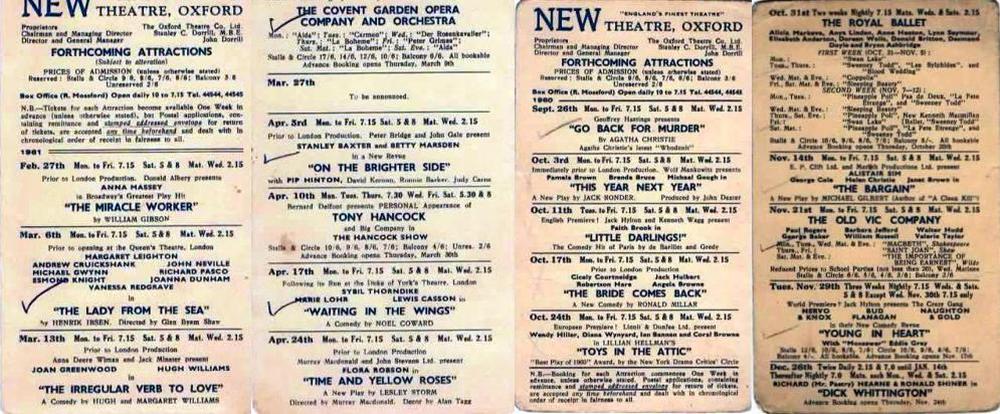
Above - Coming Attraction Cards for the New Theatre, Oxford in 1960 and 1961 - Courtesy Mike McCluskey.
 In 1972 the Dorrill family sold the Theatre to the Howard & Wyndhams
Theatre chain, who in 1977 sold the Theatre on to Apollo Leisure. Apollo
changed the Theatre's name then to the 'Apollo Theatre' Oxford. However,
they were bought out in 1999 by SFX, who were then bought by Clear Channel
Entertainment in 2001.
In 1972 the Dorrill family sold the Theatre to the Howard & Wyndhams
Theatre chain, who in 1977 sold the Theatre on to Apollo Leisure. Apollo
changed the Theatre's name then to the 'Apollo Theatre' Oxford. However,
they were bought out in 1999 by SFX, who were then bought by Clear Channel
Entertainment in 2001.
Right - A Variety Programme for the New Theatre, Oxford - Courtesy Philip Paine. On the Bill were The Crazy Gang, Les Joyeux Rossignols, Chuck Brown & Rita, The Radio Revellers, Eddie Gray, and Bud Flanagan.
The Theatre was refurbished in 2003 and the name reverted back to 'The New Theatre'. Clear Channel Entertainment's Theatres division became Live Nation, who two years later sold out to the 'Ambassador Theatre Group' who bought the Theatre in 2009.
 The
Theatre's current seating capacity is 1,800, and continues to provide
varied entertainment for the citizens of Oxford,
presenting Welsh National Opera, English National Ballet, West
End and Broadway musicals and plays, contemporary dance, pop concerts,
and stand up comedy.
The
Theatre's current seating capacity is 1,800, and continues to provide
varied entertainment for the citizens of Oxford,
presenting Welsh National Opera, English National Ballet, West
End and Broadway musicals and plays, contemporary dance, pop concerts,
and stand up comedy.
Left - The New Theatre, Oxford in May 2011 - Courtesy Tim Speechley.
The Theatre is currently run by the Ambassador Theatre Group and you may like to visit their own Website for the Theatre here.
The above article on the New Theatre, Oxford was first written for this site by David Garratt in 2011, with later additions by Matthew Lloyd.
If you have any more images or programmes for this Theatre that you are willing to share please Contact me.