
The Empire Theatre, Beresford Street, Woolwich
Formerly - The New Portable Theatre, Woolwich / West Kent Theatre / Duchess of Kent's Theatre / Barnard's Theatre Royal / Theatre Royal
Other Theatres in Woolwich
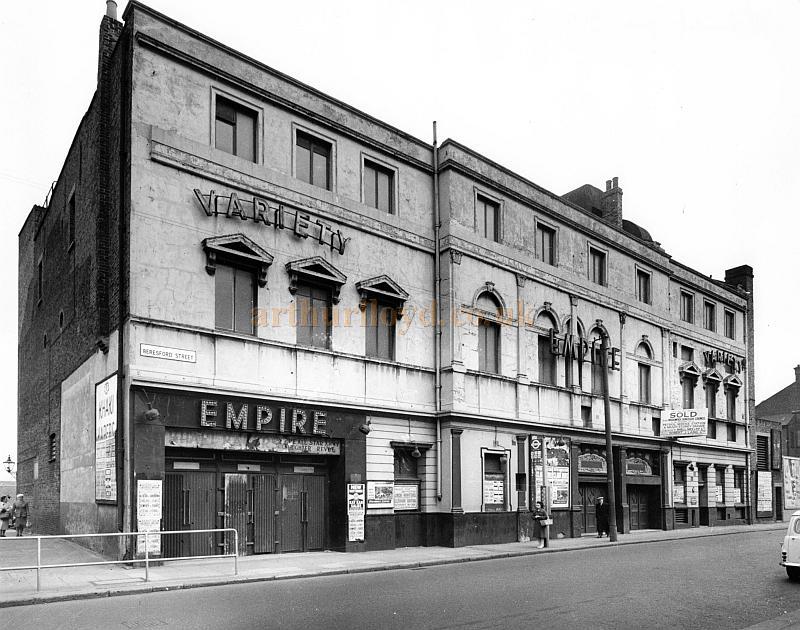
Above - The Woolwich Empire in 1959, after it had closed and not long before it's demolition - Photo Courtesy John Earl. With the kind permission of the Greenwich Heritage Centre

 The
Empire Theatre was situated on Beresford Street, Woolwich and was designed by the renowned Theatre Architect Frank
Matcham in 1899. The Theatre
was originally opened as Barnard's Theatre Royal. However, even this was built on the site of a series
of previous Theatres. Originally on the site there was the New Portable Theatre
which opened in 1834.
This was replaced by a permanent structure in 1835, called the West Kent Theatre. This Theatre was renamed the Duchess of Kent's Theatre
in 1837.
The
Empire Theatre was situated on Beresford Street, Woolwich and was designed by the renowned Theatre Architect Frank
Matcham in 1899. The Theatre
was originally opened as Barnard's Theatre Royal. However, even this was built on the site of a series
of previous Theatres. Originally on the site there was the New Portable Theatre
which opened in 1834.
This was replaced by a permanent structure in 1835, called the West Kent Theatre. This Theatre was renamed the Duchess of Kent's Theatre
in 1837.
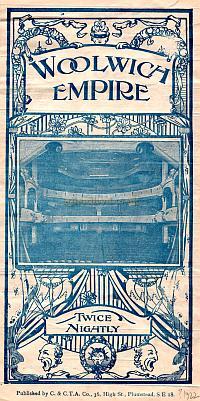
Right - Programme for twice nightly Variety at the Woolwich Empire in 1922 - Courtesy John Earl.
The Theatre was again renamed in 1892, this time to the Barnard's Theatre Royal, and was later reconstructed and renovated in 1900. The ERA reported on the 1900 alterations in their February 3rd 1900 edition which you can read below.
The Theatre would later become known as the simpler named Theatre Royal. But its final change of name came when it was renamed the Woolwich Empire in the 1920s, and is known to have had a capacity of 1,450 at this time. The Woolwich Empire remained structurally in this form until it was demolished in 1960. Details of the Woolwich Empire, written by John Earl in 1998 can be seen below.
The Woolwich Empire by John Earl 1998

Above - Real Photograph of the Woolwich Empire Theatre in the mid 1950s - Courtesy John Earl.
 When
the Woolwich Empire closed in 1958, the site had been occupied by a
theatre for 123 years without a break. In 1835, a portable cast iron-framed
theatre was moved from Greenwich, where
it had stood for two years, to a site in Beresford Street, Woolwich,
where it was known first as the West Kent Theatre, then as the Duchess
of Kent's. In 1836 it was
replaced by a permanent building which, like most small theatres at
that time, was rectangular, with a single balcony and a benched pit,
set behind a narrow, stucco pedimented facade. It was then known as
the Theatre Royal. The portable was presumably sold and erected elsewhere,
but its subsequent history (if it had one) is unknown.
When
the Woolwich Empire closed in 1958, the site had been occupied by a
theatre for 123 years without a break. In 1835, a portable cast iron-framed
theatre was moved from Greenwich, where
it had stood for two years, to a site in Beresford Street, Woolwich,
where it was known first as the West Kent Theatre, then as the Duchess
of Kent's. In 1836 it was
replaced by a permanent building which, like most small theatres at
that time, was rectangular, with a single balcony and a benched pit,
set behind a narrow, stucco pedimented facade. It was then known as
the Theatre Royal. The portable was presumably sold and erected elsewhere,
but its subsequent history (if it had one) is unknown.
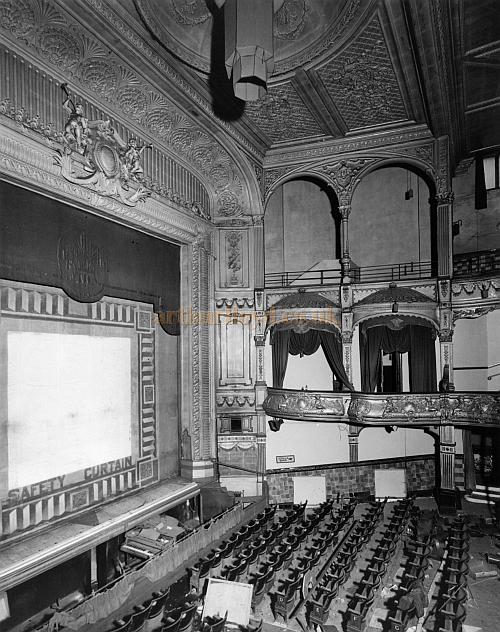
Right - The Auditorium and Safety Curtain of the Woolwich Empire in 1959, after it had closed and not long before it's demolition - Photo Courtesy John Earl. With the kind permission of the Greenwich Heritage Centre
In 1884 Frank Matcham, whose best years as a theatre architect were still to come, presented two designs for reconstruction, but neither of these was implemented. Some minor improvements may have been made in the 80s by a local man named J.O.Cook, but in 1892 Edward Clark, who had been one of the most active music hall designers of the crucial 1860-80 period, was called in to carry out a major reconstruction. Clark, by this time, near the end of his productive life, was not an innovative architect, but he had designed the first Metropolitan music hall in Edgware Road and he is also known to have been responsible for - or at least he carried out substantial works to - 14 other classic halls, including Forester's in Mile End and the Sun, Knightsbridge. His third design for the Woolwich theatre, dated December 1893, was executed. This raised and extended the existing Theatre Royal facade, reconstructed the auditorium with two balconies and provided the stage with a fly tower.
This first major reconstruction was commissioned by Samuel Barnard, who had taken over the licence in 1892. The building was officially the Royal, but known popularly thenceforth as Barnard's. In 1898, Barnard, who must have prospered, embarked on a further wholesale improvement campaign, this time employing the man who had prepared the unexecuted 1884 designs and who had since come to be recognised as the leading theatre architect of the time, Frank Matcham. On this occasion little more than the outside walls were left standing. Matcham was obviously working to a tight budget and the Royal remained externally much as Clark had left it in 1893, still incorporating some fabric of the pre-Victorian theatre. Internally it lacked the magnificence of Matcham's finest theatres, but it was pleasing and efficient, with excellent sight lines from every part of the house.
 The ERA printed a review of Barnard's new
Theatre Royal, Woolwich in their 3rd of February 1900 edition saying:- 'The
reopening of Barnard's Theatre Royal, Woolwich,
after reconstruction and renovation, was celebrated on Monday evening
by two of the largest audiences that have gathered within the walls
of a London variety theatre, and the enterprise which the proprietor
has displayed as a caterer for Public amusement in the town is in fair
way of meeting its due reward.
The ERA printed a review of Barnard's new
Theatre Royal, Woolwich in their 3rd of February 1900 edition saying:- 'The
reopening of Barnard's Theatre Royal, Woolwich,
after reconstruction and renovation, was celebrated on Monday evening
by two of the largest audiences that have gathered within the walls
of a London variety theatre, and the enterprise which the proprietor
has displayed as a caterer for Public amusement in the town is in fair
way of meeting its due reward.
The Old building, which was closed about six months ago to enable the work of rebuilding to commence, was good enough in its way, but Mr Barnard's patrons outnumbered its meeting capacity, and the result wag its reconstruction on a thoroughly up-to-date scale, and in a style that will place Barnard's amongst the first-class music halls of the metropolis.
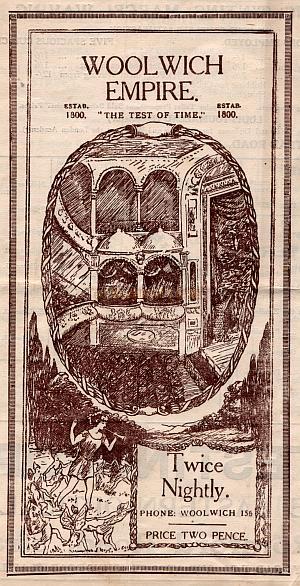
Left - A Programme for the Lew Lake revue 'The New Splinters' at the Woolwich Empire, formerly Barnard's Theatre Royal, in August 1927, by the Les Rouges et Noirsat company, with music by David Hunter and lyrics by Douglas Furber. The programe cover shows an illustration of the auditorium and boxes - Courtesy John Earl.
With seating accommodation for some 2,500 persons, fitted with every up-to-date appliance conducive to the comfort of visitors, and decorated in a manner which, without being lavish is in the best sense artistic, Mr Barnard is to be congratulated on his latest addition to the variety houses of London, in view of the thoroughness with which the work has been carried out, the time occupied in the rebuilding has not been excessive, and it may be mentioned that the extension involved the clearing away of three or four houses, which occupied the site of the new stage.
Mr Frank Matcham, who has had so great an experience in theatrical architecture, in this instance has given farther evidence of professional talent. The stage is of noble dimensions, extending some 38ft from back to front, with a proscenium opening of 26ft. and a width of stage of 58ft. The height to grid is 50ft, and proper access is provided, therefrom to all the properties. There are six well-lighted and ventilated dressing-rooms, provided with the usual offices. The stage, in case of necessity, can be cut off from the auditorium by an Iron curtain, and by an ingenious arrangement a spray of water can be directed down the curtain. The arrangements for the safety of the public have been carried out with commendable thoroughness, and to the satisfaction of the exacting requirements of the London County Council...
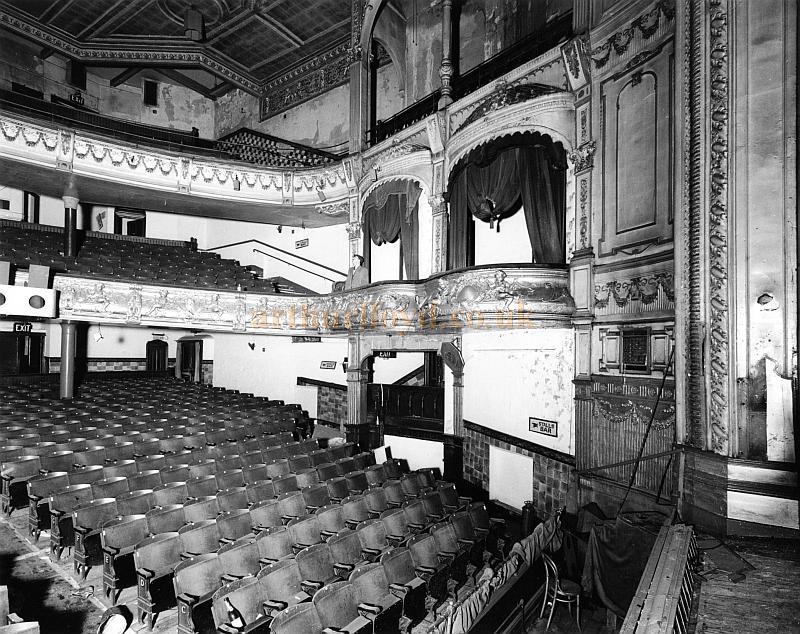
Above - The Auditorium of the Woolwich Empire seen from the stage in 1959, after it had closed and not long before it's demolition - Photo Courtesy John Earl. With the kind permission of the Greenwich Heritage Centre
...The drop scene, of Venetian character is in effective accordance with the general scheme of decoration, which is carried out in the French Renaissance style. The whole effect is rich and pleasing to the eye, anything approaching garishness being eschewed. The prevailing tints are terra-cotta and blue, with gold relief. The ceiling is an admirable piece of work, all the walls are faced with an enduring embroidery of lacustrine, and there is a sliding roof which will be appreciated on summer evenings.
The house is a two-tier one, and from every seat in the building an unobstructed view of the stage is obtained. There are four boxes provided. The dress circle, which is elegantly upholstered in blue plush has seating accommodation for 306. The pit is seated for about 1,000, and the balcony for between 700 and 800, whilst there is a refreshment buffet for each part of the house.
The lighting of the building with electric incandescent lamps is remarkably effective, the generating agent being a 24-horse-power gas-engine and dynamo in the basement. Arc lamps light the stage, where great attention has been paid to electric effects by the contractors in this department. There is a two-fold scheme of lighting, and the electric light can be instantly replaced by gas. Ample means of exit and entrance are provided to all parts of the house; there are no fewer than five exits from the pit, and two each from the dress-circle and the balcony. Eleven hydrants are provided for the repression of any outbreak of fire, with the usual fittings and 40ft. of hose...
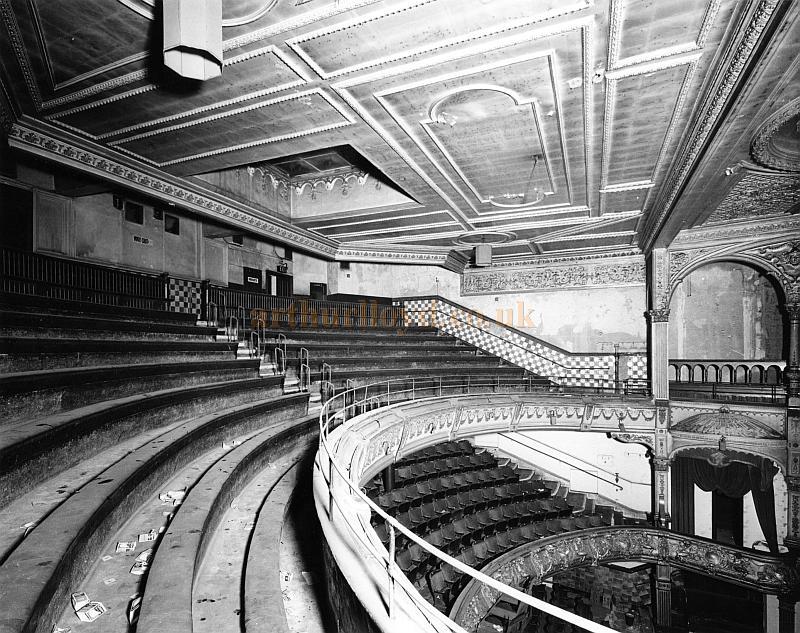
Above - The Gallery of the Woolwich Empire in 1959, after it had closed and not long before it's demolition - Photo Courtesy John Earl. With the kind permission of the Greenwich Heritage Centre
...The contractors for the building, Messrs Thomas and Edge, of Woolwich, have performed their work to the satisfaction of all concerned, the supervision being carried out by the successive clerks of the works, Mr J. F. Revill and Mr L. Phillips. Messrs Dean, of Birmingham, have done the upholstering in superb style.
 Amongst
the overflowing audience on Monday evening were many of the leading
townspeople and members of the local board, and Mr Barnard was heartily
congratulated on the completion of his undertaking.
Amongst
the overflowing audience on Monday evening were many of the leading
townspeople and members of the local board, and Mr Barnard was heartily
congratulated on the completion of his undertaking.
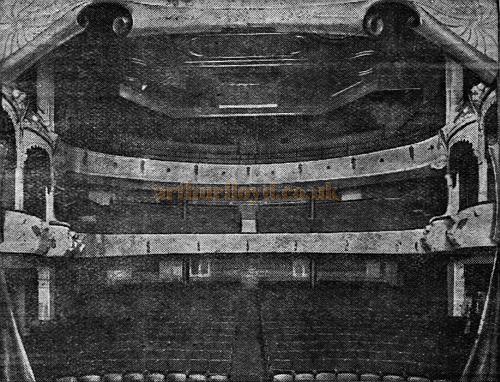
Right - A photograph of the auditorium of the Woolwich Empire - From a programme for twice nightly Variety at the Theatre in 1922 - Courtesy John Earl.
The programme provided included some excellent turns, amongst the artistes being the M'Donald Troup of international dancers; Miss Marion Grahame, an admirable ballad vocalist; Mr Harry Nation, a laughing comedian; Miss Daisy James, a fascinating soubrette; Miss Rose D'Alberg, soubrette and danceuse, who was much appreciated; Milner Verren, male soprano; and the Brown and Kely combination in a spirited representation of My Wife's Baby. In the course of the evening Mr S. Barnard, who was accompanied by a number of his colleagues in the music hall world, addressed the audience, and expressed his satisfaction at the manner in which the architect, Mr Matcham, had carried out his task. He also paid a tribute to the contractors, Messrs Thomas and Edge. The arrangements of the evening were carried out admirably under the supervision of Mr D. Barnard.'
The above text in quotes was first published in the ERA, February 3rd 1900.
 Barnard described the Theatre to a licensing session in 1906 as 'not what you would call a high class theatre; it is a very nice
building but at the same time it is used... by artisans and their wives
who work in the Royal Arsenal... It is only a cheap theatre'.
Barnard described the Theatre to a licensing session in 1906 as 'not what you would call a high class theatre; it is a very nice
building but at the same time it is used... by artisans and their wives
who work in the Royal Arsenal... It is only a cheap theatre'.
The Barnards ran a number of theatres and music halls in south east London and west Kent. Sam, who remained in control until 1930, and David Barnard, who took over for a further two years, continued to hold a stage plays licence, saying that 'no variety season is run', but the bills were, nevertheless, extremely catholic and, as time went on, variety turns and bioscope shows became more frequent.
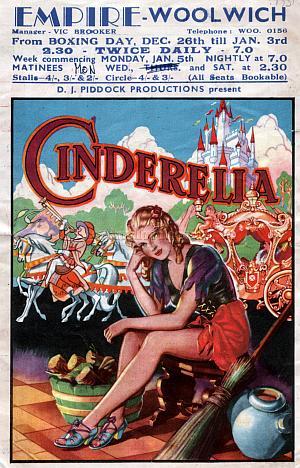
Right - A Programme for 'Cinderella' at the Woolwich Empire in 1931 - Courtesy John Earl.
At the time of Sam Barnard's rebuilding, Woolwich could clearly have supported a big variety theatre, but the Royal site, squeezed between Beresford Street and a narrow lane called Ropeyard Rails, was too small for such a purpose. Matcham, in fact, designed a fantastic Moorish-style Grand music hall for a site in nearby Beresford Square, close enough to constitute a threat to the Royal, but it was never built. Competition eventually came from another Grand, later renamed Woolwich Hippodrome (built 1900) and the Century (Arsenal) Cinema, converted from a row of cottages on the corner of Beresford Street and the Square, but demand for entertainment in the garrison town was still brisk and the Royal managed to stay in business. As the Empire, it flirted for a time with films (back projection) but returned to variety when it was outclassed as a cinema by the Woolwich 'supers', the Granada and the Odeon, both of which opened in 1937. The Granada made all the local theatres look old-fashioned by mounting variety shows between the films on a stage that was in every way superior to the Empire's.
From 1932 the former Barnard's had been licensed to the Woolwich Empire Company. In February 1939 closure was announced, but another company took over, retaining the name Empire. The Empire Repertory Players presented a series of plays, farces and melodramas (including Todd Slaughter in 'Sweeney Todd') but four years later the fare was almost exclusively variety and revues.
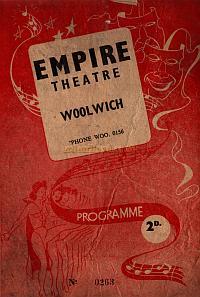
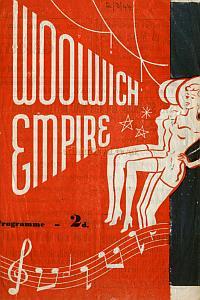
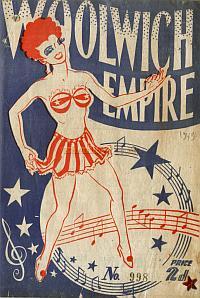
Above - Three 1940s Programmes for the Woolwich Empire - Courtesy John Earl.
By the 1950s the Empire was hopelessly outdated and sadly run down. A steadily increasing number of strip shows gave it a semblance of life but here, as everywhere else, this was a policy of desparation, appealing to a dwindling and ageing audience.
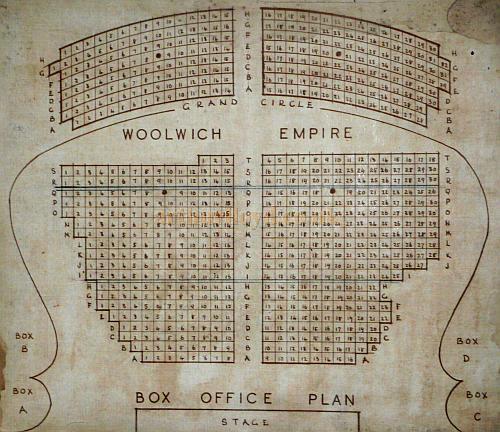
Above - A 1950s Box Office Plan for the Woolwich Empire - Courtesy John Earl.

Above - A page from the Takings Book of the Woolwich Empire Theatre on a Wednesday in February 1952, the banked cash amounted to a miserable £40 - Courtesy John Earl.
 The
takings book for December 1951 to March 1952 (Shown Above) has
survived and tells its own dismal story. The seating capacity was optimistically
advertised as 1800, with the uncomfortable benched gallery (rarely opened)
limited by the licence to 450.
The
takings book for December 1951 to March 1952 (Shown Above) has
survived and tells its own dismal story. The seating capacity was optimistically
advertised as 1800, with the uncomfortable benched gallery (rarely opened)
limited by the licence to 450.
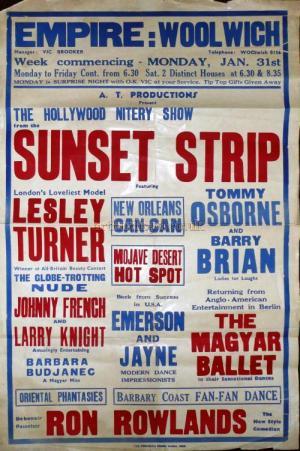
Right - Poster for 'Sunset Strip' at the Woolwich Empire in the 1950s - Courtesy John Earl.
The 1951/2 Christmas show was a circus which ran for nearly a fortnight, followed by 'Snow White' for a week. The first night of 'Snow White' produced an attendance of 436 for the matinee, 294 for the first house and 194 for the second house.
 The top attendance achieved during the
currency of the book was 929 for a Monday in March ('On the Sunny Side'),
but for a first house for 'Beauties of 1952' on a Saturday in January
only 120 ticket sales were recorded, 'papered' to amore
respectable number by 98 complimentaries. The second house had 149 paying
customers, with 100 complimentaries. Bar takings for this performance
were £12, the banking total for the night being just over £122.
The top attendance achieved during the
currency of the book was 929 for a Monday in March ('On the Sunny Side'),
but for a first house for 'Beauties of 1952' on a Saturday in January
only 120 ticket sales were recorded, 'papered' to amore
respectable number by 98 complimentaries. The second house had 149 paying
customers, with 100 complimentaries. Bar takings for this performance
were £12, the banking total for the night being just over £122.
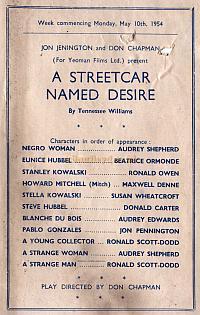
Left - In 1954 a return to drama was tried at the Woolwich Empire with a season of plays including this production of 'A Streetcar Named Desire' but it was not sustained and the Theatre had to return to variety to survive. - Courtesy John Earl.
Even this was a healthy state of affairs, compared to what was to follow. In its last years the 'orchestra' was reduced to a solo piano and even the few good turns played to nearly empty houses. My wife and I went to see Nat Travers, the cockney comedian, at the Empire in 1953. We were alone in the front stalls. Travers was visibly touched to see that his audience (both of us) knew the words of his songs.
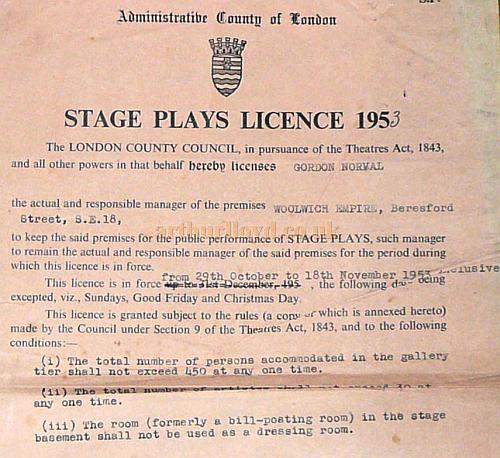
Above - Licence for the Woolwich Empire to produce stage plays in 1953 - Courtesy John Earl.
In 1956 a diamond merchant bought the theatre for £3,500 as a gift for his girl friend, Frances Grayson, described in Press reports as 'fan dancer'. For reasons now difficult to fathom, a theatre chaplain was appointed. A funeral director would have been more appropriate. Under this regime 'Glamour Shows' were the normal fare. Following one short break in the tedious series the manager said 'As an experiment we tried to put on a nice type of show but the public wants something more spicy. We have been losing money... so the leggy shows start again next Monday'.
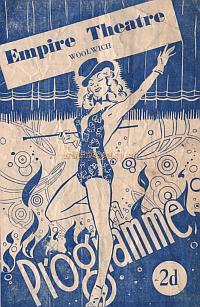
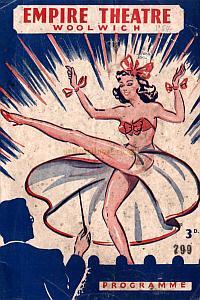
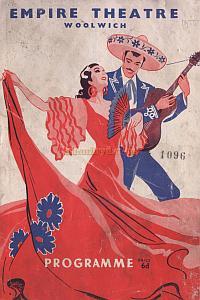
Above - Three 1950s Programmes for the Woolwich Empire - Courtesy John Earl.
 In
March 1957 the LCC's Public Control Department warned the proprietor
that his licence might not be renewed. The star of the show, Peaches
Page, had been seen to move on the stage without adequate covering (nudes
at that time had to keep still). Page said 'I don't know what the fuss
is about. My act is artistic... It's for red-blooded English gentlemen'.
There were too few such gentlemen.
In
March 1957 the LCC's Public Control Department warned the proprietor
that his licence might not be renewed. The star of the show, Peaches
Page, had been seen to move on the stage without adequate covering (nudes
at that time had to keep still). Page said 'I don't know what the fuss
is about. My act is artistic... It's for red-blooded English gentlemen'.
There were too few such gentlemen.
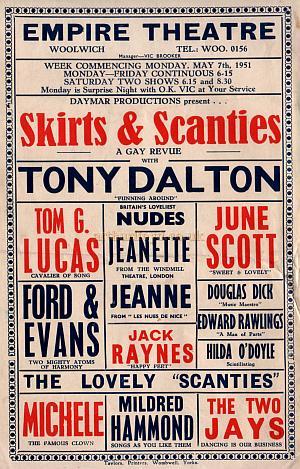
Left - Leaflet advertising the Daymar production of 'Skirts & Scanties' at the Woolwich Empire in 1951 Courtesy John Earl.
 Takings
continued to fall. As an added attraction, the management considered
asking the glamour show girls to take turns serving at the bar, but
Equity objected.
Takings
continued to fall. As an added attraction, the management considered
asking the glamour show girls to take turns serving at the bar, but
Equity objected.
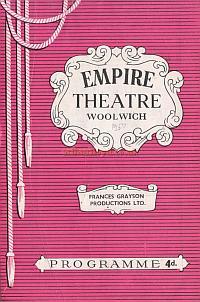
Right - Programme for a Frances Grayson production at the Woolwich Empire in 1957 - Courtesy John Earl.
The Empire closed in 1958 and was demolished in 1960, ending a history of well over 120 years of entertainment on this one site. Woolwich remains to this day without a purpose-built theatre. The final tragedy was followed by a farce. A modern wonder, the mechanical AutoStacker, rose on the site to solve the town's parking problems at a stroke. On the day it was opened by Princess Margaret, a car drove on to the lift platform and nothing happened. The AutoStacker was demolished some years later without ever having served the purpose it was designed for.
The above article on the Woolwich Empire Theatre was written by John Earl in 1998, and was very kindly sent for inclusion on this site by him in 2008.
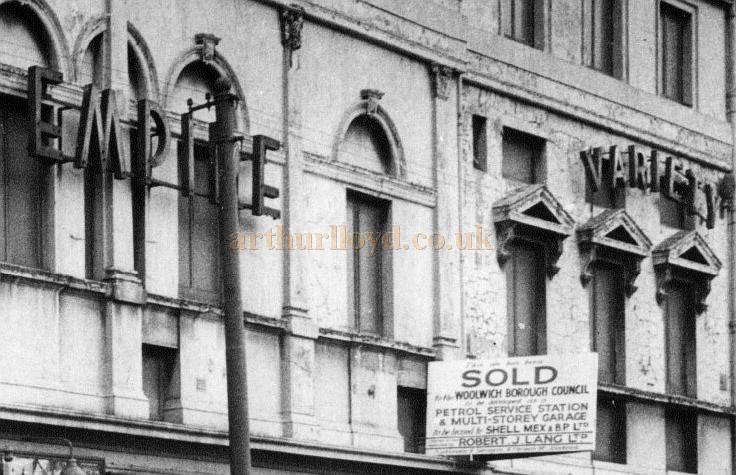
Above - The Woolwich Empire in 1959, shortly after it had been closed and sold for the building of a petrol service station and multi-storey car park for Shell Mex & BP Ltd (See sign) - Photo Courtesy John Earl. With the kind permission of the Greenwich Heritage Centre
Click here for details of other Theatres in Woolwich
Archive newspaper reports on this page were collated and kindly sent in for inclusion by B.F.