
The Royal Adelphi Theatre, Christian Street, Liverpool
Formerly - The Christian Street Circus / Olympic Circus / Queen's Theatre / Royal Adelphi Theatre / Adelphi Theatre / Adelphi Music Hall & Theatre of Varieties / Adelphi Cinema
Liverpool Theatres Index

Above - The Liverpool Adelphi Theatre in 1863 - From 'Annals of the Liverpool Stage' by R. J. Broadbent 1908.

 The Adelphi Cinema which some people may still
remember today was situated on Christian Street, Liverpool. The site
of this Cinema has a long and interesting history. It began life in
the late 1700s as Livery Stables run by T. Tinker who eventually added
a covered ring and ran it as a riding school and also put on equestrian
shows there.
The Adelphi Cinema which some people may still
remember today was situated on Christian Street, Liverpool. The site
of this Cinema has a long and interesting history. It began life in
the late 1700s as Livery Stables run by T. Tinker who eventually added
a covered ring and ran it as a riding school and also put on equestrian
shows there.
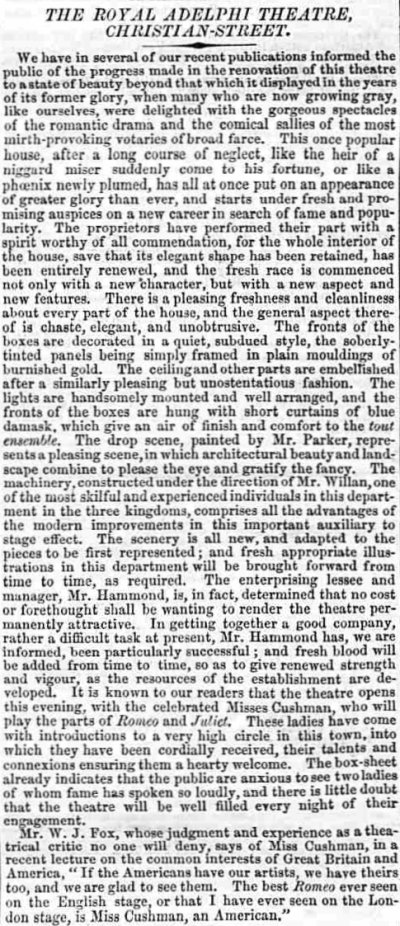
Right - A Report on the Royal Adelphi Theatre, Liverpool when it reopened in 1846 - From The Liverpool Albion, 13th of April 1846.
The place was taken over by a Mr. Davis in 1803 and he put on all manner of equestrian and Circus acts there intermittently until it was reopened on a more permanent basis in April 1805 as the Olympic Circus. The building was enlarged and much improved by the architect John Foster in 1808 and it ran as such until 1812 when it was taken over by Astley, Davis, and Parker, and reopened in November 1813 as the New Olympic Circus.
For a while in the early 1820s the building was known as Cooke's Olympic Circus when John Cooke and his Equestrian Company were engaged there, Cooke later took over the Lease and ran the venue until 1825 when a sewer burst and the building was flooded with water. Cooke went on to open a new Circus in Great Charlotte Street the following year.
The Christian Street Circus was improved and redecorated after the flood and reopened as the Royal Olympic Circus in December 1825 but was soon in decline due to the opening of Cooke's New Circus in Charlotte Street, so the Olympic was eventually converted into a Theatre and reopened as the Queen's Theatre on the 26th of December 1831 with a production of 'Harlequin Gulliver' with the comedian Harry Beverley playing the main role.
The Queen's Theatre then ran under a succession of different managers for the next 15 years until 1846 when the then owner, Mr. Hammond, had the building extensively altered. The interior was gutted and rebuilt, and the exterior was re-faced in a more ornamental style. The building reopened as the Royal Adelphi Theatre on the 13th of April 1846 with a production of 'Romeo and Juliet'.
The Theatre was taken over by William Scholes Branson in July 1862 who renamed it to the more simple Adelphi Theatre and ran it until 1869 when he retired. During his time there it became well known for its very successful and spectacular drama productions.
 Thomas Theodore Heath then took over the Theatre and began putting
on variety productions, and would change
the name the following year to the Adelphi Music Hall & Theatre
of Varieties, managed by Harry De Freece. Drama was reintroduced at
the Theatre in the 1870s by Edward
Trevanion, but it eventually went over to Twice nightly Variety.
Thomas Theodore Heath then took over the Theatre and began putting
on variety productions, and would change
the name the following year to the Adelphi Music Hall & Theatre
of Varieties, managed by Harry De Freece. Drama was reintroduced at
the Theatre in the 1870s by Edward
Trevanion, but it eventually went over to Twice nightly Variety.
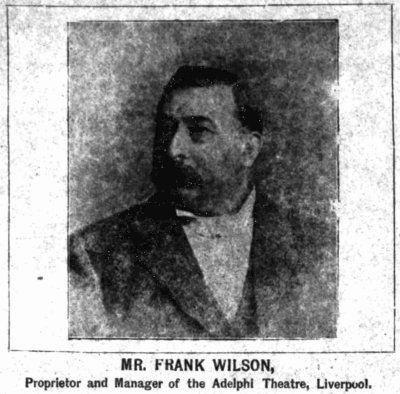
Left - Frank Wilson, Proprietor and Manager of the Adelphi Theatre in 1899 - From Boxing World and Mirror of Life, 27th of September 1899.
By 1897 Frank Wilson was the Proprietor and Manager of the Adelphi and was putting on Boxing matches at the Theatre along with the live shows, and in 1910 the Theatre was converted for full time use as a Boxing Arena, which was used by the Liverpool Gymnastics Club, and its live Theatre days were well and truly over.
However, in 1912 the building was converted for Cinema use and reopened as the Adelphi Cinema, but this was destroyed by fire on Tuesday the 12th of April 1921 and subsequently demolished, a new Cinema was then built a few hundred yards from its original site to replace it, see below.
In 1921 the old Adelphi Cinema was demolished and a new Cinema was built a few hundred yards along from the original site to replace it, opening in November 1922 as the New Adelphi Cinema. This new Cinema was nearer to Rose Hill / St. Anne street than the previous Theatre / Cinema.
The Bioscope reported on the new Adelphi in their 9th of November 1922 edition saying:- 'The new Adelphi - one of the new cinemas just completed in Liverpool - opened to the public last week with "Over the Hill." The new Adelphi has seating capacity for about 1,200 people, a proportion of whom are accommodated in a large balcony. The waiting-room accommodates about 600 people. Two Kalee Indomitable projectors with 105ft. throw and two 100 amp. 60 volt. Boothroyd generators have been installed. The joint proprietors, Mr. R. Gold and Mrs. A. Tarshish, who previously owned the old Adelphi, Christian Street, Liverpool, which was burnt down a few years ago, have appointed as manager Mr. Jack Morrissey, a gentleman well known because of his association with the Electric, Scotland Road, prior to its closing down. The prices of admission, including tax, are 3d., 5d. and 8d.' - The Bioscope, 9th of November 1922.
The new Adelphi Cinema had opened in November 1922 and continued in business until it was destroyed during the war in November 1940. A photograph of the Cinema can be seen on the Flickr Website here. The site of the Cinema was later grassed over and formed part of Bishop Goss school's playing field.
A visitor to this site, Les Crowder, says:- 'I Was a boy of 11 in the blitz, living and sheltering at home in Rose Hill. The 'Delly' was a very short walk, about 200 yards. It was destroyed by a land mine on 28th / 29th of November 1940 (the 3 day / night blitz). A large piece of twisted steel girder from the cinema landed under our parlour window and our front door was blown off. A Large family in Rose Place called Armstong lost 90% of their total. They left the shelter early thinking the 'All Clear' was imminent.' - Les Crowder.
Some of the information for this Theatre was gleaned from the excellent book 'The Liverpool Stage' by Harold Ackroyd. And some later details were kindly sent in by Ged Fagan.
If you have any more information or images for this Theatre that you are willing to share please Contact me.