
The Music Hall, Bold Street and Concert Street, Liverpool
Later - Himes Music Hall, Bold Street
Liverpool Theatres Index

Above - A Woodcut by Alexander Mosses of the Bold Street Music Hall, Liverpool in around 1810 - From 'The Annals of the Liverpool Stage' by R. T. Broadbent, first published in 1908.

This early Liverpool Music Hall stood on the corner of Bold Street and Concert Street and was built in 1786 by a Mr. Wilson on land that he had purchased from Jonas Bold for £120, hence the name. The Music Hall was designed by Charles Eyes, well known as the publisher of a map of Liverpool in 1785, and it opened the following year on the 12th of June 1786. The Bold Street Music Hall is said to have 'witnessed the triumphs of the greatest musical celebrities of the day' according to R. T. Broadbent in his book 'The Annals of the Liverpool Stage' published in 1908, along with the image shown above. The Music Hall eventually declined in popularity however, and was converted for commercial uses in the early 1800s. Eventually the building was sold by auction on the 22nd of October 1850 for £6,000 and then rebuilt as Hime's Music Hall in 1853, see details below.
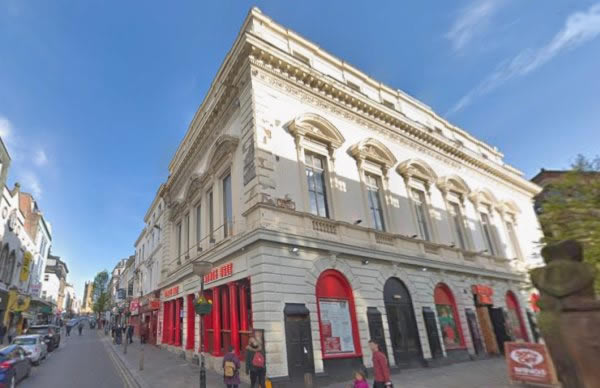 Hime's Music Hall opened on the same site on the 24th of October 1853, run by H. E Hime, who also ran a Music Warehouse at 57 Church Street, it is said to have been an 'Elegant Room, the Decorations being Rich and Chaste', with seating for nearly a thousand people.
Right - A Google StreetView Image showing the former Hime's Music Hall Building, Bold Street and Concert Street, Liverpool in April 2018 - Click to Interact.
The Music Hall was designed by Arthur Holme in the Italian Style with its Auditorium on the first floor and shops occupied by the Bradley Brothers Upholsterers situated below.
The Liverpool Standard and General Commercial Advertiser of the 25th of October 1853 reported on the opening of Hime's Music hall saying:- 'The new music-hall, in Bold-street, of which Mr. H. E. Hime is lessee, was opened last night by a concert, in which Misses Birch and E. Birch, Messrs. Francis, E. Land, and Frank Bodda, together with Master Arthur Napoleon, performed. The programme was good and promising, and the attendance highly respectable.
The hall itself presents many features of interest, and as a place for the accommodation of musical meetings, and such entertainments, it is exceedingly well adapted. It is seated for the comfortable accommodation of nearly a thousand auditors in the body of the hall, while a small but commodious gallery at the end opposite the orchestra affords space for comfortably accommodating about a hundred more.
The general appearance of the hall is light, pleasing, and elegant. The walls are lofty, and the limited ornamentation of the ceiling tasteful and appropriate - rich and pleasing, yet void of glare - combining in its decorative hues a sufficient admixture of warm and cold tints to render it agreeable either by artificial or daylight.
The illumination is effected by a range of four sunlights, running along either side of the ceiling, one in the orchestra, and one above the gallery. The windows along one side of the hall are obscured, and are ornamented in the centre by pink coloured panels, each containing an emblematic figure, cleverly drawn. At either side of the orchestra is a Corinthian column with a gilded capital, and beyond each pillar is a handsomely-fitted up private box.
The ventilation and temperature have been provided for on approved principle, and everything has been done to secure the comfort and convenience of the audience. In connection with this hall we are glad to learn that Mr. Hime intends to introduce the practice or giving morning concerts, a species of entertainment deserving of encouragement, as it enables many to enjoy a musical treat whose health, distant residence, or other Circumstances render attendance on an evening concert a matter of serious inconvenience.'
The above text in quotes was first published in the Liverpool Standard and General Commercial Advertiser on the 25th of October 1853.
Although quite successful during its short period of operation, just a few years after its opening in 1853 Hime's Music Hall was closed, on the 3rd of November 1855, for conversion into Warehouse and Showroom use by the Bradley Brothers, Cabinet Makers and Upholsterers, who had been occupying the shops below since it first opened. It seems they needed more room and bought out H. E. Hime. The last event held in the Music Hall was a showing of a Diorama of the Holy Land. The following year Bradley Brothers advertised the sale of the seats from the former Music Hall stating that they were 'nearly new' and 'of the best materials, well-seasoned, with mahogany backs, french polished, and fitted with crimson moreen cushions'. And in 1857 the former Music Hall's Organ was advertised for sale by Gray and Davidson Organ Builders calling it 'a fine old instrument'.
Some years later an Advertisement appeared in the Liverpool Daily Post of the 4th of March 1869 advertising that the building was 'To Let' and stating that it consisted of a 'Dry well-lighted basement with lofty shop on the ground floor and two magnificent show-rooms on the first and second stories', these two 'show-rooms' were clearly situated in the spaces formerly occupied by the Music Hall itself.
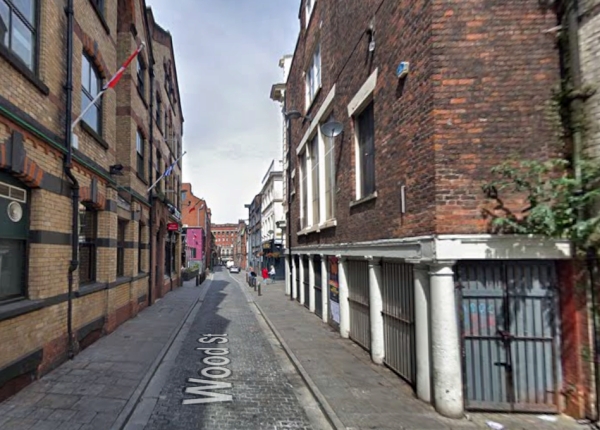 Perhaps remarkably given its age the Building is still standing today although much altered, see image shown higher up on this page, and has been put to use as Public Bars and Restaurants for many years.
Right - A Google StreetView Image showing Wood Street and the rear of the former Hime's Music Hall in June 2018 - Click to Interact.
In the image shown right of the rear of the former Music Hall in June 2018 you can see the Pillars which are thought to be a remnant of the original Bold Street Music Hall of 1786.
If you have any more information or Images for this Theatre that you are willing to share please Contact me.