
The Pavilion Picture & Variety Theatre, 74 - 76 High Street, Hawick, Roxburghshire, Scotland
See also - The Electric Picture Playhouse, Barrhead - The Pavilion Picture and Variety Theatre, Clydebank

Above - The Pavilion Picture & Variety Theatre, Hawick in 1915 - From The Bioscope, 6th of May 1915.

 The Pavilion Picture & Variety Theatre was situated on the High Street in Hawick, Scotland and was the seventh Theatre to be built for Scott's Theatres under the ownership of Glasgow born George Urie Scott. The Theatre, which could seat 1,400 people, was designed by the architect Charles J. McNair and built by J. A. Mactaggart, both of Glasgow, and cost £8,000 to construct. Apart from Cinema Provisions it also had a large stage and full orchestra pit, and several dressing rooms for artists.
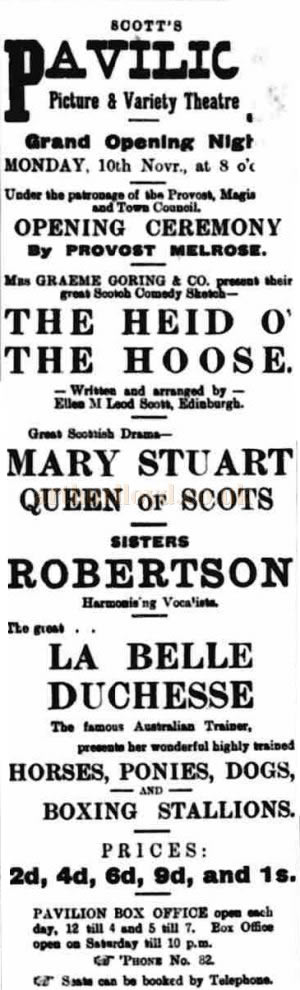
The Theatre opened on Monday the 10th of November 1913 with a Grand Opening Night Variety Production which included many different performances including animal acts, see the opening advertisement shown right.
Right - An Advertisement for the opening of the Pavilion Picture & Variety Theatre, Hawick in 1913 - From the Hawick News and Border Chronicle, 7th of November 1913.
The Hawick News and Border Chronicle reported on the imminent opening of the Pavilion Theatre in their 31st of October 1913 edition saying:- 'Much interest has been evinced among towns-people by the building of Scott's Pavilion Theatre of Pictures and Varieties. The Pavilion is one of the most prominent buildings in the High Street, and will, we believe, when finished, be also one of the most attractive. The final operations are being carried through with great activity, in view of the opening performance on 10th November.
The interior arrangements of the Pavilion are as complete and perfect as modern skill and workmanship can make them. On entering the vestibule, access is had from thence to the stalls, circle, and boxes. Access to the pit stalls it obtained from the left corridor. The corresponding corridor on the right will be used only for exit purposes. Altogether there will be six exits from the floor of the hall to the side corridors, which open directly on the street. From the circle, two broad stairs lead down to the vestibule, and the management are absolutely confident that a full house can be cleared of its audience of 1,400 within two minutes. There are also two emergency exits at the back, opening on the spare ground immediately behind the Pavilion.
A very commendable feature of the floor construction in the pit is the great angle at which it slopes upwards to the back, thus making it possible for everyone to have a clear view of the stage.
The stage is of unusually large dimensions, namely, 54ft by 25ft. The actual stage opening is 27ft 6in wide, and admirable provision is made for the effective display of pictures and scenic effects. Suitable provision is also made, immediately in front of the stage, for the accommodation of a large orchestra.
The electric lighting it controlled from three different parts of the house - from the stage, from the operator's box, and from the pay-box. Easily regulated heating arrangements are introduced, and ventilation will be secured by a powerful electric fan.
 The pit is entirely furnished with tip-up seats, and the pit-stalls with polished tip-up chairs. The orchestra stalls and the circle are furnished throughout with plush tip-up chairs. The floors will be tastefully covered with linoleum, which conduces to the maintenance of thorough cleanliness. The corridors and inside passages will be carpeted.
A series of "boxes," constructed immediately behind the circle - and from which an excellent view is obtained - are likely to be immensely popular with small parties who wish to be together at a performance. These boxes are luxuriously fitted up.
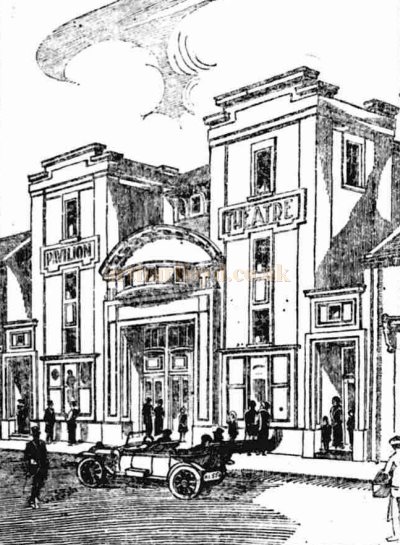
Left - A Sketch of the Hawick Pavilion Theatre - From the Hawick News and Border Chronicle, 7th of November 1913.
Among other points of interest, we may mention that the cinematograph machine will be places and operated behind the thick outer wall, in a space entirely surrounded by brick and concrete. The apertures in the wall, through which the light is projected, can be closed in a moment by an iron shutter under the immediate control of the operator, so that the risks from fire and explosions are reduced to a minimum. Again, should any confusion arise among the children on a Saturday afternoon - that being the time when the young people's matinee is held - it will be possible to flood the place with day-light in a couple of minutes.
Lavatory accommodation, it should be noted, is also very fully provided for.
We have said sufficient to indicate that the Pavilion will be a great acquisition to the town; and Mr. Scott may be relied upon to provide entertainment in keeping with the first-rate provision he has made for the personal comfort of his patrons'
The above text in quotes was first published in the Hawick News and Border Chronicle, 31st of October 1913.
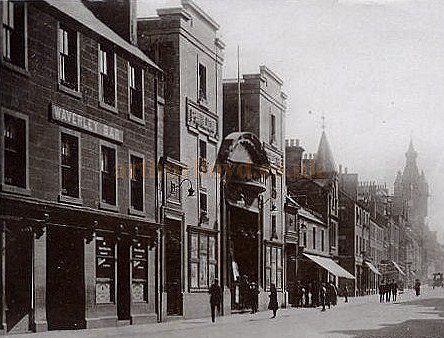
Above - An Exterior View of the Pavilion Theatre, Hawick - Shown here with a Creative Commons (Attribution) License from Mike Blakemore at the Cinema Treasures Website.
 The Hawick Pavilion had first opened on the 10th of November 1913 as a Cinema and Variety Theatre. George Urie Scott had good access to Films and Variety acts and all his Theatres proved very successful.
Right - A Google StreetView Image showing the site of the former Hawick Pavilion in August 2021 - Click to Interact.
The Pavilion continued in operation throughout both World Wars and luckily remained unscathed. By 1930 the Theatre was fitted with Western Electric Sound apparatus for the showing of Talking Pictures, and by 1954 it had Cinemascope provision installed too.
Continuing right into the 1960s the Pavilion was however, eventually closed in 1964 and would be demolished some time afterwards. Today the site of the Theatre is in use for shops and apartments, see image above right.
If you have any more information or Images for this Theatre that you are willing to share please Contact me.